AI-generated Iliad trailer shared by Elon Musk on X amid debate over Christopher Nolan’s The Odyssey. Credit: Screenshot / Elon Musk’s official twitter account
Elon Musk has entered the controversy surrounding Christopher Nolan’s upcoming The Odyssey by sharing an AI-generated trailer featuring an all-white cast of ancient Greek heroes.
Musk posted the video on X on Thursday, June 4, as debate continues over Nolan’s decision to cast Lupita Nyong’o as Helen of Troy in The Odyssey. Musk, who has already criticized the casting online, introduced the clip as an “Iliad (Troy) trailer made by Grok Imagine 1.5,” referring to the video-generation model developed by his artificial intelligence company xAI.
The 40-second trailer quickly went viral and drew more than 18.4 million views, according to the original Greek report. Although Musk did not explicitly mention Nolan’s film in the post, the timing and visual choices linked the clip to the wider argument over how ancient Greek figures should appear on screen.
An AI version of Homer’s world
The trailer presents a dramatic version of the Trojan War, with burning cities, warships, battlefield speeches, emotional close-ups, and large-scale combat scenes. Its visual style closely resembles a Hollywood historical epic. However, AI tools produced the video rather than a traditional studio production.
The choice of The Iliad also matters. Homer’s Iliad and Odyssey are two of the foundational works of ancient Greek literature. The Iliad centers on the Trojan War, while The Odyssey follows Odysseus on his long journey home after the fall of Troy.
That connection made Musk’s post look less like a random AI experiment and more like a response to the current debate around Nolan’s film. By using AI to create his own vision of the Trojan War, Musk placed himself directly inside a cultural dispute involving Greek mythology, Hollywood casting, and the future of filmmaking.
Nolan’s The Odyssey is scheduled for release on July 17, 2026. The film stars Matt Damon as Odysseus and Anne Hathaway as Penelope. Its cast also includes Tom Holland, Zendaya, Robert Pattinson, Charlize Theron, and Lupita Nyong’o.
Much of the online backlash has focused on Nyong’o’s role as Helen of Troy. Critics of the casting argue that Helen, one of the most famous figures of Greek mythology, should reflect the traditional image associated with the character.
Supporters of the film, however, say Homeric myth is not documentary history. They argue that artists have reinterpreted the epics for centuries through theater, literature, painting, and cinema. Nyong’o has also addressed the criticism, saying the film’s cast reflects the world and emphasizing that the story belongs to mythology rather than historical reconstruction.
Musk’s AI trailer now adds another layer to the dispute. The clip does not simply promote artificial intelligence as a filmmaking tool. Instead, it presents an alternative visual version of the Homeric world at the exact moment when Hollywood’s version is under scrutiny.
Was very fun to try out the latest 1.5 Grok Imagine model for this one! https://t.co/x5OwuhySyH
Elon Musk turns AI Iliad trailer into a cultural statement
After Musk posted the trailer, the creative studio Heavy Pulp, which worked on the project, said it had enjoyed making it. Musk then asked whether the team wanted to make a full-length film. Heavy Pulp replied that it was already in.
That exchange helped transform the video from a short viral experiment into a possible challenge to Hollywood. Musk appeared to test whether AI could generate not only trailers, but also full-scale mythological films outside the traditional studio system.
The response online came quickly. Many users praised the trailer’s cinematic look and argued that it showed how fast AI video tools are improving. Others viewed the clip as a direct provocation toward Hollywood, especially because it appeared during a high-profile debate over representation in a film based on Greek mythology.
Νέο διαδικτυακό θόρυβο προκαλεί ο Ίλον Μασκ, ο οποίος επανέρχεται στη δημόσια συζήτηση γύρω από τις επιλογές casting στην πολυαναμενόμενη κινηματογραφική μεταφορά της Οδύσσειας από τον Κρίστοφερ Νόλαν. Με αφορμή τη συζήτηση που έχει ανοίξει για τον ρόλο της Ωραίας Ελένης, ο Μασκ ανάρτησε στο Χ ένα βίντεο που παρουσιάζεται ως AI trailer της Ιλιάδας, με όλους τους πρωταγωνιστές να απεικονίζονται ως λευκοί ηθοποιοί. Η Βαλεντίνα Καραγεωργίου είναι μαζί μας με όλες τις λεπτομέρειες και τις αντιδράσεις που έχει προκαλέσει η νέα παρέμβαση του Ίλον Μασκ. #starchannelnews#tiktokgreece#newsgr
A primeira edição do REGENERAR realizou-se com grande sucesso, reunindo um grupo de mulheres para uma experiência única dedicada à longevidade feminina, ao bem-estar e ao desenvolvimento pessoal. Ao longo de três horas ao pôr do sol, as participantes embarcaram numa jornada de conhecimento, consciência e regeneração, num ambiente intimista cuidadosamente preparado para promover a […]
Thursday marked the fourth consecutive day of protests in Albania, sparked by plans for a proposed billion-dollar luxury resort backed by Jared Kushner, the husband of Donald Trump's daughter, Ivanka Trump. Online, however, misleading videos of the unrest are going viral, with social media users sharing old and out-of-context footage falsely presented as scenes from the current demonstrations. Many protesters fear that the Kushner-backed development could devastate a protected wildlife ecosystem.
Sykoutris viewed the heroic ideal not as blind defiance but as a conscious affirmation of meaning in the face of suffering. Credit: Photo Credit: Ioannis Sykoutris, c. 1935 – ELIA / Hellenic Literary and Historical Archive. Source: SearchCulture.gr. CC BY 4.0.
Ioannis Sykoutris, born in Smyrna in 1901, is one of the most tragic yet heroic figures of 20th-century Greek intellectual history. His life was marked by brilliance, deep philosophical inquiry, and, ultimately, a heartbreaking end.
On September 21, 1937 at the young age of 36, Sykoutris took his own life in Corinth. It was a tragic event that sent shockwaves through the Greek intellectual community. Though his life was cut short, his intellectual legacy and philosophical views continue to resonate to this day.
Philosophical views and his interpretation of Plato
Sykoutris was born into a humble family of Chios descent, and his early years were shaped by the struggles of a post-Ottoman world. After completing his studies at the University of Athens, he moved to Germany. There, he further honed his intellectual capabilities at universities such as Leipzig and Berlin.
Upon returning to Greece in 1929, Sykoutris took up a position as a lecturer at the University of Athens, where he made significant contributions to Greek philosophy and literature. His work spanned various areas, including the translation and analysis of classical texts, most notably Aristotle’s Poetics and Plato’s Symposium. These works established him as one of Greece’s leading intellectuals, and his translations, in particular, gained international recognition.
Sykoutris was deeply drawn to the works of the Greek philosopher Plato, particularly to The Symposium. His interpretation of the dialogue explored the nature of love and eroticism in Ancient Greek society. He especially focused on the acceptance of homosexuality as a cultural and social phenomenon in classical Greece.
While his intellectual rigor and deep insight into these themes were recognized, his perspectives also invited controversy. Conservative circles, for instance, tended to criticize his ideas on love and relationships. Sykoutris emphasized the philosophical and intellectual aspects of love, challenging the moralistic views of his time and revealing his progressive stance on issues considered taboo in his era.
His work on Plato was not limited to translations. Sykoutris believed that Plato’s philosophical ideas held the key to understanding the soul and the nature of human existence. He viewed Plato’s dialogues as a guide to achieving higher states of being through philosophical contemplation.
The heroic ideal: Sykoutris and the heroic human
Sykoutris drew on German idealism to shape his understanding of Greek thought, insisting that philosophy must transform the moral and intellectual character of individuals and society. He grounded his philosophical framework in the concept of the heroic human, which he identified as a central idea in both Greek philosophy and the modern intellectual landscape.
He viewed the “heroic human” as one who transcends conventional societal norms, embracing personal suffering and intellectual struggle in pursuit of higher ideals. For Sykoutris, the heroic individual was not just a figure of physical strength or military prowess. Instead, this was a person of profound philosophical depth who embodied the struggle for self-perfection.
In many ways, Sykoutris viewed philosophy as a means of rebellion against the oppressive social structures of his time. He admired the courage of individuals who resisted conformity. This theme echoes in his interpretation of ancient Greek heroes who defied the gods and societal expectations.
His vision of the heroic ideal was also influenced by his reading of Nietzsche and German idealism, which placed the individual at the center of philosophical inquiry and moral struggle. Sykoutris’ own life can be seen as an embodiment of such a heroic ideal. He was an intellectual who chose to live authentically, confronting both external social pressures and his own inner demons.
An artistic representation of Plato’s Symposium. Credit: Anselm Feuerbach, Wikimedia Commons, Public Domain
The tragedy of his death
A complex interplay of personal, professional, and societal factors marked the circumstances surrounding Sykoutris’ suicide. Despite his intellectual achievements, Sykoutris felt a profound sense of isolation and disillusionment, particularly due to the fierce criticism he faced from religious and conservative factions in Greek society.
His progressive ideas were at odds with the prevailing norms, and this conflict led to personal and emotional strain. The attacks against him, especially concerning his views on love and sexuality, likely contributed to his feelings of alienation.
Sykoutris’ death was not just a personal tragedy but a cultural one, as well. It marked the loss of one of Greece’s most promising philosophers at a time when the country was undergoing significant political and social transformation. His suicide raised questions as to the psychological toll of intellectual rebellion and the cost of living as an outsider in a society unwilling to embrace change.
Sykoutris chose to end his life like the Trojan war hero Ajax. Credit: Wikimedia Commons, Public Domain
Legacy and influence
Despite his short life, Ioannis Sykoutris left behind a profound intellectual legacy that continues to shape modern Greek thought. His writings on Plato, Greek philosophy, and the nature of love continue to be studied and discussed in academic circles, and his work offers valuable insights into the tensions between tradition and modernity, on the one hand, and intellectualism and societal conformity on the other. He remains a symbol of intellectual courage, a figure who dared to challenge the status quo in the pursuit of truth.
Sykoutris’s tragic death only added to his mystique, transforming him into a martyr for the intellectual and cultural causes he championed. His legacy is not just one of academic achievement but also of moral and philosophical courage. These qualities remain an inspiration for those who seek to transcend the limitations of their time and pursue a higher, more meaningful life.
Ioannis Sykoutris was a man ahead of his time, whose intellectual journey continues to inspire scholars and philosophers alike. His views on Plato and the heroic ideal reflect a deep commitment to the power of philosophy as a tool for personal and societal transformation. While his life ended in tragedy, his philosophical contributions endure, and his legacy as a heroic intellectual remains a vital part of Greece’s cultural history.
Ukrainian President Volodymyr Zelenskyy has written an open letter to his Russian counterpart Vladimir Putin, urging him to attend a meeting between the two leaders at a neutral location to agree an end to the war.
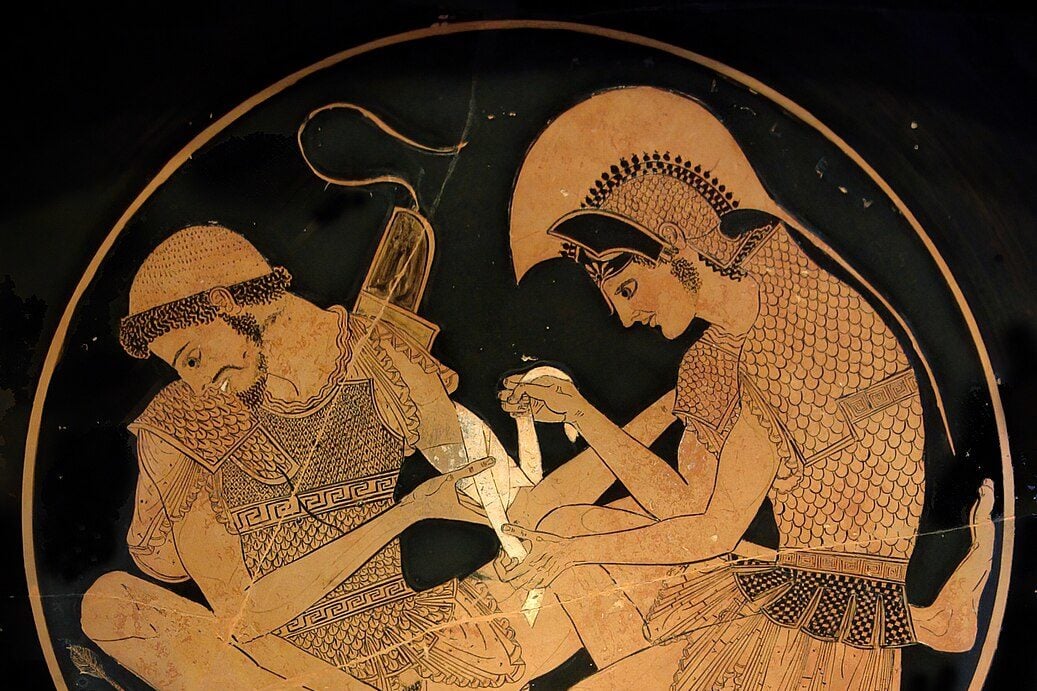
Ancient Greeks and Romans used spiderwebs in medicine, believing their natural fibers could stop bleeding and protect wounds from infection. Credit: Wikimedia Commons, public domain
Among the most intriguing practices in Ancient Greek medicine was the use of spiderwebs—and even live spiders—in healing treatments. Ancient medicine often surprises modern readers with remedies that seem unusual at first glance, yet many of these traditional approaches contained a practical logic beneath layers of symbolism and inherited belief.
Greek and Roman physicians placed particular emphasis on controlling bleeding, especially in the context of warfare and surgery. Soldiers frequently sustained deep wounds from swords, spears, and arrows, while physicians had no access to modern antiseptics or advanced surgical instruments. In response, healers continuously experimented with natural materials that could help stop blood flow and protect exposed tissue. One of the more unusual solutions they turned to was spiderwebs.
Ancient Greek and Roman medical writers do, in fact, refer to the use of spiderwebs in medicine. Spider silk was observed to have properties that made it unexpectedly effective for wound care. Physicians noted its ability to absorb blood, cover injuries, and support the clotting process. While they lacked any understanding of modern biochemistry, their meticulous attention to such effects often led them to surprisingly effective medical practices.
Pliny the Elder and natural remedies, such as the use of spiderwebs, in the medicine of Ancient Greece and Rome
The Roman author Pliny the Elder offers some of the clearest references to spider-based medicine in his encyclopedic work Natural History. He describes a range of remedies involving both spiderwebs and actual spiders, noting that the former could help stop bleeding and support healing when applied directly to wounds. He also made mention that spiders were believed to serve as effective remedies for a variety of diseases and injuries in antiquity.
For Ancient Greek healers, spiderwebs appeared naturally suited for wound treatment. Their soft, fibrous texture allowed them to cover cuts with ease, while their adhesive qualities helped seal damaged tissue and protect it. Ancient warfare produced particularly severe injuries. Greek hoplites and Roman soldiers fought in brutal close combat, where swords and spears regularly tore flesh open. Even relatively minor wounds could turn fatal due to blood loss or infection. Physicians accompanying armies therefore required treatments that acted quickly and could be easily carried onto the battlefield.
The use of spiderwebs among the Ancient Romans and Greeks provided several practical advantages in medicine. They were lightweight, widely available in nature, and naturally adhesive when applied to skin. Healers thus collected cobwebs and preserved them for medical use, and soldiers are sometimes described as carrying small containers filled with spiderwebs during military campaigns.
Long before the development of modern antibiotics, healers frequently relied on natural substances that appeared to reduce infection risk and support faster healing.
Galen and Ancient Greek traditions in medicine
The great Greek physician Galen likewise discussed spider cobwebs in his work On the Powers of Simple Remedies in which he refers to their Ancient Greek medicinal applications in the treatment of injuries and the control of bleeding. Because gladiators suffered frequent injuries, Galen gained extensive experience treating wounds and preventing infection. Greek medicine placed strong emphasis on observation and practical effectiveness, so physicians often tested remedies repeatedly under real and demanding conditions.
This connection makes historical sense. Ancient doctors valued materials that combined absorbency, flexibility, and ease of application. Spider silk possessed all three qualities. Furthermore, physicians in antiquity often preferred natural substances that were readily available in military environments, where medical resources were limited.
Modern science helps explain why ancient healers valued spiderwebs. Spider silk is composed of strong protein fibers capable of forming protective coverings over wounds. The silk also absorbs moisture effectively and creates a temporary barrier against dirt and contaminants. Additionally, spiderwebs may exhibit mild antiseptic properties due to natural compounds present within the silk. Although ancient physicians could not observe bacteria, they recognized through experience that some treatments reduced infection more effectively than others.
Many people also associate spiderwebs with clotting because webs can contain traces of vitamin K from insect remains and environmental material. Vitamin K is a nutrient that contributes to blood coagulation in the human body. Most importantly, however, the web itself functions physically as a mesh. When pressed against a wound, the fibers help gather blood and support clot formation.
Modern medicine even studies spider silk for advanced surgical materials due to its exceptional strength and biocompatibility. Ironically, contemporary science now investigates properties that ancient healers observed intuitively thousands of years ago. Thus, ancient healers may have developed practical wound-care techniques through centuries of observation rather than theoretical science.
Galen, the pioneering Greek physician who influenced Western medicine through the 1700s. Portrait by Pierre-Roch Vigneron. Credit: Wikimedia Commons Public Domain
Ancient medicine and empirical knowledge
The use of spiderwebs highlights a central feature of ancient medicine, namely that Greek and Roman physicians often relied on empirical observation rather than formal scientific theory. They closely observed which remedies appeared effective and preserved those methods within medical tradition.
Greek physicians, in particular, placed great value on careful observation. The Hippocratic tradition encouraged doctors to study symptoms, environments, diets, and physical responses in detail. As a result, treatments survived not because they were theoretically justified but because they produced visible and consistent results. In this context, spiderwebs were valued because their silk fibers formed a natural covering over wounds while also helping to control blood flow. Folk medicine across many cultures likewise used cobwebs as anti-fungal and antiseptic remedies for cuts and open injuries.
Spiderwebs likely entered medical practice through precisely this kind of experiential process. Healers observed reduced bleeding and improved healing following their application, and over time, the practice spread across regions and generations. Cobwebs were part of a much broader landscape of natural medicine in antiquity. Ancient healers regularly used honey, wine, herbs, oils, vinegar, and minerals in wound care and general treatment.
Many of these substances also possessed genuine antibacterial or medicinal properties. Honey, for instance, inhibits bacterial growth and is still used in certain modern wound treatments. Wine and vinegar functioned as early disinfectants due to their alcohol and acid content. Within this framework, spiderwebs would not have seemed unusual to ancient physicians. Instead, they represented another readily available natural material with observable healing potential. Greek and Roman medicine thus consistently explored the relationship between nature and health, making use of natural resources, including even something so peculiar to modern eyes as spiderwebs.
Honey was used by the Ancient Greeks in medicine as well. Credit: The Drug Users Bible, CC BY SA, 2.0
The symbolic dimension of spiderwebs and their silk in Ancient Greece
Ancient cultures attached rich symbolic meaning to spiders and the act of weaving, and in Greek tradition, these associations carried particular weight. Mythology linked weaving to intelligence, fate, and skilled craftsmanship through figures such as Athena and Arachne, embedding it within a broader cultural framework that connected material creation with order, skill, and even divine influence. Spider silk itself likely appeared mysterious and almost otherworldly, given its delicate structure and surprising strength—qualities that blurred the boundary between natural substance and something almost magical.
This symbolic dimension may have reinforced confidence in cobweb-based remedies, since ancient medicine often operated at the intersection of practical treatment and cultural meaning. In battlefield contexts especially, where speed and improvisation were essential, surgeons had to remove arrows, close wounds, cauterize bleeding, and stabilize fractures under extreme conditions with limited equipment, relying heavily on whatever materials were immediately available. Spiderwebs fit this environment well, both practically and symbolically, as soldiers or assistants could gather them quickly from camps, caves, or buildings, requiring no preparation and allowing for rapid application under pressure.
Even when cobwebs were not perfectly effective, they could still provide a basic protective layer that was often better than leaving wounds exposed, which would have only allowed dirt and uncontrolled bleeding to pose immediate risks to survival. In many cases, this simple barrier alone may have made a meaningful difference in outcomes. Today, the same material that once carried symbolic and practical value in antiquity is again attracting scientific interest, as researchers explore spider silk for potential applications in surgery, tissue engineering, and regenerative medicine.
O Governo dos Açores está a averiguar um eventual crime ambiental relacionado com a morte violenta de um tubarão em Rabo de Peixe, após denúncias de cidadãos e participação ao Ministério Público. Na sequência da divulgação de um vídeo que mostrava a morte violenta de um tubarão no porto de Rabo de Peixe, em São Miguel, o executivo açoriano confirmou, esta quinta-feira, que está em curso um processo de averiguações por eventual ilícito criminal de natureza ambiental. O Governo dos Açores adiantou, esta quinta-feira, que está em curso um processo de averiguações respeitante a “eventual ilícito criminal” de natureza ambiental
Reconstruction of Ötzi the Iceman. Credit: South Tyrol Museum of Archaeology / Flickr / CC BY-NC-ND 2.0
More than 5,300 years after his death, Ötzi the Iceman is helping scientists uncover a hidden world of cold-adapted yeasts. Researchers have discovered that the famous mummy’s skin and stomach contain yeasts that likely colonized his body shortly after his death. Some of these microorganisms may still be active today, according to a study published June 3 in the journal Microbiome.
Ötzi, one of the world’s best-preserved natural mummies, was discovered by hikers in the Ötztal Alps in 1991. Scientists believe he died around 3300 B.C. after a violent attack.
Microorganisms survived alongside the mummy
Researchers analyzed swab samples, thawed water from inside the mummy, soil from the discovery site, and material from Ötzi’s storage environment. Using genetic analysis, they identified microbial communities living on and around the remains.
The study found that many of the yeasts are closely linked to cold Alpine environments. Scientists believe they originated from the glacier where Ötzi’s body remained frozen for thousands of years.
The findings suggest the microorganisms survived after the mummy was recovered and transferred to a refrigeration chamber maintained at about 21 degrees Fahrenheit (minus 6 degrees Celsius).
More than 5,300 years after his death, Ötzi the Iceman is still surprising scientists.
Researchers discovered cold-adapted yeasts living on and inside the famous mummy. Some may have survived since the Copper Age, while others appear to have continued growing in cold storage. pic.twitter.com/mpIT8neT24
— Tom Marvolo Riddle (@tom_riddle2025) June 4, 2026
Researchers found that the yeasts are highly adapted to cold conditions, allowing them to persist in both glacial environments and modern storage facilities.
Ancient yeasts may still be active
The team successfully cultivated four cold-adapted yeast species from samples collected from Ötzi’s skin and from water taken from inside the mummy.
Genetic evidence showed signs of ancient DNA damage, suggesting the yeasts either remained dormant for more than five millennia or descended directly from the original microorganisms that colonized the body after death.
Researchers also compared skin samples collected in 2019 with samples gathered in 2010. The analysis showed that a cold-loving yeast known as Glaciozyma had become the dominant strain over time.
The finding indicates that the glacier-associated yeast has continued to slowly grow while the mummy has remained in cold storage.
Study co-author Frank Maixner of the Eurac Research Institute for Mummy Studies said the discovery shows that Ötzi is not simply a preserved archaeological artifact but part of an evolving biological system.
Potential uses beyond archaeology
The researchers also explored whether the ancient yeasts could have practical applications. Preliminary tests showed some strains performed well in sourdough fermentation. Lead author Mohamed Sarhan said the results suggest the yeasts could potentially be used in industries that rely on fermentation, including bread and beer production.
Scientists also identified modern microorganisms that were likely introduced during decades of conservation and study. It remains unclear whether these microbes affect the long-term preservation of the mummy.
Researchers said Ötzi offers a rare glimpse into ancient microbial life. However, they cautioned that the mummy represents only one individual and cannot fully reflect the broader population of the Copper Age.
Ukrainian President Volodymyr Zelensky on Thursday called for a face-to-face meeting with his Russian counterpart Vladimir Putin in a rare open letter, saying he was also ready for a “full ceasefire”. In response, the Kremlin said Zelensky could meet Putin in Moscow "any time".
On Uncanny Valley, we dive into the IPO bonanza that the top AI companies are embarking on to the point where some real estate listings are looking for not just regular old cash, but Anthropic stock.
This story originally appeared in Common Dreams on June 04, 2026.It is shared here under a Creative Commons (CC BY-NC-ND 3.0) license.
Voters in Monterey Park, California on Tuesday overwhelmingly approved a permanent ban on data centers within city limits, becoming the first city in the US to prohibit the power-hungry facilities via a ballot initiative.
In total, the anti-data center resolution passed with 86% voter support, with only 14% of voters opposed. The resolution’s text said that a ban was necessary to “protect air quality, drinking water resources, and public health” and “prevent impacts to electricity and water rates.”
Steven Kung, a leader of the local initiative, told ABC 7 Eyewitness News that the result was “a landslide victory.”
Kung listed multiple reasons why residents in the city resoundingly rejected building data centers in their community.
“The noise pollution, the air pollution, the rise in the electricity rates,” he said, “the deal just didn’t make sense and it doesn’t make sense for most, if not all, cities data centers go to.”
In an interview with Politico, Monterey Park Mayor Elizabeth Yang predicted that her city would be far from the last to pass data center bans, noting data center projects have spurred protests across the country.
“A lot of the other cities that are facing data center proposals are going to follow suit,” said Yang. “There’s [a] bad reputation across the board, across the country, from other data centers that have been built in neighborhoods.”
Monterey Park city councilmember Jose Sanchez expressed a similar sentiment, telling The Guardian that he hoped his city would become a inspiration to others.
“We hope that other communities will use the model set by residents here in Monterey Park,” said Sanchez, “as inspiration to stop data centers from encroaching in their backyard.”
Data centers have become political lightning rods in recent months, as residents across the country object to their massive resource consumption, which is leading to a major spike in utility bills, as well as the noise pollution they generate.
Sen. Bernie Sanders (I-Vt.) and Rep. Alexandria Ocasio-Cortez (D-NY) earlier this year introduced a bill that would impose a nationwide moratorium on AI data center construction “until strong national safeguards are in place to protect workers, consumers, and communities, defend privacy and civil rights, and ensure these technologies do not harm our environment.”
A poll released on Wednesday by Public First showed US residents more opposed to data center construction than any nation in the world, with just 26% of Americans registering support for building more data centers.
This opposition isn’t merely abstract, as it has caused major headaches for Big Tech firms that have been scrambling to increase their AI models’ compute power.
As The Financial Times reported on Thursday, “dozens of projects collectively worth at least $156 billion have been blocked or stalled since 2025” thanks to local opposition to their development.
The indie artist has played a string of surprise, small-venue shows with no phones allowed, prompting fans to piece together clues about a potential upcoming album.

 Login
Login




.mp4)


.mp4)