The prime minister of Pakistan said Friday the U.S. and Iran reached an agreement on a peace framework to end the more than 100-day war. The country has been leading the mediation efforts between the two sides to bring the Middle East hostilities to an end and reopen the Strait of Hormuz. The effective closure…
The prime minister of Pakistan said Friday the U.S. and Iran reached an agreement on a peace framework to end the more than 100-day war. The country has been leading the mediation efforts between the two sides to bring the Middle East hostilities to an end and reopen the Strait of Hormuz. The effective closure…
President Trump on Friday discredited details of a new U.S.-Iran peace deal that Tehran shared with various news organizations. “The terms that Iran leaked out to the Fake News have NOTHING to do with the terms that were agreed to, in writing,” Trump wrote in a Truth Social post. “What they said, including their weak…
President Trump on Friday discredited details of a new U.S.-Iran peace deal that Tehran shared with various news organizations. “The terms that Iran leaked out to the Fake News have NOTHING to do with the terms that were agreed to, in writing,” Trump wrote in a Truth Social post. “What they said, including their weak…
Sen. Adam Schiff (D-Calif.) said Thursday evening that President Trump’s account of the state of negotiations to end the Iran war “lacks a lot of credibility.” Trump earlier in the day threatened ramped-up strikes on Tehran but later canceled them with a promise that Iran’s supreme leader had approved a deal to reopen the Strait…
Sen. Adam Schiff (D-Calif.) said Thursday evening that President Trump’s account of the state of negotiations to end the Iran war “lacks a lot of credibility.” Trump earlier in the day threatened ramped-up strikes on Tehran but later canceled them with a promise that Iran’s supreme leader had approved a deal to reopen the Strait…
The Iranian regime on Thursday signaled the U.S. and Tehran “had not reached a final conclusion” on a deal to end hostilities in the region, despite President Trump’s claim of a breakthrough in negotiations. Foreign ministry spokesperson Esmail Baghaei said “most of the text of the agreement was finalized, but the problem began when the…
The Iranian regime on Thursday signaled the U.S. and Tehran “had not reached a final conclusion” on a deal to end hostilities in the region, despite President Trump’s claim of a breakthrough in negotiations. Foreign ministry spokesperson Esmail Baghaei said “most of the text of the agreement was finalized, but the problem began when the…
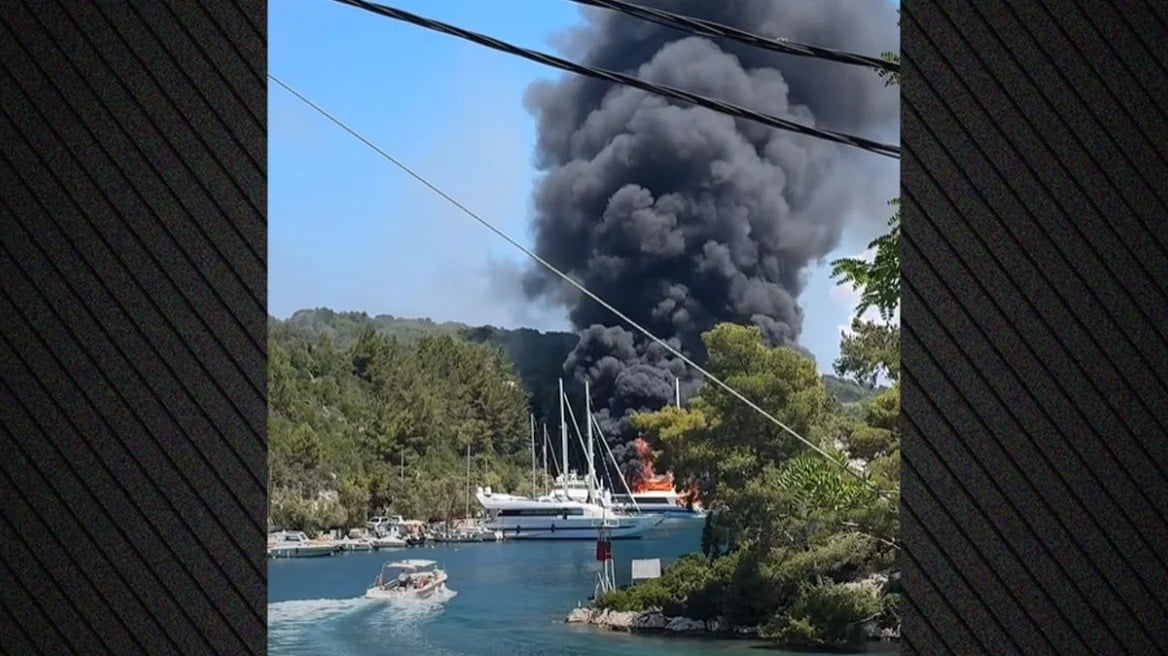
Tourist boats aflame. Video screenshot, Valentina Madonia/Facebook
Thick black smoke is billowing over the port of Paxos after a fire completely engulfed a tourist vessel before spreading to a second boat docked nearby. Fortunately, all passengers had disembarked before the outbreak. The cause of the fire remains unknown.
The incident began around 1:00 PM on Thursday at the New Passenger Terminal in Gaios, Paxos.
According to local reports from kerkyrasimera.gr and corfutvnews, the blaze began on a day-boat that operates tourist cruises, quickly spreading out of control due to unknown causes. Fueled by flammable materials onboard, the flames rapidly jumped to a neighboring vessel.
Reports indicate that the passengers, who had just completed a popular daily excursion from Parga to Paxos, had safely stepped off the vessel just moments before the fire broke out.
The Hellenic Coast Guard confirmed that the fire involved two commercial tourist vessels and that no passengers were onboard at the time of the incident. Fire service vehicles, an ambulance and a tugboat have been deployed at the port.
The Parga-Paxos route is one of the single most popular day-trip cruises in the entire Ionian Sea. During the summer season, it is a massive staple of the local tourism economy, drawing thousands of international and domestic visitors every week.
Forty-one people were killed and 115 injured in the blaze at Le Constellation bar, which investigators believe started in the basement when sparklers attached to champagne bottles were held too close to sound-insulating foam on the ceiling.
Greek fire was the mysterious weapon used by the Byzantines to destroy enemies and prospective invaders, keeping the Empire strong and awe-inspiring.
The Byzantine liquid fire that protected the Empire was a terror-inspiring incendiary weapon that protected the Empire for centuries. Widely known as Greek Fire, this mighty weapon enabled the Byzantine Empire to survive and maintain its power through many attacks from various enemies.
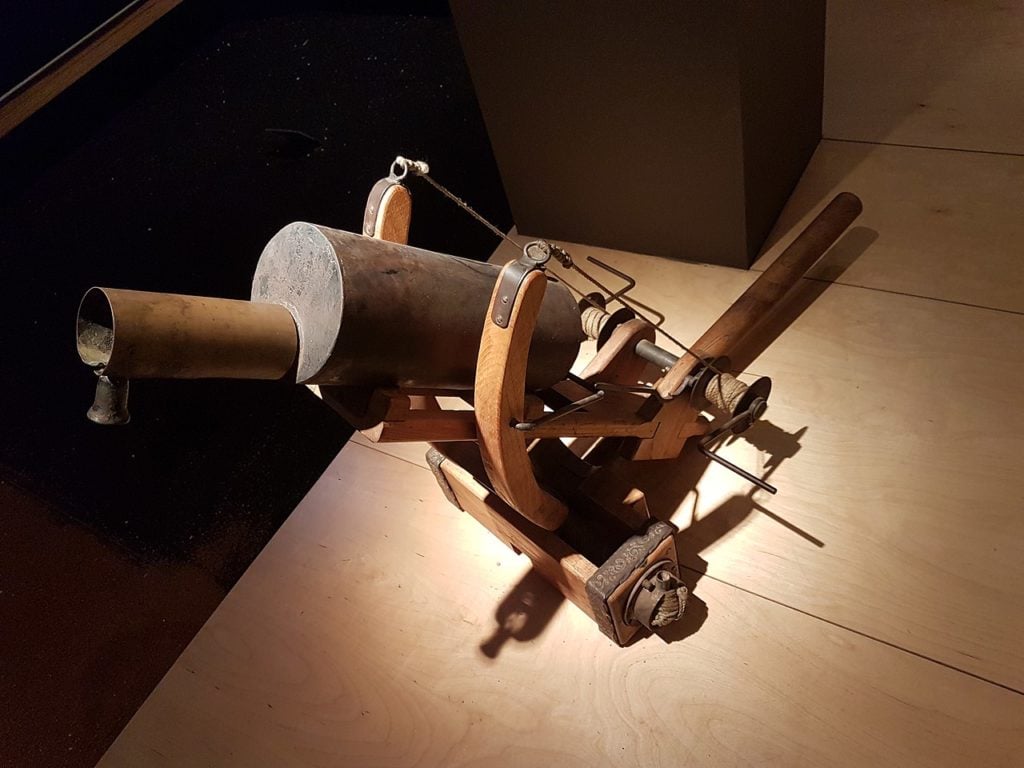
The weapon could be compared to the modern day flame-thrower. To the enemy in Byzantine times, it looked like a machine spewing destructive fire from hell. However, its exact origin remains unclear, and the recipe for this formidable weapon is still unknown, puzzling scientists and historians.
A Byzantine ship using Greek fire against a ship . On top, Greek alphabet in Byzantine form. Credit: Public Domain
Records suggest Greek fire contained a mix of petroleum, quicklime, and other unknown ingredients. This potent combination is believed to have made it one of the most flammable and dangerous substances of its time. What was truly amazing about the Byzantine liquid fire weapon was that it continued to burn on water and was practically impossible to put out with medieval means.
It helped the Empire maintain sovereignty over the mass land it occupied, spanning all of Southern Europe, North Africa, and Asia Minor. The weapon’s impact on the course of history is undeniable. It played a key role in the defense of Constantinople and the preservation of the Byzantine Empire.
A Brilliant Invention
Fire as a weapon had been used for centuries but never in such a sophisticated and destructive means as the Greek fire (or Υγρόν πυρ – Hygron pyr, as it was referred to in Greek). It was the Crusaders who referred to it as Greek fire or “liquid fire,” “Roman fire,” or “sea fire.” It was a significant weapon that never ceased to terrify the enemy.
This innovative weapon would fire massive flames in a continuous jet, burning a trail of destruction in its path that was nearly impossible to extinguish. When it came to naval warfare, it was a weapon that was impossible for the enemy to defend their ships from. Yet, the exact recipe for the liquid fire substances the Byzantines used remains a mystery to this day.
The Greek fire cannon-like machine was created in the seventh century. It most likely was the invention of Kallinikos of Heliopolis, a Jewish architect who fled from Syria to Constantinople. It was between 674 and 678 when the Byzantine Empire was attacked by the Islamic fleet of the Umayyad caliphate that had already taken over parts of Syria.
Concerned about an Islamic attack against Constantinople, Kallinikos experimented with a variety of materials until he discovered a mix for an incendiary weapon. Kallinikos sent the formula to the Byzantine emperor, and authorities developed a siphon that operated somewhat like a syringe, propelling the fiery concoction toward enemy ships.
Emperor Constantine IV reluctantly ordered the use of Greek fire to destroy the Umayyad fleet. However, the Byzantine weapon was very successful. According to historian Kelly DeVries and his book Medieval Military Technology, it was the first reported use of an incendiary weapon in battle.
Was Byzantine Liquid Fire a State Secret?
Some historians believe the reason the recipe for liquid fire remains unknown is because Byzantine emperors wanted to keep it a state secret, never to fall into the hands of the enemy. The vast Empire was surrounded by numerous enemies coveting its lands. Liquid fire was a potent deterrent to any army that would think of invading.
Constantine VII Porphyrogenitus warned his son Romanos II to not reveal the recipe “and not to prepare this fire but for Christians, and only in the imperial city.”
Anna Komnene, daughter of Emperor Alexios I Komnenos (r. 1081-1118) and a historian, wrote about the recipe for Greek fire:
This fire is made by the following arts: From the pine and certain such evergreen trees, inflammable resin is collected. This is rubbed with sulfur and put into tubes of reed, and is blown by men using it with violent and continuous breath. Then in this manner it meets the fire on the tip and catches light and falls like a fiery whirlwind on the faces of the enemies.
It was not that straight-forward, of course. Otherwise, it would be easy for the enemy to recreate the fiery weapon. It seems indeed that the Byzantines intended to keep the process of creating the liquid fire top secret, as no friend or enemy ever managed to gain insight into this so as to construct their own similar weapon.
Use of a hand-siphon, a portable flame-thrower, from a siege tower. Detail from the medieval manuscript Codex Vaticanus Graecus 1605. Public Domain
Greek Fire in Battle
In his book, Devries explains that Greek fire can refer to three different weapons: firstly, a fiery liquid pumped out of a nozzle; secondly, a liquid weapon that was filled in small grenades; and thirdly, a solid incendiary probably based on gunpowder.
The third is impossible to have been used in Byzantium. Its reported use started in the fourteenth century in Western Europe. However, there are Byzantine era depictions of men carrying hand-held tubes spitting fire that look even more like modern flame-throwers.
In fact, Greek fire was rarely used except primarily in naval battles, as the apparatus was complicated and required technically equipped handlers. Furthermore, it was dangerous to have an incendiary mechanism on a wooden ship.
In 727, Emperor Leo sent a fleet to burn that of Hellas and Cyclades, who had been revolting against him. In 941, a Rus naval raid from Kiev across the Black Sea was stopped, and their fleet was annihilated by the Byzantines.
Reportedly, in the eleventh century, Viking Ingvar the Far Travelled encountered ships equipped with the weapon, which he described as “a brass (or bronze) tube and from it flew much fire against one ship, and it burned up in a short time so that all of it became white ashes…”
However, by the end of the twelfth century and the Angeloi emperors, the Empire started to decline, losing more and more land to the rising Ottoman Empire. As Byzantium began to fade, so did the use of Greek fire until it became but a simple chapter in the great history of the Byzantine Empire.
Former Defense Secretary Lloyd Austin on Monday said the U.S. could reopen the Strait of Hormuz but should only undertake the effort with the support of international allies. “Certainly, the United States Navy could open the Strait of Hormuz,” Austin, who served under former President Biden, told Bloomberg during remarks at the HSBC Gulf Cooperation…
Former Defense Secretary Lloyd Austin on Monday said the U.S. could reopen the Strait of Hormuz but should only undertake the effort with the support of international allies. “Certainly, the United States Navy could open the Strait of Hormuz,” Austin, who served under former President Biden, told Bloomberg during remarks at the HSBC Gulf Cooperation…

 Login
Login