A primeira-ministra da Itália, Giorgia Meloni, conversou sobre parar de fumar com outros líderes do G7, enquanto se preparavam para se reunir para uma das reuniões da Cúpula na França.
No início de outubro de 2025, o presidente turco Tayyip Erdogan disse a Meloni que ela precisava parar de fumar, à margem de uma cúpula sobre Gaza.
O presidente francês Emmanuel Macron, que estava perto deles, disse que isso era impossível, enquanto Meloni respondeu dizendo que sabia que deveria abdicar do hábito.
O G7 é a abreviação de Grupo dos Sete, uma organização informal de líderes de algumas das maiores economias do mundo: Canadá, França, Alemanha, Itália, Japão, Reino Unido e Estados Unidos.
Os países integrantes do grupo se reúnem anualmente em uma cúpula para discutir questões urgentes no cenário global e coordenar políticas. A segurança internacional e a economia global são frequentemente tópicos de discussão. Este ano, o foco se dividiu entre o conflito no Oriente Médio e a guerra na Ucrânia.
Ao contrário das organizações internacionais formais, o G7 não possui qualquer estrutura administrativa permanente.
A Cúpula deste ano começou na segunda-feira (15) e vai terminar nesta quarta-feira (17).
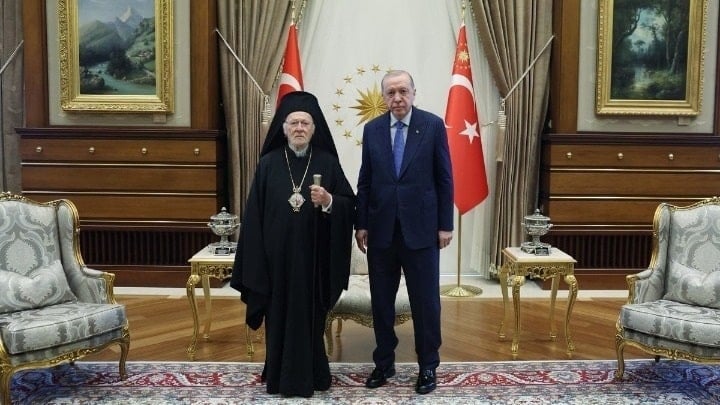
The meeting between Erdogan and Ecumenical Patriarch Bartholomew on the Halki Seminary reopening centered on concrete steps to revive the historic institution. Credit: Presidency of the Republic of Türkiye/X
Ecumenical Patriarch Bartholomew and Turkish President Recep Tayyip Erdogan held a highly anticipated meeting on Tuesday in Ankara to discuss the prospective reopening of the Holy Theological School of Halki.
According to an official statement from the Ecumenical Patriarchate, the discussions were held in a “cordial atmosphere,” focusing on long-standing issues concerning the Greek Orthodox community in Istanbul. Most notably, the dialogue centered on concrete steps to revive the historic seminary, a process now being actively negotiated among Turkey’s Ministry of National Education, the Council of Higher Education (YÖK), and the Patriarchate.
While the meeting marks a significant diplomatic thaw domestically, insiders note that the sudden momentum behind the talks is deeply tied to political pressure radiating from Washington, specifically via US President Donald Trump, who is expected to visit Ankara (and, perhaps, Athens) in July.
The Washington catalyst
The groundwork for Tuesday’s breakthrough was largely laid during a high-stakes, two-hour meeting at the White House between President Trump and President Erdogan last September. During their joint Oval Office press conference, the reopening of Halki was thrust into the international spotlight as a major bargaining chip in US–Turkey relations.
President Trump revealed that he had personally hosted Ecumenical Patriarch Bartholomew at the White House just days prior, when the leader of global Orthodoxy requested American intervention. “The Greek Orthodox Church was here and they would really like some help, and I said I would bring it up,” Trump told reporters with Erdogan sitting beside him.
Erdogan publicly acknowledged to reporters that the reopening of Halki was on the table, stating that Turkey was “ready to do whatever we can on our side” following direct coordination with Patriarch Bartholomew.
Halki Seminary: A decades-old wound
The Holy Theological School of Halki, perched atop a hill on the island of Heybeliada near Istanbul, has been a painful point of contention for over half a century. Established in 1844, it served as the main theological school for the Ecumenical Patriarchate of Constantinople, training generations of Orthodox bishops and Patriarchs.
However, in 1971, the seminary was forced to shut its doors after the Turkish parliament passed a law banning private institutions of higher education, effectively nationalizing or closing religious schools. For fifty-five years, the closure has throttled the Ecumenical Patriarchate’s ability to train new clergy locally, threatening the long-term survival of the spiritual center of the world’s three hundred million Orthodox Christians.

 Login
Login