Some investors consider Musk a genius and a visionary; others just want a piece of the cash grab. But all of them are pretending that this IPO can be separated from the repugnant things about Musk — his promotion of white supremacy and antisemitism, the poison his social media network pours into global debate every day, the damage he has done to the federal government. None of that exists in a separate sphere from his businesses. It is not a hobby or a sidelight. It is the very heart of who he is and the world he is seeking to create. Musk and his IPO are where greed meets hate, and that stain should be on anyone who participates.
Musk has turned the social media network formerly known as Twitter into the most important amplifier of hatred in the world today.
This week, ahead of the IPO, Musk encouraged what became an anti-immigrant pogrom in Belfast. This horrific series of events began when an immigrant in Northern Ireland was charged with attempted murder — an event that was caught on video. Far-right provocateurs in Great Britain and elsewhere immediately called for anti-immigrant protests, which Musk used his X account to amplify to his 240 million followers. When a far-right politician pledged “to prosecute officials and politicians who knowingly placed dangerous third world savages in our communities,” Musk replied on X, “This is the way.” He also shared a post announcing locations for anti-immigrant protests and a post from the far-right Restore Britain party that said, “Do not make peace with evil. Destroy it.”
Later that day, masked men rampaged through a Belfast neighborhood, burning cars and setting fire to houses where they believed immigrants lived. “As a woman from an ethnic minority background looked down from an upstairs window, some of the men rushed the front door and broke it down,” The Guardian reported. “As they stormed the property, some claimed to be ‘liberating’ it. Graffiti nearby demanded ‘local homes for local people.’”
Musk denies that he promotes violence. But he has turned the social media network formerly known as Twitter into the most important amplifier of hatred in the world today. This is hardly the first time the richest man on the planet was an awful human being. Henry Ford, for instance, was a hateful antisemite; Adolf Hitler decorated his office with a picture of Ford, who published and distributed works like “The International Jew: The World’s Foremost Problem.” But the automaker’s reach pales in comparison to what Musk can do with X.
After Musk bought the platform (and later rolled it into his artificial intelligence company, xAI), he dismantled many of its guardrails against disinformation and hate. In short order, neo-Nazi and other far-right accounts began to flourish on the site. I certainly experienced it. Thanks to writing on the internet for decades, I have thick skin. But when my ordinary comments about politics started being greeted with “Get in the oven, Jew,” I decided I had had enough. I left X, which I haven’t regretted for a moment.
This was a feature of X, not a bug, and it is reflected in Musk’s personal drift to the right. An analysis earlier this year by The Guardian found that Musk “posted about how the white race was under threat, made allusions to race science or promoted anti-immigrant conspiracy content on 26 out of 31 days in January.” A longer examination by The Washington Post in April found that Musk had made “posts about race and his concerns about perceived threats to Whiteness” hundreds of times in recent months, at a dramatically accelerated rate from his previous dabbling in white supremacy. Offline, Musk threw up a stiff-armed salute at Trump’s inauguration, and he has long promoted the Nazi-aligned Alternative für Deutschland party in Germany.
Let’s not forget the wreckage left by Musk’s so-called Department of Government Efficiency.
Then there’s Grok, xAI’s chatbot. From its beginning, Musk specifically positioned Grok as a rebuttal to “woke nonsense” from other AIs. Last summer, xAI had to roll back a Grok update and delete “inappropriate” posts last summer after the chatbot started spewing antisemitism and dubbing itself “MechaHitler.” People have used Grok to produce millions of sexualized images of real people, including children. (In a statement at the time, xAI said, “We take action against illegal content on X,” such as by suspending accounts and working with authorities.)
Earlier this year, Musk merged xAI into SpaceX, and now Grok is at the heart of the SpaceX IPO. In its propsectus, SpaceX claimed “the largest actionable total addressable market (‘TAM’) in human history. We estimate that our quantifiable TAM is $28.5 trillion.” But $22.7 trillion of that estimate comes not from anything space related, but from “enterprise applications” of AI — in other words, businesses spending money to use Grok.
And let’s not forget the wreckage left by Musk’s so-called Department of Government Efficiency. This assault on the capacity of the federal government left agencies dismantled, sensitive data compromised and thousands of committed civil servants purged. Immense damage has been done by the destruction of the U.S. Agency for International Development, the world’s largest foreign aid agency, which Musk spoke gleefully of “feeding … into the wood chipper.” The toll is mind-boggling. Hundreds of thousands around the globe have already died because of the rapid withdrawal of food and medical aid. The devastation will compound as time goes by. One study published in The Lancet projected that by 2030, more than 14 million people will have died as a result of the shutdown of USAID, including 4.5 million children. A study by the Center for Global Development estimates between 670,000 and 1.6 million lives lost annually due to the cuts.
SpaceX doesn’t have to bring in fantastical profits to work out well for early investors; all that’s necessary is that the hype machine keeps rolling so they can offload the shares — and the risk — to a steady supply of new investors. That machine is wholly dependent on Elon Musk. But buying into Musk means buying into the future he is trying to create, a future in which government’s ability to protect the public interest is crippled, inequality worsens, AI slop drowns the internet and the ideology of hate prevails. If you invest with him, that’s what you’re investing in.
El partido político Movimiento Sumar, que se supone, aunque quizá a estas alturas ya sea demasiado suponer, es la matriz tanto del grupo parlamentario Sumar (cuarta fuerza política de la cámara y socio de coalición del PSOE) como de la coalición electoral Sumar, que no está claro que a día de hoy exista, ha convocado para el próximo 11 de julio de 2026 su III Asamblea, que, a voz de pronto, lo de ir a asamblea por año tampoco está claro que favorezca una solidez estructural a un partido político. Y, para celebrar el ambiente preasambleario, los dirigentes de esta formación que quedan han decidido ilustrar a sus seguidores con una nueva y entrañable trifulca pública, que tenía en los tuits de Elizabeth Duval contra Lara Hernández su mejor proyección pública, con el trasfondo de acusaciones de acoso laboral.
Yolanda Díaz, antigua militante de Izquierda Unida y del PCE, apareció como una de las diputadas de las 'mareas' gallegas, la confluencia gallega de Podemos en las elecciones generales de 2015 y 2016, y luego, tras vivir en primera fila cómo dichas mareas se autodestruían, en 2019 pasó a ser diputada por Galicia en Común, la nueva confluencia gallega de Unidas Podemos. Fue Pablo Iglesias quien la propuso como ministra en el primer gobierno de coalición PSOE-Unidas Podemos en 2020. Y en marzo de 2021, el mismo Iglesias anunció de manera unilateral que la proponía para reemplazarle como vicepresidente cuando decidió retirarse del Gobierno, y también para que liderara el espacio político 'a la izquierda' del PSOE. Difícilmente se podía imaginar Díaz que la misma persona que le ofrecía sucederle iba a ser su mayor hostigador durante todos sus años al frente de ese espacio político.
Yolanda Díaz intentó construir la plataforma Sumar, intentando dejar claro que no quería ser tutelada por el 'pablismo', algo que Juanma del Olmo ya decía que no le iban a perdonar. Un repaso a su etapa como cabeza visible de este espacio refleja unos años bastante convulsos.
8 de julio de 2022 - Yolanda Díaz anuncia en un acto público la constitución de un proyecto político denominado Sumar. Al acto acude Enrique Santiago, secretario de Estado en uno de los ministerios regentados por Podemos. Ese mismo mes es destituido de ese cargo y reemplazado por Lilith Verstrynge. Irene Montero le acusará posteriormente de haber conspirado contra ella.
13 de noviembre de 2022 - La celebración de un acto político de Yolanda Díaz con la 'errejonista' Mónica García, Ada Colau y Mónica Oltra, titulado Otras Políticas, en Valencia, inicia oficialmente una campaña de Podemos, encabezada por el propio Pablo Iglesias y los activistas de este partido en redes sociales, contra Yolanda Díaz por no haber incluido a la ministra de Igualdad y madre de los hijos de Iglesias, Irene Montero, en dicho acto. Las malas relaciones entre 'el pablismo' y el 'yolandismo' eran un secreto a voces, aunque oficialmente se habían negado hasta ese momento. Antonio Maestre había pedido en un artículo en ElDiario.es un abrazo público entre Yolanda Díaz y Pablo Iglesias (24-09-2022), pero este nunca se producirá.
2 de abril de 2023 - Yolanda Díaz presenta públicamente, en un acto en Magariños, la coalición Sumar y el partido político que será su matriz, Movimiento Sumar. Al acto asisten, entre otros, Izquierda Unida, Más País-Más Madrid, los Comunes, Compromís y Chunta, pero no Podemos, que boicotea el acto y ataca desde las redes sociales y sus tertulias a Sumar.
2 de junio de 2023 - El proceso de negociación de las listas electorales de Sumar acaba en conflicto público. Yolanda Díaz, al configurar su equipo, no desea contar con las figuras más destacadas del 'pablismo', como la ministra Irene Montero o Pablo Echenique. Podemos opta, no por una negociación discreta, sino por "calentar" desde las redes sociales como método de presión para forzar a Yolanda Díaz a rectificar e incluir como diputada a Irene Montero, para no seguir siendo tachada de traidora y vendida, causando que todas las entrevistas sobre Sumar no se centren en su programa, sino en el "veto a Irene Montero". El ministro Alberto Garzón (Izquierda Unida) renuncia a ir en las listas de Sumar en nombre de la renovación, facilitando la exclusión de Montero.
9 de junio de 2023 - Podemos firma su integración en la coalición Sumar. Su secretaria general, Ione Belarra, incluida en un puesto de elección segura en las listas de Sumar, anuncia el acuerdo, pero no con ilusión, sino con reproches. Belarra estará en las listas electorales de Sumar, pero no estará la ministra Irene Montero, cosa que Podemos considera un insulto para ellos. Podemos escogerá la estrategia de 'pitufo gruñón' contra Sumar y, a pesar de formar parte de la coalición, sus activistas en redes sociales no pararán de atacar a Yolanda Díaz en ningún momento. Uno de los fichajes estrella de Yolanda Díaz es el de Elizabeth Duval como secretaria de Comunicación.
23 de julio de 2023 - Las elecciones generales dan a la coalición Sumar 31 diputados. El partido mayoritario es el propio Movimiento Sumar, siendo Marta Lois, diputada gallega del equipo de Yolanda Díaz, quien asumirá la portavocía parlamentaria. También obtienen diputados Izquierda Unida (5), Podemos (5), los Comunes (6), Más Madrid (2), Compromís (2), Chunta (1) y Més per Mallorca (1). Tras conocerse los resultados, Ione Belarra, diputada electa de Sumar, declara públicamente que la estrategia de Yolanda Díaz "ha fracasado" y la acusa de haber querido "invisibilizar" a Irene Montero, a la que considera portavoz del feminismo español. Se mantiene la presión por parte de las redes de Podemos para que Yolanda Díaz incluya a Irene Montero como ministra de Sumar a cambio de frenar los ataques.
17 de noviembre de 2023 - Yolanda Díaz propone que Nacho Álvarez sea el representante de Podemos dentro de los ministros de Sumar. Este acepta, pero Podemos lo desautoriza, lo que provoca que Nacho Álvarez abandone Podemos y se retire de la política. Los ministros de Sumar, finalmente, serán Yolanda Díaz (Movimiento Sumar) como vicepresidenta, Pablo Bustinduy (Movimiento Sumar), Sira Rego (Izquierda Unida), Mónica García (Más Madrid) y Ernest Urtasun (Comunes).
5 de diciembre de 2023 - Pablo Iglesias anuncia a través de su canal, Canal Red, que los cinco diputados de Podemos —Ione Belarra, Lilith Verstrynge, María Martina Velarde, Javier Sánchez y Noemí Santana— abandonan el grupo parlamentario de Sumar y se pasan al Grupo Mixto después de que Irene Montero fuera excluida del Gobierno.
6 de enero de 2024 - Íñigo Errejón es nombrado portavoz del grupo parlamentario de Sumar a propuesta de Yolanda Díaz. Sustituye así a Marta Lois, que deja el cargo para ser candidata de Sumar a la presidencia de Galicia.
18 de febrero de 2024 - Las elecciones gallegas suponen una derrota total para Sumar y para Yolanda Díaz en particular, que se volcó en aquella campaña. De los 170.000 votos que logró Sumar en las generales de 2023, se desploma a 28.000 votos en las autonómicas (Podemos queda por debajo de los 5.000). La derrota debilita mucho la imagen de Yolanda Díaz de cara a sus socios, dado que se suponía que Galicia debía ser la zona territorial donde ella arrastrara más voto, frente a aliados como Íñigo Errejón, de Más Madrid, que representa a un partido que sí demostraba tener un electorado potente en Madrid.
23 de marzo de 2024 - La I Asamblea de Movimiento Sumar elige a Yolanda Díaz como su coordinadora. El partido tendrá una ejecutiva en la que Íñigo Errejón aparece como una de las piezas fuertes, simultaneando su condición de portavoz parlamentario con la de responsable de Análisis Político y Discurso. Lara Hernández será la secretaria de Organización y Elizabeth Duval se mantiene como secretaria de Comunicación.
25 de marzo de 2024 - El fundador y líder espiritual de Podemos, Pablo Iglesias, se estrena como tertuliano de TVE con una ristra de ataques contra Yolanda Díaz y Sumar, sin que nadie salga en defensa de este espacio político en sus intervenciones. La dirección de RTVE de José Pablo López concede una fuerte presencia a tertulianos de Podemos, como Iglesias, Laura Arroyo o Manu Levin, para que despellejen a Sumar, pero, en cambio, no concede el mismo grado de presencia a tertulianos de Sumar en esos mismos espacios.
9 de junio de 2024 - Las elecciones europeas suponen un nuevo varapalo para Sumar. De los seis eurodiputados logrados por Unidas Podemos en 2019, Sumar se queda con la mitad: tres, en 2024.
11 de junio de 2024 - Yolanda Díaz anuncia que dimite como coordinadora de Movimiento Sumar tras los malos resultados de la coalición Sumar en las elecciones europeas. Se presenta como una asunción de responsabilidades, a pesar de lo importante que es, en los primeros años de existencia de un partido, mantener una dirección estable de cara a sus seguidores. La dimisión de Díaz coloca al portavoz parlamentario Íñigo Errejón como "la figura fuerte" de Sumar.
24 de octubre de 2024 - Íñigo Errejón dimite de todos sus cargos al quedar destruido política y públicamente al verse involucrado en acusaciones anónimas de machismo y en una acusación pública, la de la actriz Elisa Mouliaá, por presunta agresión sexual. La nueva portavoz del grupo parlamentario de Sumar será Begoña Martínez Barbero. Yolanda Díaz comparece el día 28 de octubre de 2024 para asegurar que, de haber sabido la actitud de Errejón hacia las mujeres, nunca le habría nombrado portavoz.
21 de noviembre de 2024 - La exministra Irene Montero y dirigente de Podemos publica el libro Algo habremos hecho, que supone un ajuste de cuentas contra los dirigentes de Sumar Yolanda Díaz, Enrique Santiago, Íñigo Errejón, Mónica García, Alberto Garzón o Jaume Asens, a los que presenta como traidores e inútiles, al tiempo que elogia a Bildu y ERC como 'izquierda fuerte'.
21 de marzo de 2025 - Elizabeth Duval dimite como secretaria de Comunicación de Movimiento Sumar. En ese momento lo presenta como una decisión personal, aunque los últimos acontecimientos apuntan a una relación mejorable con Lara Hernández.
29 de marzo de 2025 - La II Asamblea de Movimiento Sumar elige a dos co-coordinadores para liderar el partido: Lara Hernández (procedente de Izquierda Unida) y Carlos Martín Urriza (procedente de CCOO), quedando Laura Moreno como secretaria de Organización y David Comas como secretario de Comunicación. Programas de televisión como 'El Intermedio' hacen burlas sobre lo escasamente conocidos que son los líderes de Movimiento Sumar para el electorado.
25 de junio de 2025 - Una de las dos diputadas de Compromís en Sumar, Àgueda Micó, la representante de Més Compromís, anuncia que, de acuerdo con una votación asamblearia, rompe con Sumar y se pasa al Grupo Mixto. El otro diputado de Compromís, representante de UPV, sí permanecerá en el grupo parlamentario.
6 de agosto de 2025 - Carlos Martín Urriza dimite como co-coordinador de Movimiento Sumar. La noticia se presenta como un tema personal, aunque la situación actual del partido ha reforzado la idea de que tuvo diferencias con Lara Hernández.
La batalla actual no tiene un trasfondo ideológico, ni tan siquiera estratégico. Se diría que los dirigentes de Movimiento Sumar saben que la coalición Sumar está acabada
17 de enero de 2026 - Se hace público un informe de Izquierda Unida que da por acabado el proyecto de Sumar y anuncia la necesidad de reformular el proyecto con una nueva denominación.
26 de mayo de 2026 - Dimite David Comas como secretario de Comunicación de Movimiento Sumar, una salida atribuida a diferencias con Lara Hernández.
9 de junio de 2026 - Se hace pública la dimisión de Laura Moreno como secretaria de Organización de Movimiento Sumar, en medio de publicaciones sobre presunto acoso laboral de la coordinadora Lara Hernández. Desde su cuenta de X, Elizabeth Duval responsabiliza a Lara Hernández de las dimisiones de Martín Urriza, deDavid Comas y de Laura Moreno, evidenciándose una nueva batalla interna dentro de Movimiento Sumar.
La batalla actual no tiene, aparentemente, un trasfondo ideológico, ni tan siquiera estratégico. Se diría que los dirigentes de Movimiento Sumar saben que la coalición Sumar está acabada y que, en la nueva coalición que llegue para ese espacio político progresista, los de Movimiento Sumar, como mucho, podrán aspirar a un puesto de elección segura, y de ahí la disputa por la persona que ocupe ese hueco, se llame Lara Hernández o se llame Verónica Martínez Barbero.
En lo que se refiere a Yolanda Díaz, podrá reivindicar su gestión de más de seis años en el Consejo de Ministros (siete si se agota la legislatura), en los que ha podido influir en multitud de legislaciones, pero lo más llamativo de su etapa como dirigente de un espacio político es que se suponía que era la líder de un espacio izquierdista ("a la izquierda del PSOE" es el eufemismo) y ha sido atacada con mucha más ferocidad por parte de Podemos que por Vox. Le tenían muchas más ganas los tuiteros de Ione Belarra y Canal Red que los de Santiago Abascal, provocando que los de Sumar no hayan podido librarse de la sombra del gag del Frente Popular de Judea durante todos sus años de existencia.
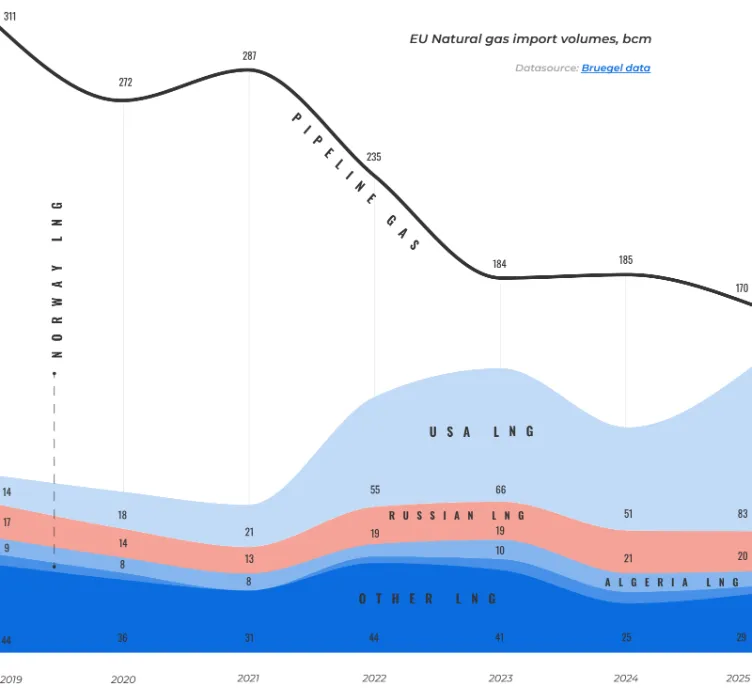
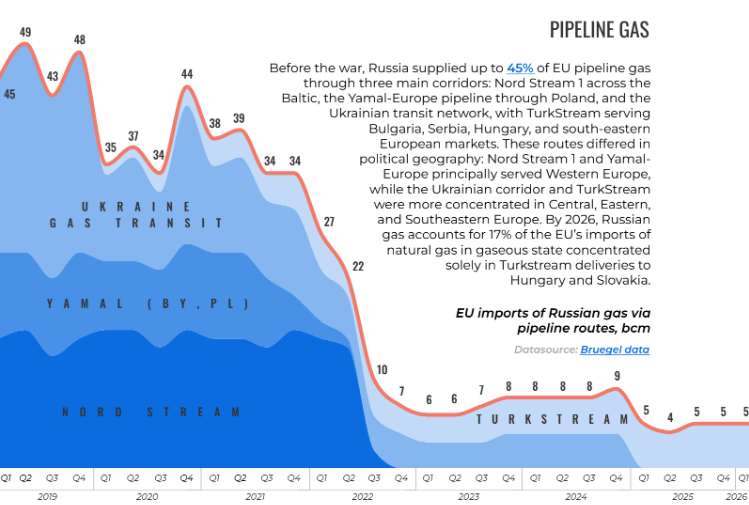
In 2026, Brussels has reason to celebrate. Russia's share of EU gas imports has fallen from 45% to 12%. Russian coal has virtually disappeared. Russian oil is down to 2% of the European market. Officials call it one of the fastest energy transformations in modern European history.
EU pipeline and LNG imports during 2019-2025. Image: RazomWeStand
But Russian LNG is still flowing. The EU paid Russia €7.2 billion for it in 2025—enough to fund roughly five years of Iskander-M ballistic missiles at the rate Russia ordered them for 2024–2025.
As President von der Leyen stated this week, EU sanctions are aimed at weakening the economic foundations of Russia's war effort. For Ukrainians, this reality is painfully tangible: every euro of revenues from Russian fossil fuel exports is transformed into drones and missiles that strike our cities and civilians.
Razom We Stand's new analytical paper,Europe's Break from Russian Fossil Fuels, reveals the gap inside the celebration. Pipeline volumes collapsed, yet the LNG channel never closed. In 2025, the EU imported around 20 bcm of Russian liquefied natural gas, and imports rose. By the first quarter of 2026, Europe was receiving 97% of exports from Russia's Arctic Yamal LNG project.
Russia is being paid by Europe's choice, not contract necessity, until 2027
The EU's 19th sanctions package, adopted in October 2025, set 1 January 2027 as the legal end of Russian LNG imports under long-term contracts. The same package gave EU buyers force majeure cover to exit early.
Yet, only after four years of Russia's invasion did the German government ask SEFE, which holds a 2.9 million-tonne-per-year contract originally running to 2040, to consider invoking the legal exit available to it. Four years of civilians killed daily by Russian missiles and drones, and four years of Ukrainian soldiers holding off the world's #2 army funded by the very money earned by selling LNG to Europe.
SEFE is, as of recent reporting, still weighing the costs. The flow continues.
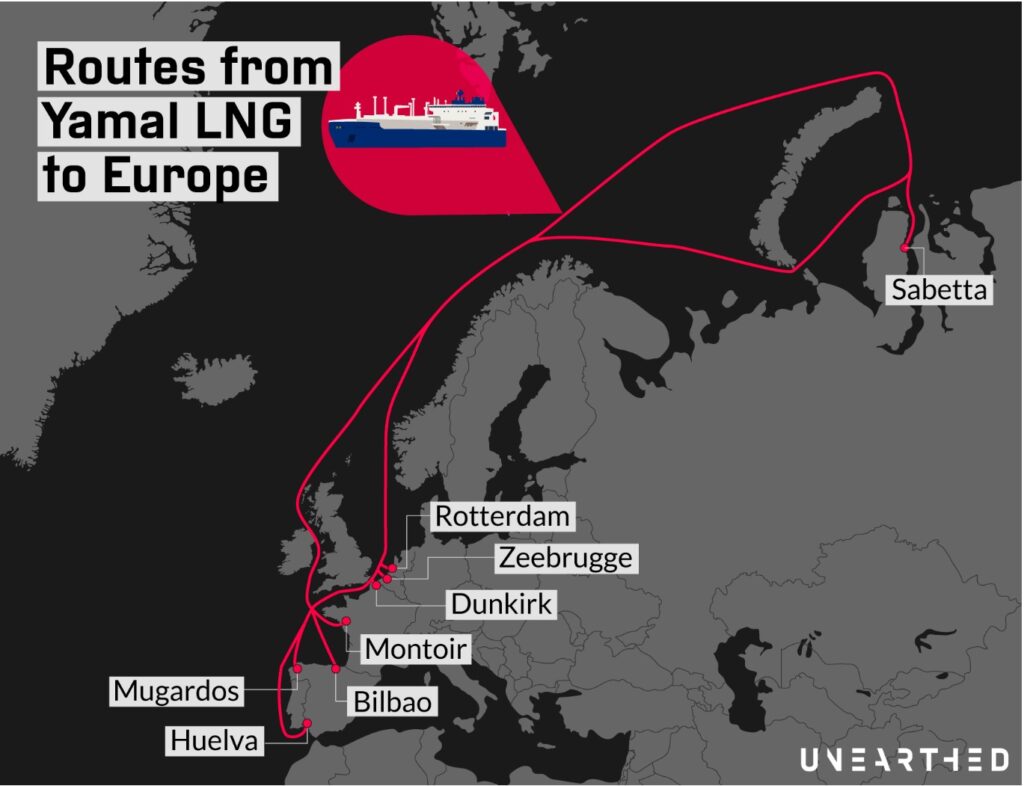
Specific European companies anchor this trade. France's TotalEnergies holds a 20% equity stake in Yamal LNG and the largest single offtake contract. Germany's SEFE and Spain's Naturgy hold long-term offtake contracts. Belgium's Fluxys operates the Zeebrugge terminal that handles a significant share of trans-shipment. The Yamal ice-class tankers that move the cargo are operated by Seapeak Maritime Glasgow in the UK and Dynagas in Greece.
France led EU buyers in 2025—87 ships delivering 6.3 million tonnes through Dunkirk and Montoir, worth €3.16 billion to Russia.
Routes from Yamal LNG to Europe. Photo: Marcela Terán/Unearthed
The TotalEnergies CEO has been candid about the philosophy. Asked about the ethics of profiting from Russian LNG amid sanctions on Russia, Patrick Pouyanné told reporters: "This is not Russian money—it's a European contract."
In February 2026, after the 20th sanctions package gave TotalEnergies additional legal protections, Pouyanné announced the contract might be terminated earlier than its 2041 end. The 20% equity stake in Yamal LNG isn't part of that timeline.
Sanctions taken hostage to restore flow of Russian oil
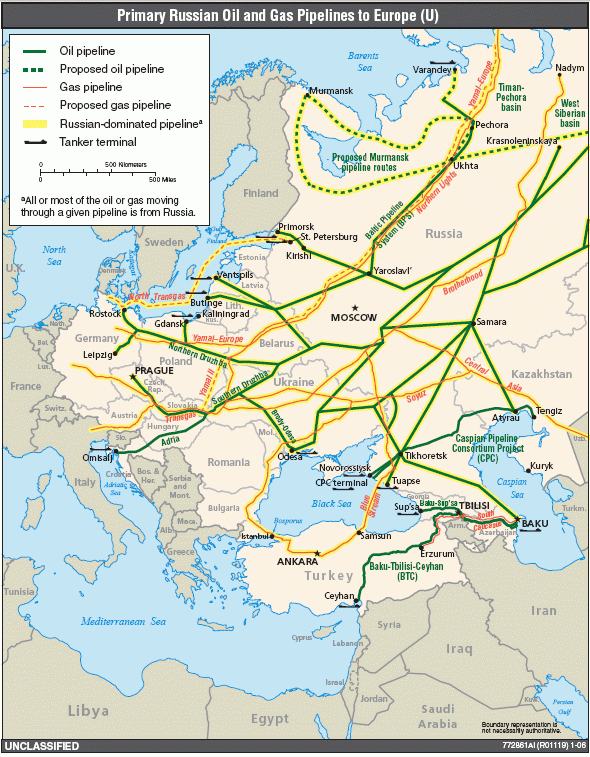
The oil channel tells a similar story. The April 2026 resolution of the Druzhba crisis allowed the 20th EU sanctions package and the €90 billion EU loan for Ukraine to pass—but the resolution restored Russian crude flows to Hungary and Slovakia. Ukraine, under pressure to unlock both, repaired the pipeline that Russia had struck at Brody in January and resumed transit of Russian oil through its territory.
The two countries continue importing through Druzhba's southern leg under exemptions with no defined end date. Hungary and Slovakia imported a combined 8.7 million tonnes of Russian oil in 2024—more than before the full-scale invasion.
Map of oil and gas pipelines from Russia. Source: US Energy Information Administration.
Croatia's Adria pipeline (JANAF) can cover their oil needs. The reason it doesn't: Hungarian state oil company MOL reports approximately 30% additional profit from arbitraging Russian crude prices.
The problem is no longer willingness. The April hostage demonstrated how Kremlin-aligned EU governments can use Russian fuel exemptions as leverage on sanctions and aid. The pattern can repeat anywhere those exemptions remain.
Russia cut its own pipeline gas exports to the EU
Even the pipeline gas drop owes more to Russia than to Europe. Razom's analysis credits Russia's own export cuts—driven by Gazprom's pivot to Asian markets and the loss of the Nord Stream pipelines—as the primary cause of the collapse from 45% to 12%. Brussels accepted the result and took credit.
Image: RazomWeStand
The diversification story is also less than it appears.
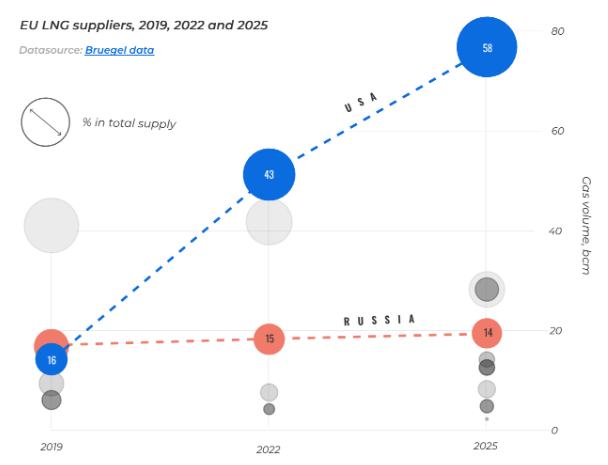
As Russian pipeline gas declined, the EU sharply increased LNG purchases—primarily from the United States. American LNG accounted for around 28% of Europe's total gas imports in 2026 and nearly 60% of all LNG consumed in Europe.
Since 2022, the EU has commissioned twelve new LNG terminals and six expansion projects, adding more than 70 bcm of import capacity.
Total LNG import capacity now stands at approximately 250 bcm per year—more than double current LNG imports. This shift now operates under the political conditions of a US administration that has explicitly used European LNG dependency as a trade and diplomatic lever. Europe has traded Kremlin leverage for White House leverage.
LNG suppliers to the EU. Chart: RazomWeStand
Closing the actual remaining channel requires enforcing what the 19th sanctions package set in October 2025—and extending it.
The package made Russian LNG imports under long-term contracts legally void from 1 January 2027 and gave EU buyers force majeure cover to exit early. EU buyers should invoke that cover now, not next year. Germany waiting until November 2025 to press SEFE is the model failure to avoid.
The 2027 deadline should also move forward. Each month of activation delay means more euros flowing to Moscow while Ukraine fights weapons funded by that revenue.
Coordinated G7 sanctions across the entire Russian LNG value chain—Novatek, Yamal LNG, Arctic LNG 2, the affiliated entities and executives, the transshipment operators, the tanker operators, the insurers. The UK has banned shipping services. The EU has not.
EU sanctions on the European companies sustaining the trade: TotalEnergies, SEFE, Naturgy, Fluxys, Seapeak Maritime Glasgow, Dynagas. And separate treatment for equity stakes—TotalEnergies plans to keep its 20% in Yamal LNG even after the contract ends. The structure outlasts the contracts.
For pipeline oil—a firm deadline on the southern Druzhba exemption. For pipeline gas—termination of the Hungary–Gazprom long-term contract for 4.5 bcm annually delivered via TurkStream, replacement with non-Russian suppliers such as Romania's forthcoming Neptun Deep project, and strengthened market monitoring to prevent circumvention through third countries.
Why is the EU moving so slowly?
The ultimate reason is that Europe still perceives the phase-out of Russian fossil fuels primarily as an economic challenge, while Ukraine experiences it as a matter of security and survival. Therefore, the business interests and lobbies of oil and gas giants and their long-term contracts with Russia get priority over cutting off Russia’s war revenue immediately and completely and establishing the continent’s energy independence.
The deeper truth behind all of this is one Russia's war has made unmissable. Fossil fuel dependence creates leverage for whoever controls the supply. Replacing the Kremlin with Doha or Washington reduces immediate risk but preserves the structure. The only path that ends the leverage is reducing demand—through renewables, electrification, heat pumps, and grids.
The EU has already proven this works. Since 2022, gas consumption has fallen 15–18%, driven not by new LNG terminals but by efficiency and renewables. Wind and solar rose from 17% to 29% of the electricity mix. Solar capacity nearly tripled, from 120 GW to 338 GW.
EU renewable energy growth during 2019-2024. Chart: RazomWeStand
That is the foundation. Finishing the job means matching the speed of demand reduction with the speed at which Brussels closes the LNG channel still funding Russia's war.
Europe has nearly broken from Russian fossil fuels. The "almost" means contracts still active until 2027, equity stakes that outlast them, named companies still buying, money still flowing to Moscow. Closing that gap—without falling into the next dependency—is the work left.
Explore further
The lobbying to bring back Russian gas is back. Faster electrification is the answer
Kateryna Kontsur is an energy policy expert at Razom We Stand with over 20 years of experience in regulatory policy, EU energy law, and renewable energy systems. She advocates for Ukraine’s energy independence and supply diversification and holds advanced project management and financial analysis degrees.
Editor's note. The opinions expressed in our Opinion section belong to their authors. Euromaidan Press' editorial team may or may not share them.
American soccer fans have suffered many indignities over the years: waking up before dawn to watch games overseas, enduring the men’s national team’s failures and listening to Alexi Lalas on television broadcasts.
But this year’s FIFA World Cup was supposed to make up for all that.
More than 1 billion people watch the World Cup final, making it the biggest event in sports. It is a global celebration. And in 2026, that celebration was finally supposed to be coming to our backyard.
Then President Donald Trump got involved.
Through a mix of manufactured crises and an apparent desire to make every major event revolve around him, Trump managed to turn the World Cup into a fiasco. It’s the biggest disappointment for American soccer fans since the men’s team failed to qualify in 2018 by losing to Trinidad and Tobago.
The World Cup was supposed to be a melting pot of global soccer lovers, drawing visitors from all 48 of the participating countries. But fans from four countries whose teams are in the World Cup — Haiti, Ivory Coast, Iran and Senegal — won’t be allowed in thanks to Trump’s refusal to even temporarily suspend those countries’ travel bans.
One of the tournament’s top referees – Omar Artan – said he was denied entry to the U.S. and held by Customs and Border Protection for 11 hours. The Trump administration said CBP denied him for ties to “suspected members of terror organizations,” but Artan already had a valid visa issued by the State Department.
Iran, currently facing attacks from the U.S. military in a war that Trump entered with no congressional approval and little public support, is set to participate in the World Cup. But even a week from kickoff, the team was still struggling to get visas to let its players get to their matches, forcing it to relocate its base to Mexico.
Even players for ostensible U.S. allies are struggling to get in. Switzerland’s star striker, Breel Embolo, one of the team’s most recognizable players, faced a temporary block on his travel authorization as the U.S. looked into a conviction he had for his role in a fight in 2018.
“They can watch it on television. It’s semi-free to watch it on television,” he said. “But that’s the way life goes.”
And for those fans willing to pay hundreds or even thousands of dollars for a ticket, Trump’s attacks on public transit subsidies and his chummy relationship with FIFA President Gianni Infantino mean fans will not have an ally in their corner to fight for increasingly awful game-day experiences.
NJ Transit’s decision to put the cost of travel entirely on soccer fans means matches in the New York area could cost close to $100 for round-trip transportation that would normally be less than $15.
For fans who have the money for the tickets and transit, Trump could theoretically be leaning on FIFA to rein in its practices seemingly meant to nickel-and-dime customers. Last week, FIFA reversed course and banned fans from bringing water bottles into stadiums despite many matches being played in temperatures above 80 degrees. The organization also plans to ban tailgating at venues.
But soccer fans will tell you that even if they have qualms about the leadership of a host country, they can still enjoy the game.
The difference in 2026 is the disruptions are not happening in the background. They are shaping who can attend, how fans travel, what they pay and, in some cases, whether teams can fully participate at all.
The World Cup was supposed to be a celebration of soccer’s ability to bring the world together. Instead, the Trump administration has turned it into a reminder of how quickly politics, bureaucracy and self-inflicted chaos can diminish even the world’s biggest sporting event.
This is a preview of MS NOW’s Project 47 Newsletter. As President Trump continues implementing his ambitious agenda, get expert analysis on the administration’s latest actions and how others are pushing back sent straight to your inbox every Tuesday. Sign up now.
Google made an announcement last month that could turn the journalism world upside down, accelerating the internet’s shift toward an overwhelmingly AI-driven landscape and serving the Trump agenda of media suppression.
At its developer conference in May, the company announced the most disruptive changes to Google Search in over 25 years. Google Search will further demote its index of the web — a list of links that information-seekers can explore as they choose. Instead of prominently displaying links, it will increasingly become a destination that answers questions directly through AI, linking only to the sources it decides to reference in its overview. On the majority of our tests, the AI overview was followed by a heavy block of sponsored results and a combination of videos, short clips, trending posts, and discussions. Index links — for example, to articles on news sites and research studies — were given only a small fraction of real estate. Additionally, Google is aggressively pushing readers to use AI Mode, which completely removes the index links.
In practical terms, this means users of the world’s largest search engine will see, in response to their queries, a summary generated by an AI bot developed by a corporate behemoth with close ties to the Trump White House.
This seismic move builds upon the launches of AI Overview in 2024 and AI Mode in 2025, shifting toward nearly eliminating the user’s ability to search autonomously, and toward an overwhelmingly AI-driven experience of the internet (and therefore, for many people, of life).
We must take into account the political context in which this shift transpires. Alphabet (Google’s parent company), along with Facebook’s parent company (Meta), as well as Amazon, Apple, Microsoft, and Nvidia, were among major tech companies that donated to President Donald Trump’s inauguration. They have also consistently capitulated to Trump’s recent manipulations.
Last fall, Alphabet’s subsidiary YouTube agreed to a $24.5 million settlement in a lawsuit stemming from the platform’s suspension of Trump’s YouTube channel. The majority of the settlement will go toward Trump’s now-infamous White House ballroom. Meta, similarly, agreed to a $25 million settlement in 2025. $22 million of that sum was designated to go to Trump’s presidential library.
Meta, like Google, has long been making moves that have severely destabilized the news industry. Facebook CEO Mark Zuckerberg decided in 2018 that the platform would prioritize showing Facebook users posts made by their friends and dramatically reduce their ability to see posts made by news organizations that they had chosen to follow. In other words, due to a single algorithm change, the more than 758,000 people who had at the time eagerly signed up to receive links to all of Truthout’s articles in their Facebook feeds suddenly stopped seeing the majority of our posts. This caused a major drop in traffic across the board to news sites, many of which had been persistently encouraged by Facebook to grow their brands on the platform. At Truthout, over 90 percent of our traffic from Facebook disappeared, which decreased our overall traffic by 40 percent and, consequently, the donations we rely on to survive.
Chaotic changes at Twitter also played a role in destabilizing the journalism ecosystem. In 2022, when Elon Musk finalized his takeover of that platform, the move quickly turned the social media site into a cesspool of far right trolls, disinformation, and bot-generated content. This toxicity and disinformation spiral forced many people on the left to leave X, which decreased traffic to progressive websites from the platform.
Over the course of these changes, news organizations like ours have struggled to respond to corresponding significant declines in readership and revenue, along with our readers’ understandable loss of trust in the social media platforms and search engines that initially allowed us to grow. Sudden algorithmic changes, news deprioritization, and increased implementation of AI summaries are shaking the economic foundation of journalism itself. Meanwhile, publishers are being sold the idea that they can cut costs by replacing staff with AI.
The connections to the Trump agenda aren’t hard to see. Trump has been an outspoken critic of news organizations, particularly those that are left-leaning and critical of his administration. Facebook and Google are suppressing journalism on their platforms and weakening news organizations’ ability to hold Trump to account, while also donating to Trump and settling multimillion-dollar lawsuits in his favor.
Whether Facebook and Google are capitulating to Trump due to fear of economic retribution, shared politics, or a desire to increase their stock prices or keep up with technology, the impact is devastating for journalism and democracy.
AI is eroding journalism — and obscuring truth
We’ve already seen some corporate publishers try to jump on the AI bandwagon, arguing that AI will come for our costly but necessary industry one way or another. They frame AI as a way to solve journalism’s most intractable problem: the cost of reporting. But in reality, they’re proposing a vision of journalism resembling content without the journalists — just regurgitated slop of varying accuracy.
Take one high-profile example from last year: Just two months after the Chicago Sun-Times laid off 20 percent of its staff, the paper issued an AI-generated summer reading list sourced from a third-party company. One key problem: Several of the books on the list didn’t actually exist. Some outlets are going so far as to create AI-generated “writers,” complete with fake names and photos, to author their AI-generated articles. And in one notable case, an AI news initiative meant to provide more information in areas with limited access to local news was scrapped after it repeatedly plagiarized the local journalists actually doing that work.
The irony is that the misinformation and deepfakes created by AI make the need for journalists more urgent than ever. For example, during the height of the war on Iran, we watched AI-generated fakery wreak havoc on the sphere of public information. And it should come as no surprise that Grok, Elon Musk’s AI chatbot most known for spewing racist hate and distributing child sexual abuse material, further spreadinaccuracies when users called upon it for help with fact checking. Right now, those of us who are real human journalists are still able to act as a bulwark against AI-introduced errors. What happens when we’re taken out of the mix?
These inaccuracies are perhaps one of the reasons why people are reluctant to get their news from AI chatbots in the first place. Make no mistake — these changes are being forced upon an unwilling public. Fewer than 1 percent of Americans say they prefer getting their news from chatbots, compared to other news sources, a recent Pew Research survey found. For people who do use chatbots for news, roughly a third of them say they have a hard time determining what’s actually true, and about half say they see news from chatbots that they think is inaccurate.
They are right to be skeptical. A recent study from the AI research company Forum AI foundthat the answers that top AI chatbots provided on questions about elections were riddled with errors; more than one-third of responses included fact errors of some type. Oftentimes those errors sounded incredibly precise, the research found, giving an undeserved air of confidence to factual inaccuracies. Those chatbots also regularly pulled from commercial sources in their summaries — even using websites like firearm retailer Ammo.com to answer questions about gun control, the researchers discovered.
Trusted news outlets have policies for issuing corrections and clarifications. Publications like ours maintain policies and avenues for offering such corrections and feedback. Who can a reader hold accountable if a Google AI summary is incorrect? Matched with the likelihood of factual errors, the lack of accountability has terrifying implications.
On a deeper level, the hyperindividualization of chatbots also poses some bleak questions about the escalating fragmentation of our shared sense of reality. For years, we’ve heard media critics sound the alarm about how social media has helped false information travel far further at much quicker speeds. Additionally, Big Tech companies, understanding that their bottom line requires eyeballs to stay on their platforms as long as possible, designed the algorithms that feed us information to be as addictive as possible by sticking us in echo chambers.
Now AI could atomize us all even further. Study after study has shown that AI chatbots are sycophantic, offering users excessive praise and telling them what they want to hear. And the timing — ahead of a high-stakes election, at a moment when trust in media is at new lows, and in a period where the future of journalism itself is at risk — could not be worse.
An existential threat to journalism
As the Google Search changes take their toll, we will very likely see a new round of cost-saving measures at longstanding newsrooms. These steps will likely include massive layoffs and downsizing, more aggressively invasive revenue generation tactics, mergers, consolidation and closures. It will be harder for existing news sites to continue publishing and nearly impossible for new newsrooms to reach a large enough audience to become financially viable.
Organizations like Truthout — ones that depend on community-building and audience growth to sustain their work — will be among the most impacted.
For 25 years, Truthout has survived by publishing impactful investigative journalism and analysis; distributing full editions 365 days a year; and building a community of readers who support us with small, hard-earned donations.
Eighty percent of our $3 million yearly budget comes from small donors alone. Of those, 8,000 readers support us with monthly donations. Back in 2018, when Facebook decided to suppress the circulation of posts made by organizations, thereby cutting readers off from seeing many articles shared by the news organizations they had intentionally decided to follow, Truthout’s total traffic declined by 40 percent, as nearly all of our traffic from that platform disappeared.
The consequences of the impending changes to Google’s search engine promise to be even more explosive. Google Search is our single largest source of traffic; it’s the route by which 27 percent of our readers find us. And visitors who find us via Google Search are more likely to stay for longer, engage with our work, and donate than those who find us through social media.
If even half of that 27 percent disappears, it will have a devastating impact on our journalism.
Truthout is just one example; journalism organizations across the field will be devastatingly affected by Google’s new move, just as they were impacted by Meta’s abrupt algorithmic shift. The entire journalism ecosystem will shoulder this blow, particularly independent publishers and news sites that depend on traffic and aren’t bankrolled by large corporations.
How do we resist?
The sudden shift in Google Search presents us with a pointed question, not only about journalism, but about the future of humanity: How much of our autonomy will we cede to AI? To what extent will we adopt an “oh well!” mentality? Or will we seek creative ways to resist, even when it may feel impossible to confront the largest corporations on the planet?
We cannot allow ourselves to become mired in the trap of inevitability-based thinking.
When grappling with questions around the future of AI, it’s helpful to remind ourselves of how the people — yes, actual humans — are relating to all this. The truth is, most people in the United States are concerned about AI. In fact, in a deeply divided country, AI is something of a uniting cause. A significant majority of Americans rate the “societal risks” of AI as high, with majorities worried that AI will disrupt human connection and inhibit creativity. People in this country are overwhelmingly more worried than excited about how AI has become enmeshed in everyday life. Meanwhile, across political lines, most people in the U.S. oppose the building of data centers in their communities. This is a mobilizable base.
Why should an entirely AI-driven future be inevitable, when most people don’t really want one? Instead of assuming the die is cast, let’s imagine a world in which the onslaught of AI threats is fuel for a broad-based movement.
This movement isn’t just aspirational: It’s already begun. Some of the most hopeful organizing in recent years can be seen in local fights against data centers. Communities are pushing back against corporate giants like Blackstone, BlackRock, and xAI. And from Arizona to New York to Wisconsin and beyond, they’re often winning. According to Data Center Watch, in 2025, local opposition efforts prevented or stalled dozens of data centers, totaling around $156 billion in investment funds.
Meanwhile, we can all respond to Google’s shift toward AI with concrete steps to support independent media and reject the “inevitability” assumption.
Instead of jumping to social media or a search engine for our news, let’s return to visiting news websites directly. Each of us can maintain a list of trusted publications to visit each day. Bookmark your favorites, and return to them. Sign up for email newsletters from your trusted publications, and create filters so that those newsletters arrive in your primary inbox instead of in spam or “promotions.” Subscribe to print publications. Commit to simply reading the news.
Double down on media literacy, practicing discernment and critical thinking as you read and watch the news. In a time when mammoth corporations are attempting to literally tell us what to believe, these commitments are acts of rebellion.
Additionally, since Google Search’s overwhelming prioritization of AI will severely impact revenue for many publications, it’s time to support independent journalism with your money as well as your readership. If you can afford to give, do so, at any level. Without material support from readers and viewers, many independent journalism organizations will fall by the wayside amid the AI onslaught.
For foundations and major donors, there’s a clear mandate here: It’s time to fund our journalism organizations while we experiment and determine new ways of expanding our audiences and driving traffic. We need room to try things — to test out strategies to map an online world beyond Google.
Funding these experiments doesn’t just help one organization or even one sector: As journalism organizations figure out new methods to reach readers, we can share those strategies with other groups, expanding the potential for grassroots groups, unions, and more to connect with human beings in a manner not dictated by the whims of giant corporations’ platforms.
Truthful journalism is an essential public good, and as Google and Meta wage algorithmic warfare against it, it’s essential to protect it. Foundations, donors, and folks connected with money should prioritize journalism alongside other urgent issues, recognizing that trustworthy information is a bulwark against rising fascism.
Finally, we must all adopt a resistance mindset in relation to AI’s slippery slope. Each day, we have an opportunity to choose another way. Resist inevitability. Resist inertia.
Our ability to access facts — and to discern truth from disinformation — is at stake. How will we fight back?
At the Trump-Xi summit in May 2026 in Beijing, China's President allegedly told his American counterpart that Vladimir Putin "might end up regretting" his invasion of Ukraine. This revelation is both encouraging and disheartening.
China's backing of Russia has been a major factor in
President Donald Trump’s penchant for characterizing pretty much any Black person who disagrees with him as “low IQ” hasn’t been called out enough as the nasty, unrepentant bigotry it is. Many Americans have come to tolerate all sorts of insults from Trump, but it’s important that we as a country condemn this racist filth, if only for the sake of Black children growing up during Trump’s presidency.
Trump expressed doubts about the intelligence of ESPN’s Stephen A. Smith after the commentator, a huge New York Knicks fan, correctly predicted that his team would lose Monday’s NBA Finals game at Madison Square Garden against the San Antonio Spurs if Trump showed up. After the game, a reporter, who mentioned that Smith has flirted with the idea of running for president in 2028, asked Trump about his comments. The president replied, “I think he’s a nice guy. You need a certain aptitude to run for president. You need a high IQ. I’m not sure that Stephen has that. I don’t think he does, actually.”
You need a certain aptitude to run for president. You need a high IQ. I’m not sure that Stephen has that.
President donald trump on ESPN’S stephen a. smith
Trump has called Supreme Court Justice Ketanji Brown Jackson “a low-IQ person.” In a May 1 social media post, he stacked up racist tropes when he wrote, “Low IQ Democrat Minority Leader, Hakeem Jeffries, is nothing but a THUG, and he is a danger to our Country!” Speaking about Rep. Jasmine Crockett, D-Texas, Trump said, “This is a low IQ person who I can’t even believe is a congressperson.” And Trump said then-Vice President Kamala Harris was so “low IQ” and “dumb” that she didn’t have the “mental capacity” to debate him.
One might think that New York Attorney General Letitia James prevailing against Trump in court in February 2024 was a sign of her intelligence, but Trump would later describe her as having a “big, nasty, and ugly mouth,” and as “a Low IQ individual.” Way back in 2018, he called Rep. Maxine Waters, D-Calif., “an extraordinarily low IQ person.”
After Somali American Rep. Ilhan Omar, D-Minn., and Palestinian American Rep. Rashida Tlaib, D-Mich., heckled Trump during his State of the Union address, he said, “Low IQ Ilhan Omar and Rashida Tlaib … screamed uncontrollably last night at the very elegant State of the Union.” His inclusion of Tlaib is evidence that he has targeted people who aren’t Black with the “low IQ” insult. In October, after he took a cognitive test, he said of Rep. Alexandria Ocasio-Cortez, D-N.Y., “AOC is low IQ” and said she should be made to take “the exams that I decided to take when I was at Walter Reed. Those are very hard.”
Tucker Carlson, Alex Jones, Megyn Kelly and former Georgia Rep. Marjorie Taylor-Greene are among the few white people Trump has called “low IQ,” but according to Mother Jones, which examined four years of posts on his social media site, Trump mostly uses “low IQ” for “Black public figures and legislators.” His occasional use of the insult for a white person does not diminish the racism he’s employing the rest of the time.
After all, in one of his many vicious rants about Somalis in the United States, Trump said, “They come to our country — low IQs — and they rob us blind. Stupid people, and they rob us blind.” In a 2024 interview with Charlie Kirk, Donald Trump Jr. referred to Haitians as having low IQs and then added, “It’s not racist. It’s just fact.”
Here’s a fact: Racism has long been baked into the design and interpretation of IQ tests. In “The Eugenic Origins of IQ Testing,” a 2008 article in the DePaul Law Review, Ajitha Reddy notes that many people who favor such tests wrongfully assume that:
1) intelligence is static; (2) it can be precisely measured; (3) it is possible to design a testing instrument capable of peeling back layers of political and socioeconomic shrouding to reveal a true essence of intelligence; (4) this essential intelligence can be expressed with a single number or with several numbers; and (5) the purpose of unmasking this essential intelligence is to allow society to identify and promote the best and brightest among us.
The truth is that no such test exists.
In what she correctly terms “our fake meritocracy,” Reddy notes that “intelligence tests serve only as predictive measures of achievement (aptitude for success within the status quo) or as measures of oppression and social disadvantage.”
It’s an offense to suggest that an intelligence test can determine the worth of a person or that it should have a role in whether certain nationalities can enter the United States. But setting aside that, and the biases inherent in the tests, there’s no reason to believe any of the Black people Trump has labeled “low IQ” would perform poorly on an IQ test, and there’s no reason to believe Trump would outperform any of them on such a test.
But it’s a losing game to even try to prove a racist stereotype — if only because it suggests that the person expressing that stereotype deserves a response. Besides, what one of Trump’s Black critics would actually score on a test has never been Trump’s point. He seeks only to promote the slander that Black people are less than fully human.
Trump’s “low IQ” insult shouldn’t be labeled crass or impolite or rude, and it shouldn’t be laughingly dismissed as Trump being Trump. It should be labeled as hateful and racist. And every journalist who reports that Trump has disparaged yet another Black person’s intelligence needs to refuse to hide behind more innocuous words like “insults.” Call it racism. Because that’s what it is.
In the lead-up to the 2026 World Cup, a coalition of more than 120 civil rights and human rights organizations, including the American Civil Liberties Union, warned visitors that traveling to the United States may carry serious risks. That’s not something we’re used to seeing for the United States of America.
The advisory cautions fans, players, journalists and visitors that they could face arbitrary denial of entry, detention, deportation, invasive searches of their electronic devices, racial profiling, surveillance, suppression of speech and protest, and cruel or degrading treatment in immigration detention. It urges visitors to arrive with an emergency plan in place.
This World Cup is increasingly becoming a tournament for the wealthy, the vetted, the approved and the politically safe.
That alone should be a global scandal. It should be the lead story in sports pages across Europe, the subject of parliamentary debate. It should be the focus of endless television coverage and have football associations scrambling to explain how they can participate in a tournament under these dangerous conditions for players and their fans.
A Somali referee selected by FIFA — one of Africa’s top officials and poised to make history — was reportedly denied entry and sent home, shattering his World Cup dream before kickoff.
An Iraqi player was detained and questioned for hours at a U.S. airport. An Iraqi team photographer was reportedly denied entry after his phone was searched.
Iran’s participation has been dragged into the full force of geopolitics. Some Iranian officials and support staff have been denied visas. The team’s travel and residency arrangements have been restricted. Players face the prospect of competing in a country whose government has been at war with their own. Iranian fans face a maze of sanctions, travel bans, visa barriers and intimidation just to support their national team.
And for fans from several African countries — including Senegal, Algeria, Cape Verde and Côte d’Ivoire — the U.S. has imposed or threatened visa bond requirements that could force some travelers to post as much as $15,000 simply to enter the country.
All of this is unfolding amid a tournament that is already pricing out ordinary fans. FIFA’s embrace of dynamic pricing has helped push tickets to extraordinary levels. European fan groups have complained about World Cup pricing to regulators. Hotel prices in host cities have surged. Transportation costs have become so concerning that New York and New Jersey lawmakers have called for FIFA to help subsidize access to MetLife Stadium.
For decades, the World Cup has been cherished because the sport belongs, at least in spirit, to ordinary people. It is the world’s game: played in alleyways, on dirt fields, on beaches, in parks, by children with nothing more than a ball and space.
But this World Cup is increasingly becoming a tournament for the wealthy, the vetted, the approved and the politically safe.
That should be a scandal, too. But where is the outrage? Where are the European football associations demanding guarantees that their fans will not be searched, detained, deported or denied entry because of their nationality, race, religion, political views or social media posts? Where are the captains promising to wear armbands for migrants rounded up by masked agents? Where are the warm-up shirts demanding due process for all?
Where are the broadcasters refusing to begin with the spectacle and instead opening with the question: How did FIFA award the world’s biggest sporting event to a country where civil rights groups are warning visitors to prepare for detention, deportation, surveillance and suppression of protest?
Where are the European ministers announcing they will boycott official ceremonies until the U.S. guarantees equal treatment for all teams and fans?
Where are the pundits asking whether the tournament should have been moved?
We know the standard because Western governments, football officials and media organizations spent years articulating it when the hosts were Russia in 2018 and Qatar in 2022.
We know the standard because Western governments, football officials and media organizations spent years articulating it when the hosts were Russia in 2018 and Qatar in 2022.
Four years ago, Qatar was essentially put on trial. Before a ball was kicked, the 2022 World Cup was framed by much of the Western press as a referendum on the host nation’s human rights record. Migrant labor. LGBTQ+ rights. Women’s rights. Press freedom. Environmental impact. Corruption. Sportswashing. All of it was fair game, and rightly so. Any host nation should face scrutiny.
The scrutiny of Qatar was relentless. The BBC famously chose not to air the opening ceremony on its main channel, instead beginning its coverage with a sweeping critique of Qatar’s treatment of migrant workers, FIFA corruption and the criminalization of homosexuality. It was dubbed the most controversial World Cup in history before the first match had even started.
Seven European teams — England, Wales, the Netherlands, Belgium, Denmark, Germany and Switzerland — planned to wear OneLove armbands in support of LGBTQ+ rights until FIFA threatened them with sporting sanctions. Germany posed for its team photo with players covering their mouths in protest.
French cities including Paris, Marseille, Lille, Strasbourg and Bordeaux refused to host public fan zones or big-screen broadcasts, citing human rights and environmental concerns. Denmark wore toned-down kits, including a black jersey described as mourning for migrant workers who died in Qatar. German fans hung #BoycottQatar2022 banners in stadiums. European lawmakers wore OneLove armbands in Parliament as they adopted resolutions criticizing Qatar’s human rights record.
The message from the West was unmistakable: The record of a World Cup host country matters.
If migrant workers mattered in Qatar, then they should matter in an America that depends heavily on immigrant labor in construction, hospitality, food service, cleaning, transportation, stadium operations and event logistics. Some of the very workers helping produce this spectacle live under threat of detention and deportation. Others labor under visa systems that tie them to employers and make them vulnerable to wage theft, coercion and exploitation.
If LGBTQ+ rights mattered in Russia, they should matter in Dallas, Houston, Atlanta and every other host city operating within a country where hundreds of bills targeting LGBTQ+ people have spread across state legislatures.
If women’s autonomy mattered in Qatar, it should matter in a World Cup hosted partly in U.S. states where abortion bans and restrictions have stripped millions of women of bodily autonomy.
If free speech mattered in Moscow, it should matter in Trump’s America, where foreign students and visitors have faced visa consequences tied to political expression, campus protesters have been arrested, demonstrations have been heavily policed and civil rights groups are warning that World Cup visitors could face surveillance, searches and suppression of protest.
If fan safety matters abroad, it should matter in the U.S., a country whose gun violence crisis has led other governments to warn their citizens about travel risks.
If making the tournament accessible to fans from around the world mattered before, then it should still matter now that the U.S. and FIFA are presiding over a tournament with staggering ticket prices, inflated hotel costs and visa policies that could price or screen out many of the very fans who make the World Cup what it is.
This World Cup is arriving in a country governed by a president accused by critics of authoritarian tendencies, contempt for democratic norms, attacks on the press, hostility toward immigrants, retaliation against dissent and a willingness to use state power as a tool of humiliation and control.
It’s a blatant case of sportswashing. Or at least it would be called that, if the host were not the United States.
We have seen this double standard before.
Before Russia hosted the 2018 World Cup, a bipartisan group of U.S. senators urged FIFA to strip Russia of the tournament because of Vladimir Putin’s annexation of Crimea and violation of Ukraine’s sovereignty. They argued that allowing Russia to host would reward Putin, elevate his global prestige and launder the image of a government engaged in aggression abroad.
That argument was not wrong. But it raises an obvious question: Does a host nation’s aggression abroad matter only when the aggressor is an official enemy of Washington?
If Russia’s annexation of Crimea made it unfit to host, why is America’s record of military operations, wars of choice and threats of territorial expansion treated as irrelevant?
The question is why one host’s flaws become the defining story of the tournament while another host’s abuses are treated as distractions from the beautiful game.
Daniel Maraccini, Grace Cardinal and Summer Wojtas contributed to this article.
The $70 billion immigration enforcement funding bill Republicans have been working to pass for months finally got President Donald Trump’s signature Wednesday afternoon. Speaker Mike Johnson, R-La., was on hand at the White House for the signing, along with Homeland Security Secretary Markwayne Mullin and a smattering of other GOP senators and representatives.
It may be a simple matter of scheduling that allowed Johnson to attend and not Thune. But the South Dakotan’s absence was notable given how often he’s lately been forced to play the uncomfortable role of the person who has to tell Trump “no.” And when it comes to Trump, even big wins like a bill funding one of his top priorities can easily be forgotten as his focus slips back toward more esoteric demands.
Trump’s relationship with Thune is best examined in contrast with the president’s interactions with Johnson. Punchbowl News framed the dynamic succinctly Wednesday morning: “Thune derives much of his power from his conference, not Trump. Johnson derives a good deal of his power from being close to the president.”
The two-vote majority Johnson controls in the House means both ends of the GOP’s contracted ideological spectrum can make demands that grind legislation to a halt. The Louisiana lawmaker’s at times tenuous grasp on the House and reliance on Trump to get his ducks in a row have been constant themes of this phase of his speakership. NOTUS recently reported that Trump has at least once declared in front of Johnson and other lawmakers: “I have two jobs: being president and being speaker.”
Johnson’s caucus first put him into the speakership in 2023 because there was nobody else who could win enough votes for the job, as several weeks of internal jostling proved. Almost three years later, there’s little appetite among House Republicans to go through the sort of internal fight to replace him without a clear alternative. But even without wanting to take Johnson out entirely, House Republicans have historically had few problems with pulling out the knives against their own leadership.
Ironically, the House speaker has much more direct control over his chamber’s workflow than the Senate majority leader does. A single senator can ruin the majority’s best-laid plans by denying the unanimous consent that keeps things flowing smoothly. In practice, Thune needs to persuade enough GOP senators to stick with him and contend with the filibuster’s limitations on what can make it through a tough vote.
Despite that, for the better part of Trump’s second term it’s been the Senate that’s been the more reliable chamber in terms of delivering on the White House’s legislative priorities. The final version of last year’s so-called Big Beautiful Bill first cleared the Senate, and it’s been the Senate that’s broken logjams over funding for Immigration and Customs Enforcement and the federal government more broadly. It’s also been the Senate steadily confirming Trump’s nominees, giving him a more or less free hand to continue his war against Iran and supporting his crackdown on immigrants.
Thune has been most willing to push back on issues he knows he can’t get his members to support. He doesn’t have the votes to kill the filibuster and doesn’t seem like he would be inclined to do so even if he did. He has refused to fire the Senate parliamentarian for blocking security funding for Trump’s White House ballroom. And Thune has allowed his members to vent freely about the corruption on display from the slush fund Trump attempted to establish.
Unfortunately, those issues also tend to be the ones on which Trump has placed an outsize focus. The president doesn’t seem to understand any system that doesn’t allow its head to act as a despot. His decision to help remove members of the GOP caucus by backing primary challengers hasn’t made it any more likely that he’ll win over holdouts. And while he has succeeded in helping to bully House members into following Johnson’s lead, those tactics have been less effective against the more imperious senators in his crosshairs.
The resulting dynamic has forced Thune to plan around Trump’s shifting demands and take the heat when his members balk at the president’s whims. It’s an arrangement that so far has managed to work out despite itself. Trump has never called for Thune’s removal from atop the Senate GOP — and to be honest, Trump may not like the response he might receive if he ever does.
For now at least, the president may control the House, but the Senate still belongs to John Thune.
The quiet goodness portrayed in All Creatures Great and Small resonates so deeply. It echoes something true about the world God is restoring. And what the show captures in glimpses, Christ is bringing to fullness: a life where ordinary faithfulness, shared burdens, and steadfast love are not small things at all, but signs of His... Continue Reading
Finding the practice [gambling] morally wrong and actively fighting the addiction in the pews are two different things.…a few churches and ministries are working to sound the alarm and address the issue. Calvin Ridley, star receiver for the Atlanta Falcons, was suspended for an entire season in 2022 for gambling on NFL games. The... Continue Reading
The date when Social Security’s trust fund is expected to run out of money just got bumped up. The fund is now projected to empty in 2032, according to a new report released by Social Security’s trustees.
The new depletion date isn’t an earth-shaking change — it’s only a quarter earlier than the estimate in last year’s report. But it illustrates how President Donald Trump’s policies are degrading a program he promised to never jeopardize — and accelerating an approaching crisis in how our government will assist the elderly and disabled.
The report names three factors that contributed to the earlier insolvency date. One is a declining fertility rate, but the other two drivers can be traced back to Trump: a drop in immigration into the country, and the “substantial effect” of the tax policies in the One Big Beautiful Bill he signed last summer.
Trump’s acceleration of the program’s insolvency comes atop his assaults on the program’s administrative capacities.
Reduced immigration during Trump’s second term — especially when coupled with a declining fertility rate — strains Social Security because the program is funded through payroll taxes. Those come out of people’s paychecks, and fewer workers supporting an aging population means the program receives less revenue. Indeed, Social Security already has been tapping its trust fund for the better part of the past two decades because the program’s costs have exceeded its cash income. And as the Center on Budget and Policy Priorities pointed out last year, last year’s tax cuts were a boon to the rich but a bust for the solvency of the Social Security trust fund.
To be clear, if the fund is depleted, Social Security won’t go belly up. Benefits will continue to be paid out, but there will be a large drop in the amount. The Committee for a Responsible Federal Budget estimates that the “average monthly cut would total $500, which is more than what the average retired household spends on groceries each month.”
That would be a huge blow to the budgets of many older Americans. Social Security is a major source of income for most retirees, and roughly 40% of beneficiaries over the age of 65 rely on it for most of their income. And it would mark the destabilization of the sole source of retirement security for most Americans that is supposed to be insulated from ups and downs — unlike 401K plans. As the CBPP has pointed out, Social Security is “most workers’ only source of guaranteed retirement income that is not subject to investment risk or financial market fluctuations.”
Trump’s acceleration of the program’s insolvency comes atop his assaults on the program’s administrative capacities. His cuts to the Social Security Administration have left offices understaffed, increased wait times, and reduced quality of customer service.
Ultimately, Trump is exacerbating a colossal social safety net problem that predates him, and the trust fund will hit dire straits after he has left office. Democrats need to have clear plans for shoring up the program and making it robust for the future — which will require not being sheepish about taxes as a tool for renewing the social contract. And when Republicans try to claim that they, too, are champions of Social Security, all Democrats need to do is point to the truth.
I’ve been documenting the Republican Party’s dubious crusade against the SPLC, the organization known for assisting law enforcement with investigating racist extremist groups. The Trump administration’s recent indictment of the SPLC on allegations the group defrauded investors by financing the extremist groups they claim to fight has ramped up that attack and fits a long tradition of white conservatives denying the origins, existence or extremism of racist organizations like the Ku Klux Klan. (The SPLC has denied any wrongdoing.)
House Judiciary Committee Chairman Jim Jordan’s line of questioning left little doubt about his effort to portray the SPLC as nefarious and the impetus for various acts of racism. At one point, Jordan asked SPLC CEO Bryan Fair whether his organization’s work was “all about the money.” At another, Jordan said the SPLC’s fundraising had increased after the deadly white supremacist rally in Charlottesville in 2017, to which Fair replied by saying the group’s funding went up after Trump became president.
The sentiment fueling the Republican Party’s resentment toward the SPLC appears to be the same angst-ridden sentiment expressed on Tuesday by Trump’s Medicare and Medicaid administrator, Mehmet Oz, when he complained to Fox Business about critics who have called the administration racist for making racist generalizations about Somalians. Which is to say, Republicans’ anger seems rooted in the fact that they or their allies aren’t free to engage in racist behavior without facing scrutiny.
Dr Oz: "You're not allowed to complain about Somalians, because that's racist. And the worst thing you can be in Minnesota is a racist." pic.twitter.com/1WAhx1ABoi
As the Republican Party copes with the pitfalls of its allegiance to a historically unpopular president ahead of the midterm elections, conservative lawmakers are scraping the barrel of desperate tactics and resorting to brazen racism.
Rep. James Comer, chairman of the House Oversight Committee, demonstrated this when he lobbed a deluded accusation on Fox News that “minority communities” in blue states are “especially” responsible for “rampant fraud.” It’s the sort of racist remark one might expect from a Ku Klux Klansman, not the leader of a congressional committee.
Comer: "What we're seeing especially in the blue states is there is rampant fraud, especially in the minority communities" pic.twitter.com/fkmHORqDGV
To state what should be obvious, Comer’s racist claim is also baseless. It aligns with bigoted claims that President Donald Trump — someone who has been found liable for fraud — has made while his administration has pushed debunked claims to portray the Somali community as rife with fraudsters. (Trump is appealing in his civil fraud case.)
Rep. Tom Emmer, R-Minn., echoed Trump’s racism back in December when he made the false claim that Somalians were responsible for “80%” of crime in Minnesota’s Twin Cities. The fundamental conceit behind these baseless attacks — apparent attempts to portray nonwhite people as more prone to crime — is a tired trope that has been deployed by white supremacists for centuries.
But with regard to Comer’s remarks, there’s no evidence that “minority communities” are responsible for rampant fraud. The term “minority” is a nonspecific one that can essentially mean whichever group the person uttering it wants to include, but in this case it’s effectively useless for all purposes except racist scapegoating.
To be clear: Racial or ethnic groups cannot be collectively responsible for fraud — individuals can be.
Otherwise, one could look at the growing list of fraudsters Trump has pardoned, note the large number of white dudes on that list and draw a conclusion that this data — along with Trump’s own history — proves there is a rampant fraud crisis among the white community.
I suspect Comer isn’t as interested in opening that can of worms as he is in peddling racist rhetoric to the masses.
There’s an old saying: There are no atheists in foxholes. Faith plays a large role in the lives of many service members (including, yes, uniformed atheists). The U.S. military has long provided religious support to service members who are naturally often far from home and their faith communities. Given that the First Amendment prohibits the government both from establishing a religion and from preventing its free exercise, the military’s formal provision of chaplains and religious services to those in uniform is understood to balance these competing constitutional demands.
Until now, that is. Secretary of Defense Pete Hegseth recently slashed the list of Pentagon-recognized religions and belief systems that service members can have reflected in their personnel records from more than 200 to just 31, with the majority of the remaining being Christian religions. Those who ascribe to one of the 180-plus now-deleted belief systems must instead list in their records either “no religion” or “other religion.” This change tilts military policy toward the unconstitutional establishment of religion and simultaneously limits its members’ free exercise of their chosen faith.
Religious resources aren’t merely a nice bonus for service members that the Pentagon chief can do away with just by snapping his fingers.
The list of recognized religions grew from 100 to more than 200 during the first Trump administration when the Pentagon’s board of chaplains “recommended adding new faith and belief groups to standardize and better identify religious preferences recognized by the Military Services” in response to legislation mandating improved religious liberty protections. Despite such rationale, Hegseth says this larger list was “infected by political correctness and secular humanism” under previous administrations.
The defense secretary is now using the Pentagon’s previous rationale for expanding the list to drastically shrink it instead, stating that his purge is about “giving chaplains clear, usable information so they can minister to service members in a way that aligns with that service member’s faith background and religious practice.” Echoing the secretary, the Pentagon says this massive cancellation of faiths is simply an administrative exercise, one designed to allow chaplains “to quickly look at the religious composition of their units and determine how they structure resources to best provide for warfighters of all faith groups,” and to “provide the best data to support our chaplains in that effort.” Yet how does no data — indeed, deliberate ignorance of service members’ faiths, if they ascribe to one of the 180 now-cancelled religions — equate to better support?
Religious resources aren’t merely a nice bonus for service members that the Pentagon chief can do away with by snapping his fingers. Reasonable access to well-rounded military chaplains is a traditional component of military life, allowing soldiers, sailors, Marines and airmen to freely practice their religious beliefs even if deployed to foreign battlefields.
It’s impossible for the Pentagon to provide a specific “religious military professional” — the phrase military regulations use for chaplains — for every possible faith; service members don’t have a right to a chaplain of their particular belief system. But military chaplains are expected and required to support the spiritual needs of all service members, not just those who hold one of the faiths the Pentagon still recognizes.
Specifically, the Pentagon’s regulation governing military chaplains states that their primary mission is to “meet the religious requirements and care for the spiritual needs of Service members” (and others, including family members). This regulation is grounded in the First Amendment and explains that the position of military chaplain “directly and indirectly supports the free exercise of religion by all Service members.” Religious ministry professionals must be “able to personally meet the religious requirements of persons in their assigned military units, potentially in isolated or combat environments.”
The Pentagon is burying its head in the sand regarding the faiths of the U.S. fighting forces.
Yet how can military chaplains meet the religious needs of their units’ members when they won’t know what faiths are actually represented, outside of the recognized few? Among faiths no longer recognized by the Pentagon are the Unitarian Universalist religious movement (to which John Adams belonged), deism (to which Benjamin Franklin and Thomas Jefferson subscribed), atheism, the Dutch Reformed Church, paganism, the African Methodist Episcopal Church and the Native American Church. These faiths count millions of Americans among their members.
Since when is ignorance “the best data”? Resources can’t be adequately structured to support service members of all faiths when the Pentagon is burying its head in the sand regarding the faiths of the U.S. fighting forces. The lack of information does not equal “useful” information — except if the intended use is to stop supporting those service members’ minority faiths and practices.
While service members can reportedly still list their faith of choice on their dog tags, that doesn’t mean a chaplain can understand their spiritual needs while they’re still alive. As religious military professionals, chaplains can’t best support those they are being essentially ordered not to see. It’s also unclear how this policy cancellation will affect the qualifications of already serving chaplains; their eligibility depends on the endorsement of religiously affiliated organizations, and surely some of those organizations are tied to religions that have lost Pentagon recognition.
Couple Hegseth’s and the Pentagon’s nonsensical reasons for this new policy with the secretary’s penchant for proselytizing his Christian faith to service members, and it’s clear that this massive purge isn’t about streamlining data or structuring resources. It’s about the Trump administration’s desire to support only certain religions, and therefore only certain service members. This move hinders other service members’ free exercise of religion, at least compared with those whose beliefs are represented. And it takes a large step in the direction of unconstitutionally “establishing” (by discriminatorily supporting) the religions that remain recognized by the military.
The Pentagon’s new policy means that some military members are now sacrificing to ensure that their fellow Americans enjoy a freedom of religion they no longer fully possess. That is not just deeply ironic; it is morally and constitutionally repugnant. And it should be added to the ever-growing list of mistakes by this White House that a future president and Congress will need to rectify.
If there were anything like justice in college sports, Brendan Sorsby would never play another down of football. It’s a tough thing to say about someone only 22 years old, and under most circumstances, I’d never argue that misdeeds should end an athlete’s career before they hit the professional ranks.
But Sorsby, Texas Tech’s star quarterback, isn’t an average college kid who made a mistake. He bet at least $90,000 on sports — including on games involving the Indiana Hoosiers when he was on that team’s roster as a freshman in 2022. For obvious reasons, the NCAA frowns upon such behavior and rightly issued a permanent ban when it discovered what Sorsby did. Sorsby says he’s been diagnosed with a gambling addiction.
Sorsby says he’s been diagnosed with a gambling addiction.
But on Monday, retired Texas judge Ken Curry, appointed to the case after another judge recused himself, gave Sorsby a pass with a temporary injunction that will allow him to play this season. Curry reasoned that the injunction was necessary to avoid “probable, imminent and irreparable injury” to the quarterback’s college football career. But the judge is mischaracterizing the consequences of Sorsby’s actions as injury.
Those who have watched college football scandals over the decades should be especially incensed by the judge’s ruling that Sorsby should play. His transgressions are exponentially worse than those of Reggie Bush, who was forced to forfeit his Heisman Trophy in 2010 for rules violations he allegedly committed while at the University of Southern California, and exponentially worse than Ohio State University’s Terrelle Pryor, who was suspended for receiving free tattoos and selling his memorabilia. Granted, those punishments were imposed in a bygone era when the NCAA still stood on the farce that players, the labor in its multibillion-dollar enterprise, were amateurs and all but forced them to the black market to profit from their work.
Those infractions from Bush and Pryor were metaphorical misdemeanors relative to the near-treasonous offense Sorsby committed against the NCAA. The integrity of the games, or at least the appearance thereof, are crucial for the association’s survival. Thus, its strict prohibition against gambling and its promise of a kind of death penalty (a lifetime ban) for athletes who gamble anyway.
Sorsby acknowledged a gambling addiction, a serious mental health issue that warrants professional treatment, and to his credit, he reports that he recently sought a 35-day rehab at an inpatient clinic in Arizona. Gambling addiction can cause immense harm to the afflicted and those around them. It’s also a compulsion whose victims often relapse, which isn’t something someone in Sorsby’s position can afford, even once.
It’s not something the NCAA can afford, either. In this instance, the NCAA saw a problem — the starting quarterback at a Power Conference school has a gambling problem that makes him vulnerable to compromise — and it took that problem out at the knees. Sorsby, who is discussed as a rising NFL prospect, had every right to try to enter the league’s supplemental draft or to seek a free agent tryout. Obviously, any NFL general manager with common sense would think long and hard before adding him to the roster, which means he’d be risking not being able to play in college or the pros. But such are the wages of his sin. The predicament he put himself in doesn’t warrant the judge forcing the NCAA to let him play after he flouted its rules and violated the integrity of its sport.
To the extent that he’s seriously contrite, Sorsby deserves credit for taking accountability, which he did in a social media post last month. But contrition doesn’t erase consequences, and accountability often demands them. Yet here we have a judge forcing the NCAA to let Sorsby play alongside other young men who have every right to question their teammate’s motives. Other college programs have responded by vowing not to play any games against Texas Tech.
Sorsby embodies two overlapping problems involving sports and gambling: the increasing prevalence of gambling addiction among young adults, teenagers and even preteens and the seemingly growing number of instances of athletes themselves betting on games. Just last week, an arbitrator ruled that NBA free agent Terry Rozier must forfeit most of his $26.6 million salary for the 2025-26 season after he was alleged to have taken a bribe to withdraw from a game early when he was playing for the Charlotte Hornets. Rozier has pleaded not guilty to the gambling accusations.
If Sorsby ever makes it to the NFL, one wonders how he will fare in a league that prohibits its players from gambling but has rich partnership deals with FanDuel, DraftKings and Caesars Entertainment, its “official casino sponsor.” In the pros, nobody even pretends there’s a wall between the action on the field and the action the sportsbooks are taking in real time. Fans will be in the stadium, not just watching but placing bets. Whichever team signs Sorsby would be gambling too: that he won’t repeat the same offenses that put the NCAA and Texas Tech in a negative spotlight.
The 2026 FIFA World Cup, which begins this week, is expected to bring millions of visitors from dozens of countries to the United States. I have tickets to the World Cup finals next month, and I’m finding it hard to contain my excitement at my opportunity to watch what I know will be the pinnacle of competition in a sport loved by billions of fans worldwide.
But as a doctor, I can’t help but think about how dangerously unprepared the United States is to meet the public health demands of hosting the largest sporting event in U.S. history. The World Cup will bring with it significant public health risks, bringing people from all corners of the world together, where infectious diseases can easily travel and become amplified in enclosed, semiconfined spaces such as stadiums, bars and restaurants.
As a doctor, I can’t help but think about how dangerously unprepared the United States is.
I know firsthand how infectious diseases spread in mass gatherings. As a Muslim performing the Hajj in Mecca, I saw some people contract meningitis, and I was one of the countless others on that spiritual pilgrimage who became infected with an upper respiratory infection. Mass gatherings of the size of the Hajj or the World Cup provide ideal conditions for infectious diseases, heat illness, crowd injuries and foodborne outbreaks to occur.
As a practicing physician who writes and speaks about public health, I have little confidence that the U.S. is prepared for the part of its World Cup-hosting duties that includes ensuring the safety of the health of millions of visitors.
The World Cup comes to a United States that remains scarred by the Covid-19 pandemic. There’s rising mistrust of vaccines, worsening healthcare staff shortages and the re-emergence of infectious diseases that had been eliminated. More than 2,000 cases of measles in the U.S. this year serve as a reminder of what happens when public health information officials such as Health and Human Services Secretary Robert F. Kennedy Jr. traffic in misinformation instead of work to preserve public health. Thanks in no small part to Kennedy, vaccine hesitancy is on the rise, and the kindergarten rate of vaccination is below the 95% rate necessary to confer protection upon the larger community.
Although a recent hantavirus outbreak on a cruise ship on the Atlantic posed a low risk to the general American public, if it had gotten out of hand, the U.S. would not have been prepared. If cases had spread across the country, we would not have been able to sufficiently test and identify cases because the lab test that detects the virus is only available at a handful of special laboratories throughout the country. And the silence from HHS and the Centers for Disease Control and Prevention was worrisome. Because public health only succeeds when and where there is clear, transparent communication, officials at those agencies should have held a national press briefing to answer the public’s questions. But they didn’t. According to an Annenberg Public Policy Center poll from March, only 43% of Americans trust public health communications from federal agencies.
The pillars of a strong public health infrastructure are early recognition of diseases, clear communication and trust, all of which appear to have been eroded lately. That’s why it seems unlikely that the U.S. could respond effectively to a major public health threat on our soil during the World Cup or at any time in the near future.
There’s little evidence that the U.S. implemented a proactive approach to the World Cup.
Our public health infrastructure has been underfunded for decades, surveillance systems have been gutted, and hundreds of critical CDC and HHS workers have been laid off. The greatest threats to a successful World Cup, then, may not be terrorism or violence, but an inability to manage predictable health emergencies at scale.
There’s little evidence that the U.S. implemented a proactive approach to the World Cup. To the contrary, it appears the country will react passively if havoc occurs. A proactive approach would have included strengthening infectious disease monitoring at airports, improving hospital surge planning, investing in public health infrastructure such as vaccine research, and rebuilding trust through transparency.
When I look at my World Cup tickets, I am filled with excitement, but I can’t shake the feeling that our country isn’t prepared for public health crises that may occur in the coming weeks.
Volodymyr Zelensky made a rare misstep when German Chancellor Friedrich Merz proposed associate EU membership for Ukraine, offering institutional access, participation in Council meetings, gradual budget integration, and critically, Article 42(7) security guarantees.
Zelensky rejected it, insisting Ukraine deserves full and equal membership. In principle, most Europeans would agree.
Nancy Mace’s political career is likely over and will almost certainly be quickly forgotten. But the South Carolina Republican had the chance five years ago to create an enduring legacy by risking her office to steadfastly oppose Donald Trump’s “big lie” and self-coup attempt after he lost the 2020 election. Instead, she chose a squishy middle path between standing up for her country’s democratic legacy and pleasing the deranged boss of her party. And that path led her nowhere.
Mace chose not to run for a fifth term in the House so she could pursue the top job in the Palmetto State’s government, but after failing to qualify for the runoff in the South Carolina Republican gubernatorial primary Tuesday, the odds of her political ambitions reaching any higher have dimmed considerably. Though he didn’t attack her by name as he did with former Rep. Marjorie Taylor Greene, R-Ga., Trump endorsed one of Mace’s primary challengers after she was one of four Republicans who signed a discharge petition forcing a vote to release the unredacted Jeffrey Epstein files in 2025.
What this country needs is Republican lawmakers and conservative thought leaders plainly rejecting Trump’s thoroughly debunked stories about a massive conspiracy of election fraud across multiple states.
This wasn’t the first time Mace stood up to Trump. On Jan. 6, 2021, she published an op-ed in The Post and Courierbefore Trump incited a MAGA mob, in which she wrote, “Today, I will solemnly cast my vote to certify the results of the Electoral College,” adding, “If Congress ever had the power to singularly throw out the Electoral College, we would set a dangerous precedent that the ruling class can disenfranchise millions of voters across the country. Does anyone really want to give Nancy Pelosi this kind of power? Certifying the results is the only way to preserve our republic and our Constitution. We must follow this course, even when we don’t like the outcome. Even when we hate the outcome.”
After Trump supporters’ violence on Jan. 6 was finally subdued, Mace went even further, telling CNN, “I hold him accountable for the events that transpired for the attack on our Capitol,” and that “everything that he’s worked for … his entire legacy, was wiped out yesterday.”
She added, “And we’ve got to start over.”
But when Mace had the chance to vote to impeach Trump a week after the riot, she demurred, questioning the “constitutionality” of the impeachment process for an outgoing president and lamenting “violence on both sides of the aisle.”
A closer glance at her Jan. 6 op-ed shows her spreading a whole lot of baseless “big lie” innuendo: “Is there evidence of voting irregularities and voter fraud in multiple states? Yes.”
Mace then spent the next several years as a MAGA-coded culture warrior, taking on Trump’s political targets — especially transgender people — as her own. But her Epstein files rebellion seems to have been the last straw for Trump.
It’s a shame, because what this country needs most in June 2026 — just as it did in January 2021 — is Republican lawmakers and conservative thought leaders plainly rejecting Trump’s thoroughly debunked stories about a massive conspiracy of election fraud across multiple states. Instead, the most powerful and influential voices are spreading democracy-eroding falsehoods — because they can’t believe that 2000s-era reality TV show villain Spencer Pratt didn’t finish higher than third as a Republican in the Los Angeles mayoral primary.
To be sure, California’s vote-counting methods are, as The New York Times put it, “notoriously time-consuming, in part because of the state’s reliance on mail-in voting, and a requirement that officials do extensive work to check signatures, open envelopes and inspect ballots.”
But let’s be very clear about this. These Republican and conservative leaders are spreading baseless fictions meant to undermine any election that doesn’t go their way. And when it’s all said and done, for all the destruction Trump’s two administrations will have reaped upon the country and the world, the cynical deployment of voter fraud lies may end up yielding the most permanent damage.
What America really needs right now is a few honorable conservatives to stand against these despicable tactics with a clear voice. Mace had the chance to be one five years ago. Instead, she’ll leave the stage as just another Republican who briefly stood up to Trump, then vacillated, then rebelled again, but ultimately prioritized currying favor with the demagogic boss of her party over standing on principle.
For her efforts at placating Trump and MAGA, Mace is a replacement-level, power-hungry politician looking for a job.
President Donald Trump and his family have cashed in big since he won the 2024 election. Of the billions of dollars they have accrued over the past 18 months, the lion’s share has reportedly come from cryptocurrency assets that bear the president’s name or his family’s endorsement. The technology may be novel, but crypto lets the Trump family play the age-old game of separating fools from their money, all while leveraging Trump’s position in the White House to boost the sales pitch.
According to an in-depth investigation from Reuters, whose reporters reviewed thousands of documents, disclosures and blockchain records, the price of the crypto offerings Trump is marketing have plummeted — but not the profits that the Trumps have pocketed. Investors who trusted Trump’s business acumen have been left unable to achieve the profits they assumed were coming or even offload the assets as their worth collapsed. In effect, a predatory market that should be subject to stricter regulation from the government instead has been a massive cash cow for the president and his family.
Crypto lets the Trump family play the age-old game of separating fools from their money
(Reuters helpfully published a full methodology for how it calculated the gains and losses on the notoriously opaque crypto market. The White House did not comment directly on Reuters’ reporting but said in a statement: “All actions by President Trump and his administration are taken in the best interest of the American people.”)
Trump has long preferred projects in which he features his name prominently but takes on little, if any, financial risk. The Trump Organization’s longtime M.O. has been licensing his name to real estate projects and reaping the benefits, even if the projects failed. Trump has also stamped his name onmattresses, wall sconces and slabs of meat. He even added his name to Bibles during the 2024 campaign.
At least all those were physical products. But in 2022, when he was out of the White House, Trump got involved in the burgeoning digital marketplace. The nonfungible tokens, or NFTs, sold for $99 each featuring his name and image as part of another licensing scheme. The cash flowed into Trump’s bank account before a “digital trading card” was sold. As a result, the latecomer entry into the NFT market, after months of decline in the NFT market’s value more broadly, mattered little to him when he had already extracted whatever value he could from the deal.
Trump and his sons Eric Trump and Donald Trump Jr. fully entered the world of cryptocurrency in late 2024. Leading up to his inauguration, the three hawked the $TRUMP meme coin and “governance tokens” for their crypto business, World Liberty Financial. The resulting surge in interest in those offerings and two crypto companies with the sons’ backing have generated a massive flood of new revenue for the Trumps. The report Reuters published Tuesday highlighted how the influx of funding for the Trumps left behind those hoping to join in the windfall:
While they vary in size and structure, each of these ventures has followed the same playbook. The Trumps risked little up front. Trump family members — notably, the president’s oldest sons, Eric and Donald Jr. — hyped the venture. The Trumps raked in money as investors piled in. And those buyers lost big when, for various reasons, the prices of their Trump-related crypto assets later tanked.
A Reuters examination shows that the Trump family has used this template to generate at least $2.3 billion in profit from investors since Trump retook the presidency. On the other side of that cash bonanza for America’s first family: the more than a million investors whose net losses totaled $2.3 billion at the end of April, according to a Reuters analysis. Those investors include retail buyers of crypto and crypto-linked equities, as well as those who invested indirectly through funds such as exchange-traded funds with exposure to Trump crypto. The loss total includes paper losses on unsold investments.
We shouldn’t ignore that, per Reuters’ calculations, the Trumps have profited at least as much money as outside investors have lost. World Liberty has sent 75% of the net revenue from token sales to the Trumps. Those tokens were meant to provide those who own them a say in the “new financial system” the company promises to eventually develop — though there’s been little progress on that front.
The price for those tokens, along with the $TRUMP meme coin, another straight-up licensing venture, have crashed. Investors have been barred from selling most of the coins they have accumulated, meaning even those who bought in early are unable to make money from their purchase or even cut their losses. Reuters interviewed an investor whose $2,000 investment in $TRUMP is now worth less than $120. (A spokesperson for World Liberty disputed the methods Reuters used to calculate the losses retail investors have seen.)
After hyping a product with almost no real value, the president and his sons have in effect siphoned billions of dollars away from investors who hoped to profit themselves
Buyers of this meme coin had even more reason to beware than investors in general given the volatile nature of the crypto market and Trump’s history of flimflam. As with most crypto tokens available to purchase, the World Liberty “governance token” and the $TRUMP meme coin also included fine-print disclaimers that their tokens are not an investment and that purchasers shouldn’t expect a profit. But that’s hard to square with the president’s marketing and him offering perks to investors including dinner at his Mar-a-Lago estate and the White House.
After hyping a product with almost no real value, the president and his sons have in effect siphoned billions of dollars away from investors who hoped to profit themselves. Anyone else who did this would be accused of running a classic pump and dump scheme. But when it’s the president of the United States behind it all, the people who bought in have nowhere to turn. Instead, they’re left holding the bag.

 Login
Login