John Healey’s complaint is that Starmer sat on this problem for months before making a derisory offer
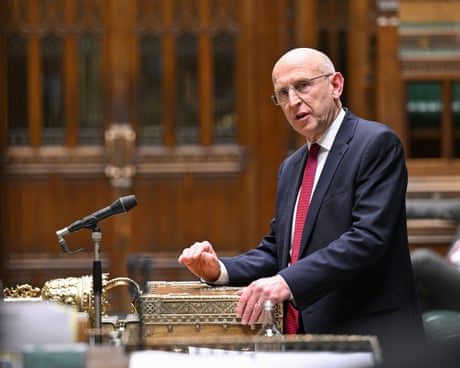
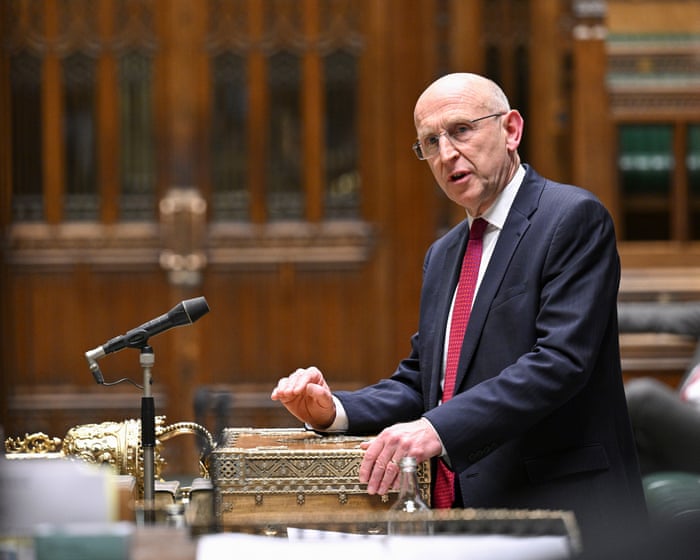
John Healey’s resignation as defence secretary on Thursday was a long time brewing, though in the end the denouement was swift. It leaves an already weak Keir Starmer without a defence strategy less than a month before a Nato summit and an unresolved row about spending as Donald Trump threatens to restart the bombing of Iran.
On Monday, No 10 finally told Healey how much more money it was prepared to give the Ministry of Defence to fund major projects as part of the defence investment plan (Dip).
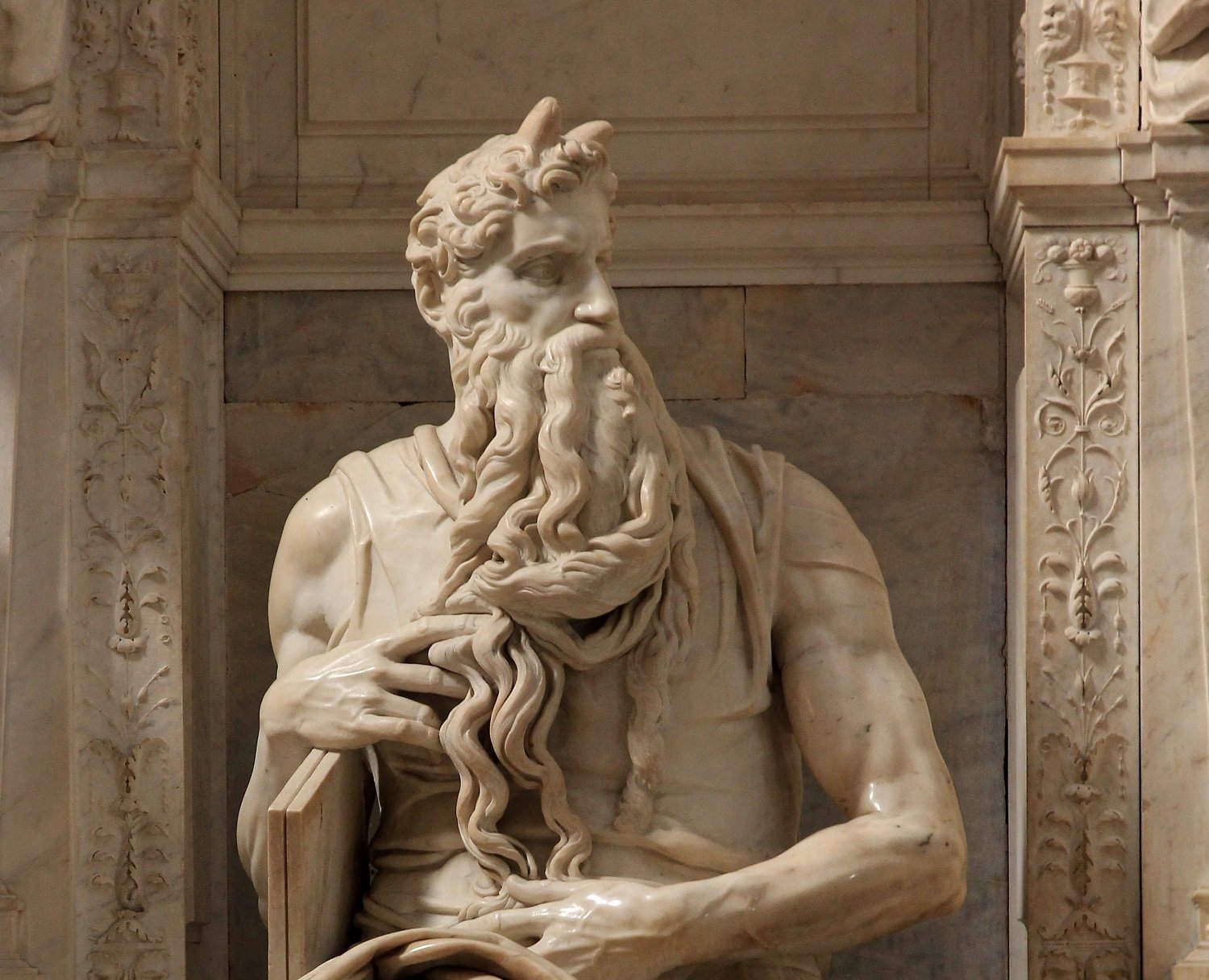
Moses by Michelangelo, c. 1513. Credit: Wikipedia Commons, CC-BY-SA-3.0
Scholars acknowledge that some legends from Greek mythology are strikingly similar to stories from the Bible. According to some theories, a few individual characters from the Bible might also appear in Greek mythology. One theory argues that the famous Moses of Egypt can be found in Greek records. Does Moses really appear in Greek mythology, or is this just wishful thinking?
Who was Moses?
Firstly, let us establish who Moses was. He appears in the Bible books of Exodus, Leviticus, Numbers, and Deuteronomy. Exodus contains the most famous part of his life story. It tells the story of how he was a Hebrew boy placed in the Nile River, where the Pharaoh’s daughter then found him.
When Moses was an adult, he tried to help his fellow Hebrews, who were slaves in Egypt, but then he ran away and remained in a distant land for forty years. He eventually returned after God allowed him to go and free his people from Egypt. Pharaoh refused to let the Hebrews go, but after ten devastating plagues from God, he relented.
Moses led the people out of Egypt across the Red Sea (where Pharaoh and his army drowned after trying to pursue them) and into the Sinai wilderness. There, he gave his people an extensive list of regulations from God, collectively known as the Mosaic Law. He also wrote many religious writings. The first five books of the Bible are attributed to him, as well as several poetic writings.
Did the Greeks know about Moses?
The theory that Moses appears in Greek mythology depends on the idea that the Greeks could have known of Moses in the first place. After all, he could not have appeared in their mythology if they did not know about him.
As it so happens, Moses does appear in quite a few Greek records. The Egyptian priest Manetho, from the third century BCE, mentioned Moses in his history of Egypt. Since Manetho lived in Egypt during its Hellenistic era, it is virtually certain that the Greeks of that region were aware of Moses. They certainly would have known of him after reading Manetho’s history.
Interestingly, there is evidence that the Greeks knew about Moses even before the Hellenistic era of Egypt. The first-century BCE Greek historian Diodorus Siculus wrote about the origin of the Jews. His account came from Hecataeus of Abdera, a Greek traveler from c. 300 BCE.
Hecataeus’ account differs from the Bible’s account in numerous ways, but it is still fundamentally the same story of Moses. Therefore, at least as early as 300 BCE, the Greeks definitely knew about Moses.
Was Musaeus from Greek mythology the same as Moses?
In ancient times, several writers explicitly identified Moses with a certain figure from Greek mythology. This figure was Musaeus. It is obvious that the main reason for identifying the two figures is due to the similarity between their names. But is there any more of a connection than this? Well, what does Greek mythology say about Musaeus?
Musaeus was a legendary intellectual, philosopher, seer, prophet, poet, musician, and historian. The Greeks believed that he founded a class of priestly poetry in Athens. He allegedly lived in the time of Heracles and was associated with Orpheus, another prominent poet and prophet from Greek mythology.
Immediately, we can see that there are some definite similarities between Moses and Musaeus from Greek mythology. In addition to the similarity in their names, their roles are also similar. Moses was a prophet, since he relayed messages from God. He was a poet, since he wrote the poetic book of Job and several of the Psalms. He was also a historian, since he wrote part of the history of the Jews.
Why Musaeus could not have been Moses
Despite these similarities, there is a key reason why Musaeus could not have been Moses. The key reason is that they did not live at the same time.
At first glance, it might look like the chronology works very well. Moses is usually placed at the time of Ramesses II, who ruled in the 13th century BCE. He is also placed in the time of Heracles, who lived about half a century prior to the Trojan War. That would also put him in the 13th century BCE according to the traditional date of the Trojan War. Therefore, it seems at first glance that Musaeus and Moses would have been exact contemporaries.
However, the reality is not so simple. Despite the popular association between Moses and Ramesses II, this has no historical or Biblical basis. The Bible’s internal chronology, along with its genealogical record of the prophet Samuel, places Moses firmly in c. 1500 BCE. That means he lived almost three centuries earlier than the traditional era of Musaeus.
The true era of Musaeus
The theory connecting Moses with Musaeus is further disproved if we examine the information about Musaeus from Greek mythology even more closely. For one thing, there is evidence that the Trojan War occurred several centuries later than the traditional date.
Furthermore, recall that Musaeus was closely associated with Orpheus. Some records say that Musaeus was Orpheus’ son, while other records give the inverse relationship. In either case, they lived at about the same time.
Greek tradition claims that Homer was a tenth generation descendant of Orpheus. That would place Orpheus, and therefore his associate Musaeus, about 200 to 250 years prior to the time of Homer. Since Homer lived in the seventh century BCE, that would mean that Musaeus would have probably lived in the ninth or tenth century BCE. Hence, this would have been long after the time of Moses. Therefore, it is virtually certain that Moses was not Musaeus from Greek mythology.
During Wednesday’s prime minister’s questions, the defence secretary was standing at the other end of the Commons, away from other cabinet members on the government frontbench. His expression gave nothing away as Keir Starmer and Kemi Badenoch blamed one another for spending too much on welfare and not enough on defence. In hindsight, he was possibly thinking “to hell with both of them”. Most defence secretaries go native sooner or later, imagining themselves to be embedded officers serving on the frontline. Tory Ben Wallace appeared to hate most of his cabinet colleagues by the time he resigned in 2023.
Less than 24 hours after PMQs, Healey had also resigned, his departure being all the more powerful for being so unexpected. This exit seemed to come out of a clear blue sky. There had been no briefings to the media in the preceding days. No threats to stand down if his demands were not met. All the arguments had taken place behind closed doors. A determination to do the right thing throughout.
Former defence secretary accuses PM of putting UK’s security at risk at a time of growing international threats
Keir Starmer’s premiership has been pushed to the brink of collapse after the shock resignationof John Healey as defence secretary undermined his security credentials and risked shredding his remaining political authority.
In a blistering resignation letter, Healey accused Starmer and his chancellor, Rachel Reeves, of putting the country’s security at risk, saying the long-awaited defence investment plan (Dip) fell well short of what was required.
Die zentrale Erzählung des Westens ist es, dass Russland aggressiv sei und die NATO angreifen wolle, während die NATO angeblich ein friedliebendes, reines defensives Bündnis sei. In Russland sieht man das anders und warnt vor der Aggressivität der NATO-Staaten, für die es viele Beispiele von Jugoslawien bis Libyen gibt. Was Starmer gesagt hat Am 5. […]
John Healey has resigned as defence secretary over Sir Keir Starmer’s defence investment plan, accusing the Prime Minister of failing to "meet the moment" over his long-delayed proposals to boost military spending.
Can anyone or anything stop Andy Burnham becoming PM now, asks Mark Littlewood in his latest Political Betting column as he contemplates breaking his usual rule and taking the 2/5 odds-on bet.
Most schools in Greece close mid-June for their summer break . Credit A.P. / Greek Reporter
Schools are about to close for summer in Greece! But did you know that if you’re a child who goes to school in Greece, you’re likely enjoying a much longer break than your peers in other parts of Europe?
Schoolchildren in Greece have some of the most generous summer breaks on the continent. These summer breaks typically stretch from mid-June (normally around the 15th of June in elementary schools) to the 11th of September, for a leisurely 12 to 14 weeks of fun in the sun.
So why do Greek children and teenagers get such an extended break compared to their neighbors in central and northern Europe? Well, it turns out there are a few key reasons for this.
The long summer breaks of Greece
Historically, the long summer break period in Greece was meant to allow children to help out with agricultural work during the busiest farming months. These traditions go back in time hundreds of years. We should never forget that, particularly in the past, the majority of Greek families were involved in farming and food production. Thus, it made sense for them to give children a break to pitch in during the peak season out in the fields.
Another main reason for the extended summer breaks is Greece’s sweltering summer climate. With temperatures soaring into the 40s Celsius in June, July, and August, it’s simply too hot to expect children (or teachers!) to concentrate and focus on their learning in stuffy classrooms under the extreme heat of the Greek summers. An extended break during the dog days of summer is a practical necessity for them all and is not only a Greek tradition.
On top of this all, we also have the Greek Orthodox calendar which plays a role. With many important religious holidays peppered throughout the year, a longer summer break helps balance out the school schedule for teachers to ensure that all students still get a proper all-rounded education.
Summer school breaks across the EU. Credit: Eurydice EU
The rest of Europe
But how does the Greek summer break compare to that of other European countries? On average, most European students enjoy a slightly shorter 10 to 12-week holiday. However, there’s significant variation between not only individual countries but also regions within the same country.
Southern European countries such as Italy, Spain, and Portugal follow very similar patterns to that of Greece. These Mediterranean and southern European nations embrace a long summer with breaks often exceeding 12 weeks. It must be all that sunshine, anyway!
Meanwhile, Scandinavian countries, Germany, the UK, and Ireland keep things much more studious with a modest average of a 6-week summer break. Ex-Soviet countries of Eastern Europe, such as Poland and Romania, fall somewhere in the middle with 8 to 10 weeks of summer fun for our little friends.
Interestingly, the UK and Ireland—two countries notoriously known for their less than balmy summers—also have relatively short six to seven-week breaks. Perhaps the British dedication to academics trumps the desire for a prolonged escape from the classroom, one might say. Others would argue that since the weather in this part of Europe is so often miserable and grey, there is not great motivation to get out of the classroom anyway!
On a more serious note, however, there are experts who argue that longer summer breaks can lead to “learning loss.” This could be particularly true in cases in which students forget key academic skills and knowledge during these extended breaks as a result of their losing contact with their schools. Countries with shorter summers tend to spread out breaks more evenly throughout the year. This may support more efficient and continuous learning. In England, for example, children normally get six weeks of summer break, three weeks of half-term breaks (one week at a time), two weeks for Christmas, and two more weeks for Easter.
However, research shows that the quality of instruction and total teaching hours matter more than the exact length of the summer holiday and the period that this is offered. Hence, while Greek students may indeed spend more days on the beach, as long as they put in the work during the school year in its entirety, they’ll still come out ahead.
At the end of the day, there is no one-size-fits-all approach to the education of our children, especially when it comes to structuring the school year. Nonetheless, students in Greece and other southern European countries have a long tradition of enjoying a long summer break, as it is a beloved and cherished tradition that’s here to stay. It is, after all, a tradition embedded within the cultures of these nations. Really, who can even argue against more time soaking up the Mediterranean sun?
Thus, as the final bells rang and Greek children left school for their three-month adventure, they felt lucky to live in a country that prioritizes a healthy balance of work and play. School may be out, but the learning never stops—whether it’s through travel, spending time with family and friends, or simply relaxing and recharging one’s batteries. Lastly, when September rolls around, kids will be ready to once again walk the school hallways they left behind this June.
Tras la crisis reputacional de la pasada primavera por las acusaciones de presuntos abusos psicológicos y físicos a antiguos empleados, el espacio danés cambia de planes y reabre el 5 de agosto en su sede central de Copenhague, liderado por un rejuvenecido equipo de gestión Leer
Tras la crisis reputacional de la pasada primavera por las acusaciones de presuntos abusos psicológicos y físicos a antiguos empleados, el espacio danés cambia de planes y reabre el 5 de agosto en su sede central de Copenhague, liderado por un rejuvenecido equipo de gestión
Investors who bought the automaker’s shares in its initial public offering became rich. As a result, many have a deep faith in Elon Musk, the chief executive of Tesla and SpaceX.
Government confirms Jarvis’s move from role as security minister to replace John Healey
Ryan Henderson, assistant chief constable for the Police Service of Northern Ireland, is about to hold a press conference about last night’s rioting.
Andy Burnham is facing criticism after saying that he thinks the Waspi women should be entitled to “some” compensation.
I’ll stick by the Waspi women because they deserve some recompense for the unfairness.
One government figure decried Burnham’s intervention as “pathetic”, adding: “He can’t say no to anyone.”
An ally of Sir Keir Starmer likened Burnham’s economic agenda to that of hard-left former Labour leader Jeremy Corbyn, and argued that the mayor’s intervention would harm his chances of manoeuvring the prime minister out of Downing Street.
Andy Burnham’s continued support for Waspi women is both welcome and hugely refreshing. While some politicians have broken their promises, it takes real courage to speak out and say what millions of people across the country and hundreds of MPs from all parties already know - that 1950s-born women deserve justice.
Andy has always recognised the unfair way in which state pension equalisation was introduced.
As mayor of Greater Manchester, he supported Waspi women in the city-region with early access to concessionary travel, providing some recompense to them within affordability limits.
Keir Starmer’s closest aides are “war-gaming” how to win a leadership contest ahead of Andy Burnham’s much-anticipated return to Westminster if he wins the Makerfield byelection, the Guardian understands.
Downing Street sources said the prime minister had taken the last fortnight to think seriously about his future but was now “hellbent” on fighting any contest. His team is working through various scenarios, including sacking ministers who publicly support Burnham.
Political and religious leaders in Northern Ireland saw early Wednesday morning — with the embers of a long night of violence in Belfast and other parts of the region still smoldering — that their calls for calm had fallen on deaf ears. Cars, buses, phone booths, and trash cans set ablaze. Homes where immigrants — or simply people from ethnic minorities — were believed to live, completely engulfed in flames after violent groups targeted them as places that needed to be “liberated.”
 Login
Login