Forbes Ukraine first reported on June 8 that Schmidt and his wife, Wendy Schmidt, had acquired a combined 36% stake in seven companies under the Dragon Capital group, a major Kyiv-based investment firm.
Managua, 10 jun (Prensa Latina) La capital de Nicaragua fue incluida en una agenda urbana utilizada en Europa para promover buenas prácticas de ciudades sostenibles, reconocimiento que destaca a la ciudad como un referente regional, resaltan hoy aquí medios locales de prensa.
Domingos Vieira de Matos, economista e presidente do Conselho de Administração do Grupo Medialivre, foi distinguido na edição deste ano do Prémio Carreira FEP.
Aquando da entrega do prémio, o empresário e alumnus da Faculdade de Economia e Gestão da Universidade do Porto (FEP) afirmou que “estar associado” à “história” da instituição “não alimenta vaidades”. “Aumenta a responsabilidade”, continuou.
“É um daqueles momentos raros em que somos obrigados a parar, olhar para trás e refletir sobre a velocidade com que o tempo passa — e sobre o peso da responsabilidade que este “casaco” que vestimos, com o selo FEP, transporta. Quando olho para a galeria de ilustres galardoados que me antecederam — homens e mulheres que ajudaram a desenhar as linhas mestras da nossa economia, que marcaram decisivamente a gestão, a política e o tecido empresarial português — sinto uma humildade profunda e muito genuína e, naturalmente, uma grande honra”, afirmou Domingos Vieira de Matos, num discurso em que percorreu o seu percurso pessoal, académico e profissional.
“Nenhum empreendedor se constrói sozinho. O sucesso nunca é um monólogo. É sempre um diálogo constante: com as nossas origens, com os erros cometidos, com o contexto histórico que atravessamos, com as pessoas que nos desafiam e com as instituições que nos formam”, refletiu.
A propósito da distinção, a family office refere em comunicado que a distinção de Domingos Vieira de Matos “reconhece um percurso empresarial de várias décadas marcado pela recuperação, transformação e desenvolvimento de empresas em diversos setores da economia portuguesa, bem como o seu contributo para o empreendedorismo, inovação e criação de valor”.
O prémio foi entregue na sessão solene do Dia da FEP 2026, no dia 27 de maio. O júri constituído para a escolha do vencedor foi composto pelo Diretor da FEP, Óscar Afonso, que preside sem direito a voto, pela presidente do Conselho de Representantes da FEP, Catarina Roseira, pelo Presidente da Associação dos Antigos Alunos da FEP, Carlos Nunes, e pelos Alumni Eduardo Rocha, Helena Freitas, José Manuel Fonseca, Maria Miguel Leitão e Ricardo Rio.
A defesa da influenciadora entrou com um pedido de habeas corpus que pretendia converter sua prisão preventiva em domiciliar, pelo fato de ser mãe e única responsável por uma criança de 9 anos. O recurso foi julgado pela Quinta Turma do STJ, que rejeitou por unanimidade a tese dos advogados de defesa e reiterou os argumentos para a prisão da influenciadora.
“Consta exposição individualizada e pormenorizada da participação da agravante nos crimes em apuração, indicando seu intenso envolvimento com a organização criminosa e com o esquema de lavagem de dinheiro descoberto pelos órgãos de persecução penal”.
No dia 21 de maio, Deolane foi detida em casa, uma mansão que fica em Alphaville, bairro que concentra condomínios luxuosos na região metropolitana de São Paulo.
Com mais de 20 milhões de seguidores nas redes sociais, a influenciadora foi indiciada pelos crimes de organização criminosa e lavagem de dinheiro. Ela está detida na Penitenciária Feminina de Tupi Paulista, no interior de São Paulo.
Deolane foi presa pela primeira vez em setembro de 2024, durante desdobramentos da Operação Integration. Na época, ela foi detida em Recife pela Polícia Civil, que investigava um esquema de lavagem de dinheiro e jogos ilegais.
A defesa da influenciadora entrou com um pedido de habeas corpus que pretendia converter sua prisão preventiva em domiciliar, pelo fato de ser mãe e única responsável por uma criança de 9 anos. O recurso foi julgado pela Quinta Turma do STJ, que rejeitou por unanimidade a tese dos advogados de defesa e reiterou os argumentos para a prisão da influenciadora.
“Consta exposição individualizada e pormenorizada da participação da agravante nos crimes em apuração, indicando seu intenso envolvimento com a organização criminosa e com o esquema de lavagem de dinheiro descoberto pelos órgãos de persecução penal”.
No dia 21 de maio, Deolane foi detida em casa, uma mansão que fica em Alphaville, bairro que concentra condomínios luxuosos na região metropolitana de São Paulo.
Com mais de 20 milhões de seguidores nas redes sociais, a influenciadora foi indiciada pelos crimes de organização criminosa e lavagem de dinheiro. Ela está detida na Penitenciária Feminina de Tupi Paulista, no interior de São Paulo.
Deolane foi presa pela primeira vez em setembro de 2024, durante desdobramentos da Operação Integration. Na época, ela foi detida em Recife pela Polícia Civil, que investigava um esquema de lavagem de dinheiro e jogos ilegais.
Marx and Aristotle, though centuries apart, both recognized that value is rooted in social relations rather than in objects themselves. Credit: GreekReporter Archive
When the philosopher Karl Marx set out to unravel the mysteries of value, exchange, and labor in capitalist society, he found a surprising intellectual ally in Aristotle, the ancient Greek philosopher who lived two millennia earlier. Despite their different historical contexts, both thinkers examined how value arises not inherently from things but from their social relations—especially through the lens of use and exchange.
Marx, in Capital, openly acknowledged Aristotle’s importance. Not only did Aristotle lay the groundwork for distinguishing use-value from exchange-value but his reflections on early human society, property, and the role of labor and technology revealed a conceptual framework that Marx would radicalize for modern critique.
Use-value and exchange-value: Aristotle’s anticipation
Aristotle’s analysis of value in Politics distinguishes between two uses of a commodity. One is proper and natural while the other is improper or derivative. He writes:
“Every commodity has two uses: both belong to the thing itself, but not in the same manner—one is the proper use, the other is not. For example, a shoe serves either to be worn or to be exchanged; both are uses of the shoe, for he who gives a shoe in exchange to someone who needs it, receiving in return money or food, uses the shoe as a shoe, but not according to its proper use, for it was not made to be exchanged.”
This distinction—between use-value and exchange-value—is a cornerstone of Marx’s analysis. For Marx, this Aristotelian formulation prefigures what he calls the “value-form” of the commodity. Commodities are useful in particular ways (use-value), but also enter into a social system of equivalence when exchanged (exchange-value).
Marx directly builds on this by showing that exchange-value does not exist inherently in an object but arises through the abstraction of labor—because human labor makes different useful things commensurable. Aristotle notes that a shoe does not exist for exchange. Marx took this insight and asked: What kind of society inverts this logic and makes objects valuable only in proportion to their exchangeability rather than their utility?
From the household to the marketplace: society before exchange
Aristotle’s theory of the household (oikos) as the first form of society was essential for Marx’s historical materialism. In Politics, Aristotle describes early society as beginning with families. In these families, property was communal and exchange unnecessary. It was only as the population grew and self-sufficiency gave way to interdependence that markets and money emerged.
Marx adopts this trajectory in Capital and his Grundrisse notebooks, writing that commodity exchange is not a timeless activity. Instead, it is a historically specific development that reflects changes in social relations and property forms. The transition from common property to private ownership and from useful production to production for exchange is the material foundation of class society.
In Aristotle, we already see the seeds of this analysis. He distinguishes between natural wealth-getting (production for use) and unnatural chrematistics (the accumulation of wealth for its own sake). Marx seizes upon this distinction to critique capitalism as a system in which the unnatural pursuit of profit replaces human need as the goal of production.
A statue of Aristotle. Credit: Public Domain, via Wikimedia Commons
The machine and slavery
One of the most striking moments in Capital (Vol. I) occurs when Marx discusses machinery and automation. Here, he ironically invokes Aristotle’s dream that if tools could operate themselves, no slaves would be needed:
“If—dreamed Aristotle, the greatest thinker of antiquity—if every tool could perform its task at command or even by anticipation, like the statues of Daedalus that moved of their own accord, or the tripods of Hephaestus that spontaneously began their sacred work, if the shuttles of the loom wove by themselves, then master craftsmen would not need assistants, nor masters slaves.”
This vision did not remain uniquely Aristotelian. Antipatros, a Greek poet from the era of Cicero, hailed the invention of the watermill—the earliest rudimentary form of productive machinery—not simply as a technical advancement but as a social revolution. He praised it as the liberator of enslaved women who had been condemned to grind grain by hand. He envisioned it as the usher of a new golden age of human dignity and freedom.
In these ancient myths and poetic praises, technology is seen not merely as efficiency but as emancipation. The ancients, despite their slave-based economies, understood that the highest purpose of tools was to free people from servitude.
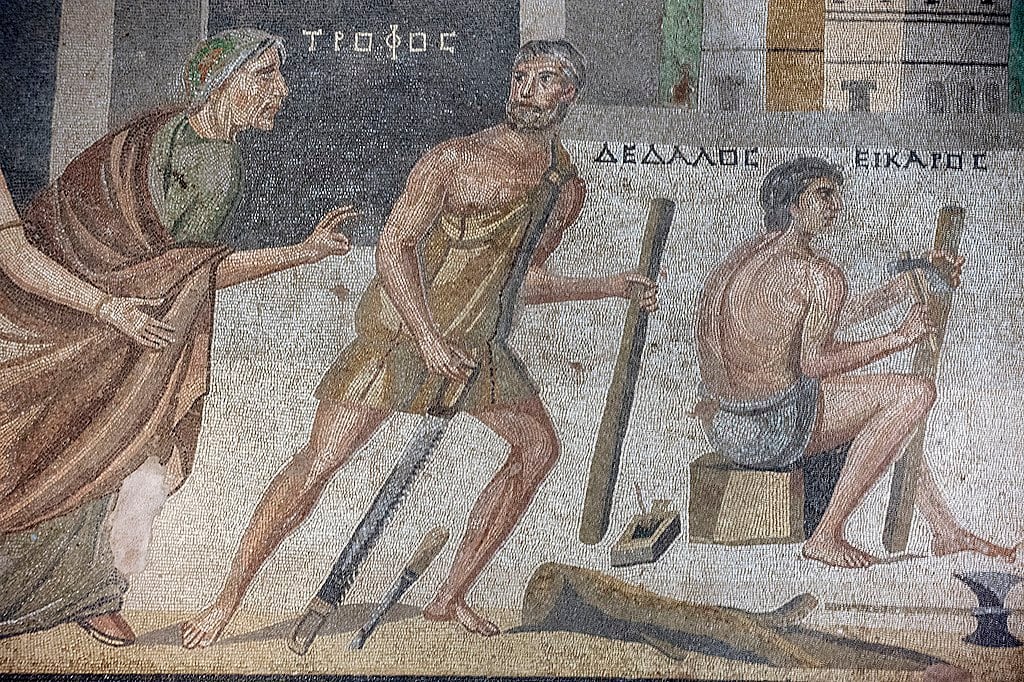
Gaziantep Zeugma Museum Daedalus mosaic. Credits: Dosseman / Wikimedia Commons CC BY-SA 4.0
Marx’s irony and the betrayal of the promise of automation
Marx, however, saw this ancient hope turned upside down in modern capitalist society. In his words, what was supposed to free labor had become its jailer:
“Ah, those idolaters! They knew nothing of political economy or Christianity, as discovered by clever Bastiat and even cleverer McCulloch. They failed to understand, among other things, that the machine is the most reliable means for lengthening the working day.”
Here, Marx mocks the liberal economists of his time. Frédéric Bastiat and John Ramsay McCulloch, champions of laissez-faire capitalism, celebrated mechanization without recognizing its role in intensifying exploitation. Unlike the “idol-worshiping pagans,” who at least had the imagination to conceive of automation as a force for liberation, these modern theorists lacked even that mythical foresight.
Marx continues with biting irony:
“They failed to understand, among other things, that the machine is the most reliable means for lengthening the working day.
Thus the strange phenomenon arises in the history of modern industry. That the machine, the most powerful instrument for reducing labor time, becomes the most unfailing means of converting the whole life of the worker and his family into labor-time for capital’s valorization.”
The true paradox for Marx is that mechanization offers a means to liberate humanity but capital instead weaponizes it to intensify exploitation. The ancients envisioned automation as a means of human emancipation. Capitalism uses it to deepen alienation and dependency.
The irony is profound: the ancients dreamed of freedom through the machine, and capitalism delivered machines that reinforce dependency. In this way, Marx reclaims the ancient vision but also shows how the promise of automation has been betrayed.
Antipatros celebrated the invention of the watermill as a liberating force, heralding it as a symbol of a new golden age of human dignity. Credit: Pietro da Cortona, Wikimedia Commons, Public Domain
Aristotle and Marx: From ancient slavery to modern compulsion
Marx’s dialogue with Aristotle was not just academic—it was dialectical. He admired Aristotle’s clarity in distinguishing between types of value and his historical insight into the development of exchange. However, Marx also showed how the slave economy of antiquity historically constrained Aristotle’s ideas.
Ironically, in an age in which full automatism is increasingly possible, the prevailing economic model continues to reproduce the conditions that Aristotle associated with slavery—not through direct ownership of people but through economic compulsion and structural inequality. In that sense, Marx saw in Aristotle both the seed of critical insight and the limit of pre-modern social theory.
Hence, while Aristotle could not imagine that labor determines value in commodities, he sensed something essential: that value is not a thing but a relation and that social forms of labor determine the shape of society itself.

 Login
Login