Triumphant Achilles dragging Hector’s body around Troy, from a panoramic fresco of the Achilleion. Credit: Franz Matsch / Public Domain
He was the swift-footed Achilles, the greatest warrior of the Trojan War, a semi-divine hero whose very name was synonymous with speed and power. And yet, for centuries, the smart brilliance of an ancient Greek philosopher has left him perpetually—and quite comically—stuck behind a tortoise. Zeno’s paradox presents a philosophical conundrum that still captivates people millennia after it first questioned the intellectual doctrines of Ancient Greece.
It is a paradox that prompts us to question the nature of motion and reality itself. Specifically, it compels us to explore the infinite—a concept that still confounds quantum physicists today.
Zeno’s Paradox: The problem with Achilles and infinite steps
Picture the scene: Achilles, in all his glorious, muscular beauty, lines up against a tortoise. The tortoise, naturally, gets a head start—a gesture of fair play, one might say, that quickly devolves into philosophical torture.
Credit: Loco Steve, Wikimedia Commons, CC BY-SA 2.0 (left), Greek Reporter archive (right)
During this event, Achilles, being well, would instantly sprint past the slow tortoise. But Zeno, with a mischievous twinkle in his eye, argued otherwise. Before Achilles can even reach the position where the tortoise started, the cute little animal will have managed to go forward a little compared to its initial position.
When Achilles finally arrives at that particular spot, the tortoise has moved again. This would carry on forever. This continuous cycle, Zeno noticed, continues ad infinitum, meaning Achilles is forever playing catch-up, never truly reaching the tortoise. It sounds childish and blatantly wrong, but is it? Think about it. It makes sense. It’s enough, at least, to make you wonder about what’s real and what isn’t.
Zeno of Elea’s Achilles paradox. Credit: Aelwyn. CC BY-SA 4.0/ Wikimedia Commons/Aelwyn
This confused the ancient Greeks, whose understanding of infinity was still rudimentary. It challenged the very idea of continuous motion, suggesting that movement itself might be an illusion, a series of frozen moments rather than a fluid progression. Indeed, Zeno’s mentor, Parmenides, had famously argued that reality was static and unchanging, and our perception of movement was nothing but a trick of the senses.
Zeno, always the loyal—and brilliant—student, used his paradoxical skills skillfully as an intellectual shield for this peculiar paradox. One can almost imagine the expressions on the faces of Athenian philosophers as Zeno calmly explained why their fastest runner could never quite outrun a slow tortoise.
Of course, modern humans comprehend concepts such as calculus, therefore understanding that Zeno’s apparent deadlock is resolved. Mathematicians like Newton and Leibniz, centuries later, demonstrated that an infinite series of ever-decreasing distances can indeed sum to a finite total.
This means that in Zeno’s paradox, Achilles does overtake the tortoise; the finish line, for him, is not an illusion. Yet, to dismiss Zeno’s paradox completely as a mathematical footnote and a logical mistake would be to miss its profound impact on human thought.
It was a puzzle that had such a consequential effect that it shaped our understanding of the universe. Consider quantum mechanics, for example, where particles seem to exist in multiple states simultaneously—a concept similar to Zeno’s discomfiting fragmentation of reality.
Our digital devices work by breaking down continuous processes into tiny, distinctive steps. This is similar to how a movie creates the illusion of motion from individual frames. This approach, which traces back to Zeno’s ideas about infinitely dividing space and time, is embedded in much of our modern technology.
However, beyond academia and the complex equations of physics that ordinary people can’t even comprehend, the paradox of Achilles and the tortoise has a surprisingly relatable, almost melancholic, wisdom for our own lives that is easier to grasp.
Modern life sometimes feels like the paradox of Achilles and the tortoise: A never-ending struggle to reach our goals, only to realise it’s not possible. Credit: Greek Reporter
Achilles and the tortoise as a modern metaphor for our lives
How many times have we felt like Achilles, tirelessly chasing a goal, a dream, or even just the promise of a calmer, better tomorrow, only for it to perpetually remain just out of reach? Life, too, often feels like a series of infinite, tiny steps, each requiring immense effort, each seeming to bring us no closer to the finish line despite the progress we make daily.
Yet, Achilles and the tortoise, when illuminated by the light of calculus, can become a story of hope. It tells us that even an infinite process can have a finite, tangible result, perhaps representing the better tomorrow we all strive for. Progress is undeniably real, however gradually it arrives.
So, the next time you feel stuck, relentlessly pursuing a goal that seems to go further away with every step, remember Achilles and that remarkably slow tortoise.
Zeno, the ancient Greek mastermind, may have created this paradox to confound his contemporaries. But in doing so, he left us with a timeless truth: movement—whether through space, thought, or life itself—is never as simple as it appears. Yet, if we keep putting one foot in front of the other, even if the journey feels impossibly long, like Achilles, we will get there. Eventually.
Early Greek alphabet painted on the body of an Attic black-figure cup. Today, there are missing letters in the Greek alphabet. Credit: flickr / Dan Diffendale CC BY-SA 2.0
The Greek alphabet has changed in many ways over the course of its existence. This is hardly surprising, given that the Greeks have been using it for nearly three millennia. One way in which it has changed is that some letters that used to exist in the Greek alphabet are now missing. Which letters were these, and what do we know about them?
The first letters of the Greek alphabet
To start, let us establish how the Greek alphabet acquired its letters in the first place. According to ancient Greek historians, the Greeks adopted the Phoenician alphabet after the arrival of a Phoenician prince named Cadmus. Archaeology confirms that this occurred at some point in the ninth century BCE.
The Phoenician alphabet was composed of only consonants. When the Greeks adopted it, they modified it to include vowels as well. This was a major step forward in the development of writing.
According to Plutarch, a Greek historian of the first century CE, there were originally sixteen Greek letters. However, Hyginus, an earlier writer, reports that there were originally eighteen.
In reality, it appears that neither version is correct. Physical evidence in the form of ancient inscriptions reveals that the earliest Greek inscriptions made use of all twenty-two letters in the Phoenician alphabet. However, four of these were for sounds which did not exist in Greek, so they were modified into vowels.
Perhaps this is where Hyginus’ idea of eighteen original letters comes from, being a distorted memory of the eighteen original consonants. In any case, the total number of letters in the Greek alphabet increased over time.
Why are there some missing letters?
Some of the letters used in ancient Greek inscriptions are simply not in the modern Greek alphabet. Why is this? Simply put, the reason is that the Greek language itself has evolved over time, and the alphabet exists to comply to the needs of the language rather than vice versa.
Additionally, different dialects of the Greek language existed within the Greek world at the same time. Therefore, the needs of each dialect would not necessarily be covered by the same letters.
In the late fifth century BCE, the alphabet used by the Ionian Greeks became the official, standardized alphabet of Athens. Over the following century, it then replaced the local alphabets of other Greek regions. By that time, the dialect of the Ionian Greeks was such that their alphabet did not make use of all the letters that had once been in use. Rather, their alphabet used just twenty-four letters. Hence, what were the letters that the Greek alphabet used to have but no longer does?
Digamma
One of the most famous lost letters of the Greek alphabet is Digamma. This had the following form:
Ϝ
It is superficially very similar to the modern F, but the sound was completely different. It was essentially the modern w sound. In fact, the original name for this letter was ‘wau’, taken directly from the Phoenician name for this letter.
San
Another lost letter is San. This had the following form:
Ϻ
Like Digamma, this looks almost identical to a more familiar letter. In this case, it looks just like the modern letter M. However, like with Digamma, the sound indicated by this ancient letter was completely different. Unlike the modern M, the ancient San, or Ϻ, was used to indicate an s sound. This fell out of use in favor of the alternative letter Sigma, written as Σ.
Koppa
Another letter that is no longer in use is Koppa, which had the following written form:
Ϙ
This is similar to the modern Q in the English alphabet, and that is no coincidence. Koppa was still part of the Greek alphabet when the Latins adopted it, which led to this letter eventually becoming the Q in English. The English alphabet originated from the Romans. The sound Koppa indicated was a k sound. It eventually fell out of favor in Greek, being replaced by the alternative letter Kappa, written as Κ.
Sampi
This next letter is called Sampi. It was written as:
Ͳ
This is very similar to the modern T, but it is unrelated. That modern letter comes from the ancient Greek Tau which, of course, had a t sound. In contrast, the ancient Greek Sampi had some kind of s or sh sound, although the exact vocalization is unknown. In any case, it fell out of favor when this sound was no longer used.
A digital representation of Ctesibius. Credit: Greek Reporter archive
Ever found yourself scratching your head, wondering if aside from legendary philosophers and epic poets there were also any “tech gurus” in ancient Greece? When the conversation turns to Greek scientific minds, one might think of figures like Archimedes and Euclid and rightly so. However, there’s a name that truly deserves a much brighter spotlight—that of Ctesibius.
Ctesibius was a true genius of Hellenistic Alexandria, who, quite literally, set the wheels (and yes, the water organ, or hydraulis!) in motion. Due to his brilliant mind, he laid down fundamental principles for technologies that, believe it or not, continue to shape our everyday world to this very day.
Ctesibius was one of ancient Greece’s greatest innovators
Born into the vibrant, intellectual epicenter of Alexandria during the Ptolemaic era, Ctesibius became a hands-on inventor, driven by an almost insatiable curiosity to truly understand and harness the raw power of the natural world.
Imagine at a time when entire civilizations relied on human muscle and simple machines, seeing someone create music from water or build a clock accurate for two thousand years. The sheer innovative audacity of Ctesibius was difficult to fathom.
Of course, at a time of wizards, this wasn’t a magic trick but the real, unadulterated brilliance of the mind of this Greek man. His groundbreaking contributions to pneumatics, the study of compressed air, and hydraulics, the science of liquids in motion, were utterly revolutionary for their time, making Ctesibius the “father of pneumatics.”
Just think about the fact that long before your car tires ever saw a pump or your pneumatic drill came to life, Ctesibius meticulously explored the very principles that made these tools possible. It’s a bit humbling, isn’t it, how many unsung heroes from antiquity have genuinely shaped the modern world we so often take for granted?
Reconstruction of the ancient hydraulis on display at the Kotsanas Museum in Athens. Credit: Aga39memnon, Wikimedia Commons, CC BY 4.0.
From melodic water organs to clocks
Among Ctesibius’ most well-known creations was the hydraulis, a genuinely revolutionary water organ. This was, quite simply, the world’s very first keyboard instrument. What an astonishing feat of engineering from over two millennia ago! It ingeniously utilized water pressure to guarantee a completely constant supply of air to its pipes, producing a sound that was remarkably stable and resonant. Imagine the awe of ancient audiences in hearing such a complex, melodic instrument for the absolute first time. It must have felt like nothing short of a miracle.
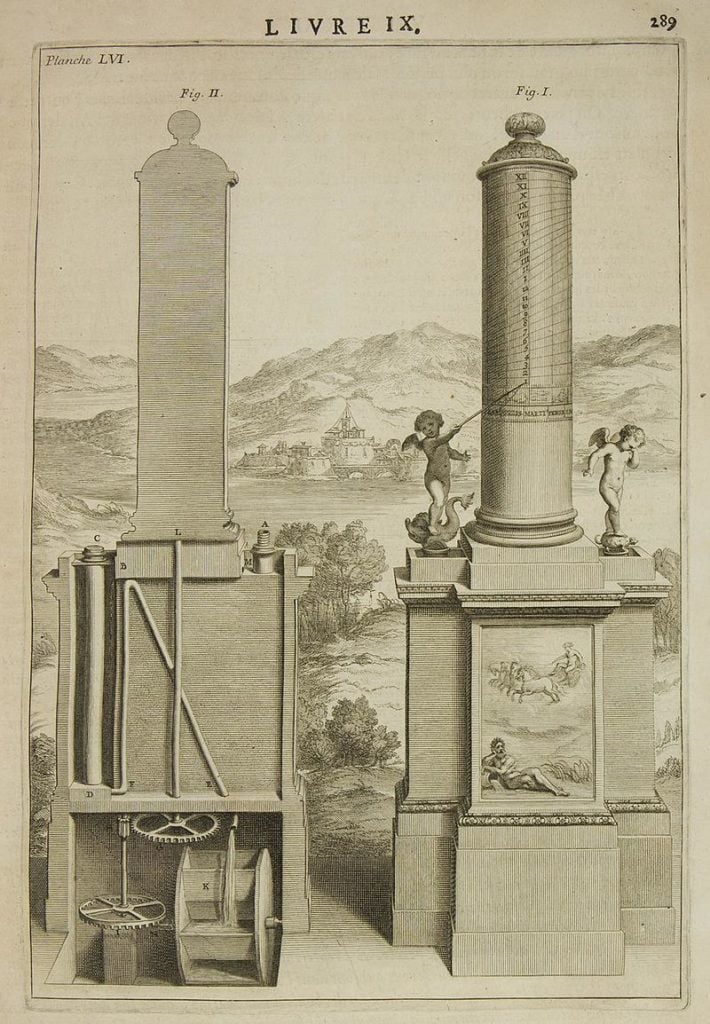
Beyond the enchanting music, Ctesibius’ improvements to the clepsydra, or water clock, were equally impressive. Prior to this tech guru, water clocks were notoriously imprecise. He revolutionized them through innovative mechanisms for regulating water flow and added an indicator system that provided unprecedented accuracy.
For over 1,800 years, his water clocks were the absolute gold standard in timekeeping. In other words, the pinpoint accuracy of your smartphone’s clock owes an indirect yet profoundly deep debt to a man who lived centuries before the mere concept of electricity was even a thing.
Ctesibius’ water clock, the first alarm clock ever, as depicted by an architect in the 17th century. Credit: Wikimedia Commons, Public domain
Ctesibius’ impact on our world
While Ctesibius himself may not have managed to become one of ancient Greece’s top names, his principles and inventions survived the test of time. They influenced later Roman and Arab engineers and eventually powered the European Renaissance. The very force pump he designed, for instance, is a direct progenitor of modern pumping systems, absolutely essential for everything from our city water supplies to the fire engines we rely on to keep us safe on a daily basis.
His profound understanding of the properties of air-laid processes set the foundation for all future pneumatic applications which today power everything from colossal industrial machinery to delicate medical devices. Hence, next time you hear the satisfying whoosh of a bus door, the gentle hiss of an automated machine, or simply admire the quiet precision of a modern watch, take a moment to think back to Ctesibius, the ancient Greek tech genius.
There is something about Greece that sets it apart from many other holiday destinations across the globe; its mythological sites.
Many ancient societies had different beliefs and myths, but none are more prominent in modern-day life than that of the Greeks. Their creatures have become legends, their tales inspiration for great fiction and their gods immortalized through the continued retelling of their conquests and trials.
Delos: an ancient mythological site in Greece
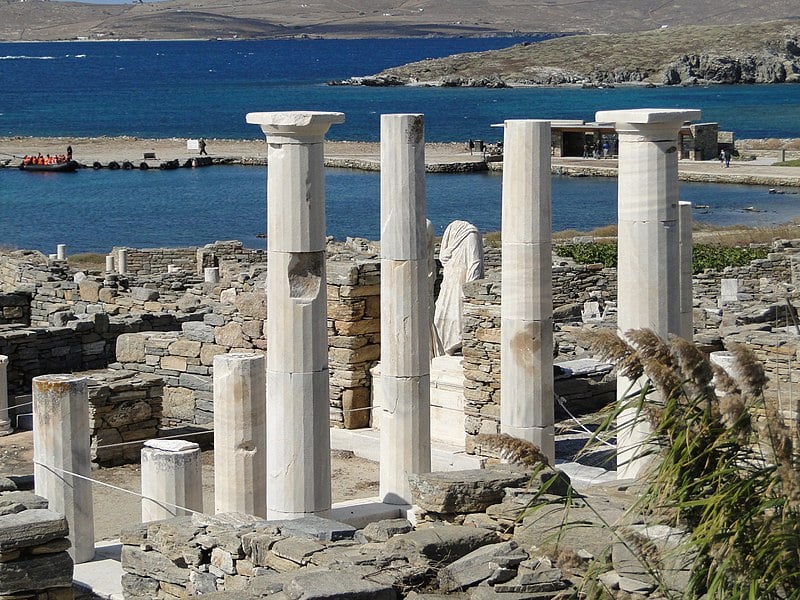
Matched only by the Acropolis of Athens, Greek mythological site the ruins on the island of Delos are an unmissable location for anybody interested in ancient Greek culture. One of the best-preserved examples of an ancient Greek civilization, the island is completely unblemished by modern architecture and as such, allows its visitors to delve deep into history.
However, it is not just a site of great historical importance, but a mythological one too. It was on this island that both gods Artemis and Apollo are said to have been born. As a result, the island became a sacred place. Sanctuaries and temples sprung up across its hillsides as people from across Greece came to the island’s shores to worship the deities.
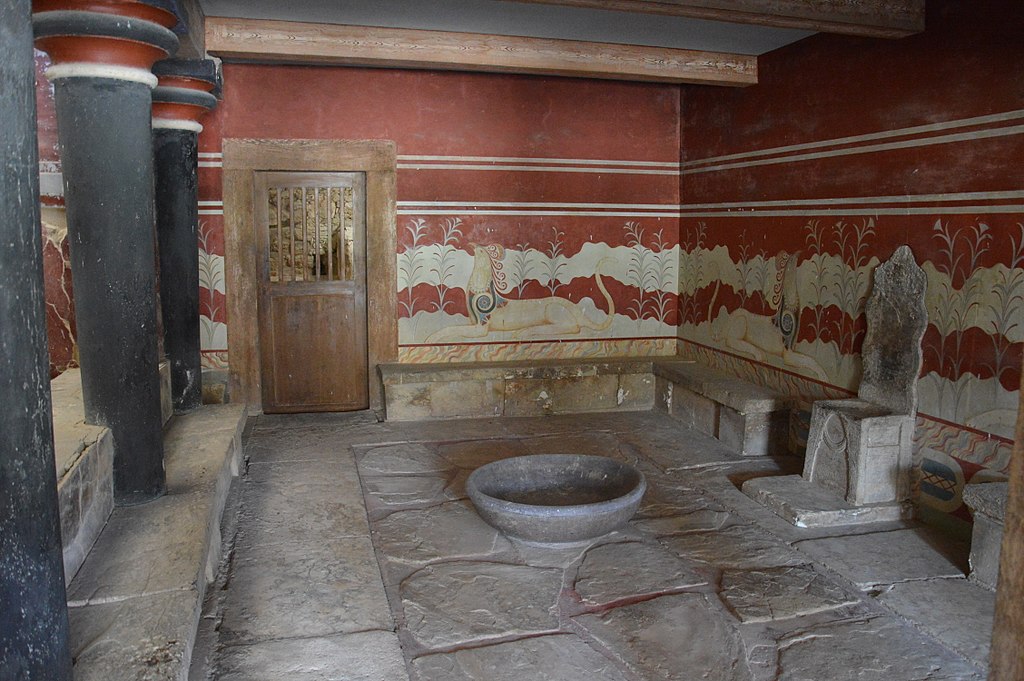
Throne room of the Minoan Palace in Knossos, Crete Credit: Annatsach – Wikimedia Commons / CC BY-SA 4.0
The Labyrinth, a famous site in Greek mythology
One of the most famous and exciting stories of Greek mythology is the tale of Minos, Theseus and the Minotaur. Minos was a powerful king, ruler of Crete and the son of Zeus, but after he betrayed Poseidon, he was cursed to raise a son with the body of a man and the head of a bull. Using this curse to his advantage, however, Minos built the fabled Labyrinth and trapped the Minotaur within it. He would then send victims to their deaths until Theseus, prince of Athens, ventured into the Labyrinth and slayed the beast.
While there are no Minotaur bones for you to see, there are two possible Labyrinths to explore. First is the likely home of King Minos, and therefore the most plausible home for the labyrinth, Kommos. Located along the southern coast of the island, Kommos is a great place to visit, with spectacular ancient ruins and beautiful ocean views.
However, if you venture deep enough into the ruins of this ancient city, you will find many maze-like corridors and walkways that may have been the Minotaur’s home; or at least the inspiration for its tale. However, just down the road you will also find Gortyn, a site of great archaeological importance to Crete and another suspected home of the Labyrinth. Further away from Minos’ home, these ruins bear a much similar resemblance to the maze of mythology. Perhaps then, it is best to visit both Greek mythological sites and decide for yourself.
The Island of Ithaca: an ancient Greek site and holiday destination
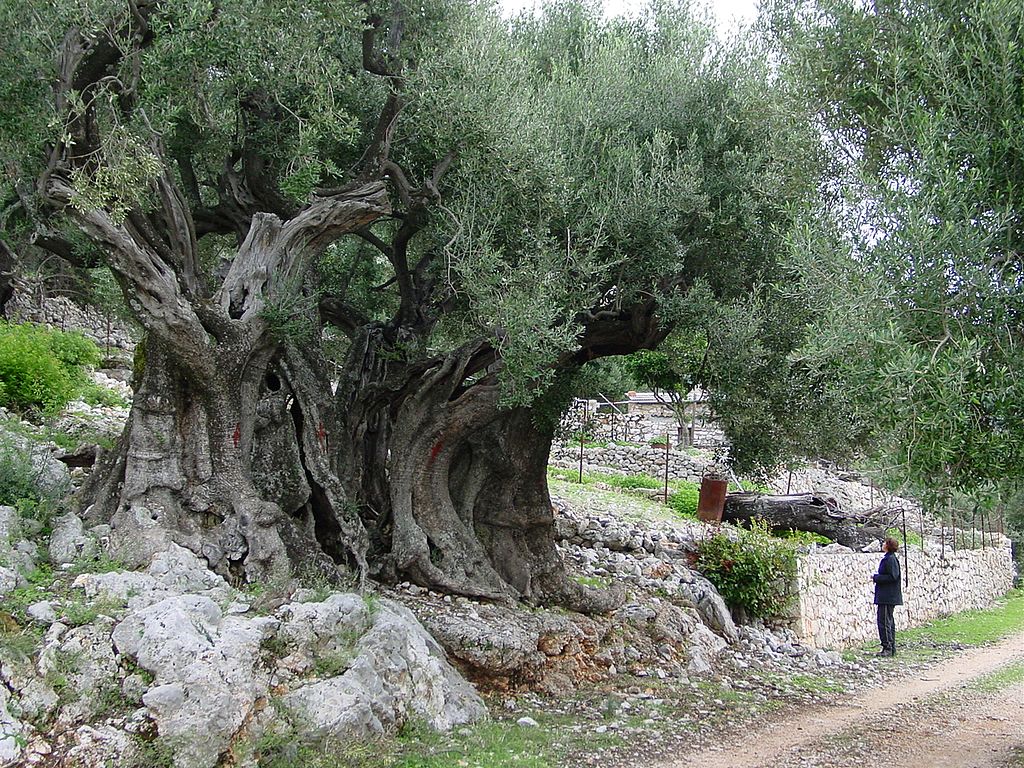
An olive tree on Ithaca that is thought to be 1,500 years old. Credit: Wikimedia Commons
Ithaca, a well-known Greek mythological site for a holiday destination, is a place with a very interesting mythological past. Most notably, it was home to the legendary trickster Odysseus, the island’s greatest king and the brains behind the trojan horse.
Odysseus was also the protagonist of Homer’s “Odyssey.” His decade-long struggle to return home after the war is the source of many of the most enduring Greek myths.
The famous Cave of Zeus on the Greek island of Crete
Cave of Zeus in Crete, Greece Credit: Tomisti / Wikimedia Commons / CC BY-SA 4.0
Hidden away on the island of Crete is an extraordinary piece of Greek mythological history. Within a cave beneath Mount Ida, it is said that the King of Gods, Zeus, was born and raised.
The Cave of Zeus is a beautiful location, with one entrance leading into a network of caves filled with stunning rock formations and underground pools. It does indeed seem a fitting place for the beginnings of the greatest god Greek mythology has ever known. However, it was not by choice he was raised here but by necessity.
His father, the titan Cronus, was set on devouring all of his progeny to ensure that they could never contest his power. However, unbeknownst to Cronus, Zeus’ mother, Rhea, hid him within the cave so one day he could return to overthrow his tyrannical father; which, according to legend, he did.
Along the eastern coast of the Greek mainland, you will find one of the most well-known natural landmarks in the world; Mount Olympus. This legendary and iconic Greek mythological site is an awe-inspiring sight, however, there is more to it than meets the eye.
In Greek mythology, Olympus was created after the gods defeated the titans in the battle of Titanomachy; otherwise known as the War of the Titans. Atop its peak they then built the Pantheon, where Zeus sat upon his throne as King of Gods and the rest of the deities would convene to discuss matters of the world below and survey the world of men.
Seeing all these incredible mythological sites can be tricky, unless you charter a course aboard Deep Blue Yachting’s luxury sailing boat, the Glaros. It is a private vessel, you can set your own course and visit every site on this list, all in one trip.
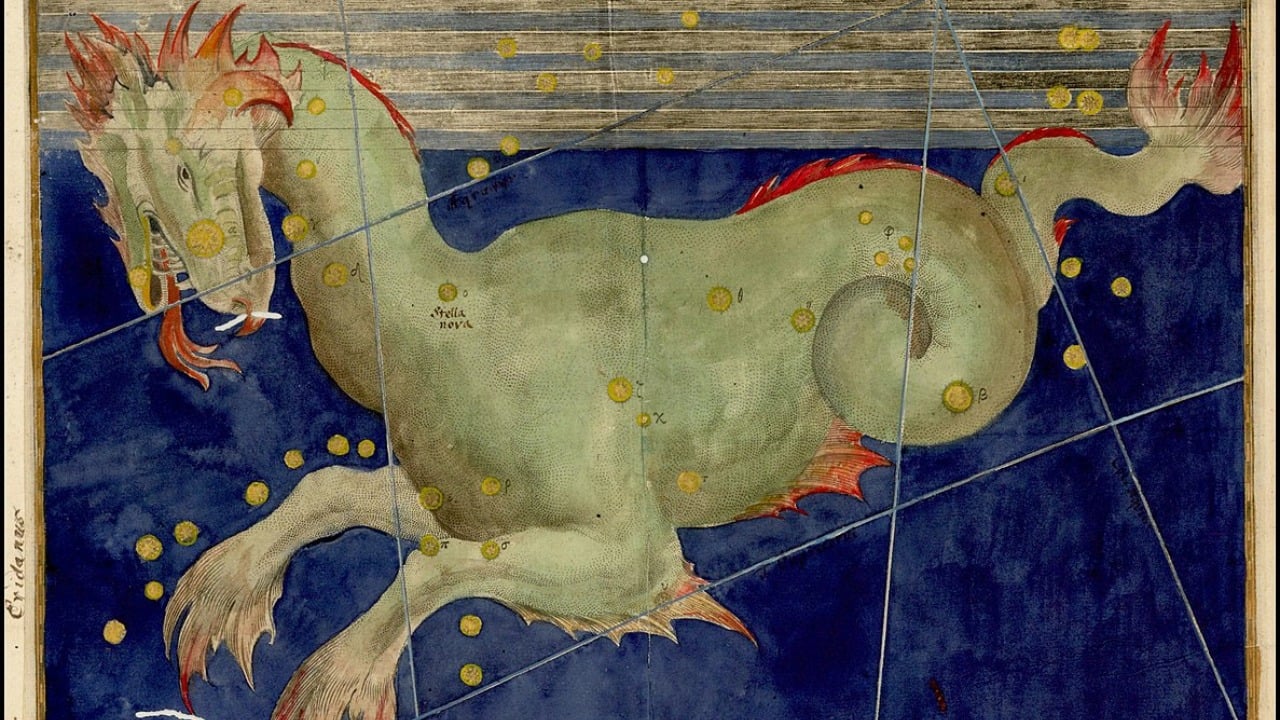
Alexander the Great is said to have encountered sea monsters during his campaigns. Credit: Johann Bayer / Public domain / Wikimedia Commons
As one of the most famous figures in human history, it comes as little surprise that the life of Alexander the Great is tied to several legends of mythic proportions, of which several concern the conqueror’s encounters with sea monsters.
Alexander’s armies traversed much of the known ancient world, leaving their native Macedon far behind them. Over the course of their long campaigns, they encountered many strange sights, some of which may have inspired later myths and legends.
At least two historians, from the ancient and medieval periods, described Alexander the Great and his encounters with sea monsters. The first was Diodorus Sciulus, a Greek historian of the 1st century BC and the Arab scholar Ibn Khaldun of the 14th century AD.
The sea creature at the siege of Tyre, 332 BC
In 323 BC, the intrepid Macedonian king laid siege to Tyre, a well-fortified Phoenician city-state on the coast of the Mediterranean. The city was extremely difficult to penetrate because it was located on an island and was defended by high walls that came right up to the sea.
Nevertheless, it was necessary to capture Tyre to deny the Persians access to a strategically important naval base. Thus, Alexander ordered his engineers to prepare artillery pieces and siege works for an assault on the city.
However, whilst this effort was underway, a strange event in which the army of Alexander the Great encountered a sea monster in the waters around Tyre occurred, according to the writings of Diodorus Siculus.
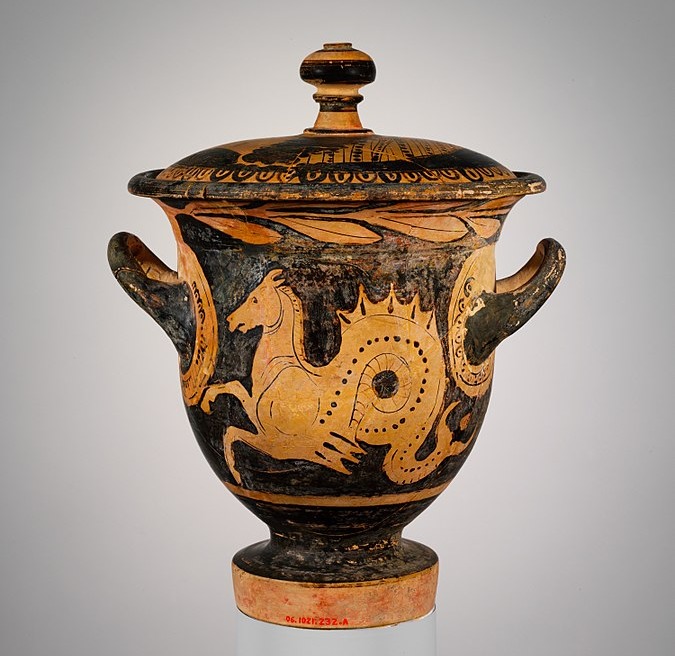
Late 5th century ancient Greek red-figure pottery depicting a hippocamp, a mythical creature with a horse’s body and the tail of a fish. Credit: Metropolitan Museum of Art / CC0, / Wikimedia Commons
“As the Macedonian construction came within range of their missiles, portents were sent by the gods to them in their danger,” wrote Diodorus Siculus. “Out of the sea, a tidal wave tossed a sea monster of incredible size into the midst of the Macedonian operations.”
“It crashed into the mole but did it no harm, remained resting a portion of its body against it for a long time and then swam off into the sea again,” continued the Greek historian. “This strange event threw both sides into superstition, each imagining that the portent signified that Poseidon would come to their aid, for they were swayed by their own interest in the matter.”
A less fantastical explanation for this incident is possible than a mythical sea monster sent by Poseidon. The creature in question may have been a shark, dolphin, whale, or other entirely normal aquatic inhabitant.
Alexander the Great and the sea monsters of Alexandria
The siege of Tyre was not the only time Alexander is said to have encountered a sea monster. According to the Arab scholar Ibn Khaldun, he saw several mythical aquatic beasts in Egypt.
In fact, Ibn Khaldun claimed that sea monsters initially halted the construction of Alexandria until Alexander devised a way to scare them away from the area.
“Sea monsters prevented Alexander from building Alexandria,” wrote the scholar. “He took a wooden container in which a glass box was inserted, and dived in it to the bottom of the sea. There he drew pictures of the devilish monsters he saw.”
According to Ibn Khaldun, “He then had metal effigies of these animals made and set them up opposite the place where building was going on. When the monsters came out and saw the effigies, they fled. Alexander was thus able to complete the building of Alexandria.”
Stoicism was one of ancient Greece’s philosophical movements founded by Zeno of Citium in Athens in the early 3rd century BC. Credit: Public domain
Stoicism, was one of ancient Greece’s philosophical movements founded by Zeno of Citium in Athens in the early 3rd century BC.
Stoicism is a philosophy of personal ethics informed by its system of logic and its views on the natural world. For the Stoic, virtue alone is sufficient for human happiness.
For Stoics, emotions like fear, envy, passionate love were merely false judgements and the sage, a person who had attained moral and intellectual perfection, would not be touched by them.
It is a philosophy of life where the individual maximizes positive emotions, reduces negative emotions, and helps him or herself hone their virtues of character.
The name derives from the porch (stoa poikile) in the Agora at Athens decorated with mural paintings, where the members of the school congregated, and their lectures were held.
Birth of Stoicism, one of ancient Greece’s philosophical movements
The philosophy of Stoicism was originally known as “Zenonism” after the founder, Zeno of Citium.
Zeno ended up in Athens after his ship wrecked near the city. He was not a philosopher, but he turned his misfortune into an opportunity by studying all the philosophical resources available in the city.
He sat in on lectures from the other schools of philosophy (e.g., Cynicism, Epicureanism) and eventually started his own.
However, the Stoics did not believe that the founders were perfectly wise. In order to avoid their philosophy becoming a cult of personality, they chose to name it Stoicism after the place they were meeting, the stoa poikile of the Agora.
Zeno’s ideas developed from those of the Cynics, whose founding father, Antisthenes, had been a disciple of Socrates. Zeno’s most influential follower was Chrysippus, who was responsible for molding what is now called Stoicism.
Other prominent Stoics included Cleanthes of Assos, Panaetius of Rhodes, Aristo of Chios, Posidonius of Apameia, Diodotus, and others.
Later, Seneca, Epictetus, and Roman emperor Marcus Aurelius ushered Stoicism to the Roman world. The philosophy flourished until the 3rd century AD.
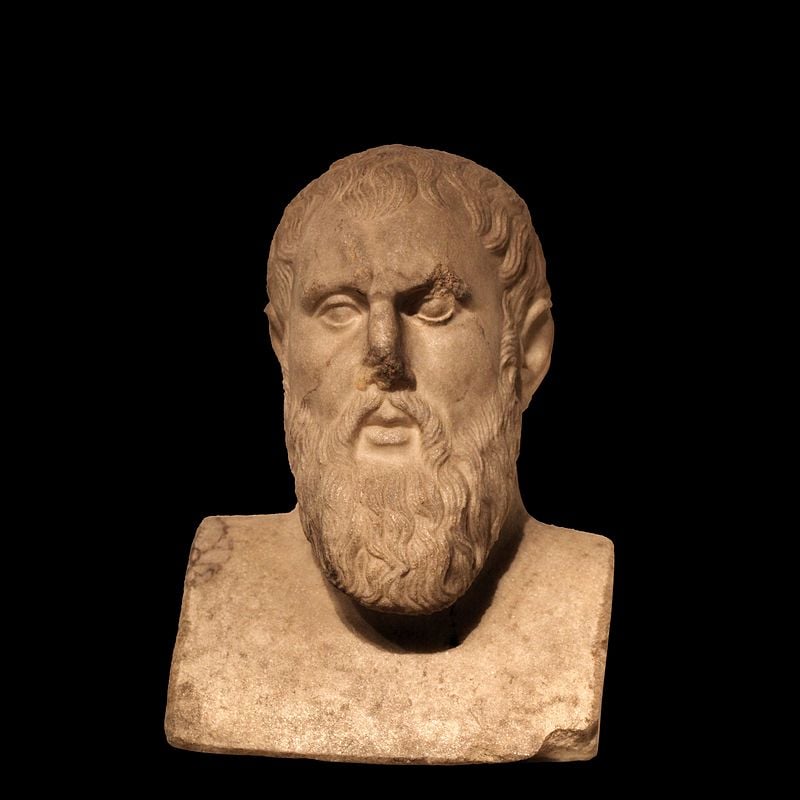
A bust of ancient Greece’s philosopher Zeno of Citium, the creator of stoicism. Credit: Rama/Wikimedia Commons/ Gallo-Roman Museum of Lyon
Stoic Philosophy
According to Stoicism, the path to eudaimonia (happiness) is embracing and accepting the moment as it presents itself by not allowing oneself to be controlled by the desire for pleasure or by the fear of pain.
The Stoic must use his or her mind to understand the world and to do one’s part in nature’s plan by working together and treating others fairly and justly.
The Stoics are especially known for the teaching “virtue is the only good” and that people must lead a virtuous life to be accomplished and complete human beings.
External things—such as health, wealth, and pleasure—are not good or bad in and of themselves but have value as “material for virtue to act upon.”
The Stoics also held that certain destructive emotions, such as fear or jealousy, resulted from errors of judgment, and they believed people should aim to maintain a prohairesis (will) that is “in accordance with nature.”
To live a good life, a person had to understand the rules of the natural order, Stoics believed, since everything was rooted in nature.
For many Stoics, virtue is sufficient for happiness. Thus, a sage would be emotionally resilient to misfortune and would therefore be considered truly free.
According to Stoics, people don’t truly have control over many things and situations in life. Therefore, they believe that worrying about things outside of their control is unproductive, or even irrational for a person who wants to attain tranquility and happiness.
Stoics differentiate between what is and what is not under human control and do not waste energy and thoughts over uncontrollable adverse events.
Where many people worry endlessly about things out of their control, the Stoics believe they should expend their energy in thinking of creative solutions to problems, rather than the issues themselves.
Stoicism is not about having a set of beliefs or ethical claims. It is not a school of philosophy that is separate from everyday life.
The stoic must continuously practice and train (“askesis”). Stoic philosophical and spiritual practices include logic, Socratic dialogue and self-dialogue.
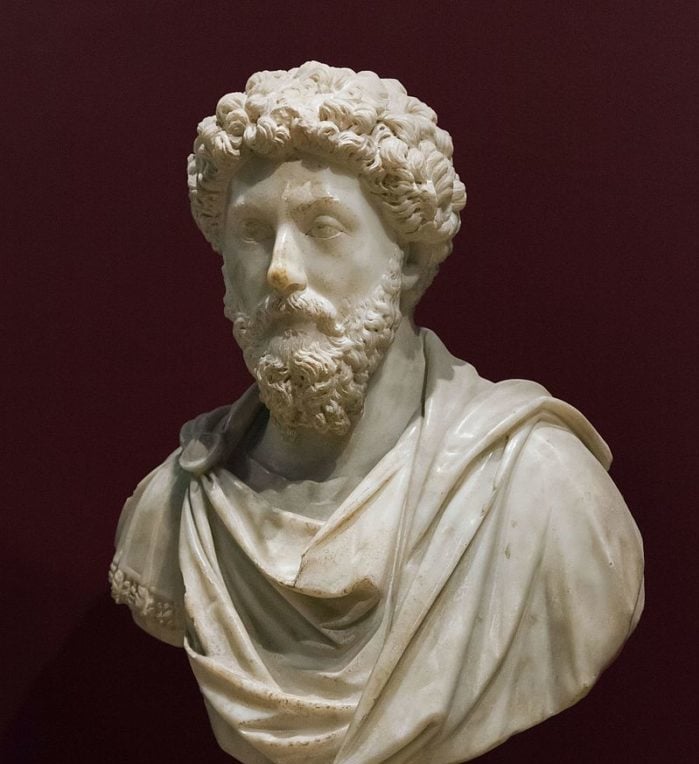
Roman emperor and philosopher Marcus Aurelius. Credit: Eric Gaba/Wikipedia
The Greek term for word is logos. The Greek philosopher Heraclitus used logos (the word) to explain what he saw as the universal force of reason that governed everything.
In the 5th century BC, Heraclitus said that all things happen according to the Logos. The Stoics also believed in the Logos, along with the notions of conscience and virtue.
A few centuries later, Greek-speaking Jews came to view the Logos as a force sent by God. In the Gospel of John, Jesus is referred to as the Word — “and the Word of God was made flesh and dwelt among men.”
The apostle Paul is known to have met with Stoics during his stay in Athens. In his letters, Paul reflected on his knowledge of Stoic philosophy, using Stoic terms and metaphors to assist new converts in their understanding of Christianity.
Both Stoicism and Christianity teach a person the importance of training their mind and body to be disciplined.
Both encourage the elimination of passions and inferior emotions, such as lust and envy, from one’s life, so that the higher possibilities of one’s humanity can be awakened and developed.
“If you want to be perfect, go, sell your possessions and give to the poor, and you will have treasure in heaven,” Jesus preached.
Similarly, as Seneca wrote, “We must give up many things to which we are addicted, considering them to be good.”
The Eastern Orthodox Church and Oriental Orthodox Church accept the Stoic ideal of dispassion to this day, as do ascetics all over the world.
Stoicism today
Daily Stoic, How to be a Stoic, The Modern Times Stoic, Modern Stoicism, Traditional Stoicism: these are only a handful of the websites that hail the importance of—even the need for—Stoicism in the 21st century.
Is it possible, though, for today’s man to embrace a philosophy that teaches indifference to material things and possessions in a ruthlessly material world?
An intellectual and popular movement called Modern Stoicism began at the end of the 20th century which is aimed at reviving the practice of Stoicism.
However, before that, Stoic philosophy served as the original philosophical inspiration for modern cognitive psychotherapy, particularly as mediated by Dr. Albert Ellis’ Rational-Emotive Behavior Therapy (REBT), the major precursor of Cognitive Behavioral Therapy (CBT).
In the original cognitive therapy treatment manual for depression by Aaron T. Beck et al., it is stated, “The philosophical origins of cognitive therapy can be traced back to the Stoic philosophers.”
A well-known quotation from the “Enchiridion” of Epictetus was taught to most clients during the initial session by Ellis and his followers: “It’s not the events that upset us, but our judgments about the events.”
This subsequently became a common element in the socialization phase of many other approaches to CBT.
Ryan Holiday’s The Obstacle is the Way; Stoicism—A Stoic Approach to Modern Life, by Tom Miles; Modern Stoicism, by Steve Brooks; and Modern Stoicism—How to Be a Stoic in the 21st Century, by Stephen Ryan are some of the books on Stoicism that have been published recently.
Famous Stoic quotes
“The happiness of your life depends upon the quality of your thoughts.”
“Luck is what happens when preparation meets opportunity.”
“You have power over your mind—not outside events. Realize this, and you will find strength.”
“It is not death that a man should fear, but he should fear never beginning to live.”
“Think of yourself as dead. You have lived your life. Now take what’s left and live it properly.”
“To live a good life; we all have the potential for it, if we learn to be indifferent to what makes no difference.”
“Death smiles at us all, but all a man can do is smile back.”
“Accept whatever comes to you woven in the pattern of your destiny, for what could more aptly fit your needs?”
“The object of life is not to be on the side of the majority, but to escape finding oneself in the ranks of the insane.”
“The best revenge is not to be like your enemy.”
“Very little is needed to make a happy life; it is all within yourself, in your way of thinking.”
“Loss is nothing else but change, and change is nature’s delight.”
“It is not because things are difficult that we don’t dare; it is because we do not dare that things are difficult.”
“A gem cannot be polished without friction, nor a man perfected without trials.”
“The bravest sight in the world is to see a man struggling against adversity.”
“Throw me to the wolves and I will return leading the pack.”
“Life is never incomplete if it is an honorable one. At whatever point you leave life, if you leave it in the right way, it is whole.”
“Man is affected not by events, but by the view he takes of them.”
“Sometimes even to live is an act of courage.”
“If you really want to escape the things that harass you, what you’re needing is not to be in a different place but to be a different person.”
“He suffers more than necessary, who suffers before it is necessary.”
“It is not the man who has too little, but the man who craves more, that is poor.”
“If a man knows not to which port he sails, no wind is favorable.”
“If you want to improve, be content to be foolish and stupid.”
“The world turns aside to let any man pass who knows where he is going.”
“Seek not the good in eternal things, seek it in yourselves.”
“It is the nature of the wise to resist pleasures, but the foolish to be a slave to them.”
“No man is free who is not a master of himself.”
“It is impossible to begin to learn that which one thinks one already knows.”
“Never depend on the admiration of others. There is no strength in it. Personal merit cannot be derived from an external source.”
An ancient Greek grill for souvlaki from Akrotiri, Santorini. Credit: Wikimedia Commons/ Public domain
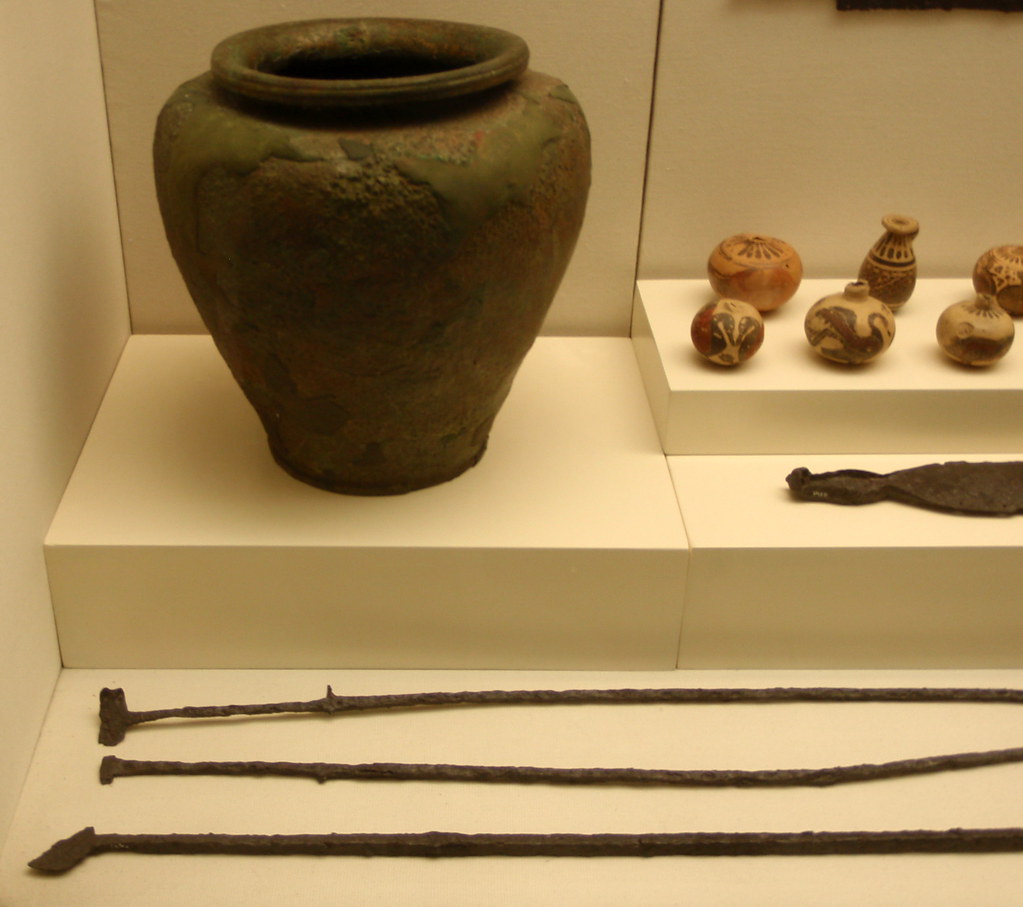
The beloved souvlaki has been around since ancient times. Archaeologists have found skewers dating back to the Bronze Age, and recent research looks at the functioning of early grills. In particular, “souvlaki trays” have been discovered dating all the way back to Mycenaean culture.
Therans and Mycenaean cultures were known for their luxurious lifestyles, ornate and colorful clothes, exquisite art, and sea trade with other cultures, such as Egypt. People developed these cultures on the islands of Crete and Santorini.
World’s oldest Bronze Age souvlaki on Santorini
The oldest souvlaki skewers found seem to be those discovered by archaeologists on Santorini dating back as far as 2000 BC. There are traces of the popularity of souvlaki on Santorini and Crete through the Bronze Age, and both Theran and Mycenean cultures made use of this method of cooking.
Ancient bronze skewers and a vase. Credit: diffendale/CC BY-NC-SA 2.0.
Ancient Greek texts such as the Iliad and the Odyssey describe a spit (Greek: ὀβελός) being used to roast meat, but the exact functioning of the souvlaki trays was unknown until recently. The works of great poets and writers describe the same obeliskos being popular. Sophocles, Aristophanes, Xenophon, and Aristoteles all mention or describe the popular dish in their works.
Mycenean cooking and culture
It seems that ancient Mycenaeans did not have a large variety of foods available to them. Despite this, they developed various types of cooking methods, fostering innovation. Part of that innovation was souvlaki trays, as was cooking in jars, among other techniques. At the time and for most of ancient history, cooking was mostly done on hearths with few ingredients. The portable and lightweight souvlaki trays changed this for Mycenaeans around 1400 to 1050 B.C.
Academics suggest that an important historical force behind these contraptions was status. While the Myceneans had incredibly rich art and fashion, their diet lacked diversity, though a marker of status was drinking wine. On the other hand, one can imagine poorer Mycenaeans drank beer.
As they were skilled sailors, Therans on Santorini island had begun brewing beer in the II millennium B.C., possibly learning the skill from Egypt or the Near East, where beer had been brewed since the III and IV millennium B.C. Accounts of the 5th and 4th centuries B.C. tell of an Athenian bias against beer. It was considered a drink of barbarians, Egyptians, or even women. Beer brewing was never seen as valuable.
By the Classical period, this all changed. Wine had become readily available to all, pushing elites in later Greek societies to seek other ways to distinguish themselves — for instance, through the use of specific gadgets and kitchen appliances, echoing earlier innovations like the Mycenaean souvlaki trays.
The souvlaki tray
The souvlaki trays found in Gla, Pylos, and Crete added something to the age-old tradition. Similar to modern-day outdoor grills, they were designed to be portable and good for travel or entertainment. Meat cuts seem to have been similar to the ones popular for souvlaki today, made from either lamb, pork, or mutton, and the meal was accompanied by bread made of various cereals.
The clay trays had placeholders for the skewers and, until recently, how they actually functioned was unknown. Researchers at Dartmouth College have recreated the trays using original ancient pottery techniques, tools, and ingredients. They realized the trays were not meant to be put on a hearth as originally thought. Rather, embers were placed in the tray and the skewers were grilled. They were practical, portable, and delicious!
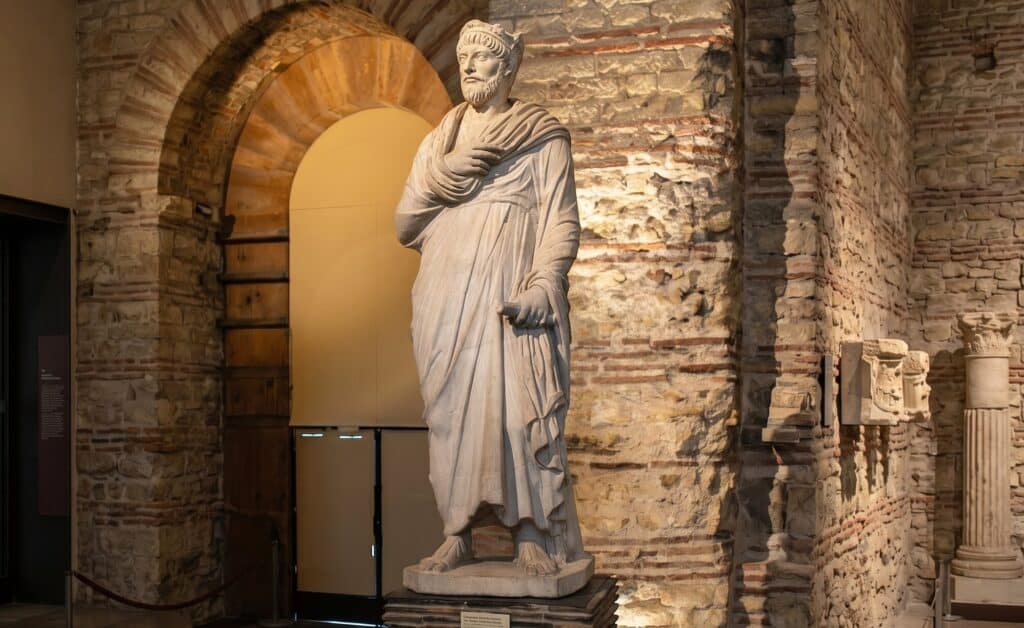
The depiction of Julian in this classical guise shows his commitment to Neoplatonism and Greek culture over the rapidly spreading Christian faith. Credit: Ash Crow, Wikimedia Commons, CC BY-SA 4.0
Few figures in late antiquity present as compelling a historical debate as Julian the Apostate’s attempt to restore the Greek gods in opposition to Christianity in the Roman Empire.
During his brief but highly consequential reign in the fourth century AD, the Roman Empire stood at a profound religious crossroads. For a short period, Julian attempted to slow the empire’s accelerating Christianization, launching a sweeping effort to revive the ancient Olympian pantheon and return Rome to its traditional pagan practices. His sudden death on the battlefield has led historians to debate how dramatically the cultural trajectory of Western civilization might have shifted had his reforms endured.
Julian was born into the heart of the Constantinian dynasty, a family that had only recently converted to Christianity. Nonetheless, he became the last Roman emperor to openly support and worship the traditional Greek gods. He ruled for only about two years from 361 to 363 AD, but he acted with urgency and purpose. Julian the Apostate initiated an extensive program of philosophical and religious reform, aiming to reverse the Christian expansion advanced by his predecessors. To the growing Christian population, he was seen as a traitor to the new religious order, but to those who still admired the intellectual and cultural legacy of the classical world, he appeared as a philosopher-king attempting to restore an older vision of Rome.
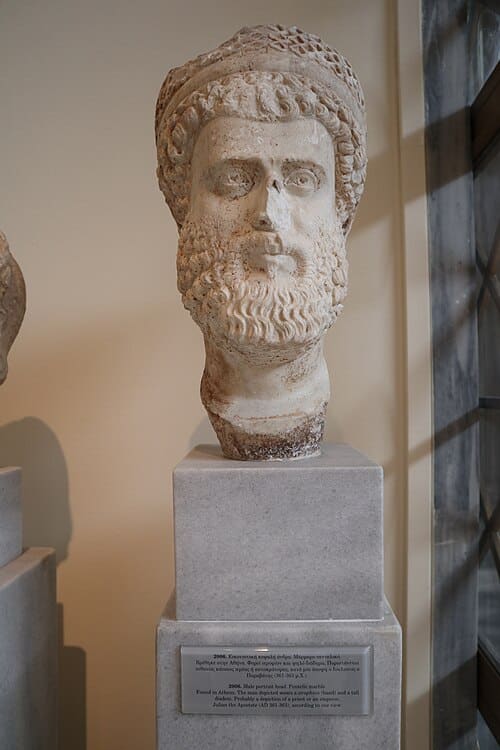
This marble head from Athens is widely believed to be a rare surviving portrait of the Roman Emperor Julian the Apostate. Credit: George Koronaios, Wikimedia Commons, CC BY-SA 4.0
Julian the Apostate’s early life
Julian did not experience the typical sheltered upbringing of an imperial heir. He grew up constantly looking over his shoulder, surviving political purges that eliminated many members of his own family. Although he was raised in a strict Christian environment under the supervision of powerful bishops, he is often understood to have developed a private intellectual attraction to classical texts and traditions associated with the ancient world.
His life took a decisive turn when he went to study in Athens. There, he was secretly initiated into the Eleusinian Mysteries, an experience that deeply shaped his philosophical outlook and strengthened his commitment to rejecting Christianity in favor of Neoplatonism. This forced dual existence helped form a uniquely strategic mindset. He became familiar with the inner workings of the Church, knowledge he later leveraged in support of his own religious and philosophical aims. By the time his troops in Gaul unexpectedly proclaimed him emperor, Julian was convinced that the gods themselves had chosen him to restore the ancient order.
Julian the Apostate as Emperor and the worship of the Ancient Greek gods in the Roman Empire
When he finally took power, Julian did not launch the kind of widespread, violent persecutions often associated with earlier periods of religious conflict. Instead, he pursued a more calculated cultural strategy. His approach focused on weakening Christian influence within imperial institutions while strengthening traditional religious structures. Julian the Apostate reduced the privileges and state support enjoyed by Christian clergy and redirected resources and prestige toward the priesthood of the traditional Greco-Roman religion centered on the Greek gods.
In a particularly controversial move, he restricted Christians from teaching classical literature. His reasoning was that those who rejected the traditional religious framework of Homer and Hesiod should not profit from instructing it. At the same time, Julian sought to make traditional religion more socially competitive by encouraging pagan priests to adopt public charitable functions, including aid for the poor and the establishment of hospitals—areas in which Christianity had been especially successful in gaining support. He appears to have believed that traditional worship had declined not because of its inherent weakness but because its institutions had failed to match the organizational and charitable presence of Christianity.
In practice, many historians argue that this cultural and intellectual strategy posed a different kind of challenge to early Christianity than outright violence. While persecution could strengthen Christian identity through martyr narratives, Julian the Apostate’s policies instead aimed to limit the social structures that supported its continued expansion while restoring the worship of the Ancient Greek gods within the broader Greco-Roman religious tradition.
This illuminated manuscript page depicts vivid scenes of Emperor Julian ordering the arrest of a Christian bishop and overseeing acts of persecution. Credit: Wikimedia Commons, Public Domain
Unfortunately for his beliefs, that grand vision of such a revived Greco-Roman empire came to an abrupt end in the arid regions of Persia. During a military campaign, Julian was struck in the side by a spear, cutting his reign tragically short. Ancient sources and later traditions continue to debate the circumstances of his death, with some attributing the blow to a Persian soldier and others speculating—without evidence—that it may have come from within his own ranks. The true origin remains uncertain.
A well-known tradition holds that, as he lay dying, Julian the Apostate is said to have declared, “Thou hast conquered, O Galilean,” acknowledging the perceived triumph of Christianity. Whether or not he actually spoke these words, his brief reign left a lasting imprint on Roman and Western history. His efforts to restore the Ancient Greek gods within the Roman world continue to be discussed by historians as a striking moment in the empire’s religious transformation. Even in modern Greek cultural memory, echoes of this tension can still be felt in the broader contrast between the rational legacy of ancient philosophy and the spiritual tradition of Orthodox Christianity.
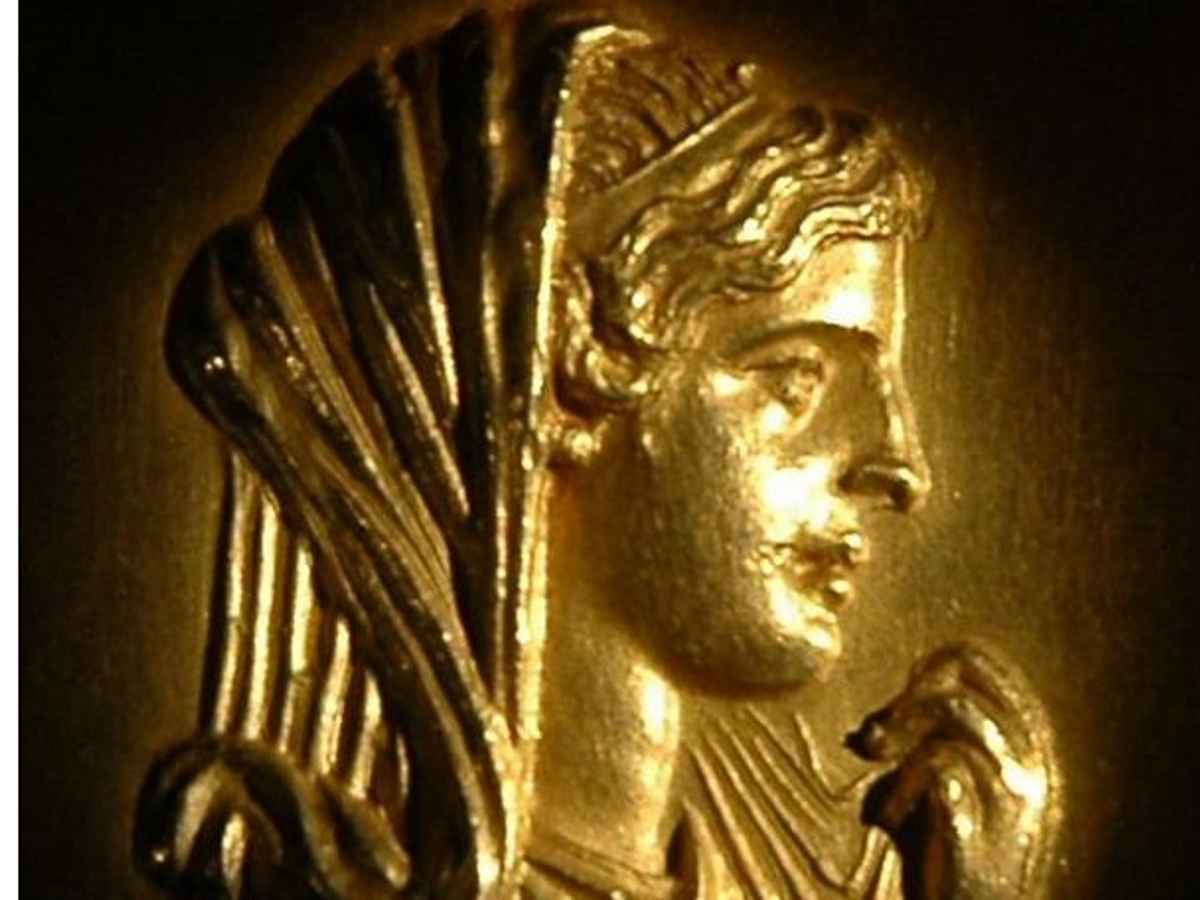
Olympias, the mother of Alexander the Great, who shaped his course and the fate of the Macedonian Kingdom. Credit: Fotogeniss, CC by sa 3.0.
No other woman in Ancient Greek history inspired as much fascination, fear, and controversy as Olympias, the mother of Alexander the Great. She is described as passionate, intelligent, ruthless, and deeply religious. Enemies portrayed her as dangerous and manipulative, while supporters viewed her as a fiercely loyal mother and protector of Alexander’s destiny.
Behind the legends and accusations, however, stood a woman who exercised enormous political influence during one of history’s most transformative periods. Olympias shaped Alexander from childhood, influenced the succession crisis after Philip II’s death, and later played a decisive role in the violent struggles that followed Alexander’s empire.
Her presence loomed over Macedon for decades. Even after Alexander conquered much of the known world, Olympias continued to influence the royal court and the fate of the Argead dynasty.
Alexander the Great’s mother, Olympias, and her Molossian origins
Olympias came from Epirus, a Greek kingdom west of Macedonia. She belonged to the royal Molossian dynasty, which claimed descent from Neoptolemus, the son of Achilles. This heroic ancestry carried enormous symbolic value in the Greek world. Her original name may have been Polyxena or Myrtale. The biographer Plutarch suggests she later adopted the name Olympias after Philip achieved victory at the Olympic Games.
From an early age, Olympias displayed strong religious devotion.They initiated her with mystery cults and ecstatic rituals connected with Dionysus and the mysteries of the Cabeiri to whom she became a high-ranking priestess. These cults emphasized sacred initiation, hidden knowledge, and intense spiritual experiences. Her religious identity later became central to the legends surrounding Alexander’s birth.
The snakes and the divine birth of Alexander
Ancient authors repeatedly connect Olympias with snakes and mystery rituals. Plutarch wrote that Philip once saw a serpent lying beside Olympias while she slept. Legends claimed that she begot Alexander with Zeus through intercourse with snakes. According to later traditions, this event contributed to the belief that Zeus himself fathered Alexander.
These stories shaped Alexander’s image ever since childhood. Olympias appears to have encouraged the belief that her son possessed divine ancestry. Such ideas naturally fit within the heroic traditions of the Greek world in which exceptional rulers often claimed descent from gods. The symbolism of Zeus held enormous political importance. Alexander did not simply present himself as a king but increasingly viewed himself as a chosen figure with a cosmic mission. Of course, Olympias likely played a major role in nurturing this mindset.
Ancient religion did not sharply separate politics from divine legitimacy. A ruler with sacred ancestry possessed more potent authority and prestige. Olympias therefore strengthened Alexander’s position both psychologically and politically. The stories involving snakes also reflected the mystical atmosphere surrounding cults. Serpents symbolized rebirth, divine wisdom, chthonic forces, and sacred power in many Greek traditions. As a priestess connected with such cults, Olympias cultivated an aura of mystery that impressed supporters and frightened enemies.
The turbulent relationship between Alexander the Great and his father, Philip II of Macedon, was one of the most complex and layered family dynamics in ancient history. Credit: Egisto Sani. CC BY-2.0/flickr
Olympias’ relationship with Philip II, the father of Alexander the Great
The marriage between Olympias and Philip II began as a political alliance, yet tensions soon emerged between them. Philip married several women during his reign, partly for diplomatic reasons. However, these marriages threatened Alexander’s position as heir. Olympias fiercely defended her son’s claim to the throne and distrusted rival factions within the Macedonian court.
Conflict intensified after Philip married Cleopatra Eurydice, a Macedonian noblewoman. Her marriage resulted in the possibility of a fully Macedonian heir, which endangered Alexander’s succession. Plutarch describes a famous banquet confrontation during which insulted Alexander by implying doubts concerning his legitimacy. The quarrel severely damaged relations within the royal family.
Olympias soon withdrew from Macedon temporarily and returned to Epirus. Alexander also left for a period before reconciliation occurred. These events led to an atmosphere of suspicion and instability that surrounded Philip’s final years.
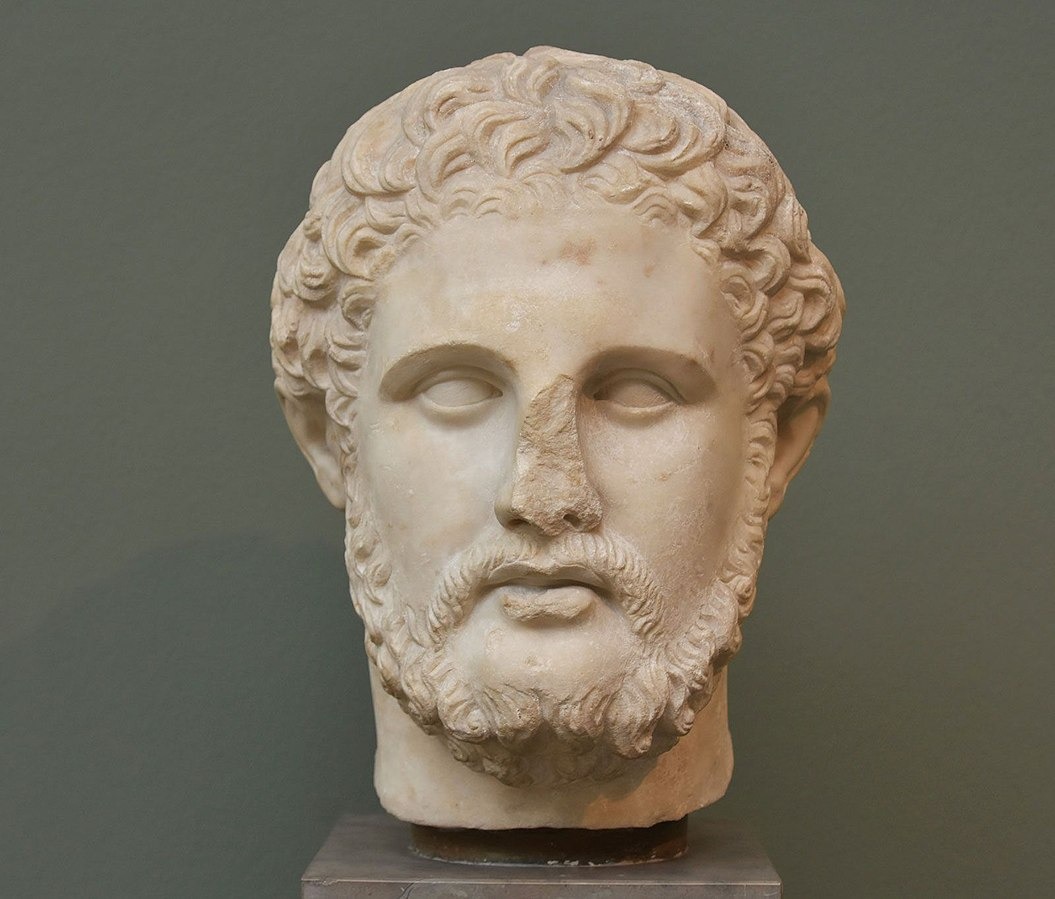
Marble bust portrait thought to depict Philip II of Macedon. Credit: Richard Mortel / CC BY 2.0 / Wikimedia Commons
The assassination of Philip and Alexander’s accession
Philip II passed away in 336 BC after assassination during a public celebration at Aegae. His bodyguard, Pausanias, killed him before guards immediately cut the assassin down. The assassination remains one of antiquity’s great mysteries. Plutarch and the historian Arrian often suspected Olympias of involvement. Some even claimed she honored Pausanias afterward or placed a crown upon his corpse. Other traditions accuse Alexander indirectly as well.
No definitive evidence proves these accusations. However, Olympias clearly benefited politically from Philip’s death because Alexander immediately became king. She acted quickly afterward to eliminate threats against her son’s rule. The geographer Pausanias accuses her of orchestrating brutal acts against Cleopatra Eurydice and her child. Whether entirely accurate or exaggerated by hostile writers, these accounts reveal Olympias’ fierce determination to secure Alexander’s position. In the brutal world of Macedonian succession politics, hesitation often meant destruction.
Even after Alexander launched his campaigns into Asia, Olympias continued influencing Macedonian affairs from afar. Alexander maintained regular correspondence with her and respected her opinions deeply. Both Arrian and Plutarch suggested that Olympias frequently warned him about political rivals and court intrigues. At times, her intense personality resulted in tension with Antipater, whom Alexander left in charge of Macedon during the eastern campaigns. Their rivalry became one of the defining political conflicts of the period.
Olympias viewed herself not merely as the king’s mother but also as guardian of the Argead dynasty and protector of Alexander’s divine mission. Meanwhile, Alexander’s own behavior increasingly reflected the heroic and semi-divine identity cultivated since childhood. His visit to the oracle of Zeus-Ammon in Siwa of Egypt supported these beliefs further when the Egyptian priest proclaimed him as “child of Ammon.” The foundations of this worldview likely originated partly through Olympias’ influence, as previously mentioned.
Alexander the Great before the Oracle at Siwa. Credit: Francesco Salviati (Italy, Florence, 1510-1563) Wikimedia Commons, Public Domain
The chaos after Alexander’s death
Alexander’s death in 323 BC plunged the empire into chaos. Without a clear successor, powerful generals fought for control over the vast territories he conquered. Olympias returned to political life aggressively during this turbulent period, supporting the rights of Alexander IV, Alexander’s young son by Roxana. Olympias viewed him as the legitimate continuation of the Argead dynasty.
In order to defend her grandson’s claim, she entered the brutal wars of the Successors. During this struggle, Olympias captured and executed Philip III Arrhidaeus and his wife Eurydice. These actions shocked many Macedonians and intensified divisions within the kingdom.
Nevertheless, Olympias believed she acted to preserve Alexander’s bloodline and royal legitimacy. Her enemies, however, saw only cruelty and vengeance.
Agamemnon’s initiation to the Samothracean Cabeiri mystery cult. Marble, Greek archaic artwork, ca. 560 BC. Credit: Jastrow, Wikimedia Commons, Public Domain
The fall of Olympias
Cassander, one of the most powerful Successors, eventually marched against Olympias. Many Macedonians abandoned her cause as political exhaustion, and civil war consumed the kingdom. After siege and defeat, Olympias surrendered.
Cassander condemned her to death in 316 BC. Plutarch claims that soldiers initially hesitated to execute her because of her royal status and dominant personality. Eventually, however, relatives of her victims carried out the killing. With Olympias’ death, the final collapse of the Argead dynasty was all the more imminent. Soon afterward, Cassander eliminated Alexander IV and Roxana, as well, and thus ended the bloodline of Philip and Alexander.
Olympias remains one of antiquity’s most complex female figures, having shaped Alexander psychologically ever since childhood and having encouraged his belief in divine destiny. She defended his succession fiercely during critical political crises and later fought relentlessly to preserve the dynasty after his death. Without Olympias, Alexander’s rise may have unfolded quite differently.
At the same time, her actions contributed to the violence and instability that destroyed Macedon after Alexander’s empire fragmented. She therefore stands both as creator and destroyer: a queen, priestess, mother, and political strategist whose influence changed the ancient world forever.
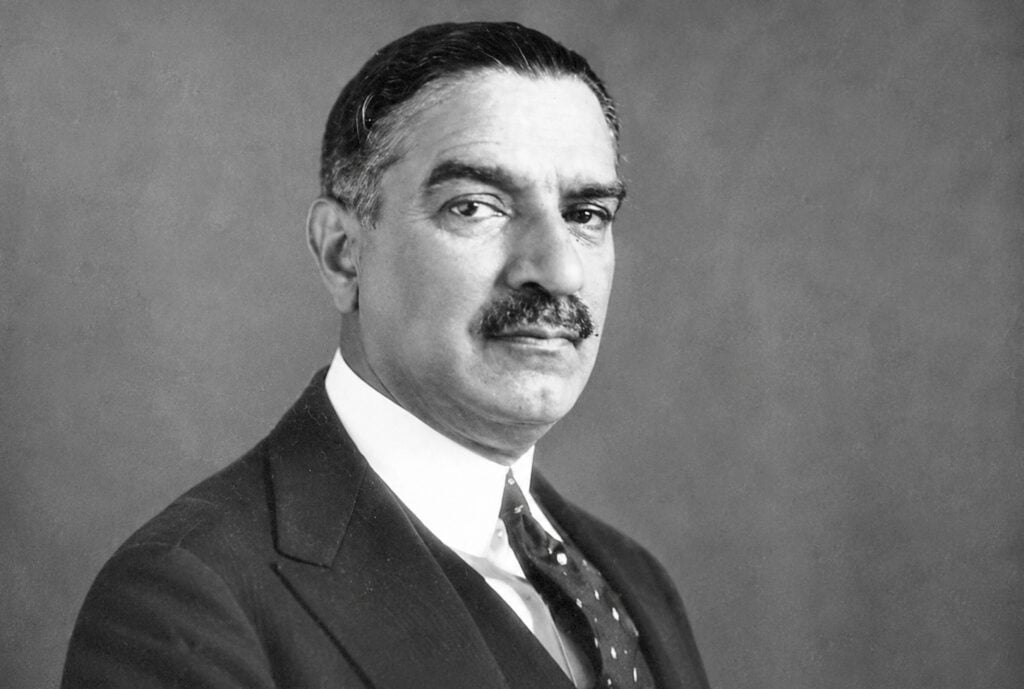
As a key political figure in early 20th-century Greece, Michalakopoulos served in numerous ministerial roles and briefly held the office of Prime Minister from 1924 to 1925. Credit: Agence de presse Meurisse – Bibliothèque nationale de France, Wikimedia Commons, Public Domain
Every day, thousands of Athenians and visitors pass through Michalakopoulou Avenue, one of the main arteries of central Athens. Yet few know the story of Andreas Michalakopoulos, the forgotten Greek Prime Minister and diplomatic genius whose name the avenue carries.
Who was the man behind the Michalakopoulos name?
Andreas Michalakopoulos was born in Patras in 1876 and went on to become one of the most important statesmen in modern Greek history. He was a man who helped redraw Greece’s borders, solved Athens’ water crisis, and brokered peace with Turkey at a time when Greece couldn’t have suffered more militarily.
Yet most Greeks today could not tell you a single thing about him. History has been unkind to Michalakopoulos, largely because he spent most of his career standing next to one of the most towering figures Greece has ever produced: Eleftherios Venizelos. That proximity was both his greatest role and the reason he is so rarely remembered—a blessing and a curse for a public figure like him. Michalakopoulos rose through the Liberal Party (Κόμμα των Φιλελευθέρων) ranks after 1910, holding portfolios in Economy, Agriculture, and Military Affairs under successive Venizelos governments.
He was not a man who craved the spotlight. He was a man who understood how government actually worked, and he was trusted with the levers of it accordingly—a true politician in the best definition of the term possible. When Venizelos went before the great powers of Europe to argue for a bigger Greece after the First World War, Michalakopoulos was beside him at the negotiating table. He participated in the long, tough diplomacy that produced both the Treaty of Sèvres in 1920 and the Treaty of Lausanne in 1923, the two documents that first promised the unthinkable and then permanently fixed, without too heavy losses, the borders of the modern Greek state. Venizelos got 100% of the credit.
However, Michalakopoulos did much of the work. He became Prime Minister in October 1924, inheriting a country in a genuine, profound, and almost existential crisis. The Asia Minor Catastrophe of 1922 had sent over a million Greek refugees flooding into Greece in a matter of months. From dreams about the reinstatement of Byzantine glory, Greece woke up in ruins, literal and metaphorical. Athens had nearly doubled in population within just a few years, and the city’s ancient water infrastructure simply could not cope. Water was being sold from carts in the streets. Taps ran dry. For a capital city that had stood for thousands of years, it was an embarrassing and dangerous situation. Greece was on the brink of collapse.
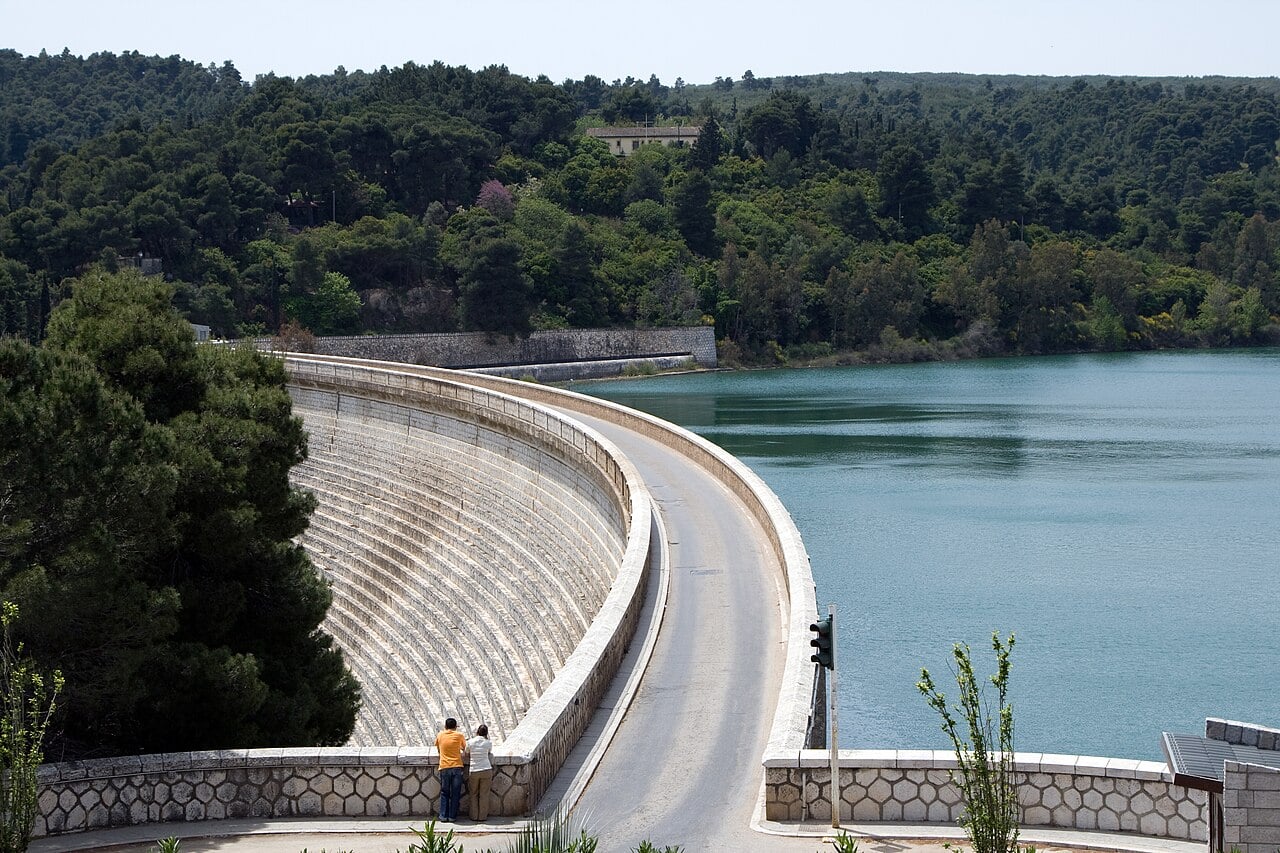
Michalakopoulos wasted little time. In December 1924, his government signed a landmark contract with American engineering firm Ulen & Company and the Bank of Athens to construct the Marathon Dam. It was one of the largest infrastructure projects in Europe at the time. The Marathon Dam was a gravity dam built of the famous Pentelic marble—the same stone used to construct the Parthenon—rising 54 meters above the Haradros River outside of Athens. The project cost more than the entire National Bank of Greece and was funded with a $10 million loan. Yes, modern Greece and loans, this stereotypical love affair…
Completed in 1929 and uniquely faced with Pentelic marble, this historic engineering project was instrumental in securing a reliable water supply for the rapidly expanding city of Athens. Credit: Vitaly, Wikimedia Commons, CC BY-SA 3.0
Construction ran from 1926 to 1929. The finished system delivered water to Athens through nearly 880 kilometers (547 miles) of new pipes and was inaugurated in 1931. The water that flows from Athenian taps today finds its roots in that contract and in that decision. Michalakopoulos never saw it completed. A military coup by General Theodoros Pangalos ended his government in June 1925, just months after the contract was signed.
But, thankfully, the work was done. He returned to government as Foreign Minister under Venizelos starting in 1928, and it was here that he made perhaps his most lasting contribution to the nation. Greece in the late 1920s was a country that had been through a lot. The Megali Idea, the great dream of a Greece stretching across the Aegean and into Anatolia, had collapsed spectacularly and catastrophically. The population exchange with Turkey had displaced more than a million people on each side. The two countries were locked in mutual suspicion and unresolved property disputes.
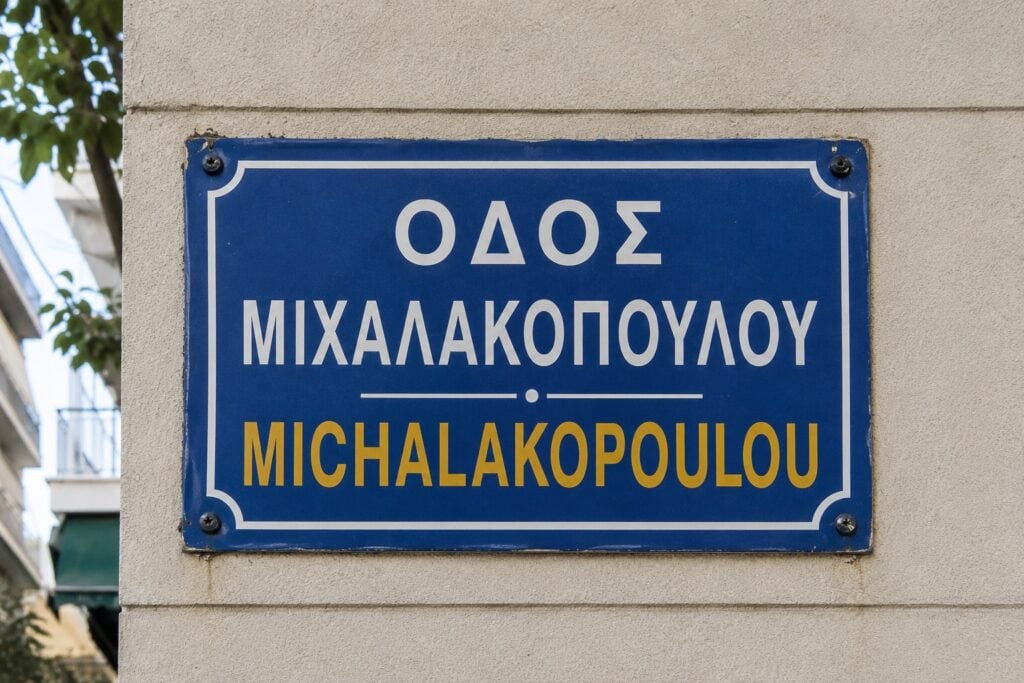
A bilingual street sign marks Michalakopoulou Street, a major avenue running through the city of Athens. Credit: Greek Reporter archive
Michalakopoulos understood, more clearly than most, that Greece could not afford to stay that way. On October 30, 1930, he co-signed the Greek-Turkish Friendship Convention, also known as the Treaty of Ankara. He did that alongside Venizelos and Turkish Prime Minister İsmet İnönü. The treaty settled the border, resolved the property claims of the displaced populations, and established naval parity in the eastern Mediterranean.
It was a remarkable diplomatic achievement that helped lay the groundwork for the Balkan Pact of 1934 and brought a genuine, working peace between two nations that had spent generations at war. When Ioannis Metaxas declared his dictatorship on August 4, 1936, Michalakopoulos refused to go along with it. He had spent thirty years building democratic institutions from the inside. He spoke out against the regime and paid a heavy price for it. He was sent into internal exile on the island of Paros. He died on March 7, 1938, aged sixty-one.
Michalakopoulos’ legacy is a strange one: a man who brought water to a thirsty city, helped draw the map of modern Greece, made peace with its archenemy, and died in exile because he would not pretend that democracy was something you could simply switch off. Next time the traffic backs up on Odos Michalakopoulou in downtown Athens, take a moment to read the sign. The water in your glass and the borders of this nation have everything to do with the man it honors.
Salt made from seawater is one of the ancient products from Messolonghi. Credit: xta11 – Own work/CC BY-SA 4.0
Salt has played a crucial role in the history of civilization, enabling food to be preserved over the winters until the modern miracles of refrigeration and preservation. This is no less true in Greece, where the salt used in antiquity likely originated from the salt flats in Messolonghi.
According to ancient sources, salt was even used in the slave trade in antiquity. It is even said that the ancient expression “not worth his salt” came from this practice.
In ancient times, most civilizations also had myths and religious and magic rites involving salt, and Greece was no exception.
With tales of its usage during sacrifices and religious rituals, the history of salt is as exotic as is the amazing Alykes, the salt marsh gardens that extend for miles on end in Messolonghi, Greece.
The unique landscape of the Messolonghi Lagoon, the largest lagoon in the country, is otherworldly, and the region is said to produce 60 percent of the country’s salt. In fact, the Messolonghi–Aetoliko lagoon system is considered to be one of the most important Mediterranean lagoons.
Sea salt from the salt flats of Messolonghi, Greece. Credit: Screenshot from Youtube
Along the coastal road from Messolonghi towards Aetoliko are the salt lakes known as Alykes of Messolonghi.
They are especially eye-catching as one can see enormous squared-off fields filled with sea water; once the water evaporates, the sea salt is left behind to be collected.
The salt comes from the Mediterranean Sea, of course, which is one of the saltiest seas in the world.
Most seawater has about 35 grams (7 teaspoons) of salt in every 1,000 grams (about a liter, or quart) of water.
The Mediterranean Sea has very high salinity—38 ppt (parts per trillion), or more in some areas. It is almost closed off from the Atlantic Ocean, and there is three times more evaporation than there is rain or freshwater flowing into it from rivers.
Messolonghi salt flats home to unique ecosystem
The area around the salt flats of Messolonghi is home to unique biodiversity in Greece. Credit: Screenshot from Youtube
The salt flat phenomenon in Messolonghi provides an amazing view along the way to the small town of Aetoliko, with flocks of flamingos basking and feeding in the nutrient-rich marshes and bright, white salt pyramids lining the drive.
The fantastic ecosystem of the region is evident upon arrival in Aetoliko which encompasses the small island that separates the two lagoons.
Famous for hosting rare birds and fish species, the lagoons are breathtaking and are dotted with traditional fishing huts built over the water on piles of wood.
The drive to the Troulida islet is one of the most sought-after trips in the area, as the sun sets and reflects off the still waters of the lagoon.
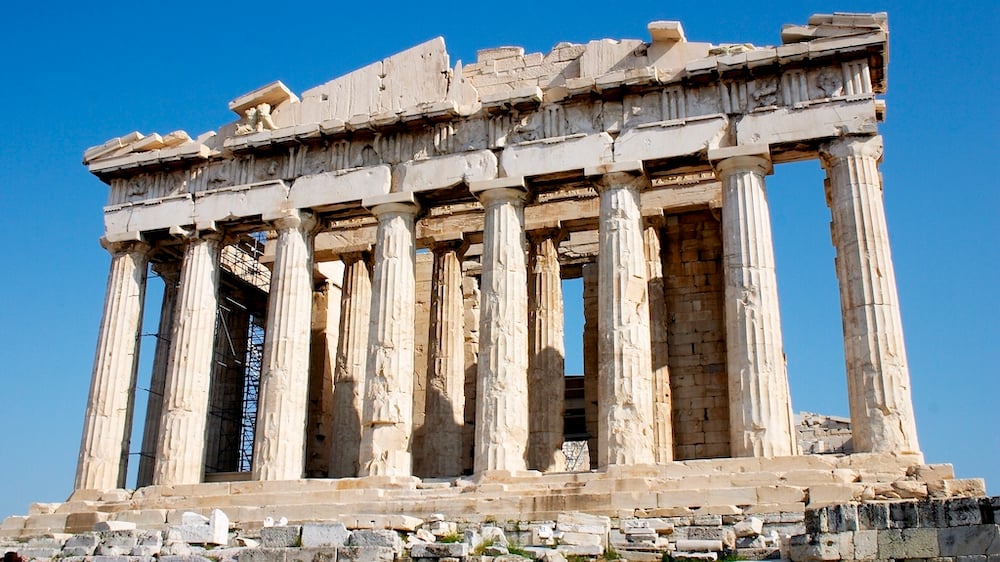
The Parthenon of Athens. Credit: Barcex/Wikimedia Commons/ CC BY-SA 3.0
Ancient Athens is renowned to this day as the birthplace of democracy and cradle of philosophical debate, but few know the story of the city state’s harshest lawgiver.
Draco, also spelled Drako or Drakon, was Athens’ first recorded democratic legislator. Draco was called upon by his fellow Athenian citizens to establish a comprehensive legal code for the city.
Many Athenians were surprised by the harshness of the laws introduced by Draco and baulked at the Draconian constitution that bore his name. Nevertheless, the Draconian constitution introduced several important innovations, namely the transition from oral laws to written laws.
Who was Draco?
Draco was an Athenian aristocrat born sometime during the 7th century BC. Despite his importance to the city’s history, Draco’s biographical details remain incredibly sketchy and little is known about his life beyond the laws that he imposed.
Indeed, as the historian Chis Carey points out in an academic paper published in The Cambridge Classical Journal, “Already for Greeks of the Classical period, Drakon was a shadowy figure. We get no patronymic, no biography; he simply emerges fully formed as a legislator.”
“He may be wholly or in part a fiction,” Carey continues. Crucially, however, Carey sees no reason to dispute the dates given by the ancient Athenians for the introduction of Draco’s laws between 624 and 620 BC.
So, whether or not Draco was a real individual, or perhaps a mythologized stand-in for a specific Athenian lawgiver or collective of legislators, the Draconian institution itself was introduced in the 7th century BC as recorded by the Athenians in the view of modern historians.
Draco’s new Athenian laws
Draco’s most important contribution as a legislator was the introduction of Athens’ first written constitution, the so-called “Draconian Constitution”.
This was an important legislative and legal innovation because the laws had previously been recorded orally. This meant that there was far too much room to arbitrarily interpret or apply the laws. A written system meant that the law was much fairer and more universally interpreted.
So that everyone would be made aware of the new laws – or at the very least, those who were literate – the laws were made visible in the city on wooden tablets called axones. These were presented on rotatable four-sided pyramids called kyrbeis.
One of Draco’s chief aims as a legislator was to bring an end to the blood feuds plaguing the city. He introduced laws that differentiated between homicides and accidental killings and specified punishments for each crime. The translations below provide some perspective:
“He who kills another Athenian, without a purpose or by accident, should be banished from Athens forever. If the killer apologizes to the family of the murdered man and the family accepts the apology, then the murderer may stay in Athens.”
“A relative of a murder victim, can hunt and take into custody the murderer and thus hand him to the authorities where he will be judged. If a relative kills the murderer he will not be allowed to enter the Athenian Forum (agora), or participate in competitions or set foot into sacred places…”
Athens’ harshest lawgiver?
As a lawgiver Draco was innovative and his changes made the legal system in Athens clearer and more consistent. However, his laws were also deemed to be excessively harsh and were subsequently repealed by Solon in the early 6th century BC.
Severe punishments were often dealt out for relatively minor crimes. For example, a thief might be sentenced to death for stealing a cabbage.
The lawgiver and his code also attracted infamy for its bias in favor of the elite over commoners in Athens. For instance, a debtor unable to honor his debts to a higher-class creditor could be sold into slavery, whereas punishments for higher-status individuals indebted to lower-status creditors were more lenient.
The English word “draconian”, meaning “excessively harsh” or “very severe” is derived from the Draconian Constitution, which is remembered for its severity.
Ancient Greek astronomers likely observed Uranus as a star, but limited tools and geocentric views kept them from recognizing it as a planet. Credit: NASA/JPL / Wikimedia Commons / Public Domain
While Uranus was officially discovered as a planet by the astronomer William Herschel in 1781 using a telescope, some ancient Greek astronomers, such as Hipparchus, may have observed Uranus—but only as a fixed star rather than as a planet.
Uranus, the seventh planet from the Sun, is unique in that it is barely visible to the naked eye, appearing as a faint, star-like point in the night sky.
Hipparchus and the catalog of stars
Hipparchus (2nd century BC), among the greatest ancient Greek astronomers, compiled one of the earliest known star catalogs. He meticulously recorded the positions of about 850 stars, significantly advancing observational astronomy. The fact that Uranus was likely observed and recorded by Hipparchus, even if only as a faint star, is a major contribution to the history of astronomy. It is proof of the remarkable precision and thoroughness of ancient astronomers in mapping the night sky.
Because Uranus moves especially slowly across the celestial sphere, its motion was imperceptible to naked-eye observers over short periods. Thus, Hipparchus correctly classified it as a fixed star rather than a planet. From the perspective of ancient Greek astronomy—which was strictly geocentric and based on Earth-centered celestial spheres—this classification was logically consistent. Uranus does not revolve around the Earth in a way that is observable to the naked eye. Therefore, ancient astronomers had no reason to consider it a “wanderer” or planet.
The classical planets of Greek astronomy
Many ancient Greek astronomers were influenced by philosophers such as Aristotle and astronomers like Hipparchus and, later on, Ptolemy. They identified five planets visible to the naked eye: Mercury, Venus, Mars, Jupiter, and Saturn. Along with the Sun and Moon, these made up the seven classical celestial bodies known as “planets” (meaning “wanderers”).
Uranus, being dim and slow-moving, did not appear among these and was therefore excluded from the traditional geocentric cosmology, which placed Earth at the center, surrounded by the concentric spheres of the other celestial bodies.
Claudius Ptolemy (2nd century AD), the eminent Greco-Roman astronomer and mathematician, authored the Almagest, a comprehensive treatise on astronomy that shaped scientific thought for over a millennium. Ptolemy’s planetary system included the Moon, Mercury, Venus, the Sun, Mars, Jupiter, and Saturn.
Although Ptolemy compiled an extensive star catalog and developed sophisticated mathematical models for planetary motions, there is no mention of Uranus as a planet or wanderer. It likely appeared in his star catalog simply as an unremarkable star without recognition of its planetary nature.
The Milky Way. Credit: ESA/ Hubble & NASA, D. Jones, A. Riess et al / Flickr / CC BY 2.0
Mythology and astral symbolism
In Greek mythology, Uranus was the primordial sky god, father of the Titans. While the planet got its name from this mythological figure, ancient Greeks did not associate the myth with any observable celestial body beyond the known planets of the time.
The naming of the planet Uranus centuries later reflected a mythological heritage, but ancient astronomy itself made no link between the myth and an actual astral element. The likelihood that Hipparchus observed Uranus as a star highlights the exceptional skill of ancient astronomers in mapping the heavens.
Yet their classification of Uranus as a fixed star rather than a planet was entirely consistent with the contemporary geocentric framework that dominated ancient Greek astronomy. Since Uranus does not visibly orbit Earth, it did not meet the criteria of a “wandering star” or planet from their perspective.
Ptolemy’s Almagest and the classical planetary model included only the five planets visible to the naked eye, omitting Uranus altogether. Ancient Greek astronomers made impressively advanced discoveries for their time. However, the observational technology and conceptual frameworks available to them ultimately limited their progress.
The eventual recognition of Uranus as a planet in the 18th century dramatically expanded the known solar system and challenged the classical view inherited from antiquity.
Sykoutris viewed the heroic ideal not as blind defiance but as a conscious affirmation of meaning in the face of suffering. Credit: Photo Credit: Ioannis Sykoutris, c. 1935 – ELIA / Hellenic Literary and Historical Archive. Source: SearchCulture.gr. CC BY 4.0.
Ioannis Sykoutris, born in Smyrna in 1901, is one of the most tragic yet heroic figures of 20th-century Greek intellectual history. His life was marked by brilliance, deep philosophical inquiry, and, ultimately, a heartbreaking end.
On September 21, 1937 at the young age of 36, Sykoutris took his own life in Corinth. It was a tragic event that sent shockwaves through the Greek intellectual community. Though his life was cut short, his intellectual legacy and philosophical views continue to resonate to this day.
Philosophical views and his interpretation of Plato
Sykoutris was born into a humble family of Chios descent, and his early years were shaped by the struggles of a post-Ottoman world. After completing his studies at the University of Athens, he moved to Germany. There, he further honed his intellectual capabilities at universities such as Leipzig and Berlin.
Upon returning to Greece in 1929, Sykoutris took up a position as a lecturer at the University of Athens, where he made significant contributions to Greek philosophy and literature. His work spanned various areas, including the translation and analysis of classical texts, most notably Aristotle’s Poetics and Plato’s Symposium. These works established him as one of Greece’s leading intellectuals, and his translations, in particular, gained international recognition.
Sykoutris was deeply drawn to the works of the Greek philosopher Plato, particularly to The Symposium. His interpretation of the dialogue explored the nature of love and eroticism in Ancient Greek society. He especially focused on the acceptance of homosexuality as a cultural and social phenomenon in classical Greece.
While his intellectual rigor and deep insight into these themes were recognized, his perspectives also invited controversy. Conservative circles, for instance, tended to criticize his ideas on love and relationships. Sykoutris emphasized the philosophical and intellectual aspects of love, challenging the moralistic views of his time and revealing his progressive stance on issues considered taboo in his era.
His work on Plato was not limited to translations. Sykoutris believed that Plato’s philosophical ideas held the key to understanding the soul and the nature of human existence. He viewed Plato’s dialogues as a guide to achieving higher states of being through philosophical contemplation.
The heroic ideal: Sykoutris and the heroic human
Sykoutris drew on German idealism to shape his understanding of Greek thought, insisting that philosophy must transform the moral and intellectual character of individuals and society. He grounded his philosophical framework in the concept of the heroic human, which he identified as a central idea in both Greek philosophy and the modern intellectual landscape.
He viewed the “heroic human” as one who transcends conventional societal norms, embracing personal suffering and intellectual struggle in pursuit of higher ideals. For Sykoutris, the heroic individual was not just a figure of physical strength or military prowess. Instead, this was a person of profound philosophical depth who embodied the struggle for self-perfection.
In many ways, Sykoutris viewed philosophy as a means of rebellion against the oppressive social structures of his time. He admired the courage of individuals who resisted conformity. This theme echoes in his interpretation of ancient Greek heroes who defied the gods and societal expectations.
His vision of the heroic ideal was also influenced by his reading of Nietzsche and German idealism, which placed the individual at the center of philosophical inquiry and moral struggle. Sykoutris’ own life can be seen as an embodiment of such a heroic ideal. He was an intellectual who chose to live authentically, confronting both external social pressures and his own inner demons.
An artistic representation of Plato’s Symposium. Credit: Anselm Feuerbach, Wikimedia Commons, Public Domain
The tragedy of his death
A complex interplay of personal, professional, and societal factors marked the circumstances surrounding Sykoutris’ suicide. Despite his intellectual achievements, Sykoutris felt a profound sense of isolation and disillusionment, particularly due to the fierce criticism he faced from religious and conservative factions in Greek society.
His progressive ideas were at odds with the prevailing norms, and this conflict led to personal and emotional strain. The attacks against him, especially concerning his views on love and sexuality, likely contributed to his feelings of alienation.
Sykoutris’ death was not just a personal tragedy but a cultural one, as well. It marked the loss of one of Greece’s most promising philosophers at a time when the country was undergoing significant political and social transformation. His suicide raised questions as to the psychological toll of intellectual rebellion and the cost of living as an outsider in a society unwilling to embrace change.
Sykoutris chose to end his life like the Trojan war hero Ajax. Credit: Wikimedia Commons, Public Domain
Legacy and influence
Despite his short life, Ioannis Sykoutris left behind a profound intellectual legacy that continues to shape modern Greek thought. His writings on Plato, Greek philosophy, and the nature of love continue to be studied and discussed in academic circles, and his work offers valuable insights into the tensions between tradition and modernity, on the one hand, and intellectualism and societal conformity on the other. He remains a symbol of intellectual courage, a figure who dared to challenge the status quo in the pursuit of truth.
Sykoutris’s tragic death only added to his mystique, transforming him into a martyr for the intellectual and cultural causes he championed. His legacy is not just one of academic achievement but also of moral and philosophical courage. These qualities remain an inspiration for those who seek to transcend the limitations of their time and pursue a higher, more meaningful life.
Ioannis Sykoutris was a man ahead of his time, whose intellectual journey continues to inspire scholars and philosophers alike. His views on Plato and the heroic ideal reflect a deep commitment to the power of philosophy as a tool for personal and societal transformation. While his life ended in tragedy, his philosophical contributions endure, and his legacy as a heroic intellectual remains a vital part of Greece’s cultural history.
Ancient Greeks and Romans used spiderwebs in medicine, believing their natural fibers could stop bleeding and protect wounds from infection. Credit: Wikimedia Commons, public domain
Among the most intriguing practices in Ancient Greek medicine was the use of spiderwebs—and even live spiders—in healing treatments. Ancient medicine often surprises modern readers with remedies that seem unusual at first glance, yet many of these traditional approaches contained a practical logic beneath layers of symbolism and inherited belief.
Greek and Roman physicians placed particular emphasis on controlling bleeding, especially in the context of warfare and surgery. Soldiers frequently sustained deep wounds from swords, spears, and arrows, while physicians had no access to modern antiseptics or advanced surgical instruments. In response, healers continuously experimented with natural materials that could help stop blood flow and protect exposed tissue. One of the more unusual solutions they turned to was spiderwebs.
Ancient Greek and Roman medical writers do, in fact, refer to the use of spiderwebs in medicine. Spider silk was observed to have properties that made it unexpectedly effective for wound care. Physicians noted its ability to absorb blood, cover injuries, and support the clotting process. While they lacked any understanding of modern biochemistry, their meticulous attention to such effects often led them to surprisingly effective medical practices.
Pliny the Elder and natural remedies, such as the use of spiderwebs, in the medicine of Ancient Greece and Rome
The Roman author Pliny the Elder offers some of the clearest references to spider-based medicine in his encyclopedic work Natural History. He describes a range of remedies involving both spiderwebs and actual spiders, noting that the former could help stop bleeding and support healing when applied directly to wounds. He also made mention that spiders were believed to serve as effective remedies for a variety of diseases and injuries in antiquity.
For Ancient Greek healers, spiderwebs appeared naturally suited for wound treatment. Their soft, fibrous texture allowed them to cover cuts with ease, while their adhesive qualities helped seal damaged tissue and protect it. Ancient warfare produced particularly severe injuries. Greek hoplites and Roman soldiers fought in brutal close combat, where swords and spears regularly tore flesh open. Even relatively minor wounds could turn fatal due to blood loss or infection. Physicians accompanying armies therefore required treatments that acted quickly and could be easily carried onto the battlefield.
The use of spiderwebs among the Ancient Romans and Greeks provided several practical advantages in medicine. They were lightweight, widely available in nature, and naturally adhesive when applied to skin. Healers thus collected cobwebs and preserved them for medical use, and soldiers are sometimes described as carrying small containers filled with spiderwebs during military campaigns.
Long before the development of modern antibiotics, healers frequently relied on natural substances that appeared to reduce infection risk and support faster healing.
Galen and Ancient Greek traditions in medicine
The great Greek physician Galen likewise discussed spider cobwebs in his work On the Powers of Simple Remedies in which he refers to their Ancient Greek medicinal applications in the treatment of injuries and the control of bleeding. Because gladiators suffered frequent injuries, Galen gained extensive experience treating wounds and preventing infection. Greek medicine placed strong emphasis on observation and practical effectiveness, so physicians often tested remedies repeatedly under real and demanding conditions.
This connection makes historical sense. Ancient doctors valued materials that combined absorbency, flexibility, and ease of application. Spider silk possessed all three qualities. Furthermore, physicians in antiquity often preferred natural substances that were readily available in military environments, where medical resources were limited.
Modern science helps explain why ancient healers valued spiderwebs. Spider silk is composed of strong protein fibers capable of forming protective coverings over wounds. The silk also absorbs moisture effectively and creates a temporary barrier against dirt and contaminants. Additionally, spiderwebs may exhibit mild antiseptic properties due to natural compounds present within the silk. Although ancient physicians could not observe bacteria, they recognized through experience that some treatments reduced infection more effectively than others.
Many people also associate spiderwebs with clotting because webs can contain traces of vitamin K from insect remains and environmental material. Vitamin K is a nutrient that contributes to blood coagulation in the human body. Most importantly, however, the web itself functions physically as a mesh. When pressed against a wound, the fibers help gather blood and support clot formation.
Modern medicine even studies spider silk for advanced surgical materials due to its exceptional strength and biocompatibility. Ironically, contemporary science now investigates properties that ancient healers observed intuitively thousands of years ago. Thus, ancient healers may have developed practical wound-care techniques through centuries of observation rather than theoretical science.
Galen, the pioneering Greek physician who influenced Western medicine through the 1700s. Portrait by Pierre-Roch Vigneron. Credit: Wikimedia Commons Public Domain
Ancient medicine and empirical knowledge
The use of spiderwebs highlights a central feature of ancient medicine, namely that Greek and Roman physicians often relied on empirical observation rather than formal scientific theory. They closely observed which remedies appeared effective and preserved those methods within medical tradition.
Greek physicians, in particular, placed great value on careful observation. The Hippocratic tradition encouraged doctors to study symptoms, environments, diets, and physical responses in detail. As a result, treatments survived not because they were theoretically justified but because they produced visible and consistent results. In this context, spiderwebs were valued because their silk fibers formed a natural covering over wounds while also helping to control blood flow. Folk medicine across many cultures likewise used cobwebs as anti-fungal and antiseptic remedies for cuts and open injuries.
Spiderwebs likely entered medical practice through precisely this kind of experiential process. Healers observed reduced bleeding and improved healing following their application, and over time, the practice spread across regions and generations. Cobwebs were part of a much broader landscape of natural medicine in antiquity. Ancient healers regularly used honey, wine, herbs, oils, vinegar, and minerals in wound care and general treatment.
Many of these substances also possessed genuine antibacterial or medicinal properties. Honey, for instance, inhibits bacterial growth and is still used in certain modern wound treatments. Wine and vinegar functioned as early disinfectants due to their alcohol and acid content. Within this framework, spiderwebs would not have seemed unusual to ancient physicians. Instead, they represented another readily available natural material with observable healing potential. Greek and Roman medicine thus consistently explored the relationship between nature and health, making use of natural resources, including even something so peculiar to modern eyes as spiderwebs.
Honey was used by the Ancient Greeks in medicine as well. Credit: The Drug Users Bible, CC BY SA, 2.0
The symbolic dimension of spiderwebs and their silk in Ancient Greece
Ancient cultures attached rich symbolic meaning to spiders and the act of weaving, and in Greek tradition, these associations carried particular weight. Mythology linked weaving to intelligence, fate, and skilled craftsmanship through figures such as Athena and Arachne, embedding it within a broader cultural framework that connected material creation with order, skill, and even divine influence. Spider silk itself likely appeared mysterious and almost otherworldly, given its delicate structure and surprising strength—qualities that blurred the boundary between natural substance and something almost magical.
This symbolic dimension may have reinforced confidence in cobweb-based remedies, since ancient medicine often operated at the intersection of practical treatment and cultural meaning. In battlefield contexts especially, where speed and improvisation were essential, surgeons had to remove arrows, close wounds, cauterize bleeding, and stabilize fractures under extreme conditions with limited equipment, relying heavily on whatever materials were immediately available. Spiderwebs fit this environment well, both practically and symbolically, as soldiers or assistants could gather them quickly from camps, caves, or buildings, requiring no preparation and allowing for rapid application under pressure.
Even when cobwebs were not perfectly effective, they could still provide a basic protective layer that was often better than leaving wounds exposed, which would have only allowed dirt and uncontrolled bleeding to pose immediate risks to survival. In many cases, this simple barrier alone may have made a meaningful difference in outcomes. Today, the same material that once carried symbolic and practical value in antiquity is again attracting scientific interest, as researchers explore spider silk for potential applications in surgery, tissue engineering, and regenerative medicine.
Medieval miniature reproducing the meeting of India’s gymnosophists with Greece’s commander Alexander the Great, c. 1420. The ancient Greeks were fascinated by India’s gymnosophists. Credit: Unknown Author, Wikimedia Commons, Public Domain.
Throughout history, and since the first exchanges between India and ancient Greece, Greeks have been captivated by the intriguing stories of the mysterious gymnosophists of India or the “naked philosophers.”
These philosophers became infamous for their austere and ascetic lifestyle along with their enigmatic wisdom. There are numerous Greek accounts of these wise people, offering a fascinating picture of the important cultural exchanges between two of the greatest civilizations on Earth.
Encounters with Alexander the Great
One could argue that perhaps the most famous interactions between Greeks and the gymnosophists took place during the campaign of Alexander the Great in India in 326 BC.
Ancient historians such as Onesicritus and Nearchus described (in their works) the dialogues that the great Macedonian Greek commander had with these naked wise men.
During these dialogues, we can see their distinctive disregard for any material possessions and their truly spectacular willingness to embrace death as a part of life. The philosopher Calanus famously demonstrated this by actually setting himself on fire in front of Alexander in an extreme attempt to showcase his fearless nature.
Miniature of Alexander encountering the gymnosophists. Image taken from f. 17v of Poems and Romances (the ‘Talbot Shrewsbury book’). Written in French. Credit: British Library, Europeana, Public Domain.
These examples are only a part of the entire collection of accounts that have managed to paint a vivid picture of the unconventional way of life of the gymnosophists. Porphyry, for instance, noted in his works that these Indian philosophers were strictly vegetarians, much like the Brahmins. Their absolute rejection of garments and clothing, in general, along with their distaste for worldly goods in pursuit of spiritual enlightenment made a deep impression on the Greeks, who were genuinely amazed by the dedication of these men.
Ancient Greece’s views on philosophy of India
For the Greeks and their worldview, the gymnosophists represented a very different and acutely unique philosophical tradition with both many similarities to but also divergences from their own. From the accounts of ancient writers we learn that Greeks saw similarities between the ideas from gymnosophists of India and their own Greek philosophical concepts.
The belief of the gymnosophists for example in reincarnation, or metempsychosis, was of particular interest to many. Some scholars even speculated that Greek thinkers such as Pythagoras may have been influenced by Indian thought in the way he shaped his own worldview.
However, it is obvious that the Greeks also noted differences. This is something that probably led to a greater curiosity about and fascination with the Indian gymnosophists. Unlike the gymnosophists, mainstream Greek philosophers tended to engage more with society and politics, becoming much more active in the everyday life of their cities. The radical asceticism of the gymnosophists, on the other hand, as well as their rejection of material life, was more extreme than most Greeks had ever witnessed.
Asceticism and self-denial—from India’s gymnosophists to ancient Greece
What seems to have impressed the Greeks the most about the gymnosophists and their life was their incredible commitment to self-denial and extreme austerity. These naked wise men renounced almost all possessions and lived in the wilderness away from urban centers of the time.
Their sole goal was to pursue spiritual wisdom through material deprivation. To Greek eyes, their extremely ascetic lifestyle represented the ultimate mastery over physical desires and earthly attachments. For the Greeks, this was almost inherently difficult to comprehend, as the Greeks had a fundamentally different view, which was much closer to today’s Western attitude towards material possessions.
This is the reason why the example of living adopted by the gymnosophists inspired some Greek philosophical movements, particularly the Cynics. The Cynics were the ones who emulated the Indian rejection of social norms and material goods in favor of the benefits of asceticism. Christian ascetics also later looked to the Indian philosophers as true role models of self-discipline and pure piety.
India’s gymnosophists and influences on ancient Greece
As is understandable, the gymnosophists played a fundamental role in shaping and affecting the Greek imagination. They appeared as archetypal wise men in works by authors like Plutarch, Lucian, and Clement of Alexandria. Their fascinating way of life continued to amaze later Greek and Roman writers. These writers saw them as exotic embodiments of the philosophical ideal.
More broadly speaking, the Greek encounters with the gymnosophists show us the importance and richness of the cultural exchanges and the discourse of ideas between ancient cultures and civilizations. These Indian wise men expanded many of the Greek notions of philosophy and the possibilities of the ascetic path, even shaping Christian thought, although they lived centuries before the birth of Jesus. At the same time, the Greek accounts give us valuable information about the fundamentals of Indian thought and practice.
Ancient Greek philosophers emphasized the importance of virtue in life. Photo of bronze door detail at the National Academy of Sciences building in Washington, DC. Credit: Carol M. Highsmith. Public Domain
For the Ancient Greeks, virtue was regarded as the highest quality a person could possess, and living virtuously was considered the ultimate goal of life.
Virtue was not merely a philosophical concept but a moral guide to be followed. Living a virtuous life was the greatest achievement for an Ancient Greek, but beyond moral virtue, the word itself also conveyed meanings of excellence, purpose in life, goodness, and happiness (eudaimonia, ευδαιμονία)—the fulfillment of human nature itself.
Reference to virtue (aretē, αρετή) first appeared in Homer’s epics, the Iliad and the Odyssey, and later evolved into a central ideal for Greek philosophers such as Socrates and Aristotle. In the Iliad, Homer exalted the virtue of bravery, placing Achilles at the forefront as the model of an excellent warrior. Achilles fought and triumphed for the sake of honor but accepted the fate destined for him.
In the Odyssey, Homer praised the virtues of intelligence (or cunning) and the endurance of Odysseus. His loyalty to Penelope is also celebrated, reflecting the virtue of loyalty to family and home. Upon returning to Ithaca, Odysseus declared that “there is nothing nobler than a man and wife who share their minds and hearts in harmony.”
The Ancient Greeks, Socrates, and virtue
Socrates, the Ancient Greek philosopher regarded by most as the father of philosophy, believed that knowledge and virtue were inseparable. The pursuit of virtue was of great importance, as Socrates viewed it as synonymous with knowledge of the good: to know what is good is to do what is good. “Virtue does not come from wealth, but wealth and every other good thing which men have comes from virtue, both to the individual and to the state” Socrates said.
By the time of the classical philosophers, the Ancient Greek world had evolved. The city-state (polis) had replaced the heroic household as the center of life, and the question was no longer how to be a great warrior but how to be a good citizen and a good person. Socrates emerged as the first great moral philosopher. “No one errs willingly,” he insisted in Plato’s Protagoras—meaning that moral failure arises from ignorance, not malice. He believed that virtue could be taught.
Socrates’ famous elenchus was a dialectical method of questioning, testing, and refining ideas. Through a series of probing questions, the method sought to expose contradictions in a person’s beliefs and systematically guide them toward a clearer, more consistent understanding of truth. By revealing these contradictions, Socrates led people toward self-knowledge.
When he was arrested and tried for disrespecting the gods and corrupting Athenian youth with his teachings, he famously declared, “The unexamined life is not worth living” (Apology 38a). For Socrates, the pursuit of virtue was the same as the pursuit of wisdom. Courage, justice, temperance, and piety were not separate traits but expressions of a unified understanding of the good. Thus, Socrates transformed virtue from heroic excellence into a philosophical and ethical ideal grounded in reason and self-knowledge.
Plato and the soul
Plato, Socrates’ most famous pupil and the philosopher who became his master’s voice, once remarked: “Consider your origins: you were not made to live as brutes, but to follow virtue and knowledge.” He developed this vision of virtue further, seeking to define its nature and role in human life. In his dialogues, especially The Republic, he explored the essence of virtue in both the individual and the state.
For Plato, the human soul was composed of three parts: the rational, spirited, and appetitive. Virtue, he taught, consisted of harmony among these elements, with reason guiding spirit and desire. Justice was this inner balance made visible in action. As he wrote, “Justice is doing one’s own work and not meddling with what is not one’s own” (Republic IV.433a). The just person, therefore, is one whose reason governs, whose spirit supports, and whose desires obey.
Plato identified four cardinal virtues that reflected this harmony: wisdom, courage, temperance, and justice. Wisdom was the virtue of reason; courage, that of the spirited part; temperance, the balance among all desires; and justice, the overarching order of the soul. These four virtues became the foundations of Western moral philosophy and profoundly influenced Christian ethical thought.
For Plato, virtue also had a transcendent dimension. True virtue was likeness to God, aimed at the Form of the Good—the ultimate reality that gives meaning and value to all things. As he wrote, “The Good is the cause of all that is right and beautiful” (Republic VI.517b). The virtuous person, through philosophical contemplation, seeks to align the soul with this divine Good, just as the sun illuminates the visible world. Thus, virtue is not only inner harmony within the self but also participation in a higher cosmic order.
Aristotle and practical virtue
For Aristotle, the concept of virtue was practical wisdom (phronēsis). He believed that ethical virtue, rather than mere self-control, is required for practical wisdom. In the Nicomachean Ethics, Aristotle defined virtue as a disposition to act correctly, formed through habit and guided by reason. Virtue was not innate, nor purely intellectual; it was something cultivated through action. “We become just by doing just acts, temperate by doing temperate acts, brave by doing brave acts” (Ethics II.1), he explained. In other words, virtue is learned by living it. As he also said, “We are what we repeatedly do. Excellence, then, is not an act but a habit.”
Aristotle’s famous doctrine of the mean illustrates the balanced nature of virtue. Every virtue lies between two extremes of excess and deficiency. Courage, for example, lies between cowardice (too little fear) and recklessness (too much). Generosity lies between stinginess and extravagance. “Virtue, then, is a state of character concerned with choice, lying in a mean,” he writes, “this being determined by reason and as the prudent person would determine it” (Ethics II.6).
For Aristotle, the goal of life was eudaimonia, often translated as “happiness” but more accurately “flourishing.” This state is achieved not through pleasure or wealth but through the full realization of one’s potential as a rational and social being. “The good for man is an activity of the soul in accordance with virtue,” he said (Ethics I.7). Virtue, then, is not a single act or rule but the lifelong practice of living wisely, courageously, and justly within a community. It requires both intellectual virtues (like wisdom and understanding) and moral virtues (like courage and moderation), harmonized under the guidance of practical wisdom.
Aristotle’s conception of virtue was purpose-driven. He believed that everything in nature has an end (telos). The eye’s purpose is to see, the seed’s to grow into a tree, and the human’s to live rationally and ethically. Virtue is the perfection of this natural purpose. Hence, for Aristotle, ethics was not about obeying rules but about fulfilling one’s nature as a rational being in society.
Quotes on virtue from Aristotle
Aristotle’s work on virtue and knowledge is unparalleled. A student of Plato and tutor to Alexander the Great, he established his own school, the Lyceum, where he explored topics ranging from biology to metaphysics. His reflections on virtue and the cultivation of character remain influential. Below are some of his most notable insights:
Aristotle emphasized the importance of educating both mind and character, stating that “educating the mind without educating the heart is no education at all.” He highlighted self-knowledge as the foundation of wisdom: “Knowing yourself is the beginning of all wisdom,” and courage and freedom were intertwined in his thought as is evident in his statement, “He who has overcome his fears will truly be free.”
Aristotle also emphasized the role of habit in shaping virtue: “Good habits formed at youth make all the difference.” For Aristotle, wisdom involved understanding life beyond immediate pleasure: “The aim of the wise is not to secure pleasure, but to avoid pain.” Cultivation of the mind and spirit was central to a flourishing life: “The energy of the mind is the essence of life,” and “The ideal man bears the accidents of life with dignity and grace.”
Aristotle also reflected on honor, leadership, and moral excellence: “Dignity does not consist in possessing honors, but in deserving them,” and “He who cannot be a good follower cannot be a good leader.” Finally, he distinguished the cultivated from the uncultivated, stating that “the educated differ from the uneducated as much as the living from the dead.”
Through these statements, Aristotle encapsulated his enduring vision of virtue as a combination of wisdom, moral character, and practical living.
The Stoics, moral worth, and virtue in Ancient Greece
The Stoics believed that the goal of all philosophical inquiry was to provide a mode of conduct characterized by tranquility of mind and certainty of moral worth. Flourishing during the Hellenistic period after Aristotle’s death, Zeno of Citium founded Stoicism around 300 BC, building on and radicalizing the moral insights of earlier philosophers. For the Stoics, virtue was not merely the highest good—it was the only good.
All external things—wealth, pleasure, health, even life itself—were morally indifferent. What mattered was the state of one’s soul: one’s rational and moral integrity. As the Stoic philosopher Epictetus later observed, “It is not things themselves that disturb men, but their opinions about things” (Enchiridion 5).
The Stoics saw virtue as living in accordance with nature, which meant acting in accordance to reason and accepting fate. Since the universe was governed by divine reason (logos), the wise individual aligns with it, remaining tranquil amid the changes of fortune. Courage, justice, temperance, and wisdom remained the core virtues, but now they were expressions of a single rational attitude toward life. As Seneca, the Roman Stoic, wrote, “Virtue is the only good, and vice the only evil; everything else is indifferent” (Letters 76). Even suffering or poverty could not harm the virtuous person because virtue itself was self-sufficient.
In this way, Stoicism universalized the Greek idea of virtue. It was no longer the privilege of citizens or philosophers but the potential of every human being. The Stoic sage, like Socrates before him, embodied moral freedom through inner mastery and reason. Marcus Aurelius, emperor and Stoic, summarized this ideal succinctly: “A man’s worth is measured by the things he pursues” (Meditations VII.3). To pursue virtue was, therefore, to live fully in harmony with the divine order of the world.
Influence of the Ancient Greek conception of virtue
The ancient Greek concept of virtue has had a profound influence on Western civilization. Ideas of moral inquiry, a virtuous life, practical wisdom, and moral worth were later adopted by Christian theology and continue to resonate today. Thomas Aquinas, for example, integrated Aristotle’s virtues with Christian faith in his writings.
In their exploration of virtue, the Ancient Greek philosophers offered no simple answers to questions such as, “How can I become virtuous?” Yet they left behind a framework for thinking, questioning, and appreciating the importance of a moral life for Western civilization.
For the Ancient Greeks, to live a virtuous life was to live well, to become the best version of oneself, and to align human nature with the rational order of the cosmos. They believed that this path led not only to moral goodness but also to true happiness.
Satellite photo of the Isles of Scilly. Credit: NASA, public domain
The Isles of Scilly are a group of islands off the southwest tip of Britain. The origin of their name has been a mystery for centuries, but one historian believes that he has now discovered the answer. According to Professor Andrew Breeze, the name of the Isles of Scilly comes from Greek. What does the name mean, and what did the ancient Greeks have to do with this group of islands near Britain?
What are the Isles of Scilly?
First, let’s clarify what exactly the Isles of Scilly are. They form a small archipelago off the southernmost tip of Britain, near the southwestern county of Cornwall. There are five inhabited islands and about 140 small rocks and islets.
Historians know very little about the early history of the islands. Something that many investigators agree on, though, is that these islands originally formed just a few larger islands, or possibly even just a single main island and a few outliers.
Speculation abounds as to whether or not these were the Cassiterides, a group of islands mentioned by ancient Greek and Roman texts. These texts refer to the Cassiterides as a group of islands in the Atlantic Ocean from which traders acquired tin.
Since the Isles of Scilly are near Cornwall, which is known for being a source of tin in the ancient world, this suggests that the Isles of Scilly might have been the Cassiterides. Nevertheless, there is no universal consensus about this.
The Greek name of the Isles of Scilly
For centuries, there has been speculation as to the true origin of the name of these islands. However, recent research by Andrew Breeze, a professor of philology at the University of Navarra, may have cleared up the issue. According to Dr Breeze, the name of the Isles of Scilly likely derives from Greek.
The earliest attested form of the name of these islands is ‘Silimnus’. This is probably a mistake for ‘Silinnus’. Other early attested forms are ‘Sillinas’ and ‘Sylina’. Based on these attested forms, Breeze argues that the origin of this place name comes from ‘syle’. This is a Greek word referring to robbery, seizure, or plunder.
Breeze argues that the ending is the Greek suffix ‘ina’, meaning ‘pertaining to’. In other words, this theory proposes that the name of these islands refers to the fact that they were a haunt of pirates and plunder.
Supporting evidence for this theory
At first glance, it might seem implausible to suggest that the Isles of Scilly could have a name with a Greek origin. After all, they were in the territory of the ancient Celts, far from the Greeks. What could the Greeks have had to do with the Isles of Scilly?
Numerous ancient records and archaeological finds demonstrate that the inhabitants of the ancient Mediterranean regularly visited Cornwall. This was a major source of tin, which was necessary to make bronze. This trade route existed for well over 1000 years. Hundreds of Greek coins have been found in Britain, most of them in the south.
There is no doubt that the Greeks had a significant presence in this area before the Roman era of Britain. The name ‘Sylina’ and its variants only appear after this. Therefore, an ancient Greek origin for the name of the Isles of Scilly is plausible.
Furthermore, Breeze highlights records from the medieval and early modern periods to support his theory. These show that the Isles of Scilly were infamous for piracy. Shipwrecks were also common, after which the ship’s cargo would be plundered. Therefore, it is understandable to see how such an area would come to be known as the ‘place of plunder’.
Does this theory stand up to scrutiny?
Since Andrew Breeze’s theory was published only recently, there has been very little response to it so far among historians and etymologists. However, we can readily make a few observations.
As Breeze himself notes, if his theory is correct, it would be the only known example of an ancient place name in Britain having a Greek origin. This, from the start, should raise our suspicions.
Furthermore, the evidence that Breeze uses to associate the Isles of Scilly with piracy and plunder comes from the medieval and early modern periods. Needless to say, this is long after the name of these islands first appears in the records.
Admittedly, though, the reason why these islands were so closely associated with piracy and plunder appears to be primarily a question of geography. For this reason, it may be reasonable to assume that this had been the case for as long as there was shipping in the area.
We know for a fact that it was always a very popular and important source of tin. Hence, there would indeed have been lots of shipping in that area from long before the Roman era of Britain. Therefore, it is likely that shipwrecks and plunder, if not piracy, were just as common back then as they were in later periods.
Is a Greek origin the only possible explanation for the Isles of Scilly?
There is, however, at least one more objection. This is the fact that another suggested etymology exists. This suggestion connects the name ‘Sylina’ to ‘Sulis’, the name of a Celtic god.
Some etymologists have pointed out that this origin would satisfy the attested medieval Cornish form of the name of these islands. However, it would not easily explain the ancient form, which is never written ‘Sul-‘, but always ‘Sil-‘ or ‘Syl-‘.
In conclusion, does the name of the Isles of Scilly really have a Greek origin? Andrew Breeze offers a theory which is surely as plausible as any yet proposed. While there are some valid objections to it, none of them are insurmountable.
Few things on this earth are as lovely as a wooden ship with its sails unfurled, sailing on the open sea; the Ancient Greek trireme ships are no exception to this rule, but of course, they were once warships that were so deadly they enabled the rise of Athens as a great power.
The graceful ships, which were propelled not only by two large sails but by three ranks of men pulling on oars, may have originated in Corinth or perhaps further afield in Phoenicia. Wherever they were first created, triremes were used by all the ancient maritime civilizations around the Mediterranean Sea, including the Phoenicians and Romans as well as the ancient Greeks.
The trireme derives its name from its three rows of oars, with one man working each oar. The early trireme was a further development of the penteconter, an ancient warship with a single row of 25 oars on each side, and the bireme, a warship with two banks of oars, from Phoenicia.
Triremes played an integral role in the rise of Athens as a great power
Known for its speed and agility in battle, the trireme was the dominant warship in the Mediterranean from the 7th to the 4th centuries BC, after which it was largely superseded by the larger quadriremes and quinqueremes, with four and five banks of rowers.
Triremes played a vital role in the history of Ancient Greece during the Persian Wars and the creation of the Athenian maritime empire — as well as its downfall in the Peloponnesian War.
Modern scholarship is divided on the provenance of the trireme — although it was either Greece or Phoenicia — and the exact time it developed into the foremost ancient fighting ship. The Greek writer Clement of Alexandria, drawing on earlier works, explicitly attributes the invention of the trireme to Sidon, the great Phoenician city.
According to the great historian Thucydides, the trireme was introduced to Greece by the Corinthians in the late 8th century BC; the Corinthian Ameinocles was recorded as building four such ships for the Samians.
In the ancient world, naval combat relied on two methods: boarding and ramming. Rams (embolon) were fitted to the prows of warships and were used to rupture the hull of the enemy ship.
The first definitive reference to the use of triremes in naval combat dates back to approximately 525 BC, when the historian Herodotus wrote that the tyrant Polycrates of Samos was able to contribute 40 triremes to a Persian invasion of Egypt for the Battle of Pelusium.
Thucydides meanwhile clearly states that in the time of the Persian Wars, the majority of the Greek navies consisted of (probably two-tiered) penteconters and ploia makrá (“long ships”). In any case, by the early fifth century, the trireme was becoming the dominant type of warship in the eastern Mediterranean,
The first large-scale naval battle in which triremes participated was the Battle of Lade during the Ionian Revolt, where the combined fleets of the Greek Ionian cities were defeated by the Persian fleet, composed of squadrons from their Phoenician, Carian, Cypriot, and Egyptian subjects.
It was 483/2 BC, however, that saw the pivotal moment in the development of the trireme, when the Athenian statesman Themistocles persuaded the Athenian assembly to begin the construction of 200 triremes, using the income of the newly discovered silver mines at Laurion.
This naval battle is considered by many historians to be one of the most decisive in history, bringing an end to the threat of the Persian invasion of the West.
Much like the earlier battle at Thermopylae, the heroics at the Battle of Salamis have risen to legendary status, as the allied Greek city-states used approximately 370 trireme ships, and the Persians had over 1,000, according to ancient sources.
The Persians planned to crush the outnumbered Greeks with the sheer force of their massive fleet.
The leader of the Greek naval force, Themistocles, aware of the great number of Persian ships, used that fact against the enemy, luring the Persians to the narrow Strait of Salamis, where the Greek ships were waiting.
Since the massive Persian fleet could not fit in the strait, they quickly became disorganized, opening up a possibility for a Greek victory.
Triremes enabled the creation of Athens’ thalassocracy
The source and foundation of Athens’ lasting political power was her strong fleet, which historians believe was composed of over 200 triremes. It not only secured control of the Aegean Sea and the loyalty of her allies but also safeguarded trade routes and the all-important grain shipments from the Black Sea, with the help of its standing navy of triremes.
Athenian maritime power is the first example of what historians refer to as a “thalassocracy,” or complete dominion over the seas, in world history.
For the crew of Athenian triremes, the ships were an extension of their democratic beliefs.
In thinking of these gigantic ships propelled by manpower, we all can recall the iconic scene of slaves manning the oars of a Roman galley in the movie Ben Hur, with men struggling to keep up with the frenetic pace that was called for in order to ram other naval ships during battle.
And indeed many of the men in such Roman galleys in reality were slaves — but this was emphatically not the case with the Greek triremes. In fact, serving aboard such a vessel was seen as an honor and the oarsmen were from all ranks of life, with rich and poor rowing alongside each other.
Historian Victor Davis Hanson argues that this “served the larger civic interest of acculturating thousands as they worked together in cramped conditions and under dire circumstances.”
Service on Athenian ships was an integral part of the military service although hired foreigners were also accepted. A typical Athenian trireme crew during the Peloponnesian War consisted of 80 citizens, 60 metics (freed slaves), and 60 foreign hands. Indeed, historians say that in the few emergency cases where slaves were used to crew ships, these were deliberately set free, usually before being employed.
Experts say that the design of the trireme most likely pushed the technological limits of the time. The three files of oarsmen on each side worked as one, with each man outboard of, and in height overlapping, the other.
While well-maintained triremes would last up to 25 years, during the Peloponnesian War, Athens had to build nearly 20 triremes a year to maintain their fleet of 300.
Athenian triremes had two great cables called hypozomata (undergirding), stretching from end to end along the middle line of the hull just under the main beams, adding the needed support for ramming during battle.
Triremes decorated with evil eyes, sculptures of deities
Its draft was relatively shallow, about 1 meter, which, in addition to the relatively flat keel allowed a trireme to be beached easily — a great advantage for amphibious operations. The construction of a trireme was expensive and required approximately 6,000 man-days of labor.
The three principal types of wood used were fir, pine, and cedar. Oak was primarily used for the hulls in order that they could withstand the force of being hauled ashore.
In the case of Athens, since most of the fleet’s triremes were paid for by wealthy citizens, there was a natural sense of competition among the patricians to create the “most impressive” trireme, both to intimidate the enemy and, perhaps surprisingly, to attract the best oarsmen.
Triremes made a fearsome and beautiful sight, as we can see from ancient depictions and reproductions of the ships today. They were highly decorated with representations of the evil eye, or mati, and had nameplates, and painted figureheads.
These decorations were used both to show the wealth of the patrician and to make the ship frightening to the enemy. The home port of each trireme was shown with pride by the wooden statue of a deity placed above the bronze ram on the front of the ship.
The resurrection of the trireme in Greece
Triremes had two masts, a main (histos megas) and a small foremast (histos akateios), with square sails, while steering was provided by two steering oars at the stern, with one at the port side and one to starboard.
Classical sources indicate that the trireme was capable of sustained speeds of about 6 knots at a relatively leisurely pace of rowing. There is also a reference by Xenophon to a single day’s voyage from Byzantium to Heraclea Pontica, which translates as an average speed of 7.37 knots.
In Athens, the ship’s captain, known as the trierarchos, would have been a wealthy Athenian citizen. He alone was responsible for manning, fitting out, and maintaining the ship for his liturgical year at least; the ship itself belonged to Athens.
During the Hellenistic period, the relatively lightweight trireme was supplanted by larger warships in dominant navies, especially the quinquereme, while triremes continued to be the mainstay of smaller navies.
Although the Hellenistic kingdoms did develop the quinquereme and even larger ships, most navies of the Greek mainland and the smaller colonies could only afford triremes. They were used by the Diadochi Empires and sea powers like Syracuse, Carthage, and later Rome.
In 1985–1987 a shipbuilder in Piraeus, advised by historian J. S. Morrison and naval architect John F. Coates and informed by evidence from underwater archaeology, built an Athenian-style trireme, Olympias.
The work was also advised by the classics teacher Charles Willink and drew on evidence gained from Greek literature, history of art, and archaeology above and below water.
The Olympias’ bronze bow ram, a copy of an original ram now in the Piraeus archaeological museum, weighs 200 kg. The ship was built from Douglas fir and Virginia oak while its keel is of iroko hardwood.
During its sea trials, in 1987, the Olympias was crewed by 170 volunteer oarsmen and oarswomen. She achieved a speed of 9 knots (17 km/h). These results, achieved with an inexperienced, mixed crew, suggest that ancient historians like Thucydides were not exaggerating about the capabilities of triremes.
Olympias was transported to Britain in 1993, to take part in events celebrating the 2,500 years since the beginning of democracy. In 2004 she was used to transport the Olympic Flame ceremonially from the port of Keratsini to the main port of Piraeus, as the Olympic Torch Relay approached Athens for the 2004 Summer Olympics.
New archaeological evidence suggests that Paleolithic humans may have baked simple types of bread as early as 30,000 years ago. Credit: 2368zauber, Wikimedia Commons, CC-BY-SA-3.0
For decades, conventional wisdom held that bread didn’t exist among Paleolithic people and was a relatively recent human innovation, an agricultural byproduct that emerged with the rise of farming in the Neolithic era, roughly 10,000 years ago. Recent archaeological discoveries have radically challenged this view, however, pushing the timeline of breadmaking back by at least 20,000 years.
In what can only be described as a groundbreaking study, a team of Italian researchers has revealed that Paleolithic hunter-gatherers in Europe not only consumed wild plants but also processed them into flour and baked a primitive flatbread. These findings were published in the prestigious journal Proceedings of the National Academy of Sciences (PNAS). They suggest that the roots of culinary innovation run far deeper than previously imagined.
Grinding stones and starch residue
At the heart of this discovery are ancient grinding stones. The archaeologists unearthed these flat stone slabs and pestle-like tools at sites across Italy, Russia, and the Czech Republic. The tools, dated to around 30,000 years ago, were originally assumed to have been used for processing pigments or crushing seeds. Nevertheless, when researchers Anna Revedin and Laura Longo of the Italian Institute of Prehistory and Early History in Florence conducted a detailed microscopic analysis, they uncovered traces of starch granules embedded in the stone surfaces.
The starches were identified as those of cattails, ferns, and other starchy wild plants, which would have required careful preparation to be rendered digestible. Revedin’s team concluded that these Paleolithic humans had not only harvested the plants but had dried, ground, and mixed them with water to form a kind of dough. Additionally, they likely cooked the resulting paste on hot stones near the fire, producing an early version of unleavened bread.
Rethinking the Paleolithic diet
The ancient Greeks themselves had a clear grasp of the evolution of human diet. Hippocrates, the father of medicine, wrote in his work On Ancient Medicine:
“It is for this reason, I believe, that people sought out food more suited to human nature, and eventually discovered the kind we now use. From wheat, after soaking, grinding, kneading, sifting, and baking, they made bread; from barley, they made flatcakes. After many efforts, they cooked, baked, mixed, and blended foods, diluting the strong and raw with milder ingredients, shaping everything according to human nature and capacity.”
The implications are profound. Until now, the standard narrative of Paleolithic diets emphasized a reliance on animal protein. This included meat and fish, with foraged fruits and plants playing only a minor role. The recent discovery challenges that model, however. Moreover, the implication is that these early humans were actually greatly skilled in the complex processing of wild plant foods. In other words, they also possessed the sophisticated ability to cook.
Furthermore, the evidence of flour production long before the advent of agriculture hints at a continuity of knowledge. The leap from gathering and grinding wild plants to cultivating domesticated grains may not have been as abrupt or revolutionary as once believed. Paleolithic peoples were far from passive consumers of raw resources, and the rise of farming could in fact have been the result of millennia of experimentation, habit, and accumulated expertise.
Ancient Greek woman taking bread out of the oven. Terracotta figure found in Tanagra, Greece. Credit: Marie-Lan Nguyen CC BY 2.5
A quiet revolution
Perhaps most striking is what this discovery on bread reveals about Paleolithic ingenuity. The production of flour and bread is not simply a dietary choice. It reflects planning, patience, and an understanding of food chemistry. Drying plant roots, grinding them into powder, and then baking them requires more than survival instinct. It also requires culture.
As more research sheds light on the lives of our Paleolithic ancestors, it becomes increasingly clear that they were not the brutish cave-dwellers of outdated caricatures. They were observant, resourceful, and remarkably sophisticated in their interaction with the natural world.
Bread, it turns out, is not just the food of civilization. It may have been the food of pre-civilization, as well.

 Login
Login