by Tim Hinchcliffe | The Sociable The RAND Corporation wargames scenarios to see if AI could contribute to human extinction by facilitating nuclear war, creating and deploying pathogens, and malicious geoengineering. According to three simulations conducted in the new RAND report called “On the Extinction Risk from Artificial Intelligence,” AI is currently unlikely to wipe out humanity on its own; however, it could still cause considerable devastation if it were programmed to do so, if it were given enough access to critical systems, and if it were granted decisionmaking powers. “The capabilities of artificial intelligence (AI) have accelerated to the […]
The Internet: America's Weapon of Strategic Domination (UnlimPHoto)
Eighty-nine days of total digital blackout. Six hours of reconnection. A naval facility destroyed near Jask. The metadata trap has just snapped shut on the Islamic Revolutionary Guard Corps.
For 88 days, Iran’s southern provinces were cut off from the digital world. Tehran openly framed the move as a shield against foreign psychological warfare operations and against potential new connected military technologies that could give the United States a decisive advantage. It was a survival strategy for the fully networked age.
On the 89th day, the fiber-optic cables linking Bandar Abbas to Chabahar were switched back on. Six hours later, a strike bearing the unmistakable signature of U.S. Central Command (CENTCOM) destroyed a naval facility suspected of housing IRGC fast-attack boats roughly 15 miles east of Jask.
“If you connect to the internet, you die.” Brutal as it sounds, the phrase now sums up the operational doctrine taking shape in this part of the world.
88 Days in Digital Darkness
To understand what happened, one first has to grasp what those three months of electronic silence meant for American intelligence capabilities. The NSA’s SIGINT collection systems — capable of absorbing terabytes of communications and geolocation signals — were effectively running blind.
The IRGC Navy, meanwhile, had reverted to Cold War-era methods: couriers, field telephones, and short encrypted burst transmissions.
For an AI-driven command-and-control system like the American JADC2 architecture, this total disconnection created an intolerable fog of war. It became impossible to target the source of a swarm of kamikaze drones when the source itself was invisible.
The Crack: A Fatal Economic Decision
The reconnection was not the result of a coordinated strategy. It stemmed from a unilateral concession by President Pezeshkian under pressure from two fronts: petrochemical magnates in southern Iran and a hyperconnected population suffering digital withdrawal.
Eighty-eight days without SWIFT transactions or market access had drained the economies of the southern provinces.
According to reports, the decision was made against the explicit advice of IRGC intelligence services, which wanted the blackout maintained indefinitely in the name of operational security for naval exercises in the Gulf of Oman.
2:14 a.m. local time. The first data packets begin moving across the Iranian network. American passive collection systems activate immediately.
Resynchronization phase. Personal phones belonging to IRGC logistics officials — believing their devices undetectable thanks to new IMEI numbers — begin checking WhatsApp, Facebook, Instagram, and TikTok.
Less than six hours later, targeting algorithms detect a constellation of geolocated signals converging on a previously inactive site near Jask. The strike is authorized.
The Metadata Trap
Washington did not need to decrypt a single encrypted message. It only had to map the sudden aggregation of signals: the phone of a logistics coordinator heading to a depot, the tablet of a commander checking weather forecasts in the Gulf of Oman, the computer of a port official accessing a cargo manifest server. For JADC2, the veil had lifted. The target had become visible.
“The United States didn’t need to crack encrypted content. It simply mapped the sudden constellation of geolocated signals clustered around a known but previously inactive site. That’s the metadata trap. It’s always deadly,” according to a local source.
A Fracture at the Top of the Iranian State
The strike — reportedly carried out using a combination of carrier-based F-35Cs and a sea-launched Tomahawk missile variant — triggered an internal political crisis.
IRGC generals reportedly turned directly against the presidency, accusing it of having “opened a breach.” Pezeshkian’s advisers deny any direct causal link.
Iran announced retaliatory measures and condemned the attack as a violation of the ongoing ceasefire. An MQ-9 Reaper drone was reportedly shot down during the operation, and an F-35C is said to have come under fire.
This episode goes beyond the Iranian case alone. It sheds light on Russia’s sporadic internet shutdowns and on the ongoing overhaul of China’s Great Firewall.
In 2026, access to the electromagnetic spectrum has become both the first casualty — and the primary vector — of modern warfare. Restoring connectivity can itself become the trigger.
The United States has now established a precedent: reconnecting a hostile state to the internet is treated as a moment of exposure, one potentially warranting an immediate kinetic response.
The Internet: America’s Invisible Weapon of Strategic Dominance
cyberguerre (UnlimPhotos)
Artificial intelligence, cyberspace, and satellite networks are redefining the art of war. In this new global battlefield, the United States maintains a strategic edge thanks to its control over the world’s digital infrastructure.
In the age of hybrid warfare and the digital battlefield, military superiority is no longer measured solely by armored divisions or nuclear arsenals. It now depends on the ability to effectively integrate artificial intelligence, space-based networks, and cyber operations into a global command architecture. In this decisive domain, the United States retains a major strategic advantage: its de facto sovereignty over the global Internet.
A Structuring Technological Dominance
The core architecture of the Internet — from undersea cables to root servers, including major digital platforms and technological standards — remains largely controlled by American actors or subject to U.S. jurisdiction. This reality gives Washington an unparalleled strategic lever, enabling it to exert decisive influence over information flows, global surveillance, and power projection capabilities in cyberspace.
At a time when warfare is becoming increasingly algorithmic, this structural dominance translates into a critical operational advantage. The power capable of merging massive datasets, space capabilities, and military AI gains an immediate upper hand over its adversaries. The United States, a pioneer in these fields, continues to hold a dominant position.
China and Russia Confront Digital Hegemony
For years, Beijing and Moscow have sought to free themselves from this strategic dependence. Alternative networks, sovereign Internet systems, independent navigation systems, national cloud infrastructures, and state control over digital infrastructure are multiplying. Yet these efforts face considerable technological, economic, regulatory, and geopolitical obstacles.
The global interoperability of the Internet, originally designed under American leadership, makes any attempt at decoupling extremely costly and inherently imperfect. Despite significant advances — particularly by China — no power has succeeded in creating a fully functional and universal alternative to the U.S.-dominated digital ecosystem.
Hybrid Warfare and “Decapitation” Operations
As long as this American sovereignty over the Internet endures, the world is likely to continue witnessing hybrid operations combining digital sanctions, information pressure campaigns, cyberattacks, and targeted actions against states considered strategically vulnerable. Some recent interventions, particularly in Latin America, have been interpreted by many observers as forms of political and economic “decapitation” operations aimed at indirectly controlling critical natural resources, especially energy resources.
This strategy fits within a broader logic of imperial survival. According to its critics, Washington is compensating for the erosion of its domestic economic model — marked by growing social polarization and structural fragilities — through an aggressive foreign policy based on technological and military projection.
A Silent Military Revolution
This American resurgence would not have been possible without a genuine revolution in military affairs. The integration of AI, autonomous drones, algorithmic intelligence gathering, and satellite networks has enabled the United States to transform past strategic setbacks into a new comparative advantage. Some analysts describe this as a “Type-T revolution,” in which technology compensates for industrial and social decline.
Toward a Fragmented Cyberspace?
The central question remains: how long can this hegemony endure? The growing number of digital conflicts, the gradual fragmentation of the Internet, and the rise of national technological sovereignties could eventually challenge the existing order. For now, however, American dominance over the world’s invisible infrastructure remains one of the fundamental pillars of its global power.
The United Kingdom government has denied Moscow’s claim that the UK and France have been secretly working on providing Ukraine with a nuclear weapon. The French government has issued a denial through its Moscow Embassy.
Robert Harneis (DR)
By Robert Harneis
Russia’s foreign intelligence service, SVR, has publicly claimed that the UK and France are “actively working” on providing Ukraine with a nuclear weapon, or a radioactive makeshift “dirty bomb”. The claim has been referred to by President Putin and his spokesman Dimitry Peskov.
The UK Prime Minister’s official spokesman claimed in a statement; “This is a clear attempt by Vladimir Putin to distract from his heinous actions in Ukraine… There is no truth to this.”
Illegal transfer of components
The intervention by President Putin indicates that the Russians take the claim seriously. Russia’s Foreign Intelligence Service state that Britain and France are actively working to resolve the issue of providing Ukraine with nuclear weapons and their delivery systems. “This involves the covert transfer of European components, equipment, and technologies in this area. One option being considered is the French TN75 small-size warhead from the M51.1 submarine-launched ballistic missile,” the statement reads.
According to the SVR, British and French elites believe that Kyiv would be able to secure more favorable terms for ending the fighting if it possessed a nuclear bomb or at least a so-called dirty bomb. “The British and French recognize that their plans constitute a gross violation of international law,” the statement continues.
A flagrant violation of international law
If true, this would be a serious breach of the Treaty on the Non-Proliferation of Nuclear Weapons (NPT). London and Paris allegedly risk undermining the global non-proliferation system. “Consequently, Westerners are focusing their efforts on making Kyiv’s acquisition of nuclear weapons appear to be the result of Ukrainian development,” the SVR wrote in their statement.
Putin’s press secretary, Peskov, called information about the possible transfer of a nuclear bomb to Kyiv extremely important and dangerous for the non-proliferation regime. “This is a flagrant violation of all norms and principles, and relevant acts of international law,” he emphasized. Meanwhile, Vladimir Putin’s aide, Yuri Ushakov, told the Vesti news service that Moscow intends to inform Washington of the possible transfer of nuclear weapons to Kyiv from London or Paris.
Clichés
According to the official Russian government news agency Tass, Deputy Speaker Konstantin Kosachev, of the Russia Federation Council, has commented that the statements issued by the French and British embassies denying plans to arm Ukraine with nuclear weapons appear to be nothing more than rehearsed clichés, lacking depth or credibility, according to Federation Council.
Kosachev criticized these responses, stating, ‘The comments from the relevant press services – particularly, in France, not even from the government ministries but solely from the embassy here in Moscow – are simply pre-cooked clichés that add no real value. They deny the findings of the Russian Foreign Intelligence Service.” He further pointed out that these statements fail to confirm that the involved countries are adhering to their obligations under the Treaty on the Non-Proliferation of Nuclear Weapons.
France’s awkward position
Britain has no independent nuclear weapons and depends entirely on US supply and consent for use. France is in a more embarrassing position as it has full control of its nuclear arsenal. The idea that Washington knew nothing about any of this – if it is true – is far-fetched. But it seems at the moment it suits Moscow to appear believe it.
Between geopolitical calculations, Russian economic resilience, and diverging interests, the conflict is bogged down in a war of attrition that neither side seems willing to end.
Robert Harneis (DR)
By Robert Harneis
The war in Ukraine is entering its fifth year with no negotiated way out in sight for either belligerent. Behind the mud of the trenches and the victory communiqués, a complex machinery — military, economic, diplomatic — has taken hold, keeping the conflict in a precarious equilibrium, so far. An in-depth look.
A long war no one wanted, pursued by everyone
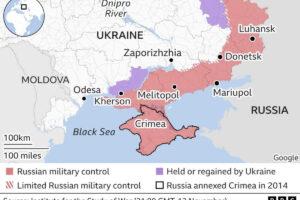
Neither Moscow nor Kyiv anticipated such a prolonged conflict. In 2022, Russia hoped for a lightning victory through decisive strikes on Kyiv, Kharkov, and the corridor leading to Crimea. The West, for its part, was betting on a rapid collapse of the Russian economy under the weight of unprecedented sanctions — the freezing of $300 billion in reserves, exclusion from the SWIFT system, diplomatic isolation. Both sides were disappointed, although Russia did achieve the land corridor to Crimea and the capture of Europe’s biggest nuclear power plant.
Today, the conflict follows a logic of attrition much encouraged by the drone revolution. Russia is waging a slow war, aware that it faces a Ukraine backed by the financial and military arsenal of the United States, NATO, and most Western countries. The model is simple: Ukraine provides the men; the West provides the weapons. Unfortunately Ukraine is running out of men and the West is running out of weapons. Unlike the state owned Russian armaments industry, the Western military industrial complex is focused on profit not mass industrial warfare. The line of conflict in Ukraine is twice the length of the Western Front in the First World War, a situation totally outside modern Western military experience.
Russia: a more resilient economy than expected
One of the great surprises of this conflict has been the resilience of the Russian economy. The West had severely underestimated its degree of self-sufficiency. As a producer of its own energy and food resources, with an industrial base inherited from the Soviet era and relatively insulated from financialization, Russia has managed to adapt.
According to the IMF, measured in purchasing power parity (PPP), the country is now ranked the world’s fourth-largest economy, behind China, the United States, and India. Paradoxically, the sanctions stimulated local production through import substitution and encouraged the repatriation of capital. Russia’s military-industrial complex has demonstrated its capacity to sustain a prolonged war effort, notably through the reactivation of Soviet-era stockpiles and the use of low-cost guided munitions. Western media have regularly predicted Russia suffering economic collapse and running out of weapons.
There are no signs of either happening
By contrast the European Union, especially Germany has suffered severe economic damage, through the loss of a reliable supply of cheap Russian energy. This undoubtedly suits Russia but also the United States. The Eurozone has lost credibility as a result of freezing Russian government funds. Central banks across the world calculate, if they can do it to Russia, they can certainly do it to us.
Some commentators believe Washington deliberately pushed Europe to adopt these extreme sanctions with a view to weakening it as an economic rival. True or not, it is what has happened.
Ukraine: between survival and dependency
Ukraine, contrôle de l’armée russe (Wikipédia)
On the Ukrainian side, internal factors are complicating any prospect of negotiation. The Kyiv government benefits, both legally and illegally, from massive financial flows tied to the war effort. The radical nationalist units that form part of the military apparatus have publicly threatened to turn on Zelensky should he sign a peace deal with Moscow — thereby forcing him to betray his 2019 electoral promise that brought him to power. The Ukrainian people have never voted for a policy of hostility to Russia but it is what they are forced to endure. The idea that Ukrainians are dying heroically to defend democracy is laughable. The extreme nationalist minority is fighting with courage, skill and determination, the rest of the population is being forced to enlist and fight.
The war has many of the characteristics of a civil war. The Ukrainian commander in chief has a brother who is a colonel in the Russian army. Many Russians have relatives living in Ukraine.
A conflict with global geopolitical dimensions
For Moscow, as Foreign Minister Sergei Lavrov has stated, the Ukrainian war is not an isolated territorial conflict but a symptom of a broader struggle: the one waged by Washington to preserve its hegemony in the face of China’s rise and Russia’s renewed military power. In this context, Beijing is quietly backing Moscow — Sino-Russian trade has grown significantly — while Russia simultaneously maintains good relations with New Delhi to avoid exclusive dependence on a single partner.
The accession of Finland and Sweden to NATO represents a strategic setback for Moscow, however, adding some 1,340 kilometers of shared border with the Atlantic Alliance. By contrast, the development of BRICS offers Russia channels to circumvent sanctions, reducing its dependence on the dollar in international trade.
War objectives in flux
On the Russian side, war aims have gradually shifted. From a simple stabilization of the status quo in 2022, Moscow moved to formally annexing four Ukrainian regions, while some internal voices are now calling for even broader territorial conquests. Should the conflict continue without a negotiated solution, Ukraine could lose much more territory. Public opinion in Russia is strongly in favor of occupying Odessa and the Black Sea coast.
There has never been any doubt that the United States and its European allies are backing the war as a way to weaken Russia regardless of the fate of the people of Ukraine. It is more than a remote possibility that the United States would be happy to see Moscow maneuvered into occupying the whole country, resulting in years of economic strain and troublesome political complications. For the EU this would have the advantage of encouraging electoral support for re-armament but it would lead to serious political risks with governments like Hungary, Slovakia and the Czech Republic no longer landlocked and benefiting from a border with Russia. This would give them new geopolitical choices in the face of a European Union determined on using the war to centralize control over member states.
BY THE NUMBERS
• 1.5 million lives lost according to various estimates since the conflict began in 2022
• 4th largest economy in the world — Russia’s ranking according to the IMF in purchasing power parity.

 Login
Login

 by Tim Hinchcliffe | The Sociable The RAND Corporation wargames scenarios to see if AI could contribute to human extinction by facilitating nuclear war, creating and deploying pathogens, and malicious geoengineering. According to three simulations conducted in the new RAND report called “On the Extinction Risk from Artificial Intelligence,” AI is currently unlikely to wipe out humanity on its own; however, it could still cause considerable devastation if it were programmed to do so, if it were given enough access to critical systems, and if it were granted decisionmaking powers. “The capabilities of artificial intelligence (AI) have accelerated to the […]