Dmytro Pletenchuk, spokesperson for the Naval Forces of the Armed Forces of Ukraine, explains how Ukraine secured its maritime corridor, pushed Russian warships away from its coast, and adapted to a new era of naval warfare shaped by drones.
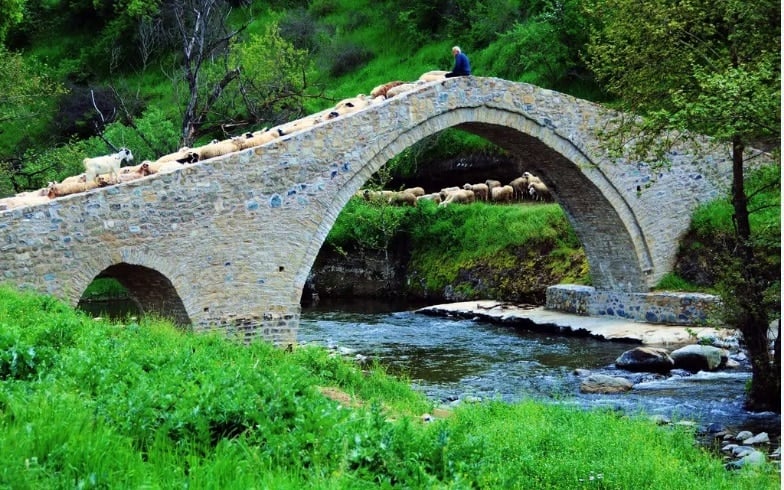
Psyrras Bridge in Meteora was built in 1790. It was a key part of the old road network, linking mountain passes to the lowlands. Credit: AMNA
The Municipality of Meteora is a testament to the enduring legacy of historical stone bridges, which serve as living monuments of folk architecture and the human drive to connect.
Built with remarkable skill by craftsmen from Epirus and Pindos, these bridges were vital arteries for communication, trade, and survival in the region’s challenging terrain. They are not merely structures but symbols of local identity and cultural heritage.
Stone bridges in Meteora and their stories
The municipality is home to several significant bridges, each with its own unique history:
Baltas Bridge: Located in Kakoplevri, this is one of the oldest bridges in the region, built in 1403. For over six centuries, it has spanned the Kakoplevritis stream, connecting isolated areas with the city of Kalambaka.
Baltas Bridge. Credit: AMNA
Delis Bridge: Also in Kakoplevri, this single-arch bridge was constructed in 1860. It crosses the Boutzas River, a tributary of the Pinios. Its name is linked to local folklore, with theories attributing its construction to either a Turkish pasha or a charioteer from the Chasia region.
Delis Bridge in Meteora. Credit: AMNA
Psyrras Bridge: Erected in 1790 over the Iona River, this single-arch bridge is a prominent feature on Asproklisia Hill. It was a key part of the old road network, linking mountain passes to the lowlands.
Michos Bridge: Built in 1799 in Anthousa Aspropotamos, this 12.5-meter-long bridge marked the beginning of a crucial mule route. It was used by agogiates (muleteers) to transport goods from the villages of Aspropotamos to Tzoumerka.
Michos Bridge in Meteora. Credit: AMNA
Vakaretsia Bridge: Located in the Xirokampos area, this single-arch bridge over the Bountza stream was a critical crossing for local residents.
Ghika Bridge: This bridge in Krania, likely built in the mid-18th century, is a single-arch structure with unique metal drawbridges added for reinforcement. It was a primary route to the Thessalian plain but was severely damaged by the “Daniel” storm. The Ministry of Culture has since initiated its restoration.
Ghika Bridge. Credit: AMNA
Sarakina Bridge: Perhaps the most renowned of these structures is the Sarakina Bridge, a magnificent seven-arched stone bridge spanning the Pinios River. It was a major link between the wider region and the Thessalian plain. Unfortunately, like the Ghika Bridge, the Sarakina Bridge suffered extensive damage from the “Daniel” storm.
Sarakina Bridge. Credit: AMNA
In a recent statement, Meteora Mayor Lefteris Avramopoulos highlighted the bridges’ significance as “living pieces of our history” and “symbols of connection.” He highlighted that both the Sarakina and Ghika bridges are considered monuments of national importance. The Municipality of Meteora is actively collaborating with the Ministry of Culture to secure funding and complete the necessary studies for their full restoration.
The Mayor emphasized that preserving these bridges is not only a “debt to the past” but also a strategic investment in the future. Their preservation and promotion through cultural tourism are seen as key levers for sustainable development in the mountainous regions, ensuring that these historical testaments continue to stand for generations to come.
Russian 37th Motorized Rifle Brigade battalion commander Bato Munkuyev took his own life on 10 June after a Ukrainian strike on the Chonhar Bridge collapsed his unit's fuel supplies, Ukraine's 1st Separate Assault Regiment named after Dmytro Kotsyubailo (Da Vinci) says. The Ukrainian unit claims Russian command pressured Munkuyev to execute combat tasks while his battalion lacked sufficient fuel, ammunition, and reinforcements.
The Ukrainian soldiers link the commander's death to documented Ukrainian strikes on the Chonhar Bridge on 7 June and 9 June that halted Russian fuel and supply movement from Crimea to the southern frontline.
The 37th brigade had been specifically waiting for fuel supplies via the Chonhar route, Ukrainian commander Dmytro Filatov "Perun" said on 10 June.
Bridge strike halted Russian logistics movement
"The Chonhar Bridge was not chosen by accident. The 37th Motorized Rifle Brigade was operating against Ukrainian forces in this direction, and it was specifically waiting for fuel supplies via this route," Filatov told Army TV.
The bridge was not fully destroyed, but the damage to the road surface proved sufficient to completely stop traffic. Part of the Russian cargo did not reach the frontline after the strike.
The Chonhar Bridge was struck on 7 June and 9 June, with the second strike halting traffic that had partially resumed after the first attack.
Munkuyev and 37th brigade: Buryatian unit with documented Bucha-area war crimes
According to the 1st Assault Regiment, Munkuyev has served in the Russian armed forces since at least 2015 and was promoted to the rank of major and to battalion command this year.
The Russian 37th Motorized Rifle Brigade is stationed at Kyakhta, Buryatia, as part of the 36th Combined Arms Army of Russia's Eastern Military District, per Ukrainska Pravda.
The brigade has been implicated in war crimes during the Russian occupation of Makariv and the surrounding Bucha district communities, including a November 2025 conviction of a 37th brigade member for rape committed during the occupation.
Ukrainian investigative journalists and the Belarusian Investigative Center have documented their involvement in the Kyiv-Chop highway atrocities of March 2022, when Russian forces opened fire on civilian vehicles attempting to evacuate the Kyiv area, per RBC-Ukraine, citing Radio Free Europe/Radio Liberty.
El príncipe Jorge, de 12 años, comenzará sus estudios en Eton College el próximo mes de septiembre, según ha anunciado este martes. “El Palacio de Kensington puede confirmar que el príncipe George asistirá a Eton a partir de este septiembre, dijo la escueta declaración de la residencia oficial de los príncipes de Gales. De este modo, el primogénito de Guillermo de Inglaterra y Kate Middleton seguirá los pasos de su padre, que también asistió a esta escuela privada solo para chicos ubicada en el condado de Berkshire, donde la matrícula ronda actualmente las 63.000 libras anuales (unos 72.000 euros). Además, los costos para el nieto del rey Carlos III incluirán el IVA que el Gobierno británico agrega a las tarifas de las escuelas privadas, según indica la BBC.
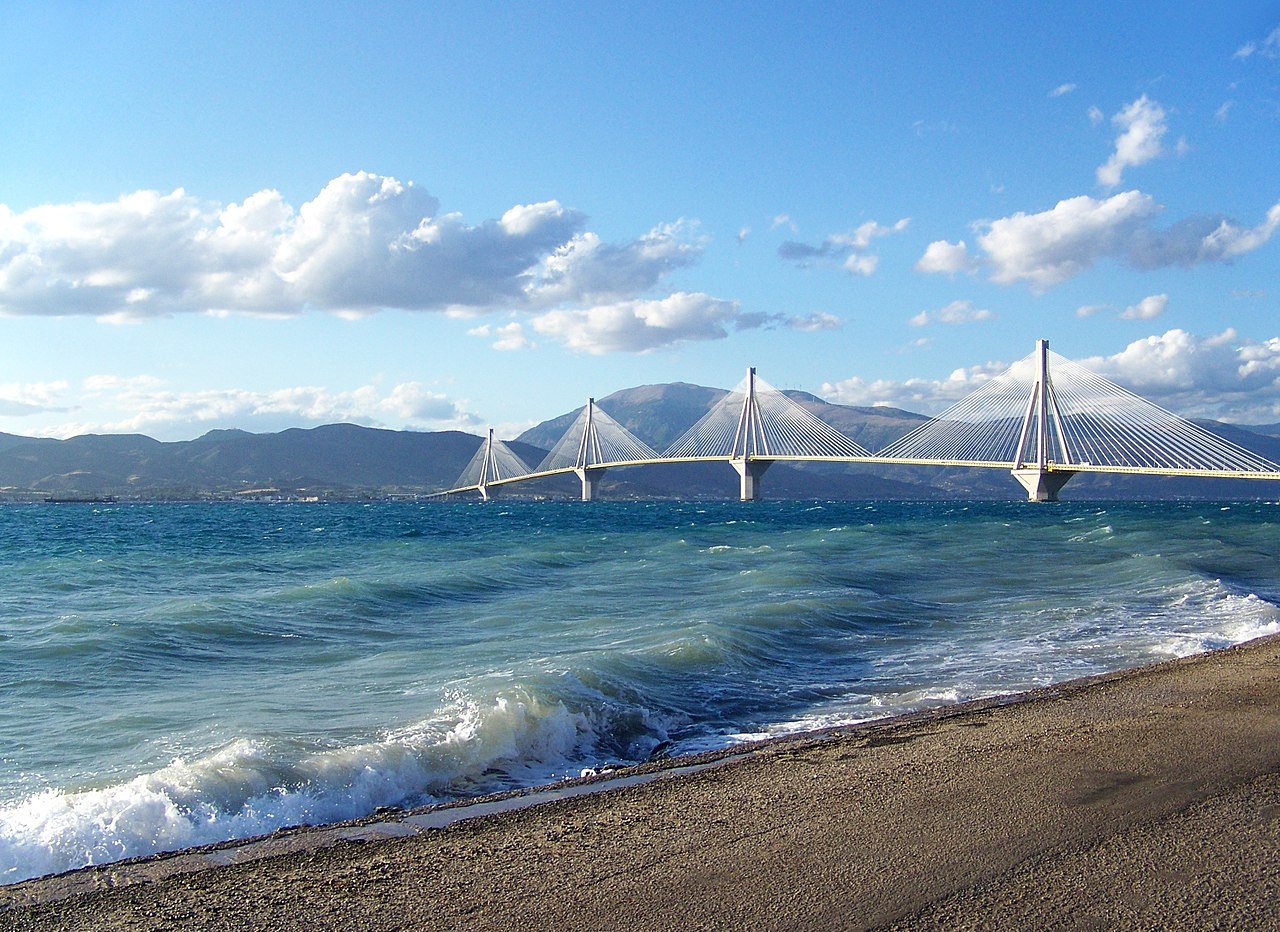
The Rio-Antirrio Bridge in Western Greece is one of the world’s longest multi-span, cable-stayed bridges. Credit: Eusebius, Eusebius CC BY-SA 3.0/ Wikipedia
The Rio-Antirrio Bridge was inaugurated on August 7, 2004, one week before the opening of the 2004 Summer Olympics in Athens.
Within two decades, it changed the economic landscape in Greece. The Rio-Antirrio Bridge, which connects the Peloponnese with Central Greece, had the aim of making the transport of passengers and cargo much easier. That has certainly been achieved.
The opening of the bridge was a celebration, with the first people to officially cross it being none other than the Olympic torchbearers of the 2004 Olympics. One member of that group was Otto Rehhagel, the German football coach who had led the Greek national team to their triumph in the Euro 2004 Cup just a month earlier.
The official name of the bridge is the Charilaos Trikoupis Bridge, named after the nineteenth-century prime minister of Greece, who was the first man to envision such a span connecting the Peloponnese with Central Greece. Unfortunately, state finances at the time did not allow for such a large-scale project.
The 2,380-meter (approximately 1.8-mile) long bridge is one of the longest cable-stay bridges in the entire world. It improves access to and from the Peloponnese, which could previously only be reached by ferry or via the Isthmus of Corinth.
The bridge connects Peloponnese with western Greece. Public Domain
According to a recent study by the Observatory of Road Networks in Western Greece and the Peloponnese, the construction of the graceful white cable-stay bridge has already resulted in enormous financial benefits. To date, this amount is estimated to be over 400 million euros.
The experts believe that the total amount of funds the bridge’s construction will bring to the area will be more than one billion euros during the period of 2017 to 2032.
Tourist flows have also improved, which is especially noted with arrivals coming into the area from the north from the port of Patras. Travelers heading for the Ionian Sea islands and areas in Central Greece can now easily and swiftly cross through the central area of the country and back again.
The study also noted that the bridge has already had a positive effect on property values in the northern region, which has led to a significant rise in land prices. This has given added value to an area that had been largely underdeveloped, attracting investment.
Traffic flows have also benefited immensely from the creation of the Charilaos Trikoupis Bridge. It not only connects two major motorways, the Ionian Odos and Olympia Odos, but transport connections between Epirus and Aitoloakarnania have been greatly improved, as well.
Before the construction of the new span, Aitoloakarnania had basically been almost completely cut off from the rest of the country.
Rio-Antirrio Bridge considered an engineering masterpiece
The construction of the imposing cable-stay bridge is widely considered to be an engineering masterpiece, owing to several solutions applied to overcome difficulties caused by its location and the geology of the region.
These difficulties included the especially deep waters of the river, the once-unstable underlying ground under the bases of the bridge, seismic activity, the probability of tsunamis, and the expansion of the Gulf of Corinth due to plate tectonics.
The seabed was first reinforced and stabilized by driving two hundred hollow steel pipes into the ground beneath each pier. The pier footings themselves were not driven into the seabed; they rest on a bed of gravel meticulously leveled to an even surface (a difficult endeavor at this depth).
During an earthquake, the piers are able to move laterally along the sea floor, with the gravel bed absorbing the energy. The bridge decking is also connected to the pylons using special jacks and dampers designed to absorb any movement.
View the fascinating video below to see all the special features of this unique and beautiful cable-stay bridge, which has already contributed immensely to the economy of the country.
The confirmed hit put the bridge out of commission, and additional strikes are not needed, the Da Vinci Regiment said, adding that "the enemy's important logistical route is completely paralyzed."
Ukrainian drones struck four vehicular bridges at Crimea's northwestern entrance overnight on 11 June 2026, quisling official Vladimir Saldo claimed. The strikes are part of Ukraine's most recent mid-range strike push—now at its fourth day—reaching every road corridor between Crimea and mainland Ukraine. The same night, drone attacks also rolled across Sevastopol, Bakhchysarai, Saky, and other Crimean sites.
Russia depends on the Crimean land corridor to push fuel, ammunition, and replacements to its forces in occupied southern Ukraine. Ukrainian mid-range drones operating under the military's LogisticsLockdown program have steadily shrunk that corridor's reliability since May. Ukraine has now struck all three major connection points between occupied Crimea and mainland Ukraine within four days, damaging some bridges and destroying others.
Four bridges damaged at the Armiansk isthmus
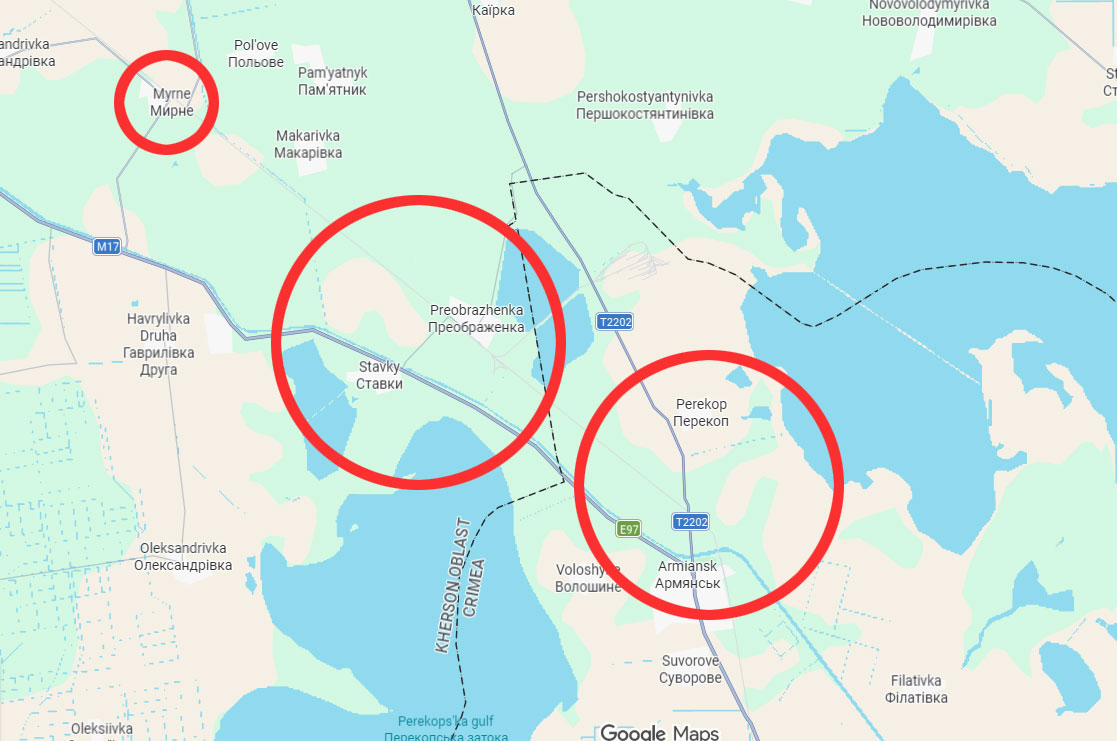
Saldo, the Russian-installed head of occupied Kherson Oblast, named the four targets on his Telegram. They include the automobile bridge in the Perekop-Armiansk area and a bridge near Stavky, Kherson Oblast. Two more bridges near Myrne and Preobrazhenka span the North Crimean Canal. Saldo stated all four spans sustained damage.
Google Maps view of the four bridges struck by Ukrainian drones overnight on 11 June 2026 — near Myrne, between Stavky and Preobrazhenka, and at Perekop near Armiansk in the northwestern Crimean isthmus. Map: Google Maps
Three Crimean northern choke points hit in four days
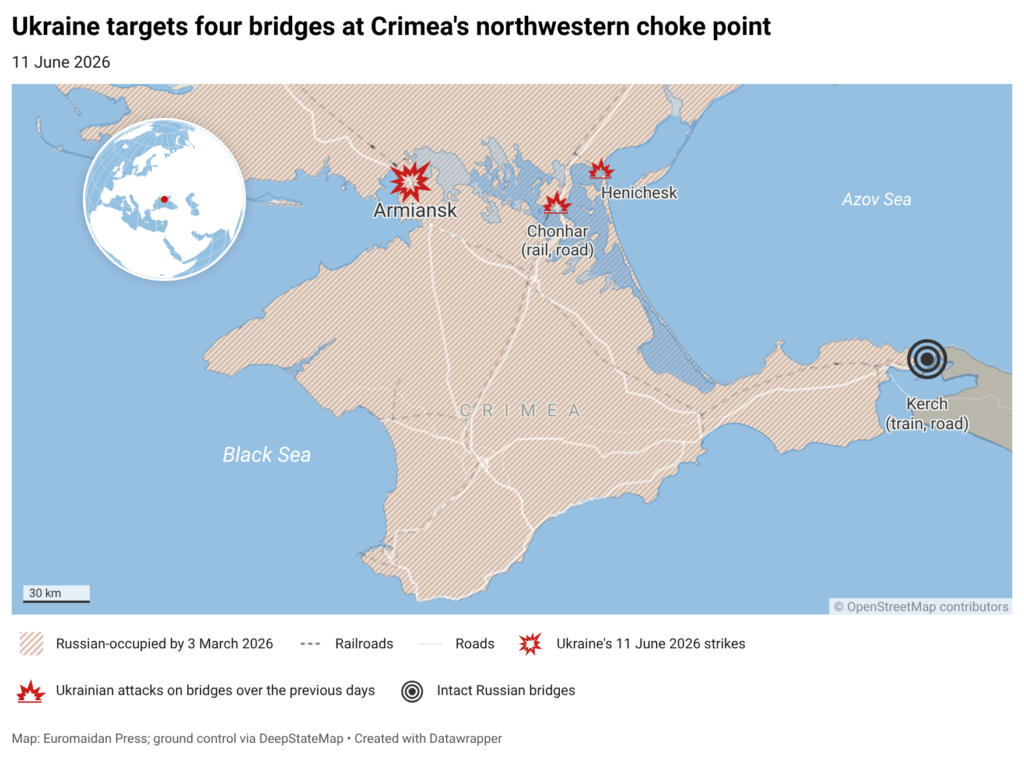
Ukraine struck the Chonhar bridge on 7 and 9 June, closing Russia's main road link to occupied Crimea, yet the Russians reportedly installed a pontoon bridge next to the severely damaged crossing. On 10 June, Ukrainian drones hit the bridge from Henichesk to Arabat Spit. With both routes fully or partially shut, Russia had rerouted traffic through Armiansk and Perekop — the very corridor struck overnight. DeepState analysts noted that Ukrainian strikes on the bridges are an important part of the blockade of occupied southern Ukraine.
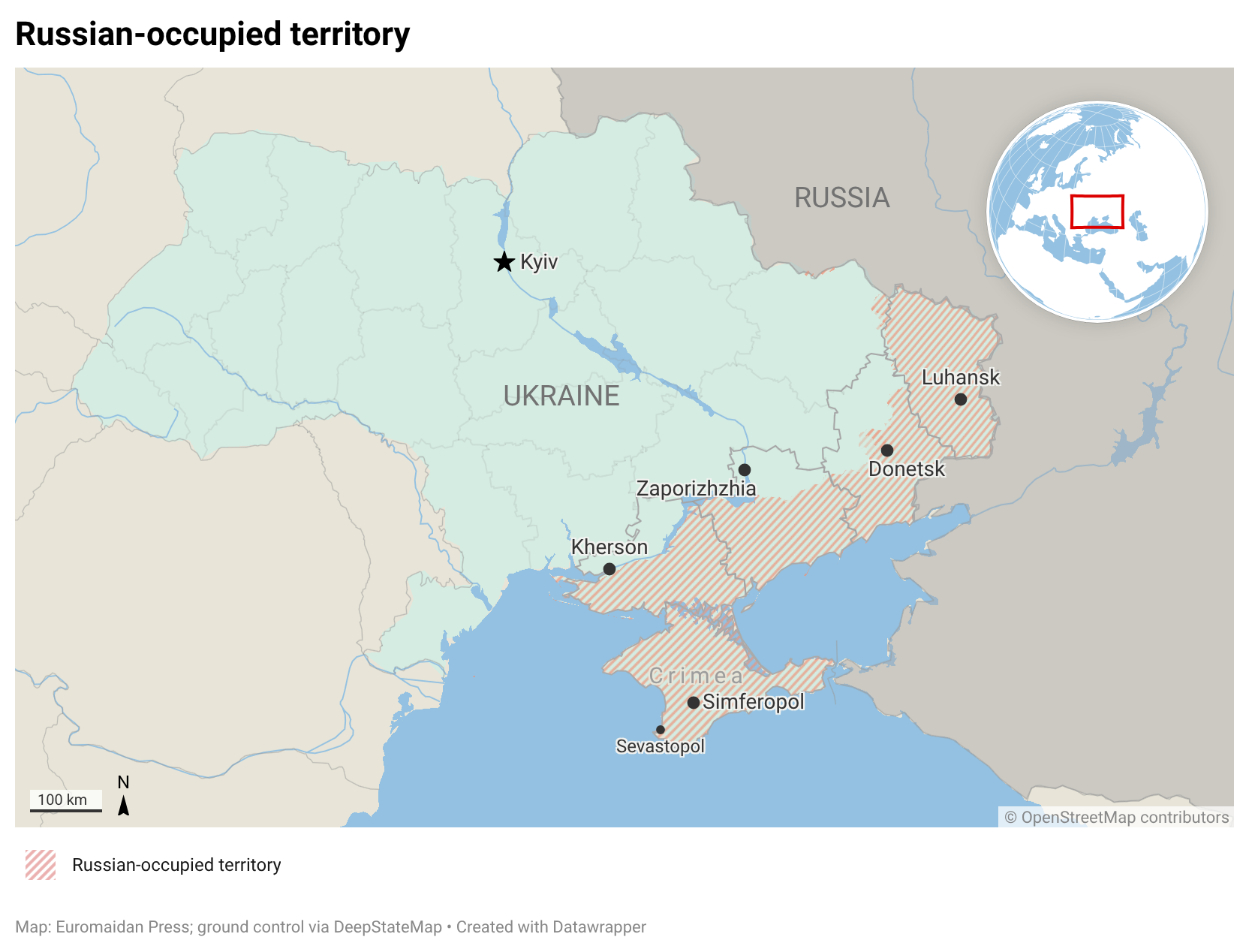
Russian-occupied Ukrainian territory, including Crimea and parts of Luhansk, Donetsk, Zaporizhzhia, and Kherson oblasts. Illustrative map: Euromaidan Press
Not only an entrance, but also targets across the peninsula
Russia's occupation governor, Mikhail Razvozhayev, claimed 32 drones were shot down over Sevastopol between 22:00 and midnight. He claimed the drones fell near Sevastopol Bay, Cape Fiolent, and Balaklava. The city declared two air alerts during the night and the morning.
Monitoring Telegram channel Krymsky Veter reported machine-gun fire in Pishchane at 21:40 and in Andriivka shortly after, citing subscribers.
"At 21:40 a machine gun started firing in Pishchane, at 21:48 a machine gun started in Andriivka, after which an anti-aircraft gun fired a couple of bursts," the channel wrote.
Detonations followed near Cape Fiolent, in Sevastopol, and later in Bakhchysarai. By morning, Krymsky Veter reported explosions and shooting in Saky.
Russia's Defense Ministry claimed the destruction of 330 drones over Russia and the occupied territories in the same overnight period.
Update
The First Assault Brigade shared the footage of the strikes:
Videos emerged of some of the Ukrainian strikes on bridges linking occupied Crimea to occupied Kherson Oblast
Ukraine's 1st Assault Brigade, 475th Assault Regiment, and SBU's Alfa reportedly took part.
A team at the University of Cambridge say this is the first time that a vaccine whose active component was 'designed entirely by computer simulations has been tested in humans.'
A team at the University of Cambridge say this is the first time that a vaccine whose active component was 'designed entirely by computer simulations has been tested in humans.'

 Login
Login