Awards for prose, children’s writing and poetry, for writers of colour in UK and Ireland, come with £1,000
Diana Evans has won this year’s Jhalak prose prize for I Want to Talk to You, a nonfiction collection on subjects ranging from Jean Rhys and Toni Morrison to lockdowns and the British monarchy.
The book, described as a “pleasure and an invigoration” by the Guardian’s reviewer Alex Clark, was announced as the 10th winner at a reception on Wednesday evening.
The actor and director who have long been snubbed will finally take home Oscars at November’s Governors awards
Glenn Close and Ridley Scott are among the names set to receive honorary Oscars at this year’s Governors awards.
The two have long been snubbed at the Oscars, with Close receiving eight nominations and Scott receiving four. The pair will be awarded this November alongside animator Floyd Norman and producers Christine Vachon and Pamela Koffler.
Stranger Things actor makes first public comments about his ex’s revealing hit album which tracks the dissolution of a relationship
David Harbour has spoken about his ex Lily Allen’s tell-all album West End Girl for the first time in a new interview.
The Stranger Things actor, who is on the Emmys trail for the HBO crime drama DTF St Louis, separated from the singer in early 2025 after they married in 2020. The couple filed for divorce months after their separation.
Le nom exprime une identité. Le nom et le prénom sont des marqueurs culturels. Ils transmettent une histoire, une langue, une filiation, une vision du monde. Ils constituent l’une des premières expressions de l’identité. Dans de nombreuses sociétés africaines, les noms portent traditionnellement une signification. Mais l’esclavage a profondément bouleversé cette réalité. Des millions d’Africains […]
Hundreds of thousands gather to remember Carlos ‘Indio’ Solari, who inspired cross-generational devotion, especially among working class
The line stretched for more than 7km (four miles). Mourners sang rock songs, waved banners, and carried speakers blasting music while smoke rose from makeshift barbecues and vendors sold T-shirts bearing the image of a bald man with sunglasses.
As evening fell, a drizzle set in, but the queue remained. At the end of the line in Avellaneda, outer Buenos Aires, stood a chapel containing the body of a rock star.
Des milliers de langues nées durant les cinq derniers millénaires auraient disparu, généralement sans laisser de traces. Depuis le XIXe siècle, le rythme de ces disparitions s'accélère singulièrement, notamment à partir des conquêtes coloniales européennes. Parmi tous les facteurs conduisant à cet assèchement du patrimoine culturel mondial, la domination économique joue un rôle majeur.
Il ne resterait que 7 100 langues environ aujourd'hui à travers la planète. Les experts prévoient qu'au cours du présent siècle entre 50 % et 90 % disparaîtront à leur tour. Un « massacre », estime l'Organisation des Nations unies pour l'éducation, la science et la culture (Unesco), qui doit publier bientôt une nouvelle édition de son Atlas des langues en danger dans le monde. On ne le remarquera même pas, car la disparition d'une langue ne représente jamais un événement spectaculaire. Pourtant, on peut parler d'un véritable « cataclysme » culturel, qui se produit dans l'indifférence générale.
Toute langue dont les utilisateurs ne détiennent pas un pouvoir politique ou qui ne dispose pas d'un statut reconnu est précaire
La mort de nombreuses langues apparaît comme une conséquence inévitable de la suprématie d'autres. En vérité, une menace pèse dès qu'une langue n'est plus en état d'expansion, qu'elle perd une partie de ses fonctions de communication, qu'elle n'est plus pratiquée quotidiennement pour les besoins usuels de la vie, qu'elle n'est plus rentable au plan économique.
Les causes de la disparition des langues demeurent multiples et complexes, mais elles sont plus ou moins circonscrites, comme pour les facteurs d'expansion, à des causes d'ordre militaire, démographique, géographique, économique, politique et culturel. Ces facteurs s'imbriquent les uns dans les autres, sans qu'il soit toujours aisé d'identifier lequel d'entre eux joue un rôle prépondérant.
1 Les conquêtes militaires
Une langue peut cesser d'exister par l'élimination pure et simple de la population qui la parle. S'il s'agit d'une petite langue minoritaire, l'effet est radical, immédiat et irréversible. Qu'on pense à la liquidation de nombreuses langues amérindiennes ou de celles de plusieurs peuples de l'ex-URSS, de la Chine : Ingouches, Kalmouks, Mekhétiens, Nus, Achangs, etc.
Dans certains cas extrêmes, un génocide constitue le début d'un long déclin. Rappelons les massacres des armées de Jules César, qui fauchèrent sept millions de guerriers gaulois et réduisirent la population du tiers de ses meilleurs effectifs ; la langue gauloise ne s'en est jamais remise. Signalons aussi l'extermination de deux millions d'Irlandais par les Anglais au XIXe siècle, celle de 1,2 million d'Arméniens par les Turcs au début du XXe siècle ou l'hécatombe des Ibos durant la guerre du Biafra (1966-1970).
2 La faiblesse numérique
Si l'essor démographique contribue à l'expansion des langues, une faible natalité entraîne leur régression. Les langues sont moribondes lorsqu'elles ne comptent que cinq, dix ou vingt locuteurs tous âgés de plus de 60 ans. C'est le cas du tosu, une langue tibéto-birmane parlée par neuf locuteurs (en 2015) dans la province du Sichuan en Chine. Cette langue disparaîtra avec le dernier locuteur survivant.
On estime que le seuil de survie d'une langue se situe à environ un million de locuteurs (un total de 382 langues en 2022), et que sa survie devient précaire dès qu'elle est pratiquée par moins de cent mille d'entre eux. Or, la plupart des 7 100 langues du monde sont parlées par un bien moindre nombre de personnes.
En somme, une langue peut disparaître parce qu'elle n'a plus suffisamment de locuteurs pour assurer un minimum de communication, mais surtout — et c'est là le phénomène le plus important — parce que ceux-ci acceptent ou choisissent de l'abandonner ou de ne plus la transmettre à leurs enfants. Autrement dit, parce qu'elle n'est plus jugée utile.
3 L'éparpillement démographique
L'une des pires situations pour une langue numériquement faible, c'est l'éparpillement de ceux qui la parlent sur de vastes étendues de territoire dominées par une ou plusieurs langues fortes.
Au Canada, le sort du million de francophones hors Québec est préoccupant dans la mesure où leur dispersion les rend vulnérables à l'assimilation. Il en est ainsi des quelque quarante mille utilisateurs du sorabe, une langue slave, qui sont dispersés dans environ cent quarante municipalités d'Allemagne. Au lendemain de la chute de l'Empire austro-hongrois en 1918, de nombreux peuples se sont retrouvés hors de leur pays d'origine et sont devenus des minorités isolées dans un autre pays, comme les petites communautés magyarophones (hongroises) dispersées en Autriche, en Slovaquie, en Slovénie, en Croatie, en Serbie, etc.
Une langue ne vit bien que lorsqu'elle est fortement concentrée sur un territoire.
4 La minorisation des communautés
Un déplacement de population peut minoriser numériquement ou fonctionnellement un groupe linguistique. Cette submersion a été pratiquée « avec succès » auprès de nombreuses communautés autochtones, notamment par la déforestation des zones équatoriales où de petites populations conservent de nombreuses langues distinctes. On retrouve ce phénomène avec les Américains à Hawaï, les Chinois au Tibet, les Italiens dans le Val d'Aoste ou en Sardaigne, les Anglais en Écosse et au Pays de Galles, les Indonésiens au Timor-Leste, les Allemands en Lusace (Brandebourg et Saxe), etc.
Fabienne Verdier ///// « Fractalscapes II, Paysage dans l'énergie d'un trait », 2012
Dans certains cas, une grande puissance peut forcer ses propres citoyens à émigrer dans des régions minoritaires afin de réduire fonctionnellement les langues locales. Les autorités d'Union soviétique répartirent ainsi des russophones dans toutes les républiques, de sorte que les langues dites tutélaires (ukrainien, géorgien, lituanien, kazakh, etc.) devenaient fonctionnellement minoritaires sur leur propre territoire, bien qu'elles aient été numériquement majoritaires. À long terme, ces langues se russifiaient à un point tel qu'elles perdaient la plupart de leurs fonctions de communication formelle, notamment en matière d'éducation. Un processus de mort lente !
5 Les mariages mixtes
Les mariages exogames affaiblissent les langues minoritaires, en accélérant la tendance à l'assimilation, à l'exemple des Canadiens francophones hors Québec, dont le taux d'assimilation varie de 30 % à 90 %.
Il existe des cas plus rares où l'exogamie joue contre les vainqueurs. Les Francs, et plus tard les Normands (Vikings), vainqueurs et minoritaires, se sont assimilés aux vaincus, car les enfants issus des mariages mixtes entre pères francs ou normands et mères gallo-romaines ou françaises ont appris la langue maternelle.
6 La domination socio-économique
La régression d'une langue dépend aussi de la place que ses locuteurs occupent dans les rapports socio-économiques. La prospérité économique a attiré les populations bretonne et galloise vers les zones urbaines où régnait la langue dominante. En moins d'une génération, le breton et le gallois ont perdu une bonne moitié de leurs locuteurs à la suite de l'industrialisation, de l'urbanisation et des brassages de population. L'apathie a fait le reste.
Une menace pèse dès qu'une langue n'est plus en état d'expansion, n'est plus pratiquée quotidiennement ou n'est plus rentable au plan économique
L'un des cas les plus étonnants de mutations linguistiques successives est celui des Kamasses. Ce petit peuple de Sibérie, comptant quatre cents individus, a changé d'idiome trois fois en cinquante ans : pratiquant à l'origine une langue samoyède (le kamassien), ils ont commencé à pratiquer le turc vers 1840 et ne parlaient plus que cette langue vingt ans plus tard ; mais à partir de 1890 ils avaient déjà abandonné le turc pour le russe. La dernière locutrice du kamassien est décédée le 20 septembre 1989.
Seul l'intérêt économique explique que des communautés entières abandonnent leur langue pour une autre jugée plus « rentable ». Réussir socialement et économiquement reste une source de motivation profonde chez les êtres humains, y compris en perdant sa langue.
7 L'impuissance politique
Toute langue dont les utilisateurs ne détiennent pas un quelconque pouvoir politique sur un territoire ou qui ne dispose pas d'un statut reconnu est nécessairement placée dans une situation précaire, particulièrement lorsqu'il s'agit d'un État fort et puissant. Les langues sans État ou celles dont les locuteurs ne bénéficient d'aucun statut dans leur pays doivent leur maintien à la bonne volonté de la majorité dominante.
Seule une minorité de langues, soit un peu plus d'une centaine, bénéficie de l'appui d'un État comme langue nationale, officielle ou coofficielle. Ainsi, les 385 000 Islandais ont beaucoup plus de chances de conserver leur langue que les Tibétains (environ 7,8 millions) ou les Kurdes (environ 30 millions), dispersés dans plusieurs pays et sans pouvoir politique. Seuls les Kurdes du Kurdistan irakien (3,8 millions sur 6,4 de kurdophones) jouissent d'une autonomie politique, acquise en 2005, qui leur procure un levier contre l'assimilation. La plupart des petits peuples ne disposent pas d'un tel levier : francophones de Louisiane (États-Unis) et de la plupart des provinces anglaises du Canada, Frisons aux Pays-Bas, Aborigènes australiens, peuples paléosibériens de Russie, Aïnous du Japon, Bochimans du sud de l'Afrique, Mélanésiens de l'Océanie, Papous en Nouvelle-Guinée, etc.
8 La domination culturelle
Fruit d'un rapport de forces au sein du pouvoir économique, la domination culturelle s'étend depuis l'école jusqu'aux produits véhiculés par les moyens technologiques tels le cinéma, la radio, la télévision, Internet ou les jeux vidéo. Faute d'école, de bibliothèque, de supports de création, les peuples qui utilisent massivement une langue et une culture différentes deviennent dépendants et anémient leur univers linguistique. La soumission tranquille devient acceptation, résignation et servitude. C'est comme si les locuteurs d'une langue étaient complices de leur propre liquidation !
La mort d'une langue n'est pas subite. Le premier symptôme de la régression apparaît quand un peuple commence à ne plus l'utiliser, l'abandonnant pour la remplacer par une autre, estimée plus « rentable ». Ce processus se déroule en des phases provisoires de bilinguisme variable, issu d'abord des élites, puis qui se généralise.
Dans la phase initiale de régression, la minorité se fait persuader qu'apprendre la langue de la majorité enrichira sa vie culturelle, lui assurera un meilleur développement économique, l'ouvrira vers l'internationalisme, tout en lui évitant un repliement sur soi. Mais les minoritaires assument le plus souvent seuls ce bilinguisme, inutile pour le groupe majoritaire, sauf quand il s'agit d'une coquetterie culturelle.
Le type de bilinguisme qui prévaut dans l'extinction des langues ne correspond ni au bilinguisme individuel ni au bilinguisme institutionnel, mais à un bilinguisme étendu à toute une communauté. La non-utilisation de la langue maternelle entraîne une perte d'habileté linguistique, d'appauvrissement dans l'expression, puis une perte d'identité culturelle, qui mène vers une mutation linguistique.
Deux forces convergentes favorisent l'assimilation : d'une part l'attraction de la langue dominante, qui se manifeste par les avantages économiques, symboliques et culturels que retire la minorité ; et, d'autre part, la pression sociale, qui se traduit par la perte des fonctions de communication : enseignement, travail, loisirs, information, etc. Plus ces fonctions s'orientent vers la langue dominante, plus l'assimilation linguistique sera rapide.
Toutefois, ce processus de mort d'une langue n'est pas irréversible, car celle-ci n'est pas un organisme biologique. C'est une réalité sociale ! Le processus d'assimilation, prélude à la disparition d'un idiome, peut s'arrêter exceptionnellement en cours d'évolution, même si la tendance commune, une fois le processus de la régression amorcée, conduit vers un déclin plus ou moins long. Cependant, tant et aussi longtemps que les locuteurs d'une langue vivront dans un isolement géographique (îles, montagnes, forêts) à l'abri d'une langue forte, ils peuvent perpétuer la survivance de leur langue. C'est l'éternel dilemme de Jean de La Fontaine dans la fable Le Pot de terre et le Pot de fer !
Why did the Metropolitan Police attend a UCL bar to kick out our group of conservative-minded students over our views on transgenderism, asks Samiksha Bhattacharjee.
Broadcaster says it is focusing on series’ long-term future after departure of showrunner and producer
The BBC has cancelled the special Christmas episode of Doctor Who amid speculation about the future of the series after Ncuti Gatwa ended his run as the Time Lord.
The broadcaster also said the long-running sci-fi series, which launched in 1963, would be put out to “competitive tender” this year as part of its Royal Charter agreement after the departure of the showrunner Russell T Davies and producer Bad Wolf.
As Steven Spielberg releases a new film on extraterrestrials, here's a brief history of modern alien conspiracies and why scientists are now taking UFO reports seriously.
The 48-team World Cup is not the only historic soccer event this year. Four titans are vying for control of video game soccer in the fiercest battle the industry has ever seen.
Renewed outrage at White House’s use manga and anime imagery after US president is depicted as ninja Naruto
Japanese anime and manga fans are urging Donald Trump to stop using their favourite characters in his social media posts.
About 20,000 people have signed a petition on Change.org entitled Protect Japanese Manga, protesting against the official White House X account posting videos featuring unauthorised use of imagery from the popular Dragon Ball, Yu-Gi-Oh! and Naruto series. Angry fans have also been posting on social media.
Greek Culture Minister Lina Mendoni and Turkish Culture and Tourism Minister Mehmet Nuri Ersoy. Credit: Ministry of Culture
Greece and Turkey have established a permanent cultural forum to strengthen bilateral cooperation in cultural heritage, museums, research, education, and new technologies, creating a new institutional framework for dialogue between the two countries.
The Greece-Türkiye Cultural Forum was formally established last week through a Joint Declaration signed by Greek Culture Minister Lina Mendoni and Turkish Culture and Tourism Minister Mehmet Nuri Ersoy during the forum’s inaugural session in Cappadocia. Under the agreement, the forum will meet regularly in both countries and serve as a platform for exchanging expertise and developing joint initiatives. “Culture is perhaps the deepest and most enduring field of communication between our societies,” Mendoni said.
The forum is the latest outcome of efforts to strengthen Greek-Turkish relations following the Athens Declaration on Friendship and Good Neighbourly Relations signed by Prime Minister Kyriakos Mitsotakis and President Recep Tayyip Erdogan in December 2023. It also builds on a Memorandum of Cultural Cooperation signed by the two culture ministers during the 6th Supreme Cooperation Council in Ankara.
Heritage protection and cultural cooperation between Greece and Turkey
During the forum, Mendoni outlined Greece’s approach to heritage protection, noting that Greek legislation safeguards all monuments equally—ancient, Byzantine, Ottoman, post-Byzantine and modern—regardless of their religious or cultural origin. She also stated that all are incorporated into the country’s cultural routes and tourism networks.
Furthermore, the forum featured presentations by officials and experts from both countries on the restoration and conservation of Byzantine and Ottoman monuments, heritage management, historical research, and the use of new technologies in the cultural sector. Discussions also focused on combating the illicit trafficking of cultural goods, an area in which Greece and Turkey have cooperated since signing a bilateral protocol in 2013.
“The exchange of information, the cooperation of competent services and the use of international mechanisms are crucial tools for effectively combating the illegal trafficking of cultural goods and securing their return to their place of origin,” Mendoni said. The Joint Declaration also highlights the importance of digitalization and improving public access to cultural resources through digital technologies, while encouraging closer cooperation in the use of emerging technologies in heritage management.
On the sidelines of the forum, Mendoni thanked Ersoy for Turkey’s support at UNESCO’s Intergovernmental Committee regarding the return of the Parthenon Sculptures. She noted that his confirmation that no Ottoman document ever authorized Lord Elgin’s removal of the sculptures strengthens the international case for their reunification in Athens.
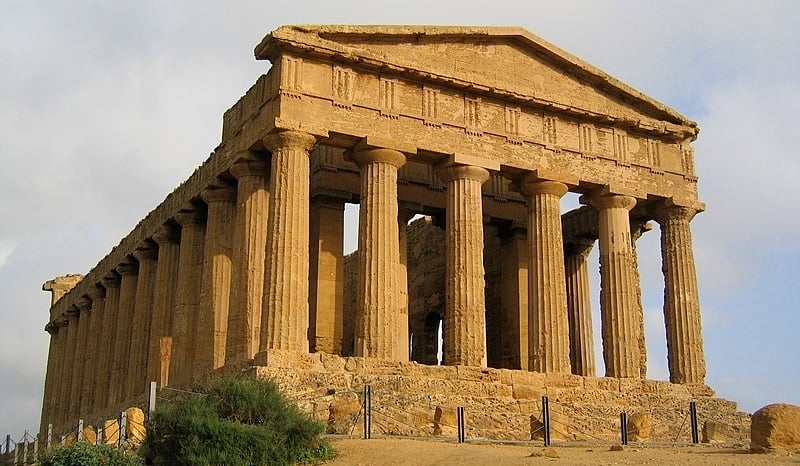
Temple of Concordia – Agrigento, Italy. Credit: Public Domain
When you think about Italy and ruins, your mind’s eye automatically brings up scenes of the Roman Forum and the Colosseum. However, Italy is home to countless ruins which are actually ancient Greek—many of which remain in stellar condition.
The country’s mainland, as well as the island of Sicily, are dotted with Greek ruins—some of which are integrated into modern-day cities and are still even used to host events! Others can be found in isolated locations well off the beaten path.
Ancient Greek Ruins of Italy
As you travel through Italy, as you really should if you call yourself a well-traveled individual, be sure to say “Opa!” as often as you say “Mamma mia!” The following are just some of the truly jaw-dropping ancient Greek ruins which are scattered throughout the Italian countryside.
Paestum
Located in southern Italy along the coast of the Tyrrhenian Sea in what was then called “Greater Greece” or Magna Graecia, this was a major Greek city in ancient times. The ruins date back to 600 to 450 B.C. and are some of the best-preserved Greek temples in the world!
The three famous ancient Greek temples at this site are of the Doric type, and the ancient city walls and amphitheater are mostly intact. The bottom section of walls from many other structures are completely intact.
It is an amazing experience to be able to walk along the ancient stone-paved roads and view the buildings along the roadsides just as the ancients did. The site is open to the public, and there is a modern national museum on-site for you to check out as well.
Another plus is that this archeological site is well off the beaten path and is seldom crowded with visitors!
Locri Epizefiri
Also on the mainland of Italy, in Reggio di Calabria, you will come across the ancient ruins at Locri. The ancient city has been mostly taken over by the encroachment of the nearby towns.
However, the area is very much worth a visit because the atmosphere quiets as you pass through shady olive groves and meander along the overgrown pathways. It is here where you will inevitably, and literally, stumble across a treasure of ancient ruins.
Greek temples, amphitheaters, and the well-known Sanctuary of Persephone grace the Locri area. The magical experience is truly something you shouldn’t miss out on.
On the island of Sicily, some truly remarkable ruins are yours to explore, starting with the still-used ancient Greek Theater of Taormina!
The Ancient Greek Theater of Taormina
With the beautiful Mediterranean sea lapping at the shores below and the active volcano of Etna looming over the city, Taormina is an upscale destination, featuring cultural events, museums, and priceless antiquities—right in the middle of a bustling city!
The ancient theatre of Taormina. Credit: Public Domain
Here you will find an ancient Greek amphitheater with exquisite views of both the volcano and the sea. While there, you might even be lucky enough to see a show at the ancient theater. It was originally built in 300’s B.C. and subsequently rebuilt by the Romans in the second century B.C.
Valle dei Templi in Agrigento
In Argrigento, you will be treated to refreshing views of expansive fields and woodlands—as well as one of the most pristine ancient Greek ruins in existence in the Valle dei Templi (the Valley of Temples).
Many of the temples and ruins here are not fenced off, so travelers may walk inside and be transported back to the fifth century B.C., when the Greeks first built the ancient city of Akragas. One of the most well-preserved Greek temples in the world, the Temple of Concord, is in this valley.
Segesta Archaeological Site
Segesta is located only 70 kilometers (43 miles) southwest of Palermo. Fortunate travelers here can visit what is perhaps the second most well-preserved temple in the world after those in the Valle dei Templi. Segesta also boasts a beautiful amphitheater, situated atop Mount Barbaro, which is also in pristine condition.
The temple dates back to the fifth century B.C. and has typical Doric architecture. Each summer the ancient amphitheater hosts a series of classical Greek dramas performed in Italian. If you’re lucky enough to visit during the summertime, be sure to catch a show.
Ancient Greek Colony in Siracusa
A favorite for all are the ancient ruins at Siracusa (Syracuse), where the ancient Greek colony dates back to the 5th century B.C. This area boasts a Greek theater and the Temple of Apollo, which dates back to the 6th century. Siracusa also has the ruins of the famous Altar of Hieron II—the largest altar from ancient Greece!
Located on the southeastern coast of Sicily and founded by ancient Greeks from Corinth, the city of Siracusa was once one of the most powerful city-states of ancient times. It was once described by the Roman orator Cicero as “the greatest Greek city, and the most beautiful of them all.”
Siracusa is so rich in historical treasures that it is listed as a UNESCO World Heritage Site.
Of course, there are many other Greek ruins that you will come across in your travels through Italy and Sicily, and we have merely scratched the surface in highlighting some of the more popular and well-preserved sites.
Be sure to work a little bit of Greek history into your itinerary on your visit to Italia!
The theatrical prequel to the Duffer Brothers’ smash-hit Netflix series is to shut down in the West End and on Broadway this winter, after selling more than 1.5m tickets
The London and New York productions of Stranger Things: The First Shadow, the theatrical prequel to Netflix’s TV blockbuster, are to both close this winter. The stage spectacular will have run for just over three years in the West End, where it won two Olivier awards, and for just over 20 months on Broadway, where it won four Tony awards. The final performance at the Phoenix theatre in London will be on 27 December and the last show at the Marquis theatre in New York will be on 3 January.
The announcement, made on Tuesday, comes as a surprise considering the TV series’ phenomenal continued success. The November launch of the fifth and final season broke viewing records for an English-language series on Netflix, with 59.6m views in the first five days, and even caused the streaming service to crash within minutes of the episodes first becoming available. In February, it was widely reported that the New York stage production was being filmed for future release, but Netflix has made no such official statement.
Israel has bombed the city of Tyre, killing eight and injuring at least 32 people, and struck dozens of other villages in south Lebanon as it issued forced evacuation orders for the historic Christian quarter of the ancient city for the first time.
Israel struck the al-Masaken neighbourhood without warning on Tuesday morning, sending smoke plumes high above the city’s buildings and igniting fires. Further airstrikes were carried out across the city and a series of bombings hit Abbasieh, a village north of Tyre.
The Leipzig Bach Festival honors the composer with a hit parade. Over 8,000 fans from 20 countries cast their votes. But Bach is celebrated in many other countries around the world as well.
Lisbon’s Design Museum (MUDE) and Lisbon Museum – Pimenta Palace are among the 34 nominees for the European Museum of the Year Award, which the organisers will host on Saturday

 Login
Login