A Goldenergy, comercializadora de eletricidade e gás natural, e a Panike, líder no setor da panificação e pastelaria ultracongelada, formalizaram uma parceria estratégica. O objetivo é reforçar a transição energética da indústria de panificação em Portugal através do fornecimento de biometano com garantias de origem certificadas.
Este acordo marca a expansão da Goldenergy na introdução de gases renováveis no tecido industrial português, uma vez que a empresa já fornece biometano a setores como a cerâmica e o têxtil, além do turismo. O fornecimento à Panike foi reforçado em junho de 2026, com um aumento dos volumes adquiridos, representando atualmente cerca de 2% do consumo total de gás da empresa.
Henrique Soares, CEO e fundador da Panike, afirmou que “esta incorporação ecológica será implementada nas três unidades industriais da PANIKE – Maia, Santo Tirso e Tondela – e constitui mais um passo na estratégia de sustentabilidade da empresa.” Ele acrescentou que a utilização de biometano complementa os investimentos em eficiência energética e eletrificação, permitindo a descarbonização de processos produtivos que ainda dependem de energia térmica.
Miguel Checa, General Manager da Goldenergy, expressou o seu orgulho em apoiar a Panike na sua jornada rumo à neutralidade carbónica, destacando que a empresa já descarbonizou 15 empresas em Portugal através do biometano. Esta parceria representa a estreia da Goldenergy no abastecimento de biometano ao setor alimentar, alargando a sua quota de descarbonização industrial.
O biometano utilizado garante compatibilidade com as redes de transporte existentes, permitindo à Panike complementar a descarbonização do seu processo de fabrico sem a necessidade de investimentos adicionais em novos equipamentos ou alterações estruturais nas suas linhas de produção atuais.
A federal judge over the weekend struck down a Trump administration effort to restrict tax credits for wind and solar energy. While the ruling is a win for renewable energy supporters, it comes less than a month before a key deadline to phase out the credits entirely under Republicans’ “Big Beautiful Bill,” so it’s unclear how wide-reaching the…
An early draft of the annual defense policy bill, or National Defense Authorization Act (NDAA), for the 2027 Fiscal Year, would authorize the addition of $5 million to the Navy’s budget for work on a containerized HELIOS. It would also add $2.5 million for a “Containerized Maritime High Energy Laser Weapon System,” which does not otherwise appear to be mentioned, at least by that name, in the service’s proposed budget for the 2027 Fiscal Year. The House Armed Services Committee released this draft NDAA earlier this week.
The one HELIOS laser directed energy weapon in Navy service currently, which is integrated onto the Arleigh Burke class destroyer USS Preble, seen being tested. USN USN
The Navy’s proposed budget for the next fiscal cycle does already include a request for $75.6 million for a separate Joint Laser Weapon System (JLWS) effort. The development of a containerized 150-kilowatt-class laser directed energy weapon, along with work toward 300 and 500-kilowatt-class designs, are part of the stated plans for JLWS. It’s unclear whether the Maritime High Energy Laser Weapon System mentioned in the draft NDAA is related to JLWS.
HELIOS, which the Navy has also designated Mk 5 Mod 0, is a 60-kilowatt-class laser directed energy weapon. At that power level, it is able to destroy or at least damage certain targets, such as drones or small boats, a capability that has now been demonstrated in multiple tests. There has been talk in the past about scaling HELIOS’s power rating up to 150 kilowatts.
Currently, the Navy only has one HELIOS laser, installed on the Arleigh Burke class destroyer USS Preble. Despite integration on an operational warship, the service describes this system as a “Non-Program of Record (POR) Research & Development (R&D) asset” in its most recent budget request.
A graphic depicting an Arleigh Burke class destroyer firing a HELIOS laser. Note that the beam would not be visible to the naked eye during a real engagement. Lockheed Martin
As an aside, another laser system, the Optical Dazzling Interdictor, Navy (ODIN), is currently found on seven other Arleigh Burke class destroyers. An eighth example was integrated on the USS Kidd, but has been temporarily removed while that ship is completing a two-year maintenance availability. That ODIN system is currently being used for land-based training at the Naval Surface Warfare Center, Port Hueneme Division, in California. Designed as a “dazzler,” ODIN is lower-powered than HELIOS, and is intended to blind or confuse electro-optical and/or imaging infrared systems, including seekers on incoming munitions, sending them off course rather than shooting them down.
An ODIN system seen undergoing testing on land. USN
As noted, HELIOS offers demonstrated capability now, and a containerized version is something the Navy might be able to field more widely in the near-term. This, in turn, could help provide a bridge to future developments under JLWS. Containerized systems, as well as palletized ones, inherently offer valuable flexibility, especially in a maritime context. Integration can be more readily achieved on a broad array of ships – including carriers, amphibious warfare ships, sea base-type vessels, and sealift ships, as well as certain surface combatants – as long as there is sufficient deck space and available power.
In April, the Navy disclosed a test of a palletized version of AeroVironment’s LOCUST laser counter-drone system on the Nimitz class aircraft carrier USS George H.W. Bush, underscoring exactly this kind of flexibility. For that test, AeroVironment leveraged a palletized configuration of LOCUST it had already developed for the U.S. Army. However, various changes were made to adapt it to shipboard use, including “hardened electronics for salt fog, humidity, vibration, and long deployments” and the addition of “stabilization hardware to manage ship motion,” according to a company press release.
The palletized LOCUST system seen on the deck of the USS George H.W. Bush. USN
When it comes to a containerized version of HELIOS, which could also be used to bolster defenses ashore, it would benefit from having been developed for maritime use from the start. It might still be less hardened against environmental conditions, as well as battle damage, than its more deeply integrated counterpart on the USS Preble. There are also questions about how the system might be integrated onto the host ship and its combat system, if it has one at all.
Laser directed energy weapons do also have limitations, especially when employed in the maritime domain, as TWZ has highlighted in the past:
“A single laser can only engage one target at once. As the beam gets further away from the source, its power also drops, just as a result of it having to propagate through the atmosphere. This can be further compounded by the weather and other environmental factors like smoke and dust. More power is then needed to produce suitable effects at appreciable distances. Adaptive optics are used to help overcome atmospheric distortion to a degree. Altogether, laser directed energy weapons generally remain relatively short-range systems.”
“In addition, laser directed energy weapons, especially sensitive optics, present inherent reliability challenges for use in real-world military operations. Shipboard use adds rough sea states and saltwater exposure to the equation. There is also the matter of needing to keep everything properly cooled, which creates additional power generation and other demands.”
Overall, the Navy’s current top leadership is already very supportive of containerized systems and directed energy weapons, including both lasers and high-power microwave types. In March, Chief of Naval Operations (CNO) Adm. Daryl Caudle, the service’s top officer, unveiled a formal Containerized Capability Campaign.
Chief of Naval Operations Adm. Daryl Caudle, left, speaks at a separate budget-related hearing before members of the House Appropriations Committee on May 12, 2026. USN
“From towed-array-systems, to drone swarms, to electronic attack systems, to high-powered lasers … I want to containerize everything,” Caudle said at the annual McAleese Defense Programs Conference in March. “Tailored capabilities give our combatant commanders something they value above all else: options.”
Laser directed energy weapons are also central to the current plan for the Navy’s future Trump class battleships, but they are expected to be deeply integrated into that design rather than containerized. Adm. Caudle has been outspoken more broadly in his view that laser-directed energy weapons are key to bolstering close-in defenses on his service’s warships going forward, including against the growing threat posed by drones.
A rendering of a Trump class battleship firing various weapons, including laser directed energy weapons. USN
“My thesis research at [the] Naval Post Graduate School was on directed energy and nuclear weapons,” the CNO told TWZ and other outlets at a roundtable at the Surface Navy Association’s (SNA) annual symposium in January. “This is my goal, if it’s in line of sight of a ship, that the first solution that we’re using is directed energy.”
In particular, “point defense needs to shift to directed energy,” Caudle added at that time. “It has an infinite magazine.”
Even before assuming his current role as CNO, Caudle has been a vocal supporter of Navy directed energy weapon developments. At the same time, as mentioned, the service has faced continued stumbling blocks to more widespread fielding of these capabilities. This is, in many ways, reflected just in HELIOS, which remains a largely experimental effort despite years of testing and previous talk about expanding it into a broader operational capability. The Navy has integrated other one-off lasers onto other ships in the past. This includes the Laser Weapon System Demonstrator Mk 2 Mod 0 installed for a time on the San Antonio class amphibious warfare ship USS Portland, which is seen being tested in this video below.
Despite it adding funding for containerized system development, the draft NDAA that the House Armed Services Committee also proposes to cut $5 million from the Navy’s Directed Energy and Electric Weapon Systems line item due to what it simply describes as “unjustified growth.” The bill is also very likely to change in substantial ways in the coming weeks and months before it is ever put to a full vote, let alone sent to President Trump’s desk.
Whether or not the extra funding for a containerized version of HELIOS, or the Maritime High Energy Laser Weapon System, comes across in the end, the Navy is already heavily committed to new developments in this arena despite the continued challenges.
Australia’s revolution in rooftop solar has left behind commercial and industrial buildings, where installations have lagged far behind homes, according to new analysis.
Australia leads the world in residential solar on per capita terms, with 22GW installed as of last December. But businesses have only installed about a quarter of that – 5.6GW – despite consuming more electricity than households, a report from the Institute for Energy Economics and Financial Analysis (IEEFA) has found.
BANGKOK — More than 600 residents of Chiang Mai and Chiang Rai provinces embarked May 31 on a roughly 68-kilometer, six-day ‘peace walk’ to demand the Thai government take action on the river pollution crisis that has seen Thai rivers polluted with heavy metals. The ensemble of affected residents, civil society groups, monks and students marched from Tha Ton subdistrict in Chiang Mai to the city of Chiang Rai in northern Thailand, reaching their destination on June 5, World Environment Day. For more than a year, Thailand’s Pollution Control Department has reported dangerous levels of arsenic, mercury, cadmium and other heavy metals in rivers across northern Thailand, with mining operations across eastern Myanmar suspected to be responsible for the pollution. “We are walking because our rivers are slowly dying,” Pianporn Deetes, executive director of the Rivers and Rights Foundation, which helped to organize the peace walk, told Mongabay by phone. “Toxic contamination from unregulated mining upstream is already affecting water, fish, food, livelihoods, and public health. We do not want to wait until more people become sick. This is an emergency.” Pianporn said the walk (42 miles) was about taking collective action to share information, document impacts and build public pressure in a bid to force the government to address the issue, which Pianporn said has, so far, been lacking. “Monitoring has improved, but action has not matched the scale of the crisis,” she said. “We need urgent diplomatic engagement with neighboring countries, stronger health monitoring, transparency, and action to…This article was originally published on Mongabay
As U.S.-Iran talks show little sign of progress, commercial traffic through the Strait of Hormuz remains sharply reduced, raising concerns about global energy markets and supply chains. Geoff Bennett speaks with energy analyst Daniel Yergin, vice chairman of S&P Global, for more on what a prolonged disruption could mean around the world.
As offshore wind farms expand rapidly in the global renewable energy transition, scientists are studying how these large marine infrastructure projects affect ecosystems beneath the waves. Research from Wageningen University & Research in the Netherlands suggests that offshore wind may bring both risks and benefits for sharks and rays, known collectively as Elasmobranchii, which are highly sensitive to electromagnetic fields (EMFs). A six-year project called “Elasmopower” examined how EMFs from subsea power cables in offshore wind farms affect bottom-dwelling sharks and rays. These species depend on natural electric and magnetic fields for key behaviors such as navigation, prey detection, habitat use and long-distance movement, particularly in low-visibility environments. The studies conducted as part of the Elasmopower project have been published in four papers, with three additional papers currently undergoing peer review. Sharks and rays have specialized electroreceptors called ampullae of Lorenzini. The jelly-filled sensory canals around the head and snout can detect even extremely weak EMFs from prey and predators, water movement, and the Earth’s geomagnetic field, Erwin Winter, a scientist at Wageningen, told Mongabay. This system is central to hunting and orientation, making Elasmobranchii especially relevant for studying EMF exposure from offshore energy infrastructure, Winter added. Erwin Winter, a researcher with the Elasmopower project, presented findings on offshore wind, electromagnetic fields and bottom-dwelling sharks and rays at the Sharks International 2026 conference in Colombo, Sri Lanka, in May. Image by Malaka Rodrigo for Mongabay. During a presentation on a summary of the Elasmopower research at the Sharks International 2026…This article was originally published on Mongabay
Fuel prices at the pumps are showing signs of rising, yet again, from Monday. According to SIC Notícias, the worst hit will be diesel, expected to increase by as much
by Ronald Stein, PE | News With Views All the parts and components to generate electricity are made from oil derivatives manufactured from oil. Lifestyles are driven by the materialistic and transportation fuel demands of society, of which so-called wind and solar are incapable of fulfilling. All the climate change alarmists blame emissions from fossil fuels, but they have yet to identify a back-up plan for “something” that will support the demand for products and fuels of current lifestyles in wealthier countries and that of developing economies. Today, “Net Zero” policymakers setting “green” policies are oblivious to the reality that so-called […]
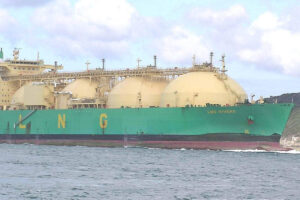
Methanier_aspher_(photo d'illustration Pline, CC BY-SA 3.0 via Wikimedia Commons)
Just as the European Commission was polishing up its new plan to ban all supplies of Russian gas disaster struck and at the worst possible moment.
Robert Harneis (DR)
By Robert Harneis
The Ban was announced to take effect in stages up to November 1st 2027. After that no more Russian gas and then as a result of the US Israeli attack on Iran, Teheran closed the straits of Hormuz and Qatar declared ‘force majeure and its inability to fulfill gas contracts. One fifth of global LNG gas passes through the straits. This comes as France and Germany have critically low levels of gas in storage – 21% and 20% respectively.
Record imports
Europe imported a record 142 billion cubic meters of LNG in 2025, a 28% increase from the previous year. US supplied 55% of Europe’s LNG imports last month, while Russia contributed just over 25%, In January, the EU’s monthly LNG imports from Russia hit a record high of 2.3bcm, up more than 10% y/y and nearly a fifth of all LNG imports.
President Putin chose this moment to observe that maybe it would be better if Russia stopped supplies to Europe immediately and got on with finding other more reliable trading partners as soon as possible.
New markets for Russia
““Other markets are opening now,” Putin said in an interview with state TV. “Maybe it’s better for us to end supplies to the European market right now? To go to those markets that are opening now and get a foothold there.”
At least half of Russia’s LNG exports already go to Europe but now without the Qatari supplies, the demand in Asia will spike and, Russia should be able to redirect all those exports to markets in Asia without difficulty.
Putin met Hungarian foreign minister Peter Szijjarto at the Kremlin on March 5 and said that Moscow intends to maintain supplies to what he described as reliable partners within Europe. Russia “remains ready to deliver energy resources to those who want to work with us,” he said, referring to Hungary and Slovakia as continuing customers.
To the highest bidder
He twisted the knife further reminding Brussels “there are customers who are ready to buy this natural gas at a higher price. In this case, this results from the developments in the Middle East and the closing of the Strait of Hormuz, and so on. Once you have these premium buyers on the market, this means, and I really believe that this is the case, that some suppliers who have been serving the European market for quite some time now, for example, the United States and US companies, will definitely switch to the highest bidder. This is quite natural.” He said.
Dictature du réel, les livraisons de gaz liquéfié russe vers la France ont augmenté de 41 % en 2023. Avec le retrait du gaz nord américain, la Russie pourrait devenir le premier exportateur de GLN vers la France. C’est aussi bien que par #nordstream2 mais c’est quatre fois plus… pic.twitter.com/G9Mla5LKYy
The United Arab Emirates’ decision to leave OPEC has sparked intense debate about the future of the global oil market and the stability of collective production management. What would an expert tell me in layman’s language, particularly about who or what really stands behind this decision? Reports of the UAE leaving OPEC are often portrayed […]

 Login
Login