This story originally appeared in Common Dreams on June 03, 2026.It is shared here under a Creative Commons (CC BY-NC-ND 3.0) license.
The US Supreme Court late Tuesday gave Alabama a green light to use an aggressively gerrymandered congressional map that a lower court said was “tainted by intentional race-based discrimination.”
The unsigned decision, from which the high court’s three liberal justices dissented, enables Alabama’s Republican-dominated government to replace its current congressional map, which has two majority-Black districts, with a map that the US Supreme Court struck down in 2023. That map has just one majority-Black district.
In her dissenting opinion, liberal Justice Sonia Sotomayor wrote that “just as Alabama doubled down on racial discrimination, the court today doubles down on chaos.”
“In addition to being wrong on the merits, the court’s decision inflicts two grave harms on the public,” wrote Sotomayor. “It debases the democratic process by upending Alabama’s entire election in the name of permitting Alabama to discriminate against Black Alabamians. It also corrodes the rule of law by rewarding Alabama’s gamesmanship and outright defiance of court orders.”
The liberal justice noted that in order to switch to the map previously struck down by the high court, Alabama election officials “will have to reassign hundreds of thousands of voters across the state to new congressional districts.”
“Three of Alabama’s counties will be particularly hard hit because they are split across two congressional districts,” Sotomayor noted. “These counties have about 600,000 registered voters between them (roughly 15% of the state’s total number of registered voters).”
Alabama Gov. Kay Ivey, a Republican, postponed US House primary elections in the wake of the Supreme Court’s April decision in Louisiana v. Callais, which severely narrowed the 1965 Voting Rights Act’s protections against racial discrimination and paved the way for Alabama and other states to impose new maps ahead of the 2026 midterms.
“The Supreme Court’s shameful ruling allowing Alabama to move forward with a gerrymander that was drawn with the explicit intent to dilute Black voting power—as found by a panel of judges that included two Trump appointees—is an absolute affront to the founding principles of our democracy, and wipes out whatever was left of the court’s credibility,” said Marina Jenkins, executive director of the National Redistricting Foundation. “This country deserves better, and we must continue to work toward federal legislation that not only bans partisan and racial gerrymandering but also ensures that our rights cannot be undermined by captured courts.”
The ruling drew condemnation from the two Democrats in Alabama’s US congressional delegation. Rep. Shomari Figures, who was elected to the US House under the independently drawn map that Alabama Republicans are working to replace, said in a statement that “the Supreme Court has now confirmed that there is no longer a Voting Rights Act in America, and states are essentially free to discriminate against minority voters with no consequences.”
“This is a dangerous ruling that sets the state and this nation back decades,” said Figures.
Rep. Terri Sewell called the ruling “just the latest in a pattern of outrageous Supreme Court decisions that help Republicans desperately cling to power ahead of the midterm elections while diluting Black voices and erasing decades of hard-fought civil rights progress.”
“No matter how hard Alabama state officials may try, they will not succeed in silencing our voices,” said Sewell. “We will not go back to the Jim Crow era. The fight for fair representation continues.”
“The era of deportations has begun.” A few months ago, this line from far‑right Swedish MEP Charlie Weimers sounded like a provocation. Now, after the agreement on the EU’s new Return Regulation between Parliament, the member states and the Commission, it reads more like an accurate description of the European Union’s political direction. With the legal framework for sending migrants to deportation camps outside Europe nearly complete, several member states — Germany, Austria, the Netherlands, Denmark and Greece — have intensified their search for countries willing to host them, mainly in Africa, far from the European continent, according to diplomatic sources. The political battle is over; the geographical one is just beginning.
With just a few days to go before the start of the 2026 FIFA World Cup, the world’s largest sporting event faces the question of what role U.S. immigration authorities will play. Now, a new poll by The Washington Post and the University of Maryland has found that most Americans would prefer they play no role at all.
52 year old Federica Mogherini, currently Director of the College of Europe and former EU Foreign Affairs High Representative, was arrested on Tuesday in connection with a fraud investigation. Mogherini was detained along with two other defendants – a manager at the College and a leading Italian diplomat, Stefano Sannino, a leading member of the EU diplomatic Corps, the European External Action Service, (EEAS). The EEAS has 140 delegations around the world, otherwise known as embassies.
The offices of the EEAS were searched, as were a number of private houses. According to the Belgian newspaper Soir, the investigation is jointly run by a ‘juge d’instruction’ in West Flanders Region, combined with the independent European prosecuting service the EPPO. The Belgian police carried out the searches and arrests. Prior to the police operations, the EPPO asked for the lifting of the diplomatic immunity of the suspects, which was granted.
According to the specialist website Euractiv, an independent EU information service partly funded by the EU, the investigation relates to an EU-funded diplomatic training program at the College of Europe, situated in Bruges, Belgium. The details of the charges are currently unclear but they are understood to concern contracts entered into in the course of the considerable expansion of the College of Europe. A new branch was opened in Tirana, Bulgaria, in 2024. The investigations go back to 2021-2022 and concern alleged “fraud in the awarding of public contracts, corruption, conflicts of interest breach of confidence’’ as well as possible “favoritism” in the awarding of places on College organized diplomatic courses.
Brilliant diplomatic careers
Federica Mogherini was among the candidates for the post of NATO Secretary General, to replace Jens Stoltenberg. Her career was promoted by former very pro EU Italian Prime Minister Matteo Renzi, who, according to Brussels insiders, now claims Mogherini has ‘disappointed’ him.
It should be noted that the matters under investigation relate to a period before Kaja Kallas took over as European High Representative. Never the less Kallas will be concerned that the present sensational scandal has exploded now, as she tries to confirm the world diplomatic presence of the EU. 48 year old Kallas, like Mogherini has so far had a brilliant politico diplomatic career. She was Estonian Prime Minister 2021-2024 and is an unrelenting Russophobe. Her father, Sim Kallas, was also Prime Minister of Estonia 2002-2003, as well as an EU Commissioner 2004-2014. Before the break-up of the Soviet Union Sim Kallas was a leading member of the Estonian Soviet Communist Party, banking expert and executive in Estonia.
Why and why now?
It is not unreasonable to ask why this dramatic and rare judicial event has happened and why now? A source close to the investigation commented that, ‘as in Kiev, the arrests indicate an underlying power struggle over policy and may be intended as a warning to Kaja Kallas and even Commission President Ursula Von der Leyen to tone down hostility to Russia, in the light of the current peace moves coming from Washington’.
It is noticeable that the obviously ambitious, US protégé, Finnish President Stubb, who until recently seemed to want to start World War 3 with Moscow, regardless of the negative consequences for the people of Finland, now seems to have turned 180° and is talking about improving border relations.
It is also possible that this is a settling of old scores by the United States going back to the awarding of the World Football Cup to Qatar rather than the US in 2010. At the time an enraged former President Bill Clinton, who was promoting the US case for holding the event, is said to have smashed a hotel mirror, when he heard the bad news.
As recently demonstrated by Presidents Biden and Trump, the US has a history of settling old scores by conducting ‘lawfare’, action in the courts against political enemies. After this act of defiance, a number of football executives found themselves extradited and imprisoned in the US. Mogherini and Sonnini were mentioned during the affair known as Qatargate.
Selective justice?
In any event it is reasonable to ask why Mogherini has been singled out for special attention, when Van Der Leyen seems untouchable despite her extraordinary activities during the Covid Pandemic, which involved tens of billions of tax payers’ euros and missing internet messages.
By contrast French Presidential candidate Marine Le Pen has been pursued with unrelenting ferocity by the EU and French judicial authorities, despite it being difficult to argue that her party’s admittedly irregular activities, cost taxpayer’s any money at all. The argument was essentially about how the money was used not about any loses to the public purse.
Suspects released without charge
Mogherini and the other suspects have now been released and no criminal charges have been made or restrictions imposed. According to Mogherini’s avocat ‘the hearing was lengthy but went very well’.
A Portuguese lawyer suspected of having helped to illegally regularise the status of around 4,000 immigrants in Portugal has been remanded in custody today, while his co-defendant, an Indian businessman, is
The right to strike is under attack throughout the world, including in the United States. Labor strikes are currently forbidden or restricted in the majority of countries.
“At a moment when workers’ organizations face sustained attacks around the world, this opinion reaffirms that the freedom to withhold one’s labor is not a privilege granted by the powerful, but a fundamental human right grounded in international law,” AFL-CIO President Liz Shuler said in a statement.
The ILO is the United Nations agency that sets global labor standards. It has 187 member states and has adopted 191 conventions since its founding in 1919. The ILO considers Convention No. 87 to be one of its 11 fundamental conventions.
In 2023, the ILO asked the ICJ to settle an internal dispute about whether Convention No. 87 gives workers the right to strike, which is not specifically addressed in the convention. Although advisory opinions of the ICJ are not legally binding, many courts accept them as authoritative legal decisions.
The ICJ ruled in its 10-4 opinion that a strike “is one of the main activities engaged in and tools used by workers and their organizations to promote their interests and improve conditions of labour, thereby ensuring the effective exercise of the freedom of association protected under Convention No. 87.”
The Court found “that protection of the right to strike is encompassed in the protection of the freedom of association provided for in Convention No. 87.”
In reaching that conclusion, the Court considered provisions in two 1996 Covenants that contain relevant rules of international law regarding the right to strike. Both refer to Convention No. 87.
Article 22, paragraph 1 of the International Covenant on Civil and Political Rights (ICCPR) provides for the right to freedom of association. The ICJ noted that for more than 25 years, the Human Rights Committee — which monitors the implementation of the ICCPR — has considered the right to strike to be encompassed in the protection of freedom of association.
Due to the high degree of overlap between the states parties to the ICESCR and ICCPR, and Convention No. 87, the ICJ determined there was a common understanding among them on the right to strike. The Court thus concluded “that an interpretation taking into account the relevant rules of international law contained in the ICESCR and the ICCPR indicates that the protection of the right to strike is encompassed in the protection of the freedom of association provided by Convention No. 87.”
No Right to Organize Without the Right to Strike
“For generations, working people have understood a simple truth: The freedom to join a union means nothing if you cannot withhold your labor when bosses refuse to listen. Now, the world’s highest court has affirmed that truth,” said Jeffrey Vogt, director of the International Lawyers Assisting Workers (ILAW) Network, which issued the call for the ILO referral of this case to the ICJ.
The ICJ decision “affirms decades of judicial precedent and what workers around the world know: there is no right to organize and bargain collectively without the right to strike,” Shuler said in her statement. “When workers are barred from taking collective action on the job, they cannot defend their rights and demand the workplace conditions and contracts they are owed. The freedom to join a union becomes an empty formality.”
“This is an important day for the International Labor Organization [ILO], and for its continued relevance in the world of work. However, the significance of this opinion extends well beyond the institutional context in Geneva,” the ILAW Network wrote in a statement.
The ICJ advisory opinion came “at a moment of acute pressure on the international labour rights system,” ILAW stated. “Across the world, the right to strike is under sustained attack — through restrictive legislation, expansive judicial interpretation of essential services, the criminalisation of trade union activity, and the use of dismissals, injunctions, and damages claims to deter collective action.”
Legal restrictions on the right to strike are increasing. In 2022, strikes were outlawed or stringently restricted in 129 of the 148 countries tallied by the International Trade Union Confederation (ITUC), one of the six organizations with consultative status at the ILO Governing Body.
The ITUC, which represents 191 million workers in 169 countries and territories, is dedicated to trade union democracy and independence. It has regional organizations in Africa, Asia, and Latin America. The ICJ decision “is important not only for workers and trade unions, but also for governments and responsible businesses,” ITUC stressed.
This decision “will serve as a powerful interpretive tool before national constitutional and labour courts, before regional human rights bodies, and before the ILO’s own supervisory bodies,” ILAW noted. “It strengthens the hand of every worker and union challenging strike bans, broad essential-services designations, criminal sanctions against strikers, prohibitions on solidarity and political strikes, and the dismissal and blacklisting of workers who exercise this right.”
Ruling Will Affect Tens of Millions of Workers
In October, 18 countries and five international organizations, including the ILO, presented oral testimony before the ICJ, and other nations filed written contributions. The majority of participants supported the right to strike, which is guaranteed in most European countries.
Harold Koh, who represented the International Trade Union Confederation (ITUC) before the ICJ, told the judges that the case would “affect the real rights of tens of millions of working people around the world.” If the Court ruled that the Convention didn’t protect the right to strike, Koh warned, “National employer groups would contest the right to strike country by country, focusing first on nations with compliant courts, weak civil societies and ineffective media.”
Jeffrey Vogt worked with the legal team of the ITUC on the briefs and oral arguments presented to the ICJ. Vogt’s co-authored book, The Right to Strike in International Law, provided a legal roadmap for the case.
Vogt told Truthout that “the written view of the US (under the Biden administration) was to support the right to strike, albeit on narrower grounds than what we had argued. When the Trump administration came in, they withdrew the Biden era brief but fortunately did not appear for oral arguments and take a contrary view.”
“The decision deals with the right to strike in the abstract — does the convention protect it — but does not go into the modalities,” Vogt added. The Court wrote that its “conclusion that the right to strike is protected by Convention No. 87 does not entail any determination on the precise content, scope, or conditions for the exercise of that right.”
“That was a conscious decision,” Vogt noted. “We did not want the court to attempt to define the scope, especially since we believe that is the proper role of the ILO supervisory system.” Vogt said that “the ICJ gave ‘great weight’ to the views of the supervisory system, which is helpful.” And although “the ILO has supported secondary strikes,” in which workers strike in solidarity with other workers at a different employer, the ICJ decision didn’t opine on that specific issue.
The Right to Strike in the US
“The right to withhold one’s labor, inherent in the right to strike, belongs to all workers, but it has been restricted,” Jeanne Mirer, a labor lawyer in private practice working with the International Commission for Labor Rights, told Truthout. “Many unions have agreed never to strike while a collective bargaining agreement is in effect.”
Most private sector workers in the US have the right to strike under the National Labor Relations Act (NLRA). Employees, including international and undocumented workers, cannot be fired or disciplined for participating in a lawful strike.
“Those exempted from the NLRA, such as agricultural and domestic workers, are not restricted in the right to strike but have no protections against discharge if they strike and do not have the power to prevent such retaliation,” Mirer added.
Some states have their own laws granting protection to domestic workers and 14 states guarantee farmworkers collective bargaining rights.
Railroad and airline workers are not covered by the NLRA, but they come under the Railway Labor Act, which has several limitations on the right to strike.
In recent years, Congress and the courts have narrowed the definition of “protected concerted activity” under the NLRA. Union membership is dropping. Nevertheless, strike actions in the US increased by almost 50 percent in 2022, according to the Economic Policy Institute.
In 2023, the US Supreme Court weakened the legal protections for striking in Glacier Northwest, Inc. v. International Brotherhood of Teamsters, making it easier for employers to sue unions in state courts. Only Justice Ketanji Brown Jackson dissented, writing, “The right to strike is fundamental to American labor law.” She noted:
Workers are not indentured servants, bound to continue laboring until any planned work stoppage would be as painless as possible for their masters. They are employees whose collective and peaceful decision to withhold their labor is protected by the [National Labor Relations Act] even if economic injury results.
The NLRA’s protections for private sector workers don’t extend to public sector employees. “Public employees in the United States have been restricted in many ways from striking,” Mirer said.
Federal workers are legally prohibited from striking. Thirty-six states prohibit public sector workers from striking. Three other states that haven’t addressed the issue would likely outlaw public sector strikes as well. In the 12 states where strikes are not per se unlawful, various preconditions must be met before workers can engage in strikes.
The World Federation of Trade Unions, which played a decisive role in the creation of Convention No. 87 in 1948, applauded the ICJ’s decision:
[I]t is clear that the existence of a class-oriented and militant trade union movement is the essential, decisive, and irreplaceable factor to ensure that the right to strike, as well as conventions, collective bargaining, labor laws, and workers’ achievements, are not merely empty words on paper but are implemented in practice. The WFTU reiterates its call for struggle in every country, sector, and workplace to safeguard the sacred right to strike in practice.
“It is up to workers and their organizations to build on the ICJ decision to ensure the right to strike can be an effective tool to build worker power,” Mirer said.
Há mais pensionistas com obrigatoriedade de fazer Prova de Vida já este ano. O Instituto da Segurança Social (ISS) anunciou, na terça-feira, o alargamento desta medida aos reformados que moram no Canadá.
“A obrigatoriedade da Prova de Vida anual foi alargada aos pensionistas residentes no Canadá, país que se junta agora à Bélgica, Cabo Verde, Luxemburgo, Países Baixos, Reino Unido e Suíça”, pode ler-se numa publicação partilhada pelo organismo público na rede social Instagram.
Segundo o ISS, “este passo é essencial para garantir que continua a receber a sua pensão de velhice, invalidez ou sobrevivência”.
Mais, “a forma mais rápida e cómoda de o fazer é a Prova de Vida Digital, através de uma verificação facial simples no telemóvel ou computador na App ou Portal da Segurança Social“, recomenda o organismo público.
Mas há outras alternativas: “Se não conseguir usar os canais digitais, pode ainda fazê-lo de forma Presencial (nos Consulados, Embaixadas ou Adidos) ou Documental (enviando o Certificado de Prova de Vida preenchido)”.
Por fim, fica a recomendação: “Evite deslocações e filas. Aceda aos nossos canais digitais e trate de tudo com total segurança e rapidez“, aconselha o ISS.
This story originally appeared in Labor Notes on May 29, 2026. It is shared here with permission.
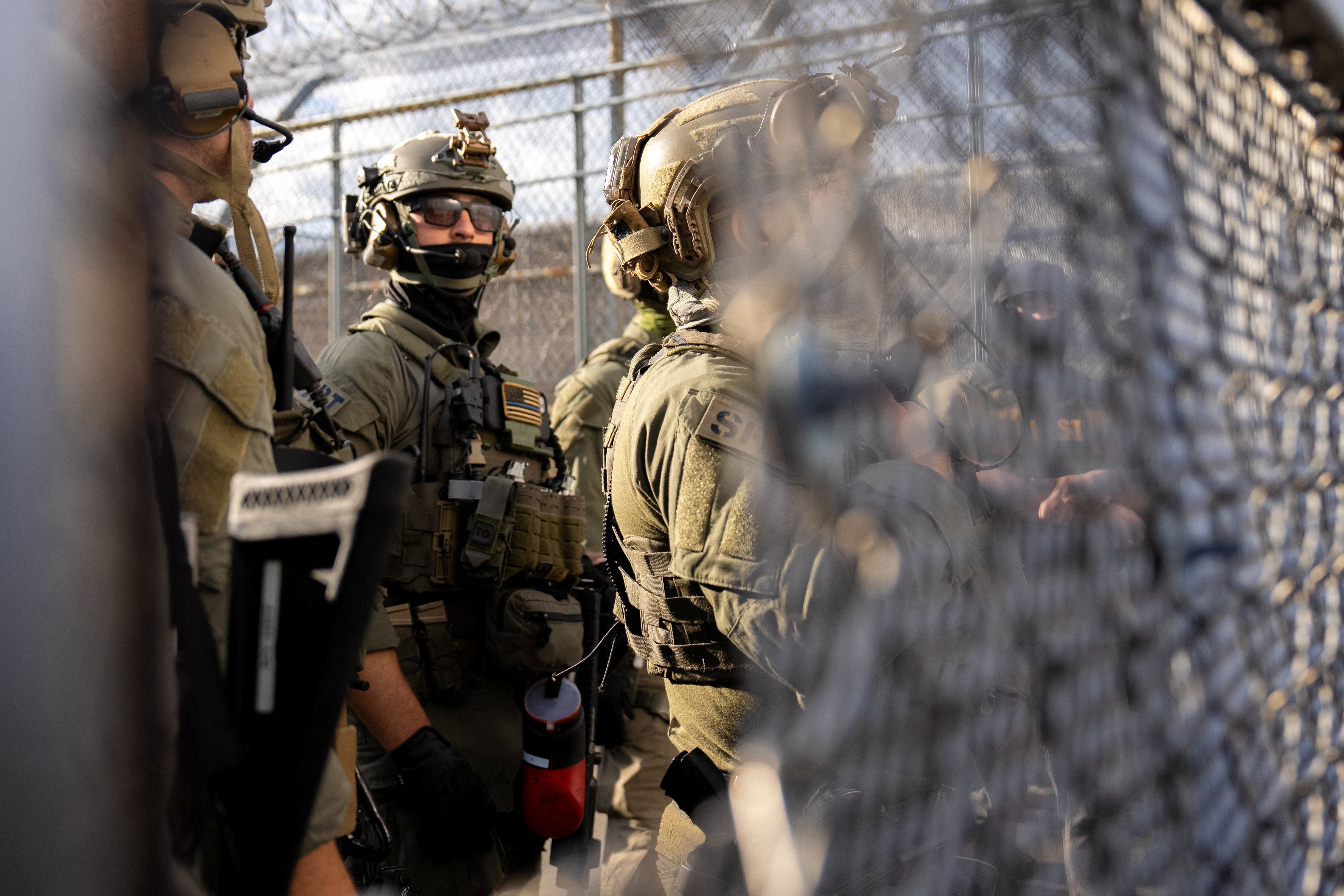
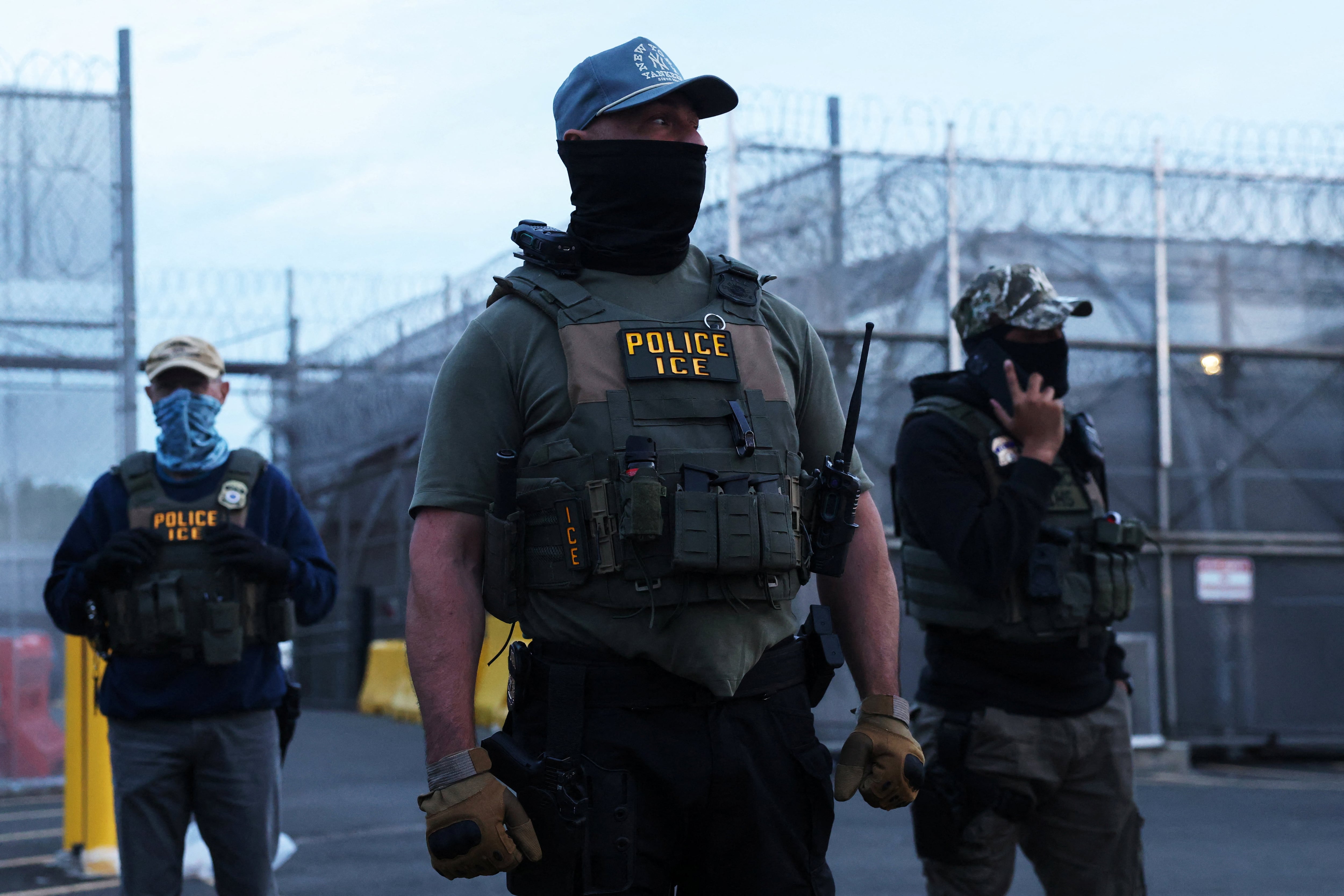
On a patch of sidewalk on a busy industrial corridor in Newark, federal agents with rifles, metal batons, flak vests, and balaclavas faced off against unarmed activists with cardboard signs and a bullhorn. Detained workers could be heard on the soccer field behind the prison walls, shouting in Spanish, “¡Libertad!” (Freedom!)
Since May 22, 300 of them are on a work stoppage and hunger strike. Over video chat, one worker told the crowd outside that they had stopped eating and working for as little as $1 an hour (or no pay at all) to demand an improvement in their living conditions. “But that’s not all we demand,” he said. “We are also doing this to demand freedom. We’re not treated like people. We’re treated like animals.”
The hunger strikers are demanding to meet with the governor, the release of young and elderly detainees and all medically vulnerable people, and ultimately, freedom for all.
For months a group of activists with the ICE Out of NJ coalition, which includes the immigrant rights group Cosecha, the Catholic advocacy group Pax Christi, and the worker center New Labor, has been protesting outside Delaney Hall, a 1,000-bed privately owned detention center where immigrants, mostly Latino, are jailed without due process.
Families and lawyers of the detainees report that Immigration and Customs Enforcement agents and guards with the GEO Group, the private-prison contractor, have been denying them medical care, offering them food swarming with worms, and refusing them bail bond or access to their lawyers. Many were snatched from construction job sites, or still wearing their service-industry work clothes; others were taken while reporting at courthouses for green-card appointments.
“In our cases, we had already been processed, we were complying with legal requirements, and there was no order from a judge for our detention or arrest,” wrote a worker identified as Brian in a handwritten letter in early May, co-signed by 300 others with redacted names, pleading for help from elected officials. “ICE officers did not take into account the fact that there was already an immigration court date, and they arrested us during check-in appointments at USCIS [U.S. Citizenship and Immigration Services] facilities.”
FROM SCARCE FOOD TO NONE
They struck because they wanted to hit their jailers’ bottom line, but they were already going without food, and their health has further deteriorated. “People aren’t eating because of the strike we are organizing and there’s no medical assistance,” said a released hunger striker named Luis to Radio Jornalera (Day Laborer Radio). Speaking with his back to the camera to conceal his identity for fear of retaliation by ICE, Luis said another detainee had become severely dehydrated and couldn’t walk. Food was already scarce or inedible, even before the strike.
When hunger strikers sought medical help at the nursing center in the prison, “they wouldn’t lend us the wheelchair,” Luis said. “We had to put in our own pills, give our own liquids with sugar and a little salt to compensate for electrolytes.” He said there has been no due process for the detentions; he was detained by ICE during a routine check-in, which doesn’t normally occur for people who have a legal case going through the immigration system. People with no criminal records have faced exorbitant fees of upwards of $50,000 for bail, or outright denials to be released on bond.
“If they freed us, we wouldn’t generate profit for this business,” Luis told the Guardian.
Nationwide, the majority of imprisoned immigrants through 2025 had no criminal records. As the American Prospect has reported, the GEO Group is raking in record profits with a federal contract valued at $1 billion. Some of these profits come from imprisoned immigrants working for little or no pay. Workers report they are coerced into participating in the government’s supposedly Voluntary Work Program through solitary confinement and other forms of torture.
The 13th Amendment to the U.S. Constitution abolished slavery, with an asterisk: “except as a punishment for crime whereof the party shall have been duly convicted.” Convicted or not, all labor has value. But what’s doubly wrong is that immigrants in ICE jails haven’t even been convicted, and are being denied due process.
VIOLENT RETALIATION
In what activists are calling retaliation, on May 28 the GEO guards and ICE agents responded to the hunger strike and work stoppage with beatings. Detainees have reported to their lawyers and families that striking units have even had the building’s ventilation cut off, while the floors in some cells are smeared with the blood of detainees.
“Right now there are ICE agents inside of Delaney Hall violently beating the hunger strikers,” Nedia Morsy, director of the nonprofit Make the Road NJ, said in a statement. “Someone will be killed if no one intervenes and shuts this down.”
Gabriela Fuentes said her husband Jose Marroquin called her around 1:30 p.m. to “say they were being beaten and pepper sprayed… This started because they [ICE] wanted to take the only person who translates for them in the unit.”
“They wanted to take him away,” she said outside the prison in a video recording. “So all of the prisoners asked to not take him away. So then agents, ICE agents came to the unit and tried to cuff him, and that’s when the confrontation started.”
She said that the detainees lifted their hands to indicate they didn’t want to fight. The guards took them to their cells. “And then there were the prisoners banging on the doors to please let them out,” Fuentes said. “My husband says there was blood in the floor and in the walls that clearly the agents now were cleaning up because they knew they messed up.”
In a statement, Fuentes said that she bolted to the prison to speak out about what was happening inside. When she got there, she saw that “one of the guys was taken by the ambulance because a guard broke his nose.”
U.S. Department of Homeland Security officials said agents responded to “to a physical fight involving detainees at Delaney Hall.” Homeland Security Secretary Markwyane Mullin has upped the ante, threatening to retaliate against sanctuary cities by pulling Customs and Border Protection officers from airports.
Even before the strike, speaking out about conditions in the prison was met with retaliation. “We have to be very careful, everything we say and do is closely monitored, at all times,” Jordi Alvarado told local news outlet NJ.com in early May. “And then, almost as if on cue, his face abruptly disappeared from the screen of the iPhone advocates had used to call him,” reported NJ.com columnist Daysi Calavia-Robertson. On the blacked out screen, a message popped up. “Call paused.” And shortly after, “Call ended.”
OFFICIAL ACTION DEMANDED
Local and federal elected officials have put out statements condemning the deplorable living conditions and treatment of detainees. New Jersey Sen. Andy Kim, a Democrat, went inside the prison on May 25, came out, joined the protestors, and got pepper sprayed. But the ICE Out of NJ coalition is demanding more action.
“Elected officials, the Governor, and the Attorney General cannot continue ignoring what is happening behind these walls,” said Jorge Torres of the National Day Laborer Organizing Network in a statement. “They must enter the facility immediately, speak directly with the people, and hold GEO Group and ICE accountable for this violence.” The detained immigrant workers have written three letters to legislators pleading for their release; they’ve received no reply.
“I have never thought Delaney Hall should open,” said New Jersey Gov. Mikie Sherrill at a news conference on May 26. “We had a law here in New Jersey against privately run detention facilities…The fact that they wouldn’t let me in there gives you some sense that there is some ‘there’ there, and that’s really concerning to me.”
The cruel impunity is as plain as day, both inside and outside the immigration detention center. On the night of May 27, federal agents struck protesters with batons, pushing one into the path of a tractor trailer wheel, a video shows.
On Thursday after reports of assaults on detainees began circulation, some local elected officials were allowed inside the prison, but access is still limited. That same day, the New Jersey Department of Health was denied full access for an inspection.
The reports often come from the families of the detained. “We’ve been hearing from constituents who have family members inside, including a mother who is being beaten by ICE agents and an 11-year-old girl who spoke to her father inside who said that there are a lot of people inside who are bloodied,” U.S. Rep. Bonnie Watson Coleman told NJ.com on the afternoon of May 28.
SOLIDARITY FUNDRAISERS
Gabriela Soto’s husband Martin Soto Hernandez was detained in January while buying diapers. He had previously been arrested for a domestic violence incident, but the charges were later dismissed and expunged, according to his lawyers. His lawyer says Soto Hernandez has lost 110 pounds: “He’s skin and bones.”
Even in his poor condition, he helped organize the hunger strike and was later transferred to a different detention camp in Elizabeth, New Jersey, on May 25.
“My husband Martin Soto got illegally detained by ICE tonight,” Soto wrote on a GoFundMe page to raise funds for her husband’s legal defense shortly after he was imprisoned. “We never fully got a lawyer for his immigration status because his court date was due for 2028… I want to be able to have a lawyer defend him so that he can stay here. His kids depend on him. His daughter knows he is her world. This is unfair what Trump is doing to this country. He’s ripping families apart and this is not fair. Please help us.”
“At this very moment, Delaney represents a dark and desolate world for those who sought to attain the American Dream,” said Gloria Guerrero of New Labor in Spanish to Labor Notes. Guerrero organizes alongside domestic workers whose husbands have been detained in ICE prisons. “Children wait for the return of parents detained by a cruel and inhumane system—locked in dungeons, treated like criminals, and stripped of every right, including the right to humane treatment,” she said.
“Yet for others, it is the greatest business venture in history—one that utterly disregards the dignity of human beings. Delaney is a Latino concentration camp where many are forced to sell themselves out of sheer necessity, shielding their faces in shame from a community that cries out: ‘Quit that job now! I am your people! I am your kin!’ Meanwhile, on the inside, others are holding fast in a strike of protest and resistance—a struggle to which we offer hope, and which we support from the outside!”
Protests erupted on Sunday night outside of the Delaney Hall immigrant jail in Newark, New Jersey, when Immigration and Customs Enforcement (ICE) moved to transfer a strike leader from the jail.
Some 300 detainees launched a hunger and labor strike on Friday in protest of the conditions at the ICE jail. On Sunday, activists and family members learned that the jail was preparing to move Martin Soto, one of the detainees who had announced the strike.
Gabriela Soto, Martin’s wife, saw ICE agents loading Martin into a van, and ran to block the van that held her husband from leaving the site. Other demonstrators joined in blocking the van from leaving the facility, and forced it back to the detention facility. Protestors formed a blockade for hours to prevent Martin Soto from being moved out of the site.
“Free Martin!” the protestors chanted. “Free them all!”
Later, around 1 am on Monday, ICE agents began to move a caravan of vehicles out of the facility, and protestors again attempted to block the vehicles from leaving. ICE agents then shoved aside protestors, pushing them against the sidewalk and against cars, and pepper sprayed at least one protestor.
A Department of Homeland Security (DHS) spokesperson announced on Monday that after “ICE successfully dispersed approximately 70 agitators” it succeeded in transferring Martin to another facility.
Since the start of the hunger strike, family members and supporters have gathered outside of the detention center. Among others, a 10-year-old child spoke about her father, who is currently being imprisoned in the facility by ICE.
On Friday, Gabriela Soto translated calls from prisoners, including her husband Martin, who said, “We deal with racism, with bad conditions, with guards that do not help us…. It gets worse all the time, and they don’t treat us like people.”
The guards soon cut access to the detainees’ phones so that these calls could not continue.
People being imprisoned at Delaney began a hunger strike after signing two letters describing their circumstances and conditions.
“We feel vulnerable and, in a way, kidnapped — detained without justification — not to mention that we are being tortured physically and psychologically due to the poor food resources provided in these detention centers,” they wrote. “Families are being destroyed and separated.”
“We have seen judges in this detention center who are ready to carry out deportations and mass expulsions without properly reviewing cases,” they went on. “We live with anguish and fear of appearing in court.”
One participant in the labor and hunger strike wrote in a letter describing the conditions of the jail:
We have people sleeping on the floor for not being processed quick enough. They neglect medications for people who are in dire need of it. All of our bonds are denied and they are telling us to file habeas corpus for everyone that is in here, they constantly tell us we are a danger to society. The same judge that denies your bond is the same judge that reviews our immigration court cases and that is not fair.
Delaney opened as an ICE jail in May 2025 in a $1 billion, 15-year contract between private prison contractor GEO Group and ICE. It is the largest ICE facility on the East Coast and has faced pushback since the announcement of its opening.
New Jersey Democratic Sen. Andy Kim visited the detention center Saturday, and wrote on X that he saw inside it a “high school student crying and saying she just wanted to graduate senior year”; a woman “who had a miscarriage in the detention facility” and was “left to manage [it] all on her own”; and a “carton with the milk inside congealed solid.”
On Monday, Kim returned to the site, and said that he was pepper sprayed. “Instead of engaging with me and others about the poor conditions, ICE sent in an armored vehicle and a line of armed agents that only poured gasoline on the fire,” he wrote on X. Kim described ICE agents tackling and restraining protestors and firing pepper balls and spray into the crowd.
On Tuesday morning, the protest continued, and video footage from outside Delaney once again shows ICE agents detaining and dragging protestors.
Leqaa Kordia — a Palestinian from East Jerusalem who was arrested in Newark when meeting with immigration officials about her status and then detained for over a year in ICE jails for her Palestine activism — wrote a statement in solidarity with the Delaney hunger strikers.
“When you choose hunger over submission, you’re doing something that terrifies ICE,” she wrote on Monday. “You are proving that even when they break your bodies, they can’t break your will. You are proving that a person stripped of freedom can’t be stripped of dignity.”
“I know the conditions you’re enduring,” she went on. “The rotten food. The medical neglect. The psychological torture of indefinite limbo. I know what it took for you to look at that tray of slop and say: No more. Not until I’m free.”
Amid growing concerns about surveillance and privacy in the Trump administration’s immigration policy, U.S. Immigration and Customs Enforcement (ICE) is significantly expanding its biometric identification infrastructure. According to NPR, the agency entered into an agreement with BI2 Technologies—a company specializing in biometric technology—that includes the deployment of iris scanners, access to private databases, and real-time verification tools for field agents.

 Login
Login