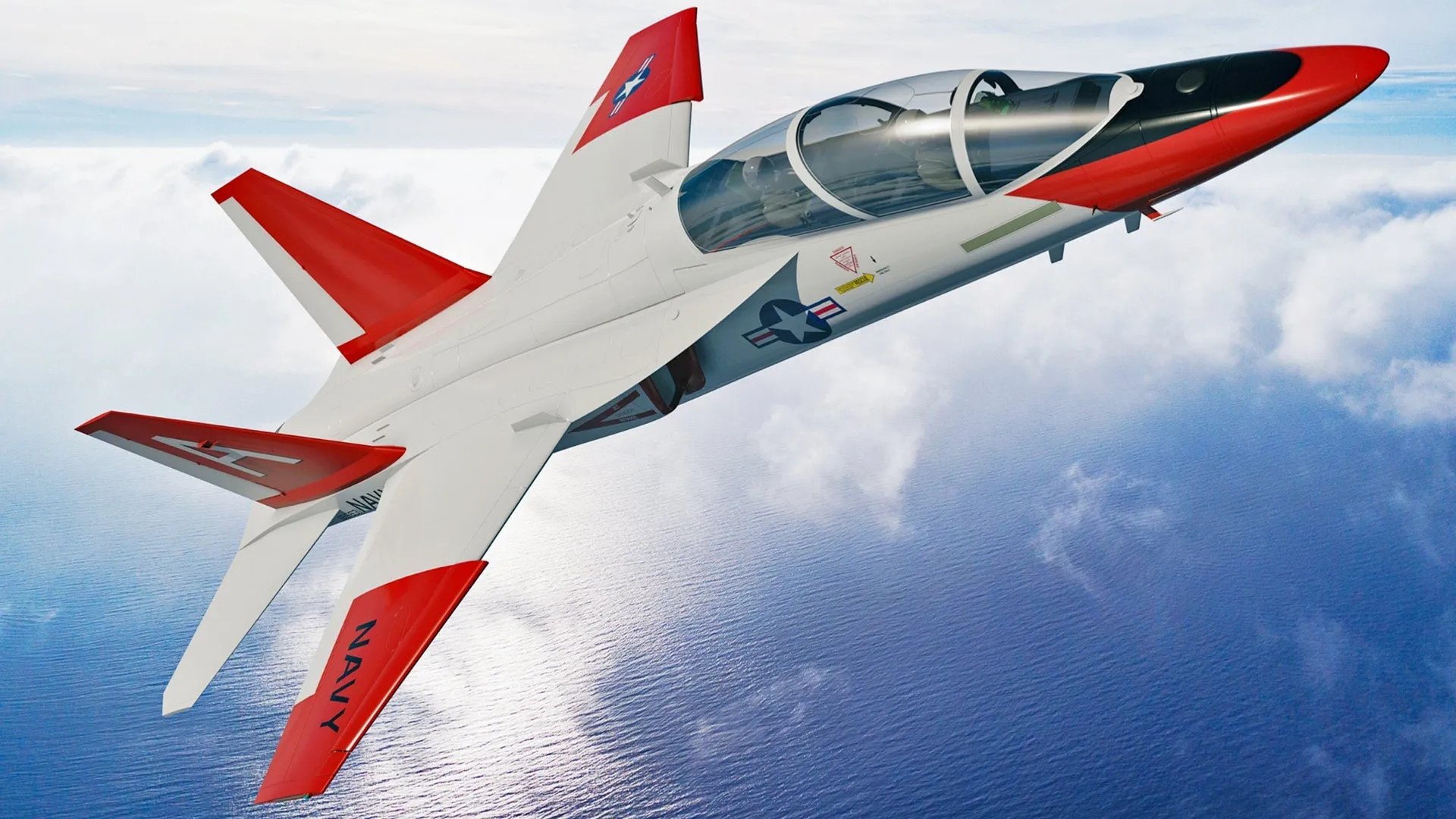
The winning UJTS design will replace the Navy’s T-45 jet trainers, one of which is seen here. USN
“Boeing is focused on meeting our commitments, and we bid for programs where we believe we can provide the right solution tailored to our customers’ needs and requirements,” a Boeing spokesperson told TWZ. “After careful evaluation, we have determined the T-7A does not meet the U.S. Navy’s Undergraduate Jet Training System requirements.”
“We have therefore informed the Navy that we will not bid on the current RFP. We remain committed to delivering the T-7A as a modern, growth-oriented training solution for 4th, 5th and 6th generation pilots as requirements evolve,” they added. “We look forward to providing and sustaining both current and future capabilities for the Navy.”
Boeing says its decision on UJTS is tied to the General Electric F404 turbofan. The company has stressed that the F404 is a proven design with millions of flight hours on multiple platforms, including the T-7A, and is a clear example of a ready-to-field design. Still, Boeing’s view is that the UJTS engine qualification requirements would require additional long-cycle development work, and potentially limit its ability to meet the Navy’s initial operational capability target for the new jet trainers.
All this being said, it is still not entirely clear what the specific issues might be, given that the F404 is such a well-established design that has been and continues to be used on a variety of military aircraft. This includes several other land-based jet trainer designs beyond the T-7, like the Scaled Composites Model 400, which competed against the Red Hawk in the Air Force’s T-X competition, and the Turkish Aerospace Industries Hürjet.
Maintainers work on the F404 engine on a US Air Force T-7A Red Hawk. USAF/Zelideth Rodriguez
Most notably, the F404 also powers the TF-50N that Lockheed Martin and KAI had put forward for UJTS. At the time of writing, neither Lockheed Martin nor KAI looks to have offered a detailed explanation for the decision to withdraw from the Navy jet trainer competition.
A rendering of the TF-50N. Lockheed Martin
The T-7A has also suffered from various technical and other issues over the course of its development, which has led to significant delays in its entry into Air Force service. The service is now hoping to reach initial operational capability with the Red Hawk next year. Any potential for direct synergies in terms of support and sustainment between the Air Force and Navy jet trainer fleets is now off the table.
It is worth pointing out that the TF-50N and the T-7 are also both single-engine designs. The Beechcraft M-346N that Leonardo and Textron have put forward is powered by a pair of Honeywell F124 turbofans. Two Williams FJ44-4M turbofans power SNC’s Freedom Jet, which is also the only clean-sheet design in the running for UJTS. This may point to a general view of the UJTS requirements that make single-engine designs less attractive.
A rendering of the M-346N. Textron/BeechcraftA rendering of a pair of SNC Freedom Jets. SNC
The Freedom Jet design is also tailored to meet now-axed requirements for UJTS to be able to perform carrier qualifications and simulated carrier touch-and-goes at base on land. The requirements for so-called Field Carrier Landing Practice (FCLP) training at facilities ashore have historically been structured specifically in a way that “simulates, as near as practicable, the conditions encountered during carrier landing operations,” according to the Navy.
SNC says its choice to build an aircraft that can still perform these tasks is deliberate, and offers the Navy what could still be important capability and flexibility in the future, as you can read more about here.
The Navy’s decision to remove carrier qualifications and otherwise alter key aspects of the tactical jet aviator training pipeline has been and continues to be controversial. The service has argued that substantial investments in virtualized training and assisted carrier landing capabilities, such as Magic Carpet and its successors, have fundamentally changed the landscape when it comes to training future pilots for carrier-based operations.
Earlier this month, the Navy also confirmed that it had raised the total cost ceiling for the prospective UJTS contract from approximately $1.8 billion to $2.7 billion.
“The Government updated the price cap to reflect a change in the program cost estimate due to new information received,” Naval Air Systems Command (NAVAIR) subsequently explained, according to Breaking Defense.
The substantial increase in the projected cost has raised its own questions about the outlook for the competition and the development program that is expected to follow. The Navy’s decisions to scale back its training requirements had previously been seen as opening the door to existing land-based jet trainer designs, or derivatives thereof, like the T-7 and the TF-50N. That, in turn, was viewed as a potential way for the service to help keep costs and risk low.
A rendering of the version of the T-7 Boeing had previously planned to submit to the UJTS competition. Boeing
The Navy’s T-45 replacement plans have already been delayed multiple times, with the service originally planning to pick a winning design this year and to have the first example enter operational service in 2028. The goal now is to award a contract in the middle of next year.
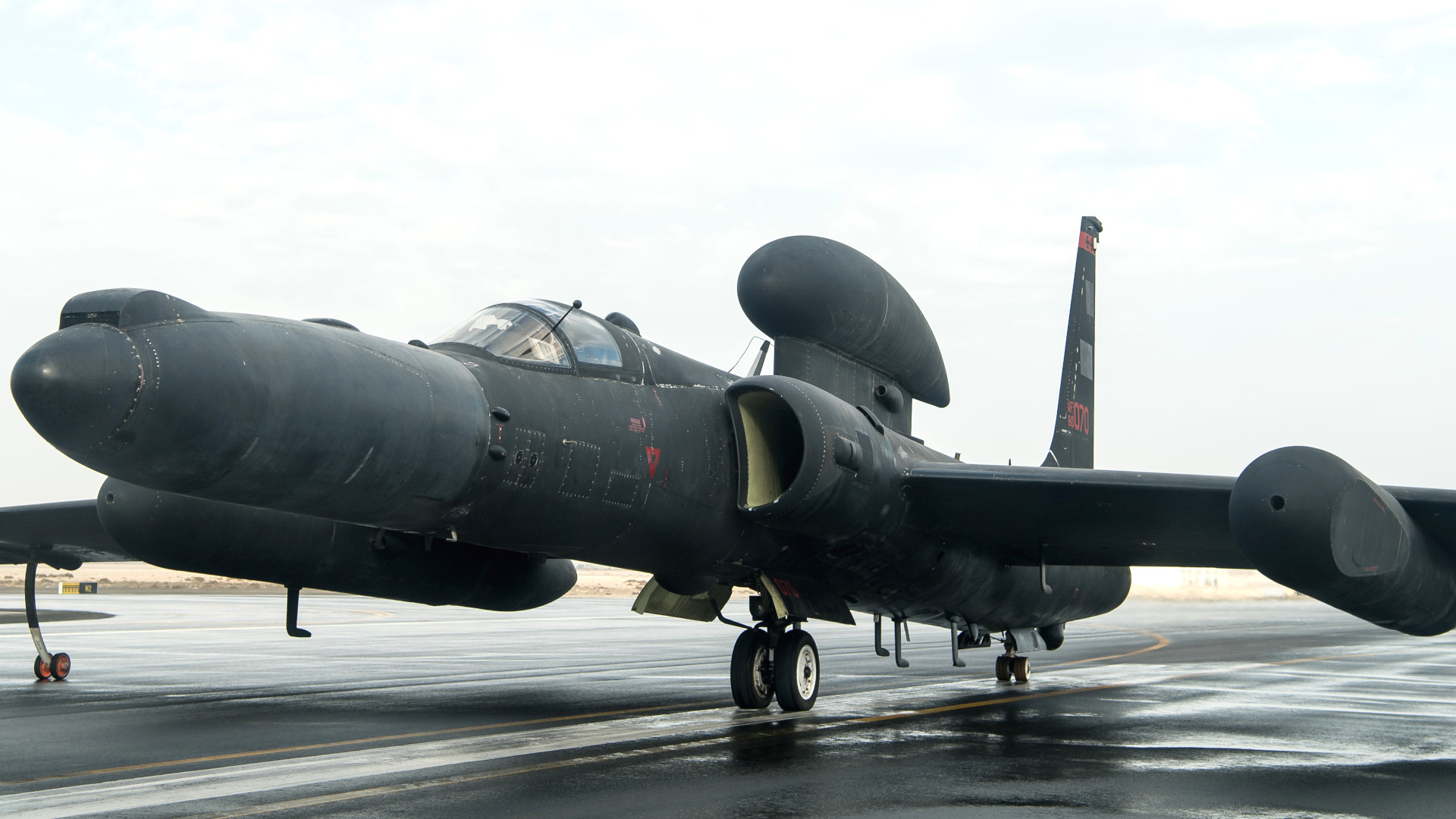
Members of Congress are again moving to block the U.S. Air Force from retiring all of its U-2S Dragon Lady spy planes. This time, legislators also want to compel the service to “fully restore” four of the iconic aircraft through heavy depot maintenance, which would bolster the fleet’s operational capacity. The Air Force continues to argue that the high-flying Cold War-era jets are too vulnerable to support future high-end fights and should be supplanted by a mix of space-based and other capabilities. This would presumably include a classified stealthy high-altitude drone, commonly (and unofficially) referred to as the RQ-180, or an evolution thereof, which first emerged publicly just earlier this year.
Yesterday, the House Appropriations Committee released a draft defense spending bill for the 2027 Fiscal Year. It includes a provision that would prevent the Air Force from retiring more than two U-2Ss in that fiscal cycle. The Air Force currently has 23 of these aircraft in inventory, including three two-seat TU-2S trainers.
One of the Air Force’s three TU-2S trainers. USAF
A summary of the proposed legislation also says it includes “$81 million for U-2 programmed depot maintenance to fully restore four aircraft.” The current operational status of the aircraft in question is unclear. This is included under the umbrella of $335.3 billion in total funding for operation and maintenance (O&M) accounts across the services that the draft bill would appropriate for Fiscal Year 2027.
Programmed depot maintenance for any aircraft is an intensive process that essentially involves a full tear-down and detailed inspection. Paint and other coatings are typically stripped and reapplied. Upgrades and modifications are often worked into depot maintenance cycles given the extensive work already being done.
“The Air Force will retire the entire 23-ship U-2 fleet, as the platform is no longer viable for future high-end conflicts,” the force structure report says. “Continued operation presents significant safety, logistical, and financial risks that outweigh the platform’s remaining utility in contested environments.”
“This decision allows for the strategic reallocation of fiscal resources to fund more critical, high-priority service requirements and accelerate modernization efforts in other key areas,” it adds. “Continuing to operate the U-2 fleet would require a significant investment to address systemic issues, including diminishing manufacturing capacity, material shortages, and safety risks inherent in the aging platform.”
A U-2 seen taking off from an undisclosed location in the Middle East in 2010. USAF
Questions about the continued relevance of the U-2 in the face of an ever-expanding global air defense threat ecosystem are not new. Near-peer competitors like China and Russia, as well as lower-tier potential adversaries like Iran, continue to develop and field more capable air defense systems and expand their anti-access and area denial bubbles. This, in turn, has threatened to push the U-2 further and further from the areas where it would be tasked to collect.
On top of all this, the U-2s are aging and becoming more costly to operate and maintain. The U-2S models in service today were upgraded from earlier variants that began their service careers in the 1980s.
The Dragon Lady continues to offer a unique ISR platform that can fly higher than any other operational non-orbital platform, crewed or uncrewed, the U.S. military has, at least from what we know today. This, in turn, means that the aircraft can bring imaging, signals intelligence, communications payloads, and other sensors up to those altitudes, giving them particularly good fields of view. From this perch, aircraft can use a slant angle to peer deep into denied areas while still flying international airspace and further away from potential threats. The use of the U-2 to gather intelligence about a Chinese spy balloon that soared over parts of the United States and Canada in 2023, which involved flying above it, offered a particularly public demonstration of the value of the aircraft’s high-altitude capabilities.
A view of the Chinese spy balloon soaring over the United States in 2023, as seen from the cockpit of a U-2. USAF
Each Dragon Lady can also carry a wide array of different sensor systems simultaneously, as well as communications packages, further increasing its flexibility. The U-2Ss have the ability to be readily deployed to forward locations globally and conduct long-duration sorties, as well. The latter points have been especially relevant in comparison to known existing ISR satellite constellations that are constrained by their orbits and can only offer relatively short-term coverage over a specific area. We will come back to this in a moment.
A now-dated graphic that still gives a good sense of the array of different sensors the U-2 can carry. US Military
The draft defense spending bill from the House Appropriations Committee does still have to be finalized, and then brought in line with companion legislation in the Senate. Both chambers of Congress then need to pass the bill before it can be sent to the President’s desk to be signed into law. There are many opportunities along the way for major changes to be made to the bill.
That being said, Congress has consistently blocked Air Force efforts to fully retire the U-2 in recent years. Another potential reprieve, which would also demand the service take steps to bolster the operational capacity of the remaining fleet, has now appeared on the horizon.
Jerod Harris caught Catfish with the pod under its belly as it came in to land at Edwards Air Force Base in California on Monday. Edwards is the main hub for U.S. Air Force test and evaluation activities, and Catfish has been seen there many times over the years as part of its work. The aircraft, which carries the U.S. civil registration code N757A, also happens to be the first 757 ever built, and took to the skies for the first time back in 1982.
Catfish with the pod under its fuselage seen on approach to Edwards Air Force Base in California. Jerod Harris
As already noted, Catfish has already played a central role in the story of F-22. The aircraft’s heavily modified nose is designed to directly replicate that of the Raptor, and contains the same AN/APG-77 active electronically scanned array (AESA) radar as the fighter. The swept wings on top of the cockpit were also designed to support testing of the conformal antennas for the Raptor’s AN/ALR-94 electronic support measures system and other components of its ‘fused’ sensor suite. The aircraft has supported the development of a wide array of other systems for the F-22, and is packed inside with additional equipment to support those needs in particular, including a replica of the Raptor’s cockpit. You can read more about Catfish and its general history here.
So it is not surprising then that the heavily modified 757 would also be used now to help with continued testing of the new underwing infrared sensor pods for the Raptor. Carrying the pod under the forward end of the fuselage would offer the sensors inside a good open field of view to the front, as well as to the left, right, and down.
Another view of Catfish carrying the stealthy infrared sensor pod. Jerod Harris
The stealthy pods have been test-flown on actual F-22s for years now. At the same time, there are only a limited number of Raptors available, in total, and they are notoriously fuel-hungry, maintenance-intensive, and otherwise expensive to operate. If the particular test plan calls just for level flight, and over extended periods of time, a platform like Catfish could be an attractive alternative. With space for dozens of engineers and technicians in its main cabin, and workstations for them, the aircraft would also offer very different options for testing and evaluating the pod while in-flight. A North American Sabreliner business jet has also been used to test these pods in the past.
N33TR, a Rockwell Sabreliner 65 for Airborne Imaging returns to KJWY/Mid-Way regional Airport as " AIRBORNE33 " carrying one of the future F-22 pods.
It was at Nellis AFB testing the pod alongside RATT55/NT-43A, a radar test bed that regularly flies alongside B-2s. pic.twitter.com/kNADnga7H0
The capability, in general, for Catfish to carry stores under its fuselage might open up additional possibilities for utilizing the aircraft in support of other testing efforts, if it hasn’t already.
Catfish continues on with its approach to Edwards. Jerod Harris
Catfish would also be well suited to supporting testing of other elements of the Raptor 2.0 package. Under the current plan, the Air Force’s F-22s are also set to get a new integrated distributed infrared search and track (IRST) system called the Infrared Defensive System (IRDS).
IRST systems have seen a renaissance across the U.S. military in recent years, as well as elsewhere globally. IRSTs detect and track targets via their infrared emissions, making them particularly valuable for helping spot stealthy targets with features designed to reduce their radar cross-sections. The sensors are also immune to radio frequency electronic warfare jamming and operate passively, meaning they do not emit signals that could alert a target to the fact they are being tracked. IRSTs can also be used to cue or otherwise be linked to other sensors, including AESA radars. This data fusion can provide higher fidelity tracks of multiple targets, as well as improved situational awareness overall.
Increased demand for IRSTs has led to a commensurate increase in demand for testing using multiple platforms. This, in turn, has been a major component of a general uptick in U.S. military flight testing in recent years to support a variety of new, advanced programs.
An F-22 with the stealthy underwing infrared sensor pods and drop tanks seen on a test flight over the Mojave Desert in March 2026. Jarod Hamilton
Other elements of the Raptor 2.0 upgrade plan include new stealthy drop tanks, improvements to the jet’s stealthy features, radar capabilities, electronic warfare suite, and more, as you can read about in detail here.
The F-22 upgrade work is reflective of current Air Force plans to keep the Raptors in service for decades to come. In 2024, the Air Force said it no longer had a firm retirement schedule for the fighters.
Catfish seen flying together with a pair of F-22s near Edwards in 2024. Courtesy photo/Kyle Larson via USAF Chase Kohler
At the same time, Catfish is now 44 years old. Boeing 757s, in general, are increasingly disappearing from service globally as they become more complicated and cost-intensive to sustain. Especially with the work ongoing now on the F-47, it seems likely Boeing will start looking toward a new highly specialized testbed aircraft modified to reflect the particular physical geometry, unique avionics, and other features of the new fighter.
Similarly, the F-35 family also has a dedicated test jet, the Boeing 737-300-based Cooperative Avionics Testbed, nicknamed the CATbird. There are several other airliner and business jet-based testbeds flying globally today, though Catfish is certainly one of the largest and most visually distinctive. Improving digital simulation and modeling tools could allow for less reliance on surrogate testbed aircraft in the future, but they will in no way be eliminated.
China’s Tu-204C-based ‘Catfish’ testbed jet. Chinese internet via X
In the meantime, Boeing Catfish remains a very important part of continued work to improve and expand the capabilities of the F-22. This now extends to testing of specialized underwing pods for the Raptor.
Special thanks again to Jerod Harris for sharing his pictures of Catfish carrying the stealthy sensor pod with us.
The House Committee on Armed Services added the requirement for the C-17 production restart briefing to a report accompanying the latest draft of the annual defense policy bill, or National Defense Authorization Act (NDAA), last week. The Air Force took delivery of its last Globemaster III in 2013, and has some 222 of these airlifters in service today. The air arms of Australia, Canada, India, Kuwait, Qatar, the United Arab Emirates, and the United Kingdom also have smaller fleets of these airlifters. Three more of these aircraft are operated under the Strategic Airlift Capability (SAC) initiative, a multi-national arrangement with several European members, as well as the United States. Boeing shuttered the C-17 line entirely in 2015.
“The committee recognizes that the existing C-17 fleet continues to bear significant operational demands supporting combatant commander requirements, humanitarian assistance missions, and global mobility operations,” the provision in the House Committee on Armed Services’ report notes. “The committee is concerned that future operational demands may place additional strain on the existing C-17 fleet.”
“Therefore, the committee directs the Secretary of the Air Force to provide a briefing to the House Committee on Armed Services not later than March 1, 2027, assessing the feasibility of restarting the production line for the C-17 aircraft,” it adds.
The committee wants the Air Force’s briefing to at least include the following:
“An assessment of the technical and industrial feasibility of restarting the C-17 production line, including the status of tooling, supplier base viability, workforce availability, and potential reconstitution costs.”
“An estimate of the timeline required to reestablish production and deliver the first newly produced aircraft.”
“A cost estimate for restarting the production line and procuring additional aircraft, including options for limited procurement and multi-year procurement.”
“An evaluation of alternative approaches to increasing strategic airlift capacity, including service life extension programs, modernization of existing aircraft, procurement of commercial derivative cargo aircraft, and expansion of the Civil Reserve Air Fleet.”
“An assessment of potential international partner interest in participating in or contributing to a restarted production line.”
A row of US Air Force C-17s. USAF
TWZ subsequently reached out to Boeing to ask about the company’s current position on rebooting C-17 production.
“Our goal is to help our customers be successful, and we work with them to develop innovative solutions to meet their mission needs, including development and production partnerships,” a Boeing spokesperson told us this week. “We are proud of our continued support for the unique, mission-proven capabilities that the C-17 Globemaster III delivers to the U.S. Air Force and eight allied nation partners.”
At the Paris Air Show last year, Turbo Sjogren, Vice President and General Manager of Boeing Global Services-Government Services, had told Shephard Defense that talks with an unnamed country about a possible C-17 production restart were in their “early infancy.”
“It is a very extraordinary effort to do” and is “reflective of the utility of the aircraft,” he also said at the time, according to Shephard.
Boeing has also now said that it is always willing to work to better understand the requirements and needs of its customers. Any talk about the prospect of restarting C-17 production would also have to be viewed in the broader context of the Air Force’s still-evolving requirements for the Next Generation Air Lift (NGAL) program. The service’s current NGAL plans envision a single aircraft replacing the very different C-17 and C-5 Galaxy fleets, as you can read more about here.
A C-5 Galaxy, at left, and a C-17, right. USAF
TWZ also reached out to the U.S. Air Force about the recently requested briefing.
It is unclear what it might cost to get the C-17 line restarted and what the unit price of these new-production aircraft would be in the end. There are various factors at play, including whether Boeing retains any relevant tooling, the knowledge base of its current workforce, the state of third-party supply chains, and the availability of physical space to build the airplanes. Back in 2019, the company sold off the facilities in Long Beach, California, where it built the original run of Globemaster IIIs.
More than a decade ago, the RAND Corporation did conduct a detailed, independent analysis that explored options for resuming production of the baseline C-17A, a new C-17B, and a significantly revised “fuel efficient” C-17FE derivative.
The C-17B was “a variant Boeing has proposed that adds centerline landing gear, a tire deflation/inflation system, higher-thrust engines, advanced flaps, and an advanced situational awareness and countermeasures system,” according to RAND’s report. The C-17FE derivative “would have a narrower fuselage, up-rated engines, a double-element flap system, winglets, a longer loading ramp, a shorter cargo door, and a modified horizontal tail.”
A graphic offering a very general comparison between the C-17A and the proposed C-17FE. Boeing
RAND said that it could cost between $2.1 and $2.7 billion in 2011 dollars to begin making C-17A models again after a pause, depending on how much tooling Boeing retained. The cost ranges would be $4.6 to $6.4 billion for new production of the improved C-17B version, and $6.2 billion to $7 billion to start building the C-17FE derivative. Billions more would be required to actually procure the aircraft, with unit prices being highly dependent on the total size of the production, as outlined in the table below. If nothing else has changed, these cost projections would still be significantly higher today just due to inflation.
RAND
As an aside here, RAND published a similar assessment of the options for restarting production of the F-22 Raptor in 2011. That report factored heavily into a study the Air Force subsequently delivered to Congress on that topic back in 2017, which you can read more about here.
Foreign participation in new production of C-17s could help defray costs, and is one of the points the House Armed Services Committee specifically wants the Air Force to address in its briefing. As TWZ noted last year after Turbo Sjogren made comments at the Paris Air Show, Boeing’s discussions at that point might not have been with the U.S. government. Earlier in 2025, then-Japanese Prime Minister Shigeru Ishiba had expressed interest in buying Globemaster IIIs, raising immediate questions about where those aircraft might come from.
It should be noted here that the U.S. Air Force’s C-17s have received various upgrades over the years, and the service continues to move ahead with other plans to improve their performance and expand their capabilities. This includes the installation of 3D-printed microvanes on the fuselage, which offer a very minor reduction in drag (approximately one percent), but that translates into real reductions in fuel consumption. All Air Force C-17s are expected to have this feature by the end of next year. Communications and data-sharing upgrades have also been a major focus area across all of the Air Force’s airlift and tanker fleets.
Boeing is now under contract for a more extensive upgrade of the flight decks on Air Force C-17s. The company says this will aid in “resolving avionics obsolescence” and integrate new open systems architectures to make it easier to add new and improved capabilities and functionality in the future.
A look inside the cockpit of a U.S. Air Force C-17. USAF
The prospect of a re-engining effort for the Globemaster III fleet has also been raised in the past, but the Air Force downplayed the value of doing so earlier this year.
When it comes to discussions about restarting C-17 production, another key factor is the lack of immediate alternative options. There is really no other aircraft in this class in production now in the United States or anywhere else in the West. Airbus has long positioned its turboprop-powered A400M as sitting in a capability space between Lockheed Martin’s C-130 family and the C-17. Embraer’s KC-390 Millennium design, which is also offered as an aerial refueling tanker, has generally been pitched as a jet-powered competitor to the C-130. China’s Y-20 and Russia’s Il-76 are really the only in-production analogs on any level to the C-17 globally.
The House Armed Services Committee has now also asked the Air Force to speak to the possibility of buying “commercial derivative cargo aircraft” and/or an “expansion of the Civil Reserve Air Fleet,” or CRAF, to help bolster airlift capacity. The CRAF is an arrangement by which the U.S. military can call upon commercial airlines and charter companies to help move cargo and personnel, which you can learn more about here.
A key issue here is that the C-17 is specifically designed for tactical operations right at the tactical edge. This includes the ability to bring combat-ready forces to far-flung locations without the need for an established airfield. Additional commercial alternatives could still be utilized in rear areas to help free up C-17s for more demanding missions and otherwise relieve stress on the Globemaster III fleet.
A C-17 at Delamar Dry Lake in Nevada during training. USAF
A wind tunnel model of a design concept for an advanced tanker and/or cargo aircraft that the Air Force explored as part of a project called Speed Agile in the late 2000s and early 2010s. USAFA rendering of the blended-wing-body demonstrator aircraft now in development for the Air Force. USAF
When any new platform developed under NGAL actually enters service remains to be seen. The stated plan the Air Force has put forward to date would see those new aircraft replacing its C-5s first, with C-17s flying through 2075. By that point, the Globemaster III, as a type, will have been in service for 80 years.
“The C-17 is the most amazing airplane ever made. I have a lot of time in it, so I can say that. We have asked it to do a lot of things, and it’s done more than we ever planned for when we bought that airplane,” Air Force Lt. Gen. Rebecca Sonkiss told TWZ and other outlets at a roundtable on the sidelines of the Air & Space Forces Association’s (AFA) annual Warfare Symposium in February. “It has performed flawlessly, but it’s getting old too.”
Sonkiss is Deputy Commander of Air Mobility Command (AMC). She has been serving as the interim head of the command since her predecessor, Gen. John Lamontagne, became Vice Chief of Staff of the Air Force in January.
“I cannot have a gap in my strategic airlift forces, and we’re working forward on the NGAL to combine the view of the C-5 and the C-17 fleet and figure out what the next strategic airlifter needs to be. That conversation, in my book, can’t happen enough, or can’t happen fast enough,” she added at the roundtable in February. “We have to get after what next looks like, and we can’t wait until we’re shoveling it into the boneyard before we get to that discussion.”
Whether the Air Force’s future airlift plans also include buying new-production C-17s remains to be seen. For its part, Boeing does not appear to have ruled out the possibility just yet.
NASA is moving to hire a contractor to assess whether or not a Boeing 737-73W can meet its needs for a new reduced-gravity testbed aircraft. The use of planes modified for this role is now new, and they are often called “Vomit Comets” because of the extreme maneuvers they perform to simulate zero-G environments and the physical side effects this often induces. However, there’s an unusual twist here with the specific plane that NASA is now eyeing: it currently belongs to the U.S. Air Force and is part of a “classified military program.” There is a strong possibility that the aircraft in question is a mysterious 737 that the service acquired in 2020, and that has been the subject of much speculation as to its purpose ever since.
NASA’s Armstrong Flight Research Center posted a contracting notice yesterday justifying a planned sole-source contract to Denmar Technical Services, Inc. in relation to “Reduced Gravity Modification” of the 737-73W aircraft. Earlier this year, signs had already emerged that NASA might be in line to get a heavily modified and highly secretive 737 from the Air Force, designated the NT-43A and commonly referred to by the callsign RAT55. However, yesterday’s notice does not appear to refer to the NT-43A, long used as an airborne signature measurement platform and described in the past as the world’s most secretive 737, which is based on a much older 200-series airframe. We will come back to this later on.
A stock picture of the NT-43A Radar Test Bed aircraft, also commonly known by the callsign RAT55. Phodocu
What NASA wants now
“NASA requires Denmar Technical Services, Inc. to conduct a feasibility assessment to determine the Boeing 737-73W’s suitability to perform the NASA reduced gravity mission; modify the aircraft cabin, if required, to support reduced gravity operations; perform overdue maintenance and inspections, perform airworthiness restoration tasks, and paint the aircraft exterior with NASA identifiers,” the contracting notice NASA released yesterday explains.
The notice adds that the aircraft, if modified, would be used, at least most immediately, “for the Reduced Gravity Test Bed Project in support of the agency [sic] need for performing validation testing on Space Suits in support of the Artemis program.”
Artemis is NASA’s current effort to return U.S. astronauts to the lunar surface. The Artemis II mission, conducted in April, involved the first fly-by of the Moon by a crewed spacecraft since the end of the Apollo program in the early 1970s. However, the spacecraft did not touch down on the surface. The goal now is for a crewed lunar landing to come in 2028. RAT55 was notably used to support the launch of the Artemis II mission and the subsequent recovery of the capsule after its return to Earth.
Back in January, NASA had put out a separate contracting notice calling for information about new options to provide “parabolic flight services” to simulate “reduced gravity environments, including microgravity” for testing and scientific research purposes. The Florida-based Zero-G corporation is currently the primary provider of these services to NASA, using a retrofitted Boeing 727-200 dubbed ‘G-Force One.’ You can read more about NASA’s general use of Vomit Comets in the context of that notice here.
The Boeing 737-73W under consideration to be turned into a Vomit Comet “is owned by the United States Air Force (USAF). Denmar Technical Services, Inc. has specialized knowledge of this Boeing 737-73W aircraft as they are currently contracted by the USAF to modify the aircraft under a classified military program,” the contracting notice NASA released yesterday adds. “NASA does not have a ‘need to know’ regarding the details of the current modifications being made under the USAF contract and therefore is unable to provide modification details to another contractor or provide another contractor with access to the aircraft. The USAF will transfer ownership of the aircraft to NASA upon completion of the closeout tasks.”
“Denmar Technical Services, Inc. is uniquely positioned to close out work under their existing obligations while performing the feasibility assessment, maintenance, and any modifications required under this action,” the notice continues. “Additionally, due to the constrained timeline for the NASA Extravehicular Activity and Human Surface Mobility Program’s space suit testing for Artemis, NASA requires the assessment and overdue maintenance to be performed immediately upon contract award and any subsequent aircraft modifications to be complete no later than October 1, 2026. The timeline can only be supported if this requirement is fulfilled concurrently with the USAF closeout tasks.”
Denmar is a small aviation firm headquartered in Reno, Nevada. At the time of writing, its website lists a wide array of specialized design, modification, flight testing, and other work among its portfolios. This includes “advanced customized mission system development” that “encompasses the design of unique airborne operator interfaces, specialized emitters and sensors, system integration, and post-mission analytics and processing.” The company also describes itself as the “Nation’s leading experts on IR [infrared] and RF [radiofrequency] survivability, signature modeling, [and] agile software development for analysis and real-world operational assessments.”
In line with all this, Denmar is understood to have been the prime contractor behind the extensive modifications to RAT55. In April, the Air Force confirmed to TWZ that the NT-43A was “being transitioned to start the next phase of its career,” as reflected by its involvement in the Artemis II mission, “after decades of flights supporting the Air Force in various roles.” The aircraft, which is understood to have long called the secretive and remote Tonopah Test Range Airport (TTR) in Nevada home, has been seen much more publicly since then.
Best views of RAT55 yet. Dorsal sensor pod (EO ball) seen in detail here. Also shot inside. I wonder if this is going to be ported in full to a contractor (it is currently operated by a contractor) https://t.co/XoE1zGFN78
However, as NASA’s recent contracting notice makes clear, the 737 it is now looking at as a potential Vomit Comet is a much newer 700-series model. TWZ has reached out to the Air Force and NASA for more information.
The curious case of N712JM
As mentioned, it is very possible, if not highly probable, that the 737 NASA is now considering turning into a Vomit Comet is one that the Air Force acquired in 2020, which TWZ explored in-depth at the time. That aircraft, which is a -73W model, is still officially on the U.S. civil register, with the registration code N712JM. Federal Aviation Administration (FAA) records show that the preceding owner of this aircraft was Denmar, which acquired it in 2019. The plane’s history before that is murky, with Boeing delivering it in 2013 to East West Bank via a trusteeship with Wells Fargo Bank, per the FAA’s records.
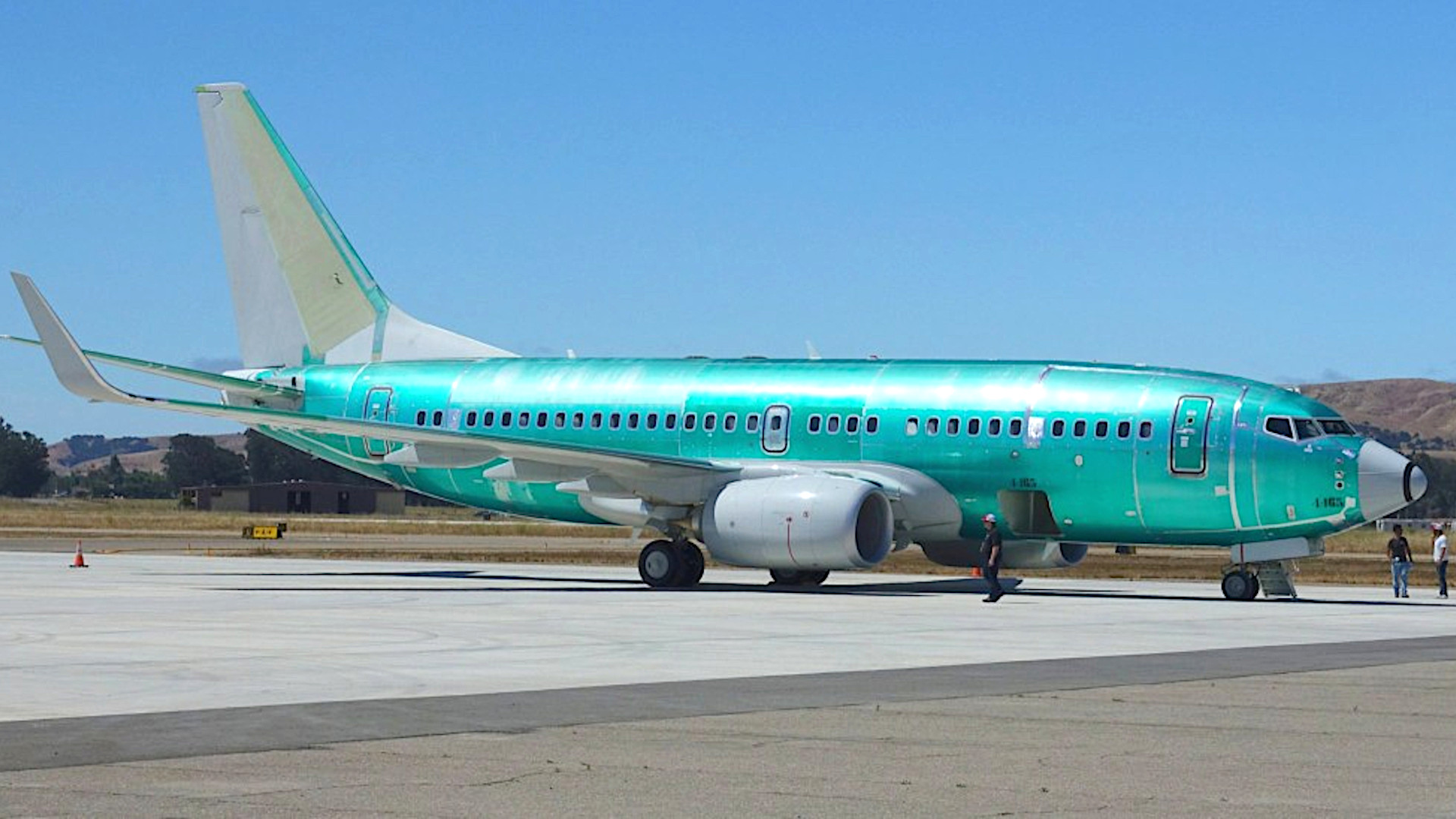
N712JM had drawn particular attention in 2020 not just because of its transfer to the Air Force, but also because it emerged at that time wearing a green protective coating and otherwise looking like it had just rolled off the production line. It also had some unusual external features that raised questions about its role, as we explored at the time.
N712JM as it was seen in 2020. Reader submission
In 2020, Jon Ostrower, long-time aviation journalist and editor-in-chief of The Air Current, told TWZ the following:
“This is definitely an airplane that never made it to a formal finish you’d expect from a commercial airplane. The green finish is a protective coating applied to fuselages during manufacturing to protect from scratches and other damage. It is dissolved during painting. You can also still see the manufacturing (line) number as well. That’s from its original trip down the assembly line. There’s also quite a bit of instrumentation visible with sensor wiring leading into the cabin through the passenger windows. This type of arrangement points to a flight test setup of some kind.”
In 2020, N712JM conducted many test flights in U.S. military ranges off the coast of Southern California, flying various flight profiles, some of them quite unusual. The aircraft flew those sorties from Santa Maria Airport in California, and used the callsign STING 38.
The 'mysterious' USAF Boeing 737-700 N712JM is just back to Santa Maria, Ca. after another 3+ hour flight as 'Sting 38'. https://t.co/3sxMyligwM
What the Air Force has been using N712JM for to date is unknown. Per FAA, the aircraft has been and continues to be registered to an address at Bolling Air Force Base (technically now part of Joint Base Anacostia-Bolling) in Washington, D.C., which looks to belong to the Air Force’s Rapid Capabilities Office (RCO). The RCO has headed up multiple cutting-edge, high-priority programs over the years, including the development of the B-21 Raider stealth bomber and the X-37B reusable spaceplane. A 737-based platform could be configured to support an array of different research and development and test evaluation activities that would fall under the purview of RCO, as well as other stakeholders that this office might engage with.
A screen capture of the entry for N712JM in the FAA’s online database at the time of writing. FAA capture
There has also been some speculation over the years that N712JM might have transformed into an Air Force 737 with the serial number 21-0024, but this appears to still be unconfirmed. The 21-0024 serial has more recently become associated with other shadowy 737s tied to the U.S. military, which have civilian-style paint schemes and may also be on the U.S. civil register. One of them was notably spotted in 2025 at a U.S. forward operating location in El Salvador, sitting directly alongside an Air Force AC-130J Ghostrider gunship and a U.S. Navy P-8A Poseidon maritime patrol plane. This, in turn, raised questions about its involvement in the ongoing U.S. campaign of strikes on alleged drug smuggling boats in the Caribbean and the Eastern Pacific Ocean, as TWZ previously explored in detail.
21-0024, for reference. When I spotted it, FR24 was indeed calling it N712JM, though ADSBx had the BuNo and a different hex. https://t.co/3WwV3kxBC4
Interestingly, there have been several online flight tracking data ‘pings’ suggesting new activity related to N712JM at Colorado Springs Airport since at least February of this year. However, there do not appear to be any confirmed flights by the aircraft from there in that same timeframe. This airport notably sits adjacent to Peterson Space Force Base.
There is still a possibility that NASA could be looking at a different Air Force 737-73W for possible conversion into a Vomit Comet. As the contracting notice makes clear, the aircraft in question is currently in the classified realm. At the same time, this seems far less likely to be the case given everything that is known (and still unknown) about N712JM.
A separate question does exist now as to what effort the Air Force might be in the process of closing out that would allow it to transfer any classified 737 to NASA. TWZ has previously raised tangential questions about how the Air Force might fill the resulting gaps left by the highly-specialized RAT55 moving on to the next stage of its career. It is certainly interesting in its own right that NASA seems to be focused heavily at the moment on leveraging some of the most secretive 737s in existence today to support its much less sensitive needs.
More details may emerge if Denmar deems the “classified” Air Force 737 to be a suitable starting place to create a new Vomit Comet to support NASA’s reduced gravity training needs and the Artemis program.
Update: 3:45 PM EST –
In immediate response to our queries, NASA has directed us to an additional notice about the award of the sole-source contract, valued at $8.4 million, to Denmar Technical Services back on June 1.
“The contractor will modify a Boeing 737-700 aircraft to perform lunar-gravity parabolic flights to test NASA space equipment. Once modifications are complete, NASA Armstrong will own the aircraft and oversee aircraft operations out of NASA Johnson,” the notice says. “The aircraft will be used to validate astronaut lunar suits and associated crew systems required to support Artemis mission objectives. This can be done with the modified 737 aircraft in an operationally relevant, reduced-gravity environment prior to lunar mission execution.”
No mention is made here about the sourcing of the aircraft from the Air Force or its classified mission work, as outlined in the sole-source justification that was released yesterday.
Update: 6/11/2026 –
The U.S. Air Force has provided TWZ with a brief statement about the 737-73W aircraft in question.
“The Boeing 737-73W aircraft was originally procured to serve as a flying testbed,” a spokesperson for the service said. “The program ended and [the] USAF is transitioning the aircraft to NASA.”
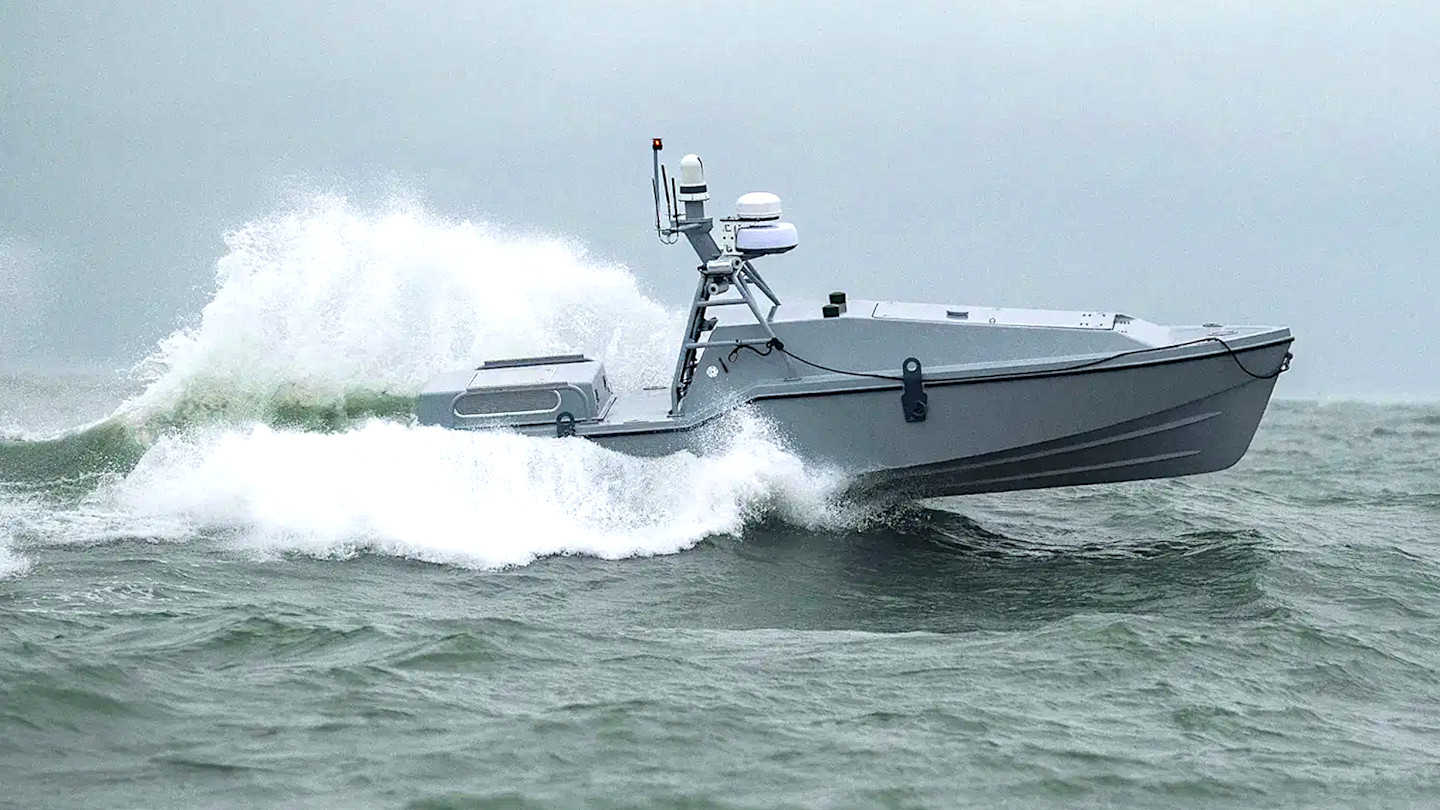
U.S. Central Command (CENTCOM) has confirmed a Saronic Corsair was the uncrewed surface vessel (USV) that rescued the crew of a U.S. Army AH-64 Apache out of the Gulf of Oman overnight. President Donald Trump has also now said Iranian forces downed the attack helicopter, and promised a response. This is the first known instance of a drone boat being used to recover personnel as part of a search and rescue mission, and has major implications for these operations going forward. Readers can otherwise get up to speed on what is already known about this incident in our initial reporting here.
“The surface drone that assisted in last night’s rescue of the Apache crew off the coast of Oman was a U.S. Navy Corsair unmanned surface vessel operated by U.S. 5th Fleet’s Task Force 59,” U.S. Navy Capt. Tim Hawkins, a CENTCOM spokesman, told TWZ. “The task force began fielding these drones in theater in late March.”
A top-down look at a Saronic Corsair USV. Saronic
The Navy confirmed last December that it had signed an Other Transaction Authority (OTA) deal with Saronic, valued at $392 million, for the production of Corsair USVs. The Corsair, which the manufacturer also calls an autonomous surface vessel (ASV), is a 24-foot-long drone boat with a speedboat-like design that was first unveiled in 2024. The manufacturer says it has a maximum range of 1,000 nautical miles, a top speed of 35 knots, and a 1,000-pound payload capacity.
Prototype to production in under 12 months. The @Saronic OTA proves how we’ll build a hybrid manned–unmanned Fleet: open competition, real contracts, real hardware for Sailors and Marines not slides. This is now the standard. pic.twitter.com/cC9DG7jTiW
— Archive: Secretary of the Navy John C. Phelan (@SecNavPhelan) December 8, 2025
The Corsair “picked them [the Apache crew] up and transported them to another location on the water where they were then hoisted up to a helicopter for further transport,” Capt. Hawkins, the CENTCOM spokesperson, added.
CENTCOM had already confirmed to TWZ and others that an unspecified USV found and rescued the two aircrew from the downed Apache. The Wall Street Journal was first to report the specific type of drone boat employed.
The Army aviators spent approximately two hours in the water before being recovered safely, according to a previous CENTCOM statement. As mentioned, President Donald Trump has also now separately said that Iranian forces were responsible for bringing down the Apache, and that a U.S. response will be forthcoming.
Trump says that Iranian forces shot down the Army AH-64 Apache attack helicopter that went down over Hormuz yesterday.
Since its establishment in 2021, the Navy’s Task Force 59 has been charged with helping expand the service’s operational use of uncrewed platforms, as well as artificial intelligence (AI) and machine learning-driven capabilities, across the Middle East. It has operated an array of different types of USVs, as well as uncrewed aerial systems, over the years.
How many Corsairs Task Force 59 has currently, as well as their exact configuration, is unclear. Pictures and videos that Saronic has released to date have shown Corsairs fitted out primarily for surveillance and reconnaissance missions, with a camera turret on top of a central mast-like frame. A commercial navigation radar, additional cameras to help provide extra situational awareness, and various other antennas have also been seen fitted to that frame. Saronic has talked about integrating other capabilities to enable additional mission sets, including launchers for loitering munitions, in the past.
A picture showing the most typical configuration of the Corsair USV that has been seen to date. Saronic
Saronic also says Corsair has a high degree of autonomy, with the type having logged more than 100,000 nautical miles of total travel to date, including multi-day missions. The SUV is designed to be employed independently or in networked swarms, according to the company. Human operators are in the loop during these operations via datalink.
Corsair, our 24ft Autonomous Surface Vessel (ASV), has officially crossed 100,000 nautical miles traveled — that’s nearly five times around the Earth or almost halfway to the Moon!
This milestone represents more than distance. It reflects relentless testing across diverse… pic.twitter.com/opXtX6jSfO
“Corsair can be given a mission, alone or as part of a collaborative swarm, and execute with minimal human interaction to deter or counter adversarial threats at a range of 1,000 nautical miles,” Saronic said in a press release back in 2024. “Employing redundant communications and passive perception capabilities, Corsair can autonomously identify, track, follow, and intercept targets in contested and communications denied environments.”
These are all capabilities well suited to the U.S. Navy’s immediate needs in the Middle East, especially in support of the current blockade of Iranian ports. Corsair would notably offer a lower-risk way to closely shadow vessels that might be attempting a run into or out of the area. Corsair’s ability to automatically spot and track objects of interest would have helped in finding and rescuing the downed Apache crew, too. It is worth noting here that automated target detection is also a key part of Corsair’s ability to safely navigate autonomously, day or night, especially in congested waterways, as seen in the video below.
In 2025, we logged more than 79,000 nautical miles and over 15,000 hours of total operations with Corsair, our 24-ft ASV. Much of this was done on our own dime, operating 6 days a week at our test sites on the West Coast, East Coast, Gulf Coast, and beyond, allowing us to… pic.twitter.com/PZETeJia17
Corsair’s overall performance in the Middle East could easily translate to further operational use of this USV by the Navy globally. The service has particularly significant demands for persistent maritime surveillance and reconnaissance capacity, as well as just general presence, across the broad expanses of the Pacific. One of the key benefits that USVs offer is the ability to provide additional distributed ‘mass’ at relatively low cost. This can help bolster the capabilities of crewed platforms they are networked together with or just ease the operational strain on those assets.
The Navy has now also clearly demonstrated how valuable USVs could be in future maritime search-and-rescue operations worldwide. This, in turn, underscores the benefits uncrewed platforms bring to these missions, especially in the face of growing anti-air and other threats.
As we already wrote today:
“As TWZ regularly highlights, search and rescue operations present inherent complexities and risks, especially when conducted in or near hostile territory. The F-15E rescue effort in Iran put a particular spotlight on the immense risks that combat search and rescue (CSAR) forces take, with helicopters and C-130 variants sent into areas where even a high-end fighter aircraft didn’t survive.”
“Open-water recoveries can present distinct additional challenges. There is always the possibility of the loss of additional assets and personnel in the process, no matter where a CSAR mission occurs.”
US Air Force HH-60W Jolly Green II search-and-rescue helicopters refuel from an HC-130J Combat King II aircraft. USAF
“The use of a Navy drone boat in the rescue overnight highlights a new dimension for maritime CSAR going forward. These uncrewed assets can be more readily pre-positioned in a distributed manner. For example, in the broad expanse of the Pacific, USVs could be forward-deployed at multiple points along certain flight paths for this exact purpose. USVs could offer other distinct advantages in certain scenarios where they might be able to get into areas where traditional assets cannot and without risking additional personnel. These realities extend well beyond the maritime domain, and we are only likely to see uncrewed platforms of all kinds increasingly taking part in rescue efforts, especially in denied areas. The U.S. military is coming to terms with just how vulnerable their CSAR assets are and the ranges that would be needed to access highly defended areas, especially during a peer fight. Using drones to execute personnel recovery is being viewed as one part of a larger set of solutions to this pressing problem.“
The additional detail we have now that the Corsair USV brought the downed aircraft to a territorial location, where they were then hoisted into a helicopter, is notable, too. This further shows how uncrewed platforms could be used as part of a distributed hub-and-spoke-style concept of operations for future rescue missions, which could increase flexibility and total area covered. USVs could be used to penetrate into especially high-threat areas, recover personnel, and then bring them to crewed assets at safer locations to the rear, as well.
“When it comes to search and rescue, you utilize the best asset that is the closest and the quickest, and that was the case in this instance,” CENTCOM’s Hawkins also told The Wall Street Journal today. “We’ve practiced this scenario in exercises, but not quite necessarily like this.”
The first Marauder prototype seen being launched earlier this year. Saronic
The Navy is already set to evaluate Marauder, as well as designs from six other companies, as part of the first round of prototyping under its latest Medium Unmanned Surface Vessel (MUSV) effort. This is part of a larger strategy the service rolled out in March to try to field more USVs and do so faster, as you can read more about here.
In the meantime, Saronic’s Corsair is already being employed operationally in the Middle East and demonstrating its ability to perform complex missions.
The U.S. Air Force has confirmed that the VC-25B “Bridge” aircraft is now wearing its new (and controversial) red, white, and blue livery as it undergoes final preparations for its official delivery.
Aviation photographer Travis Ghormley shared the first picture of the modified Boeing 747-8i with its new paint scheme yesterday. It was taken the day before in Waco, Texas. The aircraft had been undergoing modification and flight testing at L3Harris’ facility in Greenville, also in Texas, as part of the conversion into its new role, since at least April, before subsequently moving to Waco to be painted. The jet, gifted to the Trump administration by the government of Qatar last year, is set to serve as an interim Air Force One aircraft ahead of the much-delayed arrival of two fully outfitted VC-25Bs from Boeing.
The VC-25B Bridge aircraft seen unpainted sometime circa May 1. Courtesy photo via the USAF
“The VC-25B Bridge aircraft has been painted and is going through final modifications,” an Air Force spokesperson told TWZ today when asked for more information about the aircraft’s current status. “I don’t have any additional details I can provide on delivery dates at this time.”
A press release the Air Force put out on May 1 said that the “VC-25B Bridge aircraft has officially completed modification and flight testing” and was “being painted.” We have confirmed that the completed modifications referred to here were on the contractor side, but the U.S. government still has additional modifications to make to the jet.
Ghormley’s picture does clearly show the jet wearing the same red, white, and blue scheme that has already been appearing on various Air Force and other U.S. government VVIP jets. The livery also includes a large American flag, depicted blowing in the wind, painted on both sides of the tail and “UNITED STATES OF AMERICA” written on both sides of the fuselage. The paint job is virtually identical to what President Donald Trump had previously chosen for the future VC-25B Air Force Ones during his first term. President Joe Biden had previously reversed that decision, bringing back plans to paint the VC-25Bs in the iconic scheme that dates back to President John F. Kennedy’s administration.
A rendering of a future VC-25B with the livery President Trump had originally selected. BoeingA rendering of a future VC-25B wearing the Kennedy-era scheme. USAF A rendering of a future VC-25B Air Force one jet. USAF
The Bridge aircraft’s current location is also unclear. Video posted on social media yesterday, seen below, purported to be of the jet departing for its new home at Andrews Air Force Base just outside of Washington, D.C. This is where the two current VC-25A Air Force One jets, as well as a host of other Air Force VVIP aircraft, are based.
Full blown operation to get this thing out without us seeing. Fueled, loaded crew, and preflighted in the hangar. Flipped CRANE01 to face me at the south end and beam me with landing lights. Entire airport blacked out, crew and grounds crew all wearing NOD’s.
Online flight tracking data does show that another U.S. military Boeing 747-8i flew from Waco, Texas, to Andrews on June 7, using the callsign Crane 01. However, this callsign has been associated with an ex-Lufthansa 747 the Air Force has also acquired for use as a trainer in support of future Air Force One operations. This aircraft, which may now carry the serial number 25-3200, has been tracked multiple times flying between facilities in Texas and Andrews in recent months. There does not appear to be tracking data for the VC-25B Bridge jet, which may also now have the serial number 25-3300, but it could have made the trip without broadcasting on ADS-B.
Past reports have indicated that the Bridge aircraft could make its public debut on July 4, which this year is also wrapped up in additional celebrations of the 250th anniversary of the founding of the United States. President Trump’s birthday (June 14) is also this weekend.
“L3Harris, known for its executive communications systems and services, was selected to undertake a complex modification of the bridge aircraft. L3Harris not only delivers secure, reliable and resilient communications for VC-25A and the executive airlift fleet but has extensive experience with self-protection and customization of VIP aircraft,” the Air Force wrote in the May 1 press release. “The accelerated timeline was further made possible by a mission-focused partnership with Boeing, who provided the necessary engineering data to support the required structural modifications.”
“Additionally, elite specialists from multiple government agencies developed advanced protocols to detect and-if necessary-neutralize potential technical hazards on previously owned aircraft,” it added. “Their rigorous approach on the Bridge aircraft has literally ‘written the book’ and set the benchmark for integrating used airframes into the secure military inventory.”
Another picture of the unpainted VC-25B Bridge aircraft, seen after arriving in Waco, Texas. Courtesy Photo via USAF
“Safety and security were at the forefront of this program. We deliberately minimized interior aesthetic modifications to focus on modifications for safety, security and mission execution. We assessed which requirements were necessary for an interim capability. We had greater flexibility in developing our mission requirements,” the Air Force also told TWZ directly at that time. “After safety and security, we focused on the mission communications systems.”
“We have made deliberate decisions such as the reduction of the number of airstairs, less chiller space, and exclusion of the Golden Eagle mission [to fly the remains of former presidents] to minimize structural modifications, while prioritizing modifications focused on safety, security and secure communications,” the service added.
Getting a new Air Force One aircraft of some kind into service on an accelerated timetable has long appeared to be a major goal for President Trump. The fully-equipped VC-25Bs from Boeing are years behind schedule. Last year, the Air Force announced that there had been some improvement on that front, but that it still did not expect to have the first of the two jets in hand until mid-2028, which would be just months before Trump is set to leave office.
What we do know for sure is that the VC-25B Bridge aircraft is now wearing Trump’s preferred red, white, and blue paint scheme ahead of its official rollout later this summer.
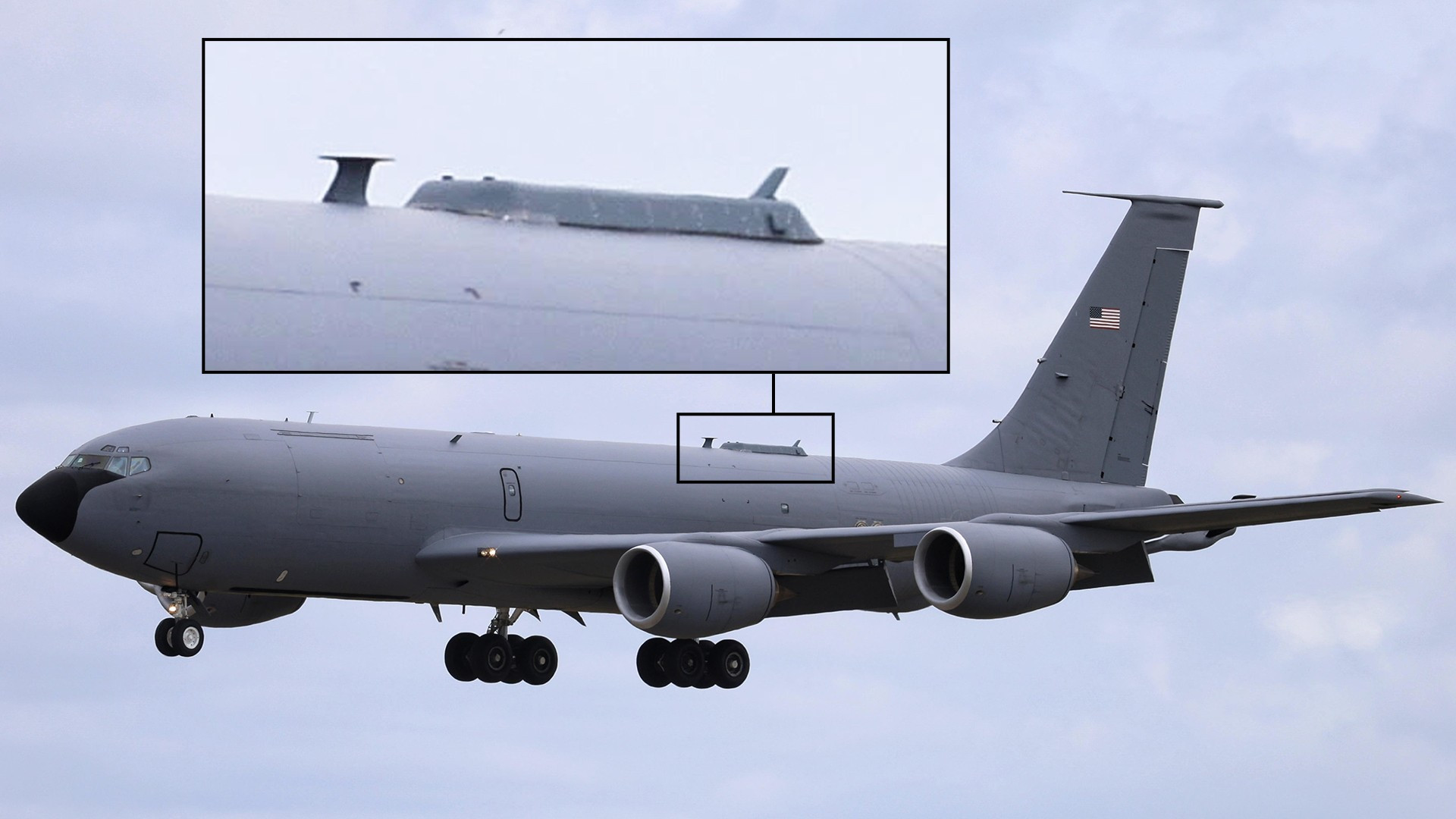
A U.S. Air Force KC-135 tanker appeared in the United Kingdom this weekend with a new antenna on top of the rear of the fuselage. The service has several efforts underway to improve the communications networking capabilities of all of its tankers and cargo planes, including ones that leverage Starshield, the government-focused cousin of SpaceX’s Starlink. This has become an especially critical priority for future survivability and effectiveness of the aging KC-135 fleet.
A stock picture of a KC-135 tanker taking off from RAF Mildenhall in 2025. USAF/Staff Sgt. Kevin Long
Ledda told TWZ that online flight tracking data says this particular KC-135 is serial number 63-7976, but that this might not be correct. The plane is largely devoid of markings, preventing easy confirmation. Two years ago, the Air Force’s Air Mobility Command (AMC) began removing serial numbers and other unique identifying markings from tankers and other aircraft as an operational security measure, as you can read more about here.
Ledda also told us that this is the first time he has seen a KC-135 with the new dorsal antenna, despite regularly photographing tankers of this type at Mildenhall. The base is home to the Air Force’s 100th Air Refueling Wing, which flies the KC-135, but is also a regular staging point for temporary deployments and a stop-over for aircraft just passing through.
A picture of the same antenna on top of a KC-135 had emerged online in April, but where and when it was taken are unclear. This may or may not be the same aircraft seen at Mildenhall this weekend. It is unknown how many Air Force KC-135s may have received this modification so far, and TWZ has reached out to the Air Force for more information. At the beginning of Fiscal Year 2026, the Air Force had 368 KC-135s in inventory, in total. At least a portion of that fleet is set to remain in service through 2050.
A close-up look at the dorsal antenna on the KC-135 seen this weekend at RAF Mildenhall. Alessandro Ledda
The antenna has a very roughly trapezoidal shape with a mostly flat top. There is a single small blade that sticks up at the rear, as well. The size and shape are broadly reflective of ‘hump’ style antennas associated with high-bandwidth satellite communications (SATCOM) suites seen on large military and commercial aircraft. In both pictures we have seen of this installation on the KC-135 so far, the new antenna is also mounted right behind a much smaller existing platter-shaped type typically used to support ultra-high-frequency SATCOM links.
Back in April, the possibility was raised that the new antenna for the KC-135 could be tied to Airlift/Tanker Open Mission Systems (ATOMS) and/or its successor, MAF NEXUS, both developed by the Sierra Nevada Corporation (SNC). MAF here stands for Mobility Air Forces, a collective term for the Air Force’s tanker and airlifter fleets, and the personnel that support them.
ATOMS is “a Starshield-based BLOS [beyond line of sight] satcom system SNC has been installing on a handful of [KC]-135s, [C]-17s, [KC]-46s, [C]-130s. Saw a C-17 getting it last week in Dayton,” Aviation Week‘s Brian Everstine wrote on X, speaking generally, in a thread discussing the first picture of the new antenna for the KC-135 that had emerged. ATOMS is “now transforming to Air Mobility Commands [sic] ‘MAF Nexus.'”
Elements of at least one iteration of ATOMS are seen, at center, inside a C-17 cargo plane during a briefing for senior officials in 2025. USAF/Staff Sgt. Joshua T. Crossman
As noted, Starshield is a more secure, government-centric offshoot of SpaceX’s Starlink space-based network. Starshield and Starlink have been in increasing use across the U.S. military on aircraft, as well as warships and in various contexts on the ground, for years now, as TWZ has explored on several occasions in the past.
The size and shape of the antenna on the KC-135 at Mildenhall is, broadly speaking, in line with commercial Starlink antennas used on airliners and other civilian aircraft.
An example of a commercial Starlink antenna for use on aircraft, in this case integrated onto a Beechcraft King Air turboprop. AeroMech Incorporated
“The SNC solution for ATOMS, originally provided as a Quick Reaction Capability (QRC) in just six months, delivers enhanced situational awareness through multidomain networking and datalink,” SNC had explained in a press release in August 2025. “The system’s ability to provide a Common Operating Picture improves data interpretation and bolsters decision advantage, strengthening AMC’s effectiveness by leveraging multiple communications paths and sensors to seamlessly share data.”
That release followed the conclusion of the Air Force’s Mobility Guardian 2025 exercise, in which ATOMS “played a pivotal role” by “demonstrating its ability to provide seamless data management and communications solutions on multiple aircraft platforms, including the C-17, KC-135, KC-46 and C-130, as well as numerous ground nodes.”
The Air Force’s 2027 Fiscal Year budget request highlights at least two other potentially relevant communications upgrade efforts for the service’s KC-135, specifically, which could also make use of Starlink/Starshield.
A row of US Air Force KC-135 tankers. USAF
There is the “Hybrid SATCOM capability,” which involves “the employment of Multi-Band, Multi-Orbit SATCOM terminals to switch between different government and commercial constellations,” according to official budget documents. This is tied to another project called MAF Connectivity focused on developing a “path forward as the tanker needs to be able to connect to the Joint fight to close kill chains and logistics chains.”
For MAF Connectivity, “possible capabilities include, but are not limited to, intelligent gateways, antennas, radios, software updates, crew displays, and multiple aperture array housings,” the budget documents also note. An “increment 1 first prototype installation” was also scheduled to be completed in the second quarter of Fiscal Year 2026, which began on January 1 and ended on March 31.
The antenna could be part of a different effort, as well. The Air Force has fielded a number of roll-on/roll-off communications and networking suites for the KC-135 over the years, but in an ad hoc manner and on a relatively limited scale. Last year, the Air National Guard also announced the demonstration of a new communications and data-sharing node packaged inside a heavily modified underwing Multipoint Refueling System (MPRS) pod, but the extent to which that capability may now be available for operational use is unclear. KC-135 and KC-46 tankers use unmodified MPRS pods to transfer fuel to receivers via the probe-and-drogue method.
A repurposed Multipoint Refueling System (MPRS) pod containing a communications and data-sharing package, seen under the wing of a Utah Air National Guard KC-135. MSgt Nicholas Perez/Utah Air National Guard
As an aside, a Boeing 757 called Trailblazer (N-number N473AP), which defense contractor L3Harris uses as a testbed, also recently emerged with a new elongated dorsal fairing. Trailblazer’s new addition is similar in some broad strokes, but also distinctly different from the antenna seen on the KC-135 at Mildenhall this weekend. One of L3Harris’ major business areas is satellite communications systems, including for the U.S. Air Force. TWZ has reached out to the company for more information about this development.
For years now, the Air Force has been trying to more deeply integrate new communications and networking capabilities onto the KC-135, as well as other tankers and aircraft across the MAF. Senior service officials have also described this as a gateway to enabling other new capabilities down the road, including ones to help better protect tankers and airlifters from future threats. TWZ has previously highlighted this as a path to airborne control for “loyal wingman” type drones and other uncrewed aerial systems, something the Air Force has already been experimenting with to differing degrees.
“I gotta keep modernizing the tanker force,” Air Force Lt. Gen. Rebecca Sonkiss told TWZ and others at a roundtable at the Air & Space Forces Association’s annual warfare symposium in February. “If I was going to parcel out the things we care about in that, though, it’s connectivity and survivability. So those are the things that we really care about in that effort.”
“There’s various ways to get after survivability,” she continued. “It starts with being connected so that you have battlespace awareness, and then it continues on to how do we protect those assets.”
Sonkiss’ official title is Deputy Commander of AMC. However, she has been serving as the interim head of the command since her predecessor, Gen. John Lamontagne, became Vice Chief of Staff of the Air Force in January.
Air Force Lt. Gen. Rebecca Sonkiss speaks at the 2026 AFA Warfare Symposium. USAF/Capt. Christian Little
“The single biggest contributor to survivability in a big airplane is connectivity. The biggest contributor is not having a 12-hour-old Intel brief that you’re relying on to get you through the mission,” retired Air Force Gen. Michael “Mini” Minihan, who led AMC from October 2021 to November 2024, told TWZ in an interview in February, as well. “So real-world updates, real-time updates, just like our fighters and our bombers enjoy. Battle management that gets after maneuver and not just kill chain. Those things matter.”
“The reality is that the car I rented right now, driving from the airport to my hotel room, has more connectivity in it than the overwhelming majority of the mobility fleet. So connectivity matters,” he also told us at that time.
New communications and networking suites could enable AMC’s KC-135, as well as the rest of the command’s fleets, to serve as essential ‘translators’ between disparate networks and waveforms in the future. Providing a link between low probability of interception/low probability of detection (LPI/LPD) datalinks that stealthy aircraft use, such as the Multifunction Advanced Data Link (MADL) and Intra-Fighter Data Link (IFDL), and more general-purpose ones, would be especially valuable. IFDL is currently only found on the F-22 Raptor, while all variants of the F-35 fighter (and future B-21 Raider bombers) use MADL, and the two cannot ‘talk’ to each other directly, which has long created challenges. Upgraded tankers could serve as important parts of a beyond-line-of-sight mesh-like network that incorporates other kinds of line-of-sight links like Link16. In this way, they could help relay data to and from forward battle management and other command and control nodes, including ones in the air.
An F-22, in front, flies together with an F-35A, at rear. USAF
In addition, improved connectivity stands to provide additional operational and safety benefits across the MAF.
“According to the Air Force, the tankers’ ability to access tactical data links could increase mission success in contested environments by improving survivability, agility, and situational awareness for command-and-control elements and aircrews,” the Congressional Research Service (CRS) wrote in a report published in January. “The connectivity could provide aircrews with such information as potential threats, fuel availability, and safer landing sites. In addition, tanker aircraft could serve as a backup information conduit for other aircraft in a degraded communications environment.”
The points here have become a broader topic of discussion after two KC-135s collided over Iraq in March during the opening weeks of Operation Epic Fury against Iran. One of the aircraft crashed, killing all six onboard. The other tanker involved was able to land in Israel despite suffering severe damage. At the time of writing, the Air Force has not yet shared any official determinations as to the chain of events that led to that fatal incident.
“We should never put mobility crews, especially tanker crews, in a position during combat operations where they have to choose between being seen by everyone, including the enemy, or being seen by no one, including the joint force and civil aviation,” Minihan subsequently wrote in a post on LinkedIn. “Mobility force connectivity now. Write the damn check.”
“Most KC-135s [sic] communications networks are ‘not the type of battle space awareness that shows you where the red is, where the blue is, and the actions that are being taken in real time in a conflict,'”Defense One reported in March, citing an interview with retired Air Force Gen. Jacqueline Van Ovost, who previously served as head of U.S. Transportation Command (TRANSCOM). “All you have is the intelligence you took off with when you got the brief two hours prior to take off.”
All this being said, the Air Force is still years away from integrating more robust communications and networking capabilities onto the entire KC-135 fleet.
“Over the course of about the next six years, you’ll see the full fleet of KC-135s fully connected,” Lt. Gen. David Tabor, Deputy Chief of Staff for Plans and Programs, told members of Congress at a hearing last month.
The appearance of the KC-135 with the added antenna at Mildenhall does point to new progress on key connectivity upgrades for Air Force tankers and airlifters. At the same time, improved communications and networking capabilities are increasingly critical now, and it remains to be seen when they become more commonplace across the KC-135 fleet.
Special thanks again to Alessandro Ledda for sharing the picture of the KC-135 seen at Mildenhall this weekend with us.
Yesterday, TWZ published an analysis of a thermal image purportedly showing a previously unseen advanced aircraft design, which appears to be a precursor to the U.S. Air Force’s forthcoming F-47 fighter from Boeing. The image, which went viral online and is from a video that has now been released, is said to have been captured near the U.S. military’s secretive Groom Lake test base, better known as Area 51. It turns out, as a number of our readers have pointed out, there may be some interesting similarities between this secret aircraft and a “Christmas tree” fighter design concept crafted decades ago by Darold Cummings, one of the top minds behind Northrop’s YF-23 Black Widow.
You can find our full initial assessment of what we may be seeing in the viral image, first posted online by the Project Fear YouTube channel earlier this week, here. What we saw initially, as shown below, appeared to feature what could be described as a “double arrowhead” profile to its forward fuselage. This is a very distinct design cue, but it could also be a result of the low quality of the image and the artifacts that come with consumer-grade thermal imagers, which was what the aircraft was recorded with.
A close-up look at what is visible in the viral thermal image. Capture via Project Fear
Project Fear has now released the full video it says it captured near Area 51, seen below, and it underscores the aforementioned points about image quality. So, it is possible the aircraft has a more traditional low-observable ‘shovel nose,’ instead. Nonetheless, the Christmas tree fighter is an interesting trip down lesser-known fighter development memory lane that is worth examining, in particular what such a unique nose configuration would provide an advanced fighter aircraft.
The full clip of the mysterious aircraft passing by starts at around 49:34 in the runtime of the video below if it does not automatically start playing at that point.
People are asking why it would be running a very bright light. Multiple reasons, could have had an emergency for all we know. But most likely, would be to keep its silhouette from being seen from certain aspects from the ground. Bright lights are established practice for… https://t.co/mxEvG2EUkz
“I was hired by Bob Sandusky in 1982 to be the Chief Configurator for the Northrop ATF [Advanced Tactical Fighter] program (YF-23). In early 1983 Bob said that Northrop had tried to develop a ‘4-spike’ (like the B-2) fighter, but it couldn’t be done, since a flying wing fighter was not possible,” Cummings wrote in his post on LinkedIn. “I told him I could design one, and he said to give it a try. The only way to accomplish this was with a series of highly swept (55 degree) surfaces over the entire length of the aircraft. The result was the DP-21, created in June of 1983.”
“4-spike” here essentially refers to the total number of radar cross-section hot-spots and where they are located, each pointing in a different direction in azimuth. The fewer ‘spikes’ a low-observable (stealthy) aircraft has, the easier it is to manage its radar signature, and to make it harder to detect and lock onto, but it’s also where those spikes are located that matter.
The blueprint of the DP-21 “Christmas tree” fighter concept. Darold Cummings
A four-spike design like the B-2 critically has nothing from the head-on aspect, as well as from the rear, which helps immensely with survivability. These are the most critical signature areas, especially the front as the aircraft is heading into hostile territory. Also, because these are located along the path of flight, these spikes can stay consistent on a threat radar as the aircraft moves directly toward or away from the sensor, and are not fleeting in nature like those from the side. So a four spike aircraft would be very attractive for a tactical fighter meant to persist in contested territory.
“I never considered this to be a serious contender for the ATF program, as the aircraft was unstable beyond 10 degrees angle of attack!” he also noted.
“Back in 1983, the ‘Christmas Tree’ DP-21 would have been difficult to fly. However, with modern flight control systems, this design could be controlled, even at high angle of attack,” Cummings told TWZ directly today after we reached out for more information. “Low observability is always better served with long edges on the design, so the small arrow-shaped foreplane is not ideal, but it still has low RCS characteristics, just not the optimum.”
“Wing shaping is always a trade-off for maximizing LO. Most of the trades have to do with the leading edge contour, which is a large contributor to signature,” he continued. “The canard has to be designed to be ‘ported’ during penetration, as this minimizes the signature. On the YF-23, the V-Tail was ‘ported’ in penetration for the same reason. This is certainly possible with modern flight control systems.”
“Ported” in this instance refers to keeping the control surface locked in the same geometric plane as the wing while cruising.
A top-down look at the YF-23 during a flight test. USAF
We also asked Cummings directly whether it was possible his DP-21 concept had an influence on what is seen in the viral thermal image, assuming it is authentic. And we asked for his take on what impacts Boeing’s experimental X-36 and Bird of Prey designs may have had on the F-47, as well.
“My DP-21 aircraft image has been available publicly for quite some time, so it is possible it had some influence, but that is only speculation on my part,” he told us. “I believe the X-36 and Bird of Prey have both influenced the F-47 design. I have always been impressed by the X-36, as it seemed to be ahead of its time.”
Boeing’s X-36 demonstrator. NASA/Carla Thomas Boeing’s Bird of Prey. USAF
“The Groom Lake images are truly intriguing,” he also noted. “It is a viable concept.”
“I think the main thing to remember is that NO ONE thought a 4-spike design (like the B-2) was possible, and my DP-21 was an example of how it was possible,” he added. “A 4-spike design for the F-47 would truly be impressive!”
“The image shows an exotic design by any interpretation. The aft-set lambda-type wings appear to have a camber and wingtip droop, as on the Boeing Bird of Prey demonstrator. There are very large canard foreplanes — a feature that appears prominently on F-47 renderings and which we have written in detail about in the past. The broad nose, too, is something that has been included in depictions of the F-47, although we have really no idea to what degree these are based in reality. It’s worth noting that in this new thermal image, it has a distinctive double-arrowhead shape, tapering in again in front of the canards. Even the canards themselves may have more than one plane, with the outer tips being drooped, matching similar architecture as the wing. The fuselage then tapers down in the center before the wing roots begin.”
“The aircraft is very likely to be tailless, a feature common to most sixth-generation concepts seen so far. However, since it’s seen from below, we cannot be sure about this aspect of its configuration.”
“As for the powerplant, it is most likely a twin-engine design, like the F-47, a theory reinforced by the sawtooth-type trailing edge. There is no obvious suggestion of any exhaust plumes, which seems odd, but that could be the result of the sensor being used in combination with the aircraft’s power setting at the time of recording, as well as general thermal signature reduction capabilities that are part of the design.”
Beyond the nose end, there are still some very broad similarities in the shaping of the wing and main body of the aircraft seen in the footage and Cummings’ DP-21 concept.
As we noted yesterday, what is seen in the viral thermal image could be unrelated entirely to the F-47. The Navy has also been pursuing a carrier-based sixth-generation fighter, commonly referred to as F/A-XX, in recent years. There has been at least some crossover between F/A-XX and the Air Force’s NGAD effort. A rendering Boeing has shared of its proposed F/A-XX design looks very much in line with what has been shown of F-47 to date. Northrop Grumman is the other company currently competing to build the Navy’s sixth-generation carrier fighter, and has released its own renderings.
Boeing’s F/A-XX render. Boeing
We're bringing tomorrow’s horizon into focus, faster, stronger and ready when the warfighter needs it.#SAS2026pic.twitter.com/r0uORyR5kM
In addition, it should be said that official F-47 and F/A-XX renderings released to date will have been carefully manipulated to maximize security of the programs, both of which remain highly classified, and to provide disinformation to adversaries.
As an aside, Cummings also shared his take on a prospective navalized version of the F-47 in a separate post on LinkedIn last year. At that time he wrote:
“I received a DM asking if I had envisioned a Navy version of my recent F-47 fighter concept, such as the F-35A to F-35C approach. I recently completed my F-47 Navy version, which I call the F-47N. However, the approach I took was somewhat different: The F-35C used a larger wing for low speed lift, whereas I used my original F-47 wing planform, and added a canard for more low speed lift and control. The canard design (inspired by the X-36), coupled with the Multi-Axis Thrust Vectoring (inspired by the X-44), provided a very reasonable first cut at a Navy version. In general, a canard layout has been treated as adding more radar signature to a fighter. However, on the YF-23 we found that if the all-moving surface (it was a V-tail on the YF-23) was kept “ported”, in this case aligned with the wing plane during cruise, the impact on LO was not a large impediment to signature reduction. The ability to keep the canard ported is achievable using thrust vectoring for trim in cruise and penetration modes.”
Cummings’ interpretation of the F-47 design at that time notably did not reflect his previous DP-21 concept. The X-44 design he mentioned is also known as the Multi-Axis No-Tail Aircraft (MANTA), and was derived from F-22. At least to our knowledge, the MANTA never came to be. The designation was recycled for an entirely unrelated flying wing-type drone, the existence of which was first reported by TWZ.
Darold Cummings’ drawing of his notional “F-47N.” Darold CummingsRenderings of the X-44A MANTA. Lockheed Martin/NASA
It’s also worth noting that the design in the newly emerged thermal video could be tied to one of many other programs, including uncrewed ones. Still, it is very much in line with what we would expect to see from a design related to the F-47 and it seems very likely this is the Boeing NGAD demonstrator, if the video is indeed authentic, which it appears to be.
It would be nice to say that we will have to wait and see whether this aircraft turns out to have a more traditional shovel-shaped nose, or even a mild Christmas tree-like design, but we may never see it again. Hopefully that is not the case, especially after the F-47 goes public, but the final design will have significant differences from its technology demonstrator forebears.
Special thanks to @ElectroFluidSys on X for bringing Darold Cummings’ posts on LinkedIn to our attention.
Modularity is a key area of interest as the U.S. Air Force formulates its latest set of requirements for a successor to the MQ-9 Reaper, according to Gen. John Lamontagne, the service’s Vice Chief of Staff. A modular design, both in terms of hardware and software, would help make the chosen platform more flexible and adaptable to different mission sets. Earlier this year, the Air Force did lay out other prospective requirements for a relevant-sounding MQ-9 replacement, including a design that is easier to produce, lower-cost, and that can be more freely sent into higher-risk environments, as we have previously reported.
Gen. Lamontagne talked about what he termed “MQ-9 Next” during a virtual talk hosted by the Air & Space Forces Association’s Mitchell Institute for Aerospace Studies earlier today. His comments came in response to a question about the Reaper performance in the latest conflict with Iran, where the drones have played a critical role, but have also suffered major losses. The latter point is a key factor in this discussion that we will come back to later on. Last month, the Air Force had also confirmed it was in the early phases of putting together a new set of requirements for an MQ-9 replacement. This follows several abortive Air Force attempts in the past to devise a successor to the Reaper.
US Air Force MQ-9 Reaper. USAF
“As we look forward in [sic] having something that is more MQ-9-like – I would characterize it as ‘MQ-9 Next’ – I think what we’d like to have is something that’s perhaps got more range, perhaps a lot more modularity,” Lamontagne explained. “We could hang ISR [intelligence, surveillance, and reconnaissance] sensors, we could hang weapons, we could hang fuel – something that we could line-in/ line-out, very modular.”
The Air Force’s number two officer made clear that his view of modularity in this extends from the hardware side to “very simple software that we own, and we could change, so it’s almost like an iPhone.”
“We have it for several years, and we could change it, and put whatever kind of apps on it, and change the speed of warfare, change the speed of need,” he continued. “We own it, we control it, and we can also change it very quickly.”
Greater control over intellectual property, and software in particular, has emerged as a major guiding principle for the U.S. military, in general, in recent years. This makes it easier to avoid the pitfalls of being locked into a single vendor. Being able to have companies compete for follow-on contracts creates opportunities to lower costs and diversifies supply chains. This diversification in the supplier base, in turn, can be beneficial when it comes to scaling up production of key subcomponents and complete systems.
A row of MQ-9 Reapers. USAF/Staff Sgt. Ariel O’Shea
All of this feeds back into the modularity equation, with the ability to readily integrate new capability and functionality helping keep doors wide open to new possibilities down the road. This is all on top of the more immediate flexibility that modular systems and architectures offer.
For MQ-9 Next, this could translate to more adaptability when it comes to “hey, do we need more ISR? Do we need more strike? Or a combination thereof?” Gen. Lamontagne said.
The general also described the current MQ-9 replacement requirements as “probably less defined” compared to where the service is right now on future Collaborative Combat Aircraft (CCA) drones. “We’re just going through some early work, our Air Force Futures team, to figure out exactly how we want to tackle that going forward [on MQ-9 Next].”
Lamontagne’s remarks today are in line with testimony from Lt. Gen. Christopher Niemi, the acting head of Air Force Futures, at a hearing before the Senate Armed Services Committee last month. At that time, Niemi talked about an MQ-9 replacement that would be “more flexible” by leveraging open architectures, easier and cheaper to produce “in mass numbers,” and usable “in a more attritable way.”
Attritable is generally taken to mean a system that is sufficiently low-cost to be sent out on higher-risk missions where it could be lost, but also capable enough to be relevant for those same missions. It is a term that has been increasingly in disuse by the Air Force in recent years.
An official US military graphic intended to help conceptualize where “attritable” falls into the spectrum of cost and capability, and the value of having capabilities in that category. Defense Systems Information Analysis Center
In April, the Air Force had also used the term in a contracting notice seeking information about prospective designs for a new ISR drone. Though the MQ-9 was not explicitly mentioned in that notice, the specific details do align with the remarks from Niemi and now Lamontagne about new plans for a Reaper replacement, as you can read more about here.
As we previously wrote:
“The latest statements from the service describe a drone with increased flexibility achieved through open architecture, rather than building bespoke batches of drones for particular requirements. Previous statements from the service outlined an aspiration to have its new drone capable of accommodating rapidly reconfigurable payloads, something that open architecture would expedite.”
“Above all else, the MQ-9 successor will still have to operate in contested environments.”
…
“The Pentagon has long worked on the basis that a future conflict with a peer rival, and especially with China in the Pacific, would see it facing highly robust anti-access/area-denial (A2/AD) scenarios. With that in mind, previous Reaper replacement studies had suggested that low observability would need to be incorporated into the design.”
“The latest thinking seems to reject that, or at least reorient the program toward a lower-cost platform of the kind that the Air Force would be able to field in mass, as well as to absorb the anticipated attrition in a high-end conflict. This does not preclude this airframe from featuring low-observable elements. In fact, it most likely will. But those would be more aggressively balanced against cost.”
A rendering of a stealthy concept Northrop Grumman previously put forward as a possible MQ-9 replacement, underscoring how the thinking in this regard has changed over the years. Northrop Grumman
There remains a question of when the MQ-9 Next requirement might actually be finalized, as well as what the acquisition strategy (and timeline) might be for the drones. As already mentioned, the Air Force has tried multiple times to develop a Reaper replacement without success. As we highlighted in our past report:
“Since MQ-Next, the U.S. drone landscape has changed considerably in terms of manufacturers. A few years ago, Northrop Grumman, Lockheed Martin, and General Atomics would have been seen as the front-runners for the MQ-9 replacement. Now, there are more contenders, often with a founding focus on rapidly scaling up production at low cost. Still, these firms have much to prove, especially considering the risk in replacing an aircraft as important as the MQ-9. At the same time, in the more advanced drone space, the legacy defense “prime” contractors are also making major progress in leveraging new technologies to reduce production costs and migrating away from exquisite, very expensive drones as their default offerings.”
All of this is made more pressing by the worrisome impacts from losses of dozens of MQ-9s just in the past year or so as a result of operations targeting Iranian-backed Houthi militants in Yemen and, more recently, the conflict directly with Iran. The Air Force itself described this attrition as concerning, but there increasingly looks to be limited options for securing any immediate replacements. The Reaper, more formally known as the MQ-9A, is out of production. The company that developed the drone, General Atomics, has moved on to the MQ-9B, an evolved design with significant differences from its predecessor. Any new Air Force purchases of drones in this broader family would have to be of the B model and worked into the existing production schedule.
USAF
General Atomics, the maker of the MQ-9 and a pioneer in the uncrewed marketplace, seems to have pushed back on some of the ideas the USAF now wants in a Reaper replacement.
“Some say we need cheaper, disposable aircraft, so that we can use them and throw them away, or lose them and not feel bad about it. No one is talking about actual capability, ready today,” C. Mark Brinkley, a spokesperson for the company, recently told TWZ. “No one is talking about all of the hard lessons, already learned, about icing and weather and weapons integration. No one is talking about the multiple survivability upgrades available for the existing platforms and the lack of investment in those.”
“These make-believe weapons that don’t exist have the luxury of being anything you imagine them to be,” Brinkely added. “Unscratched lottery tickets, promising all of the win and none of the lose [sic].”
USAF
In the meantime, operational demands for MQ-9s remain high, and Lamontagne lauded their contributions in the latest conflict with Iran during his talk today. He also said that he sees Reaper’s performance as validating his service’s broader plans for new uncrewed platforms, including CCAs, as well as MQ-9 Next.
“I think it affirms the path that we’re on with Collaborative Combat Aircraft,” he said. “Collaborative Combat Aircraft, different [from MQ-9], much more autonomous,” but “still controlled by a man or a woman, and a fighter that is going to direct them to do what they need to do.”
A “very loyal wingman” and “not quite as intensive from a manpower perspective – true both in the air and on the ground,” he continued. “So, I think it very much affirms that’s the right path. And we’re going down that road, and we’re spending really good money on CCAs, and we’re excited about what kind of capability that’s going to deliver.”
“I think we’ve learned a lot of lessons, both with CCAs and MQ-9 Next, to take us into the future.”
When it comes to MQ-9 Next, the requirements are still very much evolving. It remains to be seen when and if this attempt at a Reaper replacement will come to fruition, unlike the various preceding attempts.
The U.S. Marine Corps is aiming to put in an order for new anti-drone 5.56x45mm ammunition for its M4 carbines and M27 rifles by the end of the year. Produced by a company called Drone Round, the L Variant cartridge has a projectile that breaks into multiple segments to improve the probability of scoring a hit on a small, fast-moving aerial target. The idea is to give anyone with a rifle an immediate boost in their ability to defend against growing drone threats, especially first-person view (FPV) kamikaze types now proliferating around the globe after becoming a fixture in the war in Ukraine.
Marine Corps Systems Command (MARCORSYSCOM) announced its intention to buy an unspecified number of 5.56x45mm L Variant cartridges through a sole-source contract with Drone Round in a notice posted online yesterday. The projected date of the contract award is December 2026.
“The 5.56mm Drone Round ‘L Variant’ is the only kinetic munition currently available in the commercial or defense marketplace that meets the Marine Corps’ strict minimum capability requirements for immediate c-sUAS [counter-small uncrewed aerial systems] defense,” according to an accompanying document justifying the need for a sole-source deal. “Specifically, this round is the only solution offering ‘drop-in’ compatibility that requires no physical modifications, specialized upper receivers, or distinct weapon platforms to be operable in current-issue Marine Corps 5.56mm weapons (e.g., M27, M4, and M4A1).”
“Furthermore, its deployment requires zero additional New Equipment Training or specialized occupational specialties, rendering it immediately effective upon issue,” the justification adds. “Failure to deliver this capability places an unnecessary risk to Marines and could lead to mission failure and loss of life.”
The results of a range test of L Variant rounds. Drone Round
Drone Round has been developing specialized anti-drone ammunition for small arms since at least 2025. At the time of writing, the company offers two 5.56x45mm versions, the aforementioned L Variant and a K Variant. The L and K versions have projectiles designed to split into five and eight segments, respectively.
With their different loadings, the L and K Variants are effective out to around 328 and 164 feet (100 and 50 Meters), both of which are relatively short ranges, according to Drone Round. No special modifications are required to use the ammunition in existing guns, and the company says the rounds are “full-auto and suppressor capable.”
Marines train with M27 rifles. USMC
L and K Variants in 7.62x51mm have also been developed, but are still in testing. Work is underway on 6.8x51mm versions, which could be fired from the U.S. Army’s new M7 rifles, M8 carbines, and M250 light machine guns. Other calibers could be on the horizon, as well.
Soldiers assigned to the US Army’s XVIII Airborne Corps load L Variant cartridges into magazines during testing. US Army/Pfc. Alexis Fischer
Marine Corps interest in ammunition of this kind, broadly, is also not new. “Enhanced ammunition for existing firearms (buckshot-like 5.56, 7.62, .50, .40mm)” was among a list of desired squad and platoon-level counter-drone capabilities included in a separate contracting notice MARCORSYSCOM put out back in 2024. This reflected the then-recent rollout of a larger service-wide counter-drone vision, the core of which is ensuring that virtually every Marine can play a role.
“For our ammunition portfolio, we need industry’s help in counter-UAS munitions for our existing weapon systems,” Marine Col. Paul Gilikin, the Program Manager for Combat Support Systems at MARCORSYSCOM, said during a talk at the Navy League’s annual Sea-Air-Space conference in April.
The basic idea of multi-projectile small arms ammunition to help improve hit probability is decades old. The U.S. Army notably explored this concept extensively in the 1950s and 1960s, but did not ultimately field any of the rounds it developed. Armed forces elsewhere around the globe have pursued similar projects over the years.
Different types of pellet-filled rounds have also been developed for various small arms, including rifles and handguns, in the past, with the Glaser Safety Slug seen in the video below being one of the better-known examples. However, small arms cartridges of this kind have typically been designed primarily for very close-range self-defense, survival, or even pest-control use.
Porting these concepts of multi-projectile small arms cartridges over to counter-drone is a growing trend at this point, too. In February, the Naval Surface Warfare Center, Crane Division (NSWC Crane) unveiled multiple Drone Killer Cartridge (DKC) designs it had internally developed in 5.56x45mm, 7.62x51mm, and .50 caliber flavors.
An array of different Drone Killer Cartridge designs developed by NSWC Crane. USN
“During a recent demonstration at Camp Atterbury in Edinburgh, Indiana, DKC achieved a 92% success rate against drone targets,” according to a Navy press release. What further progress has been made since then in the development of any of the DKC designs, or their fielding, is unknown.
High-Precision Complexes Holding has begun rolling out the first batches of its 'Многоточия' (Ellipse) triplex C-sUAS rounds. These are the СЦ 226 (STs 226) in 5.45×39, and the СЦ 228 (STs 228 in 7.62×39. Claims hit probability is improved by a factor of 2.5x at 300 m. pic.twitter.com/DUSFXHlb55
To reiterate, the key benefit that multi-projectile counter-drone cartridges offer is the boost in hit probability when engaging small and highly maneuverable drones. They can also be fired from existing guns without modification. This, in turn, presents a way to give anyone in a unit with an M4 or M27 an additional means of protecting against uncrewed aerial threats without adding to the bulk and weight that personnel already have to carry around.
The Marine Corps and other branches of the U.S. military have already been pursuing other add-on capabilities to improve the effectiveness of small arms against small drones, especially for individual rifles. In particular, variants of the SMASH family of computerized optical sight systems from Israeli firm Smart Shooter have been in growing use across America’s armed forces, and elsewhere globally, for years now. The Marines have at least tested another counter-drone rifle aiming system that uses a buttstock designed to automatically move the gun in line with the target. These are capabilities that could easily be paired with specialized ammunition. It might be possible to tweak software behind these systems to better work with multi-projectile loadings, too.
Range has been cited as one limiting factor, especially for shotguns. Specialized rifle rounds like Drone Round’s L Variant and the DKC types developed by NSWC Crane, which are fired at higher velocities than shotgun shells, are intended to help mitigate this, at least to a degree. However, as noted, Drone Round says that the effective range that it has demonstrated with its 5.56x45mm types to date is 328 feet (100 meters). As a point of comparison, the stated effective range of an M4 carbine firing standard single-projectile ammunition is around 1,640 feet (500 meters), according to the Army.
The closer a counter-drone engagement occurs, the less time there is to react, overall. There is the additional question then of whether standing and fighting is the best course of action.
“When shooting you are static, which makes it easier for the operator to aim the drone,” a contemporary Russian manual on counter-drone tactics notes, according to a report in April from Forbes. That being said, there might not be somewhere safer to move in many cases.
Russian correspondent hides from a Ukranian drone … it looks for him like in a scary movie. pic.twitter.com/XPPQGzDzn0
Ukrainian drone operators located a concentration of Russian hardware inside a large warehouse somewhere in the south of Ukraine, preparing for an assault.
The very skilled drone operators sent in several drones and eliminated several MBTs, IFVs, trucks and more. In the end, the… pic.twitter.com/jgcqibiJRD
Having to manage multiple ammunition types on the fly could also present challenges. What kind of effectiveness rounds like L Variant might offer against more traditional targets is unclear.
All this being said, counter-drone rifle rounds do continue to be fielded on both sides of the conflict in Ukraine, even if the full extent of their use is not entirely clear. The explicit fielding of shotguns as counter-drone weapons is another trend that is growing globally, including in the U.S. military.
Small arms are, of course, just one part of a layered ecosystem of defenses necessary to challenge the ever-growing threats posed by various tiers of drones. For the Marine Corps, specialized counter-drone 5.56x45mm ammunition is now in line to be part of that larger equation.
A new type of submarine that appears to lack a traditional sail has emerged in China. The same shipyard launched a smaller ‘sailless’ submarine — a technology demonstrator — eight years ago. More recently, a top Chinese shipbuilding conglomerate put forward a concept for an uncrewed underwater vehicle (UUV) with a broadly comparable hullform. Designs of this kind can offer benefits in terms of speed, maneuverability, and reduced acoustic signature, but also have major drawbacks.
TWZ has obtained imagery of the submarine in question at JN (Jiangnan) Shipyard in Shanghai on June 1, as seen at the top of this story and below, from Vantor (previously Maxar Technologies). The boat, the name and/or designation of which are currently unknown, first appeared there sometime at the end of May, according to Naval News. That outlet was first to report on this development.
From the imagery, the submarine does not have a traditional sail. However, the exact shaping of what is present is also not entirely clear from the view that is currently available. As noted, JN Shipyard is known to have built at least one other ‘sailless’ submarine in the past, which we will come back to later on.
Writing for Naval News, undersea warfare analyst H.I. Sutton has assessed the design to be roughly 394 feet (120 meters) long and to be between 33 and 36 feet (10 and 11 meters) wide. What its intended missions might be are unknown, but this is certainly larger than common diesel-electric submarines (SSK) and even longer than most nuclear fast attack submarines. For comparison, variants of China’s Type 093 nuclear-powered attack submarine (SSN), some of the most modern submarines in People’s Liberation Army Navy (PLAN) service today, are approximately 356 to 360 feet (108 to 110 meters long) and 36 feet wide. The official stated length and width of the U.S. Navy’s Virginia class SSNs, across all existing subvariants, are 377 feet (114.8 meters) and 34 feet (10.36 meters), respectively.
An X-shaped stern is a feature now further associated with a next-generation Chinese attack submarine design commonly, but still unofficially, referred to as the Type 095. Naval News also reported today on the recent launch of what may be another Type 095, which has a traditional sail, at the Bohai Shipyard in Huludao, hundreds of miles to the north of Shanghai. This may have caused some confusion online, with some mistaking a boat at Bohai for a ‘sailless’ type.
Just translated via @type36512: CSSC Bohai Shipbuilding: Launch of a New Submarine
Satellite imagery captured on May 29. I believe this image depicts the new 120m-class, sail-less submarine discussed in the accompanying article. However – due to limitations in image resolution – https://t.co/sHF9Y8gkGe
Even if we scale 09V's hull diameter with this mystery submarine (for illustration purposes), it is a fair bit shorter, meaning it probably isn't a 09V, but it also doesn't correspond to what a 10m diameter, 120m length submarine would look like…
The newly emerged submarine at JN Shipyard may also have a shrouded propulsor, which could be a pumpjet type. Pumpjets offer further benefits for quieter operation, especially at higher submerged speeds.
The absence of a traditional sail is still the most notable aspect of the new submarine at JN Shipyard. Omitting a large structure sticking out of the top of the hull helps significantly with streamlining the overall design. Eliminating that drag can allow greater optimization for speed and maneuverability while submerged. It can also help make the submarine quieter and, by extension, harder to detect, even while transiting through an area at higher speeds. This can be especially useful when racing out to threats, even those far away.
Not having a traditional sail could impose certain design constraints. Traditionally, naval submarines have used their sails to mount periscopes and other sensor masts, as well as extendable communication antennas and snorkels to help cycle air without fully resurfacing. That is space that can be used for other purposes, including launchers for countermeasures and general storage.
A generic example of the array of masts that extend up from the sails of modern naval submarines. Hensoldt
Above all else, while running on the surface, the sail is key for general navigation and situational awareness. It can also provide an elevated position for local force protection or supporting vertical replenishment (VERTREP) operations. If sufficiently hardened, it can even break through feet of ice during operations in and around the polar regions.
The sail of the US Navy’s Los Angeles class attack submarine USS Santa Fe seen broken through the ice during an exercise in the Arctic Circle in March 2026. USN/Petty Officer 1st Class Jacob Bergh
The lack of a sail might reflect a focus on seabed operations far from the surface where mast deployment and other considerations might be less pressing. At the same time, the design’s features could just as easily be centered on improving performance, including the ability to make transits as quickly as possible during blue water operations. It could also offer benefits for shallow-water operations, though we have noted that, overall, it is very large compared to SSKs.
As mentioned, a smaller ‘sailless’ submarine had already emerged at JN Shipyard in 2018. H.I. Sutton previously estimated that design to be around 150 feet (45 meters) long and 15 feet (four to four-and-a-half meters) wide. That submarine also had a non-X-shaped rudder arrangement and what appeared to be an unshrouded propeller. The exact reasons for building that boat and how it has been utilized over the years remain unknown, but it would have at least provided a testbed and technology demonstration platform to explore this design concept, and potentially other capabilities. Whether it was designed for crewed or uncrewed operation, or to be optionally crewed, is not clear, either. The same is true of this new submarine, though it seems unlikely it is uncrewed.
A top-down look at the first low-profile submarine to emerge from JN Shipyard. Chinese Internet
At the Zhuhai Airshow in 2024, the state-run China State Shipbuilding Corporation (CSSC) did show a model of an unprecedentedly large, diesel-electric UUV. Its overall design was highly reminiscent, at least in broad strokes, of JN Shipyard’s original ‘sailless’ submarine, as TWZ noted at the time. JN Shipyard is one of many subsidiaries of CSSC.
CSSC said at the time that the drone submarine could be configured to perform a wide array of missions, including launching attacks on enemy vessels, laying mines, supporting special operations forces, and serving as a mothership for smaller uncrewed underwater vehicles (UUV). You can read more about all of this here.
The model of the low-profile UUV design CSSC showed at the Zhuhai Airshow in 2024. Chinese internet
Other shipyards and navies around the world have explored low-profile submarine designs in the past, but designs have generally been consigned to the world of paper concepts and limited experimentation. The U.S. Navy, for instance, previously tested a Large Scale Vehicle Range (LSVR) subscale demonstrator submarine with a novel sail structure. The Navy’s Acoustic Research Detachment (ARD) conducted that work in a lake in Bayview, Idaho.
Large Scale Vehicle Range (LSVR) subscale demonstrator submarine seen sailing in Lake Pend Oreille in Idaho. Public DomainA model of a low-profile ballistic missile submarine concept called Arktur shown in Russia in 2022. @MuxelAero
In 2021, the Navy also notably put out a contracting notice calling for concepts for inflatable sail structures, which could combine the benefits of traditional sails and low-profile designs. What degree of work the service may have conducted since then on this Inflatable Deployable Sail System (IDSS) is unclear, but it underscores how important a sail is for general operations on the surface.
The PLAN’s submarine force otherwise continues to grow in terms of capability and capacity, with an increasing number of more modern types. U.S. officials have openly said in the past that the quality of newer Chinese submarines has been getting closer in parity to American designs. All of this is further underscored by the recent appearance of the other new submarine at Bohai. In addition to new nuclear-power designs, China is also understood to be developing at least one design with a hybrid nuclear/conventional propulsion system, referred to as the Type 041 or Zhou class. The first known example of the Type 041 came to light after it looked to have sunk in a shipyard in 2024.
Greater use of nuclear propulsion promises to extend the reach of Chinese submarines in the Pacific and beyond, and is clearly part of the PLAN’s larger vision for naval power projection going forward.
“The PLA Navy is executing a significant strategic shift from diesel-electric to all-nuclear construction, representing a fundamental departure from historical construction patterns,” U.S. Navy Rear Adm. Mike Brookes, head of the Office of Naval Intelligence, wrote in prepared remarks ahead of a hearing before members of the U.S.-China Economic and Security Review Commission in March.
Brookes also highlighted how the hybrid Type 041, specifically, could offer “greater endurance, potentially filling regional patrol and presence missions more economically than full-size SSNs [attack submarines] and SSGN [guided missile submarines].”
More remains to be learned about the newly emerged submarine at JN Shipyard, but it could point to new low-profile designs without traditional sails, possibly to act as the PLAN’s underwater high-speed interceptor, being part of China’s larger future submarine future.
U.S. Special Operations Command (SOCOM) has confirmed that it has no plans for a direct replacement for the U-28A Draco, which is primarily used for intelligence, surveillance, and reconnaissance (ISR). The command had previously said it was exploring requirements that might lead to a successor to the U-28A, as well as its MC-12 surveillance planes. America’s special operations community now increasingly looks to be getting entirely out of the business of flying dedicated crewed ISR aircraft, which were a staple during the Global War on Terror era.
At least publicly, all of the remaining U-28s in service today are assigned to units under Air Force Special Operations Command (AFSOC). The U-28 is a militarized version of the Pilatus PC-12 single-engine turboprop that carries a variety of sensors, including electro-optical and infrared cameras and a signals intelligence (SIGINT) suite. It can also be used, if required, as a light utility aircraft. AFSOC currently has around 30 U-28s in its inventory.
A member of the 27th Special Operations Wing performs preflight checks on a U-28 during Exercise Southern Star 25 in Chile. USAF
“USSOCOM will retire 8 U-28A intelligence, surveillance, and reconnaissance aircraft in FY [Fiscal Year] 2027 as part of its phased plan to divest all manned ISR platforms by 2029,” according to an annual force structure report the Pentagon released last month. “These retirements align with evolving mission requirements and reflect the scheduled drawdown of aircraft that have reached or exceeded their expected service life.”
Similar language has been included in past iterations of this report since 2024, but it appears to have gone largely unnoticed. Aviation Week was first to report on the contents of the newest version of the document last week. TWZ subsequently reached out to SOCOM for further clarification and more information about this decision.
“SOCOM previously announced a decision to divest the U-28 platform in 2020,” a spokesperson for the command told us today. “There are no plans to replace this ISR platform.”
TWZ has reached back out to confirm whether or not SOCOM currently expects crewed aircraft to be part of the special operations aerial ISR ecosystem at all after the U-28 leaves service at the end of the decade.
It is true that SOCOM’s plans to retire the U-28s, along with its MC-12 fleet, are well established at this point. The command completed divestment of the last of its MC-12s in 2025. This designation has been used to refer to a variety of ISR-configured variants of the Beechcraft King Air twin-engine turboprop. Special operations versions have also sometimes been referred to by the program name Javaman.
A special operations MC-12, in front, seen together with a U-28, behind. Air National Guard Andrew LaMoreaux
“The command is rapidly modernizing, to include ISR infrastructure,” Col. Justin Bronder, head of SOCOM’s Program Executive Office for Fixed Wing (PEO-FW), told TWZ and other outlets when asked about what could follow the U-28 and the MC-12 at a roundtable at the annual SOF Week conference in May 2024. “We’re working very closely with our counterparts in G2 [SOCOM’s top intelligence office], AFSOC, JSOC [Joint Special Operations Command], etc, to help both identify what the real requirements are” and “how to get after new capabilities” as “we divest and move on from some platforms that serve admirably where we were for the counter-VEO [violent extremist organization]/ Crisis Response fight in the Middle East for 20 years.”
“SOCOM has not taken steps to plan for, or add, critical ISR capabilities provided by soon-to-be divested aircraft,” the Government Accountability Office (GAO), a Congressional watchdog, said in a report published in September 2024. “Also, SOCOM has not addressed risks associated with the loss of these capabilities if the new aircraft does not provide them.”
A U-28A at a mock Forward Area Refueling Point (FARP) during an exercise. USAF
However, GAO’s report did not explicitly say that SOCOM had no intention of filling those gaps, even in part, with a new crewed platform.
“SOCOM told us that their decisions about Armed Overwatch occurred separate from their decisions to divest of existing aircraft,” a GAO spokesperson told TWZ directly at that time when asked for more information. “We are separately conducting a classified assessment of SOCOM’s process for how it decided to divest of ISR aircraft.”
There were some signs at this year’s SOF Week conference that the forthcoming retirement of the U-28 could be more of a final coda for dedicated crewed ISR aircraft within the U.S. special operations community. A representative of PEO-FW told TWZ and others at the gathering that all of the secretive SOCOM Tactical Airborne Multi-Sensor Platform (STAMP) aircraft would be transferred somewhere within the Air Force. Whether or not it will make its way under AFSOC’s umbrella is not clear, though it seems likely. How long those aircraft will remain in service at all is also unclear. The STAMP fleet, which we were first to report on years ago, has included types based on the De Havilland Canada DHC-8, or Dash 8, and the Beechcraft King Air over the years.
A STAMP fleet Dash-8. US Army
“Just a reminder that OA-1K is not a replacement for U-28,” Col. Bronder also said again at this year’s SOF Week conference. “Certainly, it can do some ISR functions, but again, [it] meets a close air support strike requirement.”
How SOCOM expects to fully make up for ISR capacity gaps left by the retirement of its existing crewed ISR aircraft remains to be seen. The U.S. special operations community does already operate a variety of drones capable of performing surveillance and reconnaissance missions, including Air Force MQ-9 Reapers and U.S. Army MQ-1C Gray Eagles. Further uncrewed capabilities will certainly be part of the equation, especially to help mitigate the threats posed by ever-more capable enemy air defense systems in contested environments.
AFSOC has already been heavily investing in what it calls the Adaptive Airborne Enterprise (A2E). This is an overarching concept of operations centered on increasing deployability by reducing personnel and logistics footprints, as well as the collaborative employment of capabilities. The vision for A2E includes heavy use of air-launched drones, loitering munitions, and other systems that are increasingly lumped together under the umbrella of so-called “launched effects.” It also extends to collaboration with friendly crewed and uncrewed assets in the ground and maritime domains.
A graphic depicting an “operational vision” (OV) for the Adaptive Airborne Enterprise (A2E) involving collaboration between platforms and forces across permissive, contested, and denied areas. USAF
As an aside, it is also worth noting that the U.S. Army finished divesting dozens of turboprop crewed ISR aircraft in December 2025 as part of a broader modernization push. That service is now in the process of acquiring a far smaller number of ME-11B High Accuracy Detection and Exploitation System (HADES) surveillance and reconnaissance planes based on the Bombardier Global 6500 business jet, which you can read more about here.
For the U.S. special operations community, all of this comes amid something of a watershed moment for crewed fixed aircraft operations, in general. In recent years, there has been reorientation across America’s armed forces toward preparing for future major conflicts, especially one against China in the Pacific, after decades of focus on counter-terrorism missions. This, in turn, has prompted questions about the continued relevance of many platforms, including the new OA-1K, which is very much geared toward low-intensity conflicts.
Outlays in SOCOM’s budget request for the 2027 Fiscal Year only show plans to acquire 53 OA-1Ks. This is down from the plans to procure 62 Skyraider II aircraft that had been previously presented in the command’s proposed budget for the 2026 Fiscal Year.
Earlier this year, SOCOM told Air & Space Forces Magazine that this was a reflection of “the strategic reallocation of resources to support [SOCOM] evolving priorities.” However, the command also insisted that it still expects to eventually acquire 75 OA-1Ks as originally planned.
SOCOM has also stressed that American special operations forces will still be called upon to provide support to counter-terrorism missions and in other low-intensity conflicts for the foreseeable future despite the pivot toward preparedness for high-end fights. The command has said this continues to justify the acquisition of the OA-1K. How the Skyraider II, as well as other fixed-wing crewed special operations aircraft like the AC-130J gunship, might provide support on the edges of a future major conflict is also something SOCOM and AFSOC are actively exploring.
Whatever the future of crewed fixed-wing special operations aviation looks like, a direct replacement for the U-28 is off the table, and crewed ISR aircraft may be increasingly absent from that equation entirely.
“The Air Force Life Cycle Management Center, Armament Directorate, Attack Division (AFLCMC/EBD) is conducting market research for an industry analysis of capabilities,” according to a contracting notice posted online yesterday. “AFLCMC/EBD is seeking to award a Multiple Award Indefinite Delivery Indefinite Quantity (IDIQ) contract to support all aspects of research & development, production, testing, and delivery of the Next Generation Penetrator (NGP), GBU-76/B weapon system.”
A partially assembled GBU-57/B Massive Ordnance Penetrator, the weapon the GBU-76/B Next Generation Penetrator is set to eventually supplant. USAF
“All interested vendors shall submit a response demonstrating their capability to support the design, production, testing, and bed down of components and specific activities related to the development, performance and sustainment of the GBU-76/B weapon system,” the notice adds. It also stresses that information is only being gathered currently for “planning purposes.”
The notice lists a wide range of “tasks that may be pertinent to this effort.” This includes fuze development and production, the development and testing of the explosive filler, the design and integration of an “Alternate Navigation System” to help guide the bomb to its target, and integration of all components into complete bombs. The full list is reproduced below.
USAF
As TWZ regularly notes, fuzing is a critical element of the design of deep-penetrating munitions. These weapons are designed to be employed against targets that are underground or otherwise present inherent challenges when it comes to establishing their exact location and layout. As such, advanced fuzes that ‘count’ floors to determine depth and/or sense the ‘voids’ of underground mission spaces help maximize the damage from a weapon like MOP or NGP. These fuzes also just need to be highly reliable in order to function after impacting very hard surfaces at high speeds and then drilling even further down into them.
The Air Force has also said in past NGP contracting notices that it “will consider novel, demonstrated, or fielded Guidance, Navigation & Control (GNC) technologies with viability for integration into a warhead guidance system design that can achieve repeatable, high accuracy performance in GPS aided, degraded, and/or denied environments.” The MOP uses a GPS-assisted inertial navigation system (INS) guidance package contained within its tail unit.
Being able to reliably hit a very specific impact point is also essential for bunker buster bombs, especially ones designed for very deep penetration. During Operation Midnight Hammer, Air Force B-2 bombers dropped six MOPs in rapid succession on each of two ventilation shafts – 12 bombs in total – at Iran’s Fordow nuclear site in order to drill down into the facility below.
A graphic offering details about the employment of MOPs on Iran’s nuclear site at Fordow during Operation Midnight Hammer. US Military
Many details about the planned design of the NGP remain unknown, including its expected total weight. The Air Force has previously said that the bomb’s “warhead” is set to tip the scales at around 22,000 pounds, but the complete weapon could be heavier. The contracting notice from yesterday says prospective vendors need to show general understanding of “tasks associated with the lifecycle of Large Penetrator Warhead Systems weighing approximately 20,000 to 30,000 lbs.” The MOP is a 30,000-pound-class bomb that includes a BLU-127/B warhead with a nominal weight of approximately 27,125 pounds.
The GBU-76/B could incorporate other advanced or novel features. The Air Force has raised the possibility of a powered design offering extended reach in past discussions about MOP replacements. An add-on rocket booster could also help further improve the weapon’s penetration characteristics.
As an aside, the B-2 is the only aircraft currently certified to employ MOPs operationally, and each of the bombers can carry just two of the bombs at a time. Making the GBU-76/B lighter and/or smaller than MOP could be beneficial for future integration on the B-21 Raider. The Raider is smaller than the B-2, and is only expected to be able to carry a single MOP at a time. The smaller payload capacity of each B-21, in general, is also set to be offset by a far larger fleet size of at least 100 bombers, and likely more. Only 21 B-2s were ever built, and 19 of them remain in service today.
A B-2 bomber sits at Whiteman Air Force Base in Missouri ahead of Operation Midnight Hammer. USAF
In line with evolving plans to actually field the new bunker busters, the NGP contracting notice the Air Force put out yesterday also asks prospective vendors to outline their ability to provide other related support. This includes supplying mission planning and weaponeering software, training assets and procedures to go along with them, and just the means of getting the bombs from point A to point B and then into waiting aircraft. The Air Force already has specialized equipment to train ground personnel on the movement and loading of MOPs on B-2 bombers, including a full-size mock bomb bay.
An inert MOP seen loaded inside the full-scale B-2 bomb bay training asset. USAFAnother inert MOP seen on a specialized trolley used to move the 30,000-pound-class bomb around and load it onto the B-2. Missouri Air National Guard
When the Air Force expects to start fielding its first operational GBU-76/Bs is unclear. The Air Force’s 2027 Fiscal Year budget request says that “Next Generation Penetrator Prototype Demonstration including Modeling and Simulation, Design, Product Development, and Test” is set to wrap up at the end of Fiscal Year 2028. It also says, unsurprisingly, that the goal of current prototyping efforts is to demonstrate an “Air to Ground penetrator with equivalent or better MOP performance.”
In September 2025, Applied Research Associates, Inc. (ARA) announced it had received a contract for work on NGP to include the production and delivery of full-scale prototypes. ARA also said at that time that “Boeing will drive tail kit development and support all-up-round integration.” Boeing is the prime contractor behind the MOP.
The start of fielding of the GBU-76/B is also unlikely to lead to the immediate retirement of GBU-57/B, and the Air Force is continuing to work on improving that bomb’s capabilities in the interim. The service’s 2027 Fiscal Year budget proposal outlines plans for additional upgrades to the MOP’s tail kit and fuze. After Operation Midnight Hammer, the Pentagon also moved to help the Air Force replenish and potentially expand its stockpile of GBU-57/Bs. How many MOPs have been procured to date is unknown. Boeing has reportedly expanded its capacity to make the bombs in the past, but total production is still understood to be relatively limited.
The budget documents also note that MOP funding has been supporting the construction of a new test target, referred to as MS-34, further details about which are not provided. While significant weaponeering work can be done today in the virtual space, testing against real-world targets continues to be an important aspect of the development of munitions, in general. They are especially important for validating the capabilities of highly specialized weapons like the MOP and NGP. You can read more about this in the context of the development of MOP here.
The ability to defeat very deeply buried and otherwise hardened targets continues to be a top priority for the U.S. military, broadly speaking. Though successfully executed, Operation Midnight Hammer underscored challenges just in holding relevant targets in Iran at risk. There have been reports in the past that some Iranian nuclear facilities might be beyond the reach even of MOP.
This is also driving U.S. development of a new deep-penetrating nuclear bunker buster bomb, currently referred to as the Nuclear Deterrent System-Air-delivered (NDS-A). The Air Force’s stockpile of MOPs currently offers the only real conventional alternative to those weapons in many cases. A nuclear weapon would still be required to realistically destroy certain especially deeply buried facilities.
Fielding the NGP bunker buster, now designated GBU-76/B, in the coming years will give commanders a new conventional option for prosecuting strikes on hardened facilities very deep underground.
The U.S. military has confirmed the loss of an “MQ-1” drone to Iranian fire this weekend. This has led many to question whether American forces are flying the venerable Predator again, some eight years after the type’s official retirement. It is also very possible, if not likely, that the uncrewed aircraft in question was an MQ-1C Gray Eagle, a related but different design still in active U.S. Army service. Regardless, rebooting U.S. Predator operations might still be an attractive course of action, especially to help plug gaps left by dozens of MQ-9 Reaper losses to Iran and the Houthis in Yemen, but actually doing it may be harder than it seems.
American forces “conducted self-defense strikes on Iranian radar and command and control sites for drones in Goruk, Iran, and Qeshm Island this weekend,” according to a brief press release that U.S. Central Command (CENTCOM) issued late yesterday. “The measured and deliberate strikes occurred on Saturday and Sunday in response to aggressive Iranian actions that included the shootdown of a U.S. MQ-1 drone that was operating over international waters. U.S. fighter aircraft swiftly responded by eliminating Iranian air defenses, a ground control station, and two one-way attack drones that posed clear threats to ships transiting regional waters.”
Thousands of U.S. service members at sea, in the skies, and from land are supporting the ongoing U.S. blockade against Iran. As of June 1, CENTCOM forces have redirected 121 commercial vessels and disabled 5 to ensure compliance. pic.twitter.com/BDtAjp0qOF
“No American service members were harmed,” yesterday’s release added. “CENTCOM will continue to protect U.S. assets and interests in response to unwarranted Iranian aggression during the ongoing ceasefire.”
What did Iran actually shoot down?
In response to a direct query from TWZ, CENTCOM declined to say whether the “MQ-1” mentioned in the release was a Predator or Gray Eagle. We also reached out to the U.S. Air Force to ask if it had lost a Predator over the weekend, and were directed to contact CENTCOM. We contacted the Army to ask if one of its Gray Eagles was shot down, as well, and were redirected to the Pentagon.
Army aviation units with MQ-1Cs are known to be deployed in the Middle East. In April, the Air Force notably released several pictures of Gray Eagles somewhere in the region, which misidentified them as Predators.
A U.S. Army MQ-1C seen being prepared for a mission somewhere in the Middle East on April 18, 2026. The official caption for this picture erroneously says the drone is an MQ-1 Predator. USAF/Master Sgt. James Cason
The AP initially reported that the drone Iran shot down was a Predator, but this appears to have been based on CENTCOM’s use of the MQ-1 designation in the press release and not confirmed. The outlet’s story originally said “the U.S. Air Force no longer flies the MQ-1 Predator, the U.S. Army still does,” which was inaccurate, and that passage no longer appears in the piece. While the Gray Eagle is derived from the Predator and has the related MQ-1C designation, it is a distinctly different design more tailored to the Army’s needs. This includes the ability to operate with a smaller logistical footprint and lower crew training requirements.
The U.S. military says it is targeting Iranian radar and drone control sites after Tehran shot down an American MQ-1 Predator drone over the weekend. Meanwhile, Kuwait says its air defenses opened fire to intercept incoming drone and missile fire. https://t.co/b6JyHHBCLa
A stock picture of a U.S. Army MQ-1C Gray Eagle. US Army
For its part, Iran has also described what it shot down simply as an “MQ-1,” and has released a video below that it says shows the engagement, as seen through an infrared camera. However, the footage is extremely low resolution, and it is impossible to tell what type of drone it might show. Iranian authorities (as well as the Houthis) routinely release similar, but generally higher-quality clips after claimed shootdowns.
Iran’s IRGC Aerospace Force Downs US MQ-1 Drone Over Territorial Waters
Iran’s IRGC Aerospace Force released the video of detection and elimination of a US MQ-1 drone on early Sunday, after it entered Iranian territorial waters with hostile intent. https://t.co/h8cEPiBKde
— Tasnim News Agency (@Tasnimnews_EN) June 1, 2026
Officially, the Air Force stopped operating the MQ-1 Predator in 2018. As of September 2024, there were 15 MQ-1Bs in storage at the boneyard at Davis-Monthan Air Force Base in Arizona, according to data the 309th Aerospace Maintenance and Regeneration Group (AMARG) previously released. TWZ has also reached out to the Air Force for an updated inventory of Predators in storage, and to ask whether or not any retired examples have been returned to service.
A stock picture of an MQ-1 Predator in U.S. Air Force service. USAF
In addition, TWZ has asked General Atomics, the company behind the Predator and the Gray Eagle, as well as the MQ-9 Reaper, for comment.
Factoring in MQ-9 Reaper losses
Despite not yet having an official confirmation one way or the other, it still seems more likely that what Iran shot down was a Gray Eagle, not a Predator. Still, there remains the potential for the U.S. to have resumed Predator operations, possibly on a contractor-owned and/or operated basis, or that it may be considering doing so in the near future. There is one factor in particular that could be a key driver here now, and that is MQ-9 losses.
A stock picture of a U.S. Air Force MQ-9 Reaper. USAF
At a recent hearing, Air Force Chief of Staff Gen. Kenneth Wilsbach had called the Reaper “perhaps the most valuable player” in the latest conflict with Iran. In early March, we commented on how it appeared MQ-9 strikes were by far the most numerous attacks featured in CENTCOM’s ‘highlight’ reels during the conflict.
MQ-9 Reapers appear do be doing a LOT of the heavy lifting against mobile ground targets and vessels in Epic Fury.
However, in May, Air & Space Forces Magazine reported that “nearly 30 MQ-9 Reapers have been lost in the course of those operations,” citing “people familiar with the matter.” On April 9, CBS News said that tally had already risen to “up to 24” Reapers since the fighting began in February, citing unnamed U.S. officials.
This is all on top of the loss of dozens more MQ-9s to Iranian-backed Houthi militants in Yemen in recent years. The Houthis separately claimed to have shot down another U.S. Reaper just this past weekend.
pic.twitter.com/9R4F0eBdHQ Fresh video evidence is circulating of a US MQ-9 Reaper drone being intercepted and brought down over Yemen’s Marib Governorate. Houthi sources claim responsibility. This is developing rapidly today.
Air Force Lt. Gen. David Tabor, Deputy Chief of Staff for Plans and Programs, told members of Congress at a hearing on May 13 that the service’s MQ-9 fleet had dwindled to 135 aircraft. This is down from the 165 Reapers the service said were in inventory as of the start of Fiscal Year 2026, according to official budget documents. The size of the fleet had already shrunk from 231 at the start of Fiscal Year 2025.
“We are concerned about how they’ve attrited,” Tabor said at that time, according to Air & Space Forces Magazine. “We’re looking at options to buy back as many of the MQ-9As as we possibly can right now, so there’s a bit of a short-term effort to buy back things immediately, in this fiscal year.”
“We are not divesting the MQ-9,” Secretary of the Air Force Troy Meink also said separately on May 20, per the same report from Air & Space Forces Magazine. “We have had some losses in that aircraft, and we’re working to fill those losses, but in parallel, we are looking at what is the follow-on to the MQ-9 aircraft.”
It is also worth noting here that the U.S. Marine Corps has acquired its own much smaller fleet of Reapers in recent years, and plans to operate the type for the foreseeable future. The Central Intelligence Agency (CIA) also operates Reapers, and has flown Predators, at least in the past.
An MQ-9 Reaper in U.S. Marine Corps service. USMC
Last month, Air & Space Forces Magazine reported that General Atomics had “less than 10 new or company-owned MQ-9As to offer to the Air Force,” but that “there are a number of decommissioned Reapers that could be brought back online and refurbished by the company,” citing company spokesperson C. Mark Brinkley.
The Reaper, also more formally known as the MQ-9A, is otherwise out of production. General Atomics has moved on to the MQ-9B, an evolved design with significant differences from its predecessor. Any new Air Force purchases of drones in this family would have to be of the new version.
TWZ has also reached out to the Air Force with questions about Reapers in storage and any efforts to return them to service.
Could Reaper losses prompt a Predator comeback?
The scale of MQ-9 losses, as well as the continued heavy use of those drones, brings us back to the possibility of returning Predators to service, even if this has not happened as of yet. Before their official retirement in 2018, questions had been increasingly raised about the risks of flying Predators in anything but permissive airspace.
An MQ-9 seen carrying a self-protection pod under its central fuselage during a test. General Atomics
More recently, the Air Force has shown a willingness to accept significant MQ-9 losses. Furthermore, many of the missions that Reapers are tasked with today could still be performed, at least to a degree, by Predators with an equivalent level of risk.
The piston-engined Predator is a smaller, shorter-ranged, lighter payload, and lower-performance design overall compared to the turboprop Reaper. At the same time, this would also be mitigated by the geography of the current operating environment in the Middle East vis-a-vis Iran, where the distances between available bases and likely operating areas wouldn’t be too far. This would be especially true for sorties in airspace over and around the Strait of Hormuz. As CENTCOM said, the “MQ-1” shootdown this weekend occurred somewhere over “international waters.”
The U.S. military previously used Predators exactly this way to monitor Iranian activities in and around the Persian Gulf from bases in the region. An Iranian Su-25 Frogfoot ground attack jet notably shot at an MQ-1 flying over that body of water back in 2012. That is just one example of Iranian harassment of U.S. drone operations in that timeframe, which got to be so bad that F-22 Raptors had to be called in to ward off Tehran’s tactical jet crews.
Beyond their continued ability to conduct surveillance and reconnaissance missions, Predators can carry a pair of AGM-114 Hellfire missiles. The Hellfire continues to be a very relevant weapon, including for use against small Iranian boats, including ones capable of firing anti-ship cruise missiles or laying mines. Predators could fire them at missile and drone launchers, road-mobile air defense systems, and other Iranian assets on land, too.
A picture of a Hellfire-armed MQ-1 Predator from circa the late 2000s. USAF
Though the MQ-9 can carry a wider selection of precision-guided munitions, Hellfire has remained a key element of that drone’s arsenal, too, including in recent operations against Iran.
The video below includes a clip of an Iranian Ghadir class diesel-electric midget submarine being struck by what has been confirmed to be an AGM-114 Hellfire missile, likely fired by an MQ-9.
U.S. forces are degrading the Iranian regime's ability to project power at sea and harass international shipping. For years, Iranian forces have threatened freedom of navigation in waters essential to American, regional and global security and prosperity. pic.twitter.com/gIBN02mowh
Reapers can carry much more ordnance per sortie than the Predator, but the latter could still provide a useful boost in interdiction capacity even with a smaller payload. There is an argument to be made that interdiction would actually be a better role than surveillance and reconnaissance for any remaining Predators. The older drones could be treated as being more expendable than their Reaper cousins, and more readily sent to hunt targets in higher-risk environments as a result.
There is a question of what kinds of upgrades might be necessary in order to return Predators to active duty, such as new datalinks to connect to more modern networks and ground stations. We also do not know what new training might be required to operate them within the context of currently available infrastructure in the Middle East, or anywhere else.
It’s also worth noting that other branches of the U.S. military beyond the Air Force could support a return of Predators to operational service, as well. The Army was actually originally the main operator of the MQ-1, as you can read more about here.
Back in the late 2010s around the Predator’s retirement, the Air Force confirmed to TWZ that there were active discussions about transferring retired MQ-1s to the Navy, either for use by that service or the U.S. Marine Corps. There is no clear indication the Navy or the Marines operated Predators in the end. At around the same time, the Navy was helping lay the groundwork for what ultimately became the Marines’ MQ-9 fleet.
An early variant of the Predator drone flies near the U.S. Navy’s Nimitz class aircraft carrier USS Carl Vinson during a test in 1995. U.S. military
That being said, as TWZ wrote at the time, the Air Force’s engagement with the Navy underscored how the Predator still offered relevant capability in a variety of operational contexts. We also noted that the steady miniaturization of sensors and other systems could open up new possibilities for the older MQ-1s.
If it is true that there were only 15 MQ-1Bs left in storage as of 2024, there is a separate question of what happened to the many dozens of other Predators the Air Force had in inventory when the type was retired. TWZ had previously raised the additional possibility that Predators could be employed as targets for live-fire training, as well as research and development and test and evaluation activities, or even converted into one way attack munitions.
What we do know is that MQ-9 remains in very high demand in the Middle East, now further driven by operations against Iran that continue to grind on. We also know that the Air Force has sustained what it has itself described as a concerning level of Reaper losses in recent years. It is unclear how many MQ-9s are out there for the service to ‘buy back’ or when its latest plans for a successor to the Reaper might bear fruit.
Even if the U.S. military has not currently put any Predator drones back on active duty, returning even a relatively small fleet of them to service might still be worth considering as a way to meet operational needs and ease pressure on the hard-hit MQ-9 fleet.
The U.S. Space Force has awarded SpaceX a $4.16B deal to help accelerate work on what could be a game-changing, space-based air moving-target indicator (AMTI) sensor network. The service says it now hopes to have an “early capability” in orbit by 2028, years ahead of the timelines officials have put forward in the past.
Aircraft like the E-7 Wedgetail seen here have historically been critical providers of AMTI capability. Australian Department of Defense
“The long-standing method of military airborne platforms to track moving targets faces continued challenges as adversaries develop increasingly sophisticated anti-access/area-denial (A2/AD) systems,” the Space Force said in its press release about the new deal with SpaceX today. “To compliment [sic; complement] traditional airborne sensing, the requirement for a layered, highly resilient tracking architecture is evident. SB-AMTI aims to enhance the Space Force’s capabilities to the Joint Force through the establishment of a persistent, global capability to sense and track airborne targets from space.”
The Space Force has described the $4.16 billion deal with SpaceX for the Space-Based Airborne Moving Target Indicator (SB-AMTI) program as a “competitive Other Transaction Authority (OTA) agreement,” rather than a traditional contract. The agreement came via the office of the Portfolio Acquisition Executive for Space-Based Sensing & Targeting (PAE SBST).
“This initial award is projected to field a constellation of satellites by 2028, providing the Joint Force with an early capability to eliminate operational blind spots,” according to the Space Force release.
DARPA
In the past, U.S. officials have generally talked about space-based AMTI becoming a reality sometime in the 2030s. Work is underway to push ground moving-target indicator (GMTI) tasks into orbit, as well.
Some degree of on-orbit prototype AMTI sensor testing has already been ongoing for at least a year, if not much longer, but this work has been heavily classified. In addition to the U.S. Air Force and Space Force, both of which fall under the Department of the Air Force, the National Reconnaissance Office (NRO) has been involved in this work. The NRO, the activities of which are shrouded in heavy secrecy, is a U.S. military organization that serves as America’s main remote sensing intelligence arm.
“The capabilities that are happening in space are far exceeding our expectations,” then-Air Force Maj. Gen. Christopher Niemi said at a hearing earlier this year as part of a response to a question about plans for the E-7. He declined to offer more details publicly. Niemi, who has since been promoted to lieutenant general, is currently Deputy Chief of Staff of the Air Force for Force Modernization, and the service’s Chief Modernization Officer.
You’d think there would be friction between the Air Force and the Space Force now that AMTI, GMTI, and several core missions are being shared or transitioning heavily toward orbit. Not quite. https://t.co/VWMav3Js75pic.twitter.com/oRzxlsXgWM
— Air-Power | MIL-STD (@NatSecLedger) May 29, 2026
SpaceX has already reportedly been deeply involved in this work, too, as you can read about more in this past TWZ feature. This underscores the company’s ever-growing dominance globally in all aspects of the space industry, which we will come back to later on.
As mentioned, a functional, persistent, and distributed AMTI (and GMTI) sensor network in orbit has the potential to be game-changing. As TWZ wrote back in 2024, talking primarily about the future of space-based GMTI capabilities:
“A larger, distributed constellation would have the ability to monitor huge swathes of the Earth simultaneously, and depending on the size of the constellation, at least far more persistently to seamlessly. This could make it difficult, if not impossible, for an opponent to hide activities of interest. A very low revisit rate, or even eliminating revisit rate altogether, could even open up the possibility of continuous ‘streaming’ coverage of a location from low Earth orbit. This would also be essential for persistent GMTI coverage that tracks ground movements in real time that will actually be high enough in fidelity to guide weapons onto those tracks. It’s possible that aerial tracking could also be a function, as well, even to a more limited degree. The E-3 Sentry Airborne Warning and Control System (AWACS) will also be replaced at least partially by space-based capabilities, along with the E-7 Wedgetail.”
A US Air Force E-3 Sentry AWACS jet. USAF
“There is also a fair chance that this is another type of system, perhaps to execute broad area optical/infrared imaging with some exotic capabilities to provide tracking. We just don’t know.”
“Regardless, yes, we are talking about the possibility of panoptic or near panoptic targeting and surveillance from space.”
“Greater collaborative capabilities, especially ones enabled by the use of machine learning and artificial intelligence (AI) technologies, could help to find targets of interest and anomalies far faster than ever before. This could also open a door to more autonomous collection, tasking/retasking, and other capabilities, as well. Areas of interest that need seamless coverage could have extra satellites retasked to the necessary orbit in order to do so automatically, without the need for human deconfliction and even direct operator direction.”
It is not hard to imagine how the satellite constellation being described here would fundamentally change the U.S. military’s ability to not just spot and track targets globally, but also close the kill chains to engage them, even at very long ranges. This has massive implications for future net-centric warfare where all sorts of tangential capabilities will increasingly be networked together. It might impact how tactical aircraft are equipped in the future, including the need for their own radars. There could at least be a reduced need for them to use their own radars to guide missiles, even when no supporting sensor network within the Earth’s atmosphere has relevant data to provide.
Unlike having to rely on a single plane in a single surveillance place, a space-based sensor network made up of a very large number of individual satellites would also be highly resilient to attacks, as well as other attrition just due to technical breakdowns or other factors.
All this being said, U.S. officials have been open about potential challenges when it comes to making space-based AMTI capabilities a reality, even just compared to establishing GMTI networks in orbit.
L3Harris
“So GMTI [ground moving-target indicator capability] and AMTI [air moving-target indicator capability] sound like they’re really close, just because one little letter that is all you changed, [but it] turns out they’re pretty different,” Chief of Space Operations Gen. Chance Saltzman, U.S. Space Force’s top officer, said during a press briefing on the sidelines of a conference in December 2025, according to Breaking Defense. “What it takes to accomplish AMTI is different than what it takes to accomplish GMTI.”
“Things on the ground move slower than things on [sic] the air, so [they] require different levels of fidelity tracks,” he added.
“The [AMTI] data the Intelligence Community and warfighter need presents a multi-phenomenology challenge that requires automated orchestration of the NRO’s collectors, low-latency data transport, and rapid data fusion by the NRO’s unmatched space communications and ground architecture capabilities,” a spokesperson for NRO also told Breaking Defense earlier this year.
It’s worth noting here that satellites with sensors are only one component of the total equation. Robust, resilient, and secure communications networks will be vital to getting the data collected where it needs to go. This is a separate area where SpaceX is already playing an increasingly central role with its Starlink and Starshield networks, as you can read more about here. Laser-based communications relays are set to be another key supporting capability.
In its announcement today, the Space Force did explicitly stress that SpaceX will not be the only company supporting the SB-AMTI effort going forward, and that it has established a larger “vendor pool.”
“By utilizing this multi-vendor framework, we are capitalizing on established industry capacity and continuously evaluating and onboarding the best tech to field this essential capability at speed and scale,” Space Force Col. Ryan Frazier, the acting PAE SBST, said in a statement. “We will not leverage any one single provider; instead, we are partnering with a highly diversified pool of traditional and non-traditional vendors, each bringing various capabilities to support the SB-AMTI architecture, ensuring the Joint Force has access to a strong, competitive industrial base well into the future.”
At the same time, as TWZ has noted in the past, SpaceX’s dominance in the market gives the company a clear advantage for securing further deals. This extends to the additional demands to put all this architecture in space. At least currently, no other company has the same capacity to provide the U.S. military with the kind of reliable access to space at the required cadence, and within budget constraints. SB-AMTI is already a major budget priority, with the Space Force asking for more than $7 billion in additional funds to procure additional elements of the system in its 2027 Fiscal Year budget request.
That being said, the new $4.16 billion agreement with SpaceX makes clear that the Space Force is pressing ahead with its plans for a space-based AMTI sensor network with hopes that at least an early operational capability could be in place within the next two years.
An early draft of the annual defense policy bill, or National Defense Authorization Act (NDAA), for the 2027 Fiscal Year, would authorize the addition of $5 million to the Navy’s budget for work on a containerized HELIOS. It would also add $2.5 million for a “Containerized Maritime High Energy Laser Weapon System,” which does not otherwise appear to be mentioned, at least by that name, in the service’s proposed budget for the 2027 Fiscal Year. The House Armed Services Committee released this draft NDAA earlier this week.
The one HELIOS laser directed energy weapon in Navy service currently, which is integrated onto the Arleigh Burke class destroyer USS Preble, seen being tested. USN USN
The Navy’s proposed budget for the next fiscal cycle does already include a request for $75.6 million for a separate Joint Laser Weapon System (JLWS) effort. The development of a containerized 150-kilowatt-class laser directed energy weapon, along with work toward 300 and 500-kilowatt-class designs, are part of the stated plans for JLWS. It’s unclear whether the Maritime High Energy Laser Weapon System mentioned in the draft NDAA is related to JLWS.
HELIOS, which the Navy has also designated Mk 5 Mod 0, is a 60-kilowatt-class laser directed energy weapon. At that power level, it is able to destroy or at least damage certain targets, such as drones or small boats, a capability that has now been demonstrated in multiple tests. There has been talk in the past about scaling HELIOS’s power rating up to 150 kilowatts.
Currently, the Navy only has one HELIOS laser, installed on the Arleigh Burke class destroyer USS Preble. Despite integration on an operational warship, the service describes this system as a “Non-Program of Record (POR) Research & Development (R&D) asset” in its most recent budget request.
A graphic depicting an Arleigh Burke class destroyer firing a HELIOS laser. Note that the beam would not be visible to the naked eye during a real engagement. Lockheed Martin
As an aside, another laser system, the Optical Dazzling Interdictor, Navy (ODIN), is currently found on seven other Arleigh Burke class destroyers. An eighth example was integrated on the USS Kidd, but has been temporarily removed while that ship is completing a two-year maintenance availability. That ODIN system is currently being used for land-based training at the Naval Surface Warfare Center, Port Hueneme Division, in California. Designed as a “dazzler,” ODIN is lower-powered than HELIOS, and is intended to blind or confuse electro-optical and/or imaging infrared systems, including seekers on incoming munitions, sending them off course rather than shooting them down.
An ODIN system seen undergoing testing on land. USN
As noted, HELIOS offers demonstrated capability now, and a containerized version is something the Navy might be able to field more widely in the near-term. This, in turn, could help provide a bridge to future developments under JLWS. Containerized systems, as well as palletized ones, inherently offer valuable flexibility, especially in a maritime context. Integration can be more readily achieved on a broad array of ships – including carriers, amphibious warfare ships, sea base-type vessels, and sealift ships, as well as certain surface combatants – as long as there is sufficient deck space and available power.
In April, the Navy disclosed a test of a palletized version of AeroVironment’s LOCUST laser counter-drone system on the Nimitz class aircraft carrier USS George H.W. Bush, underscoring exactly this kind of flexibility. For that test, AeroVironment leveraged a palletized configuration of LOCUST it had already developed for the U.S. Army. However, various changes were made to adapt it to shipboard use, including “hardened electronics for salt fog, humidity, vibration, and long deployments” and the addition of “stabilization hardware to manage ship motion,” according to a company press release.
The palletized LOCUST system seen on the deck of the USS George H.W. Bush. USN
When it comes to a containerized version of HELIOS, which could also be used to bolster defenses ashore, it would benefit from having been developed for maritime use from the start. It might still be less hardened against environmental conditions, as well as battle damage, than its more deeply integrated counterpart on the USS Preble. There are also questions about how the system might be integrated onto the host ship and its combat system, if it has one at all.
Laser directed energy weapons do also have limitations, especially when employed in the maritime domain, as TWZ has highlighted in the past:
“A single laser can only engage one target at once. As the beam gets further away from the source, its power also drops, just as a result of it having to propagate through the atmosphere. This can be further compounded by the weather and other environmental factors like smoke and dust. More power is then needed to produce suitable effects at appreciable distances. Adaptive optics are used to help overcome atmospheric distortion to a degree. Altogether, laser directed energy weapons generally remain relatively short-range systems.”
“In addition, laser directed energy weapons, especially sensitive optics, present inherent reliability challenges for use in real-world military operations. Shipboard use adds rough sea states and saltwater exposure to the equation. There is also the matter of needing to keep everything properly cooled, which creates additional power generation and other demands.”
Overall, the Navy’s current top leadership is already very supportive of containerized systems and directed energy weapons, including both lasers and high-power microwave types. In March, Chief of Naval Operations (CNO) Adm. Daryl Caudle, the service’s top officer, unveiled a formal Containerized Capability Campaign.
Chief of Naval Operations Adm. Daryl Caudle, left, speaks at a separate budget-related hearing before members of the House Appropriations Committee on May 12, 2026. USN
“From towed-array-systems, to drone swarms, to electronic attack systems, to high-powered lasers … I want to containerize everything,” Caudle said at the annual McAleese Defense Programs Conference in March. “Tailored capabilities give our combatant commanders something they value above all else: options.”
Laser directed energy weapons are also central to the current plan for the Navy’s future Trump class battleships, but they are expected to be deeply integrated into that design rather than containerized. Adm. Caudle has been outspoken more broadly in his view that laser-directed energy weapons are key to bolstering close-in defenses on his service’s warships going forward, including against the growing threat posed by drones.
A rendering of a Trump class battleship firing various weapons, including laser directed energy weapons. USN
“My thesis research at [the] Naval Post Graduate School was on directed energy and nuclear weapons,” the CNO told TWZ and other outlets at a roundtable at the Surface Navy Association’s (SNA) annual symposium in January. “This is my goal, if it’s in line of sight of a ship, that the first solution that we’re using is directed energy.”
In particular, “point defense needs to shift to directed energy,” Caudle added at that time. “It has an infinite magazine.”
Even before assuming his current role as CNO, Caudle has been a vocal supporter of Navy directed energy weapon developments. At the same time, as mentioned, the service has faced continued stumbling blocks to more widespread fielding of these capabilities. This is, in many ways, reflected just in HELIOS, which remains a largely experimental effort despite years of testing and previous talk about expanding it into a broader operational capability. The Navy has integrated other one-off lasers onto other ships in the past. This includes the Laser Weapon System Demonstrator Mk 2 Mod 0 installed for a time on the San Antonio class amphibious warfare ship USS Portland, which is seen being tested in this video below.
Despite it adding funding for containerized system development, the draft NDAA that the House Armed Services Committee also proposes to cut $5 million from the Navy’s Directed Energy and Electric Weapon Systems line item due to what it simply describes as “unjustified growth.” The bill is also very likely to change in substantial ways in the coming weeks and months before it is ever put to a full vote, let alone sent to President Trump’s desk.
Whether or not the extra funding for a containerized version of HELIOS, or the Maritime High Energy Laser Weapon System, comes across in the end, the Navy is already heavily committed to new developments in this arena despite the continued challenges.

 Login
Login