Wong says she isn’t concerned about One Nation’s fundraising efforts, but more about their policies. Pauline Hanson’s party says it has raised more than $1.5m in the last day, although those claims are unverified.
I’m less interested in what Pauline Hanson fundraises and am more concerned about One Nation’s policies. Just as I am concerned about the fact that the Liberal party and One Nation seem to be working together and that it appears to be very clearly that a vote for One Nation is actually a vote for the Liberal party, and a vote for the Liberal party is actually a vote for One Nation.
We’ve said for some time it’s obviously a fragile ceasefire, but we’ve also said that what Australia wants is a negotiated end to the war. That’s what we’re calling for, and that’s what we will continue to press for …
We’re not a central player in the Middle East, as we have said. What we can do is add our voice to others who are calling for a negotiated end to the conflict. It’s obviously one of the things we discuss today with the United Kingdom.
Albanese says Australia still impacted by Middle East conflict ‘each and every day’
The prime minister, Anthony Albanese, is now on the ABC News Breakfast couch. He said Australia remains concerned about the economic impact of the turmoil in the Middle East.
Our job now is to demonstrate that we are a genuine and credible alternative to this terrible Labor government.
He’s a great supporter of the party, he’s a great supporter of Angus Taylor, I think this is a great opportunity. The Liberal party has always been what John Howard called the broad church: we like having different opinions.
We listen to everybody’s views, and we represent them.
What happens to higher education when institutions dedicated to critical thought increasingly align themselves with the logics of war, surveillance, and national security? Unless we mount an organized resistance, we may viscerally experience the answer to this question all too soon.
We are already watching this transformation play out in both the U.S. and Canada as universities face growing pressure to align their missions, research agendas, and pedagogical practices with the values, priorities, and imperatives of a society increasingly organized around the logic of war.
Militarized policies, values, identities, and modes of governance no longer merely creep into U.S. society. Under the Trump administration, they increasingly define it. Militarization now extends far beyond the battlefield, reshaping everyday life, public institutions, and the very meaning of citizenship. War is celebrated as a moral imperative, often wrapped in the language of religious righteousness and white Christian nationalism. Due process gives way to abductions and arbitrary detention, dissent is met with threats and repression, soldiers occupy U.S. cities, and political violence is normalized through a steady stream of incendiary rhetoric and state-sponsored spectacles that glorify force, exclusion, and domination. Democratic ideals are displaced by a culture of fear, manufactured insecurity, and the belief that the nation is besieged by enemies both within and beyond its borders — largely immigrants and people of color.
In this militarized landscape, critical thought is derided, informed judgment is replaced by ideological conformity, and institutions charged with nurturing democratic agency increasingly come under attack. This fusion of militarism, toxic masculinity, religious fundamentalism, and white nationalist politics functions as a powerful form of public pedagogy, producing the authoritarian values, identities, and modes of agency that have historically provided the cultural foundations for fascist politics.
The Dangers of the “Military-Industrial-Academic Complex”
The late U.S. President Dwight D. Eisenhower warned of the dangers posed by what he called the “military-industrial-academic complex.” In an earlier draft of his famous 1961 farewell address on the military-industrial complex, Eisenhower included the word “academic,” recognizing that universities could become deeply entangled with military power, corporate interests, and state security agendas in ways that threatened their intellectual independence and democratic mission.
This warning extends to countries that increasingly live in the shadow of the U.S.’s expanding warfare state and its militarized culture. For instance, against an increasingly militarized global order, the Canadian government has unveiled an expansive “Defence Industrial Strategy” backed by 81.8 billion Canadian dollars (around 60 billion in U.S. dollars) in new defense spending in Budget 2025, including 6.6 billion Canadian dollars devoted specifically to expanding the country’s defense-industrial infrastructure. The strategy marks the largest long-term expansion of Canada’s military economy since the Second World War.
What once appeared to be limited partnerships between North American universities and defense industries has evolved into a far broader transformation of higher education itself. As Canada dramatically expands military spending through its Defence Industrial Strategy, universities are increasingly being drawn into the orbit of defense priorities. Federal initiatives encourage partnerships between universities, defense contractors, and government agencies in fields such as artificial intelligence, cybersecurity, quantum computing, autonomous systems, and advanced surveillance technologies. Research funding is increasingly directed toward projects framed around national security, defense innovation, and military competitiveness. As these priorities gain influence, higher education is being reshaped by the social logics of militarization, technological control, and permanent security, altering not only what knowledge is produced but also the purposes to which it is put, raising urgent questions about the future of the university as a democratic public sphere.
Militarized knowledge production blurs the line between education and warfare, transforming universities into laboratories for the development of technologies whose ultimate purpose is often surveillance, social control, and lethal violence.
The growing use of drones and AI-driven warfare systems is not simply a military development. It signals a broader transformation in how research and knowledge are produced, funded, and valued. As universities deepen their involvement in military research, fields ranging from artificial intelligence and data analytics to robotics and cybersecurity are increasingly organized around the imperatives of surveillance, security, and warfare. AI technologies are already being deployed by state agencies to monitor migrants, journalists, activists, and political dissidents, while drones have revolutionized warfare by making it cheaper, more remote, and less accountable. Under such conditions, knowledge is not viewed primarily as a public good serving democratic life. Instead, it is increasingly organized around military imperatives of prediction, control, targeting, and domination. The result is a form of militarized knowledge production that blurs the line between education and warfare, transforming universities into laboratories for the development of technologies whose ultimate purpose is often surveillance, social control, and lethal violence.
Michael S. Sherry rightly argues that in an age in which state power is increasingly organized through militarized values and security logics, military culture now shapes not only state policy but “broad areas of national life.” As David Theo Goldberg argues, militarization no longer operates only through armies and weapons systems. It increasingly shapes culture, technology, modes of governance, and everyday life. As Goldberg observes:
The military is not just a fighting machine…. It serves and socializes. It hands down to society, as big brother might, its more or less perfected goods, from gunpowder to guns, computing to information management … In short, while militarily produced instruments might be retooled to other, broader social purposes, the military shapes pretty much the entire range of social production from commodities to culture, social goods to social theory.
The implications for higher education are profound. Militarization does not simply reshape culture, technology, and governance. It also reorganizes the production of knowledge itself, aligning university research with the imperatives of surveillance, security, and warfare while legitimating authoritarian forms of power. The rapid expansion of artificial intelligence research tied to military and surveillance applications deepens these dangers. Universities are increasingly helping to develop technologies used for predictive policing, automated warfare, mass surveillance, and forms of digital authoritarianism that blur the line between security and repression. Such developments are routinely justified in the language of innovation, efficiency, and national security, yet they raise profound ethical questions about the role of higher education in designing technologies that deepen inequality, expand state violence, erode civil liberties, and facilitate the killing of civilians, including children, in conflicts largely removed from public scrutiny.
The militarization of the university is not simply a matter of research contracts or funding priorities. It is pedagogical, cultural, and deeply political.
The militarization of the university is not simply a matter of research contracts or funding priorities. It is pedagogical, cultural, and deeply political. Universities do more than train workers; they shape civic identities, ethical sensibilities, and the capacity for democratic agency itself. When higher education embraces military partnerships and military-driven research agendas, it legitimates a worldview in which security eclipses justice, technological efficiency displaces ethical reflection, and dissent is recast as a threat rather than a democratic necessity.
How Militarization Reorganizes the Production of Knowledge
As militarization becomes woven into the fabric of political culture, universities increasingly reorganize knowledge, research priorities, and technological innovation around the assumptions of permanent conflict, geopolitical competition, and security management. In doing so, higher education normalizes the belief that militarized knowledge and military solutions should govern everyday life. Yet militarization does not merely reshape research priorities and institutional culture. It also reorganizes historical memory, civic identity, and the very terms through which democracy is understood.
Militarization also bears heavily on the production of knowledge itself. As Fintan O’Toole observes, contemporary authoritarian movements do more than expand military power; they seek to reshape historical memory and civic consciousness. Shameful histories are recast as heroic achievements, while assaults on democracy are reimagined as acts of patriotism. The Confederate rebellion is transformed from a defense of slavery into a noble cause, much as the January 6 attack on the U.S. Capitol is increasingly celebrated by its defenders as a patriotic uprising rather than an assault on democratic institutions. Equally troubling are efforts to remake the military itself through demands that soldiers be trained for loyalty to political leaders rather than to constitutional principles. Here, power seeks not only to command institutions but also to militarize knowledge, memory, and civic identity. Universities have a crucial responsibility to resist such distortions by defending historical truth, critical inquiry, and the capacity to distinguish education from propaganda.
As Kevin Baker notes, military solutions increasingly displace diplomacy, democratic institutions, and other civic responses to social problems. Within a culture saturated by militarism, aggression is celebrated as prevention, repression is justified in the name of security, and military force is invoked to discipline dissent and erode democratic values. Under such conditions, education is organized less around the imperatives of democratic culture than around the demands of the arms industry, surveillance systems, technological acceleration, and the national security state.
These developments become even more troubling when they intersect with the ongoing marketization of higher education. At its best, higher education functions as a democratic public sphere, a place where students learn to think critically, question authority, engage history, and imagine alternative democratic futures. Yet under the pressures of neoliberalism, universities have increasingly abandoned this mission. Education is now often reduced to job training, students are treated as consumers, faculty are deskilled and casualized, and learning is defined largely in instrumental terms. Questions about how education might nurture civic courage, ethical imagination, social responsibility, and democratic agency are increasingly sidelined in a market-driven university culture.
Yet the assault on higher education is not only economic. It is also ideological and political. In recent years, a growing chorus of liberal and conservative critics has claimed that universities have lost their way, charging that the humanities and critical scholarship have corrupted higher education through ideology and activism. Under the seductive language of “reform,” “balance,” “civility,” “institutional trust,” and “neutrality,” these critics present themselves as defenders of academic integrity while advancing a profoundly reactionary project. In some cases, liberal critics go so far as to treat “social justice” as a threat to scholarship rather than asking how power, exclusion, race, gender, class, empire, and inequality have always shaped what counts as knowledge. Their calls for neutrality, which function as a cover for depoliticization, do not protect intellectual freedom; they align with a broader assault on critical thought, historical memory, and democratic culture. They are aghast at the notion put forward by Thomas Chatterton Williams that “For humanities departments [and higher education in general] to continue to matter, they must challenge the modern world rather than accommodate it.” In doing so, they obscure the far more dangerous attacks on higher education coming from the right: censorship, book bans, assaults on DEI programs, the repression of student protest, and efforts to align universities with corporate, state, and military interests.
Critical scholarship is condemned as ideological, while militarized research, donor influence, state-directed threats of defunding, and forms of ideological indoctrination are celebrated as common sense. The real danger is not that universities have become too political, but that they are being stripped of their democratic mission and transformed into institutions that normalize conformity, surveillance, militarization, and authoritarian power. Higher education is not under attack because it has been ruined by the left. On the contrary, it is under assault by the Trump administration and a broader network of far right forces precisely because it keeps alive a dangerous truth: education is not merely about credentials, careers, or conformity to the status quo. At its best, it cultivates the capacity for critical judgment, informed dissent, compassion, and democratic agency. What authoritarian movements fear most is not ideological indoctrination but an educated public capable of questioning power, holding authority accountable, and imagining a more just future.
Militarization deepens anti-democratic tendencies. Research is increasingly tied to military applications, geopolitical competition, and outside funding rather than to the public good. Universities adopt the language of security, risk management, efficiency, and competitiveness while corporate and military values increasingly shape institutional priorities. As a Simons Foundation policy briefing warns, militarization has increasingly become a “default response” to political instability and global insecurity, reinforcing a culture in which social problems are framed through the logics of surveillance, strategic competition, and military preparedness rather than diplomacy, public investment, and democratic cooperation. As Professor Catherine Lutz notes, such actions run the risk of eroding legal and moral boundaries. In such a climate, higher education loses its civic character and becomes subordinated to the interests of the warfare state and defense industries.
As universities become increasingly tied to military and security logics, they risk abandoning their civic purpose in favor of a pedagogy of permanent emergency, one that privileges surveillance, strategic competition, and technological domination over critical inquiry, civic imagination, ethical responsibility, and social solidarity. What disappears in this militarized vision of higher education is the conviction that universities should cultivate informed citizens capable of holding power accountable rather than simply servicing the imperatives of the national security state.
Equally troubling, militarization reshapes the culture of the university itself. Militarized institutions reward conformity, secrecy, technocratic thinking, and instrumental rationality. Ethical questions about violence, disposability, colonialism, and state power are pushed aside in favor of managerial efficiency and national competitiveness. Students protesting Israel’s war in Gaza, settler colonialism, genocide, sexual violence, or war crimes are too often met not with dialogue but with surveillance, administrative repression, and policing.
The dominance of war-like values in both higher education and the wider civic culture prepares “civil society itself for the production of violence.”
In such instances, the university ceases to function as a space for critical engagement and becomes instead an extension of a broader authoritarian culture. As scholar John Gills notes, the dominance of war-like values in both higher education and the wider civic culture prepares “civil society itself for the production of violence.” In this way, universities risk becoming agents of militarized socialization rather than sites of democratic education. Such developments raise not only political and educational concerns but also urgent ethical questions about the kinds of institutions that universities are becoming and the values they choose to endorse.
The militarization of higher education raises a profound ethical question: What happens when universities enter into partnerships with military institutions while remaining silent about documented human rights abuses associated with those same institutions? Such silence is never politically neutral. It suggests that violations of human rights can be overlooked, rationalized, or normalized when carried out in the name of security, defense, or national interest.
This issue extends beyond universities themselves and raises broader questions about the responsibilities of democratic governments. As Canada, among other countries, deepens military cooperation with allies and expands investments in defense industries, it cannot exempt those relationships from ethical scrutiny. If credible allegations of war crimes, torture, collective punishment, or sexual violence are ignored in the name of strategic alliances or national security, democratic principles are hollowed out from within. Universities, precisely because they are charged with fostering critical inquiry and ethical judgment, have a responsibility to challenge such silences rather than reproduce them.
Such allegations also raise broader concerns about how security regimes can be used not only against occupied populations but also against those who challenge state policies. Reuters reported that organizers of a flotilla attempting to deliver humanitarian aid to Gaza alleged that some activists detained by Israeli authorities experienced physical abuse and that at least 15 reported sexual assaults, including allegations of rape. Zeteo provided shocking and wrenching video testimonies from some of the activists, largely ignored by Western media. Whatever the final findings regarding these allegations, they underscore the need for independent scrutiny of security institutions and the dangers of granting them unquestioned legitimacy in the name of national defense. When accusations of abuse are met with silence rather than investigation, the boundaries between security, impunity, and state-sanctioned violence become increasingly blurred.
If universities claim to uphold principles of human rights, social responsibility, and ethical inquiry, they cannot selectively ignore such evidence when it implicates states or institutions with which they maintain research, military, or security partnerships. To do so risks transforming universities from spaces of critical inquiry into institutions that legitimate power while remaining silent about its abuses. At stake is more than the question of particular research contracts. It is the moral integrity of higher education itself.
These concerns are not confined to particular institutions or isolated abuses. They are symptomatic of a broader culture in which militarized values increasingly shape public life, political discourse, and social priorities. From sporting events and military recruitment in schools to popular films, social media spectacles, gun culture, and state-sponsored propaganda, aggression, domination, and war are normalized as features of everyday life.
Nowhere is this more visible than in the influence of Trump’s Secretary of Defense, Pete Hegseth, who celebrates “maximum lethality, not tepid legality” and wraps militarism in the language of white Christian nationalism and religious righteousness. As Jasper Craven observes, Hegseth champions a form of “military manliness” stripped of any ethical center. Such a worldview elevates domination as a virtue, defines violence as a moral ideal, and transforms, in Craven’s words, “the Pentagon into the staging ground for an ideological religious crusade.” As these values circulate through culture and public institutions, they increasingly shape higher education itself, influencing not only what universities teach but also the forms of knowledge they produce, fund, and legitimate.
Universities cannot claim to defend democracy while simultaneously aligning themselves with industries and state policies organized for state violence, war, and imperial aggression.
Defenders of militarized partnerships insist that universities must remain pragmatic and “neutral” in securing funding and advancing national interests. But neutrality in such cases is largely a myth. Universities cannot claim to defend democracy while simultaneously aligning themselves with industries and state policies organized for state violence, war, and imperial aggression. Higher education has no legitimate ethical mandate to function as a research arm of militarized power.
Universities Must Refuse to Become Laboratories for War
The issue is not whether universities are political, but what kind of politics they embody and in whose interests they function. In an age marked by rising authoritarianism, widening inequality, climate catastrophe, and endless wars, universities cannot escape matters of power and values, and they must decide whether they will serve democracy or militarized power. Nor can educators retreat into the call for neutrality. At stake here is more than institutional policy. It is the fate of the university as a democratic institution. Few writers understood these dangers more clearly than Toni Morrison, who warned: “If the university does not take seriously and rigorously its role as a guardian of wider civic freedoms, as interrogator of more and more complex ethical problems, as servant and preserver of deeper democratic practices, then some other regime or menage of regimes will do it for us, in spite of us, and without us.”
Higher education may be one of the few public spheres left where knowledge, values, and learning can nurture radical hope, civic responsibility, informed agency, critical thinking, and substantive democracy. The struggle against the militarization of Canadian universities is therefore not merely a fight over funding priorities. It is a struggle over whether education will serve democracy or become an extension of the warfare state. Activists from groups like World Beyond War Canada and the Canadian Federation of Students are right to insist that genuine security comes not from militarism and permanent war, but from investing in education, housing, public health, and the social good.
Universities must refuse their transformation into laboratories for war, surveillance, and technological domination. At stake is whether higher education will further accommodate militarized and authoritarian power or become a crucial site of resistance, critical consciousness, and democratic possibility, one that refuses to confuse security with fear, civic responsibility with obedience, and education with the demands of war and domination. In an age when militarism increasingly shapes culture, politics, and everyday life, universities must remain among the few institutions willing to defend critical inquiry, civic responsibility, and democratic freedom against the expanding reach of the warfare state.
The federal government must enact human-centric regulations for AI before it's too late to protect children and preserve human agency, and the Every Student Succeeds Act must be reauthorized to account for the AI economy.
The federal government must enact human-centric regulations for AI before it's too late to protect children and preserve human agency, and the Every Student Succeeds Act must be reauthorized to account for the AI economy.
The Department of Health and Human Services (HHS) announced Monday that numerous medical school accrediting organizations and assessors have agreed to increase nutrition requirements for U.S. medical education. HHS said in a release that eight medical school organizations had agreed to “increase nutrition requirements at every level of U.S. medical education, competency-evaluation, training, and residency.”…
‘If Australian datacentres are going to power the AI revolution, we deserve a fair return’ – David Pocock
Independent senator David Pocock has published an opinion piece about the growth of AI datacentres in Australia and how the gold rush should benefit Australians. He writes:
Huge investment in this space is pouring into Australia. In the past year, Microsoft has announced $25bn will go into Australian datacentres and Amazon Web Services has committed another $20bn.
The prime minister has posed for photos with the CEOs of both companies, welcoming the investment with open arms despite a growing backlash by communities against AI and datacentre construction. At a time when economic growth is sluggish, the government sees billions of dollars in investment as making for a good headline.
I think if you look at the programme itself, it’s a great podcast that she’s done a great job on a topic that I’m sure will be of real interest and real importance to many Australians who suffer from those conditions, and particularly young Australians and young Australian women.
So there’s a balance in all these things … for the ABC to be ensuring that we bring great content to air and also acknowledging that, you know, with some of the people that we work with, sometimes there will be controversy.
Obviously we’ve looked at Charlie’s comments. I think he did express that they were his own view. They weren’t represented at the ABC. It was a little bit on the hop and a little bit not. So I think we felt comfortable that we were able to accept that his comments weren’t a breach of the ABC code of conduct.
CLCC – Centro de Línguas, Cultura e Comunicação has announced its new partnership with the British Council as an IELTS Official Partner Testing Point, and will begin administering IELTS exams
Bright International School – Algarve has been recognised as the Most Innovative International School in Europe 2026 by K12 Digest, highlighting Bright’s commitment to reimagining education by placing curiosity, creativity,
Greek schools will now sell or serve much healthier options to their students. Credit: Wikimedia Commons / Nikolaos Kotopoulis / CC BY SA 4
The Greek Ministry of Health has announced a sweeping overhaul of food guidelines for school canteens across the country. In a targeted effort to combat high rates of childhood obesity, the new regulations impose strict dietary standards, including a total ban on processed meats and soft drinks.
Set to take full effect during the 2026-2027 school and academic year, the updated framework replaces guidelines that have been in place since 2013. The policy applies to all primary, secondary, and high schools in Greece, covering canteens, dining areas, and vending machines.
Alternate Minister of Health Eirini Agapidaki introduced the initiative as a core component of the National Program for the Prevention and Treatment of Childhood Obesity. The health ministry drafted the new rules based on contemporary recommendations from Greece’s National Nutrition Committee.
Under the revised regulations, school menus will undergo structural changes. Authorities have completely prohibited the sale of cold cuts and sodas. The ministry has also mandated a reduction in portion sizes for specific food items to prevent overeating.
Greece overhauls school meals entirely
The approved product list now prioritizes fresh foods and traditional Greek cuisine staples. Students will have access to fresh fruits, vegetables, fruit salads, and unsweetened dried fruits. Dairy options include plain milk, yogurt, kefir, ariani, and rice pudding, all strictly without added sugars.
Baked snacks remain available under healthier parameters. School vendors can sell the traditional Koulouri of Thessaloniki, whole-grain rusks, cereal bars, pasteli, and halva. Nuts are permitted exclusively for middle and high school students.
Sandwiches will no longer contain processed meats. They must be made with whole-wheat bread and filled with Greek cheeses, boiled chicken or turkey, egg, or tuna. Spreads are restricted to olive oil or soft margarine. Similarly, savory pies and pizzas can only contain vegetables or cheese, prepared using an olive-oil-based dough.
Beverage options will now also be tightly regulated. Canteens will stock water and natural juices. Older students can purchase plant-based milk alternatives and tea. Coffee sales are strictly restricted to teaching staff.
“The fight against childhood obesity is not a theoretical battle, but a daily act of responsibility that starts where our children spend most of their day: at school,” Agapidaki stated following the announcement.
She emphasized that the updated framework relies on rigorous scientific data. “With the new health regulation, we are radically changing the rules of the game. We are permanently removing cold cuts and soft drinks from school canteens and reducing portions, creating an environment that actively protects students,” she said.
Agapidaki urged school administrators and suppliers to begin preparations immediately to ensure full compliance. “We make no discounts on the health of the new generation,” she added, noting that the ultimate goal is to equip Greek youth with lifelong healthy eating habits.
Young students going home from school. Credit: GR Archive
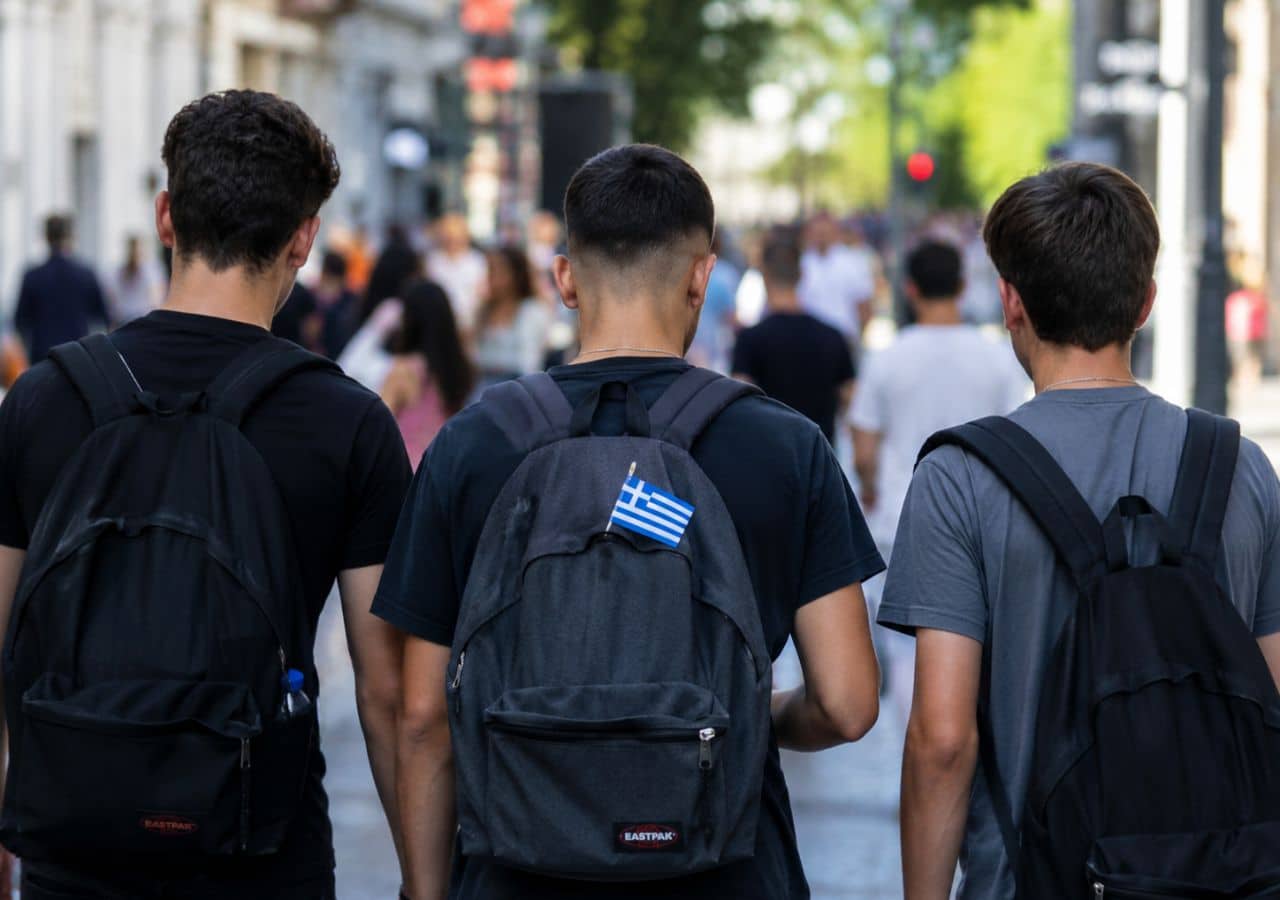
Greece recorded one of the lowest rates of young people leaving education and training early in the European Union in 2025, ranking second among all 27 member states for keeping young people in education, according to new data from Eurostat.
The country posted a rate of 3.0%, trailing only Croatia, which reported the lowest share in the EU at 2.1%. Ireland placed third at 3.6%.
Greece’s standing reflects consistent progress over the past decade. In 2015, the country’s rate stood at 7.9%. Over ten years, it fell to 3.0%, a drop of nearly 5 percentage points.
Eurostat defines “early school leavers” as young people between the ages of 18 and 24 who exit education and training before completing upper secondary or higher-level studies. The data measures this group as a share of the total population in that age range.
Greece’s decade-long push keeps young people in education
The EU-wide average stood at 9.1% in 2025, just above the bloc’s own target of bringing that figure below 9.0% by 2030. The rate has declined steadily from 11.0% in 2015. Nineteen of the 27 EU member states reported a lower rate in 2025 compared to 2015, and 17 have already met the 2030 target.
In 2025, the share of early school leavers (young people aged 18-24 leaving early from education and training) in the EU was 9.1%.
Lowest shares in: Croatia (2.1%) Greece (3.0%)
Highest shares in: Romania (15.5%) Germany (13.1%)
Among countries that improved the most since 2015, Malta led with a drop of 7.7 percentage points. Portugal followed with a decrease of 7.4 percentage points, and Spain dropped by 7.2 percentage points.
Not all countries moved in the right direction. Seven EU member states reported higher rates in 2025 than in 2015. Cyprus saw the biggest rise, climbing 4.6 percentage points over the decade.
Germany increased by 3.0 percentage points, and Austria rose by 2.7 percentage points. Romania posted the highest rate in the EU in 2025 at 15.5%, followed by Germany at 13.1% and Spain at 12.8%.
Men across the EU still quit school earlier than women
A gap between men and women remained consistent across the EU. More young men left education early than women, though both groups showed improvement. The rate for men fell from 12.5% in 2015 to 10.6% in 2025. For women, the figure dropped from 9.4% to 7.5% over the same period.
Greece’s rate of retaining young people in education has improved in nearly every year over the past decade, placing it firmly among the EU’s strongest performers on this measure.
This story originally appeared in Prism on June 04, 2026.
When members of The New School’s Student Senate were faced with a report detailing how Hillel International was providing material and logistical support to Israel’s atrocities in Gaza, they voted on May 1 to cut all ties with their campus chapter of the national Jewish college network and to strip its funding. The student leaders hoped the school’s administration would go on to investigate Hillel’s presence on its New York City campus.
Instead, after an intense pressure campaign by pro-Israel groups, advocates, and elected representatives, the university’s administration is now investigating the student senators who voted to cut ties with Hillel.
“We were hoping that the university would act on the the evidence provided by the Student Senate report about Hillel’s complicity in genocide. They are investigating us instead,” said Ryder Glickman, who is chair of The New School Student Senate and helped produce the report.
The Student Senate acted upon the recommendations of the Registered Student Organizations (RSO) Compliance Committee, which presented a comprehensive report about the ways in which Hillel had assisted the Israeli military during its ongoing genocide in Gaza.
The report found that students from The New School and a host of other New York City-based schools volunteered at the Israeli military’s Hatzerim Air Force Base in January 2024, as part of the Hillel on Base program. “Our students are packaging a days worth of rations to our soldiers,” stated an Instagram story by Hillel at Baruch College, the umbrella organization of Hillel at The New School, alongside a photo from the airbase, according to the report.
The Hatzerim airbase reportedly has been used by the Israeli Air Force for hundreds of airstrikes in Gaza, with F-15s from the base dropping bombs in civilian areas.
In the days following the publication of the report and the Student Senate vote to terminate funding to The New School’s Hillel, the university’s administration acted swiftly to discredit the findings.
“To avoid any misunderstanding, the University Student Senate does not have the authority to determine official status, funding eligibility, or the recognition of RSOs. Our Hillel chapter remains, as it always has been, in good standing, eligible for funding, and supporting Jewish life at The New School,” said an schoolwide email sent to from the university signed by President Joel Towers, Provost Richard Kessler, and Vice Provost Robert Mack.
“By distorting a qualified student organization and characterizing it as something it is not,” the statement continued, “the [University Student Senate] is using its platform to target fellow students in a misguided attempt to hold those students responsible for the acts of governments.”
On May 3, two days after the vote, Ilya Bratman, the executive director of Hillel at Baruch College, wrote in an email to Towers and other members of The New School’s leadership that the Student Senate’s actions were “a direct attack on Jewish students.” Bratman bcc’d the Student Senate email address, and members shared the email with Prism.
“We hope to meet with you in the coming days so that you can hear directly from the students affected by this action, and so that we can better understand the university’s plan of action moving forward. The [University Student Senate] has shown no indication that it intends to step back from these egregious and deeply troubling actions,” Bratman wrote.
The New School administration and Hillel at Baruch College did not respond to Prism’s inquiry about whether university leadership and Hillel officials had the meeting.
Days later, on May 8, Glickman received an email, viewed by Prism, from The New School’s office of Student Equity, Accessibility & Title IX. The email said that the school was investigating him for an allegation that the Student Senate’s decision to cut ties with Hillel was in “potential violation of Title VI of the Civil Rights Act of 1964 on the basis of race, color, or national origin in any program or activity receiving federal financial assistance.” The administration later clarified to Glickman that the university is investigating all student senators involved in the vote.
External pushback
The university launched its investigation into student senators following a string of social media activity by pro-Israel groups, advocates, media, and elected representatives attacking the report.
Glickman was called a “virulent anti-Israel activist” in an X post by Canary Mission, the secretive group notorious for doxing and targeting pro-Palestinian activists.
A string of articles by pro-Israel publications, including The New York Post and The Times of Israel, reported on The New School administration rejecting the Student Senate vote while omitting the details and evidence found by the RSO about Hillel’s ties with the Israeli military.
Two New York members of Congress took to social media to denounce the report. Rep. Dan Goldman—who recently marched in New York’s Israel Day parade featuring Israeli cabinet ministers who are wanted by the International Criminal Court for war crimes or have made genocidal statements about Palestinians—said the students were engaged in “hateful and vile antisemitism.” Rep. Ritchie Torres also condemned the vote, calling it “shameful” and “discrimination against Jewish individuals and institutions.” Goldman and Torres are heavily backed by the American Israel Public Affairs Committee.
“The fact that there was such open repression and universal condemnation of the report shows that the administration’s response was coordinated with Zionist organizations accusing us of antisemitism,” Glickman told Prism. “This is extremely worrying when we made a very basic case about international law.”
Students volunteering with the Israeli military
Hillel at Baruch, which organized trips to Israel, acts as an umbrella organization for chapters in multiple New York schools in addition to The New School, including Fordham University, John Jay College, and City College.
“Volunteer on an IDF (Israeli Defense Force) base in Southern Israel, wear IDF uniform, give back to the community on base, and explore Israel!” reads a description about the program on Hillel at Baruch’s website.
The 38-page report by the RSO compliance committee found that Hillel at Baruch organized several trips between May 2022 and January 2025 for students to volunteer at multiple Israeli army and air force bases. Hillel International also operates the Onward Israel program which organizes internship trips for American students to Israel and facilitates volunteering opportunities within the Israeli military.
The report further found that in July 2024, another post from Hillel at Baruch and New School Hillel’s Instagram account said, “Tonight, some of our onward students had the incredible opportunity to volunteer at the Tze’elim army base, where they helped prepare a barbecue for over 700 soldiers from the Oketz, Kfir, Golani and Handasa units in the IDF.”
Soldiers of the Golani Brigade’s 631st Reconnaissance Battalion were behind the March 24, 2025, killing of 15 Palestinian emergency responders that included Red Crescent ambulance workers in Rafah, according to an investigation by Haaretz.
In May 2024, a BBC analysis found that 11 soldiers of the Kfir brigade were responsible for posting photos and videos of Palestinian prisoners being abused.
By registering for the Hillel on Base program, participants also automatically register for the Volunteers for Israel (VFI) program, the report found.
“VFI is the ONLY organization that creates opportunities for American students to volunteer in Israel on IDF bases,” says a description of the program, which includes activities such as packing medical supplies and repairing machinery and equipment for military units.
The VFI program is run by Sar-El, an Israeli volunteer nonprofit organization under the direction of the Israeli Logistics Corps, a support branch of the Israeli military, establishing direct collaboration between Hillel and the Israeli government, according to the report.
“I am nauseated by the fact that I have classmates who have provided direct material and logistical support to genocide,” Glickman said.
A week after The New School vote, the student leadership of the Hillel chapter of Middlebury College, Vermont, voted to change its name to the Jewish Association at Middlebury, after growing demand from its members to disaffiliate from Hillel International and its activities, according to reporting by the school’s newspaper.
Editorial Team: Sahar Fatima, Lead Editor Lara Witt, Top Editor Rashmee Kumar, Copy Editor

 Login
Login









 Croatia (2.1%)
 Greece (3.0%)
 Romania (15.5%)
 Germany (13.1%)


