Normal view

Is This Secretive Air Force 737 About To Become NASA’s Next ‘Vomit Comet’? (Updated)

10 June 2026 at 19:47

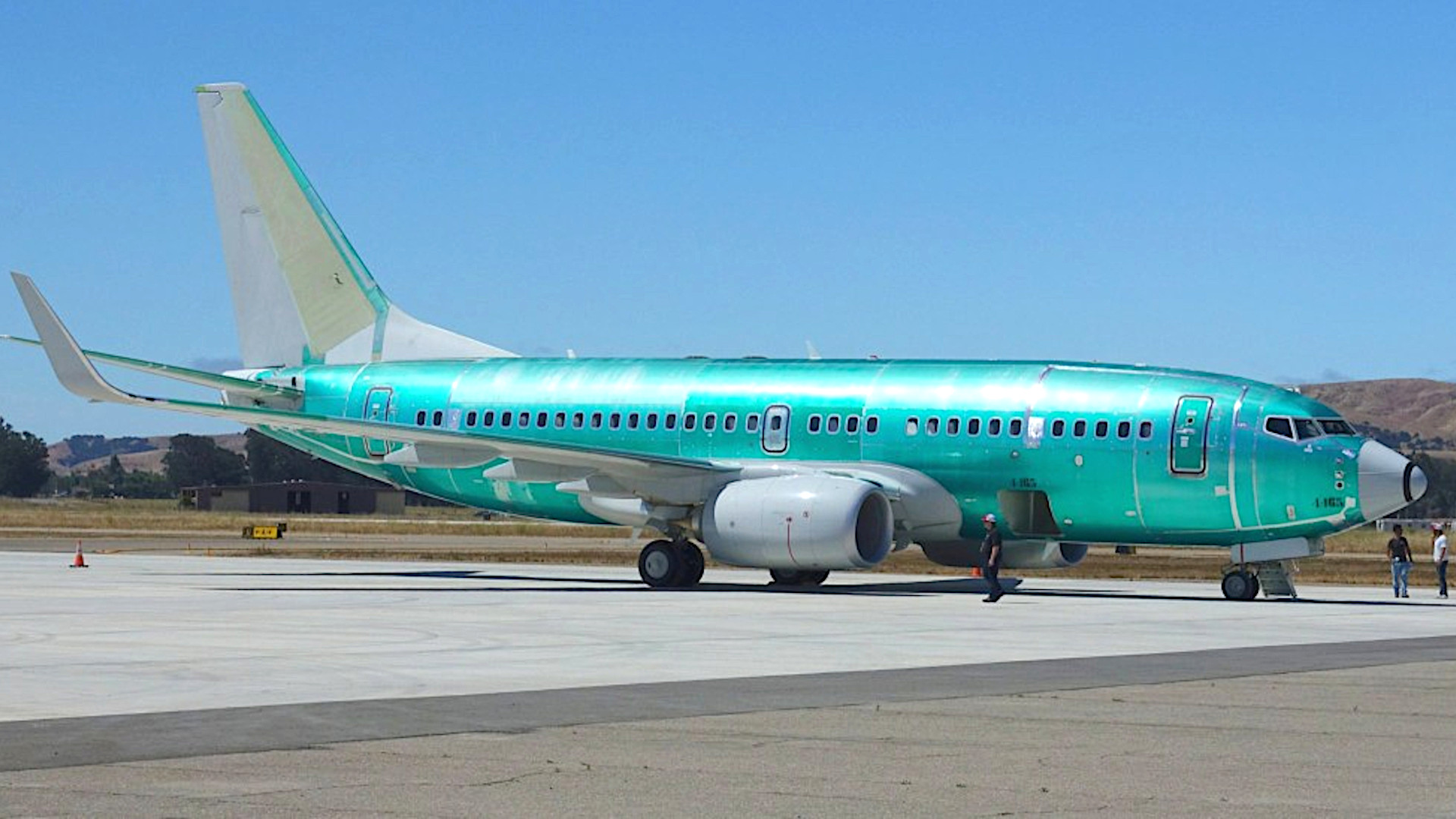
NASA is moving to hire a contractor to assess whether or not a Boeing 737-73W can meet its needs for a new reduced-gravity testbed aircraft. The use of planes modified for this role is now new, and they are often called “Vomit Comets” because of the extreme maneuvers they perform to simulate zero-G environments and the physical side effects this often induces. However, there’s an unusual twist here with the specific plane that NASA is now eyeing: it currently belongs to the U.S. Air Force and is part of a “classified military program.” There is a strong possibility that the aircraft in question is a mysterious 737 that the service acquired in 2020, and that has been the subject of much speculation as to its purpose ever since.

NASA’s Armstrong Flight Research Center posted a contracting notice yesterday justifying a planned sole-source contract to Denmar Technical Services, Inc. in relation to “Reduced Gravity Modification” of the 737-73W aircraft. Earlier this year, signs had already emerged that NASA might be in line to get a heavily modified and highly secretive 737 from the Air Force, designated the NT-43A and commonly referred to by the callsign RAT55. However, yesterday’s notice does not appear to refer to the NT-43A, long used as an airborne signature measurement platform and described in the past as the world’s most secretive 737, which is based on a much older 200-series airframe. We will come back to this later on.

A stock picture of the NT-43A Radar Test Bed aircraft, also commonly known by the callsign RAT55. Phodocu

What NASA wants now

“NASA requires Denmar Technical Services, Inc. to conduct a feasibility assessment to determine the Boeing 737-73W’s suitability to perform the NASA reduced gravity mission; modify the aircraft cabin, if required, to support reduced gravity operations; perform overdue maintenance and inspections, perform airworthiness restoration tasks, and paint the aircraft exterior with NASA identifiers,” the contracting notice NASA released yesterday explains.

The notice adds that the aircraft, if modified, would be used, at least most immediately, “for the Reduced Gravity Test Bed Project in support of the agency [sic] need for performing validation testing on Space Suits in support of the Artemis program.”

Artemis is NASA’s current effort to return U.S. astronauts to the lunar surface. The Artemis II mission, conducted in April, involved the first fly-by of the Moon by a crewed spacecraft since the end of the Apollo program in the early 1970s. However, the spacecraft did not touch down on the surface. The goal now is for a crewed lunar landing to come in 2028. RAT55 was notably used to support the launch of the Artemis II mission and the subsequent recovery of the capsule after its return to Earth.

Back in January, NASA had put out a separate contracting notice calling for information about new options to provide “parabolic flight services” to simulate “reduced gravity environments, including microgravity” for testing and scientific research purposes. The Florida-based Zero-G corporation is currently the primary provider of these services to NASA, using a retrofitted Boeing 727-200 dubbed ‘G-Force One.’ You can read more about NASA’s general use of Vomit Comets in the context of that notice here.

The Boeing 737-73W under consideration to be turned into a Vomit Comet “is owned by the United States Air Force (USAF). Denmar Technical Services, Inc. has specialized knowledge of this Boeing 737-73W aircraft as they are currently contracted by the USAF to modify the aircraft under a classified military program,” the contracting notice NASA released yesterday adds. “NASA does not have a ‘need to know’ regarding the details of the current modifications being made under the USAF contract and therefore is unable to provide modification details to another contractor or provide another contractor with access to the aircraft. The USAF will transfer ownership of the aircraft to NASA upon completion of the closeout tasks.”

“Denmar Technical Services, Inc. is uniquely positioned to close out work under their existing obligations while performing the feasibility assessment, maintenance, and any modifications required under this action,” the notice continues. “Additionally, due to the constrained timeline for the NASA Extravehicular Activity and Human Surface Mobility Program’s space suit testing for Artemis, NASA requires the assessment and overdue maintenance to be performed immediately upon contract award and any subsequent aircraft modifications to be complete no later than October 1, 2026. The timeline can only be supported if this requirement is fulfilled concurrently with the USAF closeout tasks.”

Denmar is a small aviation firm headquartered in Reno, Nevada. At the time of writing, its website lists a wide array of specialized design, modification, flight testing, and other work among its portfolios. This includes “advanced customized mission system development” that “encompasses the design of unique airborne operator interfaces, specialized emitters and sensors, system integration, and post-mission analytics and processing.” The company also describes itself as the “Nation’s leading experts on IR [infrared] and RF [radiofrequency] survivability, signature modeling, [and] agile software development for analysis and real-world operational assessments.”

In line with all this, Denmar is understood to have been the prime contractor behind the extensive modifications to RAT55. In April, the Air Force confirmed to TWZ that the NT-43A was “being transitioned to start the next phase of its career,” as reflected by its involvement in the Artemis II mission, “after decades of flights supporting the Air Force in various roles.” The aircraft, which is understood to have long called the secretive and remote Tonopah Test Range Airport (TTR) in Nevada home, has been seen much more publicly since then.

Best views of RAT55 yet. Dorsal sensor pod (EO ball) seen in detail here. Also shot inside. I wonder if this is going to be ported in full to a contractor (it is currently operated by a contractor) https://t.co/XoE1zGFN78

— Tyler Rogoway (@Aviation_Intel) April 4, 2026

However, as NASA’s recent contracting notice makes clear, the 737 it is now looking at as a potential Vomit Comet is a much newer 700-series model. TWZ has reached out to the Air Force and NASA for more information.

The curious case of N712JM

As mentioned, it is very possible, if not highly probable, that the 737 NASA is now considering turning into a Vomit Comet is one that the Air Force acquired in 2020, which TWZ explored in-depth at the time. That aircraft, which is a -73W model, is still officially on the U.S. civil register, with the registration code N712JM. Federal Aviation Administration (FAA) records show that the preceding owner of this aircraft was Denmar, which acquired it in 2019. The plane’s history before that is murky, with Boeing delivering it in 2013 to East West Bank via a trusteeship with Wells Fargo Bank, per the FAA’s records.

N712JM had drawn particular attention in 2020 not just because of its transfer to the Air Force, but also because it emerged at that time wearing a green protective coating and otherwise looking like it had just rolled off the production line. It also had some unusual external features that raised questions about its role, as we explored at the time.

N712JM as it was seen in 2020. Reader submission

In 2020, Jon Ostrower, long-time aviation journalist and editor-in-chief of The Air Current, told TWZ the following:

“This is definitely an airplane that never made it to a formal finish you’d expect from a commercial airplane. The green finish is a protective coating applied to fuselages during manufacturing to protect from scratches and other damage. It is dissolved during painting. You can also still see the manufacturing (line) number as well. That’s from its original trip down the assembly line. There’s also quite a bit of instrumentation visible with sensor wiring leading into the cabin through the passenger windows. This type of arrangement points to a flight test setup of some kind.”

In 2020, N712JM conducted many test flights in U.S. military ranges off the coast of Southern California, flying various flight profiles, some of them quite unusual. The aircraft flew those sorties from Santa Maria Airport in California, and used the callsign STING 38.

The 'mysterious' USAF Boeing 737-700 N712JM is just back to Santa Maria, Ca. after another 3+ hour flight as 'Sting 38'. https://t.co/3sxMyligwM

Seven years old yet still in 'greenie' primer, lots of sensors in odd places… Article: https://t.co/erZf3MMSwi @thewarzonewire pic.twitter.com/ivs2WQFkt4

— Airport Webcams (@AirportWebcams) June 15, 2020

What the Air Force has been using N712JM for to date is unknown. Per FAA, the aircraft has been and continues to be registered to an address at Bolling Air Force Base (technically now part of Joint Base Anacostia-Bolling) in Washington, D.C., which looks to belong to the Air Force’s Rapid Capabilities Office (RCO). The RCO has headed up multiple cutting-edge, high-priority programs over the years, including the development of the B-21 Raider stealth bomber and the X-37B reusable spaceplane. A 737-based platform could be configured to support an array of different research and development and test evaluation activities that would fall under the purview of RCO, as well as other stakeholders that this office might engage with.

A screen capture of the entry for N712JM in the FAA’s online database at the time of writing. FAA capture

There has also been some speculation over the years that N712JM might have transformed into an Air Force 737 with the serial number 21-0024, but this appears to still be unconfirmed. The 21-0024 serial has more recently become associated with other shadowy 737s tied to the U.S. military, which have civilian-style paint schemes and may also be on the U.S. civil register. One of them was notably spotted in 2025 at a U.S. forward operating location in El Salvador, sitting directly alongside an Air Force AC-130J Ghostrider gunship and a U.S. Navy P-8A Poseidon maritime patrol plane. This, in turn, raised questions about its involvement in the ongoing U.S. campaign of strikes on alleged drug smuggling boats in the Caribbean and the Eastern Pacific Ocean, as TWZ previously explored in detail.

21-0024, for reference. When I spotted it, FR24 was indeed calling it N712JM, though ADSBx had the BuNo and a different hex. https://t.co/3WwV3kxBC4

— Volgowrath (@volgowrath) April 27, 2023

Sightings and flight tracking data have also pointed to N712JM being a resident at the Sierra Nevada Corporation’s (SNC) facility at Colorado Springs Airport, in the Colorado city of the same name, over the years. SNC is well known for highly specialized and unique aircraft modification work, especially for the U.S. military, but its exact connection to this 737 is unclear.

Interestingly, there have been several online flight tracking data ‘pings’ suggesting new activity related to N712JM at Colorado Springs Airport since at least February of this year. However, there do not appear to be any confirmed flights by the aircraft from there in that same timeframe. This airport notably sits adjacent to Peterson Space Force Base.

N712JM was on again today, this time thing ping is outside the hangar but that may not be accurate https://t.co/ijkrCDLmUh pic.twitter.com/mCdJbY5OOI

— 𝗦𝗥_𝗣𝗹𝗮𝗻𝗲𝘀𝗽𝗼𝘁𝘁𝗲𝗿 (@SR_Planespotter) April 8, 2026

Are we seeing the revival of N712JM? Last ping about 2 hours ago. What will it look like? https://t.co/vnFH9W6Afw pic.twitter.com/MZSLhkwXv8

— 𝗦𝗥_𝗣𝗹𝗮𝗻𝗲𝘀𝗽𝗼𝘁𝘁𝗲𝗿 (@SR_Planespotter) March 25, 2026

There is still a possibility that NASA could be looking at a different Air Force 737-73W for possible conversion into a Vomit Comet. As the contracting notice makes clear, the aircraft in question is currently in the classified realm. At the same time, this seems far less likely to be the case given everything that is known (and still unknown) about N712JM.

A separate question does exist now as to what effort the Air Force might be in the process of closing out that would allow it to transfer any classified 737 to NASA. TWZ has previously raised tangential questions about how the Air Force might fill the resulting gaps left by the highly-specialized RAT55 moving on to the next stage of its career. It is certainly interesting in its own right that NASA seems to be focused heavily at the moment on leveraging some of the most secretive 737s in existence today to support its much less sensitive needs.

More details may emerge if Denmar deems the “classified” Air Force 737 to be a suitable starting place to create a new Vomit Comet to support NASA’s reduced gravity training needs and the Artemis program.

Update: 3:45 PM EST –

In immediate response to our queries, NASA has directed us to an additional notice about the award of the sole-source contract, valued at $8.4 million, to Denmar Technical Services back on June 1.

“The contractor will modify a Boeing 737-700 aircraft to perform lunar-gravity parabolic flights to test NASA space equipment. Once modifications are complete, NASA Armstrong will own the aircraft and oversee aircraft operations out of NASA Johnson,” the notice says. “The aircraft will be used to validate astronaut lunar suits and associated crew systems required to support Artemis mission objectives. This can be done with the modified 737 aircraft in an operationally relevant, reduced-gravity environment prior to lunar mission execution.”

No mention is made here about the sourcing of the aircraft from the Air Force or its classified mission work, as outlined in the sole-source justification that was released yesterday.

Update: 6/11/2026 –

The U.S. Air Force has provided TWZ with a brief statement about the 737-73W aircraft in question.

“The Boeing 737-73W aircraft was originally procured to serve as a flying testbed,” a spokesperson for the service said. “The program ended and [the] USAF is transitioning the aircraft to NASA.”

Contact the author: joe@twz.com

The post Is This Secretive Air Force 737 About To Become NASA’s Next ‘Vomit Comet’? (Updated) appeared first on The War Zone.


Dal mondo dello spettacolo alla difesa della natura: Andrea Candeo riceve il Diploma Segni di Pace

10 June 2026 at 06:00

Andrea Candeo entra tra i protagonisti dell’edizione 2026 del Premio Segni di Pace, il riconoscimento europeo promosso dalla Cattedra della Pace di Assisi e destinato a personalità che si distinguono per il loro contributo alla diffusione di valori quali la solidarietà, la responsabilità sociale e la tutela del bene comune.

La cerimonia si è svolta a Palazzo Valentini, a Roma, dove l’attore, modello e agronomo ha ricevuto il Diploma Onorifico Segni di Pace per il suo impegno nella sensibilizzazione ambientale e nella difesa degli animali, temi che da anni caratterizzano il suo percorso professionale e sociale.

Il riconoscimento arriva dopo un periodo di intensa attività pubblica per Candeo, già vincitore del concorso “Il più bello d’Italia 2024” e testimonial di diverse campagne promosse dall’associazione nazionale no-profit “Rispetto per tutti gli animali”, attraverso le quali ha sostenuto iniziative dedicate alla tutela della biodiversità e al rispetto di ogni forma di vita.

Dal mondo dello spettacolo alla difesa della natura: Andrea Candeo riceve il Diploma Segni di Pace
Andrea Candeo con il Diploma Onorifico Segni di Pace promosso dalla Cattedra della Pace di Assisi

Le motivazioni del premio europeo Segni di Pace

Secondo le motivazioni del premio, Andrea Candeo si è distinto per la capacità di utilizzare la comunicazione come strumento di educazione e sensibilizzazione, coinvolgendo soprattutto le nuove generazioni nella costruzione di una cultura fondata sul rispetto della natura e della convivenza civile.

Nel suo intervento durante la cerimonia, il premiato ha voluto sottolineare il legame profondo tra pace, ambiente e responsabilità individuale.

«Siamo abituati a pensare alla pace come a qualcosa di lontano, quasi astratto. Io credo invece che si costruisca ogni giorno attraverso i nostri comportamenti. La tutela degli animali, il rispetto dell’ambiente e la cura della Terra sono gesti concreti che ci aiutano a creare una società più giusta e più umana», ha dichiarato.

Per Candeo, infatti, la pace non coincide soltanto con l’assenza di conflitti, ma rappresenta una forma di partecipazione attiva e di attenzione verso il mondo che ci circonda.

«La pace non è soltanto assenza di conflitto, ma anche partecipazione, rispetto e consapevolezza. Ogni gesto rivolto alla tutela dell’ambiente e delle creature che lo abitano rappresenta un passo verso una società più umana».

L'articolo Dal mondo dello spettacolo alla difesa della natura: Andrea Candeo riceve il Diploma Segni di Pace proviene da Affaritaliani.it.

‘Earth’s first starfleet’: Nasa reveals Artemis III crew and project’s next steps

Luca Parmitano to pilot all-male crew of four paving way for planned first human landing of Artemis IV in 2028

Jared Isaacman, the Nasa administrator, hailed the creation of “Earth’s first starfleet” on Tuesday as he revealed the Artemis III crew and details of the next stages of the space agency’s project to return humans to the moon.

An Italian astronaut, Luca Parmitano of the European Space Agency (ESA), will be the pilot of the planned two-week mission to lower Earth orbit next year that will test lunar landers from private companies Blue Origin and SpaceX.

Continue reading...

© Photograph: Bill Stafford/NASA/AP

© Photograph: Bill Stafford/NASA/AP

© Photograph: Bill Stafford/NASA/AP

Party Like a Deejay, Milano fa il pieno: 270mila presenze, 32mila ai concerti e boom sui social

8 June 2026 at 16:51

Party Like a Deejay 2026 chiude con 270.000 presenze a Milano e circa 32.000 persone ai concerti. La festa di Radio Deejay ha animato Parco Sempione, Arco della Pace e Castello Sforzesco dal 5 al 7 giugno, con musica, talk, sport, famiglie e un forte seguito sui social.

Arco della Pace pieno per due sere: da Annalisa, Giorgia, Tommaso Paradiso al rap di Fabri Fibra, Madame, Neffa

Party Like a Deejay 2026 chiude con numeri da grande evento popolare. La festa di Radio Deejay, andata in scena a Milano da venerdì 5 a domenica 7 giugno, ha raccolto 270.000 presenze complessive tra Parco Sempione, Arco della Pace e Castello Sforzesco.

Party Like a Deejay, Milano fa il pieno: 270mila presenze, 32mila ai concerti e boom sui social

Il dato segna una crescita rispetto allo scorso anno: 30.000 presenze in più sul 2025, pari a un +8%. Circa 32.000 persone hanno partecipato ai principali stage live. I numeri sono stati rilevati dall’agenzia The Valuehub e confermano il legame tra il pubblico e uno degli appuntamenti più riconoscibili della radio italiana.

La festa, realizzata con la collaborazione del Comune di Milano, ha trasformato Parco Sempione in un grande villaggio aperto a pubblici diversi. Adulti, giovani e famiglie con bambini si sono mossi tra musica live, talk, sport, giochi e aree tematiche. Nel parco sono state allestite Area Family&Kids, Area Sport, Area Action Sport e Urban Culture, Area Giochi Senza Wi-Fi, Virtual Zone, Casa Deejay e Deejay Café.

L’anteprima è stata affidata a “50 Linetti”, sold out con 2.000 spettatori al Cortile delle Armi del Castello Sforzesco. Sul palco, Linus ha festeggiato i 50 anni di radio con quasi due ore di racconto tra musica, curiosità, ricordi personali, vita vera e aneddoti.

Il cuore musicale dell’evento è stato all’Arco della Pace, dove 30.000 persone hanno seguito le due serate live. Sabato 6 giugno si sono alternati sul palco Annalisa, Carl Brave, Ditonellapiaga, Frah Quintale, Fulminacci, Gaia, Giorgia, J-Ax, Levante, Noemi, Paola Iezzi, Pinguini Tattici Nucleari, Sayf, The Kolors e Tommaso Paradiso.

Domenica 7 giugno spazio a “One Two One Two Celebration”, la serata dedicata al rap organizzata in collaborazione con Radio m2o e presentata da Albertino. Sul palco sono saliti Ele A, Emis Killa, Ernia, Fabri Fibra, Frankie hi-nrg mc, Madame, Nayt, Neffa, Sottotono e TY1.

Al Cortile delle Armi hanno fatto il pieno anche gli Speakers’ Corner. Sabato sono arrivati 7.000 spettatori per incontrare i protagonisti della radio: Linus e Nicola Savino, Il Trio Medusa, Alessandro Cattelan, Fabio Volo e Pinocchio con La Pina, Diego Passoni e La Vale.

Domenica pomeriggio, nella stessa location, Capital Live ha portato circa 2.000 persone al concerto gratuito realizzato in collaborazione con Radio Capital. Sul palco si sono esibiti Arya, Birthh, Bluvertigo, Angelica Bove, Dimartino, Alberto Fortis e Santamarea.

Grande partecipazione anche a Casa Deejay, sulla collinetta della Biblioteca del Parco. Durante le giornate di sabato e domenica si sono alternati alla consolle gli speaker della radio: Andy & Mike, Umberto & Damiano, Danilo Da Fiumicino, Wad, Federico Russo & Francesco Quarna, Nicola Savino, Federico Pecchia & Davide Damiani, Nicola & Gianluca Vitiello, Dj Angelo & Roberto Ferrari, Dj Aladyn & Friends.

Il Deejay Café è stato invece il punto d’incontro più rilassato, con appuntamenti gratuiti e momenti con i talent della radio. Tra gli incontri, “Cartoline dal weekend” con Florencia, Pecchia&Damiani e Annie Mazzola, “SOS Animal House” con Dunia e Paolo Menegatti, “DEEVINO” con Francesco Quarna e Maurizio Rossato, e “Deejay on The Road” con Frank e DJ Aladyn.

Anche i social hanno spinto forte. I primi dati, ancora in crescita, parlano di 30 milioni di views, con un aumento del 43% rispetto al 2025, e 6 milioni di utenti, in crescita del 62%, sui canali ufficiali di Radio Deejay: Facebook, Instagram e TikTok.

Dopo Milano, la festa si sposta al mare con Beach Like a Deejay, il tour estivo di Radio Deejay con musica, concerti live, sport e intrattenimento insieme agli speaker. La prima tappa sarà a Jesolo dal 3 al 5 luglio, poi Viareggio dal 10 al 12 luglio, Alghero dal 17 al 19 luglio e Barletta dal 24 al 26 luglio.

La produzione esecutiva di Party Like a Deejay è stata affidata per il quinto anno consecutivo a Eric Galiani per Videomobile. L’immagine coordinata è stata creata da Chunk Studio.

LEGGI TUTTE LE NOTIZIE DELLA SEZIONE MEDIATECH

L'articolo Party Like a Deejay, Milano fa il pieno: 270mila presenze, 32mila ai concerti e boom sui social proviene da Affaritaliani.it.

Pentagon’s Plans To Track Aircraft From Orbit Accelerated With New $4B SpaceX Deal

29 May 2026 at 23:37

The U.S. Space Force has awarded SpaceX a $4.16B deal to help accelerate work on what could be a game-changing, space-based air moving-target indicator (AMTI) sensor network. The service says it now hopes to have an “early capability” in orbit by 2028, years ahead of the timelines officials have put forward in the past.

Plans for an AMTI satellite constellation were directly tied to an attempt in the past year to axe purchases of E-7 Wedgetail airborne early warning and control aircraft, something the Pentagon has now fully abandoned after Congress intervened. Though the Air Force is moving ahead again with the E-7, which will succeed its aging E-3 Sentry Airborne Warning and Control System (AWACS) jets, the end goal remains to eventually push most, if not all, AMTI tasks into space.

Aircraft like the E-7 Wedgetail seen here have historically been critical providers of AMTI capability. Australian Department of Defense

“The long-standing method of military airborne platforms to track moving targets faces continued challenges as adversaries develop increasingly sophisticated anti-access/area-denial (A2/AD) systems,” the Space Force said in its press release about the new deal with SpaceX today. “To compliment [sic; complement] traditional airborne sensing, the requirement for a layered, highly resilient tracking architecture is evident. SB-AMTI aims to enhance the Space Force’s capabilities to the Joint Force through the establishment of a persistent, global capability to sense and track airborne targets from space.”

The Space Force has described the $4.16 billion deal with SpaceX for the Space-Based Airborne Moving Target Indicator (SB-AMTI) program as a “competitive Other Transaction Authority (OTA) agreement,” rather than a traditional contract. The agreement came via the office of the Portfolio Acquisition Executive for Space-Based Sensing & Targeting (PAE SBST).

“This initial award is projected to field a constellation of satellites by 2028, providing the Joint Force with an early capability to eliminate operational blind spots,” according to the Space Force release.

DARPA

In the past, U.S. officials have generally talked about space-based AMTI becoming a reality sometime in the 2030s. Work is underway to push ground moving-target indicator (GMTI) tasks into orbit, as well.

Some degree of on-orbit prototype AMTI sensor testing has already been ongoing for at least a year, if not much longer, but this work has been heavily classified. In addition to the U.S. Air Force and Space Force, both of which fall under the Department of the Air Force, the National Reconnaissance Office (NRO) has been involved in this work. The NRO, the activities of which are shrouded in heavy secrecy, is a U.S. military organization that serves as America’s main remote sensing intelligence arm.

“The capabilities that are happening in space are far exceeding our expectations,” then-Air Force Maj. Gen. Christopher Niemi said at a hearing earlier this year as part of a response to a question about plans for the E-7. He declined to offer more details publicly. Niemi, who has since been promoted to lieutenant general, is currently Deputy Chief of Staff of the Air Force for Force Modernization, and the service’s Chief Modernization Officer.

You’d think there would be friction between the Air Force and the Space Force now that AMTI, GMTI, and several core missions are being shared or transitioning heavily toward orbit. Not quite. https://t.co/VWMav3Js75 pic.twitter.com/oRzxlsXgWM

— Air-Power | MIL-STD (@NatSecLedger) May 29, 2026

SpaceX has already reportedly been deeply involved in this work, too, as you can read about more in this past TWZ feature. This underscores the company’s ever-growing dominance globally in all aspects of the space industry, which we will come back to later on.

As mentioned, a functional, persistent, and distributed AMTI (and GMTI) sensor network in orbit has the potential to be game-changing. As TWZ wrote back in 2024, talking primarily about the future of space-based GMTI capabilities:

A larger, distributed constellation would have the ability to monitor huge swathes of the Earth simultaneously, and depending on the size of the constellation, at least far more persistently to seamlessly. This could make it difficult, if not impossible, for an opponent to hide activities of interest. A very low revisit rate, or even eliminating revisit rate altogether, could even open up the possibility of continuous ‘streaming’ coverage of a location from low Earth orbit. This would also be essential for persistent GMTI coverage that tracks ground movements in real time that will actually be high enough in fidelity to guide weapons onto those tracks. It’s possible that aerial tracking could also be a function, as well, even to a more limited degree. The E-3 Sentry Airborne Warning and Control System (AWACS) will also be replaced at least partially by space-based capabilities, along with the E-7 Wedgetail.”

A US Air Force E-3 Sentry AWACS jet. USAF

“There is also a fair chance that this is another type of system, perhaps to execute broad area optical/infrared imaging with some exotic capabilities to provide tracking. We just don’t know.”

“Regardless, yes, we are talking about the possibility of panoptic or near panoptic targeting and surveillance from space.”

“Greater collaborative capabilities, especially ones enabled by the use of machine learning and artificial intelligence (AI) technologies, could help to find targets of interest and anomalies far faster than ever before. This could also open a door to more autonomous collection, tasking/retasking, and other capabilities, as well. Areas of interest that need seamless coverage could have extra satellites retasked to the necessary orbit in order to do so automatically, without the need for human deconfliction and even direct operator direction.”

It is not hard to imagine how the satellite constellation being described here would fundamentally change the U.S. military’s ability to not just spot and track targets globally, but also close the kill chains to engage them, even at very long ranges. This has massive implications for future net-centric warfare where all sorts of tangential capabilities will increasingly be networked together. It might impact how tactical aircraft are equipped in the future, including the need for their own radars. There could at least be a reduced need for them to use their own radars to guide missiles, even when no supporting sensor network within the Earth’s atmosphere has relevant data to provide.

Unlike having to rely on a single plane in a single surveillance place, a space-based sensor network made up of a very large number of individual satellites would also be highly resilient to attacks, as well as other attrition just due to technical breakdowns or other factors.

All this being said, U.S. officials have been open about potential challenges when it comes to making space-based AMTI capabilities a reality, even just compared to establishing GMTI networks in orbit.

L3Harris

“So GMTI [ground moving-target indicator capability] and AMTI [air moving-target indicator capability] sound like they’re really close, just because one little letter that is all you changed, [but it] turns out they’re pretty different,” Chief of Space Operations Gen. Chance Saltzman, U.S. Space Force’s top officer, said during a press briefing on the sidelines of a conference in December 2025, according to Breaking Defense. “What it takes to accomplish AMTI is different than what it takes to accomplish GMTI.”

“Things on the ground move slower than things on [sic] the air, so [they] require different levels of fidelity tracks,” he added.

“The [AMTI] data the Intelligence Community and warfighter need presents a multi-phenomenology challenge that requires automated orchestration of the NRO’s collectors, low-latency data transport, and rapid data fusion by the NRO’s unmatched space communications and ground architecture capabilities,” a spokesperson for NRO also told Breaking Defense earlier this year.

It’s worth noting here that satellites with sensors are only one component of the total equation. Robust, resilient, and secure communications networks will be vital to getting the data collected where it needs to go. This is a separate area where SpaceX is already playing an increasingly central role with its Starlink and Starshield networks, as you can read more about here. Laser-based communications relays are set to be another key supporting capability.

In its announcement today, the Space Force did explicitly stress that SpaceX will not be the only company supporting the SB-AMTI effort going forward, and that it has established a larger “vendor pool.”

“By utilizing this multi-vendor framework, we are capitalizing on established industry capacity and continuously evaluating and onboarding the best tech to field this essential capability at speed and scale,” Space Force Col. Ryan Frazier, the acting PAE SBST, said in a statement. “We will not leverage any one single provider; instead, we are partnering with a highly diversified pool of traditional and non-traditional vendors, each bringing various capabilities to support the SB-AMTI architecture, ensuring the Joint Force has access to a strong, competitive industrial base well into the future.”

At the same time, as TWZ has noted in the past, SpaceX’s dominance in the market gives the company a clear advantage for securing further deals. This extends to the additional demands to put all this architecture in space. At least currently, no other company has the same capacity to provide the U.S. military with the kind of reliable access to space at the required cadence, and within budget constraints. SB-AMTI is already a major budget priority, with the Space Force asking for more than $7 billion in additional funds to procure additional elements of the system in its 2027 Fiscal Year budget request.

These are all factors that are also notably set to play into how the Golden Dome missile defense initiative evolves. There has already been talk about Golden Dome leveraging existing work, including programs under the umbrella of PAE SBST, to help accelerate the fielding of at least an initial layer of capability.

It should also be reiterated that the Air Force is now moving ahead again with the E-7 program, and traditional aerial AMTI capabilities look set to remain an important element of U.S. military operations for the foreseeable future.

That being said, the new $4.16 billion agreement with SpaceX makes clear that the Space Force is pressing ahead with its plans for a space-based AMTI sensor network with hopes that at least an early operational capability could be in place within the next two years.

Contact the author: joe@twz.com

The post Pentagon’s Plans To Track Aircraft From Orbit Accelerated With New $4B SpaceX Deal appeared first on The War Zone.

❌