Bulgaria’s new government will stop sending military aid to Ukraine, the country’s defense minister said on Tuesday, as the more than four-year-old war grinds on with no end in sight. “We have already made it clear that the war in Ukraine will not be resolved on the battlefield,” Defense Minister Dimitar Stoyanov told reporters, according […]
Wong says she isn’t concerned about One Nation’s fundraising efforts, but more about their policies. Pauline Hanson’s party says it has raised more than $1.5m in the last day, although those claims are unverified.
I’m less interested in what Pauline Hanson fundraises and am more concerned about One Nation’s policies. Just as I am concerned about the fact that the Liberal party and One Nation seem to be working together and that it appears to be very clearly that a vote for One Nation is actually a vote for the Liberal party, and a vote for the Liberal party is actually a vote for One Nation.
We’ve said for some time it’s obviously a fragile ceasefire, but we’ve also said that what Australia wants is a negotiated end to the war. That’s what we’re calling for, and that’s what we will continue to press for …
We’re not a central player in the Middle East, as we have said. What we can do is add our voice to others who are calling for a negotiated end to the conflict. It’s obviously one of the things we discuss today with the United Kingdom.
Federal prosecutors unsealed an indictment on Wednesday against eight pro-Palestinian activists who are accused of conspiring to run a criminal intimidation campaign against University of Michigan officials while trying to force the school to cut financial ties to Israel.
The indictment also describes vandalism against some companies that operate in Michigan and against the Jewish Federation of Metropolitan Detroit.
A sixth case of New World screwworm has been confirmed in a Texas calf. It’s the second calf in La Salle County, Texas, to become infested with the parasite that threatens wildstock with larvae that burrows deep into the tissue of its inhabitant, according to the U.S. Department of Agriculture. Officials in the Lone Star…
A sixth case of New World screwworm has been confirmed in a Texas calf. It’s the second calf in La Salle County, Texas, to become infested with the parasite that threatens wildstock with larvae that burrows deep into the tissue of its inhabitant, according to the U.S. Department of Agriculture. Officials in the Lone Star…
For months, Rep. Gregory Meeks of New York, the top Democrat on the Foreign Affairs Committee, had championed legislation to send additional security aid to Ukraine as it defends itself against Russia’s invasion. The proposal, however, was stuck: House Republican leaders refused to consider it, and so the bill languished.
Last month, however, it became unstuck: Proponents of the legislation managed to go around the GOP leadership thanks to a discharge petition — a tactic that allows members to bring a bill to the floor if it’s formally endorsed by a majority of the House. As MS NOW reported last week, the Ukraine aid package cleared the House with 226 votes, including 18 Republicans.
The House tonight passed another Democrat-led bill that made its way to the floor after a group of Republicans bucked their party’s leadership and joined Democrats in forcing a vote.
The Faster Labor Contracts Act, which would force employers to start negotiating with a newly certified union within 10 days of receiving the request, passed with the support of 20 Republicans and all Democrats.
Critics will note that both this bill and the Ukraine aid still have to clear the Senate, where the measures’ fate remains uncertain, and they would still need Donald Trump’s signature to become law. It’s a fair point.
But let’s not miss the forest for the trees. Republican Rep. Brian Fitzpatrick of Pennsylvania said in an online written statement, “If the House Floor was managed properly, discharge petitions would never be needed. A successful discharge petition is clear and direct evidence of a poorly managed House Floor — because it demonstrates that the will of the majority of the People is being thwarted by the privileged few.”
Fitzpatrick didn’t mention House Speaker Mike Johnson by name, but given the context, he didn’t have to.
Indeed, it might not be immediately obvious just how embarrassing these latest developments are for the Louisiana Republican and his leadership team.
In the past century or so, successful discharge petitions have been very rare. The reason is simple: Such petitions have long been seen as a slap in the face of a sitting House speaker.
As New York magazine’s Ed Kilgore recently explained, “Indeed, prior to Johnson’s ascent to the Speakership, only two 21st-century discharge petitions achieved the 218 signatures needed to trigger a floor vote.”
This roughly once-per-decade average has undergone a dramatic revision under the Louisiana Republican’s tenure. In the last Congress, which ended in early January 2025, there were two successful discharge petitions, which was itself a significant total. Meanwhile, in the current Congress, which is far from over, there have been six successful discharge petitions, which The Hill accurately described as “extraordinary.”
The first came in March 2025, and it dealt with proxy voting for new parents serving in Congress. In November 2025, another discharge petition advanced the Epstein Files Transparency Act; five days later, a measure to repeal an executive order that gutted federal workers’ union rights also received 218 signatures.
Usually, members embarrass Johnson by ignoring his wishes and voting against legislation he has urged them to support. But this flurry of successful discharge petitions, which has no modern precedent, makes the House speaker appear even more diminished.
Kilgore’s recent piece added, “Signs of weakness invite further revolts by House members who fear voters more than this mild-mannered former backbencher from Louisiana, whose authority is totally dependent on Trump’s backing, which can be erratic during times when the president is distracted by nonlegislative matters like ending wars and naming things after himself. Politicians, like guard dogs, can smell fear and irresolution.”
The question, then, is less whether we’ll see more successful discharge petitions and more a question of when, as Johnson’s weak hold on power unravels further.
Rep. James Gallagher (R-Calif.) was officially sworn into Congress on Wednesday afternoon, slightly broadening the GOP’s slim majority in the House. Gallagher won the special election on June 2 for the seat for California’s 1st Congressional District, following Rep. Doug LaMalfa’s (R) death in January. The former state assemblymember, who was backed by President Trump,…
Rep. James Gallagher (R-Calif.) was officially sworn into Congress on Wednesday afternoon, slightly broadening the GOP’s slim majority in the House. Gallagher won the special election on June 2 for the seat for California’s 1st Congressional District, following Rep. Doug LaMalfa’s (R) death in January. The former state assemblymember, who was backed by President Trump,…
President Trump on Wednesday said visa disputes for FIFA World Cup attendees are under review, though he told reporters that the administration is working to ensure “the right people” enter the U.S. A reporter told the president in the Oval Office that some “people are afraid that it’s going to be harder and harder to…
President Trump on Wednesday said visa disputes for FIFA World Cup attendees are under review, though he told reporters that the administration is working to ensure “the right people” enter the U.S. A reporter told the president in the Oval Office that some “people are afraid that it’s going to be harder and harder to…
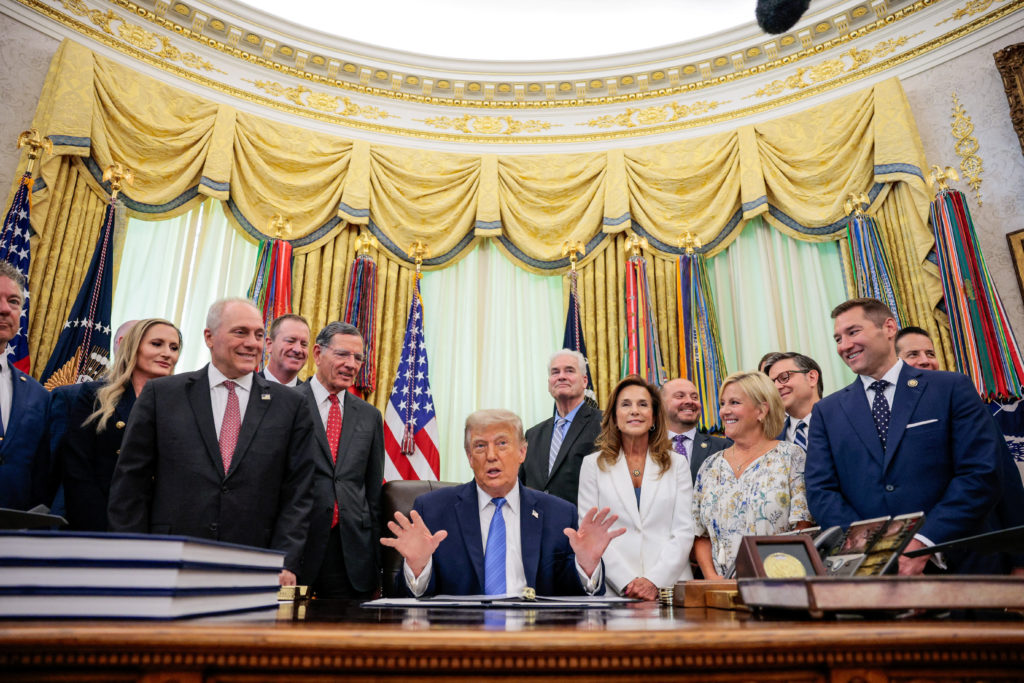
During an Oval Office event on Wednesday afternoon, a reporter asked Donald Trump for his reaction to the news that inflation has reached a three-year high. The president responded that the new data was “great,” adding, “I love the inflation.”
And while that was strange, it quickly got worse. As part of his explanation for why he professed his “love” of inflation, Trump went on to say, “You know, I can say it now, something you didn’t know. You know we’ve been taking out millions of barrels of oil. Nobody knows it. You know who doesn’t know about it? Iran — until right now.”
He said this operation involved 22 ships that traveled “with no lights” and went undetected because Iranians “don’t have any radar because we blasted the crap out of it.”
Even at face value, this was difficult to understand. The president loves inflation because the United States is taking oil out of the Middle East?
Complicating matters, there was also uncertainty about the nature and accuracy of Trump’s claims, even within his own White House Cabinet. MS NOW reported as part of the network’s liveblog coverage:
Energy Secretary Chris Wright, who was simultaneously testifying before the House Committee on Science, Space and Technology, told lawmakers that he did not know of any such operation.
Wright said he was not aware of “millions” of barrels of oil having been extracted from Iran, but he said earlier in the hearing that the U.S. military had helped get some oil out of the Strait of Hormuz.
As a rule, Wright can be counted on to toe the party line on pretty much anything Trump says, but when pressed by Democratic Rep. Emilia Sykes of Ohio on the president’s public comments, Wright said Trump was merely “talking casually.”
SYKES: *plays audio of Trump claiming US is stealing Iranian oil*WRIGHT: I think the president is talking casually SYKES: Do you think that it's appropriate to 'talk casually' about war?WRIGHT: I think you talk to all different audiences and you talk in all different styles
When Sykes followed up by asking about the propriety of a president speaking “casually” about a war, the energy secretary was reduced to saying, “I think you talk to all different audiences, and you talk in all different styles.”
What did that mean in this context? Your guess is as good as mine. It’s similarly unclear whether Wright’s use of the word “casually” was meant to convey the idea that sometimes Trump just says stuff without any meaningful regard for accuracy.
That said, it’s certainly possible that 22 ships moved through the Strait of Hormuz. The New York Times noted, however, “He did not say what time period he meant. Ordinarily, dozens of oil tankers would pass through the strait each day, and thousands would have done so since the war began, if not for Iran’s blockade.”
Four senior senators, two Democrats and two Republicans, are calling on Congress to tackle the “hard” debate over how to extend the solvency of Social Security after the program’s trustees issued a new report this week projecting it will face a significant shortfall at the end of 2032. “It’s clear now that Congress shouldn’t delay…
Four senior senators, two Democrats and two Republicans, are calling on Congress to tackle the “hard” debate over how to extend the solvency of Social Security after the program’s trustees issued a new report this week projecting it will face a significant shortfall at the end of 2032. “It’s clear now that Congress shouldn’t delay…
 Login
Login