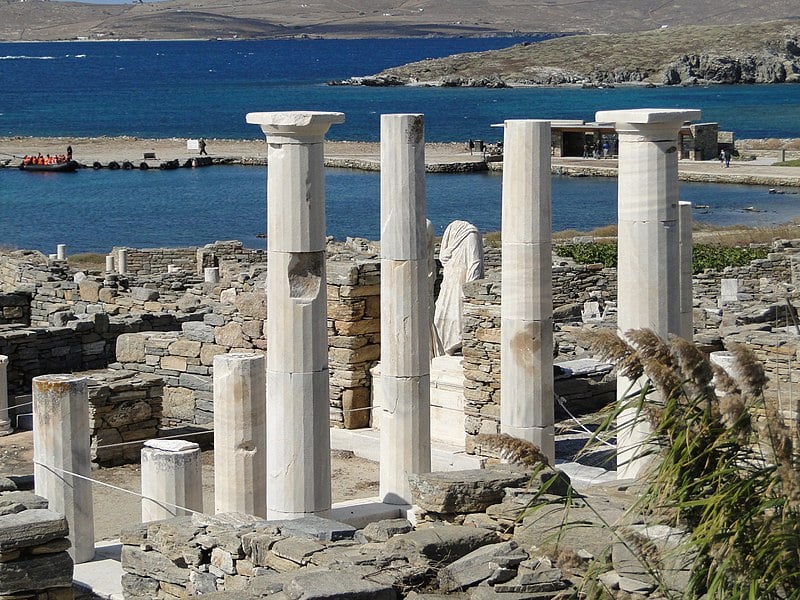
Dwarf elephants once inhabited the Aegean Islands and influenced Mycenaean culture through the use of their fossil remains. Credit: Ninjatacoshel, Wikimedia Commons, CC-BY-SA 3.0
The dwarf elephants of the Aegean Islands represent a fascinating intersection of paleontology, archaeology, and environmental history, yet their significance during the Mycenaean period remains insufficiently explored.
These now-extinct, insular-adapted elephants provide a critical look into evolutionary biology and human-environment interaction in Bronze Age Greece.
Insular dwarfism: Evolutionary mechanisms and island biogeography
Dwarf elephants of the Aegean, such as Elephas creticus on Crete and Palaeoloxodon tiliensis on Tilos, exemplify insular dwarfism, an adaptive response to island isolation characterized by limited resources, absence of large predators, and ecological shifts.
Morphometric analyses of fossilized remains at the Department of Genetics, Evolution and Environment of the University College of London demonstrate a marked reduction in body size, skeletal robustness, and changes in dentition compared to mainland proboscideans.
These evolutionary modifications likely occurred over tens of thousands of years, culminating well before the Mycenaean era, with the last populations vanishing at the close of the Pleistocene or early Holocene. The islands’ geographical isolation, combined with fluctuating sea levels and climatic conditions, further influenced the survival and adaptation of these populations.
Archaeological correlations: Mycenaean awareness and utilization
Mycenaean Boar’s tusk helmet, similar to the one worn by Odysseus in Homer’s account. Credit: Wikimedia Commons, Doreio, CC-BY-3.0
A probable descendant of the large straight-tusked elephant (Palaeoloxodon antiquus), scholar George Theodorou claimed it walked the Earth as recently as 3,500 years ago. This is based on preliminary radiocarbon dating completed in the 1970s, which would make it the youngest surviving dwarf elephant as well as elephant in general in Europe.
Archaeological evidence suggests that Mycenaean societies were aware of—and possibly exploited—remnants of these creatures. Elephant molars and teeth, discovered in Mycenaean contexts across mainland Greece and the islands, appear to have been repurposed as raw materials for crafting tools, ornaments, or ritual objects.
The provenance of these elephant teeth is debated. They may have been derived from fossilized remains of dwarf elephants embedded in island deposits. The Mycenaeans scavenged these for durable ivory-like materials. The studies of Mycenaean artifacts employing elephant ivory or tooth, for instance, demonstrate distinct wear patterns and sourcing signatures, implying a sophisticated interaction with paleontological resources.
In an early form of “cultural paleontology,” this is evidence that megafauna contributed materially and symbolically to Bronze Age material culture. However it’s not unreasonable to suggest that the Mycenaeans may have seen living dwarf elephants, especially on remote islands such as Tilos.
Even if rare, their presence could explain the cultural reuse of elephant teeth—not just as fossil curiosities,but as materials from an animal still within human memory or possibly even within living contact. Such use is also indicative of a level of knowledge or at least recognition of these animals’ past presence, perhaps integrated into local lore or ritual symbolism.
Fossil of the extinct Palaeoloxodon creutzburgi species that subsisted on the island of Crete. Credit: G.M. Woodward, Wikimedia Commons, Public Domain.
Ecological impact and anthropogenic factors in extinction
The extinction of dwarf elephants in the Aegean is often attributed primarily to natural climatic shifts. Sea-level changes following the last Ice Age also had a significant impact. However, the intensification of human activity during the Neolithic through Mycenaean periods likely accelerated their disappearance.
Deforestation, habitat fragmentation, and hunting pressure from early agricultural communities would have placed additional stress on already vulnerable island populations. Analyzing sediment cores and pollen records in conjunction with archaeological site data indicates significant environmental transformations. These coincide with the expansion of Mycenaean influence.
Although most dwarf elephant species went extinct well before the Mycenaean period (ca. 1600–1100 BC), there is credible evidence that some may have survived into that time, potentially overlapping with early Mycenaean society.
Analytical implications: Reassessing Mycenaean interaction with prehistoric fauna
The presence of elephant teeth in Mycenaean material culture challenges traditional dichotomies separating natural history from human history. It invites reconsideration of this society’s environmental perception. Mycenaeans were not merely exploiters of living fauna but also curators of a landscape layered with prehistoric memory.
Further multidisciplinary research combining paleontology, archaeozoology, and geochemical sourcing is necessary to clarify the extent and nature of Mycenaean engagement with these extinct species. The analysis of wear patterns, isotopic signatures, and contextual associations of elephantine artifacts can yield insights into trade networks, symbolic systems, and resource utilization strategies.
Moreover, integrating the study of dwarf elephants into the broader narrative of Mycenaean civilization enriches understanding of how ancient societies conceptualized and incorporated their environmental heritage. It reveals a nuanced picture of cultural continuity and ecological awareness, bridging deep time with Bronze Age lifeways.
Ancient Elamite ziggurat Choqa Zanbil in Iran. Credit: Wikimedia Commons, GFDL
In the Trojan War of Greek mythology, many nations were allied with Troy to fight against the Greeks. This included many of the nations of ancient Anatolia. Perhaps the most surprising participant in the Trojan War, however, was a prince from ancient Iran. He was Memnon, best known as the Ethiopian ruler who died at the hands of Achilles in the final year of the war.
Memnon, king of the eastern Ethiopians
Since Memnon is usually remembered as being a king of the Ethiopians, how can he have been from ancient Iran? The reason is that there was more than just one group of people known to the Greeks as Ethiopians.
For example, notice the words of Greek historian Herodotus of the fifth century BCE in his description of the large army of Xerxes the Great:
“Ethiopians above Egypt and the Arabians had Arsames for commander, and the Ethiopians of the east (for there were two kinds of them in the army) served with the Indians.”
This shows that the Greeks recognized the existence of Ethiopians outside of Africa. Specifically, these other Ethiopians lived in the east, evidently not too far from India. Since Memnon was the king of the Ethiopians, he could potentially have been the king of either the eastern Ethiopians or the African ones.
It is worth mentioning that in ancient Greek, the word Αἰθίοψ (Ethiops) was used not only to describe a specific group of people, but also more generally to refer to individuals with darker skin. The term is a compound of αἴθω (to burn) and ὤψ (face or appearance), literally meaning “burnt-face.” It appears frequently in early Greek literature, such as Homer’s epics, where Ethiopians are depicted as distant, noble figures living at the edges of the known world, rather than as members of a clearly defined nation.
The Ethiopians of Iran
Herodotus himself states that the city of Susa, the ancient capital of Elam (a prominent region in what is now Iran), was known as the city of Memnon. This suggests that Memnon was the king of the eastern Ethiopians, evidently a people in the region of Iran.
This is confirmed by Ctesias, just a few decades after Herodotus. According to this Greek historian, Memnon’s father, Tithonus, was the ruler of Persia. He was either subject to or allied with the king of the Assyrian Empire.
The territory of Persia in the time of the Assyrian Empire corresponded to a large part of what is now Iran. According to Ctesias, Memnon built a palace for himself at Susa. He goes on to claim that Memnon’s army, which he led to Troy, was composed of many Ethiopians and Susians, or inhabitants of Susa.
As for why the Greeks called the inhabitants of that region ‘Ethiopians’, we cannot be sure. However, it may be related to the use of the word ‘Cissians‘ (‘Kíssioi’ in Greek) for the inhabitants of the region of Elam. The Greeks might have confused this for ‘Kush’, the name for the kingdom of the Ethiopians south of Egypt.
How ancient Iran participated in the Trojan War
Ctesias provides the most detailed early account of this army from ancient Iran that fought in the Trojan War. According to Ctesias, King Priam of Troy was subordinate to the king of Assyria, named Teutamos. Due to the difficulties he was facing in the Trojan War, he sent word to Teutamos to ask for help.
As a result, Teutamos sent a large army of 10,000 Ethiopians and 10,000 Susians under the command of Memnon. This army from ancient Iran marched from the furthest corner of the Assyrian Empire over to Troy. Ctesias wrote:
“Memnon assisted the Trojans with 20,000 infantry and 200 chariots and… he was admired for his courage and for killing many Greeks in battle.”
Despite his prowess in battle, Ctesias goes on to explain that the Thessalians killed him. This refers to his death at the hands of Achilles, as per other sources. Achilles was from the kingdom of Phthia in ancient Thessaly.
Did an army from ancient Iran fight in the Trojan War?
Could Memnon have been a historical king or prince of Elam in ancient Iran? Some scholars have speculated that he might be identical to Humban-Numena I, the king of Elam in the Bronze Age. Furthermore, the latter half of his name is admittedly similar to ‘Memnon’.
However, he likely reigned in the first half of the 14th century BCE. Therefore, this king from ancient Iran lived too early to have fought in the Trojan War.
Two other possibilities are Humban-Numena II, possibly in the 11th century BCE, and Humban-Numena III, who lived at the end of the eighth century BCE. The latter’s name is often written in modern sources as “Humban-menanu.” The similarity to “Memnon,” while not exact, is there.
This latter candidate, although living much later than the traditional date of the Trojan War, is particularly noteworthy given Ctesias’ chronological information. He places Memnon’s activities at the height of the Assyrian Empire.
Another candidate from approximately the same time is a prominent Elamite known only as Menanu, referenced in a letter from Ashurbanipal, the king of Assyria. The letter makes it clear that Menanu is a supporter of Assyria. This fits what Ctesias tells us about Memnon.
However, this does not necessarily mean that an army marched from ancient Iran to fight in the Trojan War. In part, this depends on when the Trojan War occurred, a continued historical debate.
Nevertheless, the legend itself is clear. Memnon led an army from ancient Iran to Troy, where they fought in the Trojan War against the Greeks.
The 37-year old Palestinian was arrested in Agios Nikolaos, Crete. File photo. Credit: AMNA
Greek authorities arrested a 37-year-old Palestinian man in Agios Nikolaos, Crete, on Saturday, preventing an alleged plot to detonate explosives on a cruise ship carrying Israeli tourists. The suspect is accused of being an operative for Hamas. He was apprehended in a highly classified joint operation by Greece’s National Intelligence Service (EYP) and the Anti-Terrorist Unit.
Intelligence officials moved quickly to detain the man just days before the targeted cruise ship was scheduled to dock in Crete on Tuesday. While the suspect reportedly claimed during interrogation that he had planned an attack but ultimately backed out, Greek authorities remain unconvinced and are treating the threat as exceptionally serious.
The connection of the Hamas associate in Greece to Cyprus
The success of the Greek investigation originated from a coordinated intelligence effort with Cyprus. Approximately two weeks ago, Cypriot authorities arrested four individuals suspected of planning strikes against Israeli interests in the European Union, allegedly motivated by the ongoing conflict in Gaza.
During the investigation in Cyprus, intelligence officers analyzed mobile phones belonging to the suspects. A specific phone number surfaced as a critical link, leading Greek counter-terrorism units directly to the 37-year-old in Crete.
Security services in Greece noted that the suspects in both countries received specialized training at a camp outside the Gaza Strip. This training specifically focused on manufacturing improvised explosives using chemical substances. Officials in Nicosia consider the group found in Cyprus deeply concerning, noting that two of the arrested individuals had lived in Cyprus for years and had reportedly even managed to obtain Cypriot citizenship. One of the suspects in Cyprus has already admitted to planning attacks against Israeli targets.
The suspect in Crete
The man arrested in Crete arrived in Greece approximately one year ago and filed an active asylum application. He integrated quietly into the local workforce, taking a seasonal job at a hotel in Agios Nikolaos. Local reports indicate he had no family on the island and intentionally maintained a low profile to avoid arousing suspicion.
Following his arrest on Saturday afternoon, Greek counter-terrorism officers raided his current residence in Crete, alongside a property he previously occupied in the Patissia neighborhood of Athens. Investigators confiscated several items that could be used as evidence against his plot. Among them, Greece’s anti-terrorism unit found chemical substances and laboratory measuring equipment, a number of mobile phones, laptops, and USB data storage drives, as well as bank cards and financial documents.
Law enforcement did not find assembled explosive devices or firearms during the raids. Intelligence assessments indicate the suspect was in the final stages of preparation for the plot but was intercepted before he could formally order the final explosive components.
The 37-year-old remains in custody and is scheduled to appear before a public prosecutor. Greece’s EYP and the Anti-Terrorist Unit are actively tracing his movements, communications, and potential local contacts to verify whether he operated alone within Greece.
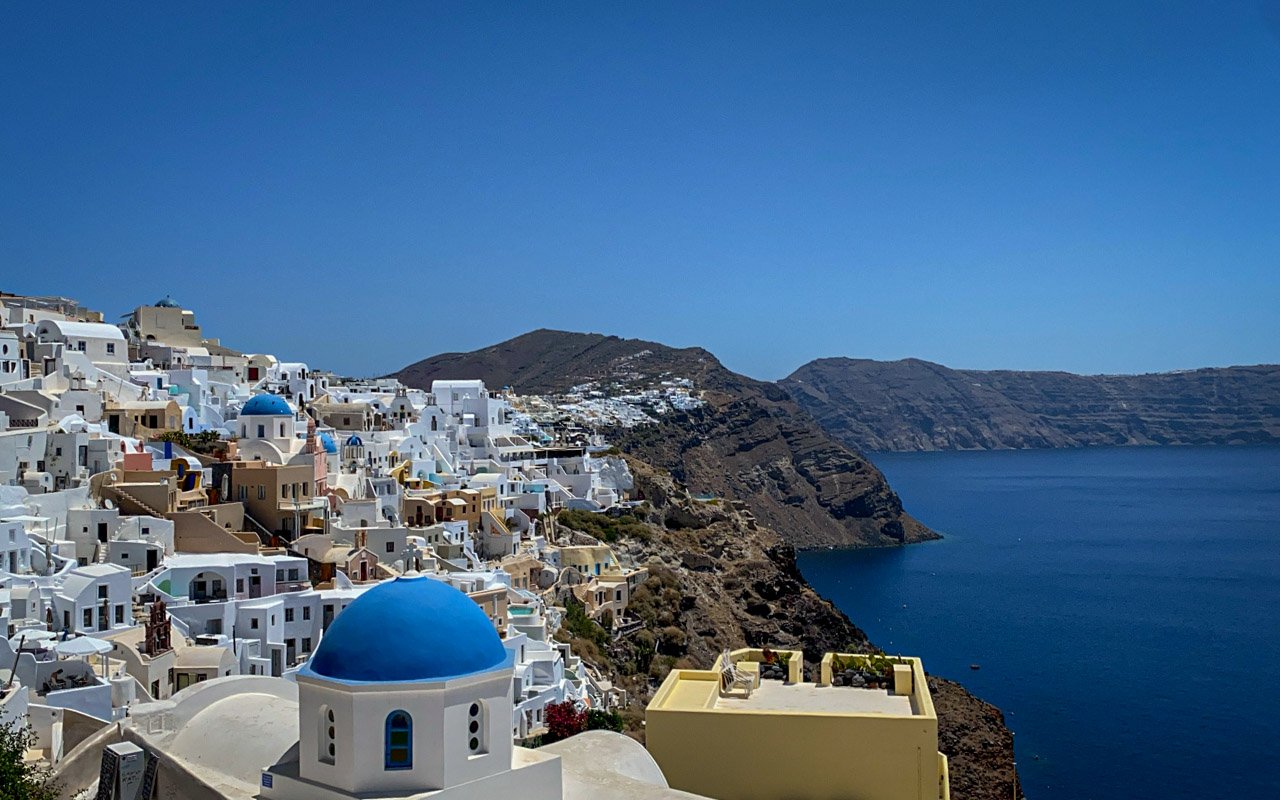
Greece has about 6000 islands, 230 of which are inhabited. Here is a map explaining all of the Greek island groups. Image: Santorini, part of Cyclades Island Group. Credit: Dimitra Damian/Greek Reporter
You have probably seen the postcard of whitewashed houses gathered together overlooking the endless blue waters of the Aegean Sea countless times, and rightly so. Greece is known for its abundance of unique islands, which every summer offer visitors a chance to unwind like nowhere else in the world.
Greece has more than 6000 islands and islets under its name. Of these islands, 227 are inhabited. All of them, nevertheless, are clustered in the Greek island groups.
Each has its own character. Some reflect a unique history or influences from antiquity to the middle ages, to modernity. Others combine Greek tradition with a sophisticated atmosphere. Yet most have bewitching beaches, coastal caves and world class cuisine. Without a doubt therefore, the Greek islands are the most unique on earth.
The main Greek island groups
There are six island groups in Greece to keep in mind:
The Cyclades, the Sporades, the Ionian islands, the Dodecanese, the Saronic Islands and the North Aegean Islands.
Each of these groups is unique in character, architectural style, influences and things to do.
Map of Greek Island Groups. Credit: Dimosthenis Vasiloudis / GreekReporter
The most famous Greek islands are the Cyclades, known as the jewel of the Aegean Sea
The Cyclades group is in the center of the Aegean Sea and is well-known for the iconic white houses and churches with blue domes that adorn its architecture.
This island group is comprised of around 220 islands. The main ones are Amorgos, Anafi, Andros, Antiparos, Delos, Ios, Kimolos, Kythnos, Milos, Mykonos, Naxos, Paros, Folegandros, Serifos, Sifnos, Syros, Tinos, Thera or Santorini, Irakleia, Koufonisia, Schoinousa and Donousa.
The perfect way to explore the region is through ”island hopping”. That is because the islands are close together, even if distinct in character. Mykonos, for example, is a cosmopolitan island globally famous for its party vibes and modern hospitality businesses. On the other hand Tinos, only a hop, skip and jump away, offers a religious feel. Despite the differences however, everyone who visits succumbs to the island’s peace and tranquility.
A blend of mythology and adventure
The name “Cyclades” refers to the islands forming a circle (the name in English means: “circular islands”) around the sacred island of Delos.
For the history and culture lovers, Delos , which is in its entirety a UNESCO World Heritage site, is a living archaeological museum, with the ancient temple of Apollo well worth visiting!
The island, referred to as “the sacred island of Delos,” is where, as Greek mythology tells it, Leto gave birth to Zeus’ twins Artemis and Apollo. Mythological history has it that because of Hera’s jealousy of Zeus and Leto, she ordered all lands to shun Leto, making it difficult for her to find a place to give birth. Zeus however asked Poseidon to find a secret, safe place for Leto to give birth. To that end, she sought out the island of Delos, where she was able to ensure the life of her twins, Artemis and Apollo.
In view of this, the small, rocky island was declared by Callimachus in the third century BC to be “the most sacred of all islands” of Ancient Greece, and was dedicated to Apollo.
One of the most popular islands of the Cyclades is Santorini. This popular destination is known for its colorful volcanic stone backdrops and its white houses and winding streets climbing the cliffs, leading you to villages and breathtaking views.
For the adventurous at heart, something you want to be sure to check out is a tour of the volcano and caldera. Another tip for those visiting is to hike the path between the main towns Fira and Oia, and of course visit the Red Sand Beach that looks like a landscape on Mars.
Much can also be said about the Cycladic cuisine, of course. The San Mihali cheese of Syros or the Naxos version of gruyere are world famous, while the fava of Santorini is a unique local delicacy, as are the mouthwatering fried tomato balls of the island. Mykonos has great sausages, while the xynotyri (sour cheese) of Ios is not to be missed.
The Sporades islands: the ”scattered” islands
Skiathos old town. Credit: dronepicr / CC-BY-2.0 / Wikimedia Commons
The name Sporades translates to “scattered”, which can broadly be applied to all islands outside of the Cyclades. The group is in the north-east of the Aegean.
This particular group consists of 24 islands. Four – Alonnisos, Skiathos, Skopelos and Skyros – are permanently inhabited.
Vast pine forests, huge olive groves and tall cypresses cover the small islands. According to legend, the islands were formed after the brothers Otus and Ephialtes of the Titans threw rocks.
Skiathos and Skopelos: the most popular
Two of the most well-liked islands in this group are Skiathos and Skopelos.
Skiathos is only 4 miles wide and no more than 7 miles long. Still, there are over 60 beaches to explore in that small space, the most popular being Koukounaries and Lalaria. The island is easily accessible, in contrast to the others, thanks to its small airport.
Another, Skopelos, is one of the many places across Greece that have never failed to enchant visitors throughout the decades. With its hilly, verdant landscapes and sparser crowds, it is a perennial draw for travelers from all over the world.
A beach on the stunning island of Skopelos, where the blockbuster movie Mamma Mia was filmed. Credit: Long lasting memories / Wikimedia Commons / CC BY-SA 4.0
Skopelos is full of the traditional architecture of Greece, with whitewashed houses, terracotta-tiled rooves, blue-hued shutters and wooden balconies. Among its loveliest beaches are Kastani, Stafilos, and Panormos, all easily reachable from Skopelos Town.
This stunning Greek retreat was also the setting for one of the most engaging films of the last few years, “Mamma Mia!.” The universally beloved movie, with an iconic soundtrack by the band ABBA, turned it into the fictional island of “Kalokairi” for the original film in 2008.
The Greek Islands Of The Dodecanese
Lindos, Rhodes. Credit: Jebulon / Public Domain
The Dodecanese island group is in the south-east of the Aegean, between the Cyclades and Turkey. It consists of 165 large and small islands, of which 26 have permanent residents.
The Dodecanese serve as a bridge between the East and the West, as the islands are very close to the Turkish coast. They have long, dry summers and lots of sunlight all year round.
The major islands in the group are Agathonisi, Astypalaia, Chalki, Kalymnos, Karpathos, Kasos, Kastellorizo, Kos, Lipsi, Leros, Nisyros, Patmos, Rhodes, Symi and Tilos.
Medieval architecture, romance and history
These islands are famous for medieval architecture, as well as their blend of history and romance, which permeates their small alleys.
Rhodes is the “medieval island” of Greece best known for its fortified port, seven gates, characteristic stag statue, and palace of the Grand Master. The Old Town lies inside ancient walls, but once outside them, you will find a more modern town which has cosmopolitan restaurants, shops, and bars.
Kos is also famous for its medieval architecture. On this island full of history, you can visit the ancient plane tree under which Hippocrates, the father of western medicine, used to teach. It is one of the oldest trees in Europe at more than 2500 years of age.
The castle of Kos island, Greece. Credit: Chris Vlachos / CC-BY-3.0 / Wikimedia Commons
Patmos is a smaller and less busy island, though of great historical and religious importance. St John the Apostle was exiled here, and it is where he wrote the Revelation of Jesus Christ, the final book of the Bible.
Kalymnos, Prerimos and Karpathos are paradise islands, with beautiful beaches, seaside villages and breathtaking vistas. They each offer unforgettable hiking adventures, and picturesque villages that will take visitors on a journey back in time.
Saronic islands: the most sophisticated of all Greek island groups
Hydra, where the Modern Greek Merchant Marine began. Credit: dronepicr/ Wikimedia commons CC BY 2.0
This Greek island group is the most accessible from Athens. Many wealthy Athenians as well as Greek and international artists prefer to visit the islands of this group. Hydra, in particular, is a famous sanctuary for poets, writers and filmmakers, including Leonard Cohen and Axel Jensen. This group consists of the islands of Aegina, Salamina, Poros, Hydra, Spetses, Agistri, and Dokos.
One of the best thing about them is that they’re untouched by mass international tourism. That is perhaps because places like Hydra, for example, is car-free. Everyone who visits gets around by boat, on foot or even by mule, giving you a truly old-fashioned feeling. It provides one with the opportunity to escape the hustle and bustle of modern everyday life.
Mules at Hydra port. Credit: Gabi Ancarola
Quaint alleys and 18th and 19th-century mansions typify the architecture, and the islands offer many beautiful bays and stunning beaches.
Hydra: where poets go to write
Hydra has been the most popular destination of the group since the 1960s. During that time, the island became a hub for international artists. One reason is that it combines elegance with a slow-paced lifestyle in a traditional setting. It was also the muse and longtime home of poet and songwriter Leonard Cohen.
Without a doubt, Hydra’s port is ideal for history lovers. Many of the critical battles of the War of Independence in 1821 occurred there. In fact, scars from some battles are still visible in the architecture.
Hydra’s beaches make it a great destination for summer trips, but its natural beauty and cosmopolitan town, filled with artisans’ shops, museums, and boutiques, make it the perfect spot for a short trip throughout the year.
Similarly, Spetses attracts visitors who seek to immerse themselves in the elegant and traditional setting of the island.
Ionian islands: the tropical islands
Zakynthos’ famous Navagio beach. Credit: Jimzoun Wikimedia Commons
This group consists of Corfu, Zakynthos (Zante), Kefalonia, Lefkada, Paxos
Kythira, ithaki (Ithaca).
Their natural setting is the main factor that makes the islands of the Ionian completely different from any of the other Greek islands. Here, the rich greenery blends harmoniously with the turquoise of the sea and the blue of the sky, creating beautiful natural scenery reminiscent of a painting.
The most photographed beaches in Greece
The beaches are characterized by limestone rock formations, sand and smooth pebbles. Visitors who have traveled extensively around the world say that the turquoise, cool, crystal-clear waters beat those of the Caribbean. While the beaches are surrounded by pine trees rather than palm trees, one could still say that these are the “tropical islands” of Greece.
The Ionian Sea’s beaches are numerous and have been photographed countless times. Shipwreck Beach on Zakynthos, the impressive Egremni Beach, the turquoise Porto Katsiki Beach of Lefkas, and Myrtos Beach of Kefalonia, are just some of the sandy stretches of heaven that make a holiday here unforgettable.
Porto Katsiki, Lefkada, Ionian Inslands. Credit: Antone Adi / Pexels
Yet there is more, of course. For example, the unbelievable “white” waters of Antipaxos, the lush greenery of Paxos with the little-known beaches of Ithaca that were the subject of Homer’s Ulysses. In addition, there is Marathonissi in the bay of Laganas on Zakynthos. Those are just a few of the sites that most deserve mentioning.
Strong Venetian influence
Another great characteristic of the Ionian islands is the Venetian presence in the architecture, the mellifluous speech of many locals, the musical influences, and even the food. For centuries, the islands of the Ionian belonged to the Venetians, and the western Mediterranean influence is still strong.
In terms of food, the Corfu pastitsada and sofrito are memorable dishes along with the island’s famous kumquat liqueur. Overall, all Ionian islands have cuisines influenced by their Venetian ancestors.
Corfu is one of the most famous islands, and it has a lot of history to its name. The old Corfu Town that is a World Heritage site is one of the most sophisticated towns in the Ionian island group.
Old Town of Corfu credit: metrogogo/Flickr CC BY-NC-SA 2.0
Locals call the island Kerkyra, perhaps because according to mythology, it was the home of Kerkyra, the daughter of Asps, the river God. Kerkyra gave birth to Poseidon’s child, and from then, the Phaeacian race was born. Nevertheless, there is more to Corfu than mythology. Its history and architecture are also worth discovering.
Ithaca is another island that is famous for its mythology. This is reputed to be the birthplace of Odysseus, but it also has impressive beaches.
North Aegean islands: Stunning beaches, strong local flavors
Seychelles beach, Ikaria, Greece. Credit: Leeturtle/Wikimedia Commons/CC BY-SA 4.0
The North Aegean island group includes Thassos, Lesbos, Samos, Lemnos, Chios, Samothrace and Ikaria. They make up some of the largest islands in Greece. Many visitors skip these islands because of their distance, which helps them to retain a strong local character and tradition.
Chios, Ikaria and Samos are the most visited. Chios is popular for its unique cultivation of “Mastica” (Greek: μαστίχα) a gummy resin that seeps out of the Pistacia lentiscus tree. The island is also home to an abundance of traditional villages.
For the adventure seekers, Lemnos is an excellent spot for hiking and biking. Worth seeing is the rugged Terran, a volcanic island which, according to legend, is the Walden belonging to Hephaestus, the God of fire.
Ikaria belongs in the Blue Zone list, a collection of spots around the world where people are said to live longer and healthier lives.
Another island worth visiting is Lesbos, in particular for fans of the popular Greek drink Ouzo, as it is the home of the spirit.
Finally, we can’t leave out Samos, a picturesque location which is ideal for history and culture lovers as it is birthplace of Pythagoras, the famous Ancient Greek philosopher and mathematician. The island is also home to many traditional taverns and provides visitors with traditional local dishes to die for.
Crete: a Greek island group on its own
The spectacular harbor of Heraklion, Crete. Credit: Greek Reporter
Crete is Greece’s biggest island and one of the largest in the Mediterranean.
There are many unique things to enjoy in Crete, from two beautiful pink-sand beaches (out of the less than twelve that exist in the world) to ancient cities, medieval castles and culinary experiences.
Crete is famous for its ancient Minoan palaces of Knossos and Phaistos. Yet various other sites and museums also depict the island’s rich history.
The island also offers to visitors a delicious local cuisine to experience. It revolves around olive oil, special herbs and local cheeses, and grilled seafood and meat.
Heraklion, the capital of the Greek island of Crete, is an ancient city that perhaps is under-appreciated for its many attractions for the international traveler. From first-rate hotels with swimming pools and rooftop bars that look out over the city and the many villages around the ancient city, the Heraklion area has much to offer.
Perhaps best known for its stunning cathedrals, picturesque old towns, and first-class restaurants and boutiques, Crete is in the midst of the sea and at the heart of Greece’s ancient history. This was the place where the Minoan civilization flourished, and it boasts traditions that go back into time immemorial.
Balos beach, Crete. Credit: Olaf Tausch / CC-BY-3.0 / Wikimedia Commons
Europe’s oldest known civilization, which flourished on Crete between 2,700 BC and 1,450 BC, served as a trading center for gold, ceramics, and the precious spice and dye saffron.
The Koules (Greek: Κούλες) or Castello a Mare, (“Fort on the Sea” in Italian) a fortress located at the entrance of the old port of Heraklion, is another must-see place for anyone who visits this ancient city. It was built by the Republic of Venice in the early 16th century, and is still in good condition today.
Finally, anyone who visits Crete can experience its folklore and traditions, as performances of local dances take place all year round, as well as festivals and cultural events lasting for days.
Work and wages in ancient Greece are often overlooked topics. Credit: Dosseman / CC BY-SA 4.0 / Wikimedia Commons
Ancient Greece is the subject of immense scholarly and popular attention. Unsurprisingly, The focus tends to be on the grandest moments of ancient Greek history such as pivotal battles or discoveries made by famous philosophers and scientists. Much less attention is paid to the wages and work of the common man in ancient Greece. The average farmer working the land in rural Greece is studied far less than famous figures like Alexander the Great or Pericles, for example.
Nevertheless, ordinary people would have been the backbone of any polis (city). These were the people who harvested the crops, sailed the seas in search of trade, and erected beautiful buildings like the Acropolis that are still admired today.
Agriculture: the backbone of the ancient Greek economy
Attitudes to work and wages differed significantly in ancient Greece to the present period and would have been linked to an individual’s status as either a free citizen, foreigner, or slave.
During the Classical period (510 BC – 323 BC) – and indeed throughout Greek history – most people would have worked in agriculture. Private individuals cultivated crops and raised livestock on their own land in ancient Greece. Land ownership by non-residents was restricted, leading to smallholdings as the common practice. Inherited equal shares of parental land by male children also prevented land consolidation.
In Athens, farm sizes ranged from five hectares (poorer citizens) to twenty hectares (aristocracy), while in Sparta, they averaged from eighteen hectares to forty-four hectares. For landowners, the amount of money they earned from their farms would have depended on the yield generated by their crops and livestock.
The poorest citizens lacked land and might have worked for pay on others’ land or leased land for cultivation, especially if they lacked other beneficial skills like craftsmanship.
In Athens, free citizens who worked on the land but did not earn any themselves would likely have belonged to the thetes class. Thetes were classified as those employed for wages or those whose annual income was less than two-hundred medimnoi. The medimnos was an ancient Greek unit of volume, usually used to measure grain, so lower-class workers may have been paid with food rather than money.
Other types of work and wages in ancient Greece
Various roles existed across what would today be considered the manufacturing, service, retail, and trade sectors. Attitudes to these occupations outside of the agricultural sector would have varied, but generally, the farmer was idealized in ancient Greece.
Earning wages was looked down upon since it was seen as limiting personal freedom and akin to enslavement. Consequently, free men working alongside free non-citizens and slaves on Acropolis construction projects earned equivalent wages. Despite this, wages seem to have been sufficient for sustaining a livelihood. In Athens, skilled laborers typically earned one drachma per day around the late fifth century and two and a half drachmai in 377 BC.
The existence of metics, foreign-born free non-citizens who settled in city-states, helped compensate for the scarcity of willing or necessary free citizens turning to business or wage labor. In Athens, which boasted an estimated twenty-five thousand metics at its zenith, these individuals were prohibited from land ownership and tended to engage in occupations looked down upon by the free citizens.
Despite challenges, economic prospects in Athens and other bustling port cities, where metics thrived, must have been promising. Their allure was strong, even though they faced a special poll tax and military service, unable to own land, engage in politics, or represent themselves legally—relying on citizen representatives.
Prominent and wealthy metics did manage to thrive in Athens. The names of some of these successful metics are still known today. For example, the bankers Pasion and Phormion, and Cephalus, a shield-maker and father of the orator Lysias.
Soldiers and sailors
Again, the pay for ancient Greek soldiers would have varied over time and geographical space. Seniority within the military would have also impacted pay and mercenaries would have negotiated contracts with their employers. Nevertheless, some figures are available that provide a rough idea of what the average soldier or sailor could expect to earn.
During the fifth century, a Greek soldier on a campaign was allotted one choinix of wheat daily. In Athens, by the late fifth century, wheat cost three drachmai per medimnos. As a medimnos contains forty-eight choinices, this meant one drachma could provide sustenance for an individual for sixteen days or a family of four for four days.
Meanwhile, pay for rowers in the Athenian navy was one drachma a day in the early fifth century. It had previously been lower at just two obloi but was increased during wartime.
Greek manufacturing is shrinking dramatically, creating an urgent need for a shift to a complex economy. AI generated image. Credit: Greek Reporter
As Greece continues to lose its manufacturing industry, becoming all the more dependent on the service sector, an urgent restart and shift to a complex economy is crucial for the country’s economic viability.
A complex economy is interconnected with other industries that are not necessarily geographically concentrated or thematically related but which share common infrastructure, resources, and solid interdependencies in production and supply chains. The Internet of Things (IoT), automation, and data-sharing are vital for the development and success of a complex economy.
A recent Bank of Greece report states that tourism in 2025 accounted for 13 percent of the country’s GDP. The government presents this as a sign of success, but, behind the numbers, there is a sad ascertainment: Greece is no longer producing goods, and almost everything other than agricultural products is imported. Substantial revenue from tourism is definitely not a bad thing. However, the average Greek does not benefit from tourism revenue. As the cost of living rises, bragging about “soaring tourism revenues” is not filling the citizen’s supermarket cart.
According to Statista and the World Bank, between 2013 and 2023, 68.6 percent of Greece’s GDP came from the service sector, while 15.2 percent of revenue stemmed from industry and 3.3 percent from agriculture. Kostas Axarloglou, the dean and a professor at Alba Graduate Business School, says the Greek industry needs a restart and transition to a complex economy. In other words, Greece needs to enter “Industry 4.0,” or the Fourth Industrial Revolution, in which interconnectedness, automation, and real-time data are key.
Low labor productivity and wages
According to Axarloglou, only four percent of the Greek population is now employed in sectors related to Greece’s complex economy, which amounts to approximately only 11 percent of the value added to the country’s GDP in general. Additionally, in the Eastern Mediterranean nation, there is fragmentation into a large number of small businesses, exhibiting both low labor productivity and wages.
As per The Atlas of Economic Complexity, the industry sector in the Greek economy presents a relatively low degree of complexity in relation to GDP, an element indicative of low potential for economic growth in the future. Nonetheless, from 2018 onwards, The Atlas of Economic Complexity records positive growth in exports with the main contributors, among others, being the pharmaceutical and IT sectors.
A gradual structural transformation of the economy is also being observed, with the transfer of productive resources and activity towards manufacturing sectors with higher added value and productivity, such as electronics and machinery manufacturing. Finally, significant opportunities to strengthen and complement the country’s existing productive fabric have been recorded.
Axarloglou argues that there are both an overall low degree of complexity as well as structural problems in Greek manufacturing. The existence of companies with high levels of specialized know-how, however, provides a sufficient launching point in supporting the restarting of industry and the general production base of the country, which could lead to sustainable development in the Greek economy.
Importance of a complex economy in Greece
Axarloglou referenced the US industry and its contribution to the economy. While the manufacturing industry in the US constitutes 11 percent of GDP, it contributes 35 percent in productivity increase and 60 percent in exports. Furthermore, the complex economy in the United States is the engine of innovation, with related industry sectors producing 55 percent of patents and contributing 70 percent of total expenditure on research and development.
A recent study (Yong, 2020) analyzes the contribution of complexity in a set of economies with varying characteristics. The importance of dynamic industries in economic growth as well as the development of social capabilities and a significant contribution to the achievement of the UN Sustainable Development Goals (SDGs) in each country’s economy were scrutinized.
Overall, the study found there is a direct impact of economic complexity on the development of specific UN Sustainable Development Goals (SDGs), including on poverty reduction, education, job creation, technological economic upgrading, and overall economic development. Moreover, policy interventions for manufacturing expansion are especially vital as they contribute to the development of skills in the country, triggering technological innovation and creating new markets and institutions.
Consequently, the development of a complex economy in Greece could greatly contribute to GDP and the implementation of UN SDGs. It must be mentioned that, in previous decades, manufacturing significantly lagged behind in general, but this lag has eased in recent years.
The two pillars for a complex economy
The development of a sustainable complex economy should be based on two pillars, Axarloglou argues: firstly, extroversion and internationalization and, secondly, innovation and specialization. The Greek industry would profit from participation in International Production Networks (IPNs). This is more feasible now, as these networks evolve from the impact of circular economy, digital transformation, sustainability, and new technologies such as robotics. The mechanisms and structures that would aid in the development of a complex economy are related to the National Recovery and Resilience Plan “Greece 2.0.”
According to Axarloglou, Greece should also orient its manufacturing production towards the international market and within the framework of the Global Value Chain Networks (GVCN), developing even at regional levels. This would include energy networks in the southeastern Mediterranean and innovation pockets in Thessaloniki and Northern Greece. In addition, market megatrends, namely digital technologies, automation-robotics, sustainability and climate change, and a circular economy, should seriously be considered as worthy endeavors.
The adoption of new technologies and digitalization of operations and processes are likewise vital. Such technologies are directly related to the internet, including the IoT, the cloud, and digital platforms and ecosystems. These lead to a greater degree of integration of production, a reduction in transaction costs and easier participation, and more effective coordination of cooperating companies from various geographical locations.
Data collection and analysis (data analytics) help in better production coordination and management within GVCNs and geographically dispersed networks. Moreover, the use of online commercial platforms (e-commerce) results in easy and direct access for producers to raw materials and semi-finished products. Large markets of potential customers are also much more readily accessible.
Sustainable development, climate change, and the circular economy
All the more, a global trend for sustainable development is affecting the structure, organization, and development of GVCNs. There is a growing need to closely monitor and control companies’ social and climate footprints and their alignment with Environment, Social, and Governance (ESG) priorities. At the same time, the imposition of rules on sustainability issues by governments directly affects the structure and operation of GVCNs since these lead to changes in transportation costs and countries’ advantageous dependence on renewable energy availability.
The necessity for sustainability and more efficient management of resources is leading to countries’ adoption of regulations for the operation of the economy and dynamic industries, and businesses are formulating business models and strategies compatible with the imperatives of the circular economy. Technological development now results in technologically and economically feasible production processes that operate within the framework of the circular economy. There is a focus on significant waste reduction, savings, and recycling / reutilization of raw materials and products.
Companies, therefore, develop business models within ecosystems based on collaboration with other companies in order to sustainably produce and deliver value. The purpose of these models and ecosystems is to effectively manage the life cycle of products and spare parts. Of course, the transition from a traditional-linear / operation-production model to a circular one mandates that companies make significant changes in the way they perceive the creation and distribution of value in the economy.
At the same time, the way in which producers in the complex economy model collect revenue is also changing. While, traditionally, income came from product sales, in the circular economy model, profits stem from product rental and other such services. This of course requires new skill development for value production more closely aligned with industrial product usage services, often the result of strategic partnerships among companies.
The circular business model, therefore, has the potential to revitalize manufacturing sectors and businesses by giving them the opportunity to develop new partnerships with companies and ecosystems within the framework of the GVCN, minimizing the burden on the environment, maintaining economic robustness, and achieving the triptych of objectives: an interconnection between the environment, society, and economy, leading to robustness.
European Union funds
The participation of the Greek complex economy in the GVCNs—and mainly in the regional GVCN—requires horizontal interventions that will establish and even improve the required structures and environment, thereby enabling Greek manufacturing to become competitive. Axarloglou argues that Greece has a great opportunity to improve its complex economy with the National Recovery and Resilience Plan “Greece 2.0.” It is a comprehensive plan of reforms and investments for the restructuring of the country’s production model within the extroversion-competitiveness-innovation axis.
The plan is based on initial funding of $35.6 billion (€31.1 billion) for the 2022-2026 period (approximately $21 billion in the form of subsidies and about $14.5 billion in the form of loans), with the prospect of drawing additional investment resources totaling $67.4 billion (€58.8 billion). The plan consists of four Pillars (and 18 sub-axes), namely green transition; digital transition; employment, skills, and social cohesion; and private investment and transformation of the economy.
Green transition emphasizes the energy transformation of the Greek economy towards renewable energy sources and a more energy-efficient operation of the economy, the more efficient use of natural resources, and the promotion of a circular economy.
The digital transition of the economy includes investment in infrastructure (optical fibers, 5G, etc.), the digital transformation of the state, and the promotion and adoption of digital technologies by businesses so that they can be interconnected in the International Production Networks (IPNs).
Employment, skills, and social cohesion includes actions to improve the functioning of the labor market, the reintegration of the unemployed into the labor market, the creation of jobs, and the reduction of inequalities, poverty, and social and economic exclusion.
Finally, private investment and economic transformation includes investments and actions to modernize public administration, strengthen the financial system, promote and support research and innovation, modernize and improve the resilience of key sectors—such as tourism and manufacturing—of the economy, and ultimately improve competitiveness and promote private investment and exports.
“Industry 4.0”
The acceleration of the “Industry 4.0” transformation program includes digital transformation as well as the development of “smart” production and a new generation of industrial parks in Greece. The promotion and support of investments for the development of new or upgraded production lines would enhance production and cooperation in GVCNs and improve competitiveness with an emphasis on advanced and digitally controlled industrial equipment, production control systems, and the establishment of industrial partnerships.
Furthermore, there should be significant structural changes to reduce bureaucracy related to business operations and simplify procedures for attracting and implementing foreign direct investment in the country. This will be possible with the implementation of horizontal actions to strengthen the Greek economy within the framework of the National Recovery and Resilience Plan “Greece 2.0.” Therefore, the “Greece 2.0” and “Industry 4.0” programs are inextricably linked to each other for the development of a productive complex economy in the country.
The earthquakes rattled large parts of central and southern Greece, including Evia and Athens. Credit: AMNA
A series of strong earthquakes, culminating in a 5.2-magnitude tremor, rattled the Greek island of Evia (Euboea) and the greater Athens metropolitan area on Sunday afternoon. The seismic activity triggered extensive landslides across the northern part of the island of Evia, though local authorities report no injuries or significant structural damage to houses.
The initial shock, measuring 4.8 on the Richter scale, occurred at 12:58 p.m. local time on Sunday, June 7.
According to the automated system of the Geodynamic Institute of the National Observatory of Athens, the epicenter was located six kilometers (4 miles) southwest of the village of Prokopi in northern Evia, with a shallow focal depth of just 14.1 kilometers.
More earthquakes followed, rattling central and southern Greece
Minutes later, a stronger 5.2-magnitude earthquake struck the same localized fault line. This second, more powerful tremor originated just two kilometers east-southeast of Prokopi at a much shallower focal depth of only five kilometers. A third notable tremor followed shortly after in the exact same region, compounding the anxiety of local residents.
All three shocks were felt prominently across the Attica region, rattling windows and disrupting the Sunday afternoon routines of millions of residents and tourists in the Greek capital.
Despite the intensity of the tremors and their shallow depth, the immediate fallout appears limited. Giannis Tsapourniotis, the mayor of Mantoudi on Evia, provided an update on the situation on the ground during a statement to the state broadcaster ERT.
The epicenter of the tremors on the island of Evia (red star). Credit: EMSC (European Mediterranean Seismic Centre)
“We have extensive landslides, but no injuries have been recorded,” Tsapourniotis confirmed. He specified that heavy rockfalls and landslides have primarily obstructed rural roadways in the areas of Plakia and Dafnousa. Emergency crews of the local council and local civil protection units are currently working to clear the affected traffic routes and assess any isolated impacts on village infrastructure. To date, homes and commercial businesses remain intact.
Greek seismologists tried to calm public fears regarding the consecutive tremors. Kostas Papazachos, a prominent professor of seismology at the Aristotle University of Thessaloniki, described the events as a series of consecutive earthquakes that align with the area’s known geological profile. Northern Evia sits directly atop a complex network of active fault lines, making such localized clusters a known phenomenon.
“These seismic tremors are not a cause for concern,” Papazachos stated, offering a reassuring outlook despite acknowledging it is still early in the post-earthquake evaluation process.
The region surrounding Prokopi is highly trafficked, especially on weekends, as it is home to the widely venerated pilgrimage site of Saint John the Russian, drawing thousands of visitors from across Greece and the global diaspora. The lack of infrastructure collapse in such a populated sector of the island has brought significant relief to state authorities.
Greece ranks among the most seismically active countries globally, located at the geological boundary where the African tectonic plate pushes beneath the Eurasian plate.
While minor tremors are a daily occurrence across the nation, shallow earthquakes above a 5.0 magnitude near heavily populated zones like Attica consistently prompt rapid responses. Local authorities in Evia remain on standby for potential aftershocks over the coming days, actively advising residents and tourists to avoid driving through steep mountainous routes prone to further rockfalls.
The statement issued by Greece’s Civil Protection
“According to official reports from the Geodynamic Institute, consecutive seismic tremors measuring 4.8, 4.3, and 5.2 on the Richter scale were recorded in northern Evia. Concurrently, the General Secretariat for Natural Disaster Recovery and State Aid has been placed on high alert and is in continuous communication with local authorities to assess the situation.
Based on initial inspections currently underway in the area, reported damages include a collapsed wall in one home, minor cracks in a few residences, and small-scale landslides affecting sections of the road network. So far, no injuries or severe damages have been reported.
Minister of Climate Crisis and Civil Protection Evangelos Tournas Tournas, accompanied by the General Secretary for Natural Disaster Recovery and State Aid, Petros Kampouris, is heading to Prokopi and Dafnousa for an on-site briefing. The Ministry of Climate Crisis and Civil Protection continues to monitor the situation closely and will immediately take any further action if necessary.”
Greek schools will now sell or serve much healthier options to their students. Credit: Wikimedia Commons / Nikolaos Kotopoulis / CC BY SA 4
The Greek Ministry of Health has announced a sweeping overhaul of food guidelines for school canteens across the country. In a targeted effort to combat high rates of childhood obesity, the new regulations impose strict dietary standards, including a total ban on processed meats and soft drinks.
Set to take full effect during the 2026-2027 school and academic year, the updated framework replaces guidelines that have been in place since 2013. The policy applies to all primary, secondary, and high schools in Greece, covering canteens, dining areas, and vending machines.
Alternate Minister of Health Eirini Agapidaki introduced the initiative as a core component of the National Program for the Prevention and Treatment of Childhood Obesity. The health ministry drafted the new rules based on contemporary recommendations from Greece’s National Nutrition Committee.
Under the revised regulations, school menus will undergo structural changes. Authorities have completely prohibited the sale of cold cuts and sodas. The ministry has also mandated a reduction in portion sizes for specific food items to prevent overeating.
Greece overhauls school meals entirely
The approved product list now prioritizes fresh foods and traditional Greek cuisine staples. Students will have access to fresh fruits, vegetables, fruit salads, and unsweetened dried fruits. Dairy options include plain milk, yogurt, kefir, ariani, and rice pudding, all strictly without added sugars.
Baked snacks remain available under healthier parameters. School vendors can sell the traditional Koulouri of Thessaloniki, whole-grain rusks, cereal bars, pasteli, and halva. Nuts are permitted exclusively for middle and high school students.
Sandwiches will no longer contain processed meats. They must be made with whole-wheat bread and filled with Greek cheeses, boiled chicken or turkey, egg, or tuna. Spreads are restricted to olive oil or soft margarine. Similarly, savory pies and pizzas can only contain vegetables or cheese, prepared using an olive-oil-based dough.
Beverage options will now also be tightly regulated. Canteens will stock water and natural juices. Older students can purchase plant-based milk alternatives and tea. Coffee sales are strictly restricted to teaching staff.
“The fight against childhood obesity is not a theoretical battle, but a daily act of responsibility that starts where our children spend most of their day: at school,” Agapidaki stated following the announcement.
She emphasized that the updated framework relies on rigorous scientific data. “With the new health regulation, we are radically changing the rules of the game. We are permanently removing cold cuts and soft drinks from school canteens and reducing portions, creating an environment that actively protects students,” she said.
Agapidaki urged school administrators and suppliers to begin preparations immediately to ensure full compliance. “We make no discounts on the health of the new generation,” she added, noting that the ultimate goal is to equip Greek youth with lifelong healthy eating habits.
Plutarch’s Ship of Theseus paradox questions if identity remains when all parts change, challenging what it means to be the same over time. Credit: Greek Reporter archive
Have you ever wondered if your favourite old jumper, battered by time and use, is still truly the same as the one you fell in love with at the shop many years ago? That seemingly silly question is one of philosophy’s oldest and most fascinating puzzles, known as the Ship of Theseus.
The Ship of Theseus is an ancient brain-teaser
Plutarch, the ancient Greek writer and historian, presented us with a real head-scratcher with his tale of Theseus’ trireme.
Picture this: the Athenians, immensely proud of the ship that carried their hero Theseus to victory over the Minotaur, kept it docked for centuries. But as we all know, wood doesn’t last forever, as it can start to rot very quickly. So, whenever a plank rotted away or timber decayed significantly, the smart Athenians would meticulously replace it with a new one. Bit by bit, year after year, every single original piece of that ship was swapped out and replaced with brand-new wood.
Now, here’s the one-million-drachma question: was this still the Ship of Theseus? Or had it, piece by piece, become an entirely different vessel that had nothing to do with Theseus’ heroic journey? This was a profound thought experiment that kept brilliant minds confounded for millennia. It makes us wonder about identity and what makes something… something. Is it about what an object or a human is made of? Does it have to do with their materials? Their shape, maybe? What about their personal story? Or could it be something else entirely? This simple story by Plutarch prompts us to delve into what we mean when we say something is “the same.”
The Ship of Theseus, an illustration representing the famous thought experiment on identity and change. Credit: Yosemite Belbury, Wikimedia Commons, CC BY-SA 4.0.
The Ship of Theseus and the idea of change
The brilliance of the Ship of Theseus story lies in its elegant illustration of the uncomfortable truth that everyone and everything, eventually, changes. Consider yourself as an example. Most of the cells in your body are replaced every few years. Are you, reading this right now, the same person you were a decade ago, even though practically all the biological components that constitute the physical you are new?
This is why the Ship of Theseus is a perfect example of this constant flow of renewal. It shows the tension between how we perceive something as permanent and its ever-changing physical reality.
And right when you think you understood the whole story, here comes a twist, often credited to Thomas Hobbes, the English philosopher.
This twist is asking us what if, hypothetically, all those old, discarded planks from Theseus’ ship were gathered up and used to build a second ship? Which one, then, is the “true” Ship of Theseus? The one that has been continuously in the harbour, even with all new parts? Or the one made of all the original pieces, just reassembled to create a brand new ship? You can almost hear the ancient Athenians debating this topic, wondering which ship deserved the glory of their hero.
Does something remain the same if every part has changed? Credit: Markus Winkler, Pexels.
The modern implications
The deep implications of the Ship of Theseus go beyond the confines of ancient Greek mythology. They truly resonate in our modern world, where things are constantly being upgraded, recycled, and reinvented only to be presented as something brand new. Take your mobile phone, for example. With every software update, every component replaced, is it still the “same” phone you bought two years ago? What about a classic car that has been restored and fixed with love, often with hardly any original parts left? Is it still that iconic model, or a new creation in an old shell?
This paradox even touches on larger ideas, such as national identity. Countries evolve, populations shift, and cultures adapt. Are we, as a nation, the “same” as our ancestors from centuries past? Is the US truly a nation or just a creation of many smaller parts of people who came from distant lands to find a better future?
Is modern Greece truly the grandchild of ancient Greece? What about the Roman identity that became synonymous with the Greeks for more than a thousand years? The word ‘Romios,’ which is Greek for Roman, still defines the notion of Greekness. Thus, are Greeks a continuation of the ancient identity, or are they something new, composed of thousands of different ethnic and cultural components that migrated to their lands over time? We share history, language, and heritage, of course, but the actual people, the “material” of the nation, have changed countless times.
The Ship of Theseus tells us that identity–whether it’s ours, our nation’s, or even a beloved object’s is a fluid and ever-changing concept, rarely as straightforward as it seems.
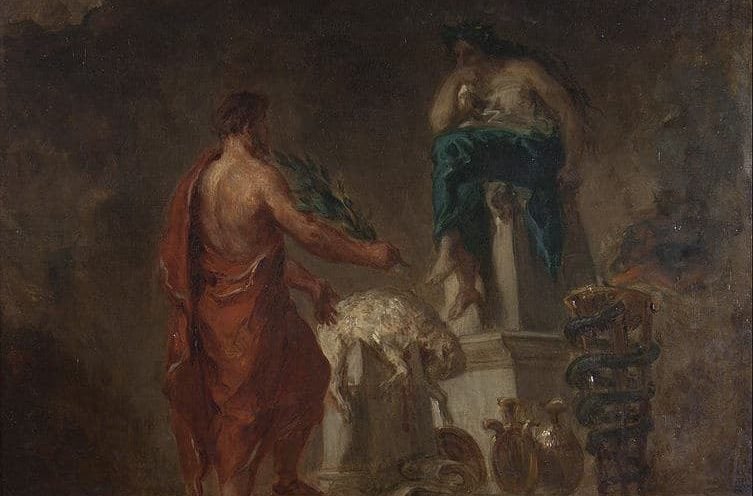
Lycurgus Consulting the priestess Pythia at the Oracle of Delphi. Credit: Wikipedia/Public domain.
In a time and place that offered few career opportunities for women, the job of the priestess of Apollo at the Oracle of Delphi stands out. Her position was at the centre of one of the most powerful religious institutions of ancient Greece. The competing Greek city states had few overarching authorities (political or otherwise), so the significance of her voice should not be underestimated.
Indeed, there is some evidence to suggest that the priestess Pythia was at the core of what we today call a “knowledge economy.” Her role may well have involved the gathering, re-packaging, and distribution of information, with the ultimate intent of providing sound advice on the trivial and not-so-trivial questions of life in ancient Greece.
The “Pythia” is the official job title. We know of several women by name who, during the long history of this institution (from ca. 800 BC to AD 390/91), held that role, including Phemonoe and Aristonike. Indeed, at some stage, Delphi became so busy that three Pythias were appointed to serve in the role simultaneously.
The oracle was consulted by the movers and shakers of ancient Greece on a diverse range of problems. For the priestess Pythia, this meant the opportunity to comment on a variety of issues of public and individual concern: cult matters, warfare, the relationships between existing city-states, and the foundation of new ones.
Numerous personal questions were also put to the oracle on matters of lovesickness, career advice, childbirth, and how to get offspring. So, by all standards, this job was demanding yet also diverse and rewarding—a position powerful enough to change the course of history.
Yet, right from the beginning, efforts to deprive the priestess of her power prevailed, particularly in older classical scholarship. Surely a woman, especially one in such a paternalistic society as ancient Greece, could not hold that powerful a position?
Some scholars suggested that the Pythia actually babbled unintelligible gibberish and that her words were later put into beautiful, deep, and meaningful hexameter verse—by male priests.
Yet, in our ancient sources, there is absolutely nothing to suggest that it was anyone other than the Pythia herself who came up with the responses. On the contrary, she is regularly named as the one and only source of the prophecies delivered at the Oracle of Delphi. There is no word of male priests beyond those in purely administrative and assisting roles.
Insult by oracle
The position of the Pythia seemed to have entailed the extraordinary opportunity to speak unwelcome truth to those in power.
A Spartan once approached the oracle with the intention of being confirmed as the wisest man in the world. In response to this question, the Pythia named another person who was wiser.
In about 700 BC, the Greek city of Megara allegedly asked the Pythia which the best of all Greek cities were, hoping to be named first. The Pythia mentioned two better cities, concluding with the line, “[Y]ou, o Megarians, [are] neither third nor fourth.” Surely, the Megarians did not see that coming!
Cleisthenes, meanwhile, the famous tyrant of Sicyon, asked whether he should remove the cult of the hero Adrastus from the city. He received an oracle that came straight to the point: “Adrastus is king of Sicyon, and you but a common slayer.”
This kind of reality check and straight talk would certainly have upset those with egos accustomed to flattery and agreement.
Of course, it is not always possible to tell whether these and other responses of the oracle were authentic or whether the whole incident was part of later historiographic lore. Yet, whatever the case: the fact is that it was a woman who was attributed such a sharp, judgmental voice.
And her voice proved extraordinarily unimpeachable. The Greeks thought that it was the god Apollo who conveyed his superior divine knowledge through the mouth of the Pythia, so the priestess herself was largely beyond reproach. While itinerant seers, augurs, and oracle mongers feature in classical literature as corrupt and unreliable, the position of the Pythia seems to have withstood all criticism.
The job and its challenges
Being a Pythia was not always easy. Several ancient enquirers sought to influence the kind of answer they hoped to get from the oracle. Subtle manipulation in how the questions were put, not-so-subtle bribery, and even an attempt to force the oracle to deliver responses on a non-auspicious day are all on record, as are complaints about unfathomable responses.
For instance the Greek historian, philosopher, soldier, and horse whisperer, Xenophon, allegedly enquired at Delphi to which deity he should sacrifice and pray so that the military expedition he was about to join would be a success. He was later reprimanded by the philosopher Socrates for having posed a manipulative question. Socrates felt he should have asked whether it would be a success, rather than how.
Cleisthenes was said to have bribed the Pythia to deliver the same response to all Spartan requests at the oracle, no matter the question: to free Athens from the rule of tyrants.
And after a series of spectacular mishaps based on misread oracles, the Lydian king Croesus complained at the Delphic Oracle about having been misled. The Pythia responded that he himself was to blame for his misfortune, as he should have interpreted the Pythia’s words correctly.
We also know of several instances in which the Pythia outright refused to respond to a question that, in one way or another, seemed unreasonable.
Job requirements
What did it take to become the Pythia? Was she a local girl from a neighboring village? Was any kind of training provided to candidates? Or were they thrown in the deep end?
Unfortunately, the ancient sources are silent. The Nobel prize-winning author William Golding in his (posthumously published) last novel, The Double Tongue, written from the perspective of a Pythia, sees her as a local girl who was unable to get herself married and so took on that role.
Yet again, this sounds like speculation designed to downplay the position.
The kind of skills required to be successful in the role are easier to reconstruct. The sanctuary of Apollo at Delphi served as a marketplace for representatives from all over ancient Greece (and beyond) who came for a variety of reasons.
In addition to the oracle, the sanctuary housed regular athletic competitions (the so-called Pythian Games, analogous to the more famous Olympic Games). With its numerous temples and monuments, the site was also a popular tourist destination. All these activities together served to establish a busy hub, where information, news, and gossip of all kinds would have circulated freely.
Perhaps the key to the Pythia’s success was simply to listen closely? There is good evidence to suggest that the fantastic tales of prediction and fulfilment are a matter of the (later) historiographic tradition and that it was mostly quite straightforward questions of everyday life that were put to the Pythia for comment, along the lines suggested by the ancient author Plutarch, who was also a priest at Delphi: Will I win? Shall I marry? Is it a good idea to sail the sea? Shall I take up farming? Shall I go abroad?
If this was indeed the case, it would, more often than not, have been possible to glean the information necessary to answer any particular enquiry from the chatter of those queuing to consult the oracle, to watch or participate in the games, or to take in the monuments. The Pythia may have trailblazed the knowledge economy millennia before the arrival of “big data” and the invention of the internet.
By Julia Kindt
Julia Kindt is a Professor, Department of Classics and Ancient History, University of Sydney. The article was published at The Conversation and is republished under a Creative Commons License.
In ancient Athens, there was a custom of sacrificing an ox in the Sanctuary of Zeus Polieus. Credit: Capillon, Public Domain
In ancient Greece, the killing of an ox was prohibited by law due to its vital role in daily life. However, a peculiar and ‘unlawful’ custom saw priests performing the sacrifice of an ox at the Sanctuary of Zeus, the king of the gods, located on the hill of the Acropolis, just a few meters from the Parthenon.
The Diipoleia, also known as Buphonia, was an ancient festival of the Athenians held towards the end of every June. It was also celebrated separately in other Greek cities during antiquity.
The Buphonia ritual and its origin
According to tradition, to justify the sacrifice, a group of oxen was led to the temple. There, the priest would place a type of bread offering made of wheat and barley on the altar. The first ox to eat from this area would be considered to have committed blasphemy, as it was believed to have consumed the offering meant for the god, and therefore had to be killed.
The priest chosen to perform the killing did so in isolation, without any witnesses present, and would then flee the city.
However, since ox sacrifices were forbidden at the time, an “investigation” was launched to identify the culprit. When the rest of the priests gathered to determine who had performed the sacrifice, the guilty priest was missing. In the end, the only evidence left would be the axe used for the killing, which would eventually be thrown into the sea.
How the ritual was performed
Ancient Greek geographer and traveler, Pausanias, provides further details in his account:
“There is a statue of Zeus—one by Leochares and another called Polieus. Concerning the established practices for the sacrifice and the reason said to justify them, I will not record them here.
For Zeus Polieus, they would place barley mixed with wheat on the altar without any kind of guard. The ox, which they have prepared for the sacrifice and kept under watch, approaches the altar and begins eating the grain. A member of the Thalonid family sacrifices the animal that eats from the sacred offerings with a double-headed axe.
They then summon a priest, called the ‘ox-slayer’ (buphonos), who kills the ox and, in accordance with the law, throws away the axe and flees. Since the identity of the person who committed the act remains unknown, they bring the axe to trial instead. Afterwards, they enter the temple that they call the Parthenon.”
The Buphonos and the trial of the axe
It was believed that the ancestor of the Thalonids, Thalon, was the first to strike the ox. Neoplatonic philosopher Porphyry, attributes the first buphonia to a foreigner named Sopater. He also provides a shorter version of the story, in which the priest of Zeus, Diomos, “murdered” the animal.The others then cut up the sacrificial victim and ate it.
Afterwards, they would hold a trial to determine the guilty party responsible for the killing. The buphonos (ox-slayer) did not appear, while those who participated in the sacrifice accused one another. They shifted responsibility for the killing from one man to the other.
The participants included the water carriers who brought water for the sacrificial tools, those who sharpened the knife and axe, as well as individuals responsible for carrying the tools.
Ultimately, they would accuse the knife, condemn it, and toss it into the sea. The ox’s hide was stuffed with straw and yoked to a plow. They did this to create the illusion that the animal was still alive.
The entire ritual permeated participants with intense feelings of guilt over the slaughter of the animal, and it was regarded as an act of murder.
The entire ritual permeated participants with intense feelings of guilt over the slaughter of the animal. Credit: Wikimedia commons, Public Domain
Rituals, beliefs, and symbolism
It is noteworthy that, according to Porphyry, after the buphonos Sopater fled to Crete and before the establishment of the festival in Athens, a plague struck the city. The plague only ceased after Sopater’s return and the institution of the festival.
Additionally, as part of the measures to address the plague, the Oracle of Delphi deemed the establishment of the ritual involving the stuffing of the animal’s hide as necessary.
To avoid the pollution (miasma) of the murder, they made efforts to eliminate the act of murder itself. When this was not sufficient, they attempted to justify the act, for example, by claiming that the defilement resulted from impiety.
Finally, they shifted human responsibility by attributing the miasma to an inanimate tool, which became the scapegoat of the entire ritual. This object absorbed the miasma and was then removed from the city.
The ox, which they have prepared for the sacrifice and kept under watch, approaches the altar and begins consuming the grain. A member of the Thalonid family sacrifices the animal that is fed from the sacred offerings with a double-headed axe. Credit: Wikimedia Commons, Public Domain
Spiritual significance and agricultural connections
According to ancient Greek philosopher Theophrastus, the remains of the ox were buried. Presumably, this was so as to prevent its spirit from seeking revenge on the city. It is important to note that, in this ritual, the value attributed to the spirit of the animal is equivalent to that given to a human.
British classical scholar and linguist Jane Harrison, connects the use of offerings to attract the animal to the altar with the rites of Dionysus Zagreus and Isodaites. Furthermore, the yoking of the stuffed hide of the ox to the plow associates the festival with fertility rituals, which pertain to chthonic deities.
This ritual of purification and averting evil was initially connected to the need to ensure an abundance of game in a pre-agricultural society. Later on, an agricultural society adopted it, shifting the focus to the fertility of the land.
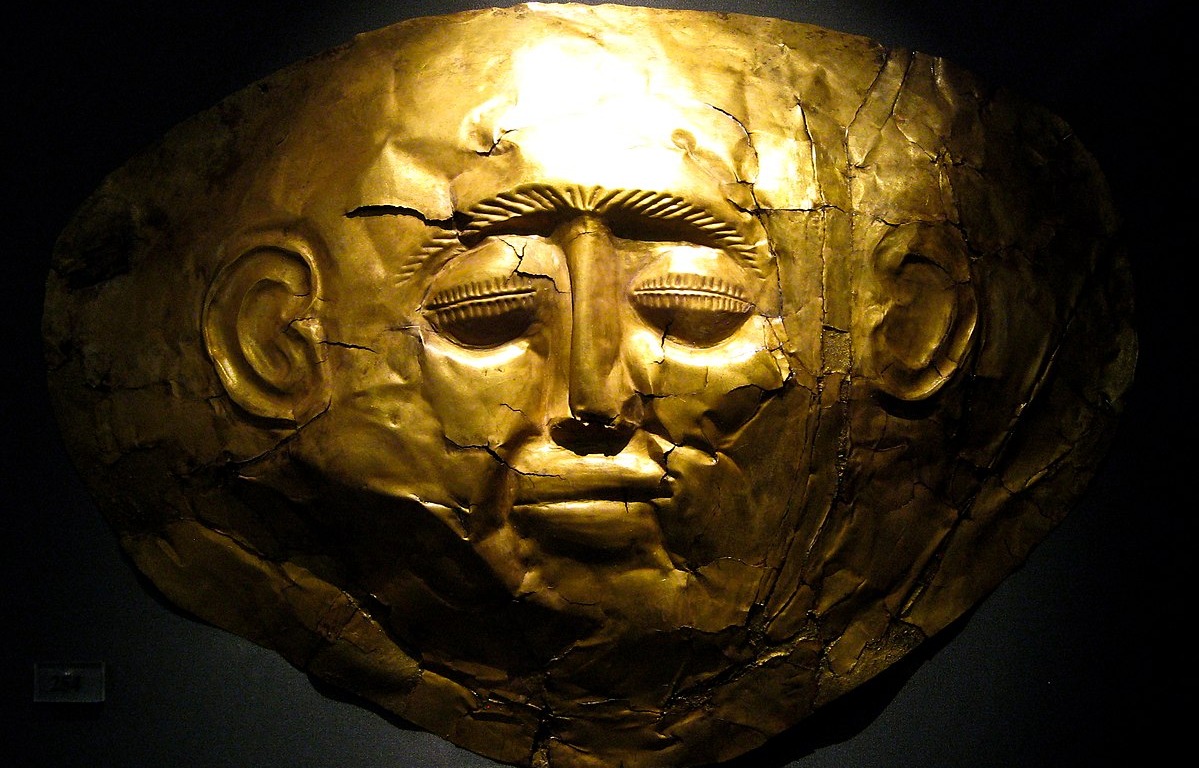
A gold Mycenaean death mask found in Greece. Credit: Sharon Mollerus / Wikimedia Commons / CC BY 2.0
Since the 19th century, several precious gold objects associated with the Mycenaean civilization have been discovered by archaeologists, predominantly at important burial sites where the royals and elite of Bronze Age Greece were buried.
The Mycenaeans were the first distinctly Greek culture to dominate mainland Greece during the late Bronze Age period between c. 1750 and 1050 BC. Their civilization was characterized by palatial states, advanced urban organization, and a written language dubbed Linear B by modern historians. It was during the Mycenaen age that the Trojan War purportedly happened, as retold in Homer’s Iliad.
The discovery of Mycenaean gold sheds light on the material culture of this enigmatic civilization but there are still many unanswered questions. For example, researchers are unsure whether the Mycenaeans crafted all of these items themselves, or whether they were obtained in trade and war.
The most famous examples of Mycenaean gold were discovered in two grave circles uncovered at the ancient Bronze Age site of Mycenae. Grave Circle A was discovered by Heinrich Schliemann in 1876 based on the descriptions of Homer and Pausanias. Grave Circle B was excavated in 1952 by archaeologists Ioannis Papadimitriou and Georgios Mylonas after workmen accidentally stumbled on the tombs a year before.
Both grave circles, dating back to the 16th century BC, contained impressive amounts of gold objects and other precious items. Unlike other Bronze Age tombs, they had not been discovered by the grave robbers and looted.
Grave Circle A contained 15 kg (33 lbs) of gold alone, making it one of the most substantial archaeological finds in all of Europe. Both grave circles contained hundreds of previous objects including jewelry, ornamental clothing attachments, decorated weapons, and highly distinctive funeral masks.
The Grave Circle An archaeological site at Mycenae. Credit: Andreas Trepte / CC BY-Sa 2.5 / Wikimedia Commons
The Death Mask of Agamemnon
The most iconic find is the so-called Death Mask of Agamemnon. Schleimann named the mask after the legendary Mycenaean King Agamemnon who led the Achaean Greeks in the Trojan War according to Homer’s Iliad. However, more recent research has indicated that the mask predates the time that Agamemnon was supposed to have lived by about three centuries.
The Mask of Agamemnon was crafted utilizing a single large gold sheet that underwent heating and hammering against a wooden surface. The intricate details were then added through the process of chasing, using a sharp tool to etch them onto the mask.
There were six other death masks discovered in Grave Circle A. Of the seven masks, six belonged to adult males and one to a child. None of the women discovered at the gravesite were buried with ornate masks.
The masks in Grave Circle A exhibit similar characteristics, featuring flat foil-like layers of gold depicting round, bald faces with round eyes and prominent ears. In contrast, Grave Circle B includes a death mask made of electrum, placed in a container next to a buried body instead of being placed on the deceased. The scarcity of death masks in Grave Circle B suggests that the interred individuals held lower wealth or status compared to the abundance of valuable material found in Grave Circle A, including the death masks.
Mycenaean death masks. The one on the right is the so-called “Mask of Agamemnon”. Credit: Zde / CC BY-SA 3.0 / Xuan Che / CC BY 2.0 / Wikimedia Commons
The Royal Tombs at Pylos
The burials at Mycenae might have provided the most famous examples of Mycenaean gold, but they are not the only Bronze Age tombs where exquisite items have been found.
In 2019, a team of archaeologists discovered Bronze Age royal tombs situated near the royal palace of Pylos, said to have once been the seat of power for Nestor, the eldest among the Greek rulers who fought in Trojan War.
The larger tomb, which was once 12m (36 feet) wide and 4.5 meters (15 feet) deep, had stone walls that once stood as tall as the ground’s height. The underground chambers were originally covered by domes, but over time, the roofs and upper walls collapsed. Consequently, the tombs became buried beneath numerous melon-sized stones and a tangled mass of grape vines. In their excavation efforts, archaeologists from the University of Cincinnati, including Jack Davis, Sharon Stocker, and their colleagues, had to painstakingly clear away vegetation and manually remove the stones.
Mycenaean bronze sword with a gold hilt and featuring a lion motif, from Grave Circle B, Mycenae. Credit: Gary Todd / CC0 / Wikimedia Commons
What they discovered, however, was extraordinary. Among the debris, the floors of the burial pits were adorned with shimmering flakes of gold leaf, which had once embellished the walls and floors of the chambers. The tombs, although lacking the remains of their occupants – suggesting a potential disturbance in the distant past – were nonetheless filled with opulent artifacts such as jewelry, gold, bronze, and gemstones.
A particularly interesting find was a gold pendant bearing the image of the Egyptian goddess Hathor who presided over motherhood and the protection of the dead. The Greeks during later periods drew parallels between Hathor and Aphrodite but it is not entirely clear what she meant to the Mycenaean Greeks during the Bronze Age. In any case, the artifact hints at trade links between the Mycenaeans and Egyptians at the time of the burials, which are believed to be about 3,500 years old.
A gold elliptical diadem. Credit: I, Sailko / CC BY-SA 3.0 / Wikimedia Commons
Gold Mining in Mycenaean Greece
As pointed out in an academic paper authored by M. Vavelidis and S. Andreou, “Numerous objects of gold displaying an impressive variety of types and manufacturing techniques are known from the Late Bronze Age (LBA) contexts of Mycenaean Greece, but very little is known about the origin and processing of gold during the second millennium BC.”
This raises several questions, namely: where did the Mycenaeans source their gold from? Interestingly, the wider Argolid region in which Mycenae was itself located and where the discoveries were made of numerous stunning golden items, is bereft of gold. If the Bronze Age Greeks did their own mining it was therefore elsewhere in Greece.
According to Vavelidis and Andreou, “Ancient literature and recent research indicate that northern Greece is probably the richest gold-bearing region in Greece, and yet very little evidence exists regarding the exploitation of its deposits and the production as well as use of gold in the area during prehistory.”
16th century BC Mycenaean earring. Credit: Louvre Museum / Public Domain / Wikimedia Commons
Nevertheless, by examining the chemical composition of prehistoric artifacts from two settlements alongside the composition of gold deposits in their nearby regions, it becomes evident that gold was locally sourced in some parts of Greece. This finding also raises the possibility that a portion of the Mycenaean gold may have originated from northern Greece.
Furthermore, the discovery of small stone crucibles, one of which bore visible traces of gold melting, at the archaeological site of Toumba in Thessaloniki, proves that local production of gold items took place very early in ancient Greek history.
Beyond mining, the Mycenaeans may also have obtained gold via trade and war. In some cases, Mycenaean traders may have bought gold for Greek craftsmen to shape into various objects, and in other cases, they would have imported finished items.
The Mycenaeans were well-respected as warriors across the Eastern Mediterranean and sometimes fought in the armies of neighboring civilizations like the Egyptians as mercenaries. The leaders of these Mycenaean mercenary bands may have received gold as payments or gifts in exchange for their martial services.
Recent research shows that ancient Greeks used a primitive type of lifting machine to move heavy stones before they began using cranes 2,500 years ago.
It is commonly believed that the foremost discovery of the ancient Greeks in building technology is the crane. Yet, enormous stone structures were known to have been built in Greece at least 150 years before the use of cranes themselves.
Cranes first appeared in the late sixth century BC, according to research published in the Annual of the British School at Athens, but their mechanical forerunners were used in buildings such as the Temples of Isthmia and Corinth at least 150 years before that, around the middle of the seventh century BC.
The researchers say that ancient Greeks were likely to have first used ramps made of earth or mudbrick to lift the heavy stone blocks used in major construction. The lifting devices are thought to have been similar to the ones used by ancient Egyptians and Assyrians centuries earlier.
An ancient Roman crane, which was modeled after the earlier ancient Greek invention. Credit: Michael Gunther/ Wikimedia Commons/ CC BY-SA 4.0
The precursor of the crane lifting machine
The paper, written by Alessandro Pierattini, an assistant professor of architecture at the University of Notre Dame, argues that a kind of lifting machine used by the ancient Greeks was the next precursor to the crane, one which was capable of lifting ashlar blocks weighing over 200 to 400 kilograms (440 to 880 pounds).
The lifting machine was originally invented by the Corinthians, who used it to build ships and for lowering heavy sarcophagi into narrow, deep burial pits. It was not a crane, since it did not use winches or hoists. Instead, the builders redirected the force of the weight by using a rope passed over a frame.
“This kind of masonry represents a crucial step in the development of Greek monumental stone architecture, marking a departure both from mudbrick construction, which had been the norm for most Greek buildings, and from previous experiments with stone construction,” Pierattini writes.
The first documented use of the lever in Greek temples
Evidence of the device is considered to be grooves etched onto the bottom of stones used to construct the Corinth and Isthmia temples. These grooves are familiar to historians, but until now, it had been unknown if the grooves had occurred as a result of lifting the blocks during the building process or from moving them around in quarries.
For the study, Pierattini studied stone blocks used in early Greek temples while he also engaged in some hands-on experimental archaeology. He studied the blocks from the mid-seventh-century temples at Corinth and Isthmia and their peculiar markings—two parallel rope-grooves cut into their undersides which turned up on one end.
Using actual stones and ropes, Pierattini found that the grooves could have served a dual function, allowing builders to both lift the blocks and position them tightly against their neighbors along the walls of buildings.
“With heavy stone blocks and high friction between stone surfaces, this was a highly problematic step of construction that in later times would require sets of purpose-made holes for using metal levers,” said Pierattini.
“Μy paper demonstrates that the builders of the early temples at Corinth and Isthmia were already using levers for the final setting of the blocks. This represents the first documented use of the lever in Greek architecture,” the professor explained to Gizmodo.
Triumphant Achilles dragging Hector’s body around Troy, from a panoramic fresco of the Achilleion. Credit: Franz Matsch / Public Domain
He was the swift-footed Achilles, the greatest warrior of the Trojan War, a semi-divine hero whose very name was synonymous with speed and power. And yet, for centuries, the smart brilliance of an ancient Greek philosopher has left him perpetually—and quite comically—stuck behind a tortoise. Zeno’s paradox presents a philosophical conundrum that still captivates people millennia after it first questioned the intellectual doctrines of Ancient Greece.
It is a paradox that prompts us to question the nature of motion and reality itself. Specifically, it compels us to explore the infinite—a concept that still confounds quantum physicists today.
Zeno’s Paradox: The problem with Achilles and infinite steps
Picture the scene: Achilles, in all his glorious, muscular beauty, lines up against a tortoise. The tortoise, naturally, gets a head start—a gesture of fair play, one might say, that quickly devolves into philosophical torture.
Credit: Loco Steve, Wikimedia Commons, CC BY-SA 2.0 (left), Greek Reporter archive (right)
During this event, Achilles, being well, would instantly sprint past the slow tortoise. But Zeno, with a mischievous twinkle in his eye, argued otherwise. Before Achilles can even reach the position where the tortoise started, the cute little animal will have managed to go forward a little compared to its initial position.
When Achilles finally arrives at that particular spot, the tortoise has moved again. This would carry on forever. This continuous cycle, Zeno noticed, continues ad infinitum, meaning Achilles is forever playing catch-up, never truly reaching the tortoise. It sounds childish and blatantly wrong, but is it? Think about it. It makes sense. It’s enough, at least, to make you wonder about what’s real and what isn’t.
Zeno of Elea’s Achilles paradox. Credit: Aelwyn. CC BY-SA 4.0/ Wikimedia Commons/Aelwyn
This confused the ancient Greeks, whose understanding of infinity was still rudimentary. It challenged the very idea of continuous motion, suggesting that movement itself might be an illusion, a series of frozen moments rather than a fluid progression. Indeed, Zeno’s mentor, Parmenides, had famously argued that reality was static and unchanging, and our perception of movement was nothing but a trick of the senses.
Zeno, always the loyal—and brilliant—student, used his paradoxical skills skillfully as an intellectual shield for this peculiar paradox. One can almost imagine the expressions on the faces of Athenian philosophers as Zeno calmly explained why their fastest runner could never quite outrun a slow tortoise.
Of course, modern humans comprehend concepts such as calculus, therefore understanding that Zeno’s apparent deadlock is resolved. Mathematicians like Newton and Leibniz, centuries later, demonstrated that an infinite series of ever-decreasing distances can indeed sum to a finite total.
This means that in Zeno’s paradox, Achilles does overtake the tortoise; the finish line, for him, is not an illusion. Yet, to dismiss Zeno’s paradox completely as a mathematical footnote and a logical mistake would be to miss its profound impact on human thought.
It was a puzzle that had such a consequential effect that it shaped our understanding of the universe. Consider quantum mechanics, for example, where particles seem to exist in multiple states simultaneously—a concept similar to Zeno’s discomfiting fragmentation of reality.
Our digital devices work by breaking down continuous processes into tiny, distinctive steps. This is similar to how a movie creates the illusion of motion from individual frames. This approach, which traces back to Zeno’s ideas about infinitely dividing space and time, is embedded in much of our modern technology.
However, beyond academia and the complex equations of physics that ordinary people can’t even comprehend, the paradox of Achilles and the tortoise has a surprisingly relatable, almost melancholic, wisdom for our own lives that is easier to grasp.
Modern life sometimes feels like the paradox of Achilles and the tortoise: A never-ending struggle to reach our goals, only to realise it’s not possible. Credit: Greek Reporter
Achilles and the tortoise as a modern metaphor for our lives
How many times have we felt like Achilles, tirelessly chasing a goal, a dream, or even just the promise of a calmer, better tomorrow, only for it to perpetually remain just out of reach? Life, too, often feels like a series of infinite, tiny steps, each requiring immense effort, each seeming to bring us no closer to the finish line despite the progress we make daily.
Yet, Achilles and the tortoise, when illuminated by the light of calculus, can become a story of hope. It tells us that even an infinite process can have a finite, tangible result, perhaps representing the better tomorrow we all strive for. Progress is undeniably real, however gradually it arrives.
So, the next time you feel stuck, relentlessly pursuing a goal that seems to go further away with every step, remember Achilles and that remarkably slow tortoise.
Zeno, the ancient Greek mastermind, may have created this paradox to confound his contemporaries. But in doing so, he left us with a timeless truth: movement—whether through space, thought, or life itself—is never as simple as it appears. Yet, if we keep putting one foot in front of the other, even if the journey feels impossibly long, like Achilles, we will get there. Eventually.
Early Greek alphabet painted on the body of an Attic black-figure cup. Today, there are missing letters in the Greek alphabet. Credit: flickr / Dan Diffendale CC BY-SA 2.0
The Greek alphabet has changed in many ways over the course of its existence. This is hardly surprising, given that the Greeks have been using it for nearly three millennia. One way in which it has changed is that some letters that used to exist in the Greek alphabet are now missing. Which letters were these, and what do we know about them?
The first letters of the Greek alphabet
To start, let us establish how the Greek alphabet acquired its letters in the first place. According to ancient Greek historians, the Greeks adopted the Phoenician alphabet after the arrival of a Phoenician prince named Cadmus. Archaeology confirms that this occurred at some point in the ninth century BCE.
The Phoenician alphabet was composed of only consonants. When the Greeks adopted it, they modified it to include vowels as well. This was a major step forward in the development of writing.
According to Plutarch, a Greek historian of the first century CE, there were originally sixteen Greek letters. However, Hyginus, an earlier writer, reports that there were originally eighteen.
In reality, it appears that neither version is correct. Physical evidence in the form of ancient inscriptions reveals that the earliest Greek inscriptions made use of all twenty-two letters in the Phoenician alphabet. However, four of these were for sounds which did not exist in Greek, so they were modified into vowels.
Perhaps this is where Hyginus’ idea of eighteen original letters comes from, being a distorted memory of the eighteen original consonants. In any case, the total number of letters in the Greek alphabet increased over time.
Why are there some missing letters?
Some of the letters used in ancient Greek inscriptions are simply not in the modern Greek alphabet. Why is this? Simply put, the reason is that the Greek language itself has evolved over time, and the alphabet exists to comply to the needs of the language rather than vice versa.
Additionally, different dialects of the Greek language existed within the Greek world at the same time. Therefore, the needs of each dialect would not necessarily be covered by the same letters.
In the late fifth century BCE, the alphabet used by the Ionian Greeks became the official, standardized alphabet of Athens. Over the following century, it then replaced the local alphabets of other Greek regions. By that time, the dialect of the Ionian Greeks was such that their alphabet did not make use of all the letters that had once been in use. Rather, their alphabet used just twenty-four letters. Hence, what were the letters that the Greek alphabet used to have but no longer does?
Digamma
One of the most famous lost letters of the Greek alphabet is Digamma. This had the following form:
Ϝ
It is superficially very similar to the modern F, but the sound was completely different. It was essentially the modern w sound. In fact, the original name for this letter was ‘wau’, taken directly from the Phoenician name for this letter.
San
Another lost letter is San. This had the following form:
Ϻ
Like Digamma, this looks almost identical to a more familiar letter. In this case, it looks just like the modern letter M. However, like with Digamma, the sound indicated by this ancient letter was completely different. Unlike the modern M, the ancient San, or Ϻ, was used to indicate an s sound. This fell out of use in favor of the alternative letter Sigma, written as Σ.
Koppa
Another letter that is no longer in use is Koppa, which had the following written form:
Ϙ
This is similar to the modern Q in the English alphabet, and that is no coincidence. Koppa was still part of the Greek alphabet when the Latins adopted it, which led to this letter eventually becoming the Q in English. The English alphabet originated from the Romans. The sound Koppa indicated was a k sound. It eventually fell out of favor in Greek, being replaced by the alternative letter Kappa, written as Κ.
Sampi
This next letter is called Sampi. It was written as:
Ͳ
This is very similar to the modern T, but it is unrelated. That modern letter comes from the ancient Greek Tau which, of course, had a t sound. In contrast, the ancient Greek Sampi had some kind of s or sh sound, although the exact vocalization is unknown. In any case, it fell out of favor when this sound was no longer used.
Erasistratus discovers the cause of the illness of Antiochus. Painting by Jacques-Louis David. Public Domain
Ancient Greek scientist Erasistratus (300-250 B.C.) is credited with being among the first human lie detectors. He devised a specific technique to read a person’s physical response so as to spot when an individual was lying.
While in Alexandria, Egypt, he is said to have proven Prince Antiochus was desperately in love with his father’s new wife, Stratonice. He noted how his pulse increased significantly whenever the queen’s name was mentioned, despite his insistence that he did not have the hots for his stepmother.
Love-struck, he fell ill with passion and chose to pine away in silence. The physicians were unable to discover the cause and nature of his disease.
Erasistratus himself was at a loss at first, until, finding nothing amiss about his body, he began to suspect that it must be the man’s mind that was diseased and that he might perhaps be in love.
Erasistratus confirmed his conjecture when he observed that the skin of Antiochus grew hotter, his color deeper, and his pulse quicker whenever Stratonice came near him, while none of these symptoms occurred on any other occasion.
The Greek physician eventually told the father, King Seleucus, that his son’s disease was incurable, for he was in love with the monarch’s wife and that he chose to die rather than to disclose his secret.
According to the anecdote, Seleucus not only gave up Stratonice, but also resigned to his son several provinces of his empire.
Erasistratus founded school of anatomy in Alexandria
Erasistratus, along with fellow physician Herophilus, founded a school of anatomy in Alexandria where they carried out anatomical research.
He is credited for his description of the valves of the heart. He also concluded that the heart was not the center of sensations. Instead, he said, it functioned as a pump. He was among the first to distinguish between veins and arteries, believing that arteries were full of air and carried the “animal spirit” (pneuma).
Together with Herophilus, he is credited by historians as the potential founder of neuroscience due to his acknowledgment of nerves and their roles in motor control through the brain and skeletal muscles.
Furthermore, Erasistratus is seen as one of the first physicians/scientists to conduct recorded dissections and potential vivisections alongside Herophilus.
The two physicians were said by several Roman authors, notably, Augustine, Celsus, and Tertullian, to have performed controversial vivisections on criminals to study the anatomy and possible physiology of human organs while they were in Alexandria.
Archbishop of Athens and all of Greece, Ieronymos. Photo Credit: AMNA
A new bill introduced by the Greek Ministry of Finance recently in the nation’s Parliament includes sweeping salary increases for the highest-ranking officials of the Orthodox Christian Church of Greece. Under the proposed legislation, the Archbishop and Metropolitan Bishops will see their monthly gross pay rise by as much as 95%, standardizing their new salaries at €4,671.90.
Greece to restructure how Bishops are paid
The adjustments, outlined in Article 56 of the extensive finance bill, fundamentally change how the state compensates senior clerics. Rather than utilizing the previous tiered allowance system, the new legislation equals the base pay of Metropolitan Bishops with that of the Archbishop of Athens and All Greece.
Both positions are now pegged directly to the compensation of top government executives. Specifically, the hierarchs will receive 90% of the maximum gross salary allotted to a Ministry General Secretary. The public sector basic salary limit for General Secretaries adjusts to €5,191 effective April 1, 2026. The legislation calculates the new clergy pay explicitly as 90% of this figure. The bill firmly states that no other supplementary benefits or allowances will be paid beyond this established rate.
Prior to this legislative update, senior clergy salaries fluctuated based on specific representation expenses and educational qualifications, such as holding a master’s or doctoral degree. The contrast with the new pay scale is significant:
The Archbishop: Previously earned a monthly gross income ranging from €2,840 to €2,915. The adjustment delivers an approximate 60% baseline increase.
Metropolitan Bishops: Previously collected between €2,400 and €2,475 monthly. Under the new equalization framework, their gross pay jumps by up to 95% to match the Archbishop.
Assistant and Titular Bishops: The bill standardizes compensation for lower-ranking hierarchs, setting their total monthly salaries at exactly 70% of the top-tier rate.
Wider public sector wage adjustments
While initially framed around measures combating the energy crisis and supporting vulnerable groups and pensioners, the bill extends far beyond ecclesiastical pay. The legislative package contains comprehensive wage restructuring for various sectors of the Greek state apparatus.
Articles 49 through 55 dictate specific salary and promotional adjustments for the judiciary and civil service. Judicial officers facing delayed promotions due to a lack of open vacancies will receive calculated percentage adjustments to their base pay, depending strictly on their accumulated years of service.
The bill also implements hard compensation caps for other public servants. Members of constitutionally protected independent authorities who hold supplementary government positions cannot exceed 80% of a judicial officer’s total pay. Finally, the legislation actively standardizes the pay scales for administrative staff serving both the Presidency of the Government and the Presidency of the Republic, ensuring direct alignment with the updated 2026 public sector guidelines.
A digital representation of Ctesibius. Credit: Greek Reporter archive
Ever found yourself scratching your head, wondering if aside from legendary philosophers and epic poets there were also any “tech gurus” in ancient Greece? When the conversation turns to Greek scientific minds, one might think of figures like Archimedes and Euclid and rightly so. However, there’s a name that truly deserves a much brighter spotlight—that of Ctesibius.
Ctesibius was a true genius of Hellenistic Alexandria, who, quite literally, set the wheels (and yes, the water organ, or hydraulis!) in motion. Due to his brilliant mind, he laid down fundamental principles for technologies that, believe it or not, continue to shape our everyday world to this very day.
Ctesibius was one of ancient Greece’s greatest innovators
Born into the vibrant, intellectual epicenter of Alexandria during the Ptolemaic era, Ctesibius became a hands-on inventor, driven by an almost insatiable curiosity to truly understand and harness the raw power of the natural world.
Imagine at a time when entire civilizations relied on human muscle and simple machines, seeing someone create music from water or build a clock accurate for two thousand years. The sheer innovative audacity of Ctesibius was difficult to fathom.
Of course, at a time of wizards, this wasn’t a magic trick but the real, unadulterated brilliance of the mind of this Greek man. His groundbreaking contributions to pneumatics, the study of compressed air, and hydraulics, the science of liquids in motion, were utterly revolutionary for their time, making Ctesibius the “father of pneumatics.”
Just think about the fact that long before your car tires ever saw a pump or your pneumatic drill came to life, Ctesibius meticulously explored the very principles that made these tools possible. It’s a bit humbling, isn’t it, how many unsung heroes from antiquity have genuinely shaped the modern world we so often take for granted?
Reconstruction of the ancient hydraulis on display at the Kotsanas Museum in Athens. Credit: Aga39memnon, Wikimedia Commons, CC BY 4.0.
From melodic water organs to clocks
Among Ctesibius’ most well-known creations was the hydraulis, a genuinely revolutionary water organ. This was, quite simply, the world’s very first keyboard instrument. What an astonishing feat of engineering from over two millennia ago! It ingeniously utilized water pressure to guarantee a completely constant supply of air to its pipes, producing a sound that was remarkably stable and resonant. Imagine the awe of ancient audiences in hearing such a complex, melodic instrument for the absolute first time. It must have felt like nothing short of a miracle.
Beyond the enchanting music, Ctesibius’ improvements to the clepsydra, or water clock, were equally impressive. Prior to this tech guru, water clocks were notoriously imprecise. He revolutionized them through innovative mechanisms for regulating water flow and added an indicator system that provided unprecedented accuracy.
For over 1,800 years, his water clocks were the absolute gold standard in timekeeping. In other words, the pinpoint accuracy of your smartphone’s clock owes an indirect yet profoundly deep debt to a man who lived centuries before the mere concept of electricity was even a thing.
Ctesibius’ water clock, the first alarm clock ever, as depicted by an architect in the 17th century. Credit: Wikimedia Commons, Public domain
Ctesibius’ impact on our world
While Ctesibius himself may not have managed to become one of ancient Greece’s top names, his principles and inventions survived the test of time. They influenced later Roman and Arab engineers and eventually powered the European Renaissance. The very force pump he designed, for instance, is a direct progenitor of modern pumping systems, absolutely essential for everything from our city water supplies to the fire engines we rely on to keep us safe on a daily basis.
His profound understanding of the properties of air-laid processes set the foundation for all future pneumatic applications which today power everything from colossal industrial machinery to delicate medical devices. Hence, next time you hear the satisfying whoosh of a bus door, the gentle hiss of an automated machine, or simply admire the quiet precision of a modern watch, take a moment to think back to Ctesibius, the ancient Greek tech genius.
Under these plans, the Sofia-to-Athens route would be completed in six hours, compared to the current 13.5 hours. Credit: 21st Europe
A highly ambitious transportation proposal aims to connect Athens with approximately 40 other destinations in Europe through a high-speed “mega-metro” rail network by 2040. Dubbed “Starline,” the blueprint of this plan hopes to replace Europe’s fragmented national railways with a unified 22,000-kilometer (14,000-mile) system, significantly reducing travel times for Greek and European passengers overall, offering a green alternative to short-haul flights.
Developed by the Copenhagen-based think tank 21st Europe, the Starline project proposes five major railway corridors spanning 22 nations across Europe. The proposed routes include Line A from Naples to Helsinki, Line B from Lisbon to Kyiv via Madrid, Line C connecting Madrid to Istanbul, Line D from Dublin to Kyiv, and Line E linking Milan to Oslo. Operating like a city metro on a continental scale and obviously above ground, the network will link European cities under a single transit identity, with trains reaching speeds between 300 and 400 kilometers per hour.
Where do Athens and Greece come into the equation of this Europe-wide system?
For Greece, the infrastructure upgrade would drastically alter regional connectivity within the country and across southeastern Europe. Τhe European Commission recently announced targets to cut Sofia-to-Athens travel from 13 hours and 40 minutes to six hours, and Berlin-to-Copenhagen from seven hours to four.
The proposal complements these targets across the continent, where similar reductions will happen. A trip from Berlin to Copenhagen, from example, will drop from seven hours to four, while historically overnight routes like Kyiv to Berlin will become predictable, direct daytime connections.
Credit: 21st Europe
Transportation remains one of Europe’s largest climate challenges, generating roughly a quarter of all greenhouse gas emissions. While aviation accounts for a smaller percentage globally, short-haul flights remain the default for millions of European travelers. High-speed rail produces up to 90 percent less carbon dioxide per journey. 21st Europe states that a large-scale shift to rail represents the best path toward meeting the European Union’s 2050 net-zero emissions targets while maintaining fast mobility.
The proposal moves away from traditional railway conventions as the dark blue trains will abandon standard first- and second-class divisions, replacing them with purpose-built spaces such as quiet workspaces, family-oriented sections, ergonomic seating, and communal coffee areas. This layout aims to democratize long-distance travel and prioritize passenger comfort.
There is something about Greece that sets it apart from many other holiday destinations across the globe; its mythological sites.
Many ancient societies had different beliefs and myths, but none are more prominent in modern-day life than that of the Greeks. Their creatures have become legends, their tales inspiration for great fiction and their gods immortalized through the continued retelling of their conquests and trials.
Delos: an ancient mythological site in Greece
Matched only by the Acropolis of Athens, Greek mythological site the ruins on the island of Delos are an unmissable location for anybody interested in ancient Greek culture. One of the best-preserved examples of an ancient Greek civilization, the island is completely unblemished by modern architecture and as such, allows its visitors to delve deep into history.
However, it is not just a site of great historical importance, but a mythological one too. It was on this island that both gods Artemis and Apollo are said to have been born. As a result, the island became a sacred place. Sanctuaries and temples sprung up across its hillsides as people from across Greece came to the island’s shores to worship the deities.
Throne room of the Minoan Palace in Knossos, Crete Credit: Annatsach – Wikimedia Commons / CC BY-SA 4.0
The Labyrinth, a famous site in Greek mythology
One of the most famous and exciting stories of Greek mythology is the tale of Minos, Theseus and the Minotaur. Minos was a powerful king, ruler of Crete and the son of Zeus, but after he betrayed Poseidon, he was cursed to raise a son with the body of a man and the head of a bull. Using this curse to his advantage, however, Minos built the fabled Labyrinth and trapped the Minotaur within it. He would then send victims to their deaths until Theseus, prince of Athens, ventured into the Labyrinth and slayed the beast.
While there are no Minotaur bones for you to see, there are two possible Labyrinths to explore. First is the likely home of King Minos, and therefore the most plausible home for the labyrinth, Kommos. Located along the southern coast of the island, Kommos is a great place to visit, with spectacular ancient ruins and beautiful ocean views.
However, if you venture deep enough into the ruins of this ancient city, you will find many maze-like corridors and walkways that may have been the Minotaur’s home; or at least the inspiration for its tale. However, just down the road you will also find Gortyn, a site of great archaeological importance to Crete and another suspected home of the Labyrinth. Further away from Minos’ home, these ruins bear a much similar resemblance to the maze of mythology. Perhaps then, it is best to visit both Greek mythological sites and decide for yourself.
The Island of Ithaca: an ancient Greek site and holiday destination
An olive tree on Ithaca that is thought to be 1,500 years old. Credit: Wikimedia Commons
Ithaca, a well-known Greek mythological site for a holiday destination, is a place with a very interesting mythological past. Most notably, it was home to the legendary trickster Odysseus, the island’s greatest king and the brains behind the trojan horse.
Odysseus was also the protagonist of Homer’s “Odyssey.” His decade-long struggle to return home after the war is the source of many of the most enduring Greek myths.
The famous Cave of Zeus on the Greek island of Crete
Cave of Zeus in Crete, Greece Credit: Tomisti / Wikimedia Commons / CC BY-SA 4.0
Hidden away on the island of Crete is an extraordinary piece of Greek mythological history. Within a cave beneath Mount Ida, it is said that the King of Gods, Zeus, was born and raised.
The Cave of Zeus is a beautiful location, with one entrance leading into a network of caves filled with stunning rock formations and underground pools. It does indeed seem a fitting place for the beginnings of the greatest god Greek mythology has ever known. However, it was not by choice he was raised here but by necessity.
His father, the titan Cronus, was set on devouring all of his progeny to ensure that they could never contest his power. However, unbeknownst to Cronus, Zeus’ mother, Rhea, hid him within the cave so one day he could return to overthrow his tyrannical father; which, according to legend, he did.
Along the eastern coast of the Greek mainland, you will find one of the most well-known natural landmarks in the world; Mount Olympus. This legendary and iconic Greek mythological site is an awe-inspiring sight, however, there is more to it than meets the eye.
In Greek mythology, Olympus was created after the gods defeated the titans in the battle of Titanomachy; otherwise known as the War of the Titans. Atop its peak they then built the Pantheon, where Zeus sat upon his throne as King of Gods and the rest of the deities would convene to discuss matters of the world below and survey the world of men.
Seeing all these incredible mythological sites can be tricky, unless you charter a course aboard Deep Blue Yachting’s luxury sailing boat, the Glaros. It is a private vessel, you can set your own course and visit every site on this list, all in one trip.

 Login
Login