US Pentagon chief Pete Hegseth on Saturday marked the 82nd anniversary of the World War II D-Day landings in France with a speech that bemoaned the "invasion" of "boats and men" on Europe's beaches. In his address at a US military cemetery in Normandy, Hegseth also called on allies to contribute more to their defence.
Plusieurs centaines de personnes ont protesté samedi dans une réserve naturelle sur la côte albanaise pour dénoncer un plan de construction d'une station balnéaire de luxe par une société liée à la famille Trump, a constaté une journaliste de l'AFP.
Protesters on Saturday gathered at the Vjosa-Narta lagoon, a nature reserve on the Albanian coast, to denounce a plan by US President Donald Trump's son-in-law, Jared Kushner, to build a luxury resort in an environmentally sensitive area. Albanian Prime Minister Edi Rama has insisted that "top" experts will be involved in the project, which has yet to be approved.
The U.S. military is waiting for clarity from the Pentagon following President Donald Trump's back-and-forth on troop levels in Europe, upending the lives of military personnel and potentially costing taxpayers millions of dollars, two U.S. defense officials told The Associated Press.
Former foreign affairs minister Stéphane Dion says Canada needs to staff its embassies in Europe and set deadlines for the flurry of agreements Brussels signed with Ottawa.
Former foreign affairs minister Stéphane Dion says Canada needs to staff its embassies in Europe and set deadlines for the flurry of agreements Brussels signed with Ottawa.
Ukraine on Saturday fired hundreds of drones targeting the St. Petersburg region in the second such attack on Russia’s second-largest city in less than a week. The attack came on the final day of the St. Petersburg International Economic Forum, President Vladimir Putin’s annual investment forum known as “Russia’s Davos”.
Le président ukrainien, Volodymyr Zelensky, a déclaré, samedi, que des drones ukrainiens avaient frappé un dépôt pétrolier de la région russe de Krasnodar et une base militaire proche de Saint-Pétersbourg (Nord).
Under these plans, the Sofia-to-Athens route would be completed in six hours, compared to the current 13.5 hours. Credit: 21st Europe
A highly ambitious transportation proposal aims to connect Athens with approximately 40 other destinations in Europe through a high-speed “mega-metro” rail network by 2040. Dubbed “Starline,” the blueprint of this plan hopes to replace Europe’s fragmented national railways with a unified 22,000-kilometer (14,000-mile) system, significantly reducing travel times for Greek and European passengers overall, offering a green alternative to short-haul flights.
Developed by the Copenhagen-based think tank 21st Europe, the Starline project proposes five major railway corridors spanning 22 nations across Europe. The proposed routes include Line A from Naples to Helsinki, Line B from Lisbon to Kyiv via Madrid, Line C connecting Madrid to Istanbul, Line D from Dublin to Kyiv, and Line E linking Milan to Oslo. Operating like a city metro on a continental scale and obviously above ground, the network will link European cities under a single transit identity, with trains reaching speeds between 300 and 400 kilometers per hour.
Where do Athens and Greece come into the equation of this Europe-wide system?
For Greece, the infrastructure upgrade would drastically alter regional connectivity within the country and across southeastern Europe. Τhe European Commission recently announced targets to cut Sofia-to-Athens travel from 13 hours and 40 minutes to six hours, and Berlin-to-Copenhagen from seven hours to four.
The proposal complements these targets across the continent, where similar reductions will happen. A trip from Berlin to Copenhagen, from example, will drop from seven hours to four, while historically overnight routes like Kyiv to Berlin will become predictable, direct daytime connections.
Credit: 21st Europe
Transportation remains one of Europe’s largest climate challenges, generating roughly a quarter of all greenhouse gas emissions. While aviation accounts for a smaller percentage globally, short-haul flights remain the default for millions of European travelers. High-speed rail produces up to 90 percent less carbon dioxide per journey. 21st Europe states that a large-scale shift to rail represents the best path toward meeting the European Union’s 2050 net-zero emissions targets while maintaining fast mobility.
The proposal moves away from traditional railway conventions as the dark blue trains will abandon standard first- and second-class divisions, replacing them with purpose-built spaces such as quiet workspaces, family-oriented sections, ergonomic seating, and communal coffee areas. This layout aims to democratize long-distance travel and prioritize passenger comfort.
Oil tankers may be stuck behind strait of Hormuz, but holding the Iata AGM in Brazil defies warnings of impending shortages
Nothing says jet fuel crisis, as one prospective attender put it, like flying everyone to Rio de Janeiro. Aviation leaders will converge in Brazil this weekend for the Iata AGM, the annual global airline summit, with the industry still, for the most part, looking resolutely skyward.
The oil tankers may still be stuck behind the strait of Hormuz as the conflict between the US, Israel and Iran flickers on, but for now, airlines continue to defy dire warnings of impending shortages which had stoked fears of a summer of chaos for European holidaymakers.
Ukraine officially apologized to Greece late on Friday over the presence of a sea drone off of the island of Lefkada. Credit: AMNA
Ukraine officially apologized to the Greek government on Friday following the discovery of a Ukrainian sea drone near the Ionian island of Lefkada. The unexpected discovery of the uncrewed surface vessel prompted swift diplomatic action from Athens, which raised serious safety and environmental concerns regarding the military presence in Greek territorial waters.
Last week, the Greek government escalated the issue by lodging a formal double diplomatic demarche. Athens directed its official protests to both the Ukrainian Embassy located in the Greek capital and directly to the Ukrainian Ministry of Foreign Affairs in Kyiv. Greek authorities clearly stated that the stray sea drone severely compromised the safety of civilian maritime navigation in the busy Ionian Sea, which is a popular tourist destination both for Greeks and foreigners. Experts noted that any accidental detonation or collision involving the device could have led to human casualties and inflicted extensive environmental damage on the region’s marine ecosystem.
Ukraine’s response to Greece
In direct response to the diplomatic protest from Athens, Ukrainian Foreign Ministry spokesman Heorhii Tykhyi released a public statement on social media late on Friday evening, addressing the issue. Tykhyi offered a formal apology on behalf of Ukraine, attributing the drone’s errant journey into Greek waters to the unpredictable circumstances generated by the ongoing Russian invasion of Ukraine.
“The Ukrainian side expresses its apologies for the incident, stressing that it was the result of circumstances brought about by the ongoing Russian aggression,” Tykhyi wrote in a statement published on Friday. He argued that the discovery off the coast of Lefkada, along with similar events reported in other regions, demonstrates how the current conflict threatens not only Ukraine but also friendly European states and the broader international community.
Addressing the specific maritime concerns raised by the Greek demarche, the Ukrainian foreign ministry noted its strict commitment to international law and the fundamental principles of civilian maritime safety. Ukraine also reiterated a strong, vested interest in preventing any similar occurrences from happening in the future.
Tykhyi pointed out that international and regional security, specifically maritime safety and combating the operations of Russia’s “shadow fleet,” remain urgent, shared priorities for both Greece and Ukraine. Despite the immediate friction caused by the drone’s discovery, Ukraine utilized the statement to emphasize the strength of its bilateral relationship with Greece.
The foreign ministry expressed deep gratitude to the Greek government and the Greek people, praising the country for its steadfast, continuous support of Ukraine since the very first days of Russia’s full-scale invasion. Kyiv concluded by reaffirming its dedication to deepening these friendly relations and maintaining a constructive dialogue across all areas of mutual interest.
Pope Leo XIV arrived in Spain on Saturday for a seven-day trip focused in part on migration, including a visit to the Canary Islands where he will honour thousands of migrants who died trying to reach Europe. Leo is also scheduled to meet with victims of sex abuse by Catholic clergy, which some 200,000 minors are estimated to have suffered in Spain since 1940.
Le pape Léon XIV arrive en Espagne, samedi, pour une visite de sept jours. Le souverain pontife mettra l'accent sur les questions migratoires et sociales et rencontrera notamment le Premier ministre socialiste, Pedro Sanchez.
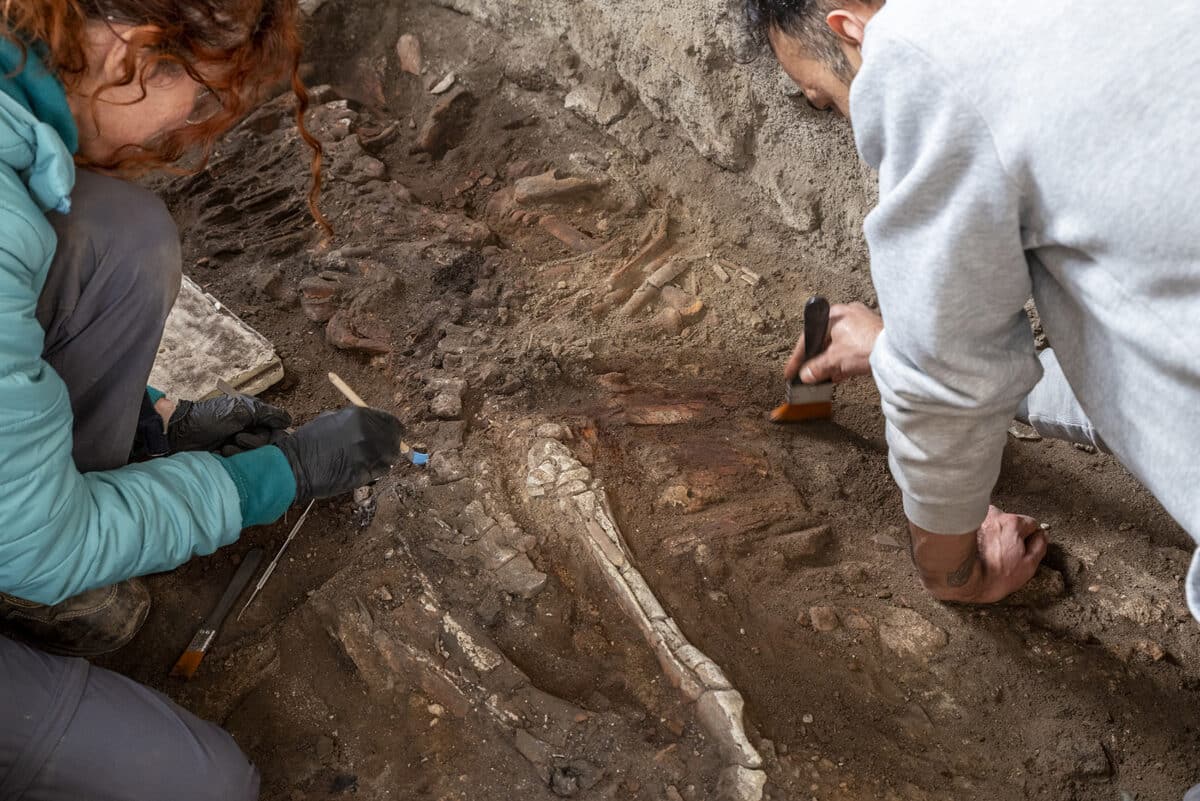
The skeleton of an equine at an ancient bread-making complex in Pompeii. Credit: Pompeii Archaeological Park
Archaeologists in Pompeii have uncovered an equine skeleton inside a bread-making workshop at one of the city’s most celebrated ancient complexes, opening a new chapter in the understanding of how humans and animals lived and worked together nearly 2,000 years ago.
The remains were discovered at the Insula of the Chaste Lovers, a large residential and commercial site renowned for its striking “chaste kiss” fresco, painted inside the dining room of the owner’s home.
The complex includes a working bakery, storage rooms, processing spaces, and the owner’s private residence. Researchers had previously found other equids at the site’s stables, where animals were used to power grain mills and transport the grain needed for bread production.
Pompeii’s chaste lovers complex was also a busy bakery
This latest skeleton was not found in the stables. Researchers found it in a separate room, suggesting the animal had fled there during the catastrophic eruption of Mount Vesuvius in 79 AD.
The excavation brought together archaeologists and specialists from the Applied Research Laboratory, including experts in animal remains, plant life, and human bones. This interdisciplinary approach has become one of the most important aspects of modern archaeological research at the site.
Archaeologists are excavating the skeleton of an equine. Credit: Pompeii Archaeological Park
Laboratory analysis is still ongoing. Researchers expect it to reveal more about the animal’s specific role in the production complex and the conditions it faced during the eruption.
The study could also contribute to a wider understanding of how animals responded to the disaster in real time, adding detail to the reconstruction of those final, chaotic hours.
Pompeii equine skeleton suggests a desperate Vesuvius escape
Gabriel Zuchtriegel, director of the Pompeii Archaeological Park, said that Pompeii offers far more than beautiful frescoes and ancient objects.
He said it gives researchers the opportunity to understand lives that were ended by the eruption, and that this extends to animals as well as people. The horse or donkey, he noted, was found inside a house with remarkable frescoes that also served as a working mill and bakery.
Its location in a room away from the stables points to an attempt to escape the eruption. Zuchtriegel called the excavation a strong example of the daily multidisciplinary collaboration at the site and said ongoing lab results will continue to offer significant scientific value.
Pompeii continues to yield new layers of ancient life. The site preserves not just objects and artwork but the full texture of daily existence, including the bonds between people, animals, and the spaces they shared.
The equine skeleton discovered in Pompeii’s ancient bread workshop is the latest reminder that the city still holds stories waiting to be told.
A sea drone exploded Friday near Romania's Black Sea port of Constanta without causing casualties. The incident prompted authorities to evacuate more than 1,000 people amid heightening concerns over the spillover effects of Russia's war in Ukraine just a week after a separate drone incident injured two civilians.
Bulgaria has become notorious for holding elections. In 5 years, voters went to the polls 8 times. But this debilitating crisis finally ended on April 19th, when the Progressive Bulgaria party won an outright majority. It is led by the former president, Rumen Radev, now the prime minister.
Negotiators from the European Parliament and EU member states have been trying to reach an agreement on the rights of air passengers travelling within the bloc. The current rules date back to 2004, but the scale and nature of air travel have changed dramatically since then. We take you inside the negotiations, examine the key sticking points, and explain why MEPs are pushing for stronger protections for passengers affected by delays and cancellations.
Albanians clash with police during a protest in Tirana against a Jared Kushner-linked resort project in a protected coastal area. Credit: Malton Dibra/EPA/AMNA
Albanians have joined a growing wave of protests against a major coastal resort project linked to Jared Kushner’s investment firm, Affinity Partners. The demonstrations began near the proposed development site in Zvernec, close to the protected Vjosa-Narta coastal area, before spreading to the capital, Tirana, where protests continued for several days.
Chanting “cancel the project” and carrying banners reading “Albania is not for sale,” demonstrators demanded that the government block the resort plans. The project includes luxury tourism development on the uninhabited island of Sazan and in the Vjosa-Narta protected landscape, a wetland area near the southern community of Zvernec. The region is known for its biodiversity and is home to flamingos, seals, and sea turtle nesting sites.
Environmental groups, local residents, and civil society activists say the development could cause irreversible damage to one of Albania’s most sensitive coastal ecosystems. They have also raised concerns over transparency, land ownership, and possible corruption.
Albanians protest coastal resort after beach access blocked
The latest wave of demonstrations began after fencing and barbed wire appeared near the proposed development area, blocking access to the beach. Residents and environmental activists gathered in Zvernec, where tensions escalated.
Private security guards reportedly attacked and injured several protesters during the gathering. Following the incident, authorities suspended several police officers and revoked the licenses of two private security companies.
The unrest then moved to Tirana, where protesters rallied outside government buildings, including the office of Prime Minister Edi Rama. Demonstrators used inflatable flamingos as a symbol of the protected wetland and held signs reading “Nation is not for sale” and “I don’t want Albania like Dubai.”
Anti-corruption prosecutors open inquiry
The protests intensified after Albania’s Special Prosecutor’s Office against Corruption and Organized Crime (SPAK) opened an inquiry into issues surrounding land titles, sales to investors, and changes affecting the protected status of the area. It has not been confirmed whether the land surrounded by barbed wire has been purchased by Affinity Partners.
Kushner first presented plans for development projects in Albania two years ago. According to those plans, Sazan, a former secret communist-era military base, would be transformed into a luxury tourist destination. The development has been estimated at around €1.4-1.6 billion ($1.62-1.86 billion). Luxury hotels were also planned for Zvernec, near the Vjosa-Narta protected area.
Albanians protest in Tirana against a Jared Kushner-linked coastal resort project near the protected Vjosa-Narta wetland. Credit: Malton Dibra/EPA/AMNA
Environmental groups warn of serious damage
In January, around forty environmental organizations called for the suspension of the resort plans, warning that the project could threaten biodiversity in a coastal zone of major ecological significance. “We want all construction to halt and heavy machines out of the protected area,” said Joni Vorpsi, an ecologist with PPNEA-BirdLife Albania. “This would be a new city with around 10,000 rooms and it will completely destroy that wild region.”
Environmentalists argue that the scale of the project is incompatible with the protected status of the area. They say the development could disrupt bird migration routes, damage habitats, and permanently alter a largely undeveloped stretch of coastline.
Albanians protest as Rama rejects calls to halt coastal resort project
Prime Minister Edi Rama invited protesters to choose a delegation of about twenty people to discuss possible solutions, but the protesters rejected the proposal. Rama has publicly defended the investment, arguing that Albania must remain open and fair toward foreign investors.
“It is very important that we remain welcoming, that we remain fair, and that under no circumstances do we receive the stigma of being a country where investors are met with hostility,” Rama said in a statement shared with Reuters. “There is absolutely no chance that the investment will stop as long as I am here.” His comments have further angered opponents of the project, who say the issue is not hostility toward investment but the protection of public land, natural heritage, and the rule of law.
Mobile World Live brings you our top three picks of the week as Anthropic widened access to its Claude Mythos model despite security concerns, the European Commission (EC) unveiled a fresh digital sovereignty push and the FCC commenced its first spectrum auction in four years.
Anthropic expands Mythos access to 150 new companies
What happened: Anthropic expanded access to its controversial Claude Mythos AI model under the Project Glasswing to 150 additional companies in sectors including power, healthcare and communications, after initially restricting it to a group of private technology players.
Why it matters: Anthropic said the latest cohort brings in sectors underrepresented in the first wave. In commentary to security publication CSO Online, experts noted the expansion could add to security concerns around the model. Carmi Levy, an independent technology analyst, questioned what Glasswing will be able to accomplish by adding 150 more participants, noting the initial point was to allow the AI player to work closely with a small, fully vetted group of vendors to develop stronger defences against cybersecurity risks. “Expanding access into the hundreds may very well bring in more minds to build better defensive measures, but it simultaneously introduces significant concerns around potential leaks.”
Research director for AI security at IDC, Grace Trinidad, added that Anthropic’s announcement pointed out that each of the 150 new participants “will need to meet our security requirements before they gain access”, which also did not build confidence. “Nobody knows what those security requirements are.”
Earlier this week, Anthropic also confidentially filed IPO paperwork with the US Securities and Exchange Commission (SEC), ahead of rival OpenAI’s rumoured float.
What happened: The EC unveiled a fresh digital sovereignty package targeting semiconductors, AI, cloud, open source and energy infrastructure in a bid to accelerate Europe’s push for digital sovereignty.
Why it matters: The package includes a proposed a revamped Chips Act 2.0 and a Cloud and AI Development Act to streamline data centre deployment and introduced measures to expand open source use, support startups and digitalise the energy system. EC president Ursula von der Leyen said Europe “cannot afford to depend on others for the technologies that keep our hospitals running, our energy grids stable and our services secure”.
Jennifer Okafor, a UN and Global Health strategist and AI and data analyst, said the policies represent “a comprehensive approach to balancing growth, stability, and long-term resilience across the EU”. However, president of German digital industry group Bitkom Ralf Wintergerst told Reuters it is “crucial that these efforts do not stop at mere announcements”, while Keegan McBride, director of science and technology at non-profit think tank Tony Blair Institute argued Europe “can’t regulate its way to competitiveness, it must build”. He added, “there’s still much more to do if Europe wants to close the gap with the US and China”.
What happened: The FCC opened Auction 113, its first spectrum auction in four years, covering spectrum in the 1695MHz to 1710MHz, 1755MHz to 1780MHz and 2155MHz to 2180MHz bands.
Why it matters: AT&T, T-Mobile US, Verizon and potentially SpaceX are among likely bidders. The licences cover territory home to more than 100 million people across 48 states and two US territories. FCC chair Brendan Carr declared: “Finally! The FCC is back in the game,” adding spectrum auctions are “the lifeblood of licensed wireless service”. Carr argued “more spectrum means more building, lower prices and stronger competition”.
Proceeds from the auction will fund the FCC’s “rip and replace” programme targeting Huawei and ZTE equipment in US networks. Indeed, the auction also bolsters the regulator’s broader Build America Agenda, which targets 800MHz of spectrum by 2034.
Amazon committed to invest more than €10 billion on upgrading its facilities in Europe with next-generation robotics, part of a wider push to modernise and expand its operations network in the continent.
Announced at the company’s Delivering the Future event in London, the technology giant stated it plans to create more jobs across the region, while using robotics to expand ultra-fast delivery options to more international cities and invest in employee upskilling.
Its pledge reflects a broader push to use AI and robotics to support its workforce, taking aim at “repetitive and physically demanding tasks”, freeing up employees to focus on higher skilled roles while customers get better service.
As part of its next-generation robotics development, Amazon introduced Proteus, an upgraded autonomous robot that is able to move items across different sites. Through AI advances, employees can apparently direct Proteus with plain, conversational text-based prompts without the need for technical commands or programming interfaces.
According to Amazon, once an employee instructs Proteus on what needs to be done, the robot figures out the priority, route and timing.
Proteus is designed to take on physically demanding tasks, move heavy carts and cover long distances. It is currently being piloted in Amazon labs, with deployment planned for the first half of 2027.
Through its €10 billion commitment, Amazon added it will expand Vulcan, its first robot with a sense of touch and STARK, a new robotics system that works alongside employees. STARK will be deployed across 15 sites in Europe by 2027.
This week, Nvidia CEO Jensen Huang also talked up the robotics opportunity within industry, as he unveiled work on a new model for academics using hardware from Unitree and Sharpa.

 Login
Login