La guerra degli Stati Uniti contro l’Iran è passata dalla fase iniziale a una nuova fase emergente — una fase in cui l’Iran scommette implicitamente sul fatto che la fase successiva sarà la guerra. Molto probabilmente si tratterà di episodi brevi di guerra limitata, che tuttavia potrebbero estendersi a livello regionale, qualora gli Stati Uniti (e Israele) decidessero di inasprire drasticamente la situazione.
La nuova fase comporta ovviamente dei rischi, ma l’Iran detiene le carte vincenti: la capacità di infliggere danni sproporzionatamente più gravi alle infrastrutture del Golfo come rappresaglia per qualsiasi danno subito, e la consapevolezza che l’Occidente si sta avvicinando sempre più al precipizio energetico.
I tre pilastri alla base di questo cambiamento sono, in primo luogo, la fiducia che l’Iran non sarà (e non potrà essere) allontanato dal suo controllo su Ormuz e che, consolidando le proprie strutture amministrative in quella zona, la realtà del controllo iraniano su Ormuz sarà sempre più assimilata dagli Stati e si rifletterà nella loro accettazione del controllo iraniano-omanita.
A questo principio fondamentale si associa l’attuazione da parte dell’Iran di una deterrenza intensificata nei confronti del blocco navale americano. Qualsiasi tentativo di intercettare o attaccare navi iraniane o di interferire con l’amministrazione dello Stretto sarà accolto con risposte sempre più dure. In definitiva, questa politica potrebbe portare l’Iran a infliggere danni sempre più gravi alle navi da guerra statunitensi – un altro punto di attrito.
Il 3 giugno, ad esempio, gli Stati Uniti hanno lanciato un missile Hellfire contro una petroliera iraniana nei pressi dello Stretto di Hormuz. In risposta, una nave di proprietà statunitense (o in parte di proprietà statunitense), la Panaya, è stata colpita da missili. Inoltre, l’Iran ha lanciato tre ondate di missili da crociera contro la base aerea e di elicotteri statunitense in Kuwait da cui era partito l’attacco. Sono emerse immagini che mostrano gravi danni anche all’aeroporto internazionale del Kuwait (sebbene la causa dei danni rimanga controversa).
Il secondo principio di fondo che influenza questo cambiamento riflette semplicemente il disprezzo iraniano per il continuo inasprimento delle richieste da parte di Trump, le minacce esagerate (che palesemente non sono all’altezza delle capacità statunitensi), insieme al suo continuo zigzagare e alla retorica sprezzante nei confronti dell’Iran.
La leadership iraniana ha concluso, a quanto pare, che probabilmente non si arriverà a un compromesso e che è meglio interrompere i “negoziati” piuttosto “che continuare i negoziati inutili e in malafede con un regime americano ingannevole e decrepito”, come il New York Times ha definito i “negoziati” con l’Iran — suggerendo che il “caos dell’accordo” non sia un singolo intoppo di Trump limitato alla questione iraniana, ma piuttosto un modello costante di disfunzionalità che si ripete praticamente in tutte le iniziative di “pace” di Trump.
Dietro la decisione dell’Iran di sospendere i colloqui, tuttavia, si cela probabilmente la chiarezza che sta gradualmente emergendo, filtrata dalle dichiarazioni e dalle analisi israeliane e americane, secondo cui il vero obiettivo dell’attacco a sorpresa statunitense-israeliano del 28 febbraio non è mai stato il cambio di regime di per sé — mirato a sostituire gli “integralisti” iraniani con un leader più moderato in stile “Delcy Rodrigues”; ma era piuttosto quello di provocare la completa distruzione e frammentazione dell’Iran — un’intuizione destinata a modificare i calcoli dell’Iran.
Questa intuizione ha consolidato enormemente il sostegno pubblico alla Repubblica Islamica e, allo stesso tempo, ha trasformato la guerra in una lotta esistenziale per preservare i valori etici della Rivoluzione. Da questo punto di vista, l’Iran ha ben poco da discutere con Trump, a parte un futuro modus vivendi — quando e se Washington comprenderà di essere con le spalle al muro e si affermerà un nuovo realismo.
Il terzo principio alla base di questa nuova fase del conflitto è quello enunciato dall’Iran sin dall’inizio dei colloqui di Islamabad: «Cessate il fuoco per tutti; oppure cessate il fuoco per nessuno». Ciò è stato nuovamente ribadito nell’ultimo ultimatum dell’Iran a Trump: «Se le minacce israeliane della scorsa settimana di radere al suolo il sobborgo meridionale di Beirut, Dahiyeh, fossero state messe in atto, l’Iran avrebbe colpito duramente il nord di Israele con i propri missili. “Era un cessate il fuoco per tutti – o nessun cessate il fuoco”.
Trump ha scelto il cessate il fuoco e, in seguito alla sua telefonata con Netanyahu, ha annunciato che era in vigore. Ha detto a Netanyahu di annullare il bombardamento pianificato su Dahiyeh, a sud di Beirut. In Israele, un’enorme ondata di rabbia proveniente da tutte le parti dello spettro politico ha attaccato Netanyahu per la sola idea di frenare qualsiasi attacco israeliano in Libano. L’ex primo ministro Naftali Bennett ha accusato Netanyahu di «aver perso il controllo sulla sovranità israeliana». E l’ex primo ministro Yair Lapid ha affermato che Israele era stato ridotto a uno “Stato vassallo” dopo la sospensione degli attacchi.
Da alcuni mesi gli Stati Uniti e Israele stanno tentando di convincere una parte dei leader libanesi ad accettare il compito di disarmare Hezbollah, come ha spiegato Rubio, “in modo che Israele non debba farlo” — cosa che i leader libanesi chiaramente non sono in grado di fare.
Israele non ha una strategia coerente per il Libano. L’ex alto ufficiale dell’intelligence militare israeliana, Danny Citrinowicz, delinea un nuovo “risultato iraniano”:
“Teheran è effettivamente riuscita a collegare il fronte libanese alla più ampia arena iraniano-israeliana. Qualsiasi escalation in Libano è ora vista sempre più attraverso il prisma delle dinamiche tra Stati Uniti e Iran”.
Ciononostante, egli osserva:
«La situazione in Libano rimane altamente instabile. Israele e Hezbollah continuano a interpretare gli attuali accordi in modi fondamentalmente diversi. [Mentre] Israele sostiene di mantenere la libertà di azione in tutto il Libano eccetto Beirut, Hezbollah [d’altra parte] insiste sul fatto che qualsiasi attività militare israeliana – in assoluto – violi il quadro del cessate il fuoco. Queste interpretazioni contrastanti creano un potenziale significativo di rinnovati attriti ed escalation sul campo».
In Israele, la situazione nelle città del nord rimane un punto nevralgico per quasi tutti gli israeliani. Molte città lungo il confine con il Libano e giù fino alla Galilea sono semivuote — «intere fasce di territorio abbandonate dal governo», scrive Ben Caspit. I politici locali sostengono di «essere anch’essi israeliani» e che il governo debba intervenire.
Il Libano rimarrà sicuramente un punto di contesa. Non è questione di se, ma di quando scoppierà la prossima crisi. Israele non lascerà le cose come stanno — persino i leader dell’opposizione liberale chiedono la distruzione di Hezbollah e protestano contro il fatto che Trump leghi le mani a Netanyahu in Libano.
Neanche l’Iran lascerà le cose come stanno. I mediatori hanno informato gli americani che l’Iran considera la fine della guerra in Libano, il ritiro delle forze israeliane e il ritiro da Hormuz come condizioni vincolanti — prima di discutere altre questioni.
Eccoci quindi a questo punto. Continuano le scaramucce militari – di fatto una serie abbreviata di attacchi da parte delle forze statunitensi contro la navigazione iraniana e le infrastrutture dello Stretto, scaturite dal desiderio di Trump di affermare il proprio blocco navale agli occhi dell’opinione pubblica statunitense. Questa situazione è chiaramente esplosiva – proprio come lo è il contesto libanese.
L’Iran sta di fatto riconoscendo la realtà che in questa nuova fase – con così tanti punti critici intrinseci – l’escalation militare americana a un certo punto diventerà probabilmente una necessità politica per le esigenze interne di Trump e dei suoi finanziatori ebrei.
E i negoziati? Non porteranno a nulla fintanto che Israele e i miliardari ebrei donatori statunitensi rifiuteranno qualsiasi esito con l’Iran che lasci il Paese intatto e più forte e – pari passu in questo pensiero binario – indebolisca di conseguenza il progetto «Israel First» all’interno degli Stati Uniti e della regione.
Un accordo che non veda l’Iran irrimediabilmente indebolito sarà condannato da queste ultime forze come una «negligenza traditrice» da parte di Trump. Egli sarà attaccato senza pietà. Eppure, deve rendersi conto che l’Iran è comunque sul punto di liberarsi dalle catene statunitensi.
Questa fase del conflitto iraniano probabilmente terminerà solo quando l’Occidente precipiterà dal precipizio economico che si avvicina…
A truly bizarre series of events off the coast of Iran today that in my opinion were entirely provoked, if not staged, by the US. It started with multiple news reports that a US Army Apache helicopter had been shot down in the Persian Gulf but the two pilots emerged unscathed. What the hell was an Apache helicopter doing?
The AH-64 Apache is a twin-engine attack helicopter primarily designed for anti-armor warfare, close air support, and armed reconnaissance. Apparently it was conducting reconnaissance. The US claims that Iran shot it down, but Iran insists it did no such thing.
I am bothered by the claim it was shot down… If the rocket or bullets had hit the cockpit or damaged the main rotor, the craft would have plunged into the water and the pilots would not have survived. So what happened? Was one of the twin engines damaged but still able to function? Was the rear rotor damaged? Those are the only two scenarios I can imagine that would not have caused a catastrophic crash. Once the helo landed in the water, the pilots had to open the canopy and jump into the water. Hopefully the main rotor — assuming it was intact when the copter hit the water — shattered on impact. Otherwise, the pilots would have been shredded trying to escape.
Coincidentally with this crash, the NY Timespublished a story, written by David Sanger, discussing the state of US and Iranian negotiations over Iran’s nuclear program. Sanger wrote:
In the days before the latest flare-ups of violence in the Middle East, President Trump’s aides were negotiating with Tehran on four major elements of a nuclear agreement that U.S. officials contend would grind the program to a halt for 15 years or so. . . .
According to the officials and diplomats, here are the four major points of negotiation on a nuclear agreement between the United States and Iran:
1. A lengthy suspension of uranium enrichment
The United States has demanded for months that Iran agree to conduct no uranium enrichment for at least 20 years. The Iranians have countered by offering a 10-year halt, but American officials believe they will settle for 15 years.
2. Iran’s current stockpile of enriched uranium is diluted, or “downblended”
The United States would work with the International Atomic Energy Agency, the U.N. inspection body, to dilute, or “downblend,” Iran’s stockpile of enriched uranium, according to two American officials familiar with the negotiations. American officials envision an active role in handling the nuclear material, something Iran has always forbidden. Iranian officials say the United States would serve only as an observer. . . .
3. Iran dismantles its nuclear sites
The United States has demanded that Iran dismantle its three major nuclear sites at Natanz, Fordo and Isfahan. The United States struck all three in Operation Midnight Hammer nearly a year ago, severely damaging them. Iran has discussed dismantling two facilities but insists on leaving one open, in part to demonstrate it has not surrendered what it views as a “right to enrich.”. . .
4. Iran agrees to “snap” inspections
The United States wants international inspectors to be able to conduct “snap” inspections, anytime and anyplace inside Iran. It is not clear if the Iranian government will agree. As a practical matter, many of the suspect nuclear sites are inside Revolutionary Guards military bases, where inspectors have frequently been barred at the gates.
This summary represents the US position. I doubt the Iranians will agree to an end to all enrichment… They will likely insist on retaining the right to enrich up to 20% for medical isotopes. Dismantling Iranian nuclear sites is a non-starter. The IRGC will simply not accept such a condition. I think Iran will be willing to “downblend” the 60% enriched uranium it currently possesses but that will come with a price tag: immediate lifting of sanctions and the return of frozen assets. What about “Snap” Inspections? That will depend on the composition of the international inspectors. Iran has already been burned by the IAEA inspectors who reportedly collected intelligence on Iranian nuclear scientists and passed that information to Israeli and Western intelligence agencies. That information was used in June 2025 and in the current war to assassinate Iranian scientists.
While Pakistani sources who have access to the status and substance of the negotiations remain optimistic that a deal will be struck, I remain very skeptical. Beyond the nuclear items — which Iran says it refuses to discuss until the US lifts its blockade and there is a genuine ceasefire, which includes Lebanon and Gaza — I do not believe that Iran is going to compromise on its demands: lift sanctions, release frozen assets and recognize its joint-control over the Strait of Hormuz with Oman.
I think that today’s US attack on Iran was an effort to scuttle the negotiations. While Iran struck back hard at targets in Bahrain, Kuwait, Jordan and Kurdish controlled territory in northern Iraq, it limited its retaliation. Iran apparently still believes that there is a viable accord that will end the war, not only the attacks on Iran, but also bring security to Lebanon and Gaza. The onus is on Donald Trump to force Israel to accept the terms. That has the Zionists very nervous, which explains why they are spying on Trump’s negotiators.
I think the negotiations will fail — I hope I am proven wrong — because I do not believe Donald Trump will be willing to accept the concessions demanded by Iran. We will know more by close of business Wednesday.
The countries that have borne the brunt of Iranian retaliation have an incentive to diversify their security structures.
On June 3, as messages continued to pass between Iranian and American negotiators, the U.S. endangered diplomacy with renewed aggression against Iran. Enforcing the blockade on Iranian ports, U.S. forces fired a Hellfire missile into the engine room of a Botswana-flagged oil tanker. Moments earlier, per CENTCOM, they had “conducted self-defense strikes on an Iranian military ground control station on Qeshm Island” in the Strait of Hormuz. These were the third round of U.S. strikes on Iran in the past week.
There is no legal or moral justification for targeting civilian infrastructure. But, amid all the talk of “criminal Iranian aggression” and of Iran’s “deliberate, calculated, and unjustified attack” on a civilian airport when all the American bases in Kuwait “are dozens of miles from the airport,” one small sentence went unnoticed. Buried in the body of a New York Timesarticle was the single line, “In recent years, American forces have operated out of a site in the Kuwaiti airport complex.”
U.S. Secretary of State Marco Rubio recently said that “our allies in the region have been very cooperative—some, obviously, very aggressively cooperative, like the UAE, for example. Kuwait’s been fantastic in this part.” Iran’s Foreign Minister Abbas Araghchi says Iran is “carrying out self-defense strikes on sites the United States was permitted to use to attack civilian shipping and violate the ceasefire.”
The Gulf states believed that hosting U.S. bases provided them with an umbrella of defense against Iran. They have come to see that those bases have become magnets for Iranian ballistic missiles and drones.
But the U.S. has not only failed to protect the Gulf states; it has openly coerced and threatened them.
Oman is a small country of outsized importance. It has a long, uninterrupted history of good relations with the United States. Oman has mediated several conflicts and helped get the U.S. out of several jams. It mediated the ceasefire between the U.S. and Yemen last year. Most importantly, Oman helped the Obama administration secure its nuclear deal with Iran. As Trita Parsi lays out in Losing an Enemy, “while the world’s eyes were locked on the ongoing P5+1 [U.S., UK, France, Germany, Russia, China] talks… the real show was taking place in secret in the heat of the Omani mountains.”
But none of this history was enough to prevent President Donald Trump from threatening to bomb Oman.
The Trump administration is angry with Oman for three reasons. The first is that, on the eve of the U.S. decision to go to war with Iran, the Omani foreign minister, Badr bin Hamad Al Busaidi, who was mediating the negotiations, made sure the world knew that war was not necessary, saying that a peace deal “is within our reach, if we just allow diplomacy the space it needs to get there.”
The second was Al Busaidi’s article in the Economist in which he called the U.S. strikes on Iran “unlawful.” Though calling the strategy “unacceptable,” he empathized with Iran’s decision to strike American bases in the Gulf countries, calling it “probably the only rational option available to the Iranian leadership.” And he criticized the Trump administration, saying it miscalculated and “lost control of its own foreign policy.”
Most importantly, Oman has not cut ties with Iran and has reportedly been in discussions with Iran to jointly control the Strait of Hormuz. It was this potential relationship that led Trump to threaten Oman that it must “behave just like everybody else, or we’ll have to blow them up.”
The U.S. does not like the neutrality of Oman, which has made it such a valuable asset in the past. It has begun to press Oman to cut diplomatic ties with Iran and align itself unambiguously with America. Despite its long history of friendship, if Oman does not acquiesce to America’s demand, it will be treated the same way as Iran: sanctions and bombs. The day after Trump threatened Oman with bombs, Treasury Secretary Scott Bessent threatened it with sanctions, warning that “Oman, in particular, should know that the U.S. Treasury will aggressively target any actors involved—directly or indirectly—in facilitating tolls for the Strait.”
The United States no longer aligns with the Gulf states’ interests. They have become instruments for projecting American interests. Kuwait, Oman, and the other Gulf countries lobbied hard to prevent the U.S. from going to war with Iran. When Trump was a day away from restarting the war with fresh strikes on Iran, he said it was the leaders of the Gulf states who asked him “to hold off on our planned Military attack of the Islamic Republic of Iran, which was scheduled for tomorrow.” It was the Gulf states that paid the retaliatory price of the war; it was Kuwait that paid the price for the renewed limited strikes.
The Gulf countries’ interests have not been served by this war. Crucial infrastructure, including energy and water desalination plants, has been struck. Investor and tourist confidence have been diminished. Lives have been lost. Hard-won regional diplomatic gains with Iran have been set back. The U.S. failed to take their interests into account by dragging them into the war, and then failed to protect them once it started.
The Gulf states’ defense networks are too integrated into the U.S. system to extricate themselves entirely. But diversification is possible. In March, Oman’s Al Busaidi said the time had come for the Gulf countries to reconsider their defense strategies. Saudi Arabia and Pakistan last year signed a Strategic Mutual Defense Agreement that states “that any aggression against either country shall be considered an aggression against both.” Last month, during the war with Iran, Pakistan sent 8,000 troops, 16 fighter jets, and a Chinese air defense system to Saudi Arabia under that agreement.
Turkey, Egypt, and Pakistan, the leading military powers in the Muslim world (including the only nuclear power), have all expressed interest in a comprehensive regional security architecture that would encompass all the Muslim-majority nations of the region. Recent events have only enhanced those discussions.
The Iran War has highlighted the need for the Gulf countries to update their security arrangements. Washington ignored their warnings, rebuffed their lobbying, and then failed to deliver the promised protection. The war may have accelerated the Gulf states’ decision to modernize and diversify their security arrangements and, perhaps, even move to a more integrated regional security architecture.
US Central Command (CENTCOM) confirmed a fresh wave of “self-defense strikes” directly hitting radar, surveillance, and military facilities in southern Iran. Credit: CENTCOM
For the second straight day, the US and Iran have traded retaliatory military strikes across the Middle East, pushing an already fragile April ceasefire to the brink of collapse.
US Central Command (CENTCOM) confirmed a fresh wave of “self-defense strikes” directly hitting radar, surveillance, and military facilities in southern Iran. The American bombardment followed a stark warning from US President Donald Trump, who declared that Washington would hit Iran “hard” because Tehran had taken “too long to make a deal” to halt hostilities permanently.
Tehran immediately struck back, targeting US military infrastructure across multiple neighboring countries. For a second consecutive day, American bases in Kuwait and Bahrain faced Iranian fire, while Iranian state media reported that the Islamic Revolutionary Guard Corps (IRGC) launched ballistic missiles at a US command center in Jordan. The attacks forced Kuwait to temporarily shut down its airspace after its military intercepted “hostile aerial targets,” while air raid sirens sounded in the middle of the night in Bahrain.
The conflict has also spilled into vital global shipping lanes. Iranian state media claimed the IRGC struck two oil tankers and declared the strategic Strait of Hormuz “completely closed.” While CENTCOM countered that commercial maritime traffic was still successfully transiting the waterway, global energy markets panicked. Brent crude quickly jumped 2%, surging to around $95 a barrel.
The escalating rhetoric suggests no immediate end to the violence. US Defense Secretary Pete Hegseth warned that bombs would continue to drop on Iran’s core facilities if a diplomatic resolution isn’t reached, a sentiment echoed by President Trump on Truth Social.
Meanwhile, Iranian President Masoud Pezeshkian stood defiant, vowing that Iran “will stand firm against any pressure or threat” while slamming Washington for sabotaging peace talks with contradictory diplomacy.
La terra sta riprendendo quello che il mare aveva preso. E lo Stretto di Hormuz — quella sottile linea d’acqua tra l’Oman e l’Iran — è il punto in cui la storia ha scelto di voltare pagina.
Vi sono momenti nella storia in cui una crisi non si limita a scuotere l’ordine esistente, ma ne rivela le fondamenta marce. La chiusura dello Stretto di Hormuz — quella striscia d’acqua larga appena quaranta chilometri attraverso cui scorre il venti per cento del petrolio mondiale — non è soltanto uno shock energetico di proporzioni straordinarie. È lo specchio attraverso cui il mondo osserva, forse per la prima volta con piena chiarezza, quanto sia fragile l’architettura commerciale e finanziaria costruita dall’Occidente nel secondo dopoguerra. E, al tempo stesso, è il catalizzatore che potrebbe accelerare la nascita di un ordine alternativo: più continentale, più multipolare, più terrestre.
Il blocco dello Stretto di Hormuz — innescato dall’escalation del conflitto tra Iran e la coalizione Israele-USA dal 28 febbraio e tuttora in vigore a — ha prodotto uno tsunami economico senza precedenti. Il prezzo del greggio Brent ha superato i 160 dollari al barile nel giro di settantadue ore dall’annuncio della chiusura, mentre il gas naturale liquefatto ha visto i propri contratti futures triplicare di valore. Le catene di approvvigionamento dell’industria manifatturiera europea e nordamericana, già indebolite dai postumi pandemici e dalla crisi dei semiconduttori del decennio precedente, hanno mostrato una fragilità drammatica: decine di stabilimenti dalla Germania alla California hanno ridotto o sospeso la produzione per mancanza di componenti e materie prime. I costi della rotta alternativa via Capo di Buona Speranza, che allunga i tragitti di diciotto giorni e aumenta i costi di trasporto del trenta-cinquanta per cento, hanno scaricato pressioni inflazionistiche su un sistema già in tensione. La volatilità sui mercati finanziari globali ha raggiunto livelli comparabili solo alla crisi del 2008: l’indice VIX ha toccato quota 58, mentre i mercati azionari di New York, Londra e Francoforte hanno registrato perdite cumulative superiori al dodici per cento nelle prime quattro settimane. Il Fondo Monetario Internazionale ha rivisto al ribasso le sue proiezioni di crescita globale di due punti percentuali per il 2026, portandole allo 0,8 per cento.
Per comprendere la portata storica di questo momento occorre guardare al sistema che la crisi di Hormuz sta corrodendo. L’ordine economico globale del XX secolo è stato, nella sua essenza più profonda, un ordine marittimo. La Pax Americana che ha dominato il pianeta dalla fine della Seconda Guerra Mondiale si fondava su tre pilastri strettamente interconnessi: la supremazia navale degli Stati Uniti nei mari del mondo, il dollaro come valuta di riserva universale e il controllo delle grandi rotte oceaniche da parte delle marine occidentali — in primis quella americana e, in subordine, quella britannica.
Questa architettura non era ideologicamente neutra: era il prolungamento geopolitico della tradizione anglosassone di potenza marittima, codificata già nell’Ottocento dall’ammiraglio Alfred Thayer Mahan nella sua opera The Influence of Sea Power upon History. Il controllo dei mari significava controllo del commercio; il controllo del commercio significava controllo dell’economia mondiale; il controllo dell’economia mondiale significava egemonia politica. Per quasi ottant’anni, questo sistema ha funzionato con efficacia sorprendente, distribuendo privilegi straordinari agli Stati Uniti — primo tra tutti il cosiddetto “privilegio esorbitante” di emettere la valuta di riserva mondiale — e ai suoi alleati.
Ma i sistemi egemonici hanno cicli di vita. E la crisi di Hormuz ha reso evidente ciò che molti affermano da anni con crescente insistenza: l’era della dominanza occidentale non è in declino, è già finita. Quello che stiamo vivendo sono le convulsioni terminali di un ordine che si ostina a non riconoscere la propria obsolescenza. L’impossibilità della Marina statunitense di tenere aperto lo Stretto nonostante la presenza della V Flotta nel Golfo Persico ha dimostrato che anche la potenza navale americana ha limiti operativi che un tempo sembravano impensabili. La dottrina della libertà di navigazione, cardine dell’ordine liberale internazionale, si è incrinata davanti alla realtà di uno Stato mediorientale — con i suoi proxy e le sue capacità missilistiche asimmetriche — capace di sfidare con successo la superpotenza marittima per eccellenza.
Il declino dell’egemonia marittima occidentale non è fenomeno di oggi. Ha radici nell’ascesa economica della Cina, nell’affermazione geopolitica della Russia post-2014, nella progressiva de-dollarizzazione avviata da un numero crescente di economie emergenti e nell’erosione del multilateralismo liberale nelle sedi internazionali tradizionali — dall’OMC al FMI, dall’ONU alla Banca Mondiale. La crisi di Hormuz non ha creato questa deriva; l’ha semplicemente accelerata con la brutalità propria degli shock storici.
L’Heartland alla riscossa: Mackinder aveva ragione?
Lo abbiamo citato tante volte, una in più non ci stupirà. Nel 1904, il geografo e stratega britannico Halford John Mackinder presentò alla Royal Geographical Society di Londra un saggio destinato a diventare uno dei testi fondativi della geopolitica moderna. Il titolo era The Geographical Pivot of History e la tesi centrale era rivoluzionaria per l’epoca: il futuro del potere mondiale non apparteneva alle potenze marittime, ma a chi avrebbe controllato quello che Mackinder chiamava “Heartland”, ovvero il cuore del supercontinente eurasiatico, quella vasta zona continentale che si estende dalle pianure dell’Europa orientale alle steppe della Siberia e alle altipiani dell’Asia centrale, impenetrabile alle flotte navali e naturalmente inaccessibile al dominio marittimo. La sintesi strategica di Mackinder, che tutti abbiamo imparato a conoscere, è entrata nella storia con la formula «Chi governa l’Europa orientale comanda l’Heartland; chi governa l’Heartland comanda l’Isola del Mondo; chi governa l’Isola del Mondo governa il Mondo». Le potenze marittime anglosassoni del XX secolo hanno costruito la propria egemonia globale proprio tentando di neutralizzare questo assioma: il contenimento dell’Unione Sovietica durante la Guerra Fredda era, nella sua essenza, un tentativo di impedire che la potenza dell’Heartland si estendesse fino a dominare le coste del supercontinente.
Ebbene, con la crisi di Hormuz, la logica di Mackinder torna al centro della riflessione strategica globale. Se le rotte marittime diventano inaffidabili — per guerra, instabilità regionale o semplice rivalità tra grandi potenze — il commercio globale deve necessariamente cercare percorsi alternativi, e quei percorsi alternativi passano quasi inevitabilmente attraverso l’Heartland. Le ferrovie, i gasdotti, i corridoi stradali transcontinentali che attraversano l’Asia centrale, la Russia, l’Iran, il Pakistan, la Turchia: è qui che si gioca la posta in gioco del nuovo ordine mondiale ed è qui che i BRICS+ hanno già costruito, o stanno costruendo proprio mentre ne scriviamo, le infrastrutture del futuro.
Mackinder è stato riscoperto nelle cancellerie di Mosca, Pechino e New Delhi con un’attenzione che non aveva mai avuto nemmeno nelle università britanniche. La crisi di Hormuz ha dato a quella riscoperta una concretezza che finora mancava: improvvisamente le rotte terrestri non sono più un’alternativa teorica, sono l’unica alternativa pratica.
L’unica via d’uscita: l’architettura BRICS+ e il post-Hormuz
È qui e ora che i BRICS+ si trovano nella posizione straordinaria di poter offrire al resto del mondo quello che nessuna potenza occidentale è in grado di proporre in questo momento: una via d’uscita concreta e già parzialmente operativa dalla crisi delle rotte marittime.
Questa via d’uscita ha quattro dimensioni che si rafforzano a vicenda: le nuove rotte terrestri eurasiatiche, i corridoi energetici alternativi, la dedollarizzazione degli scambi commerciali e la costruzione di un’architettura finanziaria indipendente da SWIFT e dal sistema bancario occidentale. Consideriamole separatamente, avendo però cura di non perdere la visione d’insieme: è la loro combinazione a rendere l’offerta BRICS+ strategicamente credibile.
La Belt and Road Initiative cinese ha costruito in silenzio, negli ultimi dieci anni, la spina dorsale di un commercio eurasiatico che non dipende dallo Stretto di Hormuz né da nessun altro passaggio marittimo critico. I corridoi ferroviari Cina-Europa attraverso l’Asia Centrale, in particolare il China-Europe Railway Express, che ha movimentato nel 2025 circa 1,9 milioni di TEU (container equivalenti da venti piedi) con una crescita del 22 per cento sull’anno precedente, rappresentano oggi un’alternativa credibile alle rotte via Suez per le merci ad alto valore aggiunto.
Il blocco di Hormuz ha moltiplicato per tre le richieste di capacità su queste linee in poche settimane. Secondo dati preliminari pubblicati dal China State Railway Group, nel solo mese di aprile 2026 le prenotazioni di spazio ferroviario sulla rotta Cina-Europa sono aumentate del 340 per cento rispetto alla media del 2025. I tempi di transito, tipicamente quindici-diciotto giorni rispetto ai trenta-quaranta della via marittima via Suez, rendono la soluzione ferroviaria particolarmente attraente per settori come l’elettronica, le automotive e i prodotti farmaceutici.
Ma la BRI non è l’unico elemento di questa riarticolazione. Il Corridoio Internazionale dei Trasporti Nord-Sud (INSTC), promosso da Russia, India e Iran e oggi allargato ad Azerbaijan, Armenia e diversi paesi centroasiatici, sta vivendo una seconda giovinezza. Questo corridoio — che collega Mumbai a San Pietroburgo via mare Arabico, Iran e Caspio — permette di collegare l’India con l’Europa in circa venticinque giorni, rispetto ai quaranta-quarantacinque della via tradizionale via Suez, riducendo i costi logistici stimati tra il venti e il trenta per cento. Con Hormuz chiuso, il segmento marittimo del corridoio deve essere ricalibrato, ma i tratti ferroviari e stradali iraniani — oggetto di significativi investimenti negli ultimi tre anni — permettono bypass efficaci. L’INSTC era considerato un corridoio secondario ma la crisi di Hormuz l’ha trasformato in una priorità strategica di primo ordine per tutta l’Asia Meridionale.
Sul fronte energetico, la crisi di Hormuz ha dato un’accelerazione decisiva a progetti di pipeline e infrastrutture energetiche terrestri che erano stati rallentati da opposizioni politiche, difficoltà finanziarie o semplicemente dalla convenienza economica delle rotte marittime. Il Power of Siberia 2 — il gasdotto che dovrebbe collegare i giacimenti siberiani con la Cina attraverso la Mongolia — ha visto le trattative accelerare significativamente dopo il blocco dello Stretto. L’accordo, discusso per anni senza una conclusione definitiva per le divergenze sui prezzi, è oggi presentato come urgenza strategica da entrambe le parti: la Cina, che importava circa il diciotto per cento del suo gas via GNL dal Golfo Persico, deve trovare alternative terrestri; la Russia, esclusa dai mercati europei dopo le sanzioni del 2022, ha bisogno di sbocchi commerciali stabili verso est.
Nel frattempo, il gasdotto TAP (Trans-Adriatic Pipeline) che porta il gas azero in Italia via Turchia, e il TurkStream che collega la Russia alla Turchia e ai Balcani, stanno lavorando a piena capacità. La Turchia — che non ha aderito alle sanzioni occidentali contro la Russia e mantiene rapporti stabili con tutti gli attori BRICS+ — si trova in una posizione di leverage straordinaria come hub energetico continentale. Ankara, non a caso, ha formalmente richiesto di entrare nell’organizzazione BRICS nel 2024, una candidatura che potrebbe essere definitivamente accolta entro la fine dell’anno.
La pipeline India-Iran-Pakistan — un progetto rimasto congelato per decenni a causa delle pressioni americane su Islamabad — è stata rilanciata in forma diversa, con un collegamento diretto India-Iran attraverso il Golfo di Oman (bypassando lo Stretto) e poi via terra sino ai mercati centroasiatici. I tecnici del ministero del Petrolio iraniano e quelli del Ministry of Petroleum and Natural Gas indiano hanno ripreso i contatti diretti per la prima volta dal 2012.
La crisi di Hormuz ha trasformato in priorità strategica ciò che era considerato un’alternativa teorica: le rotte terrestri eurasiatiche sono oggi l’unica risposta credibile al blocco dei passaggi marittimi.
Bye bye Mr. Dollar
“Il petrolio si compra e si vende in dollari”, questo diceva la sacra legge di Nixon. Non erano concesse alternativo ed è ciò che ha permesso agli Stati Uniti di finanziare i propri deficit commerciali praticamente senza costi, di esercitare pressioni economiche attraverso le sanzioni e di mantenere il dollaro al centro del sistema finanziario globale indipendentemente dalla performance reale dell’economia americana. La crisi di Hormuz ha accelerato in modo drammatico una tendenza che era già in corso da anni: la de-dollarizzazione degli scambi energetici ed commerciali tra i paesi BRICS+. Il processo era iniziato con gli accordi bilaterali Cina-Russia denominati in yuan e rubli dopo il 2022; si era esteso agli scambi India-Russia per il petrolio (saldati in gran parte in rupie) e agli accordi Cina-Arabia Saudita per forniture di greggio denominate parzialmente in yuan. Poco a poco, la banconota verde ha smesso di avere potere. Con il blocco di Hormuz, la de-dollarizzazione ha subito una accelerazione sistemica particolarmente impattante. Quando le rotte commerciali si ridisegnano su tracciati terrestri eurasiatici, quando il commercio avviene tra paesi BRICS+ attraverso corridoi che non passano per i sistemi finanziari occidentali, quando le sanzioni americane perdono efficacia perché i flussi commerciali evitano i nodi bancari su cui Washington esercita la propria influenza — il dollaro smette di essere l’unica opzione praticabile e diventa sempre più uno strumento di una parte sola.
Il BRICS Bridge — il sistema di pagamenti interbancari proposto dal blocco come alternativa a SWIFT, operativo in forma pilota dal gennaio 2026 — ha visto le transazioni raddoppiare nel solo mese di aprile rispetto alla media del trimestre precedente. Il sistema, basato su una piattaforma distribuita che consente pagamenti bilaterali nelle valute nazionali dei paesi aderenti, non è ancora competitivo con SWIFT in termini di volumi assoluti, ma la sua crescita è esponenziale. Quello che stiamo assistendo è un cambiamento strutturale nel sistema monetario internazionale che potrebbe dimostrarsi più profondo di quello che ci aspettavamo, e sta avvenendo più rapidamente di quanto i modelli economici standard prevedessero.
L’accordo annunciato in aprile tra Brasile, Russia, India e Cina per denominare in yuan e in un paniere di valute BRICS il commercio di commodities agricole — cereali, soia, carne bovina — all’interno del blocco rappresenta un passo storico che potrebbe accelerare la de-dollarizzazione ben oltre il settore energetico. Il Brasile, primo esportatore mondiale di soia e carne bovina, è il tassello che mancava: la sua adesione a questo schema significa che una fetta significativa del commercio agricolo mondiale potrà bypassare il dollaro.
La direzione è chiara. Non si tratta di una sostituzione istantanea del dollaro — nessun analista serio la prevede a breve termine — ma di una progressiva erosione del suo monopolio. Il Fondo Monetario Internazionale, nel suo World Economic Outlook di aprile 2026, ha rilevato per la prima volta che la quota del dollaro nelle riserve valutarie mondiali è scesa sotto il 55 per cento, al minimo storico. Venticinque anni fa era al 71 per cento.
L’Europa senza bussola
In questo scenario di ridisegno globale, l’Europa si trova in una posizione di singolare impotenza. Dipendente per il settanta per cento del proprio fabbisogno energetico da importazioni extra-continentali, priva di una politica estera comune capace di proiettare autonomia strategica, militarmente subordinata all’ombrello NATO e quindi alle priorità americane, e commercialmente esposta sia all’instabilità delle rotte marittime sia alla competizione industriale cinese, il Vecchio Continente rischia di essere la grande vittima collaterale del riassetto in corso. Le elite politiche europee — ancora impegnate a declinare la crisi di Hormuz come problema di sicurezza regionale piuttosto che come catalizzatore di un cambio d’epoca — faticano a cogliere che il tempo delle scelte si sta restringendo rapidamente. L’Europa ha una finestra — che molti analisti stimano in non più di tre-cinque anni — per ridefinire la propria posizione nell’ordine globale emergente: o come appendice strategica dell’Occidente a guida americana, oppure come attore autonomo capace di dialogare con tutti i poli del sistema multipolare.
Le crisi geopolitiche ed economiche sono, nella storia, i momenti in cui gli ordini si disintegrano e i nuovi emergono. La Prima Guerra Mondiale ha distrutto l’ordine imperiale europeo e aperto la strada alla supremazia angloamericana. La Grande Depressione e la Seconda Guerra Mondiale hanno liquidato quel primo tentativo di ordine liberale multilaterale e costruito, sulle sue ceneri, il sistema di Bretton Woods. Lo shock petrolifero del 1973 ha anticipato la fine della crescita illimitata del dopoguerra e aperto l’era della finanziarizzazione e della globalizzazione neoliberale.
La crisi di Hormuz del 2026 appartiene a questa categoria di eventi fondativi. Non è un’interruzione temporanea che si risolverà con qualche aggiustamento marginale — è la prova generale di un ordine che viene. Le infrastrutture terrestri eurasiatiche che i BRICS+ stanno attivando non torneranno inutilizzate quando lo Stretto riaprirà. Le relazioni commerciali denominate in valute non-dollaro non si dissolveranno con il ritorno alla normalità nei mercati energetici. La fiducia nelle rotte marittime controllate dalle potenze anglosassoni — già incrinata dopo l’episodio del Canale di Suez del 2021 (la nave Ever Given) e l’instabilità nel Mar Rosso del 2023-2024 — ha subito una frattura che non si sutura semplicemente con la riapertura di un passaggio.
Le crisi non creano le condizioni del cambiamento, le rivelano. Le rotte terrestri eurasiatiche, la de-dollarizzazione, i nuovi sistemi di pagamento BRICS+, tutto questo esisteva già, lo sappiamo. Hormuz ha semplicemente reso evidente che è il futuro, non un esperimento marginale.
Gli investitori globali lo hanno capito prima dei governi occidentali. Il rendimento dei Treasury americani a dieci anni ha toccato il 5,8 per cento a metà maggio — il massimo da decenni — mentre le valute dei paesi BRICS+ hanno mostrato una tenuta sorprendente nonostante la volatilità generale. Il rublo, supportato dalle esportazioni energetiche terrestri verso la Cina, è rimasto stabile. Lo yuan ha guadagnato terreno come valuta di riserva. La rupia indiana si è apprezzata rispetto all’euro.
Il panorama delle istituzioni finanziarie internazionali riflette questa transizione. La New Development Bank dei BRICS ha approvato in aprile un pacchetto di emergenza da 15 miliardi per finanziare l’adeguamento infrastrutturale dei paesi membri più colpiti dalla crisi logistica. La velocità e l’entità di questa risposta non hanno precedenti nella storia dell’istituzione, e sono state deliberatamente messe a confronto con i tempi burocratici del FMI e della Banca Mondiale.
Verso la Grande Convergenza Eurasiatica
Guardando oltre l’emergenza immediata, quello che si intravvede è uno scenario di riassetto strutturale del commercio e della geopolitica globale che potrebbe dispiegarsi nel corso del prossimo decennio con conseguenze paragonabili a quelle della fine della Guerra Fredda. La grande convergenza eurasiatica — il progressivo allineamento degli interessi commerciali e strategici di Cina, Russia, India, Iran, paesi del Golfo e dell’Africa subsahariana attorno a un sistema di rotte, valute e istituzioni alternativo a quello occidentale — ha nell’allargamento BRICS+ il suo quadro istituzionale e nella crisi di Hormuz il suo momento catalizzatore.
La presenza nell’organizzazione BRICS+ sia dell’Arabia Saudita sia dell’Iran — nonostante le tensioni bilaterali che hanno contribuito alla crisi stessa — è di per sé un dato straordinario. Il blocco comprende oggi paesi che rappresentano il 46 per cento della popolazione mondiale, il 37 per cento del PIL globale in parità di potere d’acquisto, il 44 per cento della produzione petrolifera mondiale e oltre il 55 per cento delle riserve accertate di gas naturale. Non si tratta di un club di paesi marginali in cerca di visibilità: è la maggioranza economica e demografica del pianeta che si organizza in forma alternativa.
Le proiezioni demografiche e di crescita economica rendono questo dato ancora più significativo. Secondo le stime di Goldman Sachs Asset Management, entro il 2035 i paesi BRICS+ rappresenteranno il 50 per cento del PIL mondiale in PPP e due terzi della crescita globale. L’Europa e gli Stati Uniti, pur mantenendo livelli di reddito pro capite superiori, vedranno la loro quota di commercio mondiale e di influenza nelle istituzioni finanziarie internazionali ridursi progressivamente.
La crisi di Hormuz appare meno come un incidente drammatico e più come il prologo di una storia già scritta.
C’è un’ironia nella storia che non sfugge a chi osserva i grandi cicli della geopolitica: l’ordine commerciale moderno è nato dalla terra — dalle carovane della Via della Seta, dai corridoi speziati dell’Asia centrale, dai mercati continentali dell’Eurasia medievale — prima che i navigatori portoghesi e spagnoli spostassero il baricentro del potere verso i mari. Per cinque secoli, le potenze marittime hanno dominato il pianeta. La crisi di Hormuz del 2026 potrebbe segnare l’inizio del ciclo successivo: il ritorno della terra.
Non si tratta di un ritorno al passato, ma di una sintesi nuova: reti ferroviarie ad alta velocità invece di carovane, gasdotti e cavi dati invece di caravanserragli, sistemi di pagamento digitali in valute nazionali invece di monete d’oro. I BRICS+ non stanno offrendo al mondo un’utopia; stanno offrendo un’infrastruttura che è già in costruzione e che la crisi di Hormuz ha reso urgente e visibile. Questo è.
Il vecchio ordine non scomparirà domani mattina. Il dollaro rimarrà valuta di riserva significativa per decenni. La Marina americana resterà la più potente del mondo. Le istituzioni di Bretton Woods continueranno a operare. Ma l’egemonia — quell’uso del potere che non richiede spiegazioni perché appare naturale e inevitabile — quella sì, si sta concludendo. E quando un’egemonia finisce, non torna.
Mackinder scrisse la sua teoria dell’Heartland per avvertire l’Impero Britannico del pericolo che veniva dall’interno del continente eurasiatico. L’avvertimento arrivò tardi e fu ignorato. Oggi, centoventidue anni dopo, la sua profezia si compie non come trionfo di una singola potenza terrestre, ma come riequilibrio di un sistema che aveva perso il proprio centro di gravità.
La terra sta riprendendo quello che il mare aveva preso. E lo Stretto di Hormuz — quella sottile linea d’acqua tra l’Oman e l’Iran — è il punto in cui la storia ha scelto di voltare pagina.
La guerra de Estados Unidos con Irán ha traspasado su fase inicial para entrar en una nueva etapa emergente, en la que Irán apuesta implícitamente por que la siguiente fase sea la guerra.
Lo más probable es que se trate de episodios breves de guerra limitada, pero que, no obstante, encierran el potencial de extenderse a nivel regional, en caso de que Estados Unidos (e Israel) decidan intensificar drásticamente el conflicto.
La nueva fase conlleva riesgos, por supuesto, pero Irán tiene las cartas ganadoras: la capacidad de infligir daños desproporcionadamente mayores a la infraestructura del Golfo como represalia por cualquier daño que se le cause, y la conciencia de que Occidente se está acercando cada vez más al «precipicio» energético.
Los tres pilares que sustentan este cambio son, en primer lugar, la confianza en que Irán no será (ni puede ser) desplazado de su control sobre Ormuz, y que, al consolidar allí sus estructuras administrativas, la realidad del control iraní sobre Ormuz será asimilada cada vez más por los Estados, y se reflejará en su aceptación del control iraní-omaní.
Asociada a este principio fundamental está la aplicación por parte de Irán de una disuasión escalada frente al bloqueo naval estadounidense. Cualquier intento de interceptar o atacar buques iraníes o de interferir en la administración del estrecho se enfrentará a represalias cada vez más duras.
En última instancia, esta política puede llevar a que Irán inflinja daños cada vez mayores a los buques de guerra estadounidenses —otro punto de fricción—.
El 3 de junio, por ejemplo, Estados Unidos disparó un misil Hellfire contra un petrolero iraní cerca del estrecho de Ormuz. En respuesta, un buque de propiedad estadounidense (o parcialmente estadounidense), elPanaya, fue alcanzado por misiles.
Además, Irán lanzó tres oleadas de misiles de crucero contra la base aérea y de helicópteros estadounidense en Kuwait desde donde se había originado el ataque. También han surgido imágenes de graves daños en el aeropuerto internacional de Kuwait (aunque la causa de los daños sigue siendo objeto de controversia).
El segundo principio subyacente que influye en este cambio refleja simplemente el desdén iraní ante el continuo aumento de las exigencias de Trump, sus amenazas exageradas (que claramente no están a la altura de las capacidades de EE. UU.), junto con sus continuos giros y su retórica despectiva hacia Irán.
Al parecer, los dirigentes iraníes han llegado a la conclusión de que probablemente no habrá compromiso, y de que es mejor poner fin a las «negociaciones» «antes que continuar con las inútiles negociaciones de mala fe con un régimen estadounidense engañoso y decrépito», como el New York Times ha calificado las «negociaciones» con Irán — lo que sugiere que el «caos del acuerdo» no es un fallo puntual de Trump limitado a la cuestión de Irán, sino más bien un patrón constante de disfuncionalidad que se repite en prácticamente todas las iniciativas de «paz» de Trump.
Sin embargo, detrás de la decisión de Irán de suspender las conversaciones se esconde probablemente la claridad que va surgiendo gradualmente, filtrándose a través de las declaraciones y análisis israelíes y estadounidenses, de que el verdadero objetivo del ataque por sorpresa estadounidense-israelí del 28 de febrero nunca fue el cambio de régimen per se —con el fin de sustituir a los «radicales» iraníes por un líder más moderado al estilo de «Delcy Rodrigues»—; sino que pretendía, más bien, provocar la completa destrucción y fractura de Irán —una perspectiva que estaba destinada a cambiar los cálculos de Irán.
Esta perspectiva ha consolidado enormemente el apoyo público a la República Islámica y, al mismo tiempo, ha convertido la guerra en una lucha existencial por preservar los valores éticos de la Revolución. Desde esta perspectiva, Irán tiene poco que discutir con Trump, salvo algún futuro modus vivendi —en el momento en que Washington comprenda que se encuentra acorralado y que el nuevo realismo se imponga.
El tercer principioque sustenta esta nueva fase del conflicto es el enunciado por Irán desde el inicio de las conversaciones de Islamabad: «Alto el fuego para todos; o alto el fuego para nadie». Esto se volvió a subrayar en el último ultimátum de Irán a Trump: «Si se hubieran llevado a cabo las amenazas israelíes de la semana pasada de arrasar el barrio de Dahiyeh, en el sur de Beirut, Irán habría golpeado duramente el norte de Israel con sus misiles. “Era un alto el fuego para todos, o ningún alto el fuego”.
Trump optó por el alto el fuego y, tras su conversación con Netanyahu, anunció que estaba en vigor. Le dijo a Netanyahu que cancelara el bombardeo previsto sobre Dahiyeh, en el sur de Beirut. En Israel, una oleada masiva de indignación procedente de todos los sectores del espectro político arremetió contra Netanyahu ante la mera idea de frenar cualquier ataque israelí en el Líbano.
El ex primer ministro Naftali Bennett acusó a Netanyahu de «perder el control sobre la soberanía israelí». Y el ex primer ministro Yair Lapid afirmó que Israel se había visto reducido a un «Estado vasallo» tras la suspensión de los ataques.
Desde hace algunos meses, Estados Unidos e Israel han estado intentando que un sector de los líderes libaneses acepte la tarea de desarmar a Hezbolá, tal y como explicó Rubio, «para que Israel no tenga que hacerlo», algo que los líderes libaneses claramente no pueden hacer.
Israel carece de una estrategia coherente para el Líbano. El exalto cargo de la inteligencia militar israelí, Danny Citrinowicz, esboza un nuevo «logro iraní» estratégico:
Teherán ha logrado efectivamente vincular el frente libanés al ámbito más amplio de las relaciones entre Irán e Israel. Cualquier escalada en el Líbano se percibe ahora cada vez más a través del prisma de la dinámica entre Estados Unidos e Irán.
No obstante, observa:
La situación en el Líbano sigue siendo muy inestable. Israel y Hezbolá continúan interpretando los acuerdos actuales de formas fundamentalmente diferentes. [Mientras que] Israel sostiene que conserva libertad de acción en todo el Líbano, excepto en Beirut, Hezbolá [por su parte] insiste en que cualquier actividad militar israelí —cualquiera que sea— viola el marco del alto el fuego. Estas interpretaciones contrapuestas crean un potencial significativo para una renovada fricción y escalada sobre el terreno.
En Israel, la situación en las localidades del norte sigue siendo un punto neurálgico para casi todos los israelíes. Muchas localidades a lo largo de la frontera con el Líbano y hacia el sur, en Galilea, están medio vacías —«franjas enteras de territorio abandonadas por [el] Gobierno», escribe Ben Caspit. Los políticos locales afirman que «ellos también son israelíes» y que el Gobierno debe responder.
Es seguro que el Líbano seguirá siendo un punto de discordia. No se trata de si se producirá la próxima crisis, sino de cuándo. Israel no dejará que el asunto quede así: incluso los líderes de la oposición liberal exigen la destrucción de Hezbolá y protestan por el hecho de que Trump haya atado las manos de Netanyahu en el Líbano.
Irán tampoco dejará pasar el asunto. Los mediadores han informado a los estadounidenses de que Irán considera que el fin de la guerra en el Líbano, la retirada de las fuerzas israelíes y la retirada de Ormuz son condiciones vinculantes —antes de discutir otras cuestiones—.
Así pues, aquí estamos. Continúan las escaramuzas militares —en la práctica, una serie abreviada de ataques de las fuerzas estadounidenses contra el transporte marítimo iraní y la infraestructura del estrecho, surgidas del deseo de Trump de reafirmar su bloqueo naval ante la opinión pública estadounidense—. Esta situación es claramente inflamable, al igual que lo es el contexto libanés.
Irán está reconociendo de hecho la realidad de que, en esta nueva fase —con tantos puntos álgidos inherentes—, la escalada militar estadounidense probablemente se convertirá en algún momento en una necesidad política para satisfacer las necesidades de Trump y de sus financiadores judíos nacionales.
¿Y las negociaciones? No llegarán a ninguna parte mientras Israel y los donantes multimillonarios judíos de EE. UU. rechacen cualquier resultado con Irán que deje a este país intacto y más fuerte y —pari passu en este pensamiento binario— debilite en consecuencia el proyecto «Israel First» dentro de EE. UU. y de la región.
Un acuerdo que no vea a Irán irremediablemente debilitado será condenado por estas últimas fuerzas como una «negligencia traicionera» por parte de Trump. Será atacado sin piedad. Sin embargo, debe darse cuenta de que Irán está, de todos modos, a punto de liberarse de las ataduras de EE. UU.
Es probable que esta fase del conflicto iraní solo termine cuando Occidente caiga por el precipicio económico que se avecina…
The U.S. war with Iran has moved beyond its initial phase to an emerging new one — one in which Iran implicitly stakes its chances on the next phase being war. Most likely this will be in abbreviated episodes of limited war, but possessing nevertheless a potential to widen regionally, should the U.S. (and Israel) elect to sharply escalate.
The new phase involves risk of course, yet Iran holds the high cards of an ability to impose disproportionately heavier damage upon Gulf infrastructure as retaliation for any hurt inflicted upon it — and the awareness that the West is edging ever closer to dropping off the energy ‘cliff’.
The three pillars underlying this shift are firstly, confidence that Iran will not (and cannot) be shifted from its hold over Hormuz, and that in consolidating its administrative structures there, the reality of Iran’s hold over Hormuz will increasingly be assimilated by states, and reflected in their coming to terms with Iranian-Omani control.
Associated with this core principle is Iran’s implementation of escalated deterrence vis á vis the American naval blockade. Any attempt to intercept or attack Iranian vessels or interfere with the Strait’s administration will be met with increasingly harsher ripostes. Ultimately this policy may lead to Iran imposing increasing levels of damage to U.S. naval vessels – another friction point.
On 3 June, for example, the U.S. fired a hellfire missile at an Iranian oil tanker near the Strait of Hormuz. In response, a U.S.-owned (or partly-owned) ship, ThePanaya, was struck with missiles. Additionally Iran launched three waves of cruise missiles at the U.S. air and helicopter base in Kuwait from where the attack had originated. Images have emerged of serious damage at Kuwait international airport too (although the cause of the damage remains disputed).
The second underlying principle affecting this shift simply reflects Iranian disdain for Trump’s continuous inflating of demands, exaggerated threats (which palpably fall short of U.S. capacities), together with his continual zigzagging and contemptuous rhetoric towards Iran.
The Iranian leadership has concluded, it seems, that compromise will likely not be forthcoming, and that it is better to cut the ‘negotiations’ rather “than continue the pointless bad-faith negotiations with a deceitful and decrepit American regime”, as the New York Times has termed the Iran ‘negotiations’ — suggesting that the ‘deal chaos’ is not a singular glitch by Trump confined to the Iran issue, but rather is a consistent pattern of dysfunctionality repeating itself across virtually all of Trump’s ‘peace’ initiatives.
Behind Iran’s decision to suspend talks however, likely lies the gradually dawning clarity, seeping out from Israeli and American statements and analysis, that the true objective of the 28 February U.S.-Israeli sneak attack was never regime change per se — aiming to swap out Iranian ‘hardliners’ for a ‘Delcy Rodrigues’-style more moderate leader; but was intended rather, to bring about Iran’s complete destruction and fracturing — an insight that was bound to shift Iran’s calculus.
This insight has consolidated public support for the Islamic Republic hugely, and at the same time has turned the war into an existential struggle to preserve the ethical values of the Revolution. Seen from this optic, there is little for Iran to discuss with Trump, bar some future modus vivendi — as and when, Washington understands that it is boxed in, and that new realism takes a hold.
The third principle undergirding this new phase of conflict is the one enunciated by Iran from the outset of the Islamabad talks: ‘Ceasefire for all; or ceasefire for no one’. This was again re-emphasised in Iran’s latest ultimatum to Trump: ‘If the Israeli threats from last week to flatten the Beirut southern suburb of Dahiyeh had been executed, then Iran would have stricken northern Israel hard with its missiles. ‘It was a ceasefire for all – or no ceasefire’.
Trump chose the ceasefire, and subsequent to his call with Netanyahu, announced that it was in effect. He told Netanyahu to cancel his planned bombing of Dahiyeh in south Beirut. In Israel, a massive wave of anger from all sides of the political spectrum attacked Netanyahu at the very notion of curbing any Israeli attacks in Lebanon. Former PM Naftali Bennett accused Netanyahu of ‘losing control over Israeli sovereignty’. And former PM Yair Lapid said Israel had been reduced to a “vassal state” after the strikes were called off.
The U.S. and Israel for some months have been attempting to bring a segment of leaders in Lebanon to accept the task of disarming Hizbullah, as Rubio explained, “so Israel doesn’t have to do it” — something Lebanese leaders clearly cannot do.
Israel has no coherent Lebanon strategy. Former senior Israeli military intelligence officer, Danny Citrinowicz, outlines a new strategic “Iranian achievement”:
“Tehran has effectively succeeded in linking the Lebanese front to the broader Iranian-Israeli arena. Any escalation in Lebanon is now increasingly viewed through the prism of the U.S.-Iran dynamic”.
Nevertheless, he observes:
“The situation in Lebanon remains highly unstable. Israel and Hezbollah continue to interpret the current understandings in fundamentally different ways. [Whilst] Israel maintains that it retains freedom of action across Lebanon except Beirut, Hezbollah [on the other hand] insists that any Israeli military activity – at all – violates the ceasefire framework. These competing interpretations create significant potential for renewed friction and escalation on the ground”.
In Israel, the situation in northern towns remains neuralgic for nearly all Israelis. Many towns along the Lebanon border and down into the Galilee are half-empty — “entire swaths of land abandoned by [the] government”, writes Ben Caspit. Local politicians claim that they ‘are Israelis too’ and that the government must respond.
Lebanon is certain to remain a point of contention. It is not a matter of if, but when, the next crisis will strike. Israel will not let the matter stand — even Liberal opposition leaders demand Hizbullah’s destruction and protest Trump’s tying of Netanyahu’s hands in Lebanon.
Iran will not let matters stand either. Mediators have informed the Americans that Iran considers an end to the war on Lebanon, withdrawal of Israeli forces, and a withdrawal from Hormuz, to be binding conditions — before discussing other issues.
So, here we are. The military skirmishes — effectively an abbreviated series of strikes by U.S. forces on Iranian shipping and Strait infrastructure, arising from Trump’s desire to assert its naval blockade to U.S. public opinion — continue. This situation is clearly flammable – just as is the Lebanon context.
Iran effectively is acknowledging the reality that in this new phase — with so many inherent flash points to it — American military escalation at some point likely will become a political necessity for Trump’s domestic and Jewish financers’ needs.
And the negotiations? They will go nowhere so long as Israel and the U.S. Jewish billionaire donors reject any Iran outcome that leaves Iran both intact and stronger and — pari passu in this binary thinking — the ‘Israel First’ project within the U.S. and the region correspondingly weakened.
A deal that doesn’t see Iran irretrievably weakened will be condemned by these latter forces as a ‘treasonous dereliction’ by Trump. He will be attacked mercilessly. Yet, he must see that Iran is anyway on the cusp of throwing off the U.S. shackles.
This phase of the Iranian conflict likely will only end when the West falls off the approaching economic cliff …
For decades, the massive MH-53E Sea Dragon helicopter has served as the Navy’s primary airborne mine countermeasure platform, dragging massive mine hunting sleds through waters all around the globe. However, the Sea Dragon’s days are now numbered, with the last 11 aircraft scheduled to sunset sometime next year. With the MH-53E’s demise on the horizon, we reached out to one of its former pilots, Steve Jones — a man who came to know this monster intimately during the Global War On Terror. He had plenty of stories to tell and provided us with a new understanding of the often misunderstood counter-mine mission.
The MH-53E’s mission is also, of course, extremely topical right now thanks to ongoing tensions with Iran. Secretary of State Marco Rubio recently told senators that the Islamic Republic mined “large segments” of the Strait of Hormuz, endangering shipping in the region.
As it currently stands, the mighty Sea Dragons, which are considered one of the military’s most dangerous to fly due to numerous fatal mishaps, are being phased out in favor of the smaller MH-60S Seahawk paired with a suite of new aerial mine countermeasures systems, as well as other new technologies, like uncrewed underwater and surface vessels. The Navy’s overall mine hunting force is going through a transition that is controversial, to say the least, with many questioning if the Pentagon is investing enough resources in this critical missions set.
Petty Officer 1st Class Rawad Madanat
With all these issues in play, in an exclusive, wide-ranging, two-hour interview, Steve Jones offered in-depth insights about the Navy’s airborne counter-mine mission, the Sea Dragon’s capabilities and dangers, current mine sweeping operations, as well as everything from what it was like to narrowly avoid getting entangled with a surfacing sub to his experiences ferrying celebrities like Robin Williams and Tom Jones around a war zone.
So, with the stage being set, let’s get into this incredible exchange.
Some of the questions and answers have been lightly edited for clarity.
Then-Navy Lt. Steve Jones in an MH-53E Sea Dragon. (Courtesy Steve Jones)
A: During the time that I selected, you could choose SH-60 Seahawks, you could choose CH-46E Sea Knights and the MH-53 Echo. You could choose SH-3 Sea Kings, but they were kind of winding down the H-3s, which is the same as the presidential helicopter Marine One that they fly now, but they were flying out of Norfolk and Puerto Rico, primarily for VIP transport.
So, I looked at the 53 for a lot of reasons. One, I liked the instructors that came from that community in the advanced helicopter training. And two, I just thought the helicopter just really looked awesome, and it was big, and so that’s why I chose it, and I just thought it would be a good personality fit, work fit for me, and it ended up being that way.
An MH-53E Sea Dragon, assigned to the “Blackhawks” of Helicopter Mines Countermeasures Squadron 15 (HM-15), takes off from the flight deck of the amphibious assault ship USS Wasp (LHD 1) during flight operations on the ship’s flight deck, April 5, 2025. (U.S. Navy photo by Mass Communication Specialist Seaman Soren V.P. Quinata) Petty Officer 3rd Class Soren Quinata
Q: What are the main differences between the Navy’s MH-53E and the Marines’ CH-53E Super Stallion?
A: It’s primarily the same aircraft. Except our aircraft has larger fuel sponsons, so we could carry more gas. The reason for that is ideally we’d want to be able to fly an hour to where the mission objective was, be able to stay on station for about an hour, and be able to fly back. That requires at least three and a half, four hours of gas and extra fuel in those side sponsors. And that allowed us to do that. So instead of a small sponson with two tanks, we had one big sponson with four fuel tanks that were inside each of the sponsons on either side of the aircraft.
Q: So how much gas would that larger sponson hold?
A: About 22,000 pounds of gas.
U.S. Navy Aviation Boatswain’s Mates (Fueling) prepare to refuel an MH-53E Sea Dragon helicopter, attached to Helicopter Mine Countermeasures Squadron (HM) 15, on the flight deck of the Nimitz-class aircraft carrier USS Abraham Lincoln (CVN 72). (Official U.S. Navy photo) Courtesy Asset
Q: Talk about the training and some of the biggest challenges of flying that huge aircraft.
A: Typical Navy training is two years of flight school, and then after flight school, we went to our Replacement Air Group, which we call the RAG, that was in Norfolk, Virginia. You spend about a year, or up to 10 months, in Norfolk, Virginia, learning primarily how to fly the helicopter, how to land the helicopter, and we do that in the combination with the Airborne Mine Countermeasure Squadron. We used aircraft from Helicopter Mine Countermeasures Squadron (HM) 14 to learn how to fly the different mission sets and learn aircraft familiarization. And then from there you either get assigned to HM-14, which was in Norfolk, Virginia, or HM-15, which was in Corpus Christi, Texas. HM-15 has now moved to Norfolk, Virginia. [Editor’s note: HM-14 sunsetted in 2022.]
Sailors assigned to the “Vanguard” of Helicopter Mine Countermeasures Squadron 14 (HM-14) posed for a photo in front of an MH-53 “Sea Dragon” helicopter prior to the squadron’s last flights Dec. 8, 2022. (U.S. Navy photo by Mass Communication Specialist 2nd Class Malachi Lakey) Mass Communication Specialist 2nd Class Malachi Lakey
The training takes about 10 months. Mine was a little bit longer because when I actually joined that community, the aircraft were down because of a crash off the coast of Corpus Christi, Texas. There was a problem called ‘thermal runaway,’ where the bearings in the main rotor head would fail, and they would seize together and get hot, and we lost a few sailors from HM-15. And until they figured out why and how to prevent it, it took about a year for those aircraft to come back up, so I was in Norfolk for maybe about a year and a half, almost two years, before I got to Corpus because of that bearing issue.
Q: What was it like when you finally got out there and learned how to fly while pulling a mine countermeasure sled?
A: There’s different types of equipment that you use and it takes a special kind of person to be able to maintain the situational awareness – both flying the aircraft and what’s happening in the back – because there’s dangers in the back. You have a very confined area, lots of equipment, and under lots of tension, and so the very first couple of times, the instructor is kind of handling everything, and you’re just kind of riding along.
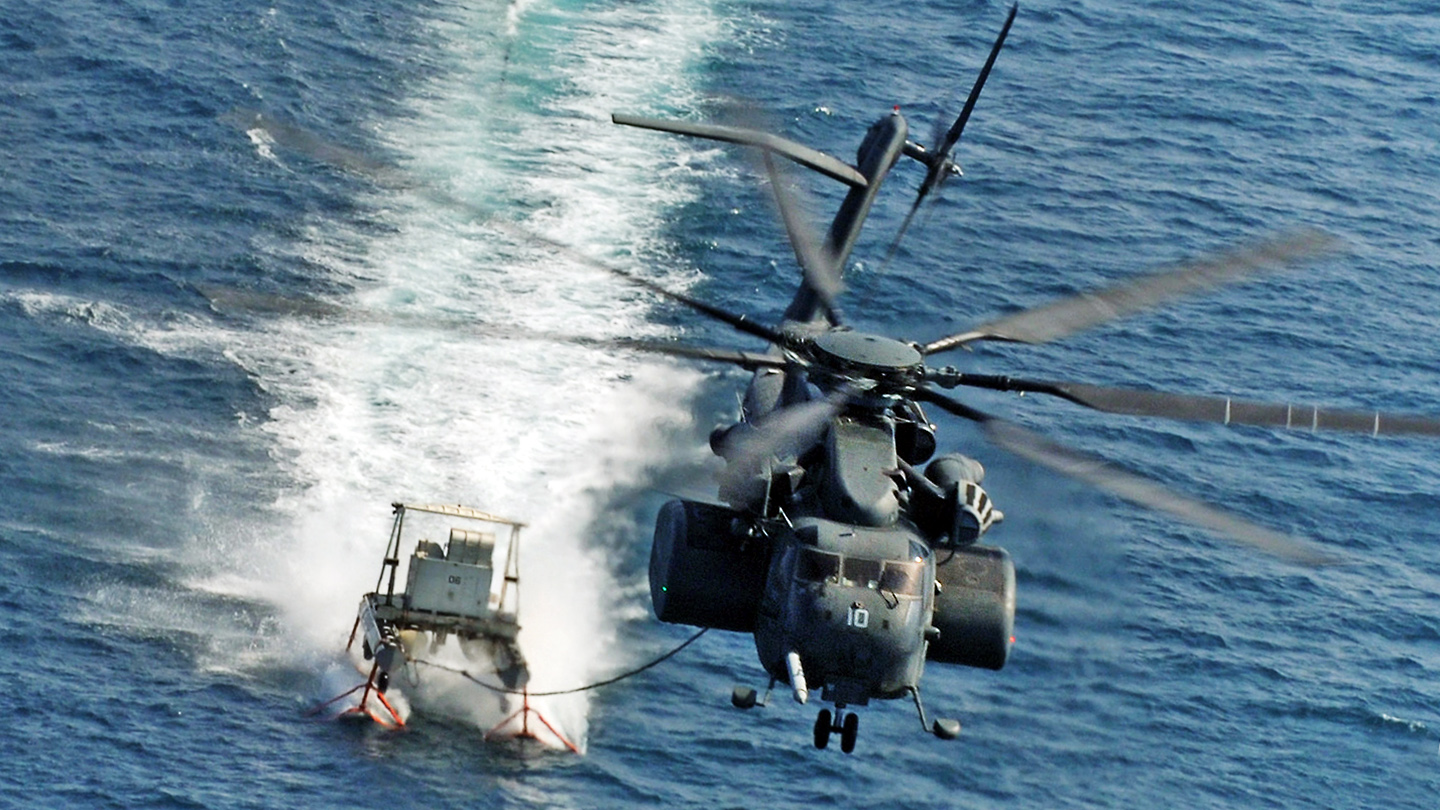
An MH-53 Sea Dragon helicopter from the “Vanguards” of Helicopter Mine Countermeasures Squadron Fourteen pulling a Mark 105 Magnetic Influence Minesweeping System (SLED). (Photo by BOB HOULIHAN / NAVY VISUAL NEWS / AFP) BOB HOULIHAN
Then eventually you start to do more tasks, physical tasks, in terms of flying and maintaining a stable platform for the men and women that are working in the back, and then over time those skills translate into a larger situational awareness, where you’re now a mission commander – where you’re flying the aircraft, but also, conducting the mission in the back is your primary responsibility. The positions are second pilot or co-pilot, and then you become a Helicopter Aircraft Commander (HAC), which is like the captain, and then you become an Airborne Mine Countermeasures Mission Commander (AMCM MC), meaning you’re flying the aircraft, you’re the commander of the aircraft, but you’re also commanding the mission.
Lt. Cmdr. Jeff Spencer and Lt. Cmdr. Nik Bochette, assigned to the Vanguards of Helicopter Mine Countermeasures Squadron (HM) 14, perform a pre-flight check on an MH-53 helicopter. (U.S. Navy photo by Mass Communication Specialist Seaman Jessica L. Dowell/Released) Petty Officer 2nd Class Casey Hopkins
Q: Did you become a mission commander?
A: I did. So I was fully qualified in the MH-53 Echo in my squadron, so I was a mission commander. I worked the maintenance side, so I was the maintenance check pilot and functional check pilot. It takes a lot of maintenance, and then post maintenance, and you have to do post maintenance flights to be able to make sure the aircraft is safe for anyone else to fly. So I spend most of my time in those areas in that squadron.
A U.S. Navy Sailor with Helicopter Mine Countermeasures Squadron 14 guides an MH-53 helicopter from a vehicle carrier ship at Marine Corps Air Station Iwakuni, Japan, Sept. 14, 2022, after completion of aircraft maintenance. (U.S. Marine Corps photo by Cpl. Darien Wright) Cpl. Darien Wright
Q: What are the MH-53’s unique quirks and advantages?
A: One of the advantages was pure brute strength. You had three GE engines, so you could handle lots of torque, and the way that we hunted and swept for mines was pulling sleds in the water, which causes thousands and thousands of pounds of stress, so it’s really like a forceful instrument in the water. The operation requires the coordination of not only meteorologists and Operations Specialists, which are like intel specialists in mine warfare, but then you have the maintainer, you had two pilots and a crew chief, plus it could be up to four people in the back, depending on the type of gear you’re stowing in the back, so it really takes coordination from the front.
An explosive ordnance disposal technician, assigned to Explosive Ordnance Disposal Mobile Unit 5 Platoon 502, operates a communications system aboard an MH-53 helicopter belonging to Helicopter Mine Countermeasures Squadron (HM) 14. (U.S. Navy Combat Camera photo by Mass Communication Specialist 2nd Class Alfred A. Coffield) Petty Officer 1st Class Alfred Coffield
The disadvantage is that it’s a very expensive aircraft to operate. Every hour of flight, required 24 hours of maintenance, and if a squadron had 10 helicopters, which we did at one point in time, you’re looking at the largest deployable squadrons in the Navy, like 600-plus people to operate these aircraft.
With everybody working together, we advertise that we could be anywhere in the world in 72 hours, where there’s a mine threat. We could break down the helicopters, put them in a C-5 and then reassemble them anywhere in the world in 72 hours. After 9/11, for Operation Iraqi Freedom, we did deploy by C-5. We took half the helicopters to Sicily and the other half went to Bahrain and took 11 C-5s in order to move a squadron that size into those two locations, so big footprints, lots of money, lots of parts.
An MH-53E Sea Dragon assigned to the “Blackhawks” of Helicopter Mine Counter Measures Squadron 15 is offloaded from a U.S. Air Force C-5 Galaxy, March 14, 2003, at the U.S. naval base at Sigonella, Sicily. (Photo by Damon J. Moritz/U.S. Navy/Getty Images) U.S. Navy
Q: How fast could the Sea Dragons fly?
A: The 53 is a fast helicopter. One of the fastest out there. We were limited to 150 knots for airframe preservation. Under towing conditions, we typically flew between 18 and 25 knots, depending on the device in the water. Each vehicle had different performance parameters to properly deploy the device. Under rapidly changing conditions we always had to maintain proper speed and altitude control.
Q: The Sea Dragon has experienced a notoriously high rate of mishaps. Did that ever concern you? What do you think contributed to this record?
A: It did. If you’ve ever seen one or been on one, been close to one, or heard one, you’ve got 100-foot long machine with millions of moving parts, right?
Our maintenance crews were very good, I always felt safe flying. I think you have to if you choose to fly that particular weapon system, but there were a lot of accidents. And I knew folks that were killed in MH-53 accidents who I went to flight school with, and buddies.
It’s a very complicated machine that did a very important mission, and accidents do happen, both mechanically, but also because of pilot error. In combination, you end up losing a lot of airframes. Besides the United States, there is only one other nation that flew that airframe, and that was the Japanese for their mine sweeping operation. It’s a very complicated, expensive machine, and that’s why not very many people flew it.
An MH-53E helicopter belonging to the Japanese Maritime Self-Defense Forces takes off during Marine Corps Air Station (MCAS) Iwakuni Friendship Day, May 5, 2004, at MCAS in Iwakuni, Japan. (Photo by Koichi Kamoshida/Getty Images) Koichi Kamoshida
Q: Did the danger concern you?
A: You know, you’re in your 20s, right? So you feel a little bit invincible. I’ll tell you a story. When I switched from 53s and started flying C-130s, after the Haitian earthquake, I flew into Guantanamo Bay, and my old squadron was there on the same ramp as we were. So I walked over to see who I still knew there, and they had a 53 turning on the deck there, and I was just going, ‘wow, I couldn’t believe I used to do that,’ and not thinking about how many things have to go right in order to have a good day. And I just kind of said to myself, ‘it’s really a young person’s game,’ because you gotta kind of hit the ‘I believe’ button on a lot of things, because there’s just a lot of opportunity for negativity to come in. Weather, environment, and then the mechanics of things.
MH-53 pilot Lt. Steve Jones in Bahrain, circa 2002. (Courtesy Steve Jones) Picasa 2.7
Q: What were the biggest factors contributing to the Sea Dragon mishaps?
A: With any aircraft system, the largest factor that contributes to any accident is the human factor. Yes, engines will fail, components will fail, but a lot of times it was human error that caused the ultimate catastrophe because when an emergency happens, you have three criteria in order to gauge when you should land.
The two critical ones are ‘land immediately,’ meaning if you do not ditch in the water or put the aircraft down, it is going to come apart in flight. The other critical criteria is ‘land as soon as possible,’ meaning as soon as you have a safe place to land, then you land as soon as possible. Then you have another condition where you can continue to fly, but flying is not recommended. And so that decision factor between land immediately and land as soon as possible, it’s a bit of a gray area, right? You have a set of skills you can fly, but you can never time when the aircraft is going to come apart.
For example, in the Corpus Christi crash, they knew that they had a problem. I’m not second-guessing the pilot, but it was in that gray area between land immediately and land as soon as possible.
The aircraft commander chose to try to bring the aircraft closer to the beach, so you could survive a ditch, because putting a helicopter in the water – nothing is guaranteed, right? Then you have no control. However, bring it closer to the beach means you’re flying that much longer. So land immediately, there could have been more survivors.
Not to ‘Monday morning quarterback’ anything. I probably would have made the same call. And then with the new equipment that was put on the aircraft, there are lights now placed in a monitoring system that kind of took the gray area out of those decisions when it came to thermal runaway with the main rotor head. So now the decision is clear. Land immediately if certain indications happen, and land as soon as possible if certain indications happen. Prior to 2000, we didn’t have that.
Q: The Sea Dragon community has been well-documented for being neglected by the Navy. What was your experience when you were flying it? Why do you think that was?
A: It’s a unique mission set. It kind of came online during the Vietnam War and Haiphong Harbor, and clearing those mines, and then again in Desert Storm, when the USS Tripoli was hit by a mine.
Mining sea straits is a very cheap way to stop a huge navy, such as the one that we have in the United States. However, the Navy, in my opinion, didn’t necessarily see the value in that mission. There are very limited resources. There’s only so much money to go around, and large strike groups and ships just took priority. We were always probably a little bit underfunded, in my opinion, for a mission that’s important, which you can see today with the Strait of Hormuz. But it was definitely a huge problem that many people did not talk about during the first two Gulf Wars.
An Iranian mine-laying boat. (Iranian state media) (Iran State Media)
Q: Why was it a huge problem?
A: Well, when you try to move a carrier strike group into a small area like the Persian Gulf, by putting mines in the water, you create doubt in a captain’s head. The captain is responsible for thousands and thousands of lives, and the battle group commander is responsible for thousands and thousands of more lives, plus the strategic reason of why they’re there. If a mine is discovered, then everything has to pause. You can’t land Marines on the beach, you can’t move the strike group closer to the shore. The ability for you to project power ashore, all that kind of comes to an end.
Q: How does the MH-53E go about this unique mission set? Can you walk us through what a mission would look like from start to finish?
A: Depending on the intel, you’ll have a threat and the threat could be you suspect that there’s mines in the water, or that you know that there’s mines in the water. So, typically it’s ‘you suspect,’ right? And we used the AN/AQS-14, or “Q-14.” There’s about three different versions of the Q-14. It’s a side-looking sonar, which you drag in the water – we call it the fish. We would fly the fish at certain depths based on the terrain and what was in the water. That was called mine hunting.
MH-53 crew members and the AN/AQS-14 side-looking sonar. (Courtesy Steve Jones)
So initially you would always kind of begin with a hunting mission, where we could, or the OS operator, or the console operator would mark what they view as a mine-like contact. You’re really kind of looking at the sonar and distinguishing between man-made objects and natural objects. If you believe it’s a man-made object, and then you would mark a tape. You could also, real time, send that image back to the ship, but that capability came a little bit later.
We also had devices that allow you to sweep. A mine can be triggered by different mechanisms. Sometimes they’re triggered by contact.
Some mines are acoustically triggered, meaning you can set that mine to blow up for a certain type of ship acoustics. For instance, a destroyer has a different set of acoustics from an amphibious ship, from an aircraft carrier. If you want to let 1,000 destroyers pass you or a submarine and then wait for the aircraft carrier, you can tune it to that way. So we had devices that could mimic the sound signatures of different ships, and you could tow that in the water, you could tow it really fast. One of the reasons why we were successful is that we could do large areas of the ocean relatively quickly.
An MH-53E Sea Dragon from Helicopter Mine Countermeasure Squadron (HM) 15, aboard the multipurpose amphibious assault ship USS Wasp (LHD 1), performs Mine Countermeasure training using the MK-105 sled. (U.S. Navy photo/Lt. Cmdr. John L. Kline) U.S. Naval Forces Central Comman
The last piece for sweeping is the magnetic variation. Each ship is a metal hull, and as a ship is moving through the water, it has a magnetic signature, and then we have gear, which you could tune to mimic certain types of ships in the water, in order to have them explode behind the gear that we’re towing in the water.
So you hunt, that means you’re searching, and then you sweep, and then that means you’re clearing. Sometimes you can clear using other technology, such as sometimes the Avenger class ships would go in and sweep, and not us. Sometimes you would use dolphins to work with EOD teams in order to sweep mines. It just depends upon the threat, on what the second tool is used after you hunt.
The most time that I spent was in the hunting phase of the mission set. In Bahrain, every week, a couple days a week, we would hunt. We would do the Strait of Hormuz. We would do the approaches into Saudi Arabia for the tankers. We would do the approaches into the Suez Canal, just to be sure that there are still no mines in that area.
That is for what we call change detection, meaning you map the ocean floor, and then over time, because of consistency, you’ll be able to tell if something changed. If something changed, then you went in to investigate further. It’s constant because the ocean floor is constantly moving, and then somebody could easily place a very cheap object that could be devastating.
An MH-53 Sea Dragon, Helicopter Mine Countermeasures Squadron 14 attached to USS Anchorage (LPD 23), controls an Mk-105 magnetic mine sweeping sled. (U.S. Navy Photo by Ensign Lindsay Lewis/Released) Ensi Lindsay Lewis
Q: Walk me through how a mission would take place.
A: The intel can be good sometimes, sometimes the intel is lacking. The weather has to be at a certain sea state in order for it to be successful, and you can’t do it at night, right? You have to do it during a daytime in littoral situation, so you’re pretty close to shore and you are susceptible to threats that are on the beach. That is the mission set and if you don’t know where the mines are, that’s why you begin with hunting. The Q-14 is a relatively quick device to deploy. You can pull it in the water relatively fast. Then you can real-time send images back, or you can collect tapes to study for that change detection.
When you’re going out for a mission, you’ll have your standard aircraft brief, where the crews get together and talk about the state of the aircraft, the conditions, the environmental conditions of today. And then you’ll get into the mission brief on where the ship is, or where the shore is, and where actually the square, or the box, or the rectangle is, where we’re going to conduct a mission. We talk about the distances from that point that we’re going to deploy the gear, because it takes time to be able to do that, and then we’ll enter what we suspect is a minefield or an area of interest from which we want to be able to tow in.
Then we fly what we call tracks. It’s almost like rows on a field, like cornrows, and we go up, down, up, down, and you have to stay within track by feet, okay? If you, if you stray as little as 20 feet off track, then you have to redo that track, because you want to have a continuous picture of the ground. And so it may take two or three sorties to cover an entire minefield.
And then times where the device may have strayed off track. It takes time, but we can do it quicker than a ship doing it on its own, like the Avenger class ship, and so between the aircraft brief and the mission brief, and executing, it’s like a six, seven hour day in the heat or in the cold, depending on where you are.
There’s no air condition on that helicopter. So everybody’s working in those conditions based on the information that we bring back. Then the tactics folks that are supplied to us by COMINEWARCOM (Commander, Mine Warfare Command), which was our bosses, those intel folks will say what needs to happen next, meaning there’s nothing that needs to happen now, or we need to investigate this further. And then they pick the next tool for us to be able to deploy, or they go with the EOD and dive teams to go take a closer look.
Lt. Sean Johnson, left, and Cmdr. Derek Brady, commanding officer of Helicopter Mine Countermeasures Squadron (HM) 14, right, pilots a MH-53E Sea Dragon out to amphibious dock landing ship USS Pearl Harbor. (U.S. Navy photo Lt. Cmdr. Jeremy Braun/Released) Seaman Molly Evans
Q: How fast are you flying, and how high are you flying? How deep do the sleds go?
A: The helicopters are anywhere between 25 and 75 feet over the water, depending on the gear, because the speed in which we pull through the water is extremely important. You could go as fast as 25 knots in some cases, which is about the top speed, or you’d have to go as slow as 12 knots.
Q: How deep do the sleds go?
A: The depth of some of the gear is classified, or at least it was at my time. I’m not sure now, but you could go relatively deep. It’s under lots and lots and lots of tension, and the reason why you had to go very deep is that some gear has to be able to get to the sea floor at certain distances, because there’s also the subsurface fleet that is operating down there, and mines will affect them as well.
Q: What’s the tension like when you’re dragging a sled?
A: You’re looking at around 15,000 to 20,000 pounds of tension. The aircraft will kind of buckle. You look at the side of a 53, it has a crease from the tension that goes on it.
If there is a swell in the sea state, sometimes the Doppler radar – which would kind of track how fast you’re going forward, backwards, or sideways – it’ll go from forward to negative, meaning we’re actually getting pulled backwards by the sea state. And the engines would automatically just start – the torque would come in as the blade did a bigger bite out of the air. And the aircraft will kind of turn, because of the torque. It’ll kind of turn and whine, and you’re just flying an out of balance flight, nose down.
A US MH-53E military helicopter drags a MK 106 Combination escorted by two military Zodiak boats during an operation off the USS Ponce to clear mines from Khor Abdullah at the entrance to Umm Qasr port in the western Gulf, 29 March 2003. (Photo by RABIH MOGHRABI/AFP via Getty Images) RABIH MOGHRABI
Q: Did you ever have the sled get tangled up behind you?
A: Yes. It can get caught on things in the water, and the tension will spike. If the tension spikes too high, or the gear gets fouled in something, you always have the option to guillotine or cut the gear.
Q: Did the aircraft have other devices that helped in the mine hunting mission?
A: Yes. In addition to the Q-14, we had the Mk 104 acoustic device, mine chain cutting devices and the Mk 105, a huge gas generator, which produces electrical charges in the water for those magnetic-seeking mines that change the magnetic variation.
There’s at least six devices that I know of that are used for hunting mines, including something as simple as what we call a MOP, which is stands for Magnetic Orange Pipe, which is what they used in Vietnam.
Essentially you have this pipe, it looks like a telephone pole, which is about the size of a telephone pole or larger, and it’s orange. It has a positive charge on one end and negative on the other end. It’s just a magnetic pipe that we would tow in the water. It’s probably the easiest thing that you can tow, and the simplest, but it’s looking for those magnetic variations. The problem with the magnetic orange pipe is you can’t change it, so it’s set for a certain amount of tactics. You can see how that could become obsolete in today’s environment.
A US MH-53E military helicopter using a cable drags an MK 106 sled sent out from the USS Ponce as mine clearance takes place in Khor Abdullah at the entrance to Umm Qasr port in the western Gulf March 29, 2003. (Photo by RABIH MOGHRABI / AFP) RABIH MOGHRABI
Q: How does the Sea Dragon integrate with other mine hunting capabilities, like the Avenger class ships or other assets?
A: We worked as a team, but obviously we’re a tool in that larger mine warfare strategy. We were the speed aspect of that, meaning we could have left holes, but if you’re trying to move at the speed of war, then sometimes we were the tool that was required. And if you have 72 hours to be somewhere, speed is required. We could do that to be sure that the fleet can continue to do what it needs to do, but if you’ve got time, then you could sail a ship or move one of those slower small boats into that environment, that makes sense.
Q: Did you ever work together with Avenger class ships?
A: Maybe in the same AOR, but other than an exercise where you would see an Avenger class ship working the tow area, and then we will be working our tow area. It was under controlled condition. When I was doing change detection, and during work conditions, we were operating concentrated on our mission set, they’re probably concentrating on their mission set, and between the two pictures, they came together in the operation center to have a very clear picture.
A stock picture of the US Navy’s Avenger class mine-hunter USS Pioneer. USN
Q: When was the Sea Dragon actually used for this mission operationally? How did it perform?
A: It was used throughout Iraqi Freedom, from Shock and Awe to the pull-out to the drawdown. If not every day, every week there was change detection in mine operations, because it’s always a threat. It’s a very cheap weapon that non-state actors can get off the black market. One mistake or one mishap causes devastating consequences for the individuals on that ship, but also the mission, so it’s a constant threat, and still is a threat.
During my time, actively hunting for mines to be sure that those straits and those approaches remain clear, dominated my entire career in the community. From the time I started and then I towed to my last days in the squadron, which was in 2005.
A U.S. Navy sailor directs an MH-53E Sea Dragon helicopter launching March 28, 2003 at the port of Umm Qasr, Iraq. The helicopter was part of a mine clearing unit that cleared the way for the British Navy ship, Sir Galahad, that delivered the first wave of humanitarian aid in support of the U.S.-led Operation Iraqi Freedom. (Photo by Bob Houlihan/U.S. Navy/Getty Images) U.S. Navy
Q: How did the Sea Dragon perform?
A: I would say, since there was not a mishap, it performed as designed. It doesn’t mean that the mines were not there. During Iraqi Freedom, mines were put in the water, but we didn’t have the mishaps like we had before that I can recall. So I would say it was a success.
In this U.S. Navy handout mines are seen which were found on four Iraqi vessels that were intercepted in the Khor Abd Allah waterway by U.S.-led coalition forces March 26, 2003 in the Arabian Gulf. (Photo by Joseph Krypel/U.S. Navy/Getty Images) U.S. Navy
Q: Any close calls during any of your sled-towing flights?
A: I got disoriented one time with vertigo. Like I mentioned earlier, you’re on an out-of-balanced flight, so your ears are doing one thing, your eyes are doing another thing, and sometimes there’s low fog over the water early in the morning. Under tow there was a time where I got vertigo and put the aircraft in an undesired state, but there’s two pilots. I recognized it and told the aircraft commander ‘I’ve got vertigo.’ He took the control and saved it. Being that close to the ground, getting vertigo could have devastating effects, right? We just ended up releasing the gear that day.
Q: How do the big rearview mirrors help with towing?
A: Mirrors are super important for situational awareness when lowering the equipment into the water and for ensuring the tow cable is staying on track. The co-pilot is crucial while under tow because they are responsible for making sure the aircraft remains clear of obstacles and threats. The pilot flying will be head-down monitoring performance of the helicopter and the gear deployed. The pilot flying will maintain navigation in the minefield and overall safety. When flying, looking out of the windows was a brief luxury.
Q: Tell me about the time you encountered a surfacing sub while dragging your sled.
A: It was sometime in 2003 or 2004. We were flying over the Strait of Hormuz, towing a side-looking sonar to do bottom mapping. I’ve got a very loud helicopter in the air and a sonar that’s pinging on the bottom, so it probably was not a surprise where we were to the submarine, but their location was a surprise to us.
It’s a bright sunny day. The water looked beautiful, and we’re just doing a random tow. And all of a sudden, this big black submarine surfaced right in front of us. Just popped out of the water, and right in line with our track.
I think I was maybe 50 feet over the water and the gear is behind me. Now I have to turn like a semi truck, having to turn myself and the gear all at the same time to maneuver around the submarine. I said something like ‘holy shit’ and I remember I banked to the right because I think it was the easiest thing to do. There’s more space.
We ended up able to clear the sub, but it had a startling effect. So either they were in the wrong spot or we were in the wrong spot, I couldn’t tell you. But no one came and knocked on the door, saying that I did something wrong. So I’m gonna leave it as if they were in the wrong spot.
During his time flying Sea Dragons, Steve Jones saw a submarine – like the guided-missile submarine USS Georgia pictured here transiting the Strait of Hormuz – surface right in front of him as he was towing a mine sweeping sled. (U.S. Navy photo by Mass Communication Specialist 2nd Class Indra Beaufort/Release) Petty Officer 1st Class Indra Beaufort
Q: What was it like aerial refueling such a monstrous helicopter and did you use it operationally often?
A: Very intimidating at first. However, it is all about training. Yes, you are very close to the other airplane, but that is not your focus. Your focus is on check points. Align your check points and the aircraft will plug. Once you connect and position the aircraft above the wing and propeller wash, the ride is smooth. When I switched over the flying C-130s, it would have been nice to go full circle, but never got the chance to give fuel.
We almost did aerial refueling during a possible mission scenario, but the plan was scaled back and we ended ship hopping. I only used the boom in training. I’m sure it happened, but didn’t know anyone who did it. They were there for a reason, and we trained for it.
Pilot’s view of an MH-53E during aerial refueling.(Steve Jones)
Q: What’s the operational situation regarding Iran at the time you were flying?
A: Annoying. They have a lot of islands that are in the Persian Gulf that are their territory, and sometimes during operations, when you’re either delivering cargo or going to field a tow, it puts you in close proximity with those islands. At the same time, if it’s necessary, you could have your own boat team in the water as well. It was post-Cole [a reference to the October 12, 2000 attack on the USS Cole just a few years earlier by explosive-laden suicide boats at the port of Aden in Yemen. The blast ripped a 40-foot-wide hole near the destroyer’s waterline, killing 17 U.S. sailors and injuring nearly 40 other crew members.]
So you have fishing boats in the water, and you don’t know who’s on that boat that is getting close to your ship. But when you got close to Iranian territory, they will speak up on the radio, and tell you to turn around, that you’re approaching their territory,. Even though you know exactly where you are, and you know exactly where this island is, they’re still going tell you are in violation of their airspace.
Then it’s always a constant threat, right? So, if I were to have to ditch a helicopter or airplane in the water, they’ve got boats in the water. You wouldn’t want to get captured by them, where they could say you are in violation of their sovereign territory by mistake, and then it becomes an issue.
We were flying helicopters without GPS, so you’re using visual navigation maps and whatnot. I’m sure there’s a GPS on those birds now, but at the time, I had a handheld GPS from Academy Sport, where I marked the islands myself, so I knew exactly where I was, or at least the best that I could manage with the equipment, to be sure that was in the right position.
Q: Did they ever directly threaten you while you were on those missions?
A: No. They talked about violating their airspace, but they never intercepted or anything like that. I think that would be a huge mistake. It would not be a good day for them.
Q: Tell us about other locales where Sea Dragons operated.
A: We had detachments in South Korea for the North Korean threat from underwater mines. We did exercises in the Pacific. We did exercises with Japan because there’s a threat of mine in those straits, like the Strait of Malacca.
There’s obviously a threat in the Pacific theater. But because of the situation with Operations Enduring Freedom and Iraqi Freedom, I spent most of my time in the Middle East.
An Mh-53E Sea Dragon from Helicopter Mine Countermeasures Squadron 14 deploys the Mk-105 sled from the USS Anchorage (LPD 23) well deck, part of air mine countermeasure operations during Rim of the Pacific (RIMPAC) exercise 2014. (U.S. Navy Photo by Ensign Lindsay Lewis/Released) Ensine Lindsay Lewis
Q: Were there any difference between operating in the Persian Gulf area and the Pacific, or Europe?
A: A lot of the effectiveness of what we do is dependent upon water. The salinity of the water, the sea state, the amount of garbage and trash that’s in the water. So those environmental threats change the tactics. That’s why you need to practice out there.
In terms of the purpose of the mission, that does not change, but how you go about it does change. If you’re closer to a near-peer actor, it’s going to require better intelligence, different types of equipment in order to counteract the threat. I would say the Iraqi Navy was not near-peer in terms of mine tactics, but the Chinese could probably be very different in terms of mine tactics. They would be a more sophisticated enemy in this case, which would heighten everything.
Chinese mine-laying AJX002 unmanned underwater vehicles seen during the military parade marking the 80th anniversary of victory over Japan and the end of World War II, in Beijing’s Tiananmen Square on September 3, 2025. (Photo by Greg Baker / AFP) GREG BAKER
Q: Did the Iraqi Navy or the Iraqis present a threat to your aircraft? Did they harass you, fire at you?
A: No, not during my time. I think maybe possibly during the first Gulf War. The threat was that there, it was always a threat when you’re operating close. So yes, something could have happened. They’ve got boats, they’ve got men in the water.
Q: What are your thoughts about the current MCM missions taking place now in the Middle East? Just how hard is it to clear an area of mines like the Strait of Hormuz?
A: I would say that it is difficult. All mine clearing operations are difficult because you’re talking about the needle in the haystack. Like literally, and you know they’re deploying something that can be hoisted by one person and thrown overboard into the water or by a machine, and you can deploy a lot of mines in a very short time in a concentrated, tactical way, or randomly. It really doesn’t matter, it’s still a threat.
I would say it is difficult because people talk about how narrow and small the Strait of Hormuz is, but you have to remember the earth is large, and there is just a sheer volume of water, and square miles or square kilometers on which something can happen.
It is a very daunting task, and so having more MH-53E helicopters probably wasn’t the solution for the future.
From reading, and then from hearing from my peers that are still in, the tactics are different, but also the equipment that they use to detect this threat is also different. It is faster. It is unmanned. You can deploy more assets quicker because you’re not relying upon one machine or two machines at one time being deployed.
Q: What equipment are they using now? What are the differences?
A: I retired in 2017 and it has changed dramatically. For one, it is more integrated into the fleet, so you’ll have multi-mission capabilities, meaning an MH-60Ss can be used for different sets of missions, from delivering cargo, to deploying different sensor arrays. You have AI for detection assistance. You have side-looking sonar, which instead of being towed are now on underwater unmanned vehicles. So I think more of what you’re looking at now is a mission package of sensors that can be deployed.
When you have sensor sets, it’s integrated into the larger Navy strategic picture better. I think that that was lacking in the past in a way, because you have to cover such a large volume of area, you need more sensors and eyes to be able to do that, and I think that’s the strategy today.
A Sailor assigned to Explosive Ordnance Disposal Mobile Unit 5, describes the capabilities of the MK 18 Mod 2 Kingfish unmanned underwater vehicle and a remotely operated vehicle (ROV) to Japan Maritime Self-Defense Force Rear Adm. Yatsutaka Ebata, commander, Escort Flotilla 2, and Rear Adm. Tom Shultz, commander, Task Force (CTF) 76. (U.S. Navy photo by Mass Communication Specialist 1st Class W. Chase Stephens) Petty Officer 1st Class Chase Stephens
Q: Do you talk to any of the current pilots/crews of the last squadron flying them? What do they say about the current status of the fleet? Are they involved in the mine clearing operation in the Strait?
A: So I talked with folks, there’s still some folks that are still active duty. Some of them have transitioned out of the 53 pilot-wise and have transitioned into the MH-60S community and so they are deploying those tactics and new systems.
I would say it is probably still a neglected community in their opinion. Everybody’s fighting for resources, but I think when you’re talking about the current situation with Iran in the straight, there’s always a time where mine countermeasures become a very hot topic, because people do forget about it.
Q: Are the MH-53Es still performing airborne counter-mine missions?
A: I’m not sure.
Q: What other missions does the MH-53 community perform? Can you talk about your experience with those and what they entail?
A: When you have that much capability, you move a lot of things. And so we did a lot of moving cargo. I could move an F-14 Tomcat engine with the afterburner completely attached. I could move it at 150 knots from shore to ship internally, so I didn’t have to sling it underneath the aircraft in a pod. I can have the engine assembled together and be able to move it. So we moved things that the C-2 Greyhound couldn’t.
The primary mission was mines, the secondary cargo and people. We would do people movement, if a better ride wasn’t available to move an admiral or someone for an important meeting, then we would do so. Obviously, you know, it’s a very dirty ride.
Aviation Warfare Systems Operator 2nd Class Gavin Chatham prepares to push cargo out of an MH-53 Sea Dragon helicopter from Helicopter Mine Countermeasures Squadron 14 (HM-14). (U.S. Navy Photo by Mass Communication Specialist 2nd Class Michael Chen/Released) Petty Officer 2nd Class Adam Craft
Q: What admirals did you move?
A: I can’t remember the admirals, because they kind of all blend together, but we did move fun people. We did Tiger Woods for all the USO engagements. Blink 182. We did Tom Jones, Robin Williams, a number of NASCAR folks and other celebrities. We did a lot of that.
Q: What was Robin Williams like?
A: Funny. He was on from the time that we picked him up in Bahrain, and then giving him the brief. He liked talking with sailors and making jokes. Tom Jones was memorable because he’s got the hair right, and he didn’t want to wear a cranial or helmet on his head to mess up his hair before he did the show, and so that became a thing. But you know, the hair won out. The hair was not going to get covered by the helmet.
Robin Williams with MH-53E crew members, from left to right, LCDR Chuck Miller, Lt. Ray Jimenez and Lt. Kyle Leslie. (Steve Jones photo)
Q: What will the Navy miss when that last squadron is finally retired next year and there are no more Sea Dragons flying? Can the MH-60S handle the job?
A: With the Greyhounds going away, I think even with the CMV-22, which is a very capable aircraft, a very fast aircraft, but in terms of lift capacity internally, there’s something to that. If it’s outsized or weirdly shaped or is on wheels, the MH-53E is your catch-all aircraft. The Navy will miss that and the large numbers of people that we can move.
During the start Operation Iraqi Freedom, when I was in Sigonella we spent four days offloading the Marine Corps battalion landing team from the Iwo Jima on to Souda Bay for them to be flown into the northern part of Iraq. With those two helicopters and in one helicopter with Helicopter Detachment 4, we moved hundreds and hundreds of Marines from a ship to the shore for them to be staged in order to be moved into Iraq in a matter of days. I don’t think that same amount of capability in terms of volume of moving at that speed can be done with what’s available today. So I think they’re going to miss the kind of the ad hoc nature of having a big aircraft to move odd things. It’s good to be a generalist sometimes.
Sailors assigned to operations department aboard the aircraft carrier, USS Gerald R. Ford (CVN 78) transfer passengers to an MH-53E Sea Dragon, attached to the “Blackhawks” of Helicopter Mine Countermeasures Squadron (HM) 15. (U.S. Navy photo by Mass Communication Specialist 2nd Class Maxwell Orlosky) Petty Officer 2nd Class Maxwell Orlosky
Q: What about the mine countermeasures mission? Is there anything that the Navy will miss from the capabilities of the 53 from that standpoint?
A: I can’t speak on it with the new equipment, because I’ve never operated it, but I think what the Navy won’t miss is the price tag, and maybe the lack of full mission capability. We operated a lot of times in that partial mission capability, because of the complexity of the equipment and the machine, and then you have to get the equipment and the machine to work together, the machine being the helicopter. I don’t think the Navy will miss that part of it.
Q: Can the MH-60 do the job?
A: They can do the job, but they don’t conduct it the same way we did. They can’t pull big sleds like we did for underwater sonars because of power and tension. And you can’t send as many crew members in the back in order to make that mission successful. But the 60 is a very capable platform in order to conduct the mission the way they do it now.
Naval Aircrewman 1st Class Patrick Miller, assigned to the Dragon Whales of Helicopter Sea Combat Squadron (HSC) 28, operates the common console, used for both Airborne Laser Mine Detection System (ALMDS) (pictured) and the Airborne Mine Neutralization System (AMNS), aboard a MH-60S Sea Hawk helicopter. (U.S. Navy photo by Chief Mass Communication Specialist Shannon E. Renfroe (Released) Chief Petty Officer Shannon Renfroe
Q: What’s the difference between what they do and what you did?
A: They’re deploying sensor arrays and underwater vehicles from the thing, so they have standoff distance. They’re capable of not putting the helicopter in the same proximity to danger. They can’t put a Mk 105 in the water, but they don’t need to, because they have other types of technology to do it.
An MH-60S Sea Hawk helicopter, from the “Screamin’ Indians” of Helicopter Sea Combat Squadron (HSC) 6, lifts off the flight deck of the aircraft carrier USS Nimitz (CVN 68). (U.S. Navy photo by Mass Communication Seaman Bryant Lang) An MH-60S from Helicopter Sea Combat Squadron 6 lifts off the flight deck of the aircraft carrier USS Nimitz. U.S. Navy photo by Mass Communication Seaman Bryant Lang
Q: What was your most fear-inducing flight in the Sea Dragon?
A: For me, I was on the sea wall in Corpus Christi, Texas, about to do a towing training mission off the coast of Texas. In the 53 you have three engines, and then you have an auxiliary power unit – another gas turbine that’s above the cockpit.
The purpose of the auxiliary power unit is to run the hydraulics and various components and accessories when the engines and the rotor head aren’t turning. The idea is, once you get the engines going and the main rotor is turning, there is a shaft that goes from the main gear box into that auxiliary power unit, where all your generators and hydraulic systems are run. So we had the engines running, we were on the sea wall – we had a hanger, and then we had an apron, and right there was the Corpus Christi Bay.
(DoW courtesy photo)
I was taxiing out to take off from the helipad, and you’re over the water as soon as you take off from the sea wall. Well, that shaft sheared while I was taxiing up. I have to push the cyclic (the stick) forward in order to tip the rotor head forward to pull me along the ground. If you lose hydraulics in a 53 there is no amount of strength that you or the other copilot has to help to change the path of that helicopter.
When the shaft broke, it meant whatever condition that rotor head was in, it was not going to move, and that rotor head was in position for me to be able to take off, but I did not have enough power in order for me to lift off. Even if I lifted off, I probably would have just careened into the water.
So we were going in a situation where I heard it pop, and then all of a sudden the controls froze, and I told the co-pilot, Ty Jurica, that I was so concentrated at that point because I could not control the aircraft. I said ‘I don’t have control, I cannot move the controls.’ But Ty’s quick thinking noted that he could get the hydraulic power unit started again, which it takes time to spool up, but he was able to hit the start on the APU, and we managed to spool up to get hydraulics back, and as soon as the pressure came on at 3000 psi, I was able to move the controls again.
We stopped the aircraft where we were, and we shut it down at that particular time, but in a few seconds, maybe, we probably just would have taxiied off over the sea wall, and into a very bad situation.
(U.S. Navy Photo by Mass Communication Specialist 3rd Class Samuel Bacon/Released)
Q: What was your best memory of a mission you flew, or a moment during one of your missions in your time in the Sea Dragons? Put us in your shoes of what that was like.
A: Oh man, my best day there? There were a lot of good days. A lot of times, we would fly in formation – two ships going out to whether it was an aircraft carrier or whatever – and we would take off before sunrise. When you’re flying in formation low over the water, and the sun is coming up over the Persian Gulf, those are those are great days. Because everything is working. You have two planes actually going to conduct the mission and not training. I don’t care who you are, it’s always a lot of fun.
You’re going relatively fast. I mean, we’re not Hornets or whatever, but we were low and fast at that time for us, and we thought we were pretty cool.
You couldn’t touch us on those days.
(U.S. Air National Guard photo by Master Sgt. Matt Hecht/Released)
Author’s note: we added three additional sets of questions and answers to this story. We asked Jones about how fast the Sea Dragons could fly, how helpful the big rearview mirrors were when pulling a sled and what it was like conducting aerial refueling in the giant helicopter.

 Login
Login