Appearance of a western reef heron in north Wales is unlikely to be the last, as heating temperatures mean species can survive Britain’s winter, say experts
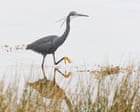
It is a tropical bird typically encountered between west Africa and India, but last week a western reef heron arrived in north Wales in what is believed to be the first ever sighting in the UK.
The heron was first spotted in Foryd Bay at the weekend before flying to nearby Caernarfon harbour where it fed among the boats.
A woman in her 30s is in a critical condition after being bitten by a large shark at Coogee beach on Saturday, with a witness describing the scene at the popular Sydney beach as “shocking”.
A spokesperson for New South Wales Ambulance said the woman suffered arm and leg injuries and had been taken by road to St Vincent’s hospital.
Long-awaited course to examine human effects on natural world and explore everyday ways to aid biodiversity
School pupils will learn how to plant a wildflower-friendly garden, according to long-awaited plans announced on Thursday for a natural history GCSE in England, Wales and Northern Ireland.
Campaigners have for more than a decade called for the study of biodiversity loss and global heating to be introduced as a dedicated subject in classrooms across the country, but despite a curriculum being previously drawn up, its launch has faced repeated delays.
Twenty-five people who were charged after they protested against the visit of the Israeli president will face a six-week joint trial in July next year.
The protesters had their matters heard before Downing centre local court on Thursday after their lawyers made a successful application for the joint hearing, arguing there were common legal issues across the cases.
The Met Office has claimed a new Welsh temperature record for springtime. But it was recorded at Bute Park, a Class 5 junk site where hot air is frequently vented from greenhouses, says Paul Homewood.
Mohammed Skaf, a notorious gang rapist, has been arrested in Sydney and charged with nearly two dozen alleged drug offences.
New South Wales police said two men and a woman will face court on Thursday over their alleged involvement in a large-scale drug supply scheme after search warrants were executed in Sydney’s southwest overnight.
State admits former Greens candidate entitled to damages and agrees to pay medical costs, but denies malicious prosecution and malfeasance in public office
The state of New South Wales has admitted that a police officer punched Hannah Thomas in the eye while holding a torch at a pro-Palestine protest – and it has offered to pay her medical costs.
Court documents seen by Guardian Australia reveal the state has admitted to false imprisonment and battery in its defence to a civil action launched by the former Greens candidate in October.
Justice secretary’s plans likely to increase black people’s suspicion of court system, committee suggests
David Lammy’s planned changes to the criminal courts in England and Wales could have a “far-reaching” impact on race relations, a cross-party committee of MPs has concluded.
The deputy prime minister’s plan to remove the right to elect for a crown court trial “has the potential to increase mistrust in the criminal justice system among the black community”, the justice select committee said, because black defendants are more likely to elect for trial.
Badenoch said, after the murder of Stephen Lawrence, it was right that people wanted to ensure this did not happen again.
It led to the Macpherson report, she said.
[It] wanted to put right what went wrong with policing in the 1990s.
However, in attempting to do so, it also enshrined a principle which I believe is wrong that a racist incident is racist if it is perceived as racist by the victim or any other person.
Equality law, properly designed, should protect us all in the same way. It should be a shield, not a sword.
It should protect people from discrimination. It should protect people from being treated differently because of their race, sex, religion, sexuality, disability or age.
New South Wales prosecutors have launched proceedings against two state Labor officials after they allegedly disguised donations to Chris Minns during his election campaign almost a decade ago.
On Tuesday, the NSW Electoral Commission revealed the director of public prosecution had begun proceedings against former Labor MP Ernest Wong and restaurateur Jonathan Yee. The commission commenced an investigation in 2019 intoa “potential scheme to circumvent” election funding laws during the campaign to elect Minns for the seat of Kogarah.
David Lammy to announce trial of AI assistants in crown courts in effort to cut backlog of cases
A plan to roll out virtual legal assistants powered by artificial intelligence to crown courts has prompted warnings that the technology should not be used to “replace vital funding and additional court staff”.
David Lammy, the deputy prime minister, will announce on Tuesday that AI assistants will be trialled in an effort to cut the backlog of court cases in England and Wales.
Exclusive: Analysis shows 72.5% of 91 judgments in England and Wales contained judicial victim-blaming, with mothers scrutinised more intensely
A report has found “widespread and concerning evidence” of bias and victim-blaming in the family courts – primarily disadvantaging women.
The report, Scratching the Surface: Victim-Blaming and Bias in Family Court Judgments, by the nonprofit organisation Right to Equality, will be shared with MPs on Tuesday at an event in parliament.
Echo project will help erase images as part of package of support to end ‘prolonged suffering of survivors’
Victims of child sexual abuse in England and Wales will be given help to remove online images of their abuse as part of a wider package of support to end the “prolonged suffering of survivors”.
The Echo project will help those who have reported their abuse to the police to identify and remove images of abuse online. They will also be given trauma support, the possibility of having a victim impact statement read in court against their perpetrators and the opportunity of criminal or civil compensation.
Trade unions have called for the government to intervene to speed up Tata Steel’s connection to the electricity grid in south Wales, after the company said its new furnace would be delayed by up to a year.
Tata Steel last month told investors that National Grid had said it would face a six- to eight-month delay. That could stretch to 12 months amid unexpected engineering difficulties.
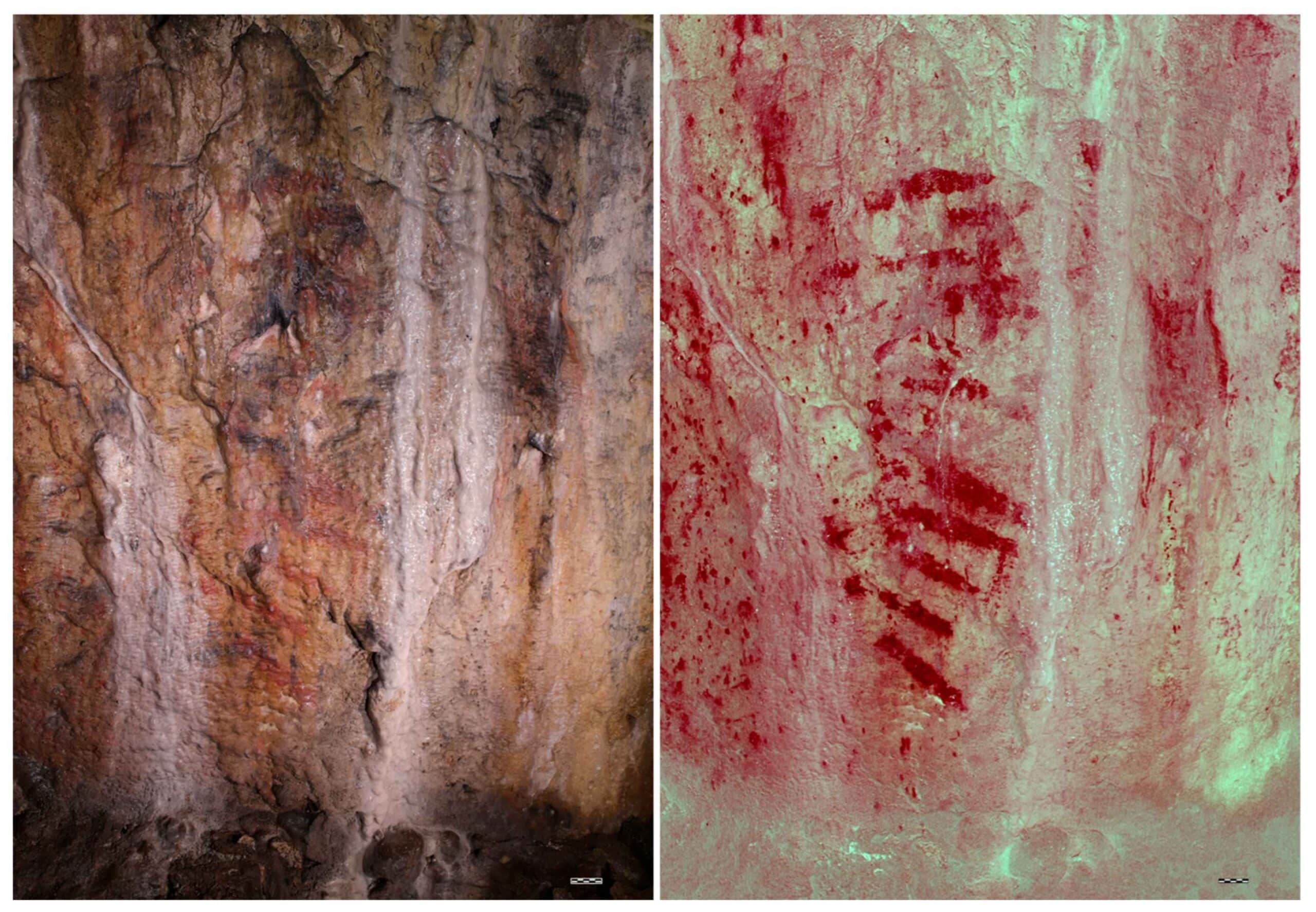
Red pigment markings at Bacon Hole Cave in Wales. Credit: George H. Nash / CC BY 4.0
A series of red markings inside a cave in south Wales has been confirmed as the UK oldest cave art, ending decades of debate over whether the images were created by humans or formed naturally.
Researchers determined that the markings at Bacon Hole Cave near Mumbles were painted about 17,100 years ago during the Upper Paleolithic period. The discovery makes them the oldest known rock art in Britain and northwestern Europe. The findings overturn a conclusion that had stood since 1928, when experts dismissed the markings as natural mineral stains rather than prehistoric artwork.
Discovery revisited after more than a century
The markings were first reported in 1912 by professors William Sollas and Henri Breuil, who identified the red bands as prehistoric cave paintings. At the time, the discovery was described as the first example of Paleolithic cave art found in Britain.
A substantial breccia deposit is located around the current entrance area of the cave. Credit: George H. Nash / CC BY 4.0
That interpretation was later rejected. Researchers concluded that the red streaks were caused by iron-rich minerals seeping through the limestone walls, and the site gradually lost its significance as a prehistoric art location.
More than a century later, an international team led by prehistoric art specialist George Nash reexamined the markings using scientific methods unavailable to earlier researchers. The team’s findings, published in the journal Quaternary, confirmed that the red pigment was intentionally applied by humans around 17,100 years ago.
Scientific analysis confirms human origin
Researchers used uranium-thorium dating and archaeometric analysis to study the pigment and surrounding cave deposits. Laboratory tests identified a mixture of calcite and clay residues within the paint, indicating that the material had been deliberately prepared. Analysis also showed that the pigment was applied directly with a finger.
The painted lines appear as evenly spaced horizontal bands arranged in a structured pattern. Researchers said the design is inconsistent with natural geological processes and supports the interpretation originally proposed in 1912.
Part of the artwork may have been overlooked for decades because a local fisherman painted graffiti on a nearby section of the cave chamber in 1894, making the markings more difficult to interpret.
Life in Wales during the Ice Age
Eastern view of the cave entrance and the Bristol Channel. Credit: George H. Nash / CC BY 4.0
The artwork was created as Wales emerged from one of the coldest phases of the last Ice Age, known as the Devensian glaciation. At the time, the landscape around Bacon Hole was a cold, largely treeless environment. Researchers believe the area surrounding what is now the Bristol Channel attracted large grazing animals during seasonal migrations.
The cave and other nearby shelters along the Gower coastline would have provided suitable living spaces for hunter-gatherer groups moving through the region.
A significant addition to Britain’s prehistoric record
Bacon Hole Cave lies within the limestone cliffs of the Gower Peninsula overlooking the Bristol Channel. Although the area is recognized for its natural beauty, the cave is not currently protected as a scheduled monument.
Researchers argue that the site’s newly confirmed status as the UK oldest cave art strengthens the case for greater protection. The study was conducted by researchers from First Art, the University of Southampton, Swansea University and other institutions, with support from the National Trust and the Bradshaw Foundation.
The discovery adds to a small number of known examples of Upper Paleolithic rock art in Britain and provides rare evidence of artistic activity in the region more than 17,000 years ago.

 Login
Login