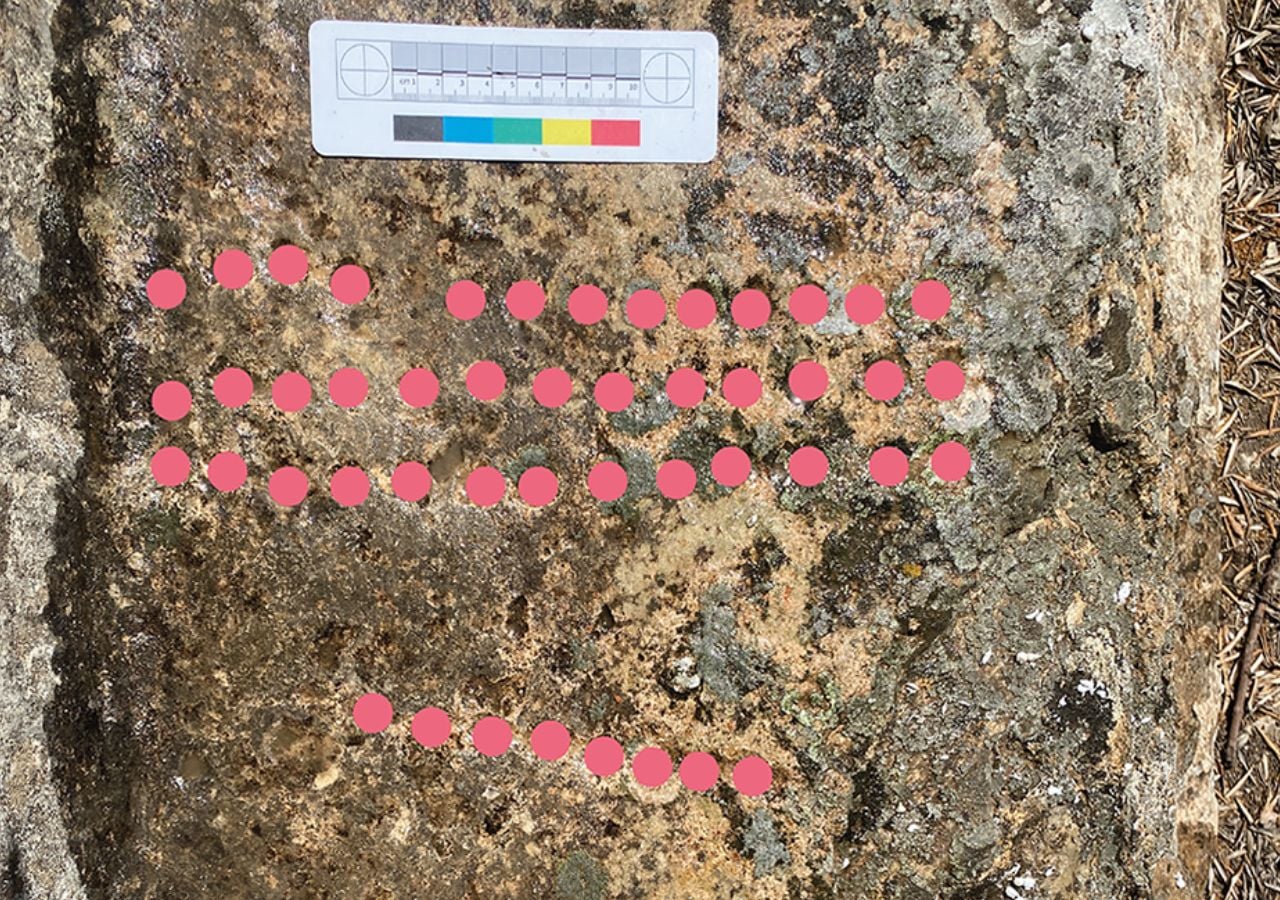
The gameboard in the hammam at Walīla, Morocco. Credit: Tim Penn / CC BY 4.0
A stone game board carved inside a medieval bathhouse in Morocco could rewrite what historians know about board games in early Islamic North Africa.
The discovery, published in the journal Libyan Studies, pushes back evidence for a game still played today by several centuries and sheds new light on social life in one of the region’s earliest Islamic settlements.
Tim Penn of the University of Reading led the study examining a previously unpublished game board at Walila, the site of ancient Roman Volubilis in Morocco. The board was carved into a stone step leading into a cold plunge pool inside a bathhouse, or “hammam,” built in the late eighth or early ninth century.
The structure was abandoned by the tenth or eleventh century. That narrow window gives researchers a rare, secure date for the board, something that is extremely difficult to establish for carved game boards found at ancient sites.
Morocco bathhouse yields a precisely dated medieval game board
The bathhouse was part of a larger complex that researchers believe served as the residence of Idrīs I, the founder of the Idrisid dynasty and one of the earliest Islamic rulers in North Africa.
Idrīs I arrived at Walila in 788 after fleeing the Hijaz and was declared imam by a local Berber tribe. The complex included a domestic building, a reception hall, and a storage compound, all built in a courtyard style more common to the Levant than North Africa.
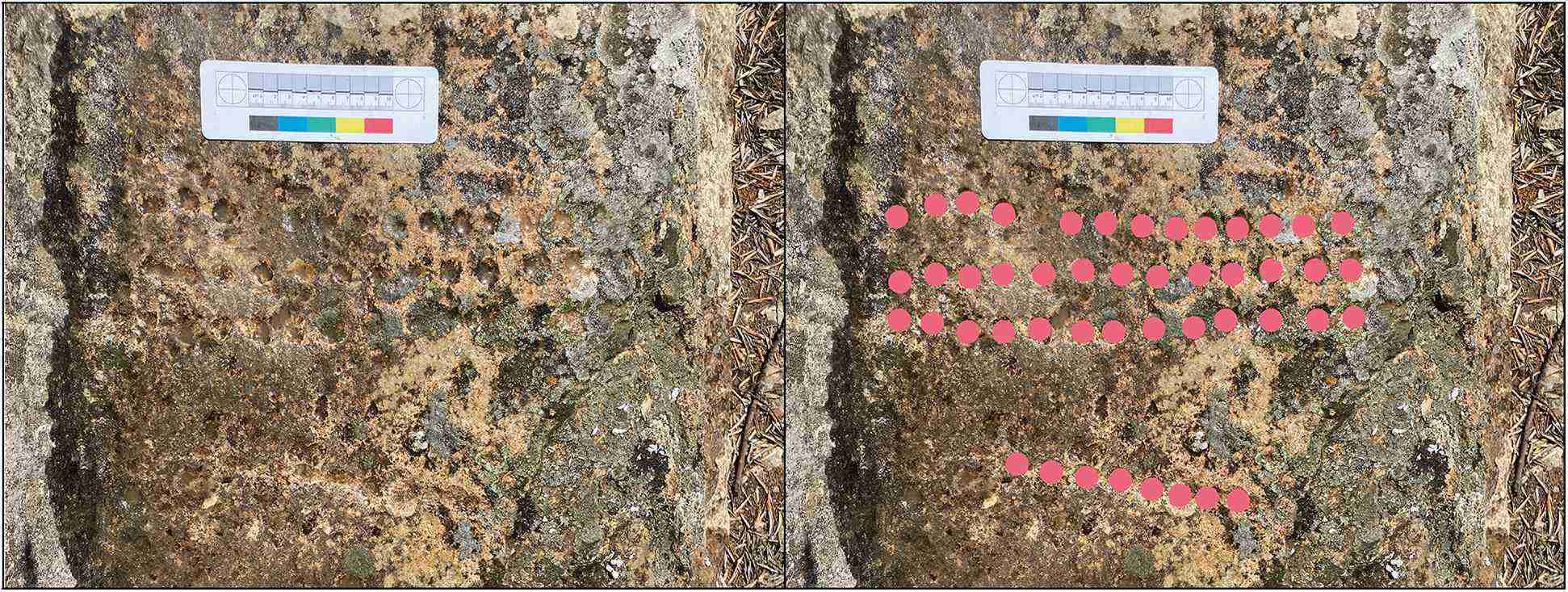
The game board itself measures roughly 34 by 9.5 centimeters (13.4 by 3.7 inches) and consists of three rows of at least 13 small, shallow holes carved into the stone.
The gameboard in the hammam at Walīla (left), with mark-up showing position of holes (right). Credit: Tim Penn / CC BY 4.0
Researchers identified it as most likely used for “tab/sig,” a running-fight game in which two players move pieces across the board from opposite sides, trying to capture each other’s pieces. The game is still played in parts of North Africa, the Middle East, and Turkey today.
Tab identified as Walila’s ancient running-fight game
The identification matters because the first known written reference to tab appears in the work of Egyptian author Ibn Daniyāl, who died in 1310.
The Walila board predates that reference by roughly 400 to 500 years, suggesting the game has a far longer history in the region than texts alone would indicate.
Researchers also ruled out mancala, another widely played ancient game, because the Walila board’s holes are too shallow and too small to hold multiple playing pieces, which mancala requires. The odd number of holes per row also makes the mancala rules impractical.
Similar boards from the early Islamic period have been found in Arabia, the Middle East, and Portugal, but none had previously been confirmed anywhere in North Africa.
The broad distribution of these boards across the early Islamic world, and as far as Scandinavia, where a closely related game called “daldos” or “sahkku” was played, points to the game traveling through trade and cultural networks.
From Arabian trade routes to Scandinavian shores
At Walila, those connections to the east are well documented. Imported coins, glassware, and a wine jar from Egypt and the Levant were all recovered at the site.
The bathhouse itself uses a dry-heat system more closely linked to Levantine construction than to the Roman bathing tradition, further reinforcing ties to the Middle East. Researchers suggest the game may have arrived in Morocco with Idrīs I or members of his entourage.
The board sat at the center of the steps into the plunge pool, fully visible to anyone in the changing room or entering the water. Researchers noted that its prominent placement suggests gaming was openly accepted as part of the social experience of bathing.
Bone dice recovered from nearby buildings at the site further confirm that a range of games, including games of chance, were played at Walila during the early medieval period.
The study calls on archaeologists working across North Africa and the broader Mediterranean to document game boards more systematically, noting that carvings of this kind are routinely left out of excavation reports.
Mycenaean religious practice included structured sacred spaces, and the evidence challenges the idea that Mycenaean temples did not exist. Credit: Wikimedia Commons, Andreas Trepte, www.avi-fauna.info, CC-BY-SA-2.5
According to a long-standing urban legend, the Mycenaeans did not build temples but worshiped outdoors under open skies. This claim appears in popular books, casual discussions, and also surfaced in earlier scholarly interpretations of Bronze Age Greece.
However, archaeological evidence challenges this view. Material finds, Linear B texts, and remains of cult architecture all point in a different direction. The Mycenaeans did not restrict worship to open-air rituals alone; they also used structured sacred spaces within buildings. In fact, they developed organized religious environments that functioned in ways comparable to early temples.
The origin of the “open-air only” idea
The idea that the Mycenaeans worshiped exclusively outdoors stems from early comparisons with Minoan Crete. Some early researchers assumed that Bronze Age societies possessed no formal religious architecture and interpreted the absence of large, classical-style temples as evidence of informal worship practices.
In addition, early archaeologists often struggled to identify religious buildings at Mycenaean sites. Many structures appeared domestic or administrative in character, leading to an underestimation of their possible ritual functions. Over time, these assumptions produced a simplified narrative suggesting that Mycenaean religion remained primitive or underdeveloped. In this interpretation, formal temple construction was seen as something that emerged only in later Greek civilization.
Today, this view is considered outdated and overlooks both textual and archaeological evidence. It also projects later Greek architectural expectations onto an earlier cultural and historical context.
What the Linear B tablets reveal about Mycenaean temples and religious practice
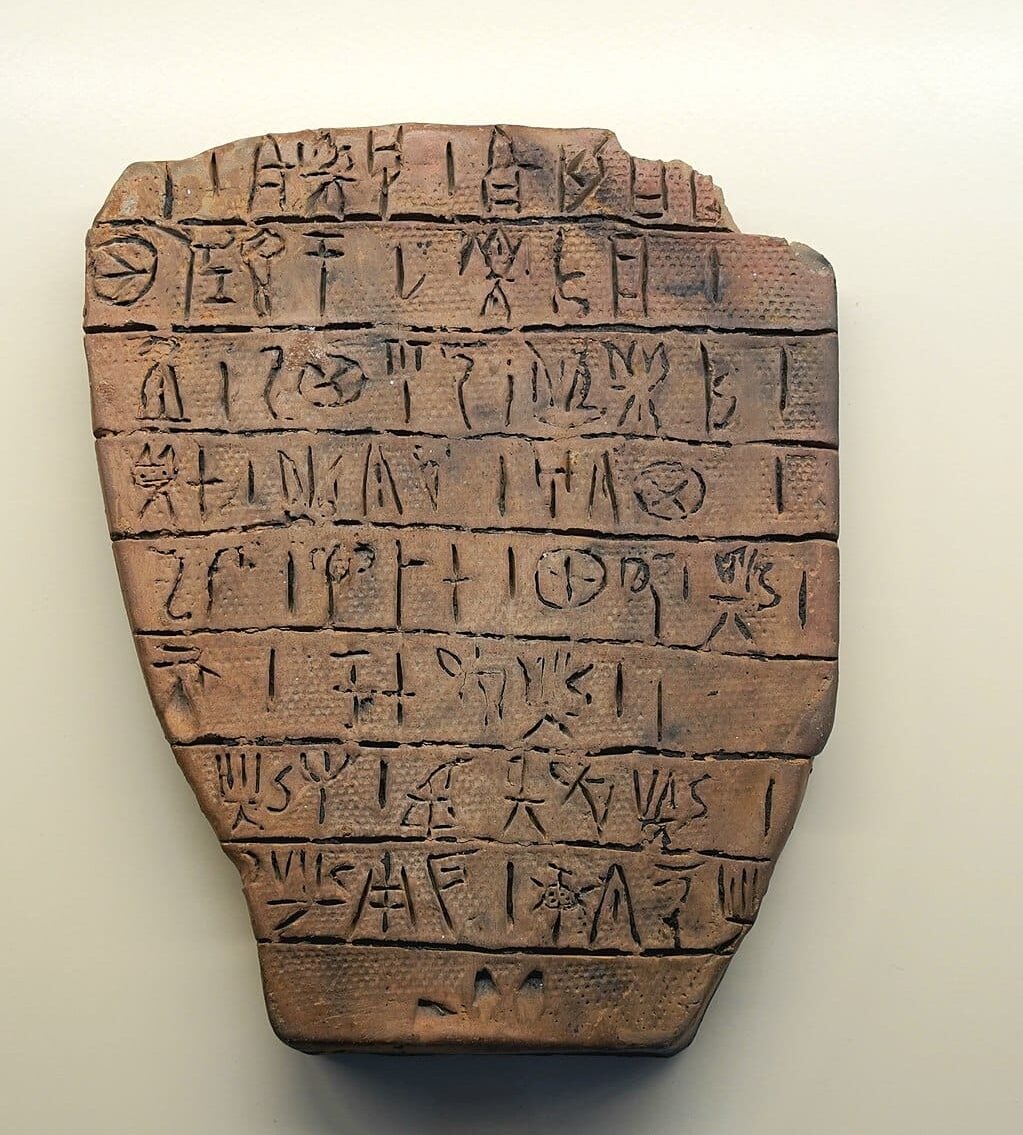
The Iliad already refers to a temple within the Trojan citadel that houses the statue of a goddess, suggesting that structured sacred spaces were part of early Greek religious imagination. Beyond literary tradition, the Linear B tablets provide some of the strongest evidence against the “open-air-only” interpretation. These tablets preserve administrative and religious records from Mycenaean palace centers, offering a rare direct glimpse into how cult activity was organized.
They record offerings and mention deities associated with the later Greek pantheon, including Zeus, Poseidon, Hera, Artemis, and Hermes, while also documenting the management of cult resources by officials. This points to a system of structured worship rather than purely spontaneous outdoor ritual.
Importantly, the tablets often connect deities with specific locations, referring to sanctuaries, priests, and offerings tied to defined, organized spaces. This suggests that religious practice was not confined to natural settings but also embedded within institutional environments. Taken together, this written evidence weakens the idea of exclusively outdoor worship. Instead, it reveals planning, hierarchy, and dedicated sacred functions within Mycenaean religious life.
Tablet with Linear B Script from the Palace of Knossos – 1375 BC. Credit: TimeTravelRome. CC BY 2.0/flickr
Archaeological evidence of cult spaces
Archaeology strengthens this conclusion. Excavations at Mycenaean sites have uncovered buildings with clearly identifiable ritual functions, including altars, offering areas, and religious artifacts. One of the most significant examples comes from Mycenae itself. The so-called “Tsountas House” provides key evidence for structured cult activity within a designed landscape.
The Tsountas House is located near the citadel of Mycenae and was first excavated during early investigations led by Christos Tsountas. The structure dates to the Late Bronze Age. At first glance, the building does not resemble a later classical temple, lacking the monumental stone columns associated with later Greek religious architecture. However, its interior evidence tells a different story. Researchers such as Kim Shelton have identified signs of ritual activity within the structure, including figurines, offering vessels, and spatial arrangements that suggest ceremonial use. The layout also indicates controlled movement through the building, reinforcing the impression of organized ritual practice.
Taken together, these features are significant. They show that Mycenaeans used enclosed architectural spaces for ritual purposes, effectively functioning as cult centers. Worship was not confined solely to mountains, peak sanctuaries, or open courtyards. Instead, structured sacred environments existed within administrative and residential settings. This evidence points to a broader religious system in which cult activity, palace administration, offerings recorded in Linear B texts, and outdoor sacred landscapes all formed interconnected components of Mycenaean religious life rather than isolated or competing practices.
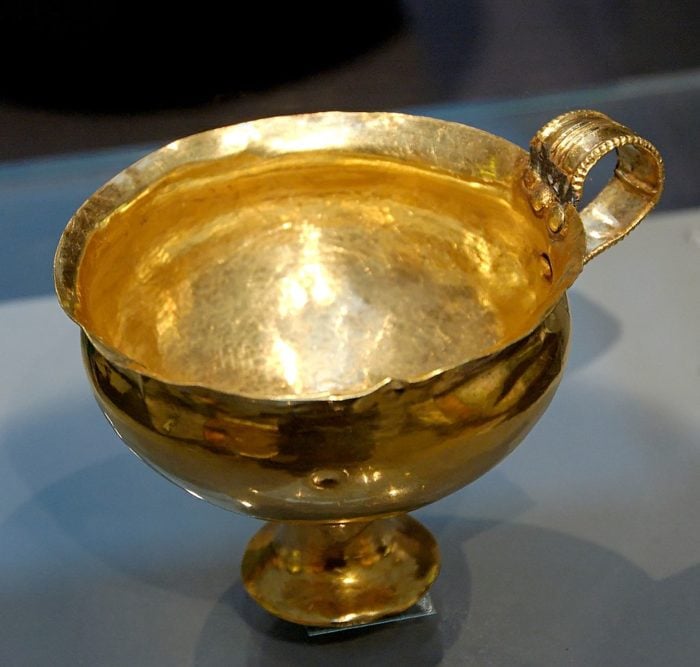
Remarkable gold artifacts discovered within the Mycenaean citadel. Credit: Xuan Che / CC BY 2.0
Why the “no temples during the Mycenaean period” narrative fails
The “no temples” narrative fails largely because it relies on a narrow, anachronistic definition of what a temple must be. If one expects Mycenaean sacred architecture to resemble later classical Doric structures, then such buildings will not appear in the archaeological record. However, this expectation sets a false standard. It overlooks architectural evolution over time and ignores the cultural and functional differences between the Bronze Age and later Greek periods.
Mycenaean sacred architecture followed its own internal logic. Ritual spaces were frequently integrated into palatial complexes or elite residences, and smaller, multi-functional buildings often served religious purposes in place of large, freestanding temples. For this reason, the absence of classical-style temples does not imply the absence of religious architecture.
At the same time, Mycenaeans did perform rituals outdoors, likely at natural features such as hills, caves, and mountain peaks. Outdoor worship was an important component of Bronze Age religious practice, a pattern that continued into later Greek tradition. Nonetheless, outdoor ritual activity did not exclude indoor sacred spaces. Rather, both forms coexisted and fulfilled different roles within a broader religious system.
Mycenaean religion combined palace-based cult administration, offerings recorded in Linear B texts, enclosed ritual spaces, and outdoor sacred sites in the landscape. Together, these elements formed a structured, multi-layered system operating across both constructed environments and the natural world. This combination underscores not only complexity and organization but also continuity with later Greek religion. Structured sacred space did not emerge suddenly in the Classical period but developed gradually from earlier Bronze Age practices.
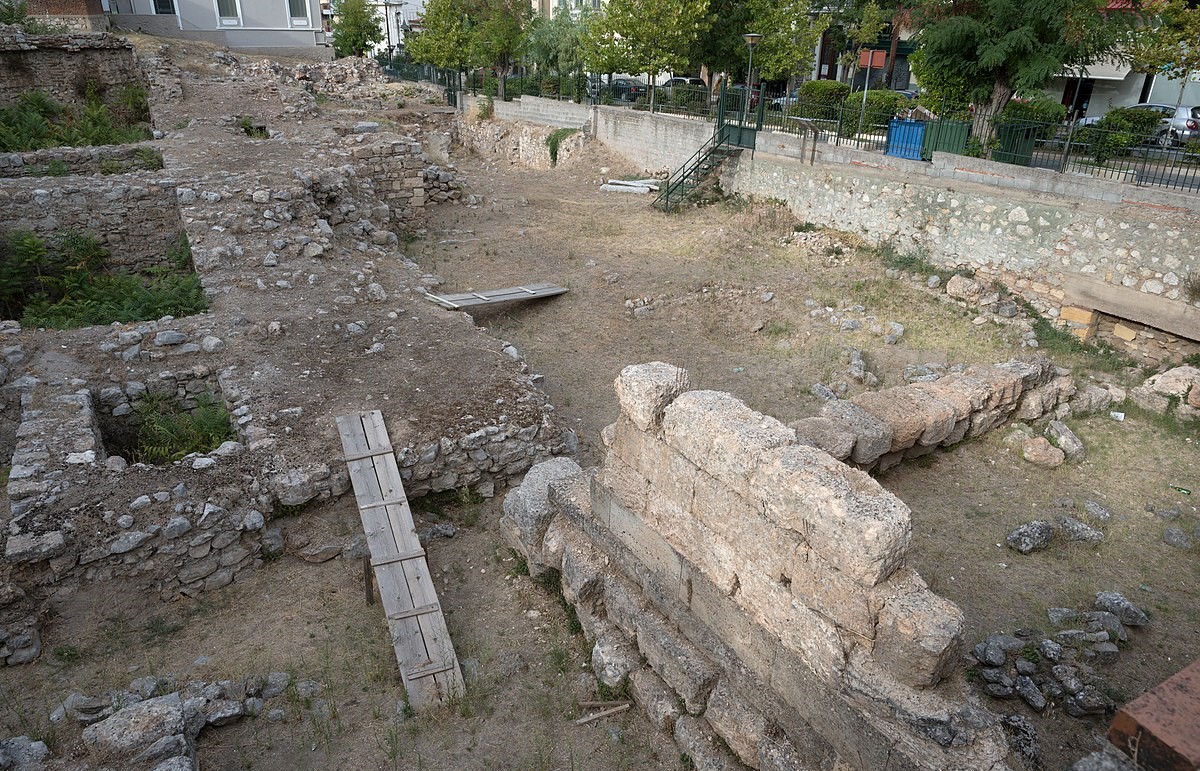
Kadmeion. Mycenaean palace complex of Thebes. Credit: Zde / Wikimedia Commons CC BY-SA 4.0
Why the myth persists today
The persistence of the “no temples” myth can be traced to three main sources. First, early scholarship shaped the expectations of later generations. Once an interpretation enters textbooks and reference works, it tends to persist, even when new evidence complicates or overturns it.
Secondly, the very word “temple” carries a strong classical bias. Readers often imagine columns, symmetry, and monumental marble architecture. When such features are absent in the Bronze Age record, this is interpreted as a lack of temples rather than a difference in architectural form.
Lastly, simplified narratives tend to spread more easily than nuanced archaeological interpretations. The idea of “primitive outdoor worship” is easy to remember and communicate, whereas the actual picture is more complex and layered. In reality, the Mycenaeans did not rely exclusively on open-air worship but also built and used structured indoor spaces for ritual activity that can reasonably be understood as early temple forms.
The claim that Mycenaeans lacked organized religious buildings does not withstand scrutiny. It reflects early interpretive bias more than archaeological evidence. Mycenaean religion combined indoor and outdoor elements and showed early forms of institutional organization. In this sense, it laid important foundations for the development of later Greek religious architecture and practice.
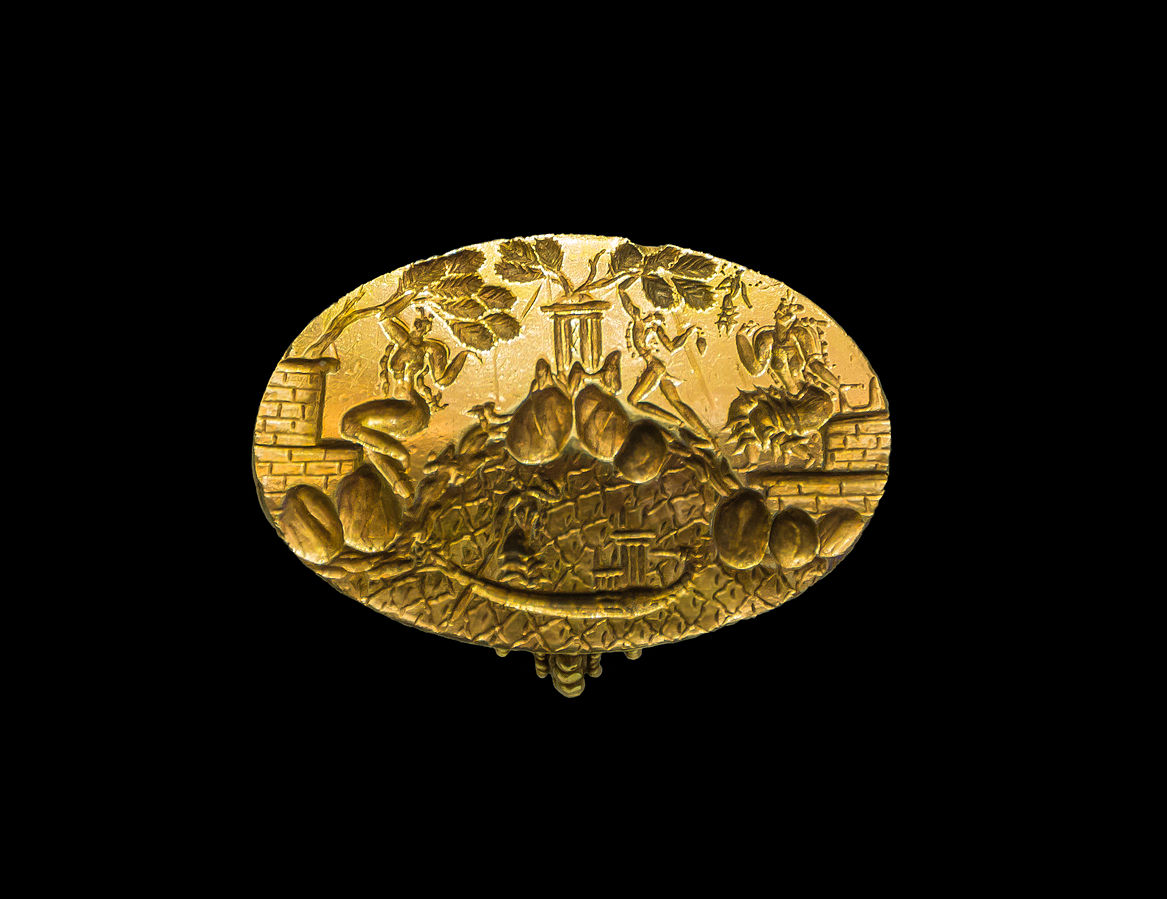
Ring of Minos Heraklion. Credit: Wikipedia/Jebulon/Public domain
The story of the ring known as the “Ring of King Minos” sounds like a tale made in Hollywood. It is a mix of ancient Greek history, mythology, and a plot involving a poor boy, a cunning priest, an English archaeologist, and hidden treasure.
The story begins in 1928, when a boy, Michalis Papadakis (1918-1974), accidentally found a ring at the archaeological site of Knossos. The place of discovery alone meant that the ring certainly had a very long history attached to it probably even going back to the Minoan civilization.
Indeed, several decades later, the shiny, gold, seal ring proved to be 3,500 years old (1,500 to 1,400 BC), as archaeologists assured him, and his was the most significant discovery of Minoan Civilization.
The boy’s father, a destitute farmer named Emmanouil, for some unknown reason, hid the ring from his wife and, for another unknown reason, two years later, he handed it over to the village priest, Father Nikolaos Polakis. Yet, before giving it away, he carved a line on the ring with his knife in order to mark its originality.
Father Polakis initially presented it to English archaeologist Sir Arthur Evans with the intention of selling it. However, there was no deal struck between the two since the priest demanded an astronomical amount of money.
In 1933 or 1934, Father Polakis decided to take the ring to the Heraklion Museum. At the time, the distinguished archaeologists, Nikolaos Platon and Spyridon Marinatos, were on the staff of the institution. Platon decided that the ring was genuine while Marinatos believed the ring was a fake.
Since the two archaeologists could not come to an agreement, they decided it was best to return the ring to the priest.
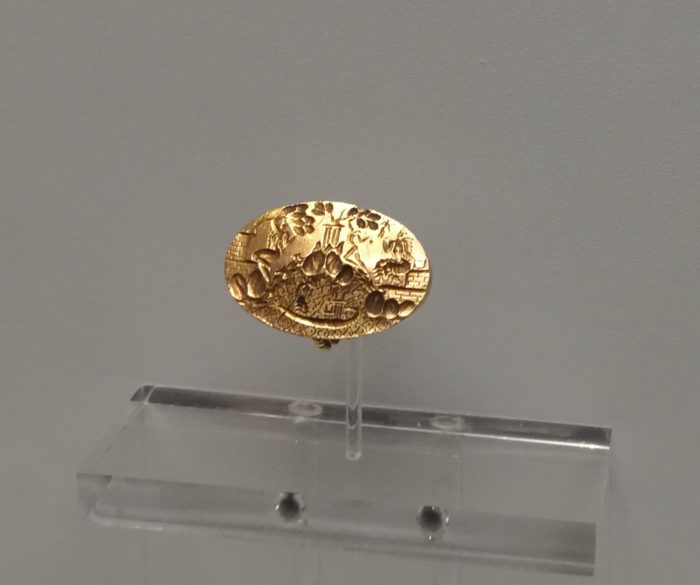
The King Minos Ring at the Heraklion Archaeological Museum. Credit: Twitter/Bokeras
However, Platon kept a copy of the ring by casting it in plasticine. The cast was later located in Platon’s archive. Several years later, he manifested a new interest in the ring and returned to the priest to ask for it. Father Polakis told him that he had given it to his wife for safekeeping, but she had lost it.
Minos ring depicts three themes
Platon wrote a treatise on the ring saying that it depicts three themes: the Minoans’ rule of the seas (“thalassocracy”), tree worship (dendrolatry), and a goddess descending from heaven to earth and getting into a row boat.
There are other, more recent interpretations of the depictions of the ring including the worship of goddesses, such as Mother Dimitra, and offerings to the Great Mother Rhea and the Great Mother Artemis.
For some time, the ring remained lost. The only information about the ring came from the copies that had been made and a number of archaeological reports which were associated with those copies.
Many years later, when Father Polakis was in his final days, he felt great regret about the “disappearance” of the precious ring. He called Evangelia Papadakis, the wife of the farmer Emmanouil, and apologized for lying to her family. He admitted that he had actually sold the ring to Evans, the English archaeologist, for 100,000 drachmas back in 1938.
However, that was one last lie by the cunning priest. What he had actually sold to Evans was a fine replica of the ring.
Evans had returned to England with the belief that he had bought the actual ring, along with a copy, and donated both, along with other precious artifacts, to the Ashmolean Museum. Today, two replicas of the legendary ring continue to be exhibited at the Ashmolean.
The story of the ring was forgotten for decades, but in the early 2000s, Giorgos Kazantzis, a retired police officer, inherited the house of the priest who was the last person in Greece who had had possession of the priceless artifact.
During renovation work, Kazantzis found a jar hidden inside the wall next to the fireplace. Inside the jar was a ring, which indeed proved to be the original Ring of King Minos. It even had the scratch made by Papadakis over seventy years ago.
Kazantzis delivered the precious artifact to the state, and in 2002, the Central Archaeological Council and a panel of expert archaeologists confirmed the authenticity of the ring. The actual monetary value of the ring was estimated to be €400,000 although its cultural value is incalculable.
Yet, for finding the ring and promptly delivering it to the appropriate authorities, Kazantzis was given a measly finder’s fee of €440.
Today, the priceless, gold Minoan ring is exhibited in all its splendor at the Heraklion Archaeological Museum.
Marx and Aristotle, though centuries apart, both recognized that value is rooted in social relations rather than in objects themselves. Credit: GreekReporter Archive
When the philosopher Karl Marx set out to unravel the mysteries of value, exchange, and labor in capitalist society, he found a surprising intellectual ally in Aristotle, the ancient Greek philosopher who lived two millennia earlier. Despite their different historical contexts, both thinkers examined how value arises not inherently from things but from their social relations—especially through the lens of use and exchange.
Marx, in Capital, openly acknowledged Aristotle’s importance. Not only did Aristotle lay the groundwork for distinguishing use-value from exchange-value but his reflections on early human society, property, and the role of labor and technology revealed a conceptual framework that Marx would radicalize for modern critique.
Use-value and exchange-value: Aristotle’s anticipation
Aristotle’s analysis of value in Politics distinguishes between two uses of a commodity. One is proper and natural while the other is improper or derivative. He writes:
“Every commodity has two uses: both belong to the thing itself, but not in the same manner—one is the proper use, the other is not. For example, a shoe serves either to be worn or to be exchanged; both are uses of the shoe, for he who gives a shoe in exchange to someone who needs it, receiving in return money or food, uses the shoe as a shoe, but not according to its proper use, for it was not made to be exchanged.”
This distinction—between use-value and exchange-value—is a cornerstone of Marx’s analysis. For Marx, this Aristotelian formulation prefigures what he calls the “value-form” of the commodity. Commodities are useful in particular ways (use-value), but also enter into a social system of equivalence when exchanged (exchange-value).
Marx directly builds on this by showing that exchange-value does not exist inherently in an object but arises through the abstraction of labor—because human labor makes different useful things commensurable. Aristotle notes that a shoe does not exist for exchange. Marx took this insight and asked: What kind of society inverts this logic and makes objects valuable only in proportion to their exchangeability rather than their utility?
From the household to the marketplace: society before exchange
Aristotle’s theory of the household (oikos) as the first form of society was essential for Marx’s historical materialism. In Politics, Aristotle describes early society as beginning with families. In these families, property was communal and exchange unnecessary. It was only as the population grew and self-sufficiency gave way to interdependence that markets and money emerged.
Marx adopts this trajectory in Capital and his Grundrisse notebooks, writing that commodity exchange is not a timeless activity. Instead, it is a historically specific development that reflects changes in social relations and property forms. The transition from common property to private ownership and from useful production to production for exchange is the material foundation of class society.
In Aristotle, we already see the seeds of this analysis. He distinguishes between natural wealth-getting (production for use) and unnatural chrematistics (the accumulation of wealth for its own sake). Marx seizes upon this distinction to critique capitalism as a system in which the unnatural pursuit of profit replaces human need as the goal of production.
A statue of Aristotle. Credit: Public Domain, via Wikimedia Commons
The machine and slavery
One of the most striking moments in Capital (Vol. I) occurs when Marx discusses machinery and automation. Here, he ironically invokes Aristotle’s dream that if tools could operate themselves, no slaves would be needed:
“If—dreamed Aristotle, the greatest thinker of antiquity—if every tool could perform its task at command or even by anticipation, like the statues of Daedalus that moved of their own accord, or the tripods of Hephaestus that spontaneously began their sacred work, if the shuttles of the loom wove by themselves, then master craftsmen would not need assistants, nor masters slaves.”
This vision did not remain uniquely Aristotelian. Antipatros, a Greek poet from the era of Cicero, hailed the invention of the watermill—the earliest rudimentary form of productive machinery—not simply as a technical advancement but as a social revolution. He praised it as the liberator of enslaved women who had been condemned to grind grain by hand. He envisioned it as the usher of a new golden age of human dignity and freedom.
In these ancient myths and poetic praises, technology is seen not merely as efficiency but as emancipation. The ancients, despite their slave-based economies, understood that the highest purpose of tools was to free people from servitude.
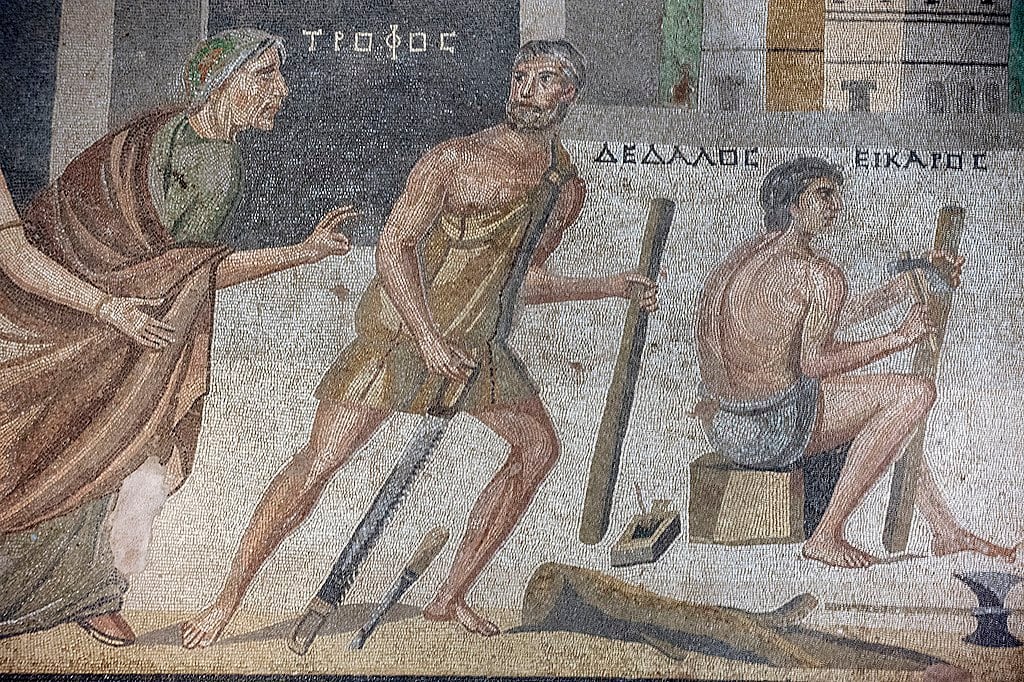
Gaziantep Zeugma Museum Daedalus mosaic. Credits: Dosseman / Wikimedia Commons CC BY-SA 4.0
Marx’s irony and the betrayal of the promise of automation
Marx, however, saw this ancient hope turned upside down in modern capitalist society. In his words, what was supposed to free labor had become its jailer:
“Ah, those idolaters! They knew nothing of political economy or Christianity, as discovered by clever Bastiat and even cleverer McCulloch. They failed to understand, among other things, that the machine is the most reliable means for lengthening the working day.”
Here, Marx mocks the liberal economists of his time. Frédéric Bastiat and John Ramsay McCulloch, champions of laissez-faire capitalism, celebrated mechanization without recognizing its role in intensifying exploitation. Unlike the “idol-worshiping pagans,” who at least had the imagination to conceive of automation as a force for liberation, these modern theorists lacked even that mythical foresight.
Marx continues with biting irony:
“They failed to understand, among other things, that the machine is the most reliable means for lengthening the working day.
Thus the strange phenomenon arises in the history of modern industry. That the machine, the most powerful instrument for reducing labor time, becomes the most unfailing means of converting the whole life of the worker and his family into labor-time for capital’s valorization.”
The true paradox for Marx is that mechanization offers a means to liberate humanity but capital instead weaponizes it to intensify exploitation. The ancients envisioned automation as a means of human emancipation. Capitalism uses it to deepen alienation and dependency.
The irony is profound: the ancients dreamed of freedom through the machine, and capitalism delivered machines that reinforce dependency. In this way, Marx reclaims the ancient vision but also shows how the promise of automation has been betrayed.
Antipatros celebrated the invention of the watermill as a liberating force, heralding it as a symbol of a new golden age of human dignity. Credit: Pietro da Cortona, Wikimedia Commons, Public Domain
Aristotle and Marx: From ancient slavery to modern compulsion
Marx’s dialogue with Aristotle was not just academic—it was dialectical. He admired Aristotle’s clarity in distinguishing between types of value and his historical insight into the development of exchange. However, Marx also showed how the slave economy of antiquity historically constrained Aristotle’s ideas.
Ironically, in an age in which full automatism is increasingly possible, the prevailing economic model continues to reproduce the conditions that Aristotle associated with slavery—not through direct ownership of people but through economic compulsion and structural inequality. In that sense, Marx saw in Aristotle both the seed of critical insight and the limit of pre-modern social theory.
Hence, while Aristotle could not imagine that labor determines value in commodities, he sensed something essential: that value is not a thing but a relation and that social forms of labor determine the shape of society itself.
Portrait of the king of Pontus Mithridates VI as Heracles, a mythical association that Alexander the Great often touted. Marble, Roman imperial period (1st century), Credit: Musée du Louvre, Paris, Public Domain.
Alexander the Great’s (356-323 BC) death meant his vision for a Greco-Persian Empire was extinguished with him—or was it?
A hodgepodge of East and West, Mithridates’ Pontic Empire emerges as a compelling possibility of what Alexander’s empire could’ve been, a faint apparition of that fleeting dream.
Alexander 2.0
Mithridates (135–63 BC) was the inheritor of two cultures and, naturally, an incarnation of two worlds. He delighted in his Macedonian heritage as much as his Persian forbearers.
Claiming Macedonian ancestry on one side and Persian dynastic lineage on the other, Mithridates used his mixed descent to reveal the commonalities between his diverse subjects.
Taking on Alexander’s mantle of global empire, Mithridates envisioned an alternative to Roman supremacy, a new world order.
To achieve this ambitious aim, the Pontian King united his Greek, Anatolian, and Persian subjects under an anti-Roman cross-cultural coalition.
The result of this cooperation was three wars mounted against Rome, wars that escalated to the point of genocide.
How could he amass such a diverse following against such a formidable foe?
Mithridates took a page from Alexander’s book and embodied East and West, both in appearance and idea.
Pontus: Alexander’s vision of empire?
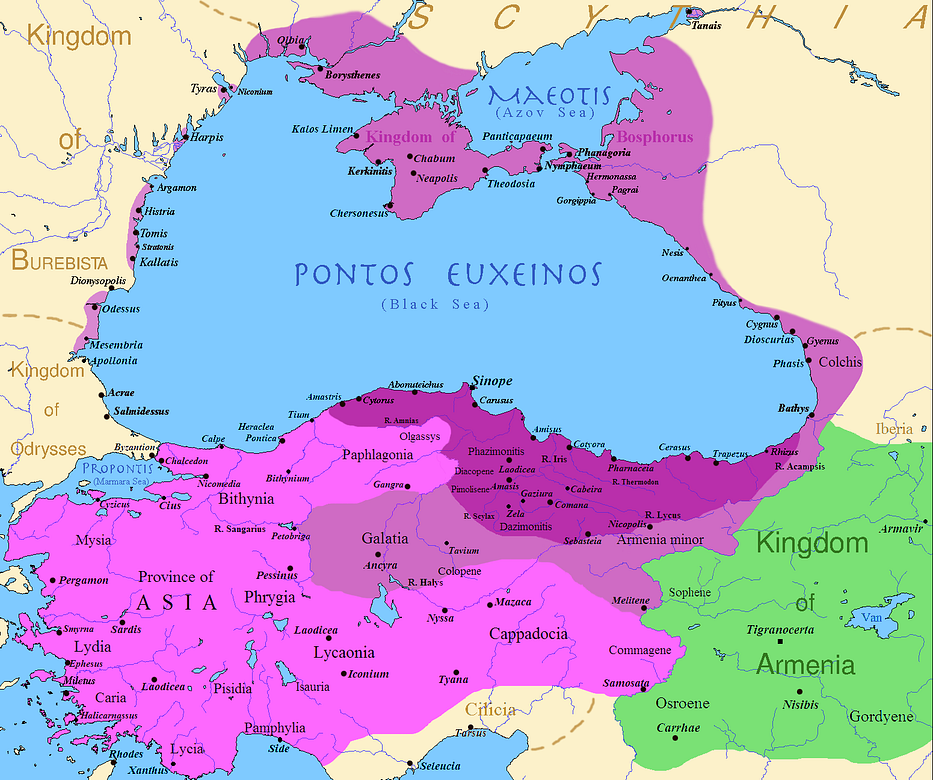
Map of the Kingdom of Pontus. Credit: Photograph by Javierfv1212, Public Domain, via Wikimedia Commons.
Mithridates hailed from the Kingdom of Pontus, a cultural melting pot that Alexander the Great would have approved of.
The north of Pontus’s snow-clad Alps was a largely Hellenic-dominated coastline. There, Greek colonists had erected the city of Sinope, Mithridates’ capital.
The historian Strabo, himself a Pontian, claimed that it was “the most noteworthy of the cities in the region.”
South of the Alps was known as Katpatuka (land of horses) by the Iranians and, later, Cappadocia by the Greeks. There, villages predominated apart from a few settlements, such as Amaseia, Strabo’s hometown, and Cabeira.
While Hellenic culture dominated the coast, the Cappadocian hinterland preserved its old Anatolian non-Greek heritage. Rostovtzeff (1932), a pioneer in Pontic history, described the Hellenic influence around the Black Sea as “a thin Greek shell around a hard native kernel.”
The third influence on the region was Iranian. The enduring relics of Persian rule would have been visible to many a Hellenistic Pontian. Strabo says that the Pontic people took sacred vows at the state temple, Zela, which were dedicated to Persian deities: Anaitis, Omanus, and Anadatus.
Moreover, Zeus Stratios, most likely a syncretic reincarnation of Ahura Mazda, received lavish offerings from Persian Kings, which Pontian rulers, including Mithridates Eupator, continued. The continuation of Persian religious customs well after an eclipse of Achaemenid authority attests to the impression Persian presence had made on Pontic royalty and their subjects.
In the subsequent Hellenistic period, the increasing pace of Hellenization of the kingdom meant that the Mithridates Dynasty had to evolve. There needed to be a balance between the new incoming wave of this ancient form of globalization with their Perso-Anatolian traditions that still held sway in their domain.
Divine descent
Mithridates Eupator depicted as Dionysus, Credit PHGCOM, Public Domain, via Wikimedia Commons.
Mithridates Eupator’s dual lineages afforded him illustrious ancestors and a unique hybrid set of dynastic customs. He was a Helleno-Persian Prince who practiced mixed religious rites.
Mithradates divine connections are well in accordance with Alexander the Great’s own claims. Like the Pontic King, Alexander claimed Heracles and Dionysus, among other numinous figures, as ancestors.
Consequently, the Pontic King embodied redemptive qualities resonating in the Greek and Perso-Anatolian worlds. For the Greeks, he established a mythical connection with Dionysus, the god of liberation and new beginnings, and took the theonym Mithridates Eupator Dionysus.
Likewise, Mithridates claimed heritage from Herakles, who emancipated the titan Prometheus, humanity’s creator. On the other hand, Mithridates’ star-signaling birth was said to fulfill Persian prophecies of a coming savior from the East, as did his name, “Mithras-sent.”
Global principles
Persian Magus-king conducting a fire ritual. Mithradates’ fire ceremony followed the traditional customs of his Persian ancestors. Detail from red-figure vase 3297, side A, by the Underworld Painter, 4th century BC. Credit: Staatliche Antikensamm lungen und Glyptothek, Munich, Public Domain
In addition to religious mediation, Mithridates weaponized the growing resentment of his subjects. Just like Alexander’s vision for his diverse empire, the Pontian King tried to respect Greek and Iranian values.
Both Greeks and Perso-Anatolians were chafing under Roman occupation. In mainland Greece and Anatolia, the common hatred towards Roman rule provoked a transcultural antagonism against Roman hegemony.
Debt accrued by Roman taxation hindered asa or Truth, a prominent Persian tenet. For the Greeks, Roman occupation was seen as compromising their eleutheria, or freedom, which was fundamental to Greek identity.
Mithridates acknowledged these grievances in his speeches, along with coins and other allusions. By showing sensitivity to both cultures, the Pontian King illustrated how compatible Iranian and Greek cultures could be.
This may be surprising, considering the tumultuous history that plagued the relations between Greeks and Iranians. Egregious crimes were committed in Athens by the Persians and by Greeks in Persepolis at Alexander’s instigation as punishment.
Yet Mithridates successfully harmonized the two cultures, as Alexander the Great’s policies aimed to accomplish.
Was Mithridates’ Pontian kingdom what Alexander’s empire could have been?
Sensitive to Greek and Perso-Anatolian culture, Mithridates entangled much of the Eastern Mediterranean in opposition to Rome. Mithridates carried on Alexander’s vision for an international empire even though he was unsuccessful in his wars against Rome. By doing so, the Pontian king proved Alexander the Great’s Helleno-Persian hypothesis was possible.
Alexander’s vision for joining East and West wasn’t an idyllic dream but was ultimately an achievable reality.
While much of the media industry focused on the churn of headlines, we became increasingly interested in the undercurrents beneath them: the hidden systems, infrastructures and ideologies shaping events across borders and over time.
Again and again, our reporting led us back to the same realization: for a long time, the struggle over information was understood primarily as a question of censorship or access. Who controls information? Who gets to publish? Who gets silenced?
Those questions still matter. But they no longer fully describe the world we live in.
Today, the struggle over information is about who builds the systems through which reality is organized, distributed and trusted. From state propaganda to algorithmic feeds, from platform monopolies to AI-generated noise, the battle is not over facts. It is over the infrastructures that determine which narratives spread, which voices are amplified and which communities remain connected.
Over the past year, these questions led to a collaboration between Coda and The Continent, the pan-African newspaper founded in Johannesburg by Simon Allison and Sipho Kings. Although our reporting emerges from very different histories and geographies, we found ourselves arriving at remarkably similar conclusions about power, fragmentation and the future of journalism in an age of informational instability.
This two-chapter essay is the beginning of that collaboration, and marks the start of a new project called The Atlas. Pilot edition is available here — please feel free to share with friends, family and colleagues, preferably in its entirety.
In Chapter One, I return to the world of my Soviet childhood: propaganda, samizdat and the search for trustworthy signals through noise.
In Chapter Two, The Continent co-founder Simon Allison presents the Parable of Sinn Sisamouth: the story of how some of the greatest songs ever written were nearly lost, and then found, and then lost again.
Taken together, these essays ask what journalism becomes in a world where information is no longer organized primarily to inform, but to capture attention, manufacture reaction and shape perception at planetary scale.
The Atlas grows out of that question.
Chapter One: Through the Static
Whenever I am asked why I decided to become a journalist, an image from my childhood pops into my head. It’s dusk. I am 10, sitting in the kitchen with my mom. She is glued to a shortwave radio. Outside, the Soviet Union is on the cusp of collapse. Georgia, where we are, is on the brink of civil war. We didn’t use the term back then, but fake news was all we got through official channels. Real news — coming from the West — felt like a lifeline. I was in awe of the crackling radio that held my mother’s full attention. I wanted to become that voice.
Illustration: Anna Jibladze.
Years later, I got my dream job at the BBC and spent much of my adult life moving between wars, uprisings and authoritarian states. Again and again, I found myself in places where truth was contested terrain: Baghdad, Damascus, Donetsk, Sana’a. But over time I realized something fundamental had changed. Modern authoritarianism no longer relied primarily on suppressing information. It had discovered something more effective.
Information could simply be drowned out by static.
That realization became stark for me in eastern Ukraine in the summer of 2014. I arrived in a field of bright yellow sunflowers where the bodies from Flight MH17 still lay scattered across the ground. A Russian missile had blown the passenger plane out of the sky, killing all 298 people on board. Yet almost immediately, the Kremlin flooded the information space with competing explanations. It was a Ukrainian fighter jet. A failed assassination attempt on Putin. The plane had been filled with corpses before takeoff. Each theory contradicted the next, but that hardly mattered. The point was not to persuade, it was to exhaust. It was to create so much noise that truth itself began to feel unstable.
Over the following years, I watched versions of the same logic spread far beyond Russia. Social platforms transformed public conversation into a permanent stream of outrage, performance and distraction, collapsing vastly different kinds of information into the same endless feed. War footage, propaganda, conspiracy theories, journalism and gossip all began competing inside systems designed not to inform people but to capture and hold attention.
Noise became the new censorship.
And increasingly, I found myself thinking about the world of my childhood again. Not because history was repeating itself neatly, but because the emotional landscape felt strangely familiar: confusion, exhaustion, distrust, the constant sense that reality itself was becoming slippery. Back then, people searched desperately for clear signals through the static of Soviet propaganda. Today, we are drowning in a different kind of static, but the instinct, the search for clarity feels remarkably similar.
In the Soviet Union, people developed ways of navigating that confusion. Among my strongest memories from that time is the sound of my parents’ typewriter late at night. Friends would pass around copies of banned Soviet literature and my parents would sit at the kitchen table all night, retyping them page by page so they could be shared again. It was my first encounter with samizdat, although I didn’t know the word then.
Looking back now, what strikes me is that samizdat was never simply about forbidden texts. It was about building trusted alternative systems of circulation when official systems had lost credibility.
At Coda, we have spent years building journalism against the logic of noise. We slowed stories down. We followed themes instead of headlines. We built a reporting system designed to connect events across borders and over time, helping readers see patterns instead of fragments. But as our globally distributed newsroom adapted to an increasingly fractured information landscape, it became clear that journalism alone was not enough. Distribution shapes understanding as much as reporting does.
Around the same time, in Johannesburg, Simon Allison, Sipho Kings and their team were building something that challenged many of the assumptions dominating digital media. The Continent, their pan-African newspaper, spreads largely through direct sharing networks: passed from reader to reader rather than pushed by algorithms.
Illustration: Wynona Mutisi.
Different histories had brought us to remarkably similar questions. What does journalism look like when trust is collapsing, attention is fragmented and the systems that carry information have themselves become instruments of power?
Out of that convergence came The Atlas: a new publication that brings together Coda’s methodology of following systems across borders and over time with The Continent’s radically distributed model for reaching readers beyond algorithmic feeds.
The Atlas is built on a shared conviction: as fragmentation, distrust and informational overload spread across the world, some of the clearest ways through will come from places that have already spent decades navigating propaganda, instability and contested reality. Places once treated as peripheral are becoming essential to understanding the defining question of this age: how can meaning survive systems designed to overwhelm it.
Michael Macor/San Francisco Chronicle via Getty Images.
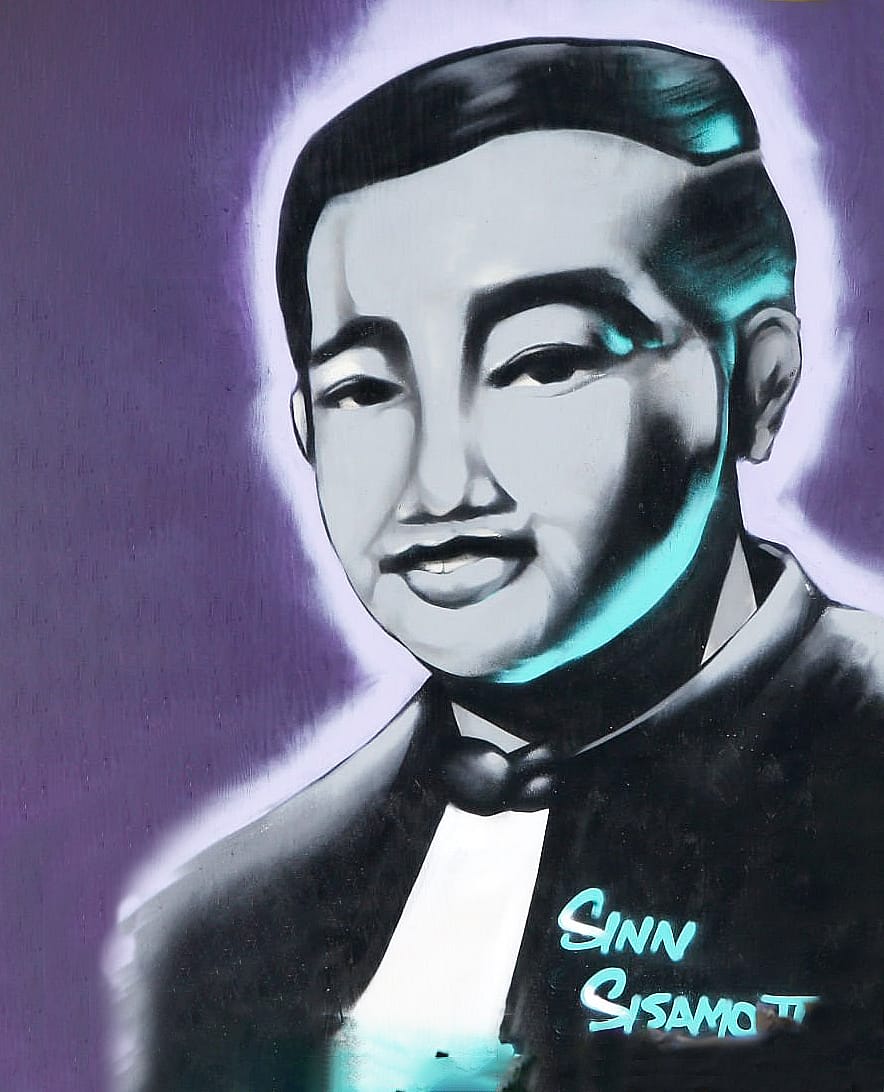
Chapter Two: The second silencing of Sinn Sisamouth
Imagine if your favourite song disappeared, forever.
Almost every album I have ever loved was recommended to me by my friend An-Rui. A few months ago, he sent me a track by the undisputed King of Khmer Music, the Golden Voice, the Cambodian Elvis himself – Sinn Sisamouth.
I had never heard of him.
I didn’t respond at first, so he nudged me. That night, after the kids were asleep, I put on my headphones, sat in the garden and immediately lost myself in Cambodia’s psychedelic rock scene of the 1960s and ‘70s. I don’t know enough about music to explain exactly what I fell in love with, but within weeks I was, according to Spotify, among the top one percent of Sinn Sisamouth listeners worldwide.
An-Rui had added a note to his recommendation. “the songs are happy but since i know what his fate was and i don’t understand the words, it sounds incredibly sad to me”.
The story goes something like this: A small-town boy with an extraordinary voice moves to the big city, and conquers all before him. He writes hundreds of songs, bridging Khmer musical traditions with new western influences: jazz, rock & roll, bossa nova, blues, the Beatles, and, of course, Elvis Presley. He toured the country. He toured the world. He made music with an actual King, Norodom Sihanouk, and became Cambodia’s most beloved rockstar.
Then, in 1975, the Khmer Rouge seized power. In the course of committing a genocide, the communist regime disappeared Sinn Sisamouth, and banned his music. He has never been seen, or heard from, again.
But his music never died. It lived on brittle records, hidden for generations under floorboards. It lived on scratchy cassettes, passed hand to hand among the diaspora.
It was only decades later that his music was digitised and remastered, and made available on streaming platforms to the likes of me.
When I listen to Sinn Sisamouth, I can’t help but think about how easily we could have lost his masterpieces entirely. And I wonder what else might have been lost that we have not been able to recover.
And then it happened again.
There’s a particular track that I like to play in my car, where I can turn the bass up as high as it goes. I was driving one afternoon and looked for it on Spotify. It was gone, even though the rest of the album was there.
I looked again on my laptop at home. Nothing. Gone from Spotify. Gone from Apple Music. Gone from YouTube. Like it had never been there in the first place. I started to wonder if I had gone crazy, and maybe imagined the song entirely. And then I started to panic: What if I never heard it again?
Eventually, I found a bootleg YouTube version, using a different transliteration of the Khmer title – Kanlang Pnheu Pran, instead of Konlong Phner Bran. Before I tracked that down, I had to wade through dozens of AI-generated Sinn Sisamouth ‘cover versions’, all uploaded to YouTube within the last few months. If I had never heard it before, I would never have been able to tell which was the original.
It’s not unusual for songs to disappear from the Internet, especially when the music is from non-English-speaking countries. I’ve had similar experiences with the music of Sharhabil Ahmed, the Sudanese jazz legend, and Ethiopia’s Tilahun “The Voice” Gessesse.
In fact, it’s not unusual for other kinds of information to disappear from the internet; to be edited after the fact; or to be simply lost among all the digital noise. Digital information is incredibly precarious, and becoming more so by the day. AI slop is taking over social media platforms. Algorithms determine what information we can and can’t see, shaping our cultural and political preferences. And powerful interests are becoming increasingly bold when it comes to brazenly manipulating information in their favour – or, of even greater concern, restricting the flow of information across borders.
Amazon changes the contents of books on people’s Kindles without telling anyone. News websites quietly alter critical stories, post-publication, to remove evidence of wrongdoing (my favourite example: the Financial Express published a story critical of India’s richest family; only to replace it with a glorified press release a few days later. They neglected to amend the URL, however, which contains the original headline). Governments shut down internet access on a whim, or legislate which apps and websites are available to specific populations.
For journalism, this is an existential threat. Our job is not just to hold power to account – it is also to write the first draft of history. But if we can’t preserve that first draft, or distribute it effectively, then what, exactly, is the point?
The Continent and Coda Story are working together to try something different. We want to publish news about the world, produced and verified by humans, that cannot be edited after the fact; and to distribute it in a way that dramatically decreases our reliance on unaccountable algorithms or search engine optimisation. The Atlas — pilot edition available here — is our answer to the precarity of information online. It’s a work in progress.
Stay tuned: if we’re going to succeed, we’ll need your help. And if we do succeed, the secret of our success will be those very same transnational networks that kept the music of Sinn Sisamouth alive. Communities of like-minded people, of friends and families will always find a way to stay connected, no matter how vast the distances between them, or how great the obstacles. So what does a global newspaper look like if we design it with exactly these communities in mind?
As soon as I found that bootleg on YouTube, I ripped an MP3 copy and sent it to An-Rui on Signal. “KEEP THIS SAFE,” I told him. I don’t know what happened to the song on Spotify, or if it is ever coming back. But I can’t take the risk of never hearing that bassline again. And here it is, in case you want to hear it too.
On May 3, an unusual procession moved through Washington DC. Several hundred people walked beneath the monuments of the American capital carrying portraits of Red Army soldiers. Children waved Soviet flags. A live orchestra played wartime songs at the World War II memorial. The Russian embassy had filed the permit; the DC Metropolitan Police provided an escort. Russian state media celebrated the event as proof that, with the return of Donald Trump, historical truth too had returned to America.
One organizer told Russian state television: “We love, respect Russia, honor the memory of our heroes.”
Similar marches took place in Paris, Amsterdam and Busan. In Berlin, authorities announced that Soviet flags, Russian symbols and military songs would once again be banned near Soviet war memorials during May 8 and 9 commemorations.
But in Moscow, Victory Day itself appeared haunted by fear.
For decades, May 9 has been Russia’s most sacred annual political ritual, binding victory, patriotism and state power into a single language. But this year, Kremlin spokesman Dmitry Peskov was reduced to announcing that the Immortal Regiment march in Moscow would continue only “in electronic format.”
The run up to this year’s Victory Day became the most anxious Moscow has experienced in recent memory. The Kremlin canceled the traditional procession in the Russian capital, moving it online. Military equipment was removed from the parade. Mobile internet access across Moscow was intermittently shut down in the days leading up to May 9. Spectator numbers in St. Petersburg were reportedly slashed from thousands to just a few hundred. The Victory Parade in Kaliningrad was canceled entirely. Russian media outlets published extraordinary reports about Vladimir Putin retreating deeper into protected bunkers amid fears of Ukrainian drone strikes and assassination attempts.
Russia’s Foreign Ministry even warned foreign governments to evacuate diplomats from Kyiv before May 9, threatening massive retaliation if Ukraine targeted the celebrations with drones.
And then came another extraordinary twist. Volodymyr Zelensky publicly “allowed” the parade to proceed. In a deliberately tongue-in-cheek decree issued after negotiations around a temporary ceasefire, the Ukrainian president formally excluded Red Square from Ukraine’s operational strike plans for the duration of the celebrations, even listing the exact geographic coordinates of the square itself.
Watching it all unfold, I kept wondering whether empires collapse more easily than the systems of feeling they create. The Soviet Union fell apart more than 30 years ago, but the architecture built around victory, sacrifice and historical grievance survived it, stretching across borders, diasporas and rival political projects. What began as Soviet myth-making about liberation has evolved into a transnational political language through which governments, activists, diasporas and rival ideological movements compete over legitimacy, victimhood and belonging.
Over the years, at Coda, in our Rewriting History current, we have tracked how the remembrance of World War II became central to Putin’s machinery of legitimacy and repression. Soon after he came to power, Russian public culture became saturated with stories of the Great Patriotic War. Watching Russian state television often felt as if the war had ended yesterday. New films, schoolbooks, drama series, speeches, parades and television specials turned victory into the emotional foundation of Putin’s Russia. Scholars of Russian memory politics have described how, under Putin, collective memory of the war became a tool for claiming legitimacy, discrediting opposition and presenting the Russian state as the eternal defender against fascism.
It resonated because it tapped into genuine emotion passed on for generations. It was never just propaganda. It rested on something real: the scale of Soviet loss and the private grief carried by millions of families.
The Immortal Regiment began in 2012 in the Siberian city of Tomsk as a local act of remembrance. Ordinary people walked through the streets carrying photographs of relatives who died in the war. By 2015, Putin was leading the Moscow procession himself, while state-backed organizations coordinated chapters in dozens of countries.But in Putin’s Russia, where victory had already become the central organizing myth of the state, the boundary between private mourning and political mythology dissolved.
The speed of that transformation still feels important to me. It says something about the way modern political systems absorb private emotion and fold it back into the language of the state.
The Kremlin framed these Victory Day rituals as a defense against what it called Western attempts to “rewrite history” by minimizing the Soviet role in defeating fascism or equating Stalinism with Nazism. Ukraine and many Eastern Europeans came to see the marches instead as vehicles for imperial nostalgia and wartime propaganda.
But the argument, it seems, is no longer only about what happened in the past. It is about who gets to turn memory and grief into political legitimacy in the present.
This year Germany found itself in the extraordinary position of having to ban Soviet flags and military songs near Soviet memorials, effectively regulating the symbolic language of antifascism itself. Historian Timothy Snyder once warned that “if fascists take over the mantle of antifascism, the memory of the Holocaust will itself be altered.” That is precisely the moral and historical dilemma Berlin has now forced into the open. What happens when the symbols of genuine antifascist sacrifice become inseparable from the imagery of an ongoing war? When the flags carried by the soldiers who liberated Auschwitz are also flown at embassy-organized rallies while Russian bombs fall on Kharkiv?
At Coda, we explored some of these tensions years ago, in our documentary “What To Do With Stalin,” which examined the strange afterlife of Stalin’s image across the former Soviet world. While filming in Georgia, we encountered arguments that now feel strikingly familiar: whether remembering Stalin represented patriotism or denial, historical pride or historical amnesia.
https://www.youtube.com/watch?v=NdfTH6rfe7E
Even then, it was obvious these battles were never really about the past.
Putin himself acknowledged as much during this year’s Victory Day speech, describing the war in Ukraine as a “just” continuation of the struggle against fascism and accusing the West of fueling confrontation with Russia “to this day.” Hours later, he suggested the war might finally be over. “I think that the matter is coming to an end,” he told reporters.
Victory Day 2026 may ultimately be remembered not for the military parade itself, but for revealing how unstable that memory system has become. Moscow performed triumph while fearing attack. Berlin restricted Soviet symbols in the name of democratic security. Washington hosted embassy-linked Soviet commemorations beneath American monuments.
I was ten years old when the Soviet Union collapsed. For those of us who grew up inside it, the end of the empire felt at once chaotic and exhilarating. Borders opened, old certainties disappeared and ideology lost its grip almost overnight. I still feel fortunate that, as a child, I witnessed an empire built on terror and repression collapse into history.
In the decades that followed, we watched Russia slowly turn the symbols and emotional reflexes of the Soviet system into instruments of political power once again. Victory Day became one of the most potent of these instruments: a ritual that fused together grief, patriotism, historical trauma and state legitimacy into a single, powerful sentiment.
Russia’s ambassador to Washington, Alexander Darchiev, praised what he described as the Trump administration’s dramatically changed attitude toward Victory Day commemorations. The holiday, he said, now played “an unequivocally positive role” in Russia-US relations. He pointed specifically to the marches held in the center of Washington, DC.
But the more I think about this year’s Victory Day, the less it feels like a story about Russia alone. When the Soviet Union collapsed, many of us assumed its emotional architecture would disappear with it. Instead, parts of it were patiently cultivated and repurposed for a new era by the men in charge of Putin’s Russia.
The emotional logic that once underpinned the Soviet system no longer belongs only to Russia and the shattered geography of its former empire. Grievances, historical trauma and rituals of belonging now shape political life all around the world. Digital networks and algorithmic systems did not create these emotional impulses, but they amplified them at a scale the Soviet state could only dream of. Perhaps that is the true afterlife of an empire: not the survival of its borders or ideology, but of the emotional systems it builds to organize fear, belonging and historical destiny.
Additional research by Masho Lomashvili and Irina Matchavariani
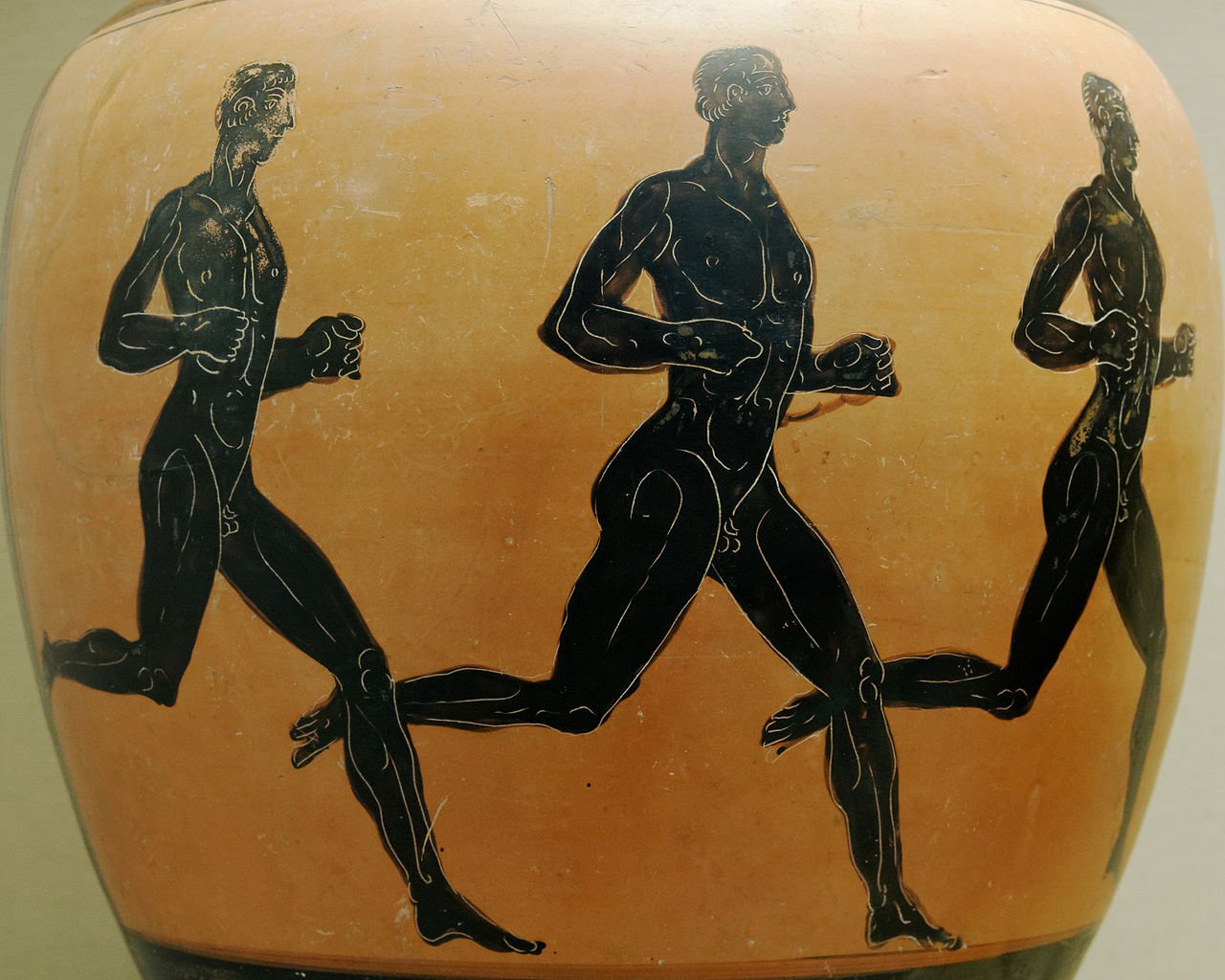
Pottery depicting three runners at the Olympic Games. Credit: Wikimedia Commons, CC-BY-SA-2.5
For many centuries, the ancient Macedonians lived on the fringes of the Greek world far removed from the prominent city-states of the south. For this reason, many have called their status as Greeks into question. Famously, only the Greeks could participate in the ancient Olympic Games. So then, what was the status of this northern tribe in that regard? Did the Macedonians participate in the ancient Greek Olympic Games or not?
The early years of the Olympic Games
According to the earliest tradition, the Greek hero Heracles founded the Olympic Games. The ancient historians placed the founding of this athletic competition in 776 BCE. For the first two centuries, there is no evidence that the Olympic Games involved the Macedonians. Why is this?
Put simply, the Macedonians generally did not have much to do with the Greeks of the south due to the fact that they lived so far north. This applied to numerous aspects of the Greek world and not just to the Olympics. They were generally quite isolated in terms of socio-political developments even though they worshipped the same gods and had the same traditions and language as the rest of the Greeks.
For this reason, it is no surprise that the Macedonians apparently did not, initially, express any interest in participating in the Olympic Games. They took place in Olympia at Elis in the Peloponnese far to the south of Macedonia.
King Alexander I, the first Macedonian in the Olympics
This changed at the turn of the 5th century BCE. At this time, King Alexander I of Macedonia wanted to participate in the athletic competition of Olympia. When he attempted to enter, the Hellanodikai, the judges of the competition, denied his request. There was, naturally, prejudice against Alexander’s people since they lived so far away from the rest of the Greeks.
However, Alexander was able to convince the judges to allow him to participate. He pointed out that his dynasty was founded by Perdiccas, the son of Temenus, a descendant of Heracles (Hercules). After hearing this explanation, the judges accepted that Alexander was a true Greek.
After Alexander participated in the Olympic Games, various other Macedonians also began doing so. It seems that he initiated an interest in the competition in his homeland.
Macedonians in the Olympic Games
At first, participation in the Olympic Games among Macedonians was limited to the royal dynasty. After Alexander I, there is a record of King Archelaus I participating. He competed in a chariot race and was victorious. This occurred in 408 BCE, still long before the expansion of Macedonian hegemony to all the Greek city-states.
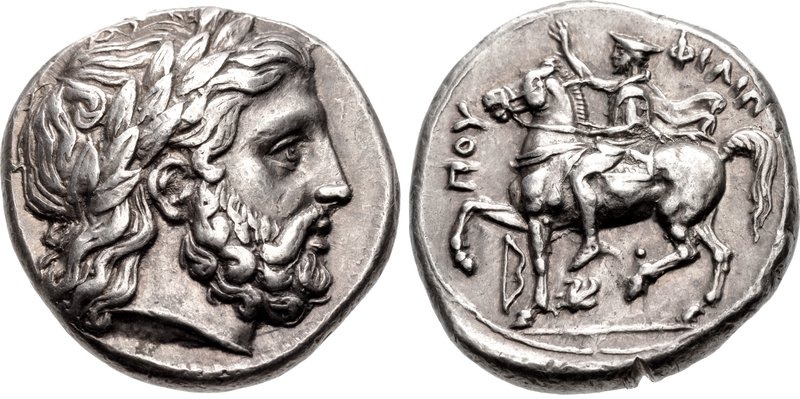
In the following century, King Philip II also competed in the Games. He was the father of Alexander the Great. Philip actually participated three times. All three times, two of which were chariot races, he was the winner. These three victories occurred in 356, 352, and 348 BCE.
Tetradrachm coin of Philip II of Macedon. Credit: Classical Numismatic Group / CC BY-SA 2.5 / Wikimedia Commons
Just after this era, we find records of non-royal Macedonians participating in the Olympic Games. Perhaps King Philip’s impressive series of victories had something to do with this. In 328 BCE, there is a record of a man named Cliton winning the important running race. Based on the available records, he was the first non-royal Macedonian to win in the Games.
After Cliton, we find records of various other Macedonians participating in and winning many of the events in the Olympic Games. In fact, we find an average of approximately one Macedonian winner per decade over the next six decades. Additionally, we need to consider the fact that we only have records of the winners. Likely, many other Macedonians participated in the Olympic Games during this period, and we certainly know that they continued to do so thereafter.
The road showcases the advanced engineering skills of the Minoans. Credits: Public Domain
The Minoan Road, over 3,500 years old, is the oldest known paved road in Europe. It connected the prominent Minoan cities of Knossos, Gortyn, and Lebena on ancient Crete.
Only small sections of the road remain intact today, but this impressive ancient route ran approximately 50 kilometers (31 miles) across Crete.
Built during the height of the Minoan civilization, around 1600 BC, the road showcases the advanced engineering skills of the Minoans, who created an infrastructure that supported both daily life and economic activity across Crete.
The road included side drains to handle water runoff, a feature that helped preserve its structure by preventing water damage. Its condition is remarkable for an ancient road.
It was constructed with a solid, 200 mm (8-inch) thick layer of sandstone blocks bound with a clay-gypsum mortar. This sturdy base layer was then topped with basaltic flagstones, providing a durable surface.
The road included defined shoulders, which may have functioned as pedestrian pathways or for animal traffic, keeping it orderly and safe for movement.
Knossos, Crete. Credit Greek Reporter
Mythical King Minos used the road to talk to Zeus
According to legend, King Minos, the mythical king of Crete, son of Zeus and Europa, set out on this road (then a mere pathway) from Knossos, covering a large part of the way to the sacred cave, to meet his father Zeus and speak with him in person. There, he would learn about the mistakes that had been made and receive oracles concerning the best legislation for the future.
He started from Knossos and ended in the stalagmite cave of Dikteon Andron, located on Mount Dikte of the Ida or Ideon mountains of Crete (the current mountain of Psiloritis).
Minoan Road a crucial link in the Minoan civilization
The Minoan Road was a crucial link in the Minoan civilization’s network, facilitating trade, communication, and cultural exchange across Crete. Knossos, one of its endpoints, was the center of Minoan political and cultural life, while Gortyn and Lebena were significant in both Minoan and later Greek periods.
This road not only attests to the Minoans’ ingenuity but also underscores the role of Crete as a cultural and commercial bridge between the civilizations of the ancient Mediterranean.
The Minoan civilization’s infrastructure, especially roads like this, laid the groundwork for the development of European trade routes and road-building techniques in the centuries that followed.
Throughout most of the Bronze Age, the Minoans were the rulers of Crete. Over the course of their civilization, they gradually built up an incredible palace complex at Knossos. This was the most powerful city on the island.
The palace complex at Knossos served temple functions and was also an administrative center.
The Temple of Apollo at Delphi was one of the most common travel destinations in Ancient Greece, as people were travelling from all over the country to consult the oracle. Credit: Greek Reporter
The Ancient Greeks were active travelers, despite the dangers of land travel and the fear of highwaymen. Sea travel required ample supplies and means.
A fascinating archaeological find exhibited in the Agora Museum in Athens is rectangular clay tablets with inscribed names and occupations that purportedly served as travel documents in antiquity.
Most travelers were aristocrats and well-to-do citizens who traveled to witness and experience the wonders of the ancient world, and other famous places and sights.
Others traveled for pilgrimage; healing in sanctuaries such as the Sanctuary of Asclepius in Olympia, the Sanctuary of Apollo on Delos Island, or to attend religious festivals and monumental athletic events like the Olympic Games at Olympia or the Panathenaic Games in Athens.
Merchants also traveled to other parts of Greece, or across the Mediterranean and beyond to promote and sell their goods to destinations such as Egypt, Asia Minor, the Middle East, and the Black Sea.
The Ancient Greeks were curious about the world and had a great desire to learn. For that reason, they held travel in high regard. The most famous epic journeys, such as Homer’s Iliad and Odyssey or Jason’s expedition to retrieve the Golden Fleece, had protagonists who had to travel far and undergo trials to achieve their goals.
In their long journeys. They experienced great adventures, encountered grave dangers, and saw things and, above all, places they would never see if confined in their birthplace all their lives. These epics celebrated heroic adventures through travel.
Then people from all over Greece and beyond would travel far to consult the oracle at Delphi and plan their future.
Also, it was through travel that ancient Greeks discovered places worth exploring and exploiting, such as uninhabited fertile lands or seaside areas with great potential, where they established trading colonies.
Overall, the accounts of travelers provided valuable information about the contemporary world. In modern day, these accounts help us understand the world during that period.
Practical issues of traveling in antiquity
Travel in ancient times required means that not all people could afford. Travelling by land meant using carriages and horses for people with means and walking for the rest. Pack animals, like mules and donkeys, were necessary. Greece had a widespread road network connecting even remote settlements, but there was always the danger of being robbed by highwaymen.
Traveling by sea was considered a safer and more comfortable means. Most major cities were located near a shore. Yet, there were no passenger ships back then, so those willing to travel by boat had to be next to the cargo, and at a price, too.
To take long journeys, overall, required a lot of money. Baggage porters and other attendants were necessary, along with armed bodyguards. The presence of security was important because the traveler could face highway robbers who could also abduct them. Similarly, when traveling by sea, there was the danger of being attacked by pirate ships.
Since there were no maps, natural landmarks such as mountains and rivers were used. In sea travel, similar landmarks across the shoreline served as guides to the destination.
Friends or social peers usually provided hospitality at the destinations for free. However, there were specific businesses that provided basic food and accommodation, especially in the larger cities, and for significant events such as the Olympic Games or religious festivals.
In the Archaic period, there was the additional legal danger of unknowingly being in another city-state territory without permission while trying to arrive at one’s destination. However, by the Classical period, relations between states were more regulated, and interstate travel was facilitated. In addition, systems of communication had improved by then. Nevertheless, the travel hazards remained.
Greek goods were found all over the then-known world
There is ample evidence that ancient Greeks traveled. Archaeological finds show contacts with other peoples and civilizations. Greek coins and goods such as amphorae have been found all over the Mediterranean. Artifacts emulating artistic styles and evidence of the adoption of rituals originating in Ancient Greece also indicate long and close contact with different peoples and cultures.
In addition, Greeks who traveled frequently brought back new ideas, Eastern tastes in clothing, jewelry, and foods, as well as architectural trends.
The ancient Greeks discovered new lands and established trading colonies across the Mediterranean, Asia Minor, and the Black Sea from the 8th through the 6th centuries. Many of these have evolved into the great cities that still stand today.
The most famous of the colonies were those in Magna Graecia, in today’s southern Italy and Sicily (Calabria, Apulia, Basilicata, Campania, Syracuse, Tarentum, Sybaris, and Croton), where the Greek element is still alive today, especially in the language.
Other important ancient Greek colonies were Massalia (modern-day Marseilles in France), Cyrene in Libya, and Byzantium on the Bosporus Strait, which later became Constantinople.
Greek philosophers on travelling
Several ancient Greek philosophers valued travelling as a means to gain knowledge and experience. Encountering different cultures and experiencing new environments broadens one’s perspective. Great figures like Thales and Pythagoras traveled to Egypt and other regions to study and acquire knowledge.
Aristotle believed that empirical observation and practical experience are good sources of knowledge. Provided, though, that one had the foundations in reason and virtue through formal education. Otherwise, one could not learn simply by travelling. The philosopher is known as saying, not in the exact words, that travel is education for the young and experience for the old.
For those who are older, Aristotle believed that they accumulate experience and wisdom by travelling. They reflect on their lives, gain new insights into the world, and may appreciate life more profoundly.
“Those who wish to know about the world must learn about it in its particular details,” said Heraclitus, the Greek philosopher from Ephesus. The quote implies that a man should travel to learn about the world with his own eyes. Heraclitus believed that the world is constantly changing: “The only thing that is constant is change,” is one of his famous quotes.
With his phrase “τα πάντα ρεί” (everything flows), Heraclitus said that the world is in perpetual motion; therefore, man should be constantly moving as well.
Plato is known for having traveled extensively, visiting Italy, Sicily, Egypt, and Libya. The reason he traveled so much was his disappointment with Athenian society. He was exposed to new cultures and ideas during his travels, which influenced his philosophical development and his Theory of Forms.
Other philosophers who traveled extensively were Thales of Miletus, who visited Egypt to study science and mathematics. Pythagoras traveled to Egypt, Israel, Babylonia, and possibly India. Democritus traveled in Asia, Egypt, and possibly India and Ethiopia.
Socrates, on the other hand, was against travelling and he never left Athens, his hometown. The father of philosophy, for many, believed that man should only make internal journeys. He emphasized self-knowledge and ethical development, which he believed were best pursued through internal reflection and dialogue.
Thousands of treasure hunters look for past riches in Greece. Photo courtesy of Antonis Vlachos
Armed with metal detectors, treasure hunters roam the landscapes of Greece, where myth and history intertwine. Drawn by whispered legends, ancient texts and the promise of lost riches they delve into the mountains, islands, and forgotten ruins in pursuit of gold, relics and long-lost artifacts.
Treasure hunters are often drawn to locations of great historical significance, with the rugged mountainous regions of Greece being among their preferred destinations. These landscapes, steeped in history and mystery, have long served as silent witnesses to war, upheaval, and human resilience.
Treasure hunters in Greece target mountainous areas
During World War II and the subsequent Greek Civil War (1946–1949), many villagers, fearing for their lives and possessions, resorted to hiding their valuables in secret caches. With no access to banks or secure storage facilities in these remote areas, people buried gold coins, jewelry, and family heirlooms deep within the earth or concealed them inside natural enclosures such as caves, stone walls, and hollowed-out tree trunks.
However, the brutal conflicts claimed countless lives and many of those who had hidden their treasures never survived to retrieve them. Over the decades, these hidden fortunes have become the stuff of local folklore, fueling speculation and inspiring generations of treasure hunters to embark on daring quests to uncover the lost wealth of the past.
Even today, rumors persist of forgotten hoards waiting to be discovered, buried beneath the very ground where history was once shaped by war and survival.
Antonis Vlachos stands out among treasure hunters. Not only does he own one of the few specialized shops in Greece that sell sophisticated metal detectors, but he also collaborates closely with the police to prevent illegal activities, such as the unauthorized excavation of ancient artifacts. For him, treasure hunting is more than just a business—it’s a passion, a lifelong hobby that combines adventure with a deep respect for history and the law.
He is also the only one of the treasure hunters who was willing to speak to Greek Reporter.
“Treasure hunters are in their thousands all over Greece. Perhaps most of the activity takes place the Peloponnese, Epirus, and Northern Greece,” he says.
“People have made money out of this activity and understandably they keep a low profile. It’s like winning the lotto. Nobody wants to reveal their identity and the value of the treasure they found.”
A location of a supposed treasure find that was a hoax. Photo courtesy of Antonis Vlachos
The legend of the Ali Pasha treasure
For decades treasure hunters searched for the so-called riches supposedly left behind by Ali Pasha, an Ottoman ruler of Ioannina known for his atrocities (1740–1822).
According to local folklore, Ali Pasha, anticipating his eventual fall from power, concealed vast amounts of treasure in various secret locations across Epirus, Thessaly and western Greece. His personal wealth came from heavy taxation, trade, extortion and alliances with foreign powers (including the British and the French).
Treasure hunters from all over the world began searching for his fortune to no avail. The first organized operation to find the treasure took place in 1913, with the liberation of Ioannina, by an Italian company. For five whole years its workers excavated the surrounding areas without result.
The latest highly publicized case was that of a Greek-Australian treasure hunter, Vangelis Dimas, who financed an excavation to locate the hoard in 2012 in Thessaly.
“It remains a topic of speculation among people, as historically, there is no concrete evidence that such a treasure ever existed,” Vlachos notes.
“Some believe that one of Ali Pasha’s sons took the wealth and fled, but the details of what truly happened—and how—remain unknown. Over time, numerous legends and myths have emerged, though only a small portion of them may be based on actual events,” he adds.
The legend of Ali Pasha is just one of many—“in every coffee shop in the country there is talk of a lost treasure that is supposedly somewhere nearby.”
Maps supposedly showing lost treasures in Greece
Vlachos is not prepared to divulge the value of the treasures that have been unearthed in Greece over the recent decades, but he insists that many people make a good living out of their endeavors. Some people—he says—go to the beaches at night and use metal detectors to search for jewelry lost by bathers in the previous days or even months.
A map supposedly showing the location of a treasure in Greece. Photo courtesy of Antonis Vlachos
He reveals that maps of supposed buried treasures are circulating among treasure hunters. They are made in a way that makes them look old, to give the impression that they are authentic. “Various crafty people make them and sell them to naive people, from 1,000 euros. I have even heard a price of 15,000 euros.”
Vlachos also says that most gold hunters operate within a legal framework and that illegals are a minority.
To proceed with an excavation, one must have three permits. A permit to possess a metal detector, then they must obtain a research permit, issued by the Ministry of Culture and the local Antiquities Ephorates. For the permit to be issued, a process that can take from three months to a year, the proposed search area must not be located within a designated archeological site.
If any findings emerge during the search, an excavation request is submitted to the appropriate authorities.
Bronze Age Minoan inscriptions written in Linear A from Phaistos. Credit: Wikimedia Commons, Zde, CC-BY 4.0
The Minoan civilization was a rich and relatively advanced culture centered on ancient Crete during the Bronze Age. However, they did not refer to themselves as the Minoans. This is a modern name coined by British archaeologist Sir Arthur Evans in the early 20th century. What was the ancient name of the Minoans? What did they call themselves, and what did other nations call them?
Ancient Greek name for the Minoans
There are no Greek historical texts which describe the Bronze Age Minoan civilisation. However, texts from the Archaic Period, such as Homer’s Odyssey, mention a people on Crete called the Eteocretans.
This name means ‘true Cretans’. Later writers, such as the historian Diodorus of the first century BCE, viewed them as the native inhabitants of Crete. Therefore, it is likely that the Eteocretans were the descendants of the Minoans.
The foundation of this term can be traced back to the Bronze Age. A Linear B inscription from Pylos dating to c. 1300 BCE refers to Crete as ‘Ke-re-te’, reconstructed as ‘Kretes’.
Given that this dates from long after the Mycenaean Greeks had conquered Minoan Crete, this cannot be used to show what the Mycenaean Greeks called the Minoans, nor what they called their island.
The Bible’s name for the Minoans
Let us now consider what the Bible calls the Minoans. In the Book of Genesis, the tenth chapter contains the famous Table of Nations. This shows the genealogy of the world’s nations. Included among this list is a reference to Caphtorim, one of the sons of Mizraim.
Mizraim, according to his name and family members, is considered the forefather of the Egyptians. His son Caphtorim is meant to be the forefather of a nation that resided in a place called Caphtor in the Hebrew Scriptures.
Biblical references to Caphtor make it an island and the homeland of the Philistines. Archaeological evidence clearly shows that the Philistines originated from the region of the Aegean Sea.
This is further supported by the fact that the Bible associates the Philistines with a nation called the Cherethites. The latter ethnonym appears to be synonymous with ‘Cretans’, since the Greek Septuagint translated it as such.
Therefore, given this information, it is evident that the island of Caphtor in the Bible is Crete. Therefore, the Caphtorim, or people of Caphtor, is the Bible’s name for the Minoans. Since the reference to the Cherethites only appears in accounts set after the Mycenaean Greeks had conquered Minoan Crete, it is impossible to say whether ‘Cherethites’ is another name for the Minoans or a name for the Greeks of Crete instead.
What other Middle Eastern nations called the Minoans
Were the ancient Hebrew Scriptures of the Bible alone in using this term, Caphtorim, for the Minoans? The evidence shows that they were not. We find variations of this ethnonym in the records of several other Middle East nations.
An 18th-century BCE document from the city of Mari in Syria refers to the island as Kaptara. It uses this term in various contexts, including referencing “Caphtorite fabric.” This suggests that the island was well known by that name in the 18th century BCE, at least within Syria.
However, was this just the name of the island itself? One of the records in the Mari Tablets uses this term referring to a certain man’s ethnicity. This suggests that the ancient inhabitants of Syria, just as in the Bible, used this term for the Minoans as a people, and not merely as the name of the island.
In later centuries, the same term appears in Assyrian records, dating long after the fall of the Minoans. This shows that it was not limited to one particular civilization. Rather, it seems to have been used (at least among some nations) for the inhabitants of Crete regardless of ethnicity.
Egyptian records
In Egyptian records, we find the name ‘Keftiu’ used about Minoan Crete. This is used for Crete in general, even long after the Mycenaean Greeks had conquered it. The fact that this was the term for Crete is clear from the itinerary lists found in Egypt in the New Kingdom period.
Amenhotep III directly associated Keftiu with the place names ‘Knossos‘ and ‘Amnissos’, two of the most prominent cities on Bronze Age Crete. This leaves no doubt that Keftiu was the Egyptian name for that island.
The name ‘Keftiu’ is very similar to ‘Caphtor’ and ‘Kaptara’. The only substantial difference is the absence of the ‘r’ at the end of the Egyptian version. Nevertheless, this Egyptian form is so similar to the others that most scholars recognise that they must be cognate with each other.
In other words, ‘Keftiu’ is the Egyptian spelling of the same word recorded in the Bible as ‘Caphtor’ and in other Middle Eastern records as ‘Kaptara’.
What did the Minoans call themselves?
Unfortunately, we cannot be completely sure what the Minoans called themselves. The reason is that Minoan records use a script called Linear A. Linguists have not yet been able to decipher it, meaning that we cannot read the Minoan inscriptions.
This does not mean that there is no indication as to what they called themselves. The fact that nations as far apart as Egypt and Syria used a form of the same term for Crete is highly significant.
This strongly suggests that Keftiu/Capthor/Kaptara was not a name invented for Crete by any one of those outside nations. Rather, to account for this consistency across that part of the world, it seems far more likely that this came directly from the Minoans’ name for themselves.
When we consider the Egyptian evidence more closely, it becomes more likely that the Egyptians correctly preserved the name of the island. As previously noted, Egyptian records link Keftiu with the place names ‘Knossos’ and ‘Amnissos’, which were the Minoan names for those sites on Crete. If the Egyptians were able to maintain the names of those sites, it is plausible that they similarly preserved the name of the island as a whole.
Therefore, although we cannot be completely sure, it does seem very likely that the Minoans called themselves something similar to the Bible’s ‘Caphtorim’ or ‘Caphtorite’.
Hercules is offered wine in this depiction of a scene from his Twelve Labors. Public Domain
The recorded history of wine in Ancient Greece begins around the 15th century BC, while viticulture appears to have existed as early as the Neolithic era, 6,500 years ago.
Ancient Greece is also the place where modern wine culture began, as wine consumption stopped being solely a sacred act, as it had been when priests and rulers controlled the vineyards.
By the early Bronze Age, vineyard cultivation of grapes was widespread in ancient Greece, and by the time of the rise of the Minoan and Mycenaean civilizations, wine was part of everyday life, for consumption and/or production.
By that time in Greek society, wine was an economically important business.
Wine and commerce in ancient Greece
There was substantial interaction between the Mycenaean and Minoan cultures, based mainly on commerce.
Around 1200 BC, people from northern Greece invaded the southern Mycenaean area, which was a monarchy.
Golden goblet from the Mycenaean period. Public Domain
The war devastated the Mycenaean lands, generating thousands of poor refugee families who escaped to fortified cities for protection.
In order to consolidate their powers, the invaders gave more privileges to the common people, thus undermining the power of monarchs and aristocrats.
The new, democratic city-states were slowly created over time with the common people having more freedoms and opportunities.
Gradually, the common people started cultivating plots of land, with vineyards and olive groves being the most plentiful and lucrative.
People could thus own vineyards, cultivate them, and trade and drink their own wine. A new class of merchants, albeit a small one, was born.
At the same time, more and more people in ancient Greece began to drink wine for pleasure rather than as a sacred ritual.
Colonization and trade expansion
The Greek city-states then began to establish colonies throughout the Mediterranean. The settlers, already experienced in vine cultivation, brought grapevines with them and were able to better cultivate already-existing vineyards.
Moving west, Sicily and southern Italy were the first colonies established by ancient Greeks. Greeks even called the southern part of the Italian Peninsula Oenotria (“the land of vines”).
Other Greeks settled in Massalia (Marseille) in southern France while others moved east all the way to the shores of the Black Sea.
The colonies provided more opportunities for wine merchants. The Greeks could now introduce their wines as far as the western part of France and to the Black Sea in the east.
Athens was a large and lucrative market for wine, as the climate in the Attica region was ideal for vines, and production was substantial. Wine from Attica was traded in all the lands along the eastern Mediterranean Sea.
Other areas famous for wine in ancient Greece were the islands of Santorini and Thasos. This is especially true in Santorini, where the rich volcanic soil produced exceptional grapes. Ancient Greeks were very particular about the origin of their wines.
Major trading partners for wine in ancient Greece were Crimea, Egypt, Scythia, and Etruria among others, as the Greeks traded their knowledge of viticulture and winemaking.
Indicative of the lucrative trade of wine from Greece is a shipwreck discovered off the coast of southern France that held nearly 10,000 amphorae containing almost 300,000 liters (79,000 US gallons) of Greek wine.
Diluted wine
The wine in ancient Greece was unlike what we know today. It was not left undiluted but was mixed with water in precise proportions in a vessel called a krater.
The mixing of water and wine was for the drinker to enable him or herself to maintain composure and self-control, traits that were highly valued in ancient Greek society.
In fact, ancient Greeks seemed to believe that only barbarians—in most cases that simply meant non-Greeks—drank unmixed wine, got drunk and behaved like…barbarians.
Modern wine culture begins in Greece
Along with their wine, Greeks had exported their way of life, including vine-growing, winemaking, and enjoying wine, to almost every port in the Mediterranean basin.
“Wine moistens and tempers the spirit and lulls the cares of the mind to rest. It revives our joys and is oil to the dying flame of life.”
Plato also praised the fruit of the vine:
“What is better adapted than the festive use of wine in the first place to test, and in the second place to train, the character of a man, if care be taken in the use of it? What is there cheaper or more innocent?
The ubiquitousness of the word “symposium” in ancient Greece, which literally means “drinking with others”—meant that ancient Greeks loved to get together, eat, drink, and converse during and after the meal.
Plato’s Symposium, by Anselm Feuerbach (1829-1880). Public Domain
It was a favorite pastime for well-to-do ancient Greeks to eat, drink, discuss, and, occasionally, philosophize, at these symposia.
Such convivial get-togethers have been illustrated on many types of Greek vases and sculptures. Examples of discussions that took place in symposia can be found in Plato’s Symposium and Xenophon’s Symposium.
Usually, symposia were hosted by aristocratic men for their peers. They would relax in recliners called klinai and drink from terracotta or, depending on how rich the host was, from bronze, silver, even gold, cups.
Wine was also used for medicinal purposes in ancient Greece. The great physician Hippocrates prescribed different wines depending on the disease.
Ancient Greeks also had a god of wine, the mischievous Dionysus. The god of the grape harvest, winemaking, fertility, orchards, fruit, vegetation, insanity, and ritual madness, he was also the god of religious ecstasy and festivity; overall, it was he who embodied the colorful, vibrant life of ancient Greece.

 Login
Login