On the day that the new tower of the Sagrada Familia basilica in Barcelona is to be blessed by the pope, a sculptor whose work is to be placed inside the new parts of the famous building has told FRANCE 24 that she's very excited to be a small part of it. French sculptor Béatrice Bizot has lived near Barcelona for over 20 years and has created a statue of the patron saint of pilgrims, Saint Roch, who was born in the French city of Montpellier. She says that seeing human beings capable of such a beautiful thing as the Sagrada Familia is incredible.
On the day that the new tower of the Sagrada Familia basilica in Barcelona is to be blessed by the pope, a sculptor whose work is to be placed inside the new parts of the famous building has told FRANCE 24 that she's very excited to be a small part of it. French sculptor Béatrice Bizot has lived near Barcelona for over 20 years and has created a statue of the patron saint of pilgrims, Saint Roch, who was born in the French city of Montpellier. She says that seeing human beings capable of such a beautiful thing as the Sagrada Familia is incredible.
A top banker has got in trouble by referring to employees whose jobs will be replaced by AI as “lower-value human capital.” But he’s just saying the quiet part out loud: compliance officers have been expected to work like inefficient computers for years already anyway. Standard Chartered CEO Bill Withers used the unfortunate phrase when describing how the bank plans to keep hitting its profitability targets by cutting 15% of back office staff, and has tried to backtrack a little after a predictable storm of criticism, including from the former president of Singapore.
It would be nice to think of bank employees deployed to fight financial crime as super-effective old-school gumshoes, with a bottle of bourbon in the bottom drawer and an inexhaustible stock of one-liners, but in reality their jobs are more like something from ‘The Office’ than ‘The Big Sleep’.
Thousands of people sit in cubicles in Warsaw or Bengaluru, checking through transactions flagged as possibly abnormal by banks’ automated systems, and confirming that 99% of them are, in fact, normal. Anything that might conceivably be abnormal gets sent up the chain, where someone more senior will almost certainly decide it wasn’t.
It is a ruinously expensive process and, as far as we can tell, completely ineffective. The best estimates we have for the size of the criminal economy suggest it has grown, untroubled, along with everything else for decades despite all the laws, fines, and prosecutions that we’ve thrown at the problem.
But banks’ financial crime compliance isn’t about stopping financial crime at all: it’s about stopping banks from being fined, as Standard Chartered has previously been, enormous sums in both the U.S. and the UK. As long as banks can be sure that AI checks boxes in ways that satisfy regulators, then they’ll be happy.
This is a little bit worrying because AI is already getting very good at fraud. I am very alert to attempts to trick me but was sufficiently fooled by an AI email yesterday to forward it on to someone. Fortunately, a very similar one arrived (purportedly from someone else) a few minutes later, alerting me to my mistake. Money laundering is a laborious activity and criminal gangs will be as keen as banks to cut their back office expenditure, and AI could help automate the processing of the many small transactions that add up to a large amount of money. Phishing and smurfing are just a couple of its use cases, however.
“Scammers can leverage AI to scrape data from social media and dating platforms to identify vulnerable targets (e.g. lonely individuals, recent retirees, or people interested in finance) for pig butchering scams,” notes TRM Labs. “Bots can sustain long-term, emotionally persuasive conversations without tiring or making mistakes, making the scam more scalable.”
And that’s before you get onto AI’s ability to exploit cryptocurrencies and smart contracts to really start rampaging through the crypto world. “TRM observed a roughly 500% increase in AI-enabled scam activity over the past year. The convergence of generative AI, programmable financial infrastructure, and global crypto liquidity has altered the economics, velocity, and scalability of fraud,” the blockchain analytics firm said in a follow-up report. This is very bad indeed.
So, although I can see why people are annoyed that Withers referred to his bank’s employees in such a disparaging way, I am more troubled that he’s planning to replace them with AI, rather than to retain them and train them in how to counter it.
It was remarkable, however, to see Warren Davidson, chair of the illicit finance subcommittee at the House of Representatives Financial Services Committee, draw precisely the wrong conclusion from all this. Although he was correct in condemning the defensive nature of compliance, and its focus on generating paperwork over results, he then got lost in praising the White House’s decisions to attack corporate transparency legislation.
"As we focus on risk, we must also ensure that tools like artificial intelligence are fully deployed to counter the AI-enabled crimes of today,” he said, without realising that, without reliable information to train the AI models on, this is as useless an approach as the one he says has failed. If you don’t know who owns what, neither will a computer, no matter how cleverly it can pretend to be human.
I sincerely hope he listened to the testimony of Carole House of the Atlantic Council who forcefully pointed out the harm to national security and to ordinary Americans caused by the United States’ failure to create even an approximation of a decent corporate registry, as well as the historic idiocy of its current crypto policy. “Without a secure identity foundation, AI agents will simply scale up fraud at a speed and volume that human investigators can't possibly track, destroying trust in the whole system,” she said in testimony that I highly recommend you take a look at.
I very much doubt Davidson was listening, however, because that is not the direction the Republican Party is going in right now. I would write more about that, but frankly it’s all too depressing, and I’d rather move on.
So let me point you towards this excellent paper on how online scam marketplaces work, with criminals using the messaging app Telegram and the stablecoin Tether to launder hundreds of billions of dollars. It argues that our current approach of sanctioning exchanges is futile since their owners just shut them down and switch to a new platform that works in the same way but hasn’t yet been sanctioned.
“As long as the underlying digital infrastructure remains permissive, criminal syndicates will simply migrate to new channels. To move from reactive disruption to systemic prevention, the international community must shift its focus toward the structural enablers of these marketplaces,” Elliptic’s Tom Robinson argues. Elliptic is unusual among blockchain analytics companies in being willing to name Tether as a major vector for money launderers. Its rivals tend to just say “stablecoins,” I have no idea why.
Meanwhile, there is something grimly depressing about the fact that — against the backdrop of, well, everything — the UK has postponed June’s illicit finance summit due to “scheduling issues in the international calendar.” Everyone is so busy dealing with the consequences of illicit finance, that no one has time to talk about illicit finance.
A version of this story was published in this week’s Oligarchy newsletter. Sign up here.
The United States is inching closer to passing a gigantic piece of legislation to put cryptocurrencies on a secure footing, with the bill emerging unscathed from the Senate’s banking committee. Opinions differ as to what this means: crypto people are thrilled, while anyone who knows about money laundering is terrified. Passage of the so-called CLARITY bill has been a key goal of crypto enthusiasts since Donald Trump came to power, since it would give them the legal certainty to engage in “financial innovation” without worrying about a return to the Biden-era policy of trying to regulate them as if they were normal people.
Committee chairman Tim Scott is delighted: “For me, this is personal. My mother raised my brother and me with faith, grit, and determination, and she taught me that the American Dream should be within reach for every family, including single mothers working hard to build a better life for their children.”
I quote Scott partly because it’s such a weird justification for passing crypto regulation (or perhaps he just says that sort of thing about literally everything he ever does?), but mainly because it’s pretty clear that the bill as it stands will be a disaster for the kind of vulnerable people he claims to be fighting for.
In a sign of experts’ concerns, Transparency International’s U.S. office put out a statement quoting nearly all the most respected voices on money laundering in America arguing that the bill needs better safeguards against dirty money. “At a time when we know that hostile actors like (Iran’s Revolutionary Guards) are looking to circumvent U.S. sanctions to rearm and threaten Americans and U.S. interests around the world, it is inconceivable to me that we would open new, effective channels for sanctions evasion,” said Richard Nephew, former U.S. Coordinator on Global Anti-Corruption and Deputy Special Envoy for Iran.
“Terrorists, violent drug traffickers, and organized criminals who prey upon the elderly and unlearned in increasingly sophisticated financial and AI generated schemes are, quite literally, getting away with murder, funded by untraceable cryptocurrency transactions hidden behind an anonymous block chain,” said former FBI agent Karen Greenaway.
There is an awful lot of money in crypto, and Tether alone now has three people among the richest 100 in the world. Tether’s largest single shareholder Giancarlo Devasini’s wealth has grown from $9.2 billion in 2024 to $89.3 billion now, while chief executive Paolo Ardoino and former CEO Jean-Louis van der Velde have done pretty well too. Though none of them have done quite as well as Changpeng “Binance” Zhao, crypto’s only centibillionaire (so far).
In the UK, there’s a lot of concern about the millions of pounds going from crypto investors to Reform’s Nigel Farage, who has become a crypto champion, no doubt coincidentally. But, wow, look at what’s happening in Alabama for a sign of what the future looks like if crypto people really get their hands on the purse strings and try to buy their way into the Senate.
That much money doesn’t just help supporters win, it also terrifies opponents: standing up to the crypto lobby guarantees you’ll be swamped in hostile advertising. How do you want to be paid, as Pablo Escobar used to say, in silver or lead?
But why should the rest of the world care that this is happening? I’m sure I’m not the only foreigner who’s been staring in bewilderment at the growth of U.S. prediction markets, and how efficiently they allow insiders to monetise their privileged access to inside information. A lot of those markets are barred in other countries, but the U.S. soldier who was arrested for betting on the Maduro capture was trading on polymarket, a crypto-denominated market which is blocked in the United States too, despite Donald Trump Jr. being an investor.
Such restrictions can be easily bypassed by using a Virtual Private Network, so U.S. regulators are using artificial intelligence to track down insider trading on polymarket. After that soldier’s arrest, I suspect Americans will be much more careful about what they do.
Prediction markets claim they don’t want insiders trading on privileged information. But if the markets are to function in a way that supports their founders’ justification for them, as a price signal for future events, they rely on people with knowledge to be using them to make bets and thus to move prices in a useful direction. So clearly the temptation will always be there for anyone with inside information to use it to make some easy money.
And does anyone think U.S. regulators will care about Indians, Brits, South Africans Ukrainians, or other foreigners using crypto to trade on information from their own countries? They after all have a track record of treating foreigners and U.S. citizens differently. That’s why it was Francesca Albanese, with her American husband and daughter, who managed to have sanctions cancelled for daring to investigate Israel’s behaviour in Gaza, whereas non-U.S. connected people have failed to do so.
The new U.S. crypto bill coupled with U.S.-based crypto-denominated prediction markets points towards the United States becoming a gigantic offshore enabler of corruption for the rest of the world; a digital version of what Switzerland was in the analogue years, with everyone else reduced to begging its regulators for assistance.
“Crypto prediction markets are accessible to anyone with an internet connection and a wallet, pooling liquidity from a global user base rather than a regional one,” says Chainalysis. I think they mean that to be a good thing, because the blockchain is transparent and malefactors can be spotted easily yada yada, but it sounds beyond dystopian to me. I’m genuinely a bit terrified of what this will mean for corruption in the next few years, and I haven’t heard of any politicians who are alert to it yet.
A version of this story was published in this week’s Oligarchy newsletter. Sign up here.
While much of the media industry focused on the churn of headlines, we became increasingly interested in the undercurrents beneath them: the hidden systems, infrastructures and ideologies shaping events across borders and over time.
Again and again, our reporting led us back to the same realization: for a long time, the struggle over information was understood primarily as a question of censorship or access. Who controls information? Who gets to publish? Who gets silenced?
Those questions still matter. But they no longer fully describe the world we live in.
Today, the struggle over information is about who builds the systems through which reality is organized, distributed and trusted. From state propaganda to algorithmic feeds, from platform monopolies to AI-generated noise, the battle is not over facts. It is over the infrastructures that determine which narratives spread, which voices are amplified and which communities remain connected.
Over the past year, these questions led to a collaboration between Coda and The Continent, the pan-African newspaper founded in Johannesburg by Simon Allison and Sipho Kings. Although our reporting emerges from very different histories and geographies, we found ourselves arriving at remarkably similar conclusions about power, fragmentation and the future of journalism in an age of informational instability.
This two-chapter essay is the beginning of that collaboration, and marks the start of a new project called The Atlas. Pilot edition is available here — please feel free to share with friends, family and colleagues, preferably in its entirety.
In Chapter One, I return to the world of my Soviet childhood: propaganda, samizdat and the search for trustworthy signals through noise.
In Chapter Two, The Continent co-founder Simon Allison presents the Parable of Sinn Sisamouth: the story of how some of the greatest songs ever written were nearly lost, and then found, and then lost again.
Taken together, these essays ask what journalism becomes in a world where information is no longer organized primarily to inform, but to capture attention, manufacture reaction and shape perception at planetary scale.
The Atlas grows out of that question.
Chapter One: Through the Static
Whenever I am asked why I decided to become a journalist, an image from my childhood pops into my head. It’s dusk. I am 10, sitting in the kitchen with my mom. She is glued to a shortwave radio. Outside, the Soviet Union is on the cusp of collapse. Georgia, where we are, is on the brink of civil war. We didn’t use the term back then, but fake news was all we got through official channels. Real news — coming from the West — felt like a lifeline. I was in awe of the crackling radio that held my mother’s full attention. I wanted to become that voice.
Illustration: Anna Jibladze.
Years later, I got my dream job at the BBC and spent much of my adult life moving between wars, uprisings and authoritarian states. Again and again, I found myself in places where truth was contested terrain: Baghdad, Damascus, Donetsk, Sana’a. But over time I realized something fundamental had changed. Modern authoritarianism no longer relied primarily on suppressing information. It had discovered something more effective.
Information could simply be drowned out by static.
That realization became stark for me in eastern Ukraine in the summer of 2014. I arrived in a field of bright yellow sunflowers where the bodies from Flight MH17 still lay scattered across the ground. A Russian missile had blown the passenger plane out of the sky, killing all 298 people on board. Yet almost immediately, the Kremlin flooded the information space with competing explanations. It was a Ukrainian fighter jet. A failed assassination attempt on Putin. The plane had been filled with corpses before takeoff. Each theory contradicted the next, but that hardly mattered. The point was not to persuade, it was to exhaust. It was to create so much noise that truth itself began to feel unstable.
Over the following years, I watched versions of the same logic spread far beyond Russia. Social platforms transformed public conversation into a permanent stream of outrage, performance and distraction, collapsing vastly different kinds of information into the same endless feed. War footage, propaganda, conspiracy theories, journalism and gossip all began competing inside systems designed not to inform people but to capture and hold attention.
Noise became the new censorship.
And increasingly, I found myself thinking about the world of my childhood again. Not because history was repeating itself neatly, but because the emotional landscape felt strangely familiar: confusion, exhaustion, distrust, the constant sense that reality itself was becoming slippery. Back then, people searched desperately for clear signals through the static of Soviet propaganda. Today, we are drowning in a different kind of static, but the instinct, the search for clarity feels remarkably similar.
In the Soviet Union, people developed ways of navigating that confusion. Among my strongest memories from that time is the sound of my parents’ typewriter late at night. Friends would pass around copies of banned Soviet literature and my parents would sit at the kitchen table all night, retyping them page by page so they could be shared again. It was my first encounter with samizdat, although I didn’t know the word then.
Looking back now, what strikes me is that samizdat was never simply about forbidden texts. It was about building trusted alternative systems of circulation when official systems had lost credibility.
At Coda, we have spent years building journalism against the logic of noise. We slowed stories down. We followed themes instead of headlines. We built a reporting system designed to connect events across borders and over time, helping readers see patterns instead of fragments. But as our globally distributed newsroom adapted to an increasingly fractured information landscape, it became clear that journalism alone was not enough. Distribution shapes understanding as much as reporting does.
Around the same time, in Johannesburg, Simon Allison, Sipho Kings and their team were building something that challenged many of the assumptions dominating digital media. The Continent, their pan-African newspaper, spreads largely through direct sharing networks: passed from reader to reader rather than pushed by algorithms.
Illustration: Wynona Mutisi.
Different histories had brought us to remarkably similar questions. What does journalism look like when trust is collapsing, attention is fragmented and the systems that carry information have themselves become instruments of power?
Out of that convergence came The Atlas: a new publication that brings together Coda’s methodology of following systems across borders and over time with The Continent’s radically distributed model for reaching readers beyond algorithmic feeds.
The Atlas is built on a shared conviction: as fragmentation, distrust and informational overload spread across the world, some of the clearest ways through will come from places that have already spent decades navigating propaganda, instability and contested reality. Places once treated as peripheral are becoming essential to understanding the defining question of this age: how can meaning survive systems designed to overwhelm it.
Michael Macor/San Francisco Chronicle via Getty Images.
Chapter Two: The second silencing of Sinn Sisamouth
Imagine if your favourite song disappeared, forever.
Almost every album I have ever loved was recommended to me by my friend An-Rui. A few months ago, he sent me a track by the undisputed King of Khmer Music, the Golden Voice, the Cambodian Elvis himself – Sinn Sisamouth.
I had never heard of him.
I didn’t respond at first, so he nudged me. That night, after the kids were asleep, I put on my headphones, sat in the garden and immediately lost myself in Cambodia’s psychedelic rock scene of the 1960s and ‘70s. I don’t know enough about music to explain exactly what I fell in love with, but within weeks I was, according to Spotify, among the top one percent of Sinn Sisamouth listeners worldwide.
An-Rui had added a note to his recommendation. “the songs are happy but since i know what his fate was and i don’t understand the words, it sounds incredibly sad to me”.
The story goes something like this: A small-town boy with an extraordinary voice moves to the big city, and conquers all before him. He writes hundreds of songs, bridging Khmer musical traditions with new western influences: jazz, rock & roll, bossa nova, blues, the Beatles, and, of course, Elvis Presley. He toured the country. He toured the world. He made music with an actual King, Norodom Sihanouk, and became Cambodia’s most beloved rockstar.
Then, in 1975, the Khmer Rouge seized power. In the course of committing a genocide, the communist regime disappeared Sinn Sisamouth, and banned his music. He has never been seen, or heard from, again.
But his music never died. It lived on brittle records, hidden for generations under floorboards. It lived on scratchy cassettes, passed hand to hand among the diaspora.
It was only decades later that his music was digitised and remastered, and made available on streaming platforms to the likes of me.
When I listen to Sinn Sisamouth, I can’t help but think about how easily we could have lost his masterpieces entirely. And I wonder what else might have been lost that we have not been able to recover.
And then it happened again.
There’s a particular track that I like to play in my car, where I can turn the bass up as high as it goes. I was driving one afternoon and looked for it on Spotify. It was gone, even though the rest of the album was there.
I looked again on my laptop at home. Nothing. Gone from Spotify. Gone from Apple Music. Gone from YouTube. Like it had never been there in the first place. I started to wonder if I had gone crazy, and maybe imagined the song entirely. And then I started to panic: What if I never heard it again?
Eventually, I found a bootleg YouTube version, using a different transliteration of the Khmer title – Kanlang Pnheu Pran, instead of Konlong Phner Bran. Before I tracked that down, I had to wade through dozens of AI-generated Sinn Sisamouth ‘cover versions’, all uploaded to YouTube within the last few months. If I had never heard it before, I would never have been able to tell which was the original.
It’s not unusual for songs to disappear from the Internet, especially when the music is from non-English-speaking countries. I’ve had similar experiences with the music of Sharhabil Ahmed, the Sudanese jazz legend, and Ethiopia’s Tilahun “The Voice” Gessesse.
In fact, it’s not unusual for other kinds of information to disappear from the internet; to be edited after the fact; or to be simply lost among all the digital noise. Digital information is incredibly precarious, and becoming more so by the day. AI slop is taking over social media platforms. Algorithms determine what information we can and can’t see, shaping our cultural and political preferences. And powerful interests are becoming increasingly bold when it comes to brazenly manipulating information in their favour – or, of even greater concern, restricting the flow of information across borders.
Amazon changes the contents of books on people’s Kindles without telling anyone. News websites quietly alter critical stories, post-publication, to remove evidence of wrongdoing (my favourite example: the Financial Express published a story critical of India’s richest family; only to replace it with a glorified press release a few days later. They neglected to amend the URL, however, which contains the original headline). Governments shut down internet access on a whim, or legislate which apps and websites are available to specific populations.
For journalism, this is an existential threat. Our job is not just to hold power to account – it is also to write the first draft of history. But if we can’t preserve that first draft, or distribute it effectively, then what, exactly, is the point?
The Continent and Coda Story are working together to try something different. We want to publish news about the world, produced and verified by humans, that cannot be edited after the fact; and to distribute it in a way that dramatically decreases our reliance on unaccountable algorithms or search engine optimisation. The Atlas — pilot edition available here — is our answer to the precarity of information online. It’s a work in progress.
Stay tuned: if we’re going to succeed, we’ll need your help. And if we do succeed, the secret of our success will be those very same transnational networks that kept the music of Sinn Sisamouth alive. Communities of like-minded people, of friends and families will always find a way to stay connected, no matter how vast the distances between them, or how great the obstacles. So what does a global newspaper look like if we design it with exactly these communities in mind?
As soon as I found that bootleg on YouTube, I ripped an MP3 copy and sent it to An-Rui on Signal. “KEEP THIS SAFE,” I told him. I don’t know what happened to the song on Spotify, or if it is ever coming back. But I can’t take the risk of never hearing that bassline again. And here it is, in case you want to hear it too.
Nigel Farage, the leader of the UK’s right-wing Reform UK party, has taken millions of pounds from crypto people, including one convicted of financial crimes in the United States. There are, despite Farage’s insistence to the contrary, questions around whether he followed the rules. Nonetheless, his party has swept local elections. There’s a lesson here for progressive parties everywhere, including in the United States where senators are seeking documents relating to financial ties between the commerce secretary and Tether. What if you get your ‘gotcha’ moment, turn around to the voters with a broad smile… and they vote for your opponents anyway?
Believers in democracy need to start advocating for more transparency, more enforcement and more restrictions on murky finance if they want to stop unaccountable money from buying influence in their countries. It is not enough to rely on journalists and activists to produce the occasional investigation, and expect voters to do the rest: we need properly-resourced agencies that can keep dirty money out of our systems if we want them to remain clean. If history tells us anything, it’s that criminals get elected all too often.
This is urgent. Tether made more than $1 billion in profits this year, in the first quarter, and is thinking hard about the midterms and how candidates might be encouraged to fight for crypto. And that’s just one company. Progressives who believe in fairer finance, a state’s right to regulate its own economy and the power to oversee who’s buying whom, don’t have that kind of money to spend to influence elections, so they need to start making the argument for campaign finance restrictions much more forcefully.
But there’s another point here too. I am working on an article about money laundering at the moment, and was chatting to two UK detectives last week. They led a successful operation in their city (I’ll post the article when it’s done) and I asked if they thought it had made a lasting difference. “With all crime, you take one out and there is another,” one of the detectives told me. “I'd like to think it has made a dent but there will always be more.”
In the case they worked on, gangs were bringing cash generated via the cocaine trade to be laundered into crypto (no prizes for guessing which cryptocurrency they preferred). The detectives identified £53 million in turnover over two years. It’s great that they jailed the ringleaders, but you can see why they’re not getting too carried away. That total is about a quarter of a percent of the UK cocaine market’s turnover, so the gangs really won’t have noticed the loss. And, for the police, it was five years’ work.
To a fairly large extent, since the first U.S. operation in Miami in 1980, when we’ve spoken about fighting dirty money, we have really been talking about stopping cocaine gangs by taking away their ability to make a profit. And, despite occasional successes like the one I’m writing about, this approach has overall been a catastrophic failure. Cocaine is cheaper, more abundant, and more widespread than ever before.
This is important for many reasons, obviously because entrusting the supply of a dangerous substance to criminals is bad, but also because the existence of a vast underground financial system to move the cocaine trade’s profits creates a mechanism through which Russian spies, terrorists and others can hide their cash too. For me though, the real problem is that we have an urgent threat to democracy posed by hidden unaccountable money. Instead of tackling that problem though, our police officers are fighting an endless war against drugs that was lost decades ago.
My modest proposal therefore is to legalise cocaine. It’s available everywhere already, so there’s no downside. We should tax it, regulate it, make sure kids can’t buy it and, as a useful side effect, take all the liquidity out of the underground economy. Our police officers could then stop running to go backwards, and instead fight a battle they might actually win, which is to stop fascists and kleptocrats from buying our democracies.
Use oligarchs to undermine Putin
Here’s a good article from The Economist by “a former senior official in the Russian Government,” arguing that Vladimir Putin is losing his grip. Now, I’m always a little cautious about articles that tell me what I want to hear, as well as the veracity of information and analysis provided by Russian officials, former or current, but it does make some very interesting points.
Of particular interest to me is the idea that Russia’s elite is annoyed with Putin because its members are worried about having their assets stolen, with $60 billion worth of property nationalised or seized by corrupt officials in the last three years.
“Previously their property rights were outsourced to the West. They used London courts, offshore structures and international arbitration to resolve conflicts or seek protection. Now conflicts must be resolved domestically, without functioning institutions. Demand for rules grows more urgent as redistribution of assets gathers pace,” the article states.
One of the reasons why democracy failed in Russia is because the oligarchs were able to keep their wealth offshore, and thus to essentially colonise their own country, secure in the knowledge they were themselves immune from the unfairness. It would be a pleasing irony if the horrific war in Ukraine ended up undermining not just Putin, but Putinism as a whole.
There is a huge opportunity here for Western governments to capitalise on the dissent, and to start quietly offering sanctions relief to Russians willing to break with Putin, and who’re prepared to surrender a decent chunk of their wealth to help Ukraine in return for being able to keep the rest. There aren’t enough police officers to actually bring the cases needed to investigate, prosecute and confiscate the oligarchs’ wealth anyway (see item above), so we may as well start negotiating and see what they’re willing to do to get it back. In short, this is a big week for me making unfashionable policy proposals.
AI-generated launderers
There’s debate in the United States about getting rid of the Corporate Transparency Act, with Jeff Bezos’ Washington Post supporting repeal, even though the law has never actually been implemented. Opaque shell companies are a weird outgrowth of capitalism that corporations’ original inventors — who wanted to create insurance for entrepreneurs, not getaway vehicles for crooks — never intended to happen, so it’s very odd that they’re now being presented as some kind of human right.
If you want a reason why the appallingly lax American system should be cleaned up, here’s a post on X about someone who tasked two AI agents with making money, and came back to find out they’d registered a Wyoming LLC all by themselves. This suggests the opening of a whole new frontier of automated money laundering, and the consequences are frankly pretty terrifying. The Corporate Transparency Act should be strengthened, not abolished.
A version of this story was published in this week’s Oligarchy newsletter. Sign up here.
On April 24, Brazil’s competition authority, the Administrative Council for Economic Defense (CADE) announced it was opening an investigation to assess whether Google’s use of news content amounted to unfair competition practices against the Brazilian press. The announcement was welcomed by civil society organizations that have tried to push regulation to limit the reckless power of Big Tech for years. Ajor, Brazil’s Digital News Association, said that “a balanced relationship between digital platforms and journalism organizations is fundamental to the flourishing of journalism committed to the public interest. By ensuring a fair competitive environment, Cade directly advances that goal.”
In spirit and intent, CADE’s investigation into Google is similar to legislation in Australia that recognized that value is being extracted from news publishers without proportionate recompense. In Brazil, the case has been debated since 2019, but the adoption of AI Overviews helped alter the perspective of Brazilian judges. The overviews are artificially generated summaries that synthesize information from several sources and appear at the top of Google Search results. They “raise potentially more concerns,” ruled Judge Camila Cabral Pires Alves, “as they may more profoundly alter the economic function of the interface and expand the ability to retain attention within the platform's own environment.”
CADE will now investigate whether Google should be sanctioned for “alleged abusive exploitation of a dominant position, in light of the technological evolution of the conduct.” While there is perhaps a greater global appetite to regulate the impacts of AI – even the Trump administration has recently acknowledged that some oversight may be necessary – the CADE judges have been under considerable pressure from Big Tech executives to stop investigations into how their control of the market harms Brazilian businesses.
For those of us who have reported on Big Tech, this aggressive lobbying is not surprising. Companies like Google, Meta, Twitter, TikTok, Amazon, and Microsoft have long attempted to interfere in any decision or legislation that can harm their interests in Latin America. According to a joint investigation by journalists across 13 countries, Big Tech lobbyists got away with convincing legislators in Colombia to weaken a rule meant to protect children’s mental health and prevent enforcement of privacy regulations in Ecuador. It took a team of over 40 journalists from 13 countries to uncover this while reporting on the ‘Big Tech Lobby’ in the continent and across the world.
Threats by the U.S. government to retaliate against any country or international entity that sought to regulate Big Tech added another layer to an already complicated and uneven relationship with Silicon Valley. “Digital Taxes, Digital Services Legislation, and Digital Markets Regulations are all designed to harm, or discriminate against, American Technology,” wrote Donald Trump on social media. “Show respect to America and our amazing Tech Companies or consider the consequences!” During the past year, Trump’s envoys have forced dozens of governments around the world to dilute or even shelve regulation in exchange for lifting tariffs.
In “Big Tech’s Invisible Hands,” which I coordinated alongside Maria Teresa Ronderos, from CLIP (Centro Latinoamericano de Investigación Periodistica), journalists mapped a total of 75 executives that were part of “public policy” or “government relations” teams in Brazil. Tech companies utilized a “revolving door” in which public sector employees could go straight into highly paid jobs leveraging their contacts and influence. Doors opened more easily. Invitations to hangouts and events were more likely to be accepted.
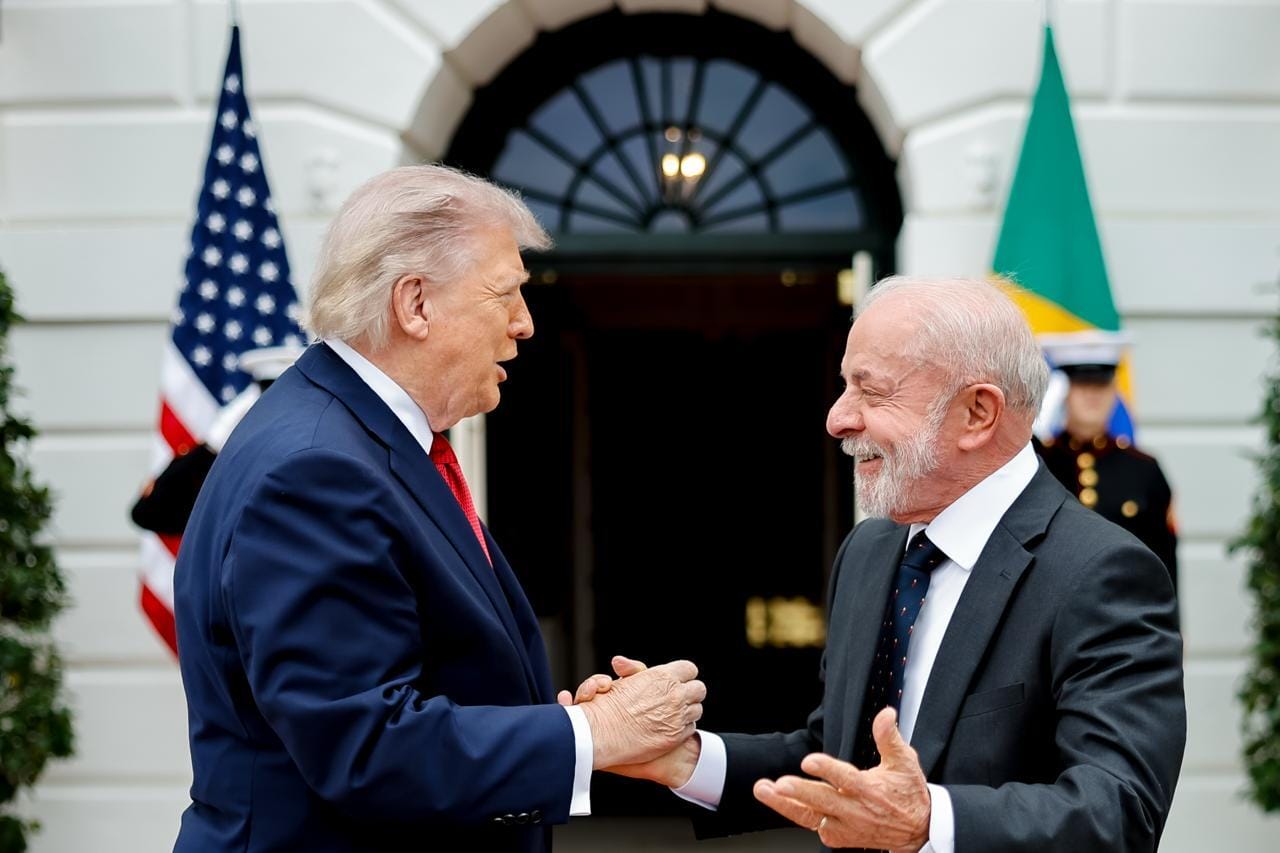
Brazilian President Luiz Inacio Lula da Silva meets with U.S. President Donald Trump at the White House on May 7, 2026. Brazilian Government / Ricardo Stuckert / Handout/Anadolu via Getty Images.
Lobbying in Brazil is dialed up to eleven. The country has 163 million internet users, with over 150 million on WhatsApp, and over 120 million on YouTube, Instagram and Facebook. With AI, Brazil is a similarly large, influential market. Portuguese is the sixth most widely-spoken language in the world, with 70% of speakers based in Brazil. Which means that, if an LLM has been trained in this language, it probably used content created by millions of Brazilians going about their business of making friends, debating politics and football online. It’s not just about journalists; we are all unpaid labor for Big Tech.
In the words of Arthur Lira, the Speaker in Brazil’s Congress who filed a criminal complaint against Big Tech executives in 2023, companies adopted a variety of tactics “to shut down democratic debate and intimidate lawmakers” and defeat any attempt at using legislation to force accountability. Google, he said, used its search homepage, used by over 85% of Brazilians, to spread fear that proposed laws would “make the internet worse” or “make it harder to know what is true or false on the internet.” A report by the Federal University of Rio de Janeiro found that Google invested in ads on its own platform so extensively that it tweaked the search, prominently featuring the word “censorship” in connection to the Brazilian bill. Google also hired Michael Temer, a lawyer and former President of Brazil, to influence lawmakers and Supreme Court Justices. Of course, it was not Google alone. Meta executives, for instance, even argued that proposed legislation in Brazil could lead to the Bible being censored.
But Brazilian lawmakers, the Supreme Court, and civil society have persisted. On August 28, 2025, the “Felca Law” was approved, after a video by the influencer Felca denounced the exploitation and exposure of children on social media. The law establishes that digital platforms must take measures like verifying user age, implementing parental controls, and preventing children's exposure to adult content, gambling, and pornography. They must create reporting channels and may face fines of up to 10% of their annual revenue in Brazil.
Brazil’s president Luiz Inácio Lula da Silva and Donald Trump have had a testy relationship, in part because of Lula’s criticism of Big Tech. In February, at the AI Impact Summit in New Delhi, Lula called for global governance of AI, warning: “When few control the algorithms, it is not innovation, but domination. Regulating the so-called Big Tech companies is linked to the imperative of safeguarding human rights in the digital sphere, promoting information integrity, and protecting our countries’ creative industries.”
By sticking to his guns, Lula may now be seeing the tide turn. He was in the White House on May 7, and though neither he nor Trump took questions, both appeared encouraged by the meeting. “Very dynamic,” was how Trump described Lula, while Lula said he was “very, very satisfied” with how the talks went. With a general election in Brazil approaching in October, Lula will be sensitive to how the White House, as it has done in other elections, and Big Tech might offer vocal support for right wing candidates.
But his willingness to stand up to Big Tech is popular with voters. A recent poll found that 78% of Brazilians want to see tech companies being held responsible for the content they publish. Another poll found that 55% of Brazilians defend regulating Big Tech, with 43.9% against it.
And as scams, fake news, and AI slop dominate ever larger swathes of all our digital space, in Brazil, as in much of the rest of the world, the entire experience of the internet is becoming more unappealing. Big Tech, with the assistance of the U.S. government, may be succeeding in slowing down the pace of regulation and watering down the content of that regulation, but in the long run its victories might be pyrrhic. People have had enough and their governments might be forced to listen.
On May 3, an unusual procession moved through Washington DC. Several hundred people walked beneath the monuments of the American capital carrying portraits of Red Army soldiers. Children waved Soviet flags. A live orchestra played wartime songs at the World War II memorial. The Russian embassy had filed the permit; the DC Metropolitan Police provided an escort. Russian state media celebrated the event as proof that, with the return of Donald Trump, historical truth too had returned to America.
One organizer told Russian state television: “We love, respect Russia, honor the memory of our heroes.”
Similar marches took place in Paris, Amsterdam and Busan. In Berlin, authorities announced that Soviet flags, Russian symbols and military songs would once again be banned near Soviet war memorials during May 8 and 9 commemorations.
But in Moscow, Victory Day itself appeared haunted by fear.
For decades, May 9 has been Russia’s most sacred annual political ritual, binding victory, patriotism and state power into a single language. But this year, Kremlin spokesman Dmitry Peskov was reduced to announcing that the Immortal Regiment march in Moscow would continue only “in electronic format.”
The run up to this year’s Victory Day became the most anxious Moscow has experienced in recent memory. The Kremlin canceled the traditional procession in the Russian capital, moving it online. Military equipment was removed from the parade. Mobile internet access across Moscow was intermittently shut down in the days leading up to May 9. Spectator numbers in St. Petersburg were reportedly slashed from thousands to just a few hundred. The Victory Parade in Kaliningrad was canceled entirely. Russian media outlets published extraordinary reports about Vladimir Putin retreating deeper into protected bunkers amid fears of Ukrainian drone strikes and assassination attempts.
Russia’s Foreign Ministry even warned foreign governments to evacuate diplomats from Kyiv before May 9, threatening massive retaliation if Ukraine targeted the celebrations with drones.
And then came another extraordinary twist. Volodymyr Zelensky publicly “allowed” the parade to proceed. In a deliberately tongue-in-cheek decree issued after negotiations around a temporary ceasefire, the Ukrainian president formally excluded Red Square from Ukraine’s operational strike plans for the duration of the celebrations, even listing the exact geographic coordinates of the square itself.
Watching it all unfold, I kept wondering whether empires collapse more easily than the systems of feeling they create. The Soviet Union fell apart more than 30 years ago, but the architecture built around victory, sacrifice and historical grievance survived it, stretching across borders, diasporas and rival political projects. What began as Soviet myth-making about liberation has evolved into a transnational political language through which governments, activists, diasporas and rival ideological movements compete over legitimacy, victimhood and belonging.
Over the years, at Coda, in our Rewriting History current, we have tracked how the remembrance of World War II became central to Putin’s machinery of legitimacy and repression. Soon after he came to power, Russian public culture became saturated with stories of the Great Patriotic War. Watching Russian state television often felt as if the war had ended yesterday. New films, schoolbooks, drama series, speeches, parades and television specials turned victory into the emotional foundation of Putin’s Russia. Scholars of Russian memory politics have described how, under Putin, collective memory of the war became a tool for claiming legitimacy, discrediting opposition and presenting the Russian state as the eternal defender against fascism.
It resonated because it tapped into genuine emotion passed on for generations. It was never just propaganda. It rested on something real: the scale of Soviet loss and the private grief carried by millions of families.
The Immortal Regiment began in 2012 in the Siberian city of Tomsk as a local act of remembrance. Ordinary people walked through the streets carrying photographs of relatives who died in the war. By 2015, Putin was leading the Moscow procession himself, while state-backed organizations coordinated chapters in dozens of countries.But in Putin’s Russia, where victory had already become the central organizing myth of the state, the boundary between private mourning and political mythology dissolved.
The speed of that transformation still feels important to me. It says something about the way modern political systems absorb private emotion and fold it back into the language of the state.
The Kremlin framed these Victory Day rituals as a defense against what it called Western attempts to “rewrite history” by minimizing the Soviet role in defeating fascism or equating Stalinism with Nazism. Ukraine and many Eastern Europeans came to see the marches instead as vehicles for imperial nostalgia and wartime propaganda.
But the argument, it seems, is no longer only about what happened in the past. It is about who gets to turn memory and grief into political legitimacy in the present.
This year Germany found itself in the extraordinary position of having to ban Soviet flags and military songs near Soviet memorials, effectively regulating the symbolic language of antifascism itself. Historian Timothy Snyder once warned that “if fascists take over the mantle of antifascism, the memory of the Holocaust will itself be altered.” That is precisely the moral and historical dilemma Berlin has now forced into the open. What happens when the symbols of genuine antifascist sacrifice become inseparable from the imagery of an ongoing war? When the flags carried by the soldiers who liberated Auschwitz are also flown at embassy-organized rallies while Russian bombs fall on Kharkiv?
At Coda, we explored some of these tensions years ago, in our documentary “What To Do With Stalin,” which examined the strange afterlife of Stalin’s image across the former Soviet world. While filming in Georgia, we encountered arguments that now feel strikingly familiar: whether remembering Stalin represented patriotism or denial, historical pride or historical amnesia.
https://www.youtube.com/watch?v=NdfTH6rfe7E
Even then, it was obvious these battles were never really about the past.
Putin himself acknowledged as much during this year’s Victory Day speech, describing the war in Ukraine as a “just” continuation of the struggle against fascism and accusing the West of fueling confrontation with Russia “to this day.” Hours later, he suggested the war might finally be over. “I think that the matter is coming to an end,” he told reporters.
Victory Day 2026 may ultimately be remembered not for the military parade itself, but for revealing how unstable that memory system has become. Moscow performed triumph while fearing attack. Berlin restricted Soviet symbols in the name of democratic security. Washington hosted embassy-linked Soviet commemorations beneath American monuments.
I was ten years old when the Soviet Union collapsed. For those of us who grew up inside it, the end of the empire felt at once chaotic and exhilarating. Borders opened, old certainties disappeared and ideology lost its grip almost overnight. I still feel fortunate that, as a child, I witnessed an empire built on terror and repression collapse into history.
In the decades that followed, we watched Russia slowly turn the symbols and emotional reflexes of the Soviet system into instruments of political power once again. Victory Day became one of the most potent of these instruments: a ritual that fused together grief, patriotism, historical trauma and state legitimacy into a single, powerful sentiment.
Russia’s ambassador to Washington, Alexander Darchiev, praised what he described as the Trump administration’s dramatically changed attitude toward Victory Day commemorations. The holiday, he said, now played “an unequivocally positive role” in Russia-US relations. He pointed specifically to the marches held in the center of Washington, DC.
But the more I think about this year’s Victory Day, the less it feels like a story about Russia alone. When the Soviet Union collapsed, many of us assumed its emotional architecture would disappear with it. Instead, parts of it were patiently cultivated and repurposed for a new era by the men in charge of Putin’s Russia.
The emotional logic that once underpinned the Soviet system no longer belongs only to Russia and the shattered geography of its former empire. Grievances, historical trauma and rituals of belonging now shape political life all around the world. Digital networks and algorithmic systems did not create these emotional impulses, but they amplified them at a scale the Soviet state could only dream of. Perhaps that is the true afterlife of an empire: not the survival of its borders or ideology, but of the emotional systems it builds to organize fear, belonging and historical destiny.
Additional research by Masho Lomashvili and Irina Matchavariani
Inequality is bad for you, and new figures in the UK show that the number of years when people can live healthy lives have fallen everywhere and furthest in the country’s poorest areas. This is partly a lingering after-effect of COVID, but is mostly a result of cuts imposed on health services by the last government. The results are dramatic, with the average person in a wealthy area expected to enjoy almost 20 years more good health than someone in a more deprived area. The situation in the United States is similar, and declines in health have also been observed in Germany, Canada and the Netherlands.
“Reducing smoking and improving diet and physical activity can delay the onset of illness and improve day-to-day wellbeing,” notes this extremely commonsensical analysis from the UK healthcare think tank The Health Foundation. “Secure work, good-quality housing and supportive local environments all influence physical and mental health.”
Being unhealthy is just terrible in all ways, and the problem is clearly getting worse, so you would expect the disrupters of our new economy to be finding ways to respond to this challenge. And at first glance, the Sam Altman-backed Retro Biosciences — with its focus on targeting “aging mechanisms to increase healthy lifespan” — looks promising. So does Altos Labs, with its mission to reverse “disease, injury, and the disabilities that can occur throughout life.” And there’s Saudi Arabia’s Hevolution, which is catalysing “the shift from lifespan to healthspan.”
And that’s before we get to the start-ups operating in a “free city” off the coast of Honduras, which has the brave approach of basically letting people do whatever medical research they like (“Prospera is a unique place where we can do such things,” says one businessman) to help drive progress towards an illness-free future.
But don’t get your hopes up. They’re not looking at ways to help people to get vaccinated, eat healthily, stop smoking or do more exercise. Instead, they’re working on gene therapy, stem cells, and other extremely expensive treatments that will only benefit people who can afford them, and who are thus already likely to be doing well. In the UK meanwhile, Genflow is also aiming to slow the ageing process in dogs, to make sure the super-rich aren’t left without their pets in this artificially prolonged future.
It’s tempting to see this as a metaphor for late-stage capitalism in the West, with its focus on the needs of the few (and their pets) rather than of society as a whole, except that we’re seeing a similar pattern in other places too. In Russia, Moscovites live longer than people from the provinces (although the picture is complicated by the relatively good health of the non-drinkers from Muslim regions), so you would have expected Vladimir Putin to be concerned about how to close that gap. But when he was chatting with Xi Jinping last year in China (where inequality has also harmed health), they were instead more focused on how to live forever.
“Human organs can be continuously transplanted, and people can live younger and younger, and even achieve immortality,” Putin said. (Three important questions: firstly, does this mean he will be president of Russia literally forever, the world’s first un-dead head of state? Secondly, are they farming people as a source of organs for him? Thirdly, does he really believe this?)
“This century, there's a chance of also living to 150,” replied Xi, who could — under that scenario — rule China for another 77 years, which is longer than he’s been alive, by which time his nation’s population could well, according to UN estimates, have halved.
I, for one, wouldn’t mind having a vote on whether this is a future I want to be a part of.
An insider betting scam
Here’s a fascinating piece of research from the Anti-Corruption Data Collective about prediction markets, looking at how often “long shot” bets on military and security matters pay off compared to what you would expect: fully 52% succeed, compared to only 14% across Polymarket as a whole.
“Government officials and members of our military being able to turn a profit on insider information incentivises corrosive corruption in public office and undermines national security,” notes David Szakonyi, Co-Founder of the Anti-Corruption Data Collective.
The analysis follows the indictment of a U.S. serviceman who made $400,000 betting on the bid to capture Nicolas Maduro in Venezuela, with 13 “yes” wagers on various aspects of the operation in December and January. And that was only a comparatively small military campaign. Just imagine how much money privileged insiders could have made in the past, if only they’d had access to prediction markets before D-Day, before the first nuclear bomb test, or before the assassination of Archduke Ferdinand in Sarajevo.
I really enjoyed this recent episode of Planet Money about prediction markets, particularly with its clear explanation that — like so much “financial innovation” of the past — they’ve not invented anything new at all; they’ve just found a clever way around regulations that previously stopped people making bets in this way.
There is fierce competition between the two leading players — Kalshi and Polymarket — although they have common ground in one area: they bothemploy Donald Trump Jr.
Trump sues his own government
There are so many things happening in the United States at the moment that it’s hard to keep track, but I did like this analysis from David Allen Green of a particularly strange lawsuit, in which President Trump is suing the federal government for $10 billion. The judge is, unsurprisingly, concerned about a situation where the president is basically suing himself, and wants more information about how that’s going to work.
This could, however, be a whole new money-making front for the first family, and why should the Trumps stop at just $10 billion? They could presumably take the government for every penny it’s got. I’m amazed no one has done this before.
A version of this story was published in this week’s Oligarchy newsletter. Sign up here.
Donald Trump and the crypto world have done well out of each other. The Trump family has made profits of several billion dollars, and ‘cryptopreneurs’ have found the United States a newly supportive environment for their products. But the crypto world is not a single entity, and there are potential differences of opinion and approach between the parts that specialise in fraud, money laundering, and speculation (as well as the small number of societally beneficial uses), and a court case between billionaire Justin Sun and the Trump family’s World Liberty Financial threatens to blow those divides wide open.
Sun is a colourful gentleman and a firm favourite of this newsletter, thanks to his efforts to essentially buy the Pitcairn Islands, his voyage into kind-of space, his consumption of a $6.2 million banana, his stewardship of the Tron blockchain, his premiership of Liberland, and his frankly adorable continued usage of “H.E.” (his excellency) as a title despite losing his Grenadian ambassadorship three years ago after being accused of fraud by the Securities and Exchange Commission.
He also had a key role in transforming Trump from cryptosceptic into cryptoenthusiast after investing millions of dollars in World Liberty Financial in late 2024, which helped to persuade the president — then running for re-election — that there was money to be made on the blockchain.
Considering the improbability of the Trump family building an actually successful crypto company, and the strong likelihood World Liberty Financial would find a way to keep investors’ money as has happened with Trump ventures in the past, quite a lot of people assumed Sun’s money was in reality more of a gift than an investment. But it appears these doubters were wrong, at any rate that’s what it says in the suit that Sun has filed in California alleging that World Liberty Financial has abused his rights.
“Mr. Sun invested $45 million to purchase $WLFI tokens from World Liberty not only because of the project’s claims that it would promote adoption of decentralized finance… but also because of the Trump family’s association with the project,” his claim states. “But as Mr. Sun unfortunately has learned, World Liberty’s operators, including Chase Herro, see the project as a golden opportunity to leverage the Trump brand to profit through fraud.”
Sun has been careful to make clear this is not an attack on the president (“Unfortunately, certain individuals on the World Liberty project team have been operating the project in a manner that goes against President Trump’s values,” he posted on X), who is, he says, being betrayed by underlings — as autocrats have always been throughout history — but he is certainly airing a lot of dirty laundry, which is likely to upset influential people.
Perhaps the most significant allegations, which World Liberty Financial denies, is that the Trump family’s company is on the verge of collapse, having paid most of its money to its owners, and that it tried to extort money from Sun to keep it in business. This is not just significant for its investors but also for America’s diplomatic ties, since Abu Dhabi has invested $2 billion via World Liberty Financial’s USD1 stablecoin, and the United States can ill-afford to further irritate its allies in the Gulf right now.
The timing of the lawsuit is interesting. It was notable that, shortly after Trump returned to the White House, the Securities and Exchange Commission paused its investigation into Sun. In March, that investigation was finally wrapped up, with Sun paying $10 million but not admitting wrong-doing, so he is perhaps no longer concerned about facing legal action himself.
Sun was also a major investor in Trump’s memecoin, but is not the only person who seems to have soured on that particularly unlovely project. One of the perks of being an investor in the token is the right to have dinner with Trump, but the value of that ticket dropped this year to just $539,000 from $3.28 million in 2025, with the Financial Times quoting an expert as calling the friendship between Trump and the crypto-world “a shotgun marriage,” which seems fair.
The Trump family has, however, made $320 million in fees from the memecoin alone, so I suspect they’re not that bothered.
A tale of two scammers
There was, hard though it is to imagine, a time when Trump was just a strangely-tinted TV personality with strong views on where Barack Obama was born. And back then, in those prelapsarian days, 2014’s billion-dollar Moldovan bank fraud was a big deal. It’s great to see that mega-oligarch Vlad Plahotniuc has been jailed for 19 years for his involvement in a crime that ruined his homeland.
Moldova has struggled through the resulting period of economic, financial, diplomatic and political turmoil, and it was great to see that Viktor Orbán’s defeat in Hungary has meant it can make progress on its movement towards membership of the European Union.
The other mastermind of the bank fraud is pro-Kremlin politician Ilan Shor who was convicted and sentenced in absentia. He remains, of course, at liberty. Though his A7A5 sanctions-evading cryptocurrency has still not recovered the trading volume it had before the recent hack of the Grinex trading platform where people bought and sold it. Grinex blamed the hack on Western intelligence agencies, but Chainalysis has an interesting alternative explanation, based on the fact that A7A5 is gradually being squeezed by Western sanctions (including the latest ones from the European Union).
“Faced with mounting international pressure and a shrinking operational footprint, actors associated with Grinex could be using the guise of an alleged hack to quietly siphon liquidity and execute an exit scam,” Chainalysis suggested. I’m not saying that is what happened and to be honest, I think it’s more likely that this was the handiwork of Ukrainian hackers or standard financial criminals. I mention it, however, because Shor does have a previous record when it comes to setting up a money laundering scheme and then defrauding everyone who was foolish enough to trust him with their money.
The billion-dollar bank fraud was a clever way to profit out of the ‘Moldovan Laundromat,’ which had been allowing Russians to smuggle money out of their homeland before Shor and his co-conspirators destroyed the Moldovan banking system and stole everyone’s cash. It would be remarkable if he had basically done the same thing for a second time with his stablecoin. Crypto people call it a rug pull.
A version of this story was published in this week’s Oligarchy newsletter. Sign up here.
Someone recently asked me what mark out of 10 I’d give for the efforts of governments to tackle financial crime. It got me thinking about that one bright spot of recent times — the West’s response to Russia’s full-scale invasion of Ukraine four years ago — and how it is now looking. Back in 2022, a lot of us were pleasantly surprised by the speed and ambition with which Western governments sanctioned the Russian government, state-owned companies and wealthy individuals. While Western pressure did not prevent the war, the asset freezes did impose a real cost on those conducting it. Four years on, however, those sanctions are beginning to look a bit shopsoiled. If they began at 7/10, they’re now scoring a lot lower.
There are reasons for this: Donald Trump does not appear particularly interested in Ukraine; the now former Hungarian prime minister Viktor Orbán has been snarling things up; and so on, as laid out in this analysis from Tom Keatinge. To make things worse, Trump’s latest adventure in Iran has pushed the oil prices sharply higher, earning more money for Russia while also giving Trump cover to lift sanctions, a temporary measure he has recently extended.
Keatinge argues that European countries need to be far more focussed on going after Russia’s payment mechanisms, particularly digital. “The extent to which crypto activity supports Russia’s war effort is clear,” he writes, “yet repeated initiatives to elevate the importance of opening a concerted line of effort on this issue are ignored. This must change.”
I agree, though it won’t be easy, considering the diffuse crypto ecosystem, and the increasing sophistication of Russian involvement in it. As long as Telegram is willing to host markets, the markets will continue to function to some extent whatever Western countries do (see the story of Xinbi, a Chinese-language hub for illicit crypto.) However, it does look like someone somewhere has lost patience with the ease with which Russia is funding itself.
“The sanctioned Russia-linked cryptoasset exchange Grinex announced an immediate suspension of its operations, citing a ‘large-scale cyberattack,’” reports Elliptic. According to the statement, which Kyrgyzstan-registered Grinex posted on Telegram, it lost around $13 million worth of USDT in the hack, blaming the theft on Western intelligence agencies.
“Today the attempts to destabilise our fatherland’s financial sector hit a new level, with the direct theft of the assets of Russian citizens and companies with the involvement of complex cyberattacks,” the statement said. Grinex is the successor to Garantex, which was shut down just over a year ago after years of effort by Western law enforcement. I would be surprised if Western countries had decided to take direct action against Grinex, as the exchange claims they did. Westerners tend to be a bit too legalistic for this kind of smash-and-grab, and I would expect any operation to more closely resemble what worked a year ago, conducted with Tether’s cooperation.
Instead, I suspect this attack is the work of hacktivists, perhaps working for or with the Ukrainians. Whatever the answer, it is embarrassing for the Russians, shows their crypto-security is not impregnable, and has made a noticeable dent in trading volumes of the A7A5 ruble-denominated stablecoin, which has become a key sanctions evasion tool. Three birds with one stone.
The important point is that sanctions were never supposed to be permanent: they are a foreign policy tool, not a law enforcement one. Hundreds of billions of Russian-owned dollars are languishing in various frozen bank accounts, and Western countries need to start thinking about what to do with them. They can confiscate them, investigate them or — if they’re feeling brave — use their potential return as leverage to persuade wealthy Russians to break with the Kremlin. What they shouldn’t do is leave them as they are to gather dust.
Hopefully, now that Orbán is out of the way, European countries will be able to take firmer collective action but they also need to be imaginative, and to start behaving as if they actually want Ukraine to win, rather than just not lose.
A defeat for transparency
Of course, the United States will have a lot to say about that too, and what it ends up saying about how to tackle the Russian crypto operations will depend on what happens in the midterm elections this year. So, it strikes me as a big deal that crypto firms are once more pouring tens of millions of dollars into campaign vehicles in their quest for, what they euphemistically refer to as, “regulatory clarity.” Among them, of course, is Tether.
If you’re wondering quite how it’s possible to spend that much money on elections, I draw your attention once more to the great Integrity Index, with its records for who’s been spending what. It boggles my mind that, for example, the three Democratic rivals to the Republicans’ Susan Collins for the Maine Senate seat have raised more than $17 million just for the primary. Collins herself has raised over $10.5 million. There really shouldn’t be that much money in politics.
Besides, when it comes to value for money, investing in court cases beats investing in politics every day of the week. I don’t know how much the (ironically) anonymous plaintiffs in the 2022 case against corporate transparency in Luxembourg paid their lawyers, but its effects just seem to keep compounding to the benefit of those who want to hide their wealth from society.
The European Union’s retreat from revealing the ownership of shell companies has given cover for Britain’s tax havens as they resisted efforts from London to force them to open up their own corporate registries. It looks like those efforts may have finally failed. “We are committed to full transparency, but I don’t think there will be any turning back,” said the British Virgin Islands’ Junior Minister for Financial Services Lorna Smith in comments confirming that the islands are in fact very much not committed to full transparency.
A version of this story was published in this week’s Oligarchy newsletter. Sign up here.
In 2016, when Peter Thiel killed Gawker, he insisted that he wasn’t attacking journalism writ large.
On the contrary, he told the New York Times, he’d spent $10 million secretly backing Hulk Hogan’s lawsuit against the news outlet because: “I saw Gawker pioneer a unique and incredibly damaging way of getting attention by bullying people even when there was no connection with the public interest… if I didn’t think Gawker was unique, I wouldn’t have done any of this. If the entire media was more or less like this, this would be like trying to boil the ocean.”
10 years later with the aid of an “AI tribunal,” a team of intelligence and law enforcement veterans, and a political climate vastly more hostile to press freedom, he is trying to do exactly that, bypassing the courts, short-circuiting the first amendment, and making it much, much cheaper to indulge in the quasi legal harassment of journalists.
Objection.ai is a new startup funded by Thiel, and cofounded by Aron D’Souza, who worked closely with him on the Gawker case. It promises “a fast affordable way to challenge statements in the media.” Anyone can file an objection, which will trigger an investigation by a team hired, the company says, from the CIA, FBI, and British intelligence agencies. Targeted outlets and reporters will have an opportunity to respond, and the results will be fed to an AI model, which will render a verdict. The complainant, and the target, are asked to agree to binding arbitration, with an unspecified range of potential consequences. Financial details are vague, but the company has said the process will cost around $2,000 — far less than the retainer of a crisis communications expert.
An initial slate of cases includes objections against the New York Times, for reporting on how Thiel’s fellow traveller David Sacks, former PayPal chief operating officer and Donald Trump’s former “AI and Crypto Czar,” uses his White House position to benefit Silicon Valley connections; The Wall Street Journal for its revelations about the doodle contributed by Donald Trump to Jeffrey Epstein’s birthday book (a case recently dismissed by a federal judge); and British reporter Hannah Broughton for an aggregated story in the UK tabloid the Mirror about allegations that Amazon workers were told to continue working while a colleague lay dead on the warehouse floor. A smattering of social media provocateurs (Candace Owens) and politicians (Bernie Sanders) round out the roster, but the aggregate effect is indisputable: Thiel’s animus was about journalism all along. Indeed, the Objection.ai team couldn't be clearer about that.
“Gawker was not unique,” writes D’Souza on the company’s website. “It was simply the first large media company to be tested against reality in the age of clicks, outrage, and algorithmic amplification. Since then, the same structural failure has spread everywhere.”
“Peter Thiel and I … did not just fight Gawker,” he goes on. “ — We demonstrated that facts still mattered if someone was willing to enforce them.”
This is worse than revisionism. D’Souza is banking on everyone having forgotten that the Hulk Hogan case had nothing to do with “reality.” It was undisputed that the sex tape published by Gawker was real. The original suit, which failed, was for copyright infringement and the ultimate $140 million award that bankrupted the company was for invasion of privacy and intentional infliction of emotional harm.
This foundational lie is important, because it is a warning against the temptation to engage Objection.ai on the merits. It would be easy enough to conduct a good faith debate to take at face value D’Souza’s argument that tech platforms and algorithms amplify false claims to millions, that courts are expensive and slow, media ombuds toothless, and fact-checkers partisan. And it would not be hard to demonstrate that he is harnessing widely shared concerns about a disordered information environment to mobilize support for an AI powered justice system controlled by a hyperpartisan private company with a track record of attacking the very institutions that are holding the line on consensus reality.
It would also be a mistake. There is nothing good faith about this effort. Rather, it is classic Thiel: an attempt to hack the principles of accountability, and turn them against journalism. Leave it to his less sophisticated Silicon Valley peers to rail against the media, create in house news outlets or buy them. The PayPal co-founder is going for the heart of the system, and financing infrastructure that will enable anyone who can afford a used Honda Civic to launch a harassment campaign, cloaked in the language of legitimate investigation. James O’Keefe, but with the judicial rather than journalistic process as its governing metaphor.
It will be tempting, too, to question the likely financial sustainability of Objection. That will be the least of its founders' concerns. The for-profit structure supports a story about the company’s purpose. It may work, or not, but its goals are nonfinancial. We reached out to Thiel for comment on Objection.ai before publication and will update this article as soon as he responds.
Providing funding, alongside Thiel, is Balaji Srinivasan, the investor and author of “The Network State,” a book about social networks with “a sense of national consciousness” replacing the nation state. He once outlined an early version of the Objection.ai model in an email to the far right theorist Curtis Yarvin about dealing with critical coverage. "If things get hot,” he suggested “it may be interesting to sic the Dark Enlightenment audience on a single vulnerable hostile reporter to dox them and turn them inside out with hostile reporting sent to *their* advertisers/friends/contacts."
These men understand the limits of the Gawker verdict’s impact. It bankrupted the company, a personal victory for Thiel, but perhaps the least important outcome of the case. At a more systemic level, it struck fear into the hearts of media insurers and newsroom counsel, focusing attention on third party litigation finance as potential threat.
If people with limitless resources could sponsor litigation against news organizations they disliked, constitutional protections would be no match for the sheer cost and complexity of defense.
Now, they’ve found an AI-assisted way to supercharge those effects.
The Gawker case routed around the First Amendment by relying on a privacy claim. Objection.ai does so by building a hallucination of the legal process. Any journalist foolish enough to agree to binding arbitration by the company probably deserves what they get, but that will be a vanishingly small minority. For those who don’t, a phone call, or a knock on the door from a former FBI agent, or defense intelligence operative, will be chilling, and an ex-parte verdict rendered by Thiel’s custom-tuned AI will act as a cudgel on social media and via traditional PR. Journalists will be assigned a “trust score” to act as an additional goad.
In an environment of less peril for press freedom, it might be easy to laugh off Objection.ai as the confection of a thin-skinned millenarian. Right now, with the crony capture of broadcast news far advanced, swathes of the tech community openly hostile to journalism, and the White House onside, it would be wise to take it seriously. That starts with seeing it for what it is, and refusing to engage with a process which, unlike the real courts, Peter Thiel has no legal power to compel.
Dutch friends like to tell me that their nation’s primary characteristic is bluntness, and the Netherlands’ Court of Audit has done nothing to challenge the stereotype with its bracing assessment of the country’s and, by extension, the world’s failure in fighting money laundering. Published last month, after an extensive analysis of the country’s efforts to stop dirty money, the Court’s report concludes that the system is expensive, discriminatory, and — possibly — completely ineffective. No one has really checked on that last point, so they can’t be sure, which if anything makes it all worse.
The Netherlands hosts the largest port in Europe, and is therefore home to a vast smuggling industry — Dutch politicians not infrequently warn that it’s becoming a narco-state — which requires an equally vast money laundering industry to service its profits. The Court of Audit set out to check the government’s response to this challenge, concluding that it cost banks €1.6 billion a year. It’s a price tag that has increased by almost 17% between 2021 and 2024, during which time the number of reports the banks’ 13,000 compliance officers made more than doubled.
“We think it is important that these employees make a meaningful societal contribution to preventing and combatting money laundering. There is no evidence that shows that they do,” the report witheringly observes.
The court sent surveys out to “politically-exposed people” (PEP is a jargon term meaning anyone in a position of power, or a close relative or associate) asking about their experiences. One person’s 83-year-old mother was asked to explain the source of an inheritance she received after the PEP applied for a loan. It is an eye-opening section, revealing how process is prioritised over any kind of judgement about where the risk of money laundering genuinely lies, but the real shock is in the section about different religious groups, which shows how the transactions of immigrant-focussed churches and mosques are systematically checked more thoroughly than local Protestant or Catholic congregations.
“A bank told a mosque that it was not possible to collect so much money after a prayer meeting,” the report notes. “The mosque’s trustees said the bank could come and see for itself but the bank declined. Feeling powerless and unable to deposit the money with the bank, the trustees hid it in the mosque.”
Imagine if we had an ongoing health crisis. And imagine that the government had created an expensive, intrusive system to tackle it, which was generating an endlessly increasing amount of paperwork, employing thousands of people and actively discriminating against religious and ethnic minorities. Surely, someone would at least put in the hours to check if the system worked, whether it was making people healthier, and assess therefore whether all these bad side effects were justified?
With anti-money laundering policy, that is simply not happening. It’s based on faith rather than facts: we just need to do more of the same thing, and eventually we’ll get the results we want; if we don’t, we need to do the same thing even more. Interestingly, Texan judge Jeremy Kernodle — fresh from gutting the Corporate Transparency Act — has returned to the fight against anti-money laundering regulation. He has killed Geographic Targeting Orders, which were supposed to collect information around real estate transactions. “FinCEN’s explanations are vague, conclusory, and unpersuasive,” the court ruled. “The fact that some bad actors have conducted non-financed real estate transactions does not make such transactions categorically ‘suspicious.’”
I’m not saying I agree with Mr. Kernodle, because I don’t, but I don’t think pushback on anti-money laundering orthodoxy is necessarily a bad thing, since it obliges us to think more deeply about what actually works, rather than just going along with ineffective old policies. I hope people outside the Netherlands read the Court of Audit’s report and start wondering whether this approach isn’t long past time for a complete overhaul.
How do you solve a problem like crypto?
It’s quite unusual for there to be a divide in the UK’s anti-corruption community, which tends to agree on technocratic solutions to the problems around illicit finance, but one has emerged around the role of cryptocurrencies in political donations. Spotlight on Corruption doesn’t think the government’s moratorium on crypto donations goes far enough. There needs to be a ban, they argue, in primary legislation with additional safeguards. I agree.
The folks at RUSI, on the other hand, think a moratorium on crypto donations is a better idea since it would prime the country to take regulating cryptocurrencies more seriously, and prepare the way for them to be widespread. Take a look, judge for yourself, and let me know what you think. The difference may reflect deeper and unresolvable political differences in how countries should respond to globalisation, but it’s an interesting one to think about.
One thing I think we all agree on is the need for an urgent overhaul of all rules around electoral finance, while there’s still an honest system to approve them.
On that note, interesting news from Cambodia, which has extradited Li Xiong to China. Xiong, who is accused by governments worldwide of playing a key role in the now-collapsed Huione group, which was laundering money for crime syndicates on an industrial scale, with particular expertise in cryptocurrencies. Of course, the criminals have not stood still and have new markets up and running, but it is striking how quickly the extradition went ahead.
In contrast, the legal proceedings around the mammoth tax fraud exposed two decades ago by Sergei Magnitsky grind tortuously on, with the culprits still safe in Russia. They certainly enjoyed themselves in Europe for a while, however, as a court case in Paris shows. “The spending spree included: €668,517, ($771,703) at a Parisian art and antique gallery; €696,015 ($803,445) across two high-end French women’s fashion brands; €96,814 ($111,757) at a luxury jewellery store in Courchevel, an exclusive ski resort in the French Alps; and €127,182 ($146,813) for a Courchevel tour package.”
There are few things that reveal the moral bankruptcy of the regime in the Kremlin more than this case. It’s not enough that corrupt officials could kill a good man who exposed their $230 million theft from the Russian people, but the Russian state then shielded them while they splashed the loot on European luxury holidays, and continues to do so to this day.
Nothing on the same scale is happening in the United States of course, but still this analysis of how enforcement of the Foreign Corrupt Practices Act is being politicised is a bit grim: “The transformation of U.S. antibribery tools into economic weapons also threatens to undo the global system the United States helped establish to punish business corruption.”
A version of this story was published in this week’s Oligarchy newsletter. Sign up here.
A funny thing happened on the day OpenAI announced it was shutting down Sora, its video generation app: Iran went all in on synthetic propaganda and very quickly started winning the global meme war. The timing is a coincidence, no doubt, but it is the kind of coincidence that illuminates.
Watching the explosive virality of the clips offers a powerful lesson in asymmetric media operations. They deploy cultural sophistication, an understanding of online communities and the enormously powerful creation tools made available by American tech companies, tools that give everyone on the internet access to a personal reality distortion field — drones, but for your feed.
On Wednesday, as Donald Trump was trying desperately to talk down the oil markets with hints of a deal, a stream of videos, carefully calibrated for U.S., regional and third country audiences rolled out on X via embassy accounts, Russia Today, and disaffected Maga influencers. The clips, by broad social media consensus, are good. Some lean heavily on the extremely online grammar of the U.S. right. Some remix Hollywood characters and likenesses in exactly the way that OpenAI’s now nixed billion-dollar deal with Disney was supposed to sanction. Others lean more heavily into Islamic iconography, featuring Donald Trump and Benjamin Netanyahu as worshippers of Baal, the foreign demon god who figures in both the Quran and the Hebrew Bible. The Lego movie is an especially rich resource, but so are TikTok formats, and the kind of idealized AI figures beloved of Trump administration meme makers. You can watch a few of them here.
Notably, faked war footage is far from the dominant format. All of these clips foreground and celebrate their own artificiality: some are sentimental, some triumphal, many are full of the gleeful adolescent wit of gamers on discord forums.
Researchers have long been warning that generative tools will undercut the authority of visual evidence, compounding and accelerating the damage created by slower, cruder forms of fakery: photoshop, selective editing, even gaming clips passed off as combat footage. Of course, we are already there, and have been for a while. Russia has been the paramount master of this game, in Ukraine and in its ongoing influence operations around the world. But others have learned quickly. Last year, when India and Pakistan were engaged in a brief aerial battle, social media bullshit overwhelmed and compromised traditional coverage. More recently, Israel’s obliteration of Gaza was accompanied by a sustained and comprehensive blizzard of visually compelling misinformation, propaganda, and official lies.
That continues. On March 28, Israel killed three journalists in a targeted strike in Southern Lebanon, claiming without evidence that one of them, Ali Shoaib, was a member of Hezbollah’s Radwan forces. They later distributed a photograph of him in military fatigues to reinforce the point, but explained to Fox news that in fact, they’d had to photoshop the uniform in because no such picture existed.
Meanwhile, in the Trump administration’s domestic war on immigrants and political opponents, we’ve seen a complete resetting of norms around the tone of official communication and any expectation that it is rooted in fact. Nowhere was that more evident than in the altered footage posted by the White House of the arrest of the prominent Minneapolis activist Nekima Levy Armstrong in January. In the video, shared by the official White House handle, a handcuffed Levy Armstrong is sobbing, her skin visibly darkened. In fact, she had faced arrest calmly.
Questioned by reporters about this blatant falsification, deputy White House communications director Kaelan Dorr responded: "Enforcement of the law will continue. The memes will continue.” Collapsing the distinction between a meme and the factual record with the aid of AI is the final step in this administration's insistence that its preferred narrative simply is reality.
The problem for the White House and its allies is that their choices in tech policy, official communication, and press freedom level the playing field for information war in ways that Tehran’s media strategists understand and they, for all their immersion in online worlds, do not.
Iranian propagandists know that the currency of visual information online has already been completely debased. They’ve dealt with it plenty, and no doubt practiced it themselves in regional battles for narrative dominance. Their insight is that as cheap and easy as it is to create and distribute fakes, returns on the effort of mobilizing what disinformation researchers call “coordinated inauthentic action” are diminishing. They still do it, but it isn’t where the action is.
Sam Altman, Elon Musk and Mark Zuckerberg have, in a very practical sense, wrought this moment in concert with Peter Thiel, Alex Karp, JD Vance and Donald Trump. At their urging, the U.S. has surrendered unrivaled dominance in scarce, expensive information and cultural assets in exchange for a political economy of media that widely distributes cheap, abundant ones.
Tech leaders and conservative politicians have worked consistently for a decade to deprecate the trustworthiness of American journalism and constrain its liberties. They have smeared its practitioners as “enemies of the people”; they have captured the commanding heights of the broadcast and culture industries through crony deals, and they have launched an assault on both press freedom and standards, two assets that once made American news outlets the envy of the world. Needless to say, the economic collapse of traditional media companies fostered by Google’s and Meta’s advertising duopoly only served to deepen the damage. Jeff Bezos’s Washington Post shuttered its Middle East bureaus just days before the war began.
Meanwhile, lying from agency podiums and the Oval Office, makes Karoline Leavitt barely distinguishable from Baghdad Bob, Iraq’s minister of information in 2003 whose surreal, truth-dodging press conferences during the U.S.-led invasion made him a global laughingstock. And the DOGEing of both the nominally independent Voice of America, as well as the state department’s Global Engagement Center leaves the administration with neither broadcast nor digital counter-propaganda assets.
When no one can be trusted with the actual truth, we are left with the AI equivalent of 19th-century editorial cartoons, produced at industrial scale and distributed globally. America has little advantage in that war, particularly when it is at a moral, political and legal nadir.
If anything, Iran, which combines repression with an enormously rich literary culture, film scene and advertising market brings serious capabilities to the fight.
Of course, the ebbing of information power was already under way during the first Trump administration, and during Joe Biden’s term in ways that are indissociable from broader democratic decline. The “trust and safety” architecture adopted by big platform companies was designed — implicitly if not always visibly — to conserve information authority, and ensure that it functioned in broadly pro-democratic ways.
After the disastrous failures of the Rohingya genocide — which rights groups and UN investigators blamed Facebook for facilitating — and the fears surrounding the manipulation of the U.S. electoral environment in 2016, there was a clear threat to the commercial and political health of Twitter, Facebook and YouTube. Tech companies, governments, researchers and human rights experts devised rules and norms for content moderation grounded in existing standards, tools for detecting coordinated inauthentic behavior, and a framework for crisis response.
The community of practitioners and institutions that sprung up to combat the flesh-eating virus attacking the body politic were working with bandaids in the battlefield hospital even before Covid, a coordinated attack from the right, and the second Trump victory hit them, but they succeeded in imposing some limits. That project now lies in ruins.
The Stanford Information Laboratory has been shut down. Trust and Safety teams at Meta and X have been disbanded. The national security arm of the project, centered around the State Department is gone, and private funding for countering misinformation has largely dried up.
Where are the hyperscalers, the AI titans, whose tools are being so effectively deployed, in all of this?
The trust and safety people who do work at OpenAI are dutifully putting out reports every few months. They are detailing how they foiled efforts to use ChatGPT for a Chinese influence campaign aimed at Sanae Takaichi, the Japanese prime minister, and exposing a Russian content mill feeding African newspapers. “Pro-tip for governments,” wrote Head of National Security policy Sasha Baker on LinkedIn of the February report. “Please don’t use our products to spread lies online.”
Governments, in the world of Sam Altman’s “democratic AI” do not include that of the United States. OpenAI has not mentioned a single U.S. ally — let alone the administration itself — in these reports.
OpenAI has hired multiple ex-Clinton, Obama and Biden officials, and in their work a weird, attenuated piece of the old national security approach to information integrity lives on, alongside the project of selling products to the Pentagon. The company’s leaders clearly treat these issues as a complement to messaging around Western AI, or a picayune adjunct to the bigger questions of AI risk, which are handled way up in the organizational stratosphere, as they are at Anthropic.
Perhaps the larger lesson is that you can’t really shut down Sora, or put AI-generated video back in its box. If you choose to prosecute an illegal war of choice after surrendering the hard-won high ground of a robust, democratic information environment, high tech weaponry will not offset the deficit. On the contrary, you will have compounded the risk of both tactical failure and strategic geopolitical defeat. When that happens, and in some ways it already has, those who made this war, and their enablers in Silicon Valley, will have only themselves to blame.
One difficulty in writing about corruption is explaining what it is. You’re either too specific — “it’s taking bribes”. Or too vague — “it’s being bad”. Another difficulty is obtaining the raw material to analyse: corrupt people don’t tend to speak openly about it, which means you’re left looking at corruption’s visible manifestations, which is like trying to understand a virus only from its spots.
So huge kudos to Earth League International for producing a detailed, specific and thoughtful report on how corruption facilitates wildlife crime globally, which is packed full of lessons for the study of corruption in general as well. Corruption is a system, everything is connected. It’s the water in which criminals swim, and it will drown the rest of us if we let it.
Earth League International embeds investigators in corrupt networks all over the world, and reveals how it is so much more than just the “abuse of entrusted power for private gain” and their report quotes multiple specific examples. The choice for an official standing in the way of a Transnational Criminal Organisation (TCO) is not between taking a bribe and being honest, it’s between taking a bribe and having a family member killed.
“Corruption tilts the playing field of justice by turning some officials or even agencies into additional arms of criminal networks, akin to painting a group of white chess pieces red and then commencing a match, giving the criminal side a decided advantage”, notes the report. And, it adds, “Transnational Criminal Organisations are savvy about which officials they approach, assessing weaknesses such as debt or family ties that may make them more vulnerable to financial offers or threats.”
It estimates the value of global wildlife-related crime at over $1 trillion annually, which is an astonishing amount of money, but an important point to take is that this is not a separate form of corruption. The same border officials that wave through illegal shipments of timber or shark fins also help with other forms of smuggling. The money that criminals funnel into politics undermines democracy in all ways. “Corruption is not the sole purview of less wealthy nations. It is everywhere. During investigations into illegal wildlife trafficking for (traditional Chinese medicine) in Europe, for example, Earth League International found enablers in San Marino, Italy, Belgium, and Poland,” notes the report.
There is something grimly ironic that so much of the despoliation that is making things worse for everyone is driven by the trade in “medicine” and thus a desire to make the world better. In reality, of course, pangolin scales and totoaba swim bladders are no more medicinal than my toenail clippings. Perhaps the ultimate expression of this is the demand for hallucinogenic toad venom, as detailed in this excellent article from a few years ago, which supposedly helps us all access the inner divine, but which is meanwhile wiping out the unfortunate toads that secrete it. “Most harvesters don’t have a consciousness about the sacredness of the species”, said a toad practitioner. “It’s just a hustle business.”
On a more geopolitical and less psychedelic level, this report on how Russia is repurposing its influence networks in Europe so as to maintain its fossil fuel exports show that other forms of corruption have huge environmental impact of their own. “The time for polite half-measures is over. Stronger enforcement, embargoes and tariffs on Russian fossil fuels to cripple exports, personal sanctions, and transparency rules are the only way to dismantle Russia’s covert influence architecture,” it concludes.
I’d add to that: we all need to build renewable energy sources like there’s a war on, because there is, and democracies urgently need to gain the freedom to act independently of autocracies’ control of fossil fuel supplies. You can’t act freely if someone’s hands are around your neck.
So, what’s the answer? As so often with financial crime, it’s possible to be overawed by the scale of the challenge. But the important thing is just to start. Here’s a manifesto from a coalition of British environmental groups, which gives some ideas. I particularly approve of this one: “government should introduce comprehensive protections and safeguards for whistleblowers, followed by financial incentives, to enable whistleblowers to disclose evidence of corruption and money laundering”.
Of course, corrupt officials are not just standing still while we agonise about how to stop them. I am particularly alarmed by the potential appeal of modern prediction markets for allowing politicians, military officers or anyone to profit from their privileged access to advance knowledge of government actions. Here’s a remarkable story about how people betting on the specific details of the Iran War sent death threats to a Times of Israel journalist whose reporting threatened to lose them a wager.
U.S. lawmakers have introduced a bill, the BETS OFF Act, for which acronym they deserve credit — to crack down on the markets that encourage this kind of behaviour, which was also observed in the hours leading up to the U.S. attack on Venezuela. “There’s no getting around the fact that any prediction market where somebody knows or controls the outcome of a bet is ripe for corruption,” said Senator Chris Murphy of Connecticut. “When events that involve good and evil, life and death become just another financial product, morality no longer matters and the soul of America is fundamentally corrupted.”
On that note, I see that someone is trying to juice the price of the $TRUMP memecoin by inviting its biggest holders to dinner at Mar-a-Lago, apparently with a speech by President Donald Trump (or whoever that is in the decidedly weird picture accompanying the announcement — Nigel Farage in a blond wig?), and an exclusive audience for the 29 biggest holders. The president, should he attend, will not, however, be accepting gifts, which is a weight off my mind. I had been worrying that this whole event was a bit dodgy.
The announcement of the event did boost the price of the $TRUMP tokens, as presumably did the announcement that Tether head Paolo Ardoino would be the headlining speaker, a remarkable turnaround for someone whose company was, just 18 months ago, having to vehemently deny it was the subject of a Department of Justice probe. Whether corruption will continue to be seriously investigated and punished, in a newly transactional world order, remains to be seen. The signs, though, are not promising.
A version of this story was published in this week’s Oligarchy newsletter. Sign up here.
There has never been a better time to be a billionaire. It’s official, Forbes says so, and it’s got the numbers to prove it. Top of the magazine’s annual list is, of course, Elon Musk who is only a Bernaud Arnault (worth about $147 billion) and some change away from being the world’s first trillionaire.
But to get the real headliner, we need to drop down to number 17 where we find Changpeng Zhao ($110 billion, since you ask), founder of cryptocurrency exchange Binance and business partner of the Trump family’s own crypto firm. Centibillionaires are old hat now but CZ is, as far as I can tell, the first centibillionaire on the Forbes list to have been pardoned by the U.S. president for egregious financial criminality. That feels like quite a big deal so congratulations to him.
CZ’s pardon last October was, according to the White House, because his 2023 plea deal and $4.3 billion fine for enabling money laundering on an industrial scale were the result of “an overly prosecuted case by the Biden administration” and part of a war on cryptocurrency.
Awkwardly for all concerned, Binance is now suing the Wall Street Journal after it reported that $1 billion had moved through the company to Iran-backed terror groups. And the Wall Street Journal has not only declined to spike the story, it has doubled down by reporting that the Justice Department is now investigating the firm’s actions. “The Wall Street Journal couldn’t determine whether the Justice Department is investigating Binance itself for potential misconduct, or solely the customers on its platform,” the WSJ said. But either way, considering the White House has committed to wiping out Iran’s support of terror groups and upended the global energy markets in its quest to do so, the news reports alleging that CZ’s company enabled those same groups would surely be embarrassing for all concerned, were any of them the kind of people capable of embarrassment.
After all, the fact that Iran is using crypto on a huge scale to evade the sanctions placed on its activities, and to support foreign proxies like Hezbollah, with the active connivance of some of the biggest companies in the crypto world, could only be a surprise to the most witlessly incurious of numbskulls. Or perhaps, I suppose, they are all making so much money from crypto that they don’t care who else might be.
While we’re on the subject of Trump, he’s at No. 640 on the list of billionaires as I write this, nearly tripling his wealth in just the last two years. Forbes has this very apropos explanation: “Donald Trump has presided over the most lucrative presidency in American history, adding billions to his net worth, largely by cashing in on crypto.”
But, I hear you ask, what about non-billionaires? How are the few billion of us whose net worth isn’t counted in the billions doing? Well, not great. And I’m beginning to feel a bit concerned about what this all means for democracy. “The widening gap between the rich and the rest is at the same time creating a political deficit that is highly dangerous and unsustainable,” said Oxfam International Executive Director Amitabh Behar back in January, and the situation has gotten worse since then.
The Bank of England’s animal stories
I spend a lot of time at the moment talking in public about money laundering because of my new book. Top of my list for policy suggestions for tackling financial crime, if anyone were to ask, is that governments should stop printing large denomination bills: $100 bills, €200 notes or — worst of all — Switzerland’s colossal 1,000-france banknote are little used by ordinary people, but extremely helpful for criminals looking to transport large amounts of wealth in a small space.
So, in one way it was great that Britain was temporarily convulsed by controversy around banknotes last week. It’s high time we talked more about them. Could this spell the end of the UK’s own big bill: the £50, of which the Bank of England issued almost an extra 30 million last year, even though pretty much the only people that ever use them are criminals and tax dodgers? Would Britain finally get serious about ending the epidemic of financial crime?
No, of course not, the controversy was entirely about the Bank of England’s decision to replace the pictures of people on its next series of banknotes with pictures of animals. For some reason, badgers were mentioned. Also otters. “It says all you need to know about the lack of seriousness of the Bank,” said former business secretary Sir Jacob Rees-Mogg, without any apparent irony, considering his own spectacular lack of seriousness in agreeing to comment on this absurdly unserious confection.
A sledgehammer that cracks nuts
While researching the anti-money laundering system that has grown over the last few decades, I have come to find it strange that there isn’t more public disquiet over the powers that governments have awarded themselves to check ordinary people’s transactions. When there is concern, it tends to come from crypto/libertarian bores (the kind of people who talk about ‘Operation Choke Point 2.0’), so perhaps no one else wants to be associated with it. But I think the situation would be a bit healthier if more of us engaged with what is being done to us in ways that we can get.
I obviously think that tackling money laundering is of huge importance, but I am coming round to the view that more public pushback over exactly how that is being done would be good. It would force policymakers to justify what they’re doing, and therefore come up with some techniques that actually work, instead of the ineffective but intrusive mess we have at the moment.
To cut a long story short, I found this contribution from the Dutch non-profit organisation ‘Privacy First’ to be interesting. “Instead of managing risk, banks seek to eliminate it by withdrawing altogether from customers or sectors perceived as problematic. The burden of compliance and over-enforcement often falls not on criminals, but on already marginalised communities with limited access to remedies,” it says.
I agree with that, and I agree also with its argument that beneficial ownership transparency should not be absolute. Were there to be opt-outs from ownership registries for vulnerable people, there would be less scope for rich crooks to argue that shell company transparency is a violation of their human rights.
A version of this story was published in this week’s Oligarchy newsletter. Sign up here.

 Login
Login