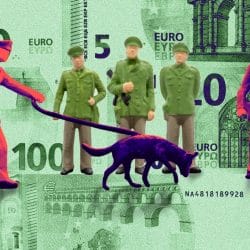
A top banker has got in trouble by referring to employees whose jobs will be replaced by AI as “lower-value human capital.” But he’s just saying the quiet part out loud: compliance officers have been expected to work like inefficient computers for years already anyway. Standard Chartered CEO Bill Withers used the unfortunate phrase when describing how the bank plans to keep hitting its profitability targets by cutting 15% of back office staff, and has tried to backtrack a little after a predictable storm of criticism, including from the former president of Singapore.
It would be nice to think of bank employees deployed to fight financial crime as super-effective old-school gumshoes, with a bottle of bourbon in the bottom drawer and an inexhaustible stock of one-liners, but in reality their jobs are more like something from ‘The Office’ than ‘The Big Sleep’.
Thousands of people sit in cubicles in Warsaw or Bengaluru, checking through transactions flagged as possibly abnormal by banks’ automated systems, and confirming that 99% of them are, in fact, normal. Anything that might conceivably be abnormal gets sent up the chain, where someone more senior will almost certainly decide it wasn’t.
It is a ruinously expensive process and, as far as we can tell, completely ineffective. The best estimates we have for the size of the criminal economy suggest it has grown, untroubled, along with everything else for decades despite all the laws, fines, and prosecutions that we’ve thrown at the problem.
But banks’ financial crime compliance isn’t about stopping financial crime at all: it’s about stopping banks from being fined, as Standard Chartered has previously been, enormous sums in both the U.S. and the UK. As long as banks can be sure that AI checks boxes in ways that satisfy regulators, then they’ll be happy.
This is a little bit worrying because AI is already getting very good at fraud. I am very alert to attempts to trick me but was sufficiently fooled by an AI email yesterday to forward it on to someone. Fortunately, a very similar one arrived (purportedly from someone else) a few minutes later, alerting me to my mistake. Money laundering is a laborious activity and criminal gangs will be as keen as banks to cut their back office expenditure, and AI could help automate the processing of the many small transactions that add up to a large amount of money. Phishing and smurfing are just a couple of its use cases, however.
“Scammers can leverage AI to scrape data from social media and dating platforms to identify vulnerable targets (e.g. lonely individuals, recent retirees, or people interested in finance) for pig butchering scams,” notes TRM Labs. “Bots can sustain long-term, emotionally persuasive conversations without tiring or making mistakes, making the scam more scalable.”
And that’s before you get onto AI’s ability to exploit cryptocurrencies and smart contracts to really start rampaging through the crypto world. “TRM observed a roughly 500% increase in AI-enabled scam activity over the past year. The convergence of generative AI, programmable financial infrastructure, and global crypto liquidity has altered the economics, velocity, and scalability of fraud,” the blockchain analytics firm said in a follow-up report. This is very bad indeed.
So, although I can see why people are annoyed that Withers referred to his bank’s employees in such a disparaging way, I am more troubled that he’s planning to replace them with AI, rather than to retain them and train them in how to counter it.
It was remarkable, however, to see Warren Davidson, chair of the illicit finance subcommittee at the House of Representatives Financial Services Committee, draw precisely the wrong conclusion from all this. Although he was correct in condemning the defensive nature of compliance, and its focus on generating paperwork over results, he then got lost in praising the White House’s decisions to attack corporate transparency legislation.
"As we focus on risk, we must also ensure that tools like artificial intelligence are fully deployed to counter the AI-enabled crimes of today,” he said, without realising that, without reliable information to train the AI models on, this is as useless an approach as the one he says has failed. If you don’t know who owns what, neither will a computer, no matter how cleverly it can pretend to be human.
I sincerely hope he listened to the testimony of Carole House of the Atlantic Council who forcefully pointed out the harm to national security and to ordinary Americans caused by the United States’ failure to create even an approximation of a decent corporate registry, as well as the historic idiocy of its current crypto policy. “Without a secure identity foundation, AI agents will simply scale up fraud at a speed and volume that human investigators can't possibly track, destroying trust in the whole system,” she said in testimony that I highly recommend you take a look at.
I very much doubt Davidson was listening, however, because that is not the direction the Republican Party is going in right now. I would write more about that, but frankly it’s all too depressing, and I’d rather move on.
So let me point you towards this excellent paper on how online scam marketplaces work, with criminals using the messaging app Telegram and the stablecoin Tether to launder hundreds of billions of dollars. It argues that our current approach of sanctioning exchanges is futile since their owners just shut them down and switch to a new platform that works in the same way but hasn’t yet been sanctioned.
“As long as the underlying digital infrastructure remains permissive, criminal syndicates will simply migrate to new channels. To move from reactive disruption to systemic prevention, the international community must shift its focus toward the structural enablers of these marketplaces,” Elliptic’s Tom Robinson argues. Elliptic is unusual among blockchain analytics companies in being willing to name Tether as a major vector for money launderers. Its rivals tend to just say “stablecoins,” I have no idea why.
Meanwhile, there is something grimly depressing about the fact that — against the backdrop of, well, everything — the UK has postponed June’s illicit finance summit due to “scheduling issues in the international calendar.” Everyone is so busy dealing with the consequences of illicit finance, that no one has time to talk about illicit finance.
A version of this story was published in this week’s Oligarchy newsletter. Sign up here.
The United States is inching closer to passing a gigantic piece of legislation to put cryptocurrencies on a secure footing, with the bill emerging unscathed from the Senate’s banking committee. Opinions differ as to what this means: crypto people are thrilled, while anyone who knows about money laundering is terrified. Passage of the so-called CLARITY bill has been a key goal of crypto enthusiasts since Donald Trump came to power, since it would give them the legal certainty to engage in “financial innovation” without worrying about a return to the Biden-era policy of trying to regulate them as if they were normal people.
Committee chairman Tim Scott is delighted: “For me, this is personal. My mother raised my brother and me with faith, grit, and determination, and she taught me that the American Dream should be within reach for every family, including single mothers working hard to build a better life for their children.”
I quote Scott partly because it’s such a weird justification for passing crypto regulation (or perhaps he just says that sort of thing about literally everything he ever does?), but mainly because it’s pretty clear that the bill as it stands will be a disaster for the kind of vulnerable people he claims to be fighting for.
In a sign of experts’ concerns, Transparency International’s U.S. office put out a statement quoting nearly all the most respected voices on money laundering in America arguing that the bill needs better safeguards against dirty money. “At a time when we know that hostile actors like (Iran’s Revolutionary Guards) are looking to circumvent U.S. sanctions to rearm and threaten Americans and U.S. interests around the world, it is inconceivable to me that we would open new, effective channels for sanctions evasion,” said Richard Nephew, former U.S. Coordinator on Global Anti-Corruption and Deputy Special Envoy for Iran.
“Terrorists, violent drug traffickers, and organized criminals who prey upon the elderly and unlearned in increasingly sophisticated financial and AI generated schemes are, quite literally, getting away with murder, funded by untraceable cryptocurrency transactions hidden behind an anonymous block chain,” said former FBI agent Karen Greenaway.
There is an awful lot of money in crypto, and Tether alone now has three people among the richest 100 in the world. Tether’s largest single shareholder Giancarlo Devasini’s wealth has grown from $9.2 billion in 2024 to $89.3 billion now, while chief executive Paolo Ardoino and former CEO Jean-Louis van der Velde have done pretty well too. Though none of them have done quite as well as Changpeng “Binance” Zhao, crypto’s only centibillionaire (so far).
In the UK, there’s a lot of concern about the millions of pounds going from crypto investors to Reform’s Nigel Farage, who has become a crypto champion, no doubt coincidentally. But, wow, look at what’s happening in Alabama for a sign of what the future looks like if crypto people really get their hands on the purse strings and try to buy their way into the Senate.
That much money doesn’t just help supporters win, it also terrifies opponents: standing up to the crypto lobby guarantees you’ll be swamped in hostile advertising. How do you want to be paid, as Pablo Escobar used to say, in silver or lead?
But why should the rest of the world care that this is happening? I’m sure I’m not the only foreigner who’s been staring in bewilderment at the growth of U.S. prediction markets, and how efficiently they allow insiders to monetise their privileged access to inside information. A lot of those markets are barred in other countries, but the U.S. soldier who was arrested for betting on the Maduro capture was trading on polymarket, a crypto-denominated market which is blocked in the United States too, despite Donald Trump Jr. being an investor.
Such restrictions can be easily bypassed by using a Virtual Private Network, so U.S. regulators are using artificial intelligence to track down insider trading on polymarket. After that soldier’s arrest, I suspect Americans will be much more careful about what they do.
Prediction markets claim they don’t want insiders trading on privileged information. But if the markets are to function in a way that supports their founders’ justification for them, as a price signal for future events, they rely on people with knowledge to be using them to make bets and thus to move prices in a useful direction. So clearly the temptation will always be there for anyone with inside information to use it to make some easy money.
And does anyone think U.S. regulators will care about Indians, Brits, South Africans Ukrainians, or other foreigners using crypto to trade on information from their own countries? They after all have a track record of treating foreigners and U.S. citizens differently. That’s why it was Francesca Albanese, with her American husband and daughter, who managed to have sanctions cancelled for daring to investigate Israel’s behaviour in Gaza, whereas non-U.S. connected people have failed to do so.
The new U.S. crypto bill coupled with U.S.-based crypto-denominated prediction markets points towards the United States becoming a gigantic offshore enabler of corruption for the rest of the world; a digital version of what Switzerland was in the analogue years, with everyone else reduced to begging its regulators for assistance.
“Crypto prediction markets are accessible to anyone with an internet connection and a wallet, pooling liquidity from a global user base rather than a regional one,” says Chainalysis. I think they mean that to be a good thing, because the blockchain is transparent and malefactors can be spotted easily yada yada, but it sounds beyond dystopian to me. I’m genuinely a bit terrified of what this will mean for corruption in the next few years, and I haven’t heard of any politicians who are alert to it yet.
A version of this story was published in this week’s Oligarchy newsletter. Sign up here.
Nigel Farage, the leader of the UK’s right-wing Reform UK party, has taken millions of pounds from crypto people, including one convicted of financial crimes in the United States. There are, despite Farage’s insistence to the contrary, questions around whether he followed the rules. Nonetheless, his party has swept local elections. There’s a lesson here for progressive parties everywhere, including in the United States where senators are seeking documents relating to financial ties between the commerce secretary and Tether. What if you get your ‘gotcha’ moment, turn around to the voters with a broad smile… and they vote for your opponents anyway?
Believers in democracy need to start advocating for more transparency, more enforcement and more restrictions on murky finance if they want to stop unaccountable money from buying influence in their countries. It is not enough to rely on journalists and activists to produce the occasional investigation, and expect voters to do the rest: we need properly-resourced agencies that can keep dirty money out of our systems if we want them to remain clean. If history tells us anything, it’s that criminals get elected all too often.
This is urgent. Tether made more than $1 billion in profits this year, in the first quarter, and is thinking hard about the midterms and how candidates might be encouraged to fight for crypto. And that’s just one company. Progressives who believe in fairer finance, a state’s right to regulate its own economy and the power to oversee who’s buying whom, don’t have that kind of money to spend to influence elections, so they need to start making the argument for campaign finance restrictions much more forcefully.
But there’s another point here too. I am working on an article about money laundering at the moment, and was chatting to two UK detectives last week. They led a successful operation in their city (I’ll post the article when it’s done) and I asked if they thought it had made a lasting difference. “With all crime, you take one out and there is another,” one of the detectives told me. “I'd like to think it has made a dent but there will always be more.”
In the case they worked on, gangs were bringing cash generated via the cocaine trade to be laundered into crypto (no prizes for guessing which cryptocurrency they preferred). The detectives identified £53 million in turnover over two years. It’s great that they jailed the ringleaders, but you can see why they’re not getting too carried away. That total is about a quarter of a percent of the UK cocaine market’s turnover, so the gangs really won’t have noticed the loss. And, for the police, it was five years’ work.
To a fairly large extent, since the first U.S. operation in Miami in 1980, when we’ve spoken about fighting dirty money, we have really been talking about stopping cocaine gangs by taking away their ability to make a profit. And, despite occasional successes like the one I’m writing about, this approach has overall been a catastrophic failure. Cocaine is cheaper, more abundant, and more widespread than ever before.
This is important for many reasons, obviously because entrusting the supply of a dangerous substance to criminals is bad, but also because the existence of a vast underground financial system to move the cocaine trade’s profits creates a mechanism through which Russian spies, terrorists and others can hide their cash too. For me though, the real problem is that we have an urgent threat to democracy posed by hidden unaccountable money. Instead of tackling that problem though, our police officers are fighting an endless war against drugs that was lost decades ago.
My modest proposal therefore is to legalise cocaine. It’s available everywhere already, so there’s no downside. We should tax it, regulate it, make sure kids can’t buy it and, as a useful side effect, take all the liquidity out of the underground economy. Our police officers could then stop running to go backwards, and instead fight a battle they might actually win, which is to stop fascists and kleptocrats from buying our democracies.
Use oligarchs to undermine Putin
Here’s a good article from The Economist by “a former senior official in the Russian Government,” arguing that Vladimir Putin is losing his grip. Now, I’m always a little cautious about articles that tell me what I want to hear, as well as the veracity of information and analysis provided by Russian officials, former or current, but it does make some very interesting points.
Of particular interest to me is the idea that Russia’s elite is annoyed with Putin because its members are worried about having their assets stolen, with $60 billion worth of property nationalised or seized by corrupt officials in the last three years.
“Previously their property rights were outsourced to the West. They used London courts, offshore structures and international arbitration to resolve conflicts or seek protection. Now conflicts must be resolved domestically, without functioning institutions. Demand for rules grows more urgent as redistribution of assets gathers pace,” the article states.
One of the reasons why democracy failed in Russia is because the oligarchs were able to keep their wealth offshore, and thus to essentially colonise their own country, secure in the knowledge they were themselves immune from the unfairness. It would be a pleasing irony if the horrific war in Ukraine ended up undermining not just Putin, but Putinism as a whole.
There is a huge opportunity here for Western governments to capitalise on the dissent, and to start quietly offering sanctions relief to Russians willing to break with Putin, and who’re prepared to surrender a decent chunk of their wealth to help Ukraine in return for being able to keep the rest. There aren’t enough police officers to actually bring the cases needed to investigate, prosecute and confiscate the oligarchs’ wealth anyway (see item above), so we may as well start negotiating and see what they’re willing to do to get it back. In short, this is a big week for me making unfashionable policy proposals.
AI-generated launderers
There’s debate in the United States about getting rid of the Corporate Transparency Act, with Jeff Bezos’ Washington Post supporting repeal, even though the law has never actually been implemented. Opaque shell companies are a weird outgrowth of capitalism that corporations’ original inventors — who wanted to create insurance for entrepreneurs, not getaway vehicles for crooks — never intended to happen, so it’s very odd that they’re now being presented as some kind of human right.
If you want a reason why the appallingly lax American system should be cleaned up, here’s a post on X about someone who tasked two AI agents with making money, and came back to find out they’d registered a Wyoming LLC all by themselves. This suggests the opening of a whole new frontier of automated money laundering, and the consequences are frankly pretty terrifying. The Corporate Transparency Act should be strengthened, not abolished.
A version of this story was published in this week’s Oligarchy newsletter. Sign up here.
Inequality is bad for you, and new figures in the UK show that the number of years when people can live healthy lives have fallen everywhere and furthest in the country’s poorest areas. This is partly a lingering after-effect of COVID, but is mostly a result of cuts imposed on health services by the last government. The results are dramatic, with the average person in a wealthy area expected to enjoy almost 20 years more good health than someone in a more deprived area. The situation in the United States is similar, and declines in health have also been observed in Germany, Canada and the Netherlands.
“Reducing smoking and improving diet and physical activity can delay the onset of illness and improve day-to-day wellbeing,” notes this extremely commonsensical analysis from the UK healthcare think tank The Health Foundation. “Secure work, good-quality housing and supportive local environments all influence physical and mental health.”
Being unhealthy is just terrible in all ways, and the problem is clearly getting worse, so you would expect the disrupters of our new economy to be finding ways to respond to this challenge. And at first glance, the Sam Altman-backed Retro Biosciences — with its focus on targeting “aging mechanisms to increase healthy lifespan” — looks promising. So does Altos Labs, with its mission to reverse “disease, injury, and the disabilities that can occur throughout life.” And there’s Saudi Arabia’s Hevolution, which is catalysing “the shift from lifespan to healthspan.”
And that’s before we get to the start-ups operating in a “free city” off the coast of Honduras, which has the brave approach of basically letting people do whatever medical research they like (“Prospera is a unique place where we can do such things,” says one businessman) to help drive progress towards an illness-free future.
But don’t get your hopes up. They’re not looking at ways to help people to get vaccinated, eat healthily, stop smoking or do more exercise. Instead, they’re working on gene therapy, stem cells, and other extremely expensive treatments that will only benefit people who can afford them, and who are thus already likely to be doing well. In the UK meanwhile, Genflow is also aiming to slow the ageing process in dogs, to make sure the super-rich aren’t left without their pets in this artificially prolonged future.
It’s tempting to see this as a metaphor for late-stage capitalism in the West, with its focus on the needs of the few (and their pets) rather than of society as a whole, except that we’re seeing a similar pattern in other places too. In Russia, Moscovites live longer than people from the provinces (although the picture is complicated by the relatively good health of the non-drinkers from Muslim regions), so you would have expected Vladimir Putin to be concerned about how to close that gap. But when he was chatting with Xi Jinping last year in China (where inequality has also harmed health), they were instead more focused on how to live forever.
“Human organs can be continuously transplanted, and people can live younger and younger, and even achieve immortality,” Putin said. (Three important questions: firstly, does this mean he will be president of Russia literally forever, the world’s first un-dead head of state? Secondly, are they farming people as a source of organs for him? Thirdly, does he really believe this?)
“This century, there's a chance of also living to 150,” replied Xi, who could — under that scenario — rule China for another 77 years, which is longer than he’s been alive, by which time his nation’s population could well, according to UN estimates, have halved.
I, for one, wouldn’t mind having a vote on whether this is a future I want to be a part of.
An insider betting scam
Here’s a fascinating piece of research from the Anti-Corruption Data Collective about prediction markets, looking at how often “long shot” bets on military and security matters pay off compared to what you would expect: fully 52% succeed, compared to only 14% across Polymarket as a whole.
“Government officials and members of our military being able to turn a profit on insider information incentivises corrosive corruption in public office and undermines national security,” notes David Szakonyi, Co-Founder of the Anti-Corruption Data Collective.
The analysis follows the indictment of a U.S. serviceman who made $400,000 betting on the bid to capture Nicolas Maduro in Venezuela, with 13 “yes” wagers on various aspects of the operation in December and January. And that was only a comparatively small military campaign. Just imagine how much money privileged insiders could have made in the past, if only they’d had access to prediction markets before D-Day, before the first nuclear bomb test, or before the assassination of Archduke Ferdinand in Sarajevo.
I really enjoyed this recent episode of Planet Money about prediction markets, particularly with its clear explanation that — like so much “financial innovation” of the past — they’ve not invented anything new at all; they’ve just found a clever way around regulations that previously stopped people making bets in this way.
There is fierce competition between the two leading players — Kalshi and Polymarket — although they have common ground in one area: they bothemploy Donald Trump Jr.
Trump sues his own government
There are so many things happening in the United States at the moment that it’s hard to keep track, but I did like this analysis from David Allen Green of a particularly strange lawsuit, in which President Trump is suing the federal government for $10 billion. The judge is, unsurprisingly, concerned about a situation where the president is basically suing himself, and wants more information about how that’s going to work.
This could, however, be a whole new money-making front for the first family, and why should the Trumps stop at just $10 billion? They could presumably take the government for every penny it’s got. I’m amazed no one has done this before.
A version of this story was published in this week’s Oligarchy newsletter. Sign up here.
Donald Trump and the crypto world have done well out of each other. The Trump family has made profits of several billion dollars, and ‘cryptopreneurs’ have found the United States a newly supportive environment for their products. But the crypto world is not a single entity, and there are potential differences of opinion and approach between the parts that specialise in fraud, money laundering, and speculation (as well as the small number of societally beneficial uses), and a court case between billionaire Justin Sun and the Trump family’s World Liberty Financial threatens to blow those divides wide open.
Sun is a colourful gentleman and a firm favourite of this newsletter, thanks to his efforts to essentially buy the Pitcairn Islands, his voyage into kind-of space, his consumption of a $6.2 million banana, his stewardship of the Tron blockchain, his premiership of Liberland, and his frankly adorable continued usage of “H.E.” (his excellency) as a title despite losing his Grenadian ambassadorship three years ago after being accused of fraud by the Securities and Exchange Commission.
He also had a key role in transforming Trump from cryptosceptic into cryptoenthusiast after investing millions of dollars in World Liberty Financial in late 2024, which helped to persuade the president — then running for re-election — that there was money to be made on the blockchain.
Considering the improbability of the Trump family building an actually successful crypto company, and the strong likelihood World Liberty Financial would find a way to keep investors’ money as has happened with Trump ventures in the past, quite a lot of people assumed Sun’s money was in reality more of a gift than an investment. But it appears these doubters were wrong, at any rate that’s what it says in the suit that Sun has filed in California alleging that World Liberty Financial has abused his rights.
“Mr. Sun invested $45 million to purchase $WLFI tokens from World Liberty not only because of the project’s claims that it would promote adoption of decentralized finance… but also because of the Trump family’s association with the project,” his claim states. “But as Mr. Sun unfortunately has learned, World Liberty’s operators, including Chase Herro, see the project as a golden opportunity to leverage the Trump brand to profit through fraud.”
Sun has been careful to make clear this is not an attack on the president (“Unfortunately, certain individuals on the World Liberty project team have been operating the project in a manner that goes against President Trump’s values,” he posted on X), who is, he says, being betrayed by underlings — as autocrats have always been throughout history — but he is certainly airing a lot of dirty laundry, which is likely to upset influential people.
Perhaps the most significant allegations, which World Liberty Financial denies, is that the Trump family’s company is on the verge of collapse, having paid most of its money to its owners, and that it tried to extort money from Sun to keep it in business. This is not just significant for its investors but also for America’s diplomatic ties, since Abu Dhabi has invested $2 billion via World Liberty Financial’s USD1 stablecoin, and the United States can ill-afford to further irritate its allies in the Gulf right now.
The timing of the lawsuit is interesting. It was notable that, shortly after Trump returned to the White House, the Securities and Exchange Commission paused its investigation into Sun. In March, that investigation was finally wrapped up, with Sun paying $10 million but not admitting wrong-doing, so he is perhaps no longer concerned about facing legal action himself.
Sun was also a major investor in Trump’s memecoin, but is not the only person who seems to have soured on that particularly unlovely project. One of the perks of being an investor in the token is the right to have dinner with Trump, but the value of that ticket dropped this year to just $539,000 from $3.28 million in 2025, with the Financial Times quoting an expert as calling the friendship between Trump and the crypto-world “a shotgun marriage,” which seems fair.
The Trump family has, however, made $320 million in fees from the memecoin alone, so I suspect they’re not that bothered.
A tale of two scammers
There was, hard though it is to imagine, a time when Trump was just a strangely-tinted TV personality with strong views on where Barack Obama was born. And back then, in those prelapsarian days, 2014’s billion-dollar Moldovan bank fraud was a big deal. It’s great to see that mega-oligarch Vlad Plahotniuc has been jailed for 19 years for his involvement in a crime that ruined his homeland.
Moldova has struggled through the resulting period of economic, financial, diplomatic and political turmoil, and it was great to see that Viktor Orbán’s defeat in Hungary has meant it can make progress on its movement towards membership of the European Union.
The other mastermind of the bank fraud is pro-Kremlin politician Ilan Shor who was convicted and sentenced in absentia. He remains, of course, at liberty. Though his A7A5 sanctions-evading cryptocurrency has still not recovered the trading volume it had before the recent hack of the Grinex trading platform where people bought and sold it. Grinex blamed the hack on Western intelligence agencies, but Chainalysis has an interesting alternative explanation, based on the fact that A7A5 is gradually being squeezed by Western sanctions (including the latest ones from the European Union).
“Faced with mounting international pressure and a shrinking operational footprint, actors associated with Grinex could be using the guise of an alleged hack to quietly siphon liquidity and execute an exit scam,” Chainalysis suggested. I’m not saying that is what happened and to be honest, I think it’s more likely that this was the handiwork of Ukrainian hackers or standard financial criminals. I mention it, however, because Shor does have a previous record when it comes to setting up a money laundering scheme and then defrauding everyone who was foolish enough to trust him with their money.
The billion-dollar bank fraud was a clever way to profit out of the ‘Moldovan Laundromat,’ which had been allowing Russians to smuggle money out of their homeland before Shor and his co-conspirators destroyed the Moldovan banking system and stole everyone’s cash. It would be remarkable if he had basically done the same thing for a second time with his stablecoin. Crypto people call it a rug pull.
A version of this story was published in this week’s Oligarchy newsletter. Sign up here.
It starts with a simple search term in the Department of Justice’s Epstein Library. “Blue eyes.” Hundreds of results. Jeffrey Epstein’s international trafficking agents send him pictures and descriptions of blue-eyed young girls: potential victims to be dispatched to his various homes. “I spotted two skinny blond blue eyes 21 years old ladies in Monaco last weekend and asked them for CVs,” one agent, whose name has been redacted, wrote. “Trying her best to move from her small town to Moscow; English isn't great. Could be fun for Paris, blue eyes,” wrote another. “Can't understand if her breast is real. Otherwise very pretty and sweet…Very blue eyes as we like.”
One of Epstein’s victims wrote of being chosen for her eye color in a journal entry later shared with federal prosecutors. "Superior gene pool?!? Why me?" she wrote, describing Epstein's worldview as "Nazi like." "It makes no sense. Why my hair color and eye color?"
Epstein — himself blue-eyed — seemed to prefer both his victims, and the people he bankrolled, to have blue eyes. “All of my fundees have blue eyes,” he boasted in one email. In the entryway of his Manhattan townhouse, he displayed dozens of prosthetic eyeballs in a frame. Epstein made notes and sent article links to his contacts asking if having blue eyes meant you were more intelligent or a “genius”. He even had a list of scientists and tech leaders with blue eyes — including Elon Musk, Peter Thiel, and Google’s Ray Kurzweil. “Total — 70 people Blue eyes — 41 Unclear (might be blue, but not 100% sure)” the list says. Appearing in the files — whether on this list or elsewhere in Epstein's records — does not connote legal wrongdoing.
Going deeper into the files, Epstein and his network of contacts discussed beliefs about how physical characteristics and race might denote intelligence. They exchanged emails about population control. They spoke of engineering women’s sex drives, building designer babies, and living in a world full of superintelligent humans that could merge with robots. They spoke of getting rid of the elderly, the infirm, and the poor.
The files offer a glimpse into a world where ideas about eugenics and race science have never gone away. On the contrary, they run through our elite universities, through the most powerful companies in Silicon Valley, and through the tech industry itself. Epstein’s was an exclusive club that counted among its members people who harbor dreams of re-engineering human minds and bodies, seizing control of our collective future, and building technology that, they hope, will one day merge with — or even replace — all of us.
Jeffrey Epstein, 27. Jeffrey Epstein's mansion El Brillo Way in Palm Beach. U.S. Virgin Islands, Department of Justice, Sexual Offender Registry Photograph.
In 2002, two decades before the launch of ChatGPT, Epstein hosted an Artificial Intelligence summit on his Caribbean island. In the years that followed, he cultivated close, regular contact with a network of (predominantly male) scientists, researchers, academics and tech leaders working at the vanguard of AI, biotech, genetics and cognitive science, meeting them at universities like Harvard and at his various homes.
In August 2018, a year before Epstein was found dead in his jail cell, he was in email correspondence with software consultant and bitcoin investor Bryan Bishop about funding a project to create “designer babies” — children with genes cherrypicked for their looks, health, strength, immune systems, sleep needs and even, in Bishop’s imaginings, abilities to live on a different planet.
“Attached is the doc you requested, it's the "use of funds" spreadsheet for the designer baby and human cloning company,” Bishop wrote to Epstein. “This gets us out of our self-funded ‘garage biology’ phase to the first live birth of a human designer baby, and possibly a human clone, within 5 years. Once we reach the first birth, everything changes and the world will never be the same again.”
Bishop went on to discuss how his ultimate ambition was to make “practically unlimited modifications to the cells before generating an embryo.”
In response to a request for comment, Bishop sent Coda a publicly available set of answers to frequently asked questions about designer babies.
“The reason people have an aversion to eugenics, and rightfully so, is because countries used genocide and sterilization to prevent reproduction by populations that they didn’t like. We have no intention of doing anything of the sort,” Bishop writes in the public FAQ. “‘Designer baby’ simply describes a child whose genome has been intentionally altered or chosen by their parents, rather than left entirely to the genetic lottery of natural conception.”
“It’s such a great subject,” Epstein responded after he read Bishop’s proposal. “We need to get a read on legal. Can’t do anything where US rules apply to US citizens regardless of where [they are].”
Building a super-race of humans, and parachuting humanity into a different evolutionary era — or even obsoleting the human race as we know it — is a running theme in the Epstein files, and an increasingly prominent ambition for tech evangelists today.
“It’s eugenics all the way down,” said Jacob Metcalf, a founding partner at Ethical Resolve, a consulting firm working with tech companies to develop their ethics protocols. A common fantasy in tech circles, he said, is “to essentially control human destiny. And a lot of the times that human destiny is for humans to be replaced. That's the really bleak thing here. What could be more eugenic than getting rid of humans.”
In 2008, Epstein began conversations with the computer scientist Ben Goertzel. Over the years, Epstein would send Goertzel more than $360,000 to fund the researcher’s plans to build towards Artificial General Intelligence (AGI), a term Goertzel himself popularized.
“I remain eager to move forward on working together to accelerate progress toward a human-obsoleting thinking machine,” Goertzel wrote to Epstein in May 2008. Eighteen years on, and the idea of obsoleting humans with artificial intelligence is widely discussed in the tech world.
When asked to comment on his exchange with Epstein, Goertzel told Coda: “I do think we will create forms of transhuman intelligence going beyond the scope of humanity as we know it, but I also very much hope and envision a strong role for humans even after this happens.”
Goertzel went on to describe a future where the world reaches the “Singularity” — a Silicon Valley buzzword signifying a tipping point where AI surpasses human intelligence. “I do think AI will eventually gain its own superhuman autonomy, but I think this can happen in a way that respects and nourishes human life rather than being harmful to it,” he said. “Epstein and I discussed this face to face a few times and indeed I was a bigger fan of the human species than he was, and more optimistic about its flourishing post-Singularity.”
In an email to Epstein, Goertzel laid out a scenario where AI systems would start running their own economic activity. He envisioned this Artificial Intelligence economy acting as a “parasite to overcome the regular human economy” that would eventually “gain its own superhuman autonomy.” The ideas Epstein and Goertzel exchanged mirror a broader conversation unfolding in the tech world that imagines a future where ultimately, human labour could be rendered superfluous, and ultimately be replaced by artificial intelligence and robots.
Together, Goertzel and Epstein also discussed modifying human brains — a concept popular in Silicon Valley today, where numerous brain-computer projects are researching ways to cognitively enhance the human brain, and alter human personality, memory, and mental capabilities.
In 2008, when Epstein told Goertzel he was “off to jail” for a year, after he was convicted of soliciting a minor for prostitution, Goertzel suggested the solution to his problems might one day be solved if human brains could be re-programmed.
Ben Goertzel with Desdemona the robot, at a tech event in Portugal in November. Sam Barnes/Sportsfile for Web Summit via Getty Images.
“According to my understanding, the girls you were involved with were old enough to know what they were doing, so society really has no ‘moral right’ to lock you up,” Goertzel wrote to Epstein. “This is a fucked-up society we live in. But past ones have really been no better -- the fault is really w/ the human brain architecture, which is precisely what I'm aiming to supercede in my AGI work.”
When asked to comment on these remarks — and in particular the implication that Epstein’s problems might be solved if his accusers' brains were one day re-engineered — Goertzel told Coda: “This was a general observation that the messed-up nature of our society generally is rooted in the way our brains have evolved... and that advanced tech will let us modify our brains to make ourselves and thus our society better. There was no implication intended (nor stated) that women’s brains are any more or less messed up or in need of improvement than men’s.”
Goertzel reflected that his comments on Epstein’s victims being “old enough” were “regrettable and unfortunate in hindsight,” adding that his impression was that Epstein had been involved with adult women, not “disgustingly curating high school students for sexual purposes. I should have paid more attention.”
In 2013, three and a half years after Epstein was released from jail, Goertzel approached Epstein for funding to build a “toddler robot”. Given Epstein’s criminal history of abusing minors, this has inevitably attracted attention online. “When we were discussing measuring the IQ of robot toddlers, the topic was never sexualized in any way,” Goertzel told Coda when asked about the project. “While I had nothing to do with Epstein's perverse sexual tastes or abuse of women, what I have read about his awful doings in the newspapers relates to his interest in teenage girls not toddlers.”
Epstein was particularly interested in funding projects that built — like Goertzel’s –- on transhumanist theories. Transhumanism is a worldview that captivates many of the most prominent tech leaders in Silicon Valley today. It believes in a future when the human body can be endlessly altered, genetically engineered, and ultimately fused with artificial intelligence.
“Transhumanism is a much more radical concept than eugenics,” explained Timnit Gebru, a computer scientist and researcher who has written extensively about eugenicist ideas within artificial intelligence. “In eugenics, you're trying to create a more superior human by breeding humans through generations. In transhumanism, you're trying to get rid of humans altogether.”
For transhumanists, she added, “their idea is to get rid of any undesirable properties they see with humans."
Perhaps the most well-known proponent of transhumanism in the Epstein files is Peter Thiel.
“I think you would prefer the human race to endure, right?” New York Times journalist Ross Douthat asked Thiel last year. “Uh—,” Thiel said. “This is a long hesitation!” Douthat said. “Should the human race survive?” “Yes, but I would like us to radically solve these problems,” Thiel said. “We want you to be able to change your heart and change your mind and change your whole body.”
Peter Thiel. Creative Commons (CC BY 2.0) /Gage Skidmore.
Thiel’s name appears in the files more than 2000 times, and Epstein reportedly invested some $40 million into Valar Ventures, a firm co-founded by Thiel. The two spoke of building secret societies and shared an interest in transhumanism and cryogenics — Epstein wanted to freeze his brain and penis when he died, so that one day he could be revived, while Thiel has also stated his body will be frozen after his death.
They also appeared to share an interest in bringing an end to the democratic systems of today, imagining a different system altogether. Epstein, for his part, spent his life puppeteering the most powerful people in the world and undermining democratic systems. Thiel, meanwhile, first expressed his own anti-democratic views in 2009 when he wrote: “I no longer believe that freedom and democracy are compatible,” adding that since women were allowed to vote, the notion of a capitalist democracy became impossible. When the Brexit vote came through, Epstein wrote to Thiel: “Brexit, just the beginning.” Thiel asked — “of what”; Epstein said – “Return to tribalism, counter to globalization, amazing new alliances.”
Globalization — and the idea of internationally powerful governing bodies — is a worldview that both Epstein and Thiel seemed to distrust. In March, in a palazzo in Rome, a stone’s throw from the Vatican, Thiel gave one of his infamous lectures in which he espoused his views about an “antichrist” that gets in the way of technological progress. This antichrist, he suggested, could be an internationally powerful body; the product of globalization. I stood outside the palace as attendees — priests, students, researchers — mutely hurried out, refusing to speak to the cluster of reporters waiting for Thiel’s black Mercedes.
“He has a totally irrational side, which lives on fear, of what danger might happen,” one audience member told me of Thiel on condition of anonymity, recalling how, up close, Thiel looked haunted and ill. “His head is full of future scenarios, which is what’s killing him. I think he’s scared.”
Thiel did not respond to multiple requests for comment.
Epstein didn’t confine himself to lofty conversations about a future collapse of the global order or re-engineering humanity. He also had ambitions for his own personal eugenics project. In 2019, it emerged that he wanted to seed the world with his DNA — and reportedly have 20 women impregnated at a time at Zorro ranch, his New Mexico property.
Epstein tried to recruit Virginia Giuffre for this very project. He “fantasized about improving the human race by fathering children who carried his superior genes,” she recounted in her memoir, published posthumously late last year. “He’d talk about using his Zorro ranch as a literal breeding ground to propagate babies.” When Giuffre was 18 years old, she recalled, Epstein asked if she would carry his child and hand over all legal rights to it – “like a modern-day handmaid.”
Zorro Ranch, New Mexico. Diary of Epstein's victim.
In a haunting diary entry from another Epstein victim, written between the ages of 16 and 17 and shared with federal prosecutors, a girl describes being told she will be sent to Zorro ranch — possibly to participate in the very same project. “Go to New Mexico? What in the hell? This makes no sense. What about school?” she writes, describing how Epstein chose her for her hair color and eye color, and tried to convince her she would create “perfect offspring.”
The teenager chronicles her pregnancy, pasting a sonogram into the scrapbook, before giving a traumatic account of giving birth with Ghislaine Maxwell beside her. “Ghislaine said to push all the pain away. I don't understand. Blood and water all over the bed.” As the baby was born, she writes, Maxwell covered her eyes. “I saw between her fingers this tiny head and body in the doctors hands.”
The girl describes hearing the baby’s “tiny cries” before “they took her.”
“I’m nothing but your property and incubator,” the teenager writes of Epstein. The diary is a terrifying piece of evidence that appears to link to Epstein’s longstanding fixation with creating genetically bespoke humans. The diary author’s lawyers, Wigdor LLP, declined to comment.
Epstein’s fever-dreams of creating an army of children carrying specific genes reflect a broader trend of “pronatalism” — a movement historically tied to eugenics — that’s thriving in Silicon Valley.
Millions of dollars of funding are currently being poured into projects creating “superbabies,” while billionaire tech oligarchs including Elon Musk — whose name appears more than 1000 times in the files — reportedly want to use surrogates “to reach legion-level before the apocalypse.” Musk did not respond to requests for comment.
In the files, women appear either as victims, as objects, or as vessels for genetic engineering experiments. They are an inconvenient reality, people to be controlled and re-booted. Epstein wrote a 2013 email implying that women “are like shrimp. You throw away the head and keep the body.”
“The obsession with "artificial" life appears tied to a masculine desire to try control the production of life – ultimately ridding themselves of their dependency on women," said Gabriella Razzano, Co-Founder of OpenUp, a social impact tech lab based in Cape Town, who is also a senior advisor at the African AI Observatory. “I think there is important work to be done on tying the narratives that are very revealing in the Epstein files to understand how, and why, technology is being developed as it is.”
The trading of ideas about intelligence — both artificial and human — takes a particularly sinister turn in a 2016 exchange between Epstein and the cognitive scientist and AI researcher Joscha Bach, whose research Epstein funded to the tune of $300,000.
Bach writes to Epstein about a study claiming that “black children outperform white children in motor development, even in very poor and socially disadvantaged households, but they lag behind (and never catch up) in cognitive development even after controlling for family income.”
Epstein responds with racist ideas about his notion of how to “make blacks smarter”, adding — “maybe climate change is a good way of dealing with overpopulation. The Earth’s forest fire. Potentially a good thing for the species,” before contemplating a world with “too many people,” where “many mass executions of the elderly and infirm make sense.”
Bronze sculpture of a female torso Jeffrey Epstein's Manhattan residence.
Epstein then imagines creating a future “Übermensch” — a superior human with cherry-picked attributes. “What I like is the idea that ubermensch could be the melding of humans, put together in one brain,” Epstein writes. This bespoke human, he suggests, would include traits from marginalized groups, who he appears to believe have a stronger awareness of how to navigate power structures because of their historical exclusion. “An increased motor system, an increased awareness, an increased status calculator (Blacks, jews, women). Ubermensch could be the combination of the best of humans, not the best of a specific race or gender. Fun idea.”
Bach told Coda in a statement: “I was summarizing a scientific study in a private email. Studies like this get often abused in ideological discourse to justify discrimination, which I strongly oppose and condemn.”
“I am firmly opposed to any form of racial discrimination, and I reject the use of group-level statistical claims to make judgments about individuals or to justify unequal treatment.”
He continued: “It goes without saying that if global warming were to lead to a reduction in the human population, it would be accompanied by immeasurable suffering. Our civilization would break down, leading to a return to dark ages, in which the elderly and infirm were often killed, because people could not support them, and often did not care about supporting them. Every reasonable person understands that this is horrible and not desirable in any way.”
Epstein “was often callous about human suffering in a way that I found disturbing but worth understanding, as a window into the perspectives of the rich and powerful,” Bach added.
Alongside Epstein’s conversations about mass executions for the old and and the sick, he was also interested in Silicon Valley’s dream concept of living forever — he had numerous email conversations with the longevity guru Peter Attia about prolonging his own lifespan, and funded a Harvard project geared towards “the end of aging.” In an email to Attia, Epstein mused: “I’m not sure why women live past reproductive age at all.” Attia, who published a statement about his relationship to Epstein, did not respond to requests for comment.
This interest in “longevity” — living for as long as possible, even living forever, is popular among the elite precisely because they find themselves in an elite class, says David Robert Grimes, a scientist and disinformation expert who has written about longevity and race science in Silicon Valley. “They're both sides of the same coin — the Silicon Valley eugenics, and also the longevity stuff. They promote an idea that ‘we are exclusive and we are special',” he said. "It helps them to justify deep social inequality."
The tech elite did not inherit this ideology by accident. Stanford University, the intellectual heart of Silicon Valley, was once a major hub for the American eugenics movement, which later helped to inspire Nazi race laws. Stanford’s founding president, David Starr Jordan, was a prominent eugenicist, campaigning for forced sterilization of people with undesirable genetic traits. The university removed his name from its buildings in 2020 — but in Palo Alto, his beliefs did not disappear with the nameplate.
"Instead of eugenics we just call it longevity or biohacking," Christopher Wylie, the Cambridge Analytica whistleblower who has spent years investigating Silicon Valley's belief systems, said on a panel with me at a journalism conference last year. "It's the same."
The ideology Epstein bankrolled in private is being built in public. It’s a vision of the future in which a select few get to upgrade and extend their lives, while tightening their grip on the systems that determine which humans are worth investing in — and which are not.
It sounds like a dark sci-fi fantasy, except, as the files show, that fantasy is being funded and pushed into reality. Most of us will never be in the rooms where these ideas are discussed. All of us will live with the results.
Someone recently asked me what mark out of 10 I’d give for the efforts of governments to tackle financial crime. It got me thinking about that one bright spot of recent times — the West’s response to Russia’s full-scale invasion of Ukraine four years ago — and how it is now looking. Back in 2022, a lot of us were pleasantly surprised by the speed and ambition with which Western governments sanctioned the Russian government, state-owned companies and wealthy individuals. While Western pressure did not prevent the war, the asset freezes did impose a real cost on those conducting it. Four years on, however, those sanctions are beginning to look a bit shopsoiled. If they began at 7/10, they’re now scoring a lot lower.
There are reasons for this: Donald Trump does not appear particularly interested in Ukraine; the now former Hungarian prime minister Viktor Orbán has been snarling things up; and so on, as laid out in this analysis from Tom Keatinge. To make things worse, Trump’s latest adventure in Iran has pushed the oil prices sharply higher, earning more money for Russia while also giving Trump cover to lift sanctions, a temporary measure he has recently extended.
Keatinge argues that European countries need to be far more focussed on going after Russia’s payment mechanisms, particularly digital. “The extent to which crypto activity supports Russia’s war effort is clear,” he writes, “yet repeated initiatives to elevate the importance of opening a concerted line of effort on this issue are ignored. This must change.”
I agree, though it won’t be easy, considering the diffuse crypto ecosystem, and the increasing sophistication of Russian involvement in it. As long as Telegram is willing to host markets, the markets will continue to function to some extent whatever Western countries do (see the story of Xinbi, a Chinese-language hub for illicit crypto.) However, it does look like someone somewhere has lost patience with the ease with which Russia is funding itself.
“The sanctioned Russia-linked cryptoasset exchange Grinex announced an immediate suspension of its operations, citing a ‘large-scale cyberattack,’” reports Elliptic. According to the statement, which Kyrgyzstan-registered Grinex posted on Telegram, it lost around $13 million worth of USDT in the hack, blaming the theft on Western intelligence agencies.
“Today the attempts to destabilise our fatherland’s financial sector hit a new level, with the direct theft of the assets of Russian citizens and companies with the involvement of complex cyberattacks,” the statement said. Grinex is the successor to Garantex, which was shut down just over a year ago after years of effort by Western law enforcement. I would be surprised if Western countries had decided to take direct action against Grinex, as the exchange claims they did. Westerners tend to be a bit too legalistic for this kind of smash-and-grab, and I would expect any operation to more closely resemble what worked a year ago, conducted with Tether’s cooperation.
Instead, I suspect this attack is the work of hacktivists, perhaps working for or with the Ukrainians. Whatever the answer, it is embarrassing for the Russians, shows their crypto-security is not impregnable, and has made a noticeable dent in trading volumes of the A7A5 ruble-denominated stablecoin, which has become a key sanctions evasion tool. Three birds with one stone.
The important point is that sanctions were never supposed to be permanent: they are a foreign policy tool, not a law enforcement one. Hundreds of billions of Russian-owned dollars are languishing in various frozen bank accounts, and Western countries need to start thinking about what to do with them. They can confiscate them, investigate them or — if they’re feeling brave — use their potential return as leverage to persuade wealthy Russians to break with the Kremlin. What they shouldn’t do is leave them as they are to gather dust.
Hopefully, now that Orbán is out of the way, European countries will be able to take firmer collective action but they also need to be imaginative, and to start behaving as if they actually want Ukraine to win, rather than just not lose.
A defeat for transparency
Of course, the United States will have a lot to say about that too, and what it ends up saying about how to tackle the Russian crypto operations will depend on what happens in the midterm elections this year. So, it strikes me as a big deal that crypto firms are once more pouring tens of millions of dollars into campaign vehicles in their quest for, what they euphemistically refer to as, “regulatory clarity.” Among them, of course, is Tether.
If you’re wondering quite how it’s possible to spend that much money on elections, I draw your attention once more to the great Integrity Index, with its records for who’s been spending what. It boggles my mind that, for example, the three Democratic rivals to the Republicans’ Susan Collins for the Maine Senate seat have raised more than $17 million just for the primary. Collins herself has raised over $10.5 million. There really shouldn’t be that much money in politics.
Besides, when it comes to value for money, investing in court cases beats investing in politics every day of the week. I don’t know how much the (ironically) anonymous plaintiffs in the 2022 case against corporate transparency in Luxembourg paid their lawyers, but its effects just seem to keep compounding to the benefit of those who want to hide their wealth from society.
The European Union’s retreat from revealing the ownership of shell companies has given cover for Britain’s tax havens as they resisted efforts from London to force them to open up their own corporate registries. It looks like those efforts may have finally failed. “We are committed to full transparency, but I don’t think there will be any turning back,” said the British Virgin Islands’ Junior Minister for Financial Services Lorna Smith in comments confirming that the islands are in fact very much not committed to full transparency.
A version of this story was published in this week’s Oligarchy newsletter. Sign up here.
Dutch friends like to tell me that their nation’s primary characteristic is bluntness, and the Netherlands’ Court of Audit has done nothing to challenge the stereotype with its bracing assessment of the country’s and, by extension, the world’s failure in fighting money laundering. Published last month, after an extensive analysis of the country’s efforts to stop dirty money, the Court’s report concludes that the system is expensive, discriminatory, and — possibly — completely ineffective. No one has really checked on that last point, so they can’t be sure, which if anything makes it all worse.
The Netherlands hosts the largest port in Europe, and is therefore home to a vast smuggling industry — Dutch politicians not infrequently warn that it’s becoming a narco-state — which requires an equally vast money laundering industry to service its profits. The Court of Audit set out to check the government’s response to this challenge, concluding that it cost banks €1.6 billion a year. It’s a price tag that has increased by almost 17% between 2021 and 2024, during which time the number of reports the banks’ 13,000 compliance officers made more than doubled.
“We think it is important that these employees make a meaningful societal contribution to preventing and combatting money laundering. There is no evidence that shows that they do,” the report witheringly observes.
The court sent surveys out to “politically-exposed people” (PEP is a jargon term meaning anyone in a position of power, or a close relative or associate) asking about their experiences. One person’s 83-year-old mother was asked to explain the source of an inheritance she received after the PEP applied for a loan. It is an eye-opening section, revealing how process is prioritised over any kind of judgement about where the risk of money laundering genuinely lies, but the real shock is in the section about different religious groups, which shows how the transactions of immigrant-focussed churches and mosques are systematically checked more thoroughly than local Protestant or Catholic congregations.
“A bank told a mosque that it was not possible to collect so much money after a prayer meeting,” the report notes. “The mosque’s trustees said the bank could come and see for itself but the bank declined. Feeling powerless and unable to deposit the money with the bank, the trustees hid it in the mosque.”
Imagine if we had an ongoing health crisis. And imagine that the government had created an expensive, intrusive system to tackle it, which was generating an endlessly increasing amount of paperwork, employing thousands of people and actively discriminating against religious and ethnic minorities. Surely, someone would at least put in the hours to check if the system worked, whether it was making people healthier, and assess therefore whether all these bad side effects were justified?
With anti-money laundering policy, that is simply not happening. It’s based on faith rather than facts: we just need to do more of the same thing, and eventually we’ll get the results we want; if we don’t, we need to do the same thing even more. Interestingly, Texan judge Jeremy Kernodle — fresh from gutting the Corporate Transparency Act — has returned to the fight against anti-money laundering regulation. He has killed Geographic Targeting Orders, which were supposed to collect information around real estate transactions. “FinCEN’s explanations are vague, conclusory, and unpersuasive,” the court ruled. “The fact that some bad actors have conducted non-financed real estate transactions does not make such transactions categorically ‘suspicious.’”
I’m not saying I agree with Mr. Kernodle, because I don’t, but I don’t think pushback on anti-money laundering orthodoxy is necessarily a bad thing, since it obliges us to think more deeply about what actually works, rather than just going along with ineffective old policies. I hope people outside the Netherlands read the Court of Audit’s report and start wondering whether this approach isn’t long past time for a complete overhaul.
How do you solve a problem like crypto?
It’s quite unusual for there to be a divide in the UK’s anti-corruption community, which tends to agree on technocratic solutions to the problems around illicit finance, but one has emerged around the role of cryptocurrencies in political donations. Spotlight on Corruption doesn’t think the government’s moratorium on crypto donations goes far enough. There needs to be a ban, they argue, in primary legislation with additional safeguards. I agree.
The folks at RUSI, on the other hand, think a moratorium on crypto donations is a better idea since it would prime the country to take regulating cryptocurrencies more seriously, and prepare the way for them to be widespread. Take a look, judge for yourself, and let me know what you think. The difference may reflect deeper and unresolvable political differences in how countries should respond to globalisation, but it’s an interesting one to think about.
One thing I think we all agree on is the need for an urgent overhaul of all rules around electoral finance, while there’s still an honest system to approve them.
On that note, interesting news from Cambodia, which has extradited Li Xiong to China. Xiong, who is accused by governments worldwide of playing a key role in the now-collapsed Huione group, which was laundering money for crime syndicates on an industrial scale, with particular expertise in cryptocurrencies. Of course, the criminals have not stood still and have new markets up and running, but it is striking how quickly the extradition went ahead.
In contrast, the legal proceedings around the mammoth tax fraud exposed two decades ago by Sergei Magnitsky grind tortuously on, with the culprits still safe in Russia. They certainly enjoyed themselves in Europe for a while, however, as a court case in Paris shows. “The spending spree included: €668,517, ($771,703) at a Parisian art and antique gallery; €696,015 ($803,445) across two high-end French women’s fashion brands; €96,814 ($111,757) at a luxury jewellery store in Courchevel, an exclusive ski resort in the French Alps; and €127,182 ($146,813) for a Courchevel tour package.”
There are few things that reveal the moral bankruptcy of the regime in the Kremlin more than this case. It’s not enough that corrupt officials could kill a good man who exposed their $230 million theft from the Russian people, but the Russian state then shielded them while they splashed the loot on European luxury holidays, and continues to do so to this day.
Nothing on the same scale is happening in the United States of course, but still this analysis of how enforcement of the Foreign Corrupt Practices Act is being politicised is a bit grim: “The transformation of U.S. antibribery tools into economic weapons also threatens to undo the global system the United States helped establish to punish business corruption.”
A version of this story was published in this week’s Oligarchy newsletter. Sign up here.
It’s good to celebrate the wins, and I’m delighted the British government has decided to cap political donations from voters overseas at 100,000 pounds a year. It has long been grotesque that a wealthy citizen could move to a tax haven, stop paying towards the upkeep of his home country, and use the money he’d saved in taxes to buy influence in the politics of the country he’s left behind. I’m delighted that this has (largely) stopped.
This policy came from the independent Rycroft Review into foreign interference in UK politics, which other countries will be looking at closely as well. For believers in liberal democracy, which is on the retreat everywhere, this issue has only been getting more urgent thanks to Russian interference in Moldova, Romania and Hungary; as well as Chinese spying scandals; and the new U.S. strategy of supporting far right parties in Europe.
There’s a good summary of the Rycroft report here, but perhaps the most contentious recommendation is for a moratorium on any cryptocurrency donations to politicians until a time when the government feels regulations around digital assets are robust enough for them to be safe. Nigel Farage of the Reform Party popped up to say this was a retrograde step against innovation, but the real question is whether a moratorium is strong enough.
So much of the threat to democracy arises from the fact that wealthy people have been able to park their money wherever they like, to exploit multiple countries’ loopholes to evade taxes, scrutiny and investigations, and then use their money to project influence anywhere they wish. This is what doomed Russia’s chance of gaining democracy, and it’s now threatening many other places too.
I would love to see the governments of the remaining few liberal democracies be far more proactive in advocating the benefits of their systems, rather than staying in the perpetual defensive crouch that they seem to be in at the moment.
Money is global, but politics is local, so rich people can buy influence in ways that are not available to others, not just because they’re richer but because they can afford a whole world full of tricks to make their money go further. The answer to this problem is either to make politics more global, so it can stand up to the money, or to make money more local, so it is subject to countries’ political processes.
This is what the Rycroft review is doing with its cap on overseas donations, and it’s also why I think a complete ban on crypto donations would be better than just a moratorium.
The health of democracy is far too important to be subject to the whims of the unaccountable, nomadic class of the mega-rich, and nothing exemplifies their influence so much as cryptocurrencies, which are privatised money. A ban would be harder for a future government to overturn than a moratorium. And it would also send a signal that liberal democracy has its own currency, which is that it abides by rules set democratically and doesn’t need or want to outsource any aspect of that to the billionaires who dominate crypto.
A moratorium on crypto suggests a time when crypto may become acceptable, and thus a time when we won’t want money to have democratic oversight, and will be comfortable with obeying the whims of its owners. Financial innovation can be good, but we don’t need to innovate in how we pay politicians, that is too risky a game to play. So play with crypto by all means, but if you want to play with democracy, you need to abide by its rules. And democracies need to be more confident about asserting that principle.
Democracies also need to enforce their own laws properly, which means — as Rycroft suggests — hiring and training specialist police officers who can investigate attempts to slip dirty money into politics.
Crypto’s digital dodge
On that note, I’m glad it wasn’t me that had to write the new U.S. national money laundering risk assessment. Glad it wasn’t me who had to balance the obvious reality that cryptocurrencies are the most potent new tool for financial criminals since the invention of the shell company with the political fact that the White House really likes cryptocurrencies. “Uneven and often inadequate regulation and supervision across jurisdictions allows digital asset service providers and illicit actors to engage in regulatory arbitrage,” notes the report. But without pointing out that the United States itself is a major source of that particular problem.
Case in point, Tether, the El Salvador-headquartered company behind the dollar-pegged USDT stablecoin, has hired the Big Four accountancy firm KPMG to audit its books and confirm everything is as it should be. This is, the FT notes, all part of a plan to expand into the United States and to raise money there, though you would imagine that a first audit of a company with a murky regulatory history and claiming such a vast haul of assets could take a while.
In other crypto news: the UK has sanctioned Xinbi, an illicit online marketplace in Southeast Asia, and #8 Park, a compound where criminals can keep up to 20,000 trafficked people to engage in global scam operations. Xinbi moved something like $20 billion between 2021 and 2025, much of it stolen from vulnerable victims, to the benefit of Chinese gangsters. The transactions tend to be arranged on the messaging app Telegram. Vladimir Putin has been restricting access to Telegram for a while now, to build a government-issued surveillance app. I don’t agree with Putin’s reasons for shutting Telegram down, but I do think that the world would be better off without it. And without Tether.
It’s hard to imagine that Tether will care about British sanctions nor that they will make much of a dent in these activities, but I think we need to keep an eye on how the situation evolves when other countries take an interest too. Xinbi has already launched its own payment app, and has expanded to use other messaging apps, including Telegram, suggesting it is working to make itself immune from regulatory actions.
This replicates what we saw with Russian crypto operators moving to the rouble-denominated A7A5 in response to the freezing of notorious crypto exchange Garantex’s assets last year. USDT is still central to how value moves globally, but the new tokens create a secure bridge in and out of it, which cannot be touched by Western regulators or governments.
A version of this story was published in this week’s Oligarchy newsletter. Sign up here.
One difficulty in writing about corruption is explaining what it is. You’re either too specific — “it’s taking bribes”. Or too vague — “it’s being bad”. Another difficulty is obtaining the raw material to analyse: corrupt people don’t tend to speak openly about it, which means you’re left looking at corruption’s visible manifestations, which is like trying to understand a virus only from its spots.
So huge kudos to Earth League International for producing a detailed, specific and thoughtful report on how corruption facilitates wildlife crime globally, which is packed full of lessons for the study of corruption in general as well. Corruption is a system, everything is connected. It’s the water in which criminals swim, and it will drown the rest of us if we let it.
Earth League International embeds investigators in corrupt networks all over the world, and reveals how it is so much more than just the “abuse of entrusted power for private gain” and their report quotes multiple specific examples. The choice for an official standing in the way of a Transnational Criminal Organisation (TCO) is not between taking a bribe and being honest, it’s between taking a bribe and having a family member killed.
“Corruption tilts the playing field of justice by turning some officials or even agencies into additional arms of criminal networks, akin to painting a group of white chess pieces red and then commencing a match, giving the criminal side a decided advantage”, notes the report. And, it adds, “Transnational Criminal Organisations are savvy about which officials they approach, assessing weaknesses such as debt or family ties that may make them more vulnerable to financial offers or threats.”
It estimates the value of global wildlife-related crime at over $1 trillion annually, which is an astonishing amount of money, but an important point to take is that this is not a separate form of corruption. The same border officials that wave through illegal shipments of timber or shark fins also help with other forms of smuggling. The money that criminals funnel into politics undermines democracy in all ways. “Corruption is not the sole purview of less wealthy nations. It is everywhere. During investigations into illegal wildlife trafficking for (traditional Chinese medicine) in Europe, for example, Earth League International found enablers in San Marino, Italy, Belgium, and Poland,” notes the report.
There is something grimly ironic that so much of the despoliation that is making things worse for everyone is driven by the trade in “medicine” and thus a desire to make the world better. In reality, of course, pangolin scales and totoaba swim bladders are no more medicinal than my toenail clippings. Perhaps the ultimate expression of this is the demand for hallucinogenic toad venom, as detailed in this excellent article from a few years ago, which supposedly helps us all access the inner divine, but which is meanwhile wiping out the unfortunate toads that secrete it. “Most harvesters don’t have a consciousness about the sacredness of the species”, said a toad practitioner. “It’s just a hustle business.”
On a more geopolitical and less psychedelic level, this report on how Russia is repurposing its influence networks in Europe so as to maintain its fossil fuel exports show that other forms of corruption have huge environmental impact of their own. “The time for polite half-measures is over. Stronger enforcement, embargoes and tariffs on Russian fossil fuels to cripple exports, personal sanctions, and transparency rules are the only way to dismantle Russia’s covert influence architecture,” it concludes.
I’d add to that: we all need to build renewable energy sources like there’s a war on, because there is, and democracies urgently need to gain the freedom to act independently of autocracies’ control of fossil fuel supplies. You can’t act freely if someone’s hands are around your neck.
So, what’s the answer? As so often with financial crime, it’s possible to be overawed by the scale of the challenge. But the important thing is just to start. Here’s a manifesto from a coalition of British environmental groups, which gives some ideas. I particularly approve of this one: “government should introduce comprehensive protections and safeguards for whistleblowers, followed by financial incentives, to enable whistleblowers to disclose evidence of corruption and money laundering”.
Of course, corrupt officials are not just standing still while we agonise about how to stop them. I am particularly alarmed by the potential appeal of modern prediction markets for allowing politicians, military officers or anyone to profit from their privileged access to advance knowledge of government actions. Here’s a remarkable story about how people betting on the specific details of the Iran War sent death threats to a Times of Israel journalist whose reporting threatened to lose them a wager.
U.S. lawmakers have introduced a bill, the BETS OFF Act, for which acronym they deserve credit — to crack down on the markets that encourage this kind of behaviour, which was also observed in the hours leading up to the U.S. attack on Venezuela. “There’s no getting around the fact that any prediction market where somebody knows or controls the outcome of a bet is ripe for corruption,” said Senator Chris Murphy of Connecticut. “When events that involve good and evil, life and death become just another financial product, morality no longer matters and the soul of America is fundamentally corrupted.”
On that note, I see that someone is trying to juice the price of the $TRUMP memecoin by inviting its biggest holders to dinner at Mar-a-Lago, apparently with a speech by President Donald Trump (or whoever that is in the decidedly weird picture accompanying the announcement — Nigel Farage in a blond wig?), and an exclusive audience for the 29 biggest holders. The president, should he attend, will not, however, be accepting gifts, which is a weight off my mind. I had been worrying that this whole event was a bit dodgy.
The announcement of the event did boost the price of the $TRUMP tokens, as presumably did the announcement that Tether head Paolo Ardoino would be the headlining speaker, a remarkable turnaround for someone whose company was, just 18 months ago, having to vehemently deny it was the subject of a Department of Justice probe. Whether corruption will continue to be seriously investigated and punished, in a newly transactional world order, remains to be seen. The signs, though, are not promising.
A version of this story was published in this week’s Oligarchy newsletter. Sign up here.
There has never been a better time to be a billionaire. It’s official, Forbes says so, and it’s got the numbers to prove it. Top of the magazine’s annual list is, of course, Elon Musk who is only a Bernaud Arnault (worth about $147 billion) and some change away from being the world’s first trillionaire.
But to get the real headliner, we need to drop down to number 17 where we find Changpeng Zhao ($110 billion, since you ask), founder of cryptocurrency exchange Binance and business partner of the Trump family’s own crypto firm. Centibillionaires are old hat now but CZ is, as far as I can tell, the first centibillionaire on the Forbes list to have been pardoned by the U.S. president for egregious financial criminality. That feels like quite a big deal so congratulations to him.
CZ’s pardon last October was, according to the White House, because his 2023 plea deal and $4.3 billion fine for enabling money laundering on an industrial scale were the result of “an overly prosecuted case by the Biden administration” and part of a war on cryptocurrency.
Awkwardly for all concerned, Binance is now suing the Wall Street Journal after it reported that $1 billion had moved through the company to Iran-backed terror groups. And the Wall Street Journal has not only declined to spike the story, it has doubled down by reporting that the Justice Department is now investigating the firm’s actions. “The Wall Street Journal couldn’t determine whether the Justice Department is investigating Binance itself for potential misconduct, or solely the customers on its platform,” the WSJ said. But either way, considering the White House has committed to wiping out Iran’s support of terror groups and upended the global energy markets in its quest to do so, the news reports alleging that CZ’s company enabled those same groups would surely be embarrassing for all concerned, were any of them the kind of people capable of embarrassment.
After all, the fact that Iran is using crypto on a huge scale to evade the sanctions placed on its activities, and to support foreign proxies like Hezbollah, with the active connivance of some of the biggest companies in the crypto world, could only be a surprise to the most witlessly incurious of numbskulls. Or perhaps, I suppose, they are all making so much money from crypto that they don’t care who else might be.
While we’re on the subject of Trump, he’s at No. 640 on the list of billionaires as I write this, nearly tripling his wealth in just the last two years. Forbes has this very apropos explanation: “Donald Trump has presided over the most lucrative presidency in American history, adding billions to his net worth, largely by cashing in on crypto.”
But, I hear you ask, what about non-billionaires? How are the few billion of us whose net worth isn’t counted in the billions doing? Well, not great. And I’m beginning to feel a bit concerned about what this all means for democracy. “The widening gap between the rich and the rest is at the same time creating a political deficit that is highly dangerous and unsustainable,” said Oxfam International Executive Director Amitabh Behar back in January, and the situation has gotten worse since then.
The Bank of England’s animal stories
I spend a lot of time at the moment talking in public about money laundering because of my new book. Top of my list for policy suggestions for tackling financial crime, if anyone were to ask, is that governments should stop printing large denomination bills: $100 bills, €200 notes or — worst of all — Switzerland’s colossal 1,000-france banknote are little used by ordinary people, but extremely helpful for criminals looking to transport large amounts of wealth in a small space.
So, in one way it was great that Britain was temporarily convulsed by controversy around banknotes last week. It’s high time we talked more about them. Could this spell the end of the UK’s own big bill: the £50, of which the Bank of England issued almost an extra 30 million last year, even though pretty much the only people that ever use them are criminals and tax dodgers? Would Britain finally get serious about ending the epidemic of financial crime?
No, of course not, the controversy was entirely about the Bank of England’s decision to replace the pictures of people on its next series of banknotes with pictures of animals. For some reason, badgers were mentioned. Also otters. “It says all you need to know about the lack of seriousness of the Bank,” said former business secretary Sir Jacob Rees-Mogg, without any apparent irony, considering his own spectacular lack of seriousness in agreeing to comment on this absurdly unserious confection.
A sledgehammer that cracks nuts
While researching the anti-money laundering system that has grown over the last few decades, I have come to find it strange that there isn’t more public disquiet over the powers that governments have awarded themselves to check ordinary people’s transactions. When there is concern, it tends to come from crypto/libertarian bores (the kind of people who talk about ‘Operation Choke Point 2.0’), so perhaps no one else wants to be associated with it. But I think the situation would be a bit healthier if more of us engaged with what is being done to us in ways that we can get.
I obviously think that tackling money laundering is of huge importance, but I am coming round to the view that more public pushback over exactly how that is being done would be good. It would force policymakers to justify what they’re doing, and therefore come up with some techniques that actually work, instead of the ineffective but intrusive mess we have at the moment.
To cut a long story short, I found this contribution from the Dutch non-profit organisation ‘Privacy First’ to be interesting. “Instead of managing risk, banks seek to eliminate it by withdrawing altogether from customers or sectors perceived as problematic. The burden of compliance and over-enforcement often falls not on criminals, but on already marginalised communities with limited access to remedies,” it says.
I agree with that, and I agree also with its argument that beneficial ownership transparency should not be absolute. Were there to be opt-outs from ownership registries for vulnerable people, there would be less scope for rich crooks to argue that shell company transparency is a violation of their human rights.
A version of this story was published in this week’s Oligarchy newsletter. Sign up here.

 Login
Login