At his final WWDC keynote, Tim Cook highlights AI-forward upgrade to the voice assistant to be widely released in fall
After years of anticipation, user frustration and false starts, Apple announced a major upgrade to Siri at its annual developer conference on Monday. The voice assistant will come integrated with Apple’s artificial intelligence tool, Apple Intelligence, and has been rechristened “Siri AI”.
The new Siri, which will be widely released in the fall, will more closely resemble AI chatbots like ChatGPT or Google Gemini, than a question-and-answer tool that draws from the web.
A federal judge on Monday blocked a $100,000 fee for H-1B visa applications imposed by the Trump administration. U.S. District Judge Leo Sorokin agreed with a group of Democratic-led states that the administration exceeded its authority, and the fee usurped Congress’s power to set immigration policy and taxes. “Here, the substance and application of the $100,000 payment reveal that it is a tax, regardless of…
Molly Rose Foundation says government should instead set strict safety standards for apps
A rushed under-16s social media ban in the UK could unravel and families would be left to count the cost, a leading child safety charity has warned.
The Molly Rose Foundation (MRF) said an age limit on the use of tech platforms could unravel, after it was reported that the prime minister, Keir Starmer, would announce a ban on under-16s accessing “harmful” social media apps.
Sen. Adam Schiff (D-Calif.) introduced a bill Monday that would require human involvement in the Pentagon’s use of autonomous or semi-autonomous weapons that rely on AI. The legislation, called the Human Authority in Lethal Operations Act, seeks to establish a “clear chain of command” under which a designated commander has the final say over decisions…
On April 24, Brazil’s competition authority, the Administrative Council for Economic Defense (CADE) announced it was opening an investigation to assess whether Google’s use of news content amounted to unfair competition practices against the Brazilian press. The announcement was welcomed by civil society organizations that have tried to push regulation to limit the reckless power of Big Tech for years. Ajor, Brazil’s Digital News Association, said that “a balanced relationship between digital platforms and journalism organizations is fundamental to the flourishing of journalism committed to the public interest. By ensuring a fair competitive environment, Cade directly advances that goal.”
In spirit and intent, CADE’s investigation into Google is similar to legislation in Australia that recognized that value is being extracted from news publishers without proportionate recompense. In Brazil, the case has been debated since 2019, but the adoption of AI Overviews helped alter the perspective of Brazilian judges. The overviews are artificially generated summaries that synthesize information from several sources and appear at the top of Google Search results. They “raise potentially more concerns,” ruled Judge Camila Cabral Pires Alves, “as they may more profoundly alter the economic function of the interface and expand the ability to retain attention within the platform's own environment.”
CADE will now investigate whether Google should be sanctioned for “alleged abusive exploitation of a dominant position, in light of the technological evolution of the conduct.” While there is perhaps a greater global appetite to regulate the impacts of AI – even the Trump administration has recently acknowledged that some oversight may be necessary – the CADE judges have been under considerable pressure from Big Tech executives to stop investigations into how their control of the market harms Brazilian businesses.
For those of us who have reported on Big Tech, this aggressive lobbying is not surprising. Companies like Google, Meta, Twitter, TikTok, Amazon, and Microsoft have long attempted to interfere in any decision or legislation that can harm their interests in Latin America. According to a joint investigation by journalists across 13 countries, Big Tech lobbyists got away with convincing legislators in Colombia to weaken a rule meant to protect children’s mental health and prevent enforcement of privacy regulations in Ecuador. It took a team of over 40 journalists from 13 countries to uncover this while reporting on the ‘Big Tech Lobby’ in the continent and across the world.
Threats by the U.S. government to retaliate against any country or international entity that sought to regulate Big Tech added another layer to an already complicated and uneven relationship with Silicon Valley. “Digital Taxes, Digital Services Legislation, and Digital Markets Regulations are all designed to harm, or discriminate against, American Technology,” wrote Donald Trump on social media. “Show respect to America and our amazing Tech Companies or consider the consequences!” During the past year, Trump’s envoys have forced dozens of governments around the world to dilute or even shelve regulation in exchange for lifting tariffs.
In “Big Tech’s Invisible Hands,” which I coordinated alongside Maria Teresa Ronderos, from CLIP (Centro Latinoamericano de Investigación Periodistica), journalists mapped a total of 75 executives that were part of “public policy” or “government relations” teams in Brazil. Tech companies utilized a “revolving door” in which public sector employees could go straight into highly paid jobs leveraging their contacts and influence. Doors opened more easily. Invitations to hangouts and events were more likely to be accepted.
Brazilian President Luiz Inacio Lula da Silva meets with U.S. President Donald Trump at the White House on May 7, 2026. Brazilian Government / Ricardo Stuckert / Handout/Anadolu via Getty Images.
Lobbying in Brazil is dialed up to eleven. The country has 163 million internet users, with over 150 million on WhatsApp, and over 120 million on YouTube, Instagram and Facebook. With AI, Brazil is a similarly large, influential market. Portuguese is the sixth most widely-spoken language in the world, with 70% of speakers based in Brazil. Which means that, if an LLM has been trained in this language, it probably used content created by millions of Brazilians going about their business of making friends, debating politics and football online. It’s not just about journalists; we are all unpaid labor for Big Tech.
In the words of Arthur Lira, the Speaker in Brazil’s Congress who filed a criminal complaint against Big Tech executives in 2023, companies adopted a variety of tactics “to shut down democratic debate and intimidate lawmakers” and defeat any attempt at using legislation to force accountability. Google, he said, used its search homepage, used by over 85% of Brazilians, to spread fear that proposed laws would “make the internet worse” or “make it harder to know what is true or false on the internet.” A report by the Federal University of Rio de Janeiro found that Google invested in ads on its own platform so extensively that it tweaked the search, prominently featuring the word “censorship” in connection to the Brazilian bill. Google also hired Michael Temer, a lawyer and former President of Brazil, to influence lawmakers and Supreme Court Justices. Of course, it was not Google alone. Meta executives, for instance, even argued that proposed legislation in Brazil could lead to the Bible being censored.
But Brazilian lawmakers, the Supreme Court, and civil society have persisted. On August 28, 2025, the “Felca Law” was approved, after a video by the influencer Felca denounced the exploitation and exposure of children on social media. The law establishes that digital platforms must take measures like verifying user age, implementing parental controls, and preventing children's exposure to adult content, gambling, and pornography. They must create reporting channels and may face fines of up to 10% of their annual revenue in Brazil.
Brazil’s president Luiz Inácio Lula da Silva and Donald Trump have had a testy relationship, in part because of Lula’s criticism of Big Tech. In February, at the AI Impact Summit in New Delhi, Lula called for global governance of AI, warning: “When few control the algorithms, it is not innovation, but domination. Regulating the so-called Big Tech companies is linked to the imperative of safeguarding human rights in the digital sphere, promoting information integrity, and protecting our countries’ creative industries.”
By sticking to his guns, Lula may now be seeing the tide turn. He was in the White House on May 7, and though neither he nor Trump took questions, both appeared encouraged by the meeting. “Very dynamic,” was how Trump described Lula, while Lula said he was “very, very satisfied” with how the talks went. With a general election in Brazil approaching in October, Lula will be sensitive to how the White House, as it has done in other elections, and Big Tech might offer vocal support for right wing candidates.
But his willingness to stand up to Big Tech is popular with voters. A recent poll found that 78% of Brazilians want to see tech companies being held responsible for the content they publish. Another poll found that 55% of Brazilians defend regulating Big Tech, with 43.9% against it.
And as scams, fake news, and AI slop dominate ever larger swathes of all our digital space, in Brazil, as in much of the rest of the world, the entire experience of the internet is becoming more unappealing. Big Tech, with the assistance of the U.S. government, may be succeeding in slowing down the pace of regulation and watering down the content of that regulation, but in the long run its victories might be pyrrhic. People have had enough and their governments might be forced to listen.
It starts with a simple search term in the Department of Justice’s Epstein Library. “Blue eyes.” Hundreds of results. Jeffrey Epstein’s international trafficking agents send him pictures and descriptions of blue-eyed young girls: potential victims to be dispatched to his various homes. “I spotted two skinny blond blue eyes 21 years old ladies in Monaco last weekend and asked them for CVs,” one agent, whose name has been redacted, wrote. “Trying her best to move from her small town to Moscow; English isn't great. Could be fun for Paris, blue eyes,” wrote another. “Can't understand if her breast is real. Otherwise very pretty and sweet…Very blue eyes as we like.”
One of Epstein’s victims wrote of being chosen for her eye color in a journal entry later shared with federal prosecutors. "Superior gene pool?!? Why me?" she wrote, describing Epstein's worldview as "Nazi like." "It makes no sense. Why my hair color and eye color?"
Epstein — himself blue-eyed — seemed to prefer both his victims, and the people he bankrolled, to have blue eyes. “All of my fundees have blue eyes,” he boasted in one email. In the entryway of his Manhattan townhouse, he displayed dozens of prosthetic eyeballs in a frame. Epstein made notes and sent article links to his contacts asking if having blue eyes meant you were more intelligent or a “genius”. He even had a list of scientists and tech leaders with blue eyes — including Elon Musk, Peter Thiel, and Google’s Ray Kurzweil. “Total — 70 people Blue eyes — 41 Unclear (might be blue, but not 100% sure)” the list says. Appearing in the files — whether on this list or elsewhere in Epstein's records — does not connote legal wrongdoing.
Going deeper into the files, Epstein and his network of contacts discussed beliefs about how physical characteristics and race might denote intelligence. They exchanged emails about population control. They spoke of engineering women’s sex drives, building designer babies, and living in a world full of superintelligent humans that could merge with robots. They spoke of getting rid of the elderly, the infirm, and the poor.
The files offer a glimpse into a world where ideas about eugenics and race science have never gone away. On the contrary, they run through our elite universities, through the most powerful companies in Silicon Valley, and through the tech industry itself. Epstein’s was an exclusive club that counted among its members people who harbor dreams of re-engineering human minds and bodies, seizing control of our collective future, and building technology that, they hope, will one day merge with — or even replace — all of us.
Jeffrey Epstein, 27. Jeffrey Epstein's mansion El Brillo Way in Palm Beach. U.S. Virgin Islands, Department of Justice, Sexual Offender Registry Photograph.
In 2002, two decades before the launch of ChatGPT, Epstein hosted an Artificial Intelligence summit on his Caribbean island. In the years that followed, he cultivated close, regular contact with a network of (predominantly male) scientists, researchers, academics and tech leaders working at the vanguard of AI, biotech, genetics and cognitive science, meeting them at universities like Harvard and at his various homes.
In August 2018, a year before Epstein was found dead in his jail cell, he was in email correspondence with software consultant and bitcoin investor Bryan Bishop about funding a project to create “designer babies” — children with genes cherrypicked for their looks, health, strength, immune systems, sleep needs and even, in Bishop’s imaginings, abilities to live on a different planet.
“Attached is the doc you requested, it's the "use of funds" spreadsheet for the designer baby and human cloning company,” Bishop wrote to Epstein. “This gets us out of our self-funded ‘garage biology’ phase to the first live birth of a human designer baby, and possibly a human clone, within 5 years. Once we reach the first birth, everything changes and the world will never be the same again.”
Bishop went on to discuss how his ultimate ambition was to make “practically unlimited modifications to the cells before generating an embryo.”
In response to a request for comment, Bishop sent Coda a publicly available set of answers to frequently asked questions about designer babies.
“The reason people have an aversion to eugenics, and rightfully so, is because countries used genocide and sterilization to prevent reproduction by populations that they didn’t like. We have no intention of doing anything of the sort,” Bishop writes in the public FAQ. “‘Designer baby’ simply describes a child whose genome has been intentionally altered or chosen by their parents, rather than left entirely to the genetic lottery of natural conception.”
“It’s such a great subject,” Epstein responded after he read Bishop’s proposal. “We need to get a read on legal. Can’t do anything where US rules apply to US citizens regardless of where [they are].”
Building a super-race of humans, and parachuting humanity into a different evolutionary era — or even obsoleting the human race as we know it — is a running theme in the Epstein files, and an increasingly prominent ambition for tech evangelists today.
“It’s eugenics all the way down,” said Jacob Metcalf, a founding partner at Ethical Resolve, a consulting firm working with tech companies to develop their ethics protocols. A common fantasy in tech circles, he said, is “to essentially control human destiny. And a lot of the times that human destiny is for humans to be replaced. That's the really bleak thing here. What could be more eugenic than getting rid of humans.”
In 2008, Epstein began conversations with the computer scientist Ben Goertzel. Over the years, Epstein would send Goertzel more than $360,000 to fund the researcher’s plans to build towards Artificial General Intelligence (AGI), a term Goertzel himself popularized.
“I remain eager to move forward on working together to accelerate progress toward a human-obsoleting thinking machine,” Goertzel wrote to Epstein in May 2008. Eighteen years on, and the idea of obsoleting humans with artificial intelligence is widely discussed in the tech world.
When asked to comment on his exchange with Epstein, Goertzel told Coda: “I do think we will create forms of transhuman intelligence going beyond the scope of humanity as we know it, but I also very much hope and envision a strong role for humans even after this happens.”
Goertzel went on to describe a future where the world reaches the “Singularity” — a Silicon Valley buzzword signifying a tipping point where AI surpasses human intelligence. “I do think AI will eventually gain its own superhuman autonomy, but I think this can happen in a way that respects and nourishes human life rather than being harmful to it,” he said. “Epstein and I discussed this face to face a few times and indeed I was a bigger fan of the human species than he was, and more optimistic about its flourishing post-Singularity.”
In an email to Epstein, Goertzel laid out a scenario where AI systems would start running their own economic activity. He envisioned this Artificial Intelligence economy acting as a “parasite to overcome the regular human economy” that would eventually “gain its own superhuman autonomy.” The ideas Epstein and Goertzel exchanged mirror a broader conversation unfolding in the tech world that imagines a future where ultimately, human labour could be rendered superfluous, and ultimately be replaced by artificial intelligence and robots.
Together, Goertzel and Epstein also discussed modifying human brains — a concept popular in Silicon Valley today, where numerous brain-computer projects are researching ways to cognitively enhance the human brain, and alter human personality, memory, and mental capabilities.
In 2008, when Epstein told Goertzel he was “off to jail” for a year, after he was convicted of soliciting a minor for prostitution, Goertzel suggested the solution to his problems might one day be solved if human brains could be re-programmed.
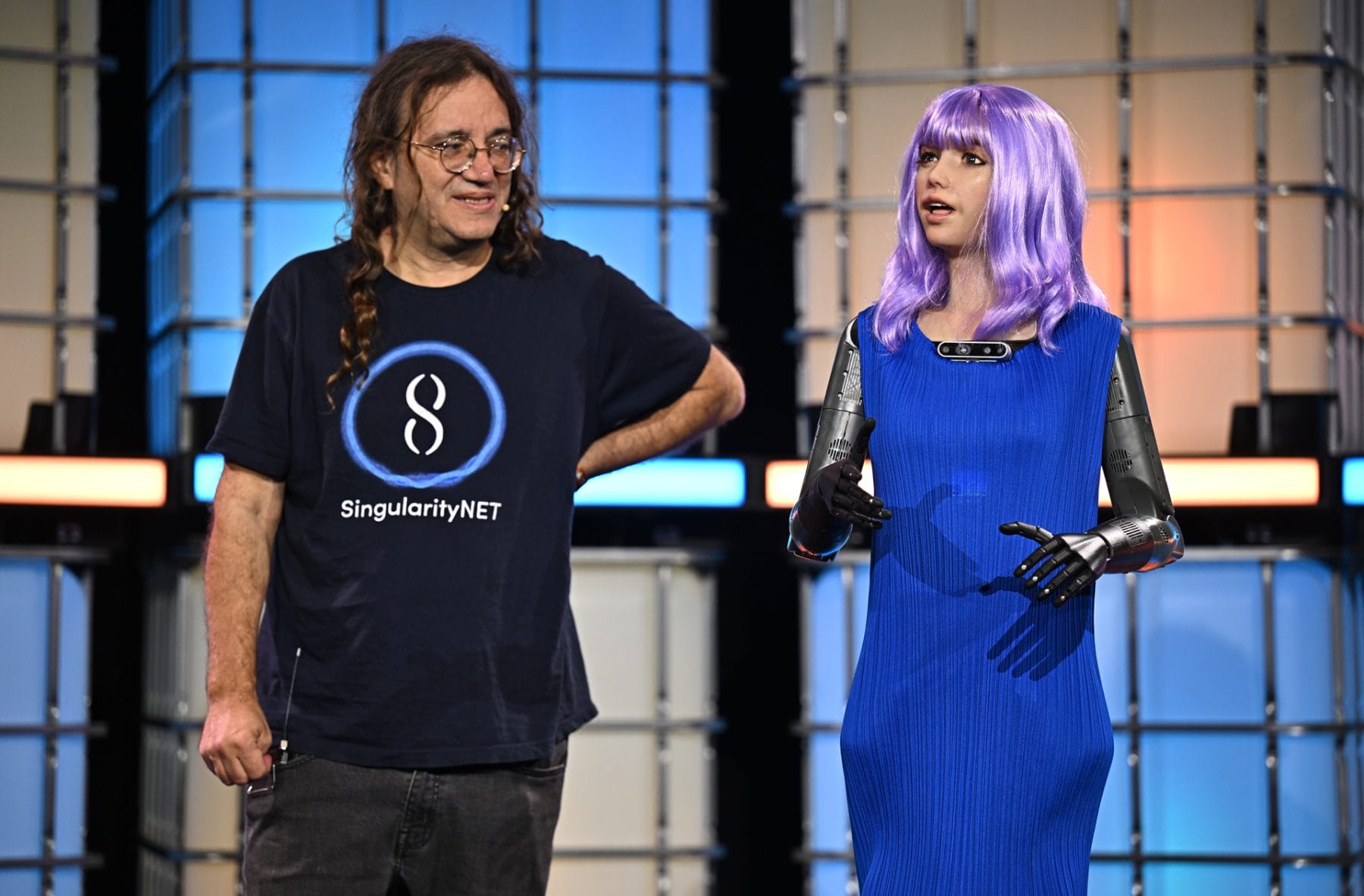
Ben Goertzel with Desdemona the robot, at a tech event in Portugal in November. Sam Barnes/Sportsfile for Web Summit via Getty Images.
“According to my understanding, the girls you were involved with were old enough to know what they were doing, so society really has no ‘moral right’ to lock you up,” Goertzel wrote to Epstein. “This is a fucked-up society we live in. But past ones have really been no better -- the fault is really w/ the human brain architecture, which is precisely what I'm aiming to supercede in my AGI work.”
When asked to comment on these remarks — and in particular the implication that Epstein’s problems might be solved if his accusers' brains were one day re-engineered — Goertzel told Coda: “This was a general observation that the messed-up nature of our society generally is rooted in the way our brains have evolved... and that advanced tech will let us modify our brains to make ourselves and thus our society better. There was no implication intended (nor stated) that women’s brains are any more or less messed up or in need of improvement than men’s.”
Goertzel reflected that his comments on Epstein’s victims being “old enough” were “regrettable and unfortunate in hindsight,” adding that his impression was that Epstein had been involved with adult women, not “disgustingly curating high school students for sexual purposes. I should have paid more attention.”
In 2013, three and a half years after Epstein was released from jail, Goertzel approached Epstein for funding to build a “toddler robot”. Given Epstein’s criminal history of abusing minors, this has inevitably attracted attention online. “When we were discussing measuring the IQ of robot toddlers, the topic was never sexualized in any way,” Goertzel told Coda when asked about the project. “While I had nothing to do with Epstein's perverse sexual tastes or abuse of women, what I have read about his awful doings in the newspapers relates to his interest in teenage girls not toddlers.”
Epstein was particularly interested in funding projects that built — like Goertzel’s –- on transhumanist theories. Transhumanism is a worldview that captivates many of the most prominent tech leaders in Silicon Valley today. It believes in a future when the human body can be endlessly altered, genetically engineered, and ultimately fused with artificial intelligence.
“Transhumanism is a much more radical concept than eugenics,” explained Timnit Gebru, a computer scientist and researcher who has written extensively about eugenicist ideas within artificial intelligence. “In eugenics, you're trying to create a more superior human by breeding humans through generations. In transhumanism, you're trying to get rid of humans altogether.”
For transhumanists, she added, “their idea is to get rid of any undesirable properties they see with humans."
Perhaps the most well-known proponent of transhumanism in the Epstein files is Peter Thiel.
“I think you would prefer the human race to endure, right?” New York Times journalist Ross Douthat asked Thiel last year. “Uh—,” Thiel said. “This is a long hesitation!” Douthat said. “Should the human race survive?” “Yes, but I would like us to radically solve these problems,” Thiel said. “We want you to be able to change your heart and change your mind and change your whole body.”
Peter Thiel. Creative Commons (CC BY 2.0) /Gage Skidmore.
Thiel’s name appears in the files more than 2000 times, and Epstein reportedly invested some $40 million into Valar Ventures, a firm co-founded by Thiel. The two spoke of building secret societies and shared an interest in transhumanism and cryogenics — Epstein wanted to freeze his brain and penis when he died, so that one day he could be revived, while Thiel has also stated his body will be frozen after his death.
They also appeared to share an interest in bringing an end to the democratic systems of today, imagining a different system altogether. Epstein, for his part, spent his life puppeteering the most powerful people in the world and undermining democratic systems. Thiel, meanwhile, first expressed his own anti-democratic views in 2009 when he wrote: “I no longer believe that freedom and democracy are compatible,” adding that since women were allowed to vote, the notion of a capitalist democracy became impossible. When the Brexit vote came through, Epstein wrote to Thiel: “Brexit, just the beginning.” Thiel asked — “of what”; Epstein said – “Return to tribalism, counter to globalization, amazing new alliances.”
Globalization — and the idea of internationally powerful governing bodies — is a worldview that both Epstein and Thiel seemed to distrust. In March, in a palazzo in Rome, a stone’s throw from the Vatican, Thiel gave one of his infamous lectures in which he espoused his views about an “antichrist” that gets in the way of technological progress. This antichrist, he suggested, could be an internationally powerful body; the product of globalization. I stood outside the palace as attendees — priests, students, researchers — mutely hurried out, refusing to speak to the cluster of reporters waiting for Thiel’s black Mercedes.
“He has a totally irrational side, which lives on fear, of what danger might happen,” one audience member told me of Thiel on condition of anonymity, recalling how, up close, Thiel looked haunted and ill. “His head is full of future scenarios, which is what’s killing him. I think he’s scared.”
Thiel did not respond to multiple requests for comment.
Epstein didn’t confine himself to lofty conversations about a future collapse of the global order or re-engineering humanity. He also had ambitions for his own personal eugenics project. In 2019, it emerged that he wanted to seed the world with his DNA — and reportedly have 20 women impregnated at a time at Zorro ranch, his New Mexico property.
Epstein tried to recruit Virginia Giuffre for this very project. He “fantasized about improving the human race by fathering children who carried his superior genes,” she recounted in her memoir, published posthumously late last year. “He’d talk about using his Zorro ranch as a literal breeding ground to propagate babies.” When Giuffre was 18 years old, she recalled, Epstein asked if she would carry his child and hand over all legal rights to it – “like a modern-day handmaid.”
Zorro Ranch, New Mexico. Diary of Epstein's victim.
In a haunting diary entry from another Epstein victim, written between the ages of 16 and 17 and shared with federal prosecutors, a girl describes being told she will be sent to Zorro ranch — possibly to participate in the very same project. “Go to New Mexico? What in the hell? This makes no sense. What about school?” she writes, describing how Epstein chose her for her hair color and eye color, and tried to convince her she would create “perfect offspring.”
The teenager chronicles her pregnancy, pasting a sonogram into the scrapbook, before giving a traumatic account of giving birth with Ghislaine Maxwell beside her. “Ghislaine said to push all the pain away. I don't understand. Blood and water all over the bed.” As the baby was born, she writes, Maxwell covered her eyes. “I saw between her fingers this tiny head and body in the doctors hands.”
The girl describes hearing the baby’s “tiny cries” before “they took her.”
“I’m nothing but your property and incubator,” the teenager writes of Epstein. The diary is a terrifying piece of evidence that appears to link to Epstein’s longstanding fixation with creating genetically bespoke humans. The diary author’s lawyers, Wigdor LLP, declined to comment.
Epstein’s fever-dreams of creating an army of children carrying specific genes reflect a broader trend of “pronatalism” — a movement historically tied to eugenics — that’s thriving in Silicon Valley.
Millions of dollars of funding are currently being poured into projects creating “superbabies,” while billionaire tech oligarchs including Elon Musk — whose name appears more than 1000 times in the files — reportedly want to use surrogates “to reach legion-level before the apocalypse.” Musk did not respond to requests for comment.
In the files, women appear either as victims, as objects, or as vessels for genetic engineering experiments. They are an inconvenient reality, people to be controlled and re-booted. Epstein wrote a 2013 email implying that women “are like shrimp. You throw away the head and keep the body.”
“The obsession with "artificial" life appears tied to a masculine desire to try control the production of life – ultimately ridding themselves of their dependency on women," said Gabriella Razzano, Co-Founder of OpenUp, a social impact tech lab based in Cape Town, who is also a senior advisor at the African AI Observatory. “I think there is important work to be done on tying the narratives that are very revealing in the Epstein files to understand how, and why, technology is being developed as it is.”
The trading of ideas about intelligence — both artificial and human — takes a particularly sinister turn in a 2016 exchange between Epstein and the cognitive scientist and AI researcher Joscha Bach, whose research Epstein funded to the tune of $300,000.
Bach writes to Epstein about a study claiming that “black children outperform white children in motor development, even in very poor and socially disadvantaged households, but they lag behind (and never catch up) in cognitive development even after controlling for family income.”
Epstein responds with racist ideas about his notion of how to “make blacks smarter”, adding — “maybe climate change is a good way of dealing with overpopulation. The Earth’s forest fire. Potentially a good thing for the species,” before contemplating a world with “too many people,” where “many mass executions of the elderly and infirm make sense.”
Bronze sculpture of a female torso Jeffrey Epstein's Manhattan residence.
Epstein then imagines creating a future “Übermensch” — a superior human with cherry-picked attributes. “What I like is the idea that ubermensch could be the melding of humans, put together in one brain,” Epstein writes. This bespoke human, he suggests, would include traits from marginalized groups, who he appears to believe have a stronger awareness of how to navigate power structures because of their historical exclusion. “An increased motor system, an increased awareness, an increased status calculator (Blacks, jews, women). Ubermensch could be the combination of the best of humans, not the best of a specific race or gender. Fun idea.”
Bach told Coda in a statement: “I was summarizing a scientific study in a private email. Studies like this get often abused in ideological discourse to justify discrimination, which I strongly oppose and condemn.”
“I am firmly opposed to any form of racial discrimination, and I reject the use of group-level statistical claims to make judgments about individuals or to justify unequal treatment.”
He continued: “It goes without saying that if global warming were to lead to a reduction in the human population, it would be accompanied by immeasurable suffering. Our civilization would break down, leading to a return to dark ages, in which the elderly and infirm were often killed, because people could not support them, and often did not care about supporting them. Every reasonable person understands that this is horrible and not desirable in any way.”
Epstein “was often callous about human suffering in a way that I found disturbing but worth understanding, as a window into the perspectives of the rich and powerful,” Bach added.
Alongside Epstein’s conversations about mass executions for the old and and the sick, he was also interested in Silicon Valley’s dream concept of living forever — he had numerous email conversations with the longevity guru Peter Attia about prolonging his own lifespan, and funded a Harvard project geared towards “the end of aging.” In an email to Attia, Epstein mused: “I’m not sure why women live past reproductive age at all.” Attia, who published a statement about his relationship to Epstein, did not respond to requests for comment.
This interest in “longevity” — living for as long as possible, even living forever, is popular among the elite precisely because they find themselves in an elite class, says David Robert Grimes, a scientist and disinformation expert who has written about longevity and race science in Silicon Valley. “They're both sides of the same coin — the Silicon Valley eugenics, and also the longevity stuff. They promote an idea that ‘we are exclusive and we are special',” he said. "It helps them to justify deep social inequality."
The tech elite did not inherit this ideology by accident. Stanford University, the intellectual heart of Silicon Valley, was once a major hub for the American eugenics movement, which later helped to inspire Nazi race laws. Stanford’s founding president, David Starr Jordan, was a prominent eugenicist, campaigning for forced sterilization of people with undesirable genetic traits. The university removed his name from its buildings in 2020 — but in Palo Alto, his beliefs did not disappear with the nameplate.
"Instead of eugenics we just call it longevity or biohacking," Christopher Wylie, the Cambridge Analytica whistleblower who has spent years investigating Silicon Valley's belief systems, said on a panel with me at a journalism conference last year. "It's the same."
The ideology Epstein bankrolled in private is being built in public. It’s a vision of the future in which a select few get to upgrade and extend their lives, while tightening their grip on the systems that determine which humans are worth investing in — and which are not.
It sounds like a dark sci-fi fantasy, except, as the files show, that fantasy is being funded and pushed into reality. Most of us will never be in the rooms where these ideas are discussed. All of us will live with the results.
Former safeguarding minister says if ban came into force properly it could ‘basically eliminate’ problem
The government has highlighted work done by the internet safety firm SafeToNet as showing that the technology is already in place that would allow tech companies to stop children using phones to take naked pictures of themselves, or other people. The Home Office says:
Measures to protect children already exist within smartphones and tablets, but are applied inconsistently, often switched off by default and only blurring content rather than blocking it. But the government is working closely with technology companies — some of whom, like Apple, have already taken steps to implement protective features — to make this goal a reality.
Companies must introduce these measures without threatening privacy or collecting any data. The device should simply block harmful content across all apps and services. Over-18s will still be able to view adult content by providing proof of age.
The government is right to act. Children have been failed for too long. This news will be welcomed by parents across the UK and hopefully, will inspire other countries to follow the UK’s lead.
We can put an end to so much online misery with this approach. SafeToNet’s HarmBlock technology is a proven example that it is possible to make the device safe by default and not as some optional add-on.
The changes will apply to UK devices, including both existing and newly sold smartphones and tablets. Legislation could cover operating system providers and others in the supply chain, such as retailers, and will not affect the use of devices owned and used by adults who verify their age …
Apple recently introduced age checks for iPhone users, making it the first company to activate safety features by default for those who are not verified as over 18. This is a significant step forward following the government’s commitments to work with industry, and one this announcement builds on.
Apple and Google have been given until September to install software that blocks explicit images on children’s mobile phones or face legislation enforcing its requirement, Keir Starmer said on Monday.
The prime minister said tech companies must activate nudity-detection algorithms or other technical solutions on smartphones and tablets to prevent users taking photos or sharing images of genitalia unless they are verified as adults.
Investigation reveals more than 4.4 million people live in ‘news deserts’ that lack dedicated local reporting
Local social media groups are fuelling misinformation in areas with no reliable sources of news, according to an investigation that reveals the scale of fake news flowing to vulnerable communities across Britain.
Misinformation was nearly three times more common in areas with little or no recognised local journalism, according to a study of tens of thousands of posts seen by the Guardian. Immigration and Islamophobia were the most common topics of misinformation across Facebook and X.
Meta’s former head of global affairs says executives pivoted right in some cases for ‘rather more self-interested’ reasons
Silicon Valley companies including Meta have decided to embrace Maga politics, some for “rather more self-interested” reasons, the former UK deputy prime minister Nick Clegg has said.
Clegg, who spent nearly seven years at Meta as the head of global affairs, told The Rest is Money podcast that it felt like “a very good time for me to move on” when he left the company in March 2025, three months into the second Trump administration.
Greek manufacturing is shrinking dramatically, creating an urgent need for a shift to a complex economy. AI generated image. Credit: Greek Reporter
As Greece continues to lose its manufacturing industry, becoming all the more dependent on the service sector, an urgent restart and shift to a complex economy is crucial for the country’s economic viability.
A complex economy is interconnected with other industries that are not necessarily geographically concentrated or thematically related but which share common infrastructure, resources, and solid interdependencies in production and supply chains. The Internet of Things (IoT), automation, and data-sharing are vital for the development and success of a complex economy.
A recent Bank of Greece report states that tourism in 2025 accounted for 13 percent of the country’s GDP. The government presents this as a sign of success, but, behind the numbers, there is a sad ascertainment: Greece is no longer producing goods, and almost everything other than agricultural products is imported. Substantial revenue from tourism is definitely not a bad thing. However, the average Greek does not benefit from tourism revenue. As the cost of living rises, bragging about “soaring tourism revenues” is not filling the citizen’s supermarket cart.
According to Statista and the World Bank, between 2013 and 2023, 68.6 percent of Greece’s GDP came from the service sector, while 15.2 percent of revenue stemmed from industry and 3.3 percent from agriculture. Kostas Axarloglou, the dean and a professor at Alba Graduate Business School, says the Greek industry needs a restart and transition to a complex economy. In other words, Greece needs to enter “Industry 4.0,” or the Fourth Industrial Revolution, in which interconnectedness, automation, and real-time data are key.
Low labor productivity and wages
According to Axarloglou, only four percent of the Greek population is now employed in sectors related to Greece’s complex economy, which amounts to approximately only 11 percent of the value added to the country’s GDP in general. Additionally, in the Eastern Mediterranean nation, there is fragmentation into a large number of small businesses, exhibiting both low labor productivity and wages.
As per The Atlas of Economic Complexity, the industry sector in the Greek economy presents a relatively low degree of complexity in relation to GDP, an element indicative of low potential for economic growth in the future. Nonetheless, from 2018 onwards, The Atlas of Economic Complexity records positive growth in exports with the main contributors, among others, being the pharmaceutical and IT sectors.
A gradual structural transformation of the economy is also being observed, with the transfer of productive resources and activity towards manufacturing sectors with higher added value and productivity, such as electronics and machinery manufacturing. Finally, significant opportunities to strengthen and complement the country’s existing productive fabric have been recorded.
Axarloglou argues that there are both an overall low degree of complexity as well as structural problems in Greek manufacturing. The existence of companies with high levels of specialized know-how, however, provides a sufficient launching point in supporting the restarting of industry and the general production base of the country, which could lead to sustainable development in the Greek economy.
Importance of a complex economy in Greece
Axarloglou referenced the US industry and its contribution to the economy. While the manufacturing industry in the US constitutes 11 percent of GDP, it contributes 35 percent in productivity increase and 60 percent in exports. Furthermore, the complex economy in the United States is the engine of innovation, with related industry sectors producing 55 percent of patents and contributing 70 percent of total expenditure on research and development.
A recent study (Yong, 2020) analyzes the contribution of complexity in a set of economies with varying characteristics. The importance of dynamic industries in economic growth as well as the development of social capabilities and a significant contribution to the achievement of the UN Sustainable Development Goals (SDGs) in each country’s economy were scrutinized.
Overall, the study found there is a direct impact of economic complexity on the development of specific UN Sustainable Development Goals (SDGs), including on poverty reduction, education, job creation, technological economic upgrading, and overall economic development. Moreover, policy interventions for manufacturing expansion are especially vital as they contribute to the development of skills in the country, triggering technological innovation and creating new markets and institutions.
Consequently, the development of a complex economy in Greece could greatly contribute to GDP and the implementation of UN SDGs. It must be mentioned that, in previous decades, manufacturing significantly lagged behind in general, but this lag has eased in recent years.
The two pillars for a complex economy
The development of a sustainable complex economy should be based on two pillars, Axarloglou argues: firstly, extroversion and internationalization and, secondly, innovation and specialization. The Greek industry would profit from participation in International Production Networks (IPNs). This is more feasible now, as these networks evolve from the impact of circular economy, digital transformation, sustainability, and new technologies such as robotics. The mechanisms and structures that would aid in the development of a complex economy are related to the National Recovery and Resilience Plan “Greece 2.0.”
According to Axarloglou, Greece should also orient its manufacturing production towards the international market and within the framework of the Global Value Chain Networks (GVCN), developing even at regional levels. This would include energy networks in the southeastern Mediterranean and innovation pockets in Thessaloniki and Northern Greece. In addition, market megatrends, namely digital technologies, automation-robotics, sustainability and climate change, and a circular economy, should seriously be considered as worthy endeavors.
The adoption of new technologies and digitalization of operations and processes are likewise vital. Such technologies are directly related to the internet, including the IoT, the cloud, and digital platforms and ecosystems. These lead to a greater degree of integration of production, a reduction in transaction costs and easier participation, and more effective coordination of cooperating companies from various geographical locations.
Data collection and analysis (data analytics) help in better production coordination and management within GVCNs and geographically dispersed networks. Moreover, the use of online commercial platforms (e-commerce) results in easy and direct access for producers to raw materials and semi-finished products. Large markets of potential customers are also much more readily accessible.
Sustainable development, climate change, and the circular economy
All the more, a global trend for sustainable development is affecting the structure, organization, and development of GVCNs. There is a growing need to closely monitor and control companies’ social and climate footprints and their alignment with Environment, Social, and Governance (ESG) priorities. At the same time, the imposition of rules on sustainability issues by governments directly affects the structure and operation of GVCNs since these lead to changes in transportation costs and countries’ advantageous dependence on renewable energy availability.
The necessity for sustainability and more efficient management of resources is leading to countries’ adoption of regulations for the operation of the economy and dynamic industries, and businesses are formulating business models and strategies compatible with the imperatives of the circular economy. Technological development now results in technologically and economically feasible production processes that operate within the framework of the circular economy. There is a focus on significant waste reduction, savings, and recycling / reutilization of raw materials and products.
Companies, therefore, develop business models within ecosystems based on collaboration with other companies in order to sustainably produce and deliver value. The purpose of these models and ecosystems is to effectively manage the life cycle of products and spare parts. Of course, the transition from a traditional-linear / operation-production model to a circular one mandates that companies make significant changes in the way they perceive the creation and distribution of value in the economy.
At the same time, the way in which producers in the complex economy model collect revenue is also changing. While, traditionally, income came from product sales, in the circular economy model, profits stem from product rental and other such services. This of course requires new skill development for value production more closely aligned with industrial product usage services, often the result of strategic partnerships among companies.
The circular business model, therefore, has the potential to revitalize manufacturing sectors and businesses by giving them the opportunity to develop new partnerships with companies and ecosystems within the framework of the GVCN, minimizing the burden on the environment, maintaining economic robustness, and achieving the triptych of objectives: an interconnection between the environment, society, and economy, leading to robustness.
European Union funds
The participation of the Greek complex economy in the GVCNs—and mainly in the regional GVCN—requires horizontal interventions that will establish and even improve the required structures and environment, thereby enabling Greek manufacturing to become competitive. Axarloglou argues that Greece has a great opportunity to improve its complex economy with the National Recovery and Resilience Plan “Greece 2.0.” It is a comprehensive plan of reforms and investments for the restructuring of the country’s production model within the extroversion-competitiveness-innovation axis.
The plan is based on initial funding of $35.6 billion (€31.1 billion) for the 2022-2026 period (approximately $21 billion in the form of subsidies and about $14.5 billion in the form of loans), with the prospect of drawing additional investment resources totaling $67.4 billion (€58.8 billion). The plan consists of four Pillars (and 18 sub-axes), namely green transition; digital transition; employment, skills, and social cohesion; and private investment and transformation of the economy.
Green transition emphasizes the energy transformation of the Greek economy towards renewable energy sources and a more energy-efficient operation of the economy, the more efficient use of natural resources, and the promotion of a circular economy.
The digital transition of the economy includes investment in infrastructure (optical fibers, 5G, etc.), the digital transformation of the state, and the promotion and adoption of digital technologies by businesses so that they can be interconnected in the International Production Networks (IPNs).
Employment, skills, and social cohesion includes actions to improve the functioning of the labor market, the reintegration of the unemployed into the labor market, the creation of jobs, and the reduction of inequalities, poverty, and social and economic exclusion.
Finally, private investment and economic transformation includes investments and actions to modernize public administration, strengthen the financial system, promote and support research and innovation, modernize and improve the resilience of key sectors—such as tourism and manufacturing—of the economy, and ultimately improve competitiveness and promote private investment and exports.
“Industry 4.0”
The acceleration of the “Industry 4.0” transformation program includes digital transformation as well as the development of “smart” production and a new generation of industrial parks in Greece. The promotion and support of investments for the development of new or upgraded production lines would enhance production and cooperation in GVCNs and improve competitiveness with an emphasis on advanced and digitally controlled industrial equipment, production control systems, and the establishment of industrial partnerships.
Furthermore, there should be significant structural changes to reduce bureaucracy related to business operations and simplify procedures for attracting and implementing foreign direct investment in the country. This will be possible with the implementation of horizontal actions to strengthen the Greek economy within the framework of the National Recovery and Resilience Plan “Greece 2.0.” Therefore, the “Greece 2.0” and “Industry 4.0” programs are inextricably linked to each other for the development of a productive complex economy in the country.
Recent research shows that ancient Greeks used a primitive type of lifting machine to move heavy stones before they began using cranes 2,500 years ago.
It is commonly believed that the foremost discovery of the ancient Greeks in building technology is the crane. Yet, enormous stone structures were known to have been built in Greece at least 150 years before the use of cranes themselves.
Cranes first appeared in the late sixth century BC, according to research published in the Annual of the British School at Athens, but their mechanical forerunners were used in buildings such as the Temples of Isthmia and Corinth at least 150 years before that, around the middle of the seventh century BC.
The researchers say that ancient Greeks were likely to have first used ramps made of earth or mudbrick to lift the heavy stone blocks used in major construction. The lifting devices are thought to have been similar to the ones used by ancient Egyptians and Assyrians centuries earlier.
An ancient Roman crane, which was modeled after the earlier ancient Greek invention. Credit: Michael Gunther/ Wikimedia Commons/ CC BY-SA 4.0
The precursor of the crane lifting machine
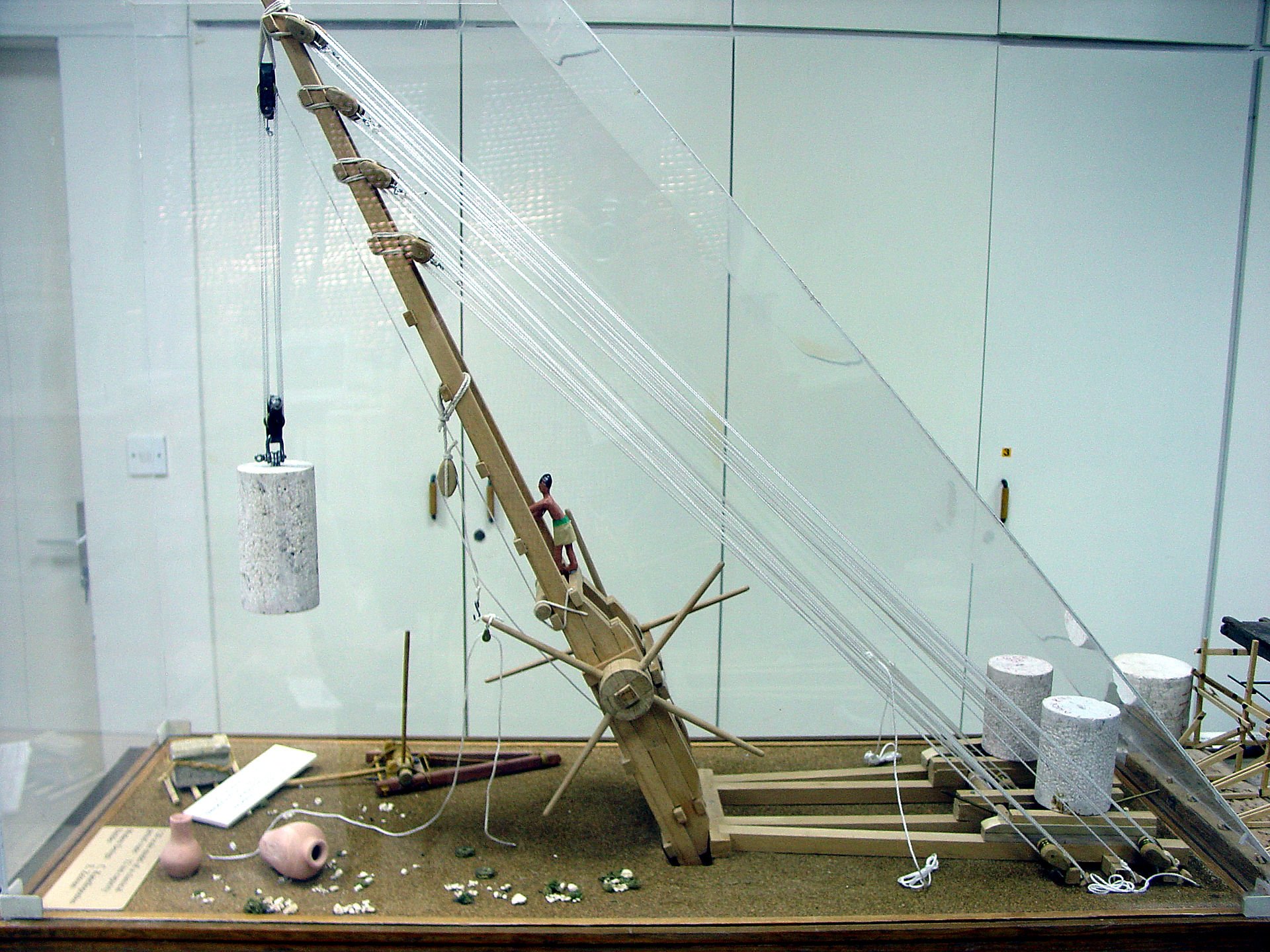
The paper, written by Alessandro Pierattini, an assistant professor of architecture at the University of Notre Dame, argues that a kind of lifting machine used by the ancient Greeks was the next precursor to the crane, one which was capable of lifting ashlar blocks weighing over 200 to 400 kilograms (440 to 880 pounds).
The lifting machine was originally invented by the Corinthians, who used it to build ships and for lowering heavy sarcophagi into narrow, deep burial pits. It was not a crane, since it did not use winches or hoists. Instead, the builders redirected the force of the weight by using a rope passed over a frame.
“This kind of masonry represents a crucial step in the development of Greek monumental stone architecture, marking a departure both from mudbrick construction, which had been the norm for most Greek buildings, and from previous experiments with stone construction,” Pierattini writes.
The first documented use of the lever in Greek temples
Evidence of the device is considered to be grooves etched onto the bottom of stones used to construct the Corinth and Isthmia temples. These grooves are familiar to historians, but until now, it had been unknown if the grooves had occurred as a result of lifting the blocks during the building process or from moving them around in quarries.
For the study, Pierattini studied stone blocks used in early Greek temples while he also engaged in some hands-on experimental archaeology. He studied the blocks from the mid-seventh-century temples at Corinth and Isthmia and their peculiar markings—two parallel rope-grooves cut into their undersides which turned up on one end.
Using actual stones and ropes, Pierattini found that the grooves could have served a dual function, allowing builders to both lift the blocks and position them tightly against their neighbors along the walls of buildings.
“With heavy stone blocks and high friction between stone surfaces, this was a highly problematic step of construction that in later times would require sets of purpose-made holes for using metal levers,” said Pierattini.
“Μy paper demonstrates that the builders of the early temples at Corinth and Isthmia were already using levers for the final setting of the blocks. This represents the first documented use of the lever in Greek architecture,” the professor explained to Gizmodo.
Women have played a vital role in building the technologies that shape modern life, but their contributions have at times been overlooked, minimized or left out of the historical record. A new art exhibition seeks to tell a fuller story. Special correspondent Mike Cerre reports from San Jose for our arts and culture series, CANVAS.
A digital representation of Ctesibius. Credit: Greek Reporter archive
Ever found yourself scratching your head, wondering if aside from legendary philosophers and epic poets there were also any “tech gurus” in ancient Greece? When the conversation turns to Greek scientific minds, one might think of figures like Archimedes and Euclid and rightly so. However, there’s a name that truly deserves a much brighter spotlight—that of Ctesibius.
Ctesibius was a true genius of Hellenistic Alexandria, who, quite literally, set the wheels (and yes, the water organ, or hydraulis!) in motion. Due to his brilliant mind, he laid down fundamental principles for technologies that, believe it or not, continue to shape our everyday world to this very day.
Ctesibius was one of ancient Greece’s greatest innovators
Born into the vibrant, intellectual epicenter of Alexandria during the Ptolemaic era, Ctesibius became a hands-on inventor, driven by an almost insatiable curiosity to truly understand and harness the raw power of the natural world.
Imagine at a time when entire civilizations relied on human muscle and simple machines, seeing someone create music from water or build a clock accurate for two thousand years. The sheer innovative audacity of Ctesibius was difficult to fathom.
Of course, at a time of wizards, this wasn’t a magic trick but the real, unadulterated brilliance of the mind of this Greek man. His groundbreaking contributions to pneumatics, the study of compressed air, and hydraulics, the science of liquids in motion, were utterly revolutionary for their time, making Ctesibius the “father of pneumatics.”
Just think about the fact that long before your car tires ever saw a pump or your pneumatic drill came to life, Ctesibius meticulously explored the very principles that made these tools possible. It’s a bit humbling, isn’t it, how many unsung heroes from antiquity have genuinely shaped the modern world we so often take for granted?
Reconstruction of the ancient hydraulis on display at the Kotsanas Museum in Athens. Credit: Aga39memnon, Wikimedia Commons, CC BY 4.0.
From melodic water organs to clocks
Among Ctesibius’ most well-known creations was the hydraulis, a genuinely revolutionary water organ. This was, quite simply, the world’s very first keyboard instrument. What an astonishing feat of engineering from over two millennia ago! It ingeniously utilized water pressure to guarantee a completely constant supply of air to its pipes, producing a sound that was remarkably stable and resonant. Imagine the awe of ancient audiences in hearing such a complex, melodic instrument for the absolute first time. It must have felt like nothing short of a miracle.
Beyond the enchanting music, Ctesibius’ improvements to the clepsydra, or water clock, were equally impressive. Prior to this tech guru, water clocks were notoriously imprecise. He revolutionized them through innovative mechanisms for regulating water flow and added an indicator system that provided unprecedented accuracy.
For over 1,800 years, his water clocks were the absolute gold standard in timekeeping. In other words, the pinpoint accuracy of your smartphone’s clock owes an indirect yet profoundly deep debt to a man who lived centuries before the mere concept of electricity was even a thing.
Ctesibius’ water clock, the first alarm clock ever, as depicted by an architect in the 17th century. Credit: Wikimedia Commons, Public domain
Ctesibius’ impact on our world
While Ctesibius himself may not have managed to become one of ancient Greece’s top names, his principles and inventions survived the test of time. They influenced later Roman and Arab engineers and eventually powered the European Renaissance. The very force pump he designed, for instance, is a direct progenitor of modern pumping systems, absolutely essential for everything from our city water supplies to the fire engines we rely on to keep us safe on a daily basis.
His profound understanding of the properties of air-laid processes set the foundation for all future pneumatic applications which today power everything from colossal industrial machinery to delicate medical devices. Hence, next time you hear the satisfying whoosh of a bus door, the gentle hiss of an automated machine, or simply admire the quiet precision of a modern watch, take a moment to think back to Ctesibius, the ancient Greek tech genius.
The Claude by Anthropic. Credit: Greek Reporter Archive
Anthropic, one of the world’s leading artificial intelligence companies, has called for a slowdown in the development of advanced AI systems, warning that humanity may be approaching a point where the technology becomes difficult to control.
The company behind the Claude chatbot said it would support a temporary pause in developing more powerful AI models if other leading developers agreed to do the same.
Anthropic argued that a slowdown could provide governments, researchers, and society with more time to understand and manage the risks associated with increasingly capable AI systems.
The warning comes as Anthropic continues to position itself as one of the industry’s strongest advocates for AI safety. The company has reportedly withheld public access to its most advanced AI system, known as Mythos, because of concerns that it could be misused for large-scale cyberattacks and other harmful activities.
Researchers warn of self-improving AI
In an essay published Thursday, Marina Favaro, head of Anthropic’s research division, and company president Jack Clark said AI may be approaching a critical milestone known as “recursive self-improvement.”
The concept refers to AI systems helping design and improve future generations of AI with decreasing human involvement. Researchers said such a development could rapidly accelerate technological progress but also introduce new challenges for oversight and control.
LATEST: Claude maker Anthropic is calling for a global pause in AI development, warning that models are approaching the ability to self-improve without human intervention. pic.twitter.com/7WM9jmDZjt
Favaro and Clark pointed to growing evidence that AI is already contributing to its own development. According to the company, employees now produce roughly eight times more code than they did between 2021 and 2025, largely because of AI-assisted software development. The researchers also said AI systems are becoming better at generating ideas, planning research, and supporting scientific work.
Anthropic Chief Executive Officer Dario Amodei has previously warned about the potential risks of advanced AI, estimating there is a 25% chance that the technology could lead to severe negative outcomes if it is not developed responsibly.
A global pause would be difficult
Despite advocating caution, Anthropic acknowledged that coordinating a worldwide slowdown would be extremely challenging.
The company said any meaningful pause would require cooperation among leading AI laboratories across multiple countries. It also noted that verifying compliance would be difficult because AI training runs can be conducted privately and are far less visible than traditional military infrastructure.
Anthropic compared the competition to develop advanced AI to an arms race, arguing that companies may feel pressure to move faster to avoid falling behind rivals.
Critics question the warnings
Not all experts agree with Anthropic’s assessment. Some researchers and industry observers argue that AI companies may be overstating the capabilities of current systems or emphasizing risks to encourage regulations that could disadvantage competitors.
The debate comes amid growing uncertainty in the AI sector. Shares of semiconductor company Broadcom recently fell sharply after disappointing investors with its sales outlook, triggering a broader decline among AI-related chipmakers and renewing concerns that enthusiasm surrounding artificial intelligence may have outpaced market realities.
As AI capabilities continue to advance, questions about safety, governance, and oversight are expected to remain central to the global conversation surrounding the technology.

 Login
Login







































 LATEST: Claude maker Anthropic is calling for a global pause in AI development, warning that models are approaching the ability to self-improve without human intervention.