Reading view

NATO's eastern flank races to rearm as Trump pressure exposes Western Europe's defense gap


This is part six of a series examining the challenges confronting the NATO alliance.

As President Donald Trump presses NATO allies to shoulder more of Europe's defense burden, countries closest to Russia are moving fastest — while some of Western Europe's biggest economies face growing pressure to catch up. 

Retired Rear Adm. Mark Montgomery, senior director at the Foundation for Defense of Democracies and former deputy director for strategy, policy and plans at U.S. European Command, said the shift is already visible across the alliance.

"Europe is clearly stepping up, but they're stepping up by geographic variation," Montgomery told Fox News Digital.

"If you ask me who's doing the most, the Eastern Europeans are clearly."

RUSSIAN DRONES TEST NATO'S ARTICLE 5 DEFENSE GUARANTEE AHEAD OF FRIDAY SANCTIONS DEADLINE

Montgomery pointed to the Baltic states, Poland, Romania and Bulgaria as countries moving aggressively to strengthen deterrence against Russia.

His assessment comes as NATO allies work toward a new defense spending benchmark agreed at the 2025 summit in The Hague, which calls on members to invest 5% of GDP in defense and security-related spending by 2035, including 3.5% for core defense requirements and 1.5% for defense-related infrastructure and security investments.

John Deni, a research professor at the U.S. Army War College, said the trend shouldn't be surprising. 

"Given the threat of Russia, allies in the East are acquiring capabilities more quickly, and they're spending even more than allies in the West," Deni told Fox News Digital. "This shouldn't surprise us because they're the ones closest to the threat."

Deni noted that many eastern allies are rapidly purchasing equipment already available on the market rather than waiting years for domestic defense programs to mature.

UK, GERMAN DEFENSE OFFICIALS DEFEND MILITARY BUILDUP UNDER RUSSIAN THREATS

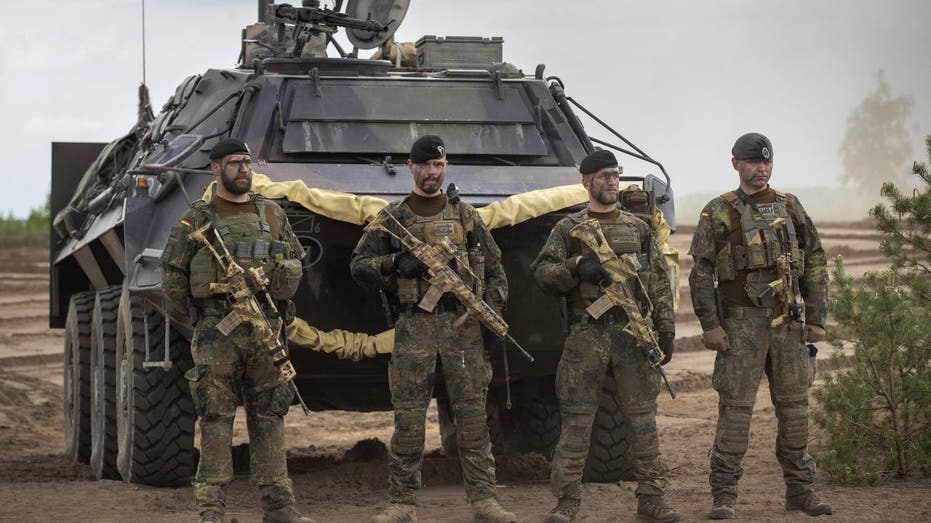
The transformation is visible across NATO's eastern and northern flanks. Poland has become one of the alliance's largest military spenders, Romania is increasing defense investments, and Finland and Sweden have added advanced military capabilities to NATO following their accession.

Secretary of State Marco Rubio praised Finland and Sweden Thursday at the Senate Foreign Relations Committee hearing, using them as examples of allies strengthening the alliance.

"Sweden and Finland have actually contributed because they brought their own defense industry, their own advanced technology," Rubio said. "They have been great partners." 

Romanian Foreign Minister Oana-Silvia Ţoiu echoed that message in an interview with Fox News Digital following an emergency U.N. Security Council session convened after a Russian drone strike injured civilians in the Romanian city of Galați.

"We do agree with President Trump on the need to increase budgets," Ţoiu said.

Ţoiu said Romania raised defense spending to 2% of GDP during Trump's previous term and plans to allocate "an average of 3.4 percent" next year through military procurement and strategic infrastructure investments.

POLAND SEEKS ANSWERS AFTER PENTAGON SCRAPS PLANNED US ARMORED BRIGADE ROTATION

"We have launched initiatives that are directed at the eastern flank because it is increasingly more clear that that needs to be protected," she said.

She argued that Romania's role extends beyond national defense.

"We need better deterrence, better defense capabilities there in order to ensure our responsibility in protecting not just the Romanian border, which is the longest border to the war, but also it is in the same time a European border and the border of the Allied territory," Ţoiu said.

For frontline states, the urgency is driven by geography as much as politics. Romania shares a border with Ukraine and repeatedly has dealt with Russian drones entering its airspace. Poland has become one of NATO's top military spenders, while the Baltic states are racing toward defense expenditures approaching 5% of GDP.

Montgomery said the eastern flank's urgency contrasts sharply with the pace in much of Western Europe.

Among the continent's five largest economies, and despite a slight decrease in military spending in 2025, the U.K. remains the largest investor relative to GDP, with 2.4%, trailed by Germany (2.3%), Spain (2.1%), France (2%) and Italy (1.9%), according to the Stockholm International Peace Research Institute (SIPRI).

WHY NATO’S DEFENSE SPENDING IMBALANCE LASTED FOR DECADES

"The Germans are the one country, I think, with a large economy that is starting to make the right kind of investments."

Germany, he argued, could become the backbone of Europe's future defense industrial base.

"Germany developing a large, impressive defense industrial base is good for NATO, it's good for Western security, and it's even good for our primes," Montgomery said.

German Chancellor Friedrich Merz has embraced higher defense spending and backed NATO's new spending goals, positioning Berlin as a potential hub for Europe's future defense industrial base as allies seek to reduce long-term dependence on the United States.

But despite rising defense budgets, experts warn Europe remains heavily dependent on American military capabilities.

Barak Seener, a senior fellow at the Henry Jackson Society, said Europe still relies on the United States for many of the systems required to fight a modern war.

NATO CHIEF WARNS EUROPE CAN’T DEFEND ITSELF WITHOUT US AS TENSIONS RISE OVER GREENLAND

"Europe is heavily dependent on NATO for its strategic airlift and sea lift, its air-to-air refueling, its cyber capabilities, its space assets, its intelligence, surveillance and reconnaissance," Seener said.

Without those capabilities, he warned, European forces would struggle to maintain situational awareness during a major conflict.

Montgomery said Europe faces three major challenges: expanding military capacity, rebuilding its defense industrial base and developing high-end support capabilities that have long been provided by the United States.

PENTAGON CUTS BRIGADE COMBAT TEAMS IN EUROPE AS TRUMP PRESSURES NATO ON SPENDING

"When you are freeloading for 30 years, you create enormous deficits in terms of people, equipment, technology and know-how," he said.

"The primary forces to defend Europe should be European," he said. "The United States should provide additional forces that allow maneuver and offensive operations."

Montgomery also criticized reported Pentagon deliberations over delaying long-range strike deployments to Germany and reconsidering future Tomahawk missile sales, arguing the systems are critical for deterring Russia.

"The goal here is not to fight Russia in the Baltics or in Poland. The idea here is we want to deter Russia from even trying to attack."

Looking ahead, Montgomery remains optimistic about NATO's future.

Montgomery predicted Europe will continue increasing defense spending and expanding its defense industrial base, while the alliance benefits from steadier transatlantic relations.

"I think you'll have a U.S. president that probably doesn't provoke the Europeans as much. You'll have Europe that's investing more," he said.

CLICK HERE TO DOWNLOAD THE FOX NEWS APP

He also predicted NATO Secretary-General Mark Rutte would be remembered for helping hold the alliance together through a period of significant change.

"I think five years from now, NATO will be stronger," he said. "And I hope we have Ukraine in there."
  •  

Germany Must Keep Supporting Rejected Asylum Seekers in New EU Ruling

The European Court of Justice has ruled that Germany cannot strip certain asylum seekers of basic support while they remain on German soil, even when another EU country is deemed responsible for […]

The post Germany Must Keep Supporting Rejected Asylum Seekers in New EU Ruling first appeared on The Expose.

  •  

Albanians protest Trump-linked resort development planned for nature reserve

Protesters on Saturday gathered at the Vjosa-Narta lagoon, a nature reserve on the Albanian coast, to denounce a plan by US President Donald Trump's son-in-law, Jared Kushner, to build a ​luxury resort in an ‌environmentally sensitive area. Albanian Prime Minister Edi Rama has insisted that "top" experts will be involved in the project, which has yet to be approved.

  •  

Ukraine launches fresh drone attack on St. Petersburg region on final day of ‘Russian Davos’

Ukraine on Saturday fired hundreds of drones targeting the St. Petersburg region in the second such attack on Russia’s second-largest city in less than a week. The attack came on the final day of the St. Petersburg International Economic Forum, President Vladimir Putin’s annual investment forum known as “Russia’s Davos”.

  •  

Pope Leo visits Spain to highlight migration, meet victims of sexual abuse by clergy

Pope Leo XIV arrived in Spain on Saturday for a seven-day trip focused in part on migration, including a visit to the Canary Islands where he will honour thousands of migrants who died trying to reach Europe. Leo is also scheduled to meet with victims of sex abuse by Catholic clergy, which some 200,000 minors are estimated to have suffered in Spain since 1940.

  •  

Negotiations on air passenger rights hit turbulence: EU Parliament takes on airlines

Negotiators from the European Parliament and EU member states have been trying to reach an agreement on the rights of air passengers travelling within the bloc. The current rules date back to 2004, but the scale and nature of air travel have changed dramatically since then. We take you inside the negotiations, examine the key sticking points, and explain why MEPs are pushing for stronger protections for passengers affected by delays and cancellations.

  •  

The Friday File: Anthropic; EU; FCC

Mobile World Live brings you our top three picks of the week as Anthropic widened access to its Claude Mythos model despite security concerns, the European Commission (EC) unveiled a fresh digital sovereignty push and the FCC commenced its first spectrum auction in four years.

Anthropic expands Mythos access to 150 new companies

What happened: Anthropic expanded access to its controversial Claude Mythos AI model under the Project Glasswing to 150 additional companies in sectors including power, healthcare and communications, after initially restricting it to a group of private technology players.

Why it matters: Anthropic said the latest cohort brings in sectors underrepresented in the first wave. In commentary to security publication CSO Online, experts noted the expansion could add to security concerns around the model. Carmi Levy, an independent technology analyst, questioned what Glasswing will be able to accomplish by adding 150 more participants, noting the initial point was to allow the AI player to work closely with a small, fully vetted group of vendors to develop stronger defences against cybersecurity risks. “Expanding access into the hundreds may very well bring in more minds to build better defensive measures, but it simultaneously introduces significant concerns around potential leaks.”

Research director for AI security at IDC, Grace Trinidad, added that Anthropic’s announcement pointed out that each of the 150 new participants “will need to meet our security requirements before they gain access”, which also did not build confidence. “Nobody knows what those security requirements are.”

Earlier this week, Anthropic also confidentially filed IPO paperwork with the US Securities and Exchange Commission (SEC), ahead of rival OpenAI’s rumoured float.

EU targets AI, chips in fresh sovereignty drive

What happened: The EC unveiled a fresh digital sovereignty package targeting semiconductors, AI, cloud, open source and energy infrastructure in a bid to accelerate Europe’s push for digital sovereignty.

Why it matters: The package includes a proposed a revamped Chips Act 2.0 and a Cloud and AI Development Act to streamline data centre deployment and introduced measures to expand open source use, support startups and digitalise the energy system. EC president Ursula von der Leyen said Europe “cannot afford to depend on others for the technologies that keep our hospitals running, our energy grids stable and our services secure”.

Jennifer Okafor, a UN and Global Health strategist and AI and data analyst, said the policies represent “a comprehensive approach to balancing growth, stability, and long-term resilience across the EU”. However, president of German digital industry group Bitkom Ralf Wintergerst told Reuters it is “crucial that these efforts do not stop at mere announcements”, while Keegan McBride, director of science and technology at non-profit think tank Tony Blair Institute argued Europe “can’t regulate its way to competitiveness, it must build”. He added, “there’s still much more to do ​if Europe wants to close the gap with the US and China”.

FCC kicks off first spectrum auction in 4 years

What happened: The FCC opened Auction 113, its first spectrum auction in four years, covering spectrum in the 1695MHz to 1710MHz, 1755MHz to 1780MHz and 2155MHz to 2180MHz bands.

Why it matters: AT&T, T-Mobile US, Verizon and potentially SpaceX are among likely bidders. The licences cover territory home to more than 100 million people across 48 states and two US territories. FCC chair Brendan Carr declared: “Finally! The FCC is back in the game,” adding spectrum auctions are “the lifeblood of licensed wireless service”. Carr argued “more spectrum means more building, lower prices and stronger competition”.

Proceeds from the auction will fund the FCC’s “rip and replace” programme targeting Huawei and ZTE equipment in US networks. Indeed, the auction also bolsters the regulator’s broader Build America Agenda, which targets 800MHz of spectrum by 2034.

The post The Friday File: Anthropic; EU; FCC appeared first on Mobile World Live.

  •  

Amazon to pump €10B into European robotics

Amazon committed to invest more than €10 billion on upgrading its facilities in Europe with next-generation robotics, part of a wider push to modernise and expand its operations network in the continent.

Announced at the company’s Delivering the Future event in London, the technology giant stated it plans to create more jobs across the region, while using robotics to expand ultra-fast delivery options to more international cities and invest in employee upskilling.

Its pledge reflects a broader push to use AI and robotics to support its workforce, taking aim at “repetitive and physically demanding tasks”, freeing up employees to focus on higher skilled roles while customers get better service.

As part of its next-generation robotics development, Amazon introduced Proteus, an upgraded autonomous robot that is able to move items across different sites. Through AI advances, employees can apparently direct Proteus with plain, conversational text-based prompts without the need for technical commands or programming interfaces.

According to Amazon, once an employee instructs Proteus on what needs to be done, the robot figures out the priority, route and timing.

Proteus is designed to take on physically demanding tasks, move heavy carts and cover long distances. It is currently being piloted in Amazon labs, with deployment planned for the first half of 2027.

Through its €10 billion commitment, Amazon added it will expand Vulcan, its first robot with a sense of touch and STARK, a new robotics system that works alongside employees. STARK will be deployed across 15 sites in Europe by 2027.

This week, Nvidia CEO Jensen Huang also talked up the robotics opportunity within industry, as he unveiled work on a new model for academics using hardware from Unitree and Sharpa.

The post Amazon to pump €10B into European robotics appeared first on Mobile World Live.

  •  
❌