Reading view

Usar o telemóvel para pagar tornou-se normal: há cuidados obrigatórios para proteger o seu dinheiro

Pagar com o telemóvel deixou de ser uma novidade. Em lojas, cafés, supermercados ou transportes, muitos consumidores já usam o smartphone como se fosse uma carteira, aproximando o equipamento do terminal para concluir a compra em poucos segundos.

A comodidade é evidente, mas também obriga a cuidados. O telemóvel concentra hoje aplicações bancárias, cartões digitais, dados pessoais e acessos financeiros. Por isso, a segurança do dispositivo passou a ser tão importante como a proteção de um cartão bancário físico.

O telemóvel passou a guardar dinheiro

De acordo com a Pplware, os pagamentos por smartphone tornaram-se cada vez mais comuns, sobretudo através de carteiras digitais, aplicações bancárias e tecnologia NFC. Esta evolução simplificou o dia a dia, mas aumentou a responsabilidade dos utilizadores. Se o telemóvel for perdido, roubado ou acedido por terceiros, pode existir risco de utilização indevida dos meios de pagamento associados.

O Banco de Espanha, citado pela imprensa espanhola, reuniu quatro recomendações de segurança para quem utiliza o telemóvel para pagar. São medidas simples, mas importantes para reduzir a exposição a fraudes ou pagamentos não autorizados.

Definir limites para pagamentos sem PIN

Uma das primeiras recomendações passa por limitar os pagamentos que podem ser feitos sem autenticação adicional. Sempre que possível, o utilizador deve definir um valor máximo a partir do qual seja obrigatório introduzir PIN, usar impressão digital ou reconhecimento facial.

Esta medida ajuda a reduzir o risco em caso de perda ou roubo do telemóvel, sobretudo se o dispositivo estiver desbloqueado no momento em que é usado por outra pessoa. As regras podem variar consoante a aplicação, o banco ou o sistema operativo. Por isso, é aconselhável consultar as definições da carteira digital ou da aplicação bancária utilizada.

Desligar o NFC quando não está a ser usado

O NFC é a tecnologia que permite pagamentos por aproximação. Em muitos telemóveis, pode estar permanentemente ativo, o que torna o pagamento mais rápido, mas também mantém o dispositivo disponível para comunicações de proximidade.

A recomendação passa por desligar o NFC quando não for necessário e ativá-lo apenas no momento de pagar. É um gesto simples, mas que reduz a exposição em ambientes movimentados ou perante dispositivos desconhecidos. Esta precaução é especialmente relevante para quem usa o telemóvel como principal meio de pagamento e circula frequentemente em transportes, centros comerciais ou zonas com grande concentração de pessoas.

Bloquear sempre o ecrã

O bloqueio do telemóvel continua a ser uma das medidas mais importantes. Um smartphone sem PIN, palavra-passe, padrão ou autenticação biométrica fica muito mais vulnerável se cair nas mãos erradas.

A impressão digital e o reconhecimento facial permitem proteger o equipamento sem tornar o uso diário demasiado complexo. Ainda assim, o código de desbloqueio deve ser seguro e não deve ser fácil de adivinhar. Na prática, um telemóvel desbloqueado pode dar acesso não só a pagamentos, mas também a mensagens, e-mails, aplicações bancárias e códigos de confirmação enviados por SMS ou notificação.

Ativar autenticação de dois fatores

A autenticação de dois fatores acrescenta uma camada extra de segurança às aplicações bancárias e carteiras digitais. Mesmo que alguém descubra uma palavra-passe, continua a precisar de uma segunda confirmação para aceder à conta ou validar determinadas operações.

Esse segundo passo pode ser feito através de código, notificação, biometria ou outro método definido pelo banco ou pela aplicação. A medida não elimina todos os riscos, mas dificulta bastante o acesso indevido. Por isso, deve estar ativa sempre que o banco, a carteira digital ou a aplicação de pagamento o permitam.

Usar apenas aplicações oficiais

Além destas quatro regras, há uma recomendação transversal: instalar apenas aplicações oficiais e manter o sistema operativo atualizado. As aplicações bancárias e carteiras digitais devem ser descarregadas através das lojas oficiais. Também deve evitar links recebidos por mensagens, e-mails ou redes sociais, sobretudo quando prometem desbloqueios, prémios, reembolsos ou atualizações urgentes.

Muitas fraudes começam precisamente com uma página falsa que imita o banco ou uma aplicação conhecida. O objetivo é levar o utilizador a introduzir dados de acesso ou informações bancárias.

O que fazer se perder o telemóvel

Em caso de perda ou roubo, o primeiro passo deve ser bloquear o equipamento remotamente, se essa funcionalidade estiver ativa. Depois, deve contactar o banco para suspender cartões digitais, serviços de pagamento e acessos associados ao telemóvel.

Também é aconselhável alterar palavras-passe de contas importantes, sobretudo e-mail, aplicações bancárias e serviços onde estejam guardados métodos de pagamento. Quanto mais depressa agir, menor será o risco de utilização indevida. É por isso que configurar previamente mecanismos de bloqueio e localização remota pode fazer diferença.

Proteger o telemóvel é proteger a carteira

Os pagamentos por telemóvel são práticos, rápidos e, quando bem configurados, podem ser seguros. Ainda assim, a concentração de dados financeiros num único dispositivo exige cuidados constantes. Limitar pagamentos sem PIN, desligar o NFC quando não está em uso, bloquear sempre o ecrã e ativar a autenticação de dois fatores são medidas simples que ajudam a proteger o dinheiro.

Numa altura em que o smartphone substituiu a carteira em muitas situações, a regra é clara: quanto mais cómodo for pagar, mais importante se torna garantir que só o verdadeiro dono consegue fazê-lo.

Leia também: “Maior erro de sempre”: Bill Gates admite falha catastrófica que custou quase 350 mil milhões de euros à sua empresa

  •  

Amazon to pump €10B into European robotics

Amazon committed to invest more than €10 billion on upgrading its facilities in Europe with next-generation robotics, part of a wider push to modernise and expand its operations network in the continent.

Announced at the company’s Delivering the Future event in London, the technology giant stated it plans to create more jobs across the region, while using robotics to expand ultra-fast delivery options to more international cities and invest in employee upskilling.

Its pledge reflects a broader push to use AI and robotics to support its workforce, taking aim at “repetitive and physically demanding tasks”, freeing up employees to focus on higher skilled roles while customers get better service.

As part of its next-generation robotics development, Amazon introduced Proteus, an upgraded autonomous robot that is able to move items across different sites. Through AI advances, employees can apparently direct Proteus with plain, conversational text-based prompts without the need for technical commands or programming interfaces.

According to Amazon, once an employee instructs Proteus on what needs to be done, the robot figures out the priority, route and timing.

Proteus is designed to take on physically demanding tasks, move heavy carts and cover long distances. It is currently being piloted in Amazon labs, with deployment planned for the first half of 2027.

Through its €10 billion commitment, Amazon added it will expand Vulcan, its first robot with a sense of touch and STARK, a new robotics system that works alongside employees. STARK will be deployed across 15 sites in Europe by 2027.

This week, Nvidia CEO Jensen Huang also talked up the robotics opportunity within industry, as he unveiled work on a new model for academics using hardware from Unitree and Sharpa.

The post Amazon to pump €10B into European robotics appeared first on Mobile World Live.

  •  

T-Mobile US turns to AI to tackle event congestion

T-Mobile US unveiled an AI-enhanced network optimisation capability aimed at keeping customers connected during high-density events including at packed stadiums, festival grounds and in post-concert taxi queues.

The mobile operator’s Dynamic CX is built on its self-organising network (SON) platform, which is also used to allocate network resources during natural disasters.

Operators have been using centralised self-organising network (C-SON) tools since 2010. In 2015, machine learning algorithms were introduced and blended with SON algorithms, which led to the first iteration of AI-for-RAN.

It is another feature built on the operator’s nationwide 5G-Advanced network which sits on its standalone 5G architecture.

Dynamic CX’s AI-driven automation adapts to network conditions in near real time, marking a meaningful step beyond traditional SON optimisation, which has historically been more reactive in nature.

The AI-enabled network optimisation capability continuously monitors and tunes network performance.

Dynamic CX scans publicly available event information, schedules and online activity to identify upcoming mass gatherings before they happen, allowing the network to begin preparing capacity adjustments in advance rather than scrambling to react once congestion hits.

Once an event is underway, Dynamic CX shifts into continuous monitoring mode, tracking how demand evolves as crowds move, stream and share throughout venues and surrounding areas.

T-Mobile is positioning the launch ahead of the FIFA World Cup, which starts this month and uses 11 US host cities. It is expected to draw millions of international visitors over several weeks.

CTO John Saw framed Dynamic CX as part of a longer arc of event-readiness investment to improve customer experience.

T-Mobile pointed to broader World Cup operational preparations including coordination with public safety agencies, staged deployable network assets and heightened cybersecurity posture across event-related infrastructure.

The post T-Mobile US turns to AI to tackle event congestion appeared first on Mobile World Live.

  •  

Comissão Europeia promove workshop sobre IA para serviços públicos

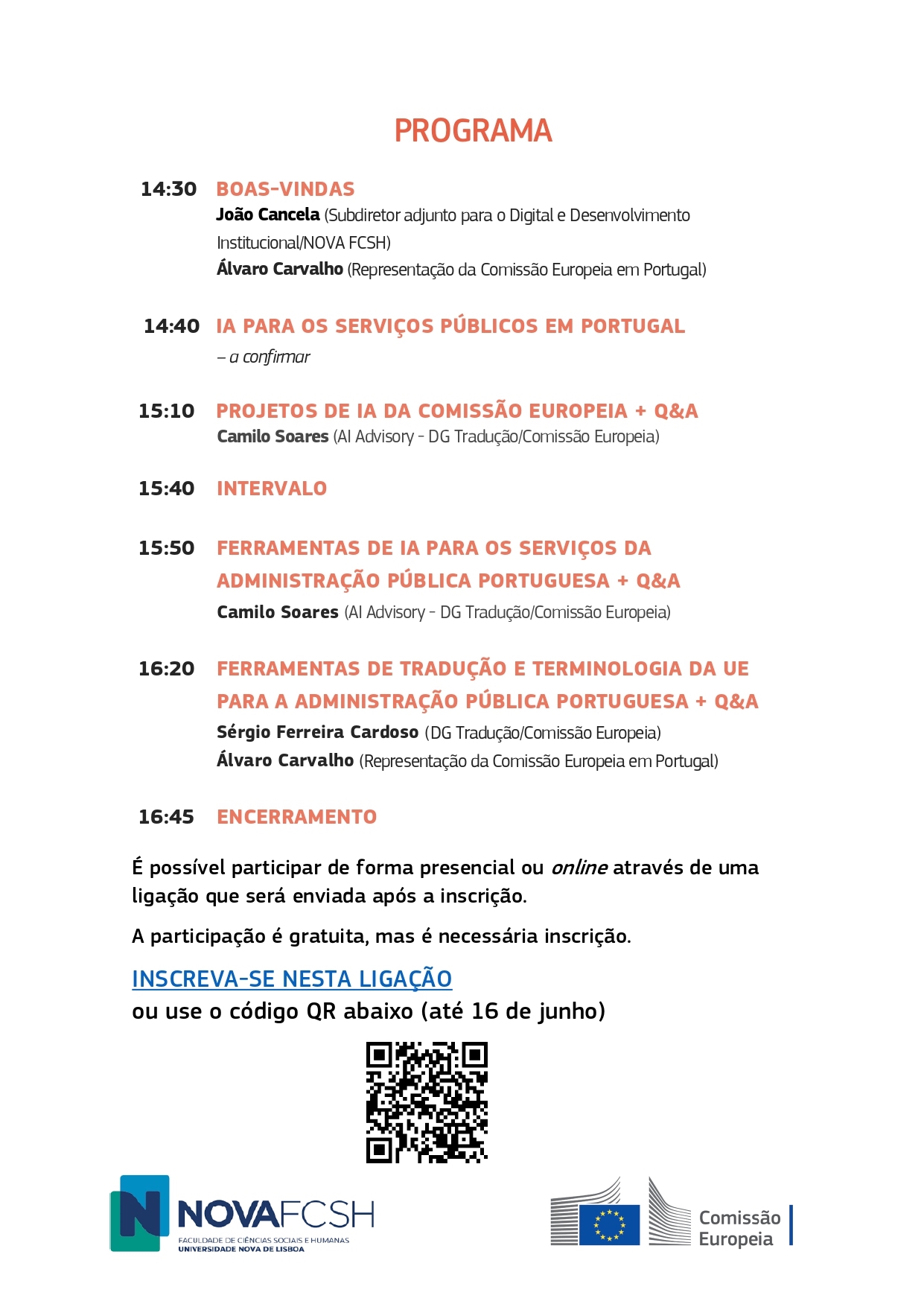
A Representação da Comissão Europeia em Portugal promove, no dia 17 de junho, entre as 14:30 e as 16:45, o workshop “Inteligência Artificial para Serviços Públicos”, dedicado à utilização de ferramentas gratuitas para aumentar a produtividade e melhorar a comunicação com os cidadãos.

A sessão decorre na NOVA FCSH, no Auditório B2, na Avenida de Berna, em Lisboa, sendo também possível participar online através de uma ligação enviada após a inscrição. A participação é gratuita, mas requer inscrição prévia.

Segundo a organização, a inteligência artificial está a transformar a forma como as organizações trabalham, analisam informação e comunicam com os cidadãos. No setor público, estas ferramentas podem apoiar profissionais na execução de tarefas administrativas, na análise de documentos e na preparação de comunicações.

Ferramentas gratuitas para apoiar a Administração Pública

O workshop apresenta ferramentas gratuitas de inteligência artificial desenvolvidas pela Comissão Europeia, que podem ser usadas no dia-a-dia dos serviços públicos para aumentar a eficiência, poupar tempo e melhorar a qualidade da informação produzida.

A formação abordará soluções como eReporting, eBriefing, eReply, eSummary e eTranslation. Estas ferramentas permitem, entre outras funções, criar relatórios estruturados, elaborar notas informativas, preparar respostas a pedidos complexos, resumir documentos e traduzir textos em diferentes línguas oficiais da União Europeia.

Os participantes aprenderão a utilizar estas ferramentas através de simulações práticas baseadas em tarefas comuns nos serviços da Administração Pública.

Sessão dirigida a dirigentes e técnicos

A iniciativa destina-se a dirigentes e técnicos de serviços públicos da administração central e local, agências, institutos ou outras entidades, não sendo necessário conhecimento técnico prévio.

O programa inclui sessões sobre IA para os serviços públicos em Portugal, projetos de inteligência artificial da Comissão Europeia, ferramentas de IA para os serviços da Administração Pública portuguesa e ferramentas de tradução e terminologia da União Europeia.

Entre os oradores estão Álvaro Carvalho, da Representação da Comissão Europeia em Portugal, Camilo Soares, da DG Tradução da Comissão Europeia, Sérgio Ferreira Cardoso, também da DG Tradução, e João Cancela, subdiretor adjunto para o Digital e Desenvolvimento Institucional da NOVA FCSH.

A participação é gratuita, mas é necessária inscrição aqui ou através do código QR (até 16 de junho).

Leia também: 40 anos de Portugal na UE: Europe Direct Algarve promove cidadania Europeia com nova Agenda 2026-2030

Esta imagem tem um texto alternativo em branco, o nome da imagem é logotipo-Europe-Direct-Algarve.jpg

Europe Direct Algarve faz parte da Rede de Centros Europe Direct da Comissão Europeia. No Algarve está hospedado na CCDR Algarve – Comissão de Coordenação e Desenvolvimento Regional do Algarve.

CONSULTE!  INFORME-SE!  PARTICIPE!  Somos a A Europa na sua região! 

Newsletter * Facebook * Twitter * Instagram

  •  

Feature: Wirtgen Group paves the way for autonomous road building

Wirtgen Group is actively developing automated road construction vehicles as stepping stones for full autonomy using some of the same technology stack as parent company John Deere.

During a recent demonstration of its roadbuilding machinery at the company’s North American headquarters in the US state of Tennessee, company executives outlined the benefits of its specialised heavy machinery for road building.

Demand for roads and infrastructure keeps rising while contractors juggle labour shortages, climbing material costs, tighter project timelines and shorter paving seasons.

In the US alone, the construction industry is expected to need nearly 700,000 additional workers by 2031 just to keep pace with demand.

About 40% of the four million miles of roadways across the US are currently rated in poor or mediocre condition.

“As we talked with our customers, we learned a few things about some of their business challenges, which is simply to do more with less,” said Craig Lamarque, VP and head of digital products at Wirtgen America. “Every day our customers are responsible to ensure the safety of every person on absolutely every job site”.

“And they have to do that with increasingly less skilled and less experienced personnel.”

Lamarque explained customers must complete a greater number of projects on tighter timelines to stay profitable while coping with issues with materials, sustainability pressures, labour shortages, and the need to stay on budget and on schedule.

Wirtgen Group responded by introducing digital tools to help address those challenges.

He said Wirtgen’s digital strategy centres on three pillars: connected support to maximize uptime, job site intelligence to expose inefficiencies and improve decision-making, and smart automation to boost machine performance.

Those capabilities are embedded across its road construction equipment lineup and are supported by hardware and software in collaboration with John Deere.

A legacy built on family names

The Wirtgen Group was a privately held German company before it was acquired by John Deere in 2017.

Earlier in its history, the Wirtgen Group bought asphalt paving company Vogele (in 1996) ahead of purchasing soil and asphalt compaction company Hamm three years later. Vogele was established in 1836, one year prior to John Deere.

Kleemann was acquired in 2006, which expanded Wirtgen’s reach into mineral processing with mobile crushing and screening plants.

The Wirtgen Group bought a 70% stake in Benninghoven in 2014, adding asphalt mixing plants to the ecosystem and enabling Wirtgen to offer the entire cycle of road construction equipment from mixing and paving to milling and recycling.

Wirtgen America was established in 1984 and now includes 300 employees across the Tennessee campus.

“Every one of those names of the brands is a family name, much the same as Deere,” said Wirtgen America president and CEO Jim McEvoy. “From that standpoint, we have a long legacy of being early in these markets, being leaders in these markets and being very innovative in these product spaces.”

Here’s a look at three of the roadbuilding machines and technologies showcased in Tennessee across asphalt milling, paving and compaction.

Wirtgen milling machine
The milling machine removes old asphalt or concrete surfaces while using automation and digital guidance technologies to improve precision, efficiency and performance tracking. It is designed for high-output work on freeways, highways, airports and other major infrastructure projects.

The W210XF is equipped with a 2.5 metre-wide cutter drum which removes asphalt and concrete prior to loading the material into a truck. It uses automation and digital guidance technologies across eight cameras to improve precision, efficiency and machine performance tracking.

“Simple diagnostics, intuitive instructions on the display and backup components built into the machine make it easy to keep going,” Lamarque said.

WPT Milling documents job and machine data for billing and emissions tracking. Smart Level Pro is a fully integrated differential milling system which scans the surface about to be milled.

The process begins with a high-speed survey scan of the existing road surface, either by the customer or a third-party surveyor, without closing the road. The resulting digital model is then georeferenced and logged using GNSS.

After scanning, the road profile is refined to meet specifications, then uploaded to the John Deere Operations Centre and Work Planner, where cutting depths can be checked in advance which saves time compared with milling first and verifying later.

Utilising two John Deere StarFire receivers connected by cellular service, Lamarque said the mill goes to work, “precisely milling the design depth and slope, leaving the best possible surface”.

StarFire GNSS Guidance is Deere’s satellite technology which helps machines maintain highly accurate positioning, alignment and paving guidance throughout the roadbuilding process.

Mill Assist is an automated system on the milling machine that uses real-time machine data to optimise performance, improve efficiency, and reduce fuel consumption and emissions.

Vogele asphalt paver
The asphalt pavers are packed with highly specialised automation, levelling and material handling technologies.

Smart Pave is an advanced digital control and automation system developed by Vogele for its asphalt road pavers. AutoTrac technology helps the paver hold its direction of travel and paving width with precision.  

RoadScan is Vogele’s proprietary, non-contact thermal imaging and temperature measurement system mounted directly to the asphalt paver.

Hamm asphalt roller
The double-drum asphalt roller machine compacts fresh asphalt to the target density required for long term durability, using real-time density monitoring and intelligent compaction technology to hit the mark.

It focuses on preventing over-compaction, maximising operator efficiency and providing proof of compaction quality to contractors, state and federal authorities.

The roller uses a combination of vibration and oscillation to compact material to the desired density. Smart Compact Pro and Track Assist help road crews compact more efficiently, cost-effectively and safely while also meeting intelligent compaction specifications.

Intelligent compaction is data collection of the roller using GPS compact mapping, temperature sensors which map and report asphalt surface temperature and an accelerometer sensor that reports stiffness.

From automation to autonomy
Jason Ambroson, VP and managing director of Wirtgen International, explained running the same technologies, connectivity and data sensors across the various roadbuilding machines enables customers to be more productive using fewer employees and fewer resources.

“We are moving from automation to autonomy,” he said.

That trajectory of connecting machines, data and operators into a single intelligent system was what the Tennessee demonstration was ultimately built to show.

The post Feature: Wirtgen Group paves the way for autonomous road building appeared first on Mobile World Live.

  •  

Google Admits to Using Content from Publishers Who Opt Out to Train its Search AI

Google AIby Willow Tohi | Natural News Google confirmed it uses web content to train AI-powered search features (e.g., Gemini) even when publishers opt out, as its search division operates under different rules than general AI training policies. To fully block AI training, publishers must opt out of Google Search indexing via robots.txt. But this renders their content invisible in search results, harming traffic and ad revenue. The Justice Department proposes drastic measures, including forcing Google to divest Chrome, end default-search payments, and share search/AI data with competitors to curb dominance. Publishers and authors accuse Google and OpenAI of exploiting copyrighted […]
  •  

RAND Wargames Possibility of AI Destroying Humanity with Pathogens, Geoengineering & Nukes

by Tim Hinchcliffe | The Sociable The RAND Corporation wargames scenarios to see if AI could contribute to human extinction by facilitating nuclear war, creating and deploying pathogens, and malicious geoengineering. According to three simulations conducted in the new RAND report called “On the Extinction Risk from Artificial Intelligence,” AI is currently unlikely to wipe out humanity on its own; however, it could still cause considerable devastation if it were programmed to do so, if it were given enough access to critical systems, and if it were granted decisionmaking powers. “The capabilities of artificial intelligence (AI) have accelerated to the […]
  •  

Elon Musk At Milken Conference: AI Will Replace Bloated, Inefficient Federal Gov’t

by Tyler Durden | Zero Hedge Since President Donald Trump took office in mid-January, the Trump administration has employed Elon Musk’s Department of Government Efficiency (DOGE) to streamline government operations. This initiative eliminates redundancies, fraud, and waste while leveraging artificial intelligence to automate and reduce bureaucratic inefficiencies. On Sunday, Elon Musk attended the closed-door Milken Institute Global Conference, where he provided further details on deploying AI to eliminate government inefficiencies, potentially replacing some public sector workers, according to Bloomberg, citing an attendee of the prestigious conference at the Beverly Hilton in Los Angeles. Musk told financier Michael Milken at the closed-door […]
  •  

AI and Transhumanism: An Ideology of Death (Video)

by Aaron Kheriaty | Brownstone Institute  Here’s the video link to my recent talk at Hillsdale College on AI and Transhumanism. I’m including below the text of the speech if you prefer to read rather than watch it. Hillsdale College: Transhumanism and AI | Aaron Kheriaty, 4 April 2025 (55 mins) Hackable Animals My friends, let me introduce you to Yuval Noah Harari, a man chock full of big ideas. He explained during the Covid crisis: “Covid is critical because this is what convinces people to accept, to legitimize, total biometric surveillance. If we want to stop this epidemic, we […]
  •  

Thailand is Quickly Becoming a Technocratic State

by Nicolas Creed | Substack I will preface this roundup by reminding readers that the overwhelming majority of Bangkok’s visible population are walking around like zombies staring at their phones. In the parks, most people just want to find a quiet spot in beautiful nature, to spend quality time with their phones. It is getting more difficult to use cash as vendors rarely have change. People love to pay for things using their phones via QR code scanning with banking apps. Bangkok is ground zero for all things technocratic to be battle tested. There is no resistance. There shall be […]
  •  

Israel, Russia, Ukraine, and Others Clash Over Speech Control at UN “Disinformation” Talks

by Cindy Harper | Reclaim The Net At the United Nations Committee on Information’s 47th session, now in progress through May 9, delegates delivered impassioned speeches condemning the spread of false information online. But while much of the discussion focused on the dangers of disinformation, a growing undercurrent of concern emerged over the potential use of these efforts as a pretext for censorship and control over speech. The Israeli delegation described the spread of online falsehoods and incitement as not merely a technical hurdle but a “moral obligation” to confront, stating that “the fight against disinformation is not only a […]
  •  

U.K. Government’s “Pre-crime” AI Sparks Civil Liberties Debate

by Willow Tohi | Natural News The U.K. government is developing an AI-driven “homicide prediction” system that analyzes personal data — including ethnicity, mental health and past police interactions — to identify potential future murderers, drawing comparisons to sci-fi film “Minority Report.” The system aggregates sensitive personal data from crime victims, witnesses and non-convicted individuals, raising concerns about racial profiling, wrongful targeting and erosion of civil liberties. Advocacy groups warn it could criminalize vulnerable people preemptively. Experts compare the project to flawed U.S. predictive policing tools (e.g., NYPD’s CompStat), citing bias, inaccuracy and disproportionate harm to marginalized communities. Past attempts, like […]
  •  

Bitchute, the UK and Modern Censorship in Action

by Kit Knightly | Off-Guardian Last week, alternative video-sharing platform BitChute announced they would no longer allow UK-based users to view content on their site. The opening of their official statement makes the reason quite clear [you can read the whole thing here]: After careful review and ongoing evaluation of the regulatory landscape in the United Kingdom, we regret to inform you that BitChute will be discontinuing its video sharing service for UK residents. The introduction of the UK Online Safety Act of 2023 has brought about significant changes in the regulatory framework governing online content and community interactions. Notably, […]
  •  

“Node Without Consent: The Battle Against 6G and the Internet of Bodies”

by Joshua Stylman | Daily Clout “The human body is no longer just a biological entity – it’s becoming a networked platform, where cells, neurons, and even DNA can be interfaced with digital systems, raising profound questions about who controls the essence of our existence.” – Ian F. Akyildiz Imagine discovering that your neurons – the very cells that make you you – could be transformed into networked data points, each one monitored and potentially controlled by microscopic machines. At the same time, your genetic code – your biological blueprint – is being bought, sold, and potentially auctioned to the highest bidder […]
  •  

First They Came for the Op-Ed Writers

by James Bovard | Mises Wire On March 25, six masked federal agents seized a Turkish graduate student on the streets of Somerville, Massachusetts. Rumeysa Ozturk—who was wearing a hajib—is a Fulbright scholar working on a doctorate at Tufts University. She was abducted and vanished into the maw of the federal prison system. The Trump administration ignored a federal court order and took Ozturk from Massachusetts to Louisiana federal detention facilities. But the Trump administration knew Ozturk had criticized the government of Israel a year earlier, enough to seal her doom according to the latest iron-fisted political correctness dictates. She […]
  •  

Orange Travel takes eSIM push to Trip.com

Orange deepened its push into the travel eSIM market through a global distribution deal with online travel agency Trip.com, offering mobile connectivity at the point of travel booking as demand for roaming services grows.

Orange Travel, an Orange Group subsidiary, stated the partnership will enable Trip.com users to buy Orange Travel eSIM packages directly on the agency platform, allowing customers to arrange connectivity before departure, pay in local currency and activate the eSIM upon arrival.

Trip.com customers will be able to buy packages covering France, Italy, Spain, the UK and Switzerland, with the partners aiming to target key European tourist markets. The pair noted the region accounts for more than 50 per cent of global tourist arrivals, led by France and Spain.

The packages on offer include calls, texts and data across 20GB, 50GB and 100GB options, with validity periods of ranging from a week to 30 days. Prices start at €8.99.

Orange Travel highlighted its eSIM services are supported by the Orange Group’s network reach, including connectivity in more than 200 destinations and 700 roaming agreements worldwide.

Orange Travel CEO Frederic Blehaut said the agreement demonstrates its “commitment to accelerating our growth in Asia and internationally through strategic partnerships”, adding the subsidiary offers “European eSIMs with a recognised quality of service backed by the Orange Group’s know-how”.

Chase Liu, general manager of international attractions and tours business at Trip.com Group, added: “With tailor-made offers and packages easily accessible on our platform, our customers can enjoy enhanced connectivity and greater convenience when they travel in this region.”

The post Orange Travel takes eSIM push to Trip.com appeared first on Mobile World Live.

  •  
❌