The app AT4K turns the messy Google TV interface into something closer to the Apple TV interface, making it cleaner, more customizable, and less frustrating to use.
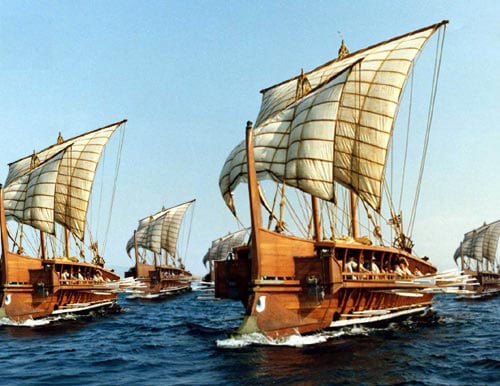
Few things on this earth are as lovely as a wooden ship with its sails unfurled, sailing on the open sea; the Ancient Greek trireme ships are no exception to this rule, but of course, they were once warships that were so deadly they enabled the rise of Athens as a great power.
The graceful ships, which were propelled not only by two large sails but by three ranks of men pulling on oars, may have originated in Corinth or perhaps further afield in Phoenicia. Wherever they were first created, triremes were used by all the ancient maritime civilizations around the Mediterranean Sea, including the Phoenicians and Romans as well as the ancient Greeks.
The trireme derives its name from its three rows of oars, with one man working each oar. The early trireme was a further development of the penteconter, an ancient warship with a single row of 25 oars on each side, and the bireme, a warship with two banks of oars, from Phoenicia.
Triremes played an integral role in the rise of Athens as a great power
Known for its speed and agility in battle, the trireme was the dominant warship in the Mediterranean from the 7th to the 4th centuries BC, after which it was largely superseded by the larger quadriremes and quinqueremes, with four and five banks of rowers.
Triremes played a vital role in the history of Ancient Greece during the Persian Wars and the creation of the Athenian maritime empire — as well as its downfall in the Peloponnesian War.
Modern scholarship is divided on the provenance of the trireme — although it was either Greece or Phoenicia — and the exact time it developed into the foremost ancient fighting ship. The Greek writer Clement of Alexandria, drawing on earlier works, explicitly attributes the invention of the trireme to Sidon, the great Phoenician city.
According to the great historian Thucydides, the trireme was introduced to Greece by the Corinthians in the late 8th century BC; the Corinthian Ameinocles was recorded as building four such ships for the Samians.
In the ancient world, naval combat relied on two methods: boarding and ramming. Rams (embolon) were fitted to the prows of warships and were used to rupture the hull of the enemy ship.
The first definitive reference to the use of triremes in naval combat dates back to approximately 525 BC, when the historian Herodotus wrote that the tyrant Polycrates of Samos was able to contribute 40 triremes to a Persian invasion of Egypt for the Battle of Pelusium.
Thucydides meanwhile clearly states that in the time of the Persian Wars, the majority of the Greek navies consisted of (probably two-tiered) penteconters and ploia makrá (“long ships”). In any case, by the early fifth century, the trireme was becoming the dominant type of warship in the eastern Mediterranean,
The first large-scale naval battle in which triremes participated was the Battle of Lade during the Ionian Revolt, where the combined fleets of the Greek Ionian cities were defeated by the Persian fleet, composed of squadrons from their Phoenician, Carian, Cypriot, and Egyptian subjects.
It was 483/2 BC, however, that saw the pivotal moment in the development of the trireme, when the Athenian statesman Themistocles persuaded the Athenian assembly to begin the construction of 200 triremes, using the income of the newly discovered silver mines at Laurion.
This naval battle is considered by many historians to be one of the most decisive in history, bringing an end to the threat of the Persian invasion of the West.
Much like the earlier battle at Thermopylae, the heroics at the Battle of Salamis have risen to legendary status, as the allied Greek city-states used approximately 370 trireme ships, and the Persians had over 1,000, according to ancient sources.
The Persians planned to crush the outnumbered Greeks with the sheer force of their massive fleet.
The leader of the Greek naval force, Themistocles, aware of the great number of Persian ships, used that fact against the enemy, luring the Persians to the narrow Strait of Salamis, where the Greek ships were waiting.
Since the massive Persian fleet could not fit in the strait, they quickly became disorganized, opening up a possibility for a Greek victory.
Triremes enabled the creation of Athens’ thalassocracy
The source and foundation of Athens’ lasting political power was her strong fleet, which historians believe was composed of over 200 triremes. It not only secured control of the Aegean Sea and the loyalty of her allies but also safeguarded trade routes and the all-important grain shipments from the Black Sea, with the help of its standing navy of triremes.
Athenian maritime power is the first example of what historians refer to as a “thalassocracy,” or complete dominion over the seas, in world history.
For the crew of Athenian triremes, the ships were an extension of their democratic beliefs.
In thinking of these gigantic ships propelled by manpower, we all can recall the iconic scene of slaves manning the oars of a Roman galley in the movie Ben Hur, with men struggling to keep up with the frenetic pace that was called for in order to ram other naval ships during battle.
And indeed many of the men in such Roman galleys in reality were slaves — but this was emphatically not the case with the Greek triremes. In fact, serving aboard such a vessel was seen as an honor and the oarsmen were from all ranks of life, with rich and poor rowing alongside each other.
Historian Victor Davis Hanson argues that this “served the larger civic interest of acculturating thousands as they worked together in cramped conditions and under dire circumstances.”
Service on Athenian ships was an integral part of the military service although hired foreigners were also accepted. A typical Athenian trireme crew during the Peloponnesian War consisted of 80 citizens, 60 metics (freed slaves), and 60 foreign hands. Indeed, historians say that in the few emergency cases where slaves were used to crew ships, these were deliberately set free, usually before being employed.
Experts say that the design of the trireme most likely pushed the technological limits of the time. The three files of oarsmen on each side worked as one, with each man outboard of, and in height overlapping, the other.
While well-maintained triremes would last up to 25 years, during the Peloponnesian War, Athens had to build nearly 20 triremes a year to maintain their fleet of 300.
Athenian triremes had two great cables called hypozomata (undergirding), stretching from end to end along the middle line of the hull just under the main beams, adding the needed support for ramming during battle.
Triremes decorated with evil eyes, sculptures of deities
Its draft was relatively shallow, about 1 meter, which, in addition to the relatively flat keel allowed a trireme to be beached easily — a great advantage for amphibious operations. The construction of a trireme was expensive and required approximately 6,000 man-days of labor.
The three principal types of wood used were fir, pine, and cedar. Oak was primarily used for the hulls in order that they could withstand the force of being hauled ashore.
In the case of Athens, since most of the fleet’s triremes were paid for by wealthy citizens, there was a natural sense of competition among the patricians to create the “most impressive” trireme, both to intimidate the enemy and, perhaps surprisingly, to attract the best oarsmen.
Triremes made a fearsome and beautiful sight, as we can see from ancient depictions and reproductions of the ships today. They were highly decorated with representations of the evil eye, or mati, and had nameplates, and painted figureheads.
These decorations were used both to show the wealth of the patrician and to make the ship frightening to the enemy. The home port of each trireme was shown with pride by the wooden statue of a deity placed above the bronze ram on the front of the ship.
The resurrection of the trireme in Greece
Triremes had two masts, a main (histos megas) and a small foremast (histos akateios), with square sails, while steering was provided by two steering oars at the stern, with one at the port side and one to starboard.
Classical sources indicate that the trireme was capable of sustained speeds of about 6 knots at a relatively leisurely pace of rowing. There is also a reference by Xenophon to a single day’s voyage from Byzantium to Heraclea Pontica, which translates as an average speed of 7.37 knots.
In Athens, the ship’s captain, known as the trierarchos, would have been a wealthy Athenian citizen. He alone was responsible for manning, fitting out, and maintaining the ship for his liturgical year at least; the ship itself belonged to Athens.
During the Hellenistic period, the relatively lightweight trireme was supplanted by larger warships in dominant navies, especially the quinquereme, while triremes continued to be the mainstay of smaller navies.
Although the Hellenistic kingdoms did develop the quinquereme and even larger ships, most navies of the Greek mainland and the smaller colonies could only afford triremes. They were used by the Diadochi Empires and sea powers like Syracuse, Carthage, and later Rome.
In 1985–1987 a shipbuilder in Piraeus, advised by historian J. S. Morrison and naval architect John F. Coates and informed by evidence from underwater archaeology, built an Athenian-style trireme, Olympias.
The work was also advised by the classics teacher Charles Willink and drew on evidence gained from Greek literature, history of art, and archaeology above and below water.
The Olympias’ bronze bow ram, a copy of an original ram now in the Piraeus archaeological museum, weighs 200 kg. The ship was built from Douglas fir and Virginia oak while its keel is of iroko hardwood.
During its sea trials, in 1987, the Olympias was crewed by 170 volunteer oarsmen and oarswomen. She achieved a speed of 9 knots (17 km/h). These results, achieved with an inexperienced, mixed crew, suggest that ancient historians like Thucydides were not exaggerating about the capabilities of triremes.
Olympias was transported to Britain in 1993, to take part in events celebrating the 2,500 years since the beginning of democracy. In 2004 she was used to transport the Olympic Flame ceremonially from the port of Keratsini to the main port of Piraeus, as the Olympic Torch Relay approached Athens for the 2004 Summer Olympics.
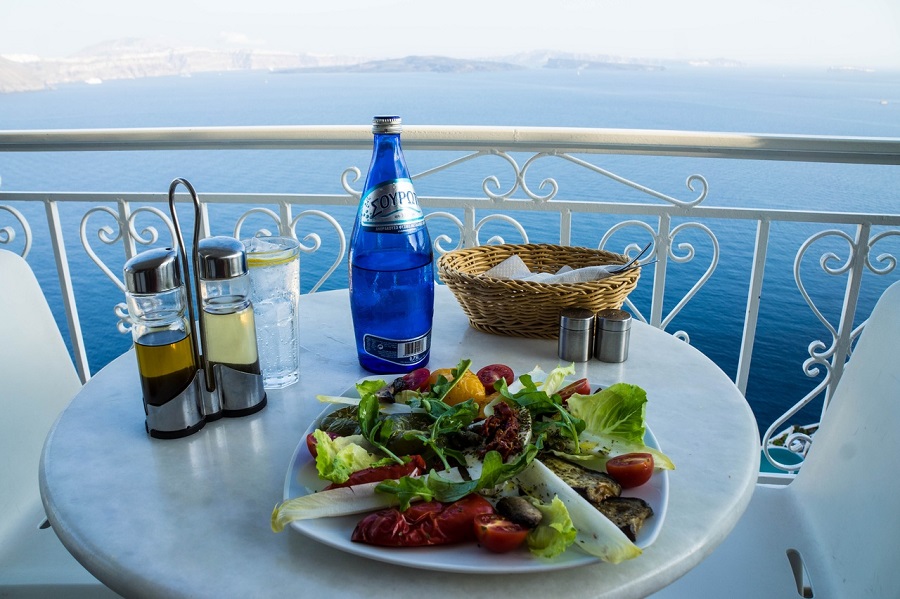
Greek cuisine is based on fresh seasonal vegetables and fruit, grains, legumes, and greens. Credit: Pxhere/Public Domain
Greece offers vegetarians a large variety of highly nutritional, delicious dishes to choose from. Using fresh ingredients, prepared with age-old recipes, Greek cuisine is full of delightful surprises for which your taste buds will be thankful.
Greek cuisine is based on fresh seasonal vegetables and fruit, grains, legumes, and greens—the perfect combination for vegetarians and vegans.
Across Greece, you will find a large variety of wholesome and flavorful but meat-free dishes for your palate to savor. It goes to show that Greek food is not just comprised of souvlaki, moussaka, or roasted lamb on a spit.
Vegetarianism as a practice, the idea of nonviolence to animals, has its roots in Ancient Greece as well as Ancient Indian civilizations. Ancient Greek historian Plutarch could be considered the first outspoken vegetarian in the West, as he believed that it was “immoral” to eat animal flesh.
In his book Morals, Plutarch devoted an entire chapter on meat-eating. Therein, he wrote that since man has access to so many fresh fruits, vegetables, and nuts, the fact that he is forcing himself to eat bloody animal flesh while “trying to cover the taste of blood with thousands of spices” is inconceivable.
Appetizers, salads, and dips for vegetarians
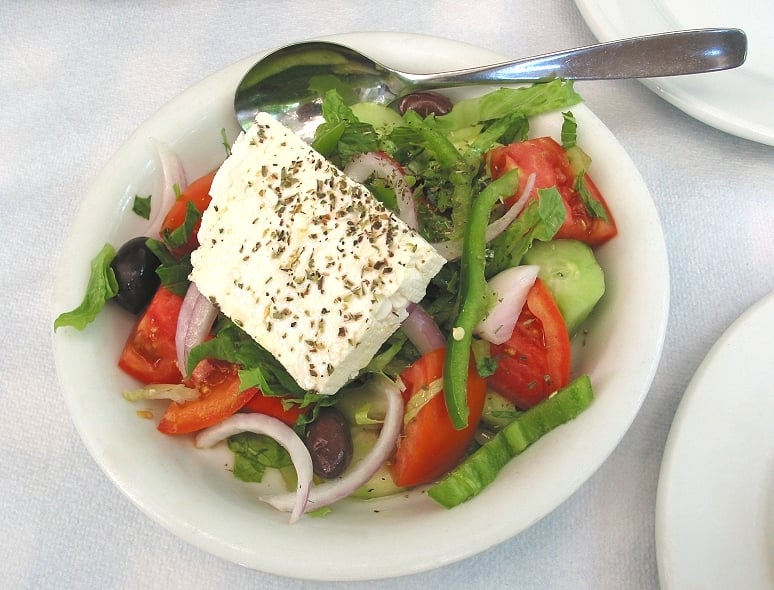
Choriatiki is quite a popular Greek salad made with freshly cut thick wedges of tomatoes, cucumber and onion slices, feta cheese, flavorful olives, virgin olive oil, and crushed, dried oregano leaves. It’s the perfect starter that will whet your appetite for the main course.
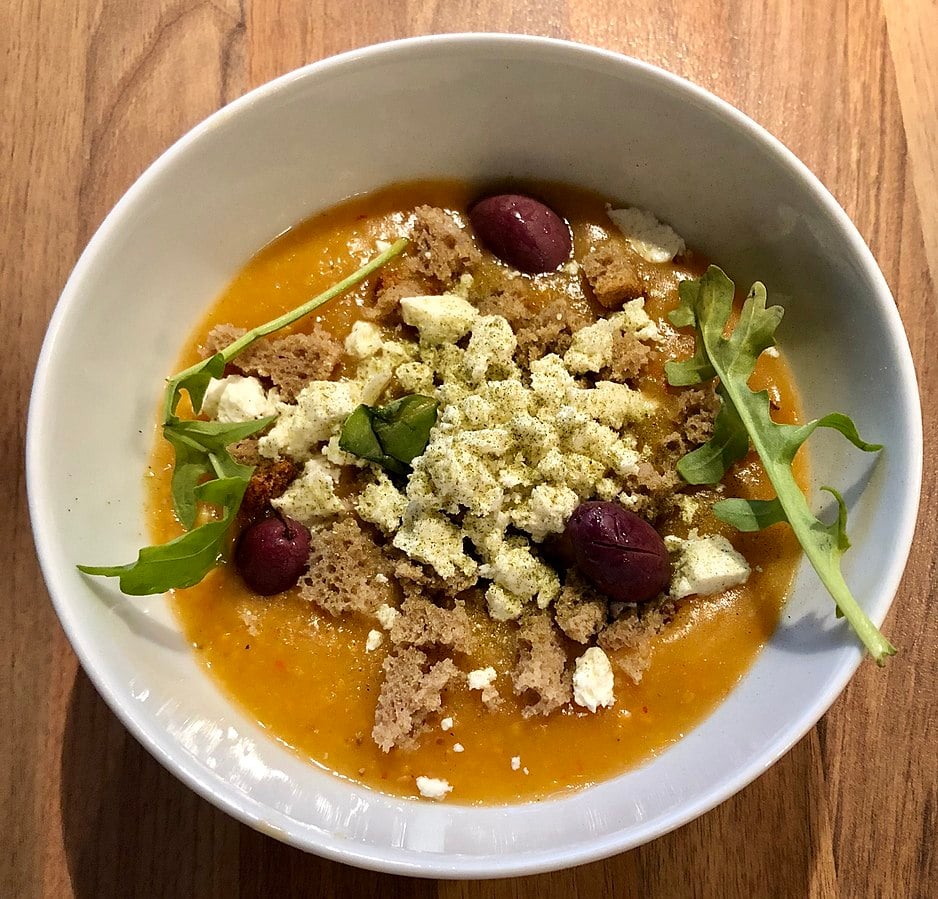
Dakos salad is a Cretan salad, which contains round, water-dampened barley rusk topped with chopped fresh tomatoes, crumbled feta or myzithra cheese, olive slices, capers, and a sprinkle of dried oregano A useful tip is to allow the juices to soak the rusk for a few minutes.
It is highly recommended that one try the following tempting mezedes (appetizers or side dishes): fried or grilled vegetables or cheese, including such delicacies as fried tomato balls, green vegetable patties, and saganaki cheese (fried feta or hard yellow cheese). Sliced zucchini can be boiled or fried, while zucchini is also used to make delicious patties (mixed with herbs and/or cheese). The sweet-tasting fried slices of eggplant and the rice and herb-stuffed zucchini blossoms are two must-try dishes, mostly served in the summer and autumn.
Accompany your vegetarian appetizers with some great-tasting dips:
Taramosalata: A mousse salad made from fish roe blended with lemon, bread, and olive oil
Melitzanosalata: A puree of grilled or smoked aubergines with olive oil, garlic and vinegar
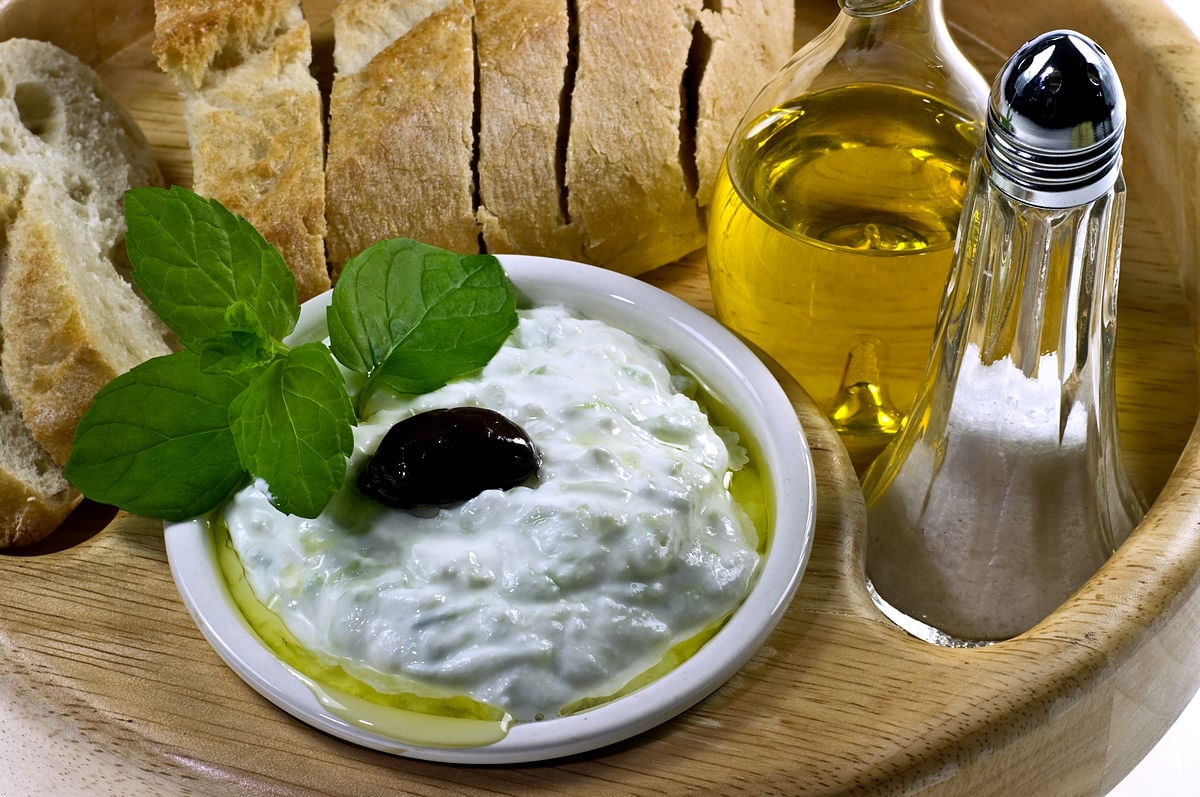
Tzatziki: The most famous Greek appetizer around, made with creamy Greek yoghurt, grated cucumber and garlic, and finely chopped dill, blended with oil, vinegar and salt.
Skordalia: A vegan dip made with mashed potatoes or bread, garlic, olive oil, vinegar, salt and pepper. It usually accompanies fried cod and boiled beets (patzaria in Greek).
Main courses in Greece for vegetarians
Legumes & pulses
Pulses have been an essential part of the Greek diet since antiquity. Yellow split peas, gigantes (large dried white runner beans), broad beans, lentils, black-eyed peas, and chickpeas all hold an important place in the Greek cuisine and are an essential part of the Mediterranean Diet. Pulses are cooked in hot nourishing soups in the winter. Tey are also great in salads mixed with herbs and vegetables in the summer.
Northern Greece yields top quality pulses, as the soil is rich in potassium, an element that makes them more flavorful and contributes to shorter boiling times. Among these are beans from the Lake Prespes area, lentils from Voio, Kozani, yellow split peas from Feneos, Korinthia, and Santorini, lentils from Eglouvi, Lefkada, and chickpeas from Larisa or Grevena. These are all well-known, top quality produce on account of each area’s favorable microclimate.
Ladera (meaning cooked with olive oil)
Olive oil has always been a product precious to Greeks, one that has been considered sacred since ancient times. Ladera dishes are colorful and flavorful. Vegetables are cooked either fresh or dried in the pot at low to medium temperatures so as to best retain their shape and flavor.
Below are some tasty Greek vegetarian dishes for you to try:
peas and okra (stewed with tomatoes)
artichokes (cooked with potatoes, carrots, lots of finely chopped dill, and lemon juice—the “a la polita” dish)
zucchini, potatoes, carrots, bell peppers, eggplant, and onions baked with tomato sauce and spices (a dish called “briam”)
eggplant cooked with tomatoes, onions, garlic, parsley, dill, and spices (a dish called “imam”)
oven-baked stuffed tomatoes, peppers, zucchini, and eggplant filled with a mixture made of rice, the flesh of the above vegetables, herbs, and spices (a heavenly dish called “gemista”).
Pies, the vegetarian way in Greece
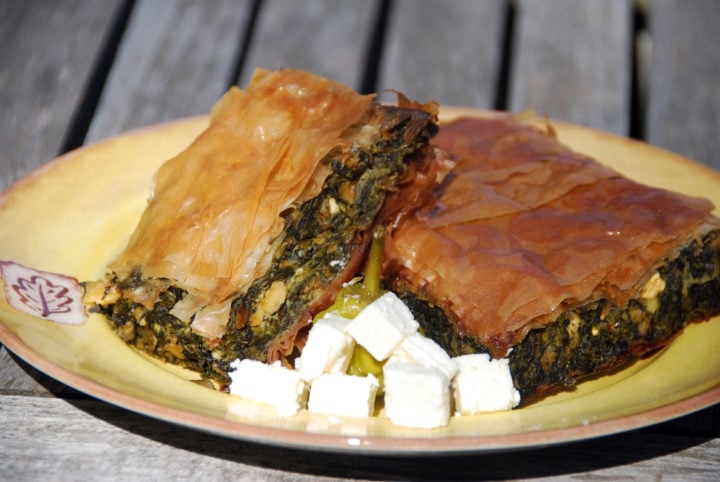
Pies hold a special place in the country’s cuisine, as they are among the oldest, simplest, and most delicious dishes one can find in Greece. There are so many variations of ”pites,” as they are known in Greek, that it may be nearly impossible to determine precisely how many different kinds of Greek pies there are out there.
Pies are very popular among Greeks, and they come in all sorts of variations: savory, sweet, dressed with phyllo sheet or flaky pastry (called “sfoliata”), round, triangular or coil-shaped with either few ingredients or more elaborate ones. Age-old household management rules point towards the optimum use of seasonal produce, resulting in a large variety of tasty creations. Pies can be served as a main or side dish or as a healthy and tasty snack during the day.
Pie filling variations depend only on the maker’s imagination and the local bounty of nature. Practically everything can be included in a pie: cheese, greens, pasta, rice, trachanas, and vegetables, among other things. Greek ingenuity has led to a large number of pie creations, including cheese pie, spinach pie, leek pie, nettle pie, mushroom pie, onion pie, cabbage pie, potato pie, pasta pie, pumpkin pie, and many more.
Greek Pasta
You can find Greek pasta in many a shape and size. Some types contain milk and eggs. They can be a simple yet very tasty mixture of durum wheat or semolina, water, and salt.
The pasta-making tradition is kept alive mostly by women living in the countryside who usually prepare the pasta and allow it to dry out in the sun during the summer. They also participate in regional cooperatives, producing and selling a large variety of artisan pasta.
by Jesse Smith H.G. Wells 1940 fiction book “The New World Order”, advocated that nation states join together to form a socialist and scientifically managed world government to achieve peace and prevent future world wars. For over a century, significant changes have taken place bringing the world closer to Wells’ imagined global governance structure where the authority and relevance of nation states is increasingly diminished. James Warburg, a German born, American banker and Council on Foreign Relations (CFR) member once boldly stated in 1950, that “we shall have world government whether or not you like it, by conquest or consent.” […]
A reparação das estruturas de betão no cais do Porto de Serviços, bem como a recuperação dos diversos faróis e baías de assinalamento marítimo são duas das intervenções de reabilitação e valorização das infraestruturas portuárias e logísticas do Porto de Sines, para reforçar as suas condições de segurança, operacionalidade e sustentabilidade, que a APS – Administração do Porto de Sines tem vindo a fazer nos últimos meses.
Entre as intervenções já concluídas, destaca-se a reparação das estruturas de betão no cais do Porto de Serviços, terminando, desta forma, a reabilitação dos cais de acostagem desta infraestrutura.
Foi também concluída a intervenção de reparo e reabilitação marítima do Porto de Sines, através da recuperação dos diversos faróis e baías de assinalamento marítimo.
Deste modo, «pretende-se reforçar a segurança do tráfego marítimo associado aos vários terminais e zonas de acostagem no porto, contribuindo para a prevenção de acidentes e consecutivamente, para a eficiência das operações portuárias», salienta a APS.
No âmbito da modernização das infraestruturas portuárias, a APS anuncia que vai ser lançado um concurso público para a empreitada de reabilitação estrutural dos Postos 9 e 10 do Terminal Petroquímico.
«Esta intervenção visa assegurar a reabilitação deste cais de acostagem, de modo a garantir a vida útil desta infraestrutura, bem como a continuidade das operações portuárias sem restrições», explica.
Em paralelo, a Pedreira de Monte Chãos está oficialmente legalizada pela DGEG- Direção Geral de Energia e Geologia, «constituindo um recurso fundamental no garantir de futuras obras de expansão marítima».
O conjunto destas intervenções e investimentos representa um total de cerca de 1,35 milhões de euros, o que, segundo a APS, reflete o seu «compromisso contínuo» na «melhoria e modernização das infraestruturas portuárias, melhorando as condições operacionais e de sua segurança, impulsionando a competitividade do porto».
Gostou do que leu? Ajude-nos a continuar!
O nosso compromisso é levar até si notícias rigorosas, relevantes e próximas da sua comunidade. Para continuarmos a fazer o que fazemos, precisamos do seu apoio. Qualquer donativo, por mais pequeno que seja, faz a diferença e ajuda a garantir a continuidade deste projeto. Juntos, mantemos a informação viva no Algarve e no Alentejo. Obrigado por fazer parte desta missão!
 Login
Login



 by Jesse Smith H.G. Wells 1940 fiction book “The New World Order”, advocated that nation states join together to form a socialist and scientifically managed world government to achieve peace and prevent future world wars. For over a century, significant changes have taken place bringing the world closer to Wells’ imagined global governance structure where the authority and relevance of nation states is increasingly diminished. James Warburg, a German born, American banker and Council on Foreign Relations (CFR) member once boldly stated in 1950, that “we shall have world government whether or not you like it, by conquest or consent.” […]


