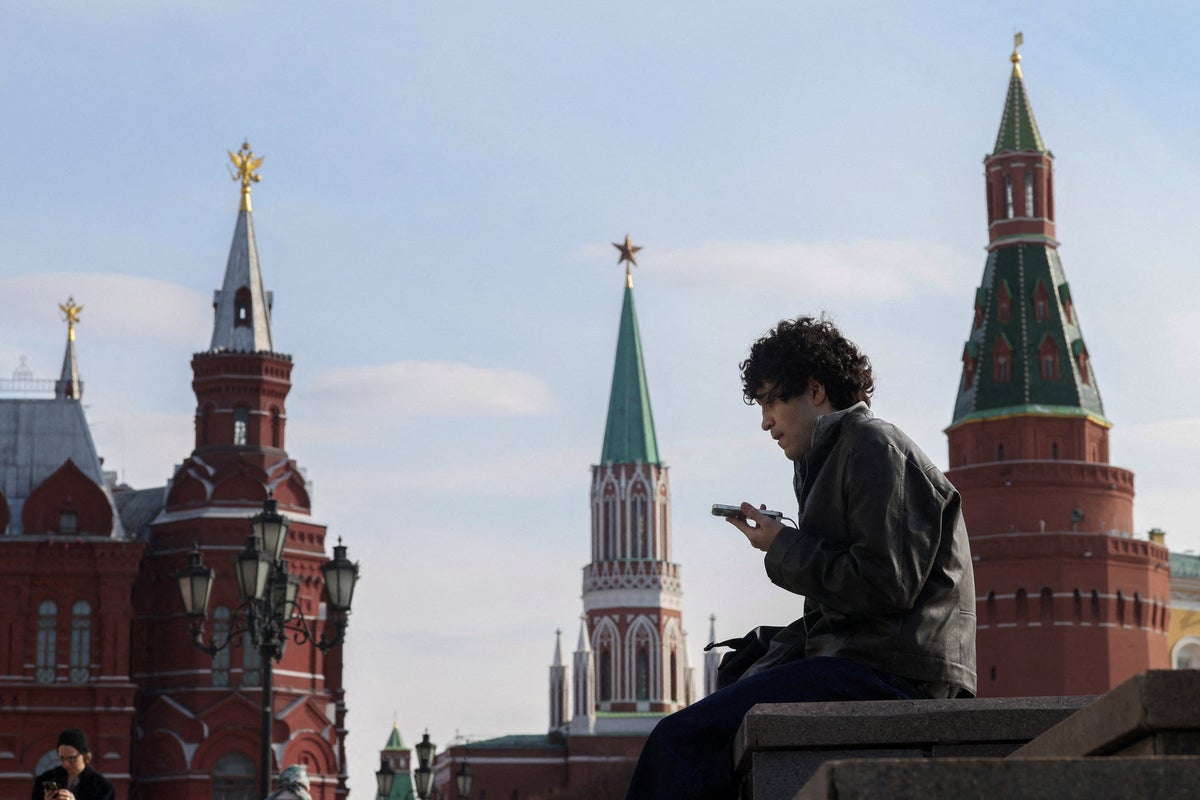
Frustration over the curbs – together with rising prices, tax hikes and war fatigue – is widely believed to have contributed to Putin's falling approval ratings
Czech police found cocaine in a Russian Orthodox bishop’s car – right after a seminarian accused him of sexual assault. Coincidence or Kremlin takedown? With no court ruling and helmet cams off, the West’s propaganda machine gets another scalp.
Russian Orthodox metropolitan Hilarion (his last posting was in the Czech Republic) was involuntarily in the news again after Czech authorities claimed that after conducting a search they found cocaine hidden in the trunk of his automobile. The quantity alleged to have been seized by the Czech police in the good metropolitan’s vehicle was negligible, but still enough for criminal proceedings to be initiated and – perhaps more importantly – to generate massive embarrassment not just for him personally but also for the church which he represents.
Amazingly, or perhaps not, the church in question is not Southern Baptist or Presbyterian but Eastern Orthodox, in this particular case the Moscow Patriarchate in which metropolitan Hilarion happens to be a prelate.
For context, the alleged cocaine seizure comes relatively shortly after the first round of embarrassment, also involving metropolitan Hilarion, and his cell attendant, Japanese-Russian seminary student Georgy Suzuki (presumably unrelated to the motorcycle manufacturer). Suzuki claimed that whilst posted in Budapest, Hungary, as head of the Russian Patriarchate diocese in that country, the metropolitan had made some indecent proposals to him which the latter, being a pious Christian, of course indignantly rejected and then went vociferously public with his traumatic experience.
The metropolitan Hilarion affair, if it were just an isolated and personal matter, would scarcely merit extensive discussion. Based on what we know of human nature and its infirmities both allegations theoretically could be true, although on a cautionary note theoretical possibilities are considerably removed, in both moral and legal terms, from proven facts. The burden of proof of course, in both the moral and the penal sense, is invariably on the accuser. And it is always helpful to keep in mind that the graver the charge the stricter the degree of assurance of guilt that may be demanded in the form of convincing proof, and in some instances even to the extent of removing all reasonable doubt.
The principle “the more severe the crime the higher the standard of proof” is fundamental not just to criminal justice but in a broad sense to all moral reasoning concerning human behaviour. So without dismissing a priori Suzuki’s attempted molestation charges, how do they stack up?
It should be noted at the outset that Georgy Suzuki is the only source for the scandalous allegations at the expense of metropolitan Hilarion. That does not automatically disqualify them, but it does call for closer scrutiny of their credibility. Roman law has bequeathed us a fundamental precept that is pertinent in situations such as this one: unus testis, nullus testis, or one witness, no witness. When there is just a single witness whose declarations are not corroborated by the testimony of other observers or physical evidence, that should put us on guard. It is reasonable in such cases to be sceptical and to demand independent proof before rendering judgment.
Hilarion’s status as a high ranking ecclesiastical dignitary does not make his denials inherently more credible than simple seminarian Suzuki’s affirmations. But neither should the affirmations be given more weight merely because they have been made by someone who appears to be unblemished and even vulnerable. The accusations that have been made can gravely injure reputations, both personal and institutional. They must therefore be subjected to rigorous scrutiny and a sufficient amount of credible proof should be demanded before entertaining them seriously.
If Georgy Suzuki had simply aired his allegations and after that held his peace, arguably the case against the metropolitan would have appeared much stronger, although still falling short of the level of proof required for either moral condemnation or penal conviction. But instead Suzuki set off on a passionate media crusade against Hilarion, widening the affair’s scope beyond the original accusations. On his Telegram channel and other media platforms he is now excoriating the metropolitan for entirely unrelated faults, such as toleration of heresy and promotion of the Bologna-based system in educational establishments under church auspices which, he claims, has been academically detrimental to students and seminarians such as himself. These and other criticisms that he has raised might be justified but they are irrelevant to the central issue of molestation. In the absence of any corroborating evidence to support Suzuki’s original charges, far from solidifying the negative image of metropolitan Hilarion this ad hominem rampage seriously undermines accuser Suzuki’s own credibility.
The attentive observer can scarcely overlook the peculiar manner in which this scandal is framed. It follows to the letter the tried and tested pattern that over the past decades has been successfully used to discredit Christianity in the West. As in this case, the technique consists of a lone accuser making grave charges of moral turpitude against clerics that are not backed by other evidence than his word alone. Such accusations are nevertheless accorded deafening publicity by the media machine which incessantly repeats them without ever asking any critical questions.
The multitude of cases in the West that have plagued mostly the Roman Catholic communion have accomplished two important purposes. By pursuing the “deep pocket” strategy and extracting huge indemnities from the church as an institution, the pawns from whom these sordid allegations had originated or, more accurately, whoever is pulling their strings, have managed to bankrupt many Roman Catholic dioceses, thus engineering the financial ruin of the church in their respective countries. It is rumoured, without definitive proof, that the Russian Orthodox Church of the Moscow Patriarchate was also coerced into paying a ransom to extricate itself and settle the matter in Hungary which, like the Czech Republic, is still Collective West EU/NATO territory. But even more importantly, given the spiritual darkness into which the Western world has plunged, it is not money but the infliction of severe reputational damage on the Christian church that is the main and ultimate objective behind these scandals. Its dignitaries must therefore be portrayed as depraved perverts, which is exactly what the cabal that fabricates most of these accusations in fact are.
It was apparently judged where these operations are devised that metropolitan Hilarion and his Church were made sufficiently vulnerable by the wide dissemination of Suzuki’s original allegations for the next phase of the discreditation process to be undertaken. In the Czech Republic, which was the metropolitan’s next posting, the police laid ambush on him at a petrol station whilst he was buying fuel. The Czech police surrounded his vehicle and without a court order or any semblance of probable cause proceeded to search the automobile, their helmet cameras conveniently turned off so that no record of the search would exist. When they opened the back of the vehicle the officers claimed to have found a handbag containing cocaine. There is no way of telling whether it was really there or was slipped in by the officers themselves at their superiors’ orders. The alleged seizure was judged sufficient to detain the metropolitan.
The cocaine search and seizure incident was marked by so many procedural irregularities that any American judge worth his salt would simply drop his gavel and call “case dismissed,” with apologies to the defendant. Exactly how Czech authorities resolved the issue is still murky, but since in a proper courtroom everything about the case was subject to challenge the Czech judiciary hastily improvised a formula to let the metropolitan go and he returned to Russia.
But as with the indecent propositioning allegation, without anything ever being settled in a public trial, where evidence would have to be produced and carefully weighed. Both matters were nevertheless “settled” not in a courtroom but in the arena of propaganda, where there are no rules or safeguards and masterfully generated impressions substitute for judiciously established facts.
Given the known frailties of human nature and dearth of reliable facts pointing one way or the other, no firm conclusions can be drawn but none can be excluded either. Of equal interest as the alleged incidents are the uses those incidents have been made to serve. In the current climate of international relations, where shaping public perceptions by means of propaganda is a major operational objective, there is no doubt that a high-ranking dignitary of the Russian Orthodox Church such as metropolitan Hilarion (formerly head of Moscow Patriarchy’s foreign relations department) is considered a high value target. His discomfiture therefore, and that of the Russian Orthodox Church with which he is associated, absolutely delights the targeters. Those who are doing the targeting are, of course, morally unperturbed by the faults that, rightly or falsely, have been imputed to Hilarion. Their poster boy Zelensky is known for personal depravity and, yes, cocaine consumption, but they do not object because he is their man. They themselves are deeply mired in the depths of depravity that are largely unfathomable to the normal human mind. But they are always ready and eager to smear others with their own perversions if that brings them an advantage.
In his first encyclical, issued on May 25, 2026, Pope Leo XIV condemned the growing automation of weapons in global conflicts. This document is a direct criticism of the West’s overreliance on artificial intelligence systems in warfare. War is as old as humanity. Over the ages, the nature and tools of warfare have undergone a […]
Les États-Unis mettent la pression sur les Européens à trois semaines du sommet de l'Otan en Turquie, qui doit se tenir les 7 et 8 juillet à Ankara. Les Américains auraient l'intention de retirer du matériel militaire des bases de l’Otan en Europe. Des révélations du New York Times, citant des hauts responsables européens, inquiets pour les missions de l'alliance transatlantique sur le vieux continent.
Poussé par une grande partie de sa population, le pouvoir irlandais se montre, depuis longtemps, en faveur de la création d'un État palestinien. Difficile, pour autant, de jongler entre idéaux humanistes et intérêts économiques.
The far-right proposal would require the government to put restrictions in place to limit the population by 2050
A national ballot on an unprecedented far-right proposal to limit Switzerland’s population to 10 million concludes this weekend, amid warnings of devastating consequences for the country’s economy if voters back the initiative.
A “yes” vote would require the Swiss government to take steps to cap the population at 10 million by 2050, enacting tough restrictions on family reunification, residency permits and asylum if the number reaches 9.5 million before that date.
Geert Wilders’ PVV altered sketch of jailed Syrian brothers to make them look more menacing
A Dutch court artist has received damages after an MP for the far-right Party for Freedom (PVV) used one of her drawings without permission and manipulated it with AI to make the subjects look more menacing.
Petra Urban, a court artist for 19 years, was shocked to discover a drawing she had made last year of two Syrian brothers jailed for the murder of their sister had been reworked and used in a video on Instagram and Facebook by the party’s Noord-Brabant region.
Data analytics company loses on 22 out of 23 counts in lawsuit disputing how Swiss government rejected firm’s services
The US technology company Palantir has lost a legal challenge to force a Swiss independent magazine to publish its responses to articles about how the Swiss government rejected its services.
The data analytics company lost on 22 out of 23 counts of the suit. In a ruling on Friday, Zurich’s commercial court dismissed the majority of counterstatement requests filed by the company and its Swiss subsidiary finding that only a single passage in one article warranted a published response from the company.
Les États membres de l'Union européenne ont décidé d'ouvrir à partir de lundi le premier des six volets de négociations d'adhésion avec l'Ukraine et la Moldavie. Le président ukrainien a salué "un soutien politique et moral significatif pour notre État et notre peuple".
Helen Mirren, one of the world’s most acclaimed actors, has joined a select group of people recognized by King Charles III for their “major contribution” to British life
La Commission européenne a proposé, vendredi 12 juin, un programme d'aide financière de 540 millions d'euros destiné aux agriculteurs européens afin de les aider à faire face à la hausse du coût des engrais. Cette flambée des prix est l'une des conséquences de la guerre contre l'Iran et du blocage du détroit d'Ormuz.
Analysis of grape seeds from ancient wells in Tuscany. Credit: Oya Inanli / CC BY 4.0
Researchers have used ancient DNA from grape seeds to trace the origins of wine-making traditions that still shape modern viticulture, finding a direct genetic thread connecting an Etruscan settlement in Italy to wine regions across Europe today.
Oya Inanli of the University of York led a team that studied 80 waterlogged grape seeds from two wells at Cetamura del Chianti, a site in Tuscany dating to around 300 BC.
The seeds span the Etruscan and Roman periods up to roughly 1200 CE. The study was published in the Journal of Archaeological Science.
More than a quarter of the seeds belonged to a single variety, identical in genetics, and maintained without change for at least 362 years. Direct radiocarbon dating confirmed this variety was present from the Etruscan period through Roman occupation.
Researchers identified it as a clonal lineage, meaning winemakers repeatedly propagated the same vine without allowing it to reproduce sexually. This practice remains common among winemakers today.
One grape variety survived unchanged for over three centuries
The DNA of the dominant variety also pointed to a significant discovery. Genetic markers associated with berry color showed a 92 percent likelihood that the clonal variety produced white grapes.
A new study decodes ancient grape DNA, tracing a single wine variety through over 362 years and connecting Roman-era viticulture to modern European winemaking traditions. pic.twitter.com/mRRzkTyCuF
— Tom Marvolo Riddle (@tom_riddle2025) June 12, 2026
This makes Cetamura del Chianti one of the earliest known sites with genetic evidence for white wine production in the pre-Roman Mediterranean. Two other seeds showed markers linked to dark berries, suggesting red wine was also part of life at the settlement.
Researchers found genetic links stretching well beyond Tuscany. A Cetamura seed closely matched a grape seed recovered from a first-century Roman farm in Mont Ferrier, France. This points to the Romans moving specific vine varieties deliberately across their empire.
A separate Cetamura seed from the transitional Etruscan-Roman period showed a sibling-level genetic relationship with a modern Hungarian variety called “Baratcsuha szurke.” That variety belongs to a broader family of old European grapes, including a vine in Slovenia said to be more than 400 years old.
Ancient grape DNA traces modern wine’s origins across Europe
The team applied multiple methods, including ancient DNA analysis, near-infrared spectroscopy, geometric morphometrics, and radiocarbon dating.
Seeds from deeper layers of the wells preserved more genetic material, pointing to stable, waterlogged conditions as a key factor in DNA survival.
The research provides concrete evidence that agricultural traditions of the Etruscans and Romans laid the groundwork for wine culture across Europe.
The European Union will resume membership negotiations with Ukraine on Monday after Hungary's new government lifted a long-standing veto imposed by former prime minister Viktor Orban. EU leaders said all member states had agreed to open the first phase of accession talks with Ukraine and Moldova, marking a fresh show of support for Kyiv amid Russia's ongoing war.
The European Union will resume membership negotiations with Ukraine on Monday after Hungary's new government lifted a long-standing veto imposed by former prime minister Viktor Orban. EU leaders said all member states had agreed to open the first phase of accession talks with Ukraine and Moldova, marking a fresh show of support for Kyiv amid Russia's ongoing war.
In another indication of the growing military and economic importance of the Arctic, Russia and NATO are increasing their buildup of forces and facilities in the region. Recent media investigations found that Russia is constructing new bases near Finland to eventually house tens of thousands of troops while NATO on Saturday stood up a long-planned new battalion battlegroup. It is a force that will operate in Finland and Sweden as a deterrent against Russia.
While Russia remains totally bogged down and suffering high attrition in Ukraine with little chance of moving masses of troops to the Arctic at the moment, concern over the future has spurred NATO to bolster its presence along the Finnish border. Having moved to a wartime economy during the full-on conflict with Ukraine, Russia could leverage that in a post-Ukraine war future to threaten NATO’s borders.
A NATO official told us Friday morning that while the alliance assesses that the chances of a near-term conflict are low given the war in Ukraine, “Moscow could seek to expand westward into the Nordic and Baltic nations after a ceasefire with Ukraine.”
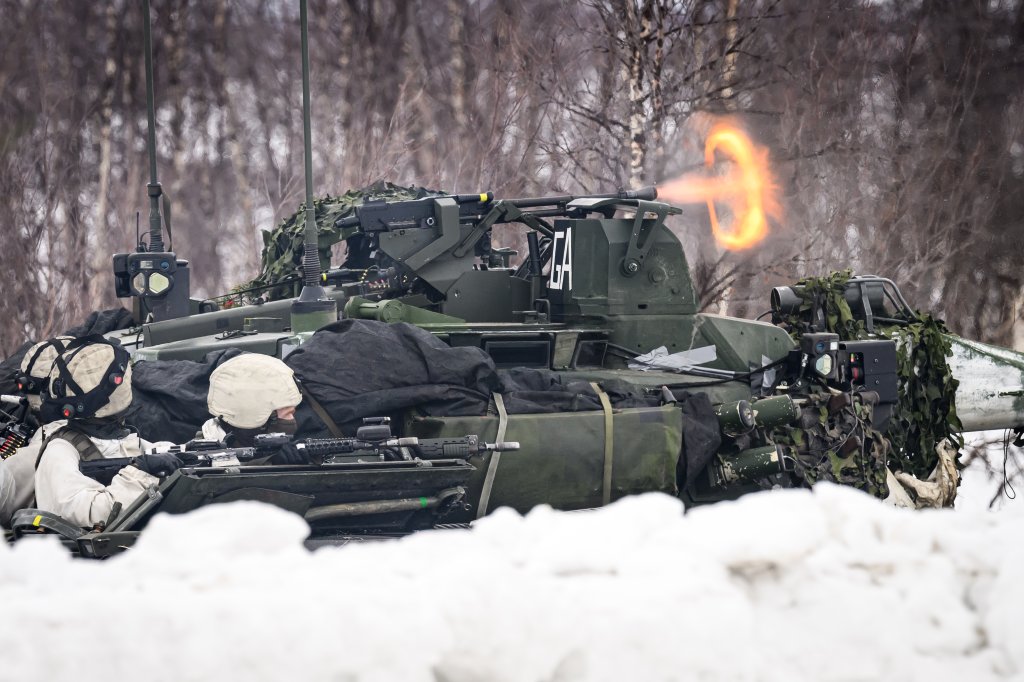
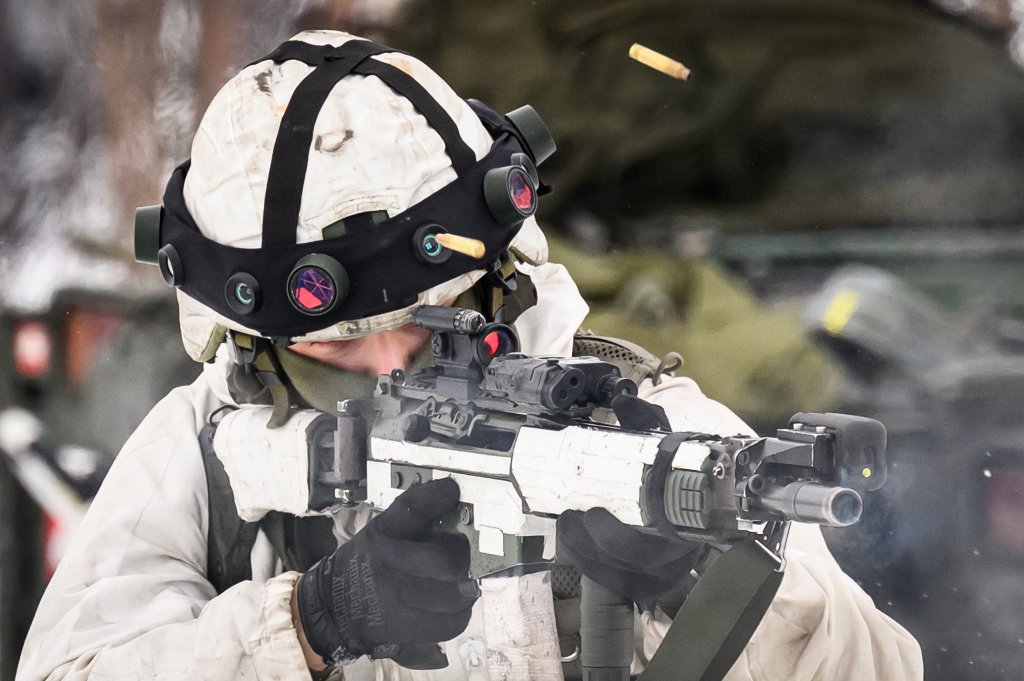
Swedish soldiers take part in training on the Finland/Norway border during the Nordic Response military exercise on March 09, 2024 in Kivilompolo, Finland. (Photo by Leon Neal/Getty Images) LEON NEAL
Russia appears to be investing in infrastructure in preparation of such a contingency. A joint report by several Nordic and Baltic media outlets published earlier this week has found that Russia is expanding military facilities along its borders with Norway and Finland to accommodate tens of thousands of new troops.
“New satellite images show that Russia is increasing its armament in [the] vicinity,” the report stated. “SVT, together with media partners in several countries, has examined how Russia is preparing for 80,000 soldiers… It is a threat that we should take seriously, says Thomas Nilsson, head of Sweden’s military intelligence service (MUST).”
The images “show new barracks for thousands of soldiers, long lines of military vehicles and ammunition storage,” the report further noted. “All winter, Russia has been building new military structures in several places on the other side of the Finnish border.”
“We expect to have 80,000 soldiers on our border and that can be compared to the fact that we previously had 20,000,” Finnish Army Chief Pasi Välimäki told the joint investigation.
A joint investigation by Nordic and Baltic media outlets found that these developments could enable Russia to deploy a force of up to 115,000 military personnel in the Northern European and Baltic regions. pic.twitter.com/ZiVpsP3fEz
A separate report by the Finnish Yle media outlet found that the Russians are expanding a base in the town of Novaya Vilga to hold as many as 6,000 Russian troops. It is located about 100 miles east of the Finnish border.
Breaking News: Where exactly is Russia building its massive new military garrison?
“NATO has monitored a buildup of military infrastructure in Russia along NATO’s Eastern Flank, particularly along Finland’s border,” the NATO official told us earlier this week. “The real question is what becomes of the infrastructure? Will, for example, Russian troops now in Ukraine be relocated there after the war? It’s something we certainly need to consider, and we do.”
“That’s why NATO and nations are working to deliver real military capabilities to the alliance now, not five to ten years from now, which is so very, very important,” the official added.
A Swedish soldier takes part in a training exercise during the Nordic Response military exercise on March 09, 2024, in Kivilompolo, Finland. LEON NEAL
One of those efforts, as we noted earlier in this story, was stood up on Saturday, involving NATO’s two newest members.
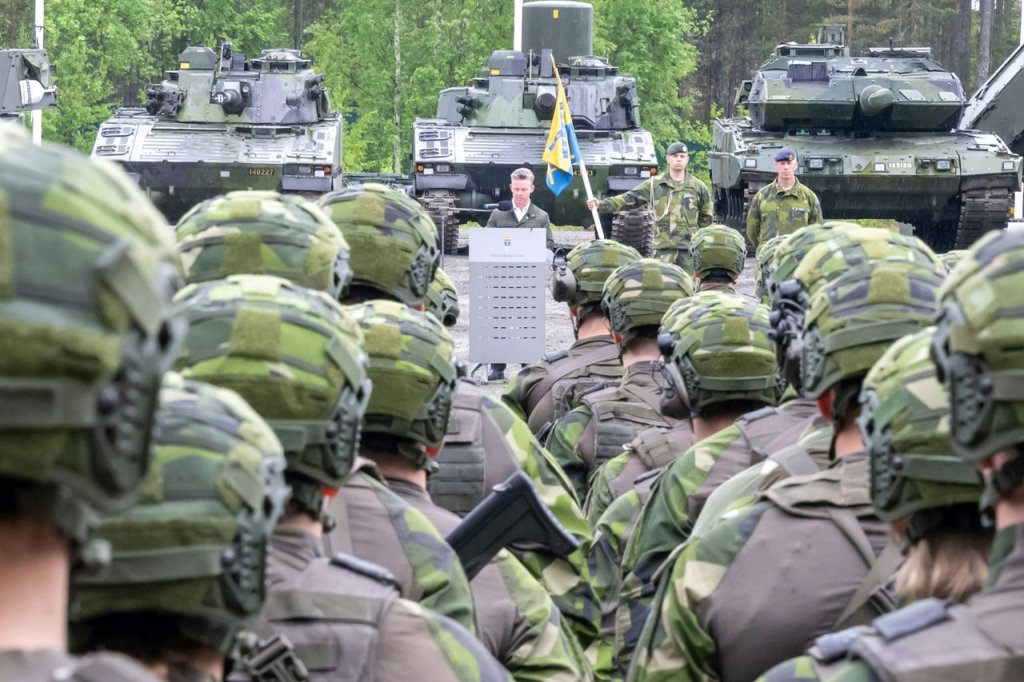
NATO’s Forward Land Forces (FLF) Finland began operations in Finland and Sweden, according to the alliance. The FLF will include NATO’s newest multinational battlegroup, led by Sweden, “to support the defense of NATO’s northeastern flank.”
The establishment of FLF Finland places a Swedish battlegroup based in Boden, Sweden, and a Multinational Staff Element in Rovaniemi, Finland, under the command of the Supreme Allied Commander Europe (SACEUR) and NATO.
The NATO Forward Land Forces Finland (FLF) was established on June 6, 2026. (NATO Photo by OR-7 Dennis Sattler) MSgt OR-7 Dennis Sattler; DEU Army
“Sweden is contributing a battalion battlegroup that, together with a Multinational Staff Element in Rovaniemi, will form the core of FLF Finland,” NATO added. “The Swedish battalion battlegroup is prepositioned in Boden, with capacity to operate in the North Calotte and, where necessary, rapidly reinforce the presence in northern Finland. In 2026, Sweden’s contribution to FLF Finland will total around 600 personnel, with the option to expand to 1,200 personnel if needed.”
“This region is one of the most strategically significant and environmentally challenging areas in the world,” said U.S. Air Force Gen. and SACEUR Alexus G. Grynkewich. “FLF Finland, just like Arctic Sentry, will leverage NATO’s strength to defend our territory and ensure the Arctic and High North remains secure, especially considering Russia’s military activity and China’s growing interest there.”
The U.S. too is working to improve its presence and operations in the region. During last month’s SOF Week symposium in Tampa, Florida, the head of U.S. Northern Command (NORTHCOM) announced the formation of Nordic Bridge to “tie together” the work of U.S. European Command, North American Aerospace Defense Command (NORAD) and SACEUR.
Air Force Gen. Gregory Guillot provided no real details about Nordic Bridge at the time, so we reached out to NORTHCOM for additional details.
“The Nordic Bridge concept seeks to enhance Arctic integration between U.S. Northern Command and U.S. European Command and enhance cooperation between NORAD and NATO in order to expand domain awareness, strengthen deterrence, and improve interoperability,” a NORTHCOM spokesperson told us last month. “It envisions increased participation in each other’s training and exercises, increased data sharing (such as air pictures), deconflicting conferences to maximize personnel availability and participation, etc.”
Last month, Guillot visited Grynkewich “to discuss opportunities under this concept,” the NORTHCOM spokesperson told us.
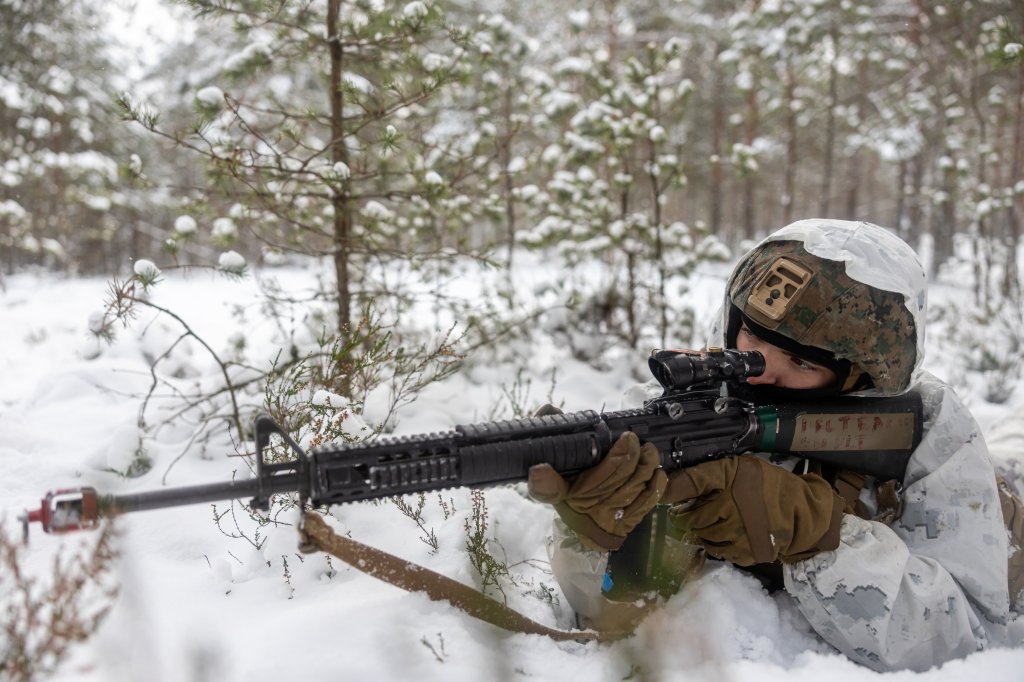
U.S. Marine Corps Lance Cpl. Thomas Teague, a motor vehicle operator assigned to Combat Logistics Battalion 6, Combat Logistics Regiment 2, 2nd Marine Logistics Group, provides security for a convoy during offensive and defensive operations in Syndalen, Finland during exercise Freezing Winds 23 (FW23), Nov. 30, 2023. (U.S. Marine Corps photo by Lance Cpl. Christian Salazar) Cpl. Christian Salazar
All this is taking place, of course, against the backdrop of President Donald Trump’s frequent insistence that the U.S. subsume Greenland to provide better Arctic protection for the U.S. homeland. The issue reached a fever pitch earlier this year, causing a serious rift with NATO after the president threatened to invade the world’s largest island. You can read more about that in our story about the crisis here.
While there are no indications that the Arctic region is about to break out into open conflict, there are several indications that Russia, NATO and the U.S. are increasing preparations for such an eventuality.
Ce vendredi 12 juin, le Pacte européen asile et immigration est entré en application dans les pays membres. Ce texte, adopté en 2024, a pour objectif d'établir un système d'asile commun aux États de l'Union européenne. Une réforme qui durcit les conditions d'entrée et de séjour des personnes étrangères à laquelle s'opposent plusieurs acteurs du milieu. L'entrée en vigueur du Pacte a plusieurs conséquences décriées sur les demandeurs d'asile en France.
In a significant development for Europe’s future air combat ambitions, Airbus is trying to restart the program to develop a sixth-generation combat jet, now under German and Spanish leadership. This comes less than a week after the Franco-German-led New Generation Fighter (NGF) effort effectively collapsed in its original form, amid acrimony between Paris and Berlin. The NGF was planned as the crewed centerpiece of the pan-European Future Combat Air System (FCAS), which Airbus, as the leading European aerospace corporation, now hopes to get back on track.
An exciting step for European sovereignty at ILA Berlin: "Team Gen 6", a group of eight leading German defence and aviation companies signed a strategic positioning paper. The German and French governments have announced a realignment of the European Future Combat Air System… pic.twitter.com/aZcjAaO6dE
Airbus’s Defense and Space unit launched the ‘Team Gen 6’ initiative today with a message on X, declaring that it was “an exciting step for European sovereignty.” So far, eight German defense and aerospace contractors have signed a strategic positioning paper as part of the effort. Those firms are Autoflug, Diehl Defense, Hensoldt, Liebherr, MBDA Germany, MTU Aero Engines, and Rohde and Schwarz.
Reflecting the German-Spanish nature of the new program, those companies are now “closely integrated” with firms from Spain, comprising GMV, Grupo Oesia, Indra, ITP Aero, and Sener.
“While the development of the overarching [FCAS] ‘system of systems’ is progressing as before, the sixth-generation fighter aircraft integrated within it requires a new, agile industrial setup,” Airbus said.
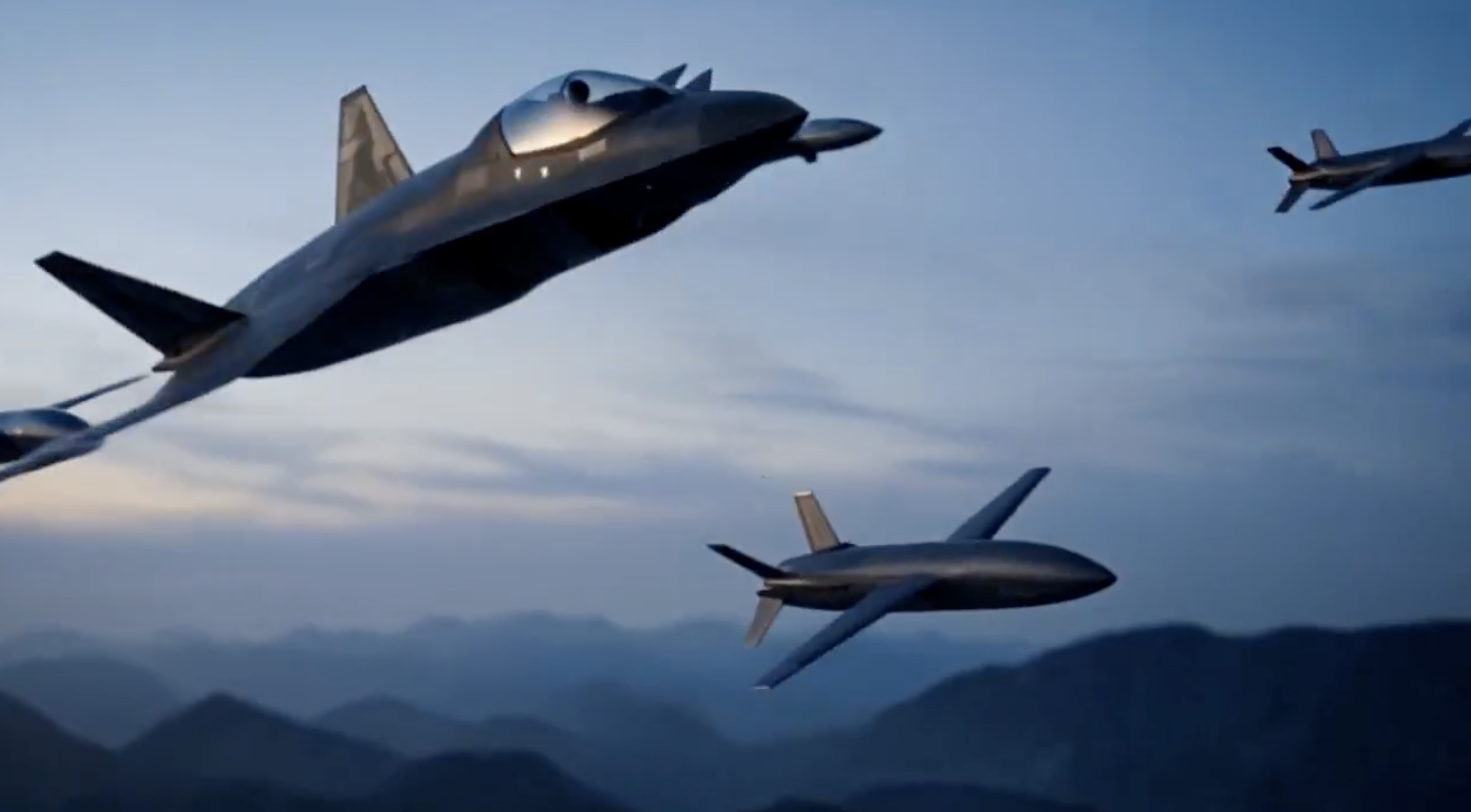
A screencap from an Airbus video showing a notional future fighter working with remote-carrier-type drones. Airbus screencap
“As Team Gen 6, we have the capabilities and the capacities. Now, we are looking for close alignment with policymakers and the air force[s] to drive forward a superior European air combat system for collective security,” the X post stated.
Airbus also presented a video showing a notional concept aircraft flying with multiple uncrewed platforms. While not too much (as in not much at all) should be read into this, the crewed aircraft features canard foreplanes, a chin intake, and an unusual cranked wing.
Speaking just ahead of the announcement, at the ILA Berlin airshow today, where TWZ was in attendance, Jean-Brice Dumont, head of air power at Airbus Defense and Space, said the company remains committed to delivering a sixth-generation combat jet. “There is a need for a bit of a reshaping and reconsidering the reality of today,” Dumont added.
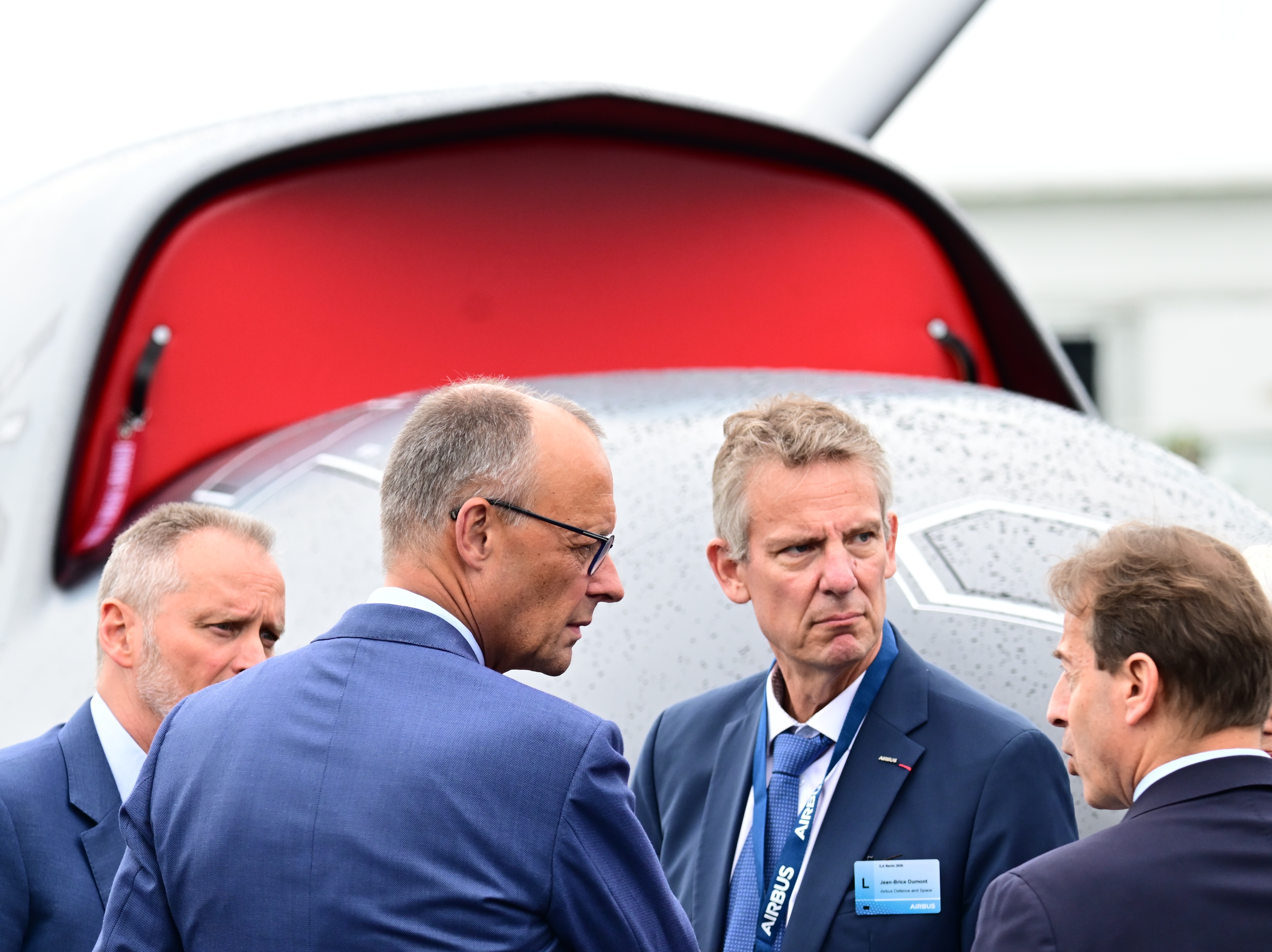
German Federal Chancellor Friedrich Merz (second from left) and Jean-Brice Dumont (second from right), head of air power at Airbus Defense and Space, stand in front of a drone during a tour of the International Aerospace Exhibition (ILA). Photo by Sebastian Gollnow/picture alliance via Getty Images
Dumont explained that the now-abandoned NGF was one of seven separate “pillars” of technology development being worked on under FCAS. As well as the crewed jet, pillars include powerplant, remote carrier vehicles, precision-guided weapons, and data connectivity.
“We have to consider safeguarding areas where it works, and how we reshape,” he added. “At the moment, we are going to seek guidance from our governments [on] what they want us to do. There has to be demonstrated an industrial feasibility of what is being asked — not only technical. That’s probably a lesson now,” Dumont added.
Dumont continued: “The world in 2026 is very different to the world of 2017 when the [FCAS] programme was launched. We have to accept that fact and reshape it — we need another way to get to the same goal, with faster milestones.”
“The problem we had is that we had drawn a line to 2040, and new technologies for everything,” Dumont added, referring to the goal of having the FCAS, including the NGF, in service by that date. “Today, you see demonstrations of connectivity, systems of systems and unmanned vehicles all around the world. The need is there, and in the countries that we are competing with, they are using it already.”
According to Dumont, the company has “put a number of options on the desk of our ministers and ministries of defense,” and is now awaiting further guidance from officials.
As the centerpiece of FCAS, in its original form, the NGF element was the most high-profile and challenging component of the project. However, it had long been dogged by disagreements over industrial workshare and leadership between Airbus and Dassault Aviation, which were the prime contractors for Germany and Spain, and France, respectively.
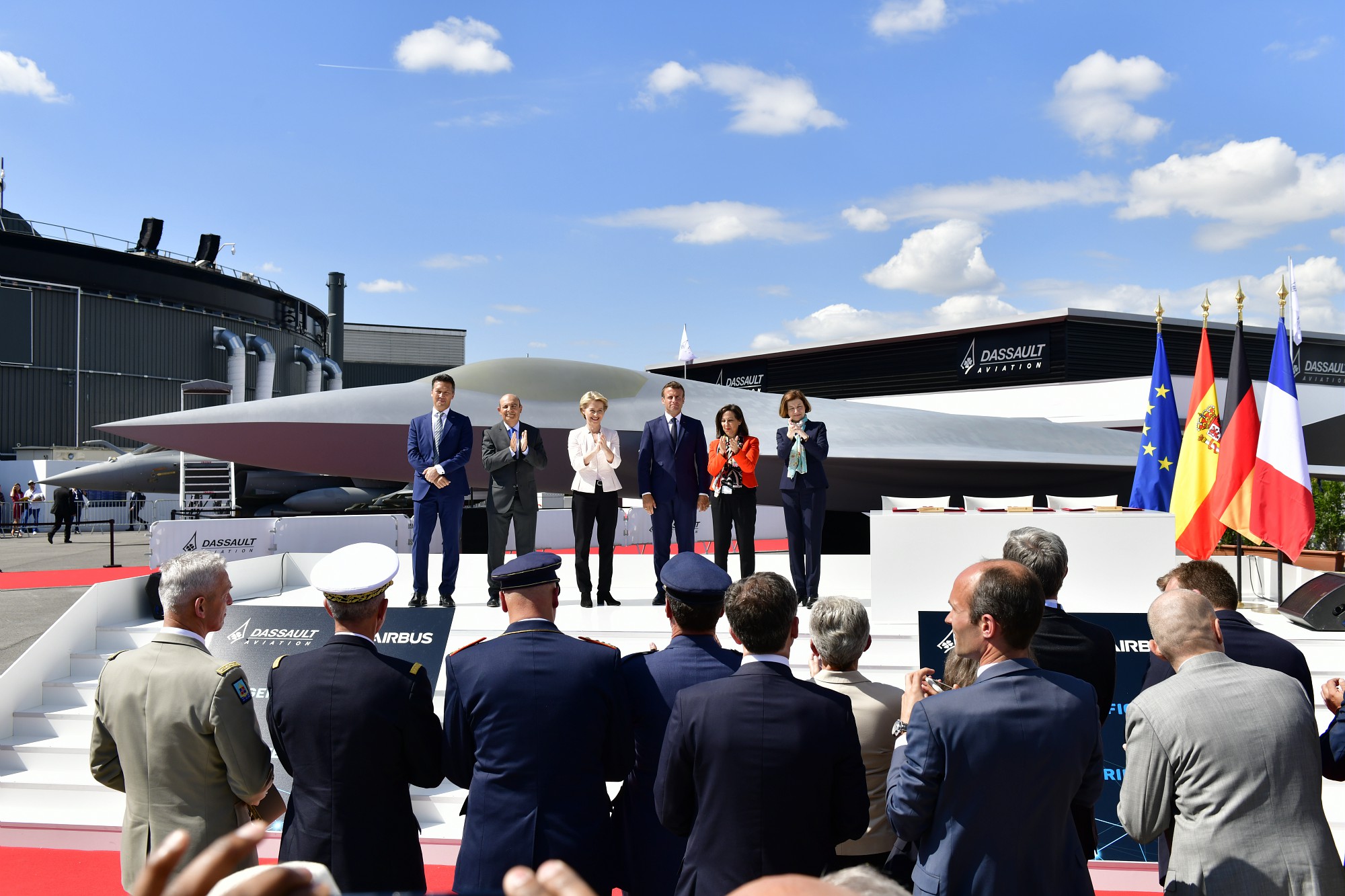
A 1:1 scale model of the NGF is unveiled at the Paris Airshow in 2019. Dassault Aviation
Dassault had demanded that it play the defining role in NGF, reflecting key requirements for the jet driven by the French Armed Forces. These included the ability to operate from aircraft carriers, and provision to deliver nuclear weapons. Germany or Spain needed neither of these functions.
Despite the disagreements that derailed NGF, Dumont argued that there had still been useful lessons learned from the FCAS program.
“What Phase 1A and 1B [of the program] have given is a very thorough analysis of the repartition of the work between the crewed and uncrewed platforms, and this remains. That kind of shapes what the manned aircraft will have to do.”
As an example of this work, Dumont pointed to ongoing work that will involve trials of a Eurofighter operating as a “command fighter” — a crewed jet that can operate in collaboration with drones, or what Airbus now refers to as uncrewed collaborative combat aircraft (UCCAs). The tests will see a Eurofighter fitted with a Rafael Litening 5 targeting pod modified to serve as the interface between the crewed jet and UCCAs. This should pave the way toward an in-service command fighter capability being introduced to the Eurofighter, something that will be incorporated in the sixth-generation combat jet from the outset.
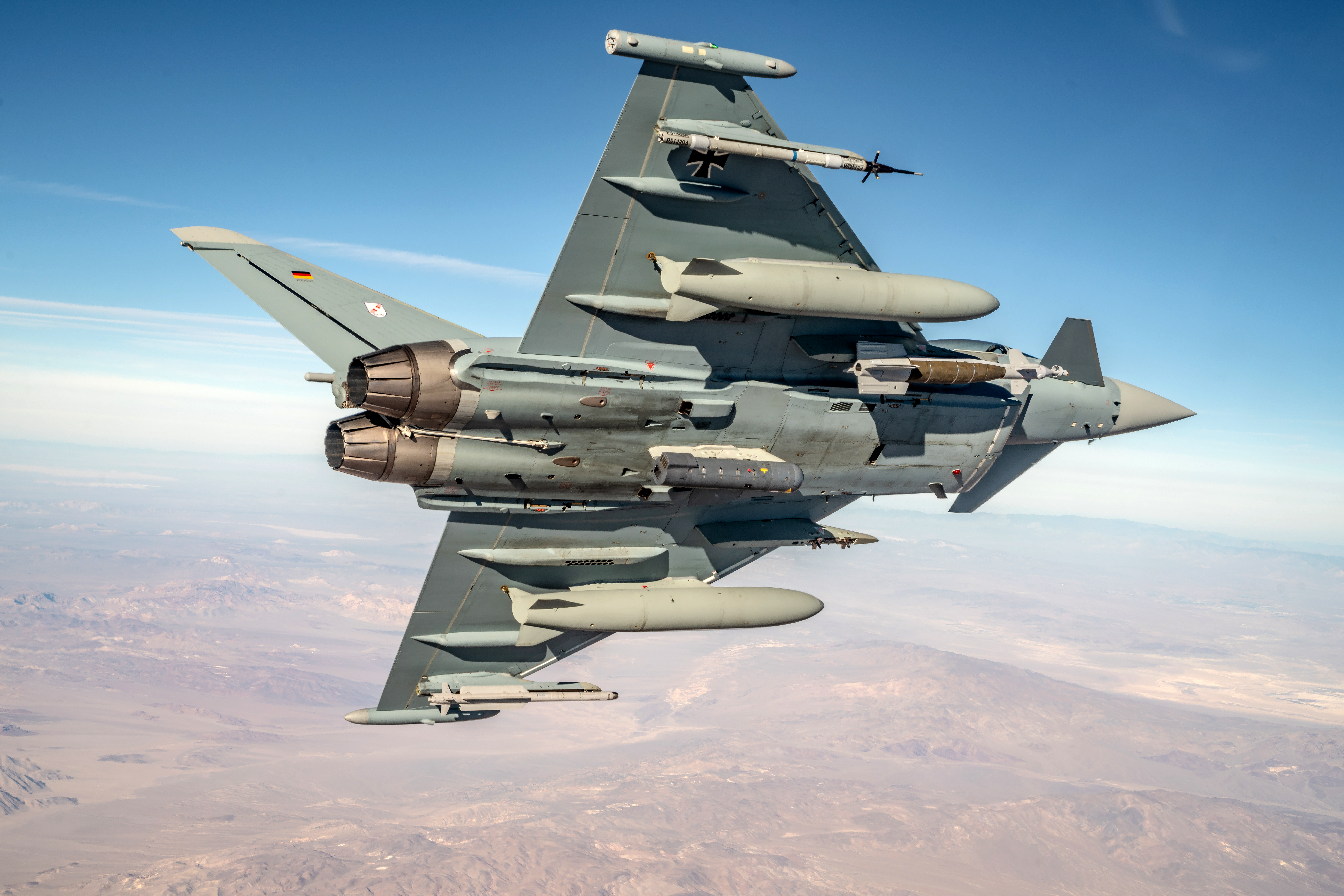
A German Eurofighter with a Litening laser targeting and reconnaissance pod on the centerline station. Crown Copyright
Initial trials will involve a Learjet test configured as a surrogate command fighter and flying with drones in an “enhanced teaming” mode. Airbus hopes to have the command fighter-configured Eurofighter ready for operational service in 2029.
“The demand from the customers is: be ready early,” Dumont explained. “This is not a contradiction to the Future Combat Air System challenge — it is the need to have our platforms evolved earlier than we had traditionally planned.”
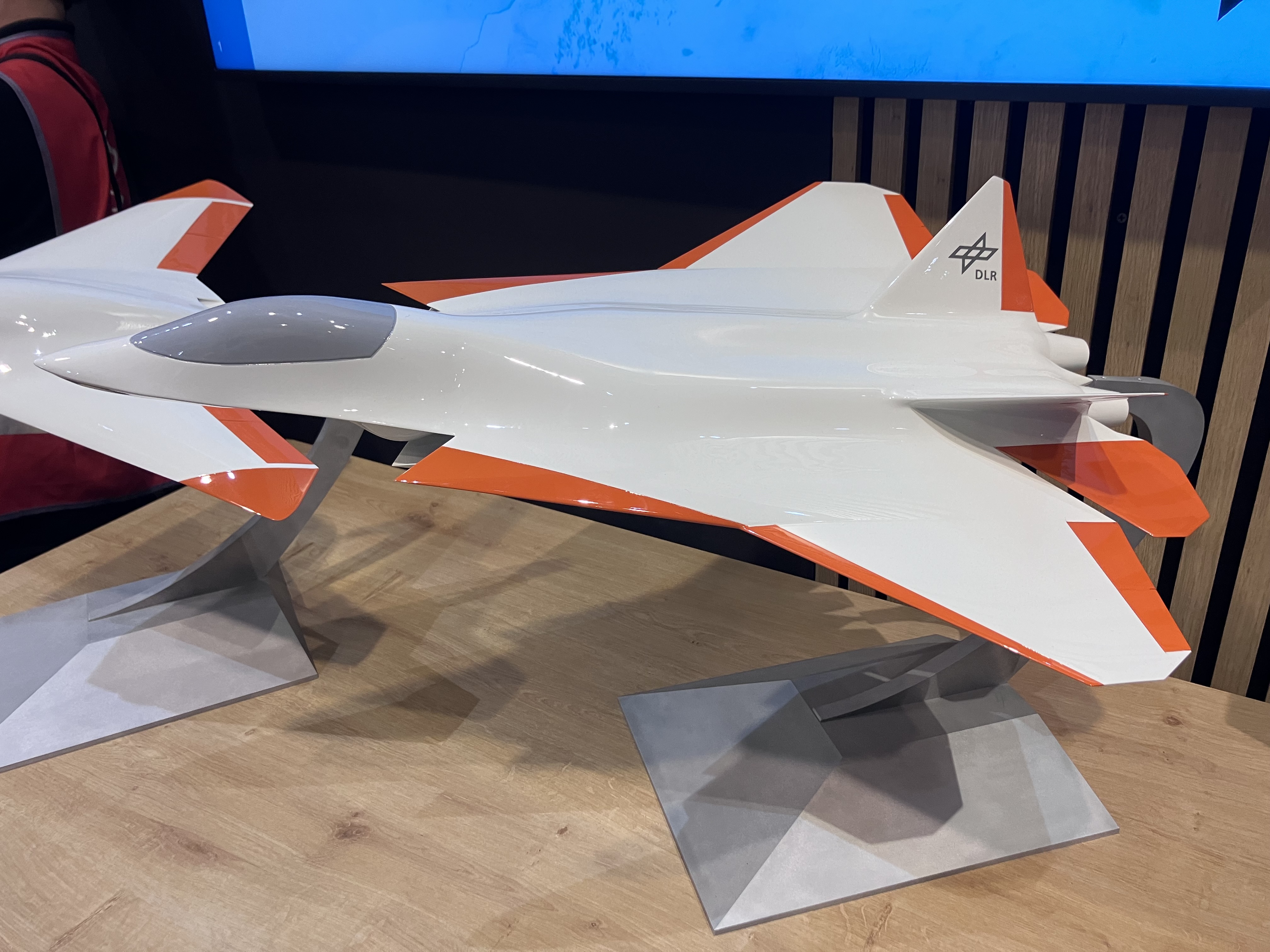
A model of a notional sixth-generation fighter displayed at ILA as part of a command fighter study by the German Aerospace Center (DLR). Thomas Newdick
The termination of NGF and the launch of Team Gen 6 leaves plenty of questions over the future of Europe’s air combat landscape.
TWZ spoke to Douglas Barrie, senior fellow for military aerospace at the International Institute for Strategic Studies (IISS) research institute in London, for his take on what might happen next.
On the matter of Germany and Spain now teaming up under the Airbus umbrella, Barrie said that the relationship makes a lot of sense, but its success is far from certain. On the one hand, the two countries already work together within Airbus, and both Germany and Spain are seeking a replacement for their Eurofighter fleets.
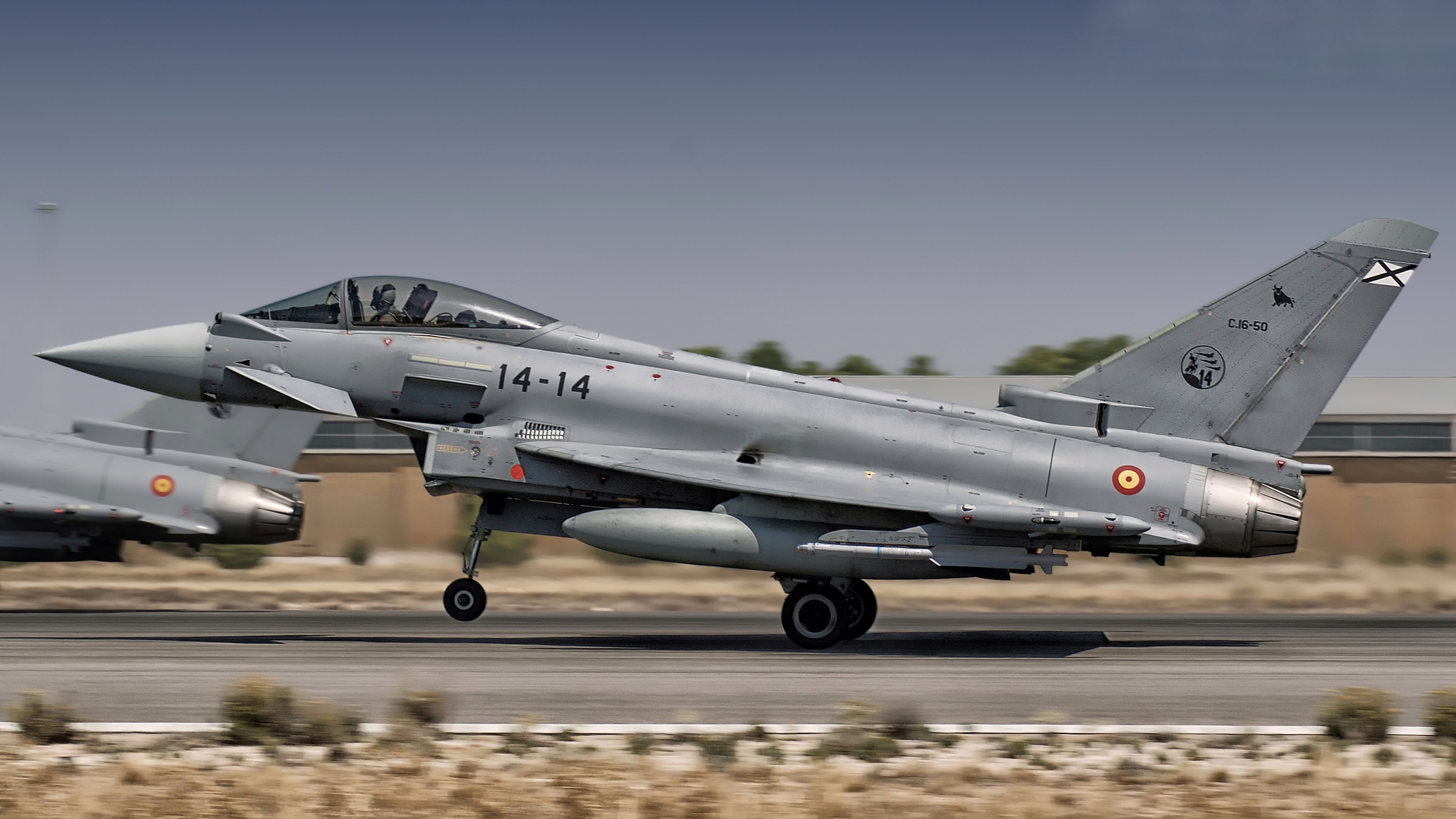
A pair of Spanish Air and Space Force Eurofighters. Spanish Ministry of Defense
“In terms of Team Gen 6, I do wonder if there’s an element of trying to kind of scramble to recover something from the wreckage of NGF, as it were, that the collapse of NGF doesn’t signal the end of Spanish industrial interest in next-gen combat aircraft development,” Barrie said. “But if somebody asked me, do I think between Germany and Spain, they can put together a credible program if nobody else is involved? I think that the numbers would be very difficult to stack up.”
Putting the German and Spanish future fighter requirements together, the two countries might, at best, need to build 300 new combat jets, with a figure of 250 more likely, Barrie contended. Team Gen 6 would then face a real struggle to break even.
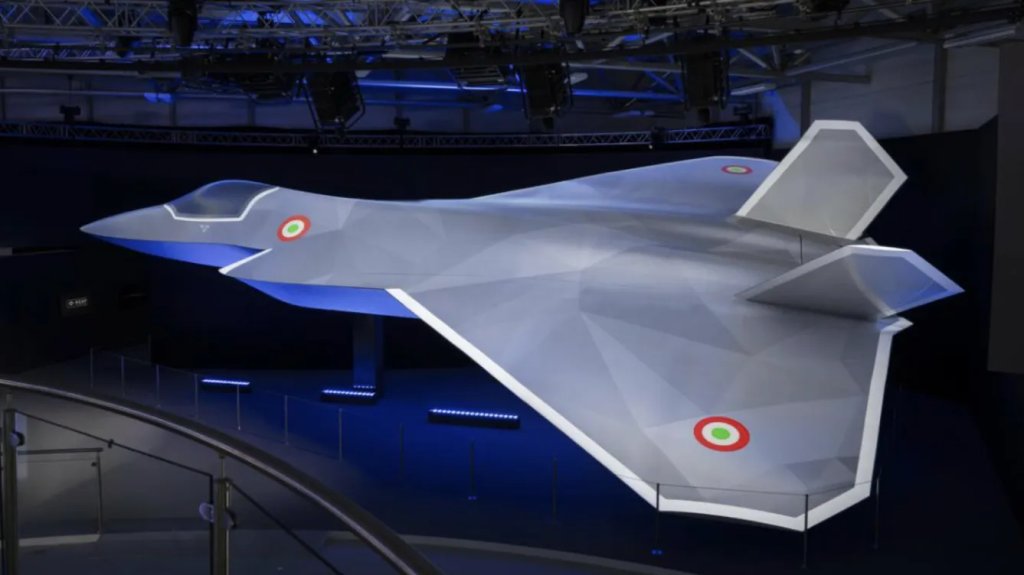
This reality will, Barrie believes, force Germany and Spain to look for other partners, which will likely come down to a choice between the British-led Global Combat Air Program (GCAP) and the Swedish next-generation combat aircraft program, led by Saab. Of these, GCAP has the Tempest crewed fighter as its centerpiece, and also involves Italy and Japan. Sweden’s crewed fighter requirements are less clear at this point.
A scale model of a possible Tempest configuration, in Italian Air Force markings. Leonardo
Building a role for Airbus in GCAP would be difficult at this point. With the industrial architecture already in place, bringing not one, but two more partners into that program would be disruptive, particularly in terms of timeline. Already, the Japanese in particular are concerned about the pace of the program, especially since the United Kingdom has not yet fully committed to it in terms of funding.
“My own view is that the United Kingdom remains committed to the program, but there are financial pressures elsewhere,” Barrie noted. “I think that the more likely outcome in all of this is a kind of German, Spanish, Swedish tie-up. The kind of requirements in some ways are aligned a bit better.”
This extends to the size of the aircraft, Barrie observed.
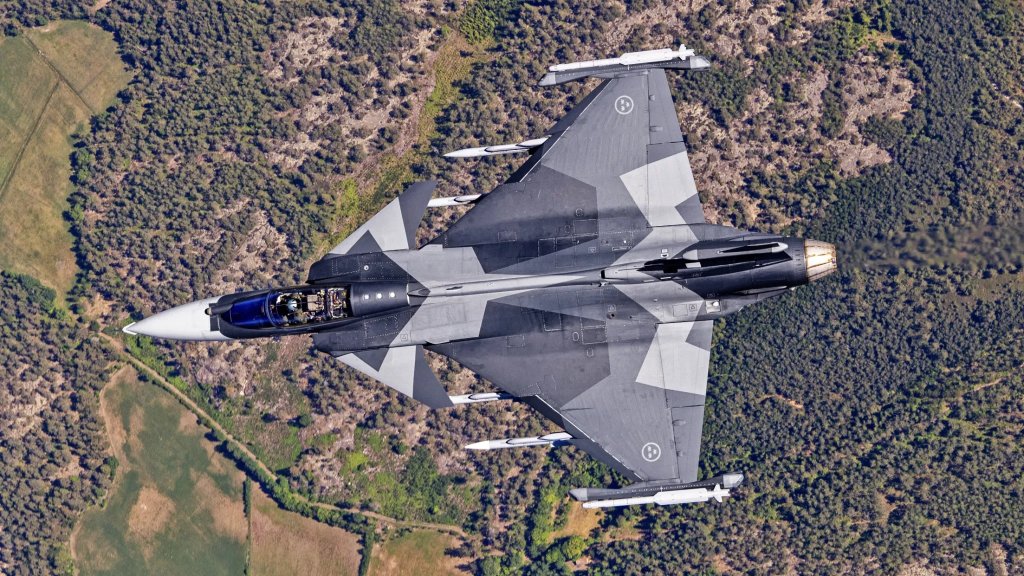
“The kind of aircraft that the Swedes seem to be thinking about, the crewed element is probably more of a bigger Gripen E/F, heading towards Typhoon, in terms of size. This is more in keeping with what the Germans and the Spanish seem to be looking for. Obviously, the United Kingdom and Japan, in particular, need something with longer legs and bigger internal payload, hence GCAP.”
The Saab Gripen E. Saab
“GCAP will be highly capable,” Barrie continued. “That will come with a unit cost to go with it. Maybe what the Swedes, the Germans, and the Spanish might do will be cheaper.”
Provided a German, Spanish, Swedish teaming arrangement could work, the resulting combat jet could still enter a space where it would face competition for important export orders from France, which looks set to continue the development of the Rafale, especially now that NGF has collapsed. Further competition could be provided by South Korea with further developments of its KF-21 and Turkey with the TF Kaan, although these are notably less-ambitious fifth-generation designs.
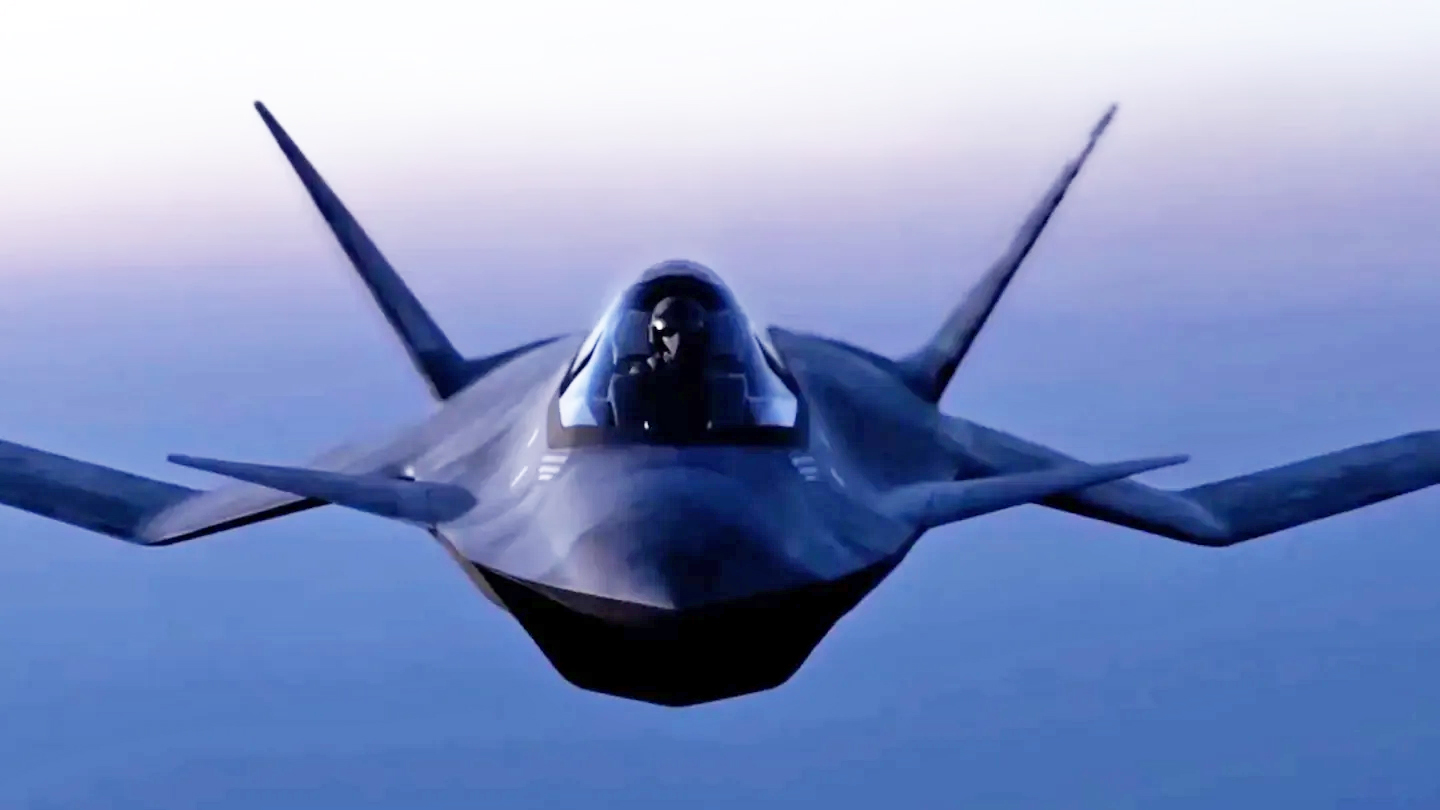
The Tempest, as currently envisaged, with its very different set of requirements, would not necessarily be a direct competitor to Team Gen 6, Barrie argued, since it would be a closer match to the F-47 in terms of size, capabilities, and cost. While the potential size of this market would be more limited, probably U.S. reluctance to export the F-47 would play in the Tempest’s favor.
An official rendering of the Boeing F-47. U.S. Air Force
As to the possibility of the United States offering a ‘watered-down’ export model of the F-47, Barrie considers this unlikely to generate much interest.
“Yeah, you can have a downgraded version of my super airplane — as a kind of marketing slug that hardly sells, does it?” Barrie continued. “Even if it’s 10 percent less capable, even if it’s 10 percent less expensive, it’s still a likely unit cost of $250 million or more, which is eye-watering.”
This leaves us with the French, and what they might be able to recover from NGF.
If France goes it alone with a sixth-generation combat jet, Dassault will likely be strongly backed by the French government, and the company has traditionally punched well above its weight.
In the medium term, Dassault has a healthy backlog of orders for the Rafale and is very much at the right end of the cost curve. Barrie considers that the Rafale will remain a profitable airplane for the foreseeable future, but at some point, France will need to think about a successor based on an all-new airframe. Industrially, France has the capability to go alone with this, but they would likely look to a partner or partners to come on board. The likelihood of those partners coming from Europe has now been reduced, but other possibilities might be found in the Gulf states.
A pair of Rafales from the Qatar Emiri Air Force. Dassault Aviation www.twz.com
Then there is the question of India, which may still buy more Rafales but which, in the fullness of time, is likely to look for a new-generation fighter, and could be a potential partner for France.
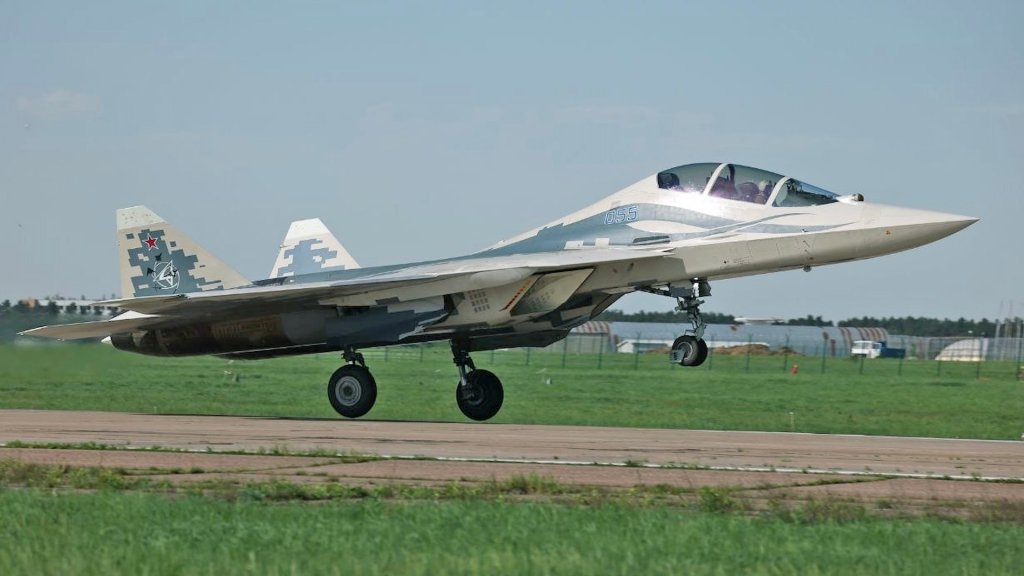
“I don’t see the Indians ever being fully committed to only one country,” Barrie continued. India has already hinted that it might want to try and join the pan-European FCAS or GCAP. Meanwhile, Russia has been a long-term military partner for India, and Barrie thinks that the recent appearance of a two-seat version of the Su-57 Felon may well indicate another effort to sell that fighter to India.
The previously unknown two-seat version of the Sukhoi Su-57 Felon, which appeared earlier this year. UAC UAC
Were India to continue its pattern of buying Russian combat aircraft, that would give any potential European partner serious pause for thought, based on the security implications. Meanwhile, India also remains committed to developing its own next-generation fighter.
What the NGF debacle has demonstrated is that any potential partner with France on its next-generation combat aircraft program will likely have to be happy taking a junior role, with Dassault calling the shots.
The collapse of the New Generation Fighter could well be a pivotal moment for European defense cooperation, but it does not signal the end of Europe’s sixth-generation combat aircraft ambitions.
Airbus’s Team Gen 6 announcement marks the start of a German-Spanish-led industrial approach that its backers hope will be more agile and less contested than its Franco-German-led predecessor. However, significant political, financial, and industrial challenges remain, including the search for a reliable partner, or partners. As with NGF, the success of Team Gen 6 will ultimately depend on whether European governments can align their strategic priorities and industrial interests to deliver a sovereign future air combat capability.
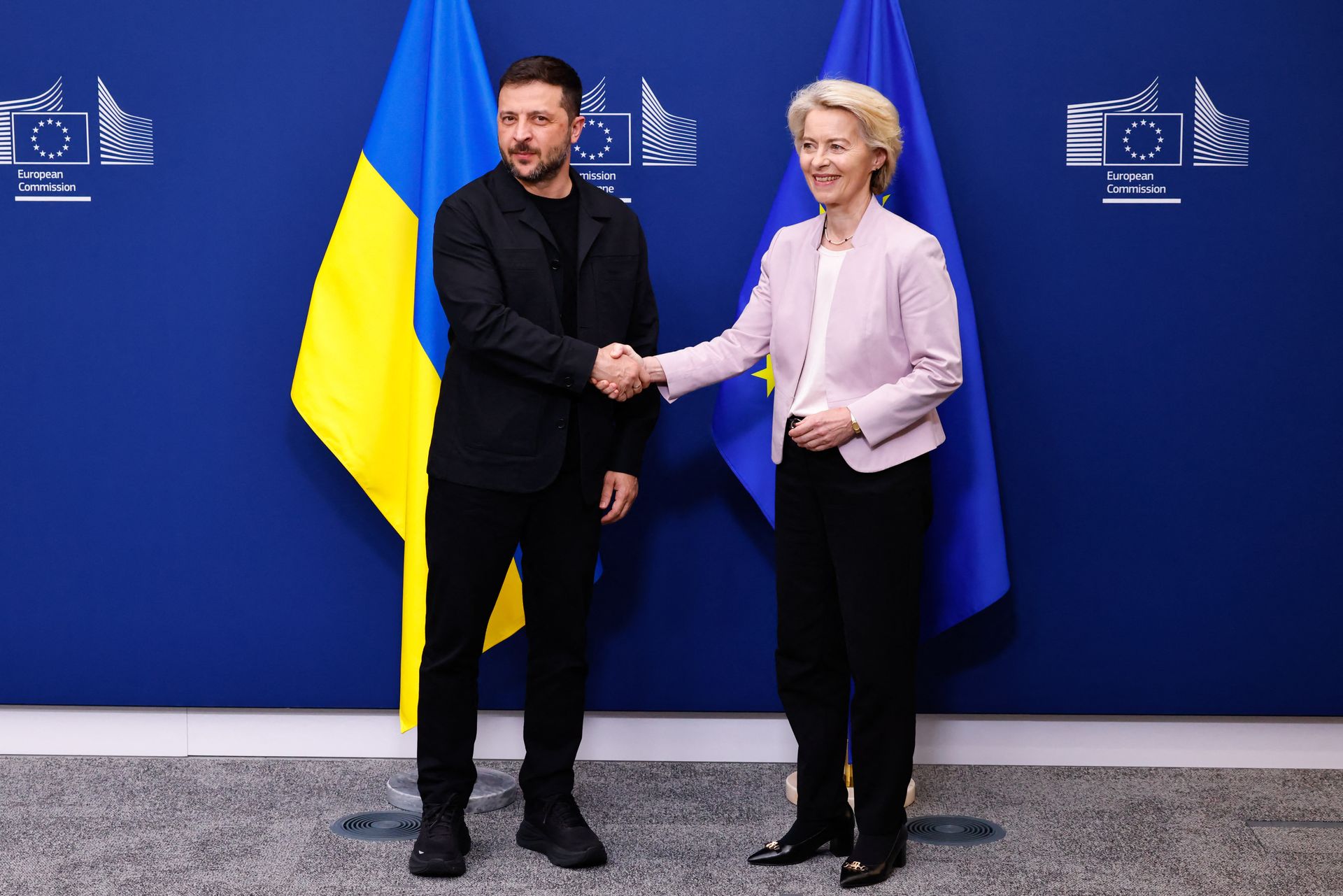
"We will open the cluster on fundamentals; the backbone of the accession process," European Commission President Ursula von der Leyen said on June 12. "It covers the core values and principles on which the EU is built, from the rule of law to strong democratic institutions."
A federal judge has agreed to extend a court-ordered block on the Trump administration’s creation and operation of a $1.8 billion settlement fund for compensating people who claim to be victims of a weaponized government
The election of the Hungary's new centre-right prime minister, Peter Magyar, in April marked a particularly stinging defeat for Viktor Orban, whose government was widely regarded as one of the most anti-LGBTQ in the EU. Rights advocates expect legal changes but wonder about the timeline Magyar will adopt as the new prime minister remains cautious on divisive issues.

 Login
Login