
Reading view

Torture, abuse, sexual violence: Freed Gaza flotilla activists speak

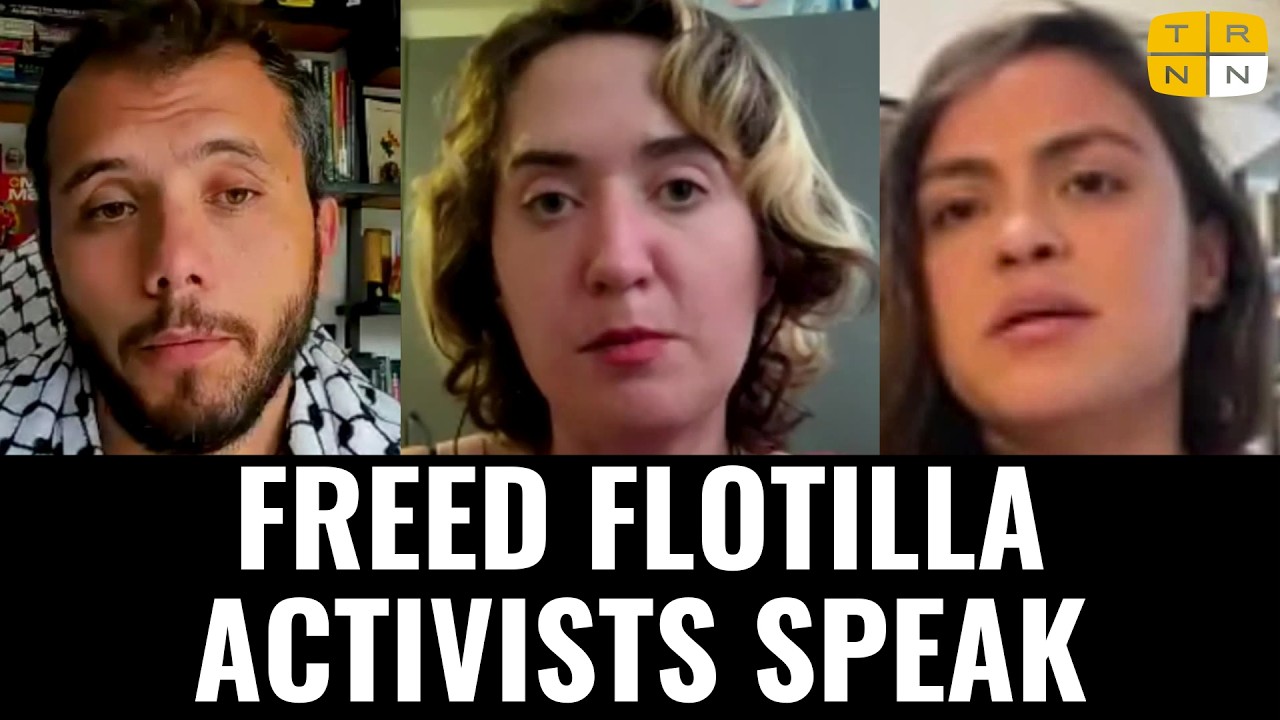
Screenshot via TRNN

Israeli military forces captured the latest convoy of humanitarian aid ships sailing to Gaza with the Global Sumud Flotilla (GSM) between late April and mid-May. Activists who were imprisoned by Israel for days and eventually deported have reported harrowing treatment by their captors, including targeted torture, abuse, broken bones, unauthorized injections of undisclosed substances, and sexual violence by Israeli soldiers. We speak with a panel of freed GSM participants—Thiago Ávila, Catríona Graham, and Ariadne Teles—about what they saw and endured, and about the successes, defeats, and future of the movement to break Israel’s siege on Gaza.

Guests:

  • Thiago Ávila is a member of the Global Sumud Flotilla Steering Committee who was abducted in international waters by the Israelis in late April off the coast of the Greek Island of Crete. At the time, Ávila was one of two Flotilla participants and leaders forcibly transported to Israel where he was held as a political prisoner for 10 days.
  • Catríona Graham is a member of the Irish delegation who sailed with the most recent voyage of the Global Sumud Flotilla. While being detained by Israel, Graham shouted “Free Palestine” in Itamar Ben-Gvir’s face and was subsequently shoved down to the floor.
  • Ariadne Telles, is a member of the Brazilian delegation who sailed with the most recent voyage of the Global Sumud Flotilla and who also experienced abuse while detained by Israel.

Credits:

  • Producer / Videographer / Editor: David Hebden
Transcript

The following rushed transcript may contain errors. It will be updated as soon as possible.

Maximillian Alvarez:

Welcome back to The Real News Network. I’m Maximillian Alvarez. After 78 years of occupation and ethnic cleansing in historic Palestine and after three years of all out genocide in Gaza, Israel’s government and military continued to display to the world what it looks like when a settler colonial ethnationalist and increasingly and openly fascist regime is openly allowed to rule and operate and slaughter and bomb with geopolitical impunity and without any accountability to international law, reason or human morality. This has been on full display from Israel’s continued ethnic cleansing of Gaza in the occupied West Bank, regardless of the so- called ceasefire that’s supposed to be in effect, to Israel’s aggression and reckless violence in Iran and Lebanon to its illegal abductions and torture of peace activists sailing with the global Samud Flotilla to break the siege of Gaza and bring lifesaving aid to Palestinians. And the latest convoy of the humanitarian age ships was intercepted by Israeli forces in late April and in early May.

And activists sailing with the global Samuel Flotilla were captured in prison for days in Israel and eventually deported. But the testimonies and affidavits coming from flotilla members who have been released are frankly horrific. They describe days of targeted torture, abuse, broken bones, unauthorized injections of undisclosed substances and sexual violence by Israeli soldiers. And these stories along with the viral videos of Israeli national security minister, Itmar Ben Gavier, taunting detained flotilla activists and the videos showing Basque police officers violently beating flotilla activists returning to Spain at Bilbao Airport have rightly sparked global outrage. And as we always do here at the real news, we’re going to take you to the front lines of this struggle so that you can hear directly from folks at the center of it. And I am really grateful to be joined today by three guests. Tiago Avila is a member of the Global Samuel Flotilla Steering Committee who was abducted in international waters by the Israelis in late April off the coast of the Greek island of Crete.

At the time, Avila was one of two Flotilla participants and leaders forcibly transported to Israel where he was held as a political prisoner for 10 days. We are also joined by Katrina Graham. The Flotilla activists who while being detained by Israel shouted free Palestine in Benjavier’s face and was subsequently shoved down to the floor and the video that Ben Gavier posted of that exchange has gone globally viral. And we are also joined today by Ariaj Nitelis, a global Samud Flotilla participant who also experienced abuse during this latest round of detentions. Thank you all so much for joining me today. I really appreciate it. And I want to start by just going around the table and giving y’all the floor. And I want to ask if you can describe for viewers and listeners what you yourself experienced on this latest mission with the Global Samud Flotilla from the time that you set sail to now.

Catríona Graham:

So for myself, I was sailing from the Italy port and it was a few smooth days of sailing. And then shockingly, we were intercepted on the waters just off Crete, which really spoke to us. Usually we have what we call this orange zone, which is just much, much closer to Gaza waters. But this time the IOF came all the way into European waters for the interception, which I think speaks to how the Greater Israel Project is not only being seen as being taken into Lebanon, but also right across the Mediterranean. We were kidnapped in the open seas illegally and we were held in detention on a makeshift prison vote for two nights. After being released into Crete, we continued on our mission and we sailed to Marmorous and then set sail towards the shores of Gaza, where once again, we were intercepted illegally in international waters.

The first time we were about 145 participants that were kidnapped and detained and the second was over 420 participants. We were subjected to extreme violence. I think it was very clear there is a marked escalation. This was the third time that I had been kidnapped also with the 2025 mission with the global smooth flotilla. And each time there’s been a marked increase in aggression, the scale of aggression, the extent. This time, as soon as the IOF rib was approaching the boat I was on, they started firing rubber bullets immediately. They pulled somebody out and subjected them to violence to having their hands cable tied to blindfolding and from there the violence continued to escalate. Within 20 minutes of being put on a prison boat, one of the others already on the boat was shot with a pellet gun. She did not have adequate treatment until we arrived in Istanbul.

And while we were in the port at Ashdod and in Ketziak prison in the desert, we started to hear more and more accounts of the extent of violence, of people being tasered, people being stabbed, shootings, rape. So this really showed a marked increase in the kinds of violence, but we’re very clear that we were there for a few days, whereas there are still more than 9,600 Palestinian political prisoners and hostages being subjected to far worse forms of torture in Palestine right now.

Ariadne Teles:

Yeah, we suffer the same. I have a fist bone, a hand actually. My radial bone in the left end is fractured and I have smashed nerves. It’s just one of all the fractures that our volunteers have. We have people inject with substance like cats say it. We have testimony of people listening to the soldiers make pleasure noises when they are without clothes. So this experience was very different and like Kat say, they improve the violence and they improve the violence because they still in punity for all the crimes that they are committed with the Palestinian people and against the Flagilias and other things that we pass through is nothing. It’s not 0.01% of the Palestinian people facing every day. Actually now we have kids in the same position that we are days ago. So just when I was in the prison car that they used to transport us to the prison, to the porch, to the prison, I saw draws of a smiley face, a sad face, and I scared phrase drugs that obviously was made for a kid.

So everything that you saw in the videos, everything we talk about our experience in this moment that I saw the draws, I just feel that all the feelings that I have some kids was passing through this too. And we in our position, we know that we have people outside, we have lawyers, we have our governments and our investors trying to make something, but the Palestinian kids, the Palestinian people, the Palestinian hostage, they are kidnapped by Israel all these days until today and maybe now, actually certainly now, they don’t have anyone. They don’t know how long they are being in this prison.

I think that the world cannot allow anymore. It’s not because we like people Western people. I’m from Global South. I know the difference that European pasta pots had in our mission too, because they are very racist and we still have people struggle for us in outside and it’s because of this that we need to be stand with the Palestinian people too and we surfer all of these things, but how my comrade Casio from Brazilian delegation say our morality was intact. We have breaking bombs, we have injuries, we have people that are hated, but our morality and our conscience are very impacted and actually we are more strong. I came from Amazoni and the struggles are very similar in my place. My place was occupied with this slogan that we need people and lands that don’t have anyone like they said about Palestine for the creation of this so- called state.

So it’s the same struggle for lands and territory and we know that we need to continue because the future of Gaza is the future of the entire humanity and we from Global South. We know what is colonization, what is imperialism when we see and definitely this is the most cruel face of the colonization in our time and I think it’s our duty, historical jury in this time, you struggle against this until Palestine will be free and all the people can be free too.

Thiago Ávila:

Yeah. Thank you Ari. Thank you, Kat. Thank you Maximillian for bringing this important subject. I was part of the first interception on April the 29th along with 180 other people on 22 boats, over 30 other boats managed to get to Greek territorial waters and escape this illegal interception, 700 narcical miles from Gaza. From there, they were testing the waters and the methods of violations that they escalated a lot three weeks later against the second wave of our global smooth flotilla. We got intercepted and sent to a prison boat and that prison boat, there were many people assaulted, very precarious place where people were put. So many psychological violence, so many physical violence after that they transferred the people, transferred 179 people to a Greek boat and then to Greek, to Greece territory. But me and Saifa Bukeshek, Spanish, Swedish, Palestinian origin, were taken illegally and kidnapped, taken to occupied Palestine.

We were taken to Ashkall and prison to a interrogation and tortured facility from Shabbat, the Israeli internal intelligence. That was a very troubled moment as well because the first three days on the transit there, we were severely assaulted. I could barely see from my right eye because I was beaten up so hard. I passed out twice while being assaulted by them. They put ropes on my neck and said that now they were allowed legally to hang people. They pretended they would throw me from the boat. They did so many violations. They would put me in stressful positions for a long, long time. They would close so tight the handcuffs that until today it’s been more than a month and I still cannot feel this part of the palm of my hand. I don’t know if it’s ever coming back because there were obviously some nerve damage.

And then after that, in this 10 days in interrogation facility, they were saying that they would kill us or would put us for a hundred years imprisonment and there was torture everywhere. We were in solitary confinement, not the first time in other flotilla missions. I was already put in solitary confinement before, but this time it was more intense, like 18 hours interrogation some days, many court hearings where they would always try to extend, extend, extend the stay and would threaten all the time. They would question about every single aspect of life. They would show everyday photos of my wife and my baby and asking what the context of the photo was, but it was not like a photo from social media. So just to show that they had the capacity to spy and to do surveillance over our families, they did so many violations. But the problem is that despite all they did with us, the first group intercepted got severely beaten more than 30 people have to get hospitalized, but then in the second moment in May the 18th, they put not 30 people they put dozens and dozens and dozens of people to get hospitalized, 30 broken bones and a lot of people under severe violations.

And the problem is that despite all this that they did with us, we’ve seen and we heard they’re doing a lot worse with the Palestinians themselves. At the interrogation and tortured facility that I was for 10 days, my neighbors were Palestinians being tortured every day and every night. So the violations that they make us go through like losing a family member and not being able to say goodbye to them, Palestinians goes through every single day like Hussama Busafia, who’s been more than 500 days being tortured in Israeli dungeons, also lost his mother like me and could not say goodbye to her. Marijuan Barguti has been arrested for so long, also lost family members, could never say goodbye to them. So the problem is that they violate international people because they only don’t do the same that they do to Palestinians because of the political cost that it has, but they wanted to do the same because they are say this.

This is a fascist supremacist regime and that needs to be defeated. But the reason why they don’t do is because they cannot pay the political cost, but they dehumanize Palestinians so much that with Palestinians, they believe they can pay the political costs. So that’s why they’ve been doing the most horrific things with the almost 10,000 Palestinians, almost 400 of them children under these Israeli dungeons. And it’s for them that we must scream and that we must keep on mobilizing.

Maximillian Alvarez:

Well, and I appreciate all three of you so much for sharing that with us. I know that there’s so much more to say and so much more that you and other members of the Flotilla have said, and I would just encourage folks out there, this is not private information. If you want to learn what these folks went through at the hands of Israel with the support of our government here in the United States, you can go listen to more of their testimonies. You can read these affidavits. It is horrific. And rather than just kind of going deeper into those horrific details, I want to use the remaining time that we have to sort of take a step back here because we’ve been covering these flotilla missions and speaking to participants for years, from union organizers like Chris Smalls to military veterans from the United States, part of different peace groups, all manner of folks who have joined these important flotilla missions and our viewers and listeners have told us how much these missions mean to them, but they’ve also asked us questions about what the ultimate mission is, what the ultimate goals are and what has and hasn’t been achieved over the course of the past nearly 20 years from the first missions in 2008 to the Gaza Freedom Flotilla in 2010, which included six ships that were raided by Israeli forces and 10 participants killed to this latest voyage and all the other voyages that were intercepted or raided or captured by Israel.

So I want to go back around the table and ask you three to respond to that and give folks your perspective on this years long mission and movement and what is being achieved even if it feels like a defeat every time Israel and the IDF prevent one of these voyages from reaching the shores of Gaza.

Catríona Graham:

So of course our ultimate goal is to support the Palestinian people in their leadership and their struggle for liberation, specifically with the Flotela missions. It is to open a humanitarian corridor to Gaza, to break Israel’s illegal siege on Gaza that has been held for nearly 20 years. We know that Qaza should not be dependent on aid. What we bring on our boats is a token amount of aid trying to bring some support that we can to those in Gaza, but ultimately we need to make sure that the siege is ended and that the people of Gaza are able to have self-agency, be able to live for themselves, work for themselves, no longer to be dependent on aid. While we are working to break the siege, there is so much else that we are working to do. So we know that at the moment since the so- called ceasefire agreement was brought in, Is are no longer on Gaza, on the daily realities being experienced not only in Kaza, but also in the West Bank.

We know, for example, on the first day of Eat, there were 10 Palestinian people murdered, including five children. We know that the violence continues, the bombing continues, the lack of access to food and resources and medical care continues. So we need to do whatever we can to raise our voices to draw attention back to Haza to the struggle for Palestinian liberation. We’ve seen as a result of this flotilla, there has been widespread condemnation. So we know that Benjavier posted this video and it received widespread condemnation from many global leaders, but this is the kind of action he has been taking for years posting videos attempting to humiliate Palestinian prisoners speaking about his intention to execute them under the new legislation that is coming through and this doesn’t receive the same kind of condemnation. Even when Netanyahu spoke out and said that he wasn’t representing the values of Israel by posting this video, it’s very clear that was more about the tone and that he shared the video rather than the extent of violence that was perpetrated against us under Flotilla, but also showing the real values of Israel, the continued abuses that are well documented being committed against Palestinian people for many, many decades, which is why we need to move beyond words of condemnations from our government leaders into real actions, into sanctions, into divestment, making sure that Israel is isolated on the international stage and finally they are forced to follow international law.

Ariadne Teles:

Maybe we cannot until now break the physical siege, the physical illegal siege. Actually, one of our boats or part of our boats reached the shore of Gaza in these days with penal solars and some food and material for the people that they are very happy to receive just because it’s important because the research are so low and a minimal thing that we arrive Gaza, it’s a good thing, but actually what’s reach Gaza with this part of our vote was hope that people, the Palestinian always says this, they feel they are not alone and the world are talking about and they have people fight for them. Like I said before, when we are in the prison, we know they’ll have people outside of the prisons fight for us and this is about humanity solidarity too. We cannot break the physical illegal siege now, but we break a lot of other seeds now I am Amazonian person talk to you right now because of this movement and we are talking about Palestine and we are talking about the liberation of the people for other people can hear and join us to what the Flotillas are.

For me, it’s an instrument of struggle for liberation for the Palestinians and the entire world. We are a global operas in this moment, it’s happening and this was built since the first Platilla create these we just not accept that Israel commit crimes. And if the government are complicit, we are not. And we just saying because the governments are doing nothing like in all the history of the humanity we see like this, all our rights we need to fight for them. And in our training we studied about the legacies of the nonviolence techniques like in the independence of the India we have Ganji make marks and struggle against the more armed in the time, the British arm and they just walk. But this cause mobilization, this cause strike, this cause and this is what we need. We need not just Platillas, we need all the people trying to do something because like we always say this is our historical duty.

So I think in the history of the Flotillas, we just create more and more united, we create solidarity, can see each other like human beings and people that need to free themselves like people, people for the people.

Yeah. I think it’s very connected with all the struggles in the entire world and it’s just an instrument, but it makes some noise and not just break the physical seats, but all the other seeds. And for me, we have a lot of seas, like Kat says in the next Fuchila, we have the Caesar fire, but we still was a victory and in this time we already have UN pronuciate against Vishal and now it’s proven they use sex of violence against the Palestinian and we don’t know if was the Flitilla that make this more in the media right now, but I think it’s a movement, a global movement and you just need to increase this solidarity how much we can.

Thiago Ávila:

I’m very satisfied with the answers of my comrades. I’d just like to add that whenever we are mobilizing solidarity with people, we need to be at the service of these people. The Palestinian people have been very clear on their callings for solidarity. They need people to stand side by side with them in their struggle for liberation. They need to stop the genocide. They need to break the siege, this illegal siege of 19 years by sea by land and by Air of Gaza and they need the internationalists of the world, the free people of the world to break their country’s complicity with the genocide. So this is being very clear calling that the Palestinian people made and that have been our line of action since day one, since the very first people that started mobilizing 18 years ago to break this siege by sea missions by using boats, it has always been the goal to break this illegal siege, to create this humanitarian corridor, but most about to be solidarity, Palestinians in their struggle for liberation.

The tactic is one with many, like all my comments said before, the boats are not more important than the massive demonstrations in the streets, not more important than the boycott campaigns, not more important than the people disrupting the armed factories and facing huge criminalization than the people spreading real news like you do here on this media, like people sharing knowledge, historical knowledge, like people doing the grassroots work, banging door to door, talking to people. So all of this is part of the same struggle to defeat Zionism, this racism supremacist ideology, to defeat their alliance with United States imperialism that uses the Israeli regime as a mean to produce and to maintain his Gemini over that region and over the world. So it’s important for us to be there doing all the actions that we can with the people that go on Flotillas, they don’t do just that.

They do all the other actions of solidarity actions with Palestine and they’re not mobilized only for Palestine. We do Flotillas to Cuba as well. We’ll be doing mobilizations for all the oppressed people in the world. So we believe in a better society free of exploitation, free of oppression, free of the destruction of nature. The Flotillas are a mean to bring more people together to push for Palestinian solidarity and hopefully to achieve concrete victories. Like Ariadne said, the last mission in October 2025 was a key factor to convince Trump that they will never succeed in implementing the complete ethnic lensing of Palestine. So Trump came from a person that four months before October was saying that they would displace Palestinians to Eritrea, South Sudan, to Congo, to Somali land, to a person say, “No, we need a peace. Israel cannot fight the whole world by himself.” So that was the mobilization of the people, the public, the global uprising that promoted that.

So we need to do this again when we decided that we would sail again, it’s not that the conditions were easier in this almost eight months of the so- called ceasefire, people are still getting killed, they’re still being restricted, but land is being stolen with the so- called yellow line and their plans are the worst by the land being ruled by war criminals like Trump and Netanyahu, by the big text with techno authoritarian regimes or by the industrial military complex that profits from war. We don’t want any of that. We decided that we would sail because the Palestinian people are saying, “Please expose that there’s no real cis fire. Please expose that the genocide is ongoing.” And we decided that we would do that despite the hard conditions, despite the increasing and escalating use of force and violence against our fotilla. And we did our best with the resources that we had.

We are very proud of what we did, but it’s an incomplete task because the genocide is still going on and we still need to defeat Zionism and imperialism, which is the key task, the historical task of this generation.

Maximillian Alvarez:

Well, I think that was really powerfully put by all of you and I know I’ve got to let you go and I wanted to just sneak in one final question here, a sort of rapid fire around the table, final message that you want to share with folks watching and listening because obviously the common feeling for people with a beating heart these days is everything is getting worse and there’s nothing I can do about it, right? The bastards are winning the genocide is continuing the wars are proliferating the fascists are rising. There’s a lot to be despondent about right now, but I know from what our viewers and listeners have told me that they see so much hope in the global Samuel Flotilla in the Palestine solidarity movement around the world, even in spite of things objectively getting worse in the world. And so I wanted to sort of bring things back down to like the ground level and ask you all if you had any messages to folks out there who were feeling despondent hopeless and they feel like they don’t have the strength to fight back right now, I want them to hear from y’all about how you find the strength, Katrina, to stare Itmar Ben Gaver in the face and shout free palace Stein.

I want to hear where you find the strength, Tiago and Ariajni to be beaten and tortured in these prisons and to still stand up and speak out for what’s right. So I wanted to just have that be our concluding question. Any final messages you want to share with folks out there about how to find that strength and how to keep going even when all seems dark and hopeless?

Catríona Graham:

Thank you for this really important question. I think we need to be clear that this is the moment to claim our collective power. There are imperialist forces trying to silence us and we need to absolutely refuse this. We need to continue resisting and we need to make sure that across the world we rise together. There is so much power in collective action and there’s so much power in our communities. Love we know will win out overall. So when we lean into these kinds of actions, when we come into community with each other and claim our power, whether it’s through going to demonstrations, participating in direct action, speaking out to political leadership, driving and pushing for change wherever we can, we can have an impact. We have had an impact and we will continue to do this until Palestine is free.

Ariadne Teles:

Yeah. I want to tell about something that happened with me in the immigration process when we are beaten, when we are arriving Ashdad and they ask us if we try to enter in Israel illegally and break and attempted to decid to Gaza. And I interrupt the soldier and I say, “First of all, it’s not Israel. It’s occupied Palestine.” And they, “What?” And I say, “Okay, Palestine.” I say, “What?” And I say, “Okay, Palestine.” And then a woman that was in the side, first of all, they asked me where I’m from and I just point to my passport and they say, “Oh, Brazil to Dubai or Brigado.” They say in Portuguese, something like that. And this woman says, “Brazil, did you know that Brazil’s occasion and you are a colonizer?” And I say, “No, I am from Amazonia and I’m life proof that the original people always win and you know that you are in the wrong side of the history.” And when I talk to the people, just to continue the story, the other one says, “Amazon, I make indigenous people.

” And I call him racist and the other God that take me to the other step. But I can say these things in his face and something that I always say is when I have conversation my side, they are question because it’s not an easy ask. We question all the time. We obeducate our families, we have educate our times, but we did this because we are on the right side of the history and when you fight the right side of the history, you already win. And when we win, we win two times. So every time that we just organize ourselves, we already work for ourselves, not for other person. It’s a work that go back to us 100% and this is very pleasure, this is joy, stay in community and fight for the liberation, fight for the future, fight for the present, fight for the person on your side, but it’s fight for you too and make your life more meaning and we can recognize ourself and stay a little bit off of this system that exploit us at 24 hours that we need to work a lot to survive, to see that a person in our side is our competitor and not a comrade and not a brother, a sister.

When you are organizing a struggle in solidarity with the people of the child work, you are in a community and you are acting like a human being, a collective person that we are a collective person. And these give us not just hope, but purpose in our life. So I just want to say that come to join us because it’s amazing what they did with us, I don’t know, it’s not compared like all the strength, all the power that we feel when we are in a collective and the power of the people and the power of the survey director can change the world and this is beautiful and this is amazing. I want to say come to join us. It’s not necessarily that you went in a vote, but you can support in many, many, many ways, but just being collective in community because this can change the world.

Thiago Ávila:

Thank you, Ariajin. Thank you, Kat, for bringing this up as well. I understand that situation is really not easy. Whenever we are analyzing the international conjuncture, we need to be very concrete in our analysis and the truth is that our enemies are getting bolder and sometimes they’re getting stronger. They are more willing to cause harm. They’re more willing to commit genocide. They see total impunity over almost three years of this escalation of genocide of Gaza, that they feel empowered to attack Lebanon, to attack Syria, to attack Iraq, to attack Yemen, to attack Iran, to attack Venezuela, and kidnap the president, to create a never naval blockade in Cuba, to threaten Mexico, Colombia, Brazil, to intervene in elections. So we are going to a very hard moment of world politics and international relations. But on the other hand, thanks to the gift that the Palestinian people gave to humanity, people woke up billions of people understood what imperialism is by the lenses of the communicators from Gaza who gave their lives to livestream of genocide and to counter the lives of the mainstream media that was saying that that was not happening, that there was no starvation, that these homes were actually tunnels below, that these hospitals actually had weapons hidden.

They gave their lives to show that that was false, that was simply wrong. There was a genocide regime bombing hospitals, schools, shelters, residential areas, all in the name of a racist and supremacist ideology called Zionism, which was not actually new. This was part of eight decades of genocide and ethnic lensing that structured itself into an apartheid colonial state. So this factor changed things because people, once they became aware, they started mobilizing as well. So that for the first time we saw a general strike based on an international topic in Italy, for example, we’ve seen the history of revolutions, many general strikes in many countries, but never for an international topic like this, like the Italians went to the street to port Palestine. We’ve seen millions and millions of people in so many countries breaking the narrative of the governments, deteriorating their image with their complicity, challenging the mainstream media point of view and winning in public opinion when they challenge that.

So that is something that shows the power. It’s not like this battle is won. Actually, we have a long way ahead. It’s a long march to freedom, but we see the means. We see the popular mobilization can defeat even the most powerful empire of our generation. Can defeat Donald Trump? Can defeat Penjamini Taniau and can corner them so much that they need to change their strategy, that they need to find other ways. So we need to do this all of our lives all the time, every time more aligned, more together, every time more courageous, more bold, because this is the mission that we have. So it’s not that it’s easy, but we’ve seen that it work and the people together, they are more powerful than any army. All they have is their violence, their hate, their bombs, and their weapons. We have all the rest.

We have solidarity. We have love. We have the history of anti-colonial struggle that shows when people are decided to take this long march of freedom. They are unstoppable and we have the idea that all people deserve to be free and equal, deserve to have the right to live in peace, but not abstract peace, but a peace with justice, peace where people can live despite their religion, despite their ethnicity, despite their race, despite their gender, people can live with all their rights guarantee. And that’s what we are aiming for. That’s what we keep mobilizing. And that’s why we know that despite being very hard way, we see that we are advancing. Our enemies advancing one way, we advance in another. And if we organize better, if we mobilize more and more, we will be victorious.
💾

“We need to continue resisting and we need to make sure that across the world we rise together… We have had an impact and we will continue to do this until Palestine is free.”
  •  

‘We demand freedom’: Immigrants on strike in New Jersey prison

ICE agents spray a protestor with a chemical irritant before detaining them outside of the federal immigration center at Delaney Hall, where ICE is housing detained immigrants, on May 28, 2026 in Newark, New Jersey. Photo by Adam Gray/Getty Images
Labor Notes logo

This story originally appeared in Labor Notes on May 29, 2026. It is shared here with permission.

On a patch of sidewalk on a busy industrial corridor in Newark, federal agents with rifles, metal batons, flak vests, and balaclavas faced off against unarmed activists with cardboard signs and a bullhorn. Detained workers could be heard on the soccer field behind the prison walls, shouting in Spanish, “¡Libertad!” (Freedom!)

Since May 22, 300 of them are on a work stoppage and hunger strike. Over video chat, one worker told the crowd outside that they had stopped eating and working for as little as $1 an hour (or no pay at all) to demand an improvement in their living conditions. “But that’s not all we demand,” he said. “We are also doing this to demand freedom. We’re not treated like people. We’re treated like animals.”

The hunger strikers are demanding to meet with the governor, the release of young and elderly detainees and all medically vulnerable people, and ultimately, freedom for all.

For months a group of activists with the ICE Out of NJ coalition, which includes the immigrant rights group Cosecha, the Catholic advocacy group Pax Christi, and the worker center New Labor, has been protesting outside Delaney Hall, a 1,000-bed privately owned detention center where immigrants, mostly Latino, are jailed without due process.

Families and lawyers of the detainees report that Immigration and Customs Enforcement agents and guards with the GEO Group, the private-prison contractor, have been denying them medical care, offering them food swarming with worms, and refusing them bail bond or access to their lawyers. Many were snatched from construction job sites, or still wearing their service-industry work clothes; others were taken while reporting at courthouses for green-card appointments.

“In our cases, we had already been processed, we were complying with legal requirements, and there was no order from a judge for our detention or arrest,” wrote a worker identified as Brian in a handwritten letter in early May, co-signed by 300 others with redacted names, pleading for help from elected officials. “ICE officers did not take into account the fact that there was already an immigration court date, and they arrested us during check-in appointments at USCIS [U.S. Citizenship and Immigration Services] facilities.”

FROM SCARCE FOOD TO NONE

They struck because they wanted to hit their jailers’ bottom line, but they were already going without food, and their health has further deteriorated. “People aren’t eating because of the strike we are organizing and there’s no medical assistance,” said a released hunger striker named Luis to Radio Jornalera (Day Laborer Radio). Speaking with his back to the camera to conceal his identity for fear of retaliation by ICE, Luis said another detainee had become severely dehydrated and couldn’t walk. Food was already scarce or inedible, even before the strike.

When hunger strikers sought medical help at the nursing center in the prison, “they wouldn’t lend us the wheelchair,” Luis said. “We had to put in our own pills, give our own liquids with sugar and a little salt to compensate for electrolytes.” He said there has been no due process for the detentions; he was detained by ICE during a routine check-in, which doesn’t normally occur for people who have a legal case going through the immigration system. People with no criminal records have faced exorbitant fees of upwards of $50,000 for bail, or outright denials to be released on bond.

“If they freed us, we wouldn’t generate profit for this business,” Luis told the Guardian.

Nationwide, the majority of imprisoned immigrants through 2025 had no criminal records. As the American Prospect has reported, the GEO Group is raking in record profits with a federal contract valued at $1 billion. Some of these profits come from imprisoned immigrants working for little or no pay. Workers report they are coerced into participating in the government’s supposedly Voluntary Work Program through solitary confinement and other forms of torture.

The 13th Amendment to the U.S. Constitution abolished slavery, with an asterisk: “except as a punishment for crime whereof the party shall have been duly convicted.” Convicted or not, all labor has value. But what’s doubly wrong is that immigrants in ICE jails haven’t even been convicted, and are being denied due process.

VIOLENT RETALIATION

In what activists are calling retaliation, on May 28 the GEO guards and ICE agents responded to the hunger strike and work stoppage with beatings. Detainees have reported to their lawyers and families that striking units have even had the building’s ventilation cut off, while the floors in some cells are smeared with the blood of detainees.

“Right now there are ICE agents inside of Delaney Hall violently beating the hunger strikers,” Nedia Morsy, director of the nonprofit Make the Road NJ, said in a statement. “Someone will be killed if no one intervenes and shuts this down.”

Gabriela Fuentes said her husband Jose Marroquin called her around 1:30 p.m. to “say they were being beaten and pepper sprayed… This started because they [ICE] wanted to take the only person who translates for them in the unit.”

“They wanted to take him away,” she said outside the prison in a video recording. “So all of the prisoners asked to not take him away. So then agents, ICE agents came to the unit and tried to cuff him, and that’s when the confrontation started.”

She said that the detainees lifted their hands to indicate they didn’t want to fight. The guards took them to their cells. “And then there were the prisoners banging on the doors to please let them out,” Fuentes said. “My husband says there was blood in the floor and in the walls that clearly the agents now were cleaning up because they knew they messed up.”

In a statement, Fuentes said that she bolted to the prison to speak out about what was happening inside. When she got there, she saw that “one of the guys was taken by the ambulance because a guard broke his nose.”

U.S. Department of Homeland Security officials said agents responded to “to a physical fight involving detainees at Delaney Hall.” Homeland Security Secretary Markwyane Mullin has upped the ante, threatening to retaliate against sanctuary cities by pulling Customs and Border Protection officers from airports.

Even before the strike, speaking out about conditions in the prison was met with retaliation. “We have to be very careful, everything we say and do is closely monitored, at all times,” Jordi Alvarado told local news outlet NJ.com in early May. “And then, almost as if on cue, his face abruptly disappeared from the screen of the iPhone advocates had used to call him,” reported NJ.com columnist Daysi Calavia-Robertson. On the blacked out screen, a message popped up. “Call paused.” And shortly after, “Call ended.”

OFFICIAL ACTION DEMANDED

Local and federal elected officials have put out statements condemning the deplorable living conditions and treatment of detainees. New Jersey Sen. Andy Kim, a Democrat, went inside the prison on May 25, came out, joined the protestors, and got pepper sprayed. But the ICE Out of NJ coalition is demanding more action.

“Elected officials, the Governor, and the Attorney General cannot continue ignoring what is happening behind these walls,” said Jorge Torres of the National Day Laborer Organizing Network in a statement. “They must enter the facility immediately, speak directly with the people, and hold GEO Group and ICE accountable for this violence.” The detained immigrant workers have written three letters to legislators pleading for their release; they’ve received no reply.

“I have never thought Delaney Hall should open,” said New Jersey Gov. Mikie Sherrill at a news conference on May 26. “We had a law here in New Jersey against privately run detention facilities…The fact that they wouldn’t let me in there gives you some sense that there is some ‘there’ there, and that’s really concerning to me.”

The cruel impunity is as plain as day, both inside and outside the immigration detention center. On the night of May 27, federal agents struck protesters with batons, pushing one into the path of a tractor trailer wheel, a video shows.

On Thursday after reports of assaults on detainees began circulation, some local elected officials were allowed inside the prison, but access is still limited. That same day, the New Jersey Department of Health was denied full access for an inspection.

The reports often come from the families of the detained. “We’ve been hearing from constituents who have family members inside, including a mother who is being beaten by ICE agents and an 11-year-old girl who spoke to her father inside who said that there are a lot of people inside who are bloodied,” U.S. Rep. Bonnie Watson Coleman told NJ.com on the afternoon of May 28.

SOLIDARITY FUNDRAISERS

Gabriela Soto’s husband Martin Soto Hernandez was detained in January while buying diapers. He had previously been arrested for a domestic violence incident, but the charges were later dismissed and expunged, according to his lawyers. His lawyer says Soto Hernandez has lost 110 pounds: “He’s skin and bones.”

Even in his poor condition, he helped organize the hunger strike and was later transferred to a different detention camp in Elizabeth, New Jersey, on May 25.

“My husband Martin Soto got illegally detained by ICE tonight,” Soto wrote on a GoFundMe page to raise funds for her husband’s legal defense shortly after he was imprisoned. “We never fully got a lawyer for his immigration status because his court date was due for 2028… I want to be able to have a lawyer defend him so that he can stay here. His kids depend on him. His daughter knows he is her world. This is unfair what Trump is doing to this country. He’s ripping families apart and this is not fair. Please help us.”

“At this very moment, Delaney represents a dark and desolate world for those who sought to attain the American Dream,” said Gloria Guerrero of New Labor in Spanish to Labor Notes. Guerrero organizes alongside domestic workers whose husbands have been detained in ICE prisons. “Children wait for the return of parents detained by a cruel and inhumane system—locked in dungeons, treated like criminals, and stripped of every right, including the right to humane treatment,” she said.

“Yet for others, it is the greatest business venture in history—one that utterly disregards the dignity of human beings. Delaney is a Latino concentration camp where many are forced to sell themselves out of sheer necessity, shielding their faces in shame from a community that cries out: ‘Quit that job now! I am your people! I am your kin!’ Meanwhile, on the inside, others are holding fast in a strike of protest and resistance—a struggle to which we offer hope, and which we support from the outside!”

  •  

Protests erupt at New Jersey detention center in support of hunger striking detainees

ICE (Immigration Customs Enforcement) agents and pro-immigration activists face off outside the Delaney Hall migrant detention center on May 25, 2026 in Newark, New Jersey. Photo by Andrew Lichtenstein/Corbis via Getty Images

This article was originally published by Truthout on May 26, 2026. It is shared here under a  Creative Commons (CC BY-NC-ND 4.0) license.

Protests erupted on Sunday night outside of the Delaney Hall immigrant jail in Newark, New Jersey, when Immigration and Customs Enforcement (ICE) moved to transfer a strike leader from the jail.

Some 300 detainees launched a hunger and labor strike on Friday in protest of the conditions at the ICE jail. On Sunday, activists and family members learned that the jail was preparing to move Martin Soto, one of the detainees who had announced the strike.

Gabriela Soto, Martin’s wife, saw ICE agents loading Martin into a van, and ran to block the van that held her husband from leaving the site. Other demonstrators joined in blocking the van from leaving the facility, and forced it back to the detention facility. Protestors formed a blockade for hours to prevent Martin Soto from being moved out of the site.

“Free Martin!” the protestors chanted. “Free them all!”

Later, around 1 am on Monday, ICE agents began to move a caravan of vehicles out of the facility, and protestors again attempted to block the vehicles from leaving. ICE agents then shoved aside protestors, pushing them against the sidewalk and against cars, and pepper sprayed at least one protestor.

A Department of Homeland Security (DHS) spokesperson announced on Monday that after “ICE successfully dispersed approximately 70 agitators” it succeeded in transferring Martin to another facility.

Since the start of the hunger strike, family members and supporters have gathered outside of the detention center. Among others, a 10-year-old child spoke about her father, who is currently being imprisoned in the facility by ICE.

On Friday, Gabriela Soto translated calls from prisoners, including her husband Martin, who said, “We deal with racism, with bad conditions, with guards that do not help us…. It gets worse all the time, and they don’t treat us like people.”

The guards soon cut access to the detainees’ phones so that these calls could not continue.

People being imprisoned at Delaney began a hunger strike after signing two letters describing their circumstances and conditions.

“We feel vulnerable and, in a way, kidnapped — detained without justification — not to mention that we are being tortured physically and psychologically due to the poor food resources provided in these detention centers,” they wrote. “Families are being destroyed and separated.”

“We have seen judges in this detention center who are ready to carry out deportations and mass expulsions without properly reviewing cases,” they went on. “We live with anguish and fear of appearing in court.”

One participant in the labor and hunger strike wrote in a letter describing the conditions of the jail:

We have people sleeping on the floor for not being processed quick enough. They neglect medications for people who are in dire need of it. All of our bonds are denied and they are telling us to file habeas corpus for everyone that is in here, they constantly tell us we are a danger to society. The same judge that denies your bond is the same judge that reviews our immigration court cases and that is not fair.

Delaney opened as an ICE jail in May 2025 in a $1 billion, 15-year contract between private prison contractor GEO Group and ICE. It is the largest ICE facility on the East Coast and has faced pushback since the announcement of its opening.

New Jersey Democratic Sen. Andy Kim visited the detention center Saturday, and wrote on X that he saw inside it a “high school student crying and saying she just wanted to graduate senior year”; a woman “who had a miscarriage in the detention facility” and was “left to manage [it] all on her own”; and a “carton with the milk inside congealed solid.”

On Monday, Kim returned to the site, and said that he was pepper sprayed. “Instead of engaging with me and others about the poor conditions, ICE sent in an armored vehicle and a line of armed agents that only poured gasoline on the fire,” he wrote on X. Kim described ICE agents tackling and restraining protestors and firing pepper balls and spray into the crowd.

On Tuesday morning, the protest continued, and video footage from outside Delaney once again shows ICE agents detaining and dragging protestors.

Leqaa Kordia — a Palestinian from East Jerusalem who was arrested in Newark when meeting with immigration officials about her status and then detained for over a year in ICE jails for her Palestine activism — wrote a statement in solidarity with the Delaney hunger strikers.

“When you choose hunger over submission, you’re doing something that terrifies ICE,” she wrote on Monday. “You are proving that even when they break your bodies, they can’t break your will. You are proving that a person stripped of freedom can’t be stripped of dignity.”

“I know the conditions you’re enduring,” she went on. “The rotten food. The medical neglect. The psychological torture of indefinite limbo. I know what it took for you to look at that tray of slop and say: No more. Not until I’m free.”

  •  

‘They were going after everyone’: Baltimore security officers fired and removed from schedules after lawful strike

Non-union city and commercially contracted security officers picket in front of City Hall in downtown Baltimore, MD, on April 9, 2026, during a one-day Unfair Labor Practice strike against their employers: Abacus Corporation, Metropolitan Protective Services, and Urban Development Solutions. Photo courtesy of Service Employees International Union (SEIU), Local 32BJ.

Nearly a year after workers voted to authorize a strike, non-union city and commercially contracted security officers in Baltimore, Maryland, walked off the job on April 9 on an unfair labor practice strike against their employers, Abacus Corporation, Metropolitan Protective Services, and Urban Development Solutions. Now, Local 32BJ of the Service Employees International Union (SEIU) say that workers have been retaliated against by Metropolitan Protective Services (MPS), alleging that the city contractor “fired and harassed workers following [the] lawful strike.” MPS denies these allegations and claims “that no employees have been terminated due to union involvement.” In this episode, we speak with Victoria Cox, a former MPS employee who worked to reach the rank of sergeant, and Daril Riley, a former MPS employee who reached the rank of corporal. Both Cox and Riley have had their shifts taken off the schedule—and, essentially, their jobs taken away—and both have been put under investigation by MPS since the strike in April.

Additional links/info:

Featured Music:

  • Jules Taylor, Working People Theme Song

Credits:

  • Audio Post-Production: Jules Taylor

Statement from Derrick Parks, CEO and President of Metropolitan Protective Services (5/26/26):

Metropolitan Protective Services, Inc. (MPSI) maintains that no employees have been terminated due to union involvement. We fully support our employees’ right to choose whether or not to join a union.

The individuals recently removed from the schedule were terminated for failing to maintain the current Maryland guard license required by the Maryland State Police. Regarding Sergeant Cox, she was removed from the schedule at the specific request of the client following multiple advisements regarding violations of client policy and insubordination.

Of our 175 employees, only six have been removed from the schedule or terminated, all due to licensing issues or performance concerns. We find these allegations to be without merit and believe they are being used by the union to exert pressure on the company.

Furthermore, we have received reports of union representatives harassing employees who chose not to join, including unauthorized site visits and the use of derogatory language. MPSI is currently considering filing a cease and desist order and a harassment lawsuit to protect the rights of our staff. Our priority remains protecting all employees, regardless of their union status.

Transcript

The following is a rushed transcript and may contain errors. A proofread version will be made available as soon as possible.

Maximillian Alvarez:

Alright. Welcome everyone to Working People, a podcast about the lives, jobs, dreams, and struggles of the working class today. Working People is a proud member of the Labor Radio Podcast Network and is brought to you in partnership with In These Times Magazine and the Real News Network. This show is produced by Jules Taylor and made possible by the support of listeners like you. My name is Maximillian Alvarez and today we’ve got an important follow-up to a story here in Baltimore that we reported on back in April. To refresh your guys’ memory on April 9th, nearly a year after workers voted to authorize a strike, non-union city and commercially contracted security officers in Baltimore walked off the job on an unfair labor practice strike against their employers, Abacus Corporation, Metropolitan Protective Services, and Urban Development Solutions. The strike involved security guards stationed at city and commercial sites around Baltimore, including Harbor East, the water treatment facility, the Able Woolman Building, police stations, and housing developments among others.

In what has been a protracted years long effort to unionize with the Service Employees International Union Local 32BJ, workers have been fighting for more job security, better pay, accessible healthcare, and safer working conditions. And in the episode that we published just before the strike, I got to talk about all of that with Laura Dixon, a veteran security officer and Abacus employee and Jaime Contreras, Executive Vice President of SEIU Local 32BJ. And today we’re talking about the latest infuriating update from this story. On Friday, May 22nd, I got a press email from SEIU Local 32BJ with the title, City Security Officers Fired and Threatened after going on strike according to labor charges filed against city contractor. Now, according to the union, quote, “Non-union security officers have filed unfair labor practice charges alleging their employer, city contractor Metropolitan Protective Services, fired and harassed workers following a lawful strike that took place on Thursday, April 9th.

NPS, which employs at least 70 officers who protect 10 public housing units run by the Baltimore Housing Authority, among other sites, receives $15 million from the Baltimore Housing Authority and $6 million from the Maryland Department of General Services. Starting the day after officers went on strike, NPS also stopped bringing paychecks to Baltimore from their Hyattsville headquarters and instead required officers to drive over 30 miles to Hyattsville, creating a new barrier between officers and access to their pay. Seven officers reported losing their jobs or being removed from their schedule for actions that MPS permitted prior to the strike, including Victoria Cox for simply eating lunch in her car after two years on the job protecting Westport housing in South Baltimore, where Cox dealt with domestic violence, break-ins, and shootings. After the strike in early April, an NPS supervisor interrogated an officer over union involvement and told the officer that he could lose his job.

Multiple officers also reported being interrogated by a supervisor after their participation in the lawful strike. So as part of my journalistic due diligence, I reached out to NPS for comment on these allegations and I received a reply from CEO and president of MPS, Derek Parks, which says in part, “Metropolitan Protective Services, Inc. Maintains that no employees have been terminated due to union involvement. We fully support our employees’ right to choose whether or not to join a union. Of our 175 employees, only six have been removed from the schedule or terminated all due to licensing issues or performance concerns. We find these allegations to be without merit and believe they are being used by the union to exert pressure on the company.” So I’ve included the full statement from NPS CEO and President Derek Parks in the show notes for this episode so that you can read the full thing.

But for now, as we always do, we’re going to take you guys to the front lines of this struggle so that you can hear directly from the working people at the center of it. And I am really grateful to be joined on the show today by Victoria Cox herself. Victoria is a former MPS employee who worked to get to the rank of Sergeant. And we’re also joined by Daril Riley, a former MPS employee who’s been working there for 15 months and reached the rank of corporal. Both Victoria and Daril have had their shifts taken off the schedule and essentially their jobs taken away and they have both been put under investigation by NPS since the strike began. Victoria, Daril, thank you both so much for joining me today. I really, really appreciate it and I really wish we were meeting under less infuriating circumstances and I want to talk about all of this with you in the short time that we have.

And to start, I wanted to just ask if you guys could both remind our listeners where this strike came from. What are the key issues that you and fellow security guards face on the job? Why have you been trying to unionize and why were you prepared to go on an unfair labor practice strike in April? I just want to make sure that folks listening remember before we talk about what happened after the strike, what this is all about.

Victoria Cox:

Well, for one, I just want to say thank you for taking the time out to hear us. We need to be heard. Enough is enough. Things need to be stopped. I’m a little emotional because we’ve been riding it out for a minute without pay. We got families, we got bills. I just bought a new car. We got bills and stuff to pay and we’re behind. So basically I’m just reaching out for help answers. The investigation being investigated too long. The reason why I’m low emotional because two years is coming up and I’m a sergeant. I’m not understanding why is this happening. I did overtime. I even did fire watch for them on my days off and the union has really stuck by me supporting me. I just need answers and why is this happening? Ever since we’ve been on strike, things has been really like hell, truthfully help for us.

Change has been like every day since we’ve been on strike, things has been like a change every day. Every day is everything. More has been added onto us and we obeyed it. When I did the 16 hours and came in the next day at nine o’clock, I think I was rightfully deserved, rightfully deserved a break. And I took my break at 11:30. As I took my break at 11:30, they came marching down like military people and asked me why was I sitting in my car on my lunch break and even lied to me and said in post orders, “I’m not allowed to sit in my car for a lunch break.” And I asked them to show me that in the post orders. They couldn’t. I pulled it up. It was nothing there. I screenshotted, sent Gmails no reply nicely. And it started off, I said, “Good morning and good afternoon.” It also ended with, “Thank you.

Can you respond to me to let me know what am I under investigated for? ” No response. So today I have gotten a Gmail saying, “Oh, it got moved to higher up chief. We need answers. We have bills. We have family. This is not fair.

We are not taking off the schedule. If you’re done with us and we’re fine, tell us that so we can move on and get unemployment and go further.” But they’re not responding and not saying nothing to us. Right now, we’re not getting paid, noth. And it’s so unfair. I just need answers.

Maximillian Alvarez:

Thank you so much for sharing that, Victoria. I really appreciate it and I completely understand why you’re feeling the way that you are. My heart breaks thinking about all the many working people I’ve talked to who are in situations like yours and just how callous these bosses are towards our pain, how callous politicians can be to that pain, how much the media can ignore it. And of course we’re doing our best here to sort of counteract that, but I guess I’m appealing to everyone listening to this that don’t let these stories and these injustices just fade into the background. Nothing’s going to happen here unless fellow workers stand up and demand accountability. And we’re going to talk more about that as this conversation goes on. And Darrell, I wanted to bring you in here and I wanted to ask if you could talk a little bit about what it was like working for you at NPS before the strike and then help remind our listeners why you went on strike and then we’ll talk about what happened to you after the strike.

Daril Riley:

Actually, before the strike, the job really wasn’t so bad. We didn’t have a whole bunch of rules or whatever. However, the job always been dangerous on most jobs is the police and then you. On our job, it’s us first and then the police. So we go into everything, like I said, head on, we get paid a little bit of money and we take all the brunt of the work. Like I said, we go in all kind of dangerous situations where it’s shootouts, where somebody got killed in the house, all that. We go first. The police is second to that, but we was really doing our job just fine basically until after the strike. So I mean, of course we want better situation because at the end of the day, we not the police. You know what I’m saying? But we acting like it, but we don’t get to pay that they get.

You know what I mean? So basically we was just trying to ask for better conditions for the job that we worked. I mean, we think we deserve it.

Maximillian Alvarez:

Well, and I’m just remembering some of the things we talked about in that last episode. I mean, all the different things you guys have to deal with. And we also talked about the fact that it’s tough because most people don’t have good interactions with security guards. And so people tend to not want to sympathize with workers that they hear are security guards. But then when you listen to the kind of stuff that you guys deal with on your shift and the kind of pay that you’re getting and the kind of crap you got to deal with from your management, I think it’s really important that everyone hear that and consider the human being behind the uniform. And so talk to me about the strike itself. I mean, how were you both feeling going into the strike? And then let’s talk about how quickly things changed after the strike in early April.

Victoria Cox:

Well, wow. I’m going to take it a little bit and rewind it back and I apologize I didn’t bring this up. We also, me and my partner, which is Daril Riley was stuck at work for three days and they promised us that they were going to … I don’t know what the surprise was supposed to have been and we never got it. We stayed away for three days. They never called a checkup on us or anything. So we sucked that up, let it go, say, “Hey, well, we rolled it out. We still doing to do our job. We still was dedicated. I didn’t know it was going to go this far. We still continue to do our job.” But soon as when the union got involved, of course they said, “No, y’all don’t need no union, blah, blah, blah, blah, blah, blah.” We said, “No, we need a union.” So of course I stuck out that sore thumb because I said, “We need this.

” So I made sure that I went up to a lot of the other officers. We got it done. Of course we go on strike and who faces biggest days on the poster mine. So of course I was a target. I was told by other officers that, “Oh yeah, we’re going to get her. She going to be the first one.” They were going after everyone that went on strike. But again, I kept a professional. Before I went on strike, I did. I told them I’m going on strike, but I have courage. And I did have coverage and I did the rightful thing. I just didn’t walk off the job. I didn’t abandon anything and I still did the rifle thing to protect my job and I still get treated like this.

I’m lost. I’m lost for words. So I just feel like they made it even worse. When we joined the union, it’s like, “Yeah, okay. Y’all not going to do what we say. We got something.” So it was like they was trying to find … I felt we were set up. They were trying to find something, something on us. So they said, “Let’s just pick with Sergeant Cox. She was sitting in our car, this just did 16 hours, came back nine o’clock. When all of us make 11:30, nah.” But I always cover myself by having proof. It was nothing said on the post orders. And then it was a smack my face the next day. The captain told me, “Hey, what so- and-so did 16 hours?” And I gave her 40 minutes and she went off post. I said, “I’m a sergeant, so what’s make her different from me?

” And she’s a new guard, so that’s why I’m hurting. I’m not understanding. I never have gotten written up either. I always was a yes or a person, even though when it was wrong, because at the end of the day, I have bills. I have bills to pay. I didn’t have a family to feed and now my family questioning me, what’s going on? And now I’m behind on some things. And I don’t even know, and I’m going to be honest with you, we even try to cash out with PTO. I don’t even know if they going to set that. And we’re in this interview right now and it’s crazy because I just got a call from Metropolitan and I got a text message from SOC telling me to call her. That’s what I wanted to bring up as well. I don’t know what this is about either.

What they going to say, no, I can’t get PTO now.

Maximillian Alvarez:

So just to make sure that we’ve got it all clear here. So Victoria, we’re working at Westport Housing, you’ve worked there for a while. Like you said earlier, you’d never been written up, you did double shifts, you’re a team player, right? And then after working a 16-hour day, the next morning you come in and at 9:00 AM in the morning, you take your lunch break at 11:00 and you have your lunch in your car and then they use that to essentially take your shifts and your job and everything away.

Victoria Cox:

Yes. They literally told Fib and said, “Oh, you on your lunch break for a whole hour.” I’m like, “What?” And I’m not being funny because I have a monkey joke. Literally, they was walking down. I didn’t even really start my lunch this year. I was eating a banana and I continued to eat my banana as I was talking to them. But I also, when they were saying something crazy, I showed them a screenshot where the post order saying that I cannot leave the post or cannot sit in my car for a lunch break. They just had their head down. So they was really trying to find something on me.

Maximillian Alvarez:

And again, this is just my ignorance of the situation. They’re trying to say that this is like a fireable offense.

Victoria Cox:

Yes. Under investigation,

Maximillian Alvarez:

Yep. Yeah. I want to be careful for listeners because Sergeant Cox has not been fired, but is under investigation, has essentially been taken all off the schedule, which is effectively firing a person without firing them, but I want to be careful with the language that we’re using. And so Victoria, so they said that because you left your post to eat your lunch in your car, that’s why it happened?

Victoria Cox:

I have them laugh on this. I’m sorry, because it’s my nerves. I have to laugh on this because when they said I left the post, I swear if you go down there, anybody that hear this go down at Westport, they be like, “Wait a minute, I even showed pictures.” I did not leave the post at all where where I was at was right there that still said Westport. I was still on the property, still there. No restaurant carry out, nothing. I was sitting in my car on the side that still say Westport. I was still in … If that’s the case, if I was off the property, how did you find me?

Maximillian Alvarez:

And how soon did this happen after the strike? Oh,

Victoria Cox:

God. I’m going to say I’d say three weeks. Again,

Maximillian Alvarez:

I don’t want to put words in your mouth, but from what you’ve been saying, it sounds like things were kind of getting noticeably worse

Victoria Cox:

Over the course

Maximillian Alvarez:

Of those three weeks.

Victoria Cox:

Yes. It seemed like ever since that happened, they would come down ain’t never their entire life because me and Corporal Riley kept saying, “Wait a minute, I’m Sergeant, you called. Why are they coming down here every day and they switch stuff up? All right y’all, y’all can’t be right here. Y’all can’t eat inside the building.” I said, “Well, I’m going to sit in my car to eat lunch.” Or, “I’m going to need y’all to start checking the front and unlocking it. I mean, making sure these doors unlock and lock.” It was things changed. It was changing every day, every day. And I even asked her when it’s pulled down raining, we said, “Yeah, I want y’all out here. Just keep walking, keep walking.” So if your legs start hurt, just keep walking or laying up against the fence. It just kept getting worse and worse and worse.

And now I guess they feel they won, “Well, yeah, we got her out of here on my lunch break.” And they also asked me why was he in his view? I said, “He’s not supposed to be alone. If something happened to him, then it’s not going to fall on me. ” So what is the problem? No one stands alone, correct? We supposed to be a team together and we were still on property. So if something did kick, we had the radios. We had to stop what we was doing and jump to it immediately like we always do.

Maximillian Alvarez:

And Daryl, how about you? Can you talk us through what this was all looking like from your vantage point after the strike?

Daril Riley:

After the strike, basically rules we never even heard of before, never even seen was now a rule that we didn’t know nothing about, you know what I’m saying? It was all new. They was basically just doing everything off the cuff, you know what I’m saying? After that, it was just like whatever, we’ll just find anything or whatever. But before then, these same things and all that with never an issue was never talked about or whatever. And the thing about it is everybody anyway goes off a property to go take their 30-minute break. You call it into command that you taking your 30-minute break so they know it. You call it in and then you call it out when it’s over. So two days before that, our captain came and said that one of the people from the contract said that we left the site or whatever.

I said, “No.” I said, “I left the site.” I went to Popeye’s. I said, “I called in the 30 minutes to command and then when I got back, I called it back out. ” And he said, “Well, that’s for us. That’s not for them.” So basically he was saying, “Okay, it’s really okay for the company.” But he don’t want the contractors to know that that’s what it is. But basically we got in trouble anyway because of it just after that.

Maximillian Alvarez:

And again, I’ll qualify this by saying that I’m drawing this comparison just as myself, Max Alvarez, a journalist who’s interviewed workers in different situations across this country, including workers at Starbucks stores that have been unionizing or trying to unionize or successfully voted to unionize. This is the kind of crap that those workers have been telling me for years. They say, “Yeah, man, all of a sudden managers are writing us up for things that they have never written a single person up for ever before. They’re saying that they’re not retaliating against us for union activity, but suddenly my hours are getting cut and now I’m losing my healthcare. I’m being assigned shifts in another store. It feels like blatant retaliation and punishment for protected union activity for everyone listening, that is illegal. Employers cannot do that. It is illegal for an employer to retaliate against you or any other worker engaging in lawful concerted union activity.

Those are your rights. And what it sounds like here is that we have another situation where workers, yourselves included, engaged in those protected rights to walk out on an unfair labor practice strike and then faced what sounds like weeks worth of retaliatory action culminating in these BS investigations and charges that you guys abandoned your posts and got taken off the schedule. So that’s again, just my commentary and observation, but the question I want to ask you both because it’s a significant one is do you suspect that you were being retaliated against for engaging in the strike?

Victoria Cox:

Yes, I know for sure. I’m telling you, I have gotten a lot of phone calls that was backing me up and saying, Hey, and I’m not even being funny, but they said, I’m just letting you know since you’ve been on that strike, you’ve been on the news and you posted up. The major came to them and told them, which is unprofessional, that I was on the chopper board. They want to make sure they get rid of me.

Maximillian Alvarez:

And Daril, do you believe you were retaliated against for participating in the strike?

Daril Riley:

Yeah, of course. I mean, because the company never wanted it to begin with. They made all kind of snide remarks and basically tried to put us against the union. They never wanted. And then once we went to it and then once it was over, then basically they showing us that they never wanted this. And so basically that’s what we’re going through now.

Maximillian Alvarez:

Well, let’s talk about what you’re going through now. As much as you’re comfortable sharing, nothing you’re uncomfortable sharing, but I know I got to let you guys go in a few minutes. And with the little time that we have left, I wanted to talk about what this has meant for you and your families, like how this has affected your lives and where the hell things stand now with this investigation, your jobs, and what is the union doing to help and what can people listening do to help?

Victoria Cox:

Well, I have to say this, and I’m sorry I’m getting emotional again. The God I serve, I know he’s going to have an answer for me and they always say when one door is shut another one open and thank God that I have a good support system and my fiance has really supported me through it all. They told me keep fighting, keep fighting, keep fighting. So without her and family members, trust me, you just don’t know. I probably had a nervous breakdown, but like I said, the God I serve and thank God I have them in my life, I will be devastated with how y’all be out here doing things I ain’t got no business doing. So I’m just asking those that’s listening to keep us in prayer and keep fighting and fighting for us and we just want answers. We need your help. We out here and been out of work with no pay, no unemployment and not understanding why.

Why? We just need help and prayer.

Maximillian Alvarez:

And Darrell, please hop in here, but I just wanted to underline something that Victoria said for everyone listening in case we haven’t made it clear if you don’t get outright fired but you just get taken off the schedule, you can’t collect unemployment. So it’s like screwing someone over twice. They can’t work to pay their bills and they can’t collect unemployment to help with the cost of that. And that’s what Daryl and Victoria are dealing with right now. Daryl, please hop in here and whatever you’re comfortable sharing with folks, just tell us where things are for you, what the union’s doing and what folks listening can do to help.

Daril Riley:

Wow. I mean, basically the union has been great for us and very supportive and basically, I mean, I’m glad I’m with them and I mean, I’m glad I met those people. However, bills do still go on even though since pretty much now I’m at a standstill. I mean, I’m sure it’s fired because basically they saying that, but they won’t say that. So basically, like you said, I mean, no unemployment, can’t get my 401k out until something happened or whatever. So basically, I mean, I have a family, I don’t know how it’s going to be, really, really tough to support them. So I mean, right now, I mean, I really don’t know what. We just going

Victoria Cox:

To keep fighting. We just going to keep fighting. Like he said, the union has really, really has been reaching us even on holidays. They reach out to us to make sure that we okay. You need anything, let us know. So we just want answers and need you guys help. Don’t give up on us and we are not going to give up on you guys. We just going to keep fighting.

Maximillian Alvarez:

All right, gang, that’s going to wrap things up for us today. I want to thank our guests, Victoria Cox and Darryl Riley. Victoria is a former employee of Metropolitan Protective Services who work to get to the rank of Sergeant and Daryl is a former MPS employee who’s been working there for 15 months and reached the rank of corporal. Both Victoria and Daryl have had their shifts taken off the schedule and essentially had their jobs taken away and they have both been put under investigation by NPS since they participated in an unfair labor practice strike in early April. And of course, I want to thank you all for listening and I want to thank you for caring. We’ll see y’all back here next time for another episode of Working People. And in the meantime, please go explore all the great work that we’re doing at the Real News Network where we do grassroots reporting that lifts up the voices and stories from the front lines of struggle.

Check us out across our YouTube channel, our podcast feeds, our website, and our social media pages and help us do more work like this by going to the realnews.com/donate and becoming a supporter today. I promise you guys it really makes a difference. I’m Maximillian Alvarez. Take care of yourselves, take care of each other. Solidarity forever.

  •  
❌