
Normal view

Hairstyles in Ancient Greece Meant Much More Than Looks

13 June 2026 at 07:01
A red figure krater depicting Ancient Greek hairstyles
Ancient Greek hairstyles marked the identity of a person and denoted social status. Depiction of Hippocrates with his hair falling loosely around the nape of his neck and a wounded soldier brought to him. Adult men were depicted with beards, while young men were portrayed without. Painting on a red figure krater. Credit: Jaime Ardiles-Arce, Wikimedia Commons Public Domain

Hairstyles in Ancient Greece were one of the most significant identifiers of individuals, as they denoted social status and strength. They were also tied to rites of passage and religious rituals.

The hair on one’s head was so particularly valuable to ancient Greeks that it was worthy of its own unique term, being referred to as the kόme (κόμη), and people of the time meticulously cared for it, as they believed it was pivotal to one’s personality and reflected an individual’s social beliefs.

Hairstyles were an essential means of expressing one’s identity. The length and texture—long or short with loose waves or tight curls—was distinctively Greek and contrasted sharply with portrayals of non-Greeks. They were important in that they were a way for people to recognize each other and communicate their place within society.

Hair rituals, such as growing and cutting hair for the purpose of honoring deities, were complex and multi-layered. They needed to account for family status, gender, age, social class, transition points, and cult practices, as well as associations and organizations to which one belonged.

Heroes such as Achilles and Menelaus were portrayed by Homer with blond hair (xanthos), leading many men to lighten their own hair in an effort to resemble them.  To do so, they relied on soaps and alkaline bleaches imported from Phoenicia. Some dyed their hair with a mixture of apple-scented yellow flowers and pollen, potassium salts, and even gold powder.

However, in Homeric and Classical Greek, xanthos (Greek: ξανθός) referred to light-colored hair more broadly and did not exclusively mean “blonde” in the modern Northern European sense. Its meaning was more flexible, often encompassing shades like golden, reddish-gold, or light brown.

Hairstyle depictions in sculptures and paintings

Much of what we know about hairstyles in Ancient Greece stems from depictions of literary works and art, such as sculptures, paintings, amphorae, and other types of vessels. In general, women are nearly always presented with long hair. Slave women, on the other hand, had short hair for hygienic reasons as well as to allow others to socially discriminate between them.

Warriors on amphorae are typically portrayed with pointed beards and long hair while their squires are usually beardless with long, curly hair, and lyre-players have long hair tied back in a bun with a hairband. In a bronze statuette of Apollo, adult men are pictured with beards and somewhat long hair whereas the younger men have no facial hair at all. What marked barbarians, on the other hand, was a moustache with no beard.

Generally speaking, there was a gradual change of style in depictions of men on sculptures and vases from more elaborate to simpler ones. On the other hand, women appeared in works of art donning a variety of ornamental kerchiefs, including pretty bands such as a type of sling known as the “sphendone” (σφενδόνη) due to its shape. A large stamnos, a type of large vase used for serving and storing liquids, depicts groups of women dressed in Ionic and Doric chitons (types of Greek tunics) with various sorts of headdresses.

In literature, the oldest accounts of hairstyles in Ancient Greece are to be found in the works of Homer in which one encounters the dedicating of hair to deities and the dead for the first time ever. This further attests to the importance ancient Greeks placed on hair. In Homer’s Iliad, Book 23, Achilles dedicates his hair to his dead friend Patroclus, for example, in an act that symbolizes his grief for his best friend who has passed away as well as his devotion to their friendship.

Ancient Greek hairstyles depicted on red figure kylix showing Heracles fighting Nereus
Ancient Greek hairstyles varied through the centuries. Painting on red figure kylix depicting Heracles fighting Nereus. Three Nereids are fleeing. Credit: ArchaiOptix Wikimedia Commons CC BY-SA 4.0

Ancient Greek hairstyles through the centuries

Paintings in the palaces and pottery of the Minoan period (c. 3000 and 1100 BC) show dancers with shoulder-length black hair. In Aegean art, men are depicted with single or double plaits, and Homer’s heroes (c. 800 BC) had such hairstyles, as well, as did warriors at the battle of Marathon (490 BC).

minoan mycenean genetics genes
“Saffron Gatherer” from a Minoan fresco in Akrotiri, Santorini. Credit: Public Domain

The most common hair adornment for women was a type of hairnet or coif made of net work known as a “kekryphalos” in Greek—otherwise also called a caul or “coif of network.” It was worn during the day and at night through to the Classical Period, and Homer made mention of these hairnets, which were frequently made of gold threads or silk, as Pausanias writes.

Overall, during the Archaic Period (c. 1100 to 480 BC), the kouros, the free-standing statues depicting male youth, had long, finely braided, shoulder-length hair at the very least. The maidens (kόre) had numerous braids and oftentimes also donned a coronet. Towards the end of the particular period, women were portrayed with their hair tied back and into a bun, known as the “knidian hairstyle,” named after the Knidian Aphrodite, a statue by Praxiteles of the 4th century BC.

Kouros Greek Statue
Greek Kouros Statue. 580 BC . Credit: wikimedia commons / Ricardo André Frantz CC BY 3.0

It was in the mid-5th century BC when males began appearing with shorter hair in Greek artwork, and at the beginning of the Classical Period (c. 480 to 323 BC), they were shown with short, neatly trimmed hair. Modern historians attribute the trend towards shorter hairstyles in Ancient Greece to the rising popularity of sports, as athletes had to have their ears free and their hair fixed in place, possibly with hair oil. A good example is the famous Discobolus statue by Myron (c. 460-450 BC).

ancient Greek athlete game
The Discobolus statue. Credit: Public Domain

Alexander the Great’s appearance—clean-shaven (unlike his father) with wind-swept locks combed back from a central part—was a tribute to the importance of youth and was subsequently adopted by other Greek kings. None of his Diadochi appeared with a beard on coinage, statues, or works of art. After Alexander the Great, it became typical for rulers to refrain from having facial hair for several centuries. This was also true of Roman emperors.

Alexander the Great
Bust of Alexander the Great. Discovered at Giannitsa. Credit: Explorer40/Wikimedia Commons

In the Archaeological Museum of Amfissa, over eight hundred miniature figurines of 3rd and 2nd century BC females are exhibited. Their hairstyles are particularly interesting, as bronze and golden spirals were used for fastening and decorating the hair. During the Hellenistic period, hairstyles became quite complex, and some of these can be seen on the figurines as well. Knidian hairdressing continued to be especially popular, but from 250 BC onwards, small curls were left hanging unfastened around the nape of the neck.

Hair rituals of the ancient Greeks

In archaic times, the ancient Greeks wore their hair long and were thus consistently referred to as long-and-thick-haired Achaeans (Greek: καρηκομόωντες Ἀχαιοί) in Homer’s works. This was a hairstyling practice that was adopted and preserved by the Spartans for centuries.

Plutarch writes that Spartan boys had their hair trimmed quite short. As soon as they reached puberty, however, they let it grow out. The men were particularly proud of their hair, as they deemed it the most affordable of body adornments and consistently took the time to properly care for it prior to going into battle. Both Spartan men and women tied their hair back in a knot over the crown of the head. Brides even shaved their heads and wore men’s costumes as part of the ceremony.

In rival Athens, the boys wore their hair long throughout childhood and had it cut off when they reached puberty. The cutting off of teenager’s hair was a solemn act honored through religious ceremonies. A libation (oinisteria) was initially offered to Hercules, and the hair was dedicated to a deity of choice afterwards. Plutarch writes that Theseus went through the ceremony at Delphi.

Prior to marriage, Delian girls and boys cut their hair in honor of the Hyperborean maidens who died at Delos and laid it on their tombs. A bride would cut her hair on the day of the wedding ceremony as a symbol of submission to her husband and offer it to the goddess Artemis or Athena. She would then pull her remaining her up in a knot. Following the ceremony, the bride wore a crown and special wedding veil. If she happened to be unfaithful to her husband, he would then shave her head, turning her into a social outcast.

Marble sculpture of 1st-century BC woman with ancient Greek hairstyle looking at what likely is her jewel box held by her attendant.
An ancient Greek hairstyle on a 1st-century BC marble sculpture of a woman looking at what likely is her jewel box held by her attendant. Credit: Dave & Margie Hill / Kleerup Wikimedia Commons CC BY-SA-2.0

A variety of hairstyles in Ancient Greece

The great variety of hairstyles in Ancient Greece makes it difficult to pinpoint the exact period during which each of the hairdos was popular, and there were a number of unique styles as well. Among these was the “melon-like” hairstyle, or the “peponoeidis,” thus named because of what resembled deep parallel grooves akin to those of a melon. Women often left their curls hanging freely around the forehead in the shape of knots or bell clappers in what was known as the “tettix.” Yet another hairdo was the “lambadion,” a type of bun with loose ends which conjured up images of torch flames or horse’s tail.

During the Hellenistic period, hairstyles became more sophisticated and complex. However, the most impressive hairstyle of the time was the knot of Heracles (herakleion amma), associated with good fortune and love. The hair was brushed forward to form a kind of bow or butterfly.

Headbands, diadems, coronets, headscarves, and clips or loops were used in creating the various styles for women, and hair additions and wigs were not uncommon. Garlands of fruit and ivy leaves, mainly from the plant of immortality, the elichryson, which was believed to bring serenity, were also incorporated into hairstyling trends.

Later on, in Roman times, hairstyles became extremely complex and pretentious and were named after the empress or specific woman of nobility who set the trend.

The Julius Caesar and Cleopatra’s Love Affair Revisited

By: guest
13 June 2026 at 02:02
Julius Caesar and Cleopatra's love affair
Caesar giving Cleopatra the Throne of Egypt. Public Domain

The Greek queen of Egypt Cleopatra is associated with a very public love affair with Roman leader Julius Caesar apart from her glamorous beauty routines, deadly snake bites, and lavish banquets. But their “situationship” was complex, according to two historians.

By Charlotte Dunn and Jayne Knight

This doomed romance ended abruptly in 44 BC when Caesar was quite literally stabbed in the back (and from all sides) by his enemies in Rome. And she pretty soon hooked up with one of his closest allies.

When Caesar met Cleopatra, he was 52 and had a wife back in Rome. But something about the 21-year-old Cleopatra caught his eye.

Perhaps it was her charming banter and impressive mind. The ancient author Plutarch reports Cleopatra was an irresistible conversation partner, and fluent in nine languages.

Things really got started when Caesar got involved in a family feud involving Cleopatra and her royal relatives.

Cleopatra came from a long line of dramatic and ruthless kings and queens, which we now call the Ptolemies.

The Ptolemies had ruled Egypt since about 305 or 304 BC. They didn’t always get along but they were very close. As in, genetically close.

The Ptolemies had practiced brother-sister marriages (and other in-the-family marriages as well) for several generations.

According to this tradition, Cleopatra was probably married to her ten-year-old brother Ptolemy XIII when their father died and they became co-rulers of Egypt.

Cleopatra pursued Julius Caesar

Cleopatra VII
Left: a Roman sculpture of Cleopatra VII wearing a royal diadem, mid-1st century BC (around the time of her visits to Rome in 46–44 BC). Right: A posthumous painted portrait of Cleopatra VII of Ptolemaic Egypt from Roman Herculaneum, made during the 1st century AD. Credit: Louis le Grand / Public domain / Wikimedia Commons (right) / Ángel M / Public Domain / Wikimedia Commons

So in pursuing Caesar, you might say Cleopatra was going against the family trend by dating outside her siblings.

Cleopatra’s union with her little brother was not a happy one: the young Ptolemy, alongside his advisors, had managed to run Cleopatra out of Egypt, wanting to rule the kingdom without her interfering.

While Cleopatra was busy raising an army to reclaim her place on the throne, Caesar arrived at the royal palace at Alexandria in 48 BC.

Caesar had his own political woes. He was in the middle of a civil war and was pursuing his rival Gnaeus Pompey (also known as Pompey the Great) after defeating his army in Greece.

Ptolemy, completely misreading the situation, greeted Caesar with a gruesome and unexpected gift: Pompey’s severed head.

Outraged and disgusted, Caesar demanded Cleopatra and her brother reconcile, but Cleopatra had other plans.

Plutarch says she hid herself in a bed sack and got smuggled into the palace to meet and charm Caesar.

Was it true love?

The young Cleopatra was ambitious, and there’s no denying a connection with Caesar was politically advantageous.

Caesar also had plenty of other affairs, including one with another queen, Eunoë of Mauretania.

But there may well have been a true connection with Cleopatra. Caesar, after all, was also very well educated and ruthlessly ambitious, and the ancient author Suetonius states Cleopatra was Caesar’s most passionate love affair.

But whatever sparks flew, Cleopatra couldn’t fully escape her family responsibilities.

Caesar put her back on the throne but arranged for her to marry her youngest brother, Ptolemy XIV after her previous brother-husband (Ptolemy XIII) drowned.

Nothing spells romance like your lover ordering you to marry your 12-year-old brother, but Cleopatra needed Caesar’s help to secure her position on the throne.

Being older and ambitious, she seemingly had no trouble taking the lead in running their kingdom, pushing Ptolemy XIV to one side.

Cleopatra
Cleopatra is famed for her lovers, but beyond romantic interests, these were important political allies. Credit: Lawrence Alma Tadema / Public Domain / Wikimedia Commons

Cleopatra and Julius Caesar take a luxurious cruise down the Nile

Some sources say Cleopatra and Caesar celebrated their success at smoothing things over in Alexandria by taking a luxurious cruise down the Nile, accompanied by 400 ships.

This promoted their partnership and alliance, and by this time there was something else to celebrate: Cleopatra was pregnant with Caesar’s son, something she wanted to advertise as the future of her dynasty.

Cleopatra and Caesar’s son was nicknamed Caesarion, meaning “little Caesar”, although he is also known as Ptolemy Caesar or Ptolemy XV.

Caesarion’s existence was a bit of a problem. Caesar probably acknowledged the boy as his son, but Roman law did not, because Roman men were not allowed to marry foreign women.

There was also of course the matter that Caesar was still married at the time, to a Roman woman named Calpurnia.

The fiercely republican Romans of this era did not have much love for monarchy, and Caesar’s dalliance with Cleopatra probably made his fellow Romans even more suspicious about his own grand plans.

When in Rome

Despite many Romans disapproving of the relationship, the Egyptian queen spent about 18 months living on Caesar’s estate in Rome.

While there, Caesar seems to have done nothing to dispel the rumours about his situationship with Cleopatra, and he may have even dedicated a golden statue of Cleopatra as Venus in the temple of Venus Genetrix.

The famous orator Cicero was not impressed, writing in a letter to a friend “reginam odi” or “I hate the queen.”

After Caesar’s assassination, Cleopatra returned to Egypt.

But she soon began a love affair with Marc Antony, Caesar’s right-hand man and would-be successor to his power, if 19-year-old Octavian (who would eventually become the first emperor Augustus) had not been named heir in Caesar’s will.

Antony and Cleopatra’s relationship flourished but ended in tragedy when Octavian’s political rivalry with Antony intensified, and Octavian used their relationship as fuel for anti-Antony propaganda.

The lovers were eventually pursued and defeated by Octavian’s forces. Both took their own lives – he stabbed himself with a sword and she, according to one version of the tale, by compelling a snake to bite her.

Charlotte Dunn is a Lecturer in Classics, the University of Tasmania

Jayne Knight is a Senior Lecturer in Classics, the University of Tasmania

The article was published in The Conversation and is republished under a Creative Commons License

The Ancient Greek Belief That Animals Possessed Intelligence and Reason

13 June 2026 at 01:01
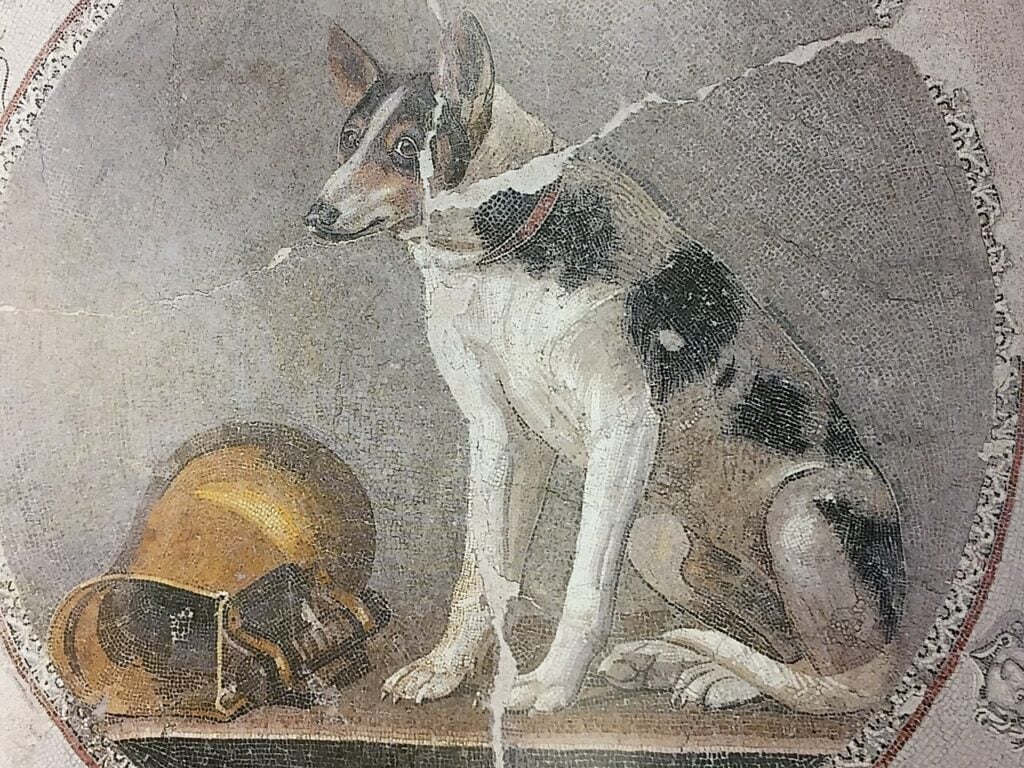
Ptolemaic mosaic of a dog from Hellenistic Egypt, dated between 200 - 150 BC, located in the Greco-Roman Museum of Alexandria, Egypt. The Ancient Greeks believed animals possessed intelligence and reason.
Ancient Greeks believed that animals had intelligence, reason, and emotion. Ptolemaic mosaic from Hellenistic Egypt, dated between 200 – 150 BC, located in the Greco-Roman Museum of Alexandria, Egypt. Credit: Public Domain

Ancient Greeks held deep respect and affection for animals, believing they possessed reason, intelligence, and emotion, even as they hunted and sacrificed them to the gods. Greek literature and philosophy reveal a culture that viewed animals not merely as property but as living beings connected to humanity through thought, feeling, and shared experience.

Among the ancient thinkers who reflected most passionately on the treatment of animals was the historian Plutarch, whose writings remain among the strongest defenses of animals in the ancient world. Long before modern debates over animal welfare emerged, Plutarch argued that animals possessed intelligence and emotion and that cruelty toward them degraded the human soul itself. His ideas did not exist in isolation. Rather, they grew out of a broader Greek tradition in which animals occupied an honored place in religion, philosophy, daily life, and even familial affection.

The Ancient Greeks lived closely alongside animals in nearly every aspect of life. Dogs guarded homes and accompanied hunters, while horses symbolized nobility and courage. Birds were kept for pleasure, and cats, although less common than in Egypt, were sometimes used to control pests. Greek children played with pets, and wealthy households often treated favored animals as cherished members of the family.

Pet tombstones reveal Ancient Greeks loved their animals

Archaeological discoveries confirm the deep emotional attachment Ancient Greeks felt toward their pets. Tombstones dedicated to dogs, horses, and birds have been uncovered throughout the Greek world, and some inscriptions mourn animals with the same tenderness reserved for human relatives. One epitaph for a dog named Parthenope expresses grief in deeply personal language, demonstrating that the death of a beloved pet could inspire genuine sorrow. Greeks occasionally buried pets beside their owners or placed them in carefully prepared graves filled with offerings and decorations. These burials suggest that companionship with animals was not merely practical but also emotional and spiritual.

This affection appears vividly in Greek literature. In the Odyssey, the old dog Argos waits faithfully for Odysseus for twenty years. When Odysseus finally returns home in disguise, Argos recognizes him immediately before dying. The scene is brief yet unforgettable because Homer portrays the dog as capable of loyalty, memory, and emotional recognition. The moment suggests that Ancient Greeks understood animals as creatures capable of deep attachment.

Greek mythology likewise reflected admiration for animals. The owl symbolized wisdom through its association with Athena, while dolphins were regarded as intelligent and sacred creatures connected to Apollo and Poseidon. Horses were honored in myths surrounding heroic figures such as Achilles. Even the gods themselves frequently appeared in animal form, suggesting a sacred bond between humanity, divine power, and the natural world. One of the most famous examples is Zeus transforming himself into a magnificent white bull to carry away Europa.

Greek philosophers on animals

The philosophical discussion of animals became especially significant among thinkers associated with Pythagoras. Pythagoras himself believed souls could migrate between humans and animals through reincarnation. Because of this belief, he discouraged the eating of meat and taught respect for all living creatures. According to ancient tradition, he once intervened to stop a man from beating a dog, claiming he recognized the voice of a deceased friend within the animal.

Pythagoras was firmly opposed to killing “living creatures,” abstaining from what ancient sources describe as “harsh-sounding bloodshed,” including animal sacrifice, and reportedly “never eating meat.” In this sense, he is often regarded as the first Greek vegetarian. None of his original writings survive today, but his ideas are known through later authors such as Philolaus, Iamblichus, Ovid, and Plutarch.

Across these accounts, it becomes clear that Pythagoras was believed to hold that animals possessed a soul. As attributed in Ovid’s writings, “Animals share with us the privilege of having a soul,” a sentiment associated with Pythagorean teaching and vegetarian practice.

The Greek philosopher Empedocles, himself influenced by Pythagorean thought, later expanded these ideas by arguing that all living beings share kinship. He condemned the killing of animals and viewed both violence toward them and their consumption as morally corrupting. He even described animal sacrifice as a form of injustice, regardless of its religious purpose. Tradition holds that he once crafted an ox out of barley meal and perfumes as an offering to the gods in place of a real animal. Such ideas were radical in a society where animal sacrifice remained central to religious life, yet they demonstrate that compassion toward animals already held a respected place in Greek philosophical thought.

Plutarch: the first animal rights advocate

No ancient writer expressed these ideas more forcefully than the biographer Plutarch. Living during the 1st and early 2nd centuries AD, Plutarch wrote essays that challenged widely held assumptions about human superiority. In works such as “On the Eating of Flesh and Whether Land Animals Are Cleverer Than Sea Animals,” he argued that animals possessed intelligence, emotion, and reasoning ability.

Plutarch was troubled not only by cruelty toward animals itself but also by the indifference people showed toward suffering. One of his most cited passages asks readers to confront the moral shock of eating flesh: “I for my part do much admire in what humor, with what soul or reason, the first man with his mouth touched slaughter.”

This was not merely a dietary critique. Plutarch believed that violence toward animals corroded human morality. In his view, cruelty was a habit that extended outward. Societies accustomed to bloodshed against animals risked becoming desensitized to violence more broadly.He also rejected the idea that animals lacked intelligence. Plutarch insisted that animals possessed perception, memory, emotion, and understanding. In one striking passage, he describes them as beings capable of thought and awareness: “Each animal hath received from Nature…imagination, and intellection.”

For Plutarch, this recognition carried clear ethical implications. He criticized those who treated living creatures as mere objects of pleasure or luxury. In another memorable line, he writes: “But for the sake of some little mouthful of flesh, we deprive a soul of the sun and light.” Such language is striking because it attributes something close to personhood to animals. Plutarch ultimately presents them not as mindless beings but as fellow participants in the shared experience of life itself.

Ancient Greek philosopher Aristotle finds similarities between behavior of humans and animals

Other Ancient Greek thinkers also recognized forms of intelligence in animals. Aristotle, though less compassionate than Plutarch, studied animals extensively and acknowledged notable similarities between animal and human behavior. In his biological works, he observed memory, communication, and social organization across a wide range of species. Theophrastus, Aristotle’s successor, went even further, arguing that animals could reason and experience pain in ways comparable to humans. He opposed unnecessary slaughter, maintaining that humans and animals share a natural kinship.

Respect for animals in the Ancient Greek world also appeared in religious practice. Certain animals were considered sacred to specific gods, and in some sanctuaries, their killing was forbidden. Festivals at times honored animals alongside deities, while myths frequently portrayed them as wise guides, loyal companions, or messengers of divine will.

Yet the Greek attitude toward animals was never entirely uniform. The same society that mourned pets and admired dolphins also engaged in hunting and animal sacrifice. Oxen plowed fields, horses served in warfare, and livestock provided food. Ancient Greek culture therefore contained an ongoing tension between the practical use of animals and a genuine admiration for them.

This contradiction is what makes Plutarch particularly significant. Rather than accepting cruelty as inevitable, he challenged prevailing norms directly. He questioned whether intelligence, emotion, and the capacity to suffer should carry moral weight. In many ways, his writings anticipate modern discussions of animal consciousness and ethical responsibility.

Plutarch’s insistence that animals possess intelligence and feeling ultimately challenged assumptions of human superiority. He argued that kindness toward animals was inseparable from human virtue itself. To harm innocent creatures unnecessarily was, in his view, to diminish one’s own humanity.

❌