Normal view

Food shortage in occupied Rubizhne: Russia blocks civilian deliveries, blames drones

8 June 2026 at 15:45

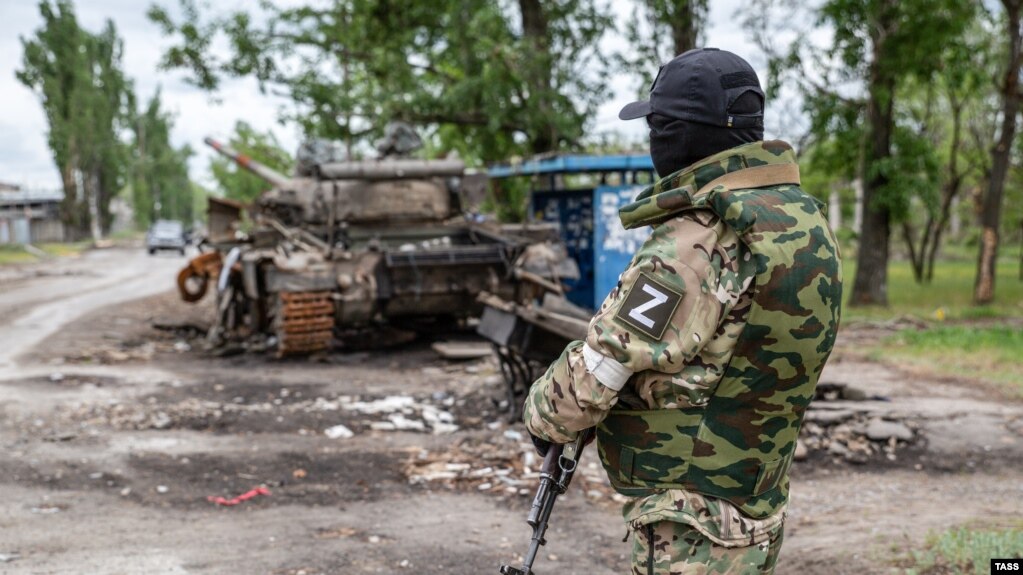
Russian soldier with Z insignia stands near a destroyed armored vehicle on a street in occupied Rubizhne, Luhansk Oblast, where occupation authorities have now manufactured a food shortage by blocking civilian deliveries

Russian occupation forces have deliberately manufactured a food shortage in occupied Rubizhne, cutting civilian food deliveries to the Luhansk Oblast city even as military supply convoys continue to flow, the head of the Luhansk Regional Military Administration reported on 8 June.

Shelves in the city's stores are emptying rapidly, Kharchenko said. Russian propaganda blames disrupted transport links, citing an alleged drone threat. Yet the occupiers have had no difficulty maintaining their own logistics routes to resupply military units stationed across the region, he noted.

"They need to make the next victim for Russian television out of local residents. They chose Rubizhne."—Luhansk governor Oleksii Kharchenko

A city turned into a propaganda prop

The official accused Russia of weaponizing hunger for television cameras. He said the occupiers intend to film bare shelves and hungry residents, then broadcast the footage to Russian audiences as evidence of suffering they themselves engineered.

Before Russia's full-scale invasion, Rubizhne was home to more than 55,000 people. Russian forces seized the city in May 2022 after weeks of devastating urban combat during which they fired up to 1,500 shells per day, the BBC's Quentin Sommerville reported from the front lines. The city's current population remains unknown, but residents who stayed have endured four years of occupation without reliable utilities, communications, or public services.

In nearby Sievierodonetsk, conditions have deteriorated so far that residents now mow the grass in their own neighborhoods and clean communal areas themselves, Kharchenko added—an admission that Russia's occupation authorities provide no basic municipal services even in the cities they claim to have "liberated."

A pattern of deliberate starvation across occupied Ukraine

The manufactured food shortage in occupied Rubizhne fits a documented pattern of Russia using hunger as a weapon against Ukrainian civilians trapped behind the front lines.

In Oleshky, a frontline city in occupied Kherson Oblast, roughly 2,000 civilians have been cut off from food, medicine, and clean water for months. "If the situation doesn't improve, people will just die there from hunger. Because there's no way out, no food supplies coming in," an Oleshky resident who escaped occupation told the Kyiv Independent. Russian forces mined the access roads, destroyed the Kakhovka dam's water infrastructure, and deployed FPV drones that residents describe as conducting "human safari" attacks—hunting anyone who steps outside. People there hunt pigeons and wild ducks with fishing line, plant vegetables in shell craters, and bury their dead in wheelbarrows because no coffins or transport exist.

Ukraine's Foreign Ministry in May appealed to the United Nations and the International Committee of the Red Cross over what it called a "severe humanitarian crisis" in Russian-occupied Kherson Oblast. Russia rejected calls for a humanitarian corridor.

In Nova Kakhovka, upstream from Oleshky, most coastal areas have been abandoned. The few residents who remain live in distant high-rise microdistricts with no functioning hospital and minimal Russian administrative presence, governed remotely from Henichesk, roughly 130 kilometers away.

The Rubizhne food shortage also coincides with Russia's broader restriction of civilian movement through occupied territories. On 6 June, occupation authorities shut down bus and private car traffic on main arteries, capping two weeks of land-corridor breakdowns that have further isolated occupied communities.

Starvation as premeditated policy

International human rights investigators have gathered evidence that Russia planned to use hunger as a weapon before the 2022 invasion. A report by Global Rights Compliance found that a Russian defense contractor purchased grain-transport trucks and bulk cargo ships in December 2021—two months before the invasion began. The evidence was submitted to the International Criminal Court for what could become the first prosecution of a head of state for the war crime of starvation as a method of warfare.

Global Rights Compliance has drawn a direct parallel to the Holodomor—the Soviet-engineered famine that killed millions of Ukrainians in 1932–1933. Russia's current starvation tactics are being perpetrated, the organization noted, by "the same attacking state."

Under the Geneva Conventions, using starvation of civilians as a method of warfare is a war crime. The Rome Statute of the ICC codified the offense in 1998. Yet in occupied Rubizhne, occupied Oleshky, and across the territories Russia claims to have annexed, the pattern continues: military convoys pass, civilian supply lines close, and shelves empty.

Russian pilot saw man in Ukraine’s Kramatorsk and chose to kill him. FPV drones are operated in real time

6 June 2026 at 19:23

Russian FPV drone operator.

A Russian FPV drone strike near a residential building in Kramatorsk on the morning of 6 June killed a man born in 1976, the Kramatorsk City Council reports. These types of drones are operated in real time, so the Russian pilot saw the target before launching the weapon at the person. 

The strike fits a documented pattern of Russian FPV-drone targeting of Ukrainian civilians in frontline cities that the UN Independent International Commission of Inquiry on Ukraine formally classified as crimes against humanity in May 2025 in its findings on Kherson Oblast, and that Ukrainian authorities continue to document across other frontline regions, including Donetsk Oblast.

Ukraine has documented more than 11,000 Russian FPV attacks on civilians, including "double-tap" strikes that hit the same site after medics and firefighters arrive at an initial attack. 

Terrorism: no justification

"Each such crime will be documented, and the guilty parties will sooner or later answer for what they have done. No justification can explain the murder of civilians. This is not how military forces act — this is how terrorists act, for whom human life has no value," the Ukrainian authorities said.

UN findings: from Kherson to three-oblast pattern

In May 2025, the OHCHR-supported UN Commission of Inquiry on Ukraine concluded that Russian drone attacks against civilians in Kherson Oblast were "widespread, systematic, and conducted as part of a coordinated state policy" and constitute crimes against humanity of murder, as well as war crimes.

The Commission documented Russian targeting across more than 100 kilometers of the right bank of the Dnipro River, basing its findings on more than 300 videos, 600 Telegram posts, and 91 interviews with victims, witnesses, and local officials.

In its October 2025 follow-up report to the UN General Assembly, the Commission found that the same pattern had expanded across more than 300 kilometers covering Dnipropetrovsk, Kherson, and Mykolaiv Oblasts. Russian FPV operators have systematically pursued specific civilians along defined routes, including at bus stops, supermarket entrances, pension queues, and residential courtyards. 

The Kramatorsk frontline context

Kramatorsk has been a focus of Russian targeting throughout the war, with repeated strikes including double-tap drone attacks on civilian infrastructure and first responders. The city's location near the contact line in Donetsk Oblast places it within FPV drone range. 

Ukrainians under occupation don't have a real choice whether to stay or to leave

8 June 2026 at 16:04

Some names have been changed to protect the identities of those featured in the story

As a war crimes researcher at the Reckoning Project, my job was to listen to Ukrainians who had fled the occupation. What they had to say reshaped how I understand life in Russian-occupied territories.

Simplistic

Lei torna crime exercício ilegal da medicina veterinária 

8 June 2026 at 13:10

Logo Agência Brasil

O Código Penal Brasileiro passa a incluir nesta segunda-feira (8) o exercício ilegal da medicina veterinária como crime. 

Pela legislação, aquele que exercer a profissão de médico veterinário sem autorização legal, ainda que de forma gratuita, está sujeito à pena de detenção de seis meses a dois anos.

Notícias relacionadas:

A norma modifica o Artigo 282 do Código Penal, que já trata do exercício irregular de profissões da área da saúde, como medicina, odontologia e farmácia. Com a mudança, passa a incluir de forma expressa a medicina veterinária. 

Pena e agravantes

O texto também estabelece agravantes para situações em que a conduta resulte em consequências mais graves:

  • Em caso de lesão corporal grave ou gravíssima em pessoa, o autor responderá também pelos crimes correspondentes previstos no Código Penal;
  • Se houver morte, a responsabilização inclui o crime de homicídio;
  • Quando a prática causar lesão ou morte de animal, o infrator também responderá por crime ambiental, conforme a Lei de Crimes Ambientais.

Suspensão profissional

Comete o mesmo crime o profissional que exercer a atividade durante período de suspensão ou após o cancelamento do registro ou habilitação profissional.

Lei torna crime exercício ilegal da medicina veterinária 

8 June 2026 at 13:10

Logo Agência Brasil

O Código Penal Brasileiro passa a incluir nesta segunda-feira (8) o exercício ilegal da medicina veterinária como crime. 

Pela legislação, aquele que exercer a profissão de médico veterinário sem autorização legal, ainda que de forma gratuita, está sujeito à pena de detenção de seis meses a dois anos.

Notícias relacionadas:

A norma modifica o Artigo 282 do Código Penal, que já trata do exercício irregular de profissões da área da saúde, como medicina, odontologia e farmácia. Com a mudança, passa a incluir de forma expressa a medicina veterinária. 

Pena e agravantes

O texto também estabelece agravantes para situações em que a conduta resulte em consequências mais graves:

  • Em caso de lesão corporal grave ou gravíssima em pessoa, o autor responderá também pelos crimes correspondentes previstos no Código Penal;
  • Se houver morte, a responsabilização inclui o crime de homicídio;
  • Quando a prática causar lesão ou morte de animal, o infrator também responderá por crime ambiental, conforme a Lei de Crimes Ambientais.

Suspensão profissional

Comete o mesmo crime o profissional que exercer a atividade durante período de suspensão ou após o cancelamento do registro ou habilitação profissional.

❌