O conflito reside entre a identidade da Ferrari, baseada na leveza e roncar do motor, e as características dos elétricos, como as grandes e pesadas baterias ou o silêncio na deslocação. O novo desportivo da Ferrari, o Luce, levanta algumas questões interessantes sobre o futuro dos supercarros de alta tecnologia e de alto custo na era elétrica. A primeira incursão do fabricante italiano de automóveis desportivos no segmento dos veículos eléctricos (VE) – de olho no mercado de luxo chinês – sinaliza pragmatismo estratégico em vez de continuidade ideológica. Para complicar ainda mais, a decisão de colaborar com a LoveFrom,
Há dois mitos que limitam a forma como as empresas pensam a experiência dos clientes, defendeu Horst Hemes, managing partner da consultora belga Onestone, durante o CX Summit 2026, realizado esta quarta-feira em Carcavelos. O especialista em estratégias de “customer experience” rejeita a ideia de que ser centrado no cliente consiste em estar à altura ou até superar as expectativas dos consumidores; e, por outro lado, não concorda que o serviço ao cliente seja, antes de mais, uma questão de atitude. Estas duas ideias, diz, são enganadoras e levam as empresas a tomar decisões erradas.
“Os gestores têm crenças falsas. E, por isso, tomam decisões que não funcionam”, afirmou Hemes, chamando-as de “mitos da centralidade no cliente”.
No primeiro caso, o conferencista sublinhou que, num inquérito feito a gestores, 60% concordaram com a afirmação de que a centralidade no cliente é “estar à altura ou até superar” as suas expectativas, mas Hemes nota que essas expectativas nem sempre são um barómetro completo, podem ser contraditórias ou depender de um contexto que o cliente não conhece bem.
Hemes dá o exemplo de um restaurante. Se um cliente se senta e espera muito tempo, a insatisfação parece inevitável, mas se o restaurante for de “slow food” a espera deixa de ser uma falha e passa a ser uma consequência da promessa feita ao cliente. “Decidi que quero mesmo servir comida fresca, mas, como consequência, as pessoas vão ter de esperar um pouco”, explicou Hemes.
O consultor defende, por isso, que os gestores devem estar mais preocupados com aquilo por que querem ser reconhecidos e apostar nessa oferta. Ter o cliente no centro, neste caso, não passa por fazer tudo o que o cliente espera, mas sim por definir uma proposta clara e aceitar as consequências. Ou seja, um restaurante que quer distinguir-se pela frescura dos alimentos pode não conseguir ser o mais rápido. “As empresas tentam combinar essas coisas, mas não conseguem”, referiu. “Se queremos fazer a diferença, a diferença tem de ser clara. Tem de ser grande e perceptível para o cliente”, disse Hemes. É isso que torna a experiência memorável. E “a única coisa que fica é a memória da experiência”, afirmou.
Relativamente ao segundo mito, Hemes não acha que a atitude seja irrelevante, mas não é suficiente, porque, mesmo quando há simpatia, empenho e educação, pode haver mau serviço. “Se dois clientes estiverem a falar sobre nós, o que queremos que digam?”, perguntou o consultor, que sublinhou a necessidade de serem bem desenhados os processos com vista a colocar o cliente no centro da experiência.
Via quattro norme “esorbitanti” dal Dl Accise: ora il testo rischia di tornare al Senato
La maggioranza fa marcia indietro su alcune delle disposizioni inserite al Senato nel decreto recante misure urgenti in materia di prezzi petroliferi legati al protrarsi della crisi dei mercati internazionali. Alla Camera sono stati infatti presentati quattro emendamenti soppressivi con l’obiettivo di eliminare norme considerate “esorbitanti” rispetto al contenuto del provvedimento. Tra le misure destinate a essere cancellate figura anche l’estensione alle telecomunicazioni del divieto di telemarketing aggressivo, introdotto con il decreto bollette e approvato in commissione Finanze del Senato. La maggioranza aveva già tentato di inserire la disposizione nel precedente decreto accise, salvo poi ritirarla per estraneità di materia.
Secondo quanto emerso dopo alcune interlocuzioni con gli uffici legislativi del Quirinale, la scelta è stata quella di procedere con emendamenti soppressivi per rimuovere dal testo le norme ritenute non coerenti con l’oggetto del decreto. Il governo e la relatrice del provvedimento hanno espresso parere favorevole ai quattro emendamenti della commissione. Oltre alla disposizione sul teleselling, le modifiche riguardano anche interventi sulla mitigazione del prezzo di zolfo e acido solforico e norme sulla tutela delle minoranze linguistiche. Qualora gli emendamenti venissero approvati dall’Aula di Montecitorio, il decreto dovrebbe tornare al Senato per una terza lettura prima della conversione definitiva in legge.
Nova lei restringe o uso de rótulos com os termos carne, vitela, carne de porco, frango, peru, pato e borrego, em alimentos que não têm carne, e define claramente “carne” como sendo “partes comestíveis de animais”. Já os “hambúrguers” e “salsichas” vegetais escaparam à proibição. O Parlamento Europeu aprovou esta terça-feira a proibição de comercializar alimentos de origem vegetal como “bife” ou “bacon”. Os “hambúrgueres” vegetarianos, porém, podem permanecer nas ementas europeias. A proibição, que carece ainda de luz verde definitiva dos Estados-membros, representa uma vitória para os produtores pecuários, que defendem que os alimentos vegetais que imitam carne correm
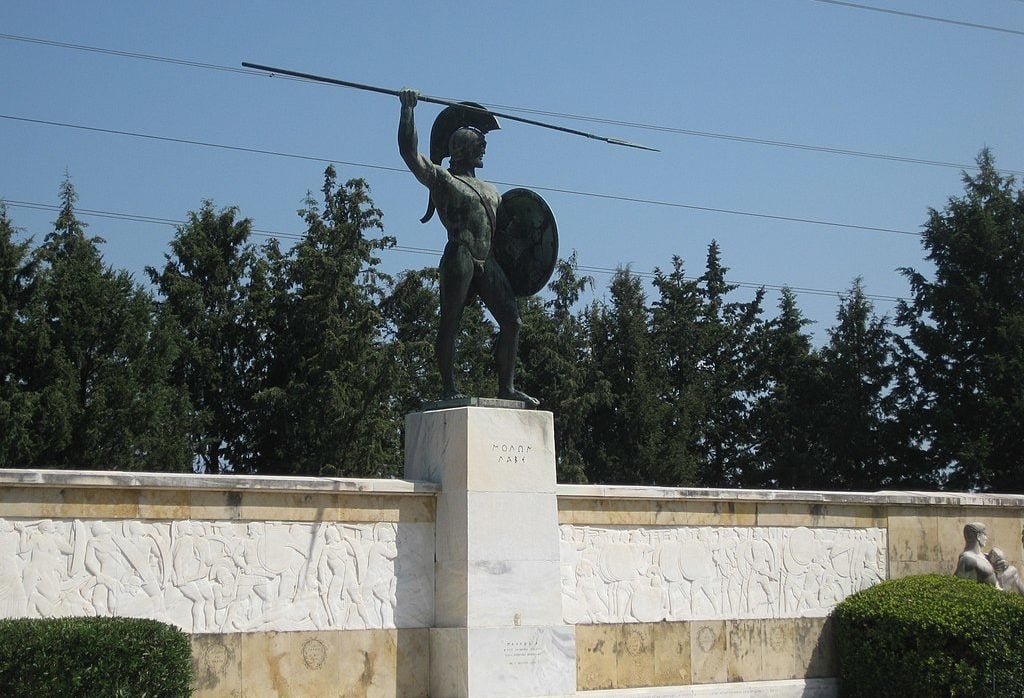
Statue of Leonidas of Sparta, Greece. Credit: Dmpexr/Wikimedia Commons/CC BY-SA 4.0
It was in 480 BC during the second Persian invasion of Greece, when King Leonidas of Sparta ahead of the legendary Battle of Thermopylae responded by the phrase “Molon Lave” (‘Come and Take Them’ in ancient Greek) to Persian King Xerxes’ demand that the Spartan army lay down their weapons and surrender to his army. The outnumbered Greeks were eventually annihilated, though they held Thermopylae for three days and inflicted serious damage to the Persians, while delaying them from reaching Athens.
That’s how the story ended back then. But little did King Leonidas know that over 2,500 years later, his “Molon Lave” phrase (also spelled “Molon Labe” by many) would not only become immortalized through the centuries but moreover, it would thrive as a global marketing tool -linked to the sale of weapons, wine, olive oil, expensive watches and even cigars.
King Leonidas I reigned the ancient city-state of Sparta, a warrior society, from 489 to 480 BC. Subjected to military drills since early manhood, the Spartans had become one of the most feared and formidable military forces in the ancient Greek world, attaining legendary status in their wars against Persia. At the height of Sparta’s power, between the 6th and 4th centuries BC, according to Peter Connolly, a British historian and the scholar of the ancient world, other Greeks commonly accepted that “one Spartan was worth several men of any other state.”
“The appeal of Molon Lave comes from its Spartan origins,” Effie Delimarkos-Fletcher, a Greek-American communications expert and marketing strategist tells Greek Reporter. “Spartans themselves have come to symbolize power, strength, resolve, and defiance, which was catapulted into the mainstream with the debut movie of ‘300.’ As a result, aligning with the phrase “Molon Lave” is a distinct way for a brand to signal strength and prowess in an area worth defending.”
Moreover, there are few other phrases like “Molon Lave,” where two single, short words are able to convey all that, perhaps the most famous military last stand of all time, embodies -defiance, strength and resolve. Spartans were expected to be men of few words, famous for using “laconic phrases,” named after Laconia, the region of Greece, including the city of Sparta, whose ancient inhabitants had a reputation for verbal austerity. A laconic phrase was used for efficiency (as during military training and operations), for emphasis or to deflate a pompous speaker.
The company has applied for and successfully registered the ‘Molon Lave’ brand in Greek, as seen on the handle of the knife. Credit: Panther WholesaleAnother Florida-based company named “Molon Labe” is selling high-quality cigars, spirits and coffee, and as with most other businesses, is also using a Spartan helmet on its logo. Credit: Molon Labe Official Instagram Account
Military, the industry where Molon Lave has the largest appeal as a brand
From tactical patches and other military paraphernalia sold online, to assault rifles sold in stores across the United States, the phrase “Molon Lave” graces thousands of military-related products.
According to Delimarkos-Fletcher, Molon Lave and its English translation “Come and Take Them” has been present in the country’s early DNA as it is said to have been used as far back as the Revolutionary War. Even so, it is better known for its connection to the Texas Revolutionary War, when the phrase was stitched onto a flag that has come to be associated with the defiant spirit of the state. In more recent times, many U.S.-based militia groups and paramilitary organizations have taken the phrase “Molon Lave,” and often the depiction of a Spartan helmet, signaling defiance for gun regulations.
“Because Molon Lave has been adopted by militia-type groups in the United States, securing the Molon Lave trademark is done by companies looking to appeal to that target,” Delimarkos-Fletcher says.
And that’s exactly what at least one US.-based company had done. A short Greek Reporter investigation revealed that, while there are hundreds of knives and weapons with the phrase “Molon Lave” appearing on them in different variations, in 2015 this one company has gone as far as to apply for and successfully register a year later a trademark for the original Molon Lave phrase in Greek (ΜΟΛΩΝ ΛΑΒΕ) for one of its knives selection. The company, advertises the knives on its website by stating “It takes a bold individual to make a statement of defiance like ‘Come and Take Them (Molon Labe),’ we provide the knives that re-enforce the bravado.”
But can a company apply and secure a trademark for the use of a common, ancient phrase like Molon Lave, that seems almost free for anyone to use?
According to Pamela Koslyn, a Los Angeles-based attorney specializing in intellectual property law, U.S. legislation allows a company to successfully apply for a trademark for a brand new phrase, or an “ancient” phrase or an invented word/phrase, with the age and origin of the phrase being irrelevant.
“A trademark isn’t a monopoly on a phrase, it’s a source identifier of some phrase associated with some goods or services. Like knives. Or olive oil. Or wine. These are all actual “live or pending marks of Molon Lave…There’s also a Chinese textile seller called Molon Lave,” Koslyn tells Greek Reporter. “If a user has a registered trademark on a phrase in a particular class, e.g. knives, that means the user own the exclusive right to use their mark in association with their goods or services and can theoretically successfully sue and enjoin any competitor who infringes those rights by using the same or confusingly similar mark for the same or confusingly similar goods or services.”
Still, Koslyn notes, that one in two trademark applications to the United States Patent and Trademark Office (USPTO) fail not only because they’re not viable or available but moreover because of the complexity of the law and the time needed to find out if an application has been approved by USPTO -a process that could take months if not years.
On its website, the restaurant says that it’s “based on the Spartan epic saying Molon Lave, which means ‘Come and Get Them,'” and has a mission “to celebrate and share Greek cuisine and culture.”Credit: Molon Lave Taverna Official Instagram Account
The famous ancient Greek phrase many want to own
But few actually register the phrase in order to enhance their branding or make their products stand out more. Given the enormous competition among companies to win the hearts of consumers, proper branding and marketing could mean the difference between life and death for a company. And given its global fame, that’s exactly what “Molon Lave” does.
Nowhere is this more obvious than in the United States, the beating heart of global consumerism. A family-owned farm winery in Virginia was established in 2009 under the name “Molon Lave.” Aside from informing its customers that it also produces “kokkineli,” a traditional Greek style rose, the winery fully explains on its website the origins of its name, noting that “‘Molon Lave’ is a phrase that has inspired throughout the centuries a sense of dignity and pride, and a unique perception of life.”
Another Florida-based company named “Molon Labe” is selling high-quality cigars, spirits and coffee, as with most other businesses, also using a Spartan helmet on its logo. Moreover, the cigars are wrapped in paper bearing the phrase in Greek. The company on its website gives no explanation as to why it chose the specific name.
A consumer browsing the handmade watches of the UK-based company. Credit: Greek Reporter
Greek Reporter’s investigation also found a watch company with the name “Molon Labe” based in the UK, selling handmade, military watches inspired by the phrase, with some having a price tag of over $1,500. There’s also a global security company named “Molon Lave,” an information technology service activity company in the UK and a gym in Cyprus, featuring on its premises the bust of a muscular Spartan soldier alongside the “Molon Lave” phrase, which is showcased in ancient Greek type. The list goes on.
With a fortitude reminiscent of the very people it once represented, the phrase “Molon Lave” survived to this day as one of the few expressions that so efficiently evoke an immediate connection not only to power but also to Greece.
It is no wonder the phrase has also been adopted as the name of a “small, Greek authentic restaurant” in Ontario, Canada, which on its website says that it’s “based on the Spartan epic saying Molon Lave, which means ‘Come and Get Them,'” and has a mission “to celebrate and share Greek cuisine and culture.”
At the same time, a thriving Greek olive oil brand named “Molon Lave” based in Sparta, the place where King Leonidas and his Spartan warriors once lived, is probably one of the more successful examples using the phrase as a marketing tool.
Delimarkos-Fletcher says many using the phrase may not even know its true origins so it is refreshing to see Greek-related businesses reclaiming Molon Lave as they “seek to evoke a connection to the best known story of Greek strength and prowess.”
“Other brands are just using ‘Molon Lave’ as shorthand for having something powerful enough that others want for their own,” Delimarkos-Fletcher tells Greek Reporter.
The winery explains on its website the origins of its name, noting that “‘Molon Lave’ is a phrase that has inspired throughout the centuries a sense of dignity and pride, and a unique perception of life.”Credit: Molon Lave Vineyards Official Instagram Account
Accise, il decreto passa al Senato: novità su fisco e consumatori tra rottamazione, bonus autobus e nuove regole Tlc
Il Senato ha approvato con voto ad alzata di mano il decreto accise, che ora passa alla Camera per la conversione in legge entro il 30 giugno. Il provvedimento, esaminato in Aula a Palazzo Madama giovedì 11 giugno, introduce una serie di modifiche su fisco, trasporti e tutela dei consumatori, confermando però anche alcune misure rimaste fuori dal perimetro finale del testo. Tra i principali interventi figura la proroga dei termini legati alla rottamazione, insieme a nuove disposizioni sul telemarketing e a un pacchetto di misure di sostegno per il settore dell’autotrasporto. Restano invece escluse alcune misure più controverse, come la sanatoria per le partite Iva e il blocco dei pignoramenti per chi è in regola con le rate della pace fiscale.
Rottamazione: tempi più lunghi e nuovo calendario
Il decreto estende di un mese, dal 30 giugno al 31 luglio, il termine per le delibere di Comuni ed enti locali che vogliono aderire alla rottamazione quinquies. Una misura che amplia la possibilità di includere anche multe e Tari tra i debiti sanabili. Rivisto anche il calendario delle dichiarazioni, che potranno essere presentate tra il 16 ottobre e il 15 dicembre, con possibilità di integrazione fino alla scadenza. Per i pagamenti, la prima rata (o unica soluzione su 54 bimestrali) slitta dal 31 gennaio al 31 marzo 2027.
Bonus autobus per l’autotrasporto
Via libera in commissione anche al credito d’imposta destinato all’autotrasporto passeggeri su autobus, pensato per attenuare l’impatto dell’aumento dei costi legati al caro-carburante.
Una delle novità più rilevanti riguarda il contrasto al telemarketing selvaggio. Il divieto di contatti commerciali indesiderati viene esteso anche al settore delle telecomunicazioni, oltre a luce e gas. Le chiamate saranno consentite solo con consenso esplicito dell’utente e da numeri identificabili.
Misure ritirate: sanatoria e pignoramenti
Non entra nel testo finale la sanatoria per le partite Iva, proposta che avrebbe introdotto un ravvedimento speciale per il periodo 2020-2024 per chi aderisce al concordato preventivo biennale 2026-2027. L’emendamento, a firma del senatore Claudio Lotito, potrebbe comunque essere ripresentato come ordine del giorno. Ritirata anche la proposta che prevedeva lo stop al pignoramento dei conti correnti per i contribuenti in regola con le rottamazioni, per problemi di copertura finanziaria.
Il decreto ora attende il passaggio alla Camera, che dovrà completare l’iter di conversione entro la fine del mese.
Os Supermercados Apolónia, marca premium de referência no setor da distribuição alimentar, anunciam a nomeação de Rute Rodrigues para o cargo de Diretora de Marketing e Comunicação. Com mais de 10 anos de experiência nas áreas de marketing, comunicação e branding nos setores do turismo, hotelaria e retail, Rute Rodrigues integra agora a equipa de liderança da insígnia algarvia, […]

 Login
Login