From Ebola to Nipah, the combined death toll since Covid is under 1,000 worldwide. So why the endless panic? Follow the money – pandemic fearmongering is a growth industry, says Dr David Bell.
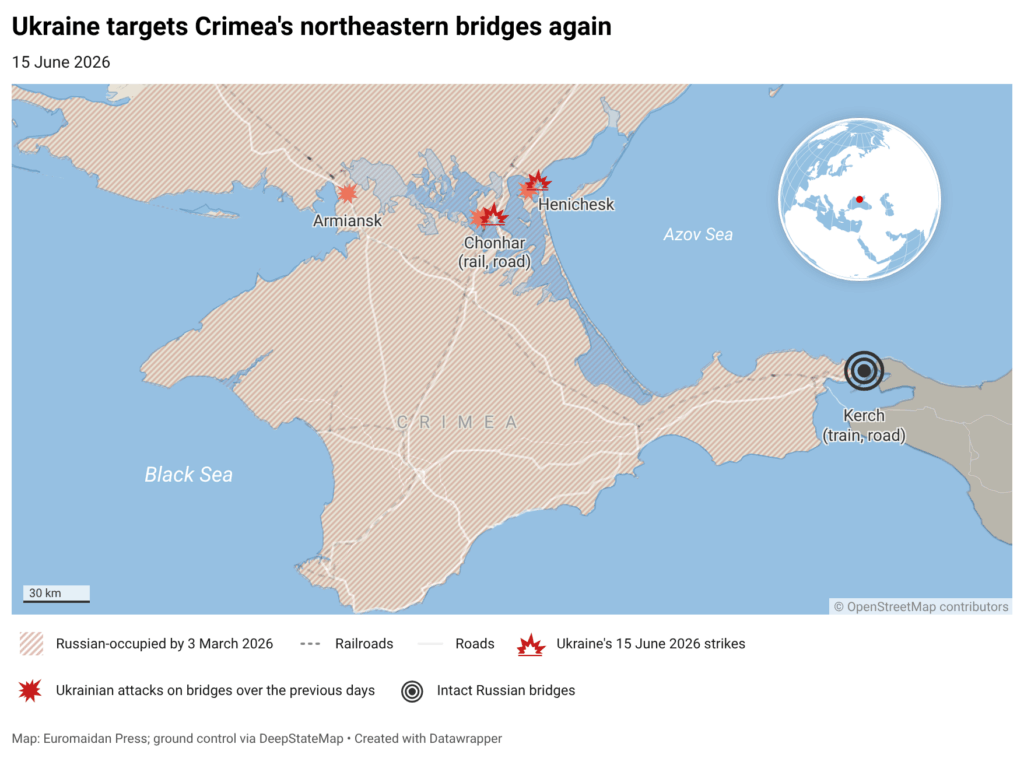
Ukraine's Defense Forces struck the Chonhar and Henichesk road bridges connecting occupied Crimea to the mainland again overnight on 15 June 2026. The drone attack damaged crossings that Russia leans on to move troops and supplies onto the peninsula, and Russia-installed officials shut a key checkpoint before claiming traffic later resumed. Monitoring channels also reported fires inside Crimea itself.
Occupied Crimea hangs on a handful of narrow crossings in the north, and Ukraine has spent recent weeks turning those chokepoints into the front line of its push—known as the Logistics Lockdown program—against Russian supply routes in the occupied south. Every span and floating crossing Ukraine knocks out again forces Russia onto slower, longer detours, and the repeated returns to the same chokepoints make resupplying its southern front costlier with each strike.
Two bridges hit, the Dzhankoi crossing shut then partially reopened
The Defense Forces hit the bridges with strike drones, the Russia-installed head of the occupied part of Kherson Oblast, Vladimir Saldo, claimed. The span near Chonhar was damaged and the Dzhankoi vehicle checkpoint fully closed. Saldo stated the restrictions would last for an undefined time because of damage to infrastructure on the approaches to the administrative border with Crimea.
The same overnight attack also damaged the bridge that links Henichesk to the Arabat Spit, a long sandbar running down Ukraine's southern coast. Both are among the few land routes onto the peninsula.
Yevgeny Balitsky, the Russia-installed head of the occupied part of Zaporizhzhia Oblast, said traffic was suspended on one of the road bridges joining northern Crimea to the mainland, with vehicles sent on a long detour through Melitopol, Novooleksiivka, Novotroitske, Chaplynka, Myrne and Armiansk.
By midday, the Russian propaganda outlet Interfax reported that Saldo had claimed reverse-mode traffic was moving again through the Dzhankoi crossing.
The details of how it came from the Ukrainian side. Petro Andriushchenko, head of the Center for Studying the Occupation, saidoccupation forces had reopened the crossing over a temporary pontoon built for passenger cars, running one direction at a time, citing occupation sources and the outlet Most.
Explore further
Ukrainian drones hit Dzhankoi as strike unit declares hunt on Russian Crimea logistics
Fires near Chonhar and at a Crimean airfield
Last night, the Crimea-monitoring Telegram channel Krymsky Veter reported two powerful explosions near the village of Donske outside Simferopol, audible in the city itself. NASA's fire detection database, FIRMS, also shows a fire near the Chonhar bridge, with thermal signatures around a former Ukrainian checkpoint now used by the Russian military. The channel separately noted a fire at the Hvardiiske airfield in occupied Crimea, at what it called an aircraft-preparation area, though no damage details were released.
Explore further
Ukrainian drones knocking out the northwestern entrance to Crimea: four bridges targeted in one night
A weeks-long campaign against Crimea's land routes
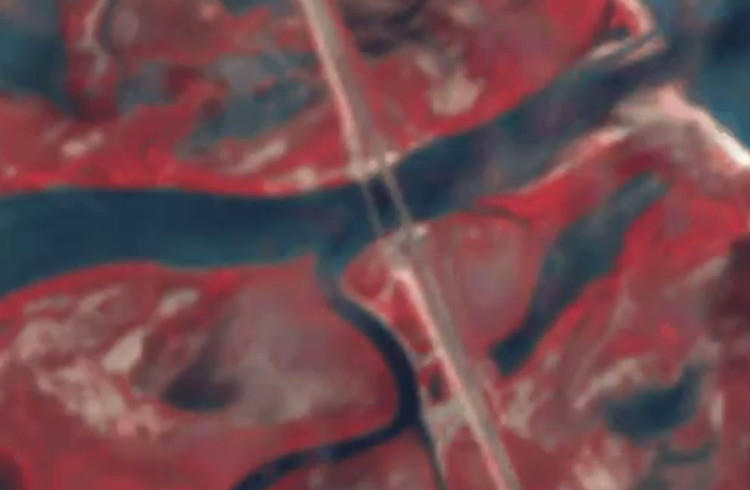
Russian crews had already set up a pontoon beside the damaged Henichesk bridge on 14 June, captured in a Copernicus satellite image posted by an open-source analyst.
The pontoon crossing (left) that Russia set up beside the damaged Henichesk bridge, 14 June 2026. Photo: Copernicus/you1126
A similar pontoon had appeared near Chonhar on 7 June after the fixed crossing was hit.
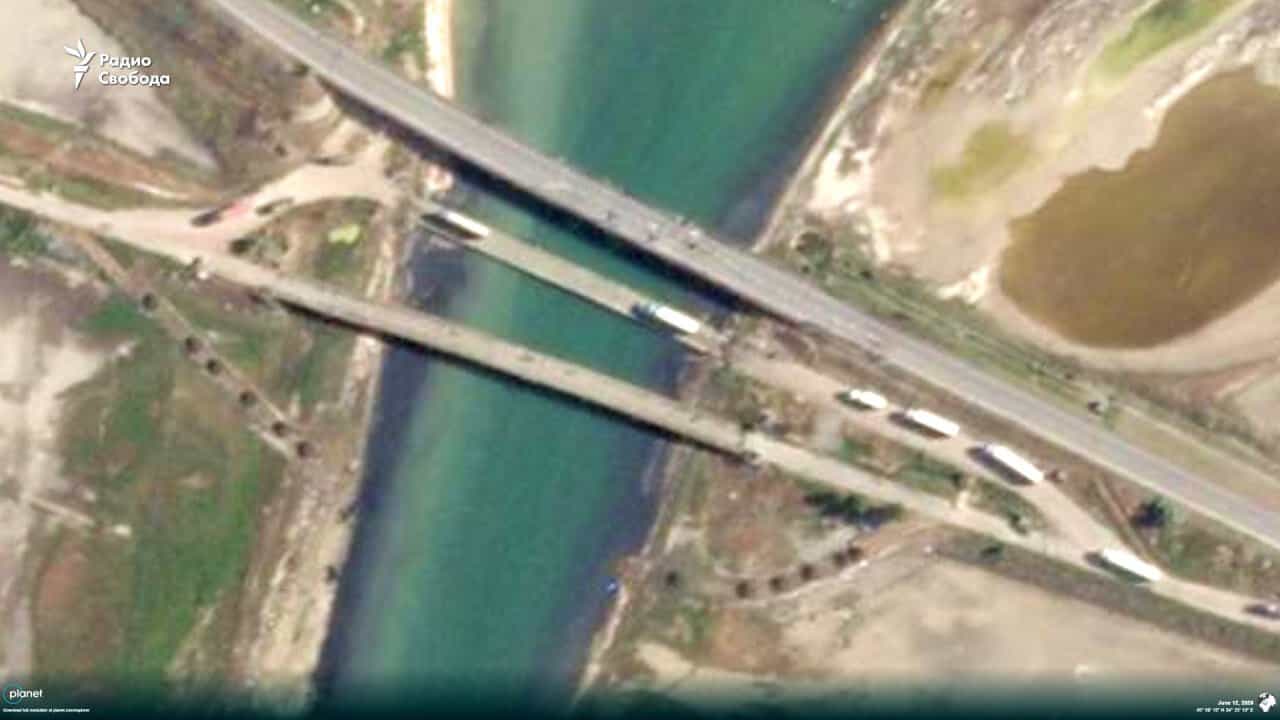
Trucks lined up at the crossing near Chonhar, 12 June 2026. Photo: Planet Labs/Radio Svoboda
Long queues of Russian trucks built up afterward: a satellite shot on the morning of 12 June showed at least 17 trucks and several cars waiting toward the mainland, with about 15 more trucks at the Dzhankoi checkpoint and nothing heading into Crimea, which still faces shortages of fuel and everyday goods. Ukrainian forces then struck that pontoon as well, part of a larger operation against Russian occupation logistics that hit road bridges near Armiansk, Chonhar, Henichesk, and Stavky.
The Chonhar crossings came under strikes on 7 June and were attacked once more on 9 June, after which Russia claimed the bridge was effectively out of service. By open reports, the area has now taken at least six confirmed strikes between June 2023 and June 2026. The latest hits form part of a widening campaign to sever the peninsula's road links, and Ukrainian commanders have tied the timing to Russian units waiting on fuel.
Russia's gasoline crisis has spread to 25 of its own regions and six occupied Ukrainian ones, the Russian-language Moscow Times reported on 10 June. Six days earlier, the count stood at 15. Ukrainian strikes on Russian refineries hit a wartime monthly record in May 2026, dropping Russian refining loading well below the start of the year.
This comes amid the Ukrainian long-range drone strike campaign, targeting Russian oil processing, transportation, and storage facilities almost every day. Additionally, Ukraine has escalated its mid-range "Logistic Lockdown" campaign, targeting Russian logistics in the occupied territories at depths of up to 200 km.
From 15 regions to 25 in under a week
The Russian Telegram channel 7×7 counted at least 25 Russian regions facing gasoline shortages and supply disruptions as of 10 June. Less than a week earlier, on 4 June, the number stood at 15. Restrictions also apply across six Russian-occupied Ukrainian regions: Crimea, Sevastopol, and the Luhansk, Donetsk, Kherson, and Zaporizhzhia oblasts.
Bloomberg counted 38 Ukrainian strikes on Russian refineries from January through May 2026. May alone saw 16 — the highest monthly figure of the war. According to OilX, Russian refinery loading has dropped 14% since the start of the year and stays roughly 20% below pre-war levels.
Explore further
Afipsky oil refinery burns again as Ukrainian drones return to Krasnodar Krai
Regional officials have responded unevenly. The acting governor of Belgorod Oblast, Alexander Shuvaev, acknowledged the shortage. Krasnodar Krai governor Veniamin Kondratyev called the situation "artificial hype." Residents publicly mocked the claim under his Telegram post, which was republished on a local channel. Gas stations in Krasnodar Krai have begun closing due to a shortage.
Fuel prices have spiked in occupied Crimea. On 10 June, AI-92 cost about $1.14 per liter, against $0.96 in Moscow. AI-95 traded near $1.25, up from $1.04 in the Russian capital. Resellers were offering fuel at $1.81-$2.08 per liter — about 50% above official Crimean prices.
On 8 June, Russia's Energy Ministry announced the creation of a task force to manage the fuel crisis, citing "growing enemy air attacks."
Occupied Sevastopol cancels fuel coupons after tankers fail to arrive
Sevastopol's Russian-installed governor said on 10 June that planned distribution of rationed petrol had been delayed, Reuters wrote on 11 June. Mikhail Razvozhayev claimed oil tanker trucks could not bring fuel into the city, following recent Ukrainian strikes on supply routes. Crimea, occupied by Russia in 2014, introduced fuel rationing last month due to shortages on the peninsula.
"Unfortunately, oil tanker trucks were unable to come to the city tonight," Razvozhayev wrote on Telegram.
Explore further
Ukrainian drones knocking out the northwestern entrance to Crimea: four bridges targeted in one night
He said priority for refueling on 11 June would go to public transport, utilities, emergency vehicles, and government vehicles.
"I am addressing everyone: there is no point in lining up at... the gas stations tomorrow," he added late on 10 June.
Existing rationing coupons would be canceled and new ones issued today.
Razvozhayev later claimed over two dozen Ukrainian drones were downed in the early hours of Thursday in a fresh attack on Sevastopol. The city is Crimea's second-largest and home to Russia's Black Sea Fleet.
On the same day, a major drone attack hit Russia's Volga region of Samara, more than 900 km from the front line, forcing state-owned oil giant Rosneft to halt processing at its Kuibyshevsky refinery.
Explore further
All three Rosneft Samara refineries now offline or reduced as drones halt Kuibyshevsky operations yesterday
Ukrainian President Volodymyr Zelenskyy said Wednesday evening that Ukraine’s recently launched mid-range strike campaign against Russian logistics, including large-scale strikes on supply and fuel trucks, had proved its worth.
"In recent months, we are especially grateful for the mid-strikes: Russian military logistics throughout the entire depth of the temporarily occupied territory are now within reach of Ukrainian drones," he said. "Our impact reaches Russia’s border regions as well. The enemy feels it, and we will continue to expand it."
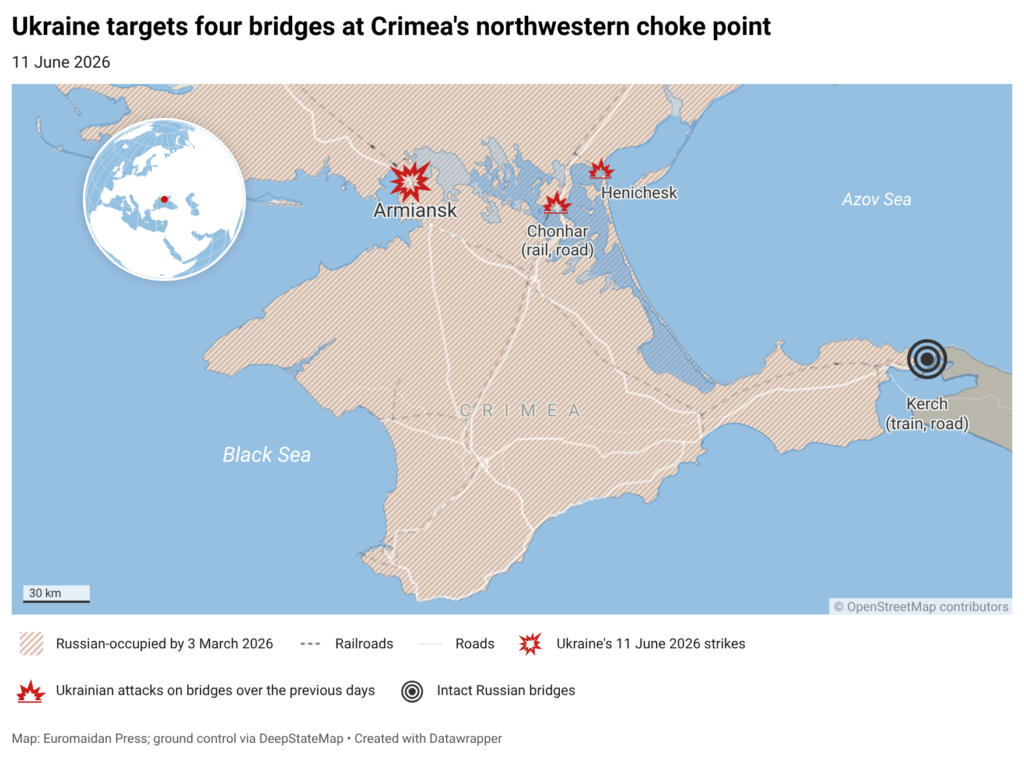
Ukrainian drones struck four vehicular bridges at Crimea's northwestern entrance overnight on 11 June 2026, quisling official Vladimir Saldo claimed. The strikes are part of Ukraine's most recent mid-range strike push—now at its fourth day—reaching every road corridor between Crimea and mainland Ukraine. The same night, drone attacks also rolled across Sevastopol, Bakhchysarai, Saky, and other Crimean sites.
Russia depends on the Crimean land corridor to push fuel, ammunition, and replacements to its forces in occupied southern Ukraine. Ukrainian mid-range drones operating under the military's LogisticsLockdown program have steadily shrunk that corridor's reliability since May. Ukraine has now struck all three major connection points between occupied Crimea and mainland Ukraine within four days, damaging some bridges and destroying others.
Four bridges damaged at the Armiansk isthmus
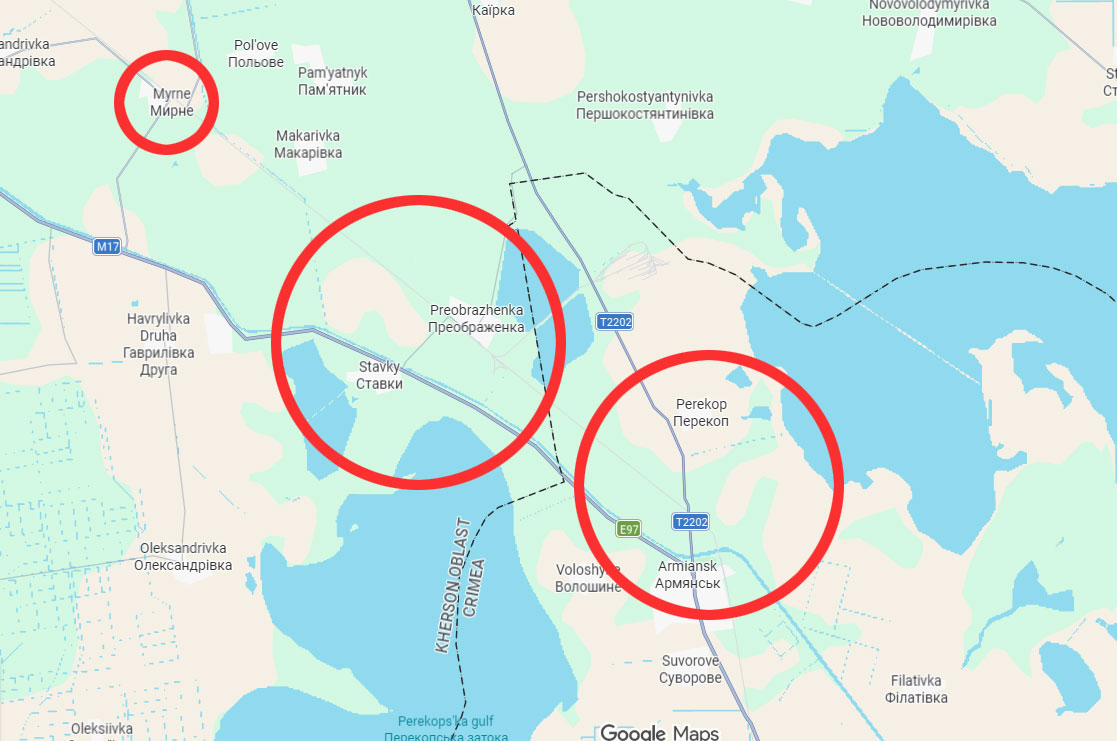
Saldo, the Russian-installed head of occupied Kherson Oblast, named the four targets on his Telegram. They include the automobile bridge in the Perekop-Armiansk area and a bridge near Stavky, Kherson Oblast. Two more bridges near Myrne and Preobrazhenka span the North Crimean Canal. Saldo stated all four spans sustained damage.
Google Maps view of the four bridges struck by Ukrainian drones overnight on 11 June 2026 — near Myrne, between Stavky and Preobrazhenka, and at Perekop near Armiansk in the northwestern Crimean isthmus. Map: Google Maps
Three Crimean northern choke points hit in four days
Ukraine struck the Chonhar bridge on 7 and 9 June, closing Russia's main road link to occupied Crimea, yet the Russians reportedly installed a pontoon bridge next to the severely damaged crossing. On 10 June, Ukrainian drones hit the bridge from Henichesk to Arabat Spit. With both routes fully or partially shut, Russia had rerouted traffic through Armiansk and Perekop — the very corridor struck overnight. DeepState analysts noted that Ukrainian strikes on the bridges are an important part of the blockade of occupied southern Ukraine.
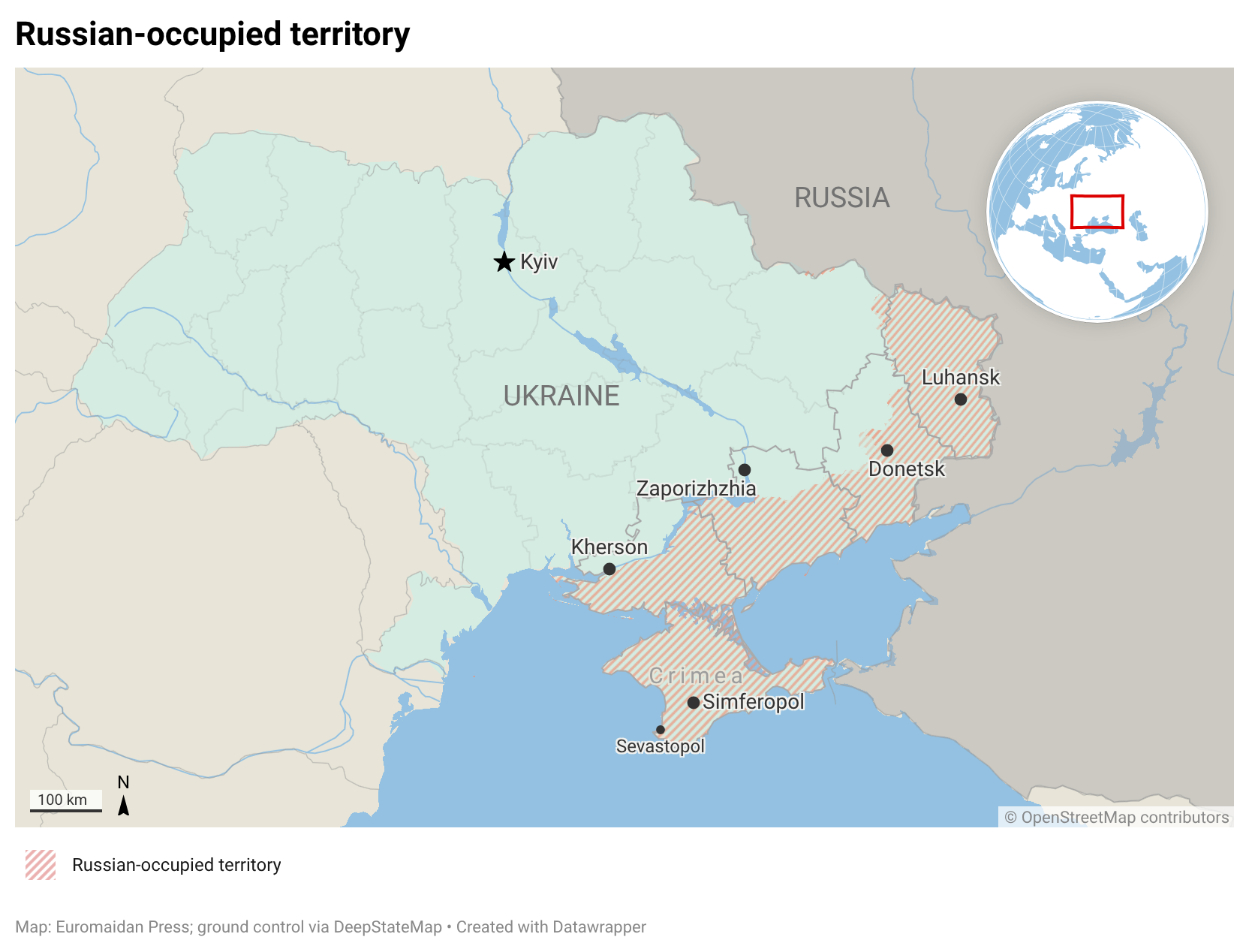
Russian-occupied Ukrainian territory, including Crimea and parts of Luhansk, Donetsk, Zaporizhzhia, and Kherson oblasts. Illustrative map: Euromaidan Press
Not only an entrance, but also targets across the peninsula
Russia's occupation governor, Mikhail Razvozhayev, claimed 32 drones were shot down over Sevastopol between 22:00 and midnight. He claimed the drones fell near Sevastopol Bay, Cape Fiolent, and Balaklava. The city declared two air alerts during the night and the morning.
Monitoring Telegram channel Krymsky Veter reported machine-gun fire in Pishchane at 21:40 and in Andriivka shortly after, citing subscribers.
"At 21:40 a machine gun started firing in Pishchane, at 21:48 a machine gun started in Andriivka, after which an anti-aircraft gun fired a couple of bursts," the channel wrote.
Detonations followed near Cape Fiolent, in Sevastopol, and later in Bakhchysarai. By morning, Krymsky Veter reported explosions and shooting in Saky.
Russia's Defense Ministry claimed the destruction of 330 drones over Russia and the occupied territories in the same overnight period.
Update
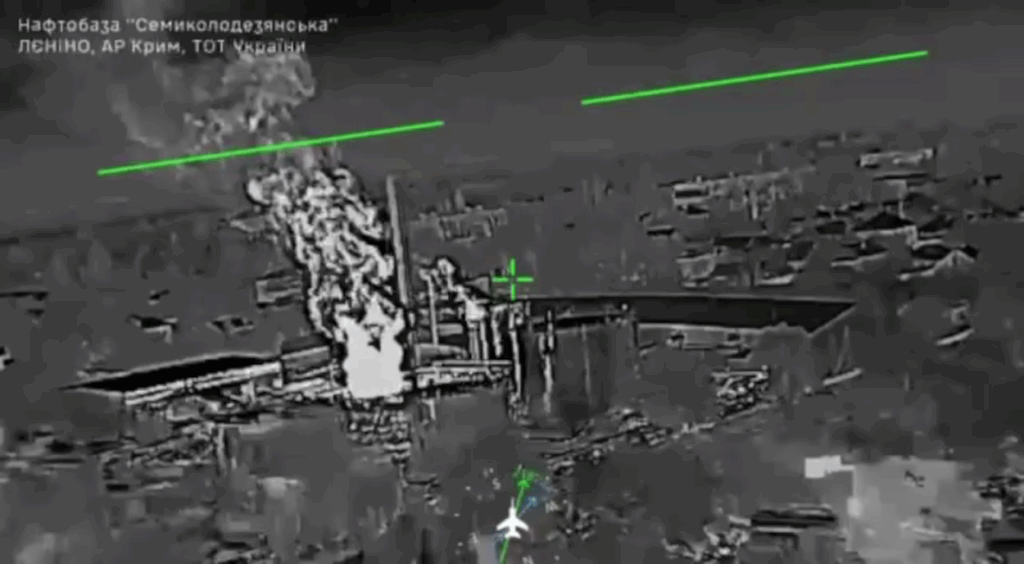
The First Assault Brigade shared the footage of the strikes:
Videos emerged of some of the Ukrainian strikes on bridges linking occupied Crimea to occupied Kherson Oblast
Ukraine's 1st Assault Brigade, 475th Assault Regiment, and SBU's Alfa reportedly took part.
Ukraine's Unmanned Systems Forces (SBS) have struck Russian targets worth nearly $40 billion in the year since the branch's creation, Volodymyr Zelenskyy said. On 10 June, the Ukrainian president signed a decree establishing the Day of Unmanned Systems Forces (SBS Day).
The $40 billion cumulative damage figure Zelenskyy cited represents a 57% increase over the $25.5 billion in cumulative Russian losses that Commander-in-Chief Oleksandr Syrskyi reported in April 2026.
The SBS Day decree institutionalizes the unmanned forces as a permanent feature of Ukraine's military doctrine, alongside the army, navy, and air force.
What Zelenskyy said about SBS's achievements
"Only a year since the creation of the SBS group, Russian targets at various levels worth nearly $40 billion have already been hit," Zelenskyy said in his evening address.
He added that SBS is really a model for many other armies, and "these months we are especially grateful for middlestrikes."
"Russian military logistics across the entire depth of the temporarily occupied territory is now accessible to Ukrainian drones. The Russian border zone also experiences our impact," he stated.
The president added that Russia already feels the effect of these strikes, and Ukraine will continue to scale them.
"The most important thing is that these are different types of strikes, and each one adds to our ability to save lives," the Ukrainian president added.
What does middlestrike mean operationally?
The middlestrike concept Zelenskyy invoked refers to Ukrainian drone strikes against Russian military logistics in the depth of occupied territory and across the Russian border zone. The depth zone covers Donetsk, Luhansk, Crimea, and parts of Zaporizhzhia and Kherson Oblasts. The Russian border zone reaches Belgorod and Kursk. Middlestrikes sit between the very-long-range deep strikes against strategic Russian infrastructure, such as the Volgograd refineries, and the tactical frontline FPV operations. The SBS is led by Brigadier General Robert Brovdi, call sign "Madiar".
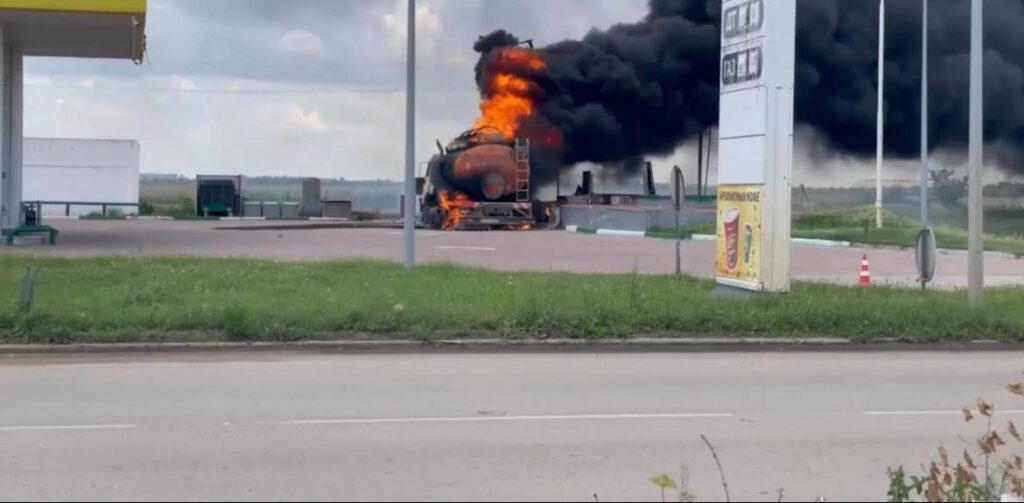
Russia has begun moving gasoline to its frontline units in occupied Ukraine in convoys of civilian cars, the Ukrainian defense outlet Militarnyi reported. Soldiers filmed themselves loading jerrycans into ordinary trunks, an improvised workaround after Ukrainian drone strikes made fuel tankers too risky to run. Russian forces are also disguising army trucks as civilian vehicles along the supply route to occupied Crimea.
This comes amid Ukraine’s ongoing “Logistics Lockdown,” a campaign by several Ukrainian military branches and the Security Service to target Russian fuel, logistics, and other supplies across occupied territories, at depths of up to 200 km.
Soldiers filmed the fuel run themselves
A video on the Exilenova+ Telegram channel showed Russians describing a convoy of passenger cars assembled to carry one metric ton of gasoline, Militarnyi reported. A man off-camera says the cars left the city of Kizilyurt in Dagestan, Russia, on the local head's orders, with the fuel destined for Russian units in occupied Tokmak, Zaporizhzhia Oblast. The footage shows jerrycans filling the trunks:
Besides the fuel, the drivers carried 1.5 million rubles ($20,900) to buy another batch of gasoline. Fuel keeps Russian frontline positions running: generators power electronic-warfare systems, charge batteries for reconnaissance and strike drones, and run communications gear in dugouts and observation posts.
Disguised trucks and a strained supply line
Russian forces have also begun disguising army trucks as civilian transport because of Ukrainian drone attacks deep in the rear. In northern Crimea, monitors spotted a freshly painted blue Ural truck driven by a man in civilian clothes, still carrying military plates, its oversized body posing as a dump truck.
The command of Russia's Dnepr grouping ordered mass use of civilian vehicles to move fuel along the route linking Rostov-on-Don with occupied Crimea, the Krymsky Veter monitoring project reported. That improvisation tracks the M-14 corridor, now within Ukraine's deepening drone range.
Explore further
ISW: The strikes will likely cascade into deeper disruption across Russia’s rear supply network
Why Russia is improvising
Ukraine's Defense Forces have intensified drone strikes on logistics trucks and fuel tankers on the roads from Russia to occupied Crimea. The attacks have already forced the occupiers to limit cargo traffic through the occupied part of Kherson Oblast toward the peninsula, and Russia has closed stretches of its own land corridor to keep them clear of strike drones.

 Login
Login