Normal view

The new samizdat

18 May 2026 at 16:02

While much of the media industry focused on the churn of headlines, we became increasingly interested in the undercurrents beneath them: the hidden systems, infrastructures and ideologies shaping events across borders and over time.

Again and again, our reporting led us back to the same realization: for a long time, the struggle over information was understood primarily as a question of censorship or access. Who controls information? Who gets to publish? Who gets silenced?

Those questions still matter. But they no longer fully describe the world we live in.

Today, the struggle over information is about who builds the systems through which reality is organized, distributed and trusted. From state propaganda to algorithmic feeds, from platform monopolies to AI-generated noise, the battle is not over facts. It is over the infrastructures that determine which narratives spread, which voices are amplified and which communities remain connected.

Over the past year, these questions led to a collaboration between Coda and The Continent, the pan-African newspaper founded in Johannesburg by Simon Allison and Sipho Kings. Although our reporting emerges from very different histories and geographies, we found ourselves arriving at remarkably similar conclusions about power, fragmentation and the future of journalism in an age of informational instability.

This two-chapter essay is the beginning of that collaboration, and marks the start of a new project called The Atlas. Pilot edition is available here — please feel free to share with friends, family and colleagues, preferably in its entirety.

In Chapter One, I return to the world of my Soviet childhood: propaganda, samizdat and the search for trustworthy signals through noise.

In Chapter Two, The Continent co-founder Simon Allison presents the Parable of Sinn Sisamouth: the story of how some of the greatest songs ever written were nearly lost, and then found, and then lost again. 

Taken together, these essays ask what journalism becomes in a world where information is no longer organized primarily to inform, but to capture attention, manufacture reaction and shape perception at planetary scale.

The Atlas grows out of that question.

Chapter One: Through the Static

Whenever I am asked why I decided to become a journalist, an image from my childhood pops into my head. It’s dusk. I am 10, sitting in the kitchen with my mom. She is glued to a shortwave radio. Outside, the Soviet Union is on the cusp of collapse. Georgia, where we are, is on the brink of civil war. We didn’t use the term back then, but fake news was all we got through official channels. Real news — coming from the West — felt like a lifeline. I was in awe of the crackling radio that held my mother’s full attention. I wanted to become that voice.

Illustration: Anna Jibladze.

Years later, I got my dream job at the BBC and spent much of my adult life moving between wars, uprisings and authoritarian states. Again and again, I found myself in places where truth was contested terrain: Baghdad, Damascus, Donetsk, Sana’a. But over time I realized something fundamental had changed. Modern authoritarianism no longer relied primarily on suppressing information. It had discovered something more effective.

Information could simply be drowned out by static.

That realization became stark for me in eastern Ukraine in the summer of 2014. I arrived in a field of bright yellow sunflowers where the bodies from Flight MH17 still lay scattered across the ground. A Russian missile had blown the passenger plane out of the sky, killing all 298 people on board. Yet almost immediately, the Kremlin flooded the information space with competing explanations. It was a Ukrainian fighter jet. A failed assassination attempt on Putin. The plane had been filled with corpses before takeoff. Each theory contradicted the next, but that hardly mattered. The point was not to persuade, it was to exhaust. It was to create so much noise that truth itself began to feel unstable.

Over the following years, I watched versions of the same logic spread far beyond Russia. Social platforms transformed public conversation into a permanent stream of outrage, performance and distraction, collapsing vastly different kinds of information into the same endless feed. War footage, propaganda, conspiracy theories, journalism and gossip all began competing inside systems designed not to inform people but to capture and hold attention.

Noise became the new censorship.

And increasingly, I found myself thinking about the world of my childhood again. Not because history was repeating itself neatly, but because the emotional landscape felt strangely familiar: confusion, exhaustion, distrust, the constant sense that reality itself was becoming slippery. Back then, people searched desperately for clear signals through the static of Soviet propaganda. Today, we are drowning in a different kind of static, but the instinct, the search for clarity feels remarkably similar.

In the Soviet Union, people developed ways of navigating that confusion. Among my strongest memories from that time is the sound of my parents’ typewriter late at night. Friends would pass around copies of banned Soviet literature and my parents would sit at the kitchen table all night, retyping them page by page so they could be shared again. It was my first encounter with samizdat, although I didn’t know the word then.

Looking back now, what strikes me is that samizdat was never simply about forbidden texts. It was about building trusted alternative systems of circulation when official systems had lost credibility.

At Coda, we have spent years building journalism against the logic of noise. We slowed stories down. We followed themes instead of headlines. We built a reporting system designed to connect events across borders and over time, helping readers see patterns instead of fragments. But as our globally distributed newsroom adapted to an increasingly fractured information landscape, it became clear that journalism alone was not enough. Distribution shapes understanding as much as reporting does.

Around the same time, in Johannesburg, Simon Allison, Sipho Kings and their team were building something that challenged many of the assumptions dominating digital media. The Continent, their pan-African newspaper, spreads largely through direct sharing networks: passed from reader to reader rather than pushed by algorithms.

Illustration: Wynona Mutisi.

Different histories had brought us to remarkably similar questions. What does journalism look like when trust is collapsing, attention is fragmented and the systems that carry information have themselves become instruments of power?

Out of that convergence came The Atlas: a new publication that brings together Coda’s methodology of following systems across borders and over time with The Continent’s radically distributed model for reaching readers beyond algorithmic feeds.

The Atlas is built on a shared conviction: as fragmentation, distrust and informational overload spread across the world, some of the clearest ways through will come from places that have already spent decades navigating propaganda, instability and contested reality. Places once treated as peripheral are becoming essential to understanding the defining question of this age: how can meaning survive systems designed to overwhelm it.

Michael Macor/San Francisco Chronicle via Getty Images.

Chapter Two: The second silencing of Sinn Sisamouth

Imagine if your favourite song disappeared, forever

Almost every album I have ever loved was recommended to me by my friend An-Rui. A few months ago, he sent me a track by the undisputed King of Khmer Music, the Golden Voice, the Cambodian Elvis himself – Sinn Sisamouth.

I had never heard of him.

I didn’t respond at first, so he nudged me. That night, after the kids were asleep, I put on my headphones, sat in the garden and immediately lost myself in Cambodia’s psychedelic rock scene of the 1960s and ‘70s. I don’t know enough about music to explain exactly what I fell in love with, but within weeks I was, according to Spotify, among the top one percent of Sinn Sisamouth listeners worldwide.

An-Rui had added a note to his recommendation. “the songs are happy but since i know what his fate was and i don’t understand the words, it sounds incredibly sad to me”.

The story goes something like this: A small-town boy with an extraordinary voice moves to the big city, and conquers all before him. He writes hundreds of songs, bridging Khmer musical traditions with new western influences: jazz, rock & roll, bossa nova, blues, the Beatles, and, of course, Elvis Presley. He toured the country. He toured the world. He made music with an actual King, Norodom Sihanouk, and became Cambodia’s most beloved rockstar.

Then, in 1975, the Khmer Rouge seized power. In the course of committing a genocide, the communist regime disappeared Sinn Sisamouth, and banned his music. He has never been seen, or heard from, again.

But his music never died. It lived on brittle records, hidden for generations under floorboards. It lived on scratchy cassettes, passed hand to hand among the diaspora.

It was only decades later that his music was digitised and remastered, and made available on streaming platforms to the likes of me.

When I listen to Sinn Sisamouth, I can’t help but think about how easily we could have lost his masterpieces entirely. And I wonder what else might have been lost that we have not been able to recover.

And then it happened again.

There’s a particular track that I like to play in my car, where I can turn the bass up as high as it goes. I was driving one afternoon and looked for it on Spotify. It was gone, even though the rest of the album was there. 

I looked again on my laptop at home. Nothing. Gone from Spotify. Gone from Apple Music. Gone from YouTube. Like it had never been there in the first place. I started to wonder if I had gone crazy, and maybe imagined the song entirely. And then I started to panic: What if I never heard it again?

Eventually, I found a bootleg YouTube version, using a different transliteration of the Khmer title – Kanlang Pnheu Pran, instead of Konlong Phner Bran. Before I tracked that down, I had to wade through dozens of AI-generated Sinn Sisamouth ‘cover versions’, all uploaded to YouTube within the last few months. If I had never heard it before, I would never have been able to tell which was the original.

It’s not unusual for songs to disappear from the Internet, especially when the music is from non-English-speaking countries. I’ve had similar experiences with the music of Sharhabil Ahmed, the Sudanese jazz legend, and Ethiopia’s Tilahun “The Voice” Gessesse.

In fact, it’s not unusual for other kinds of information to disappear from the internet; to be edited after the fact; or to be simply lost among all the digital noise. Digital information is incredibly precarious, and becoming more so by the day. AI slop is taking over social media platforms. Algorithms determine what information we can and can’t see, shaping our cultural and political preferences. And powerful interests are becoming increasingly bold when it comes to brazenly manipulating information in their favour – or, of even greater concern, restricting the flow of information across borders.

Amazon changes the contents of books on people’s Kindles without telling anyone. News websites quietly alter critical stories, post-publication, to remove evidence of wrongdoing (my favourite example: the Financial Express published a story critical of India’s richest family; only to replace it with a glorified press release a few days later. They neglected to amend the URL, however, which contains the original headline). Governments shut down internet access on a whim, or legislate which apps and websites are available to specific populations.

For journalism, this is an existential threat. Our job is not just to hold power to account – it is also to write the first draft of history. But if we can’t preserve that first draft, or distribute it effectively, then what, exactly, is the point?

The Continent and Coda Story are working together to try something different. We want to publish news about the world, produced and verified by humans, that cannot be edited after the fact; and to distribute it in a way that dramatically decreases our reliance on unaccountable algorithms or search engine optimisation. The Atlas — pilot edition available here — is our answer to the precarity of information online. It’s a work in progress.

Stay tuned: if we’re going to succeed, we’ll need your help. And if we do succeed, the secret of our success will be those very same transnational networks that kept the music of Sinn Sisamouth alive. Communities of like-minded people, of friends and families will always find a way to stay connected, no matter how vast the distances between them, or how great the obstacles. So what does a global newspaper look like if we design it with exactly these communities in mind?

As soon as I found that bootleg on YouTube, I ripped an MP3 copy and sent it to An-Rui on Signal. “KEEP THIS SAFE,” I told him. I don’t know what happened to the song on Spotify, or if it is ever coming back. But I can’t take the risk of never hearing that bassline again. And here it is, in case you want to hear it too.

The post The new samizdat appeared first on Coda Story.

Legalize Cocaine to save democracy

13 May 2026 at 12:55

Nigel Farage, the leader of the UK’s right-wing Reform UK party, has taken millions of pounds from crypto people, including one convicted of financial crimes in the United States. There are, despite Farage’s insistence to the contrary, questions around whether he followed the rules. Nonetheless, his party has swept local elections. There’s a lesson here for progressive parties everywhere, including in the United States where senators are seeking documents relating to financial ties between the commerce secretary and Tether. What if you get your ‘gotcha’ moment, turn around to the voters with a broad smile… and they vote for your opponents anyway?

Believers in democracy need to start advocating for more transparency, more enforcement and more restrictions on murky finance if they want to stop unaccountable money from buying influence in their countries. It is not enough to rely on journalists and activists to produce the occasional investigation, and expect voters to do the rest: we need properly-resourced agencies that can keep dirty money out of our systems if we want them to remain clean. If history tells us anything, it’s that criminals get elected all too often.

This is urgent. Tether made more than $1 billion in profits this year, in the first quarter, and is thinking hard about the midterms and how candidates might be encouraged to fight for crypto. And that’s just one company. Progressives who believe in fairer finance, a state’s right to regulate its own economy and the power to oversee who’s buying whom, don’t have that kind of money to spend to influence elections, so they need to start making the argument for campaign finance restrictions much more forcefully.

But there’s another point here too. I am working on an article about money laundering at the moment, and was chatting to two UK detectives last week. They led a successful operation in their city (I’ll post the article when it’s done) and I asked if they thought it had made a lasting difference. “With all crime, you take one out and there is another,” one of the detectives told me. “I'd like to think it has made a dent but there will always be more.”

In the case they worked on, gangs were bringing cash generated via the cocaine trade to be laundered into crypto (no prizes for guessing which cryptocurrency they preferred). The detectives identified £53 million in turnover over two years. It’s great that they jailed the ringleaders, but you can see why they’re not getting too carried away. That total is about a quarter of a percent of the UK cocaine market’s turnover, so the gangs really won’t have noticed the loss. And, for the police, it was five years’ work.

To a fairly large extent, since the first U.S. operation in Miami in 1980, when we’ve spoken about fighting dirty money, we have really been talking about stopping cocaine gangs by taking away their ability to make a profit. And, despite occasional successes like the one I’m writing about, this approach has overall been a catastrophic failure. Cocaine is cheaper, more abundant, and more widespread than ever before.

This is important for many reasons, obviously because entrusting the supply of a dangerous substance to criminals is bad, but also because the existence of a vast underground financial system to move the cocaine trade’s profits creates a mechanism through which Russian spies, terrorists and others can hide their cash too. For me though, the real problem is that we have an urgent threat to democracy posed by hidden unaccountable money. Instead of tackling that problem though, our police officers are fighting an endless war against drugs that was lost decades ago.

My modest proposal therefore is to legalise cocaine. It’s available everywhere already, so there’s no downside. We should tax it, regulate it, make sure kids can’t buy it and, as a useful side effect, take all the liquidity out of the underground economy. Our police officers could then stop running to go backwards, and instead fight a battle they might actually win, which is to stop fascists and kleptocrats from buying our democracies.

Use oligarchs to undermine Putin

Here’s a good article from The Economist by “a former senior official in the Russian Government,” arguing that Vladimir Putin is losing his grip. Now, I’m always a little cautious about articles that tell me what I want to hear, as well as the veracity of information and analysis provided by Russian officials, former or current, but it does make some very interesting points.

Of particular interest to me is the idea that Russia’s elite is annoyed with Putin because its members are worried about having their assets stolen, with $60 billion worth of property nationalised or seized by corrupt officials in the last three years. 

“Previously their property rights were outsourced to the West. They used London courts, offshore structures and international arbitration to resolve conflicts or seek protection. Now conflicts must be resolved domestically, without functioning institutions. Demand for rules grows more urgent as redistribution of assets gathers pace,” the article states.

One of the reasons why democracy failed in Russia is because the oligarchs were able to keep their wealth offshore, and thus to essentially colonise their own country, secure in the knowledge they were themselves immune from the unfairness. It would be a pleasing irony if the horrific war in Ukraine ended up undermining not just Putin, but Putinism as a whole.

There is a huge opportunity here for Western governments to capitalise on the dissent, and to start quietly offering sanctions relief to Russians willing to break with Putin, and who’re prepared to surrender a decent chunk of their wealth to help Ukraine in return for being able to keep the rest. There aren’t enough police officers to actually bring the cases needed to investigate, prosecute and confiscate the oligarchs’ wealth anyway (see item above), so we may as well start negotiating and see what they’re willing to do to get it back. In short, this is a big week for me making unfashionable policy proposals.

AI-generated launderers

There’s debate in the United States about getting rid of the Corporate Transparency Act, with Jeff Bezos’ Washington Post supporting repeal, even though the law has never actually been implemented. Opaque shell companies are a weird outgrowth of capitalism that corporations’ original inventors — who wanted to create insurance for entrepreneurs, not getaway vehicles for crooks — never intended to happen, so it’s very odd that they’re now being presented as some kind of human right.

If you want a reason why the appallingly lax American system should be cleaned up, here’s a post on X about someone who tasked two AI agents with making money, and came back to find out they’d registered a Wyoming LLC all by themselves. This suggests the opening of a whole new frontier of automated money laundering, and the consequences are frankly pretty terrifying. The Corporate Transparency Act should be strengthened, not abolished.

A version of this story was published in this week’s Oligarchy newsletter. Sign up here.

The post Legalize Cocaine to save democracy appeared first on Coda Story.

How Brazil is starting to rein in Big Tech

13 May 2026 at 12:50

On April 24, Brazil’s competition authority, the Administrative Council for Economic Defense (CADE) announced it was opening an investigation to assess whether Google’s use of news content amounted to unfair competition practices against the Brazilian press. The announcement was welcomed by civil society organizations that have tried to push regulation to limit the reckless power of Big Tech for years. Ajor, Brazil’s Digital News Association, said that “a balanced relationship between digital platforms and journalism organizations is fundamental to the flourishing of journalism committed to the public interest. By ensuring a fair competitive environment, Cade directly advances that goal.”

In spirit and intent, CADE’s investigation into Google is similar to legislation in Australia that recognized that value is being extracted from news publishers without proportionate recompense. In Brazil, the case has been debated since 2019, but the adoption of AI Overviews helped alter the perspective of Brazilian judges. The overviews are artificially generated summaries that synthesize information from several sources and appear at the top of Google Search results. They “raise potentially more concerns,” ruled Judge Camila Cabral Pires Alves, “as they may more profoundly alter the economic function of the interface and expand the ability to retain attention within the platform's own environment.”

CADE will now investigate whether Google should be sanctioned for “alleged abusive exploitation of a dominant position, in light of the technological evolution of the conduct.” While there is perhaps a greater global appetite to regulate the impacts of AI – even the Trump administration has recently acknowledged that some oversight may be necessary – the CADE judges have been under considerable pressure from Big Tech executives to stop investigations into how their control of the market harms Brazilian businesses. 

For those of us who have reported on Big Tech, this aggressive lobbying is not surprising. Companies like Google, Meta, Twitter, TikTok, Amazon, and Microsoft have long attempted to interfere in any decision or legislation that can harm their interests in Latin America. According to a joint investigation by journalists across 13 countries, Big Tech lobbyists got away with convincing legislators in Colombia to weaken a rule meant to protect children’s mental health and prevent enforcement of privacy regulations in Ecuador. It took a team of over 40 journalists from 13 countries to uncover this while reporting on the ‘Big Tech Lobby’ in the continent and across the world.   

Threats by the U.S. government to retaliate against any country or international entity that sought to regulate Big Tech added another layer to an already complicated and uneven relationship with Silicon Valley. “Digital Taxes, Digital Services Legislation, and Digital Markets Regulations are all designed to harm, or discriminate against, American Technology,” wrote Donald Trump on social media. “Show respect to America and our amazing Tech Companies or consider the consequences!” During the past year, Trump’s envoys have forced dozens of governments around the world to dilute or even shelve regulation in exchange for lifting tariffs. 

In “Big Tech’s Invisible Hands,” which I coordinated alongside Maria Teresa Ronderos, from CLIP (Centro Latinoamericano de Investigación Periodistica), journalists mapped a total of 75 executives that were part of “public policy” or “government relations” teams in Brazil. Tech companies utilized a “revolving door” in which public sector employees could go straight into highly paid jobs leveraging their contacts and influence. Doors opened more easily. Invitations to hangouts and events were more likely to be accepted. 

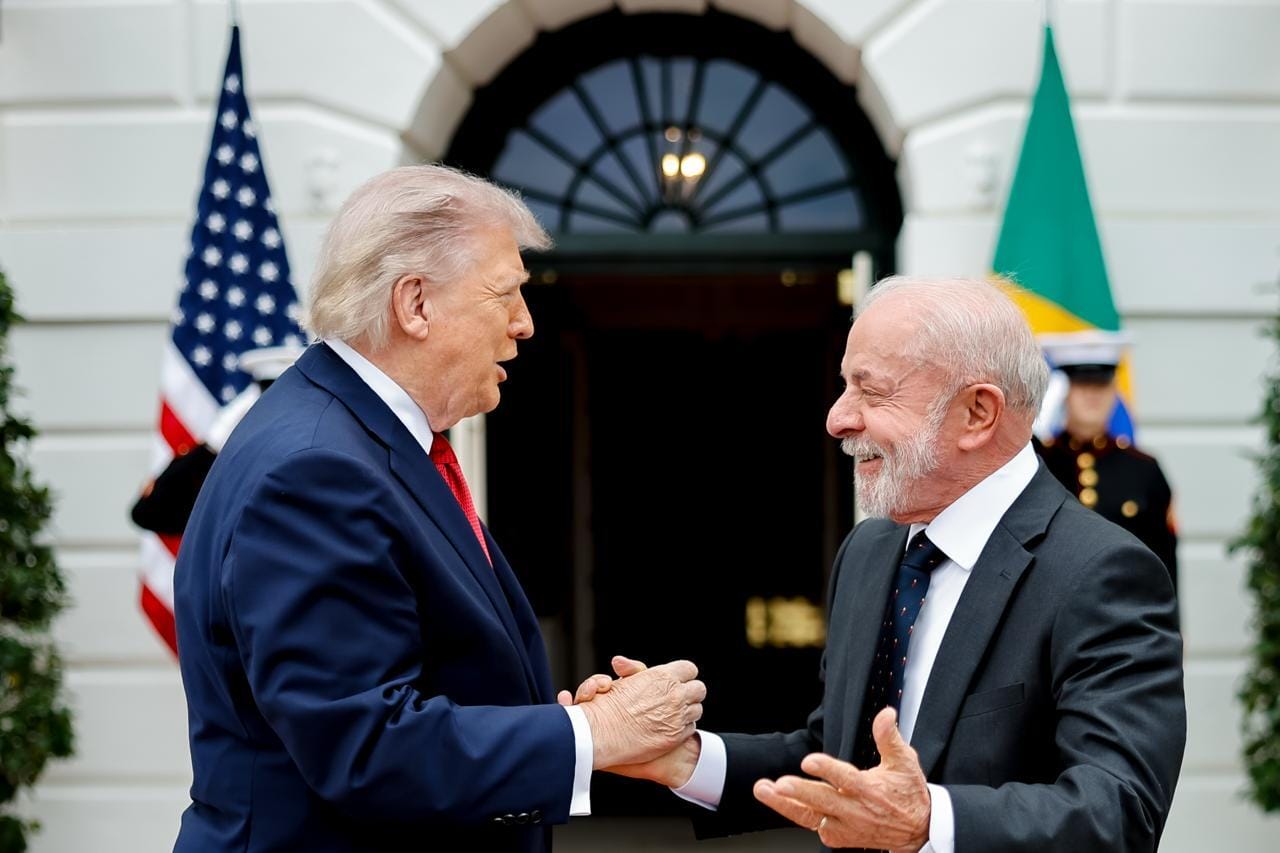
Brazilian President Luiz Inacio Lula da Silva meets with U.S. President Donald Trump at the White House on May 7, 2026. Brazilian Government / Ricardo Stuckert / Handout/Anadolu via Getty Images.

Lobbying in Brazil is dialed up to eleven. The country has 163 million internet users, with over 150 million on WhatsApp, and over 120 million on YouTube, Instagram and Facebook. With AI, Brazil is a similarly large, influential market. Portuguese is the sixth most widely-spoken language in the world, with 70% of speakers based in Brazil. Which means that, if an LLM has been trained in this language, it probably used content created by millions of Brazilians going about their business of making friends, debating politics and football online. It’s not just about journalists; we are all unpaid labor for Big Tech. 

In the words of Arthur Lira, the Speaker in Brazil’s Congress who filed a criminal complaint against Big Tech executives in 2023, companies adopted a variety of tactics “to shut down democratic debate and intimidate lawmakers” and defeat any attempt at using legislation to force accountability. Google, he said, used its search homepage, used by over 85% of Brazilians, to spread fear that proposed laws would “make the internet worse” or “make it harder to know what is true or false on the internet.” A report by the Federal University of Rio de Janeiro found that Google invested in ads on its own platform so extensively that it tweaked the search, prominently featuring the word “censorship” in connection to the Brazilian bill. Google also hired Michael Temer, a lawyer and former President of Brazil, to influence lawmakers and Supreme Court Justices. Of course, it was not Google alone. Meta executives, for instance, even argued that proposed legislation in Brazil could lead to the Bible being censored.

But Brazilian lawmakers, the Supreme Court, and civil society have persisted. On August 28, 2025, the “Felca Law” was approved, after a video by the influencer Felca denounced the exploitation and exposure of children on social media. The law establishes that digital platforms must take measures like verifying user age, implementing parental controls, and preventing children's exposure to adult content, gambling, and pornography. They must create reporting channels and may face fines of up to 10% of their annual revenue in Brazil.

Brazil’s president Luiz Inácio Lula da Silva and Donald Trump have had a testy relationship, in part because of Lula’s criticism of Big Tech. In February, at the AI Impact Summit in New Delhi, Lula called for global governance of AI, warning: “When few control the algorithms, it is not innovation, but domination. Regulating the so-called Big Tech companies is linked to the imperative of safeguarding human rights in the digital sphere, promoting information integrity, and protecting our countries’ creative industries.”

By sticking to his guns, Lula may now be seeing the tide turn. He was in the White House on May 7, and though neither he nor Trump took questions, both appeared encouraged by the meeting. “Very dynamic,” was how Trump described Lula, while Lula said he was “very, very satisfied” with how the talks went. With a general election in Brazil approaching in October, Lula will be sensitive to how the White House, as it has done in other elections, and Big Tech might offer vocal support for right wing candidates.

But his willingness to stand up to Big Tech is popular with voters. A recent poll found that 78% of Brazilians want to see tech companies being held responsible for the content they publish. Another poll found that 55% of Brazilians defend regulating Big Tech, with 43.9% against it. 

And as scams, fake news, and AI slop dominate ever larger swathes of all our digital space, in Brazil, as in much of the rest of the world, the entire experience of the internet is becoming more unappealing. Big Tech, with the assistance of the U.S. government, may be succeeding in slowing down the pace of regulation and watering down the content of that regulation, but in the long run its victories might be pyrrhic. People have had enough and their governments might be forced to listen.

The post How Brazil is starting to rein in Big Tech appeared first on Coda Story.

The afterlife of empire

12 May 2026 at 12:54

On May 3, an unusual procession moved through Washington DC. Several hundred people walked beneath the monuments of the American capital carrying portraits of Red Army soldiers. Children waved Soviet flags. A live orchestra played wartime songs at the World War II memorial. The Russian embassy had filed the permit; the DC Metropolitan Police provided an escort. Russian state media celebrated the event as proof that, with the return of Donald Trump, historical truth too had returned to America.

One organizer told Russian state television: “We love, respect Russia, honor the memory of our heroes.”

Similar marches took place in Paris, Amsterdam and Busan. In Berlin, authorities announced that Soviet flags, Russian symbols and military songs would once again be banned near Soviet war memorials during May 8 and 9 commemorations.

But in Moscow, Victory Day itself appeared haunted by fear.

For decades, May 9 has been Russia’s most sacred annual political ritual, binding victory, patriotism and state power into a single language. But this year, Kremlin spokesman Dmitry Peskov was reduced to announcing that the Immortal Regiment march in Moscow would continue only “in electronic format.”

The run up to this year’s Victory Day became the most anxious Moscow has experienced in recent memory. The Kremlin canceled the traditional procession in the Russian capital, moving it online. Military equipment was removed from the parade. Mobile internet access across Moscow was intermittently shut down in the days leading up to May 9. Spectator numbers in St. Petersburg were reportedly slashed from thousands to just a few hundred. The Victory Parade in Kaliningrad was canceled entirely. Russian media outlets published extraordinary reports about Vladimir Putin retreating deeper into protected bunkers amid fears of Ukrainian drone strikes and assassination attempts.

Russia’s Foreign Ministry even warned foreign governments to evacuate diplomats from Kyiv before May 9, threatening massive retaliation if Ukraine targeted the celebrations with drones.

And then came another extraordinary twist. Volodymyr Zelensky publicly “allowed” the parade to proceed. In a deliberately tongue-in-cheek decree issued after negotiations around a temporary ceasefire, the Ukrainian president formally excluded Red Square from Ukraine’s operational strike plans for the duration of the celebrations, even listing the exact geographic coordinates of the square itself.

Watching it all unfold, I kept wondering whether empires collapse more easily than the systems of feeling they create. The Soviet Union fell apart more than 30 years ago, but the architecture built around victory, sacrifice and historical grievance survived it, stretching across borders, diasporas and rival political projects. What began as Soviet myth-making about liberation has evolved into a transnational political language through which governments, activists, diasporas and rival ideological movements compete over legitimacy, victimhood and belonging.

Over the years, at Coda, in our Rewriting History current, we have tracked how the remembrance of World War II became central to Putin’s machinery of legitimacy and repression. Soon after he came to power, Russian public culture became saturated with stories of the Great Patriotic War. Watching Russian state television often felt as if the war had ended yesterday. New films, schoolbooks, drama series, speeches, parades and television specials turned victory into the emotional foundation of Putin’s Russia. Scholars of Russian memory politics have described how, under Putin, collective memory of the war became a tool for claiming legitimacy, discrediting opposition and presenting the Russian state as the eternal defender against fascism.

 It resonated because it tapped into genuine emotion passed on for generations. It was never just propaganda. It rested on something real: the scale of Soviet loss and the private grief carried by millions of families.

The Immortal Regiment began in 2012 in the Siberian city of Tomsk as a local act of remembrance. Ordinary people walked through the streets carrying photographs of relatives who died in the war. By 2015, Putin was leading the Moscow procession himself, while state-backed organizations coordinated chapters in dozens of countries. But in Putin’s Russia, where victory had already become the central organizing myth of the state, the boundary between private mourning and political mythology dissolved.

The speed of that transformation still feels important to me. It says something about the way modern political systems absorb private emotion and fold it back into the language of the state.

The Kremlin framed these Victory Day rituals as a defense against what it called Western attempts to “rewrite history” by minimizing the Soviet role in defeating fascism or equating Stalinism with Nazism. Ukraine and many Eastern Europeans came to see the marches instead as vehicles for imperial nostalgia and wartime propaganda. 

But the argument, it seems, is no longer only about what happened in the past. It is about who gets to turn memory and grief into political legitimacy in the present.

This year Germany found itself in the extraordinary position of having to ban Soviet flags and military songs near Soviet memorials, effectively regulating the symbolic language of antifascism itself. Historian Timothy Snyder once warned that “if fascists take over the mantle of antifascism, the memory of the Holocaust will itself be altered.” That is precisely the moral and historical dilemma Berlin has now forced into the open. What happens when the symbols of genuine antifascist sacrifice become inseparable from the imagery of an ongoing war? When the flags carried by the soldiers who liberated Auschwitz are also flown at embassy-organized rallies while Russian bombs fall on Kharkiv? 

At Coda, we explored some of these tensions years ago, in our documentary “What To Do With Stalin,” which examined the strange afterlife of Stalin’s image across the former Soviet world. While filming in Georgia, we encountered arguments that now feel strikingly familiar: whether remembering Stalin represented patriotism or denial, historical pride or historical amnesia.

https://www.youtube.com/watch?v=NdfTH6rfe7E

Even then, it was obvious these battles were never really about the past.

Putin himself acknowledged as much during this year’s Victory Day speech, describing the war in Ukraine as a “just” continuation of the struggle against fascism and accusing the West of fueling confrontation with Russia “to this day.” Hours later, he suggested the war might finally be over. “I think that the matter is coming to an end,” he told reporters.

Victory Day 2026 may ultimately be remembered not for the military parade itself, but for revealing how unstable that memory system has become. Moscow performed triumph while fearing attack. Berlin restricted Soviet symbols in the name of democratic security. Washington hosted embassy-linked Soviet commemorations beneath American monuments.

I was ten years old when the Soviet Union collapsed. For those of us who grew up inside it, the end of the empire felt at once chaotic and exhilarating. Borders opened, old certainties disappeared and ideology lost its grip almost overnight. I still feel fortunate that, as a child, I witnessed an empire built on terror and repression collapse into history.

In the decades that followed, we watched Russia slowly turn the symbols and emotional reflexes of the Soviet system into instruments of political power once again. Victory Day became one of the most potent of these instruments: a ritual that fused together grief, patriotism, historical trauma and state legitimacy into a single, powerful sentiment.

Russia’s ambassador to Washington, Alexander Darchiev, praised what he described as the Trump administration’s dramatically changed attitude toward Victory Day commemorations. The holiday, he said, now played “an unequivocally positive role” in Russia-US relations. He pointed specifically to the marches held in the center of Washington, DC.

But the more I think about this year’s Victory Day, the less it feels like a story about Russia alone. When the Soviet Union collapsed, many of us assumed its emotional architecture would disappear with it. Instead, parts of it were patiently cultivated and repurposed for a new era by the men in charge of Putin’s Russia.  

The emotional logic that once underpinned the Soviet system no longer belongs only to Russia and the shattered geography of its former empire. Grievances, historical trauma and rituals of belonging now shape political life all around the world. Digital networks and algorithmic systems did not create these emotional impulses, but they amplified them at a scale the Soviet state could only dream of. Perhaps that is the true afterlife of an empire: not the survival of its borders or ideology, but of the emotional systems it builds to organize fear, belonging and historical destiny.

Additional research by Masho Lomashvili and Irina Matchavariani

The post The afterlife of empire appeared first on Coda Story.

Why an insurgency in Mali matters in Moscow

1 May 2026 at 12:55

A coup is underway in Mali, though it has not brought down the governing junta just yet. The country’s military leader, General Assimi Goïta has, after days in hiding, appeared in public to claim, unconvincingly, that the “situation is under control.” But rebel forces — an alliance of Al-Qaeda affiliates and Tuareg separatists — have taken over provincial cities and are calling for a blockade of the capital Bamako. Mali’s military junta hangs on by a thread, in a familiar regional story of violence, civilian suffering and international intrigue.

On April 25, coordinated attacks across Mali exposed the junta’s fragile hold over the country. Jamaat Nusrat al-Islam wal-Muslimin (JNIM), the al-Qaeda affiliate that has driven insurgency across the region for over a decade, joined forces for the first time with Tuareg separatist groups — who have been fighting the central government for even longer — to simultaneously strike cities hundreds of miles apart, including the capital Bamako, Gao, Kidal, Sévaré, and the garrison town of Kati. A suicide car bomber drove into the residence of defence minister General Sadio Camara, killing him along with his wife, two grandchildren, and several civilians. Camara was one of the most influential figures in Mali's ruling junta and had been widely seen as a possible future leader of the country. He was also the key architect of Mali's military alliance with Russia. Mali, Burkina Faso and Niger, which together form the Alliance of Sahel States (AES), have all in recent years realigned away from France, the former colonial power in the region, and towards Russia.

Russian mercenaries, in the form of the Wagner Group and more recently the Africa Corps, have backed military juntas in the Sahel, after coups in Mali, Burkina Faso and Niger led to the withdrawal of French troops from France’s former colonies. But during these latest rebel strikes, it was Russian fighters that were chased out of the northern city of Kidal to the sound of jeers. Africa Corps, the Kremlin-controlled paramilitary group, described the insurgent attacks as a "coup attempt" backed by "Western intelligence services." RT amplified these claims, accusing France and the West of orchestrating the violence, even as it claimed Russian fighters successfully repelled rebels. In 2024, Ukraine’s military agency said it had provided information to help Tuareg rebels ambush and rout a Wagner convoy, killing dozens of Russian mercenaries. Both Mali and Niger have cut diplomatic ties with Kyiv. Burkina Faso has described Kyiv as a destabilizing force in the region, making the Sahel effectively a front in Russia’s war with Ukraine. 

The Kremlin’s combination of misinformation and mercenaries helped exploit growing anti-Western sentiments in the Sahel to give Russia a propaganda win in the region. Former colonial powers such as France didn’t help themselves, as can be seen even now in Madagascar, the latest nation to expel a French diplomat and accuse Paris of fomenting unrest. But the success of Russian propaganda hasn’t been matched on the ground. As Mali struggles to contain a rebel alliance that has fresh impetus and energy, Moscow’s control is weakening and the effectiveness of its military support is under question. Already, with Russian weapons in short supply because of war with Ukraine, it is China that the Malian junta turns to for arms. China’s strategic efforts in the Sahel have been similar to its efforts in the rest of the African continent – a focus on securing infrastructure contracts as part of the Belt and Road Initiative and securing access to mineral resources. But rebel attacks in the Sahel are bad for Chinese business. In February, the Chinese embassy in Niamey, the capital of Niger, warned Chinese companies to take their workers out of the firing line as rebels increasingly targeted Chinese infrastructure projects, including a $4.5 billion oil pipeline from Niger to Benin.

In 2024, the United States was forced to leave neighboring Niger after a coup, to withdraw from a $100 million base. It seemed the U.S. was losing ground to both Russia and China in the Sahel. Earlier this year, though, as security concerns in the Sahel escalated sharply, the U.S. adjusted its approach, choosing to deal pragmatically with military juntas. By late February, the U.S. lifted sanctions on top Malian officials, including General Camara, the recently slain defence minister. It may see closer cooperation with Sahel countries as essential to its security interests and a way to undercut Chinese access to Sahelian resources.

The three Sahel states, Mali, Burkina Faso and Niger, have turned away from France and Europe and towards Russia, while increasingly flirting with the U.S. and reliant on Chinese weapons. The result has been disaster. All three Sahel states are ranked in the top 5 for countries impacted by terrorism. And the humanitarian toll has been severe. Millions of people face internal displacement across the region and cuts in aid programmes mean many millions, especially children, also face acute hunger. But, as the great powers circle the region, jockeying for geopolitical gain, the talk remains about the logistics of propping up failing juntas, providing military solutions to human crises, and maintaining power rather than confronting problems.

Mali, Burkina Faso and Niger – all led by military authorities that came to power in a coup – have also isolated themselves from the rest of their neighbors by withdrawing from the West African regional bloc, Ecowas. Meanwhile, they sell their model as an alternative to Western-style democracy, a narrative that Russian propaganda networks have been all too eager to promote. But the strength of the insurgency against Mali’s government, and Russia’s apparent inability to protect it, sends a different message to the rest of the African continent.

The post Why an insurgency in Mali matters in Moscow appeared first on Coda Story.

The influencer bubble: Can content creators continue to airbrush the Gulf?

11 March 2026 at 13:50

Julia E, an 18-year-old influencer from Germany, was hanging out with her family on the Palm Jumeirah beach when she heard a blast and saw a fireball erupt into the sky. She knew tension was mounting following the U.S.-Israeli attack on Iran the previous day, but she didn’t imagine Dubai would be on the frontline. “I was a little scared,” she says. “Usually you just read about it in the newspapers, you see it online, but when you see it in front of you, it’s a different feeling — like your heart just drops.”

The fear was not an emotion she expressed on Instagram. Julia’s family moved to Dubai from Germany in 2024, tempted by the business potential of an emirate that aggressively marketed itself as the influencer capital of the world — a digital utopia carved out of the desert, with its gleaming skyscrapers and Insta-ready waterfronts. Dubai’s state-backed Creator HQ offers content creators long-term residencies, legal support, networking opportunities, training and an environment geared towards digital entrepreneurship. Influencers need a permit to legally operate in Dubai but taxes are negligible — 5% VAT on taxable income from clients in the UAE over AED 375,000 (about $102,000), and a flat 9% corporate tax on income exceeding AED 1,000,000 (about $272,000). It has attracted over 50,000 content creators to Dubai, which has a population of about 4 million.

With 60,000 followers on TikTok and Instagram, Julia is looking to build her own marketing company in Dubai. In an effort, she says, to comfort her younger brother, she recorded a video shortly after witnessing the explosion. It showed Julia, a palm tree and the glittering night skyline behind her, with the caption: “You live in Dubai, aren’t you scared?” The video cuts to a montage of Mohamed bin Zayed Al Nahyan and other Emirati sheikhs: “No, because I know who protects us.” The short video is set to an AI-generated rendition of the Belgian singer Stromae’s ‘Papaoutai’, a song that laments the loss of a father.

According to Julia, she was the first content creator to post an ‘Are you safe?’-style video, a now viral trend across the Gulf as influencers counter the narrative of a region in turmoil. 

“I decided to make that video,” she says, “because I did feel safe. And I wanted to spread some positivity and my perspective that we are still being protected and we still have someone behind us here.” As Iranian drones hit the Gulf, including luxury tourist hotels destinations like Fairmont, The Palm hotel and the Burj Al Arab hotel, there was a wave of schadenfreude online. Some users outside Dubai could not contain their glee that the city’s glossy surface, its influencer-curated image of sunkissed luxury, had been ripped apart. The distress of those who spend their working hours flaunting luxury and throwing shade at the cities they come from, were, it has to be admitted, amusing to many.

But Dubai’s influencers doubled down, as the war spiralled and airports shut down, stressing the city’s safety, walking around in crowded public spaces, praising “the best air defense systems” and the men behind it: a reaction so seemingly choreographed that people questioned whether it was part of a government PR campaign. 

On March 3, the UAE’s president and crown prince were conspicuously filmed on a stroll through a Dubai mall, reassuring bewildered shoppers. It was eerily reminiscent of Volodymyr Zelensky’s “The President is here” video from four years ago, when Russia invaded Ukraine. Vogue Arabia, headquartered in the UAE, praised Gulf leaders and wrote about the influencer campaigns and the people’s “unwavering faith in their nation’s leadership and its steadfast commitment to protecting those who call it home.” 

As inviting as Dubai is to influencers, they must acquire advertiser permits that can cost up to $4,000 and are told to respect the state and avoid circulating rumors and unverified information or any content that can harm the UAE’s foreign relations or “offend or compromise national unity or social cohesion.” In the wake of Iran’s strikes, the UAE’s Public Prosecution announced that "anyone who shares or republishes content from unknown sources may face legal accountability under the country’s applicable laws, even if they are not the original creator of the content.”

There is a sense of vulnerability among Dubai’s influencers, says Zoe Hurley, associate professor of media at the American University of Sharjah and author of the 2023 book ‘Social Media Influencing in the City of Likes: Dubai and the Postdigital Condition’. “They haven't necessarily been trained professionally. They don't have institutional guardrails protecting them, or any formal buffer zones that might have protected people who are putting themselves out there.” she said. Hurley made a distinction between “influencers who are here on holiday who don't live here and who are followed by, say, people in the UK” and homegrown ones, representing diasporas in Dubai — from South Asia, the Levant and Europe — “who people are turning to because they're the thought leaders in their communities.”

None of the influencers we contacted in Dubai or across the Gulf confirmed ever being prompted or paid to post positive content. The German NTV network, however, reported concerns voiced by German influencers: "I don't know what I'm allowed to say and what I'm not allowed to say," one posted, "We're not allowed to post anything!” said another. These stories and reels have since been deleted.

https://www.instagram.com/reel/DVUQr2LEmtZ/?utm_source=ig_web_copy_link
Julia E., an 18-year old influencer in Dubai, said she was the first content creator to record the now-viral "Aren't you scared" video.
https://www.instagram.com/reel/DVbNjNZEjNU/?utm_source=ig_web_copy_link
Julia recorded a second video in response to the backlash she faced.

Julia made another video, responding to the accusations that influencers were essentially providing a PR service for Dubai. “I will tell you exactly how much I got paid,” she says. “Dubai pays me in business… in safety… in connections… with weather.” She adds that, unlike in Dubai, she would never venture outside alone in her native Germany after 8 at night.

This point about Dubai’s safety — leaving things in the car without being scared to be robbed, or walking alone at night — is echoed widely among European expatriates in the Emirates and Saudi Arabia who compare it to the relative anxiety they feel in Europe. Telegram’s CEO, Pavel Durov recently made the same point: “Unfortunately, I had to leave Dubai for Europe a week ago — so I’m not only missing the free fireworks from Iran, but also exposing myself to greater risk. Given Europe’s crime rates, Dubai is statistically safer even with missiles flying.” Elon Musk shared the sentiment, writing that “No country is perfect, but Dubai and UAE broadly are objectively safer and better run than many areas of Europe.” Notorius influencer and ‘manosphere’ icon, Andrew Tate, still facing human trafficking and rape charges in Romania, posted a video of himself dancing on a yacht “as bombs fall.” His brother Tristan Tate chimed in, comparing air attacks in Dubai to stabbings in London. 

What these influencers don’t discuss is Dubai’s underbelly, an invisible city occupied by an underpaid migrant workforce, their treatment explained away on the grounds that they make more money in Dubai than they would in the poor countries in South Asia and Africa that they come from. While the influencers enjoy government-sponsored benefits and status, these other migrant workers remain bound under the kafala (sponsorship) system that binds their residency status to their employer. Despite reforms, under the system their status remains uncertain, their earnings precarious, and imprisonment or fines for relatively minor offences is common. There are no golden visas for laborers and maids, never mind darker reports about human trafficking and sexual and physical abuse. 

London-based barrister Caoilfhionn Gallagher described the UAE’s exploitation of migrant workers as a “grubby reality, with rampant human rights abuses.” She said she had “acted for people prosecuted and jailed in the UAE for daring to work with human rights organisations or criticise the authorities,” referring to the mass trial in 2024, when 43 people, among them human rights activists, had been “subjected to enforced disappearance, solitary confinement and incommunicado detention.” 

The contrast between the city that influencers show their followers and the city built on the abuse of migrant labor is one that governments across the Gulf want to bury. The UAE’s 2031 vision sees creative industries contributing up to 5% of the country’s GDP. 

For decades now, the UAE has been trying to diversify its economy, to pivot away from its reliance on hydrocarbons. It is betting on the digital economy and tourism to be the cornerstones of economic growth. 


But for all the bravado on display, rich people and Western influencers are fleeing the Gulf, as war with Iran continues. Influencers unable or unwilling to leave, must keep grinding. Narcissus could not stop staring at his reflection even as he was dying. Will Dubai’s influencers be allowed to look away from their reflections in the city’s famous mirrored skyscrapers?

The post The influencer bubble: Can content creators continue to airbrush the Gulf? appeared first on Coda Story.

❌