Younger students have regained ground academically after the pandemic's disruptions while older students' test scores continue to stagnate, according to the latest testing data released Wednesday by the federal government.
Wong says she isn’t concerned about One Nation’s fundraising efforts, but more about their policies. Pauline Hanson’s party says it has raised more than $1.5m in the last day, although those claims are unverified.
I’m less interested in what Pauline Hanson fundraises and am more concerned about One Nation’s policies. Just as I am concerned about the fact that the Liberal party and One Nation seem to be working together and that it appears to be very clearly that a vote for One Nation is actually a vote for the Liberal party, and a vote for the Liberal party is actually a vote for One Nation.
We’ve said for some time it’s obviously a fragile ceasefire, but we’ve also said that what Australia wants is a negotiated end to the war. That’s what we’re calling for, and that’s what we will continue to press for …
We’re not a central player in the Middle East, as we have said. What we can do is add our voice to others who are calling for a negotiated end to the conflict. It’s obviously one of the things we discuss today with the United Kingdom.
A sixth case of New World screwworm has been confirmed in a Texas calf. It’s the second calf in La Salle County, Texas, to become infested with the parasite that threatens wildstock with larvae that burrows deep into the tissue of its inhabitant, according to the U.S. Department of Agriculture. Officials in the Lone Star…
A sixth case of New World screwworm has been confirmed in a Texas calf. It’s the second calf in La Salle County, Texas, to become infested with the parasite that threatens wildstock with larvae that burrows deep into the tissue of its inhabitant, according to the U.S. Department of Agriculture. Officials in the Lone Star…
The defense company Ukrainian Armor and European firm MBDA on June 10 initiated a strategic partnership aimed at developing deep strike and anti-drone systems.
Rep. James Gallagher (R-Calif.) was officially sworn into Congress on Wednesday afternoon, slightly broadening the GOP’s slim majority in the House. Gallagher won the special election on June 2 for the seat for California’s 1st Congressional District, following Rep. Doug LaMalfa’s (R) death in January. The former state assemblymember, who was backed by President Trump,…
Rep. James Gallagher (R-Calif.) was officially sworn into Congress on Wednesday afternoon, slightly broadening the GOP’s slim majority in the House. Gallagher won the special election on June 2 for the seat for California’s 1st Congressional District, following Rep. Doug LaMalfa’s (R) death in January. The former state assemblymember, who was backed by President Trump,…
Federal agents outside of Dodger Stadium in Los Angeles last June during the Trump administration’s immigration enforcement surge, which has stirred anxiety.
Several blocks around Madison Square Garden will be closed to most people Wednesday afternoon. The city approved a ticketed watch party, though it was unclear whether it would take place.
NHS bosses urge all hospitals in England to use ‘digital triage’ process to combat overcrowding in emergency services
Patients who turn up at A&E with non-urgent ailments could be told to come back another time under NHS plans to stop hospitals becoming overcrowded and avoid the service’s usual winter crisis.
Eighteen hospitals in England are already using “digital triage assessment” to help A&E staff decide which patients need to be seen right away or be dealt with in another way. If patients do need urgent care they are treated at once in the usual way. But if they have more minor ailments and can wait, they are told to come back later that day or the next day, or are referred to a community-based service, such as a GP or pharmacy.
Maine Senate hopeful Graham Platner (D) addressed the string of controversies about his past behavior on Wednesday, following his recent win in the state’s Democratic primary election. “There’s nothing out there that’s actually concerning,” Platner, who is looking to unseat incumbent Sen. Susan Collins (R-Maine), said on MS NOW’s on “Morning Joe.” “People will make…
Maine Senate hopeful Graham Platner (D) addressed the string of controversies about his past behavior on Wednesday, following his recent win in the state’s Democratic primary election. “There’s nothing out there that’s actually concerning,” Platner, who is looking to unseat incumbent Sen. Susan Collins (R-Maine), said on MS NOW’s on “Morning Joe.” “People will make…
DEDURU OYA, Sri Lanka – On April 16, eight members of Priyantha Kumara’s family including his wife, son, brother, father-in-law, and four other relatives were swept away by strong currents in the Deduru Oya, a river in Sri Lanka’s North Western province. Sri Lanka Police reported more than 30 drowning deaths between April 12 and 21 this year, underscoring the risks posed by flooding rivers. Sri Lanka Police media spokesperson Udaya Kumara Wootler told Mongabay that 376 individuals have died due to drowning in rivers last year while 595 fatalities were reported in 2024. Buddhika Sampath, spokesperson for the Sri Lanka Navy told Mongabay that the Navy Diving Unit recovered 148 bodies of people between May 2022 and May 2023. While the police are yet to disclose official statistics of deaths due to drowning from January to May 2026, the number of reported incidents show over 50 fatalities. Kumara is a resident of Gopallawa in the northwestern district of Kurunegala. His son had requested that they all go for a bath in the river. The group had been bathing at a popular spot named Kuriyagas Mankada when they met the tragedy. “My son was only 13 years old, and he was a bright student,” Kumara told Mongabay. “My brother was about to hold a housewarming ceremony at his newly built house. But all these dreams were shattered within seconds. My father used to take us to this same spot to bathe when we were young. But the river has changed…This article was originally published on Mongabay
On Tuesday, engineers working inside a Himalayan mountain completed the final blast of a critical tunnel that links India’s Kashmir Valley to its Ladakh frontier with China, marking a key step in the country’s push to secure year-round access to one of its most sensitive border areas.
The Zojila Tunnel, stretching 13.14 kilometers (8.2 miles) beneath the mountains, will become India’s longest road tunnel once finishing work is done, with full operation expected by 2028.
Road Minister Nitin Gadkari remotely triggered the last detonation at the eastern portal near Minimarg in Ladakh, joining excavations driven from both ends of the mountain over more than five years.
Gadkari described the project as far more than a transport link, saying it serves as a vital lifeline for communities cut off by winter weather.
Project engineer Manmohan Singh said the team completed the job without a single accident despite working through extreme cold and difficult conditions around the clock.
Himalayan tunnel gives India year-round access near China
The Zojila Pass, which the tunnel cuts beneath at an elevation of 11,578 feet, currently shuts down every winter under heavy snowfall that can pile well above the roof of a large truck, blocking road travel between Srinagar and Leh for months. More than 3,000 workers have been involved in excavation since October 2020.
In Photos | Zojila Tunnel Poised for Historic Breakthrough
Security personnel stand guard outside the Zojila Tunnel in Minamarg ahead of the landmark breakthrough ceremony of the ₹6,500-crore project. Set to provide all-weather connectivity between Kashmir and Ladakh, the… pic.twitter.com/PkM4tqDIC3
— Kashmir Observer® (@kashmirobserver) June 9, 2026
This tunnel is one of four major passages in a $712 million road corridor that also includes the 6.5-kilometer (4 miles) Sonamarg tunnel, with all components targeted for full operation by 2028.
Beyond road access, India launched a $3.9 billion railway from its lowland plains to Kashmir in June 2025, as reported by Al Jazeera, featuring the Chenab Rail Bridge, currently the world’s tallest railway bridge.
The 272-kilometer (169 miles) line starts at Udhampur, the base of the Indian Army’s northern command.
Billions in rail and roads back India’s border push
The push behind all these projects traces to a deadly confrontation in Galwan Valley in June 2020, when Indian and Chinese soldiers fought hand-to-hand at high altitude, killing 20 Indian troops.
The clash set off an accelerated construction race on both sides of the 3,500-kilometer (2,175 miles) shared border.
The Himalayan tunnel is central to India’s effort to close the infrastructure gap with China, where both countries completed troop disengagement at contested frontier points in October 2024, as reported by The Diplomat.
Kashmir has been split between India and Pakistan since the end of British rule in August 1947, with both countries claiming it in full.
Rep. Jason Smith (R-Mo.) said Wednesday that Congress has to act on Social Security, a day after the Trump administration projected that one of the program’s trust funds will run out by 2032. “Congress needs to get their act together to address Social Security and the insolvency that’s coming, instead of poking blame at other…
Rep. Jason Smith (R-Mo.) said Wednesday that Congress has to act on Social Security, a day after the Trump administration projected that one of the program’s trust funds will run out by 2032. “Congress needs to get their act together to address Social Security and the insolvency that’s coming, instead of poking blame at other…
The United States professional baseball league (MLB) was suspended for three months between May and July 2020, at the worst point of the pandemic. When it finally resumed, it did so behind closed doors or with very restricted access. For the first time in many years, stars of the sport such as Mike Trout of the Los Angeles Angels and Christian Yelich of the Milwaukee Brewers had to celebrate their victories in front of empty stands.
Ukrainian forces conducted 50,000 missions with unmanned ground vehicles as of January, the Ministry of Defense announced. The number is constantly growing: from 7,500 missions in January to 14,000 in May, and the number of units employing UGVs grew from 117 to 230.
"The UGV is a very, very promising thing," callsign Electric of the 93rd Brigade told Euromaidan Press—his brigade was an early adopter, having used UGVs for three years running.
"It has already proven its effectiveness, developing and scaling quickly, and becoming one of those tools of war that is already contributing to victory."
UGVs are meant to solve Ukraine’s chronic personnel shortages and battlefield casualties and have been rather effective, according to testimonials such as these. The General Staff has credited ground robotic platforms with cutting personnel casualties by up to 30%. In the Azov Corps, a single battalion moves over 40 tons of equipment per month with UGVs.
However, just having more machines is not nearly enough. Ukrainian forces are working to solve a myriad challenges before these machines can live up to their fullest potential, including:
Creating a military doctrine for their use
Establishing sufficient training for their operation
Building the infrastructure to deliver, modify, and repair them
Ironing out spare parts shortages, intercompatibility, and delivery challenges
Figuring out how to employ the menagerie of the dozens of systems in service
“The development of UGVs is one of our priorities: the more tasks robots perform, the more lives of military personnel can be saved,” Defense Minister Mykhailo Fedorov said in a statement.
More doctrine, more training
While remote-controlled ground crawlers existed before the full-scale invasion, mass adoption only exploded in 2026. The number of units using UGVs doubled between January and June. “The majority of brigades don’t have a (specialized) working UGV unit inside,” said Andrei Kushniarou, Commander of the 108 Battalion “Da Vinci Wolves.”
As a result, many units are getting UGVs for the first time without much of an idea of what to do with them, soldiers said in interviews. This applies not just to driving them but planning missions, figuring out what models work best for specific tasks, and which ones to commit to purchasing.
“They began rapidly scaling up UGVs in just over six months,” Electric said. “Before that, there was no systematic use of this in the army. There were only isolated units that were doing something, trying things out.”
“Systematic implementation began in just over six months and it scaled up from a dozen units, to hundreds of units. That is, this is an incredibly rapid leap, so there is no doctrine, nothing. There is only the experience of certain successful units, which share it and finally scale it up.”
This is natural: any new way of war requires figuring out. Ukrainian air defenders and UAV operators have had a long and difficult learning process over the past four years before Ukraine began to tip the drone war in its favor. UGVs must tread a similar path.
For the time being, for every story of a UGV rescuing a wounded soldier or capturing a Russian position, there are lesser-known stories of troops flailing about and learning on the job. Kushniarou said he has seen logistics UGV operators using the same route to deliver supplies to front line troops for half a year, as though inviting Russian FPV drones to come and destroy them.
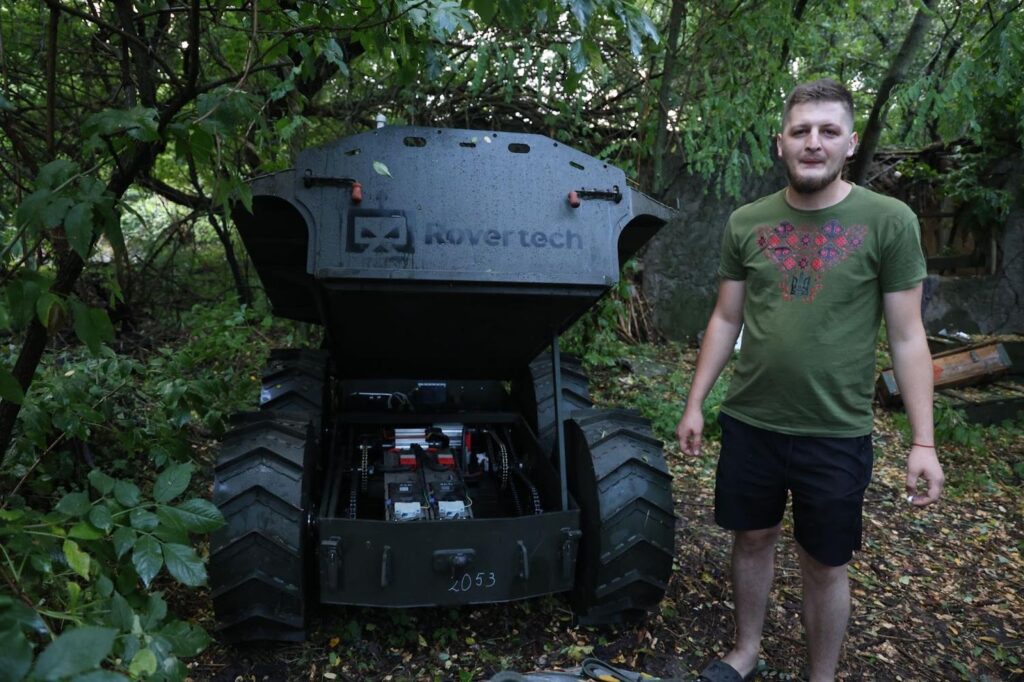
“We have some classes for FPV drones, for the bombers, where they use simulators before taking the real drones. But we don't have this kind of thing for UGV's,” said Olexiy Severin, the financial director of Ukrainian Unmanned Systems, which produces the heavy-duty Ravlyk ground drone for units including the military intelligence (GUR).
Lyuba Shipovich stands near a Ukrainian TERMIT unmanned ground vehicle (UGV). (Photo David Kirichenko)
The solution is more training. There are some military training centers, such as the one operated by the 3rd Corps, as well as others scattered among different units. The military is working on creating more—for example, the South Operation Command, which plans to not only train soldiers how to use drones but to better integrate them with infantry. Volunteer-led initiatives like Dignitas are launching their own programs.
One bottleneck is the lack of experienced instructors, soldiers said. Experienced operators are at a premium, both on the front line and in the classroom. Meanwhile, current best practices become outdated in roughly six months. Another bottleneck is cash.
"We need money. A lot," Electric said. "First and foremost, money for scaling up production facilities, training centers and infrastructure development workshops. Everything is ready for it, it's just a matter of stating the facts and writing a doctrine."
Managing the menagerie of systems
Around 33 different models are available through the DOT-Chain marketplace. The actual number of different models of UGV floating around the country is closer to 200, soldiers said.
This can be an overwhelming number of systems to get used to. Every system comes with its own nuances, use cases, and teething troubles. And “basically every one” has to be modified by the unit before it can be used, said Mykyta Puz, a technology liaison with the Azov Corps. Other soldiers agreed with him.
“That's why we were the first to create our own universal control board, which we're installing throughout this entire zoo, standardizing the electronic components at a minimum,” Electric said. They must also add their own cameras and Starlink terminals.
The 93rd isn’t alone in this. Starlink is the standard army-wide control method for driving UGVs at a distance, yet Starlink doesn’t come standard with UGVs. Many robots come without night vision and thermal cameras integrated into the basic package.
Other parts require tinkering as well, especially when UGVs come from outside Ukraine. Multiple soldiers were quite negative with their reviews of foreign-made machines, with reviews like "highly expensive, utterly useless" and "the quality of work is really bad.”
Specific complaints ranged from the act of driving toggling a safety cutoff switch, antennas jostling loose, or radio controls dying when a friendly UAV was flying nearby.
The 93rd is trying to solve the “zoo” issue by limiting themselves to no more than 10 systems they trust, of which two are the mainstay and several more sit in backup.
Spare parts and infrastructure
The challenge there is access to spare parts, with Electric calling it “critical… We only supply them through our own resources and methods.”
Kushniarou said that units have a choice to make. They can decide to rely on just one or two developers, to buy UGVs from them. But if these developers get hit by a Russian missile or some parts fail to arrive from China, they can be screwed.
Or they can embrace the “zoo,” work with many developers at the same time, which spreads out the risk, but turns into a “logistical hell” where parts are concerned. This also calls for really good specialists who know how to work with a dozen different systems.
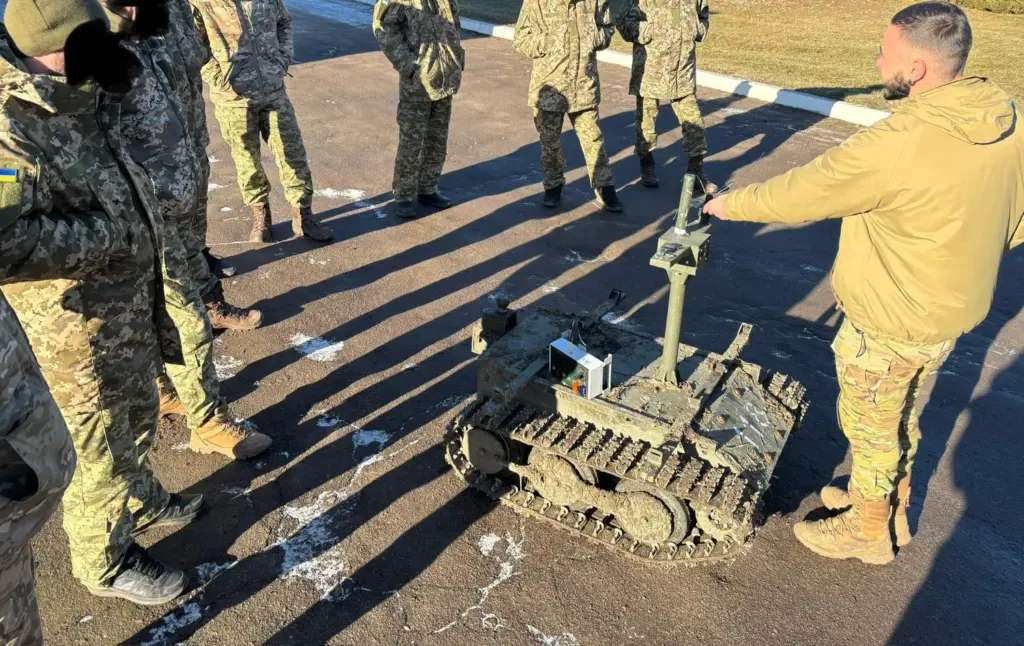
A small tracked unmanned ground vehicle of the kind multiplying across the Ukrainian front in dozens of locally-built variants. The vertical mast carries an elevated camera or communications antenna; the exposed controller board on the chassis is the workshop signature — the visible mark of a platform iterated in the dugout R&D labs Yabchanka describes, not on a factory production line. These small UGVs handle resupply, reconnaissance, and serve as radio relays extending the range of other robots and FPV drones operating deeper into the kill zone. Photo: Oleksandr Yabchanka / Facebook.
Getting parts can be a doozy, even when they are available. Severin said that units are begging his company to include a second battery for the Ravlyk UGV into the standard purchase package because "to buy additional batteries is all the circles of hell, harder than to buy a new UGV, because they have to go through multiple layers of military permission."
He said that the company replaces wheels free of charge at its own expense, just so Ravlyk users can get them repaired in a week instead of a month.
The solution is to build a more robust military-wide infrastructure for UGVs, soldiers said. That includes a spare parts pipeline, repair and servicing centers, and analytical centers for what can be improved.
"You can’t just have a UGV, you need to create infrastructure around it,” like workshops, R&D and analytical centers, and logistics systems for parts, Kushniarou said. “Without infrastructure, any UGV is just a tool without a master.”
Scaling up adoption
Ukraine has set a goal to offload 100% of logistics tasks to UGVs. If all of the doctrinal and military-industrial teething troubles can be resolved, many more frontline warfighters’ lives can be saved.
The Defense Ministry previously mentioned several things it’s doing to accelerate adoption.
One is the development of “a separate UGV competence center” that will liaise between the General Staff and the military and become a “single point of contact” for manufacturers.
The ministry also said it’s working on “comprehensively resolving” a VAT issue that led to contract delays. Severin told Euromaidan Press that a VAT that applies to electric vehicles has hit the Ravlyk, making it cost 30% more when purchased directly by units, discouraging them from using it.
Procurement contracts are now being signed for the following year to ensure the lots can be delivered.
As for 2026, Ukraine has plans to contract for 50,000 UGVs. But as of mid-May, the Ministry of Defense wrote that over 3,000 orders have been filed through the DOT-Chain marketplace and over 1,000 of them were delivered. Even though this number doesn’t include direct unit purchases, getting to 25,000 units by the end of June seems unlikely.
It would be in the military’s best interest to prioritize getting good systems rather than fulfilling the number at any cost, developers said.
US defense secretary continues ramp-up of pressure against country including sanctions and devastating oil blockade
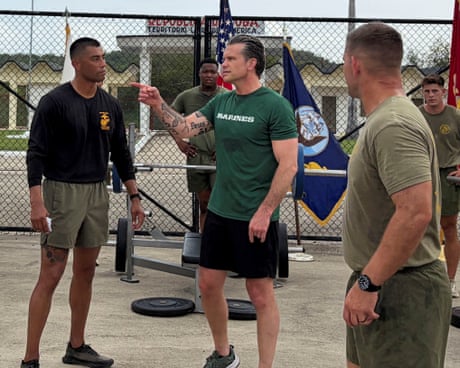
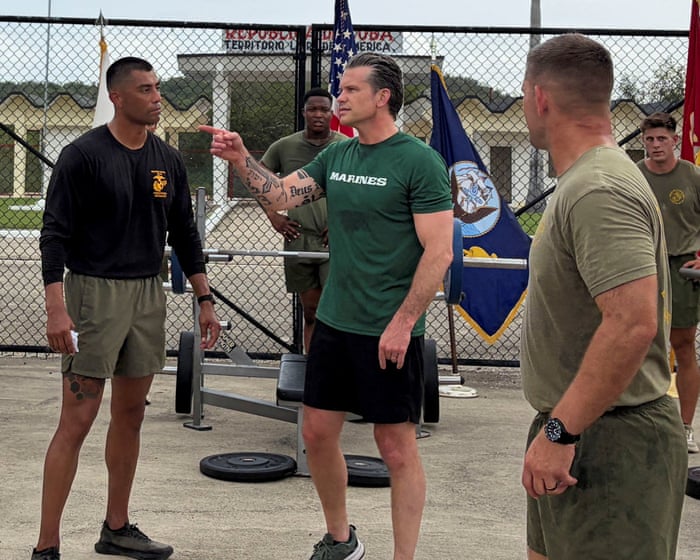
Pete Hegseth has warned Cuba against acquiring weapons that could threaten the United States, during a visit to the US military base at Guantánamo Bay.
Washington has ramped up pressure against Cuba with sanctions and a devastating oil blockade, and Donald Trump has repeatedly signaled that the Cuban government could be the next after Venezuela to fall to US pressure.

 Login
Login