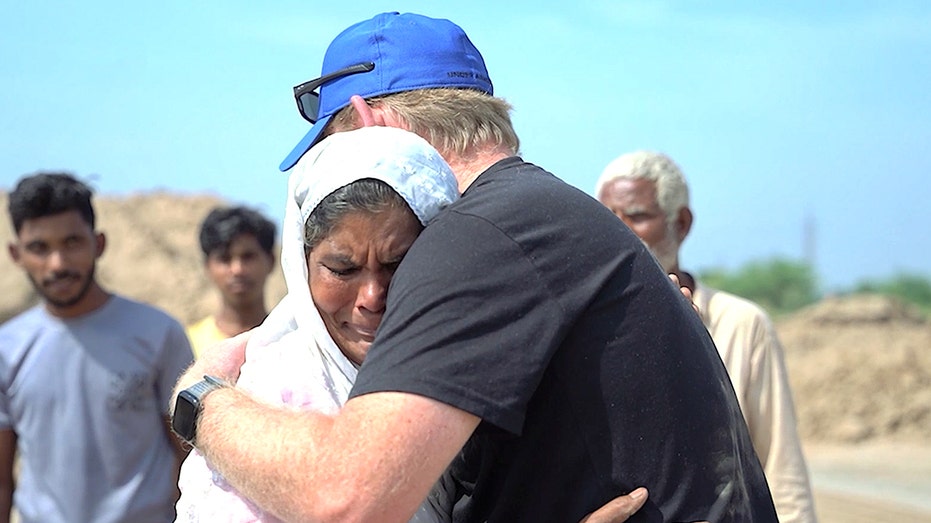
Idaho resident Aaron Hutchings arrived at a Pakistani brick factory in January. The devout Christian told Fox News Digital that he was shocked to see children turning bricks under the hot sun to work off the debts that their families had incurred, sometimes over the course of generations.
Within hours of his arrival, Hutchings paid off the debts for two enslaved Christian families and escorted them to freedom, breaking the "curse that they’ve had for hundreds of years."
There are up to one million Christians working in slave and bonded labor in Pakistan, according to Emma Hall, a persecution researcher working with charity Open Doors U.K. and Ireland, told Fox News Digital. This could comprise as much as 30% of Pakistani Christians, counted at 3.3 million in the 2023 census and accounting for 1.37 percent of the population.
Hall noted that "extreme poverty drives desperate families to accept advance loans (peshgri) for emergency and basic needs, trapping them in cycles of debt bondage where repayment systems are structured in ways that make exit extremely difficult."
Emmanuel Hernandez said he was shocked when he first heard that Christians in Pakistan were living in debt-based enslavement in Pakistan’s brick-making industry. After traveling to Pakistan to meet the woman who would later become his wife, Hernandez witnessed bonded laborers at a brick factory for the first time.
"Never in my life have I seen such hopelessness," he told Fox News Digital. "At that moment, I committed myself to rescuing one family a year for the rest of my life."
In January 2025, Hernandez started the nonprofit Project Jubilee. He says that it is "by the grace of God" that people have already donated enough through the nonprofit to save 300 Pakistanis from slavery.
Though Project Jubilee will save any bonded slave, regardless of race or faith, Hernandez said that "98% of the people we rescue are Christians, and that’s because they’re second-class citizens" in their country.
The average cost to help one family is about $8,500, Hernandez said, because Project Jubilee recognizes that slaves needed more than debt relief to escape the cycle of bonded labor.
"Our goal is for them to succeed in life and make sure that they never go back," he explained. To accomplish this, Hernandez and his team pay lawyers to take care of all applicable paperwork, and help each family with two months of rent and food. They also get families in touch with a local minister, pay for children to attend school and purchase every family a tuk tuk, a motorcycle taxi, which they can use to create income.
He said that in most cases, factory owners are grudgingly accepting of letting slaves go after their debts are paid off. But in some cases, he says owners have put a cap on the number of families Hernandez’s group can free in a month, or told them that they’re "never allowed to come back again."
Hutchings found Hernandez’s online profile in late 2025 and messaged him, asking to be part of his effort. Retired from the IT world, Hutchings said he is "just a normal guy who wanted to do something…to help people."
After a short conversation over the phone, Hernandez invited Hutchings to come along to a trip to Pakistan in January. Hutchings agreed. It was during this visit that Hutchings freed two families and reported he "just got hooked." He admits that the process is highly emotional. "It changes an entire family’s future for generations," he explained.
Hutchings said that it is especially impactful to witness the change that freedom brings to children. "We get to ask them, ‘what do you want to be when you grow up?" Hutchings said. "They probably haven’t even really thought about that. They’re [thinking] ‘I’m going to be a brick worker for the rest of my life, just like my parents.’"
Hutchings started his own nonprofit, Intentional Faith Foundation, which he now uses to collect donations from people who want to help free more slaves.
Just months after his first journey, Hutchings returned to Pakistan in May to free an additional ten families. After video of his visit went viral, Hutchings said that his nonprofit raised enough funds to save another family from enslavement.
The practice of bonded slavery was outlawed formally in Pakistan in 1992, Hall says, but "enforcement remains weak." Discrimination extends beyond the bonded labor environment, with the U.S. Commission on International Religious Freedomnoting in 2025 that there were "recent and escalating attacks against religious minorities" in Pakistan, including Christians.
During his recent visit, Hutchings learned that securing housing was difficult, with many landlords refusing to rent to Christians. Eventually, a Pakistani Christian group working with families was able to find housing and jobs for parents, and located a teacher for the children who were largely illiterate.
In a 2023 report, Pakistan's National Commission for Human Rights released a series of recommendations for diminishing the pain that bonded labor brings to approximately three million Pakistanis. In her introduction, the group's chairperson stated, "It is deeply appalling that in the 21st century, slavery persists in the form of bonded labor."
Among its recommendations are forbidding children from laboring in brick kilns, helping laborers access justice and creating unions for collective representation. They suggest registering all brick kilns, increasing the use of automated machinery, and encouraging brick purchasers to buy bricks from kilns "that provide a safe and decent working environment."
Representatives of the Pakistani government did not respond to Fox News Digital's questions about the enforcement of laws against bonded labor, or about the treatment of Pakistani Christians. Neither Hutchings nor Hernandez reported having complications with the Pakistani government when working to free brick kiln laborers.
For Hutchings, the work has been transformative. "Looking back, it is hard to see any of it as random. I believe God's hand was in it from the beginning, and even though we were doing all of this to show Jesus' love towards these people, we ended up receiving more than we gave."
Traditional fishing in the lagoons stretches back to Byzantine times and Venetian rule. Credit: Greek Ministry of Culture
The Messolonghi-Aitolikos Lagoons National Park in Western Greece is a testament to the enduring legacy of traditional fishing, a practice deeply intertwined with the ingenuity of local communities and the sustainable management of natural resources.
This ancestral knowledge, vital to the region’s cultural identity, is now being meticulously recorded and preserved for future generations. For centuries, fishing here has been more than just a profession; it’s an art form with roots stretching back to medieval-Byzantine times and Venetian rule. Through collaborative efforts with local communities, this crucial element of the region’s heritage is being safeguarded.
Traditional boats in the lagoons. Credit: Greek Ministry of Culture
Part of the history and life of our country
“The traditional fishing of the Messolonghi Lagoon is part of the history and life of our country. It is connected to the collective cultural consciousness of the inhabitants of the region and travels through the depths of time,” said Spilios Livanos, the former Minister of Rural Development and Food.
The lagoon itself is a vibrant ecosystem, a living organism teeming with rich flora and fauna. This biodiversity, which boasts 290 bird species and over 100 plant species, underpins the traditional fishing practices and exemplifies the harmonious coexistence of humans and nature. The rich natural environment is a cornerstone of professional activity, sustainable development, and the preservation of the traditional way of fishing.
House built in the sea. Credit: Greek Ministry of Culture
Central to the unique fishing culture of the Messolonghi-Aitolikos lagoons are the distinctive methods and tools employed. The divaria, permanent fishing traps that double as natural fish farms, are a prime example. Across the lagoon complex, there are fourteen such facilities, eight of which are traditional and strategically located where the lagoon meets the sea.
Remarkably, the placement of these traditional divaria has remained unchanged since 1826, a testament to their enduring effectiveness and the deep-rooted knowledge of the local fishermen. These wetlands are highly productive habitats, attracting a vast array of aquatic organisms that are commercially exploited by the more than seven hundred active fishermen in the lagoon today.
Fishermen’s homes in the lagoons. Credit: Greek Ministry of Culture
Beyond the stationary divaria, other key elements of this traditional know-how include the Pelades, the iconic reed houses built on stilts above the water, which serve as both homes and operational bases for fishermen. The gaites, unique flat-bottomed wooden boats, are essential for navigating the shallow waters of the lagoon and are built using specific types of wood, reflecting a deep understanding of local resources.
Flathead grey mullet (Mugil cephalus) is the most famous fish species caught in these waters. This species is particularly important, as its roe is used to produce the famous Avgotaracho of Messolonghi, a protected designation of origin (PDO) delicacy.
Preserving traditional fishing in Greece’s lagoons
Despite the demanding conditions, generations of fishermen continue this tradition, making it an integral part of their historical and cultural heritage. This resilience was even a crucial factor in the survival of the people of Messolonghi during the city’s historic siege.
The rich tapestry of traditional fishing knowledge encompasses a wide range of skills: from constructing buildings and utilitarian objects to identifying suitable wood for boat building and crafting fishing tools like longlines, harpoons, and stafnokari (a type of net). These permanent installations (divaria) and mobile means (boats, gaites), along with the tools, collectively form a cultural heritage that continues to sustain the inhabitants of the region.
In 2022, the traditional fishing practices of the Messolonghi-Aitolikos Lagoons were included in the National Register of Intangible Cultural Heritage of Greece.
Political victories achieved through strict party discipline and powerful financial support often result in a deepening of internal divisions, the consequences of which only become noticeable over time. Back in my days as a young public school teacher in Kentucky, I learned fast that in politics, money talks, and anything else (BS) takes a hike […]

 Login
Login