Reading view

How Roman Emperor Julian Fought Christianity to Save the Ancient Greek Gods
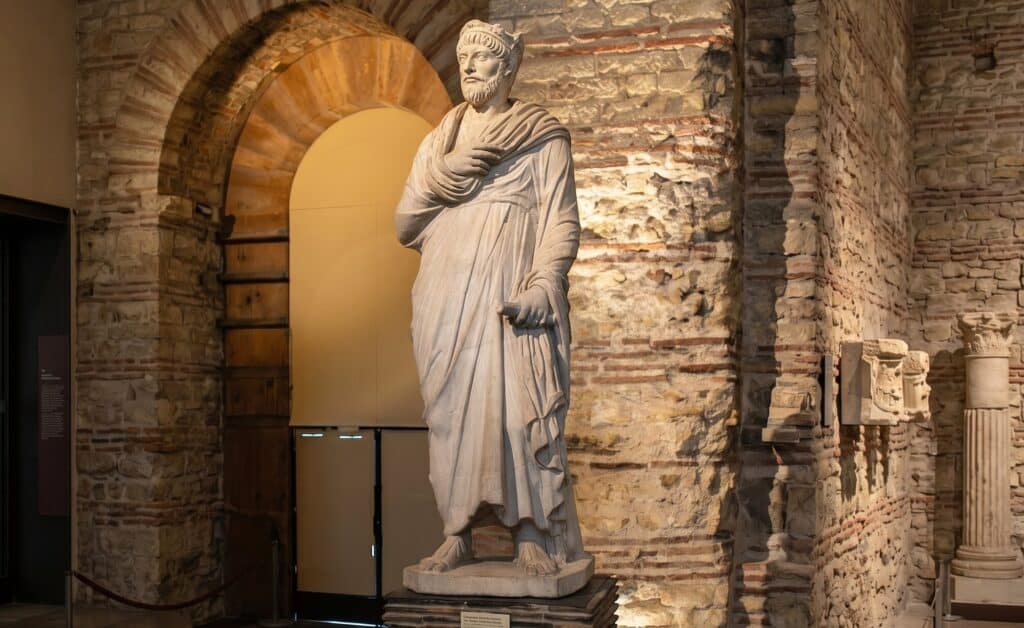
A full-length marble statue of a bearded man draped in a traditional Roman cloak and holding a scroll stands within a stone gallery.
The depiction of Julian in this classical guise shows his commitment to Neoplatonism and Greek culture over the rapidly spreading Christian faith. Credit: Ash Crow, Wikimedia Commons, CC BY-SA 4.0

Few figures in late antiquity present as compelling a historical debate as Julian the Apostate’s attempt to restore the Greek gods in opposition to Christianity in the Roman Empire.

During his brief but highly consequential reign in the fourth century AD, the Roman Empire stood at a profound religious crossroads. For a short period, Julian attempted to slow the empire’s accelerating Christianization, launching a sweeping effort to revive the ancient Olympian pantheon and return Rome to its traditional pagan practices. His sudden death on the battlefield has led historians to debate how dramatically the cultural trajectory of Western civilization might have shifted had his reforms endured.

Julian was born into the heart of the Constantinian dynasty, a family that had only recently converted to Christianity. Nonetheless, he became the last Roman emperor to openly support and worship the traditional Greek gods. He ruled for only about two years from 361 to 363 AD, but he acted with urgency and purpose. Julian the Apostate initiated an extensive program of philosophical and religious reform, aiming to reverse the Christian expansion advanced by his predecessors. To the growing Christian population, he was seen as a traitor to the new religious order, but to those who still admired the intellectual and cultural legacy of the classical world, he appeared as a philosopher-king attempting to restore an older vision of Rome.
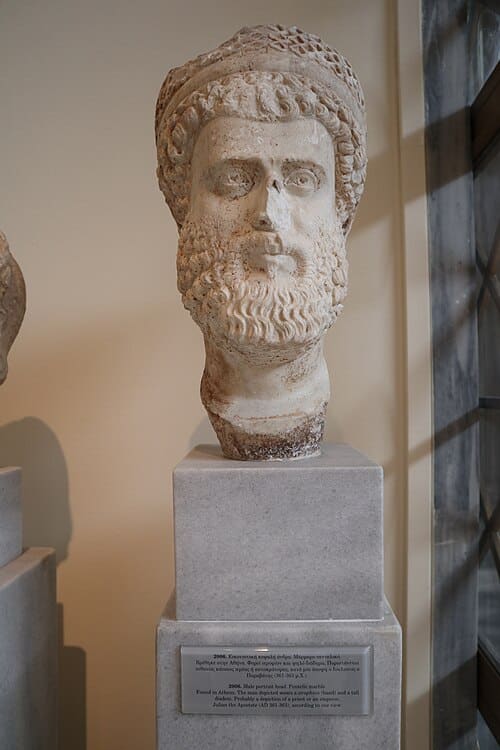
A sculpted marble portrait head of a bearded man wearing a diadem rests upon a stone pedestal inside a museum.
This marble head from Athens is widely believed to be a rare surviving portrait of the Roman Emperor Julian the Apostate. Credit: George Koronaios, Wikimedia Commons, CC BY-SA 4.0

Julian the Apostate’s early life

Julian did not experience the typical sheltered upbringing of an imperial heir. He grew up constantly looking over his shoulder, surviving political purges that eliminated many members of his own family. Although he was raised in a strict Christian environment under the supervision of powerful bishops, he is often understood to have developed a private intellectual attraction to classical texts and traditions associated with the ancient world.

His life took a decisive turn when he went to study in Athens. There, he was secretly initiated into the Eleusinian Mysteries, an experience that deeply shaped his philosophical outlook and strengthened his commitment to rejecting Christianity in favor of Neoplatonism. This forced dual existence helped form a uniquely strategic mindset. He became familiar with the inner workings of the Church, knowledge he later leveraged in support of his own religious and philosophical aims. By the time his troops in Gaul unexpectedly proclaimed him emperor, Julian was convinced that the gods themselves had chosen him to restore the ancient order.

Julian the Apostate as Emperor and the worship of the Ancient Greek gods in the Roman Empire

When he finally took power, Julian did not launch the kind of widespread, violent persecutions often associated with earlier periods of religious conflict. Instead, he pursued a more calculated cultural strategy. His approach focused on weakening Christian influence within imperial institutions while strengthening traditional religious structures. Julian the Apostate reduced the privileges and state support enjoyed by Christian clergy and redirected resources and prestige toward the priesthood of the traditional Greco-Roman religion centered on the Greek gods.

In a particularly controversial move, he restricted Christians from teaching classical literature. His reasoning was that those who rejected the traditional religious framework of Homer and Hesiod should not profit from instructing it. At the same time, Julian sought to make traditional religion more socially competitive by encouraging pagan priests to adopt public charitable functions, including aid for the poor and the establishment of hospitals—areas in which Christianity had been especially successful in gaining support. He appears to have believed that traditional worship had declined not because of its inherent weakness but because its institutions had failed to match the organizational and charitable presence of Christianity.

In practice, many historians argue that this cultural and intellectual strategy posed a different kind of challenge to early Christianity than outright violence. While persecution could strengthen Christian identity through martyr narratives, Julian the Apostate’s policies instead aimed to limit the social structures that supported its continued expansion while restoring the worship of the Ancient Greek gods within the broader Greco-Roman religious tradition.

A weathered page from an illuminated manuscript features three stacked, colorful panels showing medieval figures in royal and religious garments amidst dramatic interactions.
This illuminated manuscript page depicts vivid scenes of Emperor Julian ordering the arrest of a Christian bishop and overseeing acts of persecution. Credit: Wikimedia Commons, Public Domain

Unfortunately for his beliefs, that grand vision of such a revived Greco-Roman empire came to an abrupt end in the arid regions of Persia. During a military campaign, Julian was struck in the side by a spear, cutting his reign tragically short. Ancient sources and later traditions continue to debate the circumstances of his death, with some attributing the blow to a Persian soldier and others speculating—without evidence—that it may have come from within his own ranks. The true origin remains uncertain.

A well-known tradition holds that, as he lay dying, Julian the Apostate is said to have declared, “Thou hast conquered, O Galilean,” acknowledging the perceived triumph of Christianity. Whether or not he actually spoke these words, his brief reign left a lasting imprint on Roman and Western history. His efforts to restore the Ancient Greek gods within the Roman world continue to be discussed by historians as a striking moment in the empire’s religious transformation. Even in modern Greek cultural memory, echoes of this tension can still be felt in the broader contrast between the rational legacy of ancient philosophy and the spiritual tradition of Orthodox Christianity.
  •  

Ancient Maya Monument Reveals Oldest Known Calendar Date in Mexico

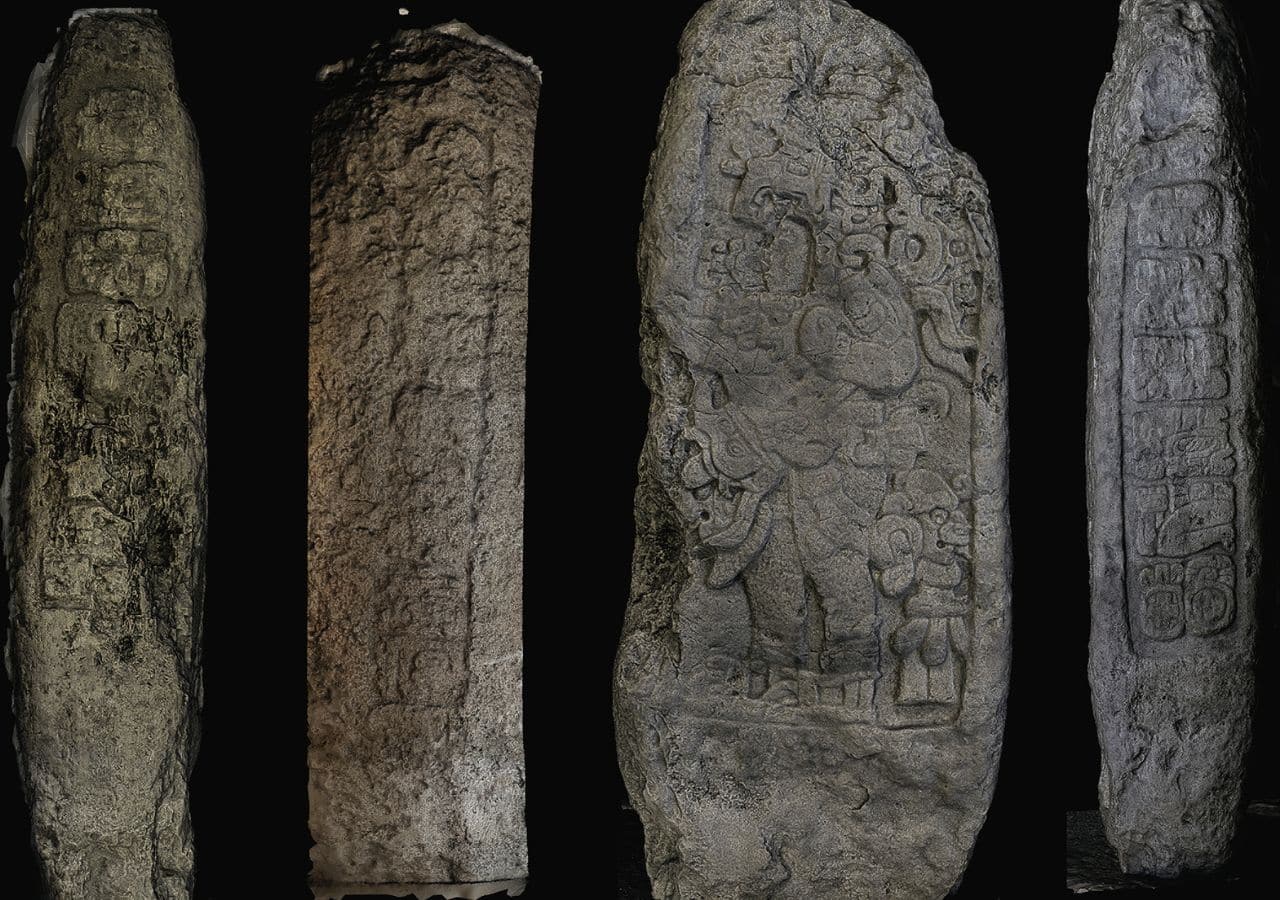
Stela 45 monument. Back face, left side, front face, and right side
Stela 45 monument. Back face, left side, front face, and right side. Credit: Kenichiro Tsukamoto / CC BY-NC 4.0

Archaeologists working at an ancient Maya site in southern Mexico have found what they say is the earliest known evidence of Maya kingship and calendar use in the region.

Kenichiro Tsukamoto, an archaeologist at the University of California, Riverside, led the study published in Ancient Mesoamerica. His team analyzed three stone monuments at El Palmar, a site in southeastern Campeche, Mexico.

One of them, Stela 46, carries an inscription dated to A.D. 180. That makes it the oldest confirmed “Long Count” calendar date discovered in the Maya Lowlands.

The Long Count is a dating system the ancient Maya used to record historical events in a fixed chronological order. Before this discovery, a stone monument at Tikal held that record with a date of A.D. 292. The El Palmar inscription predates it by 112 years.

Stone monuments link Maya kingship to an ancient calendar

What distinguishes Stela 46 from earlier finds is its direct connection to historical rulers and events. A king named Ajaw K’al Ubaah acceded to the throne in A.D. 131. Some 49 years later, in A.D. 180, he commissioned the stela as part of a royal ritual.

Alongside the Long Count, the inscription also incorporates the 260-day divinatory calendar, binding the royal event to a specific ceremonial date. No earlier Long Count inscription had ever been linked to a named ruler, the researchers said.

Stela 46. Left side, front face, and right side
Stela 46 monument. Back face, left side, front face, and right side. Credit: Kenichiro Tsukamoto / CC BY-NC 4.0

To read the heavily worn carvings, researchers combined traditional photography with photogrammetry and a high-resolution 3D scanner called Artec Spider II. The device captures detail as fine as 0.1 millimeters (0.0039 inches). It uncovered inscriptions that scholars had previously missed entirely.

The carvings also show that the king carried two royal titles, pointing to an already established order of royal authority at the site.

Monument traces El Palmar’s rulers back 17 generations

A second monument, Stela 20, strengthened the picture of Maya kingship at El Palmar. Its text identifies the ruler who commissioned it as the 17th king in a successive royal line.

Using the estimated average reign of 22.5 years for Classic Maya kings, the team calculated that the lineage’s first ruler likely rose to power between A.D. 102 and 154. That closely matches the accession date recorded on Stela 46.

A third monument, Stela 45, records the accession of a ruler named Tz’u Chak Ahk in A.D. 342. Together, the three stelae trace a royal dynasty from the second century A.D. to at least A.D. 884, one of the longest recorded among ancient Maya kingdoms.

Tsukamoto noted that El Palmar rose during a turbulent period. Several large Maya polities collapsed around A.D. 150 due to drought, soil erosion, and political instability. El Palmar appears to have grown as a new power center in their place.

The study concludes that calendar systems did more than track time. At El Palmar, they helped rulers legitimize and hold power for more than 700 years.

https://youtu.be/2sGZRo5POf8?si=wF6pXkzKrpiZuZ88

  •  

Olympias: The Mysterious Queen Who Shaped Alexander the Great Into a World Conqueror

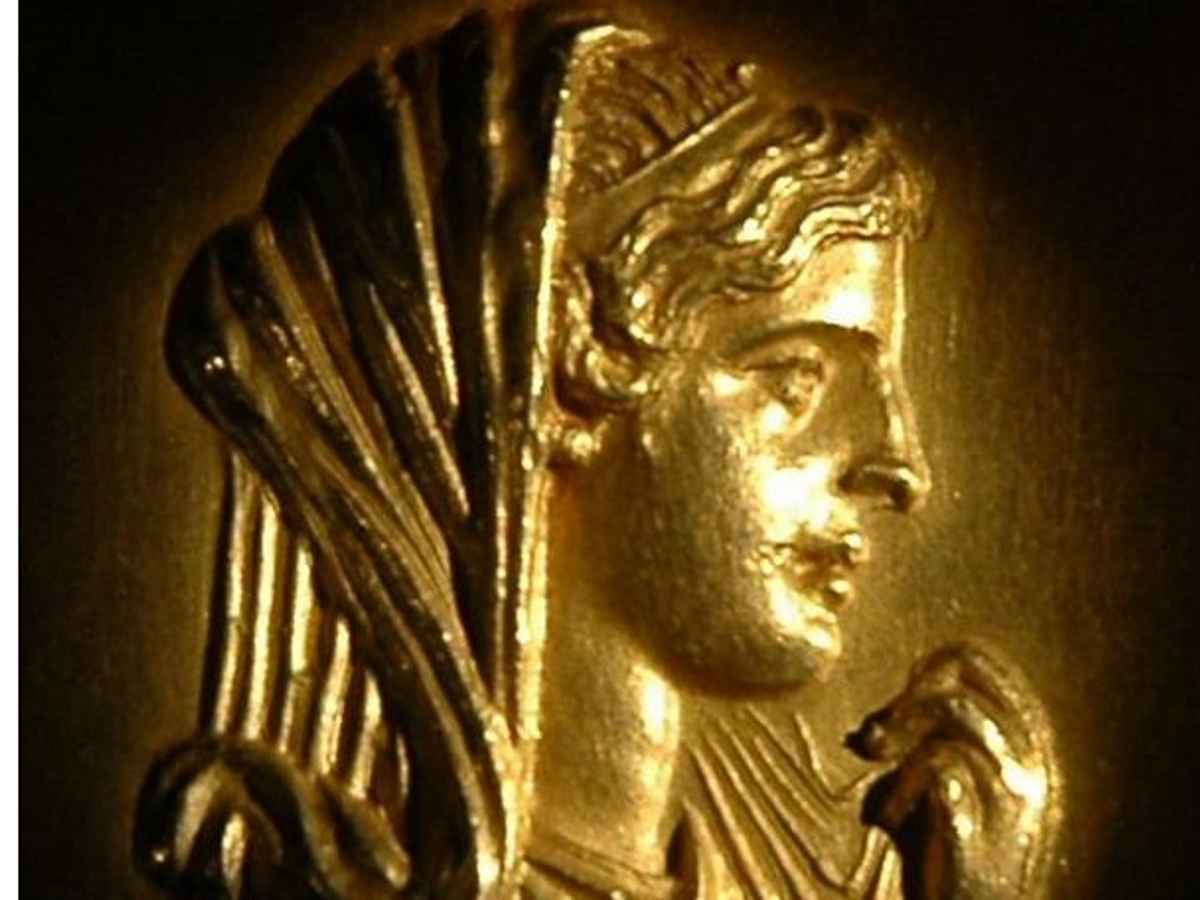
Portrait of Olympias, mother of Alexander the Great, on ancient medallion, 225-250 AD: Exhibition CE.2017, Archaeological Museum of Thessaloniki
Olympias, the mother of Alexander the Great, who shaped his course and the fate of the Macedonian Kingdom. Credit: Fotogeniss, CC by sa 3.0.

No other woman in Ancient Greek history inspired as much fascination, fear, and controversy as Olympias, the mother of Alexander the Great. She is described as passionate, intelligent, ruthless, and deeply religious. Enemies portrayed her as dangerous and manipulative, while supporters viewed her as a fiercely loyal mother and protector of Alexander’s destiny.

Behind the legends and accusations, however, stood a woman who exercised enormous political influence during one of history’s most transformative periods. Olympias shaped Alexander from childhood, influenced the succession crisis after Philip II’s death, and later played a decisive role in the violent struggles that followed Alexander’s empire.

Her presence loomed over Macedon for decades. Even after Alexander conquered much of the known world, Olympias continued to influence the royal court and the fate of the Argead dynasty.

Alexander the Great’s mother, Olympias, and her Molossian origins

Olympias came from Epirus, a Greek kingdom west of Macedonia. She belonged to the royal Molossian dynasty, which claimed descent from Neoptolemus, the son of Achilles. This heroic ancestry carried enormous symbolic value in the Greek world. Her original name may have been Polyxena or Myrtale. The biographer Plutarch suggests she later adopted the name Olympias after Philip achieved victory at the Olympic Games.

From an early age, Olympias displayed strong religious devotion.They initiated her with mystery cults and ecstatic rituals connected with Dionysus and the mysteries of the Cabeiri to whom she became a high-ranking priestess. These cults emphasized sacred initiation, hidden knowledge, and intense spiritual experiences. Her religious identity later became central to the legends surrounding Alexander’s birth.

The snakes and the divine birth of Alexander

Ancient authors repeatedly connect Olympias with snakes and mystery rituals. Plutarch wrote that Philip once saw a serpent lying beside Olympias while she slept. Legends claimed that she begot Alexander with Zeus through intercourse with snakes. According to later traditions, this event contributed to the belief that Zeus himself fathered Alexander.

These stories shaped Alexander’s image ever since childhood. Olympias appears to have encouraged the belief that her son possessed divine ancestry. Such ideas naturally fit within the heroic traditions of the Greek world in which exceptional rulers often claimed descent from gods. The symbolism of Zeus held enormous political importance. Alexander did not simply present himself as a king but increasingly viewed himself as a chosen figure with a cosmic mission. Of course, Olympias likely played a major role in nurturing this mindset.

Ancient religion did not sharply separate politics from divine legitimacy. A ruler with sacred ancestry possessed more potent authority and prestige. Olympias therefore strengthened Alexander’s position both psychologically and politically. The stories involving snakes also reflected the mystical atmosphere surrounding cults. Serpents symbolized rebirth, divine wisdom, chthonic forces, and sacred power in many Greek traditions. As a priestess connected with such cults, Olympias cultivated an aura of mystery that impressed supporters and frightened enemies.

Alexander the Great according to Euphranor
The turbulent relationship between Alexander the Great and his father, Philip II of Macedon, was one of the most complex and layered family dynamics in ancient history. Credit: Egisto Sani. CC BY-2.0/flickr

Olympias’ relationship with Philip II, the father of Alexander the Great

The marriage between Olympias and Philip II began as a political alliance, yet tensions soon emerged between them. Philip married several women during his reign, partly for diplomatic reasons. However, these marriages threatened Alexander’s position as heir. Olympias fiercely defended her son’s claim to the throne and distrusted rival factions within the Macedonian court.

Conflict intensified after Philip married Cleopatra Eurydice, a Macedonian noblewoman. Her marriage resulted in the possibility of a fully Macedonian heir, which endangered Alexander’s succession. Plutarch describes a famous banquet confrontation during which insulted Alexander by implying doubts concerning his legitimacy. The quarrel severely damaged relations within the royal family.

Olympias soon withdrew from Macedon temporarily and returned to Epirus. Alexander also left for a period before reconciliation occurred. These events led to an atmosphere of suspicion and instability that surrounded Philip’s final years.

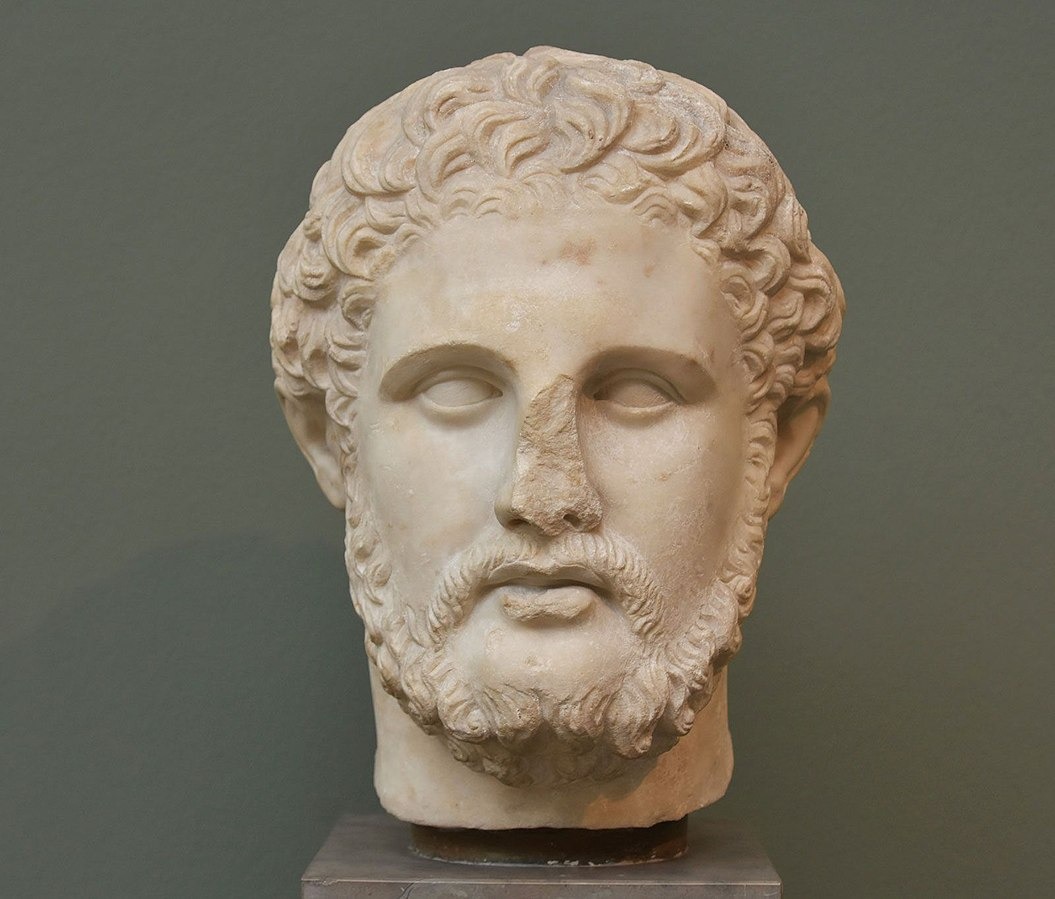
Marble bust thought to depict Philip II of Macedon.
Marble bust portrait thought to depict Philip II of Macedon. Credit: Richard Mortel / CC BY 2.0 / Wikimedia Commons

The assassination of Philip and Alexander’s accession

Philip II passed away in 336 BC after assassination during a public celebration at Aegae. His bodyguard, Pausanias, killed him before guards immediately cut the assassin down. The assassination remains one of antiquity’s great mysteries. Plutarch and the historian Arrian often suspected Olympias of involvement. Some even claimed she honored Pausanias afterward or placed a crown upon his corpse. Other traditions accuse Alexander indirectly as well.

No definitive evidence proves these accusations. However, Olympias clearly benefited politically from Philip’s death because Alexander immediately became king. She acted quickly afterward to eliminate threats against her son’s rule. The geographer Pausanias accuses her of orchestrating brutal acts against Cleopatra Eurydice and her child. Whether entirely accurate or exaggerated by hostile writers, these accounts reveal Olympias’ fierce determination to secure Alexander’s position. In the brutal world of Macedonian succession politics, hesitation often meant destruction.

Even after Alexander launched his campaigns into Asia, Olympias continued influencing Macedonian affairs from afar. Alexander maintained regular correspondence with her and respected her opinions deeply. Both Arrian and Plutarch suggested that Olympias frequently warned him about political rivals and court intrigues. At times, her intense personality resulted in tension with Antipater, whom Alexander left in charge of Macedon during the eastern campaigns. Their rivalry became one of the defining political conflicts of the period.

Olympias viewed herself not merely as the king’s mother but also as guardian of the Argead dynasty and protector of Alexander’s divine mission. Meanwhile, Alexander’s own behavior increasingly reflected the heroic and semi-divine identity cultivated since childhood. His visit to the oracle of Zeus-Ammon in Siwa of Egypt supported these beliefs further when the Egyptian priest proclaimed him as “child of Ammon.” The foundations of this worldview likely originated partly through Olympias’ influence, as previously mentioned.

Alexander the Great before the Oracle at Siwa.
Alexander the Great before the Oracle at Siwa. Credit: Francesco Salviati (Italy, Florence, 1510-1563) Wikimedia Commons, Public Domain

The chaos after Alexander’s death

Alexander’s death in 323 BC plunged the empire into chaos. Without a clear successor, powerful generals fought for control over the vast territories he conquered. Olympias returned to political life aggressively during this turbulent period, supporting the rights of Alexander IV, Alexander’s young son by Roxana. Olympias viewed him as the legitimate continuation of the Argead dynasty.

In order to defend her grandson’s claim, she entered the brutal wars of the Successors. During this struggle, Olympias captured and executed Philip III Arrhidaeus and his wife Eurydice. These actions shocked many Macedonians and intensified divisions within the kingdom.

Nevertheless, Olympias believed she acted to preserve Alexander’s bloodline and royal legitimacy. Her enemies, however, saw only cruelty and vengeance.

Agamemnon's initiation to the Samothracean Cabeiri mystery cult. Marble, Greek archaic artwork, ca. 560 BC.
Agamemnon’s initiation to the Samothracean Cabeiri mystery cult. Marble, Greek archaic artwork, ca. 560 BC. Credit: Jastrow, Wikimedia Commons, Public Domain

The fall of Olympias

Cassander, one of the most powerful Successors, eventually marched against Olympias. Many Macedonians abandoned her cause as political exhaustion, and civil war consumed the kingdom. After siege and defeat, Olympias surrendered.

Cassander condemned her to death in 316 BC. Plutarch claims that soldiers initially hesitated to execute her because of her royal status and dominant personality. Eventually, however, relatives of her victims carried out the killing. With Olympias’ death, the final collapse of the Argead dynasty was all the more imminent. Soon afterward, Cassander eliminated Alexander IV and Roxana, as well, and thus ended the bloodline of Philip and Alexander.

Olympias remains one of antiquity’s most complex female figures, having shaped Alexander psychologically ever since childhood and having encouraged his belief in divine destiny. She defended his succession fiercely during critical political crises and later fought relentlessly to preserve the dynasty after his death. Without Olympias, Alexander’s rise may have unfolded quite differently.

At the same time, her actions contributed to the violence and instability that destroyed Macedon after Alexander’s empire fragmented. She therefore stands both as creator and destroyer: a queen, priestess, mother, and political strategist whose influence changed the ancient world forever.

  •  

Andreas Michalakopoulos: The Forgotten Prime Minister Who Shaped Modern Greece

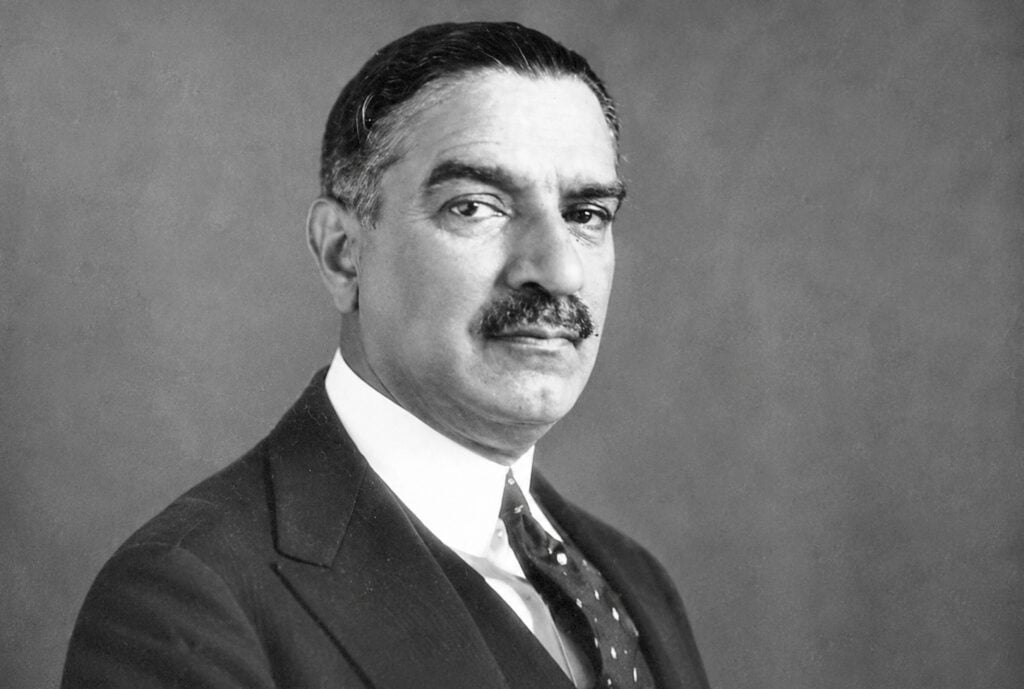
A black-and-white portrait features Greek politician Andreas Michalakopoulos wearing a dark suit, white collared shirt, and a patterned tie.
As a key political figure in early 20th-century Greece, Michalakopoulos served in numerous ministerial roles and briefly held the office of Prime Minister from 1924 to 1925. Credit: Agence de presse Meurisse – Bibliothèque nationale de France, Wikimedia Commons, Public Domain

Every day, thousands of Athenians and visitors pass through Michalakopoulou Avenue, one of the main arteries of central Athens. Yet few know the story of Andreas Michalakopoulos, the forgotten Greek Prime Minister and diplomatic genius whose name the avenue carries.

Who was the man behind the Michalakopoulos name?

Andreas Michalakopoulos was born in Patras in 1876 and went on to become one of the most important statesmen in modern Greek history. He was a man who helped redraw Greece’s borders, solved Athens’ water crisis, and brokered peace with Turkey at a time when Greece couldn’t have suffered more militarily.

Yet most Greeks today could not tell you a single thing about him. History has been unkind to Michalakopoulos, largely because he spent most of his career standing next to one of the most towering figures Greece has ever produced: Eleftherios Venizelos. That proximity was both his greatest role and the reason he is so rarely remembered—a blessing and a curse for a public figure like him. Michalakopoulos rose through the Liberal Party (Κόμμα των Φιλελευθέρων) ranks after 1910, holding portfolios in Economy, Agriculture, and Military Affairs under successive Venizelos governments.

He was not a man who craved the spotlight. He was a man who understood how government actually worked, and he was trusted with the levers of it accordingly—a true politician in the best definition of the term possible. When Venizelos went before the great powers of Europe to argue for a bigger Greece after the First World War, Michalakopoulos was beside him at the negotiating table. He participated in the long, tough diplomacy that produced both the Treaty of Sèvres in 1920 and the Treaty of Lausanne in 1923, the two documents that first promised the unthinkable and then permanently fixed, without too heavy losses, the borders of the modern Greek state. Venizelos got 100% of the credit.

However, Michalakopoulos did much of the work. He became Prime Minister in October 1924, inheriting a country in a genuine, profound, and almost existential crisis. The Asia Minor Catastrophe of 1922 had sent over a million Greek refugees flooding into Greece in a matter of months. From dreams about the reinstatement of Byzantine glory, Greece woke up in ruins, literal and metaphorical. Athens had nearly doubled in population within just a few years, and the city’s ancient water infrastructure simply could not cope. Water was being sold from carts in the streets. Taps ran dry. For a capital city that had stood for thousands of years, it was an embarrassing and dangerous situation. Greece was on the brink of collapse.

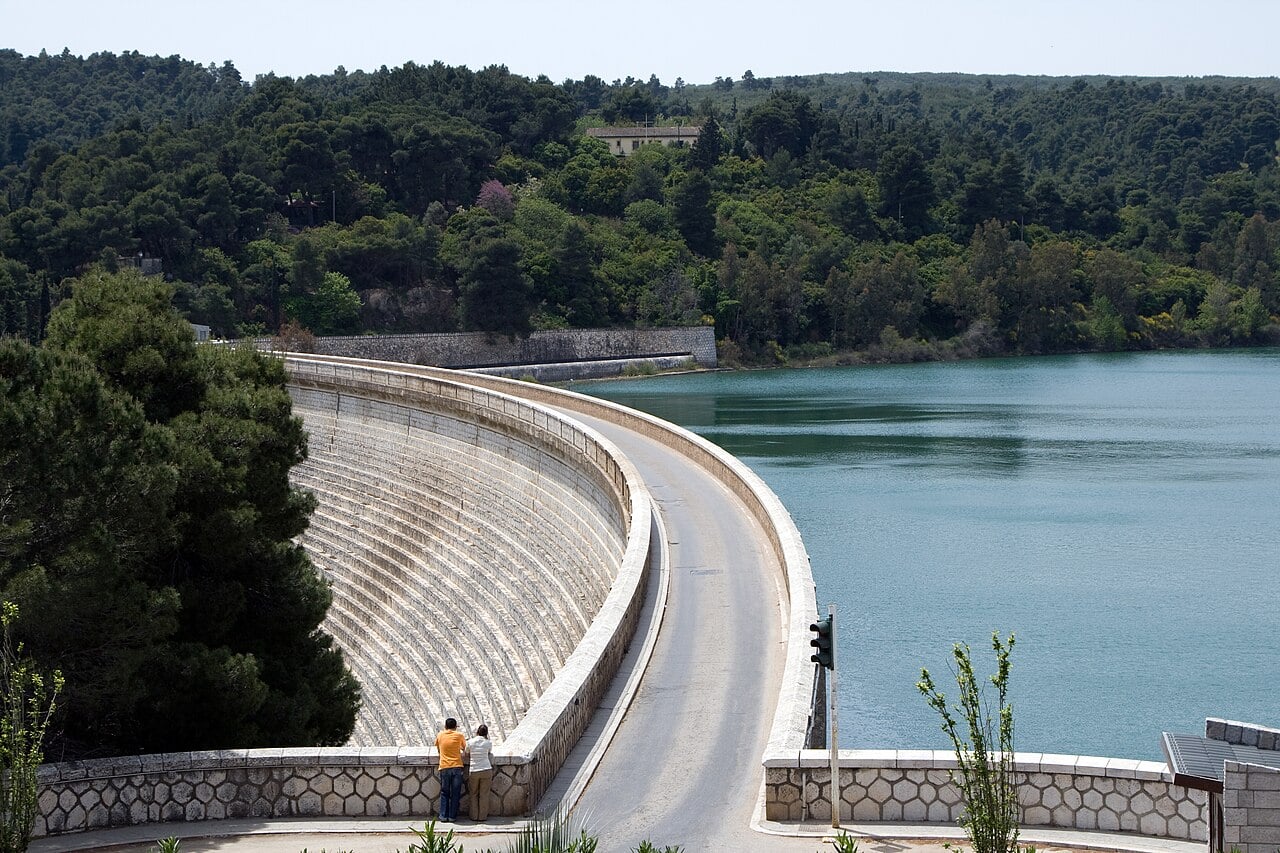
Michalakopoulos wasted little time. In December 1924, his government signed a landmark contract with American engineering firm Ulen & Company and the Bank of Athens to construct the Marathon Dam. It was one of the largest infrastructure projects in Europe at the time. The Marathon Dam was a gravity dam built of the famous Pentelic marble—the same stone used to construct the Parthenon—rising 54 meters above the Haradros River outside of Athens. The project cost more than the entire National Bank of Greece and was funded with a $10 million loan. Yes, modern Greece and loans, this stereotypical love affair…

A wide view captures the curved, stepped stone structure of the Marathon Dam holding back a large reservoir flanked by forested hills, with two people observing from a lower walkway.
Completed in 1929 and uniquely faced with Pentelic marble, this historic engineering project was instrumental in securing a reliable water supply for the rapidly expanding city of Athens. Credit: Vitaly, Wikimedia Commons, CC BY-SA 3.0

Construction ran from 1926 to 1929. The finished system delivered water to Athens through nearly 880 kilometers (547 miles) of new pipes and was inaugurated in 1931. The water that flows from Athenian taps today finds its roots in that contract and in that decision. Michalakopoulos never saw it completed. A military coup by General Theodoros Pangalos ended his government in June 1925, just months after the contract was signed.

But, thankfully, the work was done. He returned to government as Foreign Minister under Venizelos starting in 1928, and it was here that he made perhaps his most lasting contribution to the nation. Greece in the late 1920s was a country that had been through a lot. The Megali Idea, the great dream of a Greece stretching across the Aegean and into Anatolia, had collapsed spectacularly and catastrophically. The population exchange with Turkey had displaced more than a million people on each side. The two countries were locked in mutual suspicion and unresolved property disputes.

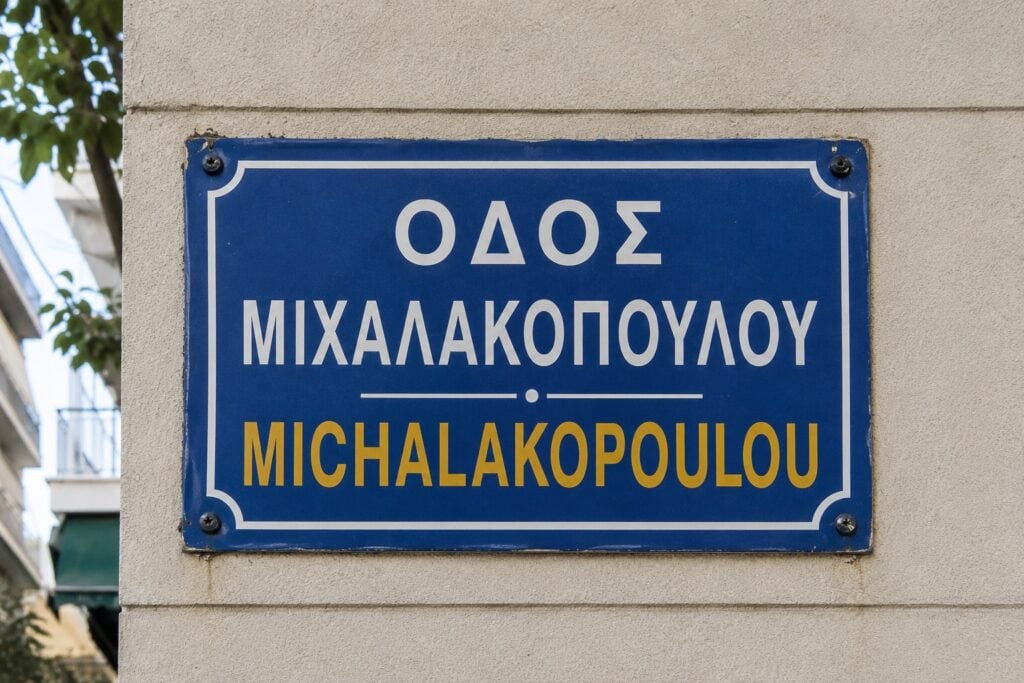
A blue enameled street sign mounted on a textured beige wall displays the name "Michalakopoulou" in white Greek lettering and yellow Latin characters.
A bilingual street sign marks Michalakopoulou Street, a major avenue running through the city of Athens. Credit: Greek Reporter archive

Michalakopoulos understood, more clearly than most, that Greece could not afford to stay that way. On October 30, 1930, he co-signed the Greek-Turkish Friendship Convention, also known as the Treaty of Ankara. He did that alongside Venizelos and Turkish Prime Minister İsmet İnönü. The treaty settled the border, resolved the property claims of the displaced populations, and established naval parity in the eastern Mediterranean.

It was a remarkable diplomatic achievement that helped lay the groundwork for the Balkan Pact of 1934 and brought a genuine, working peace between two nations that had spent generations at war. When Ioannis Metaxas declared his dictatorship on August 4, 1936, Michalakopoulos refused to go along with it. He had spent thirty years building democratic institutions from the inside. He spoke out against the regime and paid a heavy price for it. He was sent into internal exile on the island of Paros. He died on March 7, 1938, aged sixty-one.

Michalakopoulos’ legacy is a strange one: a man who brought water to a thirsty city, helped draw the map of modern Greece, made peace with its archenemy, and died in exile because he would not pretend that democracy was something you could simply switch off. Next time the traffic backs up on Odos Michalakopoulou in downtown Athens, take a moment to read the sign. The water in your glass and the borders of this nation have everything to do with the man it honors.

  •  

Draco: The Harshest Lawgiver of Ancient Athens

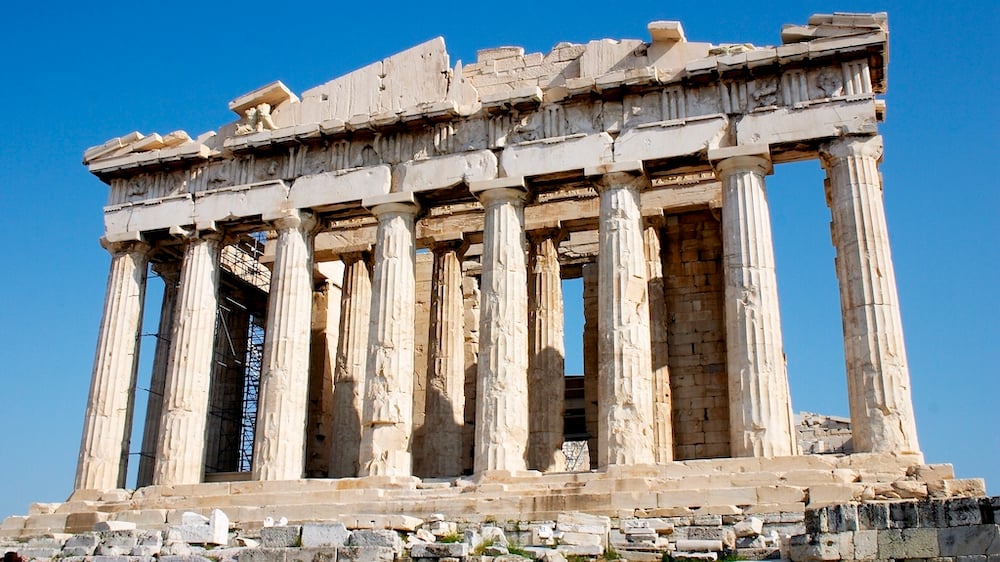
Greece parthenon made by Greeks
The Parthenon of Athens. Credit: Barcex/Wikimedia Commons/ CC BY-SA 3.0

Ancient Athens is renowned to this day as the birthplace of democracy and cradle of philosophical debate, but few know the story of the city state’s harshest lawgiver.

Draco, also spelled Drako or Drakon, was Athens’ first recorded democratic legislator. Draco was called upon by his fellow Athenian citizens to establish a comprehensive legal code for the city.

Many Athenians were surprised by the harshness of the laws introduced by Draco and baulked at the Draconian constitution that bore his name. Nevertheless, the Draconian constitution introduced several important innovations, namely the transition from oral laws to written laws.

Who was Draco?

Draco was an Athenian aristocrat born sometime during the 7th century BC. Despite his importance to the city’s history, Draco’s biographical details remain incredibly sketchy and little is known about his life beyond the laws that he imposed.

Indeed, as the historian Chis Carey points out in an academic paper published in The Cambridge Classical Journal, “Already for Greeks of the Classical period, Drakon was a shadowy figure. We get no patronymic, no biography; he simply emerges fully formed as a legislator.”

“He may be wholly or in part a fiction,” Carey continues. Crucially, however, Carey sees no reason to dispute the dates given by the ancient Athenians for the introduction of Draco’s laws between 624 and 620 BC.

So, whether or not Draco was a real individual, or perhaps a mythologized stand-in for a specific Athenian lawgiver or collective of legislators, the Draconian institution itself was introduced in the 7th century BC as recorded by the Athenians in the view of modern historians.

Draco’s new Athenian laws

Draco’s most important contribution as a legislator was the introduction of Athens’ first written constitution, the so-called “Draconian Constitution”.

This was an important legislative and legal innovation because the laws had previously been recorded orally. This meant that there was far too much room to arbitrarily interpret or apply the laws. A written system meant that the law was much fairer and more universally interpreted.

So that everyone would be made aware of the new laws – or at the very least, those who were literate – the laws were made visible in the city on wooden tablets called axones. These were presented on rotatable four-sided pyramids called kyrbeis.

One of Draco’s chief aims as a legislator was to bring an end to the blood feuds plaguing the city. He introduced laws that differentiated between homicides and accidental killings and specified punishments for each crime. The translations below provide some perspective:

  • “He who kills another Athenian, without a purpose or by accident, should be banished from Athens forever. If the killer apologizes to the family of the murdered man and the family accepts the apology, then the murderer may stay in Athens.”
  • “A relative of a murder victim, can hunt and take into custody the murderer and thus hand him to the authorities where he will be judged. If a relative kills the murderer he will not be allowed to enter the Athenian Forum (agora), or participate in competitions or set foot into sacred places…”

Athens’ harshest lawgiver?

As a lawgiver Draco was innovative and his changes made the legal system in Athens clearer and more consistent. However, his laws were also deemed to be excessively harsh and were subsequently repealed by Solon in the early 6th century BC.

Severe punishments were often dealt out for relatively minor crimes. For example, a thief might be sentenced to death for stealing a cabbage.

The lawgiver and his code also attracted infamy for its bias in favor of the elite over commoners in Athens. For instance, a debtor unable to honor his debts to a higher-class creditor could be sold into slavery, whereas punishments for higher-status individuals indebted to lower-status creditors were more lenient.

The English word “draconian”, meaning “excessively harsh” or “very severe” is derived from the Draconian Constitution, which is remembered for its severity.

  •  

How the Marshall Plan Rebuilt Post-War Greece—and Bound It to the US

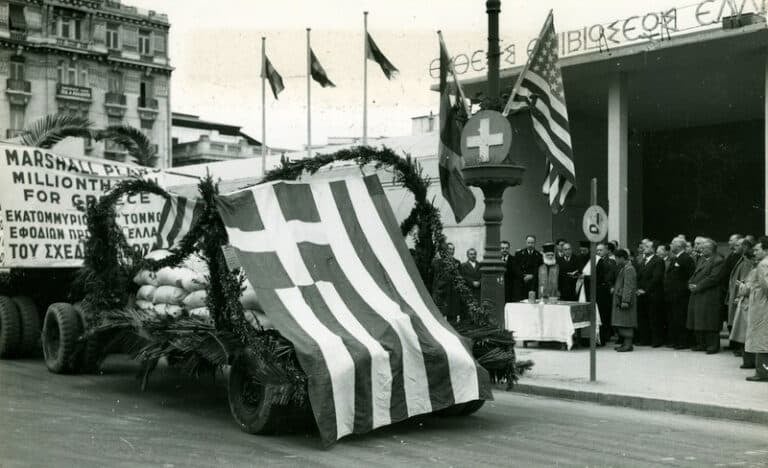
Marshall plan Greece
Between 1947 and 1951, Greece received roughly $2 billion in Marshall Aid and related Truman Doctrine funds—an astronomical sum worth more than $21 billion today. Credit: Public Domain

On June 5, 1947, US Secretary of State George C. Marshall stood before a Harvard University commencement crowd. He proposed a radical blueprint for the survival of post-war Europe—the European Recovery Program, famously known as the Marshall Plan.

Conceived in a climate of escalating Cold War anxieties, Marshall famously declared:

“Our policy is directed not against any country or doctrine but against hunger, poverty, desperation and chaos. Its purpose should be the revival of a working economy in the world so as to permit the emergence of political and social conditions in which free institutions can exist.”

While the resulting Marshall Plan is celebrated globally for sparking Western Europe’s golden age of growth, its application in Greece was uniquely volatile. It acted as an economic accelerator for a nation on the brink of collapse. Still, the cure arrived with heavy-handed strings that permanently altered Greek sovereignty, escalated an internal civil war, and drew fierce resistance from the country’s left-wing factions.

Greece in ruins

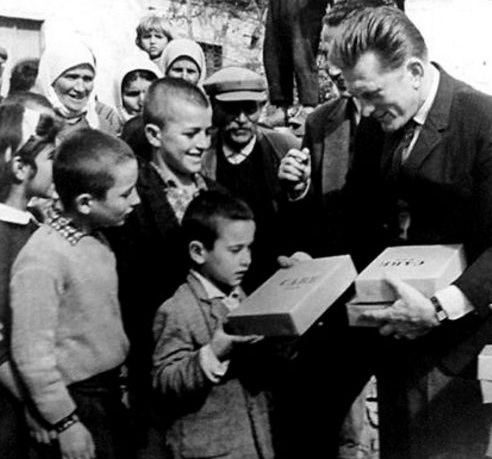
Marshall plan Greece
Legendary Hollywood actor Kirk Douglas actively supported the US aid efforts for Greece in the midst of the Civil War in the late 1940s. Credit: Public Domain

By 1947, Greece was a landscape of absolute ruin. The brutal wartime Axis occupation had destroyed its railways, burned hundreds of villages, and decimated the merchant marine fleet. Infrastructure such as the vital port of Piraeus serving Athens and the three-mile-long Corinth Canal lay unusable.

Compounding this physical tragedy was a bitter, bloody civil war between the royalist government and communist-led insurgents of the Democratic Army of Greece (DSE).

Starvation was an immediate threat. Appealing to Congress for immediate intervention, President Harry S. Truman painted a grim picture of the Greek reality: “Greece is today without funds to finance the importation of those goods which are essential to bare subsistence…the people of Greece cannot make progress in solving their problems of reconstruction. Greece is in desperate need of financial and economic assistance to enable it to resume purchases of food, clothing, fuel, and seeds.”

The American response was unprecedented. Between 1947 and 1951, Greece received roughly $2 billion in Marshall Aid and related Truman Doctrine funds—an astronomical sum worth more than $21 billion today. At its peak, US aid financed 67% of all Greek imports and constituted a staggering 25% of the nation’s gross national product.

Marshall plan rebuilds Greece’s infrastructure

The economic injection quite literally rebuilt the country’s shattered spine. Over 6.5 million tons of American food, clothing, and medical supplies flooded into Greek ports, staving off a humanitarian catastrophe.

American engineers and funding dredged and reopened the blockaded Corinth Canal, completely reconstructed the Port of Piraeus, and paved thousands of miles of modern highways that connected isolated rural provinces to urban markets.

In the fields and factories, the money drove rapid modernization. Thousands of American tractors, advanced irrigation pumps, and high-yield seeds were imported, shifting Greek agriculture from primitive subsistence farming to a competitive export industry.

Furthermore, the plan financed the establishment of the Public Power Corporation (DEI), laying the initial brickwork for a unified national electrical grid.

The cost and institutional decay

Yet, this massive economic lifeline had a darker, counterproductive underside. Unlike in Great Britain or France, where aid was managed by robust local governments, the United States viewed the unstable, war-torn Greek administration with deep suspicion.

Consequently, Washington established the American Mission for Aid to Greece (AMAG), an oversight apparatus that wielded extraordinary, direct control over the country’s domestic affairs. Dwight Griswold, the head of AMAG, made it very clear to the Greek government that the money came with absolute American leverage: “We are here to help Greece, but we must be sure that the help is used effectively. If the Greek government does not take the necessary steps to stabilize its economy and clean up its administration, we will have to reconsider our position.”

American administrators held functional veto power over the Greek state budget, tax legislation, and currency issuance. Greek cabinet ministers routinely had to clear basic administrative policies with US advisers. This heavy-handed intervention saved the state from collapsing into communist hands—Washington’s primary geopolitical goal—but it severely eroded Greek political autonomy.

Prominent Greek intellectual and novelist Giorgos Theotokas captured the growing local resentment in his diary during the late 1940s: “The Americans have become our true masters. Ministers do not dare make a move without asking the permission of some American adviser. We have been saved from the rebels, but we have lost our independence.”

Furthermore, because aid was distributed through a centralized state apparatus during a civil war, funds and import licenses were frequently weaponized. Capital was often allocated based on political loyalty to the right-wing government rather than economic merit, inadvertently reinforcing a rigid system of political patronage and favoritism.

Konstantinos Karamanlis, a rising political figure who would later become Prime Minister, looked back on how the rush of money warped the country’s institutional health:

“The aid was a blessing, but the way it was managed taught Greeks to look to the state for salvation rather than their own productivity. It fed a system of dependency and favoritism that outlived the docks and roads we built with it.”

Marshall plan opponents in Greece

Because Marshall Aid was fundamentally tied to Washington’s anti-communist containment strategy, it faced fierce, violent opposition from the Greek Left, primarily spearheaded by the Greek Communist Party (KKE) and its military wing, the DSE.

To the communists, the Marshall Plan was not a humanitarian gesture but a textbook example of “American imperialism” designed to turn Greece into a strategic military outpost for the United States. KKE propaganda aggressively painted the American administrators as the “new conquerors,” succeeding the German occupiers.

They argued that the economic restructuring pushed by AMAG was explicitly designed to restrict Greek industrial self-sufficiency, forcing the nation to remain a dependent market for American manufactured goods and agricultural surpluses.

This opposition extended far beyond rhetorical propaganda into active physical resistance and domestic warfare. Communist circles actively orchestrated plans to paralyze American reconstruction work. Guerrilla cells launched targeted bombings and acts of sabotage against critical infrastructure projects, focusing on the newly restored Piraeus docks and the Corinth Canal to disrupt the flow of American supplies.

An ambiguous legacy

Ultimately, the Marshall Plan in Greece achieved its immediate, vital objectives. It prevented mass starvation, facilitated the defeat of the communist insurgency, and laid the concrete physical foundations for the country’s mid-century economic expansion.

However, the sheer velocity and volume of the aid left a profoundly ambiguous legacy. It demonstrated how foreign aid can simultaneously rescue a nation’s people from chaos, while binding its political institutions and sovereign decision-making to the strategic whims of an external superpower.

The ideological battle over the economic recovery is captured visually in the following historical archival footage, which illustrates the intersection of American material aid and public relations efforts during the height of the reconstruction program. The “Story of Koula” Marshall Plan Film demonstrates how the US government utilized media to promote the agricultural modernization of the Greek countryside during this volatile era.

Related: What Has the United States Ever Done for Greece?

  •  

How Ancient Greek Astronomers Spotted Uranus Without Knowing It

Uranus' biggest moons may have hidden oceans located deep beneath their icy crusts
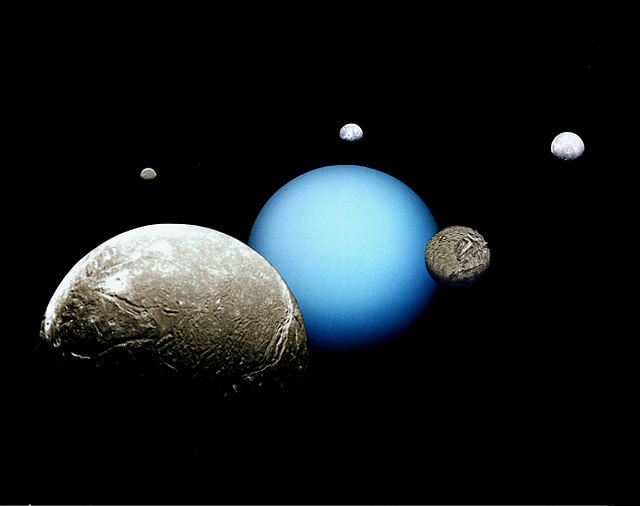
Ancient Greek astronomers likely observed Uranus as a star, but limited tools and geocentric views kept them from recognizing it as a planet. Credit: NASA/JPL / Wikimedia Commons / Public Domain

While Uranus was officially discovered as a planet by the astronomer William Herschel in 1781 using a telescope, some ancient Greek astronomers, such as Hipparchus, may have observed Uranus—but only as a fixed star rather than as a planet.

Uranus, the seventh planet from the Sun, is unique in that it is barely visible to the naked eye, appearing as a faint, star-like point in the night sky.

Hipparchus and the catalog of stars

Hipparchus (2nd century BC), among the greatest ancient Greek astronomers, compiled one of the earliest known star catalogs. He meticulously recorded the positions of about 850 stars, significantly advancing observational astronomy. The fact that Uranus was likely observed and recorded by Hipparchus, even if only as a faint star, is a major contribution to the history of astronomy. It is proof of the remarkable precision and thoroughness of ancient astronomers in mapping the night sky.

Because Uranus moves especially slowly across the celestial sphere, its motion was imperceptible to naked-eye observers over short periods. Thus, Hipparchus correctly classified it as a fixed star rather than a planet. From the perspective of ancient Greek astronomy—which was strictly geocentric and based on Earth-centered celestial spheres—this classification was logically consistent. Uranus does not revolve around the Earth in a way that is observable to the naked eye. Therefore, ancient astronomers had no reason to consider it a “wanderer” or planet.

The classical planets of Greek astronomy

Many ancient Greek astronomers were influenced by philosophers such as Aristotle and astronomers like Hipparchus and, later on, Ptolemy. They identified five planets visible to the naked eye: Mercury, Venus, Mars, Jupiter, and Saturn. Along with the Sun and Moon, these made up the seven classical celestial bodies known as “planets” (meaning “wanderers”).

Uranus, being dim and slow-moving, did not appear among these and was therefore excluded from the traditional geocentric cosmology, which placed Earth at the center, surrounded by the concentric spheres of the other celestial bodies.

Claudius Ptolemy (2nd century AD), the eminent Greco-Roman astronomer and mathematician, authored the Almagest, a comprehensive treatise on astronomy that shaped scientific thought for over a millennium. Ptolemy’s planetary system included the Moon, Mercury, Venus, the Sun, Mars, Jupiter, and Saturn.

Although Ptolemy compiled an extensive star catalog and developed sophisticated mathematical models for planetary motions, there is no mention of Uranus as a planet or wanderer. It likely appeared in his star catalog simply as an unremarkable star without recognition of its planetary nature.

Image of the Milky Way
The Milky Way. Credit: ESA/ Hubble & NASA, D. Jones, A. Riess et al / Flickr / CC BY 2.0

Mythology and  astral symbolism

In Greek mythology, Uranus was the primordial sky god, father of the Titans. While the planet got its name from this mythological figure, ancient Greeks did not associate the myth with any observable celestial body beyond the known planets of the time.

The naming of the planet Uranus centuries later reflected a mythological heritage, but ancient astronomy itself made no link between the myth and an actual astral element. The likelihood that Hipparchus observed Uranus as a star highlights the exceptional skill of ancient astronomers in mapping the heavens.

Yet their classification of Uranus as a fixed star rather than a planet was entirely consistent with the contemporary geocentric framework that dominated ancient Greek astronomy. Since Uranus does not visibly orbit Earth, it did not meet the criteria of a “wandering star” or planet from their perspective.

Ptolemy’s Almagest and the classical planetary model included only the five planets visible to the naked eye, omitting Uranus altogether. Ancient Greek astronomers made impressively advanced discoveries for their time. However, the observational technology and conceptual frameworks available to them ultimately limited their progress.

The eventual recognition of Uranus as a planet in the 18th century dramatically expanded the known solar system and challenged the classical view inherited from antiquity.

  •  
❌