Reading view

New Pompeii Discovery Reveals Equine Skeleton in Ancient Bread-Making Workshop
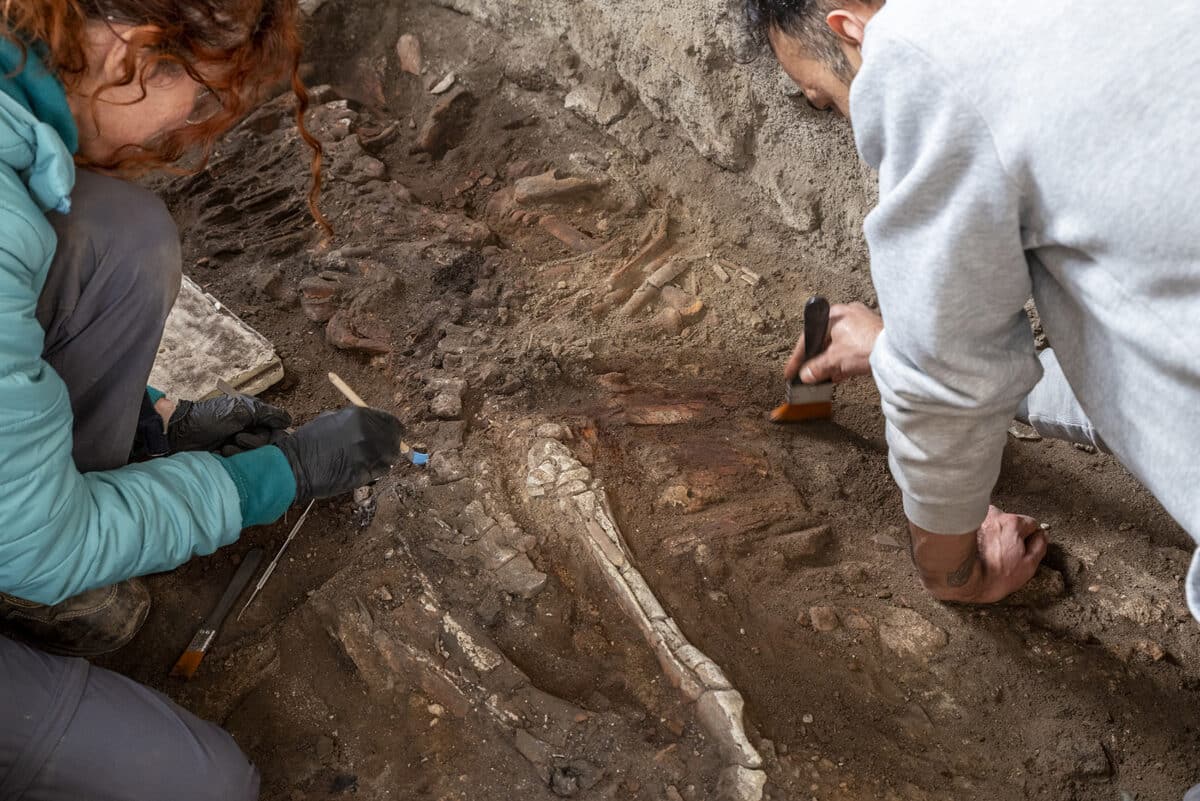
The skeleton of an equine at ancient bread making complex in Pompeii
The skeleton of an equine at an ancient bread-making complex in Pompeii. Credit: Pompeii Archaeological Park

Archaeologists in Pompeii have uncovered an equine skeleton inside a bread-making workshop at one of the city’s most celebrated ancient complexes, opening a new chapter in the understanding of how humans and animals lived and worked together nearly 2,000 years ago.

The remains were discovered at the Insula of the Chaste Lovers, a large residential and commercial site renowned for its striking “chaste kiss” fresco, painted inside the dining room of the owner’s home.

The complex includes a working bakery, storage rooms, processing spaces, and the owner’s private residence. Researchers had previously found other equids at the site’s stables, where animals were used to power grain mills and transport the grain needed for bread production.

Pompeii’s chaste lovers complex was also a busy bakery

This latest skeleton was not found in the stables. Researchers found it in a separate room, suggesting the animal had fled there during the catastrophic eruption of Mount Vesuvius in 79 AD.

The excavation brought together archaeologists and specialists from the Applied Research Laboratory, including experts in animal remains, plant life, and human bones. This interdisciplinary approach has become one of the most important aspects of modern archaeological research at the site.

Archaeologists excavating the skeleton of an equine
Archaeologists are excavating the skeleton of an equine. Credit: Pompeii Archaeological Park

Laboratory analysis is still ongoing. Researchers expect it to reveal more about the animal’s specific role in the production complex and the conditions it faced during the eruption.

The study could also contribute to a wider understanding of how animals responded to the disaster in real time, adding detail to the reconstruction of those final, chaotic hours.

Pompeii equine skeleton suggests a desperate Vesuvius escape

Gabriel Zuchtriegel, director of the Pompeii Archaeological Park, said that Pompeii offers far more than beautiful frescoes and ancient objects.

He said it gives researchers the opportunity to understand lives that were ended by the eruption, and that this extends to animals as well as people. The horse or donkey, he noted, was found inside a house with remarkable frescoes that also served as a working mill and bakery.

Its location in a room away from the stables points to an attempt to escape the eruption. Zuchtriegel called the excavation a strong example of the daily multidisciplinary collaboration at the site and said ongoing lab results will continue to offer significant scientific value.

Pompeii continues to yield new layers of ancient life. The site preserves not just objects and artwork but the full texture of daily existence, including the bonds between people, animals, and the spaces they shared.

The equine skeleton discovered in Pompeii’s ancient bread workshop is the latest reminder that the city still holds stories waiting to be told.

  •  

Negotiations on air passenger rights hit turbulence: EU Parliament takes on airlines

Negotiators from the European Parliament and EU member states have been trying to reach an agreement on the rights of air passengers travelling within the bloc. The current rules date back to 2004, but the scale and nature of air travel have changed dramatically since then. We take you inside the negotiations, examine the key sticking points, and explain why MEPs are pushing for stronger protections for passengers affected by delays and cancellations.

  •  

Thousands of Albanians Protest Jared Kushner-Linked Coastal Resort Project

Albanians and police officers face each other during a protest in Tirana over a proposed coastal resort development.
Albanians clash with police during a protest in Tirana against a Jared Kushner-linked resort project in a protected coastal area. Credit: Malton Dibra/EPA/AMNA

Albanians have joined a growing wave of protests against a major coastal resort project linked to Jared Kushner’s investment firm, Affinity Partners. The demonstrations began near the proposed development site in Zvernec, close to the protected Vjosa-Narta coastal area, before spreading to the capital, Tirana, where protests continued for several days.

Chanting “cancel the project” and carrying banners reading “Albania is not for sale,” demonstrators demanded that the government block the resort plans. The project includes luxury tourism development on the uninhabited island of Sazan and in the Vjosa-Narta protected landscape, a wetland area near the southern community of Zvernec. The region is known for its biodiversity and is home to flamingos, seals, and sea turtle nesting sites.

Environmental groups, local residents, and civil society activists say the development could cause irreversible damage to one of Albania’s most sensitive coastal ecosystems. They have also raised concerns over transparency, land ownership, and possible corruption.

Albanians protest coastal resort after beach access blocked

The latest wave of demonstrations began after fencing and barbed wire appeared near the proposed development area, blocking access to the beach. Residents and environmental activists gathered in Zvernec, where tensions escalated.

Private security guards reportedly attacked and injured several protesters during the gathering. Following the incident, authorities suspended several police officers and revoked the licenses of two private security companies.

The unrest then moved to Tirana, where protesters rallied outside government buildings, including the office of Prime Minister Edi Rama. Demonstrators used inflatable flamingos as a symbol of the protected wetland and held signs reading “Nation is not for sale” and “I don’t want Albania like Dubai.”

Anti-corruption prosecutors open inquiry

The protests intensified after Albania’s Special Prosecutor’s Office against Corruption and Organized Crime (SPAK) opened an inquiry into issues surrounding land titles, sales to investors, and changes affecting the protected status of the area. It has not been confirmed whether the land surrounded by barbed wire has been purchased by Affinity Partners.

Kushner first presented plans for development projects in Albania two years ago. According to those plans, Sazan, a former secret communist-era military base, would be transformed into a luxury tourist destination. The development has been estimated at around €1.4-1.6 billion ($1.62-1.86 billion). Luxury hotels were also planned for Zvernec, near the Vjosa-Narta protected area.

Albanians holding flags and banners during a protest in Tirana against a coastal resort project linked to Jared Kushner.
Albanians protest in Tirana against a Jared Kushner-linked coastal resort project near the protected Vjosa-Narta wetland. Credit: Malton Dibra/EPA/AMNA

Environmental groups warn of serious damage

In January, around forty environmental organizations called for the suspension of the resort plans, warning that the project could threaten biodiversity in a coastal zone of major ecological significance. “We want all construction to halt and heavy machines out of the protected area,” said Joni Vorpsi, an ecologist with PPNEA-BirdLife Albania. “This would be a new city with around 10,000 rooms and it will completely destroy that wild region.”

Environmentalists argue that the scale of the project is incompatible with the protected status of the area. They say the development could disrupt bird migration routes, damage habitats, and permanently alter a largely undeveloped stretch of coastline.

Albanians protest as Rama rejects calls to halt coastal resort project

Prime Minister Edi Rama invited protesters to choose a delegation of about twenty people to discuss possible solutions, but the protesters rejected the proposal. Rama has publicly defended the investment, arguing that Albania must remain open and fair toward foreign investors.

“It is very important that we remain welcoming, that we remain fair, and that under no circumstances do we receive the stigma of being a country where investors are met with hostility,” Rama said in a statement shared with Reuters. “There is absolutely no chance that the investment will stop as long as I am here.” His comments have further angered opponents of the project, who say the issue is not hostility toward investment but the protection of public land, natural heritage, and the rule of law.

  •  

The Friday File: Anthropic; EU; FCC

Mobile World Live brings you our top three picks of the week as Anthropic widened access to its Claude Mythos model despite security concerns, the European Commission (EC) unveiled a fresh digital sovereignty push and the FCC commenced its first spectrum auction in four years.

Anthropic expands Mythos access to 150 new companies

What happened: Anthropic expanded access to its controversial Claude Mythos AI model under the Project Glasswing to 150 additional companies in sectors including power, healthcare and communications, after initially restricting it to a group of private technology players.

Why it matters: Anthropic said the latest cohort brings in sectors underrepresented in the first wave. In commentary to security publication CSO Online, experts noted the expansion could add to security concerns around the model. Carmi Levy, an independent technology analyst, questioned what Glasswing will be able to accomplish by adding 150 more participants, noting the initial point was to allow the AI player to work closely with a small, fully vetted group of vendors to develop stronger defences against cybersecurity risks. “Expanding access into the hundreds may very well bring in more minds to build better defensive measures, but it simultaneously introduces significant concerns around potential leaks.”

Research director for AI security at IDC, Grace Trinidad, added that Anthropic’s announcement pointed out that each of the 150 new participants “will need to meet our security requirements before they gain access”, which also did not build confidence. “Nobody knows what those security requirements are.”

Earlier this week, Anthropic also confidentially filed IPO paperwork with the US Securities and Exchange Commission (SEC), ahead of rival OpenAI’s rumoured float.

EU targets AI, chips in fresh sovereignty drive

What happened: The EC unveiled a fresh digital sovereignty package targeting semiconductors, AI, cloud, open source and energy infrastructure in a bid to accelerate Europe’s push for digital sovereignty.

Why it matters: The package includes a proposed a revamped Chips Act 2.0 and a Cloud and AI Development Act to streamline data centre deployment and introduced measures to expand open source use, support startups and digitalise the energy system. EC president Ursula von der Leyen said Europe “cannot afford to depend on others for the technologies that keep our hospitals running, our energy grids stable and our services secure”.

Jennifer Okafor, a UN and Global Health strategist and AI and data analyst, said the policies represent “a comprehensive approach to balancing growth, stability, and long-term resilience across the EU”. However, president of German digital industry group Bitkom Ralf Wintergerst told Reuters it is “crucial that these efforts do not stop at mere announcements”, while Keegan McBride, director of science and technology at non-profit think tank Tony Blair Institute argued Europe “can’t regulate its way to competitiveness, it must build”. He added, “there’s still much more to do ​if Europe wants to close the gap with the US and China”.

FCC kicks off first spectrum auction in 4 years

What happened: The FCC opened Auction 113, its first spectrum auction in four years, covering spectrum in the 1695MHz to 1710MHz, 1755MHz to 1780MHz and 2155MHz to 2180MHz bands.

Why it matters: AT&T, T-Mobile US, Verizon and potentially SpaceX are among likely bidders. The licences cover territory home to more than 100 million people across 48 states and two US territories. FCC chair Brendan Carr declared: “Finally! The FCC is back in the game,” adding spectrum auctions are “the lifeblood of licensed wireless service”. Carr argued “more spectrum means more building, lower prices and stronger competition”.

Proceeds from the auction will fund the FCC’s “rip and replace” programme targeting Huawei and ZTE equipment in US networks. Indeed, the auction also bolsters the regulator’s broader Build America Agenda, which targets 800MHz of spectrum by 2034.

The post The Friday File: Anthropic; EU; FCC appeared first on Mobile World Live.

  •  

Amazon to pump €10B into European robotics

Amazon committed to invest more than €10 billion on upgrading its facilities in Europe with next-generation robotics, part of a wider push to modernise and expand its operations network in the continent.

Announced at the company’s Delivering the Future event in London, the technology giant stated it plans to create more jobs across the region, while using robotics to expand ultra-fast delivery options to more international cities and invest in employee upskilling.

Its pledge reflects a broader push to use AI and robotics to support its workforce, taking aim at “repetitive and physically demanding tasks”, freeing up employees to focus on higher skilled roles while customers get better service.

As part of its next-generation robotics development, Amazon introduced Proteus, an upgraded autonomous robot that is able to move items across different sites. Through AI advances, employees can apparently direct Proteus with plain, conversational text-based prompts without the need for technical commands or programming interfaces.

According to Amazon, once an employee instructs Proteus on what needs to be done, the robot figures out the priority, route and timing.

Proteus is designed to take on physically demanding tasks, move heavy carts and cover long distances. It is currently being piloted in Amazon labs, with deployment planned for the first half of 2027.

Through its €10 billion commitment, Amazon added it will expand Vulcan, its first robot with a sense of touch and STARK, a new robotics system that works alongside employees. STARK will be deployed across 15 sites in Europe by 2027.

This week, Nvidia CEO Jensen Huang also talked up the robotics opportunity within industry, as he unveiled work on a new model for academics using hardware from Unitree and Sharpa.

The post Amazon to pump €10B into European robotics appeared first on Mobile World Live.

  •  

Rare Roman Gold Ring Found in England Sheds Light on Britain’s Ancient Revolt

AI reconstruction of the Ilminster ring
AI reconstruction of the Ilminster ring. Credit: Greek Reporter Archive

A rare Roman gold ring discovered by an amateur metal detectorist in southwest England is offering new insights into a turbulent period of Roman Britain nearly 1,700 years ago.

The ring was found near Ilminster in Somerset by Kevin Minto, a former soldier and truck driver who has spent years searching local fields with a metal detector. Experts have described the find as one of the most significant Roman discoveries made in the region in recent years.

An exceptional example of Roman craftsmanship

Weighing 48 grams (1.7 ounces), the ring is unusually large compared with most Roman jewelry recovered in Britain. At its center is a finely carved gemstone depicting Victory, the Roman goddess of triumph, driving a two-horse chariot. Researchers say the craftsmanship is exceptional, and comparable examples are rarely found in Britain.

The discovery was made in an area where Minto had previously uncovered a hoard of nearly 300 Roman coins. He continued returning to the site over several years, eventually finding the gold ring and other Roman-era objects.

Under Britain’s treasure laws, significant archaeological finds must be reported to authorities and assessed before museums can acquire them. The South West Heritage Trust has now acquired the ring and coin hoard after raising £78,010 (about $105,000). The artifacts will eventually become part of the collection at The Museum of Somerset.

A clue to political unrest in Roman Britain

Researchers believe the ring belonged to a wealthy member of Roman society. South Somerset was a prosperous region during the Roman period, known for its villas, agricultural estates, and trade connections along the nearby Fosse Way, one of Roman Britain’s most important roads.

The discovery may also shed light on a dramatic chapter in British history. According to museum officials, the ring and accompanying objects were likely buried around A.D. 297 during the aftermath of the Carausian Revolt.

A rare Roman gold ring discovered in Somerset, England, is shedding light on a turbulent chapter of Roman Britain. Researchers believe the ring was buried around A.D. 297 during the aftermath of the Carausian Revolt and remained hidden for more than 1,700 years. #Archaeology pic.twitter.com/K42ig1eBjt

— Tom Marvolo Riddle (@tom_riddle2025) June 4, 2026

The rebellion began in A.D. 286 when Carausius declared himself ruler of Britain and parts of northern Gaul, creating a breakaway state that lasted for nearly a decade. Roman forces eventually regained control of Britain in A.D. 296.

Archaeologists suggest the valuables may have been hidden for protection during this period of political uncertainty and never recovered by their owner.

Amal Khreisheh, senior curator at the South West Heritage Trust, said the artifacts help researchers understand how people in South Somerset lived through a time of instability and change.

Bringing Roman history to local communities

Before the ring goes on permanent display, it is being used in community outreach programs. Local schoolchildren have already been given the opportunity to examine the ring and some of the coins.

According to Khreisheh, many students have been fascinated by the mystery surrounding the find, asking who owned the ring and why it was buried. While those questions remain unanswered, the discovery has created a direct link between modern Somerset and its Roman past.

  •  

When Balance Becomes Paralysis: Poland and the Structural Limits of the Post-1989 Order

On 3 May 2026, Polish President Karol Nawrocki announced the creation of a Council for a New Constitution. The initiative, framed as a response to chronic institutional deadlock, has opened a debate that reaches far beyond technical constitutional reform. It touches the core question quietly confronting much of Central and Eastern Europe: whether governance architectures […]
  •  

Apple poised to open first European developer centre

Apple unveiled plans to open a facility for developers in Berlin, Germany, a site intended to help European companies in creating and improving apps for the iPhone-maker’s devices.

The developer centre will be Apple’s first of its type in Europe. It runs similar facilities in Singapore, Shanghai, Cupertino and Bengaluru.

It is set to host workshops for app developers, one-on-one appointments and other in-person sessions in an attempt to help companies elevate the design and performance of applications for iPhones, iPads, macs and other devices using its operating systems.

Apple added dedicated labs will also offer hands-on support across multiple languages.

The company’s VP worldwide developer relations Susan Prescott said Europe was “home to an extraordinary community of developers who are building apps that create connections, encourage creativity, and drive innovation”.

“We have always believed that when developers have the right tools and resources to do their best work, incredible things follow. That belief is what this centre is built on, and we look forward to seeing what the community continues to develop.”

The site, located in the Mitte district of the German capital, is due to open later this year.

The post Apple poised to open first European developer centre appeared first on Mobile World Live.

  •  

Russia ramps up pressure on Armenia ahead of Sunday's crucial election

Russia has increased its pressure on Armenia ahead of Sunday’s parliamentary elections, pulling out virtually all the stops linked to trade should its long-term ally persist in its ambitions to join the European Union. Moscow has threatened to raise gas prices, put measures in place to be able to restrict the Russian import of certain Armenian products and warned it may suspend the country from the Eurasian Economic Union.

  •  

Ukrainian attacks kill several in Crimea after Kyiv targets St. Petersburg energy, military sites

At least four people have been killed in Crimea, Moscow-installed authorities said on Thursday, a day after Kyiv targeted energy and military facilities in Saint Petersburg during Russia's flagship economic forum. US Secretary of State Marco Rubio warned of a "real" risk of escalation, while Ukraine described the attacks as justified retaliation for intensified Russian strikes on its territory.

  •  

17,100-Year-Old Cave Paintings in Wales Rewrite Britain’s Ancient History

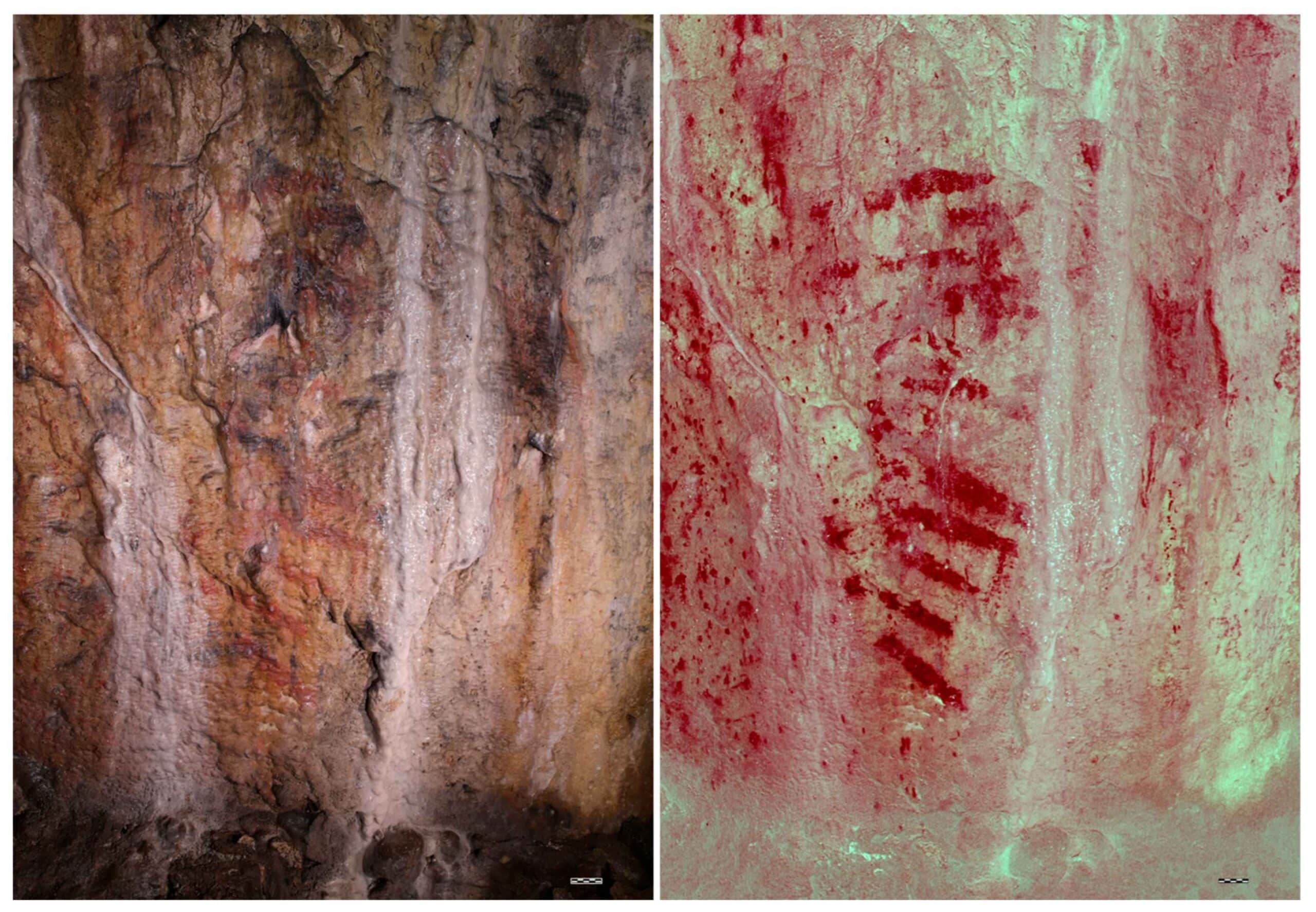
Red pigment markings at Bacon Hole Cave in Wales
Red pigment markings at Bacon Hole Cave in Wales. Credit: George H. Nash / CC BY 4.0

A series of red markings inside a cave in south Wales has been confirmed as the UK oldest cave art, ending decades of debate over whether the images were created by humans or formed naturally.

Researchers determined that the markings at Bacon Hole Cave near Mumbles were painted about 17,100 years ago during the Upper Paleolithic period. The discovery makes them the oldest known rock art in Britain and northwestern Europe. The findings overturn a conclusion that had stood since 1928, when experts dismissed the markings as natural mineral stains rather than prehistoric artwork.

Discovery revisited after more than a century

The markings were first reported in 1912 by professors William Sollas and Henri Breuil, who identified the red bands as prehistoric cave paintings. At the time, the discovery was described as the first example of Paleolithic cave art found in Britain.

A substantial breccia deposit is located around the current entrance area of the cave
A substantial breccia deposit is located around the current entrance area of the cave. Credit: George H. Nash / CC BY 4.0

That interpretation was later rejected. Researchers concluded that the red streaks were caused by iron-rich minerals seeping through the limestone walls, and the site gradually lost its significance as a prehistoric art location.

More than a century later, an international team led by prehistoric art specialist George Nash reexamined the markings using scientific methods unavailable to earlier researchers. The team’s findings, published in the journal Quaternary, confirmed that the red pigment was intentionally applied by humans around 17,100 years ago.

Scientific analysis confirms human origin

Researchers used uranium-thorium dating and archaeometric analysis to study the pigment and surrounding cave deposits. Laboratory tests identified a mixture of calcite and clay residues within the paint, indicating that the material had been deliberately prepared. Analysis also showed that the pigment was applied directly with a finger.

The painted lines appear as evenly spaced horizontal bands arranged in a structured pattern. Researchers said the design is inconsistent with natural geological processes and supports the interpretation originally proposed in 1912.

Part of the artwork may have been overlooked for decades because a local fisherman painted graffiti on a nearby section of the cave chamber in 1894, making the markings more difficult to interpret.

Life in Wales during the Ice Age

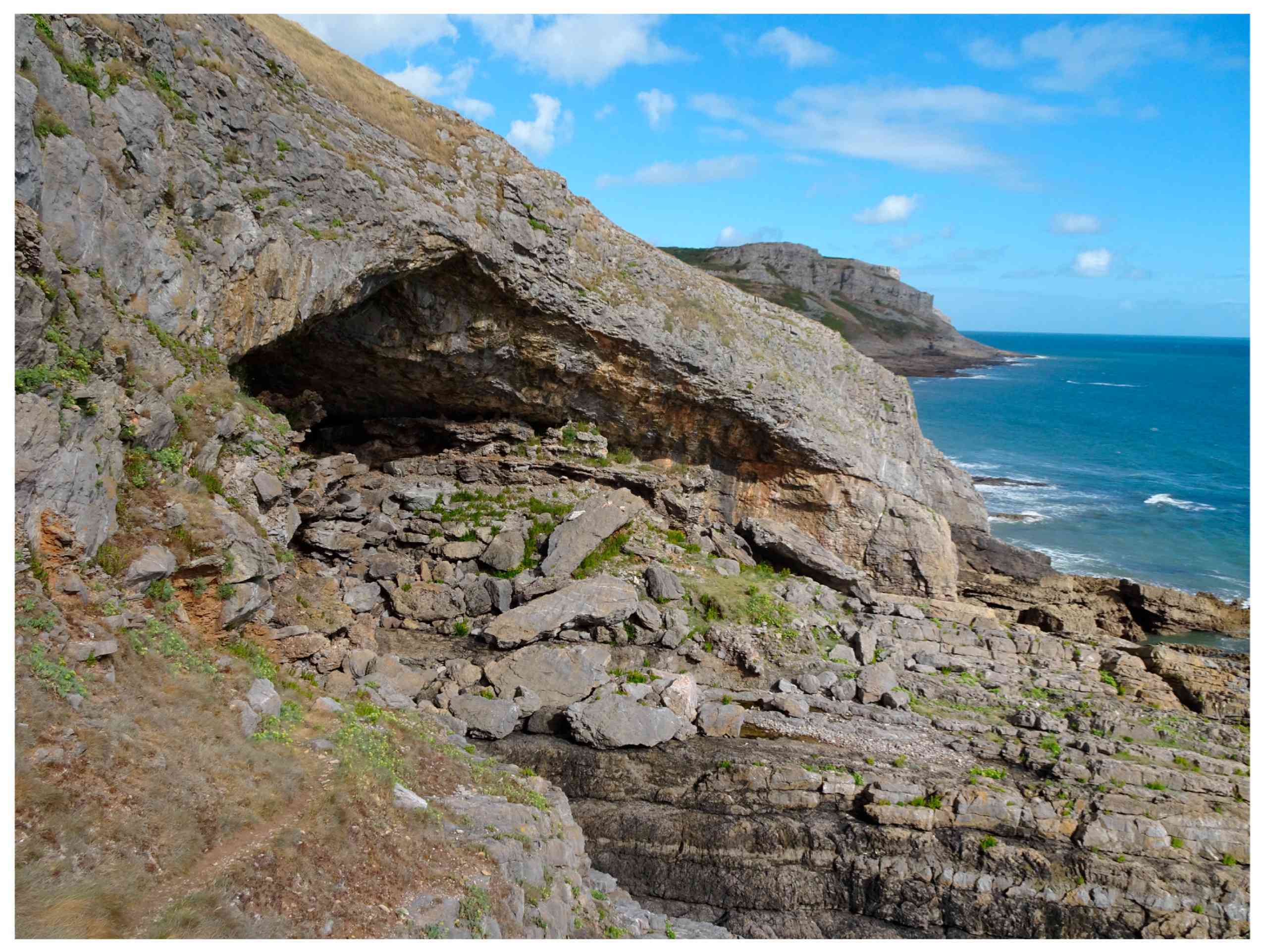
Eastern view of the cave entrance and the Bristol Channel
Eastern view of the cave entrance and the Bristol Channel. Credit: George H. Nash / CC BY 4.0

The artwork was created as Wales emerged from one of the coldest phases of the last Ice Age, known as the Devensian glaciation. At the time, the landscape around Bacon Hole was a cold, largely treeless environment. Researchers believe the area surrounding what is now the Bristol Channel attracted large grazing animals during seasonal migrations.

The cave and other nearby shelters along the Gower coastline would have provided suitable living spaces for hunter-gatherer groups moving through the region.

A significant addition to Britain’s prehistoric record

Bacon Hole Cave lies within the limestone cliffs of the Gower Peninsula overlooking the Bristol Channel. Although the area is recognized for its natural beauty, the cave is not currently protected as a scheduled monument.

Researchers argue that the site’s newly confirmed status as the UK oldest cave art strengthens the case for greater protection. The study was conducted by researchers from First Art, the University of Southampton, Swansea University and other institutions, with support from the National Trust and the Bradshaw Foundation.

The discovery adds to a small number of known examples of Upper Paleolithic rock art in Britain and provides rare evidence of artistic activity in the region more than 17,000 years ago.

  •  

18th-Century Shipwreck Off Norway Reveals Chinese Porcelain Cargo

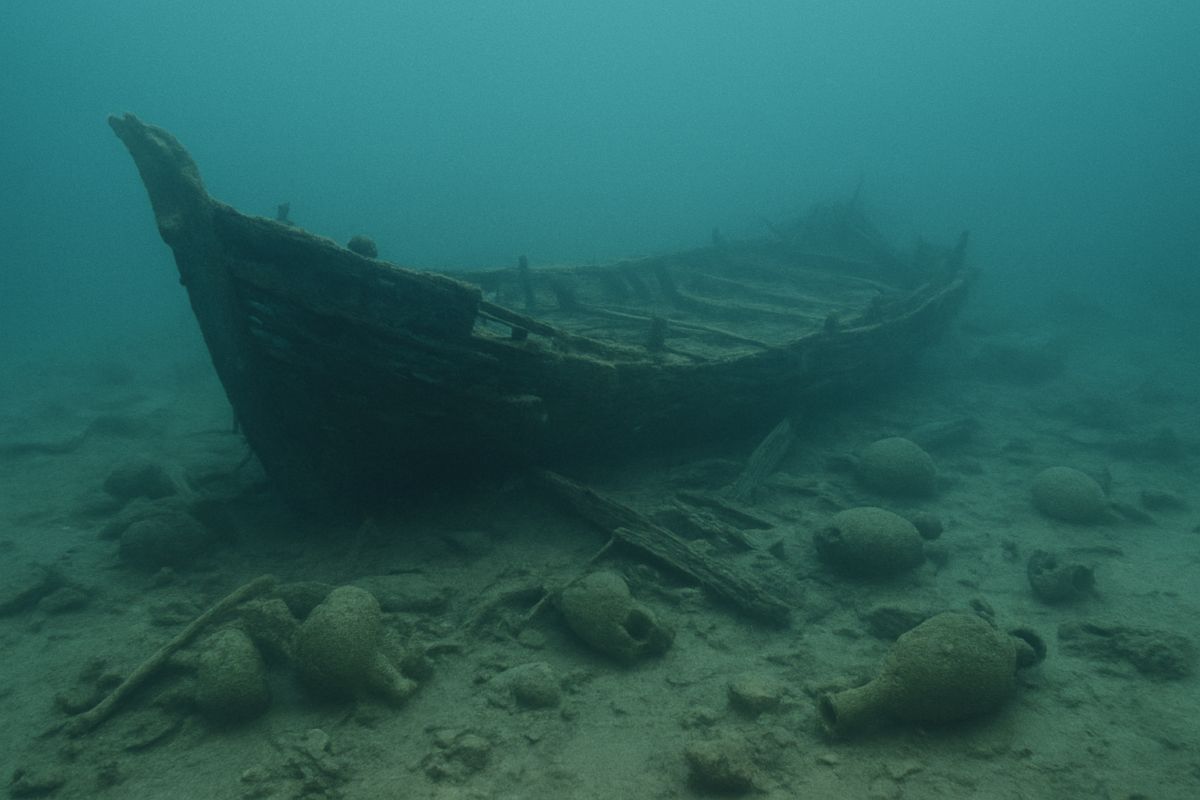
roman shipwreck
An interpretation of an ancient shipwreck. Credit: GreekReporter Archive

A deep-sea shipwreck in Norway, archaeologists call the “Porcelain Wreck,” has revealed hundreds of pieces of Chinese porcelain cargo and other luxury goods, offering a rare glimpse into trade networks that connected Europe and Asia during the 18th century.

The wreck was discovered about 600 meters (nearly 2,000 feet) below the surface in the Skagerrak, the body of water between Norway, Denmark, and Sweden. Researchers say the vessel and its cargo are among the best-preserved maritime finds ever recorded in Northern Europe.

Discovery beneath the seabed

The find began in September last year when professional diver Espen Saastad was conducting a routine seabed survey off the Norwegian coast. During a review of underwater footage, he noticed a shipwreck surrounded by stacks of porcelain resting on the seafloor.

The footage was sent to the Norwegian Maritime Museum, where researchers immediately recognized its significance.

“We thought it was an incredible wreck,” said Sven Ahrens, research director at the museum. “We often find cargo and freight, but it’s usually broken or covered by marine growth. Here, whole plates were lying in stacks on the seabed.”

Museum experts identified the cargo as 18th-century Chinese porcelain. The footage also revealed fragments of chandeliers, fine stemware, and other luxury items.

Rare evidence of global trade

Researchers believe the vessel was likely a galiot, a small cargo ship that operated within Northern Europe. While the ship probably never traveled to Asia, the Chinese porcelain cargo likely arrived through major trading centers such as Amsterdam, Copenhagen, or Gothenburg before being loaded onto the vessel.

The discovery provides evidence of the expanding trade networks and growing consumer culture that transformed Europe during the 18th century.

A remarkably preserved shipwreck discovered 600 meters beneath the waters off Norway has revealed hundreds of pieces of Chinese porcelain and other luxury goods dating to the 18th century. pic.twitter.com/nO5sL4SUfB

— Tom Marvolo Riddle (@tom_riddle2025) June 3, 2026

Unlike many shipwrecks found off the Norwegian coast that carried a single commodity, such as timber, fish, or iron, this vessel transported a diverse cargo of imported goods.

“The Porcelain Wreck is the first wreck we have found that demonstrates the breadth of interregional commercial activity in Northern Europe during the 18th century,” said maritime archaeologist Frode Kvalø, who leads the project.

Technology helps recover artifacts

Archaeologists have explored the wreck using a remotely operated vehicle, or ROV, controlled from a research vessel on the surface. The technology allowed researchers to create a detailed 3D model of the site and map the location of the ship and its cargo.

In May, the team recovered nearly 40 artifacts using a robotic arm equipped with specially designed suction cups. Most of the recovered objects were pieces of Chinese porcelain that appeared almost untouched despite spending centuries underwater.

One recovered brick from the ship’s galley carried a maker’s mark linked to Lübeck, Germany. Researchers are now examining historical Danish Sound Dues records in hopes of identifying the vessel and reconstructing its final voyage.

Thousands of artifacts remain

Only a small portion of the cargo has been recovered so far. Thousands of artifacts remain on the seabed, including unopened crates whose contents are still unknown.

Researchers hope the next phase of the project will involve a full archaeological excavation of the site. Such an effort could provide unprecedented insight into maritime trade, shipping practices, and daily life during a period when global commerce was rapidly expanding.

For archaeologists, the shipwreck of Norway represents more than a remarkable collection of Chinese porcelain. It offers a rare and largely untouched snapshot of the commercial world that linked continents centuries ago.

  •  

“Dig of the Century” at Notre Dame Reveals 2,000 Years of Paris History

Notre Dame Cathedral reopens in Paris with 'Merci' projected on its facade
Notre Dame Cathedral reopens in Paris with ‘Merci’ projected on its facade. Credit: Julian Fong / CC BY-SA 2.0

Tourists stand in line under the summer sun outside Notre Dame Cathedral, waiting to climb the landmark and see its famous Roman artifacts. Just a few meters below them, archaeologists are digging into nearly 2,000 years of Parisian history.

The excavation is taking place beneath the cathedral’s forecourt as part of a project to redesign the square. Paris plans to add trees, shade, and cooling features around Notre Dame following its restoration after the devastating 2019 fire. Before work can begin, archaeologists must investigate and protect any remains buried underground.

French media have dubbed the project the “dig of the century” because of the discoveries emerging from one of the city’s most historic locations.

“It’s a rare opportunity for us to work on something that’s tangibly going to make a difference to the history of Paris,” Lucie Altenburg, a conservator with the Paris archaeology unit, told The Associated Press.

Ancient artifacts emerge

Researchers have already recovered hundreds of artifacts. One of the most important finds is a fourth-century coin depicting Roman Emperor Constantine. The coin was heavily corroded when it was unearthed, but X-ray imaging revealed the emperor’s portrait. Such finds help archaeologists date the different occupation layers beneath the cathedral.

The team has also uncovered fragments of medieval pottery marked with faint reddish inscriptions painted on the inside. Similar symbols appear on multiple shards, but experts have not yet determined their meaning.

Archaeologists digging beneath Notre Dame Cathedral have uncovered Roman-era artifacts, medieval pottery with mysterious markings and evidence of Paris' ancient past.#notredame #romanartifacts pic.twitter.com/NB7zlQJtGq

— Tom Marvolo Riddle (@tom_riddle2025) June 3, 2026

Some of the most remarkable discoveries have come from medieval latrines buried beneath houses that once crowded the area around Notre Dame. The pits served as both toilets and rubbish dumps, creating conditions that preserved everyday objects for centuries.

Archaeologists have recovered complete jugs, cups, and other ceramics that survived intact after spending hundreds of years underground. It is “rare to find complete ceramics,” said archaeologist Valentine Breloux.

Clues to Paris’ evolution

The excavation has also revealed evidence of Paris’ transformation from the Roman city of Lutetia into the medieval capital that followed.

Archaeologists discovered a Roman stone doorstep that had been removed from a larger building, turned upside down, and reused as paving in a later roadway. The find shows how residents repurposed materials as the Roman world gave way to a new era.

Once artifacts leave the site, they are transported to the city’s archaeology center, where specialists clean, catalog, and study them.

Looking deeper into the past

The work is expected to continue as Paris moves forward with plans to plant 160 trees and create a cooler, greener public square by 2028. Archaeologists hope to dig even deeper before then, searching for traces of the Gauls, the people who inhabited the area before the Roman conquest.

“The hope is that we are able to go back in time even further than we’ve ever been before,” Altenburg said.

  •  
❌