Reading view

Diomedes: The Greek Warrior Whose Extraordinary Bond With Horses Made Him a Trojan War Hero
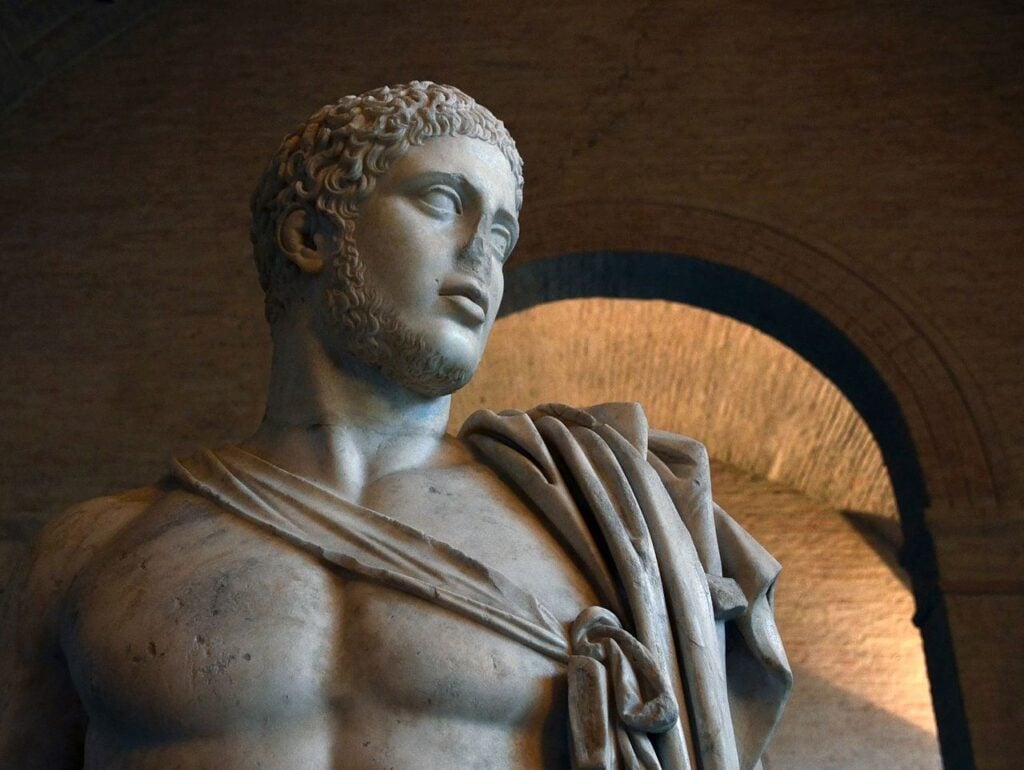
Statue of Greek hero Diomedes
Greek hero Diomedes fought in battle with the help of his divine horses. Roman copy of Diomedes statue attributed to Kresilas 440-430 BC. Exhibited at the Glyptothek in Munich, Germany. Photo credit: Bassil Wikimedia Commons CC0

Diomedes was a distinct Greek hero whose story in Homer’s Iliad is marked by his battle skills, courage, intelligence, and aid from the gods, as well as his association with horses of divine ancestry. However, he is often overshadowed by legendary figures such as Achilles and Odysseus in accounts of the Trojan War. Nevertheless, Diomedes, the king of Argos, remains a central figure in Homeric tradition, particularly within the Iliad itself.

In Craig Russell’s paper, “Diomedes’ Magical Horses,” the scholar explores the Greek hero’s extraordinary relationship with horses, especially those believed to possess exceptional ancestry. This is an often overlooked aspect of the Greek hero’s identity. Drawing on mythological sources, Russell demonstrates that Diomedes’ horses are not merely possessions or instruments of war but symbols of heroic excellence, divine favor, and aristocratic status. Their significance reveals key aspects of Greek heroic culture and highlights the close connection between humans, animals, and the gods.

In Greek mythology, horses frequently symbolize nobility, power, and divine intervention. Greek heroes and kings are often associated with divine horses that distinguish them from ordinary warriors. Russell argues that Diomedes’ own horses belong within this tradition. According to Homeric accounts, the ones ridden by Diomedes during the Trojan War were descended from immortal steeds originally given by Zeus to the Trojan Prince Tros. Through a long genealogical chain, these remarkable horses eventually came into the possession of Diomedes, the Argive Greek hero. Their lineage connected them to the divine realm and elevated their status beyond that of ordinary warhorses.

The Greek hero Diomedes and his divine horses as a unified team

The divine ancestry of Diomedes’ horses is particularly significant because Greek mythology frequently draws on genealogy to establish authority and prestige. Just as heroes traced their lineage to gods and legendary ancestors, animals associated with heroes could also possess sacred origins. Russell emphasizes that the horses’ connection to Zeus reflects the broader Greek belief that excellence often derives from divine favor. By possessing such animals, Diomedes demonstrates not only wealth and military strength but also a special relationship with the gods. The horses become visible markers of his status.

Russell further notes that Diomedes’ horses are closely linked to his success on the battlefield. In the Iliad, mobility and speed are essential components of warfare. Chariots allowed warriors to move quickly across the battlefield, pursue enemies, and withdraw from danger. The quality of a hero’s horses could therefore determine military effectiveness. Diomedes’ steeds are repeatedly described as powerful, swift, and reliable, characteristics that mirror the hero’s own virtues. Their performance contributes directly to his battlefield achievements, reinforcing the idea that the hero and his horses function as a unified team.

The connection between Diomedes and his horses also reflects the broader theme of the relationship between humans and animals within Greek epic literature. Unlike modern perspectives that often separate humanity from nature, Greek mythology frequently portrays animals as intelligent companions capable of sharing in heroic destinies. Russell argues that Diomedes’ horses should be understood within this context. They are not passive creatures but active participants in the hero’s adventures. Their divine heritage grants them an elevated status, and their loyalty reflects the mutual dependence between warrior and steed.

Horses as symbols of status and power

An important aspect of Russell’s analysis involves comparison with other famous horses in Greek mythology, most notably the immortal horses Xanthus and Balius, owned by Achilles. Like Diomedes’ horses, these animals possess divine ancestry and extraordinary abilities. The comparison reveals a recurring pattern in heroic narratives: remarkable Greek heroes are often accompanied by exceptional animals whose qualities complement their masters. However, Russell suggests that Diomedes’ horses have received far less scholarly attention despite their comparable significance. This neglect may stem from the greater fame of Achilles, whose dramatic story dominates much of the Homeric tradition.

The symbolic importance of horses extends beyond warfare. In Ancient Greek society, horse ownership was associated with aristocratic status and political power. Maintaining horses required substantial wealth, making them markers of elite identity. Russell highlights this social dimension in his discussion of Diomedes. As a king and military leader, the Greek hero embodies the values of the warrior aristocracy. His possession of magnificent horses reinforces his position within the social hierarchy and affirms his legitimacy as a ruler. Thus, the horses function not only as military companions but also as indicators of social prestige.

Another key theme in Russell’s essay is the relationship between divine gifts and human responsibility. Greek mythology often portrays gifts from the gods as both blessings and challenges. Heroes who receive divine assistance must prove themselves worthy of it through courage, wisdom, and self-discipline. Diomedes’ horses exemplify this principle. Their divine lineage grants him advantages, but those become meaningful only through Diomedes’ own skill and character. Russell’s interpretation underscores the central Greek idea that excellence results from the combination of divine favor and human achievement.

Athena’s intervention in the Trojan War

The role of the goddess Athena further strengthens this interpretation. Among all the Olympian deities, Athena is the divine patron most closely associated with Diomedes. During the Trojan War, she grants him extraordinary strength and clarity of vision, enabling him to confront even gods, such as Ares, the god of war, on the battlefield. Russell suggests that Diomedes’ horses complement this broader pattern of supernatural support. Together, Athena’s guidance and the horses’ divine ancestry create an image of a Greek hero uniquely favored by divine powers. Yet, Diomedes never relies solely on these advantages; his personal bravery remains essential to his success.

Russell also highlights the narrative function of the horses within epic storytelling. In oral tradition, recurring symbols help audiences recognize and remember key figures. The mention of Diomedes’ horses serves as such a marker, reinforcing his heroic stature. Whenever they appear, listeners are reminded of his exceptional qualities and distinguished lineage. This symbolic role contributes to the enduring significance of the horses within the mythological tradition.

Furthermore, the story of Diomedes’ horses illustrates the interconnected nature of Greek mythology. Their lineage links different generations, kingdoms, and legendary figures. Such connections reflect a characteristic feature of Greek myth in which individual stories rarely exist in isolation. Instead, heroes, gods, and extraordinary creatures form part of a vast narrative network. Russell demonstrates that tracing the history of Diomedes’ horses reveals broader patterns of inheritance, divine intervention, and heroic identity that extend far beyond a single tale.

According to Russell, Diomedes’ horses are far more than simple war animals. Their divine ancestry, battlefield importance, symbolic value, and connection to aristocratic culture make them essential to the Greek hero’s identity. They embody Greek ideals of excellence, divine favor, and noble status while highlighting the close relationship between humans, animals, and the gods.
  •  

Thetis and Achilles: How a Divine Mother Shaped the Greek Hero’s Fate

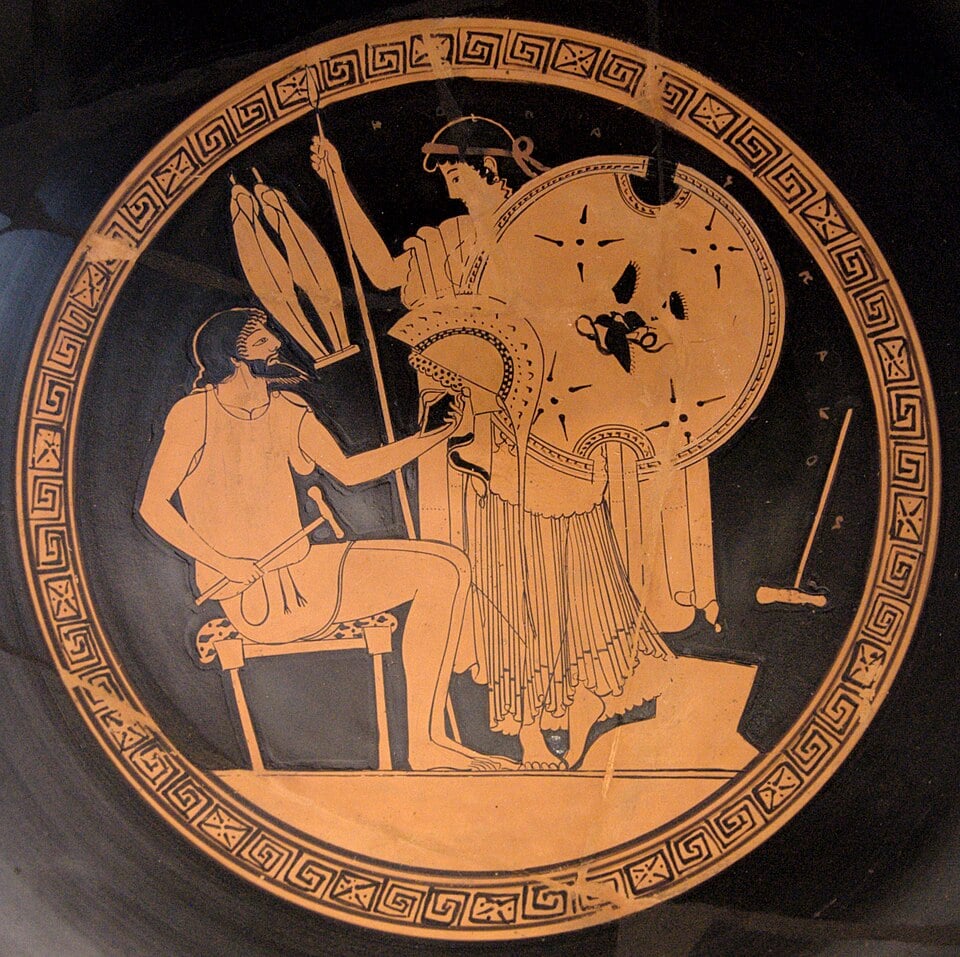
Attic red-figure Kylix, 490–480 BC, featuring Achilles and Thetis
Thetis takes the magical shield for Achilles from Hephaestus. Attic red-figure Kylix, 490–480 BC. Credit: Public Domain

In Homer’s Iliad, Thetis plays an important role in shaping the destiny of her son, Achilles. As a goddess, she intervenes at key moments in the epic, pushing the Greek hero to alter the course of events.

Although Thetis appears less frequently than many of the warriors and gods who dominate the battlefield at Troy, her actions influence some of the most significant developments in the poem. As a sea goddess and the mother of the greatest Greek warrior, she occupies a unique position between the divine and mortal worlds. She cannot prevent Achilles from dying, since the Fates have already decreed it, yet she repeatedly intervenes to protect his honor, ease his suffering, and ensure that his glory endures.

Through Thetis’ character, Homer explores themes of maternal love, fate, mortality, glory, and divine power. The first major instance of Thetis helping Achilles occurs in Book 1. After Agamemnon captures Briseis, a captive woman awarded to Achilles as a war prize, the Greek hero feels deeply dishonored and withdraws from battle. In his grief and anger, Achilles calls upon his mother. Thetis immediately rises from the sea to comfort him and listen to his complaint.

This scene reveals the extraordinary bond between mother and son. Unlike many divine figures in Greek mythology, Thetis responds with sympathy and tenderness. She understands Achilles’ suffering because she is painfully aware of his short lifespan. Her lament for him reflects a mother’s helplessness in the face of fate.

Thetis petitions Zeus to turn events in favor of Troy

After hearing Achilles’ request, Thetis undertakes one of the most consequential actions in the epic. She travels to Olympus and petitions Zeus to punish the Greeks by granting success to the Trojans. Her aim is not simply revenge but the restoration of Achilles’ honor. Zeus eventually agrees, and his decision alters the course of the war. The Trojans begin to gain the upper hand, while the Greeks suffer devastating losses. Through this intervention, Thetis helps Achilles achieve the recognition he believes Agamemnon has denied him.

This episode demonstrates the extent of Thetis’ influence among the gods. Although she cannot alter fate itself, she is capable of shaping the chain of events that leads toward it. Her appeal to Zeus succeeds in part because of a previous favor she had done for him. In this sense, her assistance rests not only on maternal devotion but also on her standing within the divine order. Achilles’ withdrawal from battle would have remained a private grievance without Thetis’ intervention. Instead, it escalates into a crisis that engulfs the entire Greek army.

The second major instance of Thetis helping Achilles occurs after the death of Patroclus. Patroclus, Achilles’ closest companion, enters battle wearing Achilles’ armor and is killed by Hector. When Achilles learns of his friend’s death, he is overwhelmed by grief and rage. Once again, Thetis hears her son’s cries and goes to him. This scene is among the most emotional in the Iliad. Thetis is aware that Achilles’ decision to return to battle will lead directly to his own death, yet she does not attempt to stop him. Instead, she offers comfort and practical assistance.

Hephaestus forges the invincible shield of Achilles

Achilles cannot immediately rejoin the fighting because Hector has confiscated his armor. Recognizing his need, Thetis travels to the forge of Hephaestus and requests new armor for her son. Hephaestus responds by crafting the magnificent shield of Achilles, one of the most celebrated objects in world literature. The shield depicts scenes of war and peace, labor and celebration, and life and death. With this armor, Thetis enables Achilles to return to battle and fulfill his heroic destiny.

This act of assistance is particularly significant because it highlights the limits of divine power. Thetis can secure the finest armor ever made, but she cannot save Achilles from mortality. Her help therefore reflects the tragic paradox that every action she takes to aid her son also brings him closer to the fate she most fears. The armor allows Achilles to defeat Hector, but it also marks the final stage of his journey toward death.

Thetis’ role after Hector’s death further underscores her importance. Achilles becomes consumed by grief and rage, dragging Hector’s body around the tomb of Patroclus. The gods disapprove of this behavior and decide that Hector must be returned to his family. Zeus sends Thetis to deliver his command to Achilles. She successfully persuades her son to release the body in exchange for ransom, helping restore moral balance and preparing the tale for closure.

This final intervention reveals another dimension of Thetis’ assistance. Earlier, she helped Achilles gain honor through vengeance; now she helps him regain humanity through compassion. Her influence guides him from destructive rage toward acceptance. The reconciliation between Achilles and Priam, one of the most moving scenes in ancient literature, would not have occurred without Thetis serving as the messenger between gods and mortals.

The complexity of Thetis, the mother of Achilles

Modern scholars have emphasized the complexity of Thetis’ character. Rather than portraying her simply as a nurturing mother, recent studies highlight her power and agency. Thetis is more than a grieving parent. She is a divine force capable of influencing both Olympus and the battlefield for the benefit of her son. This is evident in actions such as her request to Hephaestus to forge an impenetrable suit of armor for Achilles.

At the same time, scholars frequently stress the tragic nature of her motherhood. Classicist Emily Wilson observes that she has come to view the Iliad as “a poem about the pain of a goddess mother who adores her mortal child and can’t protect him.” This insight captures the emotional core of Thetis’ role in the epic. Despite her divine status, she remains powerless as a mother in the face of fate. Her interventions can shape events, but they cannot prevent the loss she knows is imminent.

Other scholars have also noted that grief defines Thetis’ presence throughout the epic poem. Classicist Serena Cannavale describes Thetis in the Iliad as “a figure of grief,” emphasizing that her sorrow is present long before Achilles actually dies. Her laments anticipate the tragedy that hangs over the entire narrative.

Ultimately, Thetis helps Achilles in three essential ways: she restores his honor by persuading Zeus to favor the Trojans, she equips him for revenge by obtaining new armor from Hephaestus, and she guides him back toward humanity by conveying Zeus’s command to release Hector’s body to Priam. These actions shape the central events of the Iliad and reveal the profound connection between mother and son. Yet the tragedy of Thetis lies in the fact that her power cannot overcome destiny. She can comfort Achilles, protect his reputation, and secure his everlasting glory, but she cannot save his life.

For this reason, Thetis embodies the tension between divine power and human mortality. Every time she helps Achilles, she demonstrates her love, yet every act of assistance also reminds readers that fate is stronger than even the gods. Through Thetis, Homer presents a moving portrait of maternal devotion in the face of inevitable loss, making her one of the emotional centers of the Iliad.

  •  

The Glittering Gold of Mycenaean Greece

Mycenaean Greece gold
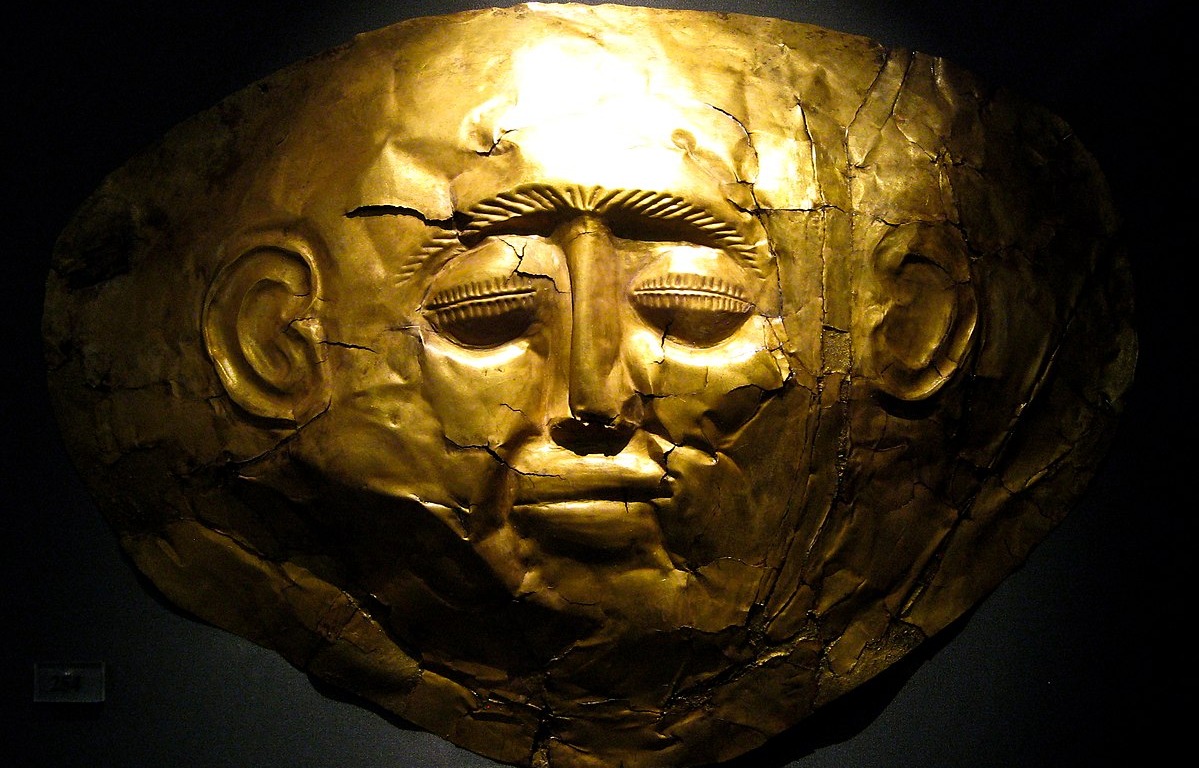
A gold Mycenaean death mask found in Greece. Credit: Sharon Mollerus / Wikimedia Commons / CC BY 2.0

Since the 19th century, several precious gold objects associated with the Mycenaean civilization have been discovered by archaeologists, predominantly at important burial sites where the royals and elite of Bronze Age Greece were buried.

The Mycenaeans were the first distinctly Greek culture to dominate mainland Greece during the late Bronze Age period between c. 1750 and 1050 BC. Their civilization was characterized by palatial states, advanced urban organization, and a written language dubbed Linear B by modern historians. It was during the Mycenaen age that the Trojan War purportedly happened, as retold in Homer’s Iliad.

The discovery of Mycenaean gold sheds light on the material culture of this enigmatic civilization but there are still many unanswered questions. For example, researchers are unsure whether the Mycenaeans crafted all of these items themselves, or whether they were obtained in trade and war.

Mycenaean Greece gold
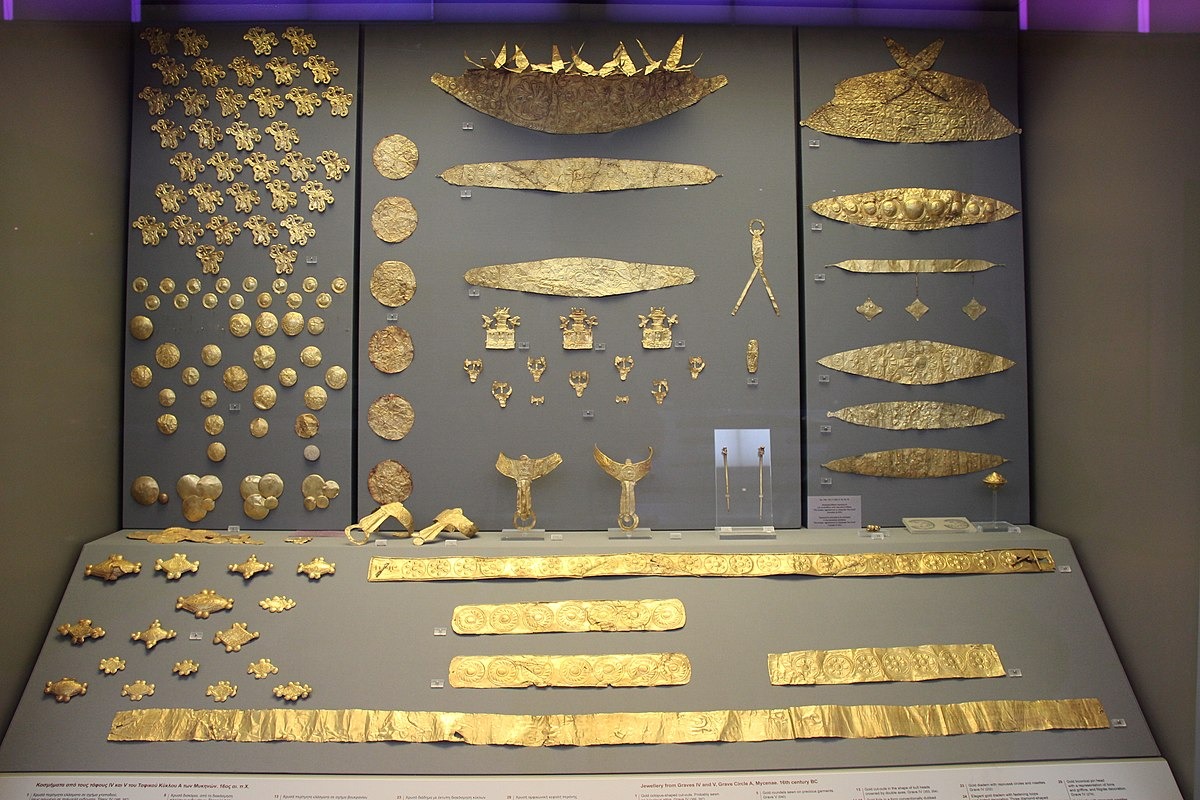
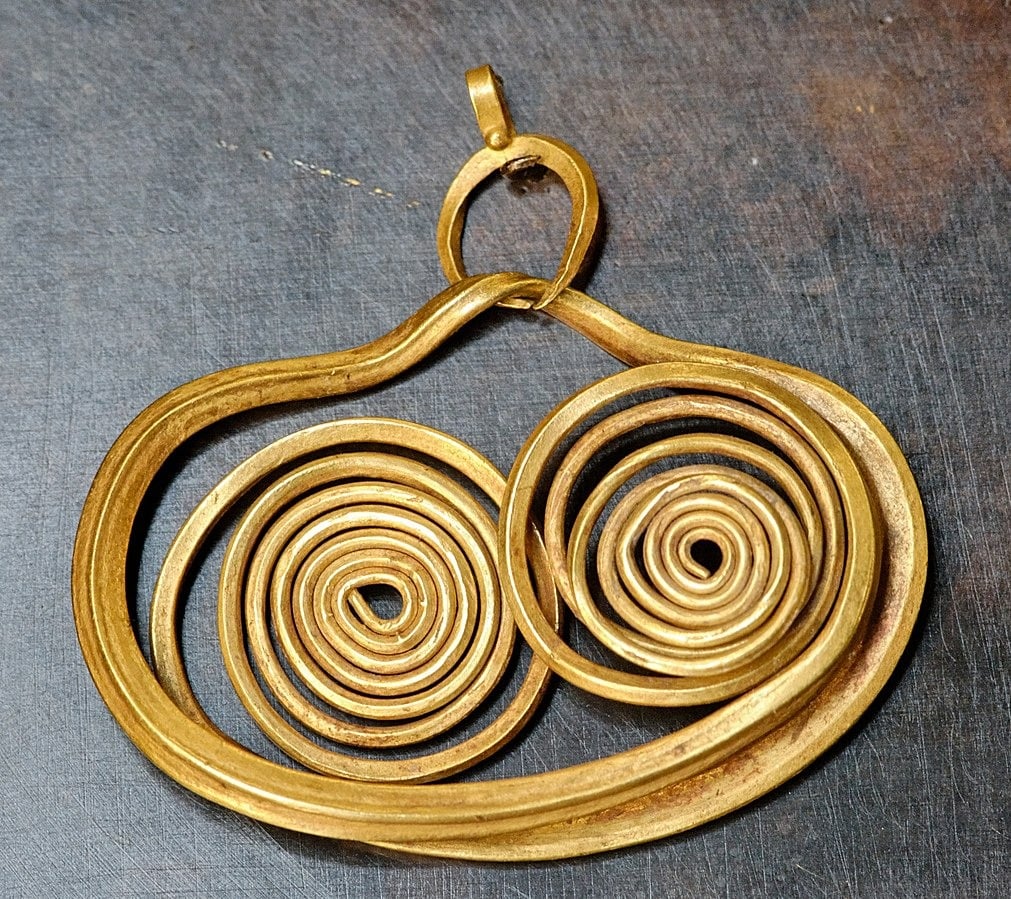
Mycenaean gold ornaments. Credit: Gary Todd / CC0 / Wikimedia Commons

The Grave Circles at Mycenae

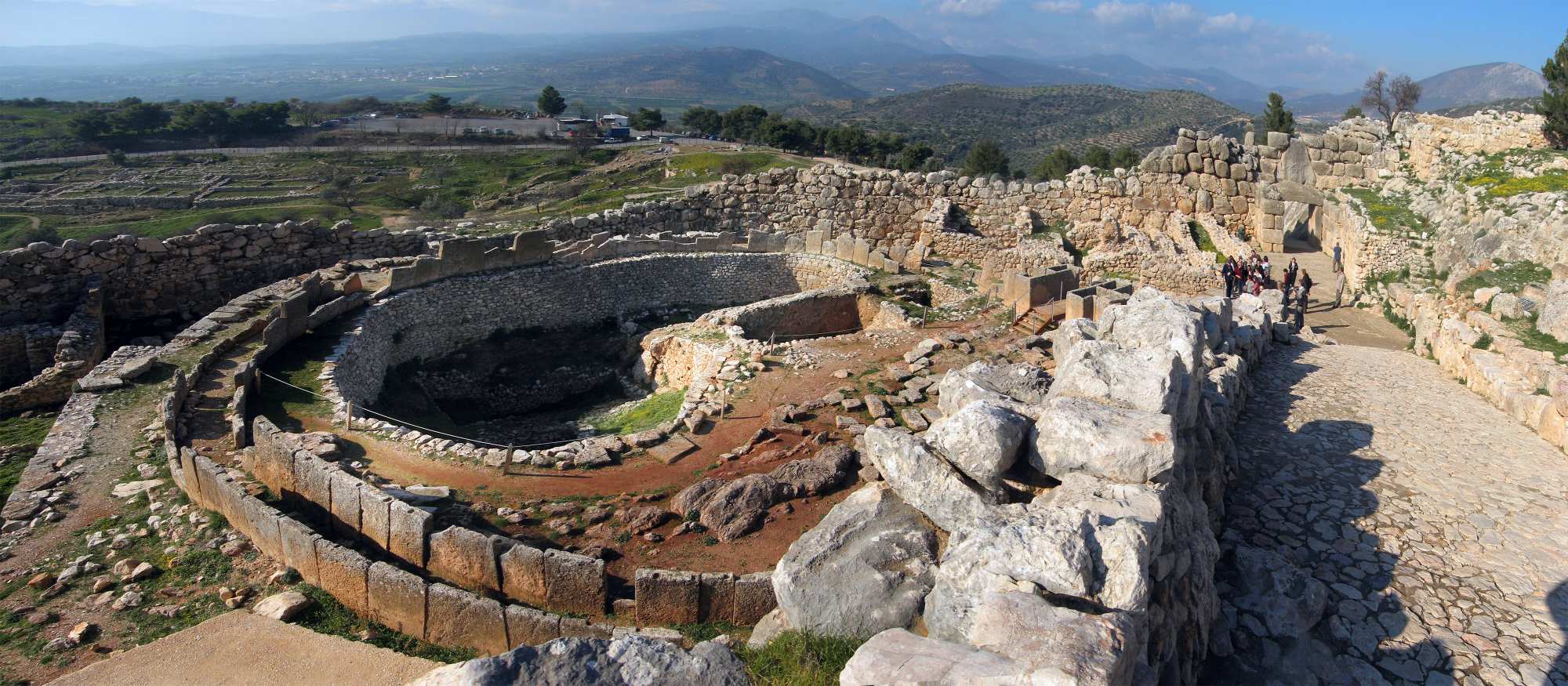
The most famous examples of Mycenaean gold were discovered in two grave circles uncovered at the ancient Bronze Age site of Mycenae. Grave Circle A was discovered by Heinrich Schliemann in 1876 based on the descriptions of Homer and Pausanias. Grave Circle B was excavated in 1952 by archaeologists Ioannis Papadimitriou and Georgios Mylonas after workmen accidentally stumbled on the tombs a year before.

Both grave circles, dating back to the 16th century BC, contained impressive amounts of gold objects and other precious items. Unlike other Bronze Age tombs, they had not been discovered by the grave robbers and looted.

Grave Circle A contained 15 kg (33 lbs) of gold alone, making it one of the most substantial archaeological finds in all of Europe. Both grave circles contained hundreds of previous objects including jewelry, ornamental clothing attachments, decorated weapons, and highly distinctive funeral masks.

Grave Circle A
The Grave Circle An archaeological site at Mycenae. Credit: Andreas Trepte / CC BY-Sa 2.5 / Wikimedia Commons

The Death Mask of Agamemnon

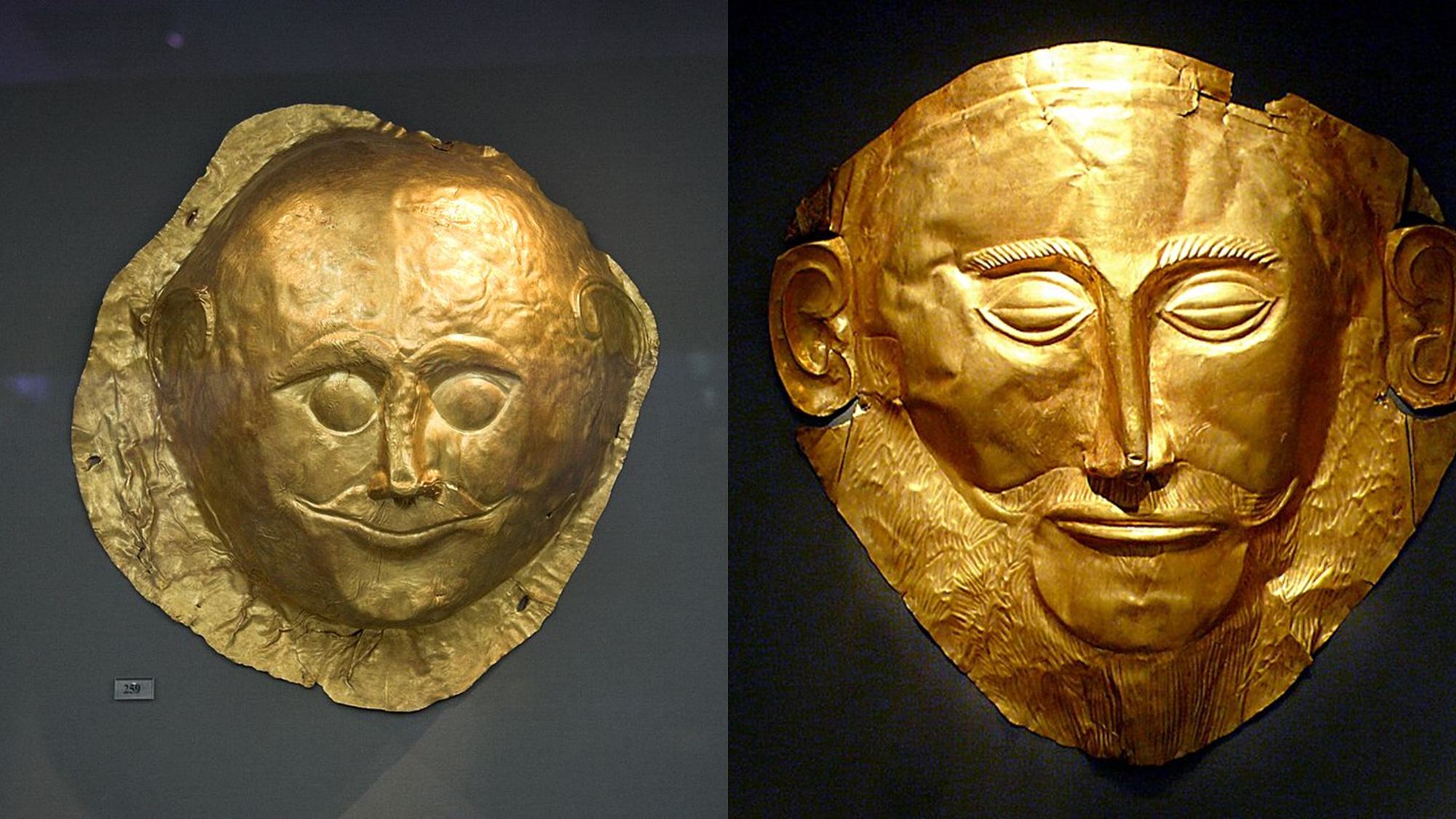
The most iconic find is the so-called Death Mask of Agamemnon. Schleimann named the mask after the legendary Mycenaean King Agamemnon who led the Achaean Greeks in the Trojan War according to Homer’s Iliad. However, more recent research has indicated that the mask predates the time that Agamemnon was supposed to have lived by about three centuries.

The Mask of Agamemnon was crafted utilizing a single large gold sheet that underwent heating and hammering against a wooden surface. The intricate details were then added through the process of chasing, using a sharp tool to etch them onto the mask.

There were six other death masks discovered in Grave Circle A. Of the seven masks, six belonged to adult males and one to a child. None of the women discovered at the gravesite were buried with ornate masks.

The masks in Grave Circle A exhibit similar characteristics, featuring flat foil-like layers of gold depicting round, bald faces with round eyes and prominent ears. In contrast, Grave Circle B includes a death mask made of electrum, placed in a container next to a buried body instead of being placed on the deceased. The scarcity of death masks in Grave Circle B suggests that the interred individuals held lower wealth or status compared to the abundance of valuable material found in Grave Circle A, including the death masks.

Mycenaean Greece gold
Mycenaean death masks. The one on the right is the so-called “Mask of Agamemnon”. Credit: Zde / CC BY-SA 3.0 / Xuan Che / CC BY 2.0 / Wikimedia Commons

The Royal Tombs at Pylos

The burials at Mycenae might have provided the most famous examples of Mycenaean gold, but they are not the only Bronze Age tombs where exquisite items have been found.

In 2019, a team of archaeologists discovered Bronze Age royal tombs situated near the royal palace of Pylos, said to have once been the seat of power for Nestor, the eldest among the Greek rulers who fought in Trojan War.

The larger tomb, which was once 12m (36 feet) wide and 4.5 meters (15 feet) deep, had stone walls that once stood as tall as the ground’s height. The underground chambers were originally covered by domes, but over time, the roofs and upper walls collapsed. Consequently, the tombs became buried beneath numerous melon-sized stones and a tangled mass of grape vines. In their excavation efforts, archaeologists from the University of Cincinnati, including Jack Davis, Sharon Stocker, and their colleagues, had to painstakingly clear away vegetation and manually remove the stones.

Mycenaean sword
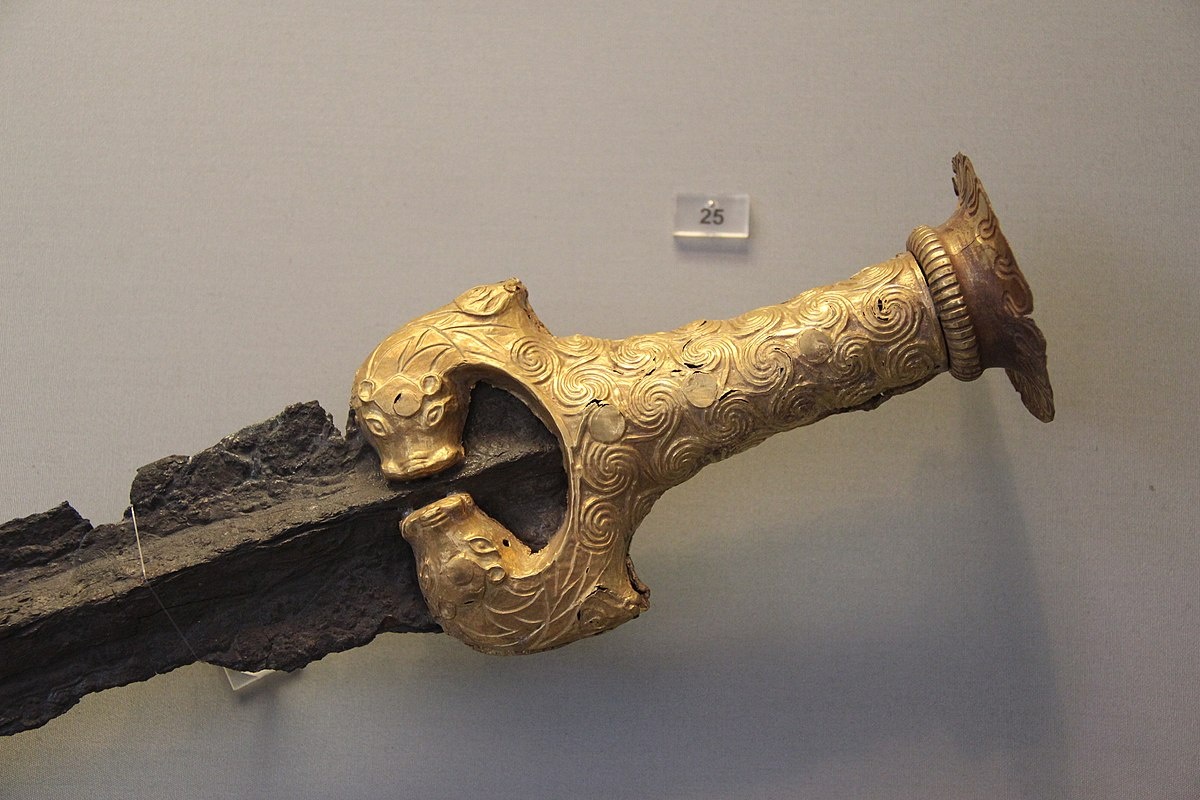
Mycenaean bronze sword with a gold hilt and featuring a lion motif, from Grave Circle B, Mycenae. Credit: Gary Todd / CC0 / Wikimedia Commons

What they discovered, however, was extraordinary. Among the debris, the floors of the burial pits were adorned with shimmering flakes of gold leaf, which had once embellished the walls and floors of the chambers. The tombs, although lacking the remains of their occupants – suggesting a potential disturbance in the distant past – were nonetheless filled with opulent artifacts such as jewelry, gold, bronze, and gemstones.

A particularly interesting find was a gold pendant bearing the image of the Egyptian goddess Hathor who presided over motherhood and the protection of the dead. The Greeks during later periods drew parallels between Hathor and Aphrodite but it is not entirely clear what she meant to the Mycenaean Greeks during the Bronze Age. In any case, the artifact hints at trade links between the Mycenaeans and Egyptians at the time of the burials, which are believed to be about 3,500 years old.

Mycenaean Greece gold
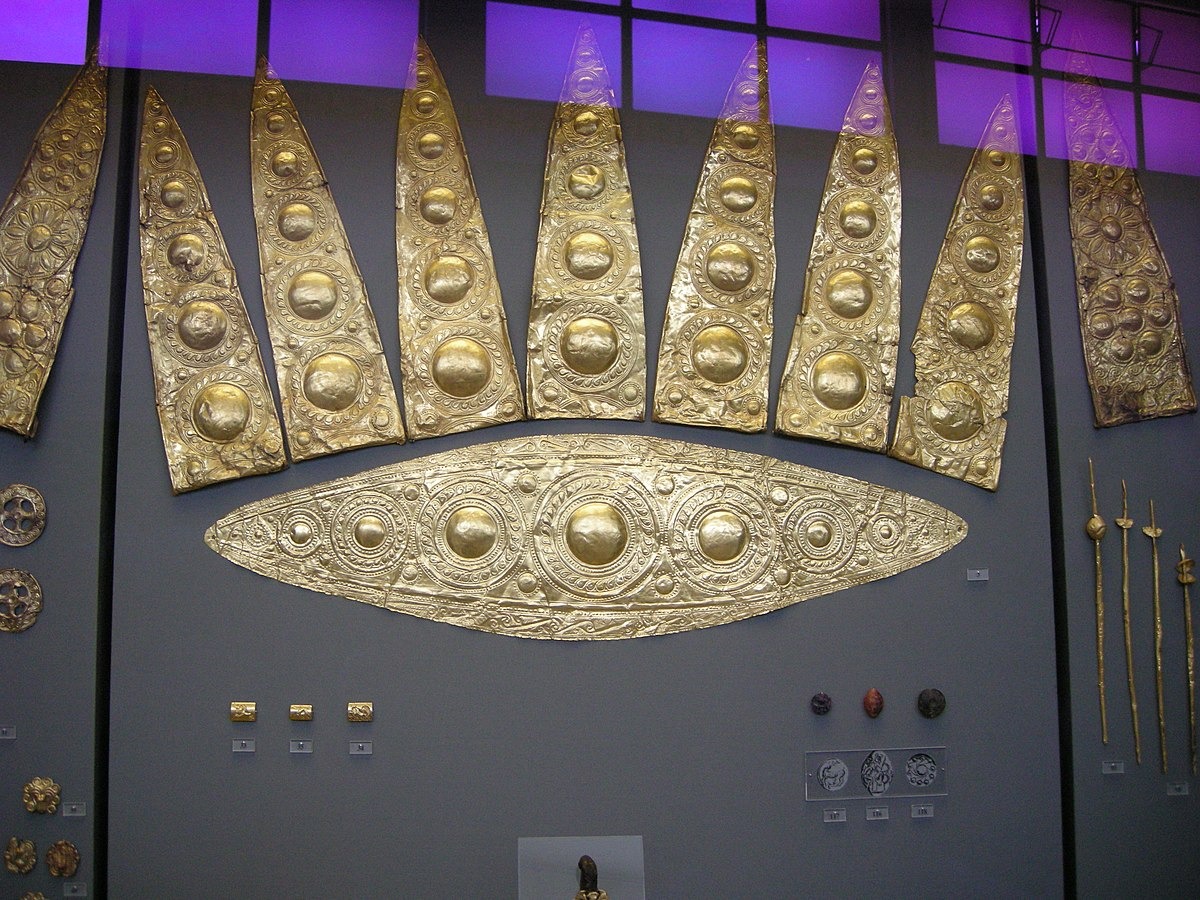
A gold elliptical diadem. Credit: I, Sailko / CC BY-SA 3.0 / Wikimedia Commons

Gold Mining in Mycenaean Greece

As pointed out in an academic paper authored by  M. Vavelidis and S. Andreou, “Numerous objects of gold displaying an impressive variety of types and manufacturing techniques are known from the Late Bronze Age (LBA) contexts of Mycenaean Greece, but very little is known about the origin and processing of gold during the second millennium BC.”

This raises several questions, namely: where did the Mycenaeans source their gold from? Interestingly, the wider Argolid region in which Mycenae was itself located and where the discoveries were made of numerous stunning golden items, is bereft of gold. If the Bronze Age Greeks did their own mining it was therefore elsewhere in Greece.

According to Vavelidis and Andreou, “Ancient literature and recent research indicate that northern Greece is probably the richest gold-bearing region in Greece, and yet very little evidence exists regarding the exploitation of its deposits and the production as well as use of gold in the area during prehistory.”

Mycenaean earring
16th century BC Mycenaean earring. Credit: Louvre Museum / Public Domain / Wikimedia Commons

Nevertheless, by examining the chemical composition of prehistoric artifacts from two settlements alongside the composition of gold deposits in their nearby regions, it becomes evident that gold was locally sourced in some parts of Greece. This finding also raises the possibility that a portion of the Mycenaean gold may have originated from northern Greece.

Furthermore, the discovery of small stone crucibles, one of which bore visible traces of gold melting, at the archaeological site of Toumba in Thessaloniki, proves that local production of gold items took place very early in ancient Greek history.

Beyond mining, the Mycenaeans may also have obtained gold via trade and war. In some cases, Mycenaean traders may have bought gold for Greek craftsmen to shape into various objects, and in other cases, they would have imported finished items.

The Mycenaeans were well-respected as warriors across the Eastern Mediterranean and sometimes fought in the armies of neighboring civilizations like the Egyptians as mercenaries. The leaders of these Mycenaean mercenary bands may have received gold as payments or gifts in exchange for their martial services.

  •  

Elon Musk Fuels Odyssey Casting Debate With AI Trailer Featuring All-White Greek Heroes

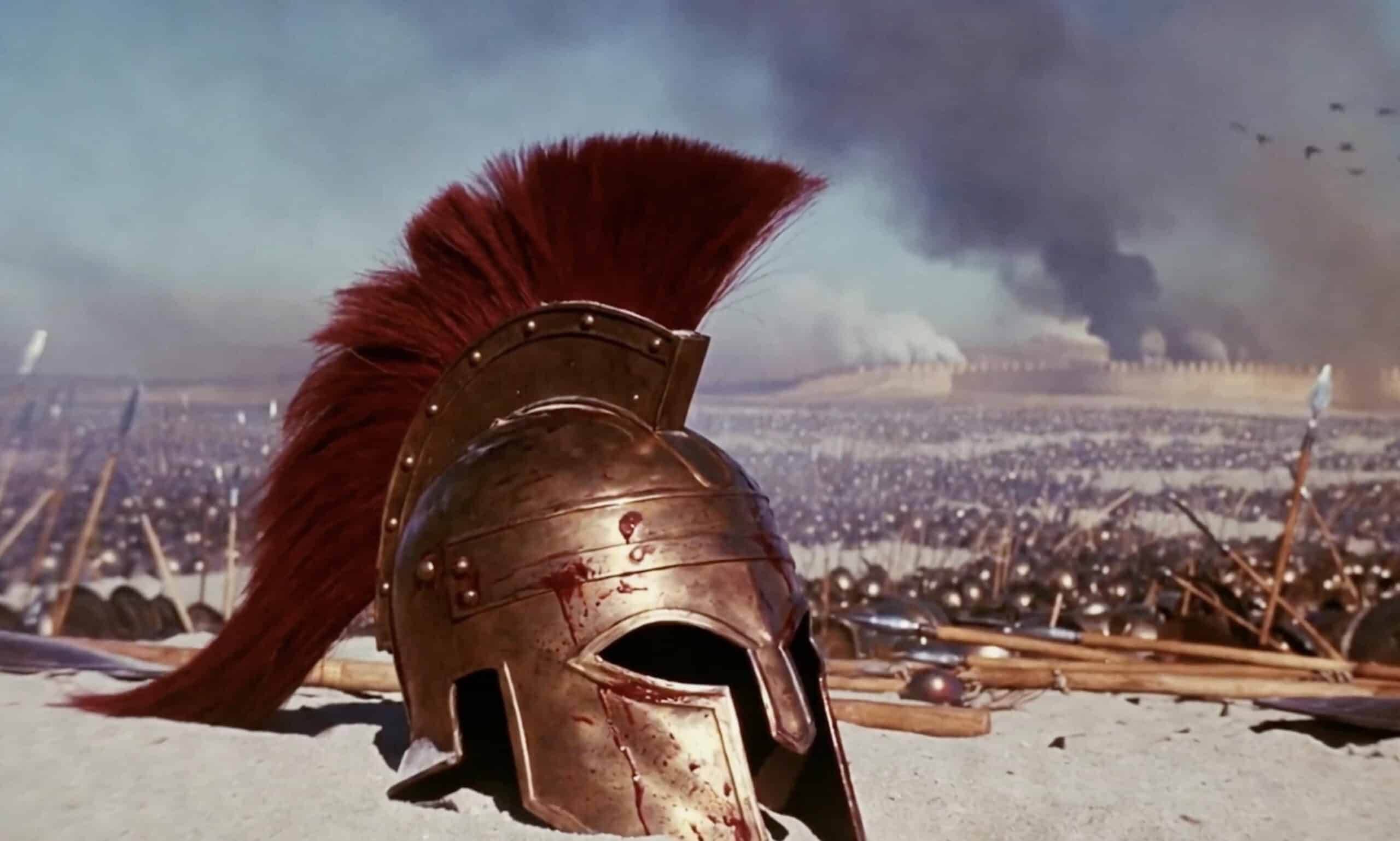
A bronze ancient Greek-style warrior helmet with a red plume lies on a battlefield, with spears, shields, smoke, and armies in the background.
AI-generated Iliad trailer shared by Elon Musk on X amid debate over Christopher Nolan’s The Odyssey. Credit: Screenshot / Elon Musk’s official twitter account

Elon Musk has entered the controversy surrounding Christopher Nolan’s upcoming The Odyssey by sharing an AI-generated trailer featuring an all-white cast of ancient Greek heroes.

Musk posted the video on X on Thursday, June 4, as debate continues over Nolan’s decision to cast Lupita Nyong’o as Helen of Troy in The Odyssey. Musk, who has already criticized the casting online, introduced the clip as an “Iliad (Troy) trailer made by Grok Imagine 1.5,” referring to the video-generation model developed by his artificial intelligence company xAI.

The 40-second trailer quickly went viral and drew more than 18.4 million views, according to the original Greek report. Although Musk did not explicitly mention Nolan’s film in the post, the timing and visual choices linked the clip to the wider argument over how ancient Greek figures should appear on screen.

An AI version of Homer’s world

The trailer presents a dramatic version of the Trojan War, with burning cities, warships, battlefield speeches, emotional close-ups, and large-scale combat scenes. Its visual style closely resembles a Hollywood historical epic. However, AI tools produced the video rather than a traditional studio production.

The choice of The Iliad also matters. Homer’s Iliad and Odyssey are two of the foundational works of ancient Greek literature. The Iliad centers on the Trojan War, while The Odyssey follows Odysseus on his long journey home after the fall of Troy.

That connection made Musk’s post look less like a random AI experiment and more like a response to the current debate around Nolan’s film. By using AI to create his own vision of the Trojan War, Musk placed himself directly inside a cultural dispute involving Greek mythology, Hollywood casting, and the future of filmmaking.

Iliad (Troy) trailer made by Grok Imagine 1.5, which was just released pic.twitter.com/o0zITVlvpn

— Elon Musk (@elonmusk) June 4, 2026

The Helen of Troy debate

Nolan’s The Odyssey is scheduled for release on July 17, 2026. The film stars Matt Damon as Odysseus and Anne Hathaway as Penelope. Its cast also includes Tom Holland, Zendaya, Robert Pattinson, Charlize Theron, and Lupita Nyong’o.

Much of the online backlash has focused on Nyong’o’s role as Helen of Troy. Critics of the casting argue that Helen, one of the most famous figures of Greek mythology, should reflect the traditional image associated with the character.

Supporters of the film, however, say Homeric myth is not documentary history. They argue that artists have reinterpreted the epics for centuries through theater, literature, painting, and cinema. Nyong’o has also addressed the criticism, saying the film’s cast reflects the world and emphasizing that the story belongs to mythology rather than historical reconstruction.

Musk’s AI trailer now adds another layer to the dispute. The clip does not simply promote artificial intelligence as a filmmaking tool. Instead, it presents an alternative visual version of the Homeric world at the exact moment when Hollywood’s version is under scrutiny.

Was very fun to try out the latest 1.5 Grok Imagine model for this one! https://t.co/x5OwuhySyH

— Heavy Pulp (@heavypulp) June 3, 2026

Elon Musk turns AI Iliad trailer into a cultural statement

After Musk posted the trailer, the creative studio Heavy Pulp, which worked on the project, said it had enjoyed making it. Musk then asked whether the team wanted to make a full-length film. Heavy Pulp replied that it was already in.

That exchange helped transform the video from a short viral experiment into a possible challenge to Hollywood. Musk appeared to test whether AI could generate not only trailers, but also full-scale mythological films outside the traditional studio system.

The response online came quickly. Many users praised the trailer’s cinematic look and argued that it showed how fast AI video tools are improving. Others viewed the clip as a direct provocation toward Hollywood, especially because it appeared during a high-profile debate over representation in a film based on Greek mythology.

@starchannelnews

Νέο διαδικτυακό θόρυβο προκαλεί ο Ίλον Μασκ, ο οποίος επανέρχεται στη δημόσια συζήτηση γύρω από τις επιλογές casting στην πολυαναμενόμενη κινηματογραφική μεταφορά της Οδύσσειας από τον Κρίστοφερ Νόλαν. Με αφορμή τη συζήτηση που έχει ανοίξει για τον ρόλο της Ωραίας Ελένης, ο Μασκ ανάρτησε στο Χ ένα βίντεο που παρουσιάζεται ως AI trailer της Ιλιάδας, με όλους τους πρωταγωνιστές να απεικονίζονται ως λευκοί ηθοποιοί. Η Βαλεντίνα Καραγεωργίου είναι μαζί μας με όλες τις λεπτομέρειες και τις αντιδράσεις που έχει προκαλέσει η νέα παρέμβαση του Ίλον Μασκ. #starchannelnews #tiktokgreece #newsgr

♬ original sound – Star News_official – Star News_official

  •  
❌