Normal view

Russia hit Kyiv’s 1,000-year-old monastery, then launched disinformation campaign with five different scenarios. Ukraine has seen this playbook in Mariupol

15 June 2026 at 15:17

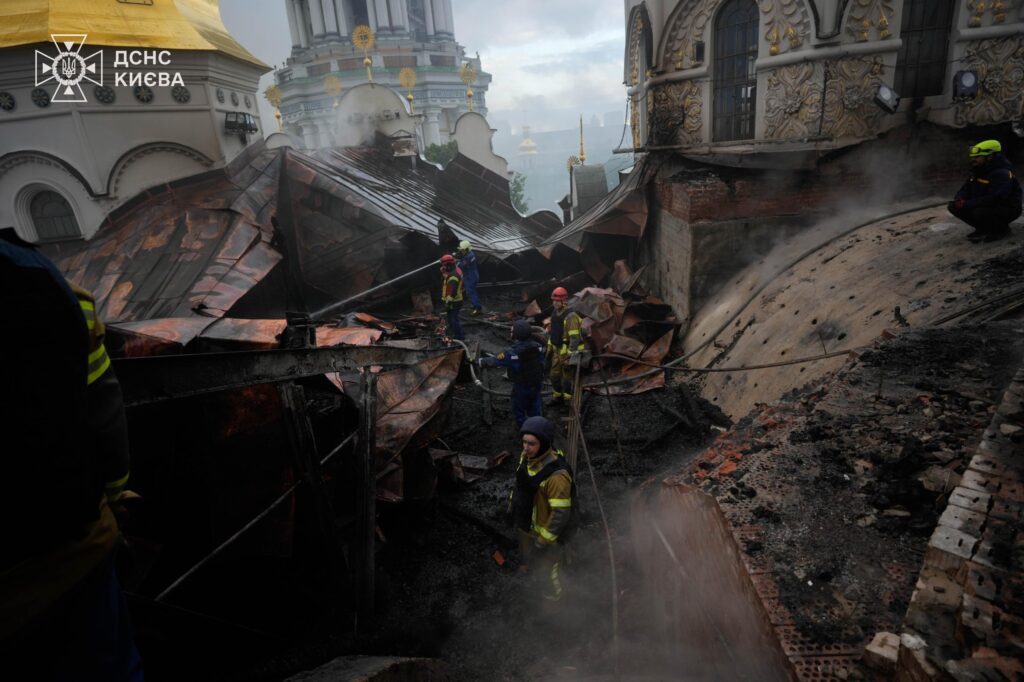
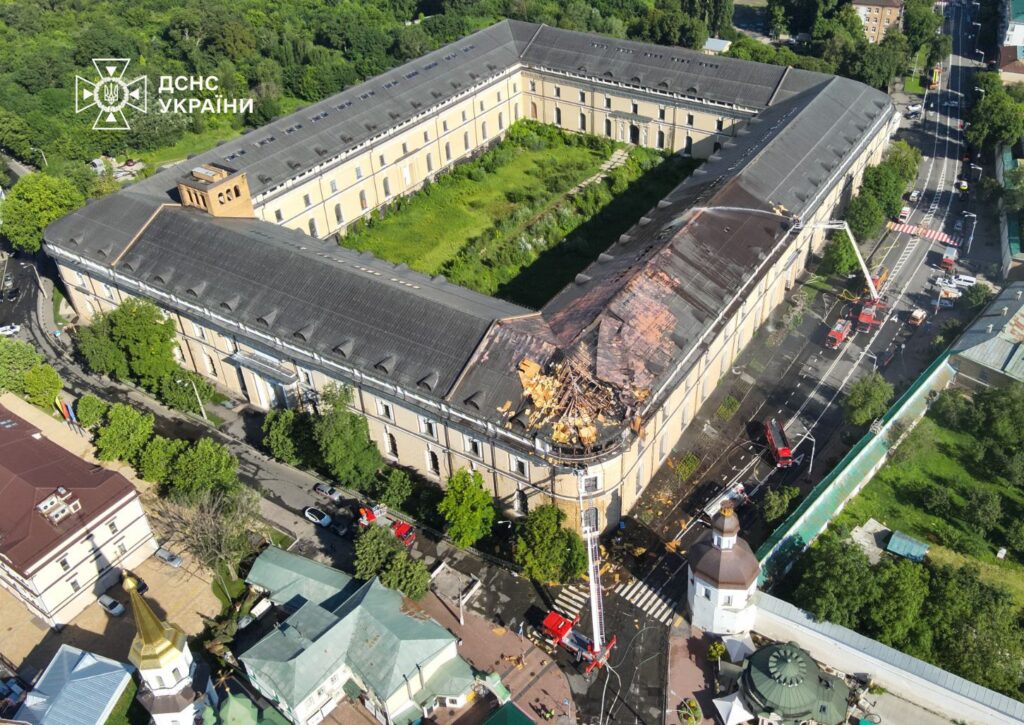
The image shows the aftermath of Russia's attack on the Kyiv-Pechersk Lavra on 15 June 2026. Credit: DSNS

Russia has launched a large-scale disinformation campaign attempting to justify mass strikes on Kyiv's civilian and cultural objects, the Ukrainian Center for Countering Disinformation (CPD) has announced. Russian sources are using a classic scenario by attempting to disguise outright terror against civilians as "strikes on military targets" or shifting blame to Ukraine itself, the CPD said.

The disinformation campaign follows a pattern Ukrainian authorities have documented after previous Russian strikes on cultural and civilian targets. The Kyiv-Pechersk Lavra, a UNESCO World Heritage site dating back to 1051, is protected under the 1954 Hague Convention on the Protection of Cultural Property in the Event of Armed Conflict and the Geneva Convention Additional Protocol I, Article 53.

Russian information operations following strikes on Ukrainian civilian targets have followed predictable patterns since 2022.

Five Russian disinformation tactics CPD identified

The CPD documented five specific Russian disinformation tactics deployed after the Kyiv strikes.

  1. The Kyiv-Pechersk Lavra fire is called "Ukrainian provocation" or "self-arson."
  2. Russian conspiracy theories blame Ukrainian authorities for the strike on the Higher Anti-Corruption Court building.
  3. The Dovzhenko Film Studio is declared a "legitimate military target" by Russian propaganda because it is allegedly a "propaganda nest."
  4. False allegations claim Kyiv has weapons-production workshops disguised as civilian buildings — in Russian propagandists' framing, every Kyiv building is a "military object."
  5. And "Ukrainian air defense" is blamed for damage to civilian buildings, a standard Russian deflection tactic.

CPD's framing: Russia carries full responsibility

All responsibility for the death and injury of peaceful Kyiv residents, destruction of historical and civilian buildings lies exclusively with Russia, and it must be punished for this, the Center says. 

"No manipulation, conspiracy theories, or attempts to grant civilian objects 'military status' will help the aggressor conceal another war crime," the CPD said in its statement.

The CPD's position represents the Ukrainian government's position. 

Broader pattern: two documented Russian disinformation campaigns after cultural site strikes

Russian disinformation following strikes on Ukrainian cultural sites has followed predictable patterns since 2022. Two documented precedent cases illustrate the same tactics now being deployed against Kyiv.

After the 16 March 2022 Russian airstrike on the Mariupol Drama Theater. Russia denied conducting the strike and claimed that Ukrainian soldiers had blown up the building themselves. An Associated Press investigation found that approximately 600 people died in the bombing, which makes it the deadliest single known attack on civilians in the war.

Amnesty International later concluded that the strike was a "clear war crime" conducted by two 500-kg bombs dropped from Russian fighter jets, ruling out alternative explanations.

After the 23 July 2023 Russian missile strike on the Odesa Transfiguration Cathedral, located within the UNESCO-protected historic center of Odesa, Russia's Defense Ministry denied targeting the cathedral and claimed the damage was caused by "the fall of a Ukrainian anti-aircraft guided missile," per Radio Free Europe/Radio Liberty. 

UNESCO condemned the strike as an "escalation of violence against the cultural heritage of Ukraine." The cathedral's assistant rector, Father Myroslav, confirmed a "direct hit to the cathedral" with three altars destroyed.

The pattern across the Mariupol Theater, Odesa Cathedral, and now Kyiv-Pechersk Lavra cases is consistent: Russia denies conducting the strike and attributes damage to Ukrainian air defense or self-inflicted destruction. 

Agência de Geologia e Energia e DGEG já têm liderança

15 June 2026 at 15:00

A Agência de Geologia e Energia (AGE) já tem os nomes da comissão instaladora.

Nuno Matias (na foto, quadro da Entidade Nacional para o Setor Energético (ENSE), onde liderava a Unidade de Reservas Petrolíferas) vai liderar a agência no período de transição.

A AGE resulta da fusão da Direção-Geral de Energia e Geologia, do Laboratório Nacional de Energia e Geologia, da Empresa de Desenvolvimento Mineiro e da EDMI – Empresa de Projetos Imobiliários, integrando ainda atribuições da Entidade Gestora de Reservas Estratégicas de Portugal.

A comissão instaladora vai ter como vice-presidente Antonieta Loureiro. Integram ainda a comissão Miguel Águas, Ana Olim e Margarida Pisco, enquanto vogais.

Numa das entidades que vai ser integrada na AGE, a Direção-Geral de Energia e Geologia (DGEG) conta com novo diretor-geral para substituir Paulo Carmona que foi liderar a Infraestruturas de Portugal: Alexandre Santos que ocupava o cargo de sub-diretor-geral desde outubro de 2025. Para o cargo de sub-diretora geral, Liliana dos Santos assume o cargo. Ambos foram designados em regime de substituição.

Russia has damaged or destroyed nearly 2,000 Ukrainian cultural heritage sites since 2022 — prosecutor general calls Lavra strike deliberate erasure

15 June 2026 at 14:16

Russian drone strike Geran on Kyiv's Unesko cathedral

Moscow's forces have looted over 7.8 million artifacts from museums in occupied territory since 2014, Ukraine's chief legal authority reported on 15 June.

The figure surfaced as Prosecutor General Ruslan Kravchenko condemned an overnight missile strike on the Kyiv-Pechersk Lavra. He placed the attack within what he called a deliberate state campaign to erase the country's identity. Kravchenko spoke hours after a combined Russian barrage set fire to the monastery's Dormition Cathedral. The cathedral is one of the most revered sites in Eastern Orthodox Christianity. Founded in 1051, the complex sits under UNESCO World Heritage protection. Moreover, it falls under the enhanced-safeguard mechanism of the 1954 Hague Convention.

A strike the prosecutor frames as cultural warfare

The Lavra hit belongs in the same category as earlier attacks on national symbols, Kravchenko argued. He grouped it with strikes on the Transfiguration Cathedral in Odesa and the Hryhorii Skovoroda museum in Kharkiv Oblast. The list also named the Ivankiv museum holding works by folk artist Maria Prymachenko. It extended to the Oleksandr Dovzhenko National Film Studio in Kyiv and the Organ and Chamber Music House in Dnipro.

"This is the deliberate policy of an aggressor state — to destroy what shapes Ukrainian identity," his office said.

Almost 2,000 sites damaged, more than 100 under UNESCO's umbrella

Russian forces have damaged or destroyed close to 2,000 elements of Ukrainian cultural heritage, Kravchenko stated. The count runs from the start of the full-scale invasion in February 2022. More than 100 of them carry UNESCO designation, he added.

That national tally runs well above the figure the UN body verifies on its own. UNESCO confirmed damage to 536 cultural sites as of 10 June 2026. That narrower count reflects stricter cross-checking against satellite imagery and on-site inspection. The gap reflects method, not contradiction. Ukrainian authorities log every culture-related facility affected in any way, while UNESCO applies a tighter definition of cultural property.

Dovzhenko studio loses Ukraine's largest costume archive

Investigators recovered missile fragments at the Dovzhenko film studio after the overnight assault, the prosecutor general reported. The strike leveled a two-story costume storehouse. It also damaged an annex to the sound stages, plus administrative and production buildings. No deaths or injuries occurred at the site.

Studio chief Andrii Donchyk told the "Snidanok z 1+1" program that the archive was the country's oldest. Roughly 100,000 costumes and about three million items of clothing had been stored there. How many survived the fire remained unclear.

Looting across occupied territory

Beyond physical damage, Kravchenko detailed a vast removal of movable Ukrainian cultural heritage. Russian forces seized or appropriated more than 7.8 million heritage objects from occupied-area museums between 2014 and 2026, he said. Furthermore, the true scale could be higher, because access to many collections remains blocked.

Prosecutors have opened more than 240 criminal cases and named 15 suspects so far.

"Crimes against cultural heritage are also war crimes. They carry no statute of limitations," Kravchenko said.

A countrywide barrage centered on Kyiv

The air force reported that Russia launched 70 missiles and 611 drones overnight on 15 June. Kyiv was the main axis of attack. Missiles also struck Dnipro and Kharkiv. Air defenses neutralized 632 incoming threats — 50 missiles and 582 drones. Nevertheless, 20 ballistic missiles and 27 attack drones hit 42 locations, while debris fell at 12 more.

In Kyiv, the strike killed five people and wounded 35, including two children, city authorities said. Fires broke out across nearly every district. President Volodymyr Zelenskyy later put the nationwide toll at 11 killed and 53 injured.

Moscow's denial and a pledge to escalate

Russia's defense ministry claimed the barrage targeted "defense-industrial complex" facilities in Kyiv, Dnipro, and Kharkiv. In addition, it repeated Moscow's standard line that its military avoids deliberate strikes on civilian infrastructure. The latest assault on Ukrainian cultural heritage and residential districts followed a 12 June statement by Vladimir Putin. He had said Russia would intensify its strikes on Ukraine.

From Bloomsbury to Whitehall: new play reimagines life of John Maynard Keynes

The Standard of Living by James Graham traces economist’s influence on British politics and culture

After exploring the rise of Rupert Murdoch and the emergence of Gareth Southgate’s England team, James Graham has turned his attention to one of the most important political figures of the 20th century: John Maynard Keynes.

His new play, The Standard of Living, directed by Nicholas Hytner and opening at the Haymarket in September, focuses on Keynes’s life from 1917 until his death in 1946 – a period in which he became the founding father of macroeconomics and reshaped government thinking on finance and the role of the arts.

Continue reading...

© Photograph: Bettmann/Bettmann Archive

© Photograph: Bettmann/Bettmann Archive

© Photograph: Bettmann/Bettmann Archive

❌