Normal view

Ukraine hits two northeastern bridges to occupied Crimea overnight again to cut a main supply road

15 June 2026 at 14:27

ukrainian drones hit two northeastern bridges occupied crimea overnight again cutting main supply road · post crimea's connection points mainland ukraine euromaidan press wyzmq-ukraine-targets-crimea-s-northeastern-bridges-again- news reports

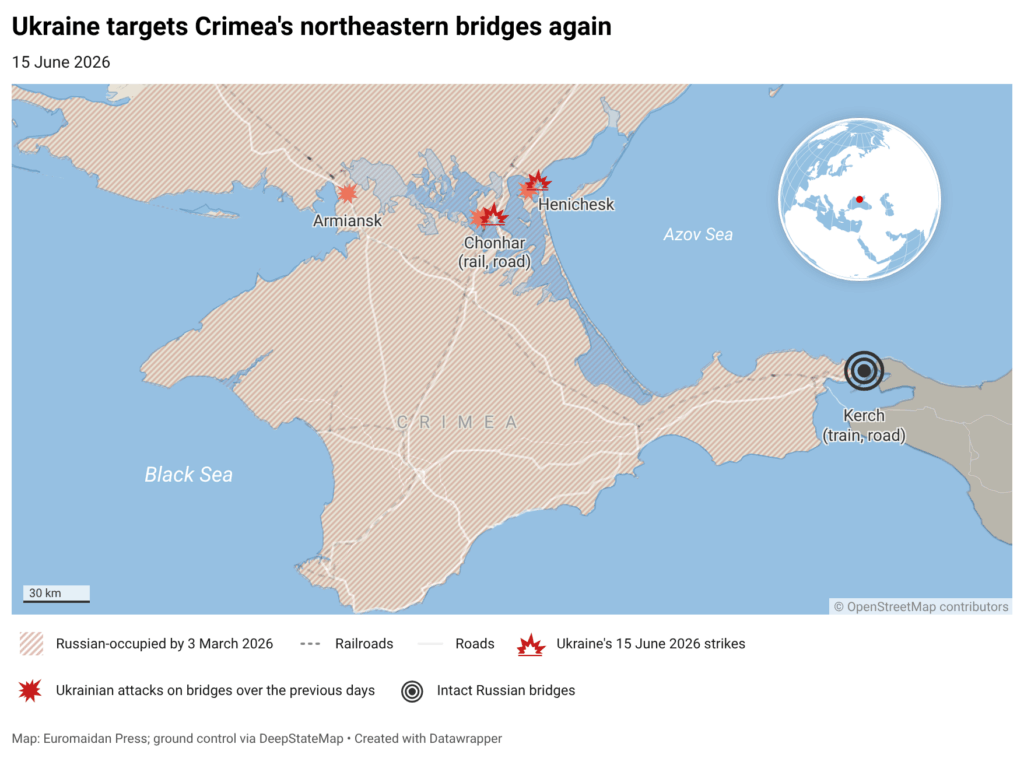
Ukraine's Defense Forces struck the Chonhar and Henichesk road bridges connecting occupied Crimea to the mainland again overnight on 15 June 2026. The drone attack damaged crossings that Russia leans on to move troops and supplies onto the peninsula, and Russia-installed officials shut a key checkpoint before claiming traffic later resumed. Monitoring channels also reported fires inside Crimea itself.

Occupied Crimea hangs on a handful of narrow crossings in the north, and Ukraine has spent recent weeks turning those chokepoints into the front line of its push—known as the Logistics Lockdown program—against Russian supply routes in the occupied south. Every span and floating crossing Ukraine knocks out again forces Russia onto slower, longer detours, and the repeated returns to the same chokepoints make resupplying its southern front costlier with each strike.

Two bridges hit, the Dzhankoi crossing shut then partially reopened

The Defense Forces hit the bridges with strike drones, the Russia-installed head of the occupied part of Kherson Oblast, Vladimir Saldo, claimedThe span near Chonhar was damaged and the Dzhankoi vehicle checkpoint fully closed. Saldo stated the restrictions would last for an undefined time because of damage to infrastructure on the approaches to the administrative border with Crimea.

The same overnight attack also damaged the bridge that links Henichesk to the Arabat Spit, a long sandbar running down Ukraine's southern coast. Both are among the few land routes onto the peninsula.

Yevgeny Balitsky, the Russia-installed head of the occupied part of Zaporizhzhia Oblast, said traffic was suspended on one of the road bridges joining northern Crimea to the mainland, with vehicles sent on a long detour through Melitopol, Novooleksiivka, Novotroitske, Chaplynka, Myrne and Armiansk. 

By midday, the Russian propaganda outlet Interfax reported that Saldo had claimed reverse-mode traffic was moving again through the Dzhankoi crossing.

The details of how it came from the Ukrainian side. Petro Andriushchenko, head of the Center for Studying the Occupation, said occupation forces had reopened the crossing over a temporary pontoon built for passenger cars, running one direction at a time, citing occupation sources and the outlet Most.
Ukrainian strikes on the Dzhankoy
Explore further

Ukrainian drones hit Dzhankoi as strike unit declares hunt on Russian Crimea logistics

Fires near Chonhar and at a Crimean airfield

Last night, the Crimea-monitoring Telegram channel Krymsky Veter reported two powerful explosions near the village of Donske outside Simferopol, audible in the city itself. NASA's fire detection database, FIRMS, also shows a fire near the Chonhar bridge, with thermal signatures around a former Ukrainian checkpoint now used by the Russian military. The channel separately noted a fire at the Hvardiiske airfield in occupied Crimea, at what it called an aircraft-preparation area, though no damage details were released.

ukrainian drones knocking out northwestern entrance crimea bridges damaged one night · post rl9vo -ukraine-targets-four-bridges-at-crimea-s-northwestern-choke-point- struck four vehicular crimea's overnight 11 2026 quisling official vladimir saldo claimed strikes part ukraine's
Explore further

Ukrainian drones knocking out the northwestern entrance to Crimea: four bridges targeted in one night

A weeks-long campaign against Crimea's land routes

Russian crews had already set up a pontoon beside the damaged Henichesk bridge on 14 June, captured in a Copernicus satellite image posted by an open-source analyst. 

ukrainian drones hit two northeastern bridges occupied crimea overnight again cutting main supply road · post pontoon crossing (left) russia set up beside damaged henichesk bridge 14 2026 понтонна переправа
The pontoon crossing (left) that Russia set up beside the damaged Henichesk bridge, 14 June 2026. Photo: Copernicus/you1126

A similar pontoon had appeared near Chonhar on 7 June after the fixed crossing was hit. 
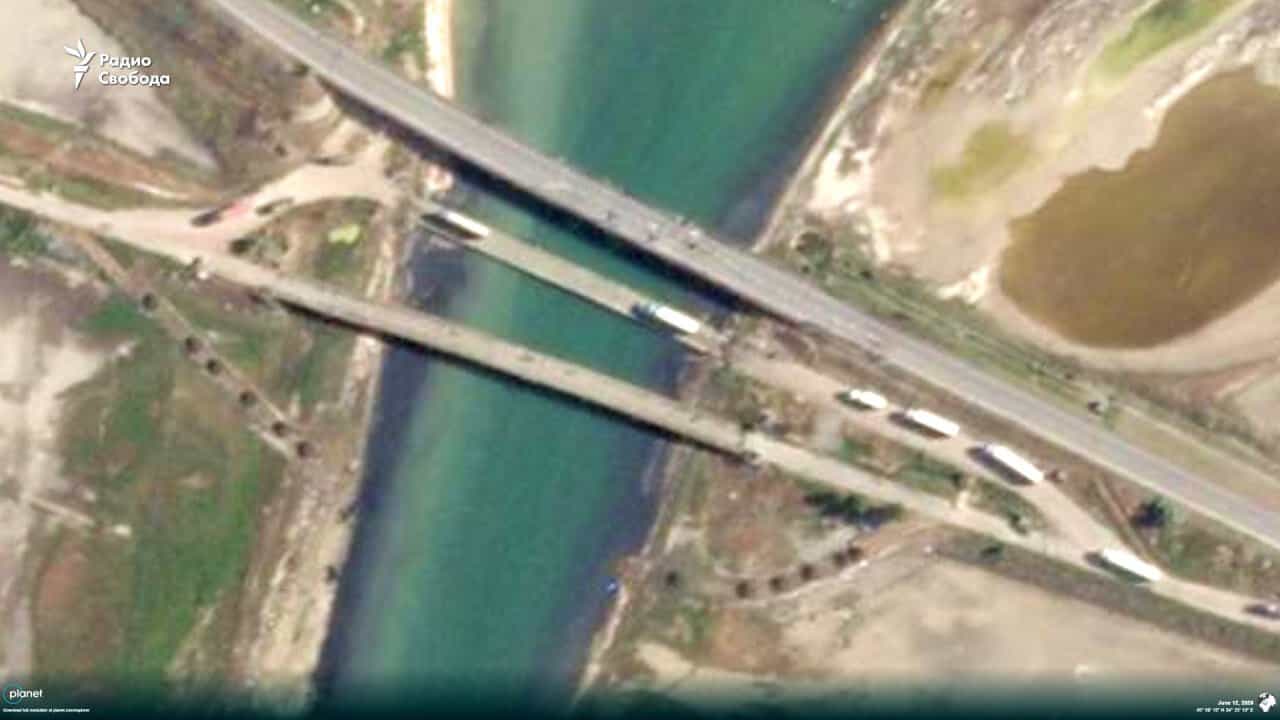
ukrainian drones hit two northeastern bridges occupied crimea overnight again cutting main supply road · post trucks lined up crossing near chonhar 12 2026 вантажівки на понтонному мосту біля чонгара
Trucks lined up at the crossing near Chonhar, 12 June 2026. Photo: Planet Labs/Radio Svoboda

Long queues of Russian trucks built up afterward: a satellite shot on the morning of 12 June showed at least 17 trucks and several cars waiting toward the mainland, with about 15 more trucks at the Dzhankoi checkpoint and nothing heading into Crimea, which still faces shortages of fuel and everyday goods. Ukrainian forces then struck that pontoon as well, part of a larger operation against Russian occupation logistics that hit road bridges near Armiansk, Chonhar, Henichesk, and Stavky.

The Chonhar crossings came under strikes on 7 June and were attacked once more on 9 June, after which Russia claimed the bridge was effectively out of service. By open reports, the area has now taken at least six confirmed strikes between June 2023 and June 2026. The latest hits form part of a widening campaign to sever the peninsula's road links, and Ukrainian commanders have tied the timing to Russian units waiting on fuel.

Netherlands transfers sixth mine countermeasures vessel to Ukraine—named Henichesk after ship sunk in 2022

15 June 2026 at 13:40

Henichesk

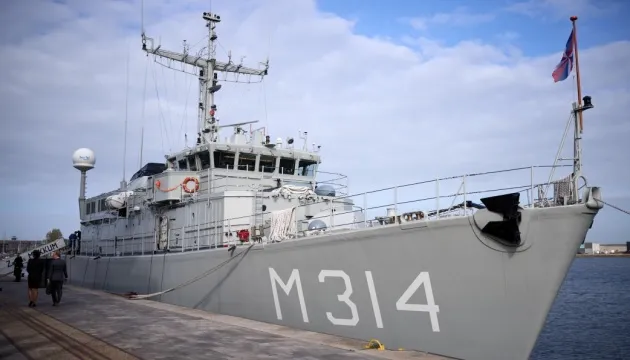
Ukraine's Naval Forces received a sixth mine countermeasures vessel from the Netherlands on 15 June, the Alkmaar-class minehunter formerly known as Zr.Ms. Makkum, renamed Henichesk and transferred under the Maritime Capabilities Coalition, Navy commander Vice Admiral Oleksii Neizhpapa announced on Facebook.

All five mine countermeasures vessels now in Ukrainian service were transferred under the Maritime Capabilities Coalition, an international grouping of more than 20 states established in December 2023 at the initiative of the United Kingdom and Norway to rebuild and modernize Ukraine's naval forces for Black Sea security.

A fleet rebuilt from allied transfers

The vessel is named after the raid minesweeper of the same name that was lost while performing a combat mission in 2022, Neizhpapa stated. At the official handover ceremony, Neizhpapa raised the Ukrainian Navy flag on the new ship in the presence of the commanders of the Royal Netherlands Navy, the Royal Belgian Navy, and the navies of Romania, Lithuania, and Latvia.

Henichesk joins four previously transferred vessels: Cherkasy and Chernihiv, both Sandown-class ships from the United Kingdom, and Melitopol and Mariupol, both Alkmaar-class ships from Belgium and the Netherlands. All five vessels will be temporarily based in the United Kingdom until the end of the war.

Vessel design and mine-clearance systems

The primary mission of Alkmaar-class minesweepers is to detect and neutralize naval mines, as well as to protect naval formations in mine-threatened areas. The hulls are built from non-magnetic materials, including polyester-based fiberglass, reducing vulnerability to magnetic mines. The superstructures are made of lightweight alloys. The ships are equipped with a hull-mounted sonar system for detecting underwater objects, as well as remotely operated underwater vehicles for identifying and neutralizing threats.

The primary mine-disposal tool is the SeaFox underwater drone, which identifies and destroys mines using a controlled explosive charge. In complex cases, divers can be deployed for specialized operations.

Black Sea demining and future exercises

Neizhpapa stated that Henichesk will strengthen Ukraine's capabilities in mine countermeasures—searching for, detecting, and neutralizing naval mines. The new ship is expected to participate in the Sea Breeze exercises in 2027. After the war ends, the vessels are planned for large-scale demining operations and for restoring safe navigation in the Black Sea and the Sea of Azov.

❌