Login
Login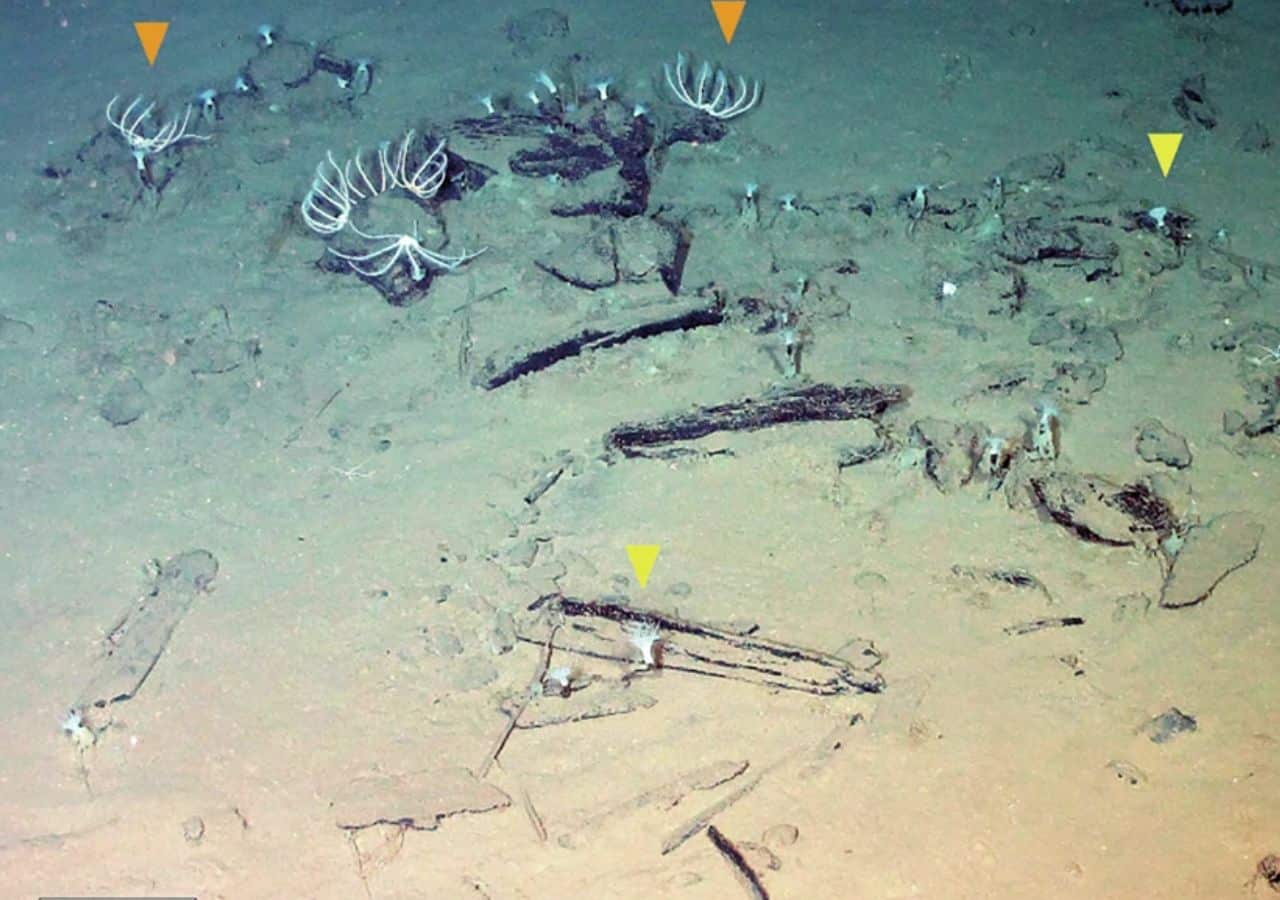

Ancient Whale Necropolis Found 23,000 Feet Beneath the Indian Ocean

Scientists have discovered a massive whale necropolis deep beneath the Indian Ocean, at depths reaching nearly 7,000 meters (22,966 feet), stretching almost 1,200 kilometers (746 miles) along the seafloor and containing hundreds of fossils dating back more than five million years.
The findings, published in Nature, offer a rare look at one of the ocean’s most extreme and least understood environments.
The site sits in the Diamantina Zone, a rugged underwater fracture zone in the southeastern Indian Ocean, at depths between 4,616 and 7,001 meters (15,144 and 22,969 feet).
Lead author Xiaotong Peng of the Institute of Deep-sea Science and Engineering at the Chinese Academy of Sciences in Sanya, China, and a team of researchers made 32 deep-sea dives using the submersible “Fendouzhe” from February to March 2023.
Whale necropolis beneath the Indian Ocean pushes known depth limits
Researchers found 476 fossilized whale remains and five active whale-fall communities, the ecosystems that form around carcasses sinking to the ocean floor.
The deepest of these communities was found at 6,789 meters (22,274 feet), extending the known depth range of whale-fall habitats by more than 2,500 meters (8,202 feet).
In some areas of the zone, whale remains reached densities of up to 759 individuals per square kilometer (1,966 per square mile).
All five active whale-fall communities are in what scientists call the “sulfophilic stage,” a prolonged phase where bacteria break down bone fats and release sulfide compounds that sustain surrounding life.
The team identified 35 animal species at these sites, including bone-eating worms, brittle stars, and chemosynthetic bivalves, creatures that draw energy from chemicals rather than sunlight. Molecular analysis showed that most of these species may be entirely new to science.
Researchers examined 43 fossil specimens and identified five ‘beaked whale’ species and one ‘baleen whale’ species. Two of the ‘beaked whale’ species still inhabit those waters today, while others have been extinct for millions of years.
One fossil belongs to a previously unknown species, named “Pterocetus diamantinae” after the Diamantina Zone.
Bones preserved for millions of years on the seafloor
Using strontium isotope dating, researchers found that whales have been sinking to this seafloor for at least 5.3 million years.
This whale necropolis survives largely because of the region’s very low sedimentation rate, which means bones are not buried quickly and can remain exposed for hundreds of thousands of years. Iron and manganese minerals gradually coat the bones, protecting them from further decay.
Peng and colleagues noted that the Diamantina Zone’s deep V-shaped underwater valleys likely funnel sinking carcasses into concentrated areas at the bottom. Beaked whales, which dive deeper than nearly any other mammal and can stay submerged for over an hour, likely died from the physical strain of extreme foraging dives.
The discovery also provides new insight into beaked whales, whose behavior and population sizes remain poorly understood because they are rarely seen and are known mostly from occasional strandings.
Researchers further suggest that this stretch of whale falls may act as a biological corridor, connecting deep-sea ecosystems across the southern Indian Ocean.