O Movimento dos Trabalhadores Rurais Sem Terra (MST) mobilizou, nos últimos dias, cerca de 10 mil pessoas, em 15 estados brasileiros, onde realizou uma série de atividades de defesa do meio ambiente, com críticas ao agronegócio.
Segundo a organização, os sem-terra plantaram mais de 5 mil mudas e semearam cerca de 30 toneladas de sementes em Alagoas, Bahia, Goiás, Maranhão, Mato Grosso, Mato Grosso do Sul, Minas Gerais, Paraíba, Paraná, Piauí, Rio de Janeiro, Rio Grande do Sul, Rondônia, São Paulo e Sergipe.
A iniciativa faz parte da Jornada Nacional em Defesa da Natureza e seus Povos, que começou na última segunda-feira (1°) e termina neste domingo (7), marcando a Semana Mundial do Meio Ambiente.
Este ano, a jornada teve como lema o mote “combater o agronegócio é cuidar da natureza!” e serve como plataforma para o MST defender a reforma agrária “como solução para o avanço dos cuidados com o meio ambiente”.
Ao mesmo tempo, a organização denuncia o que classifica como “crimes ambientais do agro-hidro-minero-negócio” e os “que exploram os bens comuns da natureza em larga escala”, em um momento em que, na avaliação do movimento, “o agronegócio aprova leis que aumentam a destruição ambiental”.
Incinerador
Neste sábado (6), em São Paulo, o MST promoveu um ato contra a instalação de um incinerador no bairro de Perus, na zona noroeste da capital paulista. Além dos sem-terra, a manifestação reuniu moradores da região, ambientalistas e integrantes de outras organizações sociais.
O incinerador integra o chamado EcoParque Bandeirantes, que a prefeitura de São Paulo pretende instalar no antigo Aterro Sanitário Bandeirantes, em parceria com uma empresa privada.
O aterro funcionou por 28 anos e teve suas operações encerradas em 2007. Desde então, consta da lista de Áreas Contaminadas em Processo de Remediação (ACRe), da Companhia Ambiental do Estado de São Paulo (Cetesb).
Além do incinerador, o projeto do EcoParque prevê um biodigestor, uma unidade de compostagem, outra de biossecagem, e uma central mecanizada de triagem de resíduos. E, segundo a prefeitura, visa a “otimização da reciclagem dos resíduos sólidos urbanos, a agregação de valor aos diversos subprodutos gerados, a geração de energia com baixa emissão de GEE e a redução dos volumes destinados à disposição final em aterros.
No entanto, de acordo com o MST, o projeto contraria os interesses de diferentes segmentos sociais que coabitam o bairro de Perus e região, incluindo indígenas que vivem no Pico do Jaraguá, próximo ao antigo aterro sanitário.
“O projeto de instalação do Incinerador em Perus mostra qual é o projeto da burguesia e do agronegócio para o Brasil: para a periferia, para o povo pobre, para os camponeses, para a classe trabalhadora é sempre a poluição, os detritos. Para deixar bonita a área da burguesia, empurram para nós os detritos”, criticou, em nota, Luciano Carvalho, da direção estadual do movimento.
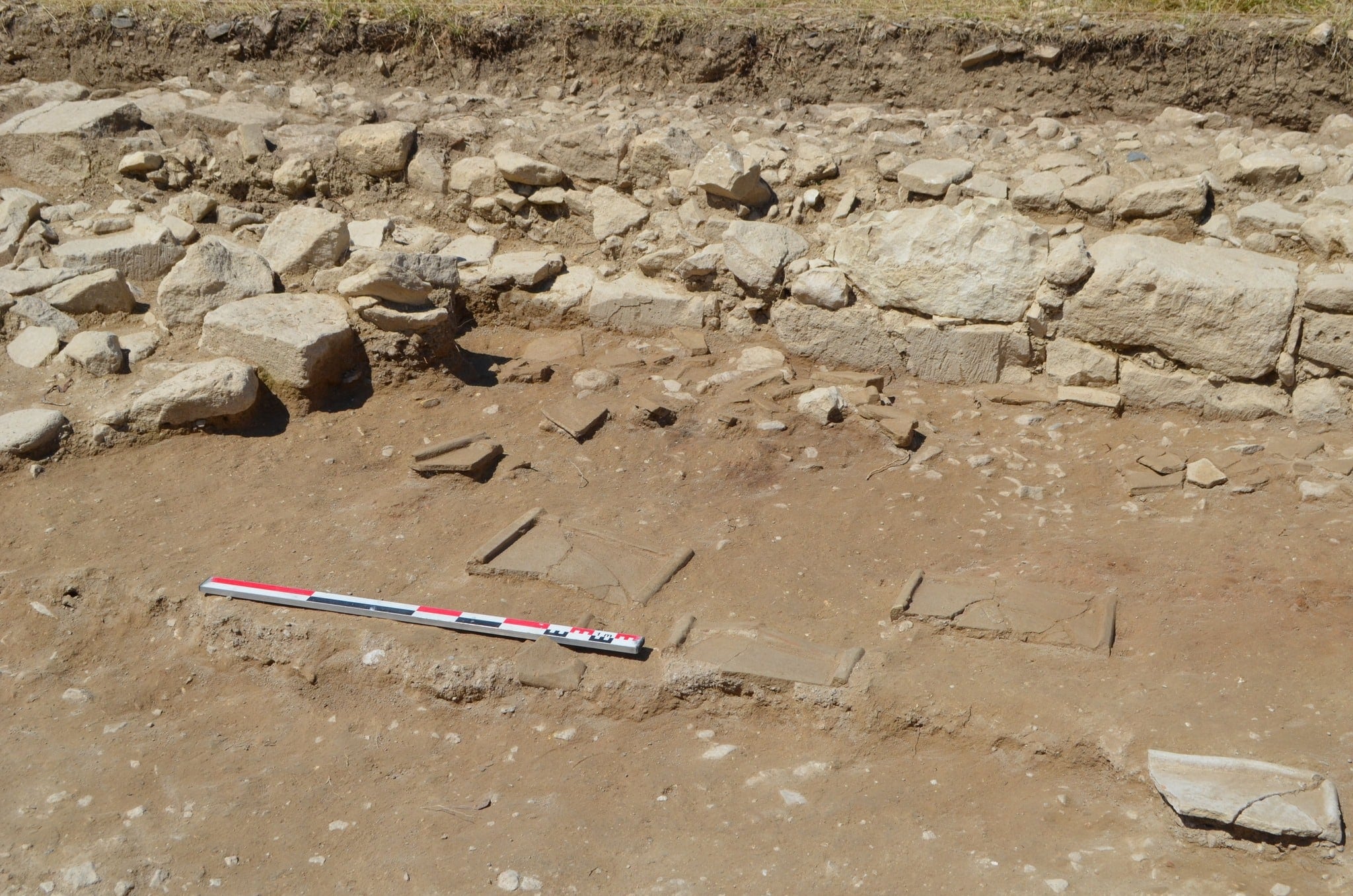
Collapse layer east of the Late Roman wall. Credit: Department of Antiquities, Cyprus
Archaeologists in Cyprus have uncovered a massive Late Roman wall at the ancient city of Amathous that may have formed part of a defensive system protecting the summit of the acropolis.
The structure, discovered on the site’s Western Terrace, offers new evidence of efforts to fortify one of the island’s most important ancient urban centers during the Late Roman period.
Details of the defensive wall
The wall reaches up to 2 meters (6.6 feet) in thickness and was built using large limestone ashlar blocks, smaller stones, and clay mortar. Excavation evidence shows that it underwent at least two construction phases, suggesting it remained an important feature of the acropolis over time.
Researchers also uncovered a floor surface associated with the wall, fallen architectural blocks, roof tiles, and mudbrick fragments from a collapsed structure. Together, the finds provide new insight into construction methods and defensive planning at Amathous during the final centuries of Roman rule.
The discoveries were made during the second excavation season of the French Archaeological Mission of Amathous, held from March 30 to April 24, 2026. The project is directed by Dr. Anna Cannavo and focuses on the Western Terrace of the Acropolis.
Expanded excavations reveal a substantial wall
The wall was first identified during excavations in 2025 following a geophysical survey conducted in 2024. During the 2026 season, archaeologists expanded Trench 1 and uncovered a much larger section of the structure.
The wall runs parallel to the natural edge of the terrace, with its southern section turning slightly toward the west. Its eastern face was constructed from large limestone ashlar blocks, while the interior was packed with smaller rough stones bonded with clay.
Researchers identified evidence for at least two building phases. The original wall measured about 135 centimeters (4.4 feet) in thickness. It was later strengthened by adding a second row of limestone blocks and filling the space between the two walls with stone rubble.
Foundations and associated floor date to the Late Roman period
A small trench excavated along the eastern side of the wall exposed its foundations and revealed a floor directly connected to the structure. Part of the floor was paved with reused roof tiles laid over a gravel bedding.
Excavation evidence indicates that both the wall and the floor date to the Late Roman period. East of the structure, archaeologists uncovered destruction deposits containing fallen ashlar blocks, roof tiles, and mudbrick fragments from the building’s upper portions.
Findings highlight the strategic importance of the Acropolis
Iron Age terracotta figurines and pottery. Credit: Department of Antiquities, Cyprus
A second excavation area, known as Trench 3, was opened at the northern end of the terrace. Although no architectural remains were found there, archaeologists recovered a rich collection of Iron Age artifacts, indicating earlier activity in the area.
Researchers believe the newly discovered wall formed part of a defensive system protecting the summit of the acropolis and the basilica that had replaced the sanctuary of Aphrodite, one of the most important religious centers in ancient Cyprus.
Future excavations will investigate the full extent of the fortification and determine whether the Late Roman remains were built over earlier structures, helping researchers better understand the long-term development of Amathous.
O goiano Guto Miguel, de 17 anos, venceu o americano Michael Antonius por 2 sets a 0 (6/3 e 6/4) na manhã deste sábado (6) e conquistou o título do juvenil em Roland Garros.
Esse é o primeiro título do Brasil na chave simples masculina da categoria. Edison Mandarino (1959), Thomaz Koch (1962 e 1963) e Luís Felipe Tavares (1967) tinham as melhores campanhas do país na competição, todos com vice-campeonatos. Gustavo Kuerten, o Guga, foi campeão em 1994, mas na chave de duplas.
Liderança do ranking mundial juvenil
A campanha histórica em Paris também rende a Guto a liderança do ranking mundial juvenil. Com a classificação para a final e a derrota do norte-americano Keaton Hance nas semifinais, o brasileiro garantiu matematicamente o posto de número 1 do mundo.
Com pelo menos 700 pontos somados em Roland Garros, Guto alcançará 2.927 pontos no ranking da ITF, superando seus principais concorrentes. O atual líder, o búlgaro Ivan Ivanov, não disputou o torneio e perderá pontos referentes à campanha do ano passado.
Guto passa a integrar uma lista extremamente restrita de brasileiros que chegaram ao topo do ranking juvenil mundial, ao lado de Tiago Fernandes (2010), Orlando Luz (2015) e João Fonseca (2023).
Como foi o jogo
Guto e Antonius fizeram um início de primeiro set muito forte, com ambos confirmando seus saques com facilidade. No entanto, no terceiro saque de Antonius, Miguel conseguiu dois slices sem resposta e conseguiu a quebra.
No nono game do primeiro set, Guto Miguel vencia por 5 a 3 e Antonius sacava para se manter vivo no jogo. O americano salvou quatro set points, mas na quinta chance que teve Guto não perdoou e venceu o primeiro set por 6 a 3.
O tenista brasileiro começou sacando no primeiro game do segundo set e teve que salvar um break point logo no início. Guto imprimiu seu ritmo e conseguiu uma nova quebra em Antonius e teve a possibilidade de sacar para confirmar a vitória, mas foi quebrado.
O set ficou 5 a 4 para o brasileiro, com Antonius no saque. O americano cometeu uma dupla falta, um erro não forçado e deixou Guto com a chance de título. Antonius evitou a primeira chance de título brasileiro, mas na segunda vantagem para Guto acabou jogando a bola na rede. 6 a 4 para o brasileiro.
A partida teve 1h15 de duração, e Guto teve muitos lances de destaque. O único erro foi ser quebrado quando teve a oportunidade de sacar para o título, mas a resposta foi muito rápida e ele conquistou o título inédito. (UOL/FOLHAPRESS)
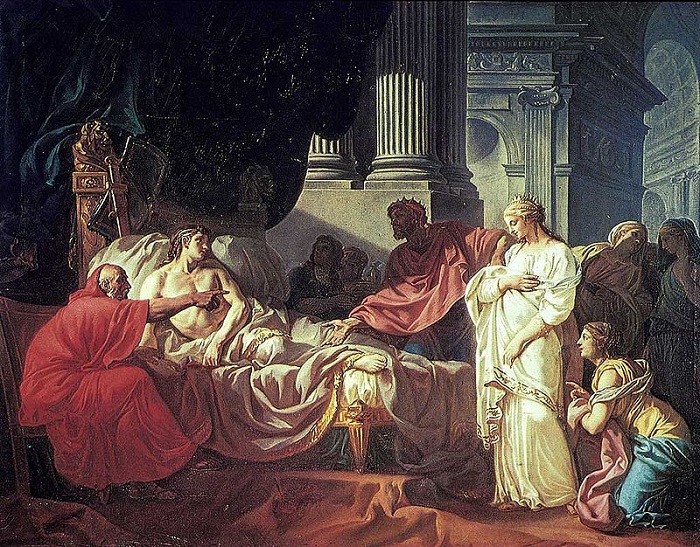
Erasistratus discovers the cause of the illness of Antiochus. Painting by Jacques-Louis David. Public Domain
Ancient Greek scientist Erasistratus (300-250 B.C.) is credited with being among the first human lie detectors. He devised a specific technique to read a person’s physical response so as to spot when an individual was lying.
While in Alexandria, Egypt, he is said to have proven Prince Antiochus was desperately in love with his father’s new wife, Stratonice. He noted how his pulse increased significantly whenever the queen’s name was mentioned, despite his insistence that he did not have the hots for his stepmother.
Love-struck, he fell ill with passion and chose to pine away in silence. The physicians were unable to discover the cause and nature of his disease.
Erasistratus himself was at a loss at first, until, finding nothing amiss about his body, he began to suspect that it must be the man’s mind that was diseased and that he might perhaps be in love.
Erasistratus confirmed his conjecture when he observed that the skin of Antiochus grew hotter, his color deeper, and his pulse quicker whenever Stratonice came near him, while none of these symptoms occurred on any other occasion.
The Greek physician eventually told the father, King Seleucus, that his son’s disease was incurable, for he was in love with the monarch’s wife and that he chose to die rather than to disclose his secret.
According to the anecdote, Seleucus not only gave up Stratonice, but also resigned to his son several provinces of his empire.
Erasistratus founded school of anatomy in Alexandria
Erasistratus, along with fellow physician Herophilus, founded a school of anatomy in Alexandria where they carried out anatomical research.
He is credited for his description of the valves of the heart. He also concluded that the heart was not the center of sensations. Instead, he said, it functioned as a pump. He was among the first to distinguish between veins and arteries, believing that arteries were full of air and carried the “animal spirit” (pneuma).
Together with Herophilus, he is credited by historians as the potential founder of neuroscience due to his acknowledgment of nerves and their roles in motor control through the brain and skeletal muscles.
Furthermore, Erasistratus is seen as one of the first physicians/scientists to conduct recorded dissections and potential vivisections alongside Herophilus.
The two physicians were said by several Roman authors, notably, Augustine, Celsus, and Tertullian, to have performed controversial vivisections on criminals to study the anatomy and possible physiology of human organs while they were in Alexandria.
A digital representation of Ctesibius. Credit: Greek Reporter archive
Ever found yourself scratching your head, wondering if aside from legendary philosophers and epic poets there were also any “tech gurus” in ancient Greece? When the conversation turns to Greek scientific minds, one might think of figures like Archimedes and Euclid and rightly so. However, there’s a name that truly deserves a much brighter spotlight—that of Ctesibius.
Ctesibius was a true genius of Hellenistic Alexandria, who, quite literally, set the wheels (and yes, the water organ, or hydraulis!) in motion. Due to his brilliant mind, he laid down fundamental principles for technologies that, believe it or not, continue to shape our everyday world to this very day.
Ctesibius was one of ancient Greece’s greatest innovators
Born into the vibrant, intellectual epicenter of Alexandria during the Ptolemaic era, Ctesibius became a hands-on inventor, driven by an almost insatiable curiosity to truly understand and harness the raw power of the natural world.
Imagine at a time when entire civilizations relied on human muscle and simple machines, seeing someone create music from water or build a clock accurate for two thousand years. The sheer innovative audacity of Ctesibius was difficult to fathom.
Of course, at a time of wizards, this wasn’t a magic trick but the real, unadulterated brilliance of the mind of this Greek man. His groundbreaking contributions to pneumatics, the study of compressed air, and hydraulics, the science of liquids in motion, were utterly revolutionary for their time, making Ctesibius the “father of pneumatics.”
Just think about the fact that long before your car tires ever saw a pump or your pneumatic drill came to life, Ctesibius meticulously explored the very principles that made these tools possible. It’s a bit humbling, isn’t it, how many unsung heroes from antiquity have genuinely shaped the modern world we so often take for granted?
Reconstruction of the ancient hydraulis on display at the Kotsanas Museum in Athens. Credit: Aga39memnon, Wikimedia Commons, CC BY 4.0.
From melodic water organs to clocks
Among Ctesibius’ most well-known creations was the hydraulis, a genuinely revolutionary water organ. This was, quite simply, the world’s very first keyboard instrument. What an astonishing feat of engineering from over two millennia ago! It ingeniously utilized water pressure to guarantee a completely constant supply of air to its pipes, producing a sound that was remarkably stable and resonant. Imagine the awe of ancient audiences in hearing such a complex, melodic instrument for the absolute first time. It must have felt like nothing short of a miracle.
Beyond the enchanting music, Ctesibius’ improvements to the clepsydra, or water clock, were equally impressive. Prior to this tech guru, water clocks were notoriously imprecise. He revolutionized them through innovative mechanisms for regulating water flow and added an indicator system that provided unprecedented accuracy.
For over 1,800 years, his water clocks were the absolute gold standard in timekeeping. In other words, the pinpoint accuracy of your smartphone’s clock owes an indirect yet profoundly deep debt to a man who lived centuries before the mere concept of electricity was even a thing.
Ctesibius’ water clock, the first alarm clock ever, as depicted by an architect in the 17th century. Credit: Wikimedia Commons, Public domain
Ctesibius’ impact on our world
While Ctesibius himself may not have managed to become one of ancient Greece’s top names, his principles and inventions survived the test of time. They influenced later Roman and Arab engineers and eventually powered the European Renaissance. The very force pump he designed, for instance, is a direct progenitor of modern pumping systems, absolutely essential for everything from our city water supplies to the fire engines we rely on to keep us safe on a daily basis.
His profound understanding of the properties of air-laid processes set the foundation for all future pneumatic applications which today power everything from colossal industrial machinery to delicate medical devices. Hence, next time you hear the satisfying whoosh of a bus door, the gentle hiss of an automated machine, or simply admire the quiet precision of a modern watch, take a moment to think back to Ctesibius, the ancient Greek tech genius.
There is something about Greece that sets it apart from many other holiday destinations across the globe; its mythological sites.
Many ancient societies had different beliefs and myths, but none are more prominent in modern-day life than that of the Greeks. Their creatures have become legends, their tales inspiration for great fiction and their gods immortalized through the continued retelling of their conquests and trials.
Delos: an ancient mythological site in Greece
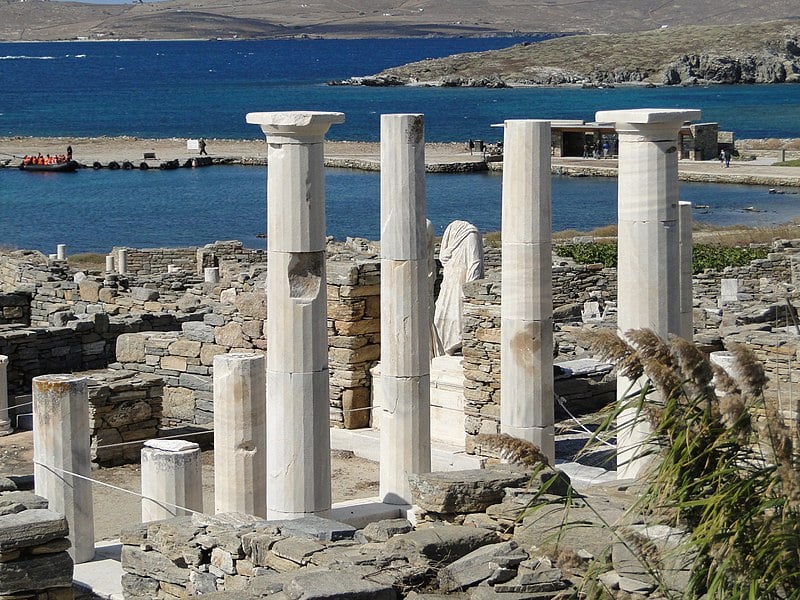
Matched only by the Acropolis of Athens, Greek mythological site the ruins on the island of Delos are an unmissable location for anybody interested in ancient Greek culture. One of the best-preserved examples of an ancient Greek civilization, the island is completely unblemished by modern architecture and as such, allows its visitors to delve deep into history.
However, it is not just a site of great historical importance, but a mythological one too. It was on this island that both gods Artemis and Apollo are said to have been born. As a result, the island became a sacred place. Sanctuaries and temples sprung up across its hillsides as people from across Greece came to the island’s shores to worship the deities.
Throne room of the Minoan Palace in Knossos, Crete Credit: Annatsach – Wikimedia Commons / CC BY-SA 4.0
The Labyrinth, a famous site in Greek mythology
One of the most famous and exciting stories of Greek mythology is the tale of Minos, Theseus and the Minotaur. Minos was a powerful king, ruler of Crete and the son of Zeus, but after he betrayed Poseidon, he was cursed to raise a son with the body of a man and the head of a bull. Using this curse to his advantage, however, Minos built the fabled Labyrinth and trapped the Minotaur within it. He would then send victims to their deaths until Theseus, prince of Athens, ventured into the Labyrinth and slayed the beast.
While there are no Minotaur bones for you to see, there are two possible Labyrinths to explore. First is the likely home of King Minos, and therefore the most plausible home for the labyrinth, Kommos. Located along the southern coast of the island, Kommos is a great place to visit, with spectacular ancient ruins and beautiful ocean views.
However, if you venture deep enough into the ruins of this ancient city, you will find many maze-like corridors and walkways that may have been the Minotaur’s home; or at least the inspiration for its tale. However, just down the road you will also find Gortyn, a site of great archaeological importance to Crete and another suspected home of the Labyrinth. Further away from Minos’ home, these ruins bear a much similar resemblance to the maze of mythology. Perhaps then, it is best to visit both Greek mythological sites and decide for yourself.
The Island of Ithaca: an ancient Greek site and holiday destination
An olive tree on Ithaca that is thought to be 1,500 years old. Credit: Wikimedia Commons
Ithaca, a well-known Greek mythological site for a holiday destination, is a place with a very interesting mythological past. Most notably, it was home to the legendary trickster Odysseus, the island’s greatest king and the brains behind the trojan horse.
Odysseus was also the protagonist of Homer’s “Odyssey.” His decade-long struggle to return home after the war is the source of many of the most enduring Greek myths.
The famous Cave of Zeus on the Greek island of Crete
Cave of Zeus in Crete, Greece Credit: Tomisti / Wikimedia Commons / CC BY-SA 4.0
Hidden away on the island of Crete is an extraordinary piece of Greek mythological history. Within a cave beneath Mount Ida, it is said that the King of Gods, Zeus, was born and raised.
The Cave of Zeus is a beautiful location, with one entrance leading into a network of caves filled with stunning rock formations and underground pools. It does indeed seem a fitting place for the beginnings of the greatest god Greek mythology has ever known. However, it was not by choice he was raised here but by necessity.
His father, the titan Cronus, was set on devouring all of his progeny to ensure that they could never contest his power. However, unbeknownst to Cronus, Zeus’ mother, Rhea, hid him within the cave so one day he could return to overthrow his tyrannical father; which, according to legend, he did.
Along the eastern coast of the Greek mainland, you will find one of the most well-known natural landmarks in the world; Mount Olympus. This legendary and iconic Greek mythological site is an awe-inspiring sight, however, there is more to it than meets the eye.
In Greek mythology, Olympus was created after the gods defeated the titans in the battle of Titanomachy; otherwise known as the War of the Titans. Atop its peak they then built the Pantheon, where Zeus sat upon his throne as King of Gods and the rest of the deities would convene to discuss matters of the world below and survey the world of men.
Seeing all these incredible mythological sites can be tricky, unless you charter a course aboard Deep Blue Yachting’s luxury sailing boat, the Glaros. It is a private vessel, you can set your own course and visit every site on this list, all in one trip.
Stoicism was one of ancient Greece’s philosophical movements founded by Zeno of Citium in Athens in the early 3rd century BC. Credit: Public domain
Stoicism, was one of ancient Greece’s philosophical movements founded by Zeno of Citium in Athens in the early 3rd century BC.
Stoicism is a philosophy of personal ethics informed by its system of logic and its views on the natural world. For the Stoic, virtue alone is sufficient for human happiness.
For Stoics, emotions like fear, envy, passionate love were merely false judgements and the sage, a person who had attained moral and intellectual perfection, would not be touched by them.
It is a philosophy of life where the individual maximizes positive emotions, reduces negative emotions, and helps him or herself hone their virtues of character.
The name derives from the porch (stoa poikile) in the Agora at Athens decorated with mural paintings, where the members of the school congregated, and their lectures were held.
Birth of Stoicism, one of ancient Greece’s philosophical movements
The philosophy of Stoicism was originally known as “Zenonism” after the founder, Zeno of Citium.
Zeno ended up in Athens after his ship wrecked near the city. He was not a philosopher, but he turned his misfortune into an opportunity by studying all the philosophical resources available in the city.
He sat in on lectures from the other schools of philosophy (e.g., Cynicism, Epicureanism) and eventually started his own.
However, the Stoics did not believe that the founders were perfectly wise. In order to avoid their philosophy becoming a cult of personality, they chose to name it Stoicism after the place they were meeting, the stoa poikile of the Agora.
Zeno’s ideas developed from those of the Cynics, whose founding father, Antisthenes, had been a disciple of Socrates. Zeno’s most influential follower was Chrysippus, who was responsible for molding what is now called Stoicism.
Other prominent Stoics included Cleanthes of Assos, Panaetius of Rhodes, Aristo of Chios, Posidonius of Apameia, Diodotus, and others.
Later, Seneca, Epictetus, and Roman emperor Marcus Aurelius ushered Stoicism to the Roman world. The philosophy flourished until the 3rd century AD.
A bust of ancient Greece’s philosopher Zeno of Citium, the creator of stoicism. Credit: Rama/Wikimedia Commons/ Gallo-Roman Museum of Lyon
Stoic Philosophy
According to Stoicism, the path to eudaimonia (happiness) is embracing and accepting the moment as it presents itself by not allowing oneself to be controlled by the desire for pleasure or by the fear of pain.
The Stoic must use his or her mind to understand the world and to do one’s part in nature’s plan by working together and treating others fairly and justly.
The Stoics are especially known for the teaching “virtue is the only good” and that people must lead a virtuous life to be accomplished and complete human beings.
External things—such as health, wealth, and pleasure—are not good or bad in and of themselves but have value as “material for virtue to act upon.”
The Stoics also held that certain destructive emotions, such as fear or jealousy, resulted from errors of judgment, and they believed people should aim to maintain a prohairesis (will) that is “in accordance with nature.”
To live a good life, a person had to understand the rules of the natural order, Stoics believed, since everything was rooted in nature.
For many Stoics, virtue is sufficient for happiness. Thus, a sage would be emotionally resilient to misfortune and would therefore be considered truly free.
According to Stoics, people don’t truly have control over many things and situations in life. Therefore, they believe that worrying about things outside of their control is unproductive, or even irrational for a person who wants to attain tranquility and happiness.
Stoics differentiate between what is and what is not under human control and do not waste energy and thoughts over uncontrollable adverse events.
Where many people worry endlessly about things out of their control, the Stoics believe they should expend their energy in thinking of creative solutions to problems, rather than the issues themselves.
Stoicism is not about having a set of beliefs or ethical claims. It is not a school of philosophy that is separate from everyday life.
The stoic must continuously practice and train (“askesis”). Stoic philosophical and spiritual practices include logic, Socratic dialogue and self-dialogue.
Roman emperor and philosopher Marcus Aurelius. Credit: Eric Gaba/Wikipedia
The Greek term for word is logos. The Greek philosopher Heraclitus used logos (the word) to explain what he saw as the universal force of reason that governed everything.
In the 5th century BC, Heraclitus said that all things happen according to the Logos. The Stoics also believed in the Logos, along with the notions of conscience and virtue.
A few centuries later, Greek-speaking Jews came to view the Logos as a force sent by God. In the Gospel of John, Jesus is referred to as the Word — “and the Word of God was made flesh and dwelt among men.”
The apostle Paul is known to have met with Stoics during his stay in Athens. In his letters, Paul reflected on his knowledge of Stoic philosophy, using Stoic terms and metaphors to assist new converts in their understanding of Christianity.
Both Stoicism and Christianity teach a person the importance of training their mind and body to be disciplined.
Both encourage the elimination of passions and inferior emotions, such as lust and envy, from one’s life, so that the higher possibilities of one’s humanity can be awakened and developed.
“If you want to be perfect, go, sell your possessions and give to the poor, and you will have treasure in heaven,” Jesus preached.
Similarly, as Seneca wrote, “We must give up many things to which we are addicted, considering them to be good.”
The Eastern Orthodox Church and Oriental Orthodox Church accept the Stoic ideal of dispassion to this day, as do ascetics all over the world.
Stoicism today
Daily Stoic, How to be a Stoic, The Modern Times Stoic, Modern Stoicism, Traditional Stoicism: these are only a handful of the websites that hail the importance of—even the need for—Stoicism in the 21st century.
Is it possible, though, for today’s man to embrace a philosophy that teaches indifference to material things and possessions in a ruthlessly material world?
An intellectual and popular movement called Modern Stoicism began at the end of the 20th century which is aimed at reviving the practice of Stoicism.
However, before that, Stoic philosophy served as the original philosophical inspiration for modern cognitive psychotherapy, particularly as mediated by Dr. Albert Ellis’ Rational-Emotive Behavior Therapy (REBT), the major precursor of Cognitive Behavioral Therapy (CBT).
In the original cognitive therapy treatment manual for depression by Aaron T. Beck et al., it is stated, “The philosophical origins of cognitive therapy can be traced back to the Stoic philosophers.”
A well-known quotation from the “Enchiridion” of Epictetus was taught to most clients during the initial session by Ellis and his followers: “It’s not the events that upset us, but our judgments about the events.”
This subsequently became a common element in the socialization phase of many other approaches to CBT.
Ryan Holiday’s The Obstacle is the Way; Stoicism—A Stoic Approach to Modern Life, by Tom Miles; Modern Stoicism, by Steve Brooks; and Modern Stoicism—How to Be a Stoic in the 21st Century, by Stephen Ryan are some of the books on Stoicism that have been published recently.
Famous Stoic quotes
“The happiness of your life depends upon the quality of your thoughts.”
“Luck is what happens when preparation meets opportunity.”
“You have power over your mind—not outside events. Realize this, and you will find strength.”
“It is not death that a man should fear, but he should fear never beginning to live.”
“Think of yourself as dead. You have lived your life. Now take what’s left and live it properly.”
“To live a good life; we all have the potential for it, if we learn to be indifferent to what makes no difference.”
“Death smiles at us all, but all a man can do is smile back.”
“Accept whatever comes to you woven in the pattern of your destiny, for what could more aptly fit your needs?”
“The object of life is not to be on the side of the majority, but to escape finding oneself in the ranks of the insane.”
“The best revenge is not to be like your enemy.”
“Very little is needed to make a happy life; it is all within yourself, in your way of thinking.”
“Loss is nothing else but change, and change is nature’s delight.”
“It is not because things are difficult that we don’t dare; it is because we do not dare that things are difficult.”
“A gem cannot be polished without friction, nor a man perfected without trials.”
“The bravest sight in the world is to see a man struggling against adversity.”
“Throw me to the wolves and I will return leading the pack.”
“Life is never incomplete if it is an honorable one. At whatever point you leave life, if you leave it in the right way, it is whole.”
“Man is affected not by events, but by the view he takes of them.”
“Sometimes even to live is an act of courage.”
“If you really want to escape the things that harass you, what you’re needing is not to be in a different place but to be a different person.”
“He suffers more than necessary, who suffers before it is necessary.”
“It is not the man who has too little, but the man who craves more, that is poor.”
“If a man knows not to which port he sails, no wind is favorable.”
“If you want to improve, be content to be foolish and stupid.”
“The world turns aside to let any man pass who knows where he is going.”
“Seek not the good in eternal things, seek it in yourselves.”
“It is the nature of the wise to resist pleasures, but the foolish to be a slave to them.”
“No man is free who is not a master of himself.”
“It is impossible to begin to learn that which one thinks one already knows.”
“Never depend on the admiration of others. There is no strength in it. Personal merit cannot be derived from an external source.”

 Login
Login