Normal view

Sherpa missing for a week on Everest found crawling toward base camp after his family begins funeral rites

4 June 2026 at 13:05

A Sherpa guide whose family had already begun funeral rituals after he vanished on Mount Everest was found alive and crawling toward base camp nearly a week later, surviving alone on the world's highest peak without food, water or supplemental oxygen in what rescuers called "nothing short of a miracle."

Dawa Sherpa, 52, disappeared around May 29 while descending Everest after turning back short of the summit with a Polish climber he was guiding. The client made it safely to base camp, but Dawa had not, triggering fears that he had died on the mountain.

A cleanup crew from the Sagarmatha Pollution Control Committee found him Thursday morning crawling through the treacherous Khumbu Icefall, one of the most dangerous sections of Everest, just above base camp, Pemba Sherpa of 8K Expeditions told The Associated Press.

Rescuers carried him to safety, gave him food and water, and flew him by helicopter to a hospital in Kathmandu, where his wife and daughter were waiting.

LONE SURVIVOR RESCUED AFTER FATAL FALL KILLS THREE CLIMBERS ON MOUNT MCKINLEY

By that point, his family had already lost hope.

His teenage daughter, Mendo Lhamu Sherpa, told the outlet that relatives were in the middle of funeral rites when news of the rescue broke.

"When we first heard about it (the rescue), we could not be sure if that person was indeed our father," she said. "So to be certain we asked for photos to be sent and then only we were sure and very happy."

His wife, Damu Sherpa, added that the family learned he was alive through local news reports and phone calls from friends.

"We first heard that he was still alive on the local news and from a person we know who called with the news that ... he is being brought down," she said.

RESCUERS FREE CLIMBER TRAPPED BENEATH 16,000-POUND BOULDER ON OREGON'S MOUNT HOOD IN COMPLEX OPERATION

Dawa was still wearing his climbing jacket when rescuers found him. His family said he is being treated for frostbite and other complications but is conscious and able to speak.

"He recognized me … is good and speaks," his daughter told Reuters. "We are happy."

The Nepal Mount Everest hiking company called his survival extraordinary.

"Dawa survived alone for nearly a week without food, water, or supplemental oxygen navigating the treacherous Khumbu Icefall (even after the fixed ladders were removed for the season)," the company said in a social media post. "This is nothing short of a miracle."

It was unclear how Dawa became separated from his client during the descent or why there was a delay in launching a search team when he went missing last week. Helicopters were eventually dispatched but failed to locate him.

His rescue came at the end of a record-breaking Everest climbing season. More than 1,000 climbers and guides reached the summit this year after Nepal issued a record 494 permits.

CLICK HERE TO DOWNLOAD THE FOX NEWS APP

Officials have said five climbers and guides died on Everest during the season, according to Reuters.

The Associated Press and Reuters contributed to this report.

New “Mega-Metro” Will Connect Athens to Nearly 40 Cities

6 June 2026 at 11:42
trains in Europe
Under these plans, the Sofia-to-Athens route would be completed in six hours, compared to the current 13.5 hours. Credit: 21st Europe

A highly ambitious transportation proposal aims to connect Athens with approximately 40 other destinations in Europe through a high-speed “mega-metro” rail network by 2040. Dubbed “Starline,” the blueprint of this plan hopes to replace Europe’s fragmented national railways with a unified 22,000-kilometer (14,000-mile) system, significantly reducing travel times for Greek and European passengers overall, offering a green alternative to short-haul flights.

Developed by the Copenhagen-based think tank 21st Europe, the Starline project proposes five major railway corridors spanning 22 nations across Europe. The proposed routes include Line A from Naples to Helsinki, Line B from Lisbon to Kyiv via Madrid, Line C connecting Madrid to Istanbul, Line D from Dublin to Kyiv, and Line E linking Milan to Oslo. Operating like a city metro on a continental scale and obviously above ground, the network will link European cities under a single transit identity, with trains reaching speeds between 300 and 400 kilometers per hour.

Where do Athens and Greece come into the equation of this Europe-wide system?

For Greece, the infrastructure upgrade would drastically alter regional connectivity within the country and across southeastern Europe. Τhe European Commission recently announced targets to cut Sofia-to-Athens travel from 13 hours and 40 minutes to six hours, and Berlin-to-Copenhagen from seven hours to four.

The proposal complements these targets across the continent, where similar reductions will happen. A trip from Berlin to Copenhagen, from example, will drop from seven hours to four, while historically overnight routes like Kyiv to Berlin will become predictable, direct daytime connections.

Map
Credit: 21st Europe

Transportation remains one of Europe’s largest climate challenges, generating roughly a quarter of all greenhouse gas emissions. While aviation accounts for a smaller percentage globally, short-haul flights remain the default for millions of European travelers. High-speed rail produces up to 90 percent less carbon dioxide per journey. 21st Europe states that a large-scale shift to rail represents the best path toward meeting the European Union’s 2050 net-zero emissions targets while maintaining fast mobility.

The proposal moves away from traditional railway conventions as the dark blue trains will abandon standard first- and second-class divisions, replacing them with purpose-built spaces such as quiet workspaces, family-oriented sections, ergonomic seating, and communal coffee areas. This layout aims to democratize long-distance travel and prioritize passenger comfort.

Top Mythological Sites in Greece

By: guest
6 June 2026 at 11:01
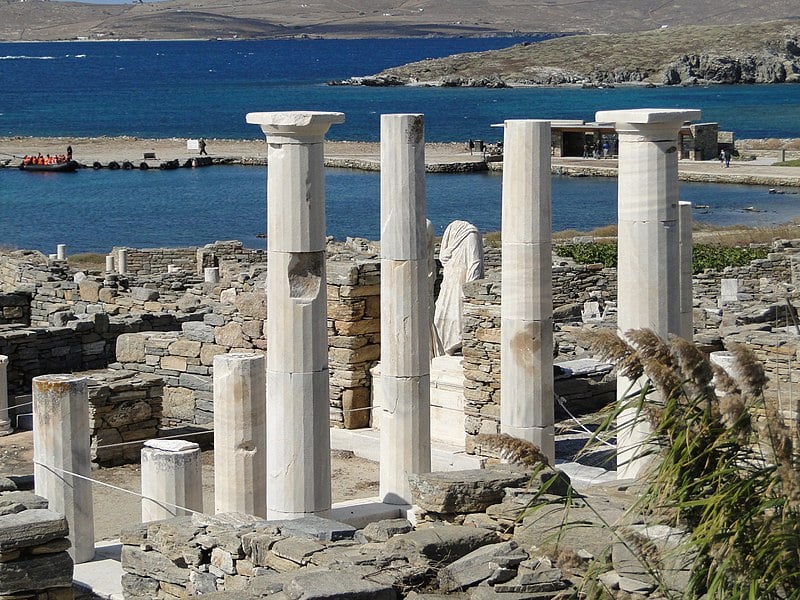
House of Cleopatra, Greece
Mythological sites in Greece. Credit: Bernard Gagnon / Wikimedia Commons/CC BY-SA 3.0

There is something about Greece that sets it apart from many other holiday destinations across the globe; its mythological sites.

Many ancient societies had different beliefs and myths, but none are more prominent in modern-day life than that of the Greeks. Their creatures have become legends, their tales inspiration for great fiction and their gods immortalized through the continued retelling of their conquests and trials.

Delos: an ancient mythological site in Greece

Matched only by the Acropolis of Athens, Greek mythological site the ruins on the island of Delos are an unmissable location for anybody interested in ancient Greek culture. One of the best-preserved examples of an ancient Greek civilization, the island is completely unblemished by modern architecture and as such, allows its visitors to delve deep into history.

However, it is not just a site of great historical importance, but a mythological one too. It was on this island that both gods Artemis and Apollo are said to have been born. As a result, the island became a sacred place. Sanctuaries and temples sprung up across its hillsides as people from across Greece came to the island’s shores to worship the deities.

Greek Mythological sites
Throne room of the Minoan Palace in Knossos, Crete Credit: Annatsach – Wikimedia Commons / CC BY-SA 4.0

The Labyrinth, a famous site in Greek mythology

One of the most famous and exciting stories of Greek mythology is the tale of Minos, Theseus and the Minotaur. Minos was a powerful king, ruler of Crete and the son of Zeus, but after he betrayed Poseidon, he was cursed to raise a son with the body of a man and the head of a bull. Using this curse to his advantage, however, Minos built the fabled Labyrinth and trapped the Minotaur within it. He would then send victims to their deaths until Theseus, prince of Athens, ventured into the Labyrinth and slayed the beast.

While there are no Minotaur bones for you to see, there are two possible Labyrinths to explore. First is the likely home of King Minos, and therefore the most plausible home for the labyrinth, Kommos. Located along the southern coast of the island, Kommos is a great place to visit, with spectacular ancient ruins and beautiful ocean views.

However, if you venture deep enough into the ruins of this ancient city, you will find many maze-like corridors and walkways that may have been the Minotaur’s home; or at least the inspiration for its tale. However, just down the road you will also find Gortyn, a site of great archaeological importance to Crete and another suspected home of the Labyrinth. Further away from Minos’ home, these ruins bear a much similar resemblance to the maze of mythology. Perhaps then, it is best to visit both Greek mythological sites and decide for yourself.

The Island of Ithaca: an ancient Greek site and holiday destination

olive
An olive tree on Ithaca that is thought to be 1,500 years old. Credit: Wikimedia Commons

Ithaca, a well-known Greek mythological site for a holiday destination, is a place with a very interesting mythological past. Most notably, it was home to the legendary trickster Odysseus, the island’s greatest king and the brains behind the trojan horse.

Odysseus was also the protagonist of Homer’s “Odyssey.” His decade-long struggle to return home after the war is the source of many of the most enduring Greek myths.

The famous Cave of Zeus on the Greek island of Crete

Greek Mythological sites
Cave of Zeus in Crete, Greece Credit: Tomisti / Wikimedia Commons / CC BY-SA 4.0

Hidden away on the island of Crete is an extraordinary piece of Greek mythological history. Within a cave beneath Mount Ida, it is said that the King of Gods, Zeus, was born and raised.

The Cave of Zeus is a beautiful location, with one entrance leading into a network of caves filled with stunning rock formations and underground pools. It does indeed seem a fitting place for the beginnings of the greatest god Greek mythology has ever known. However, it was not by choice he was raised here but by necessity.

His father, the titan Cronus, was set on devouring all of his progeny to ensure that they could never contest his power. However, unbeknownst to Cronus, Zeus’ mother, Rhea, hid him within the cave so one day he could return to overthrow his tyrannical father; which, according to legend, he did.

Mount Olympus: Home of the Greek gods

Greek Mythological sites
Mount Olympus. Credit: Maylett/ Wikimedia Commons / CC BY-SA 3.0

Along the eastern coast of the Greek mainland, you will find one of the most well-known natural landmarks in the world; Mount Olympus. This legendary and iconic Greek mythological site is an awe-inspiring sight, however, there is more to it than meets the eye.

In Greek mythology, Olympus was created after the gods defeated the titans in the battle of Titanomachy; otherwise known as the War of the Titans. Atop its peak they then built the Pantheon, where Zeus sat upon his throne as King of Gods and the rest of the deities would convene to discuss matters of the world below and survey the world of men.

Seeing all these incredible mythological sites can be tricky, unless you charter a course aboard Deep Blue Yachting’s luxury sailing boat, the Glaros. It is a private vessel, you can set your own course and visit every site on this list, all in one trip.

By Cliff Blaylock

❌