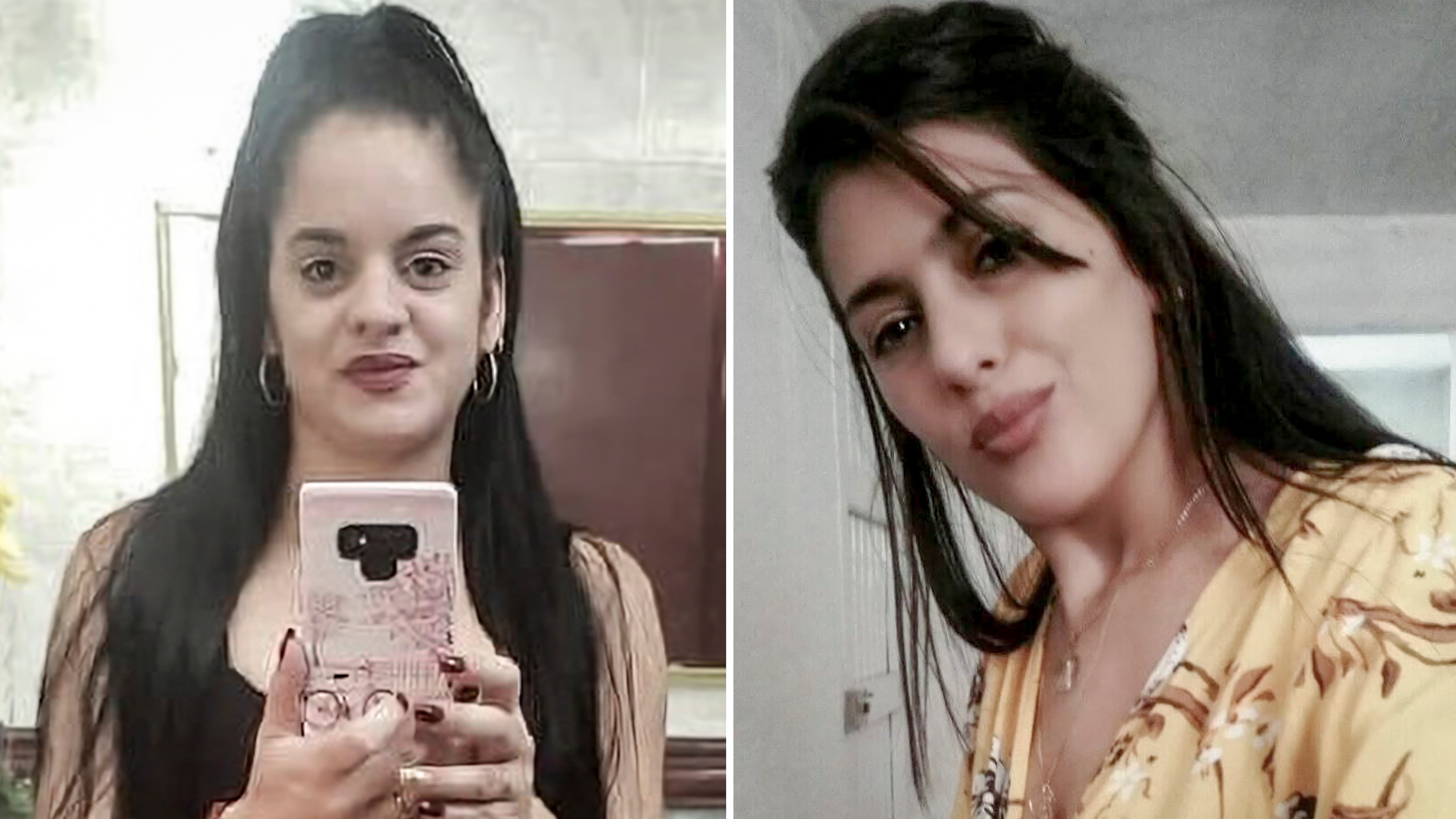
Vanesa Rodríguez Valdés, based in Las Vegas, and her best friend, Liuddibet Calzadilla, in Barcelona, Spain, talked almost daily about their lives and their families back in Cuba, where they were both from. They talked about how much Valdés missed her teenage daughter and the diminutive size of the bedsit in the United States. On Sunday, May 26, Calzadilla wrote to her to ask how she was. She also asked if her husband Roelmer Sánchez Garrido was at home. If he was not, it meant they could talk freely.
When a Cuban person on the island wants to refer to “those in charge,” they lightly tap their shoulder with two fingers. The subtle gesture, shaped by nearly seven decades of censorship, is a reference to the epaulet of a military uniform. In Cuba, people do not speak of the government or the party (the Communist Party of Cuba, the only legal one), but rather of the “country’s leadership.” It is a euphemism that points to the real political and economic power: the Revolutionary Armed Forces (FAR).
This story originally appeared in Common Dreams on May 20, 2026.It is shared here under a Creative Commons (CC BY-NC-ND 3.0) license.
As the US Justice Department indicted former Cuban President Raúl Castro on Wednesday in what could be a prelude to military action, the Cuban government denounced the US for “cruel and ruthless aggression.”
The 94-year-old Castro, who served as Cuba’s leader until 2021 after taking over for his brother Fidel in 2008, was indicted on one count of conspiracy to kill US nationals for his alleged role in the shooting down of planes operated by the anti-Castro Cuban exile group Brothers to the Rescue in 1996, which resulted in the deaths of four Cuban Americans.
“For nearly 30 years, the families of four murdered Americans have waited for justice,” acting Attorney General Todd Blanche said as he announced the charges at Miami’s Freedom Tower. “My message today is clear: The United States and President Trump does not and will not forget its citizens.”
While Blanche described the four men as “unarmed civilians,” the Cuban government said the group had repeatedly violated its sovereign airspace and that it had warned the US government before shooting down the plane.
Declassified documents from a month before the incident show that officials in the Federal Aviation Administration (FAA) viewed the Brothers’ activities as “taunting” and feared the Cuban government might shoot a plane down.
“Is a sovereign state like Cuba obligated to tolerate illegal and continuous incursions into its territory? Under no circumstances,” the Cuban embassy in the US said in a statement published on Wednesday on social media. “International law and global civil aviation conventions protect the sovereignty of nations over their airspace.”
“When formal warnings to the [International Civil Aviation Organization], the FAA, and political authorities are sustainedly ignored, the defense of borders and national security becomes an unavoidable duty for the protection of the country.”
✈️🇨🇺 MythBreakers: Exposing the Brothers to the Rescue hoax
Is a sovereign State like Cuba obligated to tolerate illegal and continuous incursions into its territory?
Under no circumstances. International law and global civil aviation conventions protect the sovereignty of… pic.twitter.com/p9UC0shT95
The indictment comes as the Trump administration issues threats that have been widely interpreted as signals that another military regime change operation could soon be on the horizon, following the administration’s attacks on Venezuela and Iran already this year.
“CUBA IS NEXT! Thank you [President Donald Trump] and [Secretary of State Marco Rubio]!” cheered US Rep. Carlos Giminez (R-Fla.), one of many Miami-based politicians who have called for aggressive action by the Trump administration against Cuba in recent days.
He was responding to a video posted by Rubio on Wednesday directed at the Cuban people in which he again denied that the crippling oil blockade imposed on Cuba by Trump bore any responsibility for the economic ruin the island’s population currently faces.
After effectively cutting off Cuba’s primary supplier of oil in January when the US conducted its illegal operation to abduct Venezuela’s president, Nicolás Maduro, Trump threatened to impose steep tariffs on any country that provided oil to Cuba, scaring off its other main suppliers, including Mexico, Russia, and Algeria. Last week, Cuba’s energy minister announced that the country had “absolutely no fuel oil, no diesel.”
But Rubio told the Cuban people in Spanish on Wednesday: “The reason you are forced to survive 22 hours a day without electricity is not due to an oil ‘blockade’ by the US. As you know better than anyone else, you have been suffering from blackouts for years. The real reason you don’t have electricity, fuel, or food is that those who control your country have plundered billions of dollars, but nothing has been used to help the people.”
He specifically laid the blame at the feet of the accused, the military-run company Grupo de Administración Empresarial S.A. (GAESA), founded by Raúl Castro in the 1990s following the collapse of the Soviet Union. The company has come to control large swathes of the Cuban economy, from hotels and grocery stores to gas stations and banks, and is estimated to control between 40-70% of Cuba’s overall economy, according to a recent New York Timesreport—though the secrecy of the organization makes it difficult to determine its true value.
Rubio said that the entrepreneurs running GAESA “have $18 billion in assets and control 70% of Cuba’s economy,” which was first reported by the Miami Herald last year based on balance sheets obtained from the company. But the Cuban government and othercritics have disputed this figure, arguing that it actually refers to Cuban pesos, which would make its holdings closer to about $746 million.
Regardless, Rubio omitted any mention of the fact that even prior to the oil blockade enacted in January by Trump, the US still had a strict trade embargo in place against Cuba for more than 60 years, which the United Nations Economic Commission for Latin America has estimated cost the country more than $130 billion since it was imposed—more than the total gross domestic product of the entire country in 2020.
Rubio said on Wednesday the US was ready to open a “new chapter” with Cuba, but that the thing getting in the way was “those who control their country.”
Rubio now full Orwellian: the total blockade that we have put on your country after decades of an embargo has nothing to do with the scarcity in your lives or the fact that we are intentionally starving your children. https://t.co/OLLHJfyo3E
In light of Trump’s persistent suggestions that he wants to “take” Cuba and “do anything I want with it,” the Cuban government described Rubio’s message as one meant to justify further US coercion.
“The reason why the US secretary of state lies so repeatedly and unscrupulously when referring to Cuba and trying to justify the aggression to which he subjects the Cuban people is not ignorance or incompetence,” said Carlos Fernández de Cossío, the deputy minister for foreign affairs in Cuba, in a social media post on Wednesday. “He knows full well that there is no excuse for such a cruel and ruthless aggression.”
Last week, the US offered to give Cuba $100 million in humanitarian assistance to deal with the crisis it has imposed through its oil blockade, but only if it agrees to “meaningful reforms” and “fundamental changes” to its government that would allow greater access to US companies.
Cuba’s current president, Miguel Díaz-Canel, contended that an easier way to alleviate Cuba’s suffering would be “by lifting or easing the blockade, as it is well known that the humanitarian situation is coldly calculated and induced.”
Update (2:00 pm ET): This story was updated to include comments from acting US Attorney General Todd Blanche following the announcement of a formal indictment on Wednesday.
Cuba’s government has announced that it has run out of oil.
On Wednesday night, Cuba’s energy minister Vicente de La O Levy said that the country has completely run out of diesel and fuel oil, and that the national grid is in a “critical” state. He further described how in the capital city of Havana, “the blackouts today exceed 20 or 22 hours.”
“The situation is very tense, it’s becoming hotter,” he added, referring to the start of summer that brings a need for more energy.
At the start of January, Trump halted Venezuelan oil exports to Cuba, following the U.S.’s kidnapping of Venezuelan President Nicolás Maduro and de facto takeover of Venezuela’s oil industry. Later that month, Trump imposed a total oil blockade on Cuba, imposing tariffs on countries that supply oil to the country, pressuring Mexico to stop its oil shipments to Cuba, and seizing oil shipments traveling to the island country.
At the end of March, a Russian tanker arrived in Cuba carrying an estimated 730,000 barrels of crude oil, breaking the U.S. blockade and temporarily easing the crisis. The crude was refined in April and provided relief for a few weeks. But this fuel has run out, Cuban officials explained. This was the sole shipment of fuel allowed to enter Cuba in more than four months.
.Cuba began suffering from power cuts in 2019, after the first Trump administration imposed “maximum-pressure sanctions.” But since January, these have become more frequent and severe, at times lasting several days.
Trump’s blockade has decimated Cuba’s universal health care system, causing deaths and forcing hospitals to close. Schools and government offices have also been forced to close.
In February, the UN Human Rights Office warned that “Intensive care units and emergency rooms are compromised, as are the production, delivery, and storage of vaccines, blood products, and other temperature-sensitive medications.”
“In Cuba, more than 80 percent of water pumping equipment depends on electricity, and power cuts are undermining access to safe water, sanitation, and hygiene. The fuel shortage has disrupted the rationing system and the regulated basic food basket, and has affected social protection networks — school feeding, maternity homes, and nursing homes — with the most vulnerable groups being disproportionately impacted,” the statement went on.
On April 30, Rep. Rashida Tlaib (D-Michigan) wrote on X, “Cuba’s infant mortality has soared by 148% from the tightening of U.S. sanctions. This is every parent’s nightmare. I can’t fathom the heartbreak of the thousands of Cubans who have lost their babies because of a cruel and broken U.S. policy.”
“It’s time to end sanctions on Cuba,” she added.
UN human rights experts also condemned Trump’s blockade on Cuba as a “violation of international law” and an “extreme form of unilateral economic coercion.”
Trump has frequently threatened that Cuba will be “next” after Iran. In March, he said he expects to “have the honor of taking Cuba,” and that “Whether I free it, take it – think I could do anything I want with it.” On May 1, Trump again said the U.S. will be “taking over” Cuba “almost immediately.”
Republicans in the Senate have suggested that Trump focus on reopening the Strait of Hormuz. Many have expressed that they hope Cuba’s government will fall from the U.S.’s economic sanctions, rather than direct military intervention.
On Wednesday, The Guardian reported that more than 30 members of Congress sent a letter to Trump urging him against military intervention in Cuba, and to stop using the U.S. Navy base at Guantánamo Bay for detention of migrants. They warned that increased aggression on Cuba would lead to more migration from the island.
The Trump administration has hoped its pressure would force “regime change” on Cuba, but has also been concerned about a rise in migration from the country due to its aggressive policies.
On Thursday, Trump’s CIA director John Ratcliffe visited Havana, offering an aid package to help ease the effects of the blockade. Cuban President Miguel Diaz-Canel said that for conditions to improve, the U.S. should lift its blockade.
Earlier this month, Cuba’s President Miguel Diaz-Canel responded to Trump’s comments, saying, “When they say we are an extraordinary and unusual threat to the United States — and we are sure that is not how the American people feel, but rather how the U.S. government feels, or the pretext that the U.S. government uses to attack us — one has to ask: What is the threat? What is extraordinary about that threat? What is unusual about that threat, when Cuba is a country of peace?”
Which positive messages of the past few weeks and announcements of events to come are important to keep in mind amid the massive news flow? Space: Past, Present, Future In April, the world marked the 65th anniversary of the first human flight into space. Across the globe, people not only honored the achievements of Soviet […]

 Login
Login