
Normal view

Torture, abuse, sexual violence: Freed Gaza flotilla activists speak

10 June 2026 at 16:13
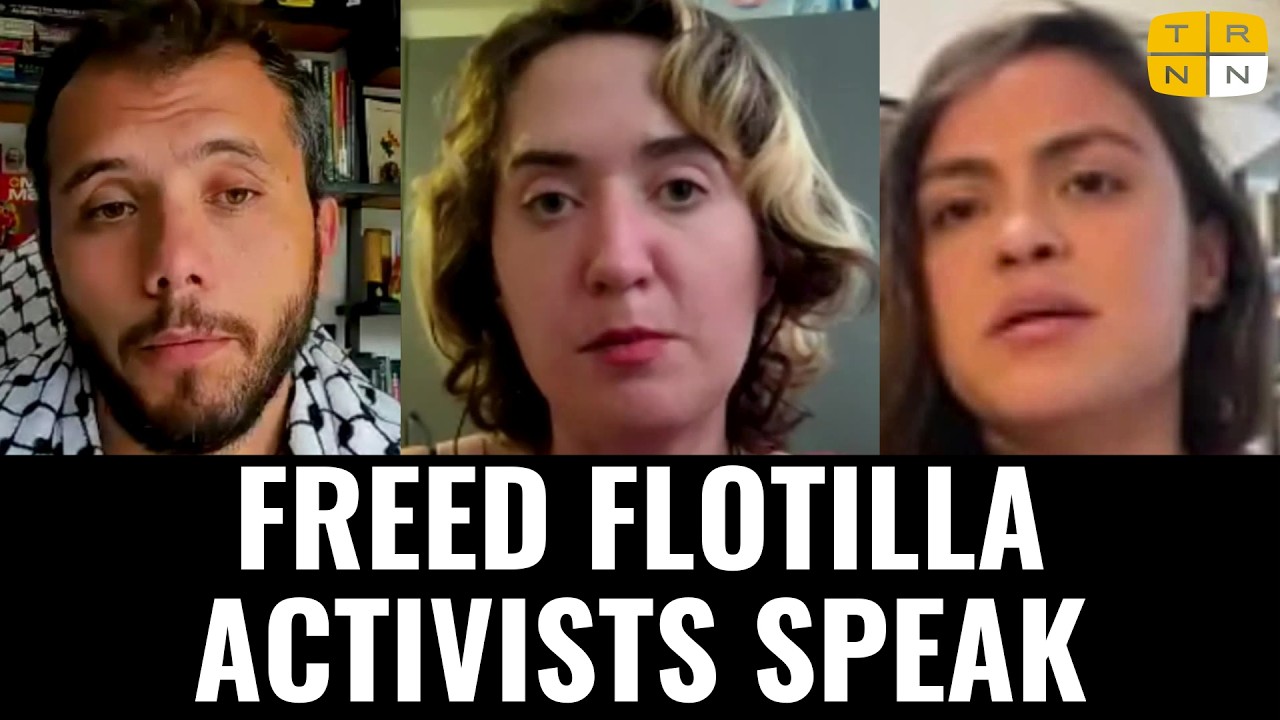
Screenshot via TRNN

Israeli military forces captured the latest convoy of humanitarian aid ships sailing to Gaza with the Global Sumud Flotilla (GSM) between late April and mid-May. Activists who were imprisoned by Israel for days and eventually deported have reported harrowing treatment by their captors, including targeted torture, abuse, broken bones, unauthorized injections of undisclosed substances, and sexual violence by Israeli soldiers. We speak with a panel of freed GSM participants—Thiago Ávila, Catríona Graham, and Ariadne Teles—about what they saw and endured, and about the successes, defeats, and future of the movement to break Israel’s siege on Gaza.

Guests:

  • Thiago Ávila is a member of the Global Sumud Flotilla Steering Committee who was abducted in international waters by the Israelis in late April off the coast of the Greek Island of Crete. At the time, Ávila was one of two Flotilla participants and leaders forcibly transported to Israel where he was held as a political prisoner for 10 days.
  • Catríona Graham is a member of the Irish delegation who sailed with the most recent voyage of the Global Sumud Flotilla. While being detained by Israel, Graham shouted “Free Palestine” in Itamar Ben-Gvir’s face and was subsequently shoved down to the floor.
  • Ariadne Telles, is a member of the Brazilian delegation who sailed with the most recent voyage of the Global Sumud Flotilla and who also experienced abuse while detained by Israel.

Credits:

  • Producer / Videographer / Editor: David Hebden
Transcript

The following rushed transcript may contain errors. It will be updated as soon as possible.

Maximillian Alvarez:

Welcome back to The Real News Network. I’m Maximillian Alvarez. After 78 years of occupation and ethnic cleansing in historic Palestine and after three years of all out genocide in Gaza, Israel’s government and military continued to display to the world what it looks like when a settler colonial ethnationalist and increasingly and openly fascist regime is openly allowed to rule and operate and slaughter and bomb with geopolitical impunity and without any accountability to international law, reason or human morality. This has been on full display from Israel’s continued ethnic cleansing of Gaza in the occupied West Bank, regardless of the so- called ceasefire that’s supposed to be in effect, to Israel’s aggression and reckless violence in Iran and Lebanon to its illegal abductions and torture of peace activists sailing with the global Samud Flotilla to break the siege of Gaza and bring lifesaving aid to Palestinians. And the latest convoy of the humanitarian age ships was intercepted by Israeli forces in late April and in early May.

And activists sailing with the global Samuel Flotilla were captured in prison for days in Israel and eventually deported. But the testimonies and affidavits coming from flotilla members who have been released are frankly horrific. They describe days of targeted torture, abuse, broken bones, unauthorized injections of undisclosed substances and sexual violence by Israeli soldiers. And these stories along with the viral videos of Israeli national security minister, Itmar Ben Gavier, taunting detained flotilla activists and the videos showing Basque police officers violently beating flotilla activists returning to Spain at Bilbao Airport have rightly sparked global outrage. And as we always do here at the real news, we’re going to take you to the front lines of this struggle so that you can hear directly from folks at the center of it. And I am really grateful to be joined today by three guests. Tiago Avila is a member of the Global Samuel Flotilla Steering Committee who was abducted in international waters by the Israelis in late April off the coast of the Greek island of Crete.

At the time, Avila was one of two Flotilla participants and leaders forcibly transported to Israel where he was held as a political prisoner for 10 days. We are also joined by Katrina Graham. The Flotilla activists who while being detained by Israel shouted free Palestine in Benjavier’s face and was subsequently shoved down to the floor and the video that Ben Gavier posted of that exchange has gone globally viral. And we are also joined today by Ariaj Nitelis, a global Samud Flotilla participant who also experienced abuse during this latest round of detentions. Thank you all so much for joining me today. I really appreciate it. And I want to start by just going around the table and giving y’all the floor. And I want to ask if you can describe for viewers and listeners what you yourself experienced on this latest mission with the Global Samud Flotilla from the time that you set sail to now.

Catríona Graham:

So for myself, I was sailing from the Italy port and it was a few smooth days of sailing. And then shockingly, we were intercepted on the waters just off Crete, which really spoke to us. Usually we have what we call this orange zone, which is just much, much closer to Gaza waters. But this time the IOF came all the way into European waters for the interception, which I think speaks to how the Greater Israel Project is not only being seen as being taken into Lebanon, but also right across the Mediterranean. We were kidnapped in the open seas illegally and we were held in detention on a makeshift prison vote for two nights. After being released into Crete, we continued on our mission and we sailed to Marmorous and then set sail towards the shores of Gaza, where once again, we were intercepted illegally in international waters.

The first time we were about 145 participants that were kidnapped and detained and the second was over 420 participants. We were subjected to extreme violence. I think it was very clear there is a marked escalation. This was the third time that I had been kidnapped also with the 2025 mission with the global smooth flotilla. And each time there’s been a marked increase in aggression, the scale of aggression, the extent. This time, as soon as the IOF rib was approaching the boat I was on, they started firing rubber bullets immediately. They pulled somebody out and subjected them to violence to having their hands cable tied to blindfolding and from there the violence continued to escalate. Within 20 minutes of being put on a prison boat, one of the others already on the boat was shot with a pellet gun. She did not have adequate treatment until we arrived in Istanbul.

And while we were in the port at Ashdod and in Ketziak prison in the desert, we started to hear more and more accounts of the extent of violence, of people being tasered, people being stabbed, shootings, rape. So this really showed a marked increase in the kinds of violence, but we’re very clear that we were there for a few days, whereas there are still more than 9,600 Palestinian political prisoners and hostages being subjected to far worse forms of torture in Palestine right now.

Ariadne Teles:

Yeah, we suffer the same. I have a fist bone, a hand actually. My radial bone in the left end is fractured and I have smashed nerves. It’s just one of all the fractures that our volunteers have. We have people inject with substance like cats say it. We have testimony of people listening to the soldiers make pleasure noises when they are without clothes. So this experience was very different and like Kat say, they improve the violence and they improve the violence because they still in punity for all the crimes that they are committed with the Palestinian people and against the Flagilias and other things that we pass through is nothing. It’s not 0.01% of the Palestinian people facing every day. Actually now we have kids in the same position that we are days ago. So just when I was in the prison car that they used to transport us to the prison, to the porch, to the prison, I saw draws of a smiley face, a sad face, and I scared phrase drugs that obviously was made for a kid.

So everything that you saw in the videos, everything we talk about our experience in this moment that I saw the draws, I just feel that all the feelings that I have some kids was passing through this too. And we in our position, we know that we have people outside, we have lawyers, we have our governments and our investors trying to make something, but the Palestinian kids, the Palestinian people, the Palestinian hostage, they are kidnapped by Israel all these days until today and maybe now, actually certainly now, they don’t have anyone. They don’t know how long they are being in this prison.

I think that the world cannot allow anymore. It’s not because we like people Western people. I’m from Global South. I know the difference that European pasta pots had in our mission too, because they are very racist and we still have people struggle for us in outside and it’s because of this that we need to be stand with the Palestinian people too and we surfer all of these things, but how my comrade Casio from Brazilian delegation say our morality was intact. We have breaking bombs, we have injuries, we have people that are hated, but our morality and our conscience are very impacted and actually we are more strong. I came from Amazoni and the struggles are very similar in my place. My place was occupied with this slogan that we need people and lands that don’t have anyone like they said about Palestine for the creation of this so- called state.

So it’s the same struggle for lands and territory and we know that we need to continue because the future of Gaza is the future of the entire humanity and we from Global South. We know what is colonization, what is imperialism when we see and definitely this is the most cruel face of the colonization in our time and I think it’s our duty, historical jury in this time, you struggle against this until Palestine will be free and all the people can be free too.

Thiago Ávila:

Yeah. Thank you Ari. Thank you, Kat. Thank you Maximillian for bringing this important subject. I was part of the first interception on April the 29th along with 180 other people on 22 boats, over 30 other boats managed to get to Greek territorial waters and escape this illegal interception, 700 narcical miles from Gaza. From there, they were testing the waters and the methods of violations that they escalated a lot three weeks later against the second wave of our global smooth flotilla. We got intercepted and sent to a prison boat and that prison boat, there were many people assaulted, very precarious place where people were put. So many psychological violence, so many physical violence after that they transferred the people, transferred 179 people to a Greek boat and then to Greek, to Greece territory. But me and Saifa Bukeshek, Spanish, Swedish, Palestinian origin, were taken illegally and kidnapped, taken to occupied Palestine.

We were taken to Ashkall and prison to a interrogation and tortured facility from Shabbat, the Israeli internal intelligence. That was a very troubled moment as well because the first three days on the transit there, we were severely assaulted. I could barely see from my right eye because I was beaten up so hard. I passed out twice while being assaulted by them. They put ropes on my neck and said that now they were allowed legally to hang people. They pretended they would throw me from the boat. They did so many violations. They would put me in stressful positions for a long, long time. They would close so tight the handcuffs that until today it’s been more than a month and I still cannot feel this part of the palm of my hand. I don’t know if it’s ever coming back because there were obviously some nerve damage.

And then after that, in this 10 days in interrogation facility, they were saying that they would kill us or would put us for a hundred years imprisonment and there was torture everywhere. We were in solitary confinement, not the first time in other flotilla missions. I was already put in solitary confinement before, but this time it was more intense, like 18 hours interrogation some days, many court hearings where they would always try to extend, extend, extend the stay and would threaten all the time. They would question about every single aspect of life. They would show everyday photos of my wife and my baby and asking what the context of the photo was, but it was not like a photo from social media. So just to show that they had the capacity to spy and to do surveillance over our families, they did so many violations. But the problem is that despite all they did with us, the first group intercepted got severely beaten more than 30 people have to get hospitalized, but then in the second moment in May the 18th, they put not 30 people they put dozens and dozens and dozens of people to get hospitalized, 30 broken bones and a lot of people under severe violations.

And the problem is that despite all this that they did with us, we’ve seen and we heard they’re doing a lot worse with the Palestinians themselves. At the interrogation and tortured facility that I was for 10 days, my neighbors were Palestinians being tortured every day and every night. So the violations that they make us go through like losing a family member and not being able to say goodbye to them, Palestinians goes through every single day like Hussama Busafia, who’s been more than 500 days being tortured in Israeli dungeons, also lost his mother like me and could not say goodbye to her. Marijuan Barguti has been arrested for so long, also lost family members, could never say goodbye to them. So the problem is that they violate international people because they only don’t do the same that they do to Palestinians because of the political cost that it has, but they wanted to do the same because they are say this.

This is a fascist supremacist regime and that needs to be defeated. But the reason why they don’t do is because they cannot pay the political cost, but they dehumanize Palestinians so much that with Palestinians, they believe they can pay the political costs. So that’s why they’ve been doing the most horrific things with the almost 10,000 Palestinians, almost 400 of them children under these Israeli dungeons. And it’s for them that we must scream and that we must keep on mobilizing.

Maximillian Alvarez:

Well, and I appreciate all three of you so much for sharing that with us. I know that there’s so much more to say and so much more that you and other members of the Flotilla have said, and I would just encourage folks out there, this is not private information. If you want to learn what these folks went through at the hands of Israel with the support of our government here in the United States, you can go listen to more of their testimonies. You can read these affidavits. It is horrific. And rather than just kind of going deeper into those horrific details, I want to use the remaining time that we have to sort of take a step back here because we’ve been covering these flotilla missions and speaking to participants for years, from union organizers like Chris Smalls to military veterans from the United States, part of different peace groups, all manner of folks who have joined these important flotilla missions and our viewers and listeners have told us how much these missions mean to them, but they’ve also asked us questions about what the ultimate mission is, what the ultimate goals are and what has and hasn’t been achieved over the course of the past nearly 20 years from the first missions in 2008 to the Gaza Freedom Flotilla in 2010, which included six ships that were raided by Israeli forces and 10 participants killed to this latest voyage and all the other voyages that were intercepted or raided or captured by Israel.

So I want to go back around the table and ask you three to respond to that and give folks your perspective on this years long mission and movement and what is being achieved even if it feels like a defeat every time Israel and the IDF prevent one of these voyages from reaching the shores of Gaza.

Catríona Graham:

So of course our ultimate goal is to support the Palestinian people in their leadership and their struggle for liberation, specifically with the Flotela missions. It is to open a humanitarian corridor to Gaza, to break Israel’s illegal siege on Gaza that has been held for nearly 20 years. We know that Qaza should not be dependent on aid. What we bring on our boats is a token amount of aid trying to bring some support that we can to those in Gaza, but ultimately we need to make sure that the siege is ended and that the people of Gaza are able to have self-agency, be able to live for themselves, work for themselves, no longer to be dependent on aid. While we are working to break the siege, there is so much else that we are working to do. So we know that at the moment since the so- called ceasefire agreement was brought in, Is are no longer on Gaza, on the daily realities being experienced not only in Kaza, but also in the West Bank.

We know, for example, on the first day of Eat, there were 10 Palestinian people murdered, including five children. We know that the violence continues, the bombing continues, the lack of access to food and resources and medical care continues. So we need to do whatever we can to raise our voices to draw attention back to Haza to the struggle for Palestinian liberation. We’ve seen as a result of this flotilla, there has been widespread condemnation. So we know that Benjavier posted this video and it received widespread condemnation from many global leaders, but this is the kind of action he has been taking for years posting videos attempting to humiliate Palestinian prisoners speaking about his intention to execute them under the new legislation that is coming through and this doesn’t receive the same kind of condemnation. Even when Netanyahu spoke out and said that he wasn’t representing the values of Israel by posting this video, it’s very clear that was more about the tone and that he shared the video rather than the extent of violence that was perpetrated against us under Flotilla, but also showing the real values of Israel, the continued abuses that are well documented being committed against Palestinian people for many, many decades, which is why we need to move beyond words of condemnations from our government leaders into real actions, into sanctions, into divestment, making sure that Israel is isolated on the international stage and finally they are forced to follow international law.

Ariadne Teles:

Maybe we cannot until now break the physical siege, the physical illegal siege. Actually, one of our boats or part of our boats reached the shore of Gaza in these days with penal solars and some food and material for the people that they are very happy to receive just because it’s important because the research are so low and a minimal thing that we arrive Gaza, it’s a good thing, but actually what’s reach Gaza with this part of our vote was hope that people, the Palestinian always says this, they feel they are not alone and the world are talking about and they have people fight for them. Like I said before, when we are in the prison, we know they’ll have people outside of the prisons fight for us and this is about humanity solidarity too. We cannot break the physical illegal siege now, but we break a lot of other seeds now I am Amazonian person talk to you right now because of this movement and we are talking about Palestine and we are talking about the liberation of the people for other people can hear and join us to what the Flotillas are.

For me, it’s an instrument of struggle for liberation for the Palestinians and the entire world. We are a global operas in this moment, it’s happening and this was built since the first Platilla create these we just not accept that Israel commit crimes. And if the government are complicit, we are not. And we just saying because the governments are doing nothing like in all the history of the humanity we see like this, all our rights we need to fight for them. And in our training we studied about the legacies of the nonviolence techniques like in the independence of the India we have Ganji make marks and struggle against the more armed in the time, the British arm and they just walk. But this cause mobilization, this cause strike, this cause and this is what we need. We need not just Platillas, we need all the people trying to do something because like we always say this is our historical duty.

So I think in the history of the Flotillas, we just create more and more united, we create solidarity, can see each other like human beings and people that need to free themselves like people, people for the people.

Yeah. I think it’s very connected with all the struggles in the entire world and it’s just an instrument, but it makes some noise and not just break the physical seats, but all the other seeds. And for me, we have a lot of seas, like Kat says in the next Fuchila, we have the Caesar fire, but we still was a victory and in this time we already have UN pronuciate against Vishal and now it’s proven they use sex of violence against the Palestinian and we don’t know if was the Flitilla that make this more in the media right now, but I think it’s a movement, a global movement and you just need to increase this solidarity how much we can.

Thiago Ávila:

I’m very satisfied with the answers of my comrades. I’d just like to add that whenever we are mobilizing solidarity with people, we need to be at the service of these people. The Palestinian people have been very clear on their callings for solidarity. They need people to stand side by side with them in their struggle for liberation. They need to stop the genocide. They need to break the siege, this illegal siege of 19 years by sea by land and by Air of Gaza and they need the internationalists of the world, the free people of the world to break their country’s complicity with the genocide. So this is being very clear calling that the Palestinian people made and that have been our line of action since day one, since the very first people that started mobilizing 18 years ago to break this siege by sea missions by using boats, it has always been the goal to break this illegal siege, to create this humanitarian corridor, but most about to be solidarity, Palestinians in their struggle for liberation.

The tactic is one with many, like all my comments said before, the boats are not more important than the massive demonstrations in the streets, not more important than the boycott campaigns, not more important than the people disrupting the armed factories and facing huge criminalization than the people spreading real news like you do here on this media, like people sharing knowledge, historical knowledge, like people doing the grassroots work, banging door to door, talking to people. So all of this is part of the same struggle to defeat Zionism, this racism supremacist ideology, to defeat their alliance with United States imperialism that uses the Israeli regime as a mean to produce and to maintain his Gemini over that region and over the world. So it’s important for us to be there doing all the actions that we can with the people that go on Flotillas, they don’t do just that.

They do all the other actions of solidarity actions with Palestine and they’re not mobilized only for Palestine. We do Flotillas to Cuba as well. We’ll be doing mobilizations for all the oppressed people in the world. So we believe in a better society free of exploitation, free of oppression, free of the destruction of nature. The Flotillas are a mean to bring more people together to push for Palestinian solidarity and hopefully to achieve concrete victories. Like Ariadne said, the last mission in October 2025 was a key factor to convince Trump that they will never succeed in implementing the complete ethnic lensing of Palestine. So Trump came from a person that four months before October was saying that they would displace Palestinians to Eritrea, South Sudan, to Congo, to Somali land, to a person say, “No, we need a peace. Israel cannot fight the whole world by himself.” So that was the mobilization of the people, the public, the global uprising that promoted that.

So we need to do this again when we decided that we would sail again, it’s not that the conditions were easier in this almost eight months of the so- called ceasefire, people are still getting killed, they’re still being restricted, but land is being stolen with the so- called yellow line and their plans are the worst by the land being ruled by war criminals like Trump and Netanyahu, by the big text with techno authoritarian regimes or by the industrial military complex that profits from war. We don’t want any of that. We decided that we would sail because the Palestinian people are saying, “Please expose that there’s no real cis fire. Please expose that the genocide is ongoing.” And we decided that we would do that despite the hard conditions, despite the increasing and escalating use of force and violence against our fotilla. And we did our best with the resources that we had.

We are very proud of what we did, but it’s an incomplete task because the genocide is still going on and we still need to defeat Zionism and imperialism, which is the key task, the historical task of this generation.

Maximillian Alvarez:

Well, I think that was really powerfully put by all of you and I know I’ve got to let you go and I wanted to just sneak in one final question here, a sort of rapid fire around the table, final message that you want to share with folks watching and listening because obviously the common feeling for people with a beating heart these days is everything is getting worse and there’s nothing I can do about it, right? The bastards are winning the genocide is continuing the wars are proliferating the fascists are rising. There’s a lot to be despondent about right now, but I know from what our viewers and listeners have told me that they see so much hope in the global Samuel Flotilla in the Palestine solidarity movement around the world, even in spite of things objectively getting worse in the world. And so I wanted to sort of bring things back down to like the ground level and ask you all if you had any messages to folks out there who were feeling despondent hopeless and they feel like they don’t have the strength to fight back right now, I want them to hear from y’all about how you find the strength, Katrina, to stare Itmar Ben Gaver in the face and shout free palace Stein.

I want to hear where you find the strength, Tiago and Ariajni to be beaten and tortured in these prisons and to still stand up and speak out for what’s right. So I wanted to just have that be our concluding question. Any final messages you want to share with folks out there about how to find that strength and how to keep going even when all seems dark and hopeless?

Catríona Graham:

Thank you for this really important question. I think we need to be clear that this is the moment to claim our collective power. There are imperialist forces trying to silence us and we need to absolutely refuse this. We need to continue resisting and we need to make sure that across the world we rise together. There is so much power in collective action and there’s so much power in our communities. Love we know will win out overall. So when we lean into these kinds of actions, when we come into community with each other and claim our power, whether it’s through going to demonstrations, participating in direct action, speaking out to political leadership, driving and pushing for change wherever we can, we can have an impact. We have had an impact and we will continue to do this until Palestine is free.

Ariadne Teles:

Yeah. I want to tell about something that happened with me in the immigration process when we are beaten, when we are arriving Ashdad and they ask us if we try to enter in Israel illegally and break and attempted to decid to Gaza. And I interrupt the soldier and I say, “First of all, it’s not Israel. It’s occupied Palestine.” And they, “What?” And I say, “Okay, Palestine.” I say, “What?” And I say, “Okay, Palestine.” And then a woman that was in the side, first of all, they asked me where I’m from and I just point to my passport and they say, “Oh, Brazil to Dubai or Brigado.” They say in Portuguese, something like that. And this woman says, “Brazil, did you know that Brazil’s occasion and you are a colonizer?” And I say, “No, I am from Amazonia and I’m life proof that the original people always win and you know that you are in the wrong side of the history.” And when I talk to the people, just to continue the story, the other one says, “Amazon, I make indigenous people.

” And I call him racist and the other God that take me to the other step. But I can say these things in his face and something that I always say is when I have conversation my side, they are question because it’s not an easy ask. We question all the time. We obeducate our families, we have educate our times, but we did this because we are on the right side of the history and when you fight the right side of the history, you already win. And when we win, we win two times. So every time that we just organize ourselves, we already work for ourselves, not for other person. It’s a work that go back to us 100% and this is very pleasure, this is joy, stay in community and fight for the liberation, fight for the future, fight for the present, fight for the person on your side, but it’s fight for you too and make your life more meaning and we can recognize ourself and stay a little bit off of this system that exploit us at 24 hours that we need to work a lot to survive, to see that a person in our side is our competitor and not a comrade and not a brother, a sister.

When you are organizing a struggle in solidarity with the people of the child work, you are in a community and you are acting like a human being, a collective person that we are a collective person. And these give us not just hope, but purpose in our life. So I just want to say that come to join us because it’s amazing what they did with us, I don’t know, it’s not compared like all the strength, all the power that we feel when we are in a collective and the power of the people and the power of the survey director can change the world and this is beautiful and this is amazing. I want to say come to join us. It’s not necessarily that you went in a vote, but you can support in many, many, many ways, but just being collective in community because this can change the world.

Thiago Ávila:

Thank you, Ariajin. Thank you, Kat, for bringing this up as well. I understand that situation is really not easy. Whenever we are analyzing the international conjuncture, we need to be very concrete in our analysis and the truth is that our enemies are getting bolder and sometimes they’re getting stronger. They are more willing to cause harm. They’re more willing to commit genocide. They see total impunity over almost three years of this escalation of genocide of Gaza, that they feel empowered to attack Lebanon, to attack Syria, to attack Iraq, to attack Yemen, to attack Iran, to attack Venezuela, and kidnap the president, to create a never naval blockade in Cuba, to threaten Mexico, Colombia, Brazil, to intervene in elections. So we are going to a very hard moment of world politics and international relations. But on the other hand, thanks to the gift that the Palestinian people gave to humanity, people woke up billions of people understood what imperialism is by the lenses of the communicators from Gaza who gave their lives to livestream of genocide and to counter the lives of the mainstream media that was saying that that was not happening, that there was no starvation, that these homes were actually tunnels below, that these hospitals actually had weapons hidden.

They gave their lives to show that that was false, that was simply wrong. There was a genocide regime bombing hospitals, schools, shelters, residential areas, all in the name of a racist and supremacist ideology called Zionism, which was not actually new. This was part of eight decades of genocide and ethnic lensing that structured itself into an apartheid colonial state. So this factor changed things because people, once they became aware, they started mobilizing as well. So that for the first time we saw a general strike based on an international topic in Italy, for example, we’ve seen the history of revolutions, many general strikes in many countries, but never for an international topic like this, like the Italians went to the street to port Palestine. We’ve seen millions and millions of people in so many countries breaking the narrative of the governments, deteriorating their image with their complicity, challenging the mainstream media point of view and winning in public opinion when they challenge that.

So that is something that shows the power. It’s not like this battle is won. Actually, we have a long way ahead. It’s a long march to freedom, but we see the means. We see the popular mobilization can defeat even the most powerful empire of our generation. Can defeat Donald Trump? Can defeat Penjamini Taniau and can corner them so much that they need to change their strategy, that they need to find other ways. So we need to do this all of our lives all the time, every time more aligned, more together, every time more courageous, more bold, because this is the mission that we have. So it’s not that it’s easy, but we’ve seen that it work and the people together, they are more powerful than any army. All they have is their violence, their hate, their bombs, and their weapons. We have all the rest.

We have solidarity. We have love. We have the history of anti-colonial struggle that shows when people are decided to take this long march of freedom. They are unstoppable and we have the idea that all people deserve to be free and equal, deserve to have the right to live in peace, but not abstract peace, but a peace with justice, peace where people can live despite their religion, despite their ethnicity, despite their race, despite their gender, people can live with all their rights guarantee. And that’s what we are aiming for. That’s what we keep mobilizing. And that’s why we know that despite being very hard way, we see that we are advancing. Our enemies advancing one way, we advance in another. And if we organize better, if we mobilize more and more, we will be victorious.
💾

“We need to continue resisting and we need to make sure that across the world we rise together… We have had an impact and we will continue to do this until Palestine is free.”

Inside mid-decade redistricting battles across states, courts

10 June 2026 at 15:54
The mid-decade redistricting war is taking shape as states lock in their maps for the midterms. Where do things stand state-by-state and court-by-court? Join Legal Affairs Reporter Zach Schonfeld and Morning Report author Jared Gans for a discussion on all of that and more. A note for The Gavel Live Briefing participants: The Gavel is…

Inside mid-decade redistricting battles across states, courts

10 June 2026 at 15:54
The mid-decade redistricting war is taking shape as states lock in their maps for the midterms. Where do things stand state-by-state and court-by-court? Join Legal Affairs Reporter Zach Schonfeld and Morning Report author Jared Gans for a discussion on all of that and more. A note for The Gavel Live Briefing participants: The Gavel is…

Watch: Rollins faces Senate questions on oversight of USDA

10 June 2026 at 15:02
U.S. Department of Agriculture (USDA) Secretary Brooke Rollins will testified Wednesday before the Senate Agriculture Committee on oversight of the agency and President Trump’s fiscal 2027 budget request. The hearing came as the Trump administration is facing a resurgence of the screwworm, a parasitic fly that had been eliminated in the U.S. since the 1960s. Rollins has…

Watch: Rollins faces Senate questions on oversight of USDA

10 June 2026 at 15:02
U.S. Department of Agriculture (USDA) Secretary Brooke Rollins will testified Wednesday before the Senate Agriculture Committee on oversight of the agency and President Trump’s fiscal 2027 budget request. The hearing came as the Trump administration is facing a resurgence of the screwworm, a parasitic fly that had been eliminated in the U.S. since the 1960s. Rollins has…

Watch live: Wright testifies before House panel on Energy budget, priorities

10 June 2026 at 14:56
Energy Secretary Chris Wright will face questions from the House Committee on Science, Space and Technology on Wednesday morning about President Trump’s fiscal 2027 budget request and priorities for the department. The hearing also comes as tensions with Iran and in the Strait of Hormuz escalate. The effective closure of the waterway, a key transporter…

Watch live: Wright testifies before House panel on Energy budget, priorities

10 June 2026 at 14:56
Energy Secretary Chris Wright will face questions from the House Committee on Science, Space and Technology on Wednesday morning about President Trump’s fiscal 2027 budget request and priorities for the department. The hearing also comes as tensions with Iran and in the Strait of Hormuz escalate. The effective closure of the waterway, a key transporter…

Watch live: SSA commissioner testifies before House on oversight of agency

10 June 2026 at 14:42
Social Security Administration (SSA) Commissioner Frank J. Bisignano will testify Wednesday morning before the House Ways and Means Committee on oversight of the agency. The hearing comes a day after the SSA released an annual report showing its Old-Age and Survivors Insurance (OASI) Trust Fund will be able to pay 100 percent of its total scheduled…

Watch live: SSA commissioner testifies before House on oversight of agency

10 June 2026 at 14:42
Social Security Administration (SSA) Commissioner Frank J. Bisignano will testify Wednesday morning before the House Ways and Means Committee on oversight of the agency. The hearing comes a day after the SSA released an annual report showing its Old-Age and Survivors Insurance (OASI) Trust Fund will be able to pay 100 percent of its total scheduled…

Tutto nella norma 2026. IA e sanità: una leva contro le disuguaglianze? Il video

10 June 2026 at 14:28

L’intelligenza artificiale sta entrando sempre più rapidamente nei sistemi sanitari, promettendo di migliorare diagnosi, ricerca clinica, presa in carico dei pazienti e organizzazione dei servizi. Ma la sua diffusione pone anche interrogativi cruciali: l’innovazione contribuirà a rendere la sanità più equa e accessibile oppure rischia di amplificare disuguaglianze già esistenti? Come garantire rappresentatività dei dati, trasparenza degli algoritmi e tutela dei diritti dei cittadini? E quale ruolo devono svolgere istituzioni, professionisti e regolatori per governare questa trasformazione?

Sono queste le domande al centro dell’incontro “IA e sanità: una leva per combattere le disuguaglianze?”, promosso da Fondazione Roche in collaborazione con Healthcare Policy e Formiche, ospitato presso il Centro Studi Americani.

L’appuntamento ha riunito rappresentanti delle istituzioni, del mondo accademico, della ricerca e della governance sanitaria per discutere opportunità, rischi e prospettive dell’intelligenza artificiale applicata alla salute, con particolare attenzione al tema dell’equità nell’accesso alle cure e alla sostenibilità dei sistemi sanitari.

Sono intervenuti:

Antonio Addis, responsabile Uosd Epidemiologia del Farmaco, Asl Roma 1; Alice Borghini, direttrice Uo Sanità digitale e Telemedicina, Agenas; Brando Benifei, Parlamentare europeo e relatore dell’AI Act; Nino Cartabellotta, presidente Fondazione Gimbe; Mariapia Garavaglia, presidente Fondazione Roche; Bernardo Mattarella, professore ordinario di Diritto amministrativo, Università Luiss Guido Carli e coautore del libro Governare le fragilità; Tilde Minasi, componente commissione Affari sociali e sanità del Senato; Luca Pani, professore di Farmacologia e Tossicologia, Università di Modena e Reggio Emilia e professore di Psichiatria Clinica, Università di Miami; Enrico Sabatini, segretario generale Fondazione Roche; Eugenio Santoro, ricercatore presso il dipartimento di ricerca oncologica clinica, Istituto di ricerche farmacologiche Mario Negri Irccs.

Moderazione: Flavia Giacobbe, direttrice Formiche

Watch live: Trump signs reconciliation package funding immigration enforcement into law

10 June 2026 at 14:15
President Trump on Wednesday morning will sign the Secure America Act, a GOP-led bill that funds U.S. Immigration and Customs Enforcement (ICE) and Border Patrol through 2029. House Republicans passed the reconciliation package, a major victory for the Trump administration, on Tuesday. The nearly $70 billion bill, which advanced in the Senate on Friday after…

Watch live: Trump signs reconciliation package funding immigration enforcement into law

10 June 2026 at 14:15
President Trump on Wednesday morning will sign the Secure America Act, a GOP-led bill that funds U.S. Immigration and Customs Enforcement (ICE) and Border Patrol through 2029. House Republicans passed the reconciliation package, a major victory for the Trump administration, on Tuesday. The nearly $70 billion bill, which advanced in the Senate on Friday after…

Watch live: DDHQ Data Nerds track primaries in Maine, South Carolina and more

9 June 2026 at 20:21
The Hill presents two hours of live, real-time primary night coverage, diving deep into the 2026 primaries in Maine, South Carolina, Nevada and North Dakota on Tuesday June 9th, 2026, from 8:00 p.m. EDT to 10 p.m. EDT. The Hill’s coverage will be anchored by Sunrise on The Hill’s Cory Smith, joined by The Hill’s Political Editor…

Watch live: DDHQ Data Nerds track primaries in Maine, South Carolina and more

9 June 2026 at 20:21
The Hill presents two hours of live, real-time primary night coverage, diving deep into the 2026 primaries in Maine, South Carolina, Nevada and North Dakota on Tuesday June 9th, 2026, from 8:00 p.m. EDT to 10 p.m. EDT. The Hill’s coverage will be anchored by Sunrise on The Hill’s Cory Smith, joined by The Hill’s Political Editor…

From Mussolini to mass incarceration: Why Gramsci matters today

9 June 2026 at 17:12
A view of street artist Jorit's mural of philosopher and politician Antonio Gramsci that paid tribute to football player Diego Armando Maradona with a banner that read: 'Hasta siempre Diego' on November 27, 2020 in Florence, Italy. Photo by Laura Lezza/Getty Images

Imprisoned by fascist dictator Benito Mussolini in 1926, the prison writings of Italian Marxist theorist Antonio Gramsci remain essential 100 years later for understanding how fascism, policing, and incarceration function to suppress political dissent and preserve unequal systems of power. In this episode of Rattling the Bars, former Black Panther and political prisoner Mansa Musa speaks with renowned scholar Alberto Toscano about the importance and terrifying relevance of Gramsci today.

Guests:

Credits:

  • Producer / Videographer / Editor: Cameron Granadino
Transcript

The following rushed transcript may contain errors. It will be updated as soon as possible.

Mansa Musa:

Welcome to this edition of Rattling the Bars. I’m your host, Mansa Musa. Today, this is just a political conversation that we’ll be having about fascism, but more importantly, talking about the works of Antonio Gramsci. Joining me today is Alberto Toscano. Welcome to Rattling the Bars Alberto.

Alberto Toscano:

Thanks for having me.

Mansa Musa:

First, explain to our audience who Antonio Gramsci was.

Alberto Toscano:

So Gramsci is best known as former secretary of the Italian Communist Party and one of the most significant Marxist and communist theorists of the 20th century. And most of his theorizing, such as we know today, was done in prison in a series of no books, his prison notebooks that were published after his death and after the end of World War II. It’s actually this year is the 100th anniversary of his arrest, which took place on the 8th of November, 1926. He was arrested while a member of parliament for Italy by the fascist state under direct orders of the fascist dictator, Benito Mussolini, in fact breaching his parliamentary immunity, which he still had at the time. Before that, Gramsci had been a communist militant, but had also been a journalist. That was his trade and also that was one of the principle ways in which he engaged in political organizing first in the Italian Socialist Party and then in 1921 in the Communist Party, when there was a split from the Socialist Party to the left.

And so he only became a member of Parliament in 1924. So he was only in Parliament for a year and a half. And of course this was a very anomalous parliament because fascism had already

Come to power in 1922, but had become increasingly more repressive. And by the time of Gramsci’s arrest, then you essentially have in the wake of that, the formation of a one party state and the abolition of any kind of multiparty system.

Mansa Musa:

So to respond to him was predict based on not only so much of his being in the parliament, but based on his writing and his journalist and what he was reporting on is that what caused him to ultimately be arrested because in a parliamentary setting, you don’t have but so much power or you don’t have so much control over information. You either going to articulate your party position. I’m a communist or you going to advocate for policy change. But in a journalist capacity, you’re hitting home with information, educating people about repression and the disconnect between the government and people. Is that what led to his ultimate aggress?

Alberto Toscano:

Well, I think both those elements at once. So on the one hand, Gramsci was the leader of the most significant and most combative group among anti-fascist forces in Italy. He was very well known internationally, of course, in the context of the communist movement. He was the head of the party. And what fascism did from before it came to power until it really fully came to control Italy was to try to destroy and neutralize all forms of working class and popular opposition and resistance. So of course the papers, whether public or indeed clandestine, all forms of education, all forms of working class organizing. And so Gramsci in many ways brought together all of those figures. The journalist, the educator, the party leader, the organizer. And so the idea was that really to arrest them was to decapitate the

Mansa Musa:

Communist

Alberto Toscano:

Movement and the anti-fascist movement. And the famous sentence I believe voiced by Mussolini, but I think also spoken by the judge at his final trial, which was in 1928, was that we’re going to stop this brain from thinking. So the idea was not just the problem of organization, not just a problem of the political and even militant power of the communist movement. The idea was that their very ideas, their ideology, their capacity to organize the worldviews of the working and popular classes in Italy had to be quashed. And so that was key. And so along with a whole number of communist party leaders and militants, Gramsci was arrested on the basis that he was leading an insurrection. I think this was the crime, let’s say, for which he was convicted was the attempt to overthrow the Italian state because shortly before his arrest, there had been a botched assassination attempt on Mussolini.

So that was kind of used as a pretext.

Mansa Musa:

And let’s unpack the stop his brain from thinking because when you look at that particular sentiment, this is what Corntell Pro was designed for in the United States specifically to stop any, who would say the rise of a Black Messiah as it related to Black people. But his overall goal was to stop brains from thinking, stop people from organizing. Talk about how Gramsky, in terms of the abolition, mirrors what we see today, a lot of the theory and a lot of the perspective about abolishing prison come out of prison, come out of the thinking and what it looked like and what it will look like, come out of the space where people are incarcerated or people are in prison. Can you make a connection between the two?

Alberto Toscano:

Yeah. I think the connection is a connection we can make, but it’s also a tricky connection to the extent that certainly in the 1920s and ’30s, the communist movement or the socialist movement, or even the anti-fascist movement more broadly, did not in any straightforward way ascribe to an abolitionist position as part of its program. And in the case of Gramsci, of course, we do have this very strong parallel that imprisoned intellectuals have played an enormous role in political education and political organization

Mansa Musa:

Across

Alberto Toscano:

Anti-colonial, across anarchists, across communists, across black liberation movements, and of course into contemporary abolitionist thought. Just the other day I was looking at the list of the books in George Jackson’s prison cell, right? I think number 82 was a collection by Gramsci, the modern prince. So amongst other things, he was also reading Gramsci. And in fact, if we look at Jackson’s Blood in My Eye, there’s a remarkable amount of detailed writing in the chapters on fascism about the emergence of Italian fascism

Mansa Musa:

In

Alberto Toscano:

The early 1920s. So I think there’s really important links and also Gramsci, I think among Marxist theorists, even though I wouldn’t go as far as calling him an abolitionist, he certainly had a very complex and developed thinking around the nature of the police and policing, right?

Mansa Musa:

And

Alberto Toscano:

About thinking about the relationship between policing, repression, the modern state and fascism. And one thing I think we have to keep in mind is that the prison notebooks, which incidentally, Gramsci only started writing when he was allowed to have a pen and a notebook in his cell, which was, I think, three years into his imprisonment. So for the first two and a half, three years, these were thoughts that he could only sketch out in letters to his family. He was only allowed to write to his family, not to comrades. And only after a lot of work mainly by his sister-in-law, Tanya, was he allowed finally to have notebooks? He couldn’t keep the notebooks all in his cell. So he had to have a complex way of organizing his thoughts because then they would be stored by the prison warden. So he had this very, aside from having extremely difficult health conditions that eventually led to his very early death, of course, worsened by the fascist prison system, he was also working against all odds as most imprisoned intellectuals and most imprisoned people have in terms of writing, reading.

The most basic things become huge struggles. But Gramsci’s notebooks were there in many ways to try to figure out the nature and the causes of the defeat, at least partial or temporary defeat of the anti-fascist movement. And that’s, I think, partly the reason why he was so interested in thinking in this expansive and complex way about the police as something that reproduced the social order, but also, and this is key for Gramsci, the police as that which disorganizes or neutralizes the opposition to a dominant or hegemonic power. And in many ways, fascism’s success as well as a result of the weakness perhaps or the failures of anti-fascist forces was also a result of its ability in disorganizing the working class and disorganizing the parties of the left and disorganizing the anti-fascist front. There was a contemporary of Gramsci who started out in the fascist movement, ended up much later in the Communist Party.

Kutzio Malapalta wrote a famous book called The Technique of the Cudita, and he talks about the fascist march on Rome in 1922. And he says that fascism’s singular ability is, as he put it, to make a void around itself. So to disorganize and in that sense, going back to what you were mentioning before about Kointel Pro, this idea of stopping thought, of stopping the relationship between intellectuals, organizations and resistance is absolutely key to fascism, which is after all a counter-revolutionary movement. And so as a counter-revolutionary movement or a counter-revolutionary regime, it’s also always a form of counterinsurgency or Angela Davis and Marcusek borrowing from an Italian anarchist from the 1920s use this term, preventive counter-revolution. So that in many ways is what policing is, right? Including for Gramsci, the police in one of its aspects is this complex practice of preventing the possibilities for successful social transformation or revolutionary change.

And Gramsci, because he had this very expansive notion of the state, also argued that the work of policing is not necessarily just done by the police, like by the uniformed police,

Mansa Musa:

By police as

Alberto Toscano:

A branch of the state. It can also be done by all kinds of private, commercial, paramilitary, NGO, all sorts of different bodies can fulfill this function of reproducing a dominant order and preventing the emergence of its challenger.

Mansa Musa:

And to show you how study was, when you look at today, we talk about creating a disorganizing, we look at today, everything you just outlined, you got private police, you got private prison industries, you got everything that’s designed around this organized or keeping people disorganized is being perpetuated today through this system as we see it. A lot of misinformation, a lot of heavy-handed policing when we see what’s going on with ICE. So his perspective as it relates to this being a wing or armor of fascism is very astute. And I like the fact that how he look at the police because Hoover and that administration, they use every level of the police in this country to eradicate any opposition. They completely destroyed the Black Panther Party as a result of infiltration or just like what they did with Fred Hampton coming to kill you or send information, misinformation, create beefs between opposing parties, individuals, right?

But talk about Grumpy wrote on Foudism, viewing it not just as a factory system, but as a project to create a new type of man through disciplined labor and regulated private lives as that industrial mold collapse, how did the transition away from Foudism help pave the way for the castle system as we see it today?

Alberto Toscano:

Yeah, that’s a really complex question. I wanted to take a step back first just to make a quick comment about what you just said regarding the dismantling by Hoover and the FBI and the infiltration of the Panthers and of course of other movements as well. Actually, Gramsci’s arrest, and there’s still a lot of debate by historians about this, was seen by Gramsci himself and by many of his comrades as a result precisely of forms of infiltration. And we now know that high level members of the Italian Communist Party, including somebody who then became a very famous anti-communist writer in Yazosilone, were paid informants,

Mansa Musa:

Right?

Alberto Toscano:

And the problem already was a similar experience as that of other movements and parties that have been subjected to counterinsurgency practices and infiltration is that if you read biographies of Gramsci, you can see that for good reason he’d become extremely suspicious

Mansa Musa:

Of

Alberto Toscano:

A number of his comrades and the fascist infiltration had led to a lot of bad blood. Some of it, it’s like fed jacketing, right? Some of it was people who actually weren’t infiltrators, but who their comrades thought were. So that dynamic was something that the fascist secret police had very much implemented already in the 1920s and 30s and it was part and parcel even of the process that led to Gramsci’s arrest.

Now, to answer your question, even though Gramsci had never been to the United States and was writing all of this material with a trickle of books and newspaper, he was reconstructing the nature of what was to become the capitalist hegemon in the United States from the confines of his prison cell under these extremely trying conditions, but he became convinced in many ways in a fairly prescient or kind of prophetic way that the reorganization of labor, capital and society in the States around the time of course of the Great Crash of 29 and then of the beginning of the New Deal under Roosevelt was a kind of pioneering transformation. So he used this terminology of Americanism and then of course used the term Fordism after Henry Ford and after the forms of labor organization, but also the efforts by Ford to really transform the private, moral, social, even sexual lives of workers in Ford factories.

And this is what Gramsci’s getting at when he’s talking about the way in which capitalism is also tandentially creating a kind of new man or a new worker or a new person and so on.

Mansa Musa:

And so

Alberto Toscano:

Many people after World War II developed these insights to talk about the regime of accumulation and the regime of labor organization pioneered by the United States as a form of fortism often linked to relatively high wages for workers in exchange for their abstention from excessive forms of class struggle, the idea that workers could also become consumers rights, so the two car nuclear family and so on and so forth. So that whole kind of norm and also kind of vision of consumer society linked to mass production

And what people have been arguing since the crises of the 1970s has been that that arrangement which was just being formed around the time that Gramsci was writing his notebooks and then becomes really pervasive and dominant in the United States, but also in the so- called global north in the post-war period comes into a kind of crisis in the 1970s, a crisis that now people talk about in terms of the emergence of neoliberalism and so on and that the norm of fortism, which had to do with mass production, mass consumption, and what the geographer, Marxist geographer, David Harvey, called a kind of almost a pact or truce between big labor, big unions, big capital in the state, this kind of phrase and you have high inflation, unemployment, and then this move to withdraw the state from social welfare, social reproduction, to limit people’s social and civic rights and so on and so forth and to give much more liberty to capital,

Mansa Musa:

To

Alberto Toscano:

Accumulation, to markets and so on and so forth. And so many people read Gramsci’s analysis of fortism as a way by contrast to think about the crisis of fortism in the 1970s, which is of course in the United States, not just in the United States, but in the United States in particular, then sets the conditions, it’s not immediate, but sets the conditions for what will become the question of mass incarceration as a form

Mansa Musa:

Of

Alberto Toscano:

Class warfare against surplus and racialized populations. And that’s what’s interesting is that when Gramsci’s writing in the 1930s, late 20s, 1930s, he’s saying, “Well, Europe can’t really do fortism properly because we have this demographic issue

Mansa Musa:

And the

Alberto Toscano:

Demographic issue in Europe is that there’s large peasantry, but there’s also old classes of landowners and there’s a kind of like- Landmarks. Yeah. And then the United States from a European standpoint, a more modern country doesn’t have those issues, right? But in fact, when you look at the crisis of fortism, then the problem of surplus populations, unemployment as linked to these questions that we’re just talking about, like mass movements for emancipation, black liberation and left wing movements, that kind of comes together. And so on can see the emergence of what then comes to be called the prison industrial complex as a kind of confluence and articulation of a counterinsurgency project on the one hand to break the back of movements, challenging capitalism, white supremacy, so on. But then on the other hand, also as a question of political economy and labor, as a question of what to do with increasing deindustrialization with the desire by the capitalist class to break that postwar arrangement because it’s no longer attractive or feasible for them and therefore to shrink manufacturing labor to reduce social rights and so on.

So I think we can use Gramsci. Of course, he’s talking about a very different moment. He’s talking about the emergence, the moment of emergence of something

That then enters into crisis in the 1970s and creates the conditions, the social and political conditions for what will become the prison industrial complex, what people call mass incarceration and so on

Mansa Musa:

And so forth. And that’s the natural outcome of that contradiction, forwardism, industrialization, but the means of production versus how do you treat people that’s producing? And you create this illusion that they had what they call Leavitown where they create these massive housing projects, they call Leavitown for World War II and when they was coming back from the war, but at the same token, your income or what you’re getting to live this lifestyle cease to exist because to your point, greed is dominant. Capitalism, they’re not trying to share the wealth. They not sitting back saying,” Well, we’re going to give you equal pay for equal labor.

Once you unionize, we going to bust that, we’re going to subjugate you. We’re going to create factories that dehumanize you, which ultimately the contradiction will become so antagonicity that the work is going to respond and respond to that repression and respond to the repression is the prison industrial complex. Some way to contain that is going to be kill you or imprison you, and that’s the natural outcome of capitalism and imperialism. But Grumsky also talked about the contradiction between, or as far as in how rural produces and then the urban consumes, can you make a comparison between that and what we see today in this country as far as how that move into that particular part of the narrative goes into the prison industrial complex or how is it that is it a relationship between the two?

Alberto Toscano:

Well, Gramsci in the Italian context of the 1920s and ’30s, he’s also somebody who comes from, even though it’s an island, Saldania, what was considered part of the South. So an area that was viewed as underdeveloped and also Sardinians themselves in a way that’s of course different from Black and Brown folk in the United States, but they were certainly in the 19th century, kind of racialized as semi-savage, partly barbarian, backward,

Mansa Musa:

Same thing

Alberto Toscano:

With Sicilians and Southerners and so on. So for Gramsci, but also for the whole socialist and communist and workers movement, there was this issue which took the name of the Southern question. It was very common in the 19th century and 20th century in the workers movement to talk about, you would have the women question, the southern

Mansa Musa:

Question,

Alberto Toscano:

All these questions. But the southern question was a way for Gramsci to think both about this geographical differentiation in Italian capitalism, but also about the fact that there were forms of so to speak internal colonialism. And Gramsci does use this language, right? He says the relationship of northern capitalists to southern peasants is like a semicolonial relationship. He talks about the role of the police and of police violence in managing and reproducing this internal colonial relationship so much so that recently an American theorist, Michael Denning has made really interesting parallels between the prison notebooks and actually what Du Bois was writing about northern capital and southern black labor and black reconstruction, which is a text written at the same time, like pretty much contemporaneous with Gramshi. As a political analyst, as a journalist and as an organizer, the question for Gramsci who was based in Italy’s the center of Italy’s car industry, like Italy’s Detroit, so to speak, which is Turin, where the Fiat Factory was, was to think about how could the industrial workers movement and the proletarian movement make links to a peasantry that was much less politically organized, but of course was being massively exploited

Mansa Musa:

Through this form

Alberto Toscano:

Of internal colonism. So part of his issue, which was it’s like the issue of all communists and socialist movements that start out like the Russian Revolution in situations where you have high proportion of workers are still tied to the soil or tied to rural forms of life, was how to make this alliance, this like worker peasant alliance.

Now, if we fast forward to the 1970s, and I’m thinking here of the work on the emergence of the prison industrial complex in California by Ruth Wilson Gilmore, we can think how the rural and the urban in moments of crisis enter into a particular articulation that creates this kind of racialized prison fix. So in the case of 1970s to 1980s California as mapped out by Gilmore, this is the situation where you have surplus capital, you have surplus land because there is a There’s a crisis or partial crisis of agribusiness and certainly of rural employment because of mechanization. And then of course you also have this through the crises of the ’70s, this expansion in surplus labor, which is also racialized and criminalized in the kind of last hired first fired situation of racialized workers. And so it’s in that context that then prison building is presented and advanced as a way of linking what to do with the surplus labor, which is to say incarcerated or incarcerate some of it and threaten the rest surplus capital to then invest in these projects of prison building that are largely taking place in kind of rural context.

So I mean, that’s just one very sketchy presentation of what is a very complicated geographic and political and political economic argument by Gilmore. But I do think that that geographical dimension is really significant for thinking about the dynamics of domination, exploitation and resistance. And that’s also why Gramsci’s own kind of form of geographical thinking was significant to so many ant-colonial scholars. So the Gramsci’s writings in the Southern question are very significant for radical Indian historians. They’re very significant for the Palestinian American

Mansa Musa:

Critic,

Alberto Toscano:

Edward Said when he writes about culture and imperialism. So that geographic dimension I think is a really unique aspect of Gramsci’s thinking, but also comes from his personal experience as somebody who comes from this semi-internal colony, but who then moves as a very young man to become a journalist and a militant in the most industrial and most advanced center of Italian capitalism. So he experiences these multiple worlds and these juxtapositions in his own person. So I think that’s also significant. And I imagine one can also make links to all of the debates that took place in the history of US Black liberation movements around this theme of internal colonialism, going back to arguments about the Black Belt and the communist movement and so on.

Mansa Musa:

And you see the Southern question when he talks about, as you articulated, how the industrialization and then the decline of the industry in rural America, you see a good example here in Maryland. In Maryland they had in the western part of Maryland, they had the upper western part of Maryland, they had industry. When all their industry closed down, prior to their industry closing down, they was talking about building prisons in that part of the state and everybody in Western Maryland was opposed to it because they had a number of prisons in different parts already. So they was like, “Nah, we’re not having that. ” But a year or two later when the industry closed down, they were begging for them to build a prison. They literally begged for them to build a prison. And now when you get to western part of Maryland, as far as your eye can see, it’s nothing but prisons.

And this come out of the analysis you just made was like how at one point you had industry, you had this industrialization, you had money, but now the shift is you shift from agribusiness to concrete and steel that becomes your product and your product is human beings and you ain’t picking cotton there, you picking up human beings and that’s your product in that narrative, right?

💾

Locked up by fascist dictator Benito Mussolini in 1926, the prison writings of Italian Marxist theorist Antonio Gramsci remain essential and terrifyingly relevant 100 years later.

Watch live: House Democrats speak amid battle over FISA, Pulte

9 June 2026 at 15:12
House Democratic leaders will speak with reporters Tuesday morning as their GOP counterparts are seeking to pass an extension of the nation’s warrantless spying powers ahead of a June 12 deadline. House Minority Leader Hakeem Jeffries (D-N.Y.) said Monday he will not vote to renew Section 702 of the Foreign Intelligence Surveillance Act (FISA) unless acting Director…

Watch live: House Democrats speak amid battle over FISA, Pulte

9 June 2026 at 15:12
House Democratic leaders will speak with reporters Tuesday morning as their GOP counterparts are seeking to pass an extension of the nation’s warrantless spying powers ahead of a June 12 deadline. House Minority Leader Hakeem Jeffries (D-N.Y.) said Monday he will not vote to renew Section 702 of the Foreign Intelligence Surveillance Act (FISA) unless acting Director…

Watch live: Melania Trump honors student winners of White House AI challenge

9 June 2026 at 14:48
First lady Melania Trump on Tuesday morning will unveil the winners of the Trump administration’s first artificial intelligence (AI) competition for students at a White House ceremony. The challenge was first announced last August, when the first lady urged kids across the country to “unleash their imagination and showcase the spirit of American innovation” through the…

❌