The Defense Department made the change after lawmakers objected to its original list, which did not include the Latter-day Saints among traditions labeled Christian.
Marx and Aristotle, though centuries apart, both recognized that value is rooted in social relations rather than in objects themselves. Credit: GreekReporter Archive
When the philosopher Karl Marx set out to unravel the mysteries of value, exchange, and labor in capitalist society, he found a surprising intellectual ally in Aristotle, the ancient Greek philosopher who lived two millennia earlier. Despite their different historical contexts, both thinkers examined how value arises not inherently from things but from their social relations—especially through the lens of use and exchange.
Marx, in Capital, openly acknowledged Aristotle’s importance. Not only did Aristotle lay the groundwork for distinguishing use-value from exchange-value but his reflections on early human society, property, and the role of labor and technology revealed a conceptual framework that Marx would radicalize for modern critique.
Use-value and exchange-value: Aristotle’s anticipation
Aristotle’s analysis of value in Politics distinguishes between two uses of a commodity. One is proper and natural while the other is improper or derivative. He writes:
“Every commodity has two uses: both belong to the thing itself, but not in the same manner—one is the proper use, the other is not. For example, a shoe serves either to be worn or to be exchanged; both are uses of the shoe, for he who gives a shoe in exchange to someone who needs it, receiving in return money or food, uses the shoe as a shoe, but not according to its proper use, for it was not made to be exchanged.”
This distinction—between use-value and exchange-value—is a cornerstone of Marx’s analysis. For Marx, this Aristotelian formulation prefigures what he calls the “value-form” of the commodity. Commodities are useful in particular ways (use-value), but also enter into a social system of equivalence when exchanged (exchange-value).
Marx directly builds on this by showing that exchange-value does not exist inherently in an object but arises through the abstraction of labor—because human labor makes different useful things commensurable. Aristotle notes that a shoe does not exist for exchange. Marx took this insight and asked: What kind of society inverts this logic and makes objects valuable only in proportion to their exchangeability rather than their utility?
From the household to the marketplace: society before exchange
Aristotle’s theory of the household (oikos) as the first form of society was essential for Marx’s historical materialism. In Politics, Aristotle describes early society as beginning with families. In these families, property was communal and exchange unnecessary. It was only as the population grew and self-sufficiency gave way to interdependence that markets and money emerged.
Marx adopts this trajectory in Capital and his Grundrisse notebooks, writing that commodity exchange is not a timeless activity. Instead, it is a historically specific development that reflects changes in social relations and property forms. The transition from common property to private ownership and from useful production to production for exchange is the material foundation of class society.
In Aristotle, we already see the seeds of this analysis. He distinguishes between natural wealth-getting (production for use) and unnatural chrematistics (the accumulation of wealth for its own sake). Marx seizes upon this distinction to critique capitalism as a system in which the unnatural pursuit of profit replaces human need as the goal of production.
A statue of Aristotle. Credit: Public Domain, via Wikimedia Commons
The machine and slavery
One of the most striking moments in Capital (Vol. I) occurs when Marx discusses machinery and automation. Here, he ironically invokes Aristotle’s dream that if tools could operate themselves, no slaves would be needed:
“If—dreamed Aristotle, the greatest thinker of antiquity—if every tool could perform its task at command or even by anticipation, like the statues of Daedalus that moved of their own accord, or the tripods of Hephaestus that spontaneously began their sacred work, if the shuttles of the loom wove by themselves, then master craftsmen would not need assistants, nor masters slaves.”
This vision did not remain uniquely Aristotelian. Antipatros, a Greek poet from the era of Cicero, hailed the invention of the watermill—the earliest rudimentary form of productive machinery—not simply as a technical advancement but as a social revolution. He praised it as the liberator of enslaved women who had been condemned to grind grain by hand. He envisioned it as the usher of a new golden age of human dignity and freedom.
In these ancient myths and poetic praises, technology is seen not merely as efficiency but as emancipation. The ancients, despite their slave-based economies, understood that the highest purpose of tools was to free people from servitude.
Gaziantep Zeugma Museum Daedalus mosaic. Credits: Dosseman / Wikimedia Commons CC BY-SA 4.0
Marx’s irony and the betrayal of the promise of automation
Marx, however, saw this ancient hope turned upside down in modern capitalist society. In his words, what was supposed to free labor had become its jailer:
“Ah, those idolaters! They knew nothing of political economy or Christianity, as discovered by clever Bastiat and even cleverer McCulloch. They failed to understand, among other things, that the machine is the most reliable means for lengthening the working day.”
Here, Marx mocks the liberal economists of his time. Frédéric Bastiat and John Ramsay McCulloch, champions of laissez-faire capitalism, celebrated mechanization without recognizing its role in intensifying exploitation. Unlike the “idol-worshiping pagans,” who at least had the imagination to conceive of automation as a force for liberation, these modern theorists lacked even that mythical foresight.
Marx continues with biting irony:
“They failed to understand, among other things, that the machine is the most reliable means for lengthening the working day.
Thus the strange phenomenon arises in the history of modern industry. That the machine, the most powerful instrument for reducing labor time, becomes the most unfailing means of converting the whole life of the worker and his family into labor-time for capital’s valorization.”
The true paradox for Marx is that mechanization offers a means to liberate humanity but capital instead weaponizes it to intensify exploitation. The ancients envisioned automation as a means of human emancipation. Capitalism uses it to deepen alienation and dependency.
The irony is profound: the ancients dreamed of freedom through the machine, and capitalism delivered machines that reinforce dependency. In this way, Marx reclaims the ancient vision but also shows how the promise of automation has been betrayed.
Antipatros celebrated the invention of the watermill as a liberating force, heralding it as a symbol of a new golden age of human dignity. Credit: Pietro da Cortona, Wikimedia Commons, Public Domain
Aristotle and Marx: From ancient slavery to modern compulsion
Marx’s dialogue with Aristotle was not just academic—it was dialectical. He admired Aristotle’s clarity in distinguishing between types of value and his historical insight into the development of exchange. However, Marx also showed how the slave economy of antiquity historically constrained Aristotle’s ideas.
Ironically, in an age in which full automatism is increasingly possible, the prevailing economic model continues to reproduce the conditions that Aristotle associated with slavery—not through direct ownership of people but through economic compulsion and structural inequality. In that sense, Marx saw in Aristotle both the seed of critical insight and the limit of pre-modern social theory.
Hence, while Aristotle could not imagine that labor determines value in commodities, he sensed something essential: that value is not a thing but a relation and that social forms of labor determine the shape of society itself.
North Yorkshire Police made a grovelling public apology to "our LGBTQ+ communities" – but has refused to apologise to a Christian officer it wrongly sacked for asking a question about Islam at a training day.
Idaho resident Aaron Hutchings arrived at a Pakistani brick factory in January. The devout Christian told Fox News Digital that he was shocked to see children turning bricks under the hot sun to work off the debts that their families had incurred, sometimes over the course of generations.
Within hours of his arrival, Hutchings paid off the debts for two enslaved Christian families and escorted them to freedom, breaking the "curse that they’ve had for hundreds of years."
There are up to one million Christians working in slave and bonded labor in Pakistan, according to Emma Hall, a persecution researcher working with charity Open Doors U.K. and Ireland, told Fox News Digital. This could comprise as much as 30% of Pakistani Christians, counted at 3.3 million in the 2023 census and accounting for 1.37 percent of the population.
Hall noted that "extreme poverty drives desperate families to accept advance loans (peshgri) for emergency and basic needs, trapping them in cycles of debt bondage where repayment systems are structured in ways that make exit extremely difficult."
Emmanuel Hernandez said he was shocked when he first heard that Christians in Pakistan were living in debt-based enslavement in Pakistan’s brick-making industry. After traveling to Pakistan to meet the woman who would later become his wife, Hernandez witnessed bonded laborers at a brick factory for the first time.
"Never in my life have I seen such hopelessness," he told Fox News Digital. "At that moment, I committed myself to rescuing one family a year for the rest of my life."
In January 2025, Hernandez started the nonprofit Project Jubilee. He says that it is "by the grace of God" that people have already donated enough through the nonprofit to save 300 Pakistanis from slavery.
Though Project Jubilee will save any bonded slave, regardless of race or faith, Hernandez said that "98% of the people we rescue are Christians, and that’s because they’re second-class citizens" in their country.
The average cost to help one family is about $8,500, Hernandez said, because Project Jubilee recognizes that slaves needed more than debt relief to escape the cycle of bonded labor.
"Our goal is for them to succeed in life and make sure that they never go back," he explained. To accomplish this, Hernandez and his team pay lawyers to take care of all applicable paperwork, and help each family with two months of rent and food. They also get families in touch with a local minister, pay for children to attend school and purchase every family a tuk tuk, a motorcycle taxi, which they can use to create income.
He said that in most cases, factory owners are grudgingly accepting of letting slaves go after their debts are paid off. But in some cases, he says owners have put a cap on the number of families Hernandez’s group can free in a month, or told them that they’re "never allowed to come back again."
Hutchings found Hernandez’s online profile in late 2025 and messaged him, asking to be part of his effort. Retired from the IT world, Hutchings said he is "just a normal guy who wanted to do something…to help people."
After a short conversation over the phone, Hernandez invited Hutchings to come along to a trip to Pakistan in January. Hutchings agreed. It was during this visit that Hutchings freed two families and reported he "just got hooked." He admits that the process is highly emotional. "It changes an entire family’s future for generations," he explained.
Hutchings said that it is especially impactful to witness the change that freedom brings to children. "We get to ask them, ‘what do you want to be when you grow up?" Hutchings said. "They probably haven’t even really thought about that. They’re [thinking] ‘I’m going to be a brick worker for the rest of my life, just like my parents.’"
Hutchings started his own nonprofit, Intentional Faith Foundation, which he now uses to collect donations from people who want to help free more slaves.
Just months after his first journey, Hutchings returned to Pakistan in May to free an additional ten families. After video of his visit went viral, Hutchings said that his nonprofit raised enough funds to save another family from enslavement.
The practice of bonded slavery was outlawed formally in Pakistan in 1992, Hall says, but "enforcement remains weak." Discrimination extends beyond the bonded labor environment, with the U.S. Commission on International Religious Freedomnoting in 2025 that there were "recent and escalating attacks against religious minorities" in Pakistan, including Christians.
During his recent visit, Hutchings learned that securing housing was difficult, with many landlords refusing to rent to Christians. Eventually, a Pakistani Christian group working with families was able to find housing and jobs for parents, and located a teacher for the children who were largely illiterate.
In a 2023 report, Pakistan's National Commission for Human Rights released a series of recommendations for diminishing the pain that bonded labor brings to approximately three million Pakistanis. In her introduction, the group's chairperson stated, "It is deeply appalling that in the 21st century, slavery persists in the form of bonded labor."
Among its recommendations are forbidding children from laboring in brick kilns, helping laborers access justice and creating unions for collective representation. They suggest registering all brick kilns, increasing the use of automated machinery, and encouraging brick purchasers to buy bricks from kilns "that provide a safe and decent working environment."
Representatives of the Pakistani government did not respond to Fox News Digital's questions about the enforcement of laws against bonded labor, or about the treatment of Pakistani Christians. Neither Hutchings nor Hernandez reported having complications with the Pakistani government when working to free brick kiln laborers.
For Hutchings, the work has been transformative. "Looking back, it is hard to see any of it as random. I believe God's hand was in it from the beginning, and even though we were doing all of this to show Jesus' love towards these people, we ended up receiving more than we gave."
JOHANNESBURG — An estimated 30,000 mostly Muslim Fulani militants are operating in Nigeria, causing "worsening insecurity and religious freedom violations," according to an influential new report.
The report, by the U.S. Commission on International Religious Freedom (USCIRF), states "violence by Fulani militants caused the highest number of deaths among all religious communities in Nigeria over the last year, as compared to attacks by organized insurgent groups and criminal gangs."
The Fulanis, so-called herders of livestock, have, according to the USCIRF report, "targeted Christian (farming) communities in the Middle Belt and, increasingly, the South, burning homes and churches as well as kidnapping, raping, and murdering."
But a former counterterrorism expert at the State Department told Fox News Digital that the kind of strikes the U.S., working with Nigerian government forces, have recently carried out in Nigeria’s North against Islamist terrorist organizations such as Boko Haram and Islamic State, wouldn’t work against the Fulanis in the predominantly Christian central areas of the country.
Sterling Tilley, former acting director within the Bureau of Counterterrorism, who has worked in Nigeria for the State Department, said that the U.S. "militarily dealing with the farmer-herder conflict is not advisable because it is likely to bring more instability in the country." Tilley, now director of the Thomas R. Pickering Graduate Foreign Affairs Fellowship at Howard University, added, "There are some steps that can be taken to quell the violence, but there must be Nigerian political will to do so."
This week, Secretary of War Pete Hegseth commented on the recent strikes ordered by President Donald Trump on Nigeria, saying, "Maybe a year ago, [the president] heard the call of Nigerian Christians who were being targeted and killed by ISIS. And he said, 'Pete, I want the War Department to focus on ensuring that we do everything we can to protect those Christians.'"
Christians make up approximately 48%, and the Fulanis, the report says, represent around 6%, or 14.5 million of Nigeria’s population. Fulani militants, the USCIRF report stated, "have often carried out operations during Christian holidays such as Christmas or Easter to further maximize the psychological impact, terrifying those communities from gathering to celebrate or worship. During attacks, assailants sometimes utter slogans with religious connotations, such as "Allahu Akbar" (Arabic for "God is great").
But, according to the report, Muslims are being attacked too. "Fulani assailants have not spared Muslims, raiding herders’ cattle and violently attacking non-Fulani Muslim communities," the report added.
"Violence at the hands of militants from the Fulani tribe far outnumbers violence from all other militant groups such as Boko Haram or ISWAP (Islamic State West African Province)," Henrietta Blyth, CEO of Open Doors UK & Ireland, an organization that highlights the persecution of Christians, told Fox News Digital.
While her organization was not part of the report, she said, "My heart has been broken as I have heard stories from women and men who have seen their beloved family members butchered in front of them or carried off into a life of slavery."
Blyth added: "The situation is complicated, and as the report concludes, it is too simplistic to say all perpetrators are religiously motivated. What is undisputable is that Christians are highly vulnerable and often the victims, paying the price in blood. They desperately need protection and, for hundreds of thousands driven from their homes, the chance to heal and rebuild their lives."
The USCIRF report also stated, "Criticism of responses to Fulani militant violence from federal and state authorities has often described their responses as unsatisfactory at best and complicit at worst."
Tilley told Fox News Digital that elections are to be held in Nigeria next year, and "the Fulani do have considerable political influence as a voting bloc. Thus, the Nigerian government seems reluctant to take actions necessary to quell the violence for fear that they could lose their base of support in the North and Middle Belt."
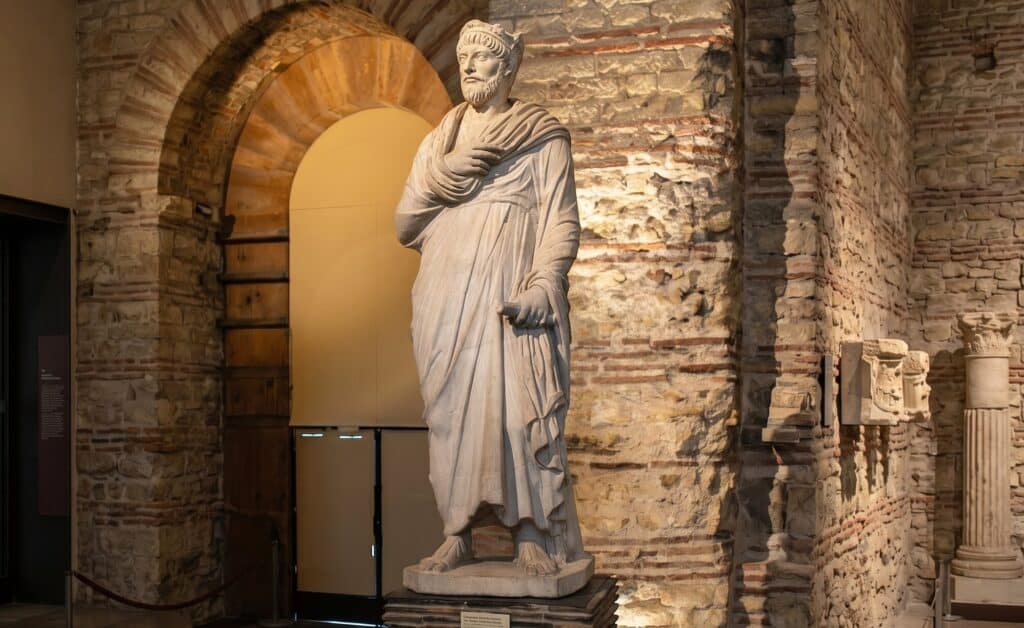
The depiction of Julian in this classical guise shows his commitment to Neoplatonism and Greek culture over the rapidly spreading Christian faith. Credit: Ash Crow, Wikimedia Commons, CC BY-SA 4.0
Few figures in late antiquity present as compelling a historical debate as Julian the Apostate’s attempt to restore the Greek gods in opposition to Christianity in the Roman Empire.
During his brief but highly consequential reign in the fourth century AD, the Roman Empire stood at a profound religious crossroads. For a short period, Julian attempted to slow the empire’s accelerating Christianization, launching a sweeping effort to revive the ancient Olympian pantheon and return Rome to its traditional pagan practices. His sudden death on the battlefield has led historians to debate how dramatically the cultural trajectory of Western civilization might have shifted had his reforms endured.
Julian was born into the heart of the Constantinian dynasty, a family that had only recently converted to Christianity. Nonetheless, he became the last Roman emperor to openly support and worship the traditional Greek gods. He ruled for only about two years from 361 to 363 AD, but he acted with urgency and purpose. Julian the Apostate initiated an extensive program of philosophical and religious reform, aiming to reverse the Christian expansion advanced by his predecessors. To the growing Christian population, he was seen as a traitor to the new religious order, but to those who still admired the intellectual and cultural legacy of the classical world, he appeared as a philosopher-king attempting to restore an older vision of Rome.
This marble head from Athens is widely believed to be a rare surviving portrait of the Roman Emperor Julian the Apostate. Credit: George Koronaios, Wikimedia Commons, CC BY-SA 4.0
Julian the Apostate’s early life
Julian did not experience the typical sheltered upbringing of an imperial heir. He grew up constantly looking over his shoulder, surviving political purges that eliminated many members of his own family. Although he was raised in a strict Christian environment under the supervision of powerful bishops, he is often understood to have developed a private intellectual attraction to classical texts and traditions associated with the ancient world.
His life took a decisive turn when he went to study in Athens. There, he was secretly initiated into the Eleusinian Mysteries, an experience that deeply shaped his philosophical outlook and strengthened his commitment to rejecting Christianity in favor of Neoplatonism. This forced dual existence helped form a uniquely strategic mindset. He became familiar with the inner workings of the Church, knowledge he later leveraged in support of his own religious and philosophical aims. By the time his troops in Gaul unexpectedly proclaimed him emperor, Julian was convinced that the gods themselves had chosen him to restore the ancient order.
Julian the Apostate as Emperor and the worship of the Ancient Greek gods in the Roman Empire
When he finally took power, Julian did not launch the kind of widespread, violent persecutions often associated with earlier periods of religious conflict. Instead, he pursued a more calculated cultural strategy. His approach focused on weakening Christian influence within imperial institutions while strengthening traditional religious structures. Julian the Apostate reduced the privileges and state support enjoyed by Christian clergy and redirected resources and prestige toward the priesthood of the traditional Greco-Roman religion centered on the Greek gods.
In a particularly controversial move, he restricted Christians from teaching classical literature. His reasoning was that those who rejected the traditional religious framework of Homer and Hesiod should not profit from instructing it. At the same time, Julian sought to make traditional religion more socially competitive by encouraging pagan priests to adopt public charitable functions, including aid for the poor and the establishment of hospitals—areas in which Christianity had been especially successful in gaining support. He appears to have believed that traditional worship had declined not because of its inherent weakness but because its institutions had failed to match the organizational and charitable presence of Christianity.
In practice, many historians argue that this cultural and intellectual strategy posed a different kind of challenge to early Christianity than outright violence. While persecution could strengthen Christian identity through martyr narratives, Julian the Apostate’s policies instead aimed to limit the social structures that supported its continued expansion while restoring the worship of the Ancient Greek gods within the broader Greco-Roman religious tradition.
This illuminated manuscript page depicts vivid scenes of Emperor Julian ordering the arrest of a Christian bishop and overseeing acts of persecution. Credit: Wikimedia Commons, Public Domain
Unfortunately for his beliefs, that grand vision of such a revived Greco-Roman empire came to an abrupt end in the arid regions of Persia. During a military campaign, Julian was struck in the side by a spear, cutting his reign tragically short. Ancient sources and later traditions continue to debate the circumstances of his death, with some attributing the blow to a Persian soldier and others speculating—without evidence—that it may have come from within his own ranks. The true origin remains uncertain.
A well-known tradition holds that, as he lay dying, Julian the Apostate is said to have declared, “Thou hast conquered, O Galilean,” acknowledging the perceived triumph of Christianity. Whether or not he actually spoke these words, his brief reign left a lasting imprint on Roman and Western history. His efforts to restore the Ancient Greek gods within the Roman world continue to be discussed by historians as a striking moment in the empire’s religious transformation. Even in modern Greek cultural memory, echoes of this tension can still be felt in the broader contrast between the rational legacy of ancient philosophy and the spiritual tradition of Orthodox Christianity.
Draft treaty claims sexual and reproductive health and rights are an existential threat to the African family
An African treaty that rejects longstanding international human rights obligations moved a step closer to becoming policy this week as governments across the continent met in Ghana.
The draft African charter on family, sovereignty and values, seen by the Guardian, asserts that African values and culture are under attack from “foreign ideologies” and urges states to withdraw from any agreements that do not align with the principles of the charter, including the 2003 Maputo protocol, which promotes gender equality and protects the reproductive and health rights of women and girls.

 Login
Login