
Normal view

Ukrainian drones hit Dzhankoi as strike unit declares hunt on Russian Crimea logistics

13 June 2026 at 11:29

Ukrainian strikes on the Dzhankoy

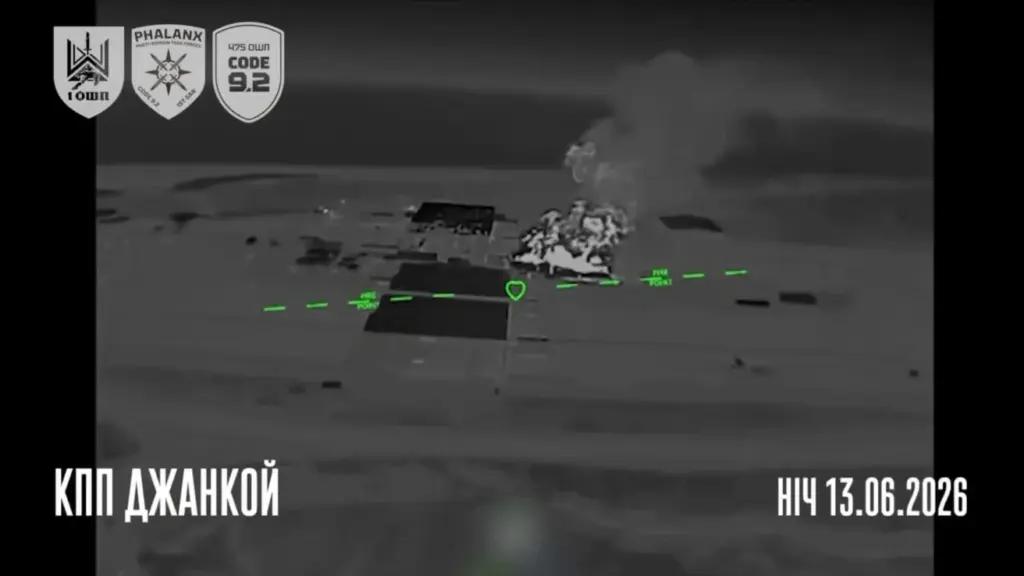
Ukrainian drones struck the Dzhankoi checkpoint, a railway bridge, a Russian pontoon crossing, and trucks at Chonhar overnight on 13 June, hitting four targets along the only land corridor between Russian-occupied Crimea and the southern front. Traffic toward the Dzhankoi checkpoint was halted, Russia's installed head of occupied Kherson Oblast Vladimir Saldo said on Telegram, claiming Russian air defenses shot down 25 Ukrainian drones overnight.

The strike marks a stated change in Ukrainian operational concept. The 1st Separate Assault Regiment named after Dmytro Kotsiubailo, which led the operation jointly with the 475th Separate Assault Regiment "CODE 9.2," announced it is moving from one-off attacks on the bridges themselves to sustained patrol of the entire logistics route. "We are transitioning to patrolling enemy logistics from temporarily occupied Crimea and blocking attempts to restore crossings," the regiment said in a statement posted to Facebook. "Pontoon throughput is low. Trucks accumulate in queues, becoming ready targets for us." Russian fuel and ammunition supplying Russia's southern front pass through this corridor.

What was hit

The Dzhankoi checkpoint controls the main road between northern Crimea and the Kherson Oblast mainland and serves as the busiest highway and rail junction in occupied Crimea. Saldo also said a bridge between Henichesk and the Arabat Spit, an alternative crossing point Ukraine first struck on 10 June, was attacked again overnight. Ukrainian forces did not confirm Saldo's air defense claim.

The Chonhar bridge — the main highway link between Crimea and occupied Kherson Oblast — was first hit on 7 June by the joint Falanga multidomain operations center of the two regiments, using Fire Point company drones and long-range "Behemoth" UAVs. Traffic was rerouted, then halted again after a second strike on 9 June. Four vehicular bridges at Crimea's northwestern entrance near Armiansk were struck on 11 June, Euromaidan Press reported. The overnight strike on the Dzhankoi checkpoint extends the pattern — and signals the campaign has moved from the bridges to the trucks themselves.

The logistics spine

The corridor Ukraine is now patrolling carries the supplies that sustain Russian operations across Ukraine's south. Russian fuel for the Huliaipole direction is shipped by ferry to Crimea and then trucked across the peninsula to the front, regiment commander Dmytro Filatov, call sign Perun, told Ukrainska Pravda earlier this week. Russian cargo, he said, does not move across the Kerch Bridge — its railway link has not been restored since the October 2022 explosion. Cyber intelligence inside Russian military networks now allows Ukrainian planners to target specific units waiting for fuel, Filatov added. The 37th Motor Rifle Brigade was the target of the 7 June Chonhar strike, he said. Trucks ordered for that brigade had still not arrived at the time of his interview.

A multiplying problem for Russian logistics

The interdiction campaign confronts Russia with a layered constraint. Pontoons replace damaged bridges, but they throttle throughput and concentrate trucks in queues — the conditions the 1st Assault Regiment now describes as "ready targets." Rerouting through Armiansk and Perekop runs into the bridges hit on 11 June. Ferrying fuel from Krasnodar Krai bypasses the corridor entirely but cannot scale to replace road transport on the timeframes Russian units in southern Ukraine need.

Filatov said on 10 June that the Chonhar bridge had sustained critical damage and that the occupation forces were searching for new logistics routes for ammunition and fuel.

What changes

The announcement is what makes this strike news rather than another item in a logistics campaign. Until now, the Crimea land corridor functioned — slowly, under pressure, but it functioned. As of overnight on 13 June, the regiment that led the bridge strikes is declaring the corridor a sustained engagement zone. Not a target struck once. A route to be patrolled.

"We bleed the enemy to advance forward," the unit said. "This is not the end.
Ukraine’s drone commander says his branch killed or wounded 102,000 Russians in 12 months. It started with a grenade taped to drone that filmed weddings

11 June 2026 at 15:59

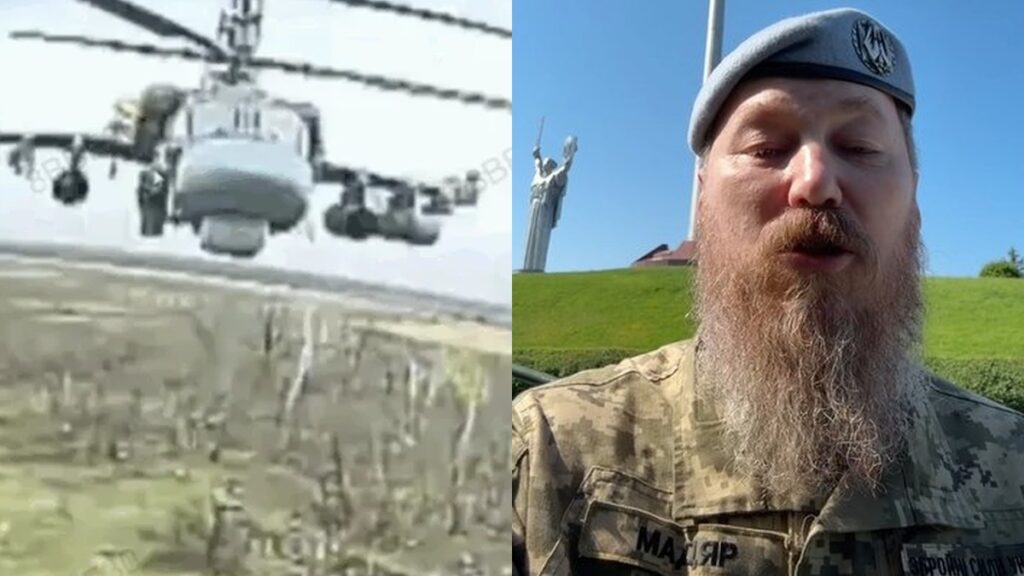
Collage. Left: Russian Ka-52 helicopter at low altitude seen through a Ukrainian FPV drone camera. Right: Major Robert "Magyar" Brovdi in fatigues and beret, speaking to camera with the Motherland Monument in Kyiv visible behind him.

Major Robert "Madiar" Brovdi marked Ukraine's first official Day of Unmanned Systems Forces on 11 June 2026 with a single number. His drone branch claims 102,000 Russian soldiers killed or wounded over twelve months, alongside 360,000 enemy targets hit and 1.7 million combat sorties flown, the commander said in a Telegram address.

The number translates four years of homemade weaponry into industrial output. By Brovdi's own reckoning, drones from his Unmanned Systems Forces (SBS) now account for one in every three Russian soldiers falling on the battlefield, and at a unit cost he prices in hundreds of dollars apiece.

"We exchange the plastic and metal of a drone worth a few hundred dollars for the carcass of an occupier. And that is the best exchange rate in the world," Brovdi said. 

"Birds changed both plan and course"

Brovdi narrated the four-year arc of Ukrainian drone warfare in a single Telegram thread. In 2022, he said, the starting slogan was "artillery, shovel, drone" to locate, correct, hide. Then, in spring 2022, he taped a grenade to a commercial quadcopter and pushed video of the drop to social media.

"No weapon in human history has evolved so quickly. A wedding drone, no joke, performed well at the front, fundamentally and forever changing world doctrine," he revealed. 

The unit he founded that month — Madiar's Birds — has since grown from platoon to brigade to a separate branch of the armed forces. The 414th brigade tripled in size in late 2024. On 3 June 2025, President Volodymyr Zelenskyy made Brovdi commander of the entire SBS, replacing Colonel Vadym Sukharevskyi.

Four targets, 2,000 kilometers deep

Madiar listed four target priorities for the year ahead: enemy manpower, sources of war financing, weapons production, and Russian air defense. The branch's reach now extends from frontline FPV strikes to deep-strike platforms confirmed beyond 1,700 kilometers inside Russia.

"The birds changed both the plan and the course," Madiar said. 

Art-collecting commander

Russian state TV calls him a "terrorist." A Russian court sentenced him in absentia to life in prison in March 2026 on charges of organizing a terrorist attack. Russian prosecutors have filed 46 counts against him in total.

The Center for European Policy Analysis calls him "a bearded talisman of Ukraine's defense" — a "swashbuckling, plain-spoken" commander whose journey ran from "besuited grain trader" to the top of the world's first dedicated drone branch.

Madiar's biography reads like Carpathian Tony Stark's: an ethnic Hungarian from Uzhhorod who ran one of Ukraine's largest grain traders, served on the Zakarpattia Regional Council from 2010 to 2015, and funded contemporary Ukrainian art through his BrovdiArt Foundation before walking into a recruitment office at the start of the full-scale war.

He closed his anniversary speech in his usual register: "And now to work, ladies and gentlemen, at all available depths, across all the hated enemy. The way we know how, with what we have, where we are."

Russian pilot saw man in Ukraine’s Kramatorsk and chose to kill him. FPV drones are operated in real time

6 June 2026 at 19:23

Russian FPV drone operator.

A Russian FPV drone strike near a residential building in Kramatorsk on the morning of 6 June killed a man born in 1976, the Kramatorsk City Council reports. These types of drones are operated in real time, so the Russian pilot saw the target before launching the weapon at the person. 

The strike fits a documented pattern of Russian FPV-drone targeting of Ukrainian civilians in frontline cities that the UN Independent International Commission of Inquiry on Ukraine formally classified as crimes against humanity in May 2025 in its findings on Kherson Oblast, and that Ukrainian authorities continue to document across other frontline regions, including Donetsk Oblast.

Ukraine has documented more than 11,000 Russian FPV attacks on civilians, including "double-tap" strikes that hit the same site after medics and firefighters arrive at an initial attack. 

Terrorism: no justification

"Each such crime will be documented, and the guilty parties will sooner or later answer for what they have done. No justification can explain the murder of civilians. This is not how military forces act — this is how terrorists act, for whom human life has no value," the Ukrainian authorities said.

UN findings: from Kherson to three-oblast pattern

In May 2025, the OHCHR-supported UN Commission of Inquiry on Ukraine concluded that Russian drone attacks against civilians in Kherson Oblast were "widespread, systematic, and conducted as part of a coordinated state policy" and constitute crimes against humanity of murder, as well as war crimes.

The Commission documented Russian targeting across more than 100 kilometers of the right bank of the Dnipro River, basing its findings on more than 300 videos, 600 Telegram posts, and 91 interviews with victims, witnesses, and local officials.

In its October 2025 follow-up report to the UN General Assembly, the Commission found that the same pattern had expanded across more than 300 kilometers covering Dnipropetrovsk, Kherson, and Mykolaiv Oblasts. Russian FPV operators have systematically pursued specific civilians along defined routes, including at bus stops, supermarket entrances, pension queues, and residential courtyards. 

The Kramatorsk frontline context

Kramatorsk has been a focus of Russian targeting throughout the war, with repeated strikes including double-tap drone attacks on civilian infrastructure and first responders. The city's location near the contact line in Donetsk Oblast places it within FPV drone range. 

Airports in disarray as strike cancels 658 flights

3 June 2026 at 17:50
Lisbon Airport

Air travel across Portugal was thrown into disarray this Wednesday after a nationwide strike led to the cancellation of 658 flights, representing nearly 45% of all scheduled operations, according to

The post Airports in disarray as strike cancels 658 flights appeared first on Portugal Resident.

“Vast majority of Portuguese are working” – Government downplays impact of general strike

3 June 2026 at 12:50
“Vast majority of Portuguese are working” – Government downplays impact of general strike

Portugal’s Labour Minister, Maria do Rosário Palma Ramalho, has downplayed the impact of Wednesday’s general strike, insisting that the “vast majority of Portuguese are working” and that disruption in the

The post “Vast majority of Portuguese are working” – Government downplays impact of general strike appeared first on Portugal Resident.

General strike: Hospitals, transport and schools face major disruption

3 June 2026 at 09:37
General strike: Hospitals, transport and schools face major disruption

Portugal is facing widespread disruption today as a nationwide general strike called by the CGTP trade union is bringing transport networks, hospitals, schools and public services to a standstill. The

The post General strike: Hospitals, transport and schools face major disruption appeared first on Portugal Resident.

Portugal braces for five-day disruption as public sector strike coincides with holiday

2 June 2026 at 11:18
Portugal braces for five-day disruption as public sector strike coincides with holiday

Portugal is preparing for widespread disruption on Wednesday as public sector workers stage a nationwide strike that is expected to impact schools, government offices and a wide range of public

The post Portugal braces for five-day disruption as public sector strike coincides with holiday appeared first on Portugal Resident.

❌