Glamourama, la cuarta novela de Bret Easton Ellis, llegó a las librerías estadounidenses a tiempo para las Navidades de 1998. El libro cuenta la historia de Victor Ward, un modelo joven y atractivo que se ve envuelto en una banda de terroristas internacionales. Para la crítica, Glamourama era un delirio. Para Ellis, era una sátira de la sociedad de los noventa, obsesionada con el consumo, las marcas y el éxito. En esa misma época, Hoyt Richards, considerado como el primer supermodelo masculino, estaba sumido en su propio thriller conspiranoico. A sus 36 años, era una leyenda de la moda. Había trabajado para los mejores diseñadores, había desfilado por todo el mundo y había ganado millones. Lo que nadie sabía es que estaba intentando escapar de una secta solo para ricos y guapos.
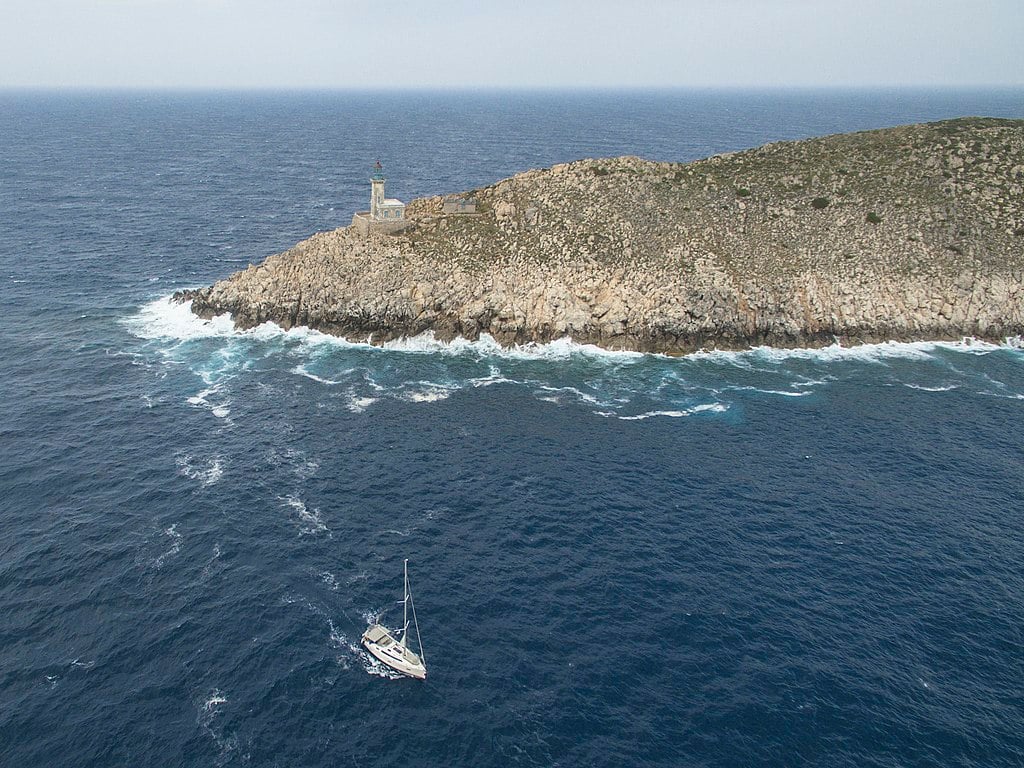
Cape Tainaro (also known as Cape Matapan) is the southernmost point of mainland Greece and the Balkan Peninsula, located at the tip of the Mani Peninsula. It’s a place of rugged beauty, characterized by dramatic cliffs, a wild landscape, and the convergence of the Messenian and Laconian Gulfs.
Tainaro has been important for thousands of years, serving as a maritime crossroads and a place of worship. Today, a lighthouse stands at its very tip, and scattered ruins of ancient settlements and temples can still be found there.
The southernmost point of the Balkan Peninsula. Credit: Nicolas Hadjidimitriou, CC BY-SA 4.0 / Wikipedia
The lighthouse that stands guard in Tainaro is considered one of the most imposing in all of Greece. It is a construction of French technicians, built of stone on a plateau on the natural rocks of the cape, with a height of about 52 feet (16 meters). It began operating in 1887 and was renovated in 1930.
In 1984, an automatic lighting machine was installed there, and the lighthouse was abandoned by its last guardians. The building was restored in 2008 and has since been guarded by Navy personnel. Every third Sunday in August, public access is free as part of World Lighthouse Day.
Ancient Greeks believed that a cave at the cape’s edge, often referred to as the “Gates of Hades” or “mouth of Taenarum,” was a direct entrance to the Underworld, the realm of the dead, ruled by the god Hades. This mythical entrance was said to be guarded by Cerberus, the monstrous three-headed hound with a serpent’s tail who prevented the dead from escaping and the living from entering.
One of the most famous myths connected to Tainaro is that of Heracles (Hercules). As his twelfth labor, he descended into the Underworld through this cave to capture and bring Cerberus to Eurystheus. The legendary musician Orpheus also used this passage to descend into Hades in his attempt to bring his beloved wife, Eurydice, back to the world of the living.
By some accounts, the sculpted canal on the east side of Porto Sternes was the path taken by the souls of the dead, ferried by Charon, the grim boatman of the Underworld.
Cape Tainaro was home to a sanctuary dedicated to Poseidon, the god of the sea. Poseidon was worshiped under various epithets, including “Poseidon Tainarios,” as the god who controlled both the seas and earthquakes.
The temple served as a place of inviolable asylum, offering refuge to criminals and even escaped slaves. A story was recounted by Thucydides about the Spartans violating this asylum by killing helots (agrarian slaves) who had taken refuge there, an act believed to have brought divine retribution in the form of an earthquake.
The site also functioned as a “necromanteion,” or Oracle of the Dead, where Ancient Greeks would perform rituals to communicate with the spirits of their deceased ancestors, seeking guidance or prophecy.
A celebrated bronze statue of the poet and singer Arion, seated on a dolphin, was a prominent dedicatory offering at the temple of Poseidon. It honors the myth of Arion, who was rescued by a dolphin after being cast into the sea by pirates and brought safely to Cape Tainaron.
In medieval times, Tainaro became a notorious pirate base—with merchant ships carefully avoiding it—and during World War II, the Battle of Tainaro (March 1941) was fought off the coast between the British and Italian fleets.
Getting to Tainaro
The only way to get to Tainaro is by hiking along a path that many consider to be the most interesting of the “inner” Mani. It is accessible to all with no significant altitude differences and has a total length of about 1.4 miles. Starting from the village of Kokkinogia, it’ll probably take around fifty minutes to get to the lighthouse.
You will find the village of Kokkinogia at the end of the Areopolis-Tainaro road. The marked dirt path begins at the church of Agioi Asomatoi and passes by the beach of Aria, where you can see a Roman mosaic. The surrounding landscape is typical of Mani: thorn bushes, thyme, low vegetation, flint stones, and no shade—so be sure to wear a hat, apply sunscreen, and bring plenty of water. The views along the way to Tainaro will make it all worthwhile.
The relationship between Donald Trump and Benjamin Netanyahu lends itself more to psychological analysis than political, after a decade in which the volatile U.S. president has alternately showered the Israeli prime minister with insults and excessive praise — sometimes almost within the same sentence. The war they launched together against Iran 100 days ago has driven them apart as the original plan dissolved: a short, successful operation with oil-related benefits, modeled on the capture of Nicolás Maduro in Venezuela. Beyond how the Iran war is resolved — if it is resolved — its lasting legacy could well be the rift between the two leaders.

 Login
Login