Normal view

Received — 16 June 2026 Euromaidan Press

Canada hits Russia with new sanctions at G7, a day after Lavra strike

16 June 2026 at 14:30

ze carney

Canada imposed new sanctions on 162 Russian individuals, entities, and vessels on 16 June. The move came a day after a Russian strike set fire to the Kyiv-Pechersk Lavra, one of Ukraine's most revered religious sites.

Prime Minister Mark Carney announced the package after meeting Ukrainian President Volodymyr Zelenskyy on the sidelines of the G7 summit in Évian, France. He condemned the strike on the monastery and pledged continued pressure on Moscow.

The targeted categories are familiar ones. Canada has sanctioned Russia's shadow fleet, energy revenues, defense-industrial base, and disinformation networks repeatedly since 2022. What stands out is the timing—the measures arrived at the G7 table within hours of a fire at a thousand-year-old UNESCO World Heritage site.

What Carney announced

The package covers 162 individuals, entities, and vessels. "This package will target a total of 162 individuals, entities, and vessels—all assets of the Russian war machine," Carney said, according to a readout from his office.

Canada has provided $2.8 billion in military assistance to Ukraine this year, the readout said. It has also sanctioned more than 3,400 individuals and entities and more than 600 shadow-fleet vessels.

Carney confirmed the renewal of Operation UNIFIER, the Canadian mission that trains Ukrainian soldiers. He also pointed to a planned Defence, Security, and Resilience Bank meant to provide low-cost financing for defense.

The strike that framed the meeting

Overnight on 15 June, a Russian missile and drone barrage set the Dormition Cathedral of the Kyiv-Pechersk Lavra ablaze. The wider assault killed at least 11 people across Ukraine.

Five of the dead were rescuers in Kharkiv, struck by a second attack as they fought an earlier blaze. In Kyiv, the strikes cut power to about 140,000 households.

Zelenskyy called the attack "one of Russia's most serious crimes against Christian culture to date." The Lavra, founded in 1051, carries enhanced protection under the 1954 Hague Convention.

Russia's defense ministry claimed it had hit defense-industrial targets. It repeated Moscow's standard line that it does not deliberately strike civilian sites.

European capitals reacted along similar lines, EP noted. France's foreign minister compared the strike to bombing Notre-Dame, and EU states pushed to add Russian energy firms to a 21st sanctions package.

Pressure, and a possible meeting

Carney framed the sanctions as leverage. The measures are meant to increase pressure on Russia to negotiate, his office said.

The diplomatic track is moving even as the strikes continue. Before arriving in Évian, Zelenskyy said he had discussed with US President Donald Trump the possibility of arranging a meeting with Russian leader Vladimir Putin in the United States.
Zelenskyy at G7: Trump “positive” on missile licenses, but Europe needs a cheaper option

16 June 2026 at 14:14

ze trump

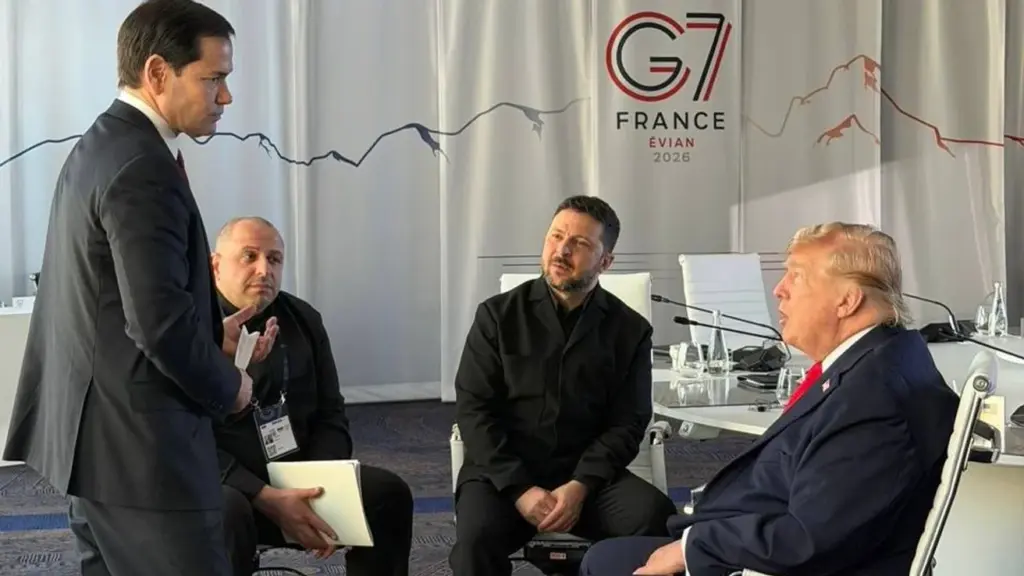
President Volodymyr Zelenskyy said US President Donald Trump responded "positively" to Ukraine's request for licenses to produce American air defense systems and missiles, speaking on the sidelines of the G7 summit in Évian-les-Bains on 16 June. But he warned that US output cannot meet the demand of Ukraine, Europe, and the Middle East at once, and urged European states to build their own, cheaper anti-ballistic systems.

The ask is not new. Ukraine has pressed Washington for production licenses since at least last spring, and Zelenskyy has said before that the US once promised Europe the right to manufacture Patriot missiles, then pulled the offer back. What changed in Évian is the framing. With American interceptor lines already stretched, partly by the war between the United States and Iran now in its fifteenth week, Zelenskyy is no longer only asking the US to share. He is telling Europe to build a substitute the continent can actually afford.

Licenses, and the limit of American production

"US production is not as large as our needs. We need licenses," Zelenskyy said in an online conference with Reuters. He has met repeatedly with manufacturers, he added, and knows that producing Patriot systems and missiles is hard. Whether the licenses come depends on Trump.

"Right now he was positive. And when President Trump is positive, I hope that means 'yes,'" Zelenskyy said.

That hope has been disappointed before. Washington promised the licenses and then declined to follow through when Ukraine first proposed European production years ago, by which point Germany had nearly exhausted the air defense missiles it could send.

So he turned to the alternative. "From the European side, we very much need the world to try to produce European anti-ballistic systems, strong ones and, between us, cheaper ones," he said. "Otherwise we, Europe, the Middle East will not have enough."

The meeting itself

The licenses came up in Zelenskyy's first in-person meeting with Trump in nearly four months, a behind-the-scenes encounter of the G7 summit. Zelenskyy has aslo had a bilateral meeting with French president, and the summit's roundtable with all G7 leaders, the Ukrainian and American leaders were seated on either side of Macron. The outcome of the conversation was not disclosed.

Publicly, Zelenskyy kept his stated priority narrow. "The main thing is to strengthen air defense for Ukraine and to push diplomacy so that Russia ends its war. Peace is needed," he wrote on Telegram.

Beyond weapons, Zelenskyy told G7 leaders Ukraine needs a "winter package," money for diesel, gas, and fuel to keep energy facilities running through the cold months if the war has not ended by then. Every country present would back it, he said. Before arriving, he had also discussed with Trump the possibility of organizing a meeting with Russian President Vladimir Putin in the US.

Pressure through sanctions

Zelenskyy said every G7 participant condemned Russian strikes on civilian sites, including one on the Lavra, a major Orthodox monastery, and that the main lever against Moscow would be sanctions. Canada and the United Kingdom raised the issue, he said, with London proposing measures against the tankers of Russia's "shadow fleet." All countries would act on it, he said.

Whether any of it converts into systems on Ukrainian soil is the question Évian did not answer. Zelenskyy has called Trump "positive" before.

Britain to supply enriched uranium to Ukraine’s reactors in $282 million deal

16 June 2026 at 12:59

Ukrainian President Volodymyr Zelenskyy and British Prime Minister Keir Starmer discuss the "Octopus" interceptor drone, a joint UK-Ukraine production, shown in the foreground

Britain will supply enriched uranium to power Ukraine's nuclear plants over the next two years, Prime Minister Keir Starmer announced ahead of a G7 session in Évian, France, on 16 June. The £210 million ($282 million) arrangement, drawn from UK Export Finance, lets the British company Urenco feed Ukraine's state operator, Energoatom.

The pledge lands the morning after a Russian barrage killed at least 11 people across Ukraine and set fire to the Dormition Cathedral inside Kyiv's Pechersk Lavra. Securing the fuel, Starmer's office said, strengthens Ukraine's ability to keep generating power as Moscow keeps striking the grid—an effort to power Ukraine "through the winters ahead."

Fuel for half the grid

The supply line matters because Ukraine cut its dependence on Russian nuclear fuel after the full-scale invasion in February 2022. Nuclear power now generates roughly half the country's electricity across 15 reactors—six of them at Zaporizhzhia, held by Russian forces since the early months of the war. Starmer and President Volodymyr Zelenskyy struck the deal at Downing Street last week.

Zelenskyy attended the Évian summit, where the first session was given over to peace and security for Ukraine and Europe. Starmer said the G7 should go further to secure Ukraine "the just and lasting peace it deserves."

A widening squeeze on Russia's oil

The fuel deal came packaged with a fresh wave of sanctions on Russia's oil trade. The new measures push the number of shadow fleet vessels under UK restrictions toward 600 and name financial systems that route around sanctions to fund weapons purchases, the government said.

The sanctions follow the first shadow fleet boarding Britain has run on its own. Royal Marines and crime-agency officers boarded the Cameroon-flagged tanker Smyrtos in the English Channel in the early hours of 14 June, a six-hour operation that left the vessel anchored off England's southern coast, as reported by Euromaidan Press. Britain had previously assisted French and US-led seizures; the Smyrtos was the first it led itself—a shift from designating tankers on paper to stopping them at sea.

Ukraine strikes Krasnodar fuel depot as Russia’s gasoline crisis widens

16 June 2026 at 12:08

KuwWc-ukrainian-drones-hit-an-nbsp-oil-depot-russia-s-krasnodar-krai-nbsp-

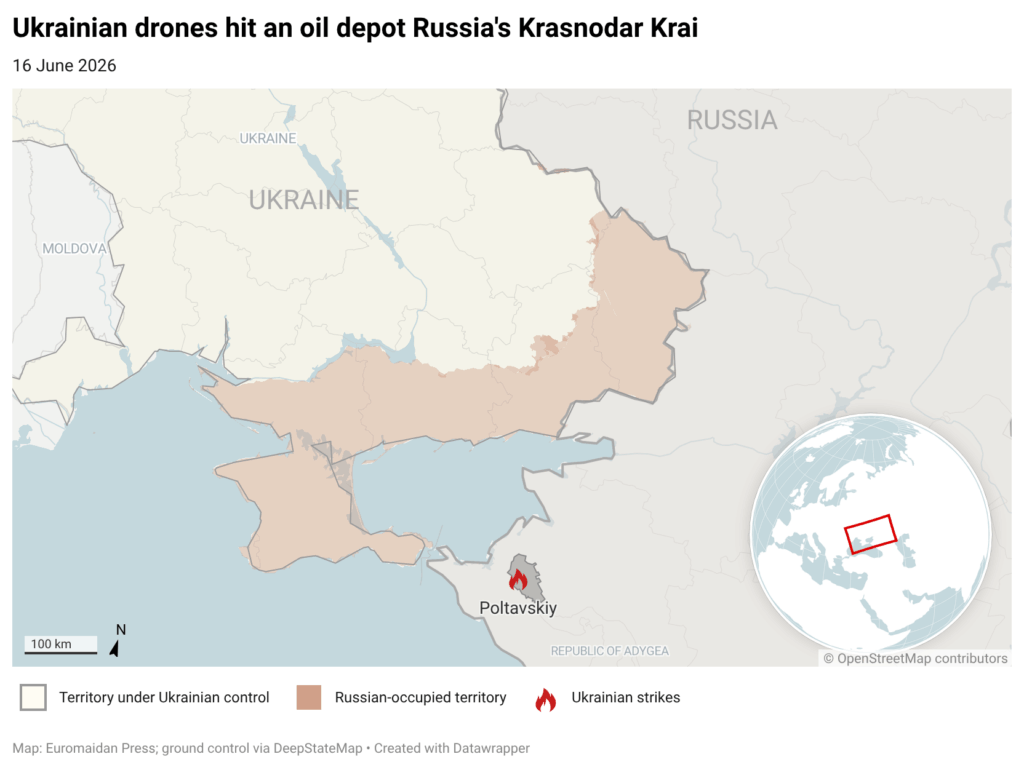
Ukrainian drones struck an oil depot in the Cossack village of Poltavskaya in Russia's Krasnodar Krai overnight on 16 June, setting off a fire. Russian regional authorities again attributed the blaze to falling debris from intercepted drones — the explanation they have offered after earlier strikes.

The depot is not a refinery.It takes in fuel from regional plants, including Lukoil facilities, and feeds it to filling stations across Krasnodar Krai. Those are the same networks that started running dry in early June, when Krasnodar followed Crimea into gasoline shortage.

A depot feeding a region already short

The operational headquarters said no one was hurt, that 32 personnel and seven units of equipment were fighting the fire, and that a local road had been closed. Poltavskaya sits about 80 km west of the regional capital and roughly 385 km from the front line.

By 11 June, gasoline shortages had spread to at least 25 Russian oblasts and six occupied Ukrainian ones, with rationing reaching Moscow and St. Petersburg. Ukrainian drones hit Russian refineries 16 times in May, the highest monthly total of the war.

"A full-fledged fuel crisis is beginning to form in Russia," Finam strategist Yaroslav Kabakov wrote in a note cited by Moscow Times on 15 June. The shock, he said, now comes "from the supply side" — not from seasonal demand or market speculation.

Subsidies, then weaker fuel

Moscow has tried to spend its way through. Oil companies took in 700 billion rubles ($9.7 billion) in subsidies across April and May. The Energy Ministry stood up a task force on 8 June. In June, the government let refiners cut quality, permitting Euro-3 gasoline in place of Euro-5.

Neither the subsidies nor the lower-grade fuel rebuilds a refinery a drone has hit, and the strikes have not stopped. Krasnodar Krai governor Veniamin Kondratyev called the shortage "artificial hype." Residents mocked him under his own Telegram post. The depot that burned at Poltavskaya was one of the places that fuel was supposed to pass through on its way to the pumps.

A second Krasnodar target the night before

Poltavskaya was the second oil facility hit in Krasnodar Krai in two nights. Drones struck the Kavkaz port in the Temryuk district overnight on 14–15 June, the Ukrainian outlet Militarnyi reported.

A fire broke out at the port's oil terminal, confirmed by NASA's FIRMS satellite system. The Kavkaz depot helps supply fuel to occupied Crimea and parts of the Kherson, Zaporizhzhia, and Donetsk oblasts.

Those are the regions where Russia has been hauling gasoline to the front in the trunks of civilian cars.

A separate blow to crude exports

Ukraine has also gone after the export end of the chain. On 14 June, the Special Operations Forces said they had sabotaged the Palkino pumping station in Yaroslavl Oblast, working with the Russian partisan group Chornaya Iskra (Black Spark).

The station feeds the Surgut–Polotsk pipeline that moves Siberian crude toward the Baltic export terminal at Primorsk. Inside Russia, the group wrote, "the Hunger Games for gasoline are starting."

A Planet Labs satellite image published by Radio Liberty, dated 15 June, showed a fire at the station.

Ukraine strikes Moscow’s largest oil refinery, 15 kilometers from the Kremlin

16 June 2026 at 08:32

moscow

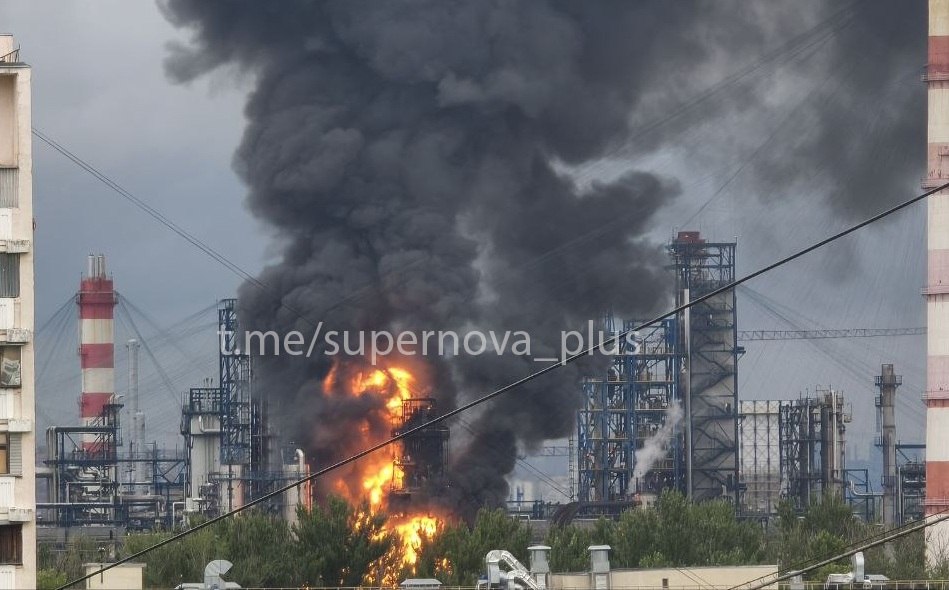
Ukrainian drones struck the Moscow Oil Refinery in the Kapotnya district on the morning of 16 June, igniting a fire at the plant roughly 15 kilometers from the Kremlin and some 500 kilometers from Ukrainian-held territory. Moscow Mayor Sergei Sobyanin conceded that a drone had damaged the facility — the capital's largest refinery — after first reporting that air defenses had downed dozens of incoming drones.

The strike landed on a plant that seems to have seen it coming. Before the hits were even confirmed, the refinery carried out an emergency release of pressure across its system, bracing for impact.

A refinery braced for the hit

The pre-emptive shutdown came from Serhii Sternenko, an adviser to Ukraine's defense minister, and was reported by RBC-Ukraine. The plant was preparing for possible hits, he said. It bled off pressure rather than risk a larger blast.

The Ukrainian monitoring channel Exilenova identified the burning unit as the ELOU AVT-6 — the refinery's primary crude-distillation unit, which it called the heart of the plant. That claim rests on open-source footage and has not been independently confirmed. Sobyanin acknowledged only narrow damage. "One of the drones damaged an MNPZ facility. There are no casualties. Emergency services are working at the scene," he wrote.

His account of the air battle shifted. Across his updates, Sobyanin's claims for drones shot down over the capital ranged from about 25 to 60 before he conceded the refinery had been hit at all.

The most heavily guarded plant in Russia

Kapotnya sits inside the densest air-defense belt in the country. Andrii Kovalenko, who heads the National Security and Defense Council's Center for Countering Disinformation, said that concentration counted for nothing. "Moscow is under attack, the Moscow refinery is ablaze. Although Putin has pulled practically all the key air-defense and missile-defense systems to Moscow, it does not save the Russians. Putin is not a guarantor of safety for a Muscovite," he wrote.

The interceptors that did fire left their own marks. The Russian Telegram channel Astra reported that debris from a downed drone struck a high-rise in Elektrostal, in Moscow Oblast, setting the top floor alight.

A war economy already rationing

The Moscow refinery belongs to Gazprom Neft and processes about 11 million tons of crude a year. It supplies roughly 40% of Moscow's gasoline and half its diesel, plus fuel for the capital's airports. Knocking it offline reaches ordinary pumps faster than a strike on almost any other plant.

The pressure is already showing. Facing repeated strikes, the Kremlin has allowed refiners to release off-specification fuel to keep supply moving. The same night as the Moscow strike, drones hit an oil depot at Poltavskaya in Krasnodar Krai, a logistics link between Lukoil's plants and the region's filling stations.

President Volodymyr Zelenskyy tied the strike directly to forcing an end to the war. "This time, Ukrainian long-range capability was felt in the Moscow Oblast. A refinery was struck at a distance of 500 kilometers," he said, thanking the SBU, the Unmanned Systems Forces, Special Operations Forces, military intelligence, and the missile troops. "Russia must be forced to end the war against our people. And Ukrainian long-range weapons are one of the important components of such coercion. This is a fair response to Russian strikes and a response to the dragging out of the war."

The response framing points back a day. Overnight on 15 June, a Russian strike hit the Kyiv-Pechersk Lavra, and Zelenskyy promised an answer.

❌